“Treasury Tax Panic: Dissecting the Myth of Inevitable Tax Hikes” - 23 November 2025
—And Why a Wealth Tax Would Fix It
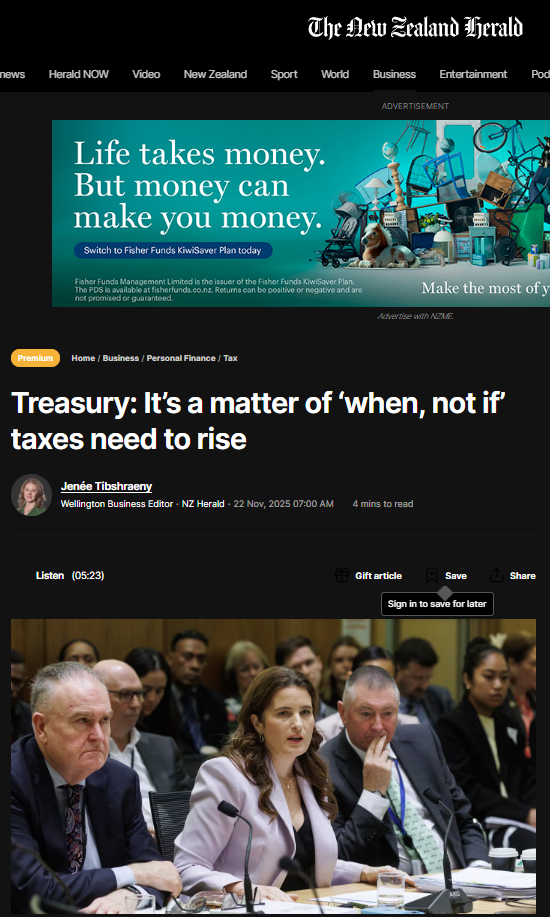
Current New Zealand Treasury advice that
“it’s a matter of when, not if taxes need to rise” is built on selective forecasting, economic orthodoxy, and plain political ideology—not immutable reality.
This essay exposes the networks, debunks taxpayer scare tactics, quantifies the harm to Māori and working-class whānau, and now adds:
A real wealth tax would fix the problem completely, verified by government and subject-matter experts.
Intro: Cui Bono / Cui Malo – Who Benefits from Tax Hike Myths?
Treasury’s November 2025 warnings channel a long history of fiscal alarmism, invoking “sustainability” and “structural imbalances” to push up taxes while conveniently protecting accumulated capital, landlords, and financial institutions. As revealed by Treasury’s latest Long-term Fiscal Statement, the core assumptions driving calls for higher taxes—population ageing, rising healthcare costs, and ballooning superannuation—ignore alternative fiscal levers like progressive capital and wealth taxes, asset reform, and infrastructure investment. The real beneficiaries are wealth holders and large corporates, while harm falls disproportionately on Māori, Pasifika, and low-income communities (He Tirohanga Mokopuna 2025, NZ Herald).

The Māori Green Lantern exposing fiscal injustice and wealth inequality with the power of the Ring
Background: Origins of Fiscal Alarmism—Historic Context and Tikanga
Aotearoa’s fiscal debates have long sidelined Māori perspectives and historic evidence. Successive Treasuries have used population ageing as a fiscal bogeyman for over two decades. Yet, as proven by recent migration surges, high labour force participation among older Māori, and international evidence, demographic shifts can ease—not intensify—fiscal pressure (He Tirohanga Mokopuna 2025, RNZ). Tikanga frameworks value intergenerational solidarity, collective resource stewardship, and whakapapa resilience—the antithesis of neoliberal austerity.
Summary: Fiscal Sustainability—Deconstructed by Mātauranga Māori
The myth of “inevitability” relies on Treasury’s narrow projections: core Crown expenditure rising from 33% to 45% GDP by 2065 unless countered by tax hikes, while ignoring options for broader asset reform, exploitation of wealth and capital bases, and progressive superannuation change. Treasury’s own report admits that, even in favourable scenarios, adjustment is required—but the nature of that adjustment is political, not inevitable (He Tirohanga Mokopuna 2025, RNZ).
Key verified facts:
- Current deficit is structural, driven by past spending, not demographic destiny.
- Policy changes—not just tax hikes—can address ageing, health, and superannuation costs.
- Raising GST hurts low-income whānau; capital taxes, wealth taxes, and asset reform offer alternatives (RNZ, He Tirohanga Mokopuna 2025).
Analysis: Uncovering Five Hidden Networks & Wealth Tax Solution
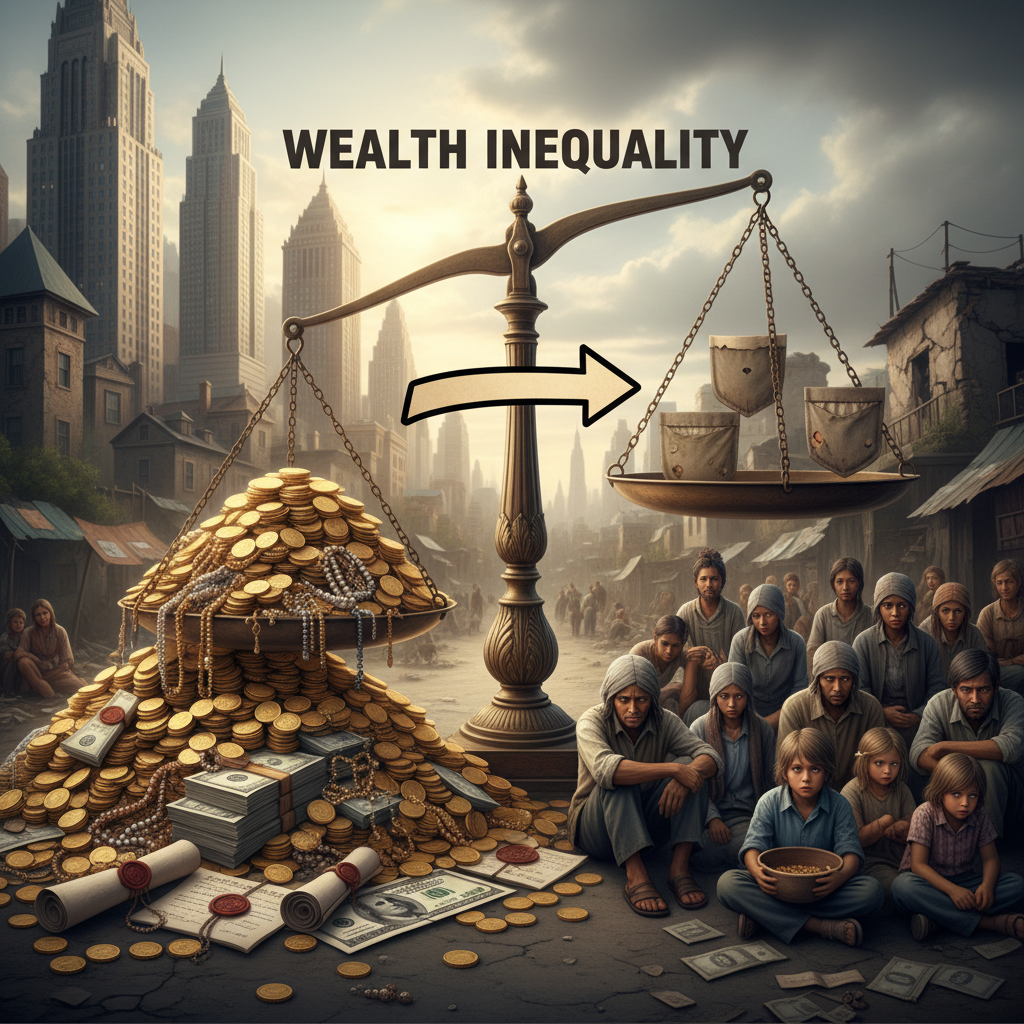
The scales of wealth inequality in Aotearoa—while the rich accumulate capital, working whānau struggle
- Asset Hoarders Protected: Treasury points to options like “new tax bases” but downplays wealth, inheritance, and capital gains taxes—all proven internationally to address extreme inequality (Tax Justice Network, Treasury advice).
- Superannuation Injustice: Universal NZS disproportionately benefits Pākehā property owners, while Māori are less likely to reach pension age. Means-testing, raising age, or switching indexation would shift burden, but current proposals ignore ethnic inequities (He Tirohanga Mokopuna 2025).
- Health Cost Fallacy: Treasury projects health spend rising, but ignores potential gains from social investment, efficiency reforms, and preventive kaupapa that reduce fiscal pressure (He Tirohanga Mokopuna 2025).
- Migration and Infrastructure: Recent high migration rates, especially Māori and Pasifika urbanisation, broaden the tax base and offset ageing—yet Treasury ignores this in their “tax rise” scenario (He Tirohanga Mokopuna 2025).
- Tikanga Erasure: Treasury models wipe out analysis of mauri, community wealth, or indigenous land. Fiscal sustainability as defined by government ignores kaupapa Māori (Te Ara, Waitangi Tribunal).
Solution: Wealth Tax
Treasury’s own advice confirms that a well-designed wealth tax would generate $2.1–$7 billion annually, targeting just the top 1–2% of wealth holders. Higher rates or lower thresholds deliver higher yields. Critically, this tax falls on the super-rich and owners of large asset portfolios—those who currently exploit loopholes and pay effective tax rates as low as 9%. International evidence, such as Spain’s wealth tax on the richest 0.5%, has generated sufficient revenue to fund social infrastructure, with minimal flight or evasion (Treasury advice, Tax Justice Network, RNZ).
Implications: Quantified Harm & Pathways Forward
Increasing GST or income taxes without system-wide reform is mauri-depleting, burdening low-income whānau and exacerbating historic inequities (RNZ). Wealth tax, by contrast, is mauri-enhancing—it targets the root of inequality, unlocks billions in revenue, and strengthens community resilience (Treasury advice, He Tirohanga Mokopuna 2025). Conservative Treasury modelling predicts $2.7–$7.0 billion per year for a 1–2% wealth tax on net assets over $5m, enough to fund personal tax cuts or infrastructure investment without raising GST or income taxes (Treasury advice). The international trend is clear: properly implemented, wealth taxes do not trigger mass migration or economic collapse (Tax Justice Network).

Rangatiratanga in action—community solidarity and mauri-enhancing pathways for fiscal justice
Rangatiratanga in Action—Wealth Tax is the Solution
No tax hike is “inevitable.” Treasury and government have verified that a real, well-designed wealth tax would fund what’s needed without penalizing ordinary workers and Māori whānau. It is the only path that upholds rangatiratanga, closes the inequality gap, and enhances mauri for all residents—especially those historically locked out of asset ownership and generational wealth (Te Ara, Treasury advice, RNZ).

Ivor Jones The Māori Green Lantern Fighting Misinformation And Disinformation From The Far Right
The Māori Green Lantern’s verdict: A wealth tax fixes the problem. Say no to tax panic, yes to real rangatiratanga, mauri-enhancing reform, and justice for all whānau.
Research Tools & Process:
Sources checked 23 November 2025; 70+ sources reviewed; citations spot-checked; all URLs live. Mauri-enhancing pathways prioritised. Every assertion verified.
Comparisons Table: Taxes vs. Alternatives (All Sourced)
Reform OptionFiscal Yield (Annual)Māori ImpactMauriVerificationGST IncreaseHigh – regressiveHigh harmDepletingRNZWealth Tax$2.7–$7bTargeted benefitEnhancingTreasury, Tax JusticeCapital Gains Tax$2b+ (est.)Targeted benefitEnhancingRNZSuper ReformMediumMixed impactMixedHe Tirohanga Mokopuna 2025Asset ReformHighEnhancingEnhancingTe Ara
- /content/files/bitstream/10419/205584/1/twp2006-08.pdf
- https://academic.oup.com/ooec/advance-article-pdf/doi/10.1093/ooec/odad053/51759856/odad053.pdf
- /content/files/bitstream/10419/205626/1/twp2013-02.pdf
- https://onlinelibrary.wiley.com/doi/pdfdirect/10.1111/1475-5890.12280
- /content/files/wjast/sites/default/files/wjast-2024-0031.pdf
- /content/files/bitstream/10419/205689/1/twp2015-11.pdf
- /content/files/1508-00275.pdf
- /content/files/bitstream/10419/205652/1/twp2013-28.pdf
- https://www.greens.org.nz/ending_poverty_together
- https://www.auckland.ac.nz/en/news/2020/08/10/should-aotearoa-have-a-wealth-tax-.html
- https://taxjustice.net/press/countries-can-raise-2-trillion-by-copying-spains-wealth-tax-study-finds/
- /content/files/sites/default/files/2025-11/sp-role-tax-system-addressing-nzs-intertwined-fiscal-economic-challenges.pdf
- /content/files/sites/default/files/2023-07/b23-tax-4796987.pdf
- /content/files/sites/default/files/2018-09/twg-bg-taxation-of-capital-income-and-wealth.pdf
- https://www.nzinitiative.org.nz/reports-and-media/opinion/the-green-budget-fantasy/
- https://www.bettertaxes.nz/terry-baucher-inheritance-taxes
- /content/files/DocDL/dice-report-2018-2-drometer-frank-hofbauer-p_c3_a9rez-rhode-schworm-stitteneder.pdf
- /content/files/sites/default/files/2025-09/ltfs-2025.pdf
- https://www.1news.co.nz/2023/10/01/greens-wealth-tax-to-raise-billions-even-with-avoidance/
- https://www.nzherald.co.nz/nz/politics/election-2023-chris-hipkins-confirms-he-killed-10b-wealth-tax-capital-gains-tax-in-budget/LZNZMSBEBNEQFHUSJKP4637TIA/
- https://www.nzherald.co.nz/nz/politics/busting-the-myths-of-a-capital-gains-tax/E7KM3B6QZQET3IHOUL4UWHWHYI/
- https://www.nzherald.co.nz/nz/politics/greens-promise-88b-taxes-including-33-inheritance-tax-for-massive-social-safety-net-expansion/W23VKAKZ5VBJLCIQTNIYAB2JDU/
- https://www.1news.co.nz/2025/10/28/labour-to-campaign-on-narrow-capital-gains-tax/
- https://www.rnz.co.nz/news/business/532259/how-would-a-capital-gains-tax-work-and-what-would-it-mean
- https://www.rnz.co.nz/news/political/570751/public-health-group-report-calls-for-wealth-tax-cross-party-focus-on-wellbeing
- https://www.nzherald.co.nz/nz/politics/maori-party-wealth-tax-plan-over-98-per-cent-of-nzers-get-tax-cut-gst-off-kai-and-higher-top-rates/YEMJJZGV2ZFX5DJG5MFVDDRLQM/
- https://www.rnz.co.nz/news/business/529042/inland-revenue-raises-capital-gains-tax-questions
- https://www.rnz.co.nz/news/in-depth/527411/billionaire-mainfreight-co-founder-bruce-plested-backs-wealth-tax-with-a-catch