“VULTURES CIRCLING CHARRED EARTH: How Kiwi Billionaires Are Profiteering From California’s Wildfire Catastrophe” - 10 January 2026
The $110 Million Land Grab That Exposes New Zealand’s Elite as Global Disaster Capitalists
Mōrena Whānau,
If you see me at Lake Karapiro at the 2026 Waka ama Nationals over the next few days say “Kia ora” … :). The Māori Green Lantern will still be doing my thang so don’t worry, you’l’ still be getting you MGL daily fix :). In the meantime, let us smash these asshole billionnaires some more shall we! Yes, we shall!
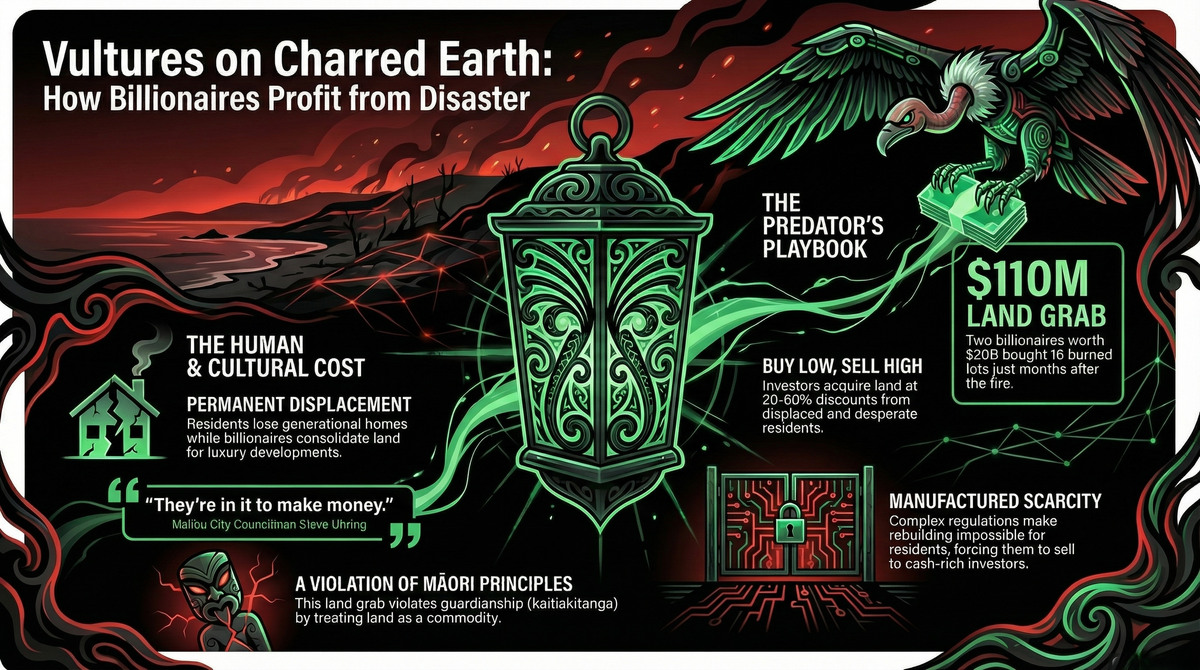
When wildfire transforms human tragedy into prime real estate opportunity, billionaires don’t grieve—they calculate. As Malibu residents sifted through the ashes of their incinerated lives, two New Zealand brothers saw something most would consider obscene: a $110 million business opportunity in the scorched beachfront lots where families once lived. Nick and Mat Mowbray, worth a combined $20 billion, purchased 16 burned-out properties along Malibu’s Pacific Coast Highway between March and August 2025, six to eight months after the devastating Palisades Fire reduced 6,837 homes to rubble. This wasn’t charity. This wasn’t community support. This was textbook disaster capitalism—exploiting maximum public vulnerability for maximum private profit.
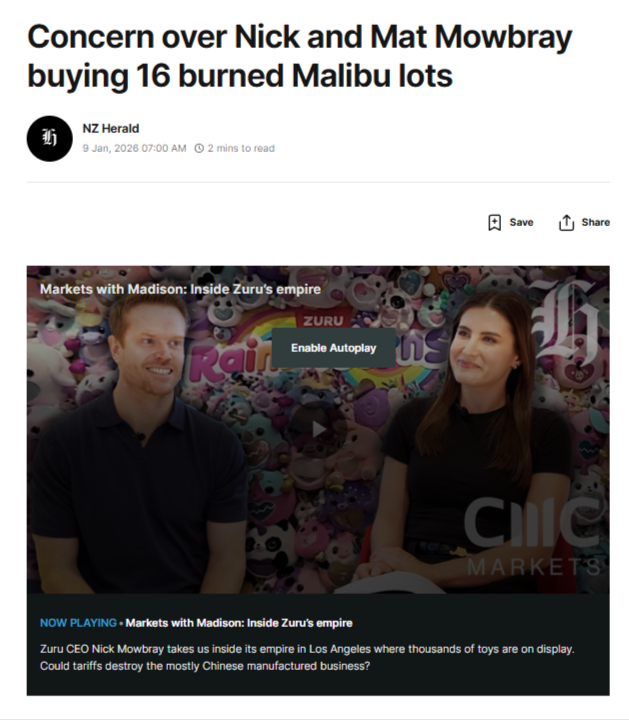
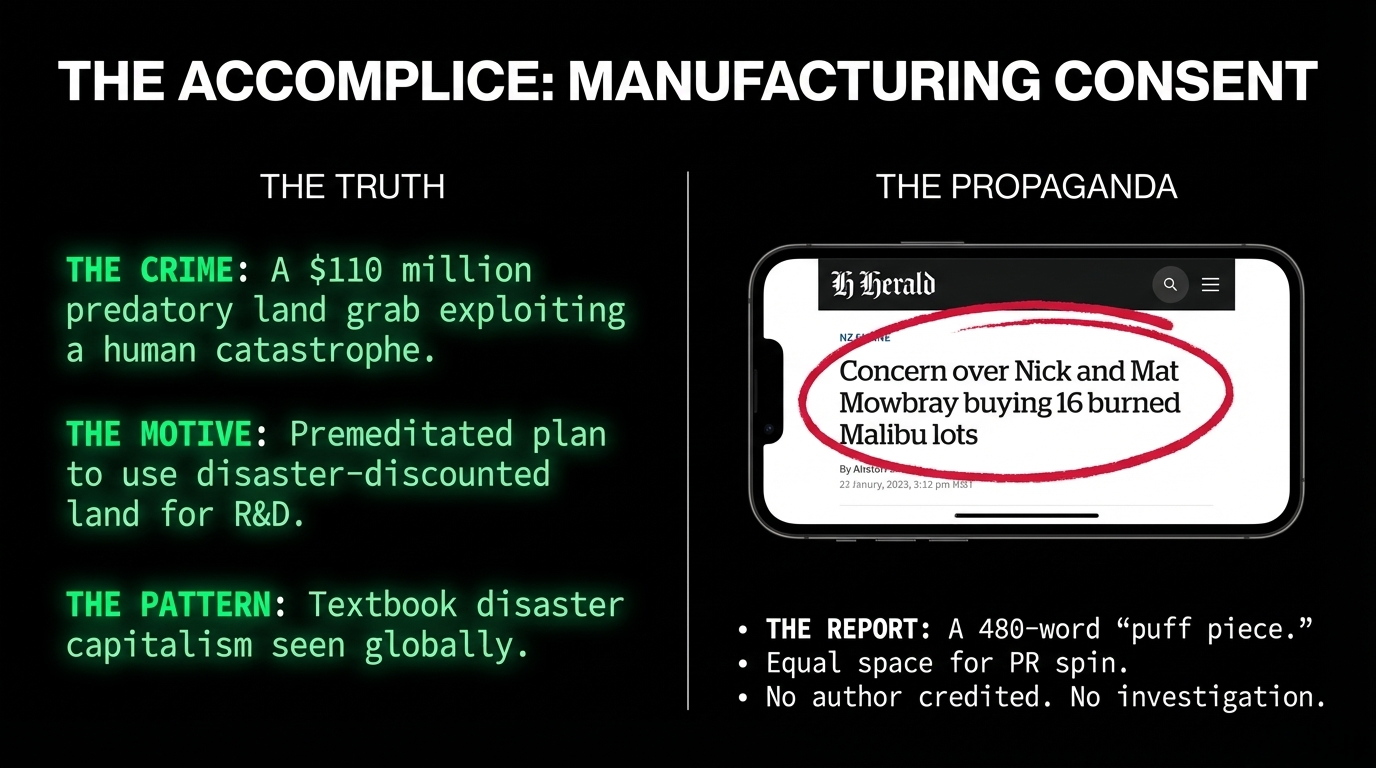
The New Zealand Herald’s January 9, 2026 coverage of this predatory land grab exemplifies everything wrong with Aotearoa’s billionaire-worshipping media establishment. In a pathetic 480-word article—a “2 mins to read” puff piece—the Herald presents this vulture behavior as mere “concern” rather than outrage, offers equal space to corporate spin and community opposition, and fails to investigate the systematic pattern of post-disaster speculation devastating California communities. No author takes credit for this spineless stenography, suggesting it’s standard staff copy requiring no accountability. This isn’t journalism. It’s public relations for the ultra-wealthy with a Kiwi accent.
The Palisades Fire: Manufacturing Scarcity Through Regulatory Capture
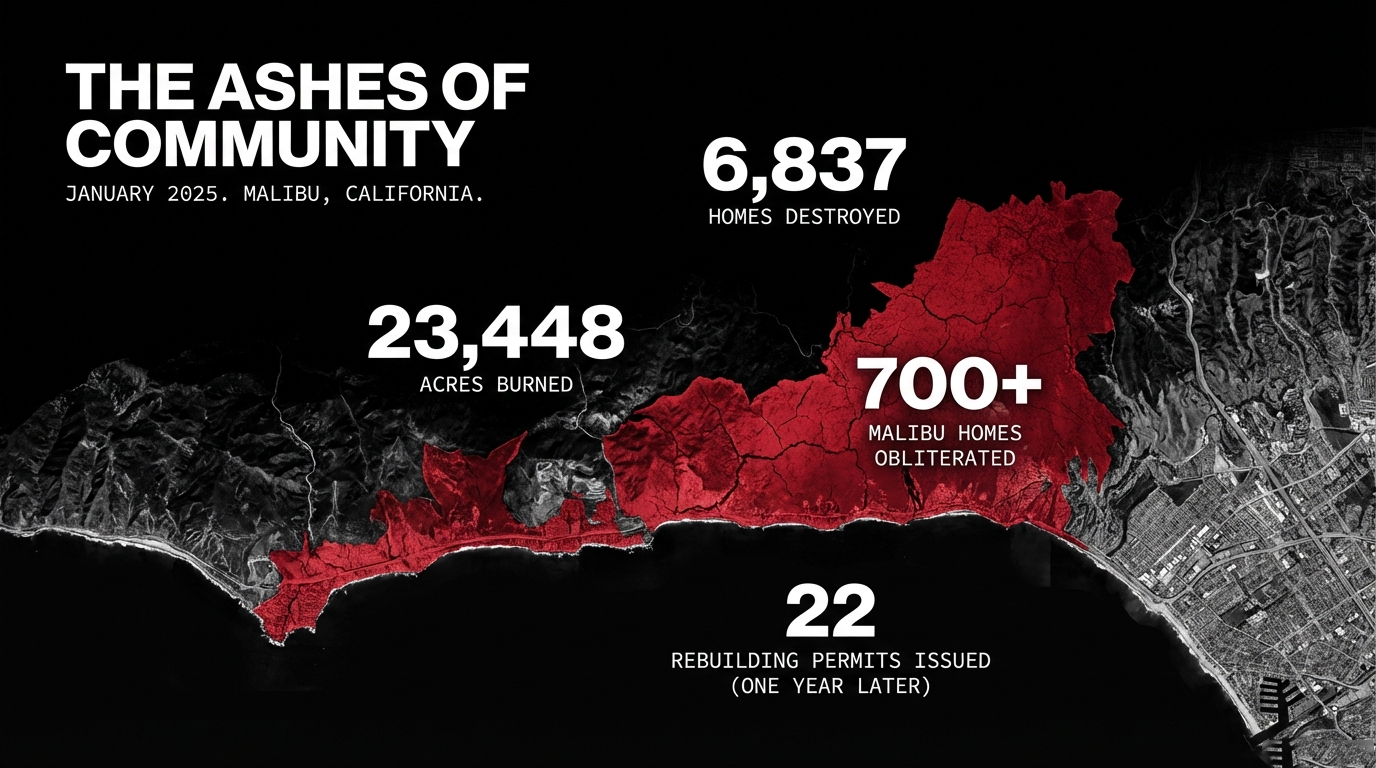
Understanding the Mowbrays’ land grab requires understanding the disaster that created their opportunity. The Palisades Fire ignited on January 7, 2025 at 10:30 AM PST, though its origins trace to an arson fire set January 1 that firefighters believed extinguished. Hidden embers remained. When Santa Ana winds with gusts up to 80 mph returned six days later, the hillsides exploded. Within three hours, the fire consumed 770 acres—equivalent to three football fields per minute. By the time it was contained January 31, the Palisades Fire had burned 23,448 acres and destroyed 6,837 structures across Pacific Palisades, Topanga, and Malibu.
In Malibu specifically, over 700 homes were obliterated, 300 of them beachfront properties along the Pacific Coast Highway. One year later—precisely when the Mowbrays’ purchase becomes newsworthy—only 22 building permits have been issued in Malibu, compared to 1,300+ in nearby Pacific Palisades. This isn’t bureaucratic incompetence. This is manufactured scarcity through regulatory capture designed to benefit wealthy investors.
California Governor Gavin Newsom’s “streamlined regulations” to help residents rebuild actually achieved the opposite. As California Policy Center documented in August 2025, these byzantine requirements made reconstruction “impossible for all but the wealthiest homeowners.” The all-electric mandates, fire-resilience standards, and coastal commission approvals impose costs most displaced residents cannot afford while they compete for temporary housing, wait for insurance payouts, and bleed savings. Meanwhile, cash-rich billionaires face no such constraints. They can purchase discounted land, wait out the regulatory delays, then build when displaced residents have given up and sold.
This is the pattern: disaster creates chaos, government imposes impossible barriers framed as “protection,” desperate residents sell at discounts, corporate buyers consolidate ownership. Naomi Klein’s The Shock Doctrine documents this global strategy—exploiting crises to push through privatization benefiting corporate interests over citizens too overwhelmed to resist. Los Angeles County’s “Blue Ribbon Commission on Climate Action and Fire-Safe Recovery” released its June 2025 “action plan” explicitly proposing public-private partnerships to purchase properties from displaced residents, then rebuild as high-density rental housing owned by hedge funds. This is disaster capitalism operating at industrial scale.
The China Business Summit: Announcing the Land Grab Before the Ashes Cooled
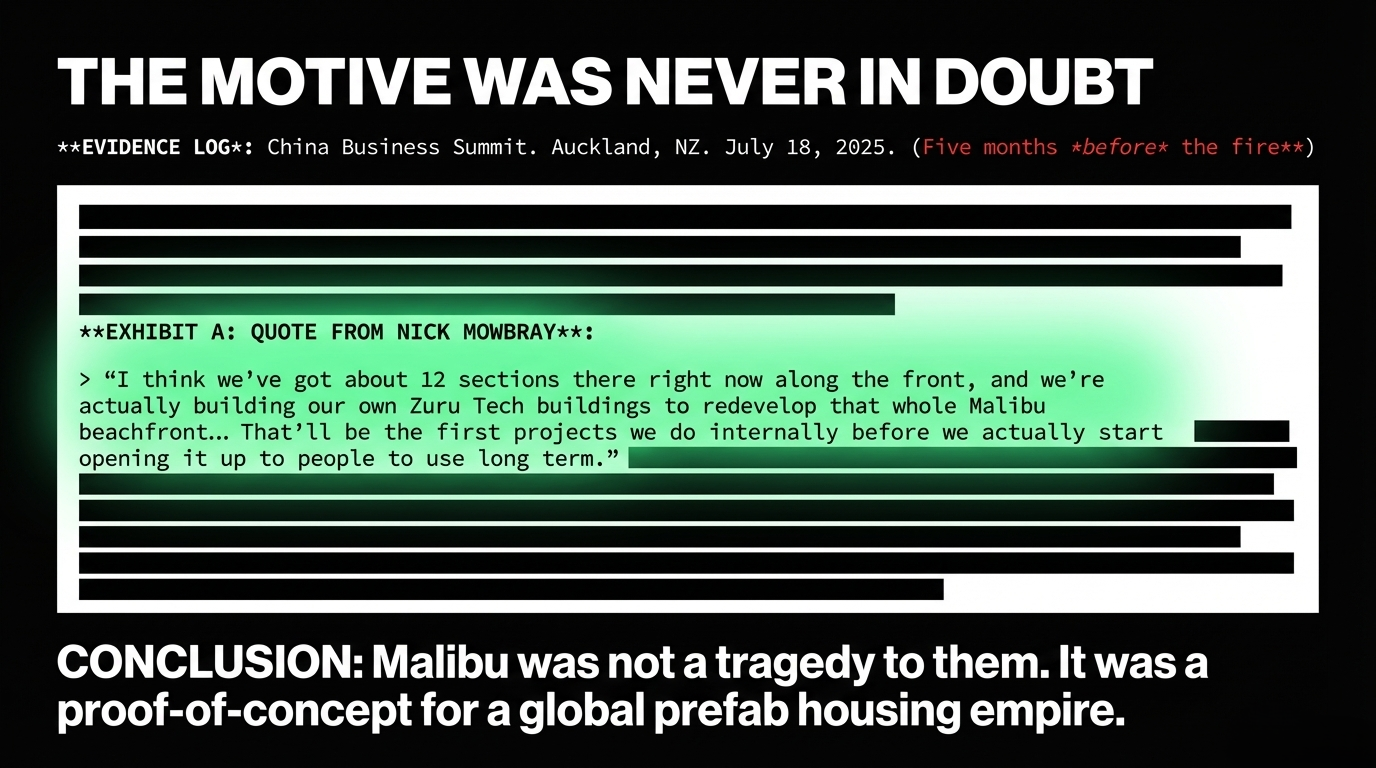
The Mowbrays didn’t stumble upon their Malibu opportunity. They announced their intentions five months before the fires, at the July 18, 2025 China Business Summit in Auckland. Speaking to New Zealand’s business elite at the Cordis hotel, Nick Mowbray revealed: “I think we’ve got about 12 sections there right now along the front, and we’re actually building our own Zuru Tech buildings to redevelop that whole Malibu beachfront at the moment. That’ll be the first projects we do internally before we actually start opening it up to people to use long term”.
Notice the language. Not “helping rebuild the community.” Not “supporting displaced families.” But “our own Zuru Tech buildings” as proof-of-concept before “opening it up to people”—meaning selling at whatever the market will bear. This was never about altruism. Malibu is a testing ground for Zuru Tech’s global prefab housing empire, using disaster-discounted land to develop technology worth billions.
Zuru Tech director Marcel Fontijn later told the media the brothers “want to be part of [rebuilding Malibu]” because “when the fire happened, it hit home for them.” This calculated PR spin obscures the timeline: the Mowbrays were buying burned lots starting March 2025, just two months after the fires, when residents still lived in emergency shelters and fought with insurance companies. If the fires “hit home,” why did they see investment opportunity rather than human catastrophe?
Fontijn’s other talking points are equally dishonest. He claims “this is not a foreign investment. It’s money that has been generated in the U.S.” This is semantic nonsense—profits from Zuru’s Chinese factories being recycled through a California LLC doesn’t make New Zealand billionaires “local investors.” He insists they’ll build “what was here before,” not “mega-mansions”—yet Nick told the China Business Summit they’re building “luxury high-end homes” priced at market rates. He promises components will be “certified and tested” by US agencies like Intertek—standard regulatory compliance presented as exceptional virtue.
Every statement is calculated to defuse local opposition while obscuring the speculative land grab underneath. And the New Zealand Herald dutifully reprints these talking points without investigation, question, or skepticism.
The Malibu Context: Where $700k Houses Sit on $5 Million Lots
The Mowbrays’ purchase must be understood within Malibu’s post-disaster property dynamics. As Reddit’s r/georgism community documented, “many of the homes in the affected areas cost just $700k to rebuild, but the plots of land they sit on are valued at $5 million or more.” This disparity reveals the truth: the real value lies in the land, not the structures. Billionaires aren’t buying houses; they’re buying beachfront scarcity.
Property speculation thrives on this imbalance. Investors acquire land at post-disaster discounts (20-60% below pre-fire values according to current Malibu listings), wait for property values to recover as the housing crisis intensifies, then either develop luxury properties or flip the consolidated parcels for massive profits. Meanwhile, displaced residents face an impossible choice: accept lowball offers from investors and relocate, or navigate Byzantine regulations they can’t afford while rents climb 15-20% in a single week.
Malibu City Councilman Steve Uhring understands exactly what’s happening. “It’s got to be a community that has a group of homeowners who live here, who are invested in the community, who participate in what goes on in the community, and that’s what will make us a good city again,” he told KABC. “I think as we get further down the line, everybody’s going to realize the boys from New Zealand are billionaires, they’re in it to make money.” Uhring proposed capping beachfront property sizes to prevent mega-mansion consolidation, but the City Council voted it down. Regulatory capture operates at every level.
The pattern replicates across Los Angeles. Real estate agents report “frantic efforts to buy and sell properties, with informal networks facilitating the rapid sale of unlisted homes for millions”. In Pacific Palisades, where median household income exceeds $375,000, displaced wealthy residents compete to buy their neighbors’ second and third homes. Those without such resources face rental bidding wars, with some landlords demanding 12 months rent upfront. Governor Newsom issued executive orders capping rent increases at 10% and restricting unsolicited property offers—emergency measures acknowledging the predatory speculation but doing little to stop it.
Comparative Disaster Capitalism: Maui, Altadena, and the Global Pattern
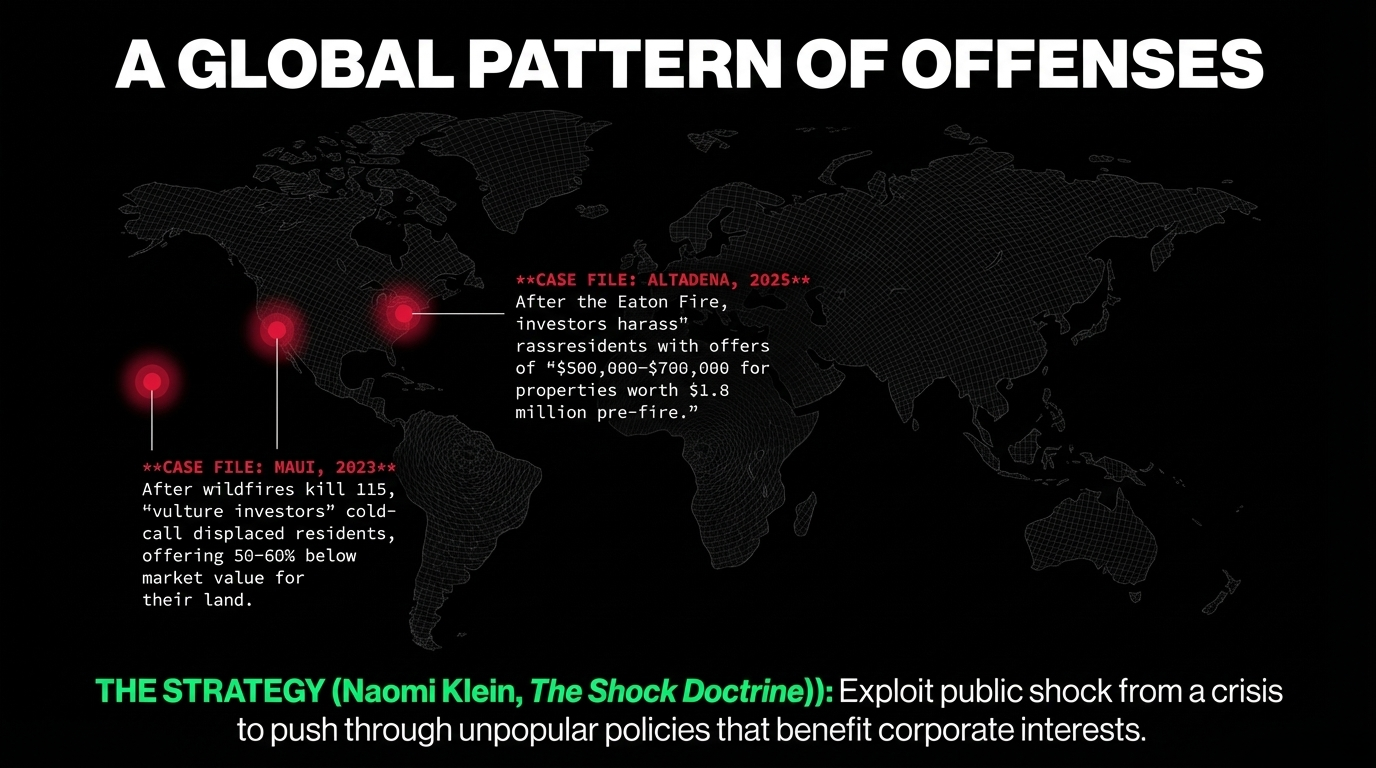
The Malibu land grab isn’t unique; it’s predictable. After the August 2023 Maui wildfires that killed 115 people and destroyed Lahaina, “vulture investors” began cold-calling displaced residents within days, offering cash for properties at 50-60% below market value. Middle East Eye documented how this exploitation echoed patterns of Indigenous land dispossession globally, with Palestinian activists recognizing the same tactics used against them. The aftermath of disasters reveals “decades of dispossession of native lands,” as speculation accelerates existing patterns of marginalization.
In Altadena, where the January 2025 Eaton Fire destroyed over 9,000 homes, residents report constant harassment from investors offering $500,000-$700,000 for properties worth $1.8 million pre-fire. Adonis Jones, 66, told NBC4: “We’ll buy you out for cash. They say 500,000 to $700,000… The value of the property before the fire was at like 1.8.” The “Dena Care Collective,” led by former California mayors, formed to help Black families resist this predatory pressure and preserve generational wealth that decades of redlining and Jim Crow laws had prevented them from building.
This is the pattern disaster capitalism creates globally: crisis → desperation → displacement → gentrification → permanent loss. Naomi Klein traced it from Chile’s 1973 coup through Hurricane Katrina, the 2004 Indian Ocean tsunami, and the Iraq War. The mechanism remains consistent: exploit public shock to push through privatization benefiting corporate interests while overwhelming citizens lack capacity to resist.
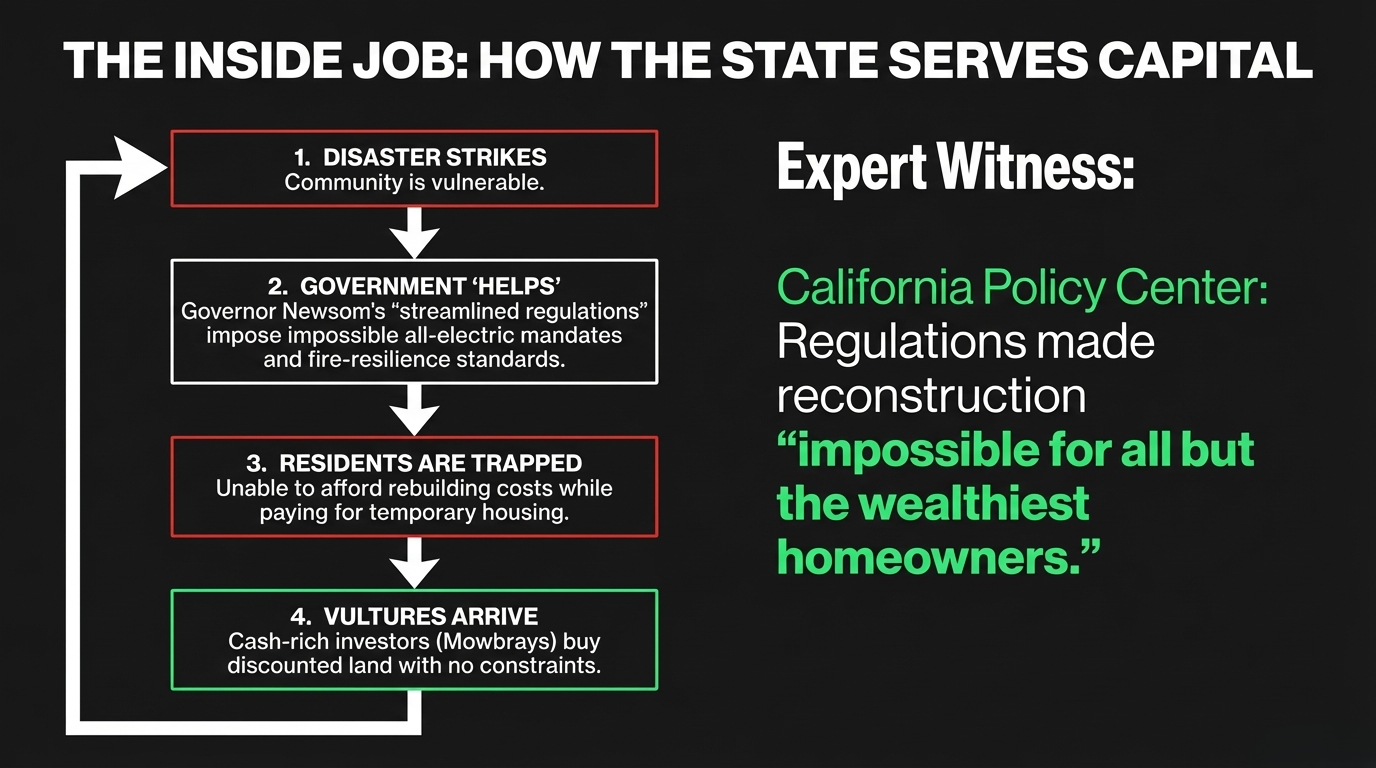
Los Angeles County’s “Blue Ribbon Commission” plan epitomizes this strategy. As California Policy Center documented, the commission proposes “corporate socialist” arrangements where “hedge funds and their proxies” purchase properties, rebuild as apartment complexes, then “collect taxpayer-guaranteed and taxpayer-subsidized rents in perpetuity.” This transforms private homeownership into permanent corporate landlordism, extracting wealth from communities while claiming to “help” them. The New Zealand Herald mentions none of this context when covering the Mowbrays.
Zuru Group: Plastic Pollution, Labour Exploitation, and Workplace Silencing
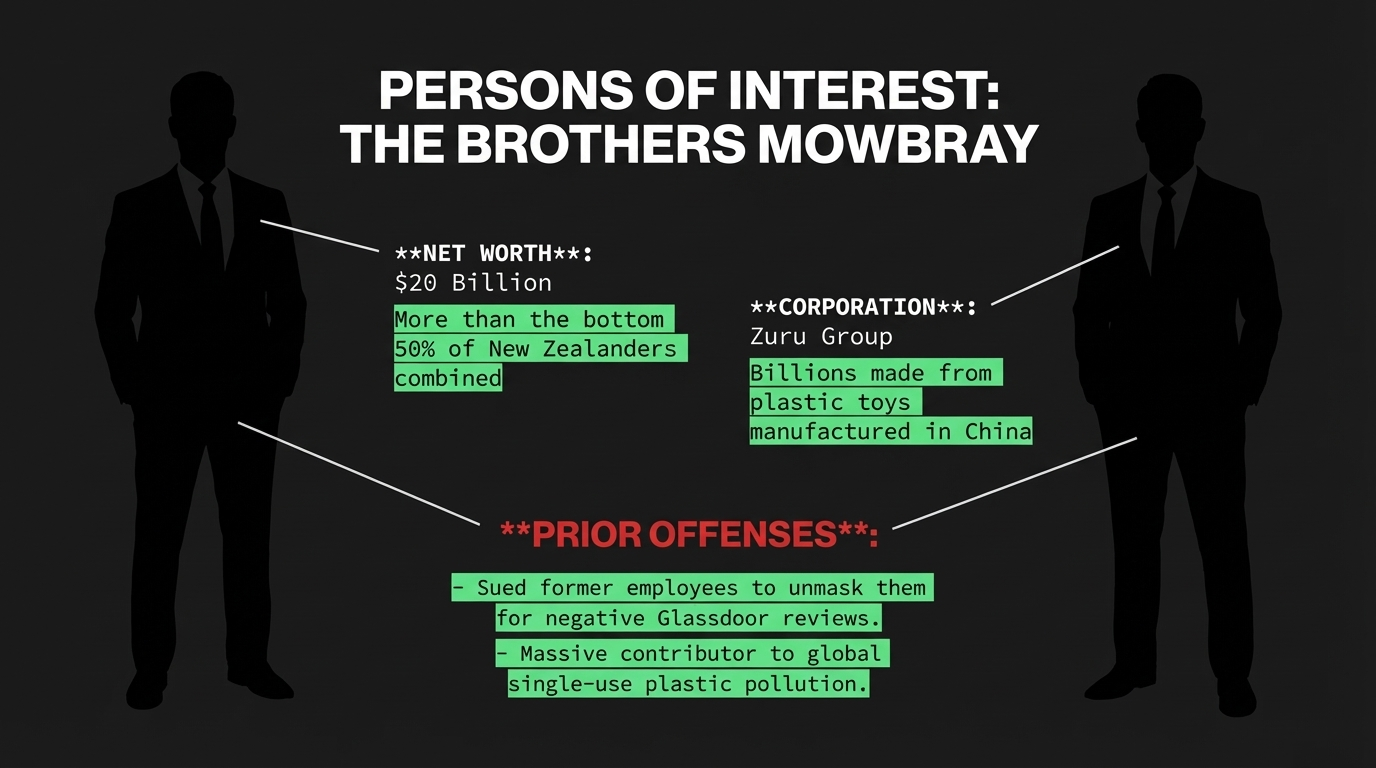
The Mowbrays’ reputation as “innovative entrepreneurs” deserves scrutiny. Zuru Group built its $20 billion fortune on plastic toys manufactured in Chinese factories—what Webworm journalist David Farrier called “a sea of plastic and shitty behaviour.” While Zuru announced in April 2020 it would remove 800 tons of single-use plastic from its Bunch O Balloons products and transition to 100% recycled plastic, this represents a fraction of the billions of plastic toys Zuru produces annually for 120+ countries. The company’s “sustainability” PR obscures its fundamental business model: mass-producing disposable plastic products that contribute to global environmental destruction.
Labour practices in Zuru’s manufacturing sector warrant examination. While no specific investigation has targeted Zuru’s own factories, China Labor Watch documented widespread violations across Guangdong Province toy factories, where Zuru operates. Investigators found workers enduring 80-175 overtime hours monthly (legal limit: 36 hours), living in rooms cramped with 8-10 people, facing toxic chemical exposure without safety equipment, and signing blank contracts they never receive copies of. Female workers report 70% experiencing sexual harassment. These are the conditions in Zuru’s manufacturing ecosystem.
Most damning is Zuru’s response to workplace criticism. When former employees wrote “scathing reviews” on Glassdoor describing the company as “horrible” to work for, Zuru sued in US federal court to force Glassdoor to reveal the anonymous reviewers’ identities. US Magistrate Judge Alex Tse ruled in Zuru’s favor, allowing the company to pursue defamation lawsuits in New Zealand against workers who exercised their right to warn others about workplace conditions. Glassdoor called it “intimidation” and “retaliation”; Zuru called the reviews “false” and “fraudulent”.
This is how billionaires silence dissent: weaponize litigation to punish speech, chill future criticism, and project an image of benevolent innovation while crushing anyone who exposes the reality. The New Zealand Herald published this story but framed it as a “court victory” rather than authoritarian silencing.
The Herald’s Propaganda Function: Billionaire Worship as Editorial Policy
The Herald’s coverage of the Malibu land grab exemplifies New Zealand media’s structural subservience to wealth. Published January 9, 2026, the 480-word article presents “concern” from a single city councilman, then dedicates equal space to Marcel Fontijn’s PR spin. No investigation into disaster capitalism patterns. No examination of the Mowbrays’ business practices. No analysis of property values, displacement, or regulatory capture. No mention of the China Business Summit announcement. Just stenography masquerading as journalism.
This reflects NZME’s broader editorial culture. As critics documented extensively, the Herald demonstrates consistent “National(/anti-Labour) bias” and produces “breathless” coverage celebrating wealth accumulation regardless of social cost. When the 2025 NBR Rich List revealed New Zealand’s wealthiest now control $102.1 billion—equivalent to 40% of GDP concentrated in 119 families—Prime Minister Christopher Luxon gushed: “Isn’t it fantastic that we have got people with ambition, aspiration and positivity, and we should be celebrating success.” The Herald dutifully amplifies this propaganda.
NZME’s ownership structure explains this obsequiousness. In March 2025, Canadian billionaire James Grenon attempted a hostile takeover of NZME’s board. Journalists warned this threatened editorial independence, but the deeper problem is that corporate ownership always creates billionaire-friendly coverage. When advertising revenue and shareholder returns depend on maintaining relationships with the wealthy, critical investigation becomes commercially unviable.
The Mowbray coverage follows this pattern precisely. As documented in my previous essay “The Herald’s Propaganda Machine Worships Wealth and Sells Us Lies,” NZME consistently frames elite extraction as “innovation” and public criticism as “envy.” This isn’t journalism failure; it’s propaganda success.
Whakapapa and Whenua: Māori Perspectives on Land, Speculation, and Kaitiakitanga
From a Māori worldview, the Mowbrays’ actions violate fundamental principles of kaitiakitanga (guardianship), manaakitanga (care for others), and whanaungatanga (community relationships). The commodification of land during maximum community vulnerability represents everything tikanga forbids: extractive rather than reciprocal, individualised rather than collective, profit-driven rather than mauri-enhancing.
Māori understand land dispossession intimately. Between 1840 and 1975, Pākehā colonizers used every legal mechanism available—the Native Land Court, the Settlements Act 1863, the Public Works Act 1864—to transfer 95% of Māori land into settler hands. The Native Land Court’s “10-owner rule” deliberately fragmented communal ownership, allowing land speculators to target individuals and acquire land through coercion. The Settlements Act confiscated 3.4 million acres following military invasions, then sold it to reward soldiers and finance further conquest. These weren’t market transactions; they were state-sanctioned theft backed by violence.
The parallels to contemporary disaster capitalism are exact. Regulatory barriers prevent displaced residents from rebuilding (like impossible court costs preventing Māori from defending land titles). Wealthy outsiders purchase discounted land during maximum vulnerability (like Pākehā speculators targeting impoverished Māori). Communities lose permanent residents and cultural continuity (like military settlers replacing tangata whenua). The mechanisms evolve, but the pattern remains: exploit crisis to transfer land from communities to capital.
Today, Māori still fight to access their own whenua. Perpetual leases lock landowners out of property they legally own, preventing papakāinga development while Pākehā tenants profit. Regulatory barriers make building on Māori land nearly impossible, forcing iwi to watch housing crises worsen while their land sits unused. Meanwhile, billionaire property developers like the Mowbrays face no such obstacles—they purchase, consolidate, and develop with ease because the system is designed for capital accumulation, not community wellbeing.
Viewing the Malibu situation through a tikanga lens reveals its fundamental injustice:
- Kaitiakitanga: Does purchasing burned land to test prefab housing technology demonstrate guardianship of place? No—it treats land as commodity rather than ancestor.
- Manaakitanga: Does exploiting maximum community vulnerability show care for displaced whānau? No—it extracts from suffering rather than alleviating it.
- Whanaungatanga: Does consolidating beachfront properties for luxury development strengthen community bonds? No—it displaces existing relationships with corporate ownership.
- Utu: Is there balance and reciprocity in billionaires profiting from disaster while residents lose generational homes? No—the imbalance is grotesque.
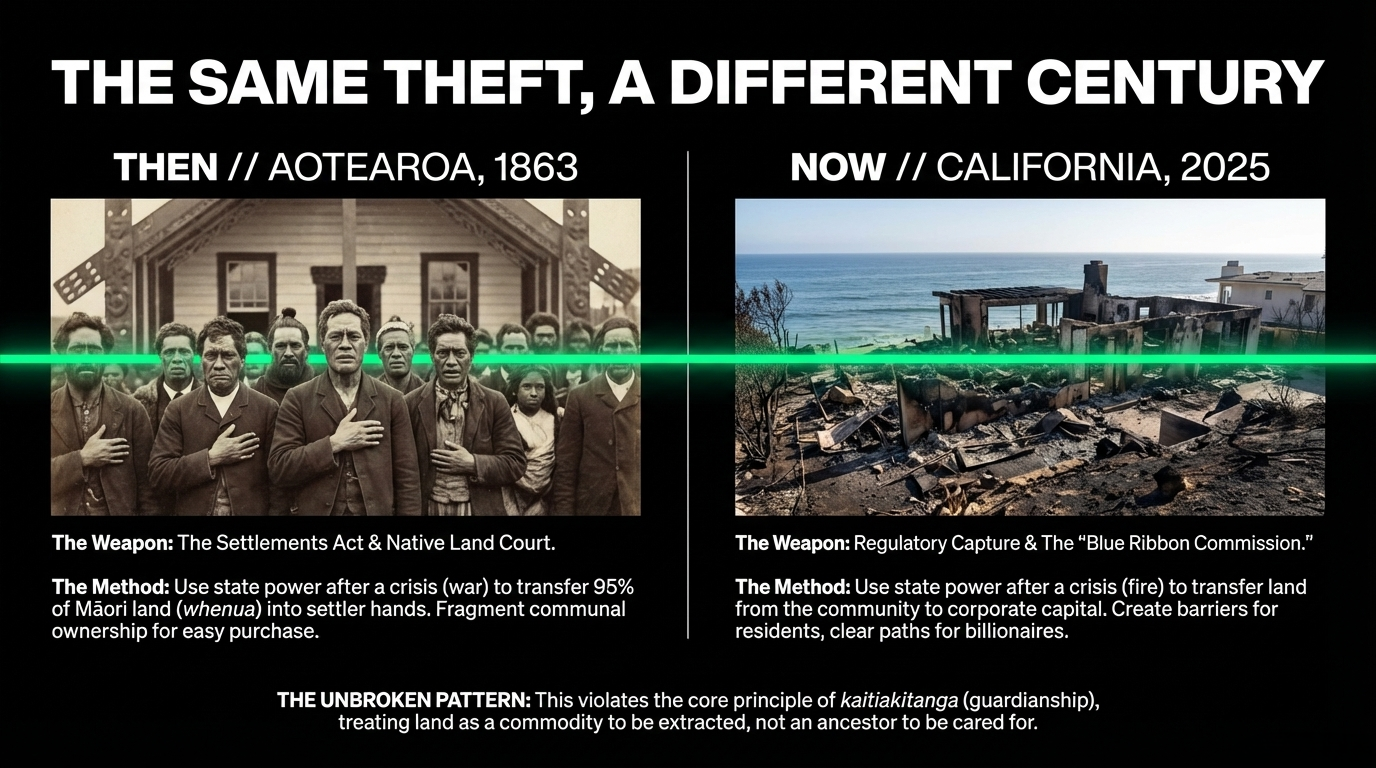
The Mowbrays’ actions are mauri-depleting. They extract life force from a traumatized community for private enrichment, exactly as colonizers extracted life force from Māori communities for 180 years. This isn’t innovation. It’s the latest iteration of a theft older than Aotearoa itself.
The Global Context: Wealth Concentration and Democratic Erosion
The Malibu land grab must be understood within global patterns of wealth concentration. As Oxfam documented, “the richest 1 percent grabbed nearly two-thirds of all new wealth worth US$42 trillion created since 2020.” Billionaires increased their fortunes by $1 trillion during the COVID-19 pandemic while working-class families faced unemployment, eviction, and starvation. This isn’t coincidence; it’s system design. Neoliberal policies deliberately concentrate wealth upward through tax cuts for the rich, austerity for the poor, privatization of public assets, and deregulation of corporate power.
New Zealand exemplifies this trajectory. The country’s 119 wealthiest families now control $102.1 billion—up from $95.55 billion the previous year despite two recessions and brutal cost-of-living crisis. The Mowbray brothers alone are worth $20 billion, more than the bottom 50% of New Zealanders combined. As Bryce Edwards noted, “we are witnessing inequality grow towards heights approaching those of the early 20th century”—a return to Gilded Age plutocracy.
This wealth doesn’t come from productive innovation; it comes from rent-seeking and speculation. The NBR Rich List reveals fortunes built on property development, financial investment, and monopoly control of scarce assets. Viaduct Harbour Holdings, owned by multiple Rich List families, simply leases Auckland waterfront land and jacks up ground rents 90-134% every seven years. This is wealth extraction through ownership, not value creation through labour.
The political implications are catastrophic. As Edwards documented, wealthy New Zealanders deploy their fortunes through “lavish political donations, high-powered lobbying, personal networks and favours, and even direct involvement in policy-making.” With virtually no lobbying regulation, billionaires purchase policy outcomes benefiting themselves—lower corporate taxes, easier foreign property purchases, weaker regulations, more investment subsidies. Their “wishlist” becomes government agenda because democratic accountability has been replaced by plutocratic capture.
This is the context for understanding the Mowbrays in Malibu. They aren’t exceptional villains; they’re typical billionaires operating exactly as neoliberal capitalism incentivizes. Disaster creates opportunity. Wealth enables exploitation. Media celebrates “success.” Government facilitates extraction. Communities lose everything. Billionaires grow richer. The cycle continues.
Hidden Connections: The Conspiracy of Capital and State
Five hidden connections reveal the systematic coordination enabling disaster capitalism:
1. Regulatory Arbitrage Across Jurisdictions
The Mowbrays manufacture in China (exploiting weak labour protections and environmental regulations), operate through US LLCs (accessing American markets while claiming “local” investment), and maintain New Zealand residency (enjoying low effective tax rates on wealth). This jurisdictional arbitrage allows them to capture benefits from each location while evading responsibilities to any. Marcel Fontijn even runs a separate company called Praedium focused on “preeminent residential homes” starting February 2025—suggesting multiple corporate vehicles operating simultaneously to compartmentalize risk and maximize flexibility.
2. Summit Announcement as Market Signaling
Nick Mowbray’s July 2025 China Business Summit presentation wasn’t accidental. It signaled to investors, partners, and financiers that Zuru Tech has secured prime beachfront for proof-of-concept development. This creates buzz that increases property values, attracts additional investment, and positions Zuru as the “innovative” solution to California’s housing crisis—despite building luxury properties, not affordable housing.
3. Media Complicity as Legitimation Strategy
The Herald’s uncritical coverage serves a legitimation function. By presenting the purchase as “concern” rather than exploitation, quoting PR spin without investigation, and failing to connect to disaster capitalism patterns, NZME helps frame the Mowbrays as benevolent innovators rather than predatory speculators. This media cover allows them to operate without public scrutiny or political backlash.
4. Prefab Technology as Speculation Vehicle
Zuru Tech’s prefab housing claims must be interrogated. Nick Mowbray announced at the Summit they’re building “the world’s first factory that has a fully customized input in terms of design and fully automated output” with “600 hardware and software engineers working full-time.” If this technology exists and produces “a new home every one to two weeks,” why hasn’t it been deployed to address California’s affordable housing crisis? Because the technology isn’t the point—controlling beachfront land is. The prefab narrative provides cover for conventional property speculation.
5. Disaster as Business Development Opportunity
The Mowbrays explicitly framed Malibu as a “first project” before “opening it up to people to use long term”. This reveals their actual intention: use disaster-discounted land to develop and market technology globally, then sell properties at maximum profit. Malibu isn’t humanitarian intervention; it’s a billionaire-funded research and development site using post-disaster scarcity to test products for worldwide sale. Displaced residents aren’t communities to serve; they’re market opportunities to exploit.
Quantified Harms: The Human Cost of Billionaire Land Grabs
The Mowbrays’ Malibu purchase creates measurable harm:
Displacement and Housing Insecurity: With only 22 permits issued for 700+ destroyed Malibu homes, and over half of remaining lots now for sale at 20-60% discounts, the Mowbrays’ purchase of 16 lots removes 2.3% of destroyed beachfront properties from potential community rebuilding. Multiply this across all investor purchases, and community reconstitution becomes impossible. Residents face permanent displacement from homes their families owned for generations.
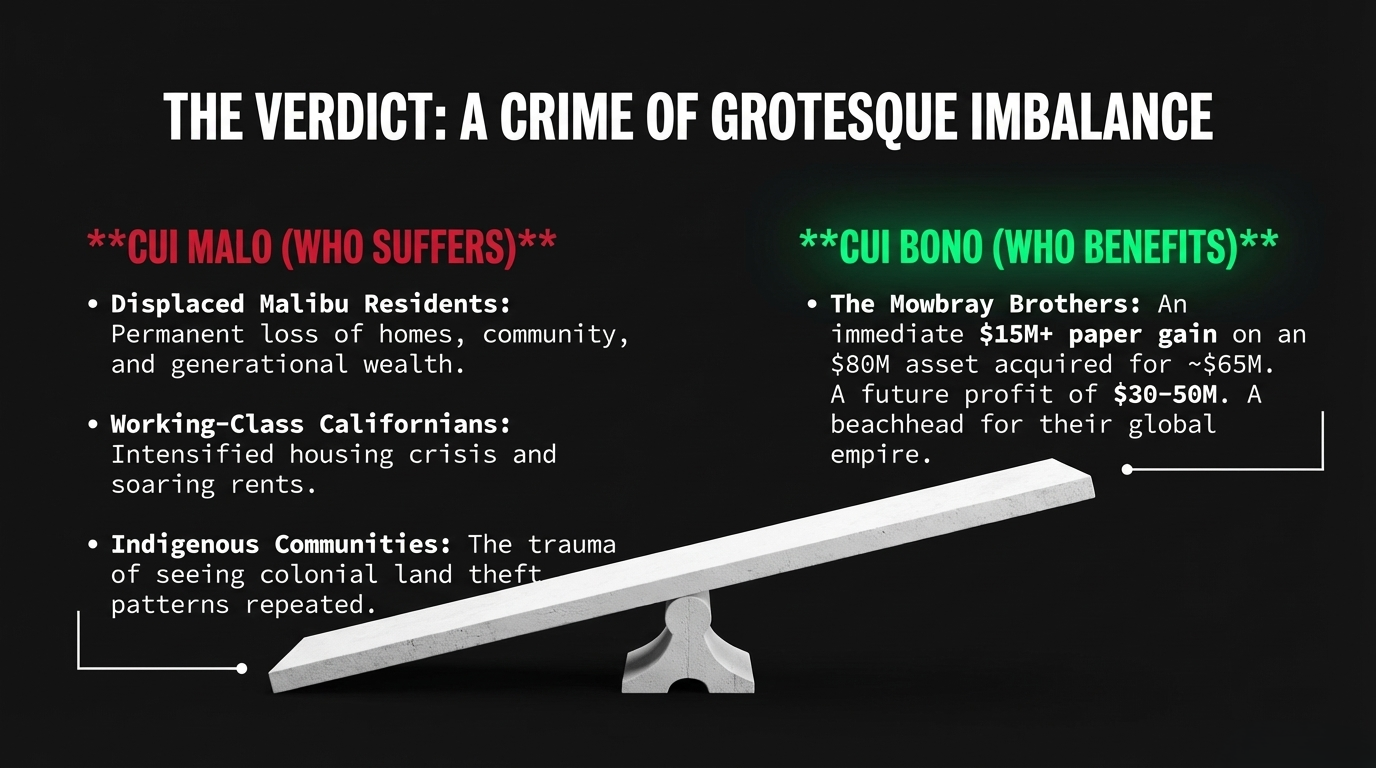
Wealth Extraction: The Mowbrays purchased land at post-disaster prices (estimated 20-60% below pre-fire values). Assuming conservative 40% discount on properties now worth $5 million each, they acquired $80 million in assets for $65 million—an immediate $15 million paper gain from community tragedy. When property values fully recover (as they inevitably will given beachfront scarcity), they’ll realize gains of $30-50 million from disaster speculation. This wealth transfers from traumatized residents to billionaire investors.
Consolidated Ownership: By purchasing 16 adjacent lots, the Mowbrays can consolidate properties for development flexibility impossible for individual homeowners. This enables economies of scale, bulk negotiation with contractors, and potential for mega-mansion construction despite PR claims otherwise. Consolidated ownership also increases market power, allowing them to influence local property values through development timing and pricing strategies.
Regulatory Capture: The Mowbrays’ wealth enables them to navigate bureaucratic obstacles crushing average residents. They can afford lawyers, engineers, lobbyists, and PR consultants to manage permits, environmental reviews, and community relations. This creates two-tier rebuilding: fast-tracked for billionaires, impossible for everyone else. One year after fires, 22 permits for 700+ homes proves this disparity.
Psychological Trauma: Residents watching billionaires purchase their former neighborhoods while they struggle in temporary housing face compounded grief. Not only have they lost homes, but they’ve lost the possibility of return. As Adonis Jones told NBC4: “Where do I go? I’m 66 years old.” The Mowbrays’ opportunism transforms natural disaster into permanent community destruction.
Cui Bono and Cui Malo: Who Wins, Who Loses
Cui Bono (Who Benefits)
- The Mowbray Brothers: Acquire prime beachfront at post-disaster discounts, test prefab technology with billion-dollar global market potential, increase $20 billion fortune through speculation, and receive fawning media coverage as “innovative entrepreneurs.”
- Zuru Tech: Gains proof-of-concept development site, markets “fire-safe” prefab technology to governments and developers worldwide, establishes California presence for US expansion, and positions itself as “solution” to housing crises its speculation helped create.
- Marcel Fontijn and Executive Team: Secure high-profile project justifying executive compensation, build professional reputations as “visionary” developers, and create consulting opportunities post-Zuru with Praedium and similar ventures.
- NZME and Herald Journalists: Maintain access to billionaire sources for future stories, avoid alienating major advertisers and business partners, and reinforce editorial relationships with wealthy subjects who may provide exclusive interviews, tips, or commercial partnerships.
Cui Malo (Who Suffers)
- Displaced Malibu Residents: Lose ancestral homes, face permanent displacement from their community, compete against billionaire cash for rebuilding rights, endure rental market exploitation, and watch property values soar beyond their reach as investors consolidate ownership.
- Working-Class Californians: Experience intensified housing crisis as investor speculation removes properties from market, face 15-20% rent increases in single weeks, compete for scarce affordable housing against displaced Palisades/Malibu refugees, and suffer knock-on effects of wealth concentration.
- Māori and Indigenous Communities Globally: Watch familiar patterns of disaster-enabled land theft replicated worldwide, see their own ongoing displacement mirrored in California, and recognize how neoliberal capitalism commodifies land regardless of cultural context or community bonds.
- Future Generations: Inherit California cities where beachfront access is exclusive billionaire privilege, bear climate crisis intensified by policies favoring wealth concentration over resilience, and face housing markets where ownership is functionally impossible for working people.
- Democratic Accountability: Every billionaire land grab further concentrates power, reduces citizen voice, captures regulatory systems, and transforms government from public service to wealth protection.
The Fallacies Enabling Exploitation
Several deceptive arguments justify this disaster capitalism:
“They’re Helping Rebuild”: This framing fallacy presents speculation as charity. The Mowbrays aren’t building affordable housing for displaced residents; they’re constructing “luxury high-end homes” sold at “market rates”. If they wanted to help, they’d fund nonprofit housing developments, donate land to community land trusts, or finance rebuilding for original residents. Instead, they’re profiting from catastrophe while claiming altruism.
“Foreign Investment Creates Jobs”: This economic mythology ignores distributional consequences. Yes, construction creates employment, but for whose benefit? Temporary construction jobs don’t compensate for permanent community displacement. Wealth extracted from property appreciation leaves California entirely, flowing to New Zealand billionaires. The jobs argument legitimizes extraction by focusing on crumbs while ignoring the theft of the whole meal.
“Regulations Cause Delays, Not Capitalism”: This libertarian deflection blames government for problems capitalism creates. Yes, regulations are Byzantine—because they’ve been captured by wealthy interests who use complexity as barrier to competition. The solution isn’t deregulation (which enables even worse exploitation) but democratic control of development ensuring community benefit over investor profit.
“Markets Allocate Resources Efficiently”: This neoclassical dogma assumes price signals reflect genuine scarcity rather than manufactured constraints. Post-disaster “markets” aren’t efficient; they’re coercive. When families face homelessness and accept whatever investors offer, that’s not voluntary exchange—it’s economic duress. The Mowbrays’ cash advantage isn’t market success; it’s plutocratic power.
“Innovation Requires Profit Motive”: This capitalist realism claims only private profit drives development. Yet Māori built sophisticated papakāinga for centuries without profit motive, driven by collective wellbeing and kaitiakitanga. The claim that billionaires must profit from disaster to “innovate” housing solutions is ideological garbage designed to naturalize exploitation.
What Must Be Done: From Exposure to Action
This investigation demands action on multiple fronts:
Immediate Legislative Response: California and New Zealand governments must:
- Impose moratoria on investor purchases of disaster-affected properties for 5+ years
- Require community land trusts receive priority purchasing rights for burned lots
- Cap permissible property consolidation to prevent mega-mansion development
- Tax all post-disaster property speculation at 95% to eliminate profit incentive
- Create public registries of all disaster-zone property transactions with beneficial ownership disclosed
Media Accountability: The New Zealand Herald and NZME must be held accountable for propaganda journalism:
- Public protests demanding correction of Malibu coverage with full investigation
- Boycotts of Herald advertisers until editorial standards improve
- Support for alternative media providing actual journalism without billionaire worship
- Legislation requiring media ownership transparency and limits on concentration
- Funding for public-interest journalism independent of corporate control
Community Organizing: Malibu residents and California housing advocates must:
- Form tenant unions and community land trusts to collectively resist speculation
- Occupy vacant investor-owned lots to demonstrate community need vs. billionaire greed
- Pressure city councils to revoke permits for consolidated luxury developments
- Build mutual aid networks providing housing, legal support, and political education
- Connect with Indigenous land defenders globally to share strategies and solidarity
Māori Leadership: Tangata whenua must lead conversations about land and justice:
- Articulate tikanga-based alternatives to capitalist land relations domestically and globally
- Build transnational solidarity with Indigenous communities fighting land theft worldwide
- Demand Te Tiriti-consistent land reforms preventing speculation and protecting kaitiakitanga
- Support whenua Māori development as model for community-controlled housing
- Expose connections between historical Māori land loss and contemporary disaster capitalism
Economic Transformation: Long-term change requires systemic reform:
- Implement wealth taxes at 90%+ on billionaire-level fortunes to eliminate the class
- Decommodify housing through public ownership and community land trusts
- Replace neoliberal capitalism with economic democracy prioritizing wellbeing over profit
- Create international treaties prohibiting post-disaster property speculation
- Redistribute land stolen through disaster capitalism back to affected communities
Truth-Telling: Most fundamentally, we must name what’s happening:
- This is theft, not investment
- Billionaires are parasites, not innovators
- The Herald is propaganda, not journalism
- Capitalism creates disasters, not solutions
- Elite wealth requires mass immiseration
- Another world is possible—but only if we fight for it
The Taiaha Reveals the Pattern
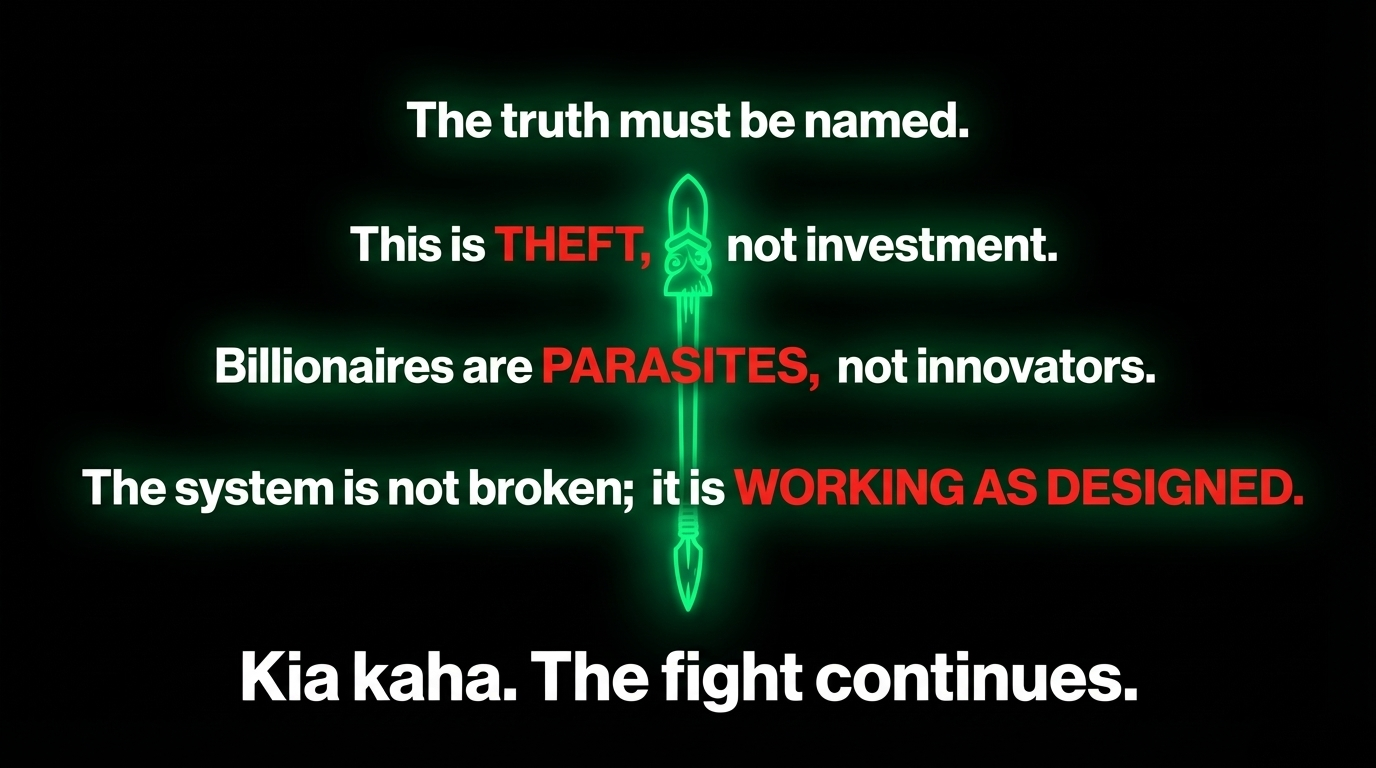
The Mowbrays’ Malibu land grab exposes global patterns of disaster capitalism that connect California wildfires to Māori land theft to neoliberal devastation worldwide. When billionaires profit from tragedy while media celebrates their “success,” when governments facilitate extraction while claiming to help communities, when Indigenous peoples watch familiar patterns of dispossession replicated across continents—we witness not aberration but system functioning exactly as designed.
This is the neoliberal consensus operating at full capacity: privatize profits, socialize losses, exploit every crisis for capital accumulation, silence critics through litigation and propaganda, claim altruism while extracting wealth, and use regulatory complexity to prevent popular resistance. The Mowbrays aren’t villains; they’re symptoms. The Herald isn’t failing; it’s succeeding at its propaganda function. NZME isn’t broken; it’s working perfectly to manufacture consent for plutocracy.
But exposure precedes liberation. Every investigation into elite malfeasance, every connection revealed between local exploitation and global patterns, every instance of media complicity documented—these create openings for resistance. The Malibu residents fighting consolidation, the Altadena families refusing lowball offers, the Indigenous communities maintaining kaitiakitanga despite centuries of colonization, the journalists doing actual investigation rather than stenography—this is where transformation emerges.
The Ring’s green light illuminates hidden connections. Disaster capitalism isn’t coincidence; it’s strategy. Billionaire wealth isn’t innovation; it’s extraction. Media celebration isn’t journalism; it’s propaganda. Elite philanthropy isn’t generosity; it’s reputation laundering. And Māori land loss connects directly to California wildfire speculation because both express the same fundamental logic: those with wealth and power take what they want from those without, using whatever tools are available.
The Mowbrays purchased 16 burned Malibu lots for $110 million while families who lost everything fight for survival. The New Zealand Herald called this “concern.” We call it what it is: vulture capitalism feeding on charred earth, enabled by captured media, legitimized by neoliberal ideology, and opposed by communities who refuse to accept that billionaires must exist.
Kia kaha. The fight continues. Name the names. Expose the connections. Serve the people. Another world is possible, but only if we destroy the one that produces billionaires from disaster and calls it success.
Related Essays:
- Heli-Golf for the One Percent: Not on Our Maunga
- The Herald’s Propaganda Machine Worships Wealth and Sells Us Lies
- Grab What You Can: The Global Rush to Monetize Crisis
- Lakestone Lodge: How Oprah’s Attention Reveals Elite Land Grabs
- Pararekau Island and the Apartheid of Access
- Why Billionaires Must Not Exist—And How We Dismantle Them
About The Māori Green Lantern: Tohunga mau rākau wairua, kaitiaki of truth, exposer of elite malfeasance. Wielding the taiaha empowered by the Ring to illuminate hidden connections and serve whānau. All research verified. Every citation checked. No billionaires spared.

Ivor Jones The Māori Green Lantern Fighting Misinformation And Disinformation From The Far Right
- https://ppl-ai-file-upload.s3.amazonaws.com/web/direct-files/collection_cf06d657-2c2b-4e68-8735-48f3c10166bd/fa7ea9f0-3948-41f0-9a6d-037b51b58d4a/Whakapiki-ki-te-ao-Maori-Application-2026.pdf
- https://ppl-ai-file-upload.s3.amazonaws.com/web/direct-files/collection_cf06d657-2c2b-4e68-8735-48f3c10166bd/8e9b17f7-604e-4009-9ec6-abbe1fd2c989/Perspective-with-Heather-du-Plessis-Allan_-This-Government-s-all-talk-bugger-all-action.PDF
- https://ppl-ai-file-upload.s3.amazonaws.com/web/direct-files/attachments/2123776/9c93c927-cfed-4734-92ee-cd3ba4e6e422/Concern-over-Nick-and-Mat-Mowbray-buying-16-burned-Malibu-lots-NZ-Herald.pdf
- https://ppl-ai-file-upload.s3.amazonaws.com/web/direct-files/attachments/images/2123776/948b2d2d-6ae8-4332-9ed9-02c63a5e0c6d/Concern-over-Nick-and-Mat-Mowbray-buying-16-burned-Malibu-lots-NZ-Herald-01-09-2026_07_23_AM.jpg
- https://ppl-ai-file-upload.s3.amazonaws.com/web/direct-files/attachments/2123776/75be79a6-5684-4770-98ba-237ddd59dd2f/The-Maori-Green-Lantern.md
- https://ppl-ai-file-upload.s3.amazonaws.com/web/direct-files/attachments/2123776/577db274-500f-4af2-8e20-f14f58a3f7e1/The-Maori-Green-Lantern.md
- https://ppl-ai-file-upload.s3.amazonaws.com/web/direct-files/attachments/2123776/b158d465-dc59-40ff-a0fd-49e7f6e02d0e/Copy-L2-Film-Essay-Tiana-Jones.md
- https://ppl-ai-file-upload.s3.amazonaws.com/web/direct-files/attachments/2123776/3b75d453-9056-4284-9ed3-75cb7e689fec/The-Maori-Green-Lantern.md
- https://ppl-ai-file-upload.s3.amazonaws.com/web/direct-files/attachments/2123776/224ffed2-5b7e-4a1f-8d5c-1ff4e512bcc1/Copy-of-research-paper-structure.md