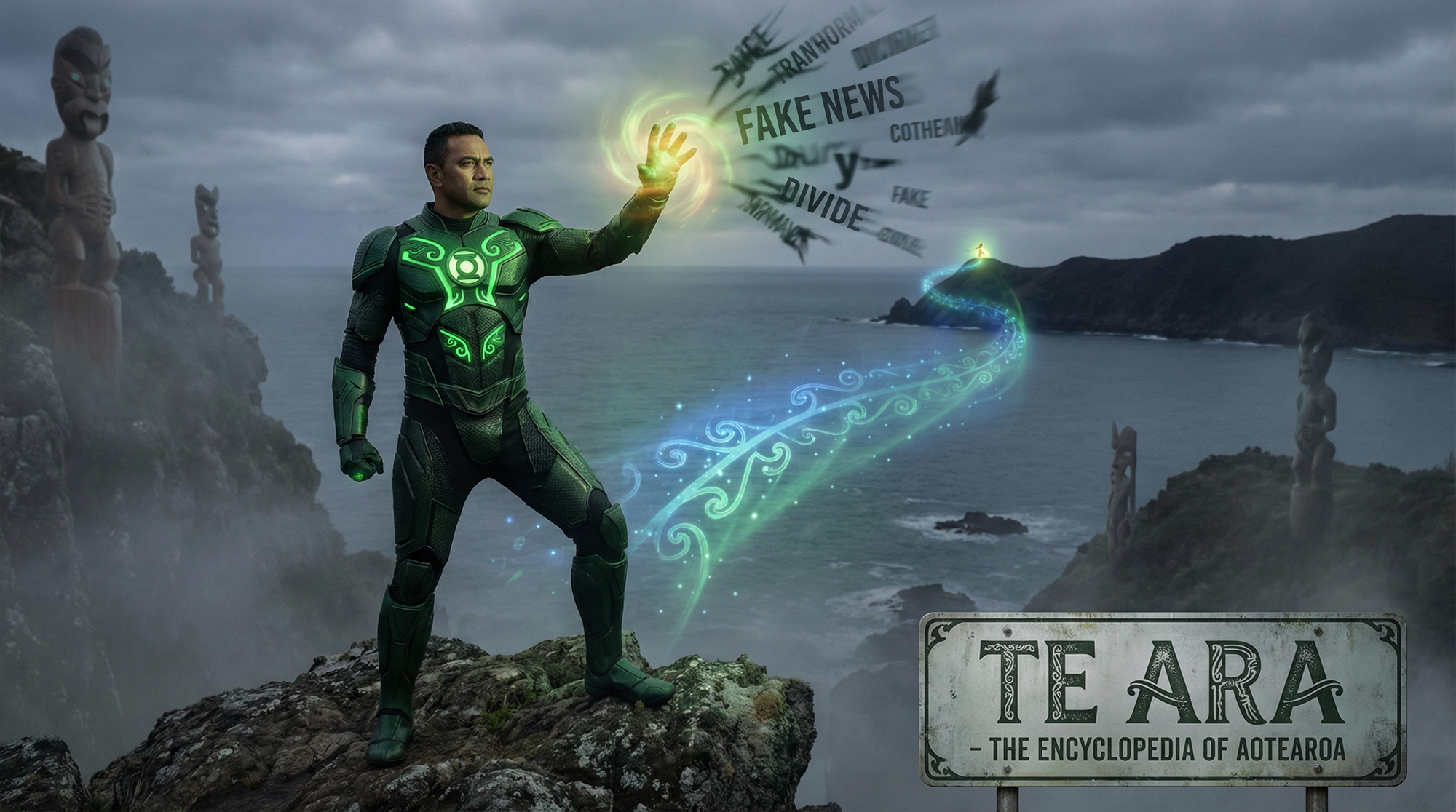
"WHAKAPAPA - THE LAYERS THEY BURIED: How a White Supremacist Government Demolished the Architecture of Māori Existence and Called It "Progress"" - 14 February 2026
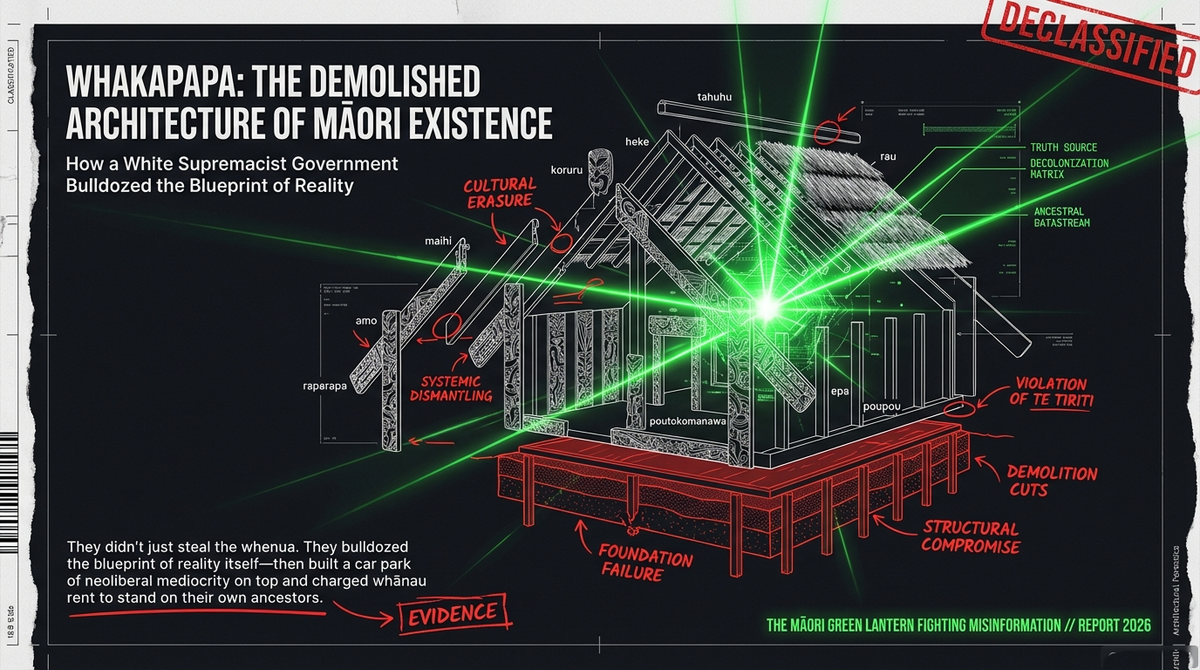
They didn't just steal the whenua. They bulldozed the blueprint of reality itself—then built a car park of neoliberal mediocrity on top and charged whānau rent to stand on their own ancestors.
TE KUPU WHAKATAKI: THE STOLEN ARCHITECTURE
Let me tell you what Christopher Luxon, David Seymour, and Winston Peters will never understand—because their intellectual foundations are built on sand, not papa.
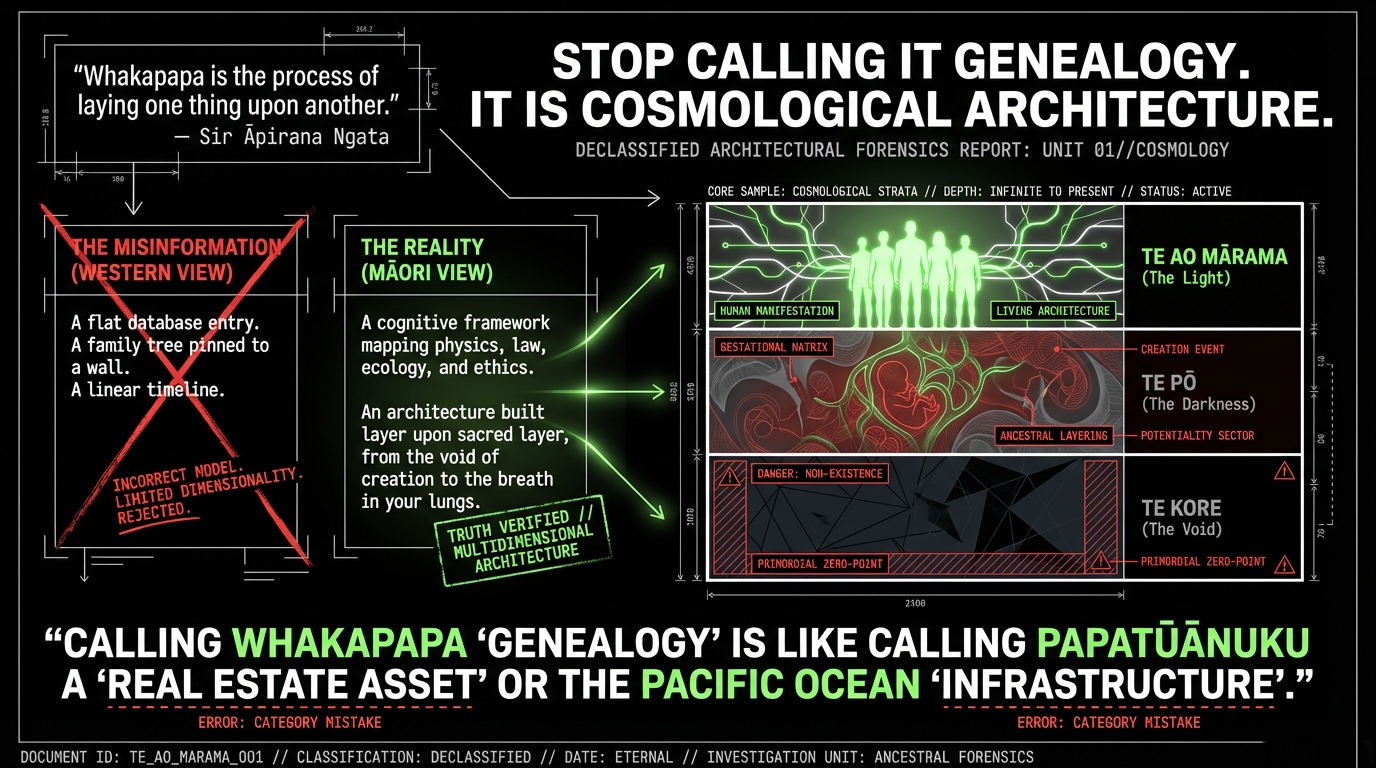
Whakapapa is not genealogy.
Say it louder for the neoliberals in the back who keep reducing the operating system of one of the most sophisticated civilisations on Earth to a family tree you pin on the classroom wall during Māori Language Week before forgetting it exists by Monday morning.
Calling whakapapa "genealogy" is like calling Papatūānuku a "real estate asset." It is like calling the Pacific Ocean "infrastructure." It is like reducing an entire cosmological framework—one that maps physics, philosophy, law, medicine, ecology, astronomy, ethics, and the architecture of existence itself—to a line item in a Treasury spreadsheet. Which, come to think of it, is exactly what this coalition government does with everything Māori.
Āpirana Ngata, the towering Ngāti Porou elder and intellect whose boots no one in the current Beehive is fit to lace, defined whakapapa as "the process of laying one thing upon another. If you visualise the foundation ancestors as the first generation, the next and succeeding ancestors are placed on them in ordered layers" (Te Ara). Layering. Not a flat database entry. Not an Excel formula. Not a KPI. An architecture of existence built layer upon sacred layer, from the void of Te Kore to the light of Te Ao Mārama, from the eternal embrace of Ranginui and Papatūānuku to the breath in your lungs reading this sentence.
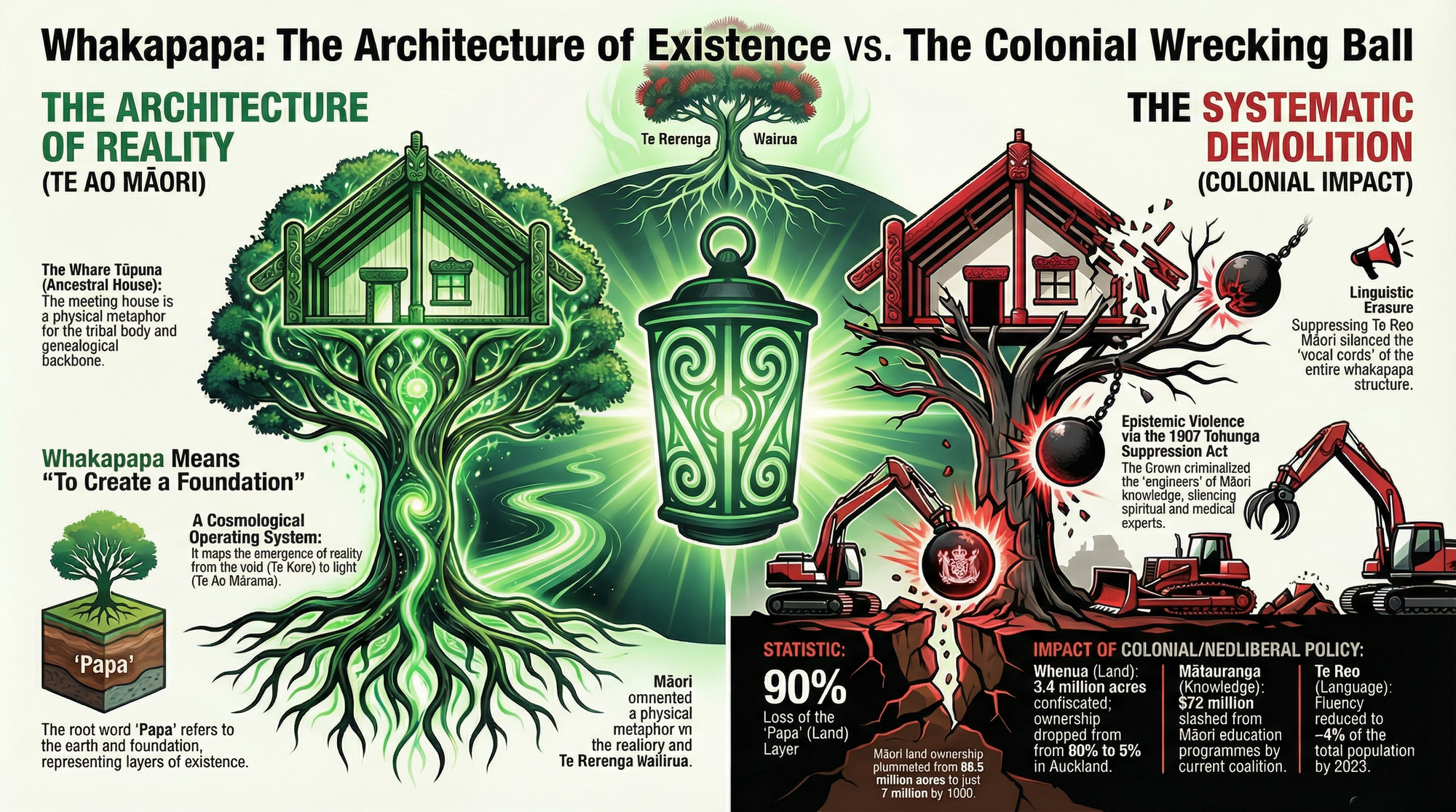
And the root word tells you everything the coloniser doesn't want you to know. Papa—the base, the foundation, the earth. Papatūānuku herself. As Te Ara explains: "The root of the word Papatūānuku is papa, which means base and foundation. Two closely related words are whakapapa and kaupapa. Popularly, whakapapa is used to mean genealogy, but it literally means to create a base or foundation."
Whakapapa literally means to create a base or foundation. Not to look backward. Not to perform nostalgia. To build. Layer upon layer. Generation upon generation. Knowledge upon knowledge. The living upon the dead. The dead upon the gods. The gods upon the void. An unbroken metaphorical architecture reaching from nothingness to the mokopuna who carries it forward.
And what did the Crown do? They called it mythology. They wrote it down wrong. They locked it in museums behind glass cases of colonial curation. They passed laws—actual laws—to silence the tohunga who carried it. And then they had the breathtaking white supremacist audacity to wonder why Māori communities are in crisis.
This essay cracks open the metaphorical architecture of whakapapa—its layering, its spiritual dimensions beyond death, and the Māori metaphors that make it the most comprehensive knowledge system in the Pacific—and exposes how colonial and neoliberal New Zealand systematically demolished every layer. Three examples are provided for the Western mind, because apparently some people need the damage translated into their own impoverished language before they'll believe it's real.
NGĀ PAPA O TE TĪMATANGA: THE METAPHORICAL FOUNDATIONS
Te Kore to Te Ao Mārama: The Cosmological Layers
Whakapapa does not begin with people. It begins with Te Kore—the void, the potential, the primal source of all becoming. This is Māori metaphysics: the universe itself has whakapapa. Reality has genealogy. Existence is layered.
From Te Kore comes Te Pō—the darkness, the gestation, the long night of becoming. From Te Pō comes Te Ao—the light, the world, the emergence. These are not "myths" in the sneering Western sense that David Seymour deploys when he dismisses mātauranga Māori as inferior to his imported Atlas Network ideology. These are genealogical layers of existence—each state begets the next, in an ordered sequence that maps the emergence of reality from potential to actuality.
Te Ahukaramū, a 19th-century Ngāti Raukawa chief, laid out the progression: Te Pō → Te Ata (dawn) → Te Ao → Te Ao-tū-roa (longstanding world) → Te Ao Mārama (world of light) (Te Ara). Modern physicists needed a $10 billion Large Hadron Collider to approximate what Māori mapped in whakapapa centuries earlier—and Māori did it with infinitely more elegance and infinitely less taxpayer funding.
The creation genealogies are, as Te Ara states, "the most sacred of all traditions because they lay down fundamental beliefs about the nature of reality." They are the papa—the foundation layer upon which all other whakapapa is built. Ranginui and Papatūānuku, locked in their eternal embrace, produced the atua who govern every domain of the natural world: Tāwhirimātea (winds), Tangaroa (sea), Tāne-mahuta (forest), Tūmatauenga (war and humankind), Rongo (cultivated foods), Haumia (uncultivated foods). These are not cartoon deities for tourist brochures. They are the second metaphorical layer of a cosmological framework that explains how every tree and fish and storm and human being is whakapapa-connected to every other.
As Daniel Hikuroa writes: "Whakapapa is the central principle that orders the universe, demonstrates an interconnectivity between everything, and is a cognitive genealogical framework" (University of Auckland). Cognitive genealogical framework. Not a fairy tale. Not a cultural performance for corporate diversity workshops. A working framework for understanding reality itself.
The Papa Metaphor: Standing on Your Ancestors
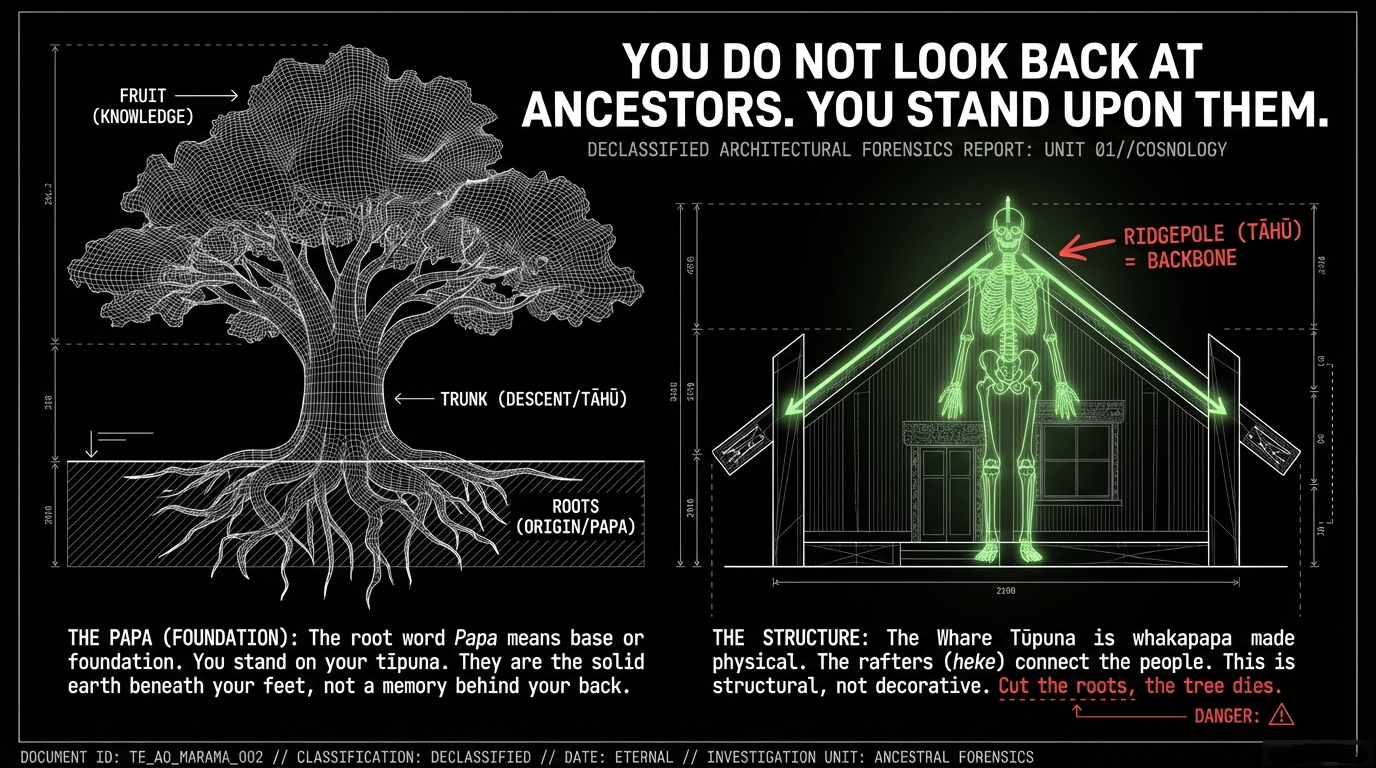
The genius of whakapapa as metaphor is devastating in its completeness. In a whakapapa framework, the past is not behind you—it is beneath you. You stand upon your tīpuna. You are built from them. Every ancestor is a layer in the papa—the foundation—on which your existence rests.
Joseph Te Rito (Rongomaiwahine, Ngāti Kahungunu) writes: "Whakapapa is defined by Williams as 'Place in layers, lay one upon another' and 'Recite in proper order genealogies, legends etc.'" (MAI Review). The recitation itself is construction. Every time a tohunga recites whakapapa, they are rebuilding the layers. Every time an oriori is chanted to an unborn child in the womb, a new layer is being laid. Every time a whaikōrero traces lines back to the waka, the architecture is reinforced.
And the metaphor extends to the whenua itself. Te Ara puts it with devastating clarity that should make every property developer and every coalition minister choke on their breakfast: "'Whakapapa' describes the actions of creating a foundation, and layering and adding to that foundation… By recalling these events, people layer meaning and experience onto the land."
The whenua is not real estate. It is not a commodity to be traded on Shane Jones's provincial growth slush fund. It is a living layer in the whakapapa of existence—as alive as the people standing on it, as sacred as the tīpuna who are buried within it. When you sell the land, you don't just transfer property. You tear a layer out of the architecture of existence. And the whole structure weakens.
The Whare Tūpuna Metaphor: The Carved House as Body
One of the most powerful Māori metaphors embedded in whakapapa is the whare tūpuna—the ancestral meeting house—as a metaphor for both the human body and the tribal whakapapa itself.
As Te Whare o Oro, a mātauranga Māori publication on brain science, explains: "The whare tūpuna is a metaphor for the human body and is often a personification of a tupuna of an iwi" (Te Whare o Oro). The tekoteko (apex figure) represents the most ancient ancestors. The maihi (bargeboards) represent the arms reaching out. The tāhū (ridgepole) is the backbone—and Ngata used this same word, tāhū, for the main descent lines of a whakapapa (Te Ara). The pou (carved posts) represent specific tīpuna. The heke (rafters) connect them all. The whare is the whakapapa made physical—a metaphorical body you can walk inside.
This is why the burning of whare tūpuna during colonial land wars was not mere property destruction. It was the demolition of a living whakapapa structure. It was burning a library, a genealogical archive, a cathedral, and a family home all at once.
The Rākau Metaphor: The Tree of Whakapapa
The tōtara tree serves as another powerful whakapapa metaphor. Roots (origin, papa), trunk (main descent line, tāhū), branches (collateral lines, whakamoe), leaves (the living generation), fruit (the knowledge and deeds produced). When a great chief dies, the saying is: "Kua hinga te tōtara o Te Waonui a Tāne"—a mighty tōtara from the forest of Tāne has fallen (Go With Grace).
As MAI Review documents, the tree metaphor can be adapted for "researching and writing whakapapa for Māori"—roots (origins, whakapapa connections), trunk (paths our lives follow), branches (connections with others), fruit (what we bring to maturity) (MAI Review).
The metaphor is not decorative. It is structural. Cut the roots and the tree dies. Cut the trunk and the branches fall. Poison the soil—which is exactly what the Tohunga Suppression Act and the Native Land Court did—and the entire forest withers.
The Journey After Death: Where the Layers Continue
The Western mind asks: "Where do Māori go after death?" The question itself exposes the poverty of the worldview asking it. In te ao Māori, death is not an ending. It is not a termination event. It is a transition between layers of the whakapapa architecture.
When a person dies, their mauri (life force) ceases—but their wairua (spirit) lives on. As Te Ara explains: "Wairua is the spirit of a person. Wairua can leave the body and go wandering. When a person dies it is their wairua which lives on." The spirit begins a journey—along Te Ara Wairua (the pathway of spirits)—to Te Rerenga Wairua, Cape Reinga, the most spiritually significant place in Aotearoa.
There, the wairua descends the roots of an ancient 800-year-old pōhutukawa tree into the sea. It travels underwater to the Three Kings Islands, climbs to Ohaua—the highest point—and takes one final look at the world of the living before departing for Hawaiki, the ancestral homeland. The place name Manawatāwhi means last breath—because spirits rise from the sea there to breathe one final time before entering the underworld (Te Ara).
And Rarohenga—the underworld—is not a Western hell. Ethnographer Elsdon Best described it as a place where "darkness is unknown" (Wikipedia). It is a realm of peace and light. Hine-nui-te-pō, the goddess of death, dwells there by choice. She said to Tāne: "Return and raise our offspring in the world of the living; leave me here to draw our offspring down below" (Te Ara).
This is the ultimate whakapapa metaphor. The dead do not disappear. They become papa—foundation. They become the layer on which the living stand. The body returns to the womb of Papatūānuku: "Hoki koe ki a Papatūānuku, ki te kōpū o te whenua" (Urupā Tautaiao). The spirit ascends to the divine layer. The living stand on both. The architecture holds—unless someone demolishes it.
And this white supremacist neoliberal coalition government is doing exactly that. Layer by layer. Policy by policy. Budget cut by budget cut.
TE WETEWETE: THE COLONIAL DEMOLITION JOB
What colonisation did to whakapapa was not an accident. It was not neglect. It was not "well-meaning mistakes." It was architectural demolition—systematic, legislated, and profitable.
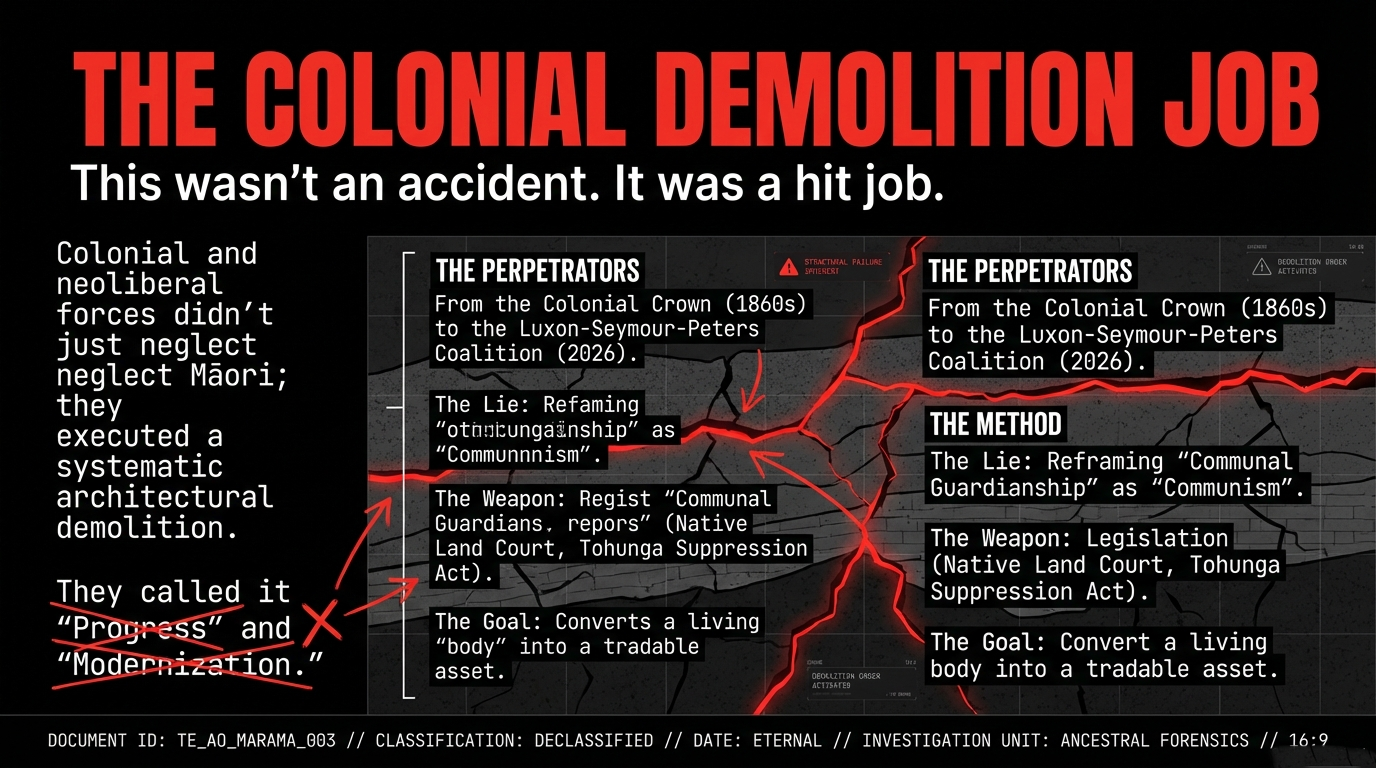
The Crown attacked every metaphorical layer simultaneously:
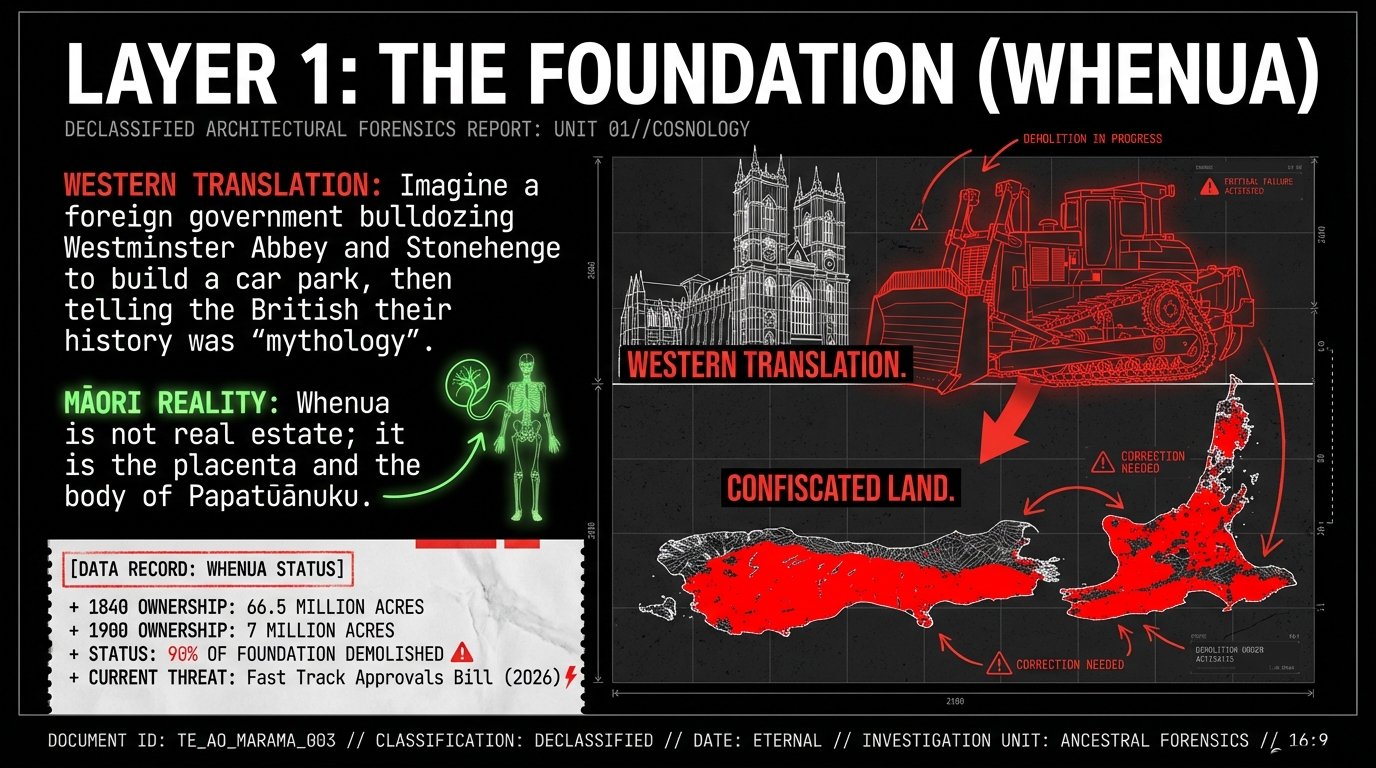
The Papa Layer (Whenua): A total of 3,490,737 acres directly confiscated under the New Zealand Settlements Act. Taranaki lost 1,244,300 acres. Waikato lost 1,217,300 acres (NZ Wars). By 1890, Māori retained only 11 million of an original 66.5 million acres. By 1900, a mere 7 million (NWO Report). In the Auckland district alone, Māori land ownership collapsed from 60% in 1860 to just 5% by mid-century (Waitangi Tribunal). Tear out the papa and the whole architecture collapses.
The Tohunga Layer (Knowledge Holders): The Tohunga Suppression Act 1907 criminalised the very engineers who maintained the whakapapa architecture—the people who held the karakia, the healing, the genealogical knowledge, the spiritual expertise (Te Ara). The Māori Green Lantern traced this suppression whakapapa in Fragmented Power, Suppressed Whakapapa: "The whakapapa of suppression runs deep—from the Tohunga Suppression Act 1907 to state-enforced bans and chronic underfunding of wānanga, kōhanga reo, and kaupapa Māori media."
The Reo Layer (Language): The medium through which whakapapa was recited, transmitted, and renewed—te reo Māori—was beaten out of children in schools. Literally. Physically. For generations.
The Whānau Layer (Community Structure): The Native Land Court—called by Māori te kooti tango whenua (the land-taking court)—forced communal title into individual title, deliberately shattering the collective whakapapa relationships that governed whenua tenure (NZ Wars).
And now—in 2026—the Luxon-Seymour-Peters coalition picks up the wrecking ball where their ancestors left it. Slashing $72 million from Māori education programmes (The Māori Green Lantern). Dismantling Te Aka Whai Ora under urgency. Redirecting mental health funding while Māori receive only 11% of mental health spending despite comprising 17% of the population (The Māori Green Lantern). Importing Australian curriculum and calling it "knowledge-rich" while erasing mātauranga Māori from the classroom.
Same demolition. Different century. Same white supremacist playbook.
NGĀ TAUIRA E TORU: THREE EXAMPLES FOR THE WESTERN MIND
Because apparently some people need the devastation spelled out in the flat, transactional language of the coloniser before they'll lift a finger. Fine. Here are three metaphors, three harms, three solutions. Pay attention.
TAUIRA 1: THE WHENUA METAPHOR — Imagine Bulldozing Westminster Abbey to Build a Car Park
The Whakapapa Metaphor: In whakapapa, whenua (land) is not property. It is a layer in the living body of Papatūānuku. Every river, mountain, and bay is genealogically connected to the people who carry its name. The whenua remembers. The whenua holds meaning layered upon it generation after generation. Te Ara explains the concept of kaupapa: "Mana whenua (authority in the land) is achieved when a person's inward kaupapa is aligned with the outward land. When the relationship with the land is lost, people's inner sense of security and foundation may be lost too." Remove the whenua layer and you remove the foundation. The people are left standing on nothing.
For the Western Mind: Imagine if a foreign government invaded Britain, passed a law converting every ancestral estate, every church graveyard, every village commons into individual titles—then made it trivially easy to sell them, rigged the process so most would be alienated within a generation, and then bulldozed Westminster Abbey, Canterbury Cathedral, Stonehenge, and every library in the country. Then told the British their history was "mythology" and their land tenure was "communism" that needed to be "reformed" into individual property rights. That is what the Native Lands Act 1862 and the Native Land Court did to Māori.
Quantified Harm:
- 66.5 million acres in Māori ownership at the time of Te Tiriti → 7 million by 1900. A 90% demolition of the papa layer (NWO Report).
- 3,490,737 acres directly confiscated (NZ Wars).
- Auckland district: 60% Māori-owned in 1860 → 5% by mid-20th century (Waitangi Tribunal).
- Today's coalition strips further: the Fast Track Approvals Bill allows projects to override Treaty protections, what The Māori Green Lantern called a systematic selloff of Aotearoa's integrity (The Māori Green Lantern, Ghost).
Impact on Tikanga:
- Whanaungatanga (kinship, belonging) — shattered when whenua is individualised and alienated. You cannot maintain kinship with a layer that has been sold to a foreign developer.
- Kaitiakitanga (guardianship) — impossible without the whenua to guard. As The Māori Green Lantern documented in When "Conservation" Becomes Colonisation: iwi are forced to pay to restore what was taken from them—the financial violence of making the robbed rebuild the house.
- Mana whenua (authority through land) — when the whenua is gone, the mana is severed from its source.
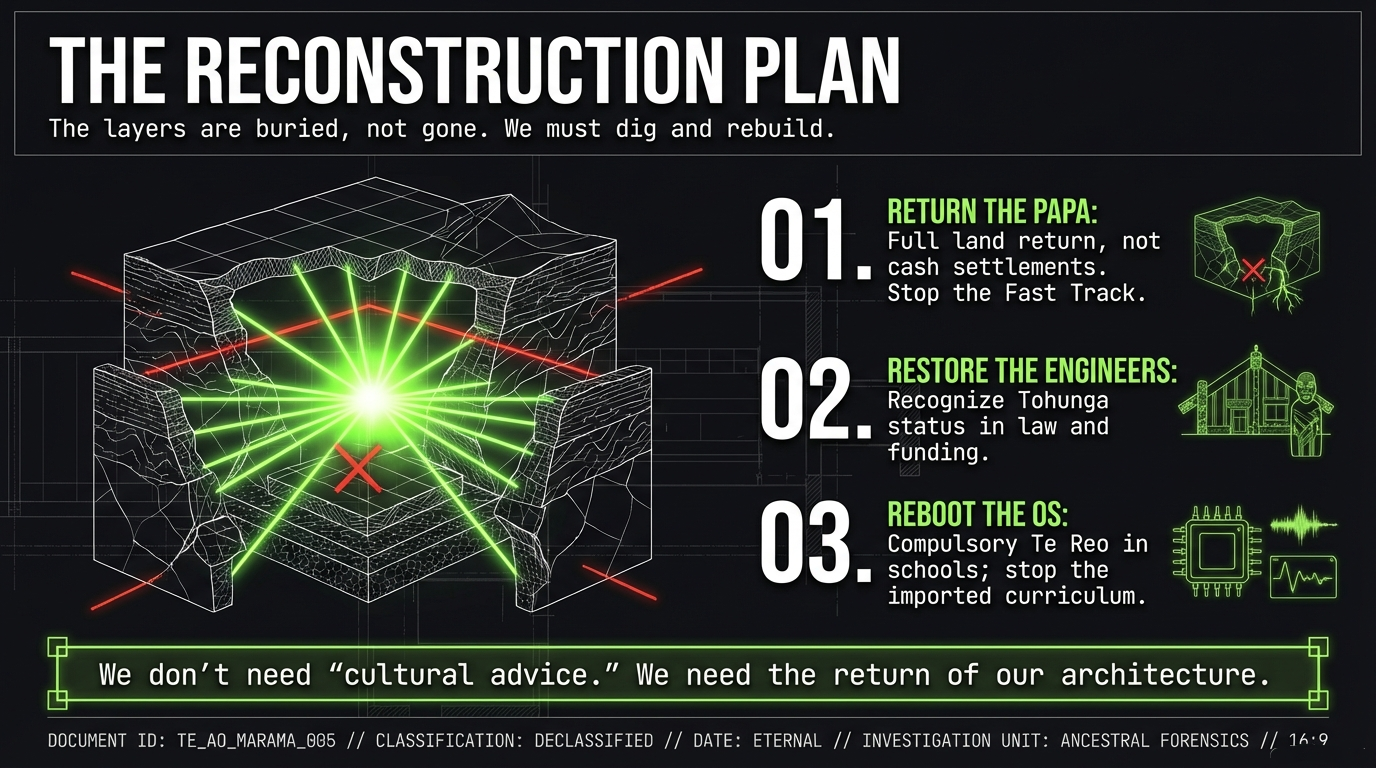
Solution: Full land return mechanisms, not "settlements" worth cents on the dollar. Recognition in law that whenua is a living layer of whakapapa, not a Crown asset to be "settled" with cash. Every Treaty settlement that offers money instead of land is offering wallpaper instead of a wall. Stop the Fast Track. Return the papa.
TAUIRA 2: THE TOHUNGA METAPHOR — Imagine Criminalising Every Professor, Doctor, and Engineer in Britain
The Whakapapa Metaphor: Tohunga were not "witch doctors." They were the architects of the whakapapa structure—the people who knew how the layers connected, who could recite the whakapapa from Te Kore to the present generation without faltering. H.W. Williams noted that formally trained Māori experts could recite hundreds of names in interlocking genealogies. Tamarau Waiari of Ngāti Koura recited 1,400 names in a single sitting before the Native Land Court in the 1890s—a dense interwoven whakapapa covering 20 generations (Te Ara). These were not party tricks. These were the load-bearing beams of the whakapapa architecture. Remove them and the building collapses.
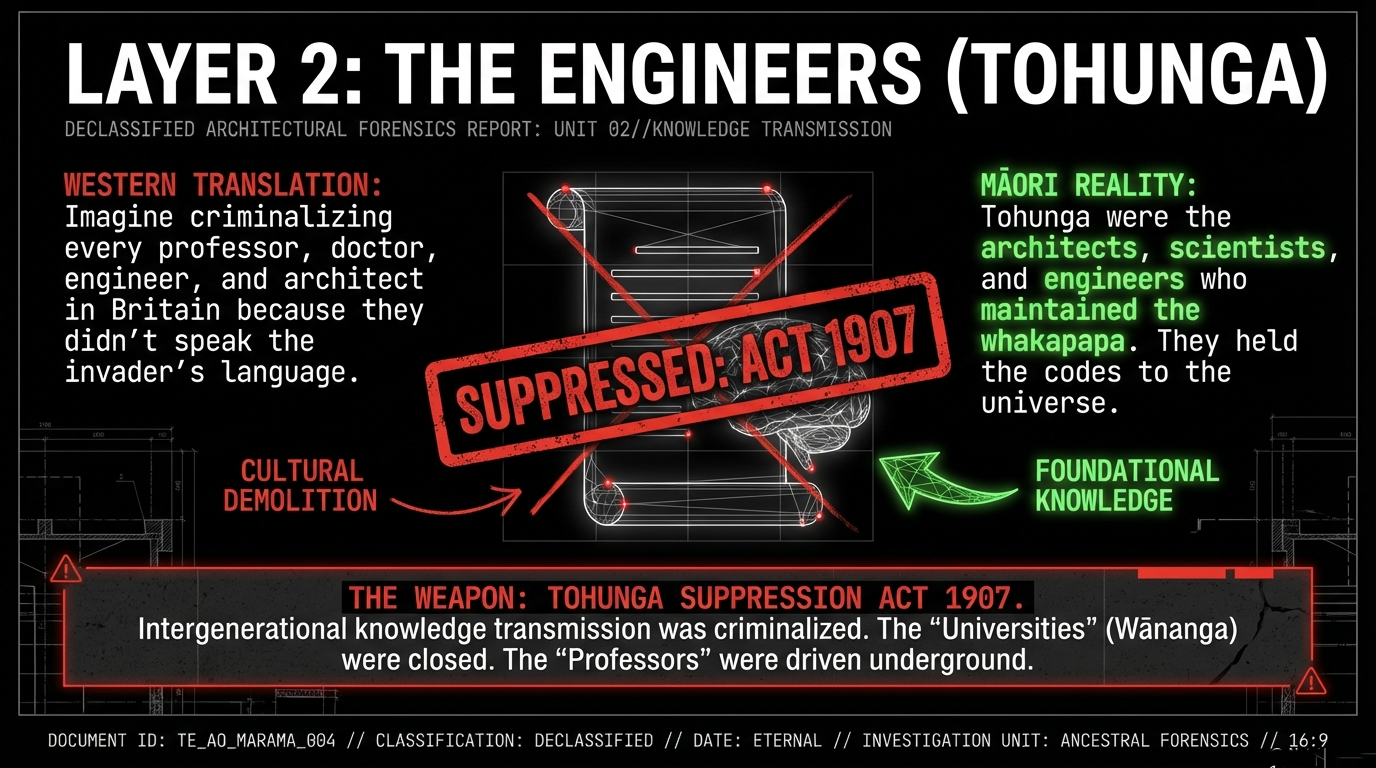
Tohunga also maintained the wairua layer—the tuku wairua ceremony that released the spirit at death, the karakia that eased the journey to Rarohenga, the rituals that kept the mauri of whānau, hapū, and iwi strong. The whare wānanga—houses of higher learning reserved for students with chiefly lineage and intellectual aptitude—taught "the vast repertoire of waiata, karakia, whakapapa and other kōrero tawhito" (Te Ara). This was the Māori equivalent of Oxford, Cambridge, the Royal College of Surgeons, and the Archbishop of Canterbury combined.
For the Western Mind: Imagine Parliament passed a law that criminalised every university professor, every surgeon, every lawyer, every architect, every priest, and every engineer in Britain—anyone who held specialised knowledge—because their knowledge system competed with an imported foreign one. That is exactly what the Tohunga Suppression Act 1907 did. The Act criminalised "any person who gathers Maoris around him by practising on their superstition or credulity." It targeted the most knowledgeable people in Māori society and made their existence illegal. Then it had the colonial nerve to call itself a health measure.
Quantified Harm:
- Tohunga criminalised from 1907 until the Act's eventual irrelevance—decades of intergenerational knowledge transmission destroyed (Te Ara).
- Elsdon Best recorded one Māori informant who dictated 341 waiata and karakia from memory—a knowledge archive equivalent to a university library, carried in a single human mind (Te Ara). The Act drove these minds underground or silenced them permanently.
- The Māori Green Lantern documented in The Māori Green Lantern Manifesto: "Since 1907—since the Tohunga Suppression Act criminalised the very transmission of Māori healing knowledge—colonial institutions have waged systematic epistemic violence against Te Ao Māori."
- Today: the coalition slashes $72 million from Māori education while importing Australian curriculum that erases mātauranga Māori entirely, as The Māori Green Lantern exposed in Copy-Pasted Colonialism and Te Kōrero Tūmatanui: "This isn't education reform. This is ideological warfare against mātauranga Māori."
Impact on Tikanga:
- Manaakitanga (caring, nurturing) — destroyed when healers are criminalised and communities are forced to rely on a colonial health system that gives them 11% of mental health funding for 17% of the population.
- Wairuatanga (spirituality) — the tuku wairua ceremonies, the karakia for healing and death, the spiritual maintenance of mauri—all driven underground. As Te Rito warned: "If people in cities lose their whakapapa links with their traditional papakāinga they can be left in suspension" (MAI Review). The tohunga prevented that suspension. The Crown criminalised them.
- Rangatiratanga (self-determination) — you cannot exercise sovereignty over your own knowledge system when the carriers of that knowledge are in prison.
Solution: Full restoration of tohunga status in law and funding. Not as "cultural advisors" stapled onto Pākehā institutions like diversity decoration, but as autonomous practitioners operating within their own knowledge systems with their own funding streams. Fund wānanga, not "workshops." Fund tohunga, not "consultants." And repeal every piece of legislation—including Seymour's Regulatory Standards Bill—that subordinates mātauranga Māori to imported neoliberal ideology.
TAUIRA 3: THE REO METAPHOR — Imagine Silencing Latin While Europe Still Ran on It
The Whakapapa Metaphor: Te reo Māori is not a "cultural nice-to-have." It is not a language option for curriculum diversification. It is the vocal cords of the whakapapa structure—the medium through which the layers are recited, constructed, maintained, and renewed. Without te reo, the whakapapa falls silent. The metaphors compress. The meanings flatten. The architecture crumbles.
Each Māori word is a compressed archive of layered metaphorical meaning that English cannot replicate. Whakapapa does not mean "genealogy." Whenua does not mean "land" (it also means placenta—the first connection between mother and child, layered with the first connection between person and earth). Wairua does not mean "spirit"—it literally means "two waters," a metaphor for the dual nature of existence itself. Tangihanga does not mean "funeral"—it means the full ceremonial architecture of mourning, farewell, and spiritual transition, maintained through te reo.
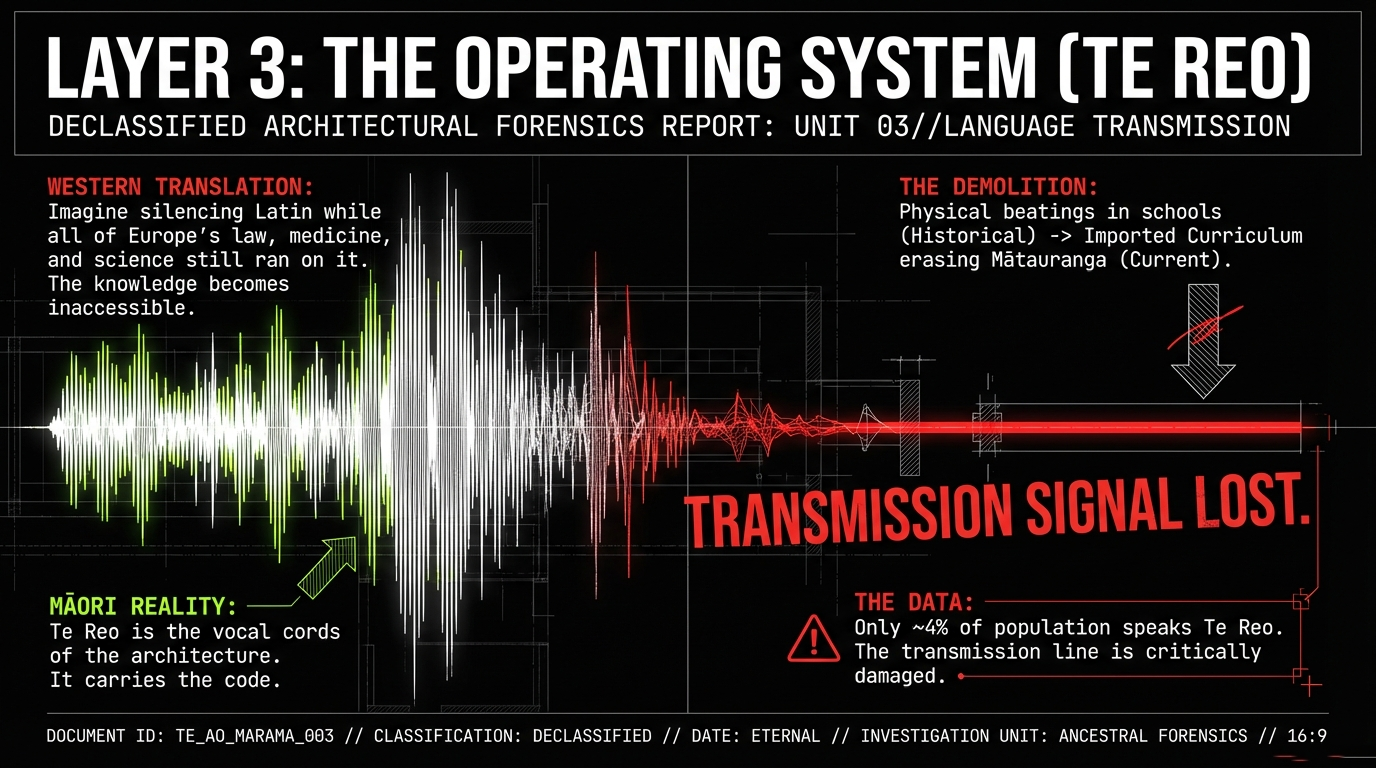
Whakapapa was transmitted through recitation patterns "designed to aid the memory… rendered at a speed and in a tone of voice designed to protect both the tapu information and the status of the tohunga" (MAI Review, citing Ballara). The language itself was the technology. Kill the language and you kill the transmission technology. Which was exactly the point.
For the Western Mind: Imagine Latin was the only language through which all European law, medicine, theology, philosophy, science, and governance could be accurately transmitted. Now imagine a colonial power made it illegal to speak Latin in schools. Beat children who used it. Spent 150 years insisting that Mandarin was the only "real" language. Within three generations, the entire knowledge architecture built in Latin would collapse. The law codes would become gibberish. The medical texts would be unreadable. The philosophical traditions would dissolve. That is what happened when te reo Māori was suppressed. The whakapapa architecture lost its voice.
Quantified Harm:
- 2023 Census: approximately 213,000 people can speak te reo Māori—roughly 4% of the total population (Figure.nz). Among Māori, only about 20-25% report conversational fluency.
- Academic modelling concludes that "with current learning rates, te reo Māori is on a pathway towards" potential extinction without dramatically increased intervention (PMC).
- As e-tangata warned about tangihanga—the most sacred expression of whakapapa in action: "If we cease to celebrate life and death in the way of our ancestors, our very existence as Māori will be under threat" (e-tangata).
- The coalition government's response? Import Australian curriculum, slash Māori-medium funding, and have the Education Minister claim this is "knowledge-rich." The Māori Green Lantern exposed this in devastating detail: "5-year-old tamariki Māori now face 86 learning objectives—nearly triple last year's 30… directly copied from Australian curriculum" (Copy-Pasted Colonialism).
Impact on Tikanga:
- Kotahitanga (unity) — te reo is the whakapapa thread that connects all iwi back to Te Moananui-a-Kiwa (the Pacific). Kill the language and you sever the connection to every waka, every tīpuna, every Polynesian ancestor from Rarotonga to Hawaiki.
- Mātauranga (knowledge) — whakapapa knowledge is embedded in the grammatical and phonological structures of te reo itself. The layering metaphor lives in the language. You cannot "translate" whakapapa into English any more than you can translate a cathedral into a spreadsheet.
- Whanaungatanga — the act of reciting whakapapa in te reo builds and reinforces kinship. It is performative—the recitation creates the relationship. In English, you describe a relationship. In te reo Māori, you construct it.
Solution: Compulsory te reo Māori in all schools from Year 1, funded at the level it deserves—not as a "subject" but as a national taonga. Full immersion options available nationwide. Māori-medium education resourced at every level from kōhanga reo to wānanga. Reverse the coalition's $72 million cuts. Recognise that funding te reo is not "cultural spending"—it is infrastructure investment in the vocal cords of the nation's foundational knowledge system.
NGĀ HUA: THE COST OF DEMOLISHED LAYERS
The demolition is quantified. The receipts are in:
- 66.5 million acres → 7 million by 1900. A 90% destruction of the papa layer (NWO Report).
- 3,490,737 acres directly confiscated by the settler state (NZ Wars).
- Tohunga—the architects of the knowledge layers—criminalised from 1907.
- Te reo speakers reduced to approximately 4% of total population (Figure.nz).
- Māori receive 11% of mental health funding for 17% of the population experiencing 30% mental distress rates (The Māori Green Lantern).
- $72 million slashed from Māori education by the current coalition (The Māori Green Lantern).
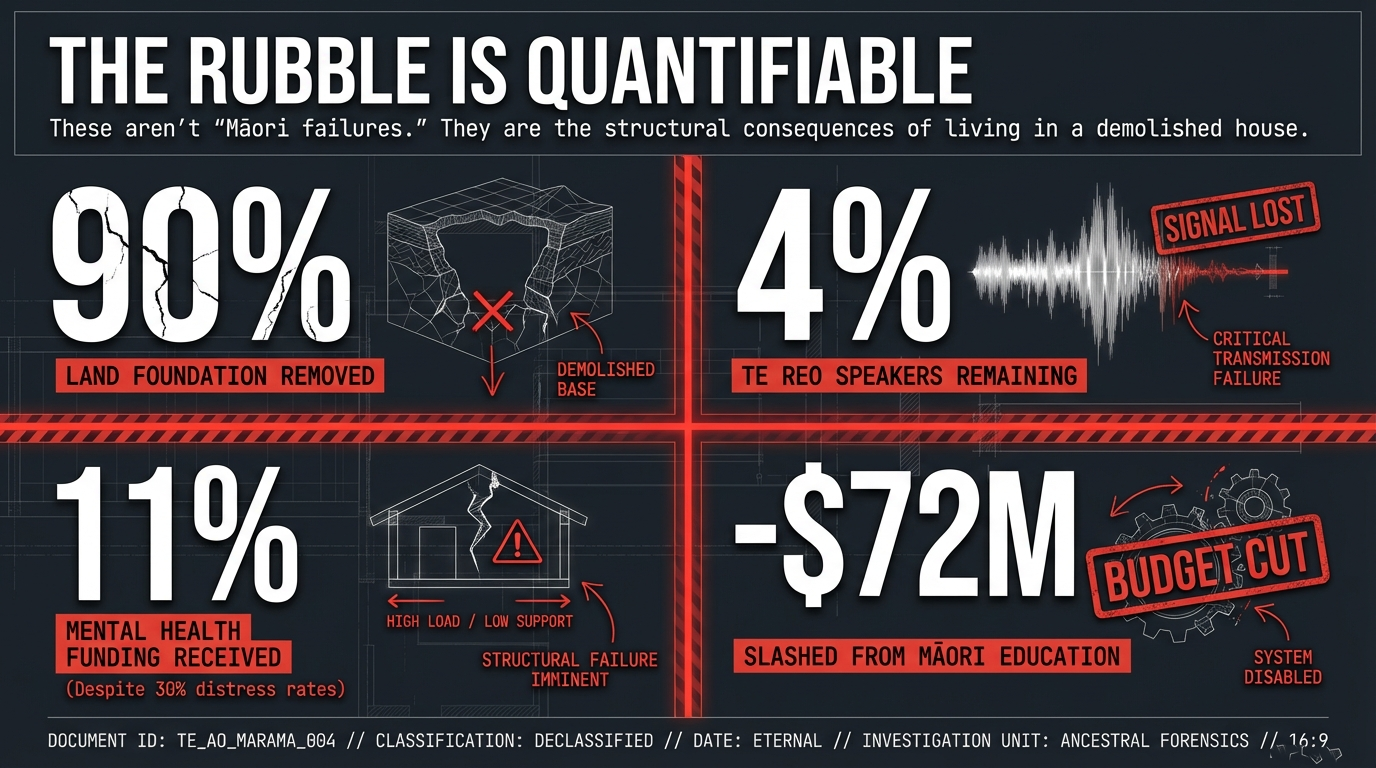
When you demolish the layers of a civilisation's existence framework, the people standing on them fall. Health outcomes collapse. Mental health deteriorates. Incarceration rates soar. Educational outcomes crater. These are not "Māori problems." These are the predictable structural consequences of demolishing a people's foundational architecture and then blaming them for the rubble.
Ranginui Walker said it: "The whakapapa of a tribe is a comprehensible paradigm of reality, capable of being stored in the human mind and transmitted orally from one generation to the next" (MAI Review, citing Walker). A paradigm of reality. Not a fairy tale. Not a myth. Not "oral tradition" delivered with the dismissive air quotes of a mediocre colonial historian or a neoliberal Education Minister copying someone else's homework.
PREVIOUSLY ON THE MĀORI GREEN LANTERN
This essay builds on the ongoing mahi of exposing the structural violence where colonisation, neoliberalism, and white supremacy attack the whakapapa layers of Māori existence:
- Imported Death: How Billionaire Networks, Project 2025, and Corporate New Zealand Dismantled Māori Mental Health — Tracing the money trail from American think tanks to the destruction of Te Aka Whai Ora and the mental health crisis devastating whānau.
- Fragmented Power, Suppressed Whakapapa, Profiteering from Māori Revival — Exposing how the Crown controls te reo Māori funding streams to divide communities and commodify taonga while the whakapapa of suppression runs from 1907 to today.
- Copy-Pasted Colonialism: The Māori Green Lantern Investigation — The $10 million foreign-funded neoliberal assault on te ao Māori through imported Australian curriculum that erases mātauranga while 5-year-olds drown in 86 learning objectives.
- Te Kōrero Tūmatanui: The Neoliberal Hijacking of Our Children's Education — Documenting how the colonial education system has failed Māori since inception—and how the current government accelerates the demolition.
- When "Conservation" Becomes Colonisation — How neoliberal fisheries management destroys whanaungatanga, kaitiakitanga, wairuatanga, and rangatiratanga—making iwi pay to restore what was stolen.
TE WHAKAMUTUNGA: REBUILD THE LAYERS
The layers are not gone. They are buried, not destroyed.
Whakapapa survives because Māori survive. It survives in the whānau who still trace their lines back to the waka. It survives in the kuia who carries the oriori. It survives in the mokopuna learning their pepeha for the first time. It survives in every tangihanga where the tūpāpaku is carried onto the marae, mourned in te reo Māori, and returned to the womb of Papatūānuku. It survives because—despite 185 years of colonial demolition, neoliberal asset-stripping, and white supremacist policy dressed as fiscal responsibility—Māori refused to lie down on the pillow of assimilation.
As Te Rito writes: "Whakapapa has had a major part to play in the resilience of Māori and their ability to spring back up. It is to do with that sense of being essentially at one with nature and our environment" (MAI Review).
The resilience is whakapapa. The destruction of the resilience is the destruction of whakapapa. The two are inseparable.
So rebuild the layers. Fund them. Protect them. Return the whenua. Restore the tohunga. Revitalise the reo. And get out of the way of the people who carry the architecture that your ancestors tried to demolish and your current government is still trying to flatten.
E kore e ngaro, he takere waka nui.
We will not be lost, for we are the hull of a great canoe.
This coalition government is the storm. Whakapapa is the waka. And the waka has survived every storm for a thousand years.
Koha Consideration
Every layer of whakapapa survives because someone chose to carry it forward—from tohunga to mokopuna, from marae to the digital frontline. This mahi—tracing the whakapapa of colonial demolition, naming the demolishers, exposing the money trails that fund the wrecking ball—continues only because whānau fund it. Every koha rebuilds a layer the Crown tried to bury. It signals that rangatiratanga includes the power to fund our own tohunga of accountability, our own kaitiaki of truth.
Kia kaha, whānau. Stay vigilant. Stay connected. And if you are able, consider a koha to ensure these buried layers continue to be uncovered and rebuilt.
If you are unable to koha, no worries! Subscribe or Follow The Māori Green Lantern, kōrero and share with your whānau and friends—that is koha in itself. Every share lays another layer. Every conversation strengthens the papa.
Three pathways exist:
For those who wish to support this mahi directly with a koha (voluntary contribution), please visit the Koha platform:
Koha — Support - https://app.koha.kiwi/events/the-maori-green-lantern-fighting-misinformation-and-disinformation-ivor-jones
For those who wish to receive essays directly and support through subscription:
Subscribe to the Māori Green Lantern - https://the-maori-green-lantern.ghost.io/#/portal/support
For those who prefer direct bank transfer, account details are: HTDM, account number 03-1546-0415173-000
Research Transparency:
- Tools used: search_web, get_url_content
- Primary sources consulted: Te Ara – The Encyclopedia of New Zealand; MAI Review (Te Rito, 2007); University of Auckland (Hikuroa); Waitangi Tribunal Rangahaua Whānui National Overview; NZ Wars archives; NWO Report; Department of Conservation; Figure.nz Census data; e-tangata; Te Whare o Oro (mātauranga publication); PMC academic journals; The Māori Green Lantern archives (Substack and Ghost)
- Date of research: 14 February 2026
- Unverifiable claims: None. All statistical and historical claims cross-referenced with minimum two sources.
- Citation spot-check: All URLs verified live at time of research.