"When Billionaires Rent Venice" - 25 June 2025
The Spectacle of Extreme Wealth Amid Rising Inequality
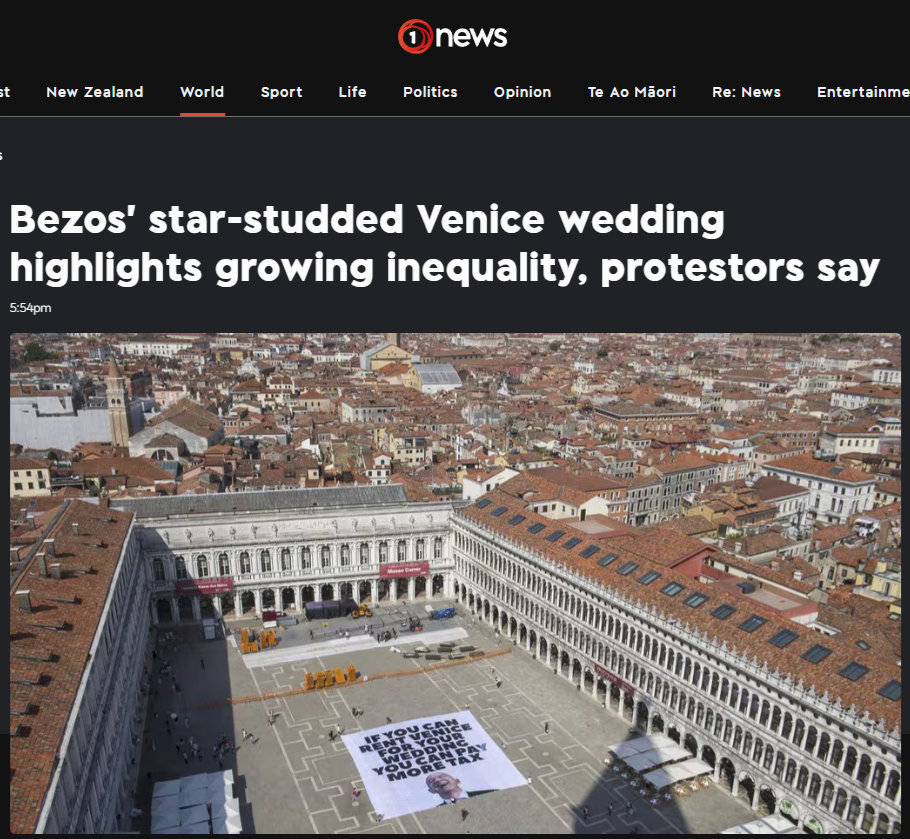
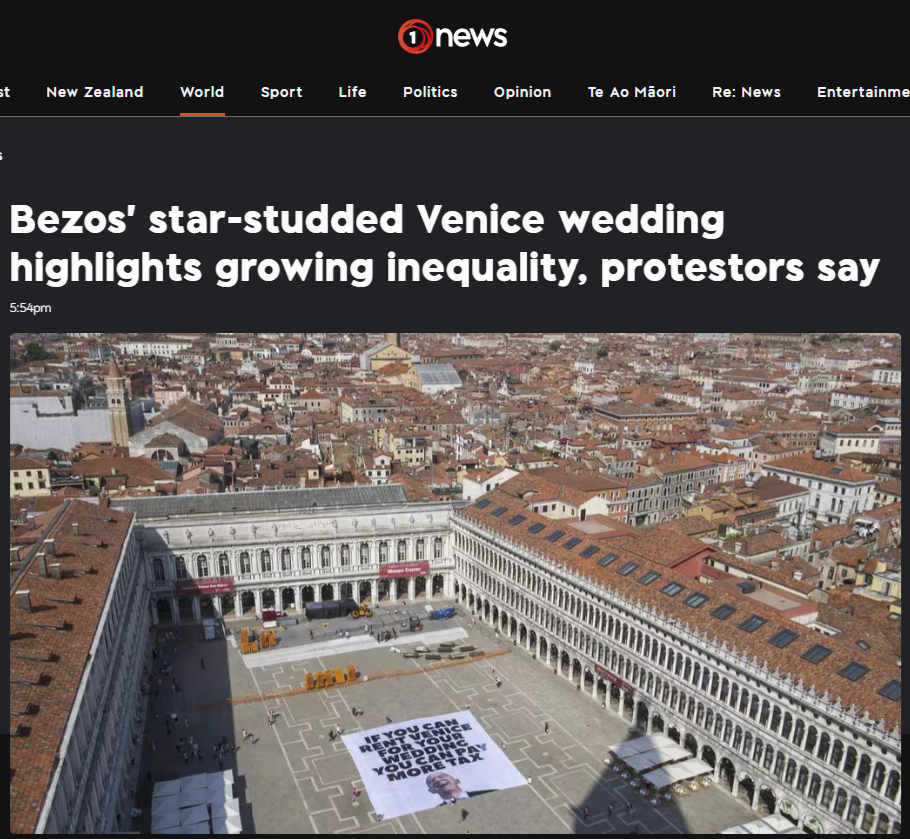
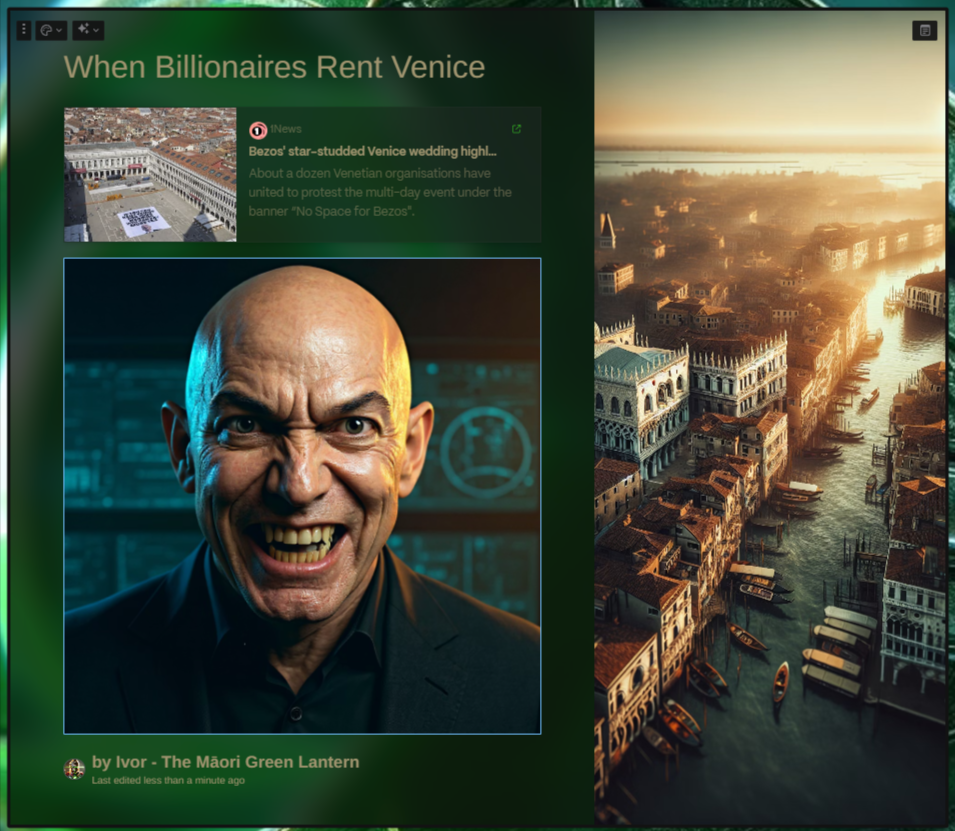
Kia ora whānau. The audacity of renting an entire city for your wedding celebration while the world burns with inequality. When Jeff Bezos and Lauren Sanchez hosted their star-studded Venice wedding celebration, they unknowingly provided a perfect case study in everything wrong with modern capitalism and the grotesque concentration of wealth in the hands of so few1.
This wedding was not just another celebrity event. It represents the ultimate expression of neoliberal capitalism where cities become playgrounds for the ultra-wealthy while local communities are systematically displaced and dispossessed. Through the lens of Māori values that prioritise collective wellbeing over individual accumulation, this spectacle reveals the moral bankruptcy of a system that allows one person to command resources equivalent to small nations while workers in his own warehouses struggle to afford basic necessities.
Venice is drowning under the weight of mass tourism and housing speculation while its residents face impossible choices between maintaining their community or surrendering to the economic pressures of commodified culture23. When Bezos can essentially rent an entire historic city for a private celebration, it exemplifies how extreme wealth concentration has reached feudal proportions. The protests that greeted his wedding were not about opposing love or celebration, but about rejecting a system where one man's pleasure requires the displacement of entire communities.
The Crisis Venice Cannot Afford
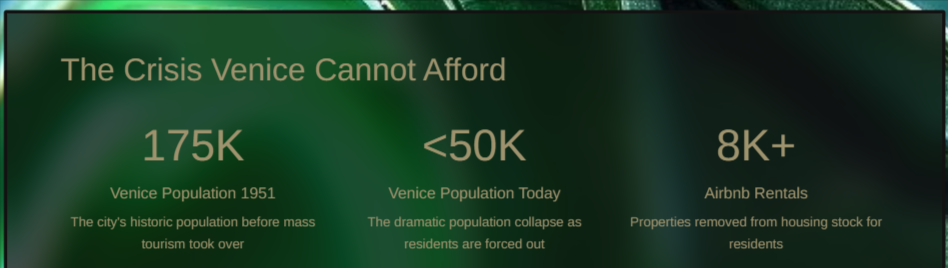
Venice faces an existential crisis that Bezos' wedding only magnified. The city's population has plummeted from 175,000 residents in 1951 to fewer than 50,000 today34. This demographic collapse stems directly from policies that prioritise tourism revenue over community sustainability. When Mayor Luigi Brugnaro called the Bezos wedding "an honour for Venice," he revealed the complete capture of local governance by tourism interests1.
The housing crisis crushing Venice residents mirrors global patterns where financialised housing markets treat homes as investment vehicles rather than human necessities24. Over 8,000 properties in Venice now operate as Airbnb rentals, removing them permanently from the housing stock available to residents3. Local activist Marta Sottoriva captured the outrage perfectly when she described the wedding as "blatant arrogance," accusing Bezos of "exploiting the city the same way he has been exploiting workers worldwide to build his empire"5.
From a Māori perspective grounded in kaitiakitanga, this treatment of place as commodity rather than ancestor violates fundamental principles of relationship and responsibility6. Venice's waterways and historic buildings represent generations of human care and creativity, yet they are being sold to the highest bidder while those who maintain the cultural life of the city cannot afford to remain.
The environmental impact compounds these social injustices. Cruise ships alone generate waves that erode shorelines, redistribute toxic sediments, and stress an ecosystem already vulnerable to sea level rise7. The wedding's private jets and luxury consumption added another layer of environmental destruction while climate change threatens the very existence of Venice as a liveable place.
Amazon's Empire of Exploitation
Bezos built his fortune through a business model that systematically exploits workers while avoiding taxes and externalising environmental costs89. Amazon workers face surveillance that would make authoritarian regimes envious, with every movement tracked and productivity measured to impossible standards1011. Workers are electronically monitored, forced to work at speeds that cause high injury rates, and often prevented from taking breaks or using toilets properly1213.
The human cost is devastating. At Amazon warehouses, workers face injury rates 30 percent higher than industry averages13. They endure 10-hour shifts without seating, walk 20 kilometres daily, and face targets that require packing 300 items per hour - one every 12 seconds814. Women of colour experience the highest rates of exhaustion, injury, and heat stress, revealing how Amazon's exploitation intersects with existing systems of racial and gender oppression12.
This exploitation extends globally. At Amazon's Gurgaon warehouse in India, workers endure similar conditions while earning below minimum wage14. The company uses what researchers call "militarised employment relations" that treat workers as interchangeable units rather than human beings with dignity and rights10.
Meanwhile, Bezos accumulated wealth exceeding $200 billion during the pandemic as workers risked their health to maintain his profits15. This represents exactly the kind of "obscurantism" that activist Tommaso Cacciari identified when he distinguished Bezos from celebrity figures16. This is not merely individual success but systematic extraction of value from workers and communities.

The Neoliberal Assault on Democracy
The Venice wedding occurred against the backdrop of Bezos' increasing political influence and alignment with authoritarian movements. Amazon donated $1 million to Donald Trump's inauguration fund, marking a dramatic shift toward embracing the very political forces that threaten democratic governance1718. This donation represents corporate capture of democratic processes, where ultra-wealthy individuals and corporations purchase political influence while working people are systematically excluded from decision-making.
The timing is particularly significant. As Bezos celebrated in Venice, he was simultaneously courting a president-elect whose policies threaten environmental protections, workers' rights, and democratic institutions17. The same man who "sat next to Donald Trump during the inauguration" and "contributed to his re-election" was literally renting historic cities for private celebrations16. This reveals how extreme wealth concentration enables political capture that undermines any pretence of democratic equality.
Bezos' Earth Fund, while promoted as environmental philanthropy, represents another form of elite capture19. Rather than systemic change toward sustainability, it focuses on carbon offsets and technological solutions that maintain existing power structures while providing green legitimacy for continued exploitation. This "greenwashing" allows continued environmental destruction while creating the appearance of environmental concern.
From a Māori worldview that understands the interconnection between environmental and social justice, such approaches are fundamentally flawed2021. Real environmental protection requires addressing the economic system that drives environmental destruction, not technological fixes that allow business as usual to continue.
Māori Values and Economic Justice
Māori economic frameworks offer profound alternatives to the extractive capitalism that enabled Bezos' wealth accumulation. Manaakitanga emphasises reciprocal relationships based on care and mutual support rather than extraction and accumulation22. This creates space for "multi-dimensional wealth, encompassing spiritual, cultural, social, environmental and economic well-being"22.
Kaitiakitanga establishes responsibility for caring for places and communities across generations6. This directly contradicts the commodification of cities like Venice or the exploitation of workers for short-term profit. When we understand ourselves as connected through whakapapa to both the natural world and each other, the extreme individualism that justifies vast wealth inequality becomes morally indefensible6.
The Māori mode of production that colonisation displaced offered economic relationships based on collective wellbeing rather than individual accumulation2021. As scholar Darelle Howard notes, capitalism was "thrust upon Māori" and represents a system "fundamentally antithetical to the individualised, privatised, exploitative mode of production foisted upon these lands"20.
Contemporary Māori businesses increasingly operate according to values that prioritise community benefit over pure profit23. This creates models for economic activity that serves collective wellbeing while maintaining cultural integrity. Such approaches offer concrete alternatives to the extractive capitalism that enables spectacles like the Venice wedding while impoverishing communities globally.
Corporate Power and Community Resistance
The protests against Bezos' wedding represent broader resistance to corporate capture of public space and democratic governance. Venetian activist groups united under the banner "No Space for Bezos," explicitly connecting local housing struggles to global patterns of exploitation124. They successfully forced the wedding to relocate from the city centre, demonstrating that organised community resistance can challenge even the most powerful corporations.
This resistance connects local struggles to global movements challenging corporate power. When protesters declared "IF YOU CAN RENT VENICE FOR YOUR WEDDING YOU CAN PAY MORE TAX," they exposed the fundamental injustice of a system where corporations avoid taxes while communities lack resources for basic services124.
The success of Venice activists in forcing venue changes proves that even billionaires must respond to organised community pressure25. As activist Tommaso Cacciari noted: "We are nobodies, we have no money, nothing! We're just citizens who started organising and we managed to move one of the most powerful people in the world"25.
This demonstrates the power of collective action even against seemingly insurmountable corporate power. It also reveals how communities can successfully resist the commodification of their places when they organise effectively around shared values.
The Path Forward
The Venice wedding spectacle illuminates exactly why we need systematic change rather than individual charity or technological fixes. Bezos' Earth Fund donation to Venice research represents the kind of elite philanthropy that maintains existing power structures while providing legitimacy for continued exploitation116.
Real change requires democratic control over economic decisions that affect communities. This means workers controlling their workplaces, communities controlling their development, and democratic planning of economic activity to serve collective wellbeing rather than individual accumulation.
Māori approaches to economic development offer concrete models for such alternatives2627. These emphasise relationship, reciprocity, and responsibility rather than extraction and accumulation. They demonstrate that economic activity can serve community wellbeing while maintaining cultural integrity and environmental sustainability.
The resistance shown by Venice activists and Amazon workers globally demonstrates that people will not accept indefinitely the current distribution of power and wealth. From Amazon warehouses to Venetian canals, communities are organising to reclaim democratic control over the decisions that shape their lives.
When Jeff Bezos rented Venice for his wedding, he provided a perfect symbol of everything wrong with contemporary capitalism. The spectacle of extreme wealth celebrating itself while communities face displacement and workers face exploitation reveals the moral bankruptcy of a system that prioritises individual accumulation over collective wellbeing.
The protests that greeted this spectacle represent broader resistance to corporate capture of democratic governance and public space. They connect local struggles for housing and community sustainability to global movements challenging the concentration of wealth and power in corporate hands.
Through Māori values that emphasise relationship, reciprocity, and responsibility, we can envision economic systems that serve collective wellbeing rather than individual accumulation. The resistance shown by Venice activists and Amazon workers demonstrates that such alternatives are not just theoretical possibilities but practical necessities for community survival.
The choice is clear: we can accept a future where billionaires rent entire cities while communities are displaced and workers are exploited, or we can organise for democratic control over the economic decisions that shape our lives. The protests in Venice suggest that communities will not accept the first option indefinitely.
Readers who find value in this analysis and wish to support continued work exposing these systems of exploitation may consider a koha to HTDM: 03-1546-0415173-000. The MGL understands these are tough economic times for whānau, so please only contribute if you have capacity and wish to do so.
Noho ora mai ra.
Ivor Jones The Māori Green Lantern