When Kaitiaki Must Stand Against Empire - 24 June 2025
The Moral Cowardice of Coalition Government's Foreign Policy
Kia ora Whakatōhea.
He aha te mea nui o te ao? He tangata, he tangata, he tangata.
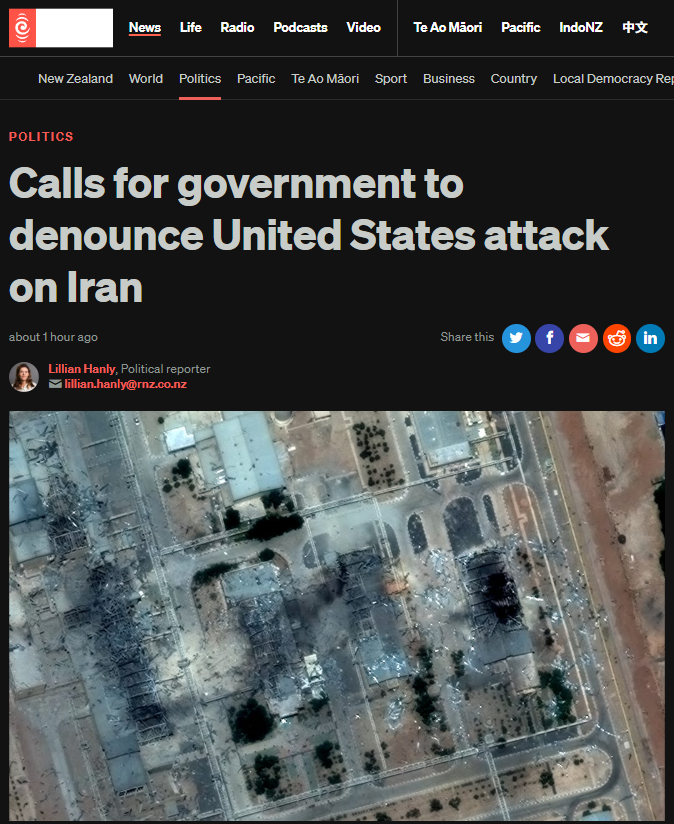
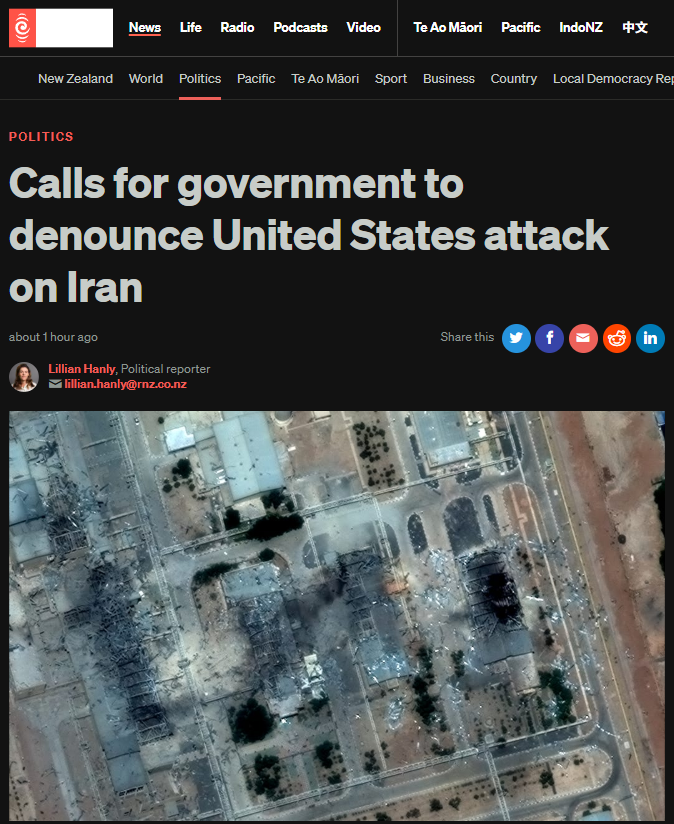
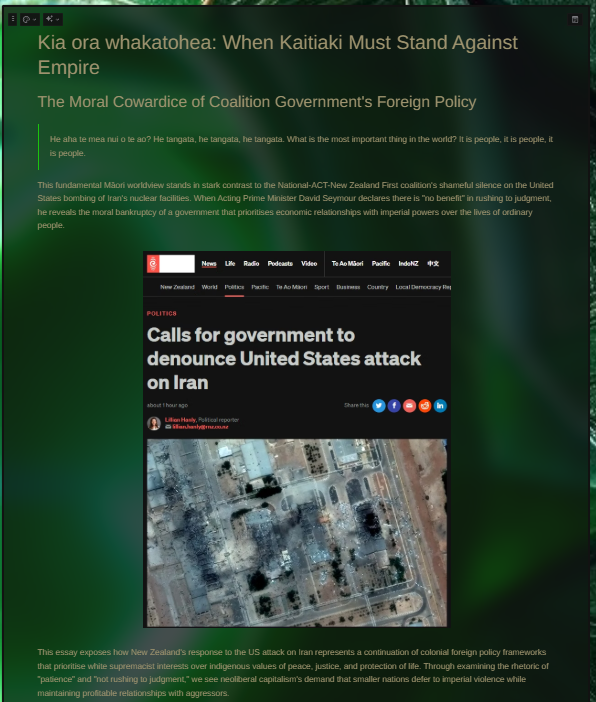
What is the most important thing in the world? It is people, it is people, it is people. This fundamental Māori worldview stands in stark contrast to the National-ACT-New Zealand First coalition's shameful silence on the United States bombing of Iran's nuclear facilities (1). When Acting Prime Minister David Seymour declares there is "no benefit" in rushing to judgment (1), he reveals the moral bankruptcy of a government that prioritises economic relationships with imperial powers over the lives of ordinary people.
This essay exposes how New Zealand's response to the US attack on Iran represents a continuation of colonial foreign policy frameworks that prioritise white supremacist interests over indigenous values of peace, justice, and protection of life. Through examining the rhetoric of "patience" and "not rushing to judgment," we see neoliberal capitalism's demand that smaller nations defer to imperial violence while maintaining profitable relationships with aggressors.
Exposing the Colonial Framework of "Measured Response"
The coalition government's response to the US bombing of Iranian nuclear facilities at Fordow, Natanz, and Isfahan reveals the deep-seated colonial mentality that continues to shape New Zealand's foreign policy (1). When Foreign Affairs Minister Winston Peters issued a statement giving "tacit endorsement" to bombing nuclear facilities while acknowledging the US claim of "collective self-defence consistent with the UN Charter" (1), he demonstrated how settler governments prioritise imperial relationships over international law.
The language of "getting all the facts" and "not rushing to judgment" serves as colonial rhetoric designed to provide cover for American aggression (1). This mirrors historical patterns where colonial administrators would delay action against imperial violence while claiming to need "more information" – a tactic used throughout the colonial period to avoid challenging white supremacist power structures (2).
University of Waikato Professor Alexander Gillespie correctly identified this as "an illegal war" where "the option of diplomacy should have been exhausted before the first strike" (1). Yet rather than uphold the international law that supposedly underpins New Zealand's foreign policy, the government chooses to defer to American assertions of legality (1). This represents what legal scholar Jessica Honan identifies as the ongoing problem where "colonisation is not lawful under international law" (3), yet colonial frameworks continue to shape how settler governments respond to imperial violence.
The Rhetoric of Imperial Deference
David Seymour's declaration that "we're far better to keep our counsel, because it costs nothing to get more information, but going off half-cocked can be very costly for a small nation" (1) reveals the fundamental cowardice at the heart of neoliberal foreign policy.
The Acting Prime Minister's assertion that "nobody is calling on New Zealand to rush to a judgment on the rights and wrongs of the situation" (1) deliberately misframes the issue. When Iranian New Zealander lawyer Arman Askarany calls the government's response showing "indifference" and describes acknowledging US claims of self-defence as a "complete joke" (1), he represents the voices of those directly affected by this imperial violence.
Te Pāti Māori co-leader Rawiri Waititi correctly identifies the pattern when he states: "When the US bombs Iran, Luxon calls it an 'opportunity'. But when Cook Islanders assert their sovereignty or Chinese vessels travel through international waters, he leaps to condemnation" (1). This double standard exposes how the coalition government applies different standards based on whether the actor is part of the white supremacist imperial core or represents Global South resistance to that dominance (4).
Historical Patterns of Moral Leadership vs Imperial Submission
The contrast between current government cowardice and previous examples of New Zealand moral leadership could not be starker. When Helen Clark's Labour government refused to join the 2003 Iraq invasion, declaring "we don't trade the lives of young New Zealanders for a war it doesn't believe in" (5), it demonstrated the kind of principled stance that builds genuine international respect.
Professor Alexander Gillespie notes that "Helen Clark spoke very clearly in 2003 against the invasion of Iraq, but he couldn't see New Zealand's current Prime Minister saying that" (1). The reason, according to Gillespie, is fear of "a backhand from the United States" because "we're spending a lot of time right now trying not to offend this Trump administration" (1).
The Clark government's stance on Iraq has been vindicated by subsequent events, including the Chilcot Report which found the invasion was based on flawed intelligence and inadequate planning (6, 7). Former UK Deputy Prime Minister John Prescott later admitted the invasion was "illegal" and expressed regret for the "catastrophic decision" (8).
New Zealand's independent stance protected both its international reputation and avoided complicity in what University of Otago Professor Robert Patman describes as setting a precedent for "might is right" (1).
Neoliberal Capitalism and Imperial Violence
The coalition government's response must be understood within the broader context of neoliberal foreign policy that prioritises market relationships over human rights. David Seymour's role as Associate Finance Minister overseeing the loosening of foreign investment rules reveals how economic interests shape foreign policy positions (9, 10).
His announcement that New Zealand had "woeful" productivity growth and was "one of the hardest countries in the developed world for overseas people to invest in" (10) demonstrates the government's priority of attracting international capital over maintaining principled foreign policy positions.
This neoliberal framework treats international relations as primarily economic transactions where moral positions become obstacles to profitable relationships. The government's concern about "the safety of New Zealanders in the region" and rising oil prices (11) reveals how neoliberal thinking reduces complex international crises to their economic impacts on domestic consumers rather than addressing the fundamental injustice of imperial violence.
Academic research on the "military-industrial-carceral complex" shows how neoliberalism and militarism reinforce each other, with "corporate profits extracted from it, the jobs dependent upon it, and the campaign contributions arising from it" (12). New Zealand's position as a junior partner in this system means the government feels compelled to avoid challenging American military actions that could affect economic relationships.
Māori Values vs Colonial Foreign Policy
The government's response violates fundamental Māori values that should guide New Zealand's international relationships. The principle of manaakitanga (hospitality and care for others) demands protecting those facing violence, not providing diplomatic cover for their attackers (13). The concept of kaitiakitanga (guardianship and protection) requires New Zealand to act as guardian of international law and human rights, not as enabler of imperial violence (14).
When the Ministry of Foreign Affairs and Trade claims to be integrating "Māori worldviews and mātauranga Māori (Māori knowledge) into foreign policy" (13), these empty statements are exposed as tokenistic when the government abandons these values in practice.
The Pacific Resilience Approach supposedly guided by Māori concepts like whanaungatanga (kinship connections) becomes meaningless when applied selectively based on imperial relationships.
Iranian New Zealander Elham Salari's description of her community's fear and stress (15) represents exactly the kind of harm that manaakitanga demands we address. When she states, "All Iranians around the world, regardless of their perspective on this war, they are all feeling the same. Their minds are there and their bodies are here," (15) she articulates the kind of suffering that Māori values demand we acknowledge and respond to with aroha and practical support.

Te Tiriti Obligations and International Law
Te Tiriti o Waitangi creates obligations for the New Zealand government that extend to international relationships. Article Two's protection of tino rangatiratanga (sovereignty and self-determination) should guide New Zealand's support for other nations' sovereignty (16). When the US bombs Iran's nuclear facilities without UN authorization, it violates the same principles of sovereignty that Te Tiriti supposedly protects for Māori (1).
The government's failure to condemn clear violations of international law undermines the rules-based international order that New Zealand claims to support (14). Legal expert Robert Patman warns that we are at "a fork in the road moment internationally" where we can either "reinstate the idea that international relations should be based on rules, principles and procedures, or we can simply passively accept the erosion of that architecture" (1).
New Zealand's commitment to international law has deep historical roots, from opposing the UN Security Council veto in 1945 to leading efforts on nuclear disarmament (14). The current government's abandonment of these principles represents a betrayal of both Māori sovereignty and New Zealand's international legal commitments.
Opposition Voices and Democratic Resistance
The opposition parties' responses reveal the spectrum of political courage in confronting imperial violence. Labour leader Chris Hipkins correctly identified the attacks as "very disappointing," "not justified" and "almost certainly" against international law (1). However, his call for the government to "take a stronger stance" lacks the moral clarity needed to confront imperial violence directly (1).
The Green Party's response through co-leader Marama Davidson represents stronger moral leadership, declaring the US actions "pose a fundamental threat to world peace" and comparing them to "the US war on Iraq" (1). Her warning that "we are at risk of a violent history repeating itself" connects current events to broader patterns of American imperial violence.
Te Pāti Māori provides the strongest analysis, with Rawiri Waititi correctly identifying how the government "condemns non-Western powers at every turn but remains silent when its allies act with impunity" (1). This analysis exposes the racist double standards at the heart of New Zealand's foreign policy framework.
The Path Forward: Decolonising Foreign Policy
New Zealand must move beyond the colonial framework that subordinates moral principles to imperial relationships. This requires acknowledging what the Friends Committee on National Legislation identifies as how "the prevailing, militaristic conception of 'national security' is steeped in racism and perpetuates white supremacy" (17).
Former Prime Minister Helen Clark's recent questioning of New Zealand's continued involvement in Five Eyes, describing it as "out of control" (18), points toward the kind of independent thinking needed. Her observation that Five Eyes has moved beyond intelligence sharing to become "a coordination of foreign policy positioning" reveals how these arrangements constrain New Zealand's ability to take principled positions.
The Cook Islands' recent advocacy for "decolonisation of international law" at the International Court of Justice (19) provides a model for how Pacific nations can challenge imperial frameworks. When Cook Islands representative Fuimaono Dylan Asafo calls for dismantling "systems of domination that drive" global crises, "including imperialism, colonialism, racial capitalism, heteropatriarchy and ableism" (19), he articulates the kind of systemic analysis needed to address root causes rather than symptoms.
Choosing Mana Over Money
The coalition government's response to US bombing of Iran reveals the moral bankruptcy of neoliberal foreign policy that prioritises imperial relationships over human rights and international law. When David Seymour declares "we're far better to keep our counsel" (1), he chooses the comfort of silence over the courage of moral leadership.
Māori values demand that New Zealand act as kaitiaki in international relationships, protecting those facing violence rather than providing diplomatic cover for their attackers. Te Tiriti obligations require supporting sovereignty and self-determination for all peoples, not just when convenient for economic relationships.
The path forward requires decolonising New Zealand's foreign policy framework by centering Māori values, upholding international law consistently, and choosing moral leadership over economic convenience. As our tīpuna taught us:
He tangata, he tangata, he tangata – it is people who matter most, not the profits of empire.
The choice is clear: we can continue the path of colonial subservience that trades moral principles for imperial favour, or we can build the kind of independent, principled foreign policy that reflects our values and serves our peoples. The government's response to Iran shows which path they have chosen. It is time for the people to demand better.
Ngā mihi nui ki a koutou katoa. For those who find value in this analysis and wish to support continued work exposing these issues, please consider a koha to HTDM: 03-1546-0415173-000. Only contribute if you have capacity in these challenging economic times.
Kia kaha, kia māia, kia manawanui.