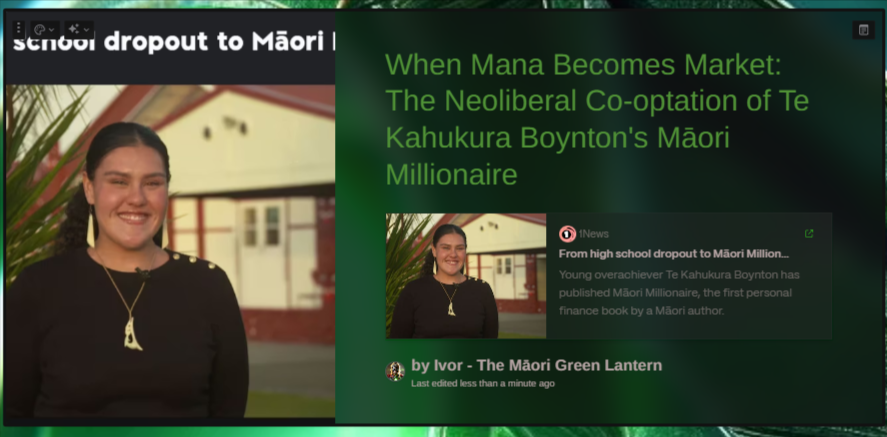
“When Mana Becomes Market: The Neoliberal Co-optation of Te Kahukura Boynton's Māori Millionaire” - 28 June 2025
The Pūtea Paradox: How Good Intentions Get Wrapped in the Wrong Worldview

Kia ora koutou,
1News recently featured a feel-good story about Te Kahukura Boynton, a 21-year-old who transformed from high school dropout to published author of New Zealand's first personal finance book by a Māori author[1][2]. While superficially celebrating Māori achievement, this narrative reveals something far more troubling - the sophisticated way neoliberalism co-opts Indigenous struggles and repackages them as individual success stories that actually reinforce the very system that created the problems in the first place.

Boynton's story follows a predictable neoliberal script: personal struggle, individual transformation through mindset change, and wealth accumulation as the ultimate solution. Her book promises to teach readers how to "become 1% better every day" and master their "mindset to align with prosperity"[2]. But beneath this slick packaging lies a fundamental betrayal of Māori values and a dangerous misdiagnosis of what actually ails our people.
The Wealth Gap Isn't About Personal Choices
The wealth disparity between Māori and Pākehā isn't a mystery requiring individual mindset shifts to solve. Research consistently shows that M\u0101ori have fundamentally different approaches to money, with traditional values emphasising whānaungatanga and collective responsibility over individual wealth accumulation[3]. These aren't deficits to be corrected through Western financial education - they're strengths that capitalism systematically undermines.
Traditional Māori economies operated on principles of mana, where chiefs accumulated authority not through hoarding resources but by distributing them effectively[4]. Wealth flowed through communities via utu (reciprocity) and koha (gift-giving), creating networks of mutual obligation and support[5][6]. This wasn't primitive - it was sophisticated wealth redistribution that maintained community wellbeing across generations.
The current wealth gap exists because colonisation systematically dismantled these economic systems and replaced them with individualised property rights designed to facilitate land theft[7]. When over 95% of Māori land was confiscated or purchased under duress, this wasn't market failure - it was market function[8].
The Neoliberal Trojan Horse
Boynton's Māori Millionaire project embodies what scholars identify as neoliberal co-optation - the process whereby genuine social movements get absorbed into the very system they originally challenged[9][10]. Her platform, while well-intentioned, reproduces key neoliberal myths that shift responsibility from systemic inequities to individual inadequacies.
The core problem is ideological. Neoliberalism promotes "the individualization of economic risk" and positions market participation as the only legitimate path to wellbeing[11]. When applied to Māori, this becomes particularly insidious because it reframes our collective dispossession as individual failure to engage properly with capitalism.
Boynton's message - encapsulated in quotes like "buying land back, not Gucci bags" - sounds empowering but actually legitimises the system that stole that land in the first place[12]. It suggests Māori poverty stems from poor spending choices rather than systematic theft and ongoing structural racism. This is textbook neoliberal sleight of hand.
How Traditional M\u0101ori Values Get Weaponised Against Themselves
The Mindset Myth and Personal Responsibility
Boynton's emphasis on "healing your money mindset" exemplifies what critics call the "personal responsibility" mantra of neoliberalism[13]. This approach locates the problem within individual psychology rather than structural inequality. When she describes her transformation as realising "I was the person who could change that," she's unconsciously reproducing the neoliberal fiction that systemic problems require individual solutions.
Research on financial literacy education reveals how these programs "promote the individualization of economic risk and privilege the autonomy of the consumer or consumer-citizen over that of the critical citizen"[11]. Rather than examining why M\u0101ori disproportionately struggle financially, the focus shifts to fixing Māori attitudes and behaviours.
This is particularly damaging because Māori financial challenges often stem from fulfilling cultural obligations that Western financial planning treats as irrational[3]. When whānau prioritise tangi costs or supporting struggling relatives over personal savings, they're practicing traditional values that neoliberal advice pathologises as "poor money management."
The Commodification of Cultural Capital
More troubling is how Boynton's platform commodifies M\u0101ori identity itself. The "Māori Millionaire" brand transforms cultural identity into marketing strategy, selling Māori-ness back to Māori people through the very capitalist frameworks that dispossessed them. This process - what researchers call "strategic essentialism" - reduces complex cultural identity to consumable identity markers[14].
When Boynton holds her book launch at Terere Marae, this appears to honour tradition but actually subordinates the marae's role as a site of collective decision-making to individual wealth-building[15]. The sacred space becomes a backdrop for capitalist messaging rather than a venue for examining capitalism's impact on Māori wellbeing.

The Entrepreneurship Trap
The celebration of Boynton as a young entrepreneur reflects neoliberalism's fetishisation of individual business ownership as the solution to Indigenous disadvantage[16]. While some research suggests Indigenous enterprises can benefit communities, the structural context matters enormously[16].
Indigenous cultures often emphasise "communality (the benefit of the many) rather than the primacy of individual wealth acquisition"[16]. When entrepreneurship is promoted without addressing this tension, it risks fragmenting communities by creating new class divisions between "successful" Indigenous entrepreneurs and those who maintain traditional economic relationships.
Traditional Māori economic principles included "focus on wealth distribution (as opposed to wealth accumulation)" and recognition that "the world provides abundance (as opposed to scarcity thinking)"[17]. These principles are fundamentally incompatible with capitalism's core logic of competitive accumulation and artificial scarcity.
The Integration Illusion
Perhaps most insidiously, Boynton's approach promotes what critics identify as "weak" multiculturalism - surface-level cultural recognition that leaves underlying power structures untouched[14]. Her platform allows Māori to feel culturally affirmed while fully integrating into the economic system that dispossessed them.
This mirrors patterns documented in other settler states, where "Indigenous experiences are sometimes uncritically co-opted into non-indigenous campaigns of resistance to neoliberal imperatives"[18]. The appearance of Indigenous agency masks continued subordination to settler economic interests.
The Alternative Path: Authentic M\u0101ori Economics
The tragedy of Boynton's approach isn't her individual choices but how the neoliberal system channels genuine Māori aspirations through frameworks that undermine Māori values. Authentic M\u0101ori economic development would centre collective wellbeing over individual wealth accumulation[5].
Research on Māori wellbeing economies demonstrates how traditional Māori economic principles can drive "radical transformation to more sustainable and equitable models"[19][20]. These approaches prioritise collective agency, empowerment, and wellbeing over individual profit maximisation[21].
Contemporary Māori communities demonstrate how "whānau-centred approaches" can create "Indigenous-led economic transformation" that maintains cultural integrity while improving material conditions[22]. The key difference is maintaining Māori agency over the terms of economic engagement rather than adapting Māori people to capitalist requirements.
Implications: The Broader Pattern of Neoliberal Co-optation
Boynton's platform reflects broader patterns of how neoliberalism "incorporates dissent into its operating logic while marginalizing radical alternatives"[23]. By celebrating individual Māori success within capitalist frameworks, the system deflects attention from its structural violence against Māori collectively.
This matters because Indigenous self-determination requires "the choice to participate within a mainstream neoliberal economy" rather than forced integration[24]. When success is defined exclusively through capitalist metrics, Māori lose the right to maintain alternative economic relationships that might serve their communities better.
The focus on individual transformation also obscures how capitalism as a system "displaced (and displaces) the Māori mode of production" through ongoing processes rather than historical events[25]. This isn't about past injustices but current structural violence that continues undermining Māori economic sovereignty.
Reclaiming Mana from Market Logic
Te Kahukura Boynton deserves recognition for her achievements and genuine desire to help her people. The critique here isn't of her personally but of how neoliberal structures co-opt even well-intentioned Māori initiatives and redirect them toward serving capital rather than community.
The real solution to Māori economic inequality isn't teaching more Māori to think like capitalists - it's challenging capitalist logic itself and creating space for Māori economic sovereignty. This means supporting collective ownership models, defending Māori land rights, and resisting the individualisation of what are fundamentally collective challenges[26].
True Māori economic empowerment would center mana whenua over market value, whakatōhea over wealth accumulation, and collective liberation over individual success[27]. It would recognise that as long as capitalism requires endless growth on a finite planet, it will always conflict with Māori values of kaitiakitanga and intergenerational responsibility.
The choice isn't between financial literacy and financial illiteracy - it's between adapting ourselves to serve an exploitative system or transforming that system to serve our people's genuine needs. Until we understand this distinction, initiatives like Māori Millionaire will continue reproducing the very inequalities they claim to address.
Mauri ora - for those who value these insights, please consider a koha to support this kaupapa: HTDM: 03-1546-0415173-000. Only donate if you have the capacity and wish to support decolonised analysis that our communities desperately need.
Ngā mihi nui, Ivor Jones - The Māori Green Lantern