"WHEN THE PETROL TANKER RUNS DRY: How a White Supremacist Neoliberal Government Left Māori at the Bottom of the Fuel Queue" - 14 March 2026
When they sold the refinery, stripped the reserves, gifted the profits offshore, and waved a four-level laminated plan at the people — that was not incompetence. That was the harvest.

Mōrena ano Aotearoa!
Thank you for considering this second essay today on the crisis affecting the entire global because of Trump, and how this pathetic white supremacist government of ours is making it worse for us all.
On 13 March 2026, while Gull petrol stations were running dry across Tāmaki Makaurau, as 1News confirmed, Energy Minister Shane Jones stood before the cameras and said — with the unblinking confidence of a man who has never missed a meal — that there was "no need for panic or over-reaction."
This is the same government that watched the US and Israel attack Iran in February, watched the Strait of Hormuz — through which 80% of the crude oil destined for our Asian refineries passes — close to a near standstill, watched Force Majeure declarations cascade through supply chains that feed 100% of New Zealand's refined fuel needs, and did nothing except convene a committee, release a laminated four-level plan, and contribute six days of fuel to an IEA emergency reserve while calling it leadership.
New Zealand sits today with 21 days of physical diesel on soil, the Strait is closed, the tankers are not moving, and this government's answer to the most structurally exposed fuel nation in the OECD is: don't panic. Māori — already carrying the weight of transport poverty, rural isolation, and an emergency plan that does not name them once — are expected to wait at the bottom of the queue, as they always have, while Corrections and Defence get guaranteed fuel and the kuia in Ruātoria wonders if she can afford to reach the hospital.
The Pūrākau: The Waka With No Ama
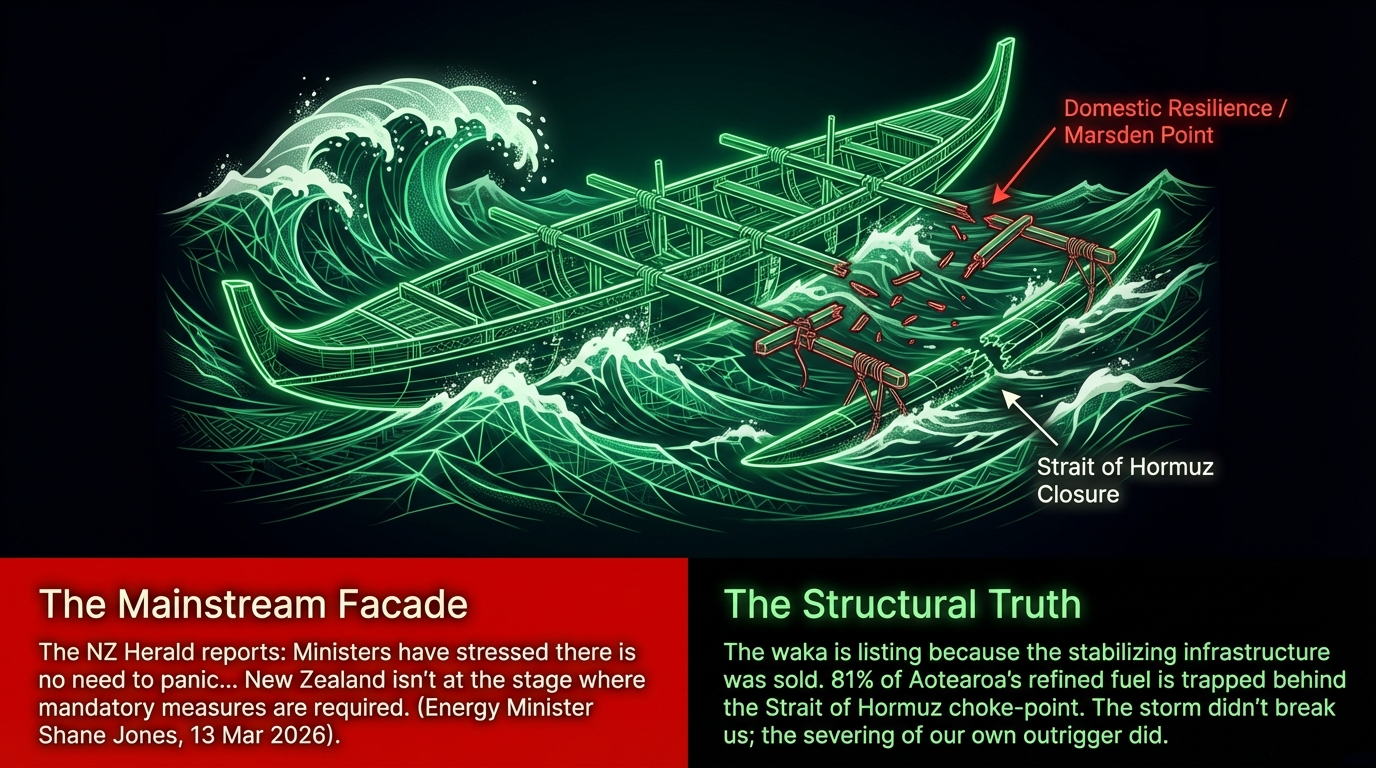
In te ao Māori, the waka hourua — the double-hulled voyaging canoe — does not sail on faith alone. It sails on preparation. On the ama: the outrigger that stops the hull capsizing in heavy seas. On the hoe: paddles held by hands trained for a thousand miles of ocean. On kaitiakitanga: the intergenerational responsibility to ensure the vessel can carry not just today's people, but tomorrow's mokopuna.
This government — this neoliberal, white supremacist construct masquerading as governance — has spent two years on watch while the ama rotted. They sold the dry dock. They outsourced the paddles to Singapore. They replaced the navigator with an MBIE spokesperson holding a four-level laminated card.
And now the Strait of Hormuz is closed.
The tanker cannot come through. The waka is listing. And Shane Jones — the man who has spent his ministerial career extracting resources from Māori land while calling it "development" — stands at the bow and tells the people: no need to panic.
This is the anatomy of a colonial harvest. Not sudden. Not accidental. Structural. Deliberate. And, as always, it will be Māori who drown first.
The Deep Dive Podcast

Listen to this lively conversation between two hosts, unpacking and connecting topics in the sources of this essay
🪙 Koha Consideration
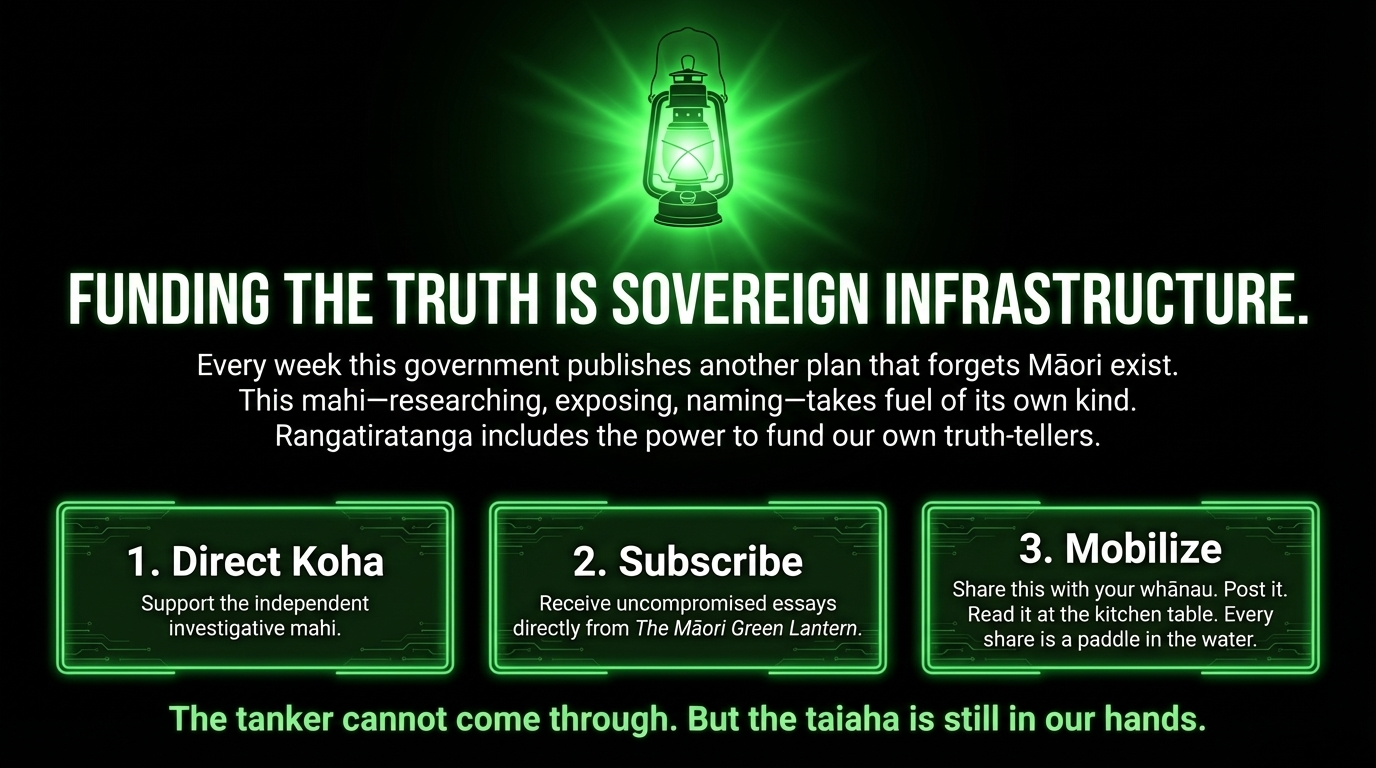
Every week this government publishes another plan that forgets Māori exist. Every week The Māori Green Lantern traces the whakapapa of that forgetting — from Marsden Point's closure to the Petroleum Demand Restraint Act 1981, from Shane Jones's extraction agenda to the kaumātua who cannot reach her marae without petrol.
This mahi — researching, exposing, naming — takes fuel of its own kind. The fuel of time, care, and the refusal to be silent.
When you koha, you are not donating to a website. You are building a sovereign information infrastructure that the Crown will never fund and corporate media will never prioritise. You are declaring that rangatiratanga includes the power to fund our own truth-tellers — that Māori deserve an independent voice that cannot be rationed, restricted, or shut down at Level 2.
If the government's emergency plan leaves your whānau at the bottom of the queue, this is for you.
Three pathways exist:
Koha — direct support for this mahi: Koha Platform
Subscribe — receive essays directly and sustain independent Māori journalism: Subscribe to The Māori Green Lantern
Direct bank transfer: HTDM, account number 03-1546-0415173-000
If you cannot koha right now — no worries. Share this essay with your whānau. Post it in your group chat. Read it at the kitchen table. That is koha in itself. Every share is a paddle in the water.
The Historical Whakapapa: How They Cut the Ama
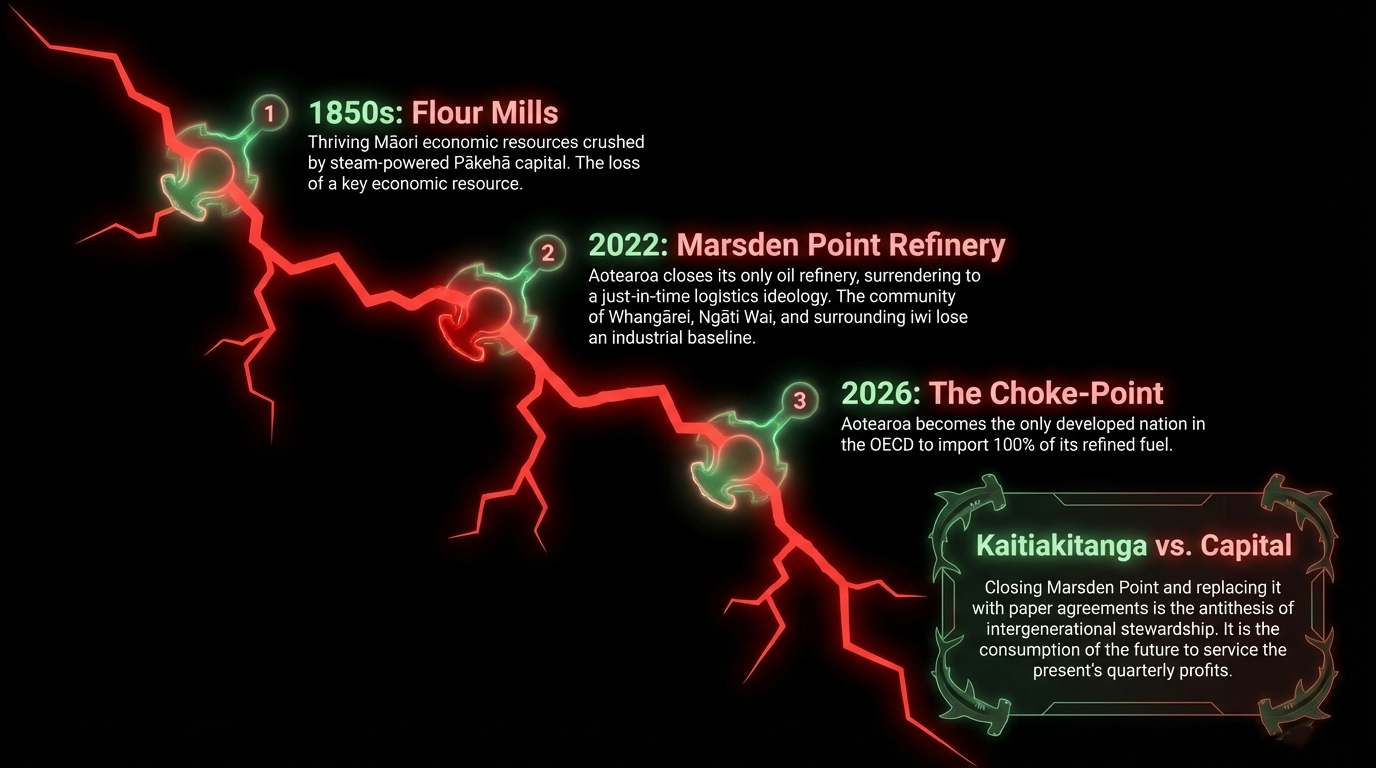
To understand how Aotearoa arrived here, you must trace the whakapapa of this vulnerability — because every structural failure has a genealogy, and every act of neoliberal vandalism leaves fingerprints.
As documented by Carbon News, New Zealand now imports 100% of its refined fuel following the closure of the Marsden Point refinery in 2022. Approximately 81% of that fuel comes from South Korean and Singaporean refineries that process Middle Eastern crude — crude that travels through the Strait of Hormuz. The same Strait now effectively closed by Iranian retaliatory strikes following the US-Israeli attack on Iran, as confirmed by MBIE's own advisory.
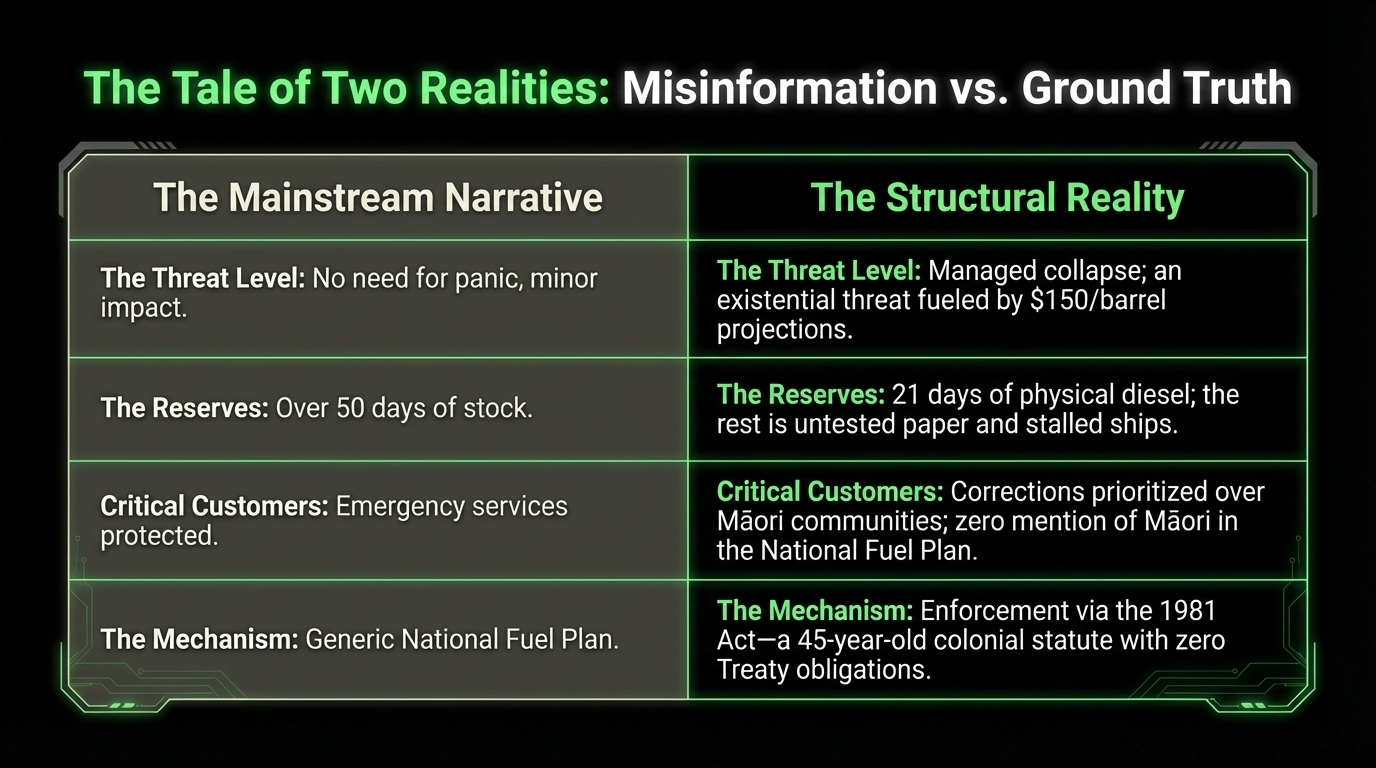
New Zealand sits on approximately 21 days of physical diesel reserves, with the increase to 28 days not scheduled until July 2028, as Carbon News reveals. The government's reassurance of "more than 50 days of fuel stock" includes fuel already on ships — ships now subject to Force Majeure declarations cascading through the supply chain. The remaining reserves exist largely as paper agreements with overseas governments — untested financial instruments dressed up as physical security.
Finance Minister Nicola Willis has admitted disruptions could cause "problems weeks or months down the track," as reported by NZ Herald. Analysts warn that if the Strait of Hormuz remains closed, oil prices could surge to $150 per barrel, as confirmed by 1News.
Te Pāti Māori and The Māori Green Lantern saw this coming. As documented in Trump's Iran War — When a Nuclear-Free Nation Genuflects Before the Bombs, MFAT's own analysis warned that Strait of Hormuz disruption would "push the price of fuel and inflation higher" — and this government chose silence over preparation, diplomatic cowardice over sovereign courage.
Shane Jones now blames Labour for allowing oil companies to abandon local storage in favour of a "just-in-time" model, as reported by RNZ. This is breathtaking. His government has been in power since October 2023. Seventeen months. And the reserve target sits unchanged — still scheduled for July 2028. The same Shane Jones who has fast-tracked drilling on Māori whenua and stripped environmental protections from coastal taonga could not find the urgency to build a fuel buffer for the people he claims to serve.
This is not incompetence. This is a feature of neoliberal governance, not a bug. As RNZ's analysis of the 2023 election shows, both Labour and National operate within the same neoliberal framework — one that treats resilience as a cost and communities as consumers rather than citizens.
The Four Levels of Colonial Theatre
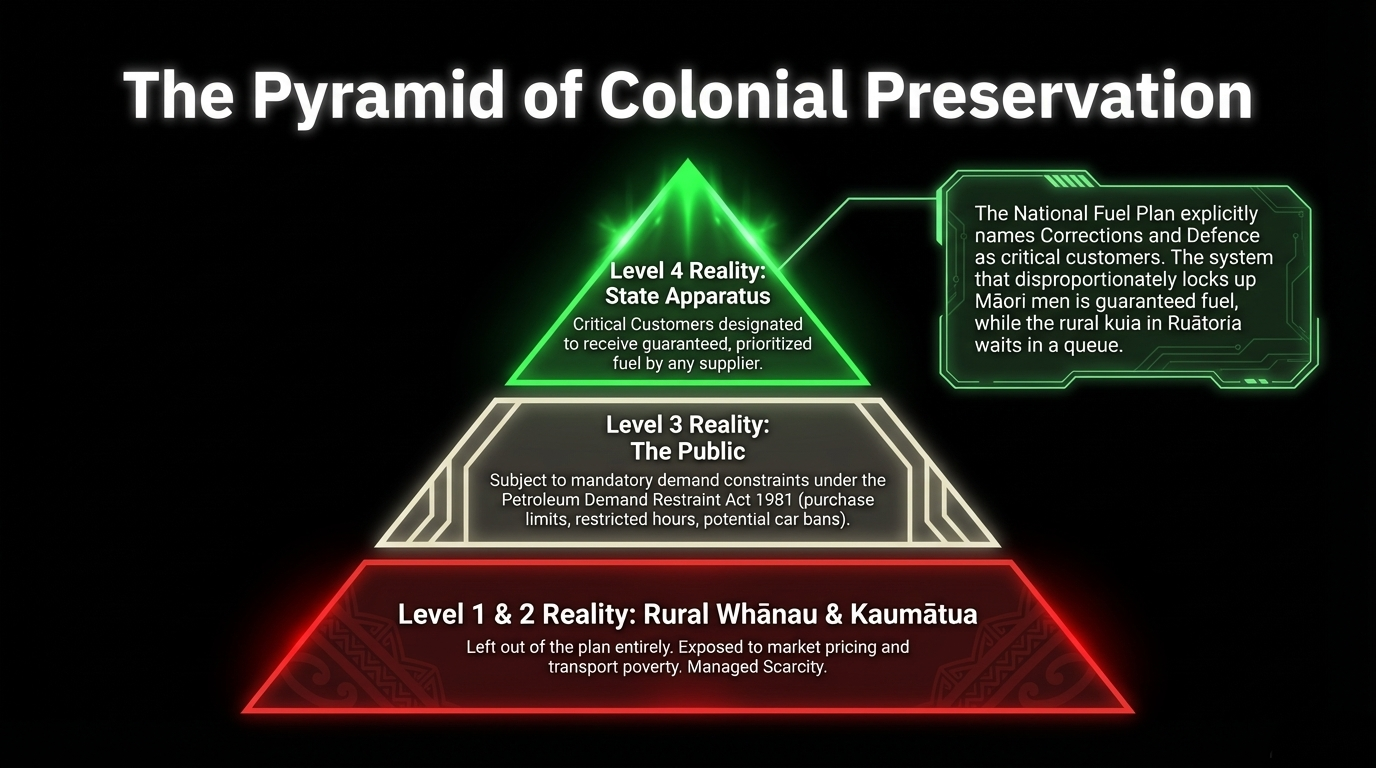
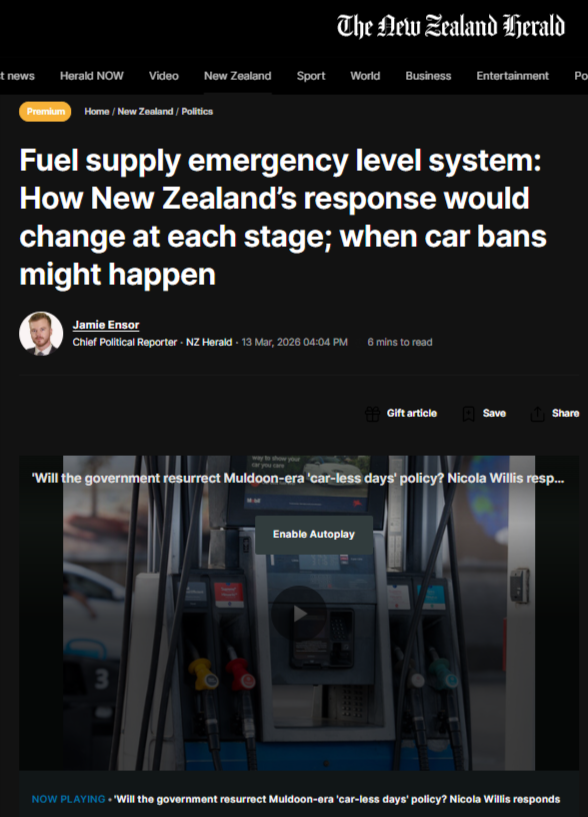
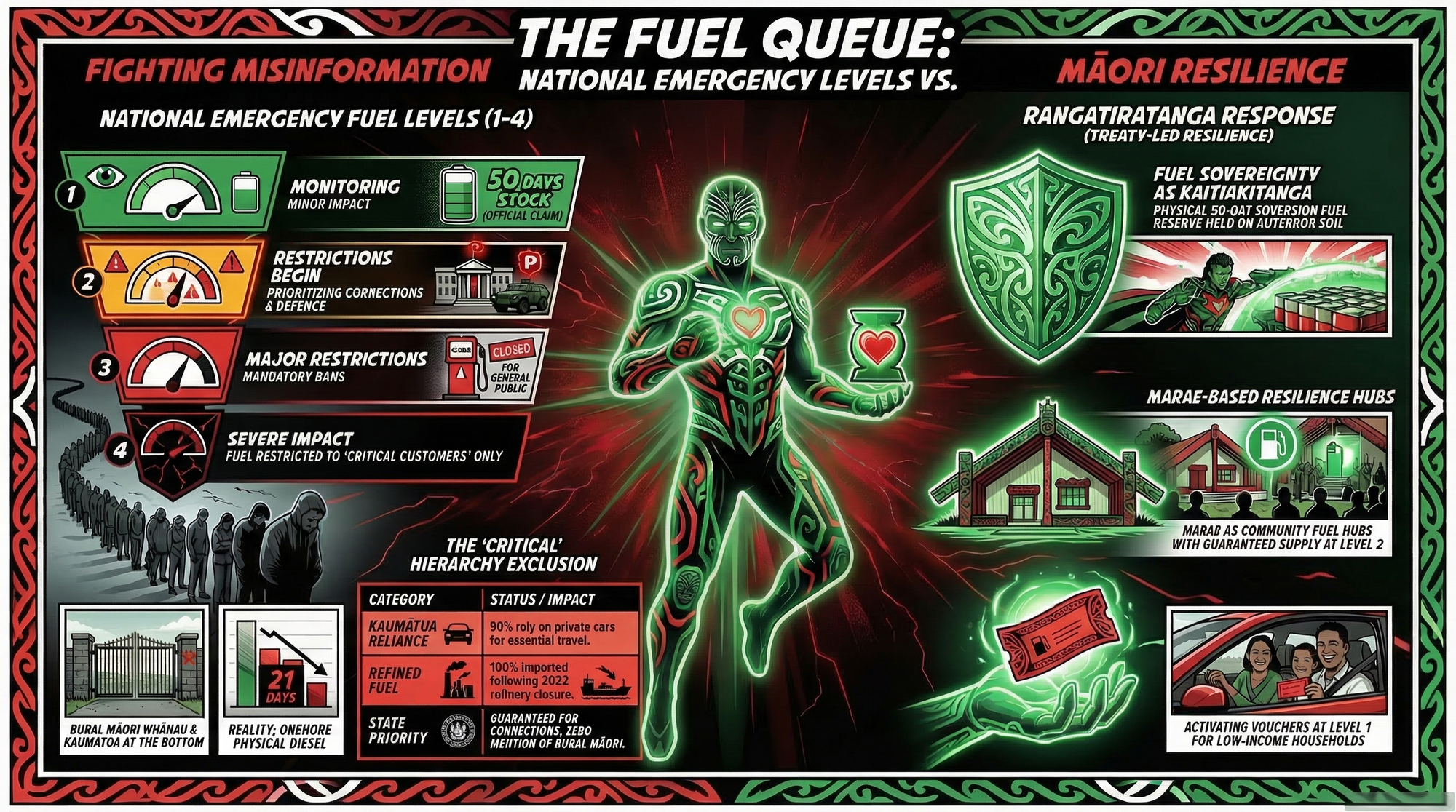
The National Fuel Plan — published in 2024, confirmed by NZ Herald — has four escalation levels:
- Level 1 (current): "Minor impact." MBIE meets with oil companies. Officials monitor.
- Level 2: "Moderate impact." Fuel rationed to "critical customers" — emergency services, Corrections, Defence. Police at stations. Your whānau in rural Tairāwhiti? Not critical.
- Level 3: "Major impact." Mandatory demand constraints under the Petroleum Demand Restraint Act 1981. Purchase limits. Restricted hours. Car use potentially banned.
- Level 4: "Severe impact." Fuel only to critical customers. Everyone else: managed scarcity.
Read those levels again. At Level 2, the "critical customers" who get guaranteed fuel are Corrections — the same system that locks up Māori men at rates The Nursery of Cages documents as a factory of colonial punishment. The same system gets guaranteed fuel while the rural kuia in Ruātoria waits in a queue. This is not emergency planning. This is the colonial hierarchy encoded into petroleum law.
The plan is, as NZ Herald acknowledges, "relatively generic" — not specifically designed for the scenario now unfolding. There is no specific provision for Māori communities. No acknowledgment of transport poverty. No tikanga framework. No Treaty obligation anywhere in the document.
Three Examples for the Western Mind
Example One: The Transport Poverty Trap — Quantified Harm
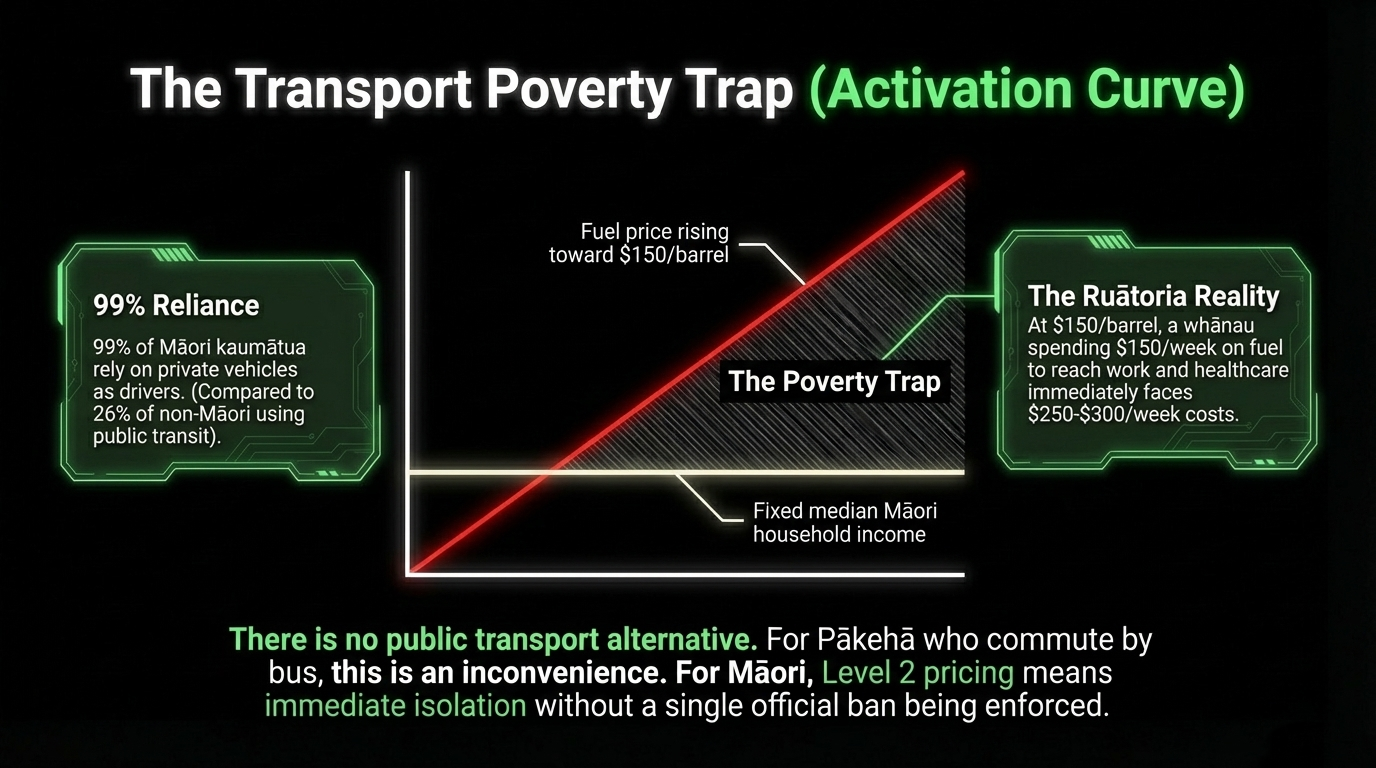
For Pākehā who commute by bus, a fuel emergency is an inconvenience. For Māori, it is an existential threat.
Research published in Transportation Research confirms that lack of access to a car is a significant barrier to employment for Māori job-seekers, and that public transport "does not cater" for journeys to sites important to Māori cultural identity, as documented in indigenous Māori transport research. A 2025 PMC study confirms that kaumātua rely on private cars 99% of the time as drivers, with fewer than 18% using public transport compared to 26% of non-Māori, making car access structurally central to Māori wellbeing, as PMC research shows. The Ministry of Environment acknowledges that "many Māori households will remain reliant on private passenger vehicles and face increased cost of living as a consequence" of fuel price shocks, as confirmed in the Ministry for the Environment's own transition report.
At $150/barrel — as analysts project via 1News — a Māori whānau in Ōpōtiki spending $150/week on fuel to reach work, healthcare, and kura will face costs of $250–$300/week minimum. There is no public transport alternative. There is no government plan for them.
The tikanga impact: Manaakitanga — the obligation to sustain, support, and uplift — is not a courtesy. It is a governing principle. When a government cannot ensure that rural Māori can reach their whānau, their work, their doctor, their marae — it has failed not just in policy, but in its most fundamental obligation as a partner under Te Tiriti. The Crown promised protection. Petroleum rationing law protects Corrections. The mauri depletes.
The solution: Establish an emergency Māori Transport Resilience Fund, activated at Level 1, providing subsidised fuel vouchers to Māori households below the median income. Require Treaty compliance in all fuel emergency planning documents. Fund community transport hubs at marae in fuel-vulnerable rural areas before Level 2 is triggered — not after.
Example Two: The Marsden Point Betrayal — The Last Whenua Sold
For the western mind: imagine your community had one bakery. Local. Yours. It fed the town. Then a consulting firm told the council it was "more efficient" to close it and buy bread from Singapore — cheaper in the short term, always available. The council agreed. The bakery closed. And then a war started.
That is Marsden Point.
New Zealand closed its only oil refinery in 2022, making us the only developed nation in the OECD that imports 100% of its refined fuel, as Carbon News confirms. The decision was made in the name of commercial efficiency. The market said it was unviable. The government agreed. And the community of Whangārei — including Ngāti Wai and other iwi whose rohe surrounds the Marsden Point site — lost both the industrial employment and the strategic buffer.
As Te Ara documents the pattern of Māori economic dispossession, Māori have seen this before: "The loss of land meant the loss of a key economic resource for Māori." In the 1850s it was flour mills crushed by steam-powered Pākehā capital. In 2022 it was a refinery surrendered to "just-in-time" logistics ideology. The mechanism is identical. Only the century changes.
The tikanga impact: Kaitiakitanga is not environmentalism. It is intergenerational stewardship — the obligation to ensure that what you inherit is passed on in better condition than you found it. Closing Marsden Point and replacing it with paper agreements with overseas governments is the antithesis of kaitiakitanga. It is the consumption of the future to service the present's quarterly profits.
The solution: Commission an independent inquiry into the decision to close Marsden Point with full Treaty compliance review. Establish a sovereign fuel reserve of minimum 90 days — physical fuel, in physical tanks, on Aotearoa soil — with site selection to involve mana whenua and prioritise Māori-owned land trusts. Invest in domestic biofuel capacity grounded in Māori food sovereignty frameworks as documented by Foundation North's food sovereignty research.
Example Three: Shane Jones and the Architecture of Managed Collapse
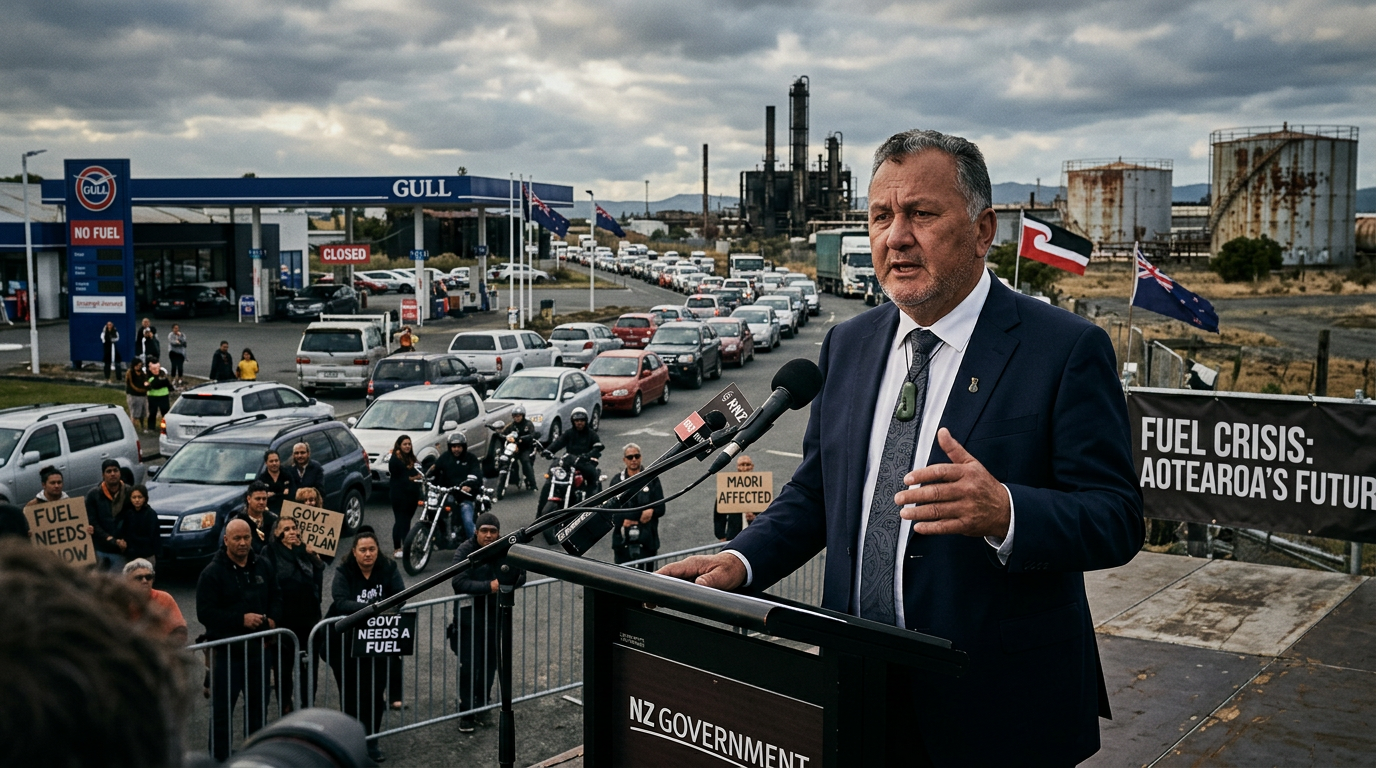
Shane Jones is the perfect emblem of this government's relationship to Māori. He performs Māori identity as political decoration while delivering colonial outcomes with the precision of a surveyor's chainsaw. He is the Resources Minister who fast-tracked drilling on Māori whenua. He is the Associate Energy Minister now warning of "problems weeks or months down the track," as reported by RNZ. And he is the man who blamed Labour — in the same breath — for the "just-in-time" model his own government has had seventeen months and chose not to fix.
This is the architecture of managed collapse. As The Colosseum of Kingsland documented: "The pattern is identical every time: manufacture a crisis, commission a friendly report, cite economic urgency, bypass democratic process, deliver the asset to corporate interests, and silence the communities who bear the cost."
The fuel crisis follows this pattern exactly. The crisis was manufactured by decades of neoliberal energy policy. The report is the National Fuel Plan — a "relatively generic" document that names Corrections as a critical customer and does not mention Māori once, as NZ Herald confirms. The economic urgency is real — analysts project $150/barrel oil per 1News reporting. And the communities who will bear the cost are, as always, those at the bottom of the "critical customer" hierarchy.
Jones's government contributed New Zealand's share — six days of fuel — to the IEA's 400 million barrel emergency release, as RNZ reports. Six days. Not a plan. Not a pipeline. Not a refinery. Six days of fuel — which is what happens when you let a neoliberal government manage critical infrastructure like a trading portfolio.
As The Charity of Conquerors documents: "The mauri depletes." Every time this government releases a framework that does not include whānau Māori in its protection architecture, the mauri of this nation — its collective life-force — is further drained.
The tikanga impact: Mana motuhake — Māori self-determination and sovereignty — is not possible when whānau cannot fuel a car to reach their marae, their kura, their hospital. When a government's emergency plan prioritises Defence and Corrections over the most vulnerable communities, it is not governing. It is managing a hierarchy. And Māori have always been at the bottom.
The solution: Require immediate Treaty-compliant revision of the National Fuel Plan to include a specific Māori community resilience schedule. At Level 2, marae must be designated as community fuel hubs with guaranteed supply. At Level 3, Māori households earning below $60,000 must receive priority purchase allocation equivalent to emergency services. No plan that does not include these provisions is fit for purpose under Article Three of Te Tiriti.
Five Threads the Government Hopes You Miss
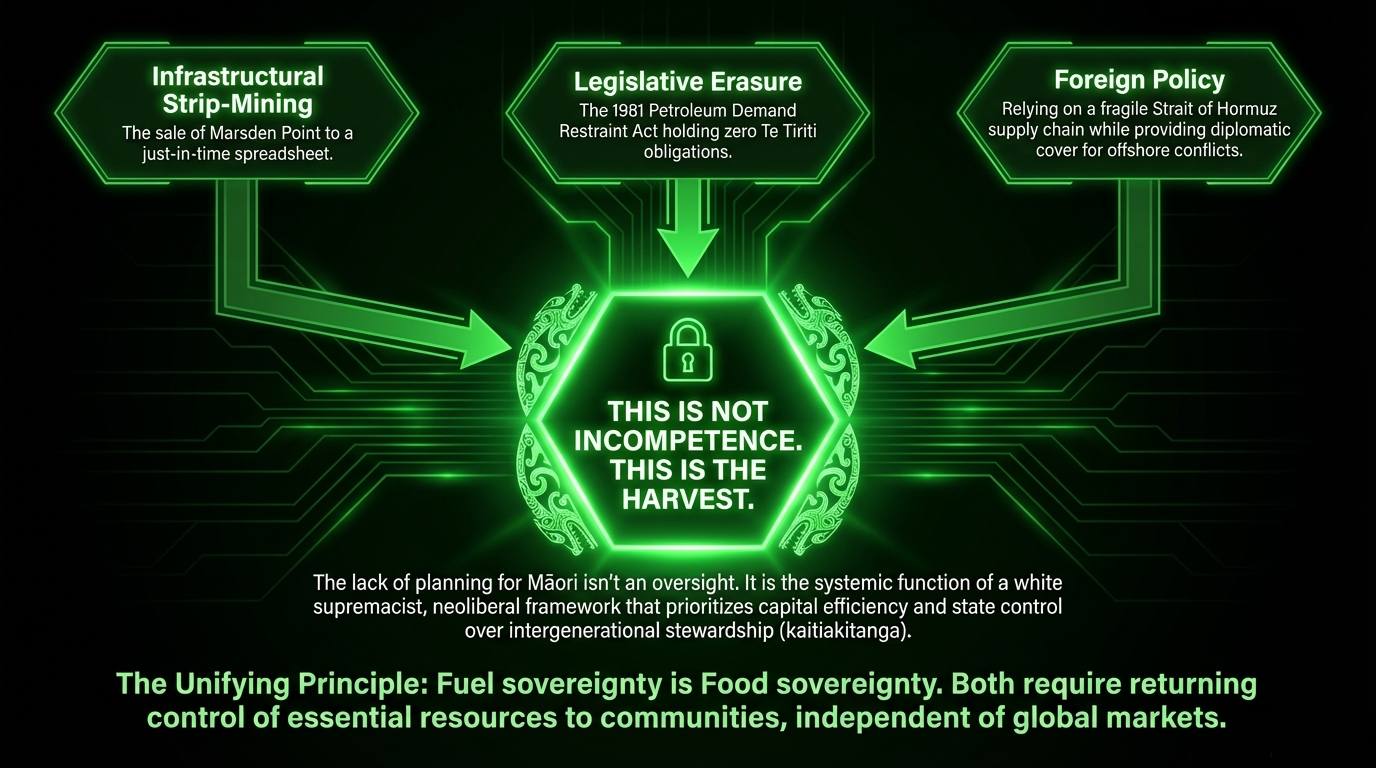
1. The Hormuz Crisis Was Predicted by MFAT — and Ignored. As The Māori Green Lantern documented in Trump's Iran War, MFAT warned internally that Strait of Hormuz disruption would push fuel prices higher. This government chose to provide diplomatic cover for the US-Israel attack on Iran rather than prepare domestic resilience frameworks. The blood of this fuel crisis is partly on the hands of Luxon's foreign policy cowardice.
2. Shane Jones Holds Both Energy and Resources. The same minister overseeing the fuel emergency is the minister who fast-tracked offshore drilling and mining on Māori land. His ideology is extraction without stewardship. He is not the solution to this crisis — he is its architect in a different ministry, as The Abalone Inquisition documents.
3. The Petroleum Demand Restraint Act 1981 Has No Treaty Obligations. The legislation the government will use to ban cars, cap purchases, and restrict hours contains no Treaty clause. The word "Māori" does not appear. A 45-year-old colonial statute will determine who gets fuel in a crisis — and Māori are not written into its protection architecture. This is not oversight. It is erasure by design.
4. The "Just-in-Time" Model Was Enabled by the Same Neoliberal Consensus. As RNZ's neoliberalism analysis confirms, both Labour and National operate within the same neoliberal framework. Blaming Labour for the just-in-time model while implementing no structural fix is political theatre, not governance. Cui malo: Māori.
5. Food Sovereignty and Fuel Sovereignty Are the Same Kaupapa. As Foundation North's food sovereignty research documents, Māori food sovereignty "puts Māori who produce, distribute and consume food — rather than the demands of global markets — at the heart of food systems." Fuel sovereignty is the same principle applied to energy. Both have been stripped. Both must be rebuilt. Neither requires permission from Shane Jones to begin.
The Quantified Harm
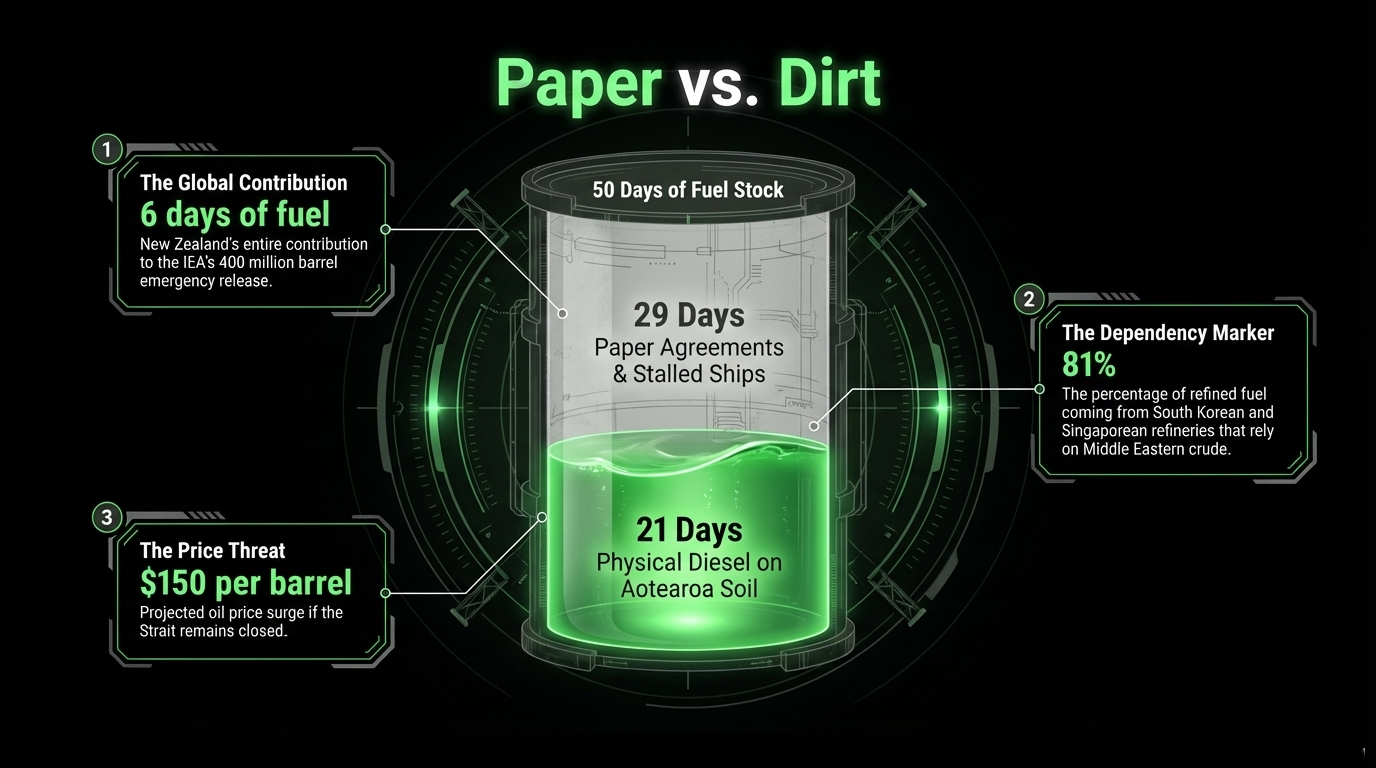
- $150/barrel oil = estimated 60–80% increase in pump prices for rural Māori with no public transport alternative 1News
- 21 days of physical diesel on NZ soil — the rest is paper Carbon News
- 81% of refined fuel dependent on Strait of Hormuz via Asian refineries MBIE
- Zero mention of Māori in the National Fuel Plan's critical customer protection framework NZ Herald
- Six days of fuel released to global markets — NZ's entire contribution to the IEA emergency response RNZ
- 99% of Māori kaumātua rely on private vehicles — among the most vulnerable to fuel rationing PMC
What you have just read is not a crisis that arrived without warning
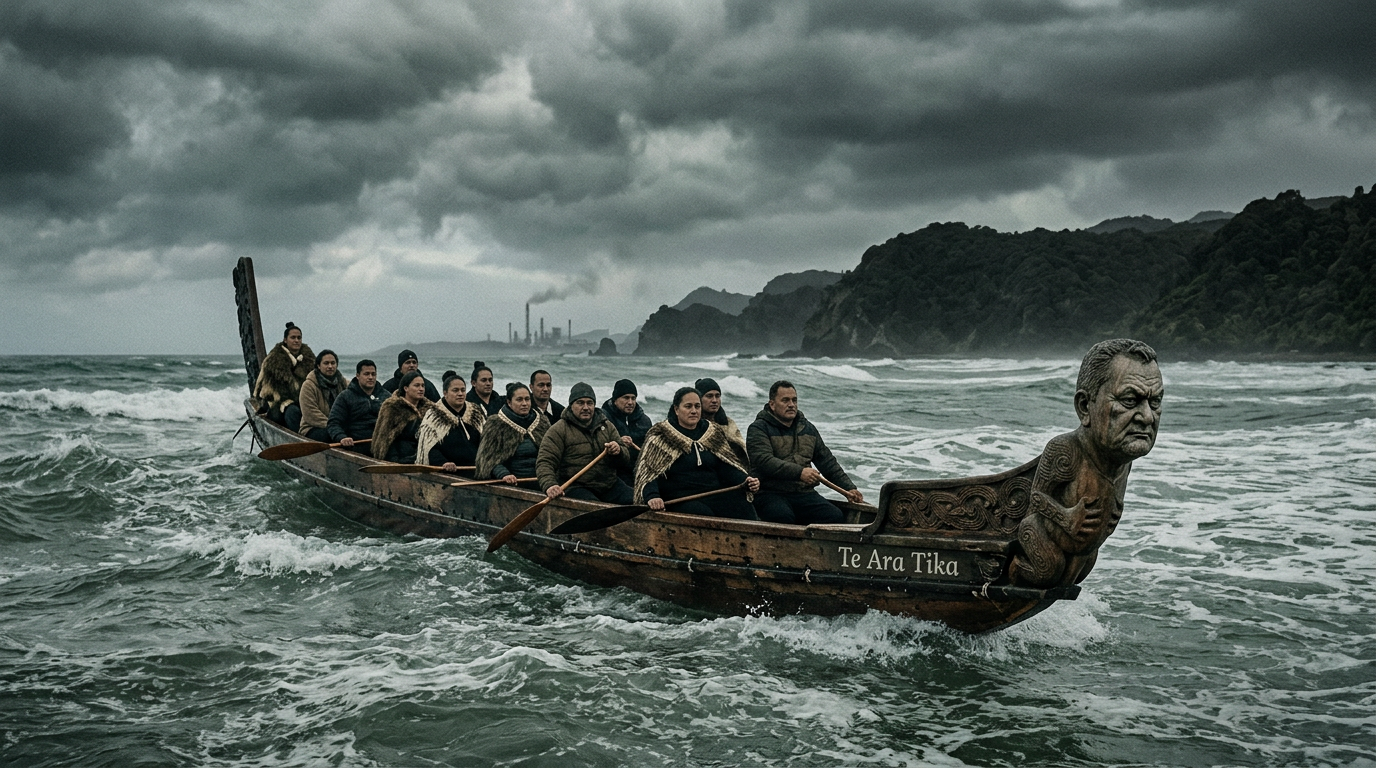
MFAT analysts predicted it. The Wise Response Society called for immediate action on March 10. RNZ's own economic analysis described New Zealand's position as "structurally exposed in ways that deserve serious attention" — the words of analysts watching a slow-motion shipwreck in real time.
The National Fuel Plan names Corrections as a critical customer and does not mention Māori once, as NZ Herald confirms. The Petroleum Demand Restraint Act 1981 — the legislation that will ban your car, cap your purchase, and restrict your hours — contains no Treaty obligation.
The refinery that could have been a buffer was sold to a spreadsheet in 2022. The reserves that should protect the vulnerable protect the state's enforcement machinery instead. And the minister responsible — Shane Jones, who simultaneously holds Resources, who has strip-mined every environmental protection he could reach — stands at the bow of this listing waka and calls it stability.
This is not a government managing an emergency. This is a colonial hierarchy, encoded in petroleum law, performing competence while Māori communities prepare to absorb, as they always do, the full weight of a structural failure that was never theirs to cause.
Ko Wai Mātou? We Are the People This Plan Forgot
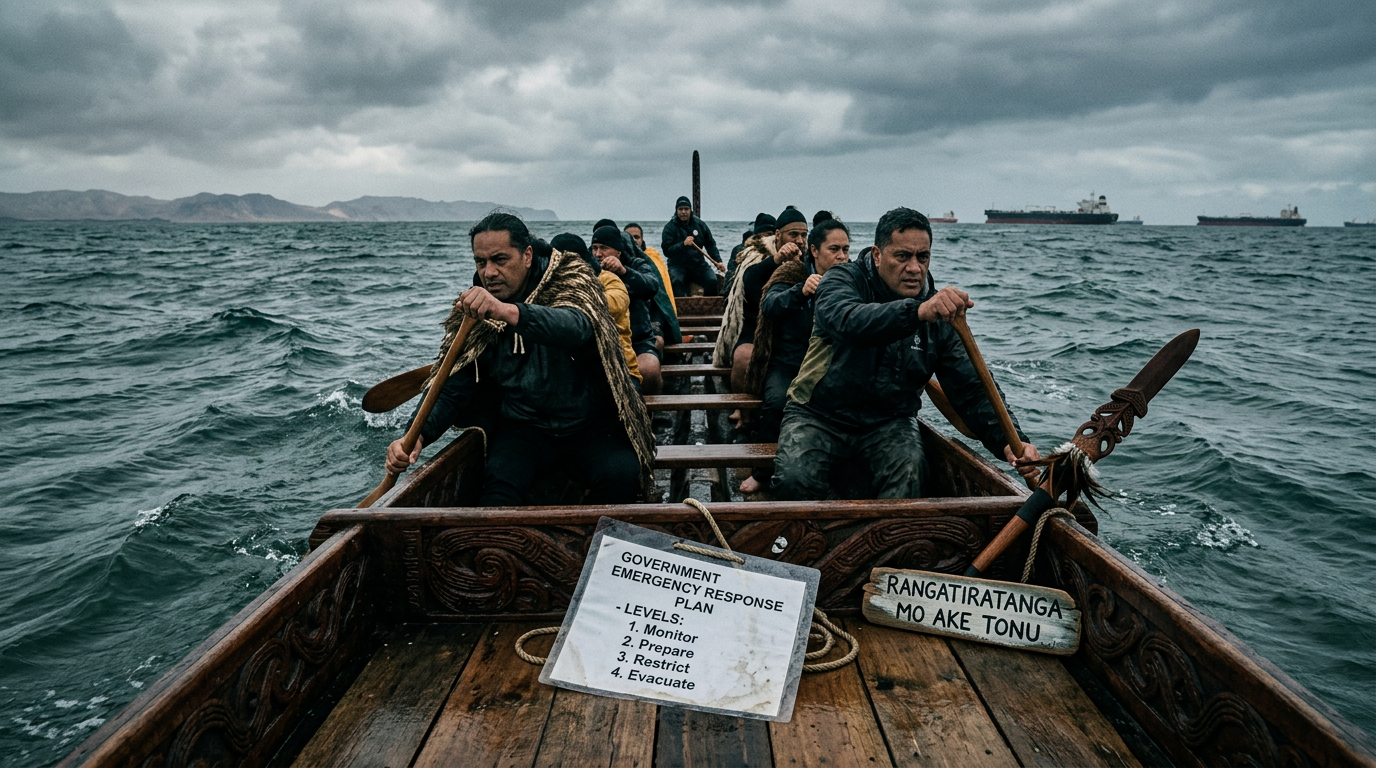
The waka is in the water. The Strait of Hormuz is closed. The government has a laminated card with four levels and no Māori in it.
This is what 180 years of colonial energy dependency looks like: a nation that surrendered its refinery to a spreadsheet, its foreign policy to Washington, and its emergency planning to a framework that puts Corrections ahead of kaumātua.
The rangatiratanga response is not to wait for Level 4. It is to build the marae fuel hub now. To invest in kai sovereignty now — because kai motuhake and fuel sovereignty are expressions of the same principle: that Māori have the right, under Article Two of Te Tiriti, to control the resources that sustain their communities. It is to demand that every emergency plan published in this country carries the weight of Te Tiriti or it carries nothing at all.
The tanker cannot come through. But the taiaha is still in our hands.
Kia kaha. Kia māia. Kia manawanui.

Ivor Jones The Māori Green Lantern Fighting Misinformation And Disinformation From The Far Right
Related essays from The Māori Green Lantern: Trump's Iran War — When a Nuclear-Free Nation Genuflects | The Colosseum of Kingsland | The Nursery of Cages | The Charity of Conquerors | The Abalone Inquisition