“When the State Abandons its Whānau” - 3 August 2025
The latest government homelessness report exposes how neoliberal cruelty has reached crisis point
Kia ora whakatōhea. Greetings to you all. The shameful truth is now laid bare in black and white statistics that reveal the depth of this coalition government's abandonment of our most vulnerable whānau. The latest Homelessness Insights Report from Te Tūāpapa Kura Kāinga exposes a housing emergency that has been deliberately engineered through neoliberal policies that prioritise property speculators over people's basic right to shelter12. This essay examines how Christopher Luxon's coalition has weaponised emergency housing criteria to manufacture a homelessness crisis that disproportionately devastates Māori communities, revealing the continuation of colonial dispossession through contemporary policy violence.
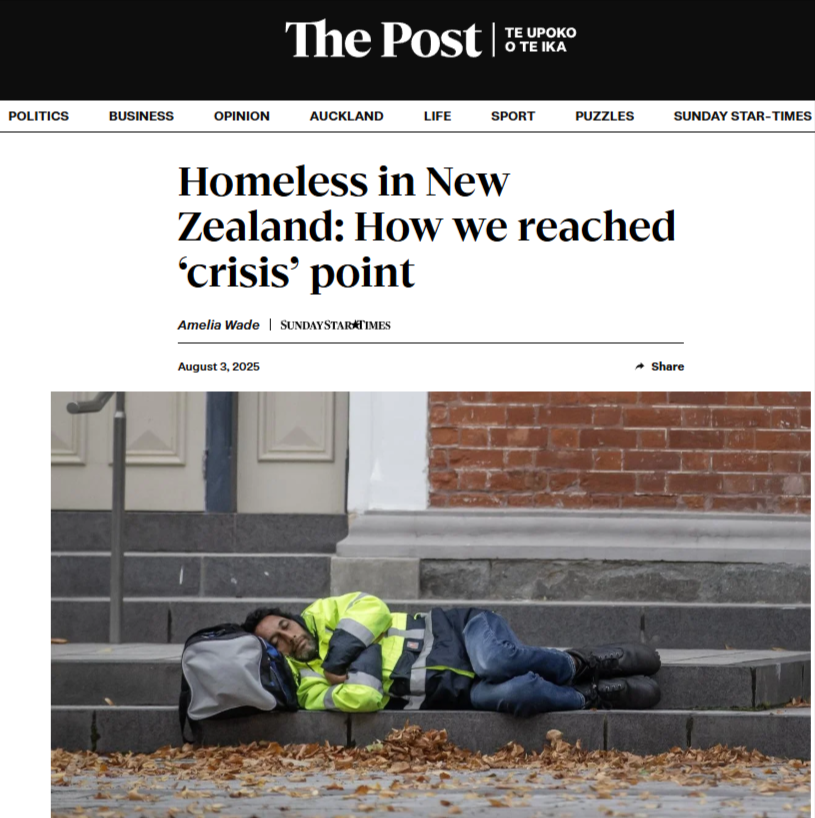
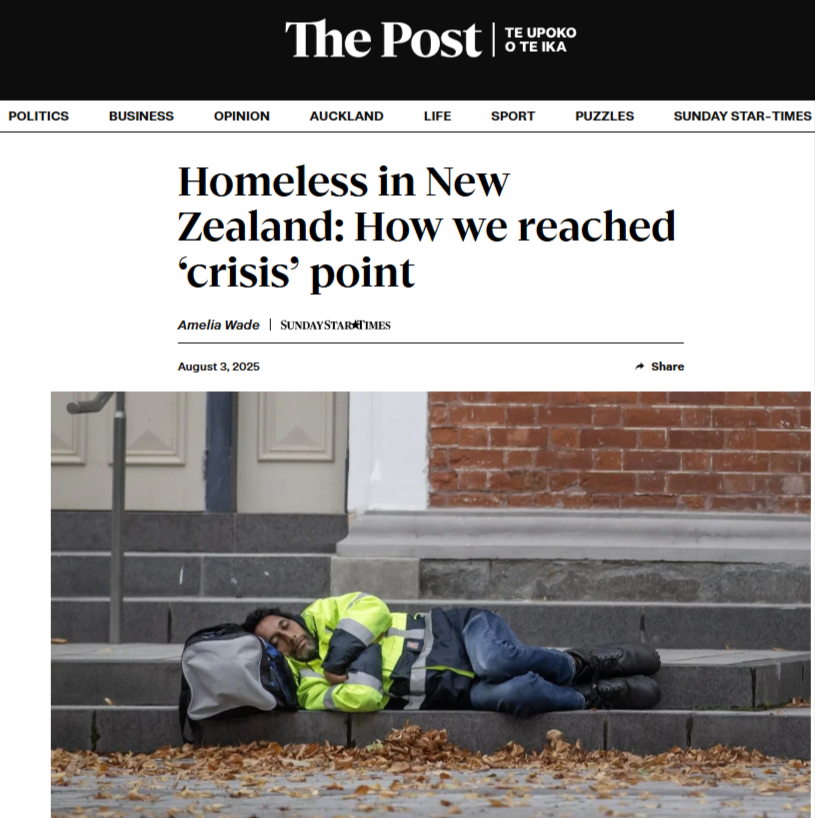
The statistics paint a devastating picture: one in every 1000 New Zealanders now lives without shelter3, emergency housing rejection rates have skyrocketed from 3 percent to 27 percent in just two years42, and Māori continue to bear the brunt of this manufactured crisis, representing 43 percent of Auckland's homeless despite being only 11 percent of the population56. This is not an accident of policy failure but a deliberate strategy to drive down emergency housing costs by simply denying people access to basic shelter. The Post article from August 3, 2025 provides a window into this cruel machinery, showing how whānau with sick children are being turned away and told they have "contributed to their own homelessness"7. This essay will expose the hidden connections between far-right ideology, neoliberal economics, and colonial violence that have converged to create New Zealand's homelessness emergency.
Background
To understand the current homelessness crisis, we must examine the historical trajectory of housing policy in Aotearoa and how colonial dispossession created the conditions for contemporary Māori housing deprivation. The roots of today's crisis trace back to the systematic alienation of Māori land through colonial legislation, which destroyed traditional collective housing arrangements and forced Māori into European-style individual property ownership models that many could not afford89.
The post-war era represented a brief respite from this trajectory, with the First Labour Government establishing state housing as a universal provision1011. However, the neoliberal counter-revolution that began in 1984 fundamentally altered the relationship between the state and housing provision1213. Ruth Richardson's "Mother of All Budgets" in 1991 marked a decisive break with the post-war social contract, introducing market rents for state housing tenants and privatising $2.4 billion worth of state mortgages - the second largest privatisation of that era1415.
The housing system was deliberately restructured according to neoliberal principles of "tenure neutrality" - the ideological fiction that housing policies should not favour any particular form of housing tenure12. This masked the reality that removing state support for homeownership would inevitably favour those with existing capital - predominantly Pākehā property owners - while further disadvantaging Māori who had been systematically excluded from property ownership through colonial land theft.
The consequences of these policy shifts have been predictable and devastating. Home ownership rates have plummeted from 73 percent in 1986 to 65 percent by 2017, with Māori experiencing the steepest declines1617. Between 1991 and 2015, 65 percent of new households formed were rental households, indicating a fundamental structural shift away from homeownership toward permanent rental tenure for younger generations14. This has created what housing researchers term a "two-tier society" divided between property owners and permanent renters, with profound implications for wealth accumulation and intergenerational equity.
The current homelessness crisis represents the logical endpoint of three decades of neoliberal housing policy, but it has been dramatically accelerated by the coalition government's deliberate policy choices since October 2023. The scale of the crisis is now undeniable: approximately 112,496 people, or 2.3 percent of the population, were severely housing deprived as of the 2023 Census, representing an increase from 99,462 individuals in 2018182. The number of people living without shelter has increased from 7.8 per 10,000 people in 2018 to 10.1 per 10,000 in 20232.
However, the most damning evidence lies in the coalition government's systematic weaponisation of emergency housing criteria to manufacture artificial reductions in demand. Emergency housing rejection rates have increased catastrophically from 3 percent in 2023 to 27 percent by January 2025 - a nine-fold increase that represents a deliberate policy choice to deny shelter to vulnerable whānau42. This has been achieved through the introduction of punitive criteria that allow Ministry of Social Development staff to reject applications if they determine applicants have "contributed to their own homelessness"1920.
7
The human cost of this ideological cruelty is evident in frontline reports from across the motu. Auckland Council recorded 809 unsheltered clients as of May 2025, up from 653 in January and 426 in September 20242. Wellington's Downtown Community Ministry reported a 40 percent increase in homelessness, with 464 people seeking help in September 2024 compared to 330 the previous year2122. Whangārei District Council saw homelessness-related reports increase from 680 in 2023 to 1,066 in 2024, with projections suggesting over 1,200 reports in 20252.
The crisis disproportionately impacts Māori communities, who represent 26.3 percent of those living without shelter nationally despite being 17.6 percent of the population2. In Auckland, the overrepresentation is even more stark, with Māori comprising 43 percent of both those living without shelter and those in temporary accommodation, despite being only 11 percent of Auckland's population56. This represents a continuation of colonial dispossession through contemporary policy violence.
The Architecture of Manufactured Homelessness
The coalition government's approach to homelessness represents a textbook case of neoliberal governance - the systematic transfer of state responsibilities to market mechanisms while blaming individuals for structural failures. Housing Minister Chris Bishop has been explicit about his ideological commitments, declaring his intention to "flood urban housing markets" with developable land while simultaneously cutting $1.5 billion from public house building and maintenance2425. This contradiction reveals the true nature of neoliberal housing policy: massive state intervention to benefit property developers and investors, combined with punitive withdrawal of support for those unable to compete in the market.
The government's emergency housing reforms, introduced in March 2024 and tightened further in August, represent a masterclass in what sociologist Loïc Wacquant terms "punitive governance" - the use of state power to discipline and control marginalised populations13. The new criteria require applicants to prove they have not "unreasonably contributed" to their housing need, effectively criminalising the experience of housing insecurity itself1920. This echoes the Victorian-era distinction between the "deserving" and "undeserving" poor, updated for the neoliberal age with bureaucratic language that obscures its moral violence.
Associate Housing Minister Tama Potaka has acknowledged that "many" link the government's emergency housing policy changes to rising homelessness, but refuses to accept responsibility for the connection2620. This represents a classic example of what political scientist Steven Levitsky calls "competitive authoritarianism" - the use of formally democratic institutions to achieve authoritarian outcomes. The government maintains the appearance of providing emergency housing while systematically denying access to it, then deflects criticism by claiming the connections are merely "anecdotal".
The ideological foundations of this approach can be traced to the influence of far-right think tanks and their promotion of "individual responsibility" narratives that obscure structural inequality1327. The same neoliberal orthodoxy that justified the privatisation of state assets in the 1990s now justifies abandoning vulnerable whānau to sleep rough, using the language of "fiscal responsibility" to mask ideological cruelty. When pressed about the human cost of these policies, Prime Minister Christopher Luxon - a property millionaire who briefly claimed $52,000 in accommodation allowances to live in his own mortgage-free apartment - simply denies that stricter emergency housing criteria have contributed to increased homelessness2828.
Colonial Continuities and Contemporary Violence
The devastating overrepresentation of Māori in homelessness statistics cannot be understood without recognising how contemporary housing policy continues the colonial project of land alienation and cultural destruction. The statistics reveal a system of structural racism so embedded that it produces "natural" outcomes: Māori represent 43 percent of Auckland's homeless population while being only 11 percent of the city's residents56. This is not the result of individual choices or cultural factors, but the predictable outcome of policies designed to privilege private property ownership in a society where Māori were systematically excluded from capital accumulation through colonial dispossession2930.
The colonial roots of contemporary homelessness are evident in the historical trajectory of Māori housing policy. Following the passage of the Native Land Court Act 1865, Māori land ownership was systematically undermined through the imposition of individual title, making collectively-owned land vulnerable to sale and fragmentation89. This process destroyed traditional Māori housing arrangements based on whānau and hapū collective responsibility, forcing Māori into European-style nuclear family housing models that many could not afford.
The urbanisation of Māori communities from the 1940s onward compounded these problems, as rural Māori moved to cities in search of employment but faced systematic discrimination in housing markets. The "pepper-potting" policy of the 1950s, which scattered individual Māori families throughout Pākehā suburbs to encourage assimilation, deliberately undermined Māori collective support networks that had historically provided housing security3132. This policy was explicitly designed to break down Māori cultural identity and force individual Māori families to adapt to European social organisation.
Contemporary homelessness among Māori must be understood as the intergenerational consequence of this systematic cultural and economic violence. As Eugene Hill, who has experienced homelessness for nine years, explains: "Homelessness is a result of unresolved issues at home, with parents and whānau, with abuse or mental abuse, physical abuse. One hundred percent colonisation"29. The system of colonisation created the conditions for homelessness, and it is the same system that now criminalises those forced to live without shelter.
The coalition government's emergency housing reforms represent a contemporary form of what Patrick Wolfe termed "the logic of elimination" - the ongoing structure of colonialism that seeks to eliminate Indigenous peoples as political subjects. By making it harder for Māori whānau to access emergency housing, while simultaneously cutting funding for Māori housing providers33, the government is effectively punishing Māori for the consequences of their own historical dispossession. This is not accidental policy failure but the predictable outcome of a system designed to prioritise private property rights over Indigenous collective welfare.
The Property Speculation Industrial Complex
The housing crisis cannot be understood without examining how successive governments have deliberately constructed policy frameworks that prioritise property speculation over housing as a human right. Christopher Luxon's personal property empire - seven properties including his mortgage-free Wellington apartment for which he claimed $52,000 in accommodation allowances - represents the perfect symbol of this captured state3435. The Prime Minister literally profits from the housing crisis while implementing policies that exacerbate homelessness, embodying the class interests that drive neoliberal housing policy.
Housing Minister Chris Bishop's rhetorical commitment to making housing "affordable" while simultaneously cutting public housing funding reveals the fundamental contradiction at the heart of neoliberal housing policy3637. Bishop promises to "flood the market" with developable land while reducing the state's role in directly providing housing, effectively subsidising private developers while abandoning vulnerable whānau to market forces2538. This represents what geographer Jamie Peck terms "actually existing neoliberalism" - the reality of massive state intervention to support capital accumulation, disguised as "market solutions".
The financialisation of housing has transformed shelter from a social good into an investment vehicle, with devastating consequences for housing affordability. Almost two-thirds of New Zealanders identify property investors as a key reason for soaring house prices39, reflecting popular understanding of how speculative investment has driven housing beyond the reach of ordinary families. The Reserve Bank's own data shows that investors accounted for up to 40 percent of housing purchases in some periods, crowding out first-home buyers and driving up prices.
This system is actively supported by government policy that treats housing as a commodity rather than a human right. Tax policies favour property investors through depreciation allowances and interest deductibility, while capital gains from property speculation remain largely untaxed4041. The Accommodation Supplement, ostensibly designed to help low-income tenants, actually functions as a massive subsidy to landlords by enabling them to charge higher rents1514. These policies represent a systematic transfer of wealth from renters to property owners, facilitated by the state.
The result is what economist Michael Hudson terms "debt deflation" - the diversion of economic activity from productive investment toward rent-seeking in the property market17. Capital that could be invested in productive enterprises instead flows into property speculation, reducing economic growth while inflating asset prices. This creates a vicious cycle where rising property prices require ever-larger loans, transferring increasing amounts of household income to the financial sector through mortgage payments.
The Salvation Army's Warning and Government Denial
The Salvation Army's stark warning that one in every 1000 New Zealanders is now without shelter represents a damning indictment of the coalition government's housing policies3. The organisation's data reveals a system in complete crisis: 57,000 women experiencing homelessness, 14 in every 1000 people living in uninhabitable housing, and crimes against homeless people increasing by 81 percent3. These are not abstract statistics but human lives destroyed by policy choices that prioritise fiscal austerity over basic human dignity.
Lieutenant Colonel Ian Hutson's call for coordinated government action highlights the fragmented and inadequate nature of current responses to homelessness3. The Salvation Army's identification of a 386 percent increase in Ministry of Social Development rejections citing that people had "contributed to their own homelessness" since August 2024 exposes the deliberate nature of the coalition's strategy3. This is not policy failure but policy success - the government is achieving its goal of reducing emergency housing costs by simply denying access to vulnerable whānau.
The government's response to mounting evidence of rising homelessness has been a masterclass in plausible deniability and bureaucratic obfuscation. When confronted with Auckland Council's data showing a 53 percent increase in rough sleeping, Prime Minister Luxon simply denied that government policy changes had contributed to the crisis28. This represents what political scientist Hannah Arendt identified as a key feature of modern bureaucratic power - the ability to inflict massive harm while avoiding individual accountability through complex administrative structures.
Associate Housing Minister Tama Potaka's acknowledgment that "many" link government policy to rising homelessness, while refusing to accept this connection himself, demonstrates the psychological mechanisms that enable policy violence26. By framing overwhelming evidence as merely "anecdotal" and attributing criticism to unspecified "others", Potaka avoids confronting the human consequences of his government's deliberate choices. This represents what psychiatrist Robert Jay Lifton terms "psychic numbing" - the psychological defence mechanism that enables ordinary people to participate in systems of organised cruelty.
The coalition's strategy of manufactured crisis serves multiple ideological functions. By creating artificial scarcity in emergency housing while increasing rough sleeping, the government can point to visible homelessness as justification for more punitive policies toward beneficiaries and greater support for private property development. This follows what Naomi Klein identified as the "shock doctrine" - the use of manufactured crises to impose neoliberal policies that would be politically impossible under normal circumstances.

The Māori Green Lantern fighting misinformation and disinformation from the far right
Implications
The homelessness crisis engineered by the coalition government represents a broader assault on the social contract that has defined New Zealand society since the post-war period. By abandoning the state's responsibility to ensure basic shelter for all citizens, the government is fundamentally redefining the relationship between state and society along market lines. This has profound implications that extend far beyond housing policy itself.
The deliberate creation of homelessness serves to discipline the entire working class by demonstrating the consequences of economic insecurity. When whānau see other families sleeping rough or living in cars, they understand that they too are only a job loss or relationship breakdown away from similar circumstances. This creates what economist Michał Kalecki identified as the "political business cycle" - the use of unemployment and economic insecurity to weaken workers' bargaining power and suppress wage demands.
For Māori communities, the homelessness crisis represents a continuation of colonial violence through contemporary policy mechanisms. The systematic overrepresentation of Māori in homelessness statistics, combined with cuts to Māori housing providers and stricter emergency housing criteria, effectively punishes Māori for the consequences of historical dispossession3342. This maintains what Indigenous scholar Glen Coulthard terms "the colonial present" - the ongoing structure of domination that continues to dispossess Indigenous peoples of their collective resources and political autonomy.
The housing crisis also has profound implications for New Zealand's democratic institutions and social cohesion. When young people cannot afford homes and families are forced to live in cars, the social basis for democratic participation is undermined. Property ownership has historically been linked to political stability and civic engagement, as homeowners have a material stake in their communities. The systematic exclusion of younger generations from homeownership threatens to create a permanent rental class with no long-term investment in New Zealand's democratic institutions.
The international implications of New Zealand's housing crisis are equally significant. As one of the most expensive housing markets in the world, New Zealand has become a symbol of how neoliberal policies can destroy social cohesion even in relatively wealthy societies4317. The crisis demonstrates that housing affordability is not simply a technical problem of supply and demand but a political question about how societies choose to distribute resources and organise economic life.
The evidence is overwhelming and undeniable: the coalition government has deliberately manufactured a homelessness crisis through the systematic withdrawal of emergency housing support, combined with policies that favour property speculators over people's basic right to shelter. The statistics tell a story of ideological cruelty disguised as fiscal responsibility - emergency housing rejection rates increasing nine-fold from 3 percent to 27 percent, rough sleeping rising across every major centre, and Māori whānau bearing the disproportionate burden of this manufactured crisis423.
This is not policy failure but policy success. Christopher Luxon's government has achieved its goal of reducing emergency housing costs by the simple expedient of denying vulnerable whānau access to basic shelter. The human cost - families sleeping in cars, children growing up without stable housing, the systematic re-traumatisation of already vulnerable communities - is treated as an acceptable price for fiscal austerity that primarily benefits property investors and landlords.
The Māori values of manaakitanga (hospitality), whakatōhea (collective responsibility), and kaitiakitanga (guardianship) offer a fundamental challenge to the neoliberal individualism that has created this crisis. These values recognise that housing is not a commodity to be traded for profit but a basic requirement for human dignity and community wellbeing. The systematic overrepresentation of Māori in homelessness statistics reflects not individual failure but the ongoing violence of a colonial system that prioritises private property rights over collective welfare.
The path forward requires rejecting the false choice between fiscal responsibility and basic human dignity. New Zealand has the resources to house every person - the crisis is not one of scarcity but of political will. This demands a fundamental reimagining of housing policy based on Indigenous values of collective responsibility rather than neoliberal principles of individual competition. It means massive public investment in social housing, strict regulation of property speculation, and the recognition that housing is a human right, not a commodity.
The choice facing New Zealand is clear: we can continue down the path of manufactured homelessness that serves only property speculators and landlords, or we can build a housing system based on the principle that every whānau deserves a warm, dry, secure home. The coalition government has chosen cruelty over compassion, ideology over humanity. It is time for all New Zealanders of conscience to choose differently.
The Māori Green Lantern understands these are tough economic times for whānau, so please only consider contributing a koha if you have capacity and wish to do so. For those readers who find value in this analysis and want to support the ongoing fight against misinformation and neoliberal propaganda, donations can be made to HTDM: 03-1546-0415173-000.
Kia kaha, kia māia, kia manawanui. Be strong, be brave, be steadfast in the fight for justice.
Ivor Jones The Māori Green Lantern
- https://www.rnz.co.nz/news/political/567818/we-have-a-real-problem-homelessness-increases-but-by-how-much-unclear-government-report
- /content/files/assets/Uploads/Documents/Homelessness/homelessness-insights-report-june-2025-pdf-1-0.pdf
- https://www.rnz.co.nz/news/national/568282/one-in-every-1000-new-zealanders-without-shelter-salvation-army
- https://www.housingfirst.co.nz/whats-happening/emergency-housing-where-are-people-living-now/
- https://www.rnz.co.nz/news/national/389336/maori-make-up-more-than-over-40-percent-of-auckland-homeless-report
- https://www.nzherald.co.nz/kahu/maori-pasifika-lgbt-and-disabled-over-represented-in-auckland-homeless-count/43VR3GYI6FBAQSY3UOSSRCLIEQ/
- https://ppl-ai-file-upload.s3.amazonaws.com/web/direct-files/attachments/2123776/a5105493-69f8-4bea-a534-c7cdbc2759a3/Homeless-in-New-Zealand_-How-we-reached-crisis-point-_-The-Post.PDF
- https://www.jstor.org/stable/10.2307/40111531?origin=crossref
- /content/files/system/files/mckee_fnl_webready.pdf
- https://kaingaora.govt.nz/about-us/history-of-state-housing/
- https://teara.govt.nz/en/housing-and-government/print
- /content/files/assets/arts/our-research/research-institutes-centres-groups/ppi/policy-briefings/ppi-housing-full2.pdf
- /content/files/Sites/article/view/271/294.pdf
- /content/files/webcontent/document/201631/20151201sppusahomelessbabyboomersrreportwebv1.pdf
- https://teara.govt.nz/en/housing-and-government/page-3
- https://counterfutures.ojs.otago.ac.nz/counterfutures/article/view/192
- https://en.wikipedia.org/wiki/New_Zealand_property_bubble
- https://en.wikipedia.org/wiki/Homelessness_in_New_Zealand
- https://www.rnz.co.nz/news/national/534007/number-of-emergency-housing-applications-denied-rises-rule-change-blamed
- https://www.rnz.co.nz/news/political/564300/homelessness-increase-not-necessarily-due-to-government-policy-changes-minister
- https://www.rnz.co.nz/national/programmes/checkpoint/audio/2018959892/40-increase-in-homelessness-in-wellington-charity
- https://www.rnz.co.nz/news/national/530871/hundreds-of-wgtn-homeless-squeezed-between-housing-crisis-and-clampdown-on-support-advocate
- https://ojs.lib.uwo.ca/index.php/ijoh/article/view/16588
- https://www.labour.org.nz/news/release-simple-reason-for-drop-in-emergency-housing/
- https://www.interest.co.nz/property/126569/housing-minister-chris-bishop-says-he-wants-flood-big-cities-30-years-mixed-use
- https://www.1news.co.nz/2025/07/20/many-link-govts-emergency-housing-policy-to-homelessness-rise-minister/
- https://chrisperleyblog.com/2016/05/25/the-housing-crisis-and-neoliberalism/
- https://www.rnz.co.nz/news/political/544438/luxon-denies-stricter-emergency-housing-rules-have-increased-homelessness
- https://www.teaonews.co.nz/2018/10/09/colonisation-made-me-homeless/
- /content/files/wp-content/uploads/2022/04/groot-indigenous-homelessness-1.pdf
- https://teara.govt.nz/en/maori-housing-te-noho-whare
- https://en.wikipedia.org/wiki/State_housing_in_New_Zealand
- https://www.rnz.co.nz/news/political/565832/regulatory-standards-bill-could-be-barrier-for-maori-housing-ministry
- https://www.rnz.co.nz/news/political/510614/pm-christopher-luxon-says-he-will-pay-back-his-accommodation-allowance
- https://www.mpamag.com/nz/news/general/christopher-luxon-under-fire-for-comments-amid-housing-crisis/318808
- https://www.nzherald.co.nz/nz/politics/labour-and-national-housing-policy-leaves-anti-density-backers-nowhere-to-run/IHLAI2X77VCZNIAAP3H6KN2OFI/
- https://www.interest.co.nz/property/130943/housing-minister-chris-bishop-wants-community-housing-providers-have-%E2%80%98competitive
- https://theconversation.com/to-achieve-real-growth-the-nz-government-needs-to-relax-the-rules-around-housing-249000
- https://www.nzherald.co.nz/nz/oneroof-report-property-investors-blamed-for-nzs-soaring-house-price-rises/SEOMQZBB4DMSW4JDART6B5UGSY/
- https://www.ijcscm.com/sites/default/files/issue/20/Samarasinghe%20D.A.S._003%20Vol%2010%20No%202.pdf
- https://www.rnz.co.nz/news/business/432915/property-investors-not-convinced-by-anz-tightening-lending
- https://www.rnz.co.nz/news/te-manu-korihi/567832/government-and-ngati-maniapoto-iwi-to-build-40-affordable-rental-homes-in-te-kuiti
- https://journals.sagepub.com/doi/10.1177/2046147X251331629
- https://essd.copernicus.org/articles/17/2625/2025/
- https://onlinelibrary.wiley.com/doi/10.1111/adj.13055
- http://e-chnr.org/journal/view.php?doi=10.4094/chnr.2025.002
- https://www.tandfonline.com/doi/full/10.1080/00480169.2024.2344560
- https://nzmj.org.nz/journal/vol-137-no-1599/update-and-projections-for-new-zealand-s-ophthalmology-workforce
- https://ashpublications.org/blood/article/144/Supplement%201/5147/533266/Impact-of-Socioeconomic-Status-on-Utilisation-of
- https://www.researchprotocols.org/2025/1/e66184
- https://www.mdpi.com/1422-0067/26/3/990
- https://www.cambridge.org/core/product/identifier/S0029665125100189/type/journal_article
- https://www.tandfonline.com/doi/pdf/10.1080/1177083X.2023.2214606?needAccess=true&role=button
- https://www.tandfonline.com/doi/pdf/10.1080/1177083X.2023.2293988?needAccess=true
- https://pmc.ncbi.nlm.nih.gov/articles/PMC8687556/
- https://www.tandfonline.com/doi/pdf/10.1080/1177083X.2023.2295021?needAccess=true
- https://dx.plos.org/10.1371/journal.pone.0259799
- https://pmc.ncbi.nlm.nih.gov/articles/PMC9644742/
- https://www.rnz.co.nz/news/political/434946/jacinda-ardern-s-government-facing-continued-criticism-over-its-housing-plans
- https://www.rnz.co.nz/news/te-manu-korihi/390553/rates-of-homeless-maori-in-auckland-should-be-a-wake-up-call-experts-say
- https://www.nzherald.co.nz/nz/emergency-housing-access-tightens-homelessness-rises/FI7ZV255WNDGREYNQQOFCWGTI4/
- https://www.rnz.co.nz/news/thedetail/564850/nowhere-to-go-for-more-than-100-000-kiwis-the-worsening-reality-of-homelessness
- https://www.rnz.co.nz/news/national/535943/the-grim-picture-of-homelessness-for-nz-women
- https://www.nzherald.co.nz/nz/jacinda-arderns-government-facing-continued-criticism-over-its-housing-plans/2A4GOAEDLPGMG2DR236JN2HFOE/
- https://www.rnz.co.nz/news/political/544007/almost-a-trap-advocates-say-near-impossible-to-get-into-emergency-housing-as-homelessness-increases
- https://www.rnz.co.nz/news/national/568266/more-women-living-without-shelter-in-aotearoa
- https://www.rnz.co.nz/news/national/432664/reserve-bank-rejects-request-for-help-fixing-the-housing-crisis
- https://www.nzherald.co.nz/nz/homelessness-crisis-advocates-call-for-better-housing-solutions-the-front-page/OGZCBOS3DRAVPHRXZU6WIT5JHU/
- https://www.rnz.co.nz/national/programmes/checkpoint/audio/2018997480/disproportionately-high-rate-of-homeless-women-in-nz
- https://www.nzherald.co.nz/nz/government-scrapping-resource-management-act-to-tackle-the-housing-crisis/RZGAI3GBGREAWGKDFHMGJ7O3AY/
- https://www.nzherald.co.nz/nz/politics/nz-leads-world-rankings-of-homelessness-as-chris-bishop-says-action-on-bill-english-report-very-soon/5IJECITTM5BH3AEYQXQ5CPV2F4/
- https://www.nzherald.co.nz/business/companies/construction/government-housing-changes-so-much-so-far-reaching-so-many-fronts-all-at-once-will-it-work/CDMIDVKD4BFZPM2HATWFXL56J4/
- https://www.hud.govt.nz/stats-and-insights/system-indicators/data-available-for-whanau-maori-pacific-peoples-and-people-with-disabilities
- https://www.hud.govt.nz/our-work/going-for-housing-growth-programme
- https://www.statista.com/statistics/1028989/new-zealand-homeless-population-in-auckland-by-ethnicity/
- https://www.beehive.govt.nz/portfolio/nationalactnew-zealand-first-coalition-government-2023-2026/housing
- https://www.stats.govt.nz/reports/te-pa-harakeke-maori-housing-and-wellbeing-2021/
- https://www.beehive.govt.nz/release/saying-yes-housing-growth
- https://data.govt.nz/datasetrequest/show/1071
- https://www.housingfirst.co.nz/data-and-evidence/
- /content/files/documents/cabinet-paper-fixing-the-housing-crisis.pdf
- https://www.hud.govt.nz/stats-and-insights/homelessness-outlook/homelessness-indicators
- https://www.sciencedirect.com/science/article/pii/S0197397523001455
- https://www.greens.org.nz/government_plan_fails_on_growing_public_housing_stock
- https://www.housingfirst.co.nz/the-truth-behind-new-zealands-housing-crisis/
- https://www.buildingbetter.nz/annotatedbibliograpy/maori-homelessness-basic-statistics/index.html
- https://www.stats.govt.nz/information-releases/2023-census-severe-housing-deprivation-homelessness-estimates/
- https://www.msd.govt.nz/about-msd-and-our-work/work-programmes/social-housing/demand-for-housing.html
- http://www.scielo.br/scielo.php?script=sci_arttext&pid=S0104-40362023000400202&tlng=en
- https://www.tandfonline.com/doi/full/10.1080/13632434.2023.2171005
- https://rgs-ibg.onlinelibrary.wiley.com/doi/10.1111/tran.12668
- https://ojs.victoria.ac.nz/nzsr/article/view/9498
- https://www.semanticscholar.org/paper/013d2437bdef70f454f66954d770f0927f631fdb
- https://www.tandfonline.com/doi/full/10.1080/1177083X.2024.2328532
- https://www.semanticscholar.org/paper/30be91f17ee110b7fbf26bc1b2ce6686dfcf611c
- http://naukaru.ru/en/nauka/monography/3264/view
- /content/files/anzsw/article/download/220/290.pdf
- /content/files/anzsw/article/download/159/242.pdf
- /content/files/anzsw/article/download/221/292.pdf
- https://www.mdpi.com/2076-0760/13/9/468
- /content/files/pub/article/download/854/743.pdf
- https://pmc.ncbi.nlm.nih.gov/articles/PMC11489037/
- /content/files/anzsw/article/download/824/738.pdf
- /content/files/anzsw/article/download/997/884.pdf
- http://www.cultureunbound.ep.liu.se/v7/a37/cu15v7a37.pdf
- /content/files/kotare/article/download/684/495.pdf
- https://www.nzherald.co.nz/nz/bryce-edwards-nationals-dangerous-social-housing-plans/7BCJ2V65UGPCSAGPFSAOXMIUZE/
- https://www.rnz.co.nz/news/political/447512/number-of-rejections-for-emergency-housing-tripled-in-2020
- https://www.nzherald.co.nz/hawkes-bay-today/news/opinion-money-for-mortar-is-our-issue/FPCVT6DI3OGRVVUYKWUMTUUNRM/
- https://www.rnz.co.nz/news/political/457953/christopher-luxon-calls-for-accountability-over-37m-on-inflated-rentals-for-emergency-accommodation
- https://www.rnz.co.nz/news/political/557114/third-of-emergency-housing-applications-being-rejected-by-msd
- https://www.nzherald.co.nz/nz/chloe-swarbrick-and-green-economics-the-lost-monopoly-lessons-simon-wilson/3RHCBIIL7BHLZAYCYXLCUGYLGQ/
- https://www.nzherald.co.nz/nz/politics/prime-minister-chris-luxon-faces-questions-on-building-product-investment-immigration-numbers/KAFOQ6UEU5DQ5NAJYZVXL7VRK4/
- https://www.nzherald.co.nz/opinion/news/article.cfm?c_id=466&objectid=11150603
- https://www.rnz.co.nz/news/political/529635/luxon-s-property-profits-highlight-unfairness-labour-says
- https://www.rnz.co.nz/news/political/457844/a-campaign-of-denial-nz-police-and-emergency-housing
- https://www.nzherald.co.nz/the-listener/new-zealand/home-truths-what-an-nz-journalist-had-to-learn-to-write-about-poverty/XUZLQJ6C75BGPM72GDF4XXJMM4/
- https://www.rnz.co.nz/news/political/566953/auckland-s-problems-a-hangover-from-labour-christopher-luxon-says
- https://www.rnz.co.nz/news/national/561772/the-social-housing-waitlist-woman-told-no-emergency-homes-available-at-all
- https://www.nzherald.co.nz/topic/poverty/7/
- https://www.rnz.co.nz/news/election-2023/498361/national-s-christopher-luxon-fronts-up-on-lunches-housing
- /content/files/content/dam/uoc-main-site/documentss/reports/ntrc-contemporary-research-division/homeless-and-landless.pdf
- https://www.act.org.nz/news/national-finally-admits-they-got-housing-density-policy-wrong
- https://thespinoff.co.nz/politics/28-01-2025/windbag-luxons-culture-of-saying-no-to-housing
- https://www.nzherald.co.nz/nz/number-of-denied-emergency-housing-applications-rises-rule-change-blamed/C5FLZMW7TNCIBECBVFFW5MPJQQ/
- https://www.saanz.net/wp-content/uploads/2024/04/Roper_Neoliberalism-in-New-Zealand_NZS-391_pp-39-59.pdf
- https://www.rnz.co.nz/news/national/528698/government-celebrates-as-number-of-whanau-in-emergency-housing-drops-by-more-than-half
- /content/files/media/pages/journal/vol-133-no-1512/neoliberalism-what-it-is-how-it-affects-health-and-what-to-do-about-it/91b3937839-1696477103/neoliberalism-what-it-is-how-it-affects-health-and-what-to-do-about-it.pdf
- https://www.interest.co.nz/economy/131704/prime-minister-wants-end-culture-saying-no-wont-say-whether-he-now-supports-or-still
- https://www.beehive.govt.nz/release/emergency-housing-target-achieved-five-years-early
- /content/files/bitstream/handle/10179/9910/02_whole.pdf

- https://academic.oup.com/tcbh/article/35/3/388/7674220
- http://www.liverpooluniversitypress.co.uk/doi/10.3828/labourhistory.2024.38
- https://acnzsn.org/richard-s-hill-and-steven-loveridge-secret-history-state-surveillance-in-new-zealand-1900-1958/
- https://openaccess.wgtn.ac.nz/articles/thesis/Inclusive_Housing_Exploring_Culturally_Inclusive_Accessible_Design_in_the_Contemporary_New_Zealand_State_House/17142536/1
- https://www.journal.mai.ac.nz/10.20507/MAIJournal.2023.12.2.6
- https://www.tandfonline.com/doi/full/10.1080/02673037.2023.2224242
- https://ojs.victoria.ac.nz/aha/article/view/8717
- https://www.tandfonline.com/doi/full/10.1080/00779954.2023.2226671
- /content/files/record/2132681/files/article.pdf
- /content/files/core/services/aop-cambridge-core/content/view/FB7176A24F271E9929EE98AA0EF1C15F/S0047279422000770a/div-class-title-the-rise-and-fall-of-social-housing-housing-decommodification-in-long-run-comparison-div.pdf
- https://www.tandfonline.com/doi/pdf/10.1080/14036096.2023.2218863?needAccess=true&role=button
- https://www.tandfonline.com/doi/pdf/10.1080/02723638.2018.1440126?needAccess=true
- https://journals.ufs.ac.za/index.php/aa/article/download/3822/3509
- https://www.mdpi.com/1660-4601/14/11/1352/pdf
- /content/files/journals/index-php/mcs/article/download/4467/4919.pdf
- /content/files/images/applications/publishing/templates/article/assets/20216/ppm_2024_02_mammadova.pdf
- https://www.nzherald.co.nz/nz/idialoguei-sick-maori-face-of-subtle-racism/EQK2J5HBH4VWYTH3OC44AQAJZI/
- https://www.rnz.co.nz/news/regional/301486/pensioners-fear-housing-privatisations
- https://teara.govt.nz/en/european-ideas-about-maori/print
- https://www.rnz.co.nz/news/national/564686/wellington-council-to-spend-460-000-on-coordination-service-to-support-rough-sleepers
- https://teara.govt.nz/en/cartoon/33892/selling-state-assets
- https://www.rnz.co.nz/news/political/518278/opinion-budget-2024-does-not-fulfil-te-tiriti-obligations
- https://www.nzherald.co.nz/nz/politics/kainga-ora-sold-80-million-of-state-housing-in-five-years/JAZROG6ASFDSNNBIEUABS22EKU/
- https://www.nzherald.co.nz/kahu/national-maori-housing-conference-must-look-for-solutions-to-address-this-nations-indigenous-housing-crisis/VGRY2X336ZCFTHTJMRSV4IGKYM/
- https://www.nzherald.co.nz/nz/the-big-read-fighting-for-a-home/C2NXG6SQH357GX7DHROPQWOO5U/
- https://www.rnz.co.nz/news/national/478877/auckland-city-mission-says-growing-social-need-outstripping-resources
- https://www.rnz.co.nz/news/political/525607/government-was-warned-emergency-housing-crackdown-could-increase-homelessness
- https://www.rnz.co.nz/news/what-you-need-to-know/449159/can-labour-tackle-the-housing-crisis-like-its-lauded-party-predecessors-what-you-need-to-know
- https://www.nzherald.co.nz/rotorua-daily-post/news/rob-rattenbury-we-must-acknowledge-the-effects-of-colonisation/ESNJJDLMFCTCPF3E7MXCZXOSMA/
- https://www.chrislynchmedia.com/news-items/breaking-new-report-exposes-scale-of-homelessness-across-new-zealand/
- https://www.nzherald.co.nz/nz/politics/government-report-shows-homelessness-appears-to-be-outstripping-population-growth/SGRFYS6EZ5F5RPOALRBBF74NIQ/
- https://www.lifewise.org.nz/indigenous-homelessness-in-aotearoa/
- https://www.nzherald.co.nz/nz/sharp-rise-in-homelessness-prompts-salvation-army-call-for-action/TOXMHT7DPZCQFHVC32EGGD6PIY/
- https://nzhistory.govt.nz/media/photo/construction-and-sale-state-houses-1938-2002
- https://www.buildingbetter.nz/wp-content/uploads/2023/10/Rout_et_al_2019_Homeless__landless_in_two_generations_KTKR.pdf
- https://nzhistory.govt.nz/culture/state-housing-in-nz
- https://www.sciencedirect.com/science/article/pii/S2352827319300333
- https://www.heritage.org.nz/list-details/1360/First%20State%20House
- https://www.housingfirst.co.nz/our-mahi/maiea-taiki-e/
- https://jurnal.saburai.id/index.php/hkm/article/view/3645
- https://www.semanticscholar.org/paper/7e000dc4c04d65c3d8ff0b3dcaf12a9de84d4043
- https://academic.oup.com/jel/article/30/3/507/5098329
- https://journals.sagepub.com/doi/10.1177/0263774X15605941
- https://www.cambridge.org/core/product/identifier/S0010417522000159/type/journal_article
- https://www.semanticscholar.org/paper/cdcc7013a7dae452f9436b243f08daf6cd958f28
- https://www.semanticscholar.org/paper/431124af05f9e031f8c107b4db35745f79bd4fbc
- https://www.tandfonline.com/doi/full/10.1080/08882746.2021.1922044
- https://www.ijhpm.com/article_4631.html
- https://journals.sagepub.com/doi/10.1177/13684310241241800
- /content/files/footprint/article/download/2139/3921.pdf
- https://journals.sagepub.com/doi/pdf/10.1177/2399654420902149
- https://journals.sagepub.com/doi/pdf/10.1177/13684310241241800
- https://extra.shu.ac.uk/ppp-online/wp-content/uploads/2013/09/modernisation_marketisation_housing_reform.pdf
- https://onlinelibrary.wiley.com/doi/pdfdirect/10.1111/plar.12422
- https://onlinelibrary.wiley.com/doi/10.1111/1468-4446.13144
- https://www.mdpi.com/1911-8074/14/11/547/pdf?version=1636701891
- https://www.tandfonline.com/doi/pdf/10.1080/03003930.2022.2033227?needAccess=true
- https://www.tandfonline.com/doi/pdf/10.1080/19491247.2019.1682234?needAccess=true
- /content/files/core/services/aop-cambridge-core/content/view/DD9C48C4382889F99204E2B9191BDB24/S0003055421000058a/div-class-title-why-parties-displace-their-voters-gentrification-coalitional-change-and-the-demise-of-public-housing-div.pdf
- https://www.nzherald.co.nz/nz/want-to-grow-the-economy-by-5-billion-a-year-heres-how-simon-wilson/SIGAQYSQXZFVTBTGOUYM6CYBHM/
- https://www.nzherald.co.nz/nz/your-views-the-rudman-and-misa-views-on-housing/6WIIMXZECQDO5HQ5BRQIZM7KJM/
- https://www.nzherald.co.nz/nz/despite-decades-of-cost-cutting-governments-spend-more-than-ever-how-can-we-make-sense-of-this/AX25MUR75BHKJDTKHDNBCWPI3Y/
- https://www.nzherald.co.nz/business/personal-finance/investment/flippers-paradise-inside-the-world-of-new-zealands-most-prolific-property-speculators/NJBT3F4H5NH3NULCP4ASM4N2E4/
- https://www.rnz.co.nz/news/thehouse/562451/what-did-the-house-get-up-to-during-budget-urgency
- https://www.nzherald.co.nz/rotorua-daily-post/news/labour-mps-criticise-nationals-housing-cuts-amid-rotorua-homelessness/WXSSGTEQ3RBCNAODIU3XP36OIU/
- https://www.nzherald.co.nz/nz/home-truths-first-home-buyers-feel-interest-rate-cost-of-living-pinch/TEXYX6F2ZVDLHOZ3CWZSDLQIDU/
- https://www.nzherald.co.nz/business/economy/employment/craig-harrison-the-delusions-of-richard-prebble-why-young-working-class-kiwis-have-been-sold-out-and-let-down/CXACKYS63JJJDJM2JHTKW5KU2M/
- https://www.rnz.co.nz/news/political/534948/fewer-than-1000-families-living-in-emergency-accommodation
- https://www.nzherald.co.nz/nz/controlled-deflation-cant-hide-fact-ordinary-people-cant-afford-own-home/7JKYN6QUMHZT5YAI5MQIFFAOG4/
- https://www.nzherald.co.nz/nz/simon-wilson-nicola-willis-and-the-daughter-of-the-mother-of-all-budgets/BY6GEA2JFRGB3MSOYZXKLP52D4/
- https://www.rnz.co.nz/news/political/564401/associate-housing-minister-tells-officials-domestic-violence-victims-get-emergency-accommodation
- https://www.nzherald.co.nz/business/economy/official-cash-rate/big-investors-snapping-up-15-per-cent-of-auckland-houses-new-data-reveals/PO3LYC76TCD6HBBO3XYI47I76I/
- https://www.rnz.co.nz/news/political/539737/christopher-luxon-announces-foreign-investment-agency-in-state-of-nation-address
- https://www.rnz.co.nz/news/political/564532/by-seymour-for-maori-tama-potaka-defends-maori-targeted-funding-cut
- https://www.beehive.govt.nz/release/m%C4%81ori-housing-partnership-deliver-198-affordable-rental-homes
- https://thespinoff.co.nz/politics/08-08-2024/is-the-housing-crisis-nationals-biggest-threat
- https://www.beehive.govt.nz/minister/hon-tama-potaka
- https://www.hud.govt.nz/our-work/wai-2750-kaupapa-inquiry
- https://properli.co.nz/the-resurgence-of-property-investors-why-new-builds-are-leading-the-charge/
- https://www.national.org.nz/news/20250529-enabling-more-housing
- https://devonfunds.co.nz/no-real-political-will-tackle-housing-crisis
- /content/files/sites/default/files/2024-07/2024-07-04-chris-bishop-speech-going-for-housing-growth.pdf
- https://www.hud.govt.nz/about-us/what-we-do
- https://www.rnz.co.nz/news/business/568627/property-investors-it-s-not-time-to-break-up-yet