“When Trump's Economic Colonialism Meets Luxon's Corporate Surrender” - 21 August 2025
How Our Prime Minister's Cowardly Capitulation to American Imperialism Betrays Māori and All Working New Zealanders
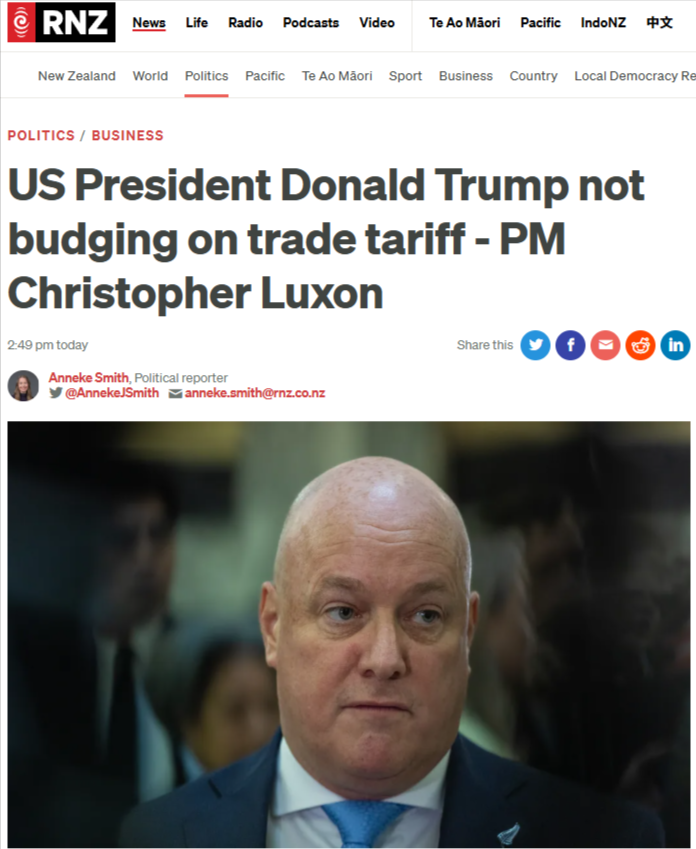
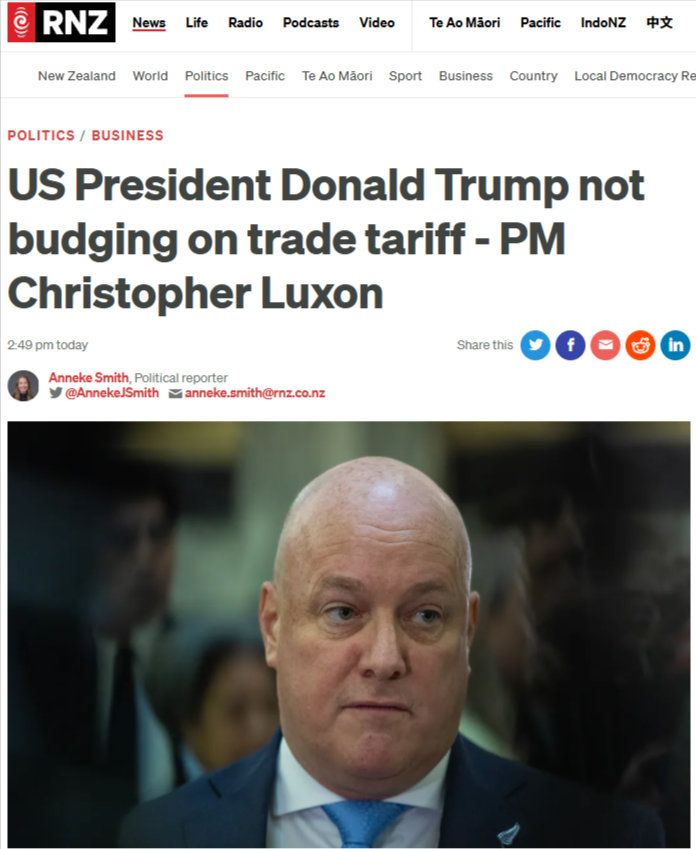
This is the story of how Christopher Luxon, a millionaire corporate executive masquerading as our Prime Minister, has utterly failed to protect Aotearoa from Donald Trump's brutal 15 percent trade tariff while simultaneously advancing the same neoliberal agenda that has devastated Māori communities for decades. This pathetic display of diplomatic incompetence represents nothing less than modern economic colonialism, where our supposed leader surrenders our economic sovereignty to American imperialism while ordinary whānau pay the price.
Background: The Colonial Legacy of Modern Trade Policy
To understand the magnitude of Luxon's failure, we must first grasp how Trump's tariff regime operates as a crude form of economic imperialism. The American president has imposed a simple, brutal formula: countries with trade surpluses face 15 percent tariffs, while those with deficits get 10 percent. This represents the return of protectionism that dominated during what economists call the Keynesian years, before the neoliberal revolution supposedly liberated global trade.ewadirect+1US-President-Donald-Trump-not-budging-on-trade-tariff-PM-Christopher-Luxon-_-RNZ-News.pdf
For Māori, this is particularly devastating because our people remain over-represented in primary industries that are now under attack. Since the neoliberal reforms of the 1980s devastated Māori employment in government-owned industries like forests, railways, and manufacturing, many of our whānau found work in dairy, beef, and other export sectors that are now facing these punitive tariffs.teara
The significance of this moment extends far beyond trade statistics. This represents the collision of two forms of colonialism: the historical dispossession of Māori through European settlement and the modern dispossession of our economic sovereignty through neoliberal trade policy that benefits wealthy elites while abandoning working families.
Trump's Economic Warfare and Luxon's Corporate Cowardice
The facts are stark and damning. New Zealand faces a 15 percent tariff on $9 billion worth of annual exports to the United States, while Australia secured a more favorable 10 percent rate. This differential alone creates a competitive disadvantage that will cost our exporters millions and potentially thousands of jobs.rnz
Trade Minister Todd McClay's desperate journey to Washington to grovel before American trade officials represents the complete bankruptcy of this government's approach. After meeting with US Trade Representative Jamieson Greer and Agriculture Secretary Brooke Rollins, McClay returned empty-handed, with Luxon himself admitting that Trump "would not change his mind".rnz
This matters profoundly for Māori because we remain disproportionately dependent on primary industries for employment. The dairy industry, which faces particular pressure from these tariffs, employs thousands of Māori workers. When export revenues decline, it is invariably working-class Māori families who bear the brunt through job losses and reduced wages.rnz
The scope of this analysis must encompass not just the immediate economic impact, but the broader pattern of neoliberal surrender that Luxon represents. This is a Prime Minister who earned $4.2 million annually as Air New Zealand CEO while implementing cost-cutting measures that harmed workers, now applying the same corporate logic to our nation's trade policy.nzherald
Exposing the Corporate Oligarchy: Luxon's Neoliberal Origins
To understand why Christopher Luxon has failed so spectacularly in defending New Zealand's interests, we must examine his corporate background and the neoliberal ideology that shapes his worldview. During his tenure as Air New Zealand CEO, Luxon was described as "commercially ruthless," focused obsessively on shareholder returns while treating workers as expendable.nzherald
This corporate mentality explains his pathetic response to Trump's economic bullying. Luxon approaches international relations like a corporate merger, believing that submission to powerful interests is simply good business. His statement that New Zealand "won't launch reciprocal tariffs against the US" because it would "add to inflation" represents the classic neoliberal fallacy that prioritizes abstract economic theories over defending our sovereignty.rnz
The hidden connections between Luxon's corporate career and his political agenda become clear when we examine his approach to privatization. ACT leader David Seymour's call to overcome "squeamishness about privatization" aligns perfectly with Luxon's corporate background, suggesting a coordinated assault on public ownership that would benefit his former corporate networks.rnz
This represents the intersection of race, class, and gender oppression that defines modern neoliberalism. Research shows that neoliberal trade policies disproportionately harm women, Indigenous peoples, and working-class communities, while enriching corporate executives like Luxon who move seamlessly between boardrooms and political power.globalizationandhealth.biomedcentral
The pattern extends beyond individual personalities to reveal how neoliberal globalization has turned countries like Ukraine into "raw material appendages of developed countries" - precisely the fate that awaits Aotearoa under Luxon's leadership.eco-science
The Colonial Mathematics of Trade Surplus Punishment
Trump's tariff formula reveals the crude imperialism underlying modern trade policy. Countries are punished not for unfair practices, but simply for being successful exporters. New Zealand's modest trade surplus with the United States of approximately $500 million - described by McClay as "not overly significant in the context of the US economy" - has nevertheless triggered the maximum penalty.1news
This mathematical approach to economic domination echoes the colonial surveying that divided up Māori land in the 19th century. Just as colonial administrators used arbitrary lines on maps to justify theft, Trump uses arbitrary trade balance calculations to justify economic punishment. The fact that New Zealand applies only 0.3 percent average tariffs on US goods while facing 15 percent in return exposes the fundamental unfairness of this system.rnz
The gendered impact of these policies cannot be ignored. Māori women, who already face multiple disadvantages through the intersection of colonialism, neoliberalism, and climate change, will bear additional burdens as export industries contract and employment opportunities diminish.journals.sagepub
Revealing the Neoliberal Consensus Across Party Lines
The most insidious aspect of this crisis is how both major parties remain trapped within neoliberal orthodoxy. Analysis shows that despite apparent differences, Labour and National share an underlying neoliberal consensus focused on free trade, low taxes, and minimal government intervention.rnz
This explains why Labour's criticism of Luxon's failure remains so muted. They cannot offer a genuine alternative because they too remain committed to the same trade paradigm that created this vulnerability. Former Labour governments signed multiple free trade agreements that prioritized corporate interests over worker protection, creating the dependence on export markets that Trump now exploits.rnz
The failure to develop genuine economic alternatives reflects the broader pattern described by critics of neoliberal trade policy, which excludes consideration of social determinants of health and equity. When trade agreements become vehicles for advancing corporate power rather than community wellbeing, disasters like Trump's tariffs become inevitable.tandfonline
Implications: The Path to Economic Decolonization
The broader implications of Luxon's failure extend far beyond immediate trade impacts. This crisis exposes the fundamental vulnerability created by our dependence on neoliberal trade models that treat our economy as a resource extraction operation for foreign markets.
For Māori communities specifically, this represents another chapter in the ongoing process of economic colonization. Just as the neoliberal reforms of the 1980s devastated Māori employment and created intergenerational poverty, Trump's tariffs will disproportionately harm our people while enriching corporate middlemen who can absorb or pass on the costs.rnz
The connection to larger patterns of exploitation becomes clear when we consider how Pacific peoples were historically exploited through "blackbirding" - masked as paid labor but actually representing systematic enslavement. Modern trade policies operate through similar deceptions, promising prosperity while delivering exploitation.rnz
The impact on Māori communities will be felt most acutely in rural areas where export industries provide crucial employment. When dairy farms and beef operations face reduced profitability due to tariffs, it will be Māori workers who lose their jobs first, continuing the pattern of economic marginalization that has persisted since colonization.

The Māori Green Lantern fighting misinformation and disinformation from the far right
Reclaiming Our Economic Sovereignty
The Trump tariff crisis and Luxon's pathetic response reveal the urgent need for a fundamental transformation of our approach to economic development. We cannot continue to accept a system where our economy serves foreign corporate interests while our own people struggle with poverty and inequality.
The key findings are clear: Luxon's corporate background has rendered him incapable of defending New Zealand's interests against American economic imperialism. His neoliberal ideology prevents him from understanding that true economic security requires building domestic capacity rather than depending on export markets controlled by hostile foreign powers.
The call to action must center on economic decolonization that prioritizes Māori values of whakatōhea (collective responsibility), manaakitanga (caring for others), and kaitiakitanga (environmental stewardship). This means developing local food systems, supporting Indigenous enterprises, and rejecting trade agreements that subordinate our sovereignty to corporate profits.
We must recognize that true prosperity comes not from serving global markets, but from building resilient communities that can provide for their own needs. The alternative is continued subjugation to economic colonizers like Trump who view our nation as nothing more than a resource extraction operation.
The time has come to reject the false promises of neoliberalism and build an economy that serves our people rather than foreign shareholders. Only through genuine economic decolonization can we protect ourselves from future Trumps and create the prosperous, equitable society that our ancestors envisioned.
Koha Appeal: Readers who find value in this analysis of corporate power and economic colonialism may wish to support this work with a koha to HTDM: 03-1546-0415173-000. The MGL understands these are difficult economic times for whānau, so please only contribute if you have capacity and wish to do so.
Aroha nui,
Ivor Jones - The Māori Green Lantern