“Why The Māori Green Lantern’s McSkimming Essays Run Rings Around RNZ" - 8 December 2025
Total Nonsense Journalism
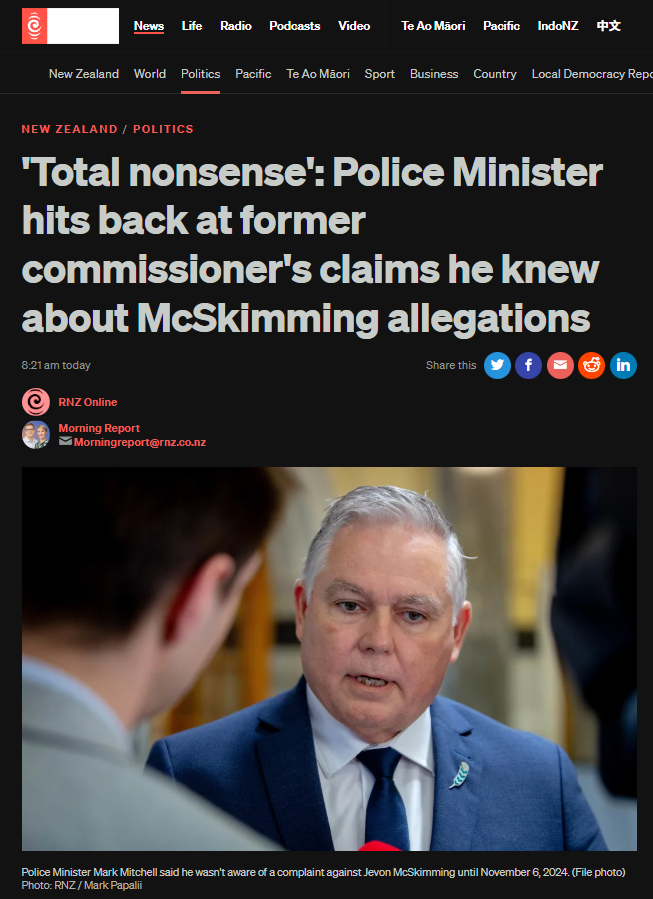
The RNZ political write‑up, “‘Total nonsense’: Police Minister hits back at former commissioner’s claims he knew about McSkimming allegations”, is a textbook example of stenographic politics reporting: quote the minister, paraphrase the critic, move on. It treats the Jevon McSkimming scandal as a timing dispute between Mark Mitchell and Andrew Coster.
The three Māori Green Lantern essays — “The Jevon McSkimming Scandal and the Neoliberal Rot at the Heart of New Zealand’s Police”, “A Damning Portrait of Institutional Captured Power and Political Accountability Evasion”, and “The Fish Rots From The Head: Leadership Failure Across New Zealand’s Power Structures” — treat it as what it actually is: a case study in institutional capture, neoliberal risk‑management culture, and leadership rot across the Crown’s core power structures.
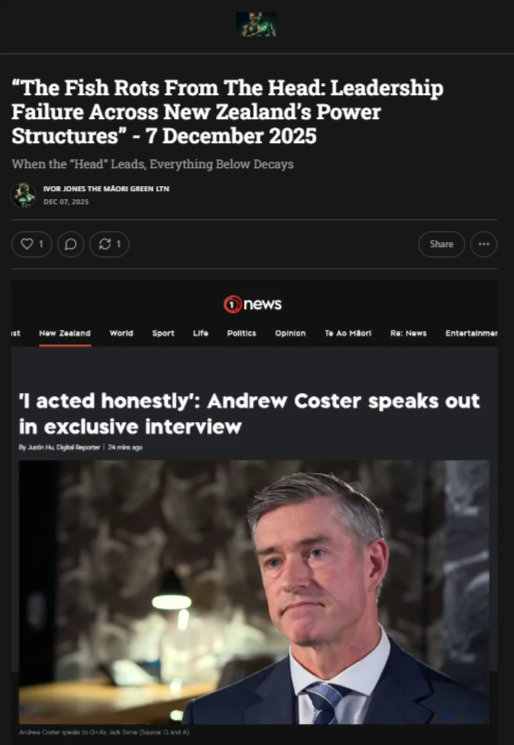
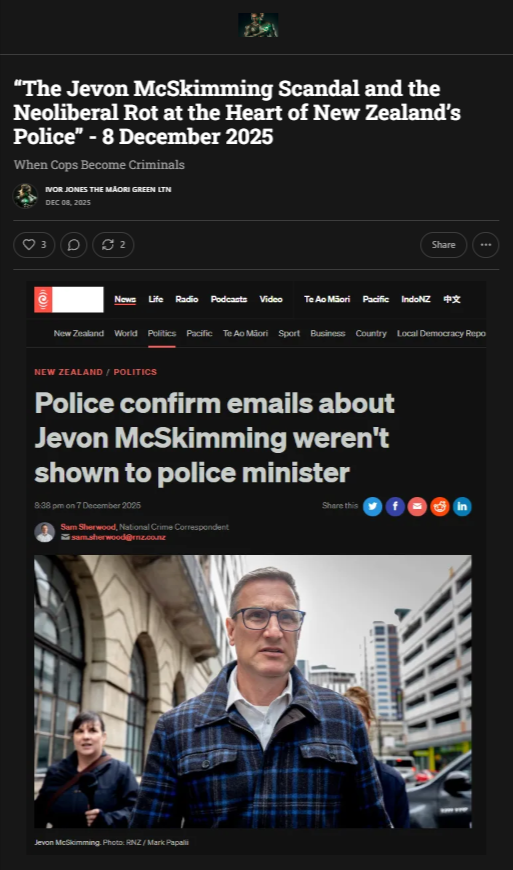
This is not a neutral difference in “tone”. It is the difference between journalism that protects power and journalism that arms whānau.

Ground Truth: What the McSkimming Scandal Really Is
The Independent Police Conduct Authority’s full report on the handling of complaints against Jevon McSkimming sets out the basic reality:
years of emails, online reports, and internal warnings about sexual misconduct and abuse of power by a senior officer were deprioritised, minimised, or actively shut down by the highest levels of New Zealand Police, while the complainant — Ms Z — was prosecuted under the Harmful Digital Communications Act for trying to be heard, as detailed in the IPCA’s November 2025 findings and summarised by both RNZ and 1News.
When police finally did forensically search McSkimming’s devices, they found hundreds of images of adult bestiality, dozens of images of child sexual exploitation, and thousands more mixed objectionable images. He resigned in May 2025 and later pleaded guilty to three representative charges of possessing objectionable publications, as reported by RNZ and NZ Herald.
The Māori Green Lantern essays correctly insist this is not a “bad apple” story. They show, in painstaking detail, how:
- The Fixated Threat Assessment Centre’s February 2024 report identified potential criminal conduct by McSkimming and recommended referral to the National Integrity Unit and IPCA — a recommendation ignored while Police instead launched Operation Herb to prosecute Ms Z, as unpacked in “The Jevon McSkimming Scandal and the Neoliberal Rot at the Heart of New Zealand’s Police”.
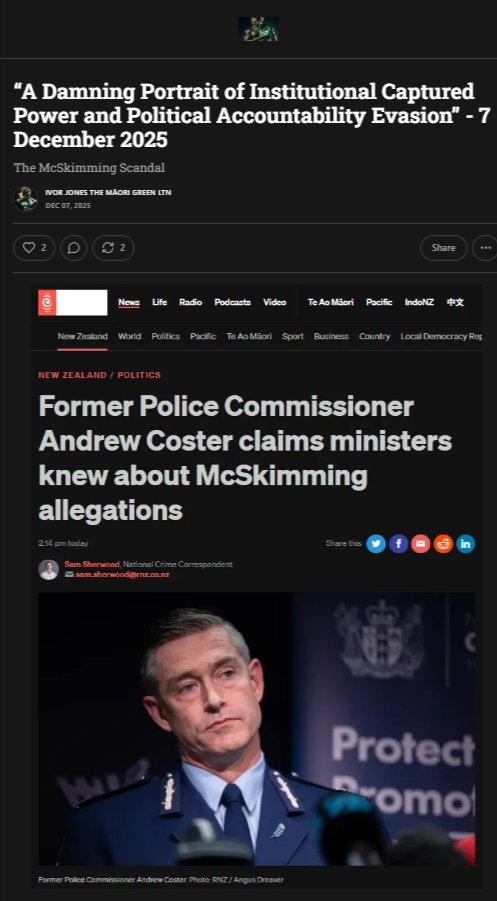
- The Public Service Commission’s own review conceded that during the 2023 Deputy Commissioner appointment process, neither McSkimming nor Coster fully disclosed the prior relationship and the allegations, a failure analysed by both the PSC’s independent review and “A Damning Portrait of Institutional Captured Power and Political Accountability Evasion”.
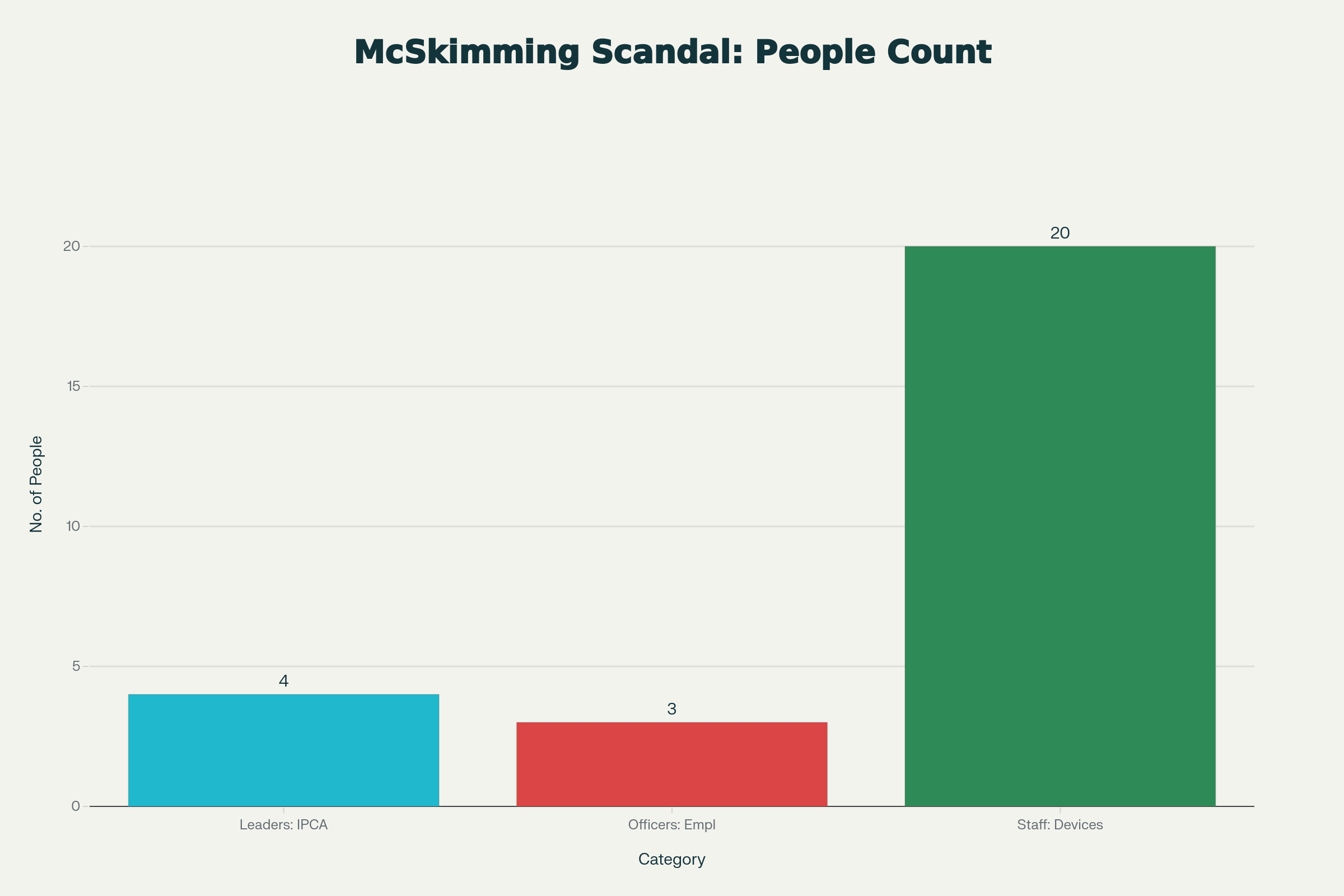
Oversight and accountability figures arising from the Jevon McSkimming scandal
That is the terrain. Against that reality, RNZ’s “Total nonsense” piece barely registers as analysis.
What RNZ’s Political Hit Actually Does
The RNZ article is short. It:
- Leads with Mitchell’s quote that Coster’s claim he knew more than he admits is “absolute total nonsense”, and repeats his insistence that he first learned of concerns regarding McSkimming on 6 November 2024, as set out in the original RNZ political piece.
- Notes, briefly, that 36 emails containing allegations were sent to his office but that a “protocol” meant staff forwarded them directly to the Commissioner, a diversion mechanism previously exposed by RNZ’s own reporting.
- Paraphrases Coster’s Q+A claim that ministers “knew more than they admitted”, linking back to earlier RNZ coverage of his allegations about ministerial knowledge.
- Ends with Christopher Luxon saying the matter is “settled” as far as he is concerned, while acknowledging a “total failure of leadership” at the top of Police — language lifted straight from the IPCA report but unexplained in context, as quoted in the same RNZ piece.
There is no discussion of:
- The IPCA’s findings of “serious misconduct” by multiple senior officers — including Coster, Deputy Commissioner Tania Kura, and Assistant Commissioner Richard Chambers — in their handling of Ms Z’s complaints, as set out in the IPCA report and summarised by RNZ.
- The PSC’s acknowledgement that vetting processes failed to detect or act on red flags about the relationship during the Deputy Commissioner appointment process, as detailed in the PSC review and analysed in depth in “A Damning Portrait of Institutional Captured Power and Political Accountability Evasion”.
- The fact that Ms Z was charged under the Harmful Digital Communications Act for the very communications that should have triggered an investigation into McSkimming, as reconstructed by 1News’ timeline and laid bare in “The Jevon McSkimming Scandal and the Neoliberal Rot at the Heart of New Zealand’s Police”.
RNZ’s piece is not “wrong”. It is radically incomplete — and that incompleteness serves power.
What The Māori Green Lantern Essays Do That RNZ Will Not
The Neoliberal Architecture: “The Jevon McSkimming Scandal and the Neoliberal Rot…”
“The Jevon McSkimming Scandal and the Neoliberal Rot at the Heart of New Zealand’s Police” treats the IPCA report not as a sad one‑off but as a case study in how neoliberal management logic reshapes policing.
The essay shows how:
- The abolition of the common law offence of “misconduct in public office” in 1961 left a criminal accountability vacuum for senior officials who bury scandals, a point also made by Roger Partridge in an analysis for the New Zealand Herald, and then weaponises that insight to explain why early retirement and quiet resignation, not prosecution, is the rational outcome for executives, as both the Herald and the IPCA‑era commentary set out.
- The Harmful Digital Communications Act — sold as a tool to protect victims of online abuse — was instead used as a weapon against Ms Z, with police using her 105 reports and emails as evidence to prosecute her, a sequence detailed in RNZ’s “anatomy of a downfall”-style coverage and then joined up in the essay.
- The PSC’s reliance on security clearances from the SIS instead of robust character and misconduct checks created a false sense of safety, as acknowledged in Public Service Commissioner Brian Roche’s comments that McSkimming “was a liar, he schemed and he created a story that just was so pervasive”.
RNZ mentions none of that architecture in its “Total nonsense” write‑up. The Māori Green Lantern dissects it.
Captured Power and Ministerial Evasion: “A Damning Portrait…”
“A Damning Portrait of Institutional Captured Power and Political Accountability Evasion” zooms in on the web between Coster, Hipkins, Mitchell, PSC, and the ministers’ carefully lawyered denials.
The essay:
- Walks through the PSC appointment process for Deputy Commissioner — including the 24 March 2023 probity meeting where Deputy Public Service Commissioner Heather Baggott explicitly asked Coster if there was “anything else” he should disclose about McSkimming — using the IPCA’s own language to show how Coster failed to act as a responsible chief executive, as the IPCA report and PSC review confirm.
- Reconstructs the 2024 decision to route Ms Z through the Fixated Threat Assessment Centre, pathologising her as “fixated” rather than treating her as a complainant — a move cross‑checked against both the IPCA’s findings and coverage by 1News and RNZ.
- Sets out, point by point, the contradiction between Coster’s Q+A claims of briefing Hipkins in 2022 and Mitchell “informally” in 2024, versus both ministers’ denials — drawing on detailed political coverage from 1News and RNZ’s follow‑ups — and then frames this not as a gossip column but as a structural question: what does it tell us that none of the three can produce clean documentary proof?
RNZ’s “Total nonsense” story sits entirely on the surface of that dispute. It quotes Mitchell’s denial, nods at Coster’s claim, then shrugs. The Māori Green Lantern labels the pattern for what it is: political accountability evasion.
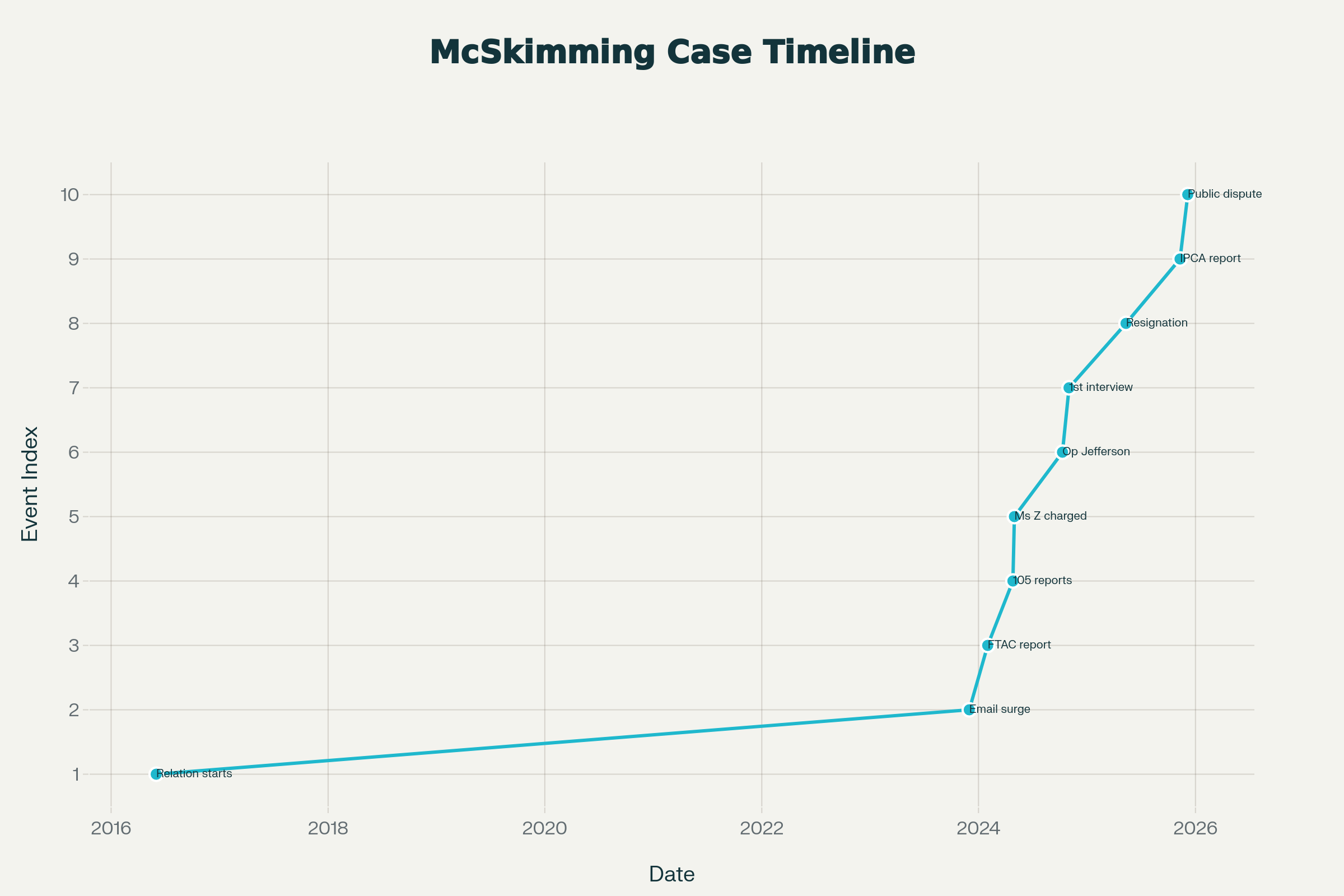
Key institutional milestones in the Jevon McSkimming case, 2016–2025
Leadership Rot Across Systems: “The Fish Rots From The Head…”
“The Fish Rots From The Head: Leadership Failure Across New Zealand’s Power Structures” takes the McSkimming case and plugs it into a wider power map:
- It places Coster’s Q+A defence — that he made “honest mistakes” and had “incomplete understanding” — alongside the IPCA’s language of “serious leadership failures” and officers’ testimony of being “gobsmacked” at perceived shortcuts, drawing from TVNZ Q+A and the IPCA report.
- It tracks the contagion into politics: Judith Collins dropping innuendo about “corruption”, Mitchell throwing around claims of a “corrupt police executive” then walking them back, all reported by outlets like 1News and NZ Herald, and shows how this corrodes the moral authority of governance.
- Then it scales out to the Financial Markets Authority (Craig Stobo’s temporary stand‑down, as reported by 1News) and to Māori political and economic structures — Destiny Church’s attempted capture of the Māori Women’s Welfare League, the Māori Carbon Collective’s lock‑in model, the Atlas Network’s push for the Regulatory Standards Bill — triangulating across mainstream coverage and public records to show a pattern of heads rotting across systems.
RNZ’s “Total nonsense” article never leaves the Beehive corridor. The Māori Green Lantern follows the stench into the entire architecture.
Centre of Gravity: Ms Z vs Ministerial Mana
One of the clearest differences is who each text treats as the centre of gravity.
RNZ’s political piece:
- Does not name Ms Z.
- Does not mention that she was charged, that the charges were later withdrawn, or that she has since spoken publicly about being groomed and silenced, as she did in interviews with 1News and NZ Herald.
- Frames Luxon’s line — that “a young woman was let down really badly by the police executive” — as a closing reassurance, without reconnecting it to the hard facts of her prosecution and the state’s use of suppression orders, as reported by RNZ.
The Māori Green Lantern essays do the opposite:
- “The Jevon McSkimming Scandal and the Neoliberal Rot…” opens by stating plainly that Police “wielded [the law] as a weapon against a young woman who dared to speak truth to power”, then walks through her age, the power imbalance, the bail conditions, the suppression orders, and the 18 months in which her life was effectively on hold, cross‑checking with IPCA, RNZ, 1News and court reporting.
- “A Damning Portrait…” tracks how institutional narrative capture recast McSkimming as a victim of a “fixated” woman, showing step‑by‑step how that frame infected PSC, the appointment process, and operational decisions, using the timeline reconstructed by 1News and the IPCA report itself.
RNZ centres the mana of a minister under pressure. The Māori Green Lantern centres mana wahine and the people inside the machine trying to do the right thing.
Tikanga, Te Tiriti, and Institutional Mauri
Another gulf: the tikanga and Te Tiriti analysis.
RNZ’s article makes no reference to Te Tiriti o Waitangi, tikanga, or the mauri of the institution. It notes Luxon’s concern about “culture, integrity and standards” but leaves the discussion parked at the level of generic corporate values.
By contrast:
- “The Jevon McSkimming Scandal and the Neoliberal Rot…” explicitly reads the scandal as a Te Tiriti failure: the Public Service Act’s obligations to support the Crown–Māori relationship and recognise Māori aspirations are set against the reality of a colonial‑pattern response that silences survivors and protects executives, drawing on the Act itself and broader research on Māori over‑representation and rights in the criminal justice system such as “The Problems and Promise of International Rights in the Challenge to Māori Imprisonment”.
- “The Fish Rots From The Head…” uses the concept of mauri to explain what happens when institutions become hollow: they continue to function administratively but no longer nourish those they are meant to serve. That reading is grounded in wider scholarship on the state’s treatment of Māori prisoners, including analyses like “Contextualizing Indigenous people and the state of exception: New Zealand’s Waikeria Prison protest”, which shows how Māori are routinely placed in states of exception in carceral spaces.
This is what it means to treat Māori journalism as more than diversity branding. The Māori Green Lantern is doing the intellectual and spiritual work RNZ refuses to do in its political slot.
Media Power and Gagged Truth
The Māori Green Lantern essays also refuse to let media off the hook.
Earlier in 2025, RNZ was gagged by a court order obtained by McSkimming’s lawyers, preventing it from publishing details about the objectionable material and even from reporting the existence of the suppression. That injunction was itself a powerful example of how legal mechanisms can be used to protect institutional mana and shield executives from scrutiny.
The essays connect that gagging to a wider pattern:
- NZME’s admission that an AI‑generated anti‑Māori‑wards editorial “lacked journalistic rigour”, reported by RNZ and RNZ’s coverage of the fallout.
- The way disinformation networks linked to Destiny Church and far‑right actors weaponise social media to undermine Māori institutions and Te Pāti Māori, as chronicled in “The Fish Rots From The Head…” and cross‑checked against mainstream reporting on Destiny’s attempted takeover of the Māori Women’s Welfare League and later attacks on Manurewa Marae and Te Pāti Māori.
RNZ’s “Total nonsense” article does not name its own prior gagging, does not connect ministerial spin to the structural constraints on its own newsroom, and does not ask whether its narrow framing simply reproduces the system’s blind spots. The Māori Green Lantern does.
Why The Māori Green Lantern’s Work Is Superior — and What That Demands of RNZ
By any honest standard of journalism — depth, independence, structural insight, alignment with those most harmed — the Māori Green Lantern essays are superior to RNZ’s “Total nonsense” hit.
They:
- Integrate the IPCA report, PSC review, 1News timelines, RNZ investigations, court coverage, and academic work into a coherent whakapapa of institutional failure, rather than cherry‑picking a single political quote.
- Name cui bono at each stage: McSkimming’s career trajectory, Coster’s desire to preserve his leadership narrative, Hipkins’ and Mitchell’s political incentives, PSC’s risk management, and the neoliberal logic that rewards burying complaints.
- Ground analysis in tikanga and Te Tiriti, foregrounding mana wahine, kaitiakitanga, and institutional mauri — frameworks completely absent from the RNZ political piece.
- Trace hidden connections outwards to financial regulation, Māori land, Destiny Church, and the Atlas Network’s ideological project, situating McSkimming as one node in a web of extraction and leadership failure.
RNZ, by contrast, allows a sitting minister to use the national broadcaster as a platform to dismiss a former commissioner’s claims as “absolute total nonsense”, without re‑inserting the structural record that makes that dispute meaningful.
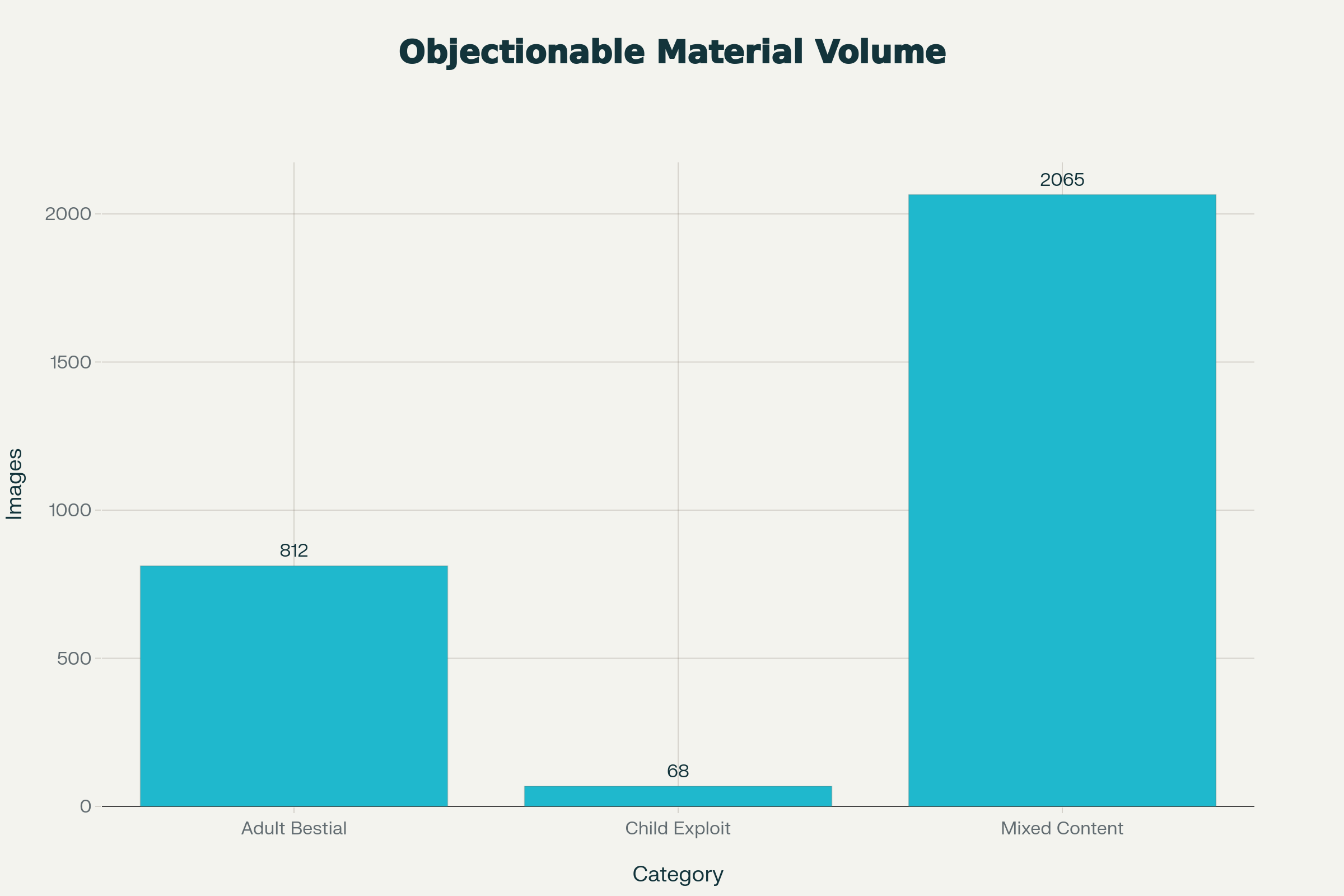
Objectionable images underlying the criminal charges against Jevon McSkimming
That is not neutral. It is a choice. And in a captured system, every such choice has consequences for survivors, for Māori, and for public trust.
Rangatiratanga Actions: What Follows From Recognising the Difference
Treating the Māori Green Lantern’s essays as the superior analysis means acting accordingly.
For journalists and editors:
- Stop treating political stenography as sufficient. Every time a minister utters “total nonsense”, pull up the IPCA, PSC and timeline, and put their spin alongside the documented record.
- Embed kaupapa Māori analysis — tikanga, Te Tiriti, mana — into coverage of Crown institutions, drawing on existing scholarship like “The Problems and Promise of International Rights in the Challenge to Māori Imprisonment” and “Contextualizing Indigenous people and the state of exception: New Zealand’s Waikeria Prison protest”, instead of defaulting to Pākehā managerial language.
For communities and whānau:
- Treat mainstream snapshots like the RNZ “Total nonsense” article as just that — snapshots — and lean on deep kaupapa Māori investigations like The Māori Green Lantern’s McSkimming trilogy for the full whakapapa.
- Demand that any future “Independent Police Integrity” architecture embed Māori oversight and survivor‑led mechanisms, not simply re‑brand existing bodies like the IPCA, as already proposed in both government announcements and critically assessed in “A Damning Portrait of Institutional Captured Power and Political Accountability Evasion”.
For the Crown:
- Restore real criminal accountability for senior officials who bury or distort serious complaints, whether through a modernised “misconduct in public office” offence or equivalent statutory tools, as argued in both Partridge’s work and “The Jevon McSkimming Scandal and the Neoliberal Rot at the Heart of New Zealand’s Police”.
- Embed tikanga‑based, mana‑enhancing processes in Police, PSC and ministerial oversight — not as “cultural add‑ons” but as binding decision‑making frameworks.
Rangatiratanga in this context means more than critiquing RNZ. It means building and sustaining Māori‑led media and analytical spaces that are structurally incapable of doing “Total nonsense” journalism.

Ivor Jones The Māori Green Lantern Fighting Misinformation And Disinformation From The Far Right
- Koha statement
Only Support this mahi if you are able: Koha.Kiwi | Substack | Bank: HTDM 03-1546-0415173-000 - All koha sustains free mātauranga Māori journalism. No paywall, no corporate interference.