“Winston Peters’ Pre-Election Positioning and the Politics of Plausible Deniability” - 19 December 2025
The Kingmaker’s Calculated Evasion
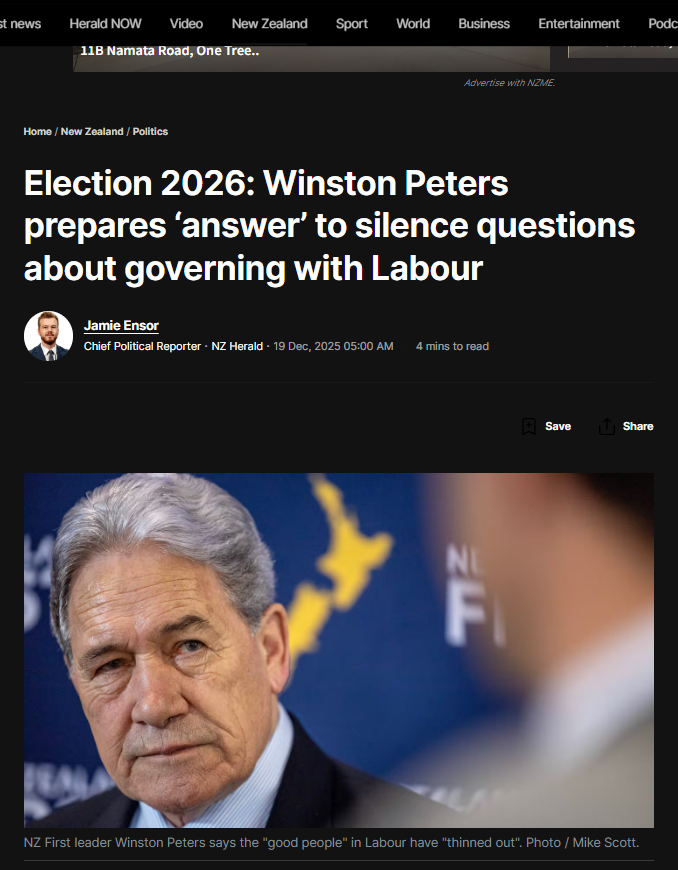
Winston Raynor Peters—the politician who has built an entire career on strategic betrayal, opportunistic alliance-switching, and the systematic extraction of power through manufactured grievance—stands once again at his familiar crossroads.
The veteran political operator who has shaped coalition governments since New Zealand’s first MMP election in 1996 now prepares his next move as polls position New Zealand First around 10% heading into the 2026 election. During an end-of-year interview,
Peters spoke extensively about feeling wronged by those in Labour’s “inner sanctum”—a carefully rehearsed performance designed to maintain the fiction that he possesses moral principle while he prepares his inevitable pivots.
He’s crafting an “answer” intended to silence speculation about whether he’d govern again with Labour—not because he’s principled, but because maintaining maximum strategic ambiguity maximizes his leverage.
This is the politics of calculated deception, where Peters maintains the appearance of having a conscience while the nation awaits his predetermined verdict.
But beneath the performative mystery lies a meticulously documented pattern of betrayal:
a political operator who has governed alongside National’s Jim Bolger and Jenny Shipley, as well as Labour’s Helen Clark and Jacinda Ardern, always positioning himself as kingmaker, always extracting maximum concessions through obstruction and brinkmanship, always ready to switch allegiances when politically expedient.
Peters has perfected the art of political sociopathy:
the ability to betray fundamental commitments while maintaining an expression of wounded innocence.
The Fabricated Betrayal Narrative: Weaponizing Grievance
Peters’ manufactured grievances against Labour center on He Puapua and the Three Waters reforms—policies he now claims were deliberately hidden from New Zealand First during the 2017-2020 coalition, as if the entire government’s policy apparatus was designed specifically to deceive him. This is the language of persecution, the rhetoric of victimhood deployed by a man who has never been a victim of anything except his own lack of self-awareness.
In a November 2022 interview with the NZ Herald, Peters delivered one of his signature performances, declaring with the theatrical wounded dignity of a Renaissance tragedian:
“No one gets to lie to me twice... When I shook hands with Jim Bolger and Helen Clark, ask them whether I could be trusted. When they deliberately mislead me and my caucus, who are a critical part of a coalition, they don’t get a second chance to do that again.”
The irony is so thick you could cut it with a taiaha—the man who has lied to every coalition partner now positioning himself as the custodian of truth. This is Orwellian double-speak deployed with characteristic shamelessness.
This narrative of martyrdom has been central to Peters’ positioning since 2020, weaponized with calculated effectiveness to justify whatever opportunistic maneuver he prepares next. He has repeatedly claimed he was “kept in the dark” over He Puapua—the report on potential ways for New Zealand to meet commitments under the UN Declaration on the Rights of Indigenous Peoples. Labour’s Māori Development Minister Willie Jackson denied any secret agenda, stating He Puapua “wasn’t government policy and hadn’t been a priority.” But facts have never troubled Peters when they interfere with a useful narrative.
Yet the documented reality of that 2017-2020 coalition tells a far more revealing story about Peters’ true character. A comprehensive investigation by The Spinoff revealed a government characterized by constant friction orchestrated by NZ First’s deliberate bad faith. Peters’ interpretation of the coalition agreement differed fundamentally from Labour’s—not because Labour was deceptive, but because Peters had no intention of honoring the agreement in the first place.
“I realised about six months in that Labour thought we had just rubber-stamped their manifesto, and that was not our view at all,” former NZ First minister Tracey Martin acknowledged—revealing not Labour’s deception, but NZ First’s premeditated intent to sabotage from within.

The KingMakers Shadow
The Coalition Reality: Systematic Obstruction as Political Doctrine
The documented record of that coalition exposes Peters’ modus operandi in brutal clarity:
a strategy of strategic obstruction designed to extract maximum concessions through calculated harassment.
Justice Minister Andrew Little’s experience was emblematic of Peters’ systematic approach to coalition bad faith. Little publicly announced plans to repeal the “three strikes” sentencing policy after conversations with Peters, only to have NZ First caucus—operating under Peters’ direct control through implied threat—refuse support.
“That was frustrating. It was annoying, and it certainly wised me up to the fact that just because something has the apparent support of the leader of NZ First, it doesn’t mean it has the support of caucus,” Little stated with admirable understatement.
This was not coincidental confusion; this was orchestrated chaos. Peters deliberately maintained plausible deniability while his caucus operated as a wrecking crew. Labour ministers, sufficiently exhausted by Peters’ systematic dishonesty, described negotiations as “plain barmy,” with one minister stating with barely contained fury:
“I expected the policy differences, but I didn’t expect the chicanery around it. There was no coherence, you never knew from one meeting to the next what position they would take on an issue. Their best tactic was they would just stonewall. They just wouldn’t get back to you.”
This wasn’t incompetence. This was a calculated strategy of attrition—weaponized delay as political leverage.
The coalition broke down most dramatically over Labour’s capital gains tax proposal, where Peters revealed the utter contempt with which he treats coalition partners. On Peters’ birthday in 2019, Finance Minister Grant Robertson received a letter from Peters’ chief of staff Jon Johansson advising NZ First would not support the tax. After a lengthy Tax Working Group process and months of policy development, there was no phone call, no meeting, no direct conversation—just a letter marked “Private,” delivered on a birthday as if it were a gift. This was not governance; this was psychological warfare.
The 2023 Pivot: Principle Becomes Punchline
Despite his emphatic 2022 declaration that he would never work with “this present Labour crowd,” the man who built his entire brand on personal relationships and honor has, with characteristic predictability, adopted calculated ambiguity as a political strategy. In May 2025, Peters told the NZ Herald he was ruling out Chris Hipkins “permanently”—but with a caveat so transparent you could see through it from space. He was ruling out Hipkins, he specified, only if Labour remained under Hipkins’ leadership. This is the classic Peters move:
plant the flag of principle while secretly preparing the retreat route.
This is Peters’ political masterstroke:
maintaining the appearance of having convictions while preserving maximum optionality. The qualifier “permanently” itself undermines its own meaning, rendering it meaningless—a word that promises finality while secretly preserving escape routes.
And the “if” clause? That’s the trapdoor. As The Spinoff noted in November 2025, back in 1996 Peters had been emphatically, publicly, repeatedly emphatic that voting for New Zealand First was the only way to remove National from government—that only NZ First could save the nation from National’s corrupting influence. Then he promptly installed a National-NZ First coalition. When challenged on this spectacular reversal of everything he’d claimed to believe, he replied with the characteristic contempt for voters’ intelligence:
“Nonsense. We have installed a National-New-Zealand-First government. Totally different.”
Semantic sophistry deployed to paper over fundamental betrayal.
The Current Coalition’s Transparent Dysfunction
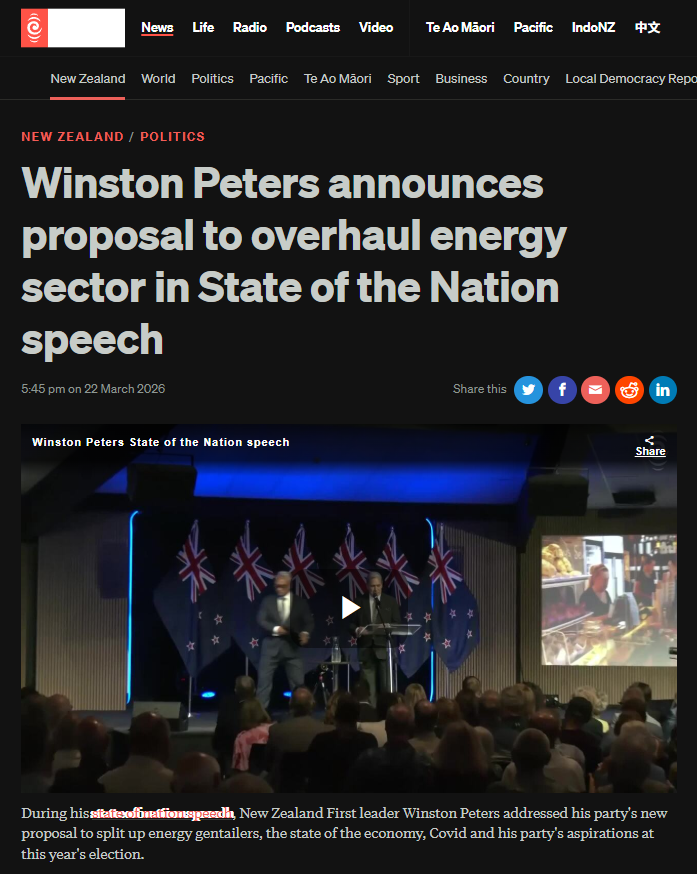
Peters’ current position as Deputy Prime Minister in the National-ACT-NZ First coalition provides a revealing case study in how this man operates. Recent public disputes between Peters and ACT leader David Seymour over the Regulatory Standards Bill expose the systematic dysfunction that Peters brings to every governing arrangement. Peters vowed to repeal the bill just days after voting for it—a breathtaking reversal that demonstrated either incompetence or deliberate bad faith. Seymour, to his credit, warned that Peters could be preparing to “jump ship to Labour,” recognizing in Peters the same pattern of unstable allegiances that has characterized his entire career.
Prime Minister Christopher Luxon has attempted to maintain the fiction that the coalition is “strong and stable,” but his bland reassurances only underscore the reality:
he is governing at Peters’ sufferance, and Peters has demonstrated he will not suffer silently. Luxon’s acknowledgment that “parties will have different points of view, and you’re going to see that as we go into election year” is political speak for:
Peters is actively positioning for maximum leverage by publicly demonstrating his capacity and willingness to undermine the government he supposedly leads with.
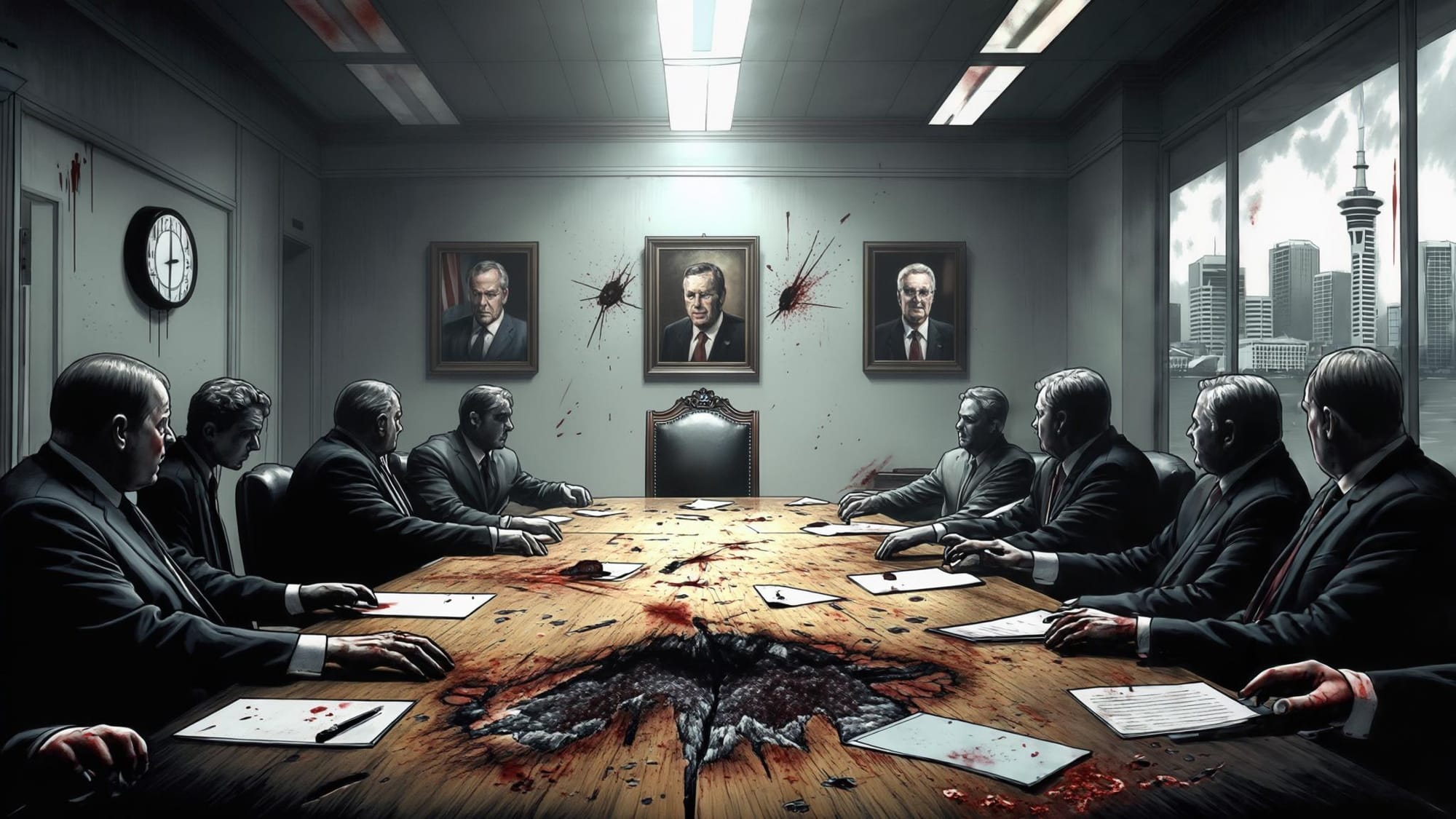
The Coalition’s Broken Clock
This is Peters’ version of leadership:
the constant threat of betrayal weaponized as a negotiating tactic.
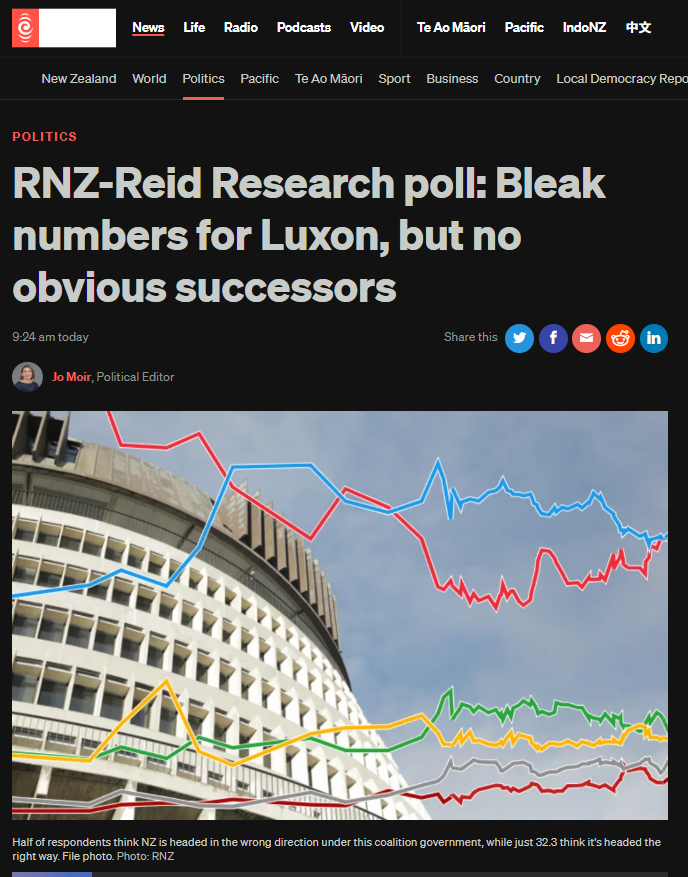
Polling suggests the 2026 election could produce a hung parliament, with NZ First once again holding the balance of power—the dream scenario for a political predator like Peters. If National and ACT cannot secure a majority, and Labour requires NZ First’s support to govern, Peters would be elevated to his preferred position:
kingmaker, the politician who holds democracy hostage to his personal ambitions, able to extract maximum concessions from either side through the implicit threat of switching allegiances.
Cui Bono? Who Profits from Strategic Ambiguity?
The answer is obvious, and it’s always the same:
Winston Peters benefits. By maintaining that he’s preparing an “answer” while simultaneously airing performative grievances about Labour’s “inner sanctum,” Peters keeps both major parties anxiously competing for his favor. National cannot take his support for granted; Labour cannot definitively rule him out. Both parties become supplicants, forced to bid against each other for his coalition support.
This maximizes his negotiating position through the systematic degradation of democratic integrity. Analysis by interest.co.nz suggests that if NZ First maintains its current ~10% polling, it would become National’s senior partner in any right-wing coalition, forcing National to make more concessions than in 2023. Alternatively, if Labour needs NZ First to form government, Peters could extract an even higher price—potentially including his long-rumored and pathetically transparent ambition to become Prime Minister through a rotating arrangement, as was floated in 1996 coalition negotiations but never materialized because Peters knew, even then, that he lacked the political credibility to lead a government.
The Pattern: Principles as Tactical Props
Peters’ entire political career reveals a consistent and contemptible pattern:
strongly-worded positions that create the appearance of principle, immediately followed by pragmatic pivots justified through semantic gymnastics of breathtaking cynicism.
He ruled out National in 1996 with the moral fervor of a prophet, then formed a coalition with National within weeks, claiming circumstances had changed when the only change was his calculation of personal advantage. He positioned himself as opposition to neoliberalism while serving as Treasurer under National, implementing the very policies he claimed to oppose. He ruled out Labour in 2022 with theatrical wounded dignity, calling them untrustworthy, yet now qualifies that position with “if” clauses and leadership conditions—revealing that his principles are not principles at all, but negotiating tactics.
The man has achieved a kind of political immortality through sheer shamelessness:
he has been caught reversing positions so many times that the reversals themselves have become predictable, and thus less scandalized. Peters has effectively normalized his own dishonesty through repetition, establishing himself as a permanent feature of New Zealand politics precisely because voters have internalized that whatever he says today will be contradicted tomorrow.
Chris Hipkins has notably refused to rule Peters in or out, demonstrating political maturity by declining to participate in Peters’ game. Hipkins stated “I’m not doing the rule in, rule out, or will we work with this person,” revealing that he understands—correctly—that engaging in Peters’ binary positioning framework only amplifies the kingmaker’s leverage. The intelligent response to Peters’ strategic ambiguity is to refuse the framing entirely.

The Taiaha’s Reckoning
The Hidden Connections: Peters’ Coalition Calculus
Several interconnected factors shape Peters’ positioning, all calculated to maximize his personal advantage while degrading democratic governance:
- Electoral mathematics orchestrated for maximum leverage: Current polling suggests neither major bloc can govern without NZ First, a scenario Peters has clearly been actively cultivating through his public disputes and performative positioning. This is not coincidental; this is by design. Peters has built a career on positioning himself as indispensable, and he will work systematically to maintain that position regardless of the cost to governance.
- Policy differentiation as a negotiating tactic: Peters’ recent attacks on the Regulatory Standards Bill are designed to position NZ First as distinct from National heading into the election—not because Peters has genuine policy convictions, but because differentiation improves his bargaining position with both potential coalition partners.
- The precedent problem Peters has created through serial betrayal: Peters has now ruled out working with Hipkins “permanently,” while simultaneously qualifying that position in ways that preserve escape routes—but in 1996, he also emphatically ruled out reinstalling National, declaring it would be a betrayal of NZ First voters, only to do exactly that. He has established a track record so consistent in its dishonesty that anything he says about coalition intentions should be treated as essentially meaningless.
- The age factor and the final power grab: At 80 years old, Peters may view 2026 as a final opportunity to extract maximum concessions or achieve long-held ambitions—specifically the Prime Ministership that has eluded him. Age has not mellowed Peters; it has made him more desperate to cement his legacy as the politician who wielded the ultimate power.
- The Trump playbook and authoritarian positioning: Peters has increasingly adopted Trumpian rhetoric, positioning NZ First as “a true nationalist party” and declaring “war on woke”—rhetoric that plays to his base of disaffected voters while maintaining flexibility on coalition partners. Peters recognizes that populist nationalist rhetoric transcends the traditional left-right divide, allowing him to court either major party based on whichever offers the better deal.
Quantified Harm: The Measurable Cost of Peters’ Strategic Instability
Peters’ strategic ambiguity imposes quantifiable costs on democratic governance and on New Zealanders:
- Policy paralysis and lost opportunities: The 2017-2020 coalition saw critical reforms delayed, gutted, or abandoned due to NZ First obstruction, including Fair Pay Agreements that would have strengthened workers’ bargaining power, and commercial rent relief during COVID-19 that would have protected small businesses. Peters didn’t just slow these policies; he weaponized them as bargaining chips, extracting political concessions in exchange for not actively sabotaging them.
- Governance dysfunction and institutional degradation: Ministers described spending “weeks and weeks and weeks” waiting for NZ First responses during coalition consultation processes—time that should have been spent on policy development wasted on managing Peters’ tactical delays. This is not efficient government; this is government hostage to one man’s need to feel powerful.
- Electoral uncertainty and democratic manipulation: Voters are systematically denied clarity about potential governing arrangements because Peters deliberately maintains strategic ambiguity as a negotiating tactic. This undermines informed electoral choice and effectively gives Peters, a politician with around 10% support, veto power over the electoral outcome.
- Institutional damage to MMP as a governing system: The pattern of coalition instability orchestrated by Peters undermines confidence in MMP as a viable system for stable government. Peters has not just exploited the coalitional architecture; he has actively weaponized it to prevent stable governance.
Rangatirataka Action: What Must Be Done
Whānau, tangata whenua, and all New Zealanders concerned with democratic integrity and honest governance must demand accountability:
- Media accountability and the refusal of amplification: Journalists must challenge Peters’ semantic evasions and calculated ambiguity rather than amplifying strategic opacity as “political intrigue.” The media’s role should be to expose Peters’ dishonesty, not to treat his tactical positioning as entertaining political theater. Every time Peters reverses a position, the media must directly state: “This contradicts his previous statement” and provide evidence of the contradiction.
- Electoral transparency as a democratic requirement: MMP coalition negotiations should be subject to strict transparency requirements, with parties required to disclose substantive policy bottom lines before elections. Peters should not be permitted to operate in the shadows, making backroom deals that overturn electoral mandates. Coalition agreements should be public documents negotiated in daylight, not secretive arrangements concluded behind closed doors.
- Historical memory as political education: The documented record of Peters’ coalition dysfunction must inform voter decisions—not as speculation, but as verified history. Every policy failure, every betrayal, every tactical reversal should be compiled into a comprehensive public record that voters can reference when Peters makes his inevitably false promises ahead of 2026.
- Democratic pressure to end the kingmaker system: Voters should demand that parties commit to post-election coalition positions before polling day, reducing the power of kingmaker politicians like Peters to override electoral mandates through post-election negotiation. If Peters wants to run candidates, he should be required to state clearly whether he will support a National-led or Labour-led government.
- Institutional reform to reduce Peters’ leverage: Electoral system reform should be considered that reduces the disproportionate power of minor parties holding the balance of power. If Peters’ entire political strategy depends on his capacity to blackmail major parties through coalition leverage, then the electoral system should be reformed to make such blackmail impossible.
Moral Clarity: The Verdict History Will Render
Winston Peters is preparing an “answer” to silence Labour coalition speculation—but the question itself reveals the manipulation. A politician of actual principle would not need to craft calculated responses to deflect straightforward questions about governing arrangements. A person with genuine integrity would state plainly:
“Here are my policy principles, here is which party aligns with those principles, and here is who I will support if elected.”
Instead, Peters maintains a performative fog of ambiguity, performing wounded dignity over Labour’s supposed “inner sanctum” betrayals while simultaneously preparing whatever opportunistic pivot maximizes his personal power. His entire career—five decades of serial reversals, broken promises, and manufactured grievances—demonstrates that Peters lacks the fundamental character trait required for democratic leadership:
the capacity to place principle above personal advantage.
Peters has become the living embodiment of everything corrupting about MMP coalition politics:
a politician whose primary talent is not policy development or effective governance, but the capacity to hold larger parties hostage to his personal ambitions. He has weaponized the electoral system itself, turning New Zealand’s voting mechanism into a vehicle for his personal enrichment.
The pattern is clear, verified through decades of documented evidence, and contemptibly cynical. Whether Peters ultimately sides with National, Labour, or extracts maximum concessions from both through protracted negotiations, his positioning demonstrates absolute certainty:
principles matter to Winston Peters only insofar as they can be weaponized as negotiating tactics. The “answer” he’s preparing is not truth—it’s another calculated maneuver in a five-decade career of systematic dishonesty, manipulation, and the reduction of democratic governance to a zero-sum game played by a man whose only loyalty is to his own power.
Peters represents what happens when democratic systems permit political predators to accumulate power through coalition leverage rather than through electoral mandate.
He is not a statesman; he is a symptom of institutional failure.
He is not a kingmaker; he is a kingbreaker
—the politician who prevents coherent governance by positioning himself as indispensable through the creation of chaos.
Kia mataara. Kia kaha. The only answer that matters is one Aotearoa must provide:
reject the politics of strategic ambiguity, refuse the kingmaker’s false choice, and demand democratic governance based on principle rather than personality, on policy rather than power plays, on integrity rather than manipulation.
The taiaha has spoken. The verdict is rendered. Peters’ legacy will be that of the politician who mistook cynicism for wisdom, and whose capacity to disrupt governance was consistently mistaken for political power.
Koha statement
Only Support this mahi if you are able: Koha.Kiwi | Substack | Bank: HTDM 03-1546-0415173-000
All koha sustains free mātauranga Māori journalism. No paywall, no corporate interference.

Ivor Jones The Māori Green Lantern Fighting Misinformation And Disinformation From The Far Right