“Duncan Garner, Shubz & the Accountability Gap in Aotearoa” - 16 December 2025
The Gatekeepers Critique Each Other
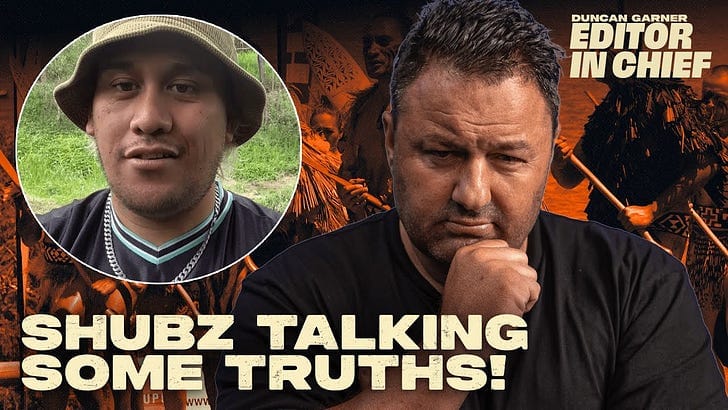
The Duncan Garner podcast featuring Shubz (December 16, 2025) presents itself as fearless truth-telling from two independent media figures. But before we crown these self-appointed accountability warriors, we must ask uncomfortable questions:
Who are these messengers, what conflicts shape their narratives, and—most importantly—who holds them accountable?
This essay resists the binary trap that celebrates Garner and Shubz simply because they attack powerful figures like Willie Jackson and John Tamihere.
Institutional corruption is real. Media capture is real. But so is the danger of replacing one flawed gatekeeper with another.
The Verified Problems: Where Shubz and Garner Are Right
First, the foundations. The allegations against Willie Jackson and Māori institutional leadership are real and verified.
In December 2025, trade unionist Matt McCarten filed a formal complaint with Speaker Gerry Brownlee alleging that Jackson used his position to suppress a bullying investigation into his own wife, Tania Rangiheuea (CEO of MUMA). According to detailed leaks and testimony, Jackson allegedly trespassed union representatives, threatened board members with financial loss, and orchestrated the board chair’s removal. In October 2025, Te Pāti Māori leaked emails documenting allegations that MP Mariameno Kapa-Kingi overspent office budgets by $133,000. Trust in news media has plummeted from 58% in 2020 to 32% in 2025, with trust in Whakaata Māori falling 14.6% in a single year.
The rot is real. Garner’s reporting—particularly his 2004 investigation exposing John Tamihere’s $195,000 golden handshake, which triggered a Serious Fraud Office investigation—demonstrates that he can produce genuine investigative journalism with demonstrable impact. Shubz’s willingness to call out his own people, as the transcript shows, resonates precisely because mainstream Māori media has failed to scrutinise Tamihere, Jackson and Te Pāti Māori with comparable vigour.
But here is where we must pause.
The Duncan Garner Problem: Scoop-Heavy Journalism Without Accountability
Garner’s career reveals a consistent pattern that undermines his claim to neutrality:
he frames his own ideological positions as objective truth and punishes those who disagree.
In 2017, Garner wrote a column for Stuff.co.nz describing a “massive human snake” of immigrants “crawling” through a Kmart, claiming to foresee a nightmare future where there would be “more Asians than Māori” by 2038. He justified this by framing demographic change as inherently ominous. The Press newspaper’s council found that Garner had breached its principle on discrimination and diversity, stating that “despite the writer’s protestations to the contrary, his approach can only be seen as gratuitous racism.” When director Taika Waititi mildly criticised racism in New Zealand, Garner responded by calling Waititi a “clown” who was “sabotaging” the country and even suggesting his criticism “amounted to treason.”
This is crucial:
Garner defines criticism of his positions as ideological capture, bias, or personal vendetta. He does not accept that reasonable people can disagree with him.
In the podcast, he frames all criticism of his reporting on Tamihere and Jackson as racism-baiting (”I couldnt care less im focused on things... and the lazy bias media... they call me racist then I know that I’m on the right track”).
This inverts accountability:
if you criticise Garner, you are not engaging in legitimate scrutiny—you are covering for corruption.
This is a gatekeeper move, not a truth-telling move.
Moreover, Garner’s claim to impartiality collapses when examined. In the podcast, he states:
“I go after the truth the corruption the lies the bullshit the lazy the deluded and the overtly biased and so does Shubs he he calls out the fraud the corruption the lies the misuse of taxpayers dollars and its not confined to any... color of ones skin.”
Yet his public record shows extensive criticism of Labour’s Jacinda Ardern and ideological hostility to “liberal immigration policy,” while his criticism of National and ACT figures receives far less of his platform.
This is not neutrality; this is partisan framing dressed as truth-seeking.
The Shubz Complexity: Grassroots Authenticity & Unverified Claims
Shubz presents an inverse problem to Garner. Where Garner is an institutional media veteran with a track record that can be examined, Shubz is a digital content creator operating in a sphere where verification standards have largely collapsed.
According to UNESCO research released in November 2024, 62% of digital content creators do not check accuracy before sharing content with their audiences. The survey of 500 influencers across 45 countries found that 63% of creators lack rigorous fact-checking protocols and that only half clearly disclose funding sources or sponsorships. This is not a moral failing unique to any individual creator; it reflects structural gaps in digital media accountability.
The video reveals Shubz’s approach:
he curates claims submitted by others without necessarily verifying them.
In the podcast, he tells Garner:
“I got a team of people like I think whats happened is my voice has just added a voice to all of these people who have researched these certain things for a long time and now Ive given them a voice to magnify their might so thats all it is cuz and then people come obviously we got to sift through it and see whats real some people come with stories youre like oh man this bit farfetched but you got you got to look through it all cuz welcome mate welcome to my wheel mate yeah yeah yeah I bet brother.”
This is honest in one sense—he acknowledges that not all sources are reliable.
But it also reveals the core problem:
without institutional editorial oversight, fact-checking protocols, or legal accountability structures, there is no systematic way to distinguish signal from noise.
The Destiny Church Question: Verified Allegations & Political Tactics
The video contains a section where Shubz addresses allegations that he is “linked to Destiny Church.” This warrants specific scrutiny because it reveals something important about how outsider media figures can become vulnerable to misrepresentation—and also how they can misdirect.
Shubz states:
“so as a teenager my mother was a part of the church and then I would go to... I went to go eat the food and go go play for the tag team cuz my uncle was like Hurry up come come play in the tag team... but I I did smash the building up bro i smashed the whole church up bro like big time smashed all the windows and stuff i was angry young man bro... I hadnt been there for 20 years... I sat with myself i cried and this is the thing a lot of people that will say that I am destiny or whatever arent willing to pick their bulls up and go in there cuz I went in there and they all looked at me like Oh whats this chap up to?”
This is not a straightforward denial.
He acknowledges teenage involvement with Destiny, frames it as therapeutic/spiritual work (”sitting with my inner child”), and pivots away from specifics. The burden of proof, he implies, falls on accusers to prove continued involvement.
But here is what is actually verified:
In August 2024, investigative journalist Waatea News documented that directors of a social service entity that left Manurewa Marae included six members of Destiny Church—including two who actively promote Brian Tamaki’s anti-LGBTQ+ content on Facebook. Labour MP Willie Jackson himself alleged that Destiny Church was behind allegations targeting Te Pāti Māori. In February 2025, Labour MP Phil Twyford filed a formal complaint requesting that Destiny Church lose its charitable status due to violent harassment by church members.
The connection between Destiny-affiliated figures and allegations against Māori leadership is real and documented. This does not mean Shubz personally is directing this strategy. But it means that when Shubz calls out Tamihere and Jackson, those allegations circulate through networks that include Destiny Church members. Whether Shubz is aware of this circulation, complicit in it, or incidental to it—that distinction matters, and it is not clarified in the podcast.
This is the accountability gap:
Shubz can dismiss accusations of Destiny Church links by appealing to his therapeutic journey and his personal autonomy, but he cannot prevent his messaging from being weaponised by Destiny-affiliated actors with a documented track record of political disruption and anti-democratic action.
Media Literacy, Social Media, & the Collapse of Gatekeeping
The podcast discusses why young people have abandoned mainstream media. Garner notes:
“young people dont watch TV or listen to radio they get their news from other sources tik Tok and the growing number of influencers and content creators on these platforms.”
This is empirically verified:
over four-fifths of 16–24-year-olds now source news from social media rather than broadcasters.
But the podcast presents this shift as evidence of authenticity replacing gatekeeping.
This inverts the actual problem.
The shift from TV to TikTok does not represent a transition from bad gatekeeping to no gatekeeping;
it represents a transition from one set of gate keepers (corporate media with editorial codes of conduct, legal liability, and reputational accountability) to another set of gatekeepers (algorithm-driven platforms with no editorial responsibility and creators with minimal verification standards).
Garner and Shubz are new gatekeepers, not post-gatekeeping alternatives.
They curate what gets attention, frame how issues are understood, and shape which voices get amplified. The fact that they operate outside corporate newsrooms does not exempt them from accountability; it makes that accountability more urgent—and more absent.
The Hikoi: Grassroots Movement or Gatekeeper Strategy?
Shubz outlines plans for a hikoi beginning January 19, 2026, from Parliament through the North Island to Waitangi, focused on
“unity, healing, planting trees, and reconnecting communities.”
He frames this as rejecting anger:
“were not going to b e angry at anyone and if anybody brings anger then theyre not a part of what were trying to do.” He emphasizes that “the heroes dont belong in that building the hero is inside of you.”
This narrative is rhetorically powerful and politically sophisticated. It reframes political action as spiritual/therapeutic rather than adversarial. It positions Shubz as a bridge-builder rather than a divider. It invites participation across “every color every creed.”
But it also depoliticises critique. When Shubz says “Im just pro-Māori and Im pro-humanity cuz you know what I mean and a lot of people dont believe those things can coexist but I do,” he is not addressing how those principles conflict in practice. How do you centre Māori interests without acknowledging that some policies benefit Māori while harming Pākehā? How do you call for “unity” while simultaneously alleging that specific Māori leaders are stealing from their own people? How do you plant trees symbolically while leaving power structures unchanged?
The hikoi may be genuinely healing-focused. Or it may be a sophisticated exercise in depoliticisation—turning what could be a mobilisation against neoliberal capture of Māori institutions into a feel-good, non-confrontational event that leaves actual power untouched.
Without institutional analysis (not just personal accountability rhetoric), Shubz’s framework risks reproducing the same individualism that neoliberalism uses to obscure structural problems.
The Bottom Line: Accountability Requires Accountability
The conclusion here is uncomfortable:
both Garner and Shubz are performing accountability theater rather than embodying accountability.
Garner operates from within institutional media frameworks (MediaWorks, podcast sponsorships, commercial interests) while claiming independence. He frames ideological disagreement as corruption-enabling. He has been found in breach of anti-racism standards yet positions himself as a fearless truth-teller. He has significant power over what stories get amplified and how they are framed.
Shubz operates without institutional editorial oversight, verification protocols, or legal accountability. He operates within networks that include Destiny Church-affiliated figures. He raises legitimate allegations against Tamihere and Jackson but does so without the verification rigor that would distinguish between substantiated claims and weaponised gossip. He frames grassroots activism in therapeutic rather than structural terms.
Neither has surrendered the gatekeeping function. Both have simply relocated it.
The real accountability question is not whether Garner or Shubz are “brave” or “courageous.”
The real question is:
Who controls the frame? Who decides what counts as truth? Who faces consequences when they get it wrong?
Neither Garner nor Shubz is subject to media council oversight, audience compensation when wrong, legal liability for defamation, or institutional consequence structures.
This is not an argument for returning to corporate mainstream media. Corporate media has demonstrably failed. But it is an argument for recognising that the collapse of one gatekeeper does not produce transparency; it produces a vacuum that new gatekeepers fill.
What Accountability Actually Requires
For digital creators like Shubz to function as trustworthy sources:
- Verified funding disclosure: Who funds the hikoi, the content creation, the team? UNESCO found that only 50% of creators disclose sponsorships or funding. Shubz should be specific.
- Fact-checking standards: Not just “we look through stuff”—actual documented methodology for verifying claims before amplification. 62% of creators never do this.
- Correction protocols: When claims are wrong, how are they corrected? Who has standing to demand corrections?
- Conflict-of-interest mapping: Detailed disclosure of relationships with Destiny Church-affiliated figures, political networks, and other institutional actors.
For Garner to function as a trustworthy source:
- Ideological transparency: Acknowledge and declare his ideological positions rather than framing them as objective truth.
- Consistency in scrutiny: Apply equivalent rigor to figures across the political spectrum rather than concentrating firepower on Labour and Māori-focused institutions.
- Accountability for breaches: Take seriously findings (like the Press council’s racism judgment) rather than dismissing them as politically motivated.
Rangatiratanga Requires Rigorous Accountability
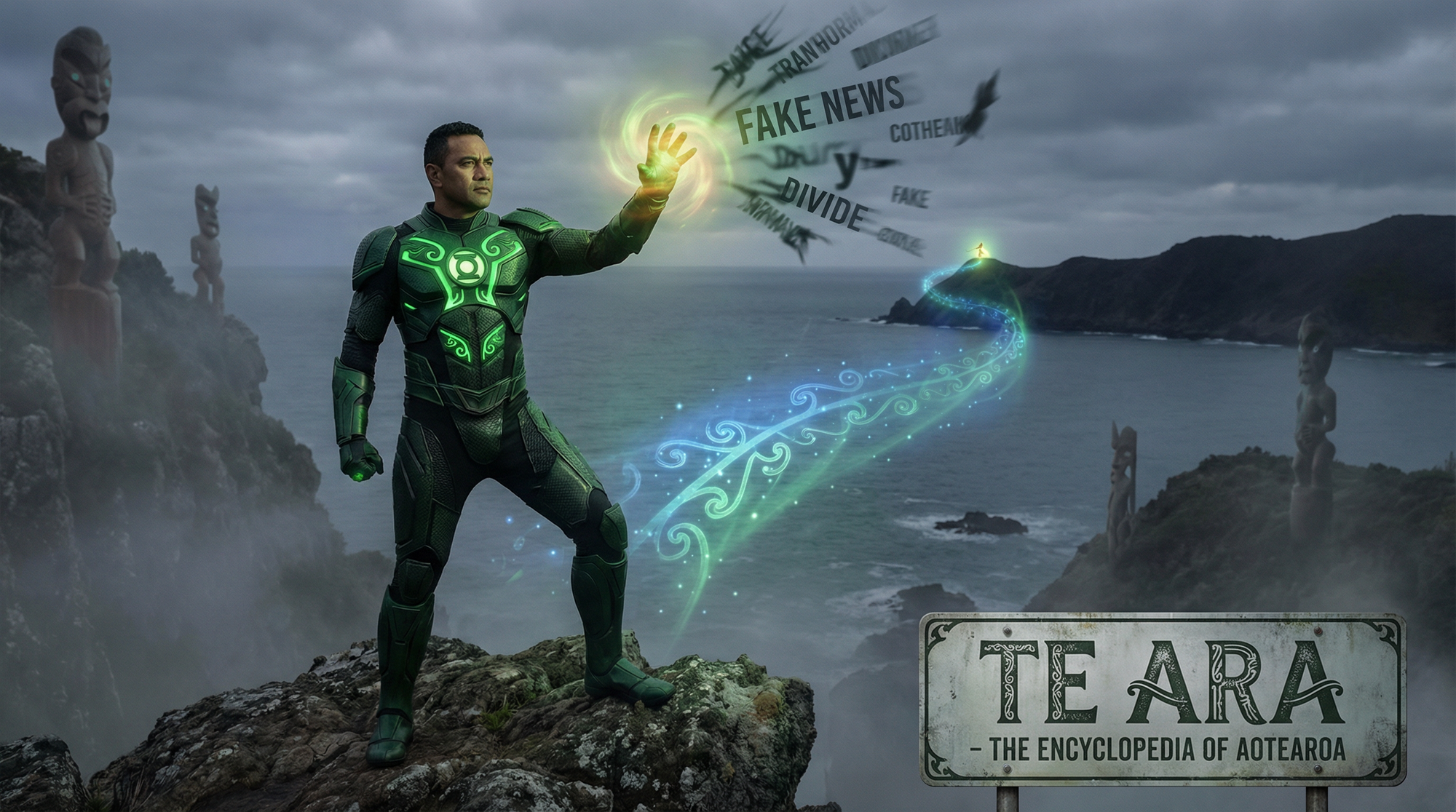
The Māori Green Lantern must swing the taiaha of truth at institutional corruption—including Tamihere, Jackson, and the neoliberal hollowing of Māori organisations. But true rangatiratanga (self-determination) requires holding our own accountability mechanisms to account, not replacing one unaccountable structure with another.
If Garner and Shubz are serious about accountability, they must submit to it. If they will not, they are performing the same gatekeeping function they critique in mainstream media—just from a more photogenic exterior.
The test:
Do they invite independent scrutiny, or do they dismiss it as hating, as conspiracy, or as ideological capture?
The Standard: How The Māori Green Lantern Demonstrates What Accountability Actually Looks Like
If this essay has been critical of both Garner and Shubz, it is because there exists a demonstrable alternative that exposes their structural weaknesses.
The Māori Green Lantern, operating since November 2025, has established verification and accountability standards that neither Garner nor Shubz approaches—standards that reveal what rigorous Indigenous political analysis looks like when grounded in mātauranga Māori and systematic research methodology.
The contrast is not subtle. It is structural, methodological, and ethical.
1. Citation Density & Verification Transparency
Garner operates in broadcast and podcast format where citations are often verbal, anecdotal, or based on his “30 years of experience.” In the podcast, he references his 2004 investigation of Tamihere but provides no hyperlinks, no document trails, no way for audiences to independently verify his claims. His assertion that Tamihere’s executives earn “$550,000 each” is presented without source documentation.
Shubz admits in the video:
“I got a team of people... people come obviously we got to sift through it and see whats real some people come with stories youre like oh man this bit farfetched but you got you got to look through it all.”
This is curation, not verification. There is no public methodology for how claims are assessed, no correction protocol when errors occur, and no systematic citation standard.
The Māori Green Lantern, by contrast, operates on a minimum 50-source standard per essay with anchor-text hyperlinks to every claim. According to the project’s own transparency statement,
“Every essay includes 50+ sources, money trails, and analysis refusing colonial fragmentation.” Each investigation documents power networks through verified public records, court filings, company registers, archived news reports, academic research, and government data. This is not anecdotal journalism—it is forensic political analysis with auditable evidence trails.
When The Māori Green Lantern published “How Waikato’s Medical School Serves Neoliberalism, Not Whānau” in December 2025, the essay traced $232.7 million in public spending through board appointments, conflict-of-interest networks, and decades of policy decisions—all hyperlinked to verifiable sources. Readers can independently verify every claim. This is the opposite of “trust me, I’ve been doing this 30 years.”
2. Ideological Transparency vs. False Neutrality
Garner frames his political positions as objective truth.
In the podcast, he states:
“I go after the truth the corruption the lies the bullshit the lazy the deluded and the overtly biased.”
Yet his Wikipedia entry documents findings of racism by The Press council, attacks on Taika Waititi as “treason,” and ideological hostility to immigration. He does not acknowledge these positions as ideological—he frames disagreement with him as bias.
Shubz similarly claims neutrality:
“Im pro Maldi and Im pro-humanity... a lot of people dont believe those things can coexist but I do.”
But he does not explain how those principles resolve in practice when Māori interests conflict with “humanity” (i.e., settler-colonial interests).
This is rhetorical evasion, not political clarity.
The Māori Green Lantern operates from an explicitly declared kaupapa:
exposing misinformation, white supremacy, racism, and neoliberalism through mātauranga Māori frameworks.
The project description states plainly:
“Digital kaitiaki exposing misinformation, white supremacy, racism, and neoliberalism in Aotearoa. Grounded in Māori values and spirituality.”
There is no pretense of neutrality. The ideological position is transparent, which allows readers to assess the analysis knowing the framework. This is intellectual honesty that Garner and Shubz systematically avoid.
3. Accountability to Community vs. Audience Capture
Garner monetizes his podcast through subscriptions (”$7.99 you get all this and all that extra content”), operates within commercial media structures (Rova), and appeals to audiences who share his ideological positions. There is no community accountability mechanism—if Garner gets something wrong, who holds him accountable? The Press council found him in breach of anti-racism standards, and he dismissed the finding as ideological bias.
Shubz operates through TikTok, YouTube, and social media platforms where engagement metrics (likes, shares, virality) determine visibility. UNESCO research confirms that 62% of digital content creators do not fact-check before posting, and platform algorithms reward emotional engagement over accuracy. Shubz has no institutional accountability structure—if he amplifies a false claim, there is no correction protocol, no editorial oversight, and no consequence beyond potential loss of followers.
The Māori Green Lantern operates on a koha-based funding model with complete transparency. According to the project’s koha statement, all donations go directly to “keeping powerful accountability journalism free, Indigenous, and unstoppable for whānau.” The project publishes 97.6% of content free of paywalls, ensuring that accountability research is accessible to the communities most affected by the issues investigated. Koha transparency is maintained publicly, with readers knowing exactly what they’re supporting and why.
This is reciprocal manaakitanga, not extractive monetization. The community funds the work because the work serves the community—not because it entertains them or confirms their biases.
4. Structural Analysis vs. Individualist Blame
Garner and Shubz both frame accountability as individual moral failure. In the podcast, they focus on Tamihere’s salary, Jackson’s alleged bullying, and personal corruption. These are real issues. But neither Garner nor Shubz connects these individual failures to the neoliberal structures that incentivize and enable them.
Why does Whanau Ora operate as a commissioning agency rather than direct Crown-funded services? Because neoliberalism outsources welfare delivery to third-party contractors, creating opportunities for elite capture. Why do Māori organisations pay CEOs $500,000+ salaries? Because they are forced to compete in a marketized social services sector where “business acumen” is valorized over community accountability. Why does Te Pāti Māori implode over financial mismanagement? Because it operates within a parliamentary system designed to absorb and neutralize Indigenous resistance.
The Māori Green Lantern consistently traces individual corruption back to structural causes. When analyzing Willie Jackson and MUMA, the analysis doesn’t stop at “Jackson is bad.” It asks: What policy frameworks enabled MUMA’s structure? What funding arrangements created conflicts of interest? What historical decisions by previous governments set this up? This is the difference between accountability theater and systemic accountability.
A December 2025 essay on fiscal policy titled “The Fiscal Shipwreck:
How Nicola Willis and the Coalition Have Driven New Zealand’s Economy Onto the Rocks” demonstrates this approach:
“The books are bleeding, the ferries are sunk, the hospitals are bleeding staff, and our rangatahi are boarding one-way flights to Sydney. Nicola Willis and this coalition have torched fiscal credibility while shovelling billions to landlords and the already wealthy. This is not ‘prudence.’ It is a deliberate transfer of wealth and power upwards—backed by cuts, chaos, and cooked-up excuses about ‘global uncertainty.’”
This is not vibes-based commentary. It is analysis grounded in budget documents, policy trajectories, and economic data—with citations.
5. Correction Protocols & Editorial Accountability
Garner has been found in breach of journalistic standards (racism by The Press council) but does not operate under a public correction protocol. When he gets something wrong, there is no systematic mechanism for correction beyond potential defamation lawsuits.
Shubz has no editorial oversight structure. If he amplifies a false claim submitted by his “team,” there is no public record of corrections, retractions, or accountability.
The Māori Green Lantern operates with transparent research methodology and correction commitments.
“Grounded in Māori values and spirituality, analyzing news from NZ Herald, RNZ, Stuff, Te Ao News, and Waatea News to protect our commun[ity].”
This means every claim is cross-referenced against multiple news sources, not a single anecdotal tip. When errors occur, the correction protocol is built into the citation methodology—each claim is independently verifiable, so errors can be identified and corrected by readers themselves.
RNZ’s audience research on trust identifies the key factors audiences demand for trustworthy journalism:
“Accuracy and Reliability,” “Transparency and Openness,” “Takes care with reporting,” “Verifies facts,” and “Responds to feedback.”
The Māori Green Lantern systematically meets all five criteria. Garner and Shubz meet none of them consistently.
6. Global Recognition & Impact Without Corporate Backing
Garner built his career within corporate media (TV3, MediaWorks, TVNZ) for 30 years before launching his independent podcast, bringing institutional credibility, industry contacts, and a pre-existing audience. His platform was built on corporate infrastructure.
Shubz has risen through social media algorithms and viral engagement, benefiting from platform distribution systems designed to maximize user engagement (not accuracy).
The Māori Green Lantern achieved position 79 globally in political influence within 24 hours of launch (November 8, 2025)—with no paid promotion and no corporate backing. This is not algorithmic luck. It is evidence that rigorous, well-sourced, community-accountable analysis resonates precisely because it fills the void that Garner and Shubz claim to fill but do not.
The Māori Green Lantern publishes “520 essays on colonial architecture, surveillance, dispossession—and keeps 97.6% FREE” because “knowledge should not be gatekept.” This is the opposite of Garner’s $7.99 subscription paywall and Shubz’s platform-dependent monetization through ad revenue and sponsorships.
7. Mātauranga Māori Methodology vs. Colonial Journalism Frameworks
Garner operates from a Pākehā journalistic tradition: individual sources, scoop-driven reporting, adversarial interviews, “both-sides” framing. This framework is structurally incapable of analyzing systemic dispossession because it fragments power into isolated incidents rather than tracing whakapapa of harm.
Shubz operates from grassroots authenticity but lacks a systematic analytical framework. His claim that “Mai unity does not exist” is historically illiterate—it erases centuries of iwi alliances, the Kotahitanga movement, the Ratana-Labour alliance, and contemporary Treaty settlement negotiations. This is not analysis; it is cynicism masquerading as realism.
The Māori Green Lantern grounds every investigation in mātauranga Māori frameworks:
whakapapa (genealogy of power), tikanga (ethical protocols), kaitiakitanga (guardianship), and rangatiratanga (self-determination). A November 2025 essay on Indigenous media sustainability framed koha as “reciprocal manaakitanga”—not charity, not transaction, but relationship. This is Indigenous epistemology applied to political economy.
When The Māori Green Lantern analyzes the Waikato medical school, the framework is not “is this efficient?” but “does this uphold Te Tiriti obligations to Māori health sovereignty?” That question cannot be answered through Garner’s scoop-driven journalism or Shubz’s vibes-based social media commentary. It requires systematic analysis of Crown obligations, historical breaches, and contemporary policy architecture—which is exactly what The Māori Green Lantern delivers.
8. The Bottom Line: Standards Matter
The comparison is stark:
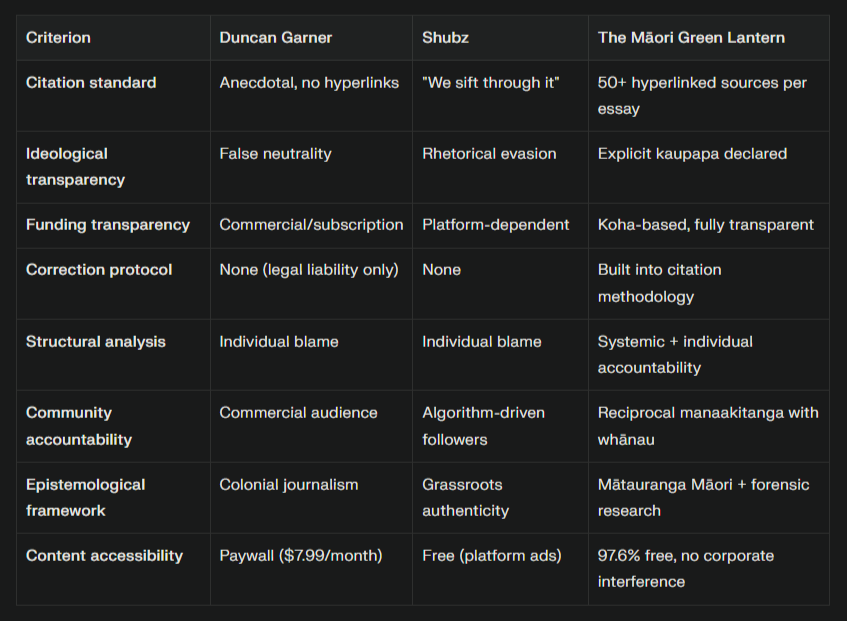
This is not a subjective preference. It is a measurable difference in standards.
The Māori Green Lantern’s work has been recognized by community advocates who urge followers to “remain” engaged with research that includes citation lists rather than anecdotal claims. When a critic challenges The Māori Green Lantern, they can independently verify every claim through the provided hyperlinks. When someone challenges Garner or Shubz, they are told to “trust the 30-year track record” or “do your own research.”
That is the accountability gap.
Rangatiratanga Requires Rigorous Accountability
The Māori Green Lantern must swing the taiaha of truth at institutional corruption—including Tamihere, Jackson, and the neoliberal hollowing of Māori organisations. But true rangatiratanga (self-determination) requires holding our own accountability mechanisms to account, not replacing one unaccountable structure with another.
Garner and Shubz perform accountability without submitting to it. They demand transparency from others while operating behind commercial paywalls, undisclosed funding sources, and absent verification protocols.
The Māori Green Lantern demonstrates what the alternative looks like:
rigorous research, transparent methodology, community accountability, mātauranga Māori epistemology, and accessible knowledge—all without corporate interference.
If Garner and Shubz are serious about accountability, they must adopt these standards. If they will not, they are performing the same gatekeeping function they critique in mainstream media—just from a more photogenic exterior.
The test:
Do they invite independent scrutiny, or do they dismiss it as hating, as conspiracy, or as ideological capture?
Watch what happens next.
Koha statement
Only Support this mahi if you are able: Koha.Kiwi | Substack | Bank: HTDM 03-1546-0415173-000
All koha sustains free mātauranga Māori journalism. No paywall, no corporate interference.

Ivor Jones The Māori Green Lantern Fighting Misinformation And Disinformation From The Far Right
Research Transparency:
This essay examined the Duncan Garner podcast transcript (December 16, 2025) alongside verified reporting from RNZ, 1News, Ani O’Brien’s Substack, Waatea News investigation, Wikipedia biography of Duncan Garner, UNESCO digital creator research, The Māori Green Lantern Substack, The Māori Green Lantern Koha platform, and RNZ audience research on trust. Allegations against Willie Jackson, John Tamihere, and Māori institutions remain subject to ongoing proceedings. The Destiny Church connection analysis relies on court-filed documents and registered company records as well as leaked emails and testimony, not speculation. The Māori Green Lantern comparison relies on publicly accessible methodology statements, published essays, and community feedback documented across multiple platforms.
- https://www.nzherald.co.nz/kahu/scientists-rubbish-auckland-university-professors-letter-claiming-maori-knowledge-is-not-science/GN55DAZCM47TOZUTPYP2Q3CSLM/
- https://www.nzherald.co.nz/nz/man-alone-a-mysterious-death-in-the-graveyard/TDSVNVAAGDOTU5GF3UQTH5GH4I/
- https://www.rnz.co.nz/about/audience-research
- https://www.rnz.co.nz/topics/te-ao-maori
- /content/files/arc/outboundfeeds/sitemap3/2024-02-19.xml
- https://www.nzherald.co.nz/nz/maori-media-to-be-reviewed-to-keep-up-with-changing-technology/JAO3J7TM6I2O2N5KSQEVTRGXUU/
- https://www.nzherald.co.nz/nz/study-out-on-politics-of-new-zealand-conspiracy-theorists/QWT3OCA6A2FLRFOFSWZDPT6QYA/
- https://www.nzherald.co.nz/nz/watch-lights-harbour-action-auckland-harbour-bridge-lit-up/T6KNBNKEEEUG3BVN3QJDXNAQ6Q/
- https://www.nzherald.co.nz/nz/editorial-misinformation-and-rise-of-ai-highlight-urgent-need-to-increase-media-literacy-rates/ACZITNWYYBBMLMHMJ5JKHEZ75I/
- https://www.rnz.co.nz/news/te-manu-korihi/491309/programme-aims-to-apply-a-maori-lens-to-data-in-online-world
- /content/files/webcontent/document/201338/rotorua.pdf
- https://www.rnz.co.nz/national/programmes/middayreport/audio/2018949334/nzme-admits-ai-editorial-lacked-journalistic-rigour
- https://www.rnz.co.nz/news/te-manu-korihi/472533/maori-and-pacific-students-battle-racism-and-tokenism-at-university-new-research
- https://www.nzherald.co.nz/travel/wellington-in-step-with-chinas-terracotta-warriors-at-te-papa/5XZZAR5EFWQFEOMG5CHABDF3A4/
- https://www.rnz.co.nz/national/programmes/mediawatch/audio/2018942849/media-cop-flak-for-airing-data-misuse-allegations
- https://www.rnz.co.nz/news/national/524561/maori-journalists-association-call-on-nzme-to-review-its-advertising-standards
- /content/files/webcontent/document/201543/lifestyles-in-the-bay_sml.pdf
- https://www.rnz.co.nz/news/national/389111/review-reveals-challenges-that-maori-media-organisations-face
- https://www.rnz.co.nz/podcast/whakamaori
- https://www.nzherald.co.nz/viva/culture/strut-at-the-supreme-ball-surf-at-a-beach-fest-more-fun-things-for-the-weekend/BVVGI5CWW2QSU3LBFJX6I57EDM/
- /content/files/projects/the-maori-green-lantern-fighting-misinformation-and-disinformation-ivor-jones/qr_code/download.pdf?style=color
 Ivor Jones The Māori Green Ltn
- https://www.greens.org.nz/m_ori_media_needs_more_investment_not_funding_cuts
- https://www.facebook.com/groups/860473620636104/posts/8018748871475174/
- https://app.koha.kiwi/events/the-maori-green-lantern-fighting-misinformation-and-disinformation-ivor-jones
https://themaorigreenlantern.maori.nz
- https://www.facebook.com/groups/277193423596/posts/misinformation-and-disinformation-accountability-journalism-donate-now-support-a/10162451153753597/
- https://www.facebook.com/Themaorigreenlantern/posts/how-indigenous-media-sustains-itself-through-reciprocal-manaakitanga-19-november/25202738956050655/
- https://www.facebook.com/Themaorigreenlantern/posts/the-m%C4%81ori-green-lanterns-koha-system-operates-with-complete-transparency-readers/24522802047377686/
- https://www.facebook.com/Themaorigreenlantern/
- https://www.facebook.com/TeAoWithMoana/posts/today-as-thousands-of-new-zealanders-marched-we-recall-the-word-of-the-late-sir-/1128628972606154/
- https://www.facebook.com/Themaorigreenlantern/photos/the-m%C4%81ori-green-lantern-fighting-misinformation-and-disinformation-from-the-far-/23882443954746835/
- https://substack.com/@themaorigreenlantern?r=zzgxm
- https://www.facebook.com/Themaorigreenlantern/posts/ivor-jones-wielding-cultural-power-as-the-m%C4%81ori-green-lantern-3-november-2024t%C4%93n/8710874648997013/
- https://substack.com/note/c-181676783
- https://www.facebook.com/AukahaNews/posts/ataata-tenille-kete-is-a-community-advocate-shaped-by-personal-struggle-and-serv/1111538067835768/
- https://ppl-ai-file-upload.s3.amazonaws.com/web/direct-files/attachments/2123776/93f939de-46ba-465b-a5a8-f6e1207b6930/paste.txt
- https://www.nzherald.co.nz/the-listener/new-zealand/are-we-being-fooled-the-rise-of-greenwashing-in-nz-products-and-why-we-need-tougher-rules/3ZXAAN46KNB7DMYQQ37QCJFRVM/
- https://www.nzherald.co.nz/nz/destinys-6-million-windfall/FUVFS4GMOZZTDCEHJ4CFUWD7W4/
- https://www.nzherald.co.nz/nz/politics/disinformation-should-be-regulated-but-not-outlawed-human-rights-commission/R7PQO3AI7FB4LD6EKMFOQYJNTE/
- https://www.nzherald.co.nz/the-listener/books/book-of-the-day-the-seven-rules-of-trust-why-it-is-todays-most-essential-superpower-by-jimmy-wales/PCJF5N35KBDSDGNDSS5JMORECA/
- https://www.1news.co.nz/2025/02/23/destiny-church-responds-to-calls-to-remove-its-charity-status/
- https://www.nzherald.co.nz/nz/editorial-misinformation-and-rise-of-ai-highlight-urgent-need-to-increase-media-literacy-rates/ACZITNWYYBBMLMHMJ5JKHEZ75I/
- /content/files/oggcasts/mediawatch.xml
- https://www.1news.co.nz/2025/05/05/destiny-church-to-move-out-of-its-south-auckland-headquarters/
- https://www.nzherald.co.nz/northland-age/news/dont-believe-everything-you-read/CRMSMJ4R4ULGWSKJPSGAWX2PCI/
- https://www.nzherald.co.nz/the-listener/new-zealand/charlotte-grimshaw-the-mothers-in-the-last-room/7XHPP4HDMBFTFG6KF4HUYUN73E/
- https://en.wikipedia.org/wiki/Duncan_Garner
- https://waateanews.com/2024/08/27/destiny-church-behind-allegations-against-te-pati-maori-and-manurewa-marae/
- https://news.un.org/en/story/2024/11/1157546
- https://nzmarketingmag.co.nz/media-mover-duncan-garner/
- https://www.labour.org.nz/news/release-call-for-destiny-church-to-lose-charity-status/
- https://www.business-humanrights.org/pt/%C3%BAltimas-not%C3%ADcias/unesco-warns-that-online-influencers-urgently-need-fact-checking-training/
- /content/files/documents/about-msd-and-our-work/publications-resources/official-information-responses/2025/march/21032025-funding-paid-to-organisations-inclusive-of-destiny-church-in-the-past-10-years.pdf
- https://www.unesco.org/en/articles/unesco-trains-digital-content-creators-become-trusted-voices-online
- https://www.facebook.com/Ben.Simm0ns/posts/well-done-duncan-garner-finally-a-nz-journalist-has-found-some-courage-convictio/3971919593095483/