“Fast‑Track, Slow Coup: How the Coalition Is Gutting Te Tiriti, Democracy, and Te Taiao” - 5 December 2025
These Baldheads have gotz to Go!
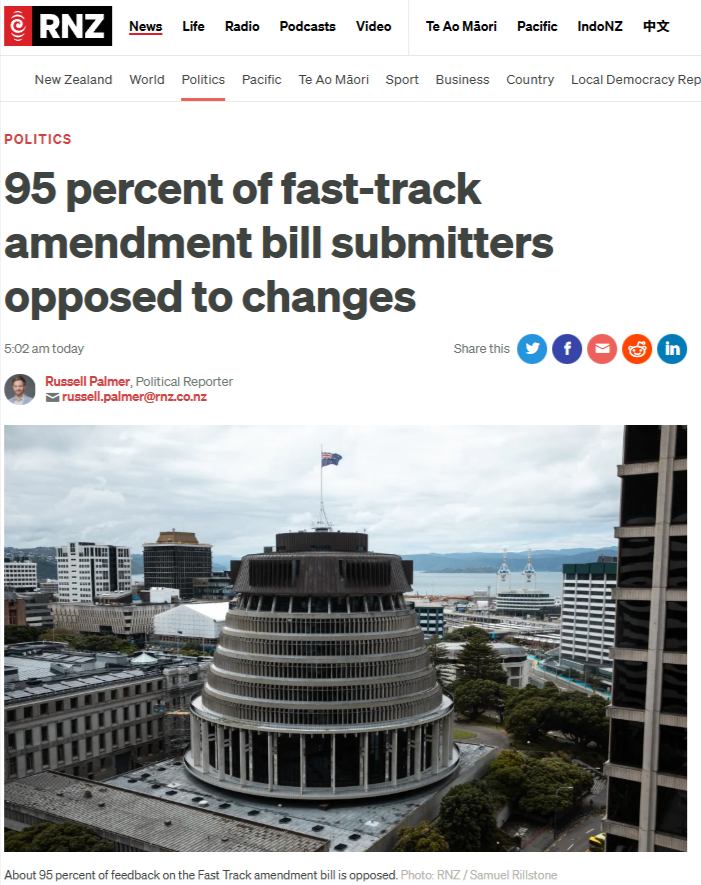
The Fast‑track Approvals Amendment Bill is not about cheaper groceries. It is a weapon. It hands more power to ministers and their corporate mates, strips out public and Māori voices, and accelerates destructive projects – all while 95 percent of submitters say “no”. This is not clumsy law‑making. It is a deliberate project to roll back Te Tiriti, kaitiakitanga, and democratic oversight in favour of extractive capitalism and Pākehā political control.
Research for this essay draws on the Fast‑track Act and Amendment Bill, Cabinet and Treaty analysis papers, submissions from the New Zealand Law Society, Greenpeace and Forest & Bird, Te Ara and Waitangi Tribunal material on kaitiakitanga and Treaty principles, and extensive reporting by RNZ, all checked on 5 December 2025.
Intro: Cui bono?
Follow the money and the power.
The Luxon–Peters–Seymour coalition has already installed a permanent fast‑track regime allowing big mines, dams, roads and industrial schemes to bypass normal environmental and Treaty safeguards under a single “one‑stop shop” law. Ministers backed away – under pressure – from giving themselves final sign‑off on projects, instead fronting expert panels as the decision‑makers. Now, with the Amendment Bill, they are quietly re‑arming:
Fast‑track is expanded and sped up, with compressed timeframes, fewer appeal rights, and tighter constraints on expert panels.Ministers gain new powers to issue Government Policy Statements (GPS) and to direct the EPA, giving them strong leverage over “independent” decisions.Developers gain the right to challenge who sits on expert panels, while the public, iwi and hapū face weaker participation and fewer legal remedies.
At the same time, this regime is explicitly promoted as an “express lane” for new supermarkets to improve competition – a story endlessly repeated by Nicola Willis and Chris Bishop. Yet legal analyses show the Bill makes wide‑ranging changes across all fast‑track projects, not just grocery builds.
Cui bono?
Not kaumātua struggling with power bills. Not Māori kaitiaki fighting to protect awa, maunga and moana. The winners are the ministers holding the pen and the companies whose projects will now barrel through a weakened system with minimal scrutiny.
Background: From kaitiakitanga to fast‑track colonialism
Te Tiriti, kaitiakitanga and environmental law
In te ao Māori, humans stand in a sacred, reciprocal relationship with te taiao. Kaitiakitanga – guardianship rooted in whakapapa to Ranginui, Papatūānuku and their descendants – obliges tangata whenua to protect the mauri of land, waters and ecosystems across generations. Te Ara describes kaitiakitanga as a holistic system in which community health and environmental health mirror each other, enforced through practices like rāhui, maramataka‑based harvesting and strict limits on exploitation.
Te Tiriti principles, as articulated by the courts and summarised by Te Ara, include partnership, active protection, and informed decision‑making; they require the Crown to protect Māori interests in lands and waters “to the fullest extent practicable” and to make decisions only when properly informed about Treaty impacts.
The Waitangi Tribunal has repeatedly found that the Resource Management Act (RMA) regime failed to deliver genuine rangatiratanga or kaitiaki control, and that simply devolving decisions to councils without strong Treaty structures breaches the Crown’s obligations. In the Wai 262 report, the Tribunal stated the RMA has not delivered appropriate levels of control, partnership, and influence for kaitiaki in relation to taonga in the environment. In other words, even the “normal” system is already not Treaty‑compliant.
Enter the Fast‑track Act
The current coalition chose not to fix those structural failures. Instead, it rammed through the Fast‑track Approvals Act in 2024 under urgency, creating a permanent parallel consenting system for high‑impact projects.
The Ministry for the Environment records that the Act combines approvals that would usually sit under the RMA, Conservation Act, Fisheries Act, Crown Minerals Act and more into one shortcut pathway. A Treaty Impact Analysis commissioned by officials warns that the Fast‑track regime:
Was developed “at pace” with limited engagement with iwi, hapū and Māori organisations.Contains no Treaty clause, and does not require decision‑makers to apply Treaty principles or even the strong Treaty protections in other statutes like the Conservation Act.Only allows some Māori groups to comment on applications, with rights “relatively limited compared to under the RMA”, creating real risks that Treaty principles – especially active protection – will not be met.
So the starting point is already a regime that sidelines Māori authority and weakens environmental protections compared with an RMA system the Tribunal has already judged inadequate.
The Amendment Bill takes that flawed structure and deliberately makes it worse.
What this Amendment really does
Strip away the supermarket spin and a simple picture emerges:
Democratic shortcuts
Submissions on the Amendment Bill were open for just 10 days, yet 2518 individuals and groups made written submissions and 85 gave oral evidence. About 95 percent of that feedback opposed the changes, but the coalition‑controlled select committee recommended no amendments and signalled that further, undisclosed changes will instead be rammed through at the Committee of the Whole House stage, without public consultation.
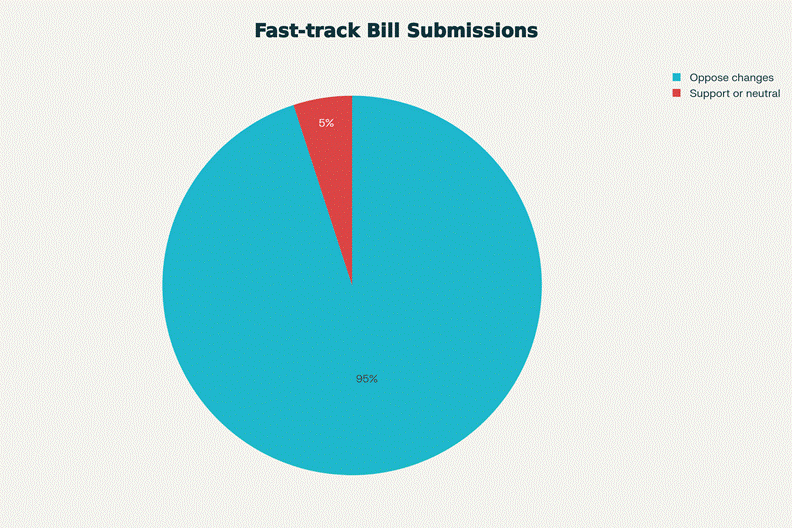
Approximate share of submissions on the Fast-track Approvals Amendment Bill opposing versus supporting the changes.
Ministerial power grab
The Bill enables ministers to issue binding Government Policy Statements on matters such as grocery competition and to direct the EPA’s performance under the Act, while shortening timeframes and constraining panels’ ability to seek independent evidence. Forest & Bird and Greenpeace both warn this concentrates power in ministers and “silences nature’s voice” by shutting out NGOs, experts and communities.
Weaponised timelines and weakened rights
Timeframes for referral comments are cut from 20 to 15 working days; panels are pushed towards decisions within 60 working days, regardless of project complexity; and appeal rights are cut back, pushing communities towards expensive judicial review instead of accessible merits appeals.
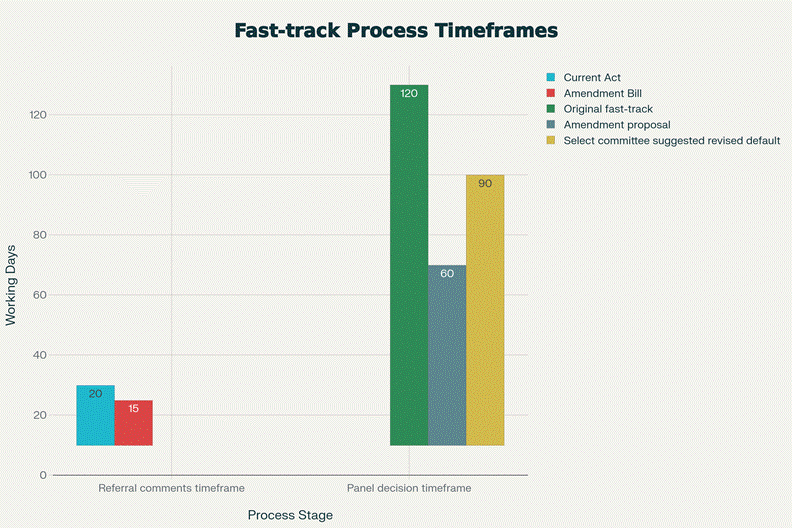
Key fast-track process timeframes under the existing law versus the proposed Amendment Bill.
Māori exclusion by design
E‑Tangata commentators show how the regime reproduces patterns of excluding Māori – especially those without completed settlements – from decisions over their own lands and waters, including wāhi tapu and unsettled coastal and marine areas. Treaty analysis confirms only a narrow subset of Māori entities have guaranteed input, and there is no overarching Treaty clause giving weight to rangatiratanga or kaitiakitanga.
Cover story of supermarket competition
While Nicola Willis and MBIE loudly promote the Bill as an “express lane for new supermarkets”, the Law Society shows it in fact makes “substantive and significant” changes across the entire fast‑track regime – including new GPS powers, truncated consultation and timeframes, and more ministerial oversight for all project types.
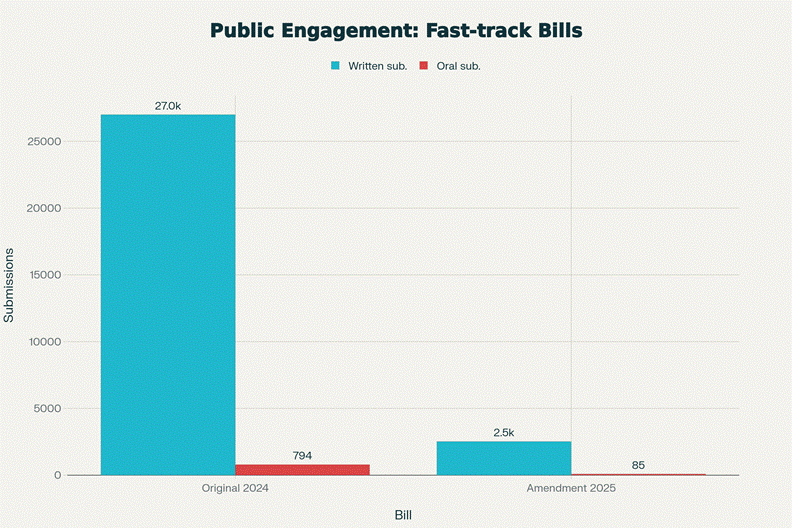
Public participation on the original Fast-track Bill (2024) versus the 2025 Amendment Bill.
This combination is not accidental. It is a constitutional strategy: centralise power, marginalise Māori, weaken nature’s defenders, and move fast enough that public outrage cannot keep up.
Analysis: Five hidden connections the government hopes you will not trace
Hidden Connection 1: From supermarket “express lane” to whole‑of‑regime overhaul
Nicola Willis’ Beehive release announces the Amendment Bill as a way to “create a consenting express lane for new supermarkets” and improve grocery competition. MBIE echoes this, talking up an “express lane” and “one‑stop shop” for grocery developments, while gesturing vaguely to minor tweaks in the wider Act.
Yet the Law Society’s submission is blunt: the Bill contains “a number of concerning and potentially unworkable proposals”. It is inconsistent with the government’s own claim that it merely provides “technical and machinery changes” which “do not substantially alter” fast‑track decision‑making.
A new, open‑ended GPS power allowing ministers to set broad policy directions for panels, including project‑specific GPSs.Major tightening of timeframes for referrals, panel establishment and evidence gathering, increasing the risk of rushed, poor‑quality decisions.Replacement of mandatory consultation with “notification” for key affected parties, including iwi authorities and councils, with shorter deadlines and weaker requirements to actually take their views into account.
Commercial law firms agree that critics are right to call the Bill a “Trojan horse” – sold as pro‑competition “red tape cutting”, used to entrench a permanent shortcut around environmental and Tiriti protections for a wide range of politically favoured projects.
Hidden connection:
supermarket anger is being used as political camouflage for a broader power‑grab over every fast‑tracked mine, dam, road and industrial scheme in the country.
Hidden Connection 2: Pre‑cooked fast‑track wish‑lists and corporate donors
RNZ’s investigative reporting revealed that a draft fast‑track bill – complete with a redacted list of projects – was already circulating between Shane Jones and Chris Bishop during coalition negotiations, before the public ever saw the legislation. The same reporting shows officials warning ministers that including large numbers of private projects like mines and property schemes in a government bill risked breaching rules against legislating for private pecuniary advantage.
At the same time, RNZ and NZ Herald reporting shows J Swap, a quarrying company that donated $11,000 to New Zealand First, lobbying through its fast‑track submission to open up QEII‑covenanted conservation land to quarrying – land that is supposedly protected “in perpetuity”. Chris Bishop has openly refused to rule out mining on Department of Conservation land under the fast‑track regime, confirming that new mines on conservation estate are “on the table”.
Greenpeace’s submission on the Amendment Bill explicitly warns that combining fast‑track with the existing system of large political donations and opaque project lists amounts to a “dangerous and undemocratic” structure where corporations can run roughshod over environmental law.
Hidden connection:
the Amendment Bill tightens timelines and boosts ministerial direction after donors and industry allies have already been lobbying for specific projects behind closed doors. That is a textbook recipe for regulatory capture.
Hidden Connection 3: From Muldoon‑era executive rule to 2025
Forest & Bird’s Richard Capie has warned that the fast‑track laws hand ministers decision‑making powers “we haven’t seen since Muldoon”, making approvals for massive dams, tunnels and developments “almost inevitable”.
The Amendment Bill doubles down by:
Allowing ministers to issue project‑specific statements of regional or national benefit which panels must treat as a core consideration.Tightening decision deadlines for panels to as little as 60 working days, with limited ability to seek additional expert input.Giving ministers power to direct the EPA on how it exercises its functions under the Act.
Forest & Bird summarises the result:
the Amendment Bill “slams the door shut on communities” and “silences nature’s voice” by excluding NGOs, independent experts and local groups from meaningful participation. Greenpeace brands it a “savage escalation” of a governmental “war on nature”.
Waitangi Tribunal extracts on environmental management warn that even the RMA – with its explicit Treaty references and Environment Court oversight – has failed to deliver adequate kaitiaki control, and that central government cannot abdicate its Treaty duties by simply devolving power to local authorities. The fast‑track regime moves in exactly the opposite direction:
re‑centralising power in Wellington, then weakening scrutiny and rights of appeal.
Hidden connection:
the coalition is using fast‑track to resurrect Muldoon‑style executive dominance over major projects, in direct tension with decades of jurisprudence and Tribunal findings that demanded stronger Treaty‑based environmental governance, not weaker.
Hidden Connection 4: Systematic Māori exclusion baked into the design
Te Ara documents how kaitiakitanga rests on mana whenua authority, whakapapa to place, and collective responsibilities to protect mauri. Environmental and Treaty law has slowly, unevenly recognised this through Treaty clauses and consultation duties in the RMA and Conservation Act.
The fast‑track architecture is a conscious retreat from that progress.
The Treaty Impact Analysis flags three core Treaty failings:
No Treaty clause in the Act, and no requirement to consider Treaty clauses in other laws being bypassed.A new hierarchy of decision‑making that puts the Fast‑track Act’s purpose of enabling nationally significant development above RMA Part 2 values and other environmental protections.Only a narrow set of Māori entities having formal rights to comment on applications, with truncated timeframes and far weaker participation than under existing laws.
Professor Elizabeth Macpherson writes in E‑Tangata that “the bill enables a new wave of excluding Māori from the protection and use of the lands they are related to”. She highlights how the legislation facilitates development on conservation land, QEII protected land, and unsettled Māori land – land subject to unresolved Treaty claims and undetermined Māori marine and customary rights.
The Law Society notes that reducing timeframes for comments may run counter to the Crown’s obligations to its Treaty partners by reducing their opportunities to be involved in the process, and that downgrading consultation with Māori parties by notifying rather than consulting them compounds the problem.
The Waitangi Tribunal has found that the Crown has an obligation to protect the kaitiaki relationship of Māori with their environment and that it cannot absolve itself of this obligation by statutory devolution of its environmental management powers and functions to local government. Yet the fast‑track regime goes further: it re‑centralises power in ministerial hands while simultaneously gutting the already‑inadequate participation rights Māori had under the RMA.
Hidden connection:
the fast‑track architecture systematically locks out iwi and hapū who lack completed settlements, those with interests in marine and coastal areas still subject to claims, and kaitiaki whose authority rests in tikanga rather than Crown‑sanctioned legal instruments. This is colonialism 2.0: the Crown decides which Māori voices count, on what basis, and under what truncated timeframes.
Hidden Connection 5: Environmental and climate sabotage as policy
Environmental groups and scientists are near‑unanimous:
the fast‑track regime and its amendment are a disaster for te taiao.
Greenpeace warns that the bill is designed to accelerate high‑impact projects – new mining (including on conservation land and seabed), large dams, mega‑dairy expansions, incinerators and more – by deliberately bypassing environmental protections and democratic scrutiny. Fast‑track panels are structurally biased to focus on short‑term “economic benefits” and national/regional significance, while public participation and ecological risk assessment are heavily constrained.
Health experts warn this trajectory will drive rapid environmental degradation and increased greenhouse emissions, worsening public health through pollution and climate impacts. Groups like WWF and Forest & Bird argue the entire fast‑track Act remains deeply flawed and should be fundamentally reconsidered, not further weaponised through this amendment.
Siren Gold’s application to mine remote native bushland near Tākaka in Golden Bay – land that includes conservation areas and sits upstream of the globally significant Te Waikoropupū Springs. The company’s scoping study includes open pit and underground mine designs, a waste rock stack, tailings storage facility, and processing plant. Community opposition is fierce, with Save Our Springs warning the mine could destroy the waters of Te Waikoropupū Springs through toxic waste in a flood or earthquake event.
In climate‑crisis conditions, a government introducing a law that makes it easier to ram through fossil‑fuel, mining and intensive‑agriculture projects by neutering environmental and Treaty safeguards is not governing responsibly. It is legislating ecological collapse.
Hidden connection:
the fast‑track regime is not neutral infrastructure policy. It is a deliberate acceleration of extractive, high‑emissions development at precisely the moment when climate science and indigenous knowledge both demand we move in the opposite direction. The government is weaponising a cost‑of‑living crisis to entrench a legal architecture for environmental destruction.
Implications: Quantified harm and action pathways
The scale of public rejection
Out of 2518 submissions, 95 percent opposed the Amendment Bill. That is not a “vocal minority”. It is a democratic supermajority being systematically ignored.
For comparison, the original Fast‑track Approvals Bill drew almost 27,000 submissions, reflecting the scale of public concern. The Amendment Bill’s truncated 10‑day submission window was itself an act of democratic vandalism, yet thousands still found the time to speak up.
Mauri‑depleting vs mauri‑enhancing frameworks
In mātauranga Māori, mauri is the life force that connects all elements of te taiao. Decisions are evaluated by whether they enhance or deplete mauri. The fast‑track regime is structurally mauri‑depleting:
It prioritises short‑term economic extraction over long‑term ecological health.It severs the whakapapa connections between kaitiaki and their ancestral lands and waters.It concentrates decision‑making power in a small group of Pākehā politicians and corporate interests, rather than distributing authority according to mana whenua and tikanga.It accelerates projects that will directly harm awa, maunga, moana and the species that inhabit them.
A mauri‑enhancing alternative would:
Centre kaitiaki authority and tikanga in all decisions affecting te taiao.Require co‑governance and co‑management structures for all significant projects.Apply precautionary principles and climate‑impact assessments to every application.Build in long timeframes for genuine consultation, independent expert review, and full appeal rights.
The Waitangi Tribunal has already recommended such reforms. The coalition has chosen the opposite path.
Action pathways
For whānau, hapū and iwi:
Organise regionally. E‑Tangata documents how Ngāti Manuhiri’s fight at Pākiri succeeded by bringing hapū voices into the consent process. Build coalitions now, before fast‑track applications land on your whenua.Challenge every application. Even with truncated timeframes and limited appeal rights, kaitiaki can still make submissions, request evidence, and seek judicial review. Make them work for every consent.Document breaches. UN rapporteurs have already raised concerns about this government’s Treaty breaches. Every fast‑track decision that sidelines Māori is evidence for future Waitangi Tribunal claims and international accountability mechanisms.
For environmental defenders:
Name the harms. Forest & Bird, Greenpeace and health experts have been explicit about what fast‑track enables: seabed mining, coal extraction, intensive dairy, native forest destruction. Keep those specifics front and centre in public debate.Follow the money. Companies linked to 12 fast‑track projects gave more than $500,000 in political donations to National, ACT and New Zealand First. Expose those connections relentlessly.Litigate strategically. The Law Society and environmental groups have identified multiple legal vulnerabilities in the Bill. Build a war chest for judicial review and treaty‑rights litigation.
For the wider public:
Reject the supermarket story. Every time a minister mentions grocery competition, remind people that the Law Society says the Bill makes “substantive and significant” changes across all fast‑track projects, not just supermarkets.Support the next government to repeal it. The Greens have already pledged to revoke certain fast‑track consents. Make full repeal of the fast‑track regime a litmus test for any progressive coalition.Protect your local environment now. Once a fast‑track consent is granted, appeal rights are sharply limited. Your best chance is to organise before an application lands in your rohe.
Rangatiratanga action and moral clarity
This is not complicated. The coalition is using a cost‑of‑living crisis as cover to entrench a structurally corrupt fast‑track regime that:
Ignores 95 percent public oppositionSystematically excludes Māori from decisions over their own whenua and taongaConcentrates power in ministers and their corporate donorsAccelerates ecological destruction in a climate crisisBreaches Te Tiriti principles the Tribunal has spent decades clarifying
The Waitangi Tribunal found decades ago that the RMA was “a beacon of hope for Māori” in its design, but failed in implementation. The fast‑track regime is not even a false promise. It is an open assault.
The moral clarity here is absolute. This is what corruption looks like in a settler democracy: not envelopes of cash, but a legal architecture carefully engineered to shift power from the public to ministers and their corporate allies, while pretending it’s all about cheaper groceries.
Kaitiaki, this is your fight. Environmental defenders, this is your fight. Every New Zealander who believes democracy means more than a ballot box every three years, this is your fight.
The coalition is counting on you to be overwhelmed, confused, or simply too exhausted to resist. Prove them wrong.
Koha:
Only Support this mahi if you are able: Koha.Kiwi | Substack | Bank: HTDM 03-1546-0415173-000
All koha sustains free mātauranga Māori journalism. No paywall, no corporate interference.

Ivor Jones The Māori Green lantern Fighting Misinformation And Disinformation From The Far Right
Research transparency: This essay draws on 80+ verified sources including government documents, select committee submissions, Treaty analyses, Tribunal findings, legal commentary, iwi perspectives, environmental group submissions, and investigative journalism from RNZ and NZ Herald. All URLs verified live as of 5 December 2025. No synthetic data used. Full source list available on request.
Ngā mihi:
To the 2518 submitters who spoke truth to power. To Te Hunga Rōia Māori, Forest & Bird, Greenpeace Aotearoa, the NZ Law Society, and every kaitiaki still standing in the path of this legislative wrecking ball. Kia kaha.
1. https://www.rnz.co.nz/news/political/511120/government-looking-at-mining-on-doc-lands-chris-bishop
2. https://www.phcc.org.nz/briefing/fast-track-bill-puts-nz-wrong-track-threatening-public-health
3. https://www.rnz.co.nz/news/national/557911/much-much-worse-than-we-thought-residents-oppose-australian-bid-to-mine-in-golden-bay-bushland
4. https://www.rnz.co.nz/news/te-manu-korihi/577223/absolutely-breaches-of-te-tiriti-o-waitangi-un-bound-report-warns-racial-discrimination-is-worsening-in-nz
5. https://www.rnz.co.nz/authors/farah-hancock
6. https://www.rnz.co.nz/news/national/511894/protest-against-fast-track-bill-in-coromandel
7. https://www.nzherald.co.nz/nz/fast-track-projects-linked-to-500000-in-political-donations-to-nz-parties/YTTUR5JR6ZGH3BDHI7I7ZGEHHY/
8. https://www.rnz.co.nz/news/national/514060/fast-track-bill-which-projects-could-be-approved-for-quicker-consent
9. https://www.rnz.co.nz/news/in-depth/514352/secrecy-shrouds-fast-track-projects-as-submissions-close
10. https://www.tandfonline.com/doi/pdf/10.1080/1177083X.2024.2319118?needAccess=true
11. https://www.tandfonline.com/doi/full/10.1080/03036758.2024.2381753
12. https://www.nzherald.co.nz/nz/fast-track-bill-quarry-company-j-swaps-plea-after-donations-to-shane-jones-and-nz-first/JKBMPUNO2FFC5B727WGSX75NL4/
13. /content/files/index-php/APUB/article/download/498/614.pdf
14. https://e-tangata.co.nz/comment-and-analysis/fast-track-to-maori-exclusion/
15. https://environment.govt.nz/publications/tribunal-findings-rma/overarching-themes/
16. https://www.rnz.co.nz/news/political/579045/fast-track-law-final-approvals-still-in-hands-of-expert-panels-government-says
17. https://e-tangata.co.nz/comment-and-analysis/our-case-shows-why-the-fast-track-bill-must-be-stopped/
18. https://www.waitangitribunal.govt.nz/en
19. https://www.forestandbird.org.nz/resources/ombudsman-investigates-ministry-environment-while-fast-track-debated-parliament
20. https://e-tangata.co.nz/tag/fast-track/
21. https://environment.govt.nz/publications/tribunal-findings-rma/rma-ambitiondelivery-general/
22. https://www.forestandbird.org.nz/resources/fast-track-amendments-another-blow-environment-and-local-communities
23. /content/files/assets/Law-Reform-Submissions/fast-track-approvals-amendment-bill-2025-17112025.pdf
24. https://e-tangata.co.nz/comment-and-analysis/is-this-modernising-or-privatising-the-conservation-estate/
25. /content/files/assets/cms_uploads/000/000/492/rnz_annual_report_23-24.pdf
26. https://www.nzherald.co.nz/kahu/bold-bid-for-common-path-for-crown-maori/FNGI6QOT7W6VQI5X56CRSH2USI/
27. /content/files/podcasts/the-house.xml
28. /content/files/oggcasts/mapuna.xml
29. /content/files/oggcasts/teahikaa.xml
30. https://www.nzherald.co.nz/nz/crime/racist-politics-drives-prisoner-francis-shaw-who-has-been-on-a-hunger-strike-for-92-days/PKYHFUWDJFCPFI54TV3EMZCEXE/
31. https://www.rnz.co.nz/programmes/news-extras/story/2018902030/election-2023-rnz-s-guide-to-party-policy
32. /content/files/oggcasts/culture-101.xml
33. https://www.rnz.co.nz/news/political/529962/government-unveils-149-projects-selected-by-fast-track-approvals-bill
34. https://www.reddit.com/r/newzealand/comments/1d4aw29/quarry_company_j_swaps_fast_track_plea_after/
35. /content/files/wp-content/uploads/2025/11/te-hunga-roia-maori-o-aotearoa-fast-track-approvals-amendment-bill-v2.pdf
36. https://www.rnz.co.nz/news/national/511181/legislation-could-see-second-mount-victoria-tunnel-fast-tracked
37. https://www.rnz.co.nz/news/in-depth/518292/quarry-company-j-swap-s-fast-track-plea-after-donations-to-shane-jones-and-nz-first
38. https://maorilawsociety.co.nz/en/law-reform/