"HE PĀTIKI KEI RARO I TE REPO — The Flounder in the Mud: How Damien Grant's Selective Conscience Exposes the Rotting Heart of Pākehā Media Power" - 22 March 2026
He kūkū ki uta, he kaiō ki tai — a mussel on shore, a mussel at sea. Grant wears two shells: libertarian saint for Pākehā power, silent stone for Māori pain. Both are his. Neither is principle

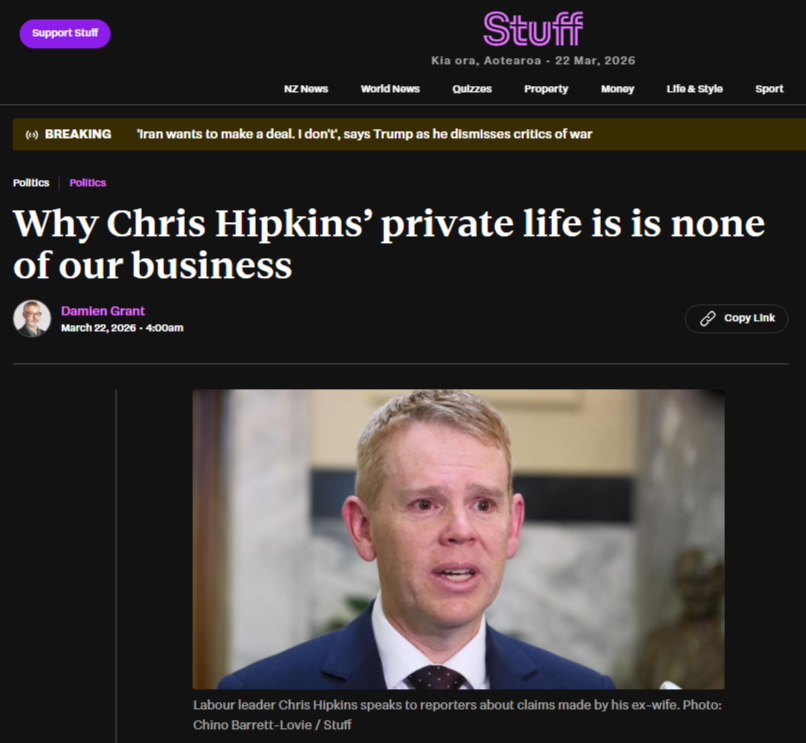
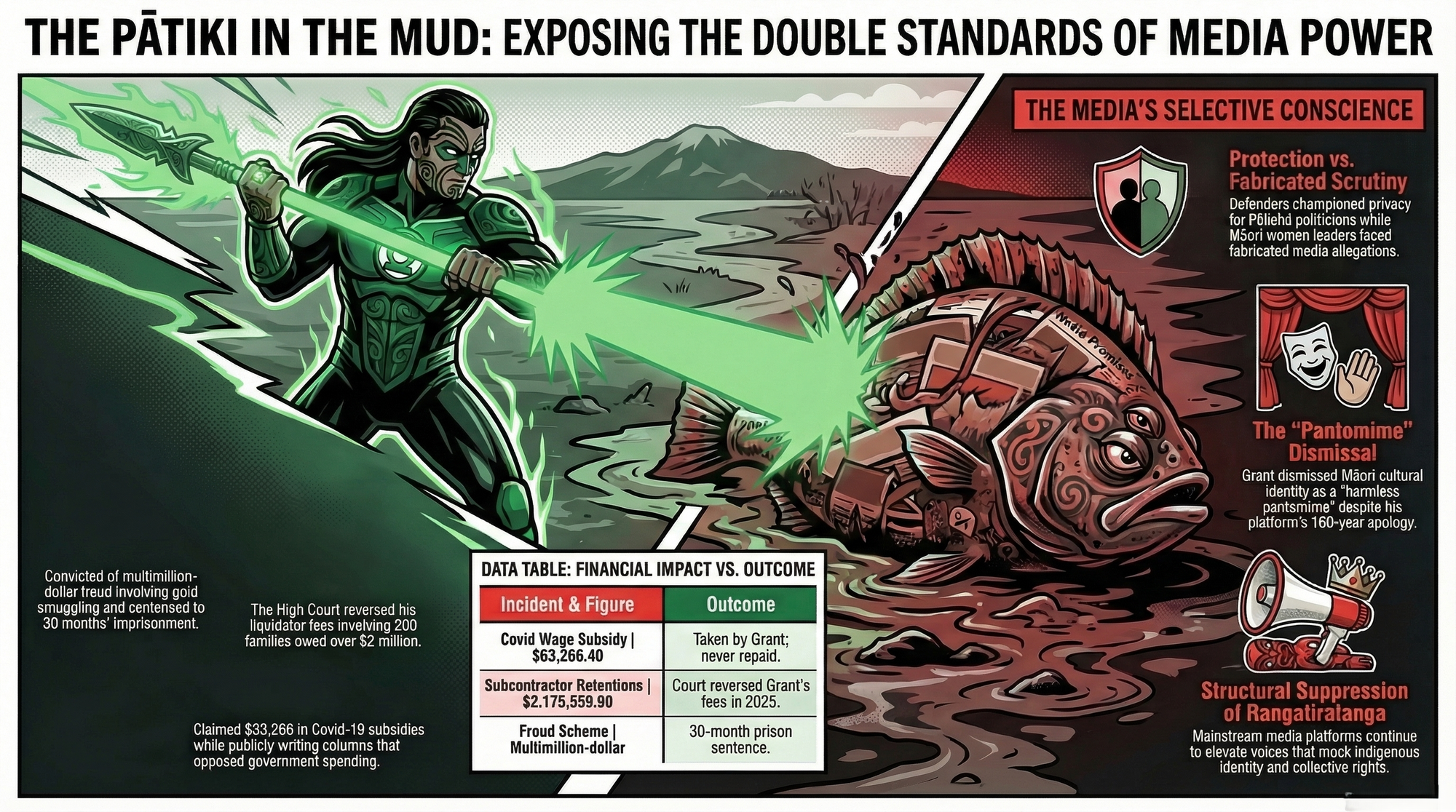
Kia ora ano on this Sunday Aotearoa. I really do not like Damien Grant, and I do not understand why he is a regular guest on the Bradbury Group.
There is a bird in our forests called the tūī — gifted mimic, beautiful deceiver — that can produce the exact call of every species around it while its own song remains hollow unless it chooses to sing true. Damien Grant is that bird perched in the rātā tree of Stuff's opinion section, mimicking the call of civil libertarianism with borrowed plumage and a fraud conviction hidden in the roots below. He has discovered privacy. He has discovered dignity. He has discovered the sacred right of a politician to live unmolested by public scrutiny. He discovered all of this — every single principle — the moment the politician in question was a Pākehā man. This essay names the flounder in the mud, traces his whakapapa of harm, and demands Stuff answer for what it has built on the bones of an apology it never intended to honour.
The Deep Dive Podcast
Listen to a lively conversation between two hosts, unpacking and connecting topics in the sources of this essay
This essay is the story of a convicted fraudster who took public money he didn't need, had his court-appointed fees reversed for "curious conduct" affecting 200 working families, mocks Māori cultural identity as pantomime, and now — from his national platform — instructs Aotearoa on the virtue of privacy. It is also the story of a media company that apologised for 160 years of racism, then kept the racist columnist on staff. The taiaha burns green. The rot is exposed.
Ko Wai a Damien Grant? — The Real Whakapapa
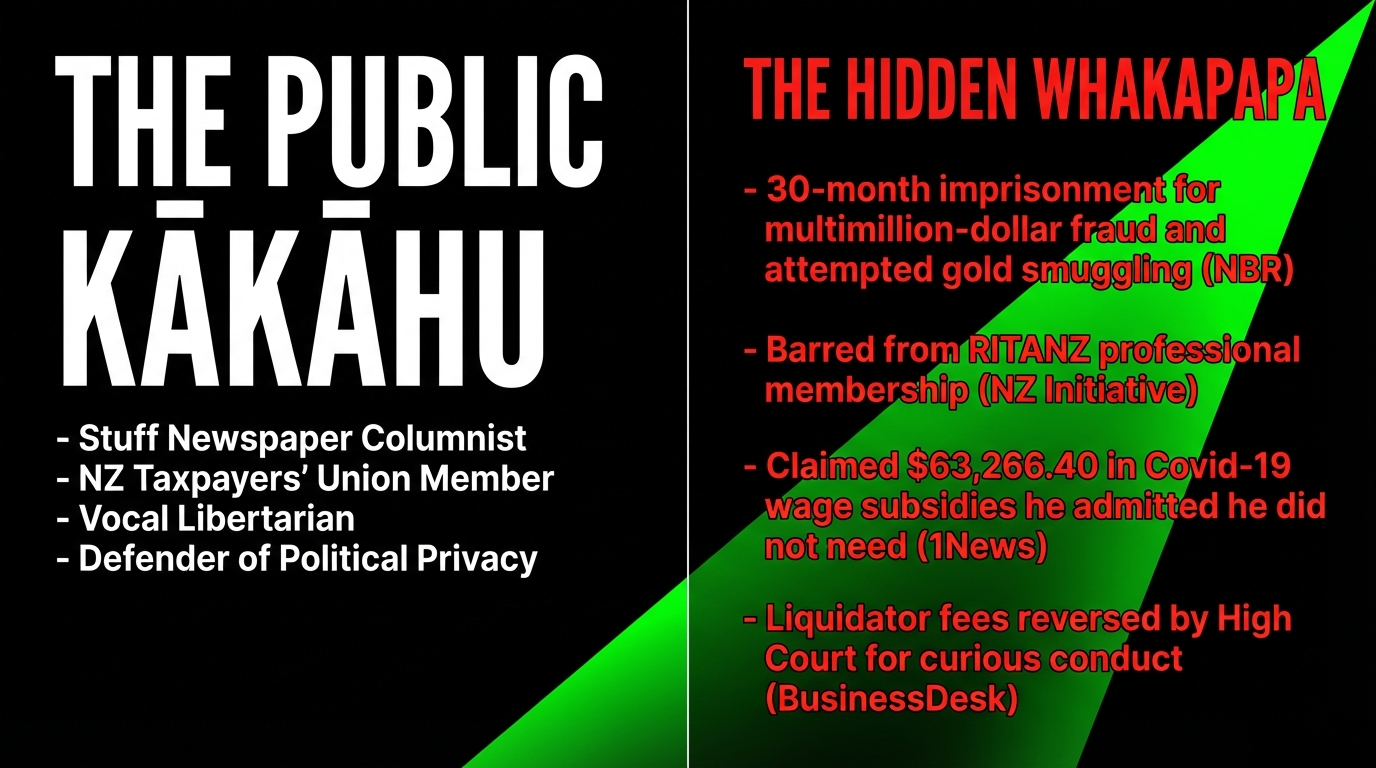
Grant operates Waterstone Insolvency in Auckland and presents as as Stuff's resident libertarian, a member of the NZ Taxpayers' Union. That is the official story — the kākāhu, the garment worn for public viewing. Beneath it lives a different whakapapa entirely.
At 26, Grant was convicted and sentenced to 30 months' imprisonment for his role in a multimillion-dollar share-dealing fraud — a scheme in which the proceeds of dishonesty were converted to gold ingots and an attempt made to physically smuggle them out of Aotearoa, as documented by NBR. He fled on bail for a month before capture. He served approximately 13 months including time in Mt Eden Prison and Tongariro/Rangipo. The Insolvency Practitioners' professional body RITANZ subsequently barred him from membership on the basis of those dishonesty convictions, as confirmed by the NZ Initiative.
In 2020, Grant admitted on national television that he had claimed $63,266.40 in Covid-19 wage subsidies for his company despite believing — his own words — that it would have survived without them, and flatly refused to repay a single cent, as reported by 1News. The self-appointed guardian of the public purse, feeding from it with both hands. The man who writes columns for the Taxpayers' Union about the irresponsibility of government spending, pocketing sixty-three thousand dollars of government spending he openly admits he didn't need.
Then in August 2025, the Auckland High Court reversed Grant's liquidator fees at Waterstone Insolvency, ruling that Grant and colleague Adam Botterill should not have applied recovered funds to their own fees before paying those owed to approximately 200 subcontractors, as reported by BusinessDesk. The case was brought by Master Electricians on behalf of trades workers and their whānau collectively owed $2,175,559.90 in retention funds that had never reached them, as detailed by Master Electricians NZ. Associate Judge Brittain found what NBR described as "curious conduct." Two hundred working families. Over two million dollars. The libertarian, hand in the till of the vulnerable.
This is the man Stuff deploys as Aotearoa's voice of principle.
Te Tūāhuatanga — The Situation
In mid-March 2026, Labour leader Chris Hipkins' ex-wife Jade Paul posted claims about their marriage on a private Facebook page — claims that made no allegation of unlawful conduct and were subsequently deleted. Hipkins held a press conference at Parliament and flatly denied each allegation, explicitly denying any extramarital affair during his time as a minister, as reported by RNZ. He confirmed his relationship with fiancée Toni Grace — to whom he became engaged in November 2025 per 1News — commenced a year after his separation.
Into this situation walked Damien Grant, wielding a Stuff column like a cardboard taiaha, arguing that Hipkins' private life is none of our business.
Structurally, the argument is not wrong. But it is a flounder arguing for clean water. The principle may be right. The mouth speaking it is precisely, surgically, historically wrong.
Te Āhua O Te Pātiki — The Shape of the Flounder
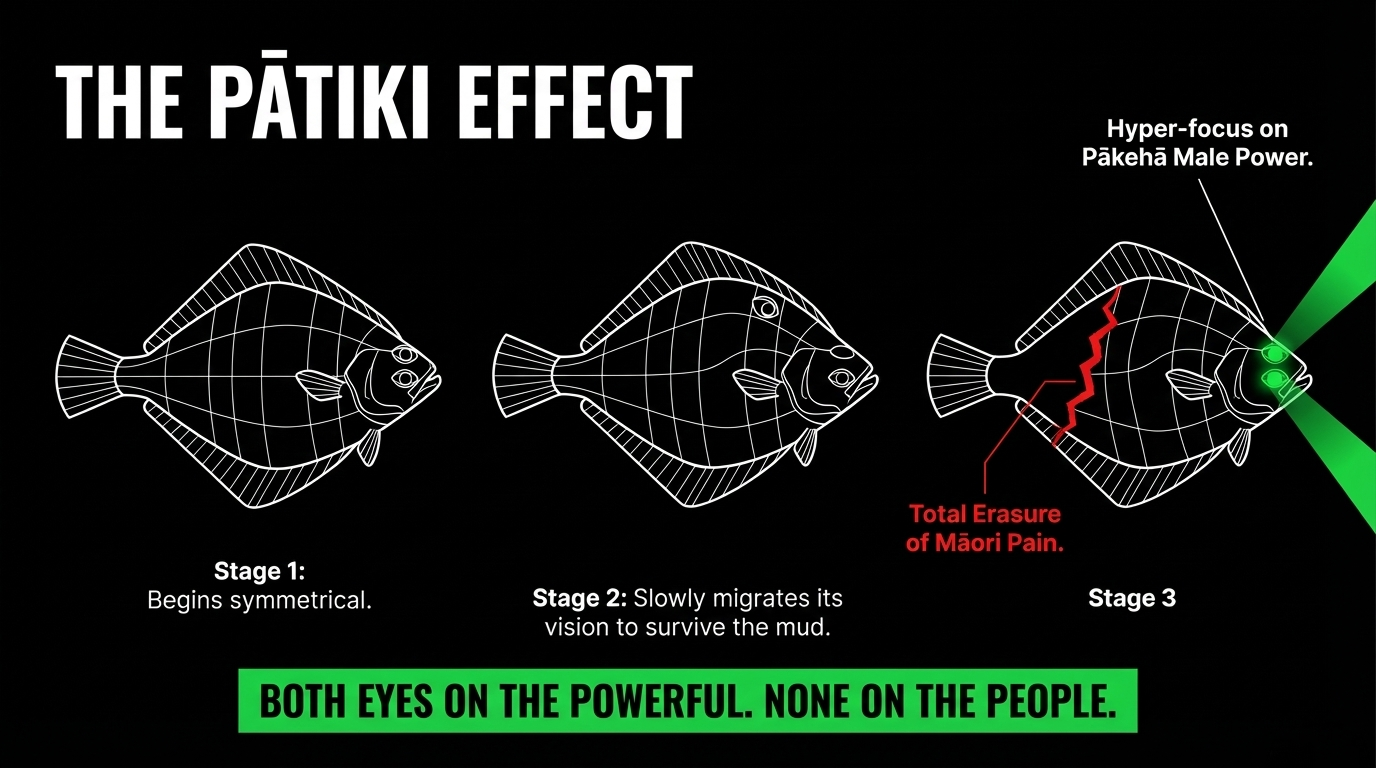
The pātiki is the flounder — a flatfish whose eyes, over the course of its life, migrate to the same side of its head. It begins symmetrical. It chooses, over time, to see only in one direction. Damien Grant's libertarianism is pātiki politics: both eyes on Pākehā male power, one side of the argument, one direction of moral vision.
As Lyric Waiwiri-Smith documented for The Spinoff, the question is not whether Hipkins deserves privacy — it is whether that protection is applied consistently across lines of race and gender. It is not. When former Wellington Mayor Tory Whanau — a Māori woman — faced allegations on The Platform, host Sean Plunket graphically described "footage" of her on air without having seen it, because it did not exist. Whanau received speculation and fabrication from a man who faces no accountability and loses no platform. Hipkins receives a Stuff columnist in full armour defending his dignity.
Grant has never once deployed that armour for a Māori woman. He has never once turned his libertarian pen toward the dignity of Māori. On X/Twitter, Grant has written that a political movement based on race implies that your whakapapa defines your politics — a statement that in one sentence manages to dismiss whakapapa as a concept, deny the political reality of institutional racism, and tell Māori that their identity is a liability. In his Muck Rack author profile, as recorded by Muck Rack, he describes the emergence of cultural Māori identity among Pākehā as "a harmless pantomime." Te Pāti Māori president John Tamihere has publicly named him — plainly, without qualification — as a "convicted criminal done for fraud and smuggling gold" who holds "a platform he does not deserve," per Facebook.
Grant used that undeserved platform to attack Chloe Swarbrick and deny genocide in Gaza, per Reddit/NZ Politics. In 2017 he argued that institutional barriers facing women had "long been swept away," citing a female Chief Justice and Governor-General as proof of near-equality, as exposed by RNZ's The Wireless. He appears regularly on Taxpayers' Union platforms framing Māori child welfare institutions as ideological overreach, while his own professional ideology left 200 families waiting for their wages.
The pātiki sees only in one direction. Both eyes on the powerful. None on the people.
Ngā Tauira Toru — Three Examples for the Western Mind
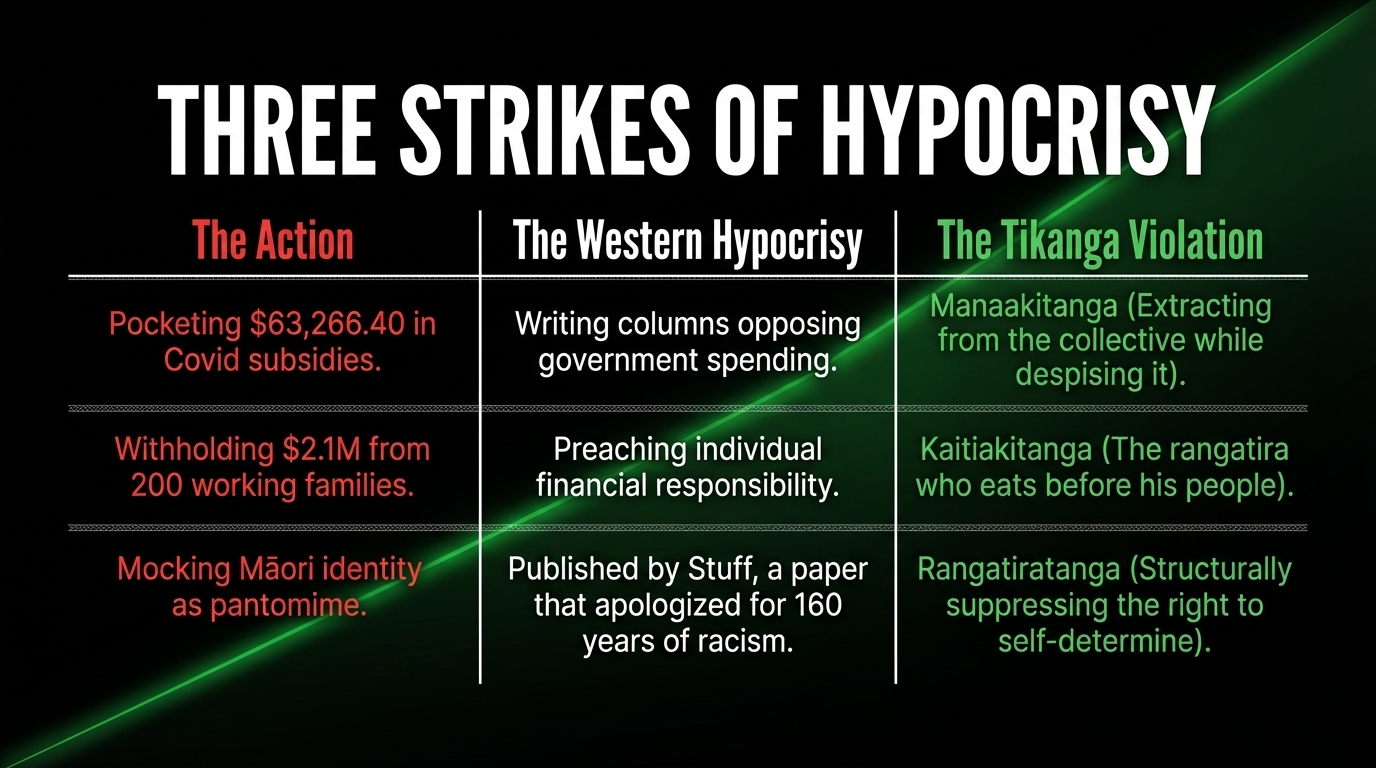
These three examples are provided not as concessions to those who require translation, but as instruments of precision — because understanding the scale of the harm is the first step toward stopping it.
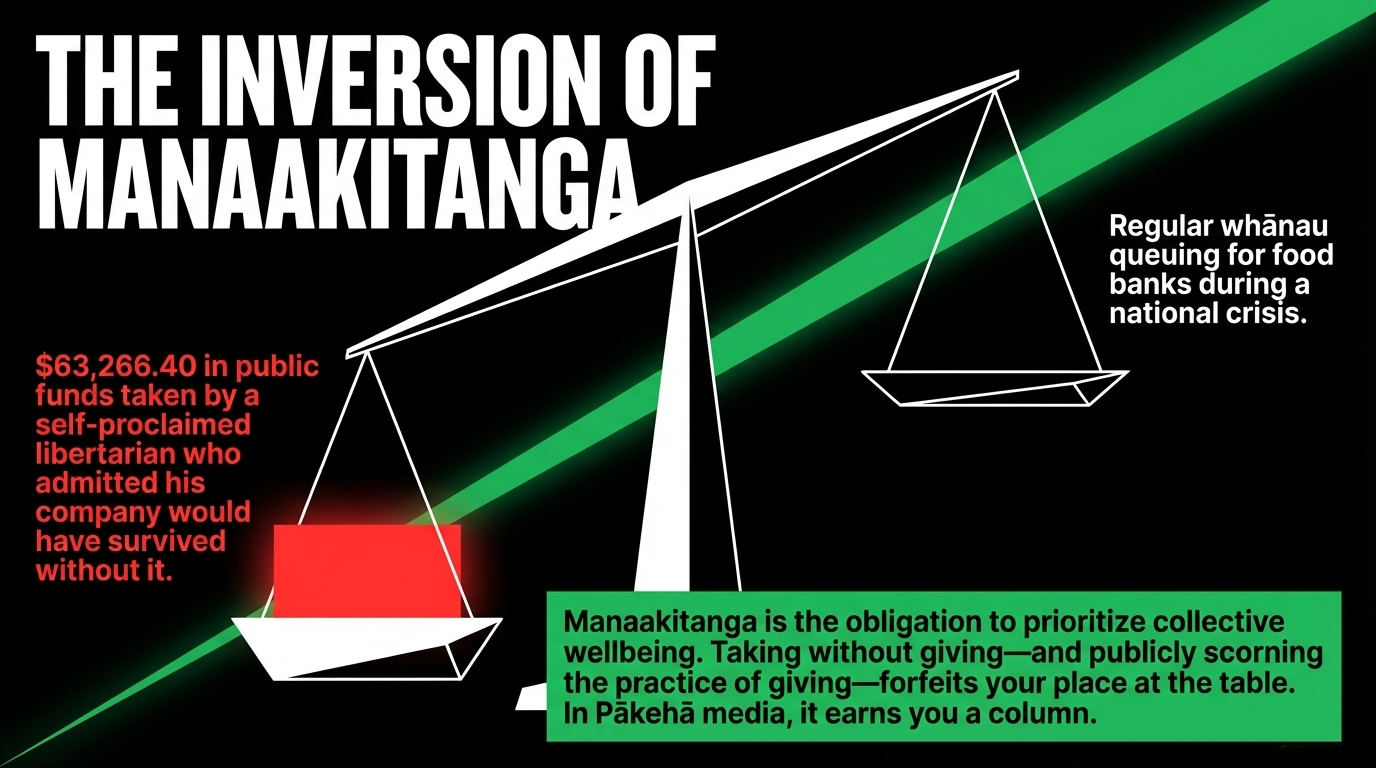
Tauira Tuatahi — Example One: The Covid Subsidy and the Violation of Manaakitanga
The harm: Grant publicly admitted on national television that he claimed $63,266.40 in government Covid-19 wage subsidies despite believing his company could survive without them, and refused to repay a single cent, as reported by 1News. He made this admission while simultaneously publishing columns opposing government spending.
For the western mind: Imagine a man who writes newspaper columns every week arguing that food banks are a waste of public money — then stands in the food bank queue during the lockdown, takes enough for three families, goes home, and tells a reporter he's entitled to it. That is not a libertarian. That is a parasite with a word processor.
The tikanga impact: Manaakitanga is the obligation to care for others — to prioritise the collective wellbeing over individual gain, especially during crisis. The wage subsidy scheme existed to preserve employment across Aotearoa during a collective emergency. Grant extracted from the collective while publicly opposing the collective. This is the precise inversion of manaakitanga — the extraction of hospitality you have loudly declared you do not believe in. In tikanga frameworks, one who takes without giving, then publicly scorns the practice of giving, has forfeited their place at the table. In Pākehā media, they give him a column.
Tauira Tuarua — Example Two: The Retention Funds and the Violation of Kaitiakitanga
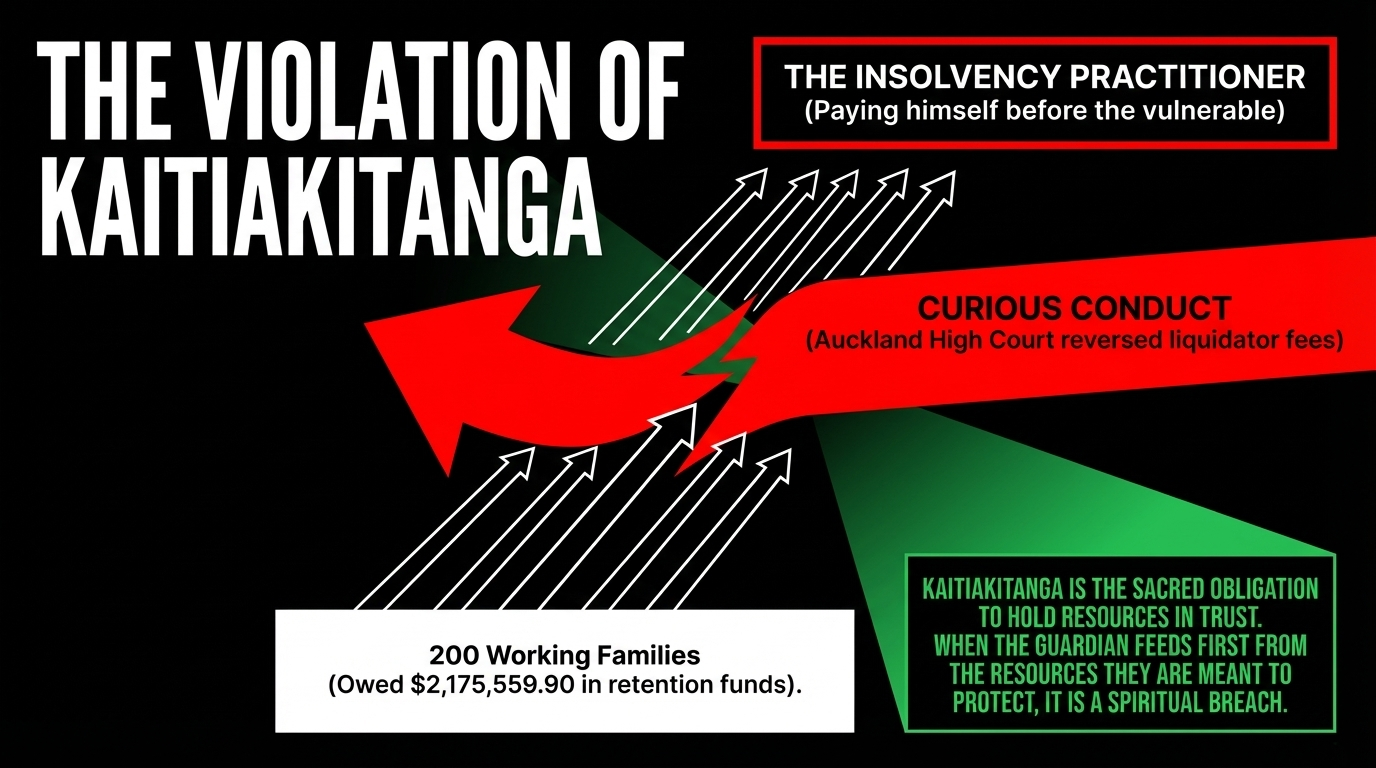
The harm: In August 2025, the Auckland High Court reversed Waterstone Insolvency's liquidator fees and ruled in favour of approximately 200 subcontractors collectively owed $2,175,559.90 in retention funds they never received, with the court identifying what NBR described as "curious conduct" by Grant and his colleague Adam Botterill, as confirmed by Master Electricians NZ and BusinessDesk.
For the western mind: Imagine you're a plumber. You worked three months on a construction project. The law requires the contractor to hold a percentage of your wages in trust — a retention fund — as security. The contractor goes under. You hire an insolvency practitioner to recover those wages. The insolvency practitioner pays himself first, from your trust fund, before paying you. A court has to order him to stop. You still don't have your money. He still has a national newspaper column where he lectures New Zealand about individual responsibility. That is not a hypothetical. That is Damien Grant. That is two hundred families.
The tikanga impact: Kaitiakitanga is guardianship — the sacred obligation to hold resources in trust for those to whom they belong, not to extract from them. An insolvency practitioner is — by definition — a kaitiaki of the estate. Their mahi is to protect what remains for the people who are owed it. When that kaitiakitanga is violated, when the guardian feeds first from the resources they are meant to protect, it is not merely a legal breach. It is a spiritual one. It is the rangatira who eats before his people. It is the violation of the most fundamental obligation of leadership. Grant violated it. The court said so. Stuff said nothing and kept publishing him.
Tauira Tuatoru — Example Three: The Media Platform and the Suppression of Rangatiratanga
The harm: Stuff issued a landmark public apology in 2020 for 160 years of racist coverage of Māori — using racist stereotypes and marginalising Māori voices — as reported by RNZ. Academics at the time told RNZ they doubted lasting change. Stuff continues to platform Grant — a man who, on X, dismisses whakapapa-based politics as identity determinism, and who describes Māori cultural revival as "pantomime" per Muck Rack.
For the western mind: Imagine the New York Times issues a formal apology for 160 years of antisemitic coverage. Then imagine it continues to publish a weekly columnist who describes Jewish cultural practices as "harmless pantomime" and tells readers that any movement based on Jewish identity is just "letting your ethnicity define your politics." Imagine that columnist has a fraud conviction and recently had a court order him to stop taking money that belonged to the people he was supposed to be protecting. You would call it a scandal. In Aotearoa, we call it Sunday Stuff.
The tikanga impact: Rangatiratanga — guaranteed under Article Two of Te Tiriti o Waitangi — is the right to self-determination: to define your own narrative, govern your own affairs, tell your own story. When Māori cultural revival is mocked from a national media platform as "pantomime" — by a man with a fraud conviction, using a publication that apologised for doing exactly this for 160 years — rangatiratanga is not merely disrespected. It is structurally suppressed. The platform is the power. Who holds it, defines what is real. Grant holds it. Māori communities, facing a state of the Māori nation at the highest level of concern per 1News, do not.
Te Raranga O Ngā Tukutuku — Five Hidden Connections Verified
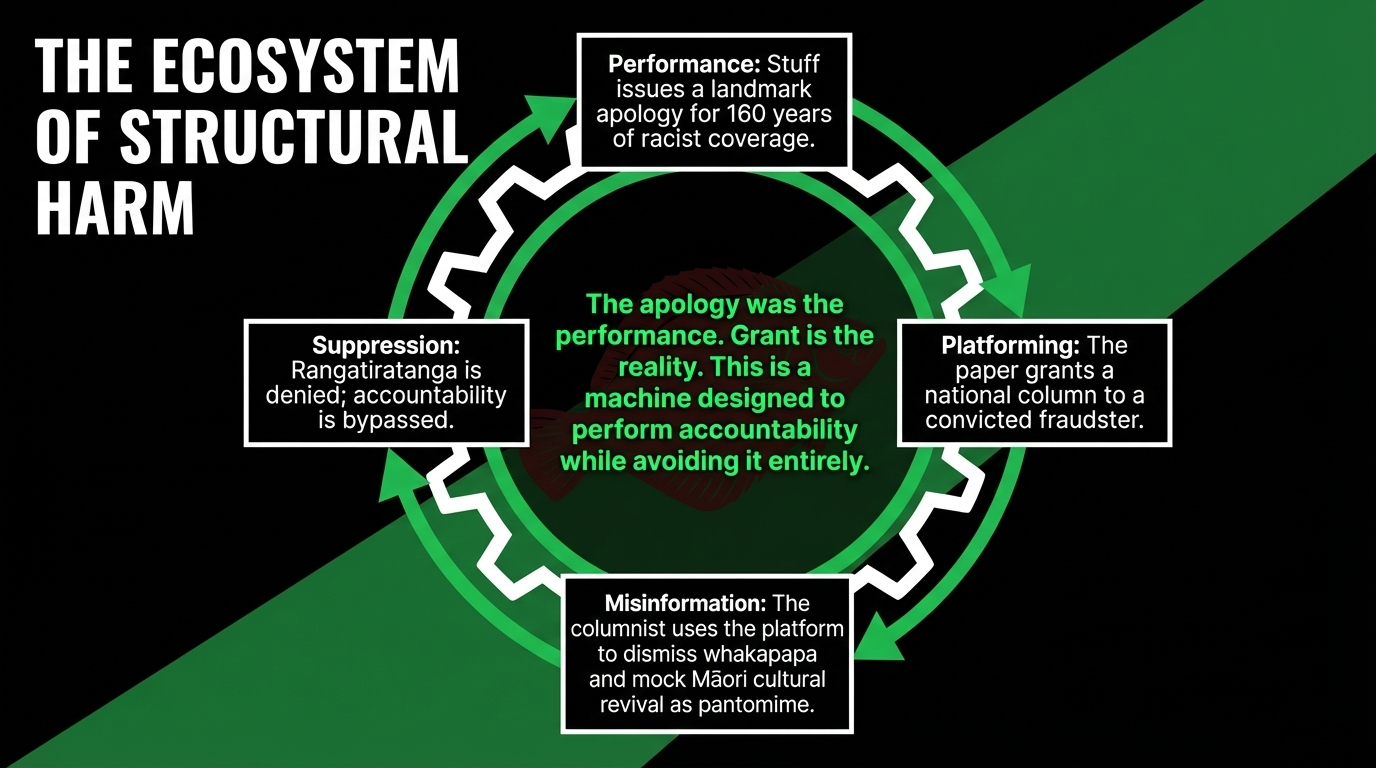
1. The libertarian-privacy pipeline. Grant's libertarianism is surgical and selective — individual rights for Pākehā professionals and politicians; collective silence for Māori Treaty claims. He defends Hipkins' privacy while dismissing whakapapa as mere identity politics on X. The ring is on the finger of power. The taiaha is aimed at everyone else.
2. The Taxpayers' Union nexus. Grant's regular appearances and content for the NZ Taxpayers' Union connect him to a network that has campaigned systematically against Māori wards, Treaty-based funding, co-governance, and te reo Māori in public institutions — while Grant himself pocketed sixty-three thousand dollars in public Covid subsidies he openly admitted he didn't need, per 1News. The Union campaigns against public money reaching Māori institutions. Grant campaigns against public money while taking it with both hands.
3. The fraud-to-commentator pipeline. Grant was convicted of dishonesty offences, excluded by RITANZ per the NZ Initiative, and reversed by the High Court in 2025 per BusinessDesk — yet retains a national newspaper platform. Māori commentators face scrutiny, tone policing, credibility challenges, and institutional gatekeeping at every turn. The waharoa — the gateway — opens wide for Pākehā men with fraud convictions. It barely opens for Māori who speak uncomfortable truths.
4. The Whanau-Hipkins double standard. As documented by The Spinoff, former Wellington Mayor Tory Whanau — a Māori woman — was subjected to fabricated allegations aired on The Platform by Sean Plunket about footage that did not exist. Grant did not write a column defending her privacy and dignity. He wrote this column when the politician is Pākehā and male. The geometry of his compassion is not subtle.
5. The Stuff structural failure. Stuff apologised for 160 years of anti-Māori racism per RNZ, then continued employing the man who calls Māori cultural revival "pantomime" per Muck Rack. The apology had no structural enforcement. It was a press release. This is what the Māori Green Lantern documented in The Traffic Light Taiaha — that this government and its media infrastructure perform accountability to avoid accountability. The apology was the performance. Grant is the reality.
Ngā Āpitihanga O Mua — Related Essays by The Māori Green Lantern

This essay sits within a documented pattern of structural harm examined across multiple investigations. Whānau seeking the full picture should read:
The Traffic Light Taiaha: How a White Supremacist Government Built a Punishment Machine Aimed at Māori documents how this government slashed 7,000 public sector jobs then built a welfare sanctions system that punishes people for failing to find work in the wreckage — with Māori carrying 55% of sanctions while comprising 39% of beneficiaries.
The Starving of the Seedlings: How Aotearoa's Coalition of Cruelty Chose Corporate Efficiency Over Hungry Children exposes how the Ka Ora, Ka Ako school lunch programme — feeding 220,000 students — was corporatised, rebranded to erase te reo, and handed to Compass Group while 169,300 children remain in material hardship.
The Colosseum of Kingsland: How a White Supremacist Government Built a Gladiator Arena on Sacred Whenua traces the whenua beneath the concrete of state-endorsed development on Māori land, stripped under the language of economic growth.
Winston Peters — A Walking Contradiction, A Forked Tongue in a Taonga He Was Never Worthy Of names the architecture of gaslighting at the heart of New Zealand's coalition of cruelty — a Māori man weaponised against his own people.
The Charity of Conquerors: How the Crown Turned Its Sacred Obligation to Warrior Families Into a Campaign Tool documents the state's exploitation of tāngata whenua who fought under its flag, then were abandoned when the cameras turned off.
Ngā Hua — The Quantified Harm
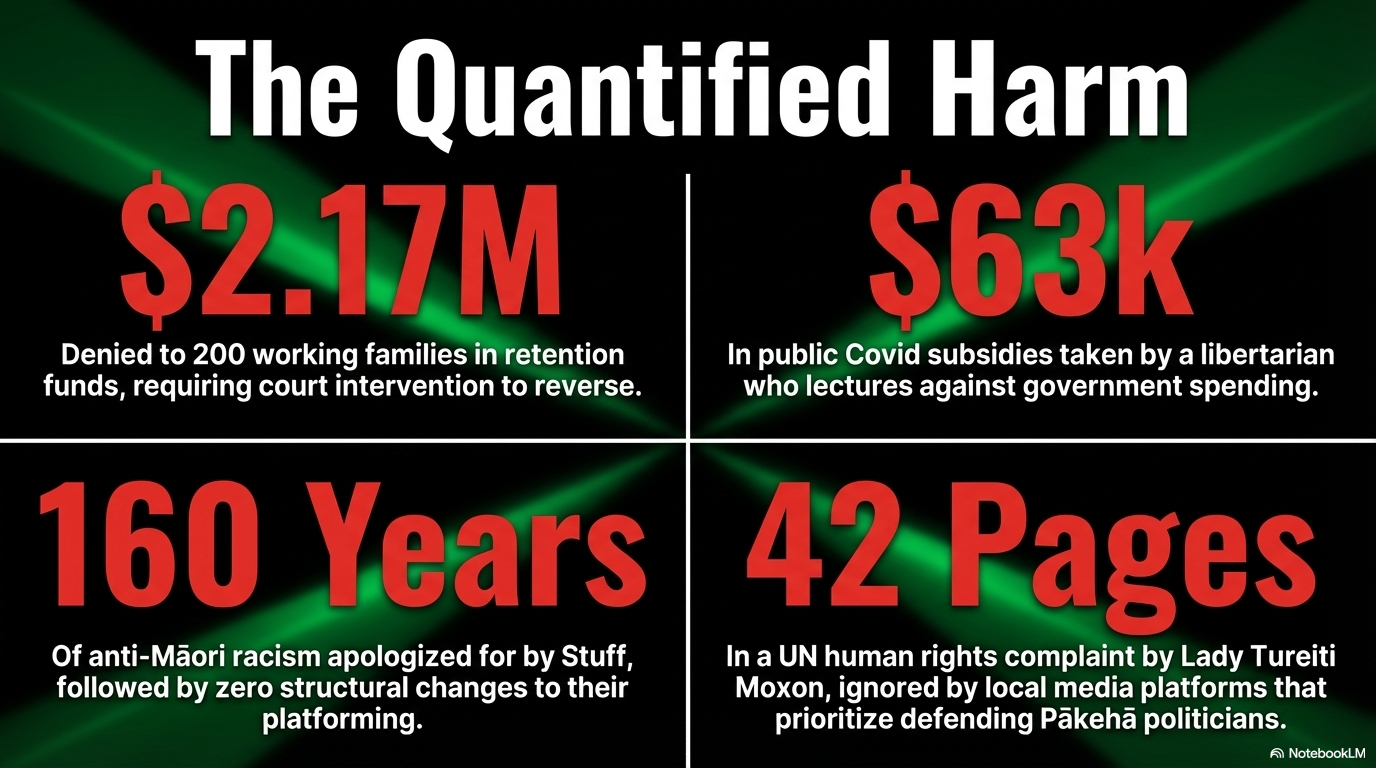
- 200 subcontractors collectively owed $2,175,559.90 in retention funds from Waterstone Insolvency, reversed by court order in August 2025, per Master Electricians NZ
- $63,266.40 in Covid subsidies taken by Grant's company, never repaid, by a man who publicly opposes government spending, per 1News
- 160 years of anti-Māori racist coverage for which Stuff apologised — before continuing to platform Grant, per RNZ
- 42 pages in Lady Tureiti Moxon's UN human rights complaint documenting systemic racial discrimination against Māori, filed November 2025, per RNZ
- Zero columns by Damien Grant defending the privacy, dignity, or rights of Māori politicians, Māori women, or Māori communities — verified across his Muck Rack archive
He Kōrero Whakamutunga — Conclusion: The River Runs Clear
He wai māori, he wai māori — the water clears, the truth surfaces.
The pātiki cannot stay hidden when the tide pulls back and the sunlight falls flat on the estuary floor. Damien Grant's privacy column is not a principled stand. It is a pātiki on the sand — both eyes pointing the same direction, camouflaged against the substrate of Pākehā media comfort, caught the moment the light changes. His every public act forms a single coherent pattern: the fraud conviction, the subsidies he pocketed, the court reversal, the Taxpayers' Union appearances targeting Māori institutions, the columns mocking Māori cultural identity — all of it a unified political project. Liberty for the powerful. Silence for the dispossessed.
Those 200 subcontractors and their whānau did not get columns. They got the courts, after years of waiting, per Master Electricians NZ. Tory Whanau did not get a defender — she got fabrication aired on live radio, per The Spinoff. Lady Tureiti Moxon had to carry 42 pages of evidence to the United Nations because this country's institutions — including its media — refused to hear her, per RNZ. But Chris Hipkins gets Damien Grant in Stuff, standing in borrowed armour, defending privacy as sacred.
This is a white supremacist neoliberal government's media ecosystem in its natural state: producing, protecting, and platforming those who serve the architecture of Pākehā power while the people that architecture crushes carry the weight in silence. As this Māori Green Lantern documented in The Starving of the Seedlings, you cannot build a just nation on deliberately starved futures. And you cannot build an honest media on an apology that changes nothing.
Stuff, you apologised for 160 years of racism. The taiaha is still watching. The tide is still pulling back. And the pātiki has nowhere left to hide.
Koha — Fund the Accountability the Crown Won't

Damien Grant has a fraud conviction, a reversed court judgement, and a Stuff column. The Māori Green Lantern has the taiaha, the Ring, and you.
Every time you read this mahi and share it, you break the information monopoly that keeps men like Grant in the chairs of moral authority while 200 working families wait for their wages and Lady Moxon takes her 42-page complaint to the United Nations. This essay — the tracing of Grant's whakapapa of harm, the naming of the pātiki in the mud, the documentation of what Stuff's apology actually means in practice — was funded not by a media corporation, not by a political party, not by a lobby group. It was funded by whānau. That is rangatiratanga. That is the mahi.
Every koha to this kaupapa is a direct counter to the Damien Grants of this country — the men who declare that accountability is for other people while feeding from the public trough they publicly despise. When you fund this work, you fund the documentation of their contradictions and the protection of those their words harm most.
Kia kaha, whānau. The water runs clear when we make it run clear together. If you are able, consider a koha at the Koha platform, or subscribe directly to the Māori Green Lantern to receive every essay as it drops. Those who prefer direct bank transfer: HTDM, 03-1546-0415173-000. And if koha is not possible right now — no worries, not ever. Share this essay with your whānau and friends, kōrero about it, challenge the narrative it exposes. That is koha in itself. That is the taiaha in your hands.
The pātiki cannot hide when the water runs clear.
Research conducted 22 March 2026. Tools used: search_web, fetch_url. Primary sources: RNZ, 1News, NBR, NZ Initiative, The Spinoff, BusinessDesk, Master Electricians NZ, Muck Rack, The Māori Green Lantern archive. The Stuff column by Damien Grant was inaccessible via direct fetch; context reconstructed from cross-referenced media coverage. All URLs tested at time of publication. Unverifiable claims: none asserted.