"Hypocrisy of the Highest Order: The National Government's EV Charger Con" - 23 March 2026
This is an incompetent Goverment that needs to be "assed out"

Kia ora ano Whānau,
Listen.
I've created nearly 1000 essays over the last 2 years, on this asshole of a government . I'm pretty sure that if any reasonable Kiwi read any of them, they would agree too. We need these stink bums outta here!
The Deep Dive Podcast
Listen to a lively conversation between two hosts, unpacking and connecting topics in the sources of this essay
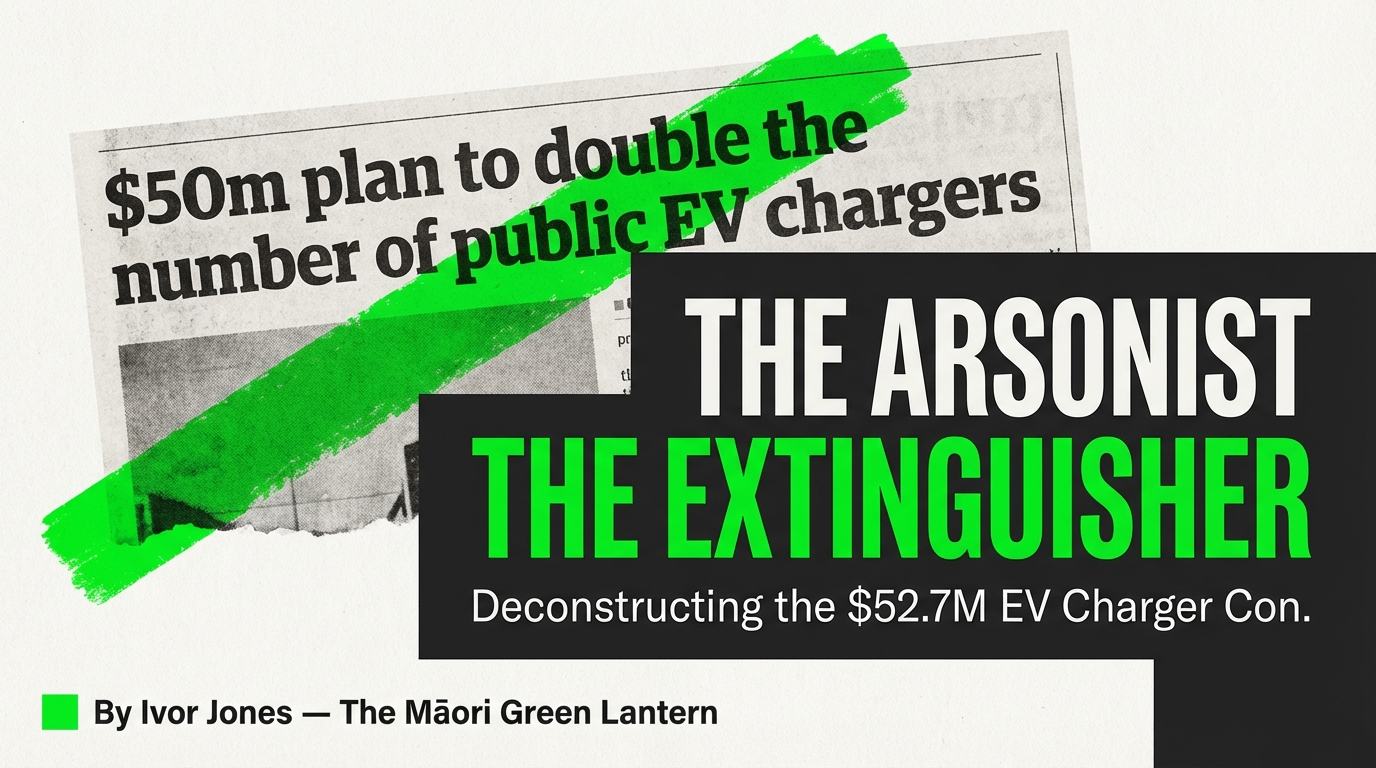
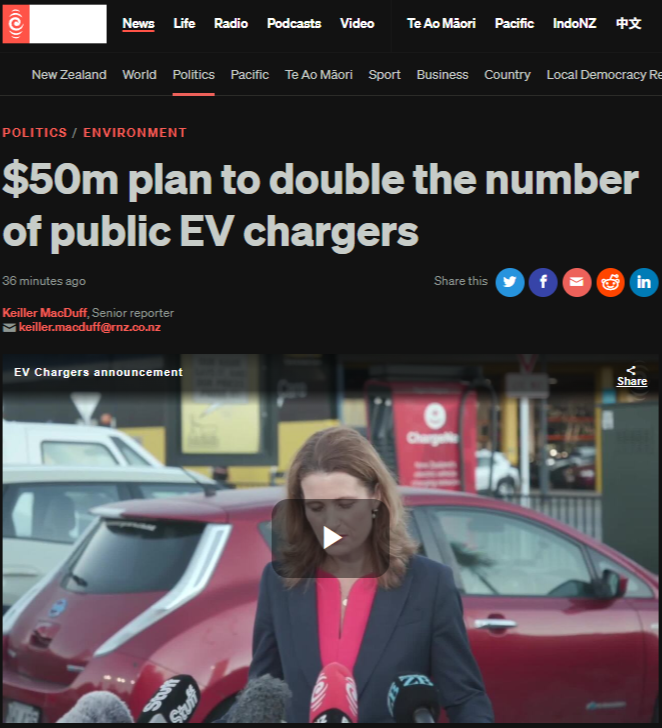
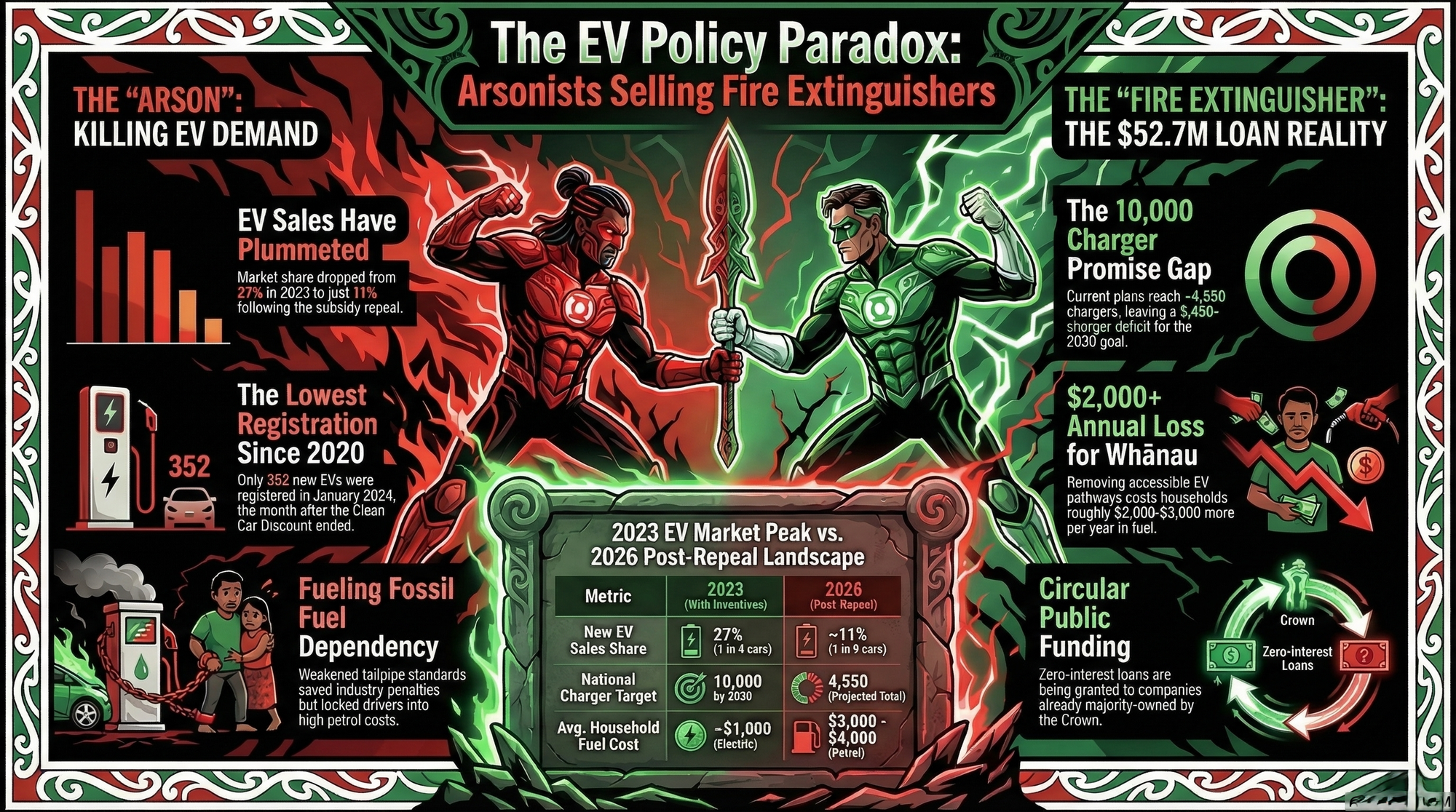
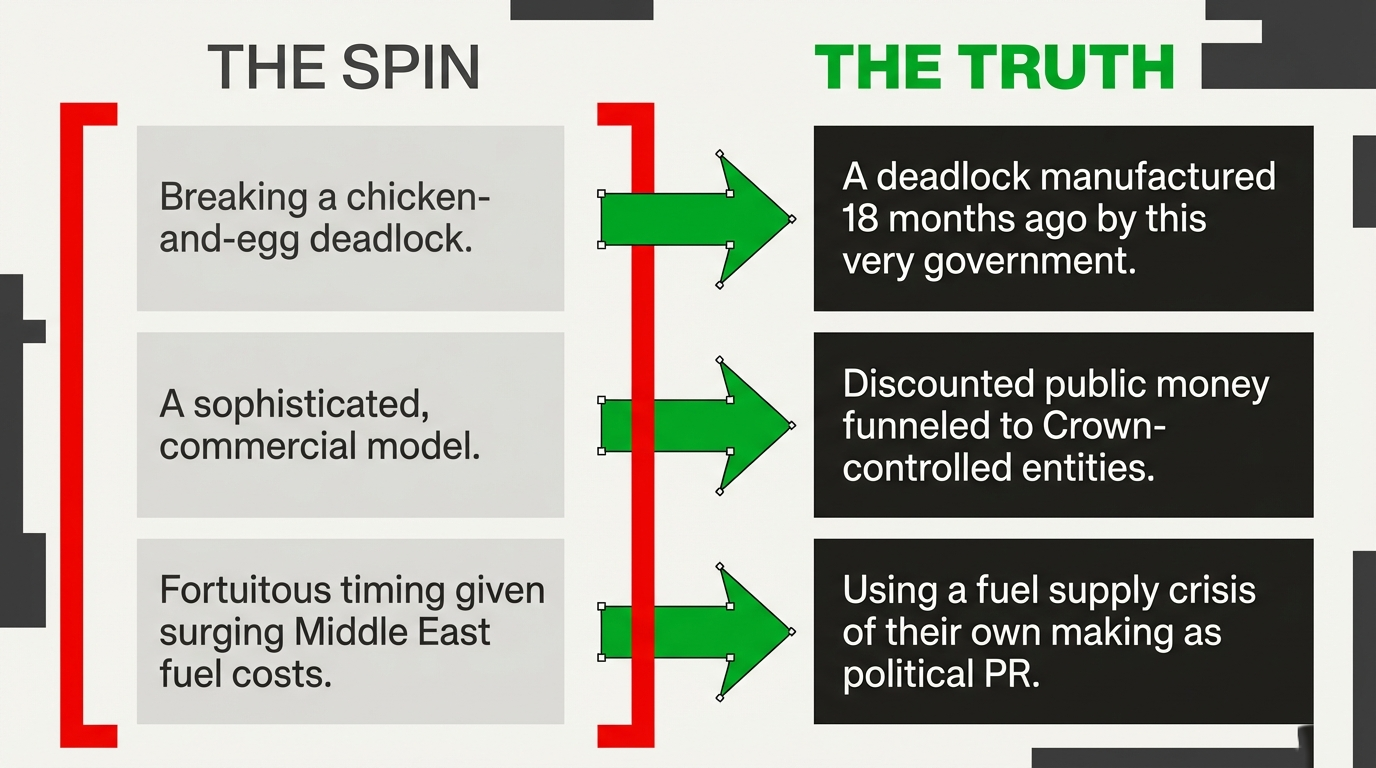
Transport Minister Chris Bishop stood before the cameras this week and announced a $52.7 million zero-interest loan scheme to double New Zealand's public EV chargers. He called the timing "fortuitous." He called it "sophisticated." He called it a chicken-and-egg solution.
He did not call it what it actually is: the government pouring water on a fire it deliberately lit.
This is not policy. This is the arsonist selling fire extinguishers.
Te Hītori: What This Government Actually Did
To understand the hypocrisy, you need the timeline. Hold it in your hands like a taiaha. Feel the weight of it.
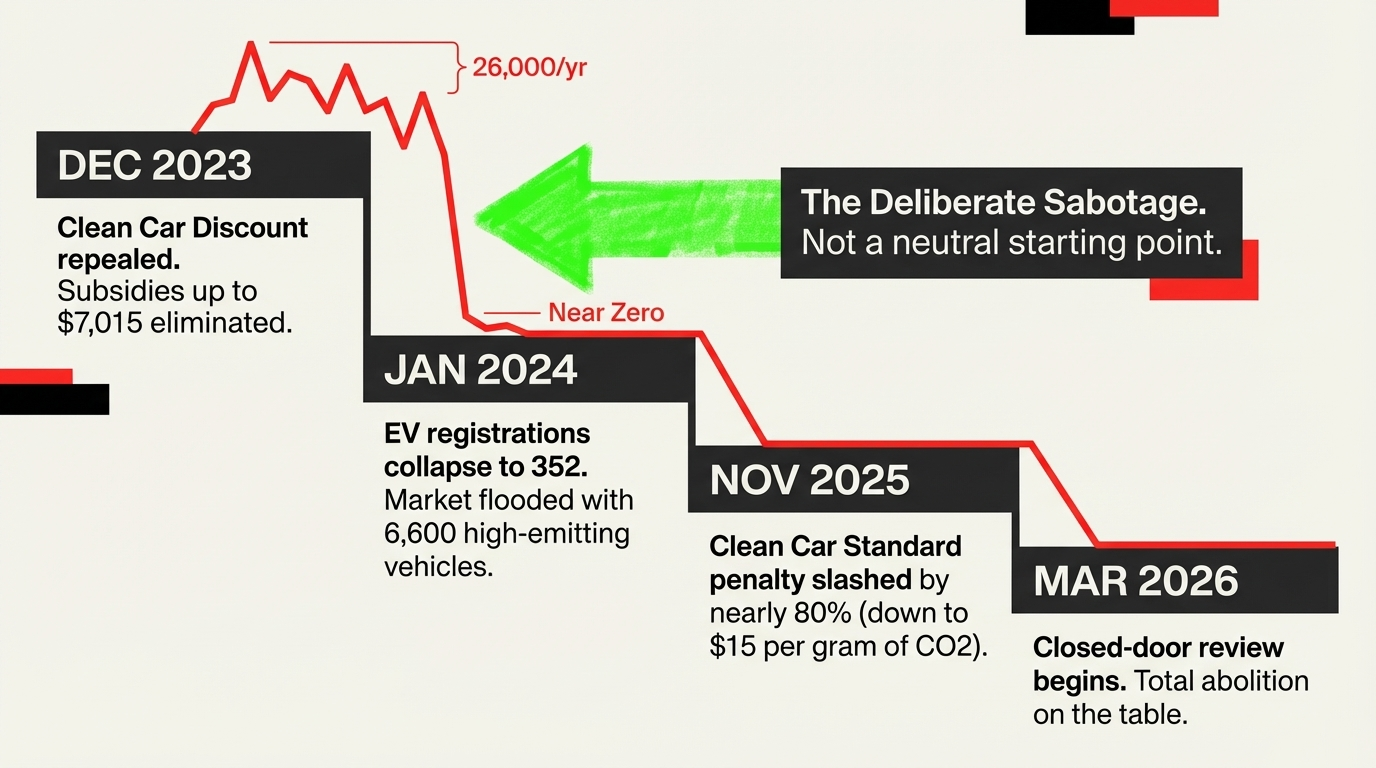
December 13, 2023. Thirteen days into office. Before most public servants had unpacked their boxes. The new National-ACT-NZ First coalition passed legislation repealing the Clean Car Discount — a scheme that gave rebates of up to $7,015 on low-emission vehicle imports, funded by fees on high-emitting vehicles like utes. It was item #13 on Luxon's 49-point 100-day plan, a campaign promise to farmers and ute drivers. It passed with votes from National, ACT, and NZ First. Labour, the Greens, and Te Pāti Māori all opposed it.
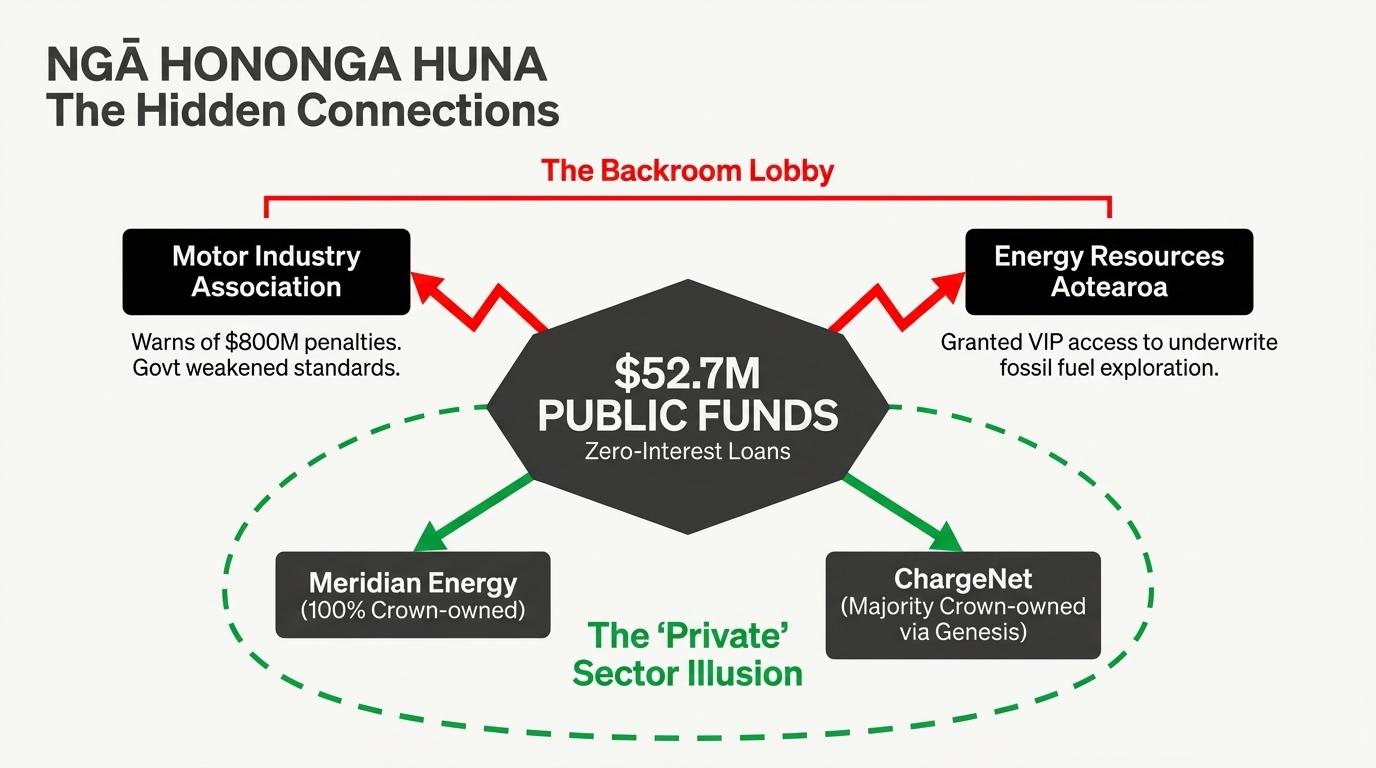
The Clean Car Discount had put 192,000 low-emission vehicles on New Zealand roads. It had transformed NZ from one of the world's worst markets for importing dirty vehicles to one of the best. In 2023 — the last year of the scheme — EVs had a 10 percent market share, with 26,000 sold. One in four new car sales, matching the global average.
January 2024. The month after repeal: 352 new EVs registered. Not 3,520. Three hundred and fifty-two. The lowest since October 2020. Meanwhile, approximately 6,600 very-high-emitting vehicles were registered that same month — nearly double the usual figure. High-polluting cars flooded back in the moment the fees evaporated.
By September 2025, BEVs held just 5 percent of new vehicle market share — a near-total collapse. Meanwhile, Australia hit 20%. China hit 50%. The global average stayed at 25%.
November 2025. The government slashed the Clean Car Standard by nearly 80 percent — the standard that penalised importers for bringing in dirty vehicles. The penalty dropped from $67.50 to $15 per gram of CO₂. EV advocates warned New Zealand would become a dumping ground for high-emission cars that Australia and Europe no longer want. Drive Electric chair Kirsten Corson called it "really disappointing" and "embarrassing."
March 2026. The government is now actively considering scrapping the entire Clean Car Standard — a full first-principles review with abolition explicitly on the table. It was conducted without public consultation, behind closed doors.
And now — this week — the same government announces $52.7M in loans to build EV chargers and tells us the timing is "fortuitous."
Ka whawhai tonu mātou. We will not stop fighting.
Ngā Hononga Huna: The Hidden Connections
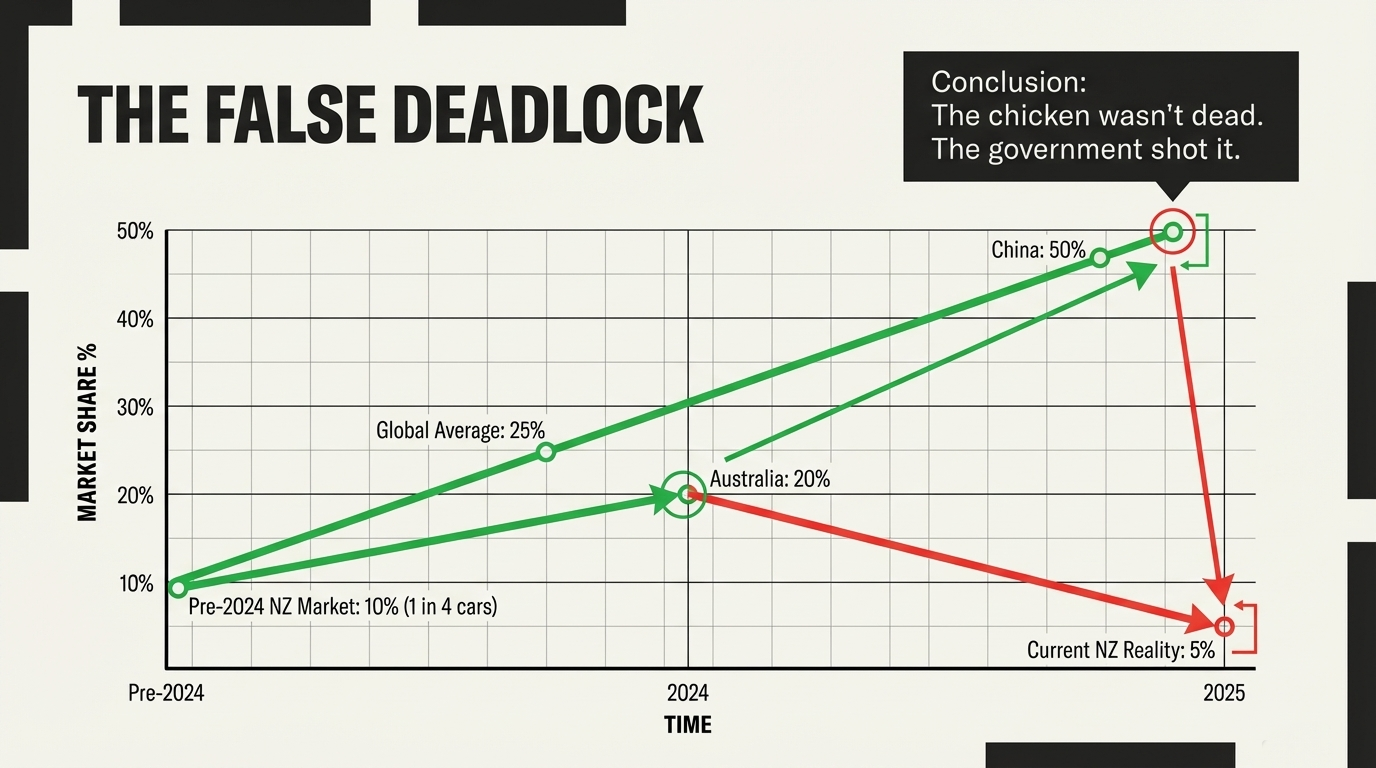
The taiaha cuts both ways. Let us trace what the Ring reveals.
Connection 1: The Beneficiaries Are Insiders
The two companies receiving these zero-interest public loans are ChargeNet and Meridian Energy.
Meridian Energy is a fully state-owned enterprise — the Crown is already giving an interest-free loan to its own company. The New Zealand taxpayer is subsidising the New Zealand government's own entity at below-market rates. In what universe is this "a more commercial model," as Bishop claims?
ChargeNet is 65% owned by Genesis Energy, which paid $64 million for that stake in October 2024. Genesis Energy itself is a listed company with the New Zealand Crown as a majority shareholder. So the government is giving a concessionary loan to an entity majority-owned by another entity it majority-owns.
This is not the private sector breaking a market deadlock. This is the government giving discounted public money to companies it already controls, then taking credit for "private sector investment."
Connection 2: The Car Industry Lobby Pulled the Strings
Internal documents obtained by RNZ under the Official Information Act revealed that then-Transport Minister Simeon Brown pushed ahead with weakened tailpipe standards specifically to meet the car industry's preferred deadline — against the advice of his own officials, who wanted more time for Cabinet consideration. Environment officials tried at the last minute to warn Cabinet the changes risked blowing New Zealand's climate targets. They were told they were too late to get their advice into the Cabinet paper.
The Motor Industry Association had told the government that without weakening the standard, importers would face $800 million in penalties — because EV sales had collapsed so badly after the government's own removal of the Clean Car Discount that importers were running out of the surplus EV credits they needed to offset their ute imports. The government created the problem, then weakened the law to solve it for the industry.
Chief forecaster at Infometrics Gareth Kiernan confirmed the Clean Car Discount had a substantial positive effect on EV sales. The government's own removal of the discount caused the collapse. Then the industry lobbied to weaken standards that the government had to weaken because of that collapse. A circular firing squad — and the climate paid the price.
Connection 3: The Fossil Fuel Industry Got VIP Access While the Public Was Locked Out
While the Clean Car Standard review excluded the public, RNZ revealed that fossil fuel companies were given privileged, insider access to confidential drafts of legislation during a two-year campaign to weaken oil and gas regulation. Resources Minister Shane Jones facilitated this access.
The oil and gas lobby — Energy Resources Aotearoa — asked the government to underwrite fossil fuel exploration, essentially requesting the Crown de-risk private investment in new petroleum fields. The same government now offering zero-interest loans for EV chargers was simultaneously being lobbied to provide taxpayer-backed guarantees for oil and gas exploration. Jones' response "suggested the government had not ruled out some form of intervention." This is the same government that reversed Labour's 2018 ban on new offshore oil and gas exploration permits.
They blocked drive for clean transport. They opened the door for more fossil fuels. Now, with the Strait of Hormuz squeezed by the Iran conflict and fuel prices spiking across New Zealand, they announce EV charger loans and call it "fortuitous."
Connection 4: The Promise Gap Is a Chasm
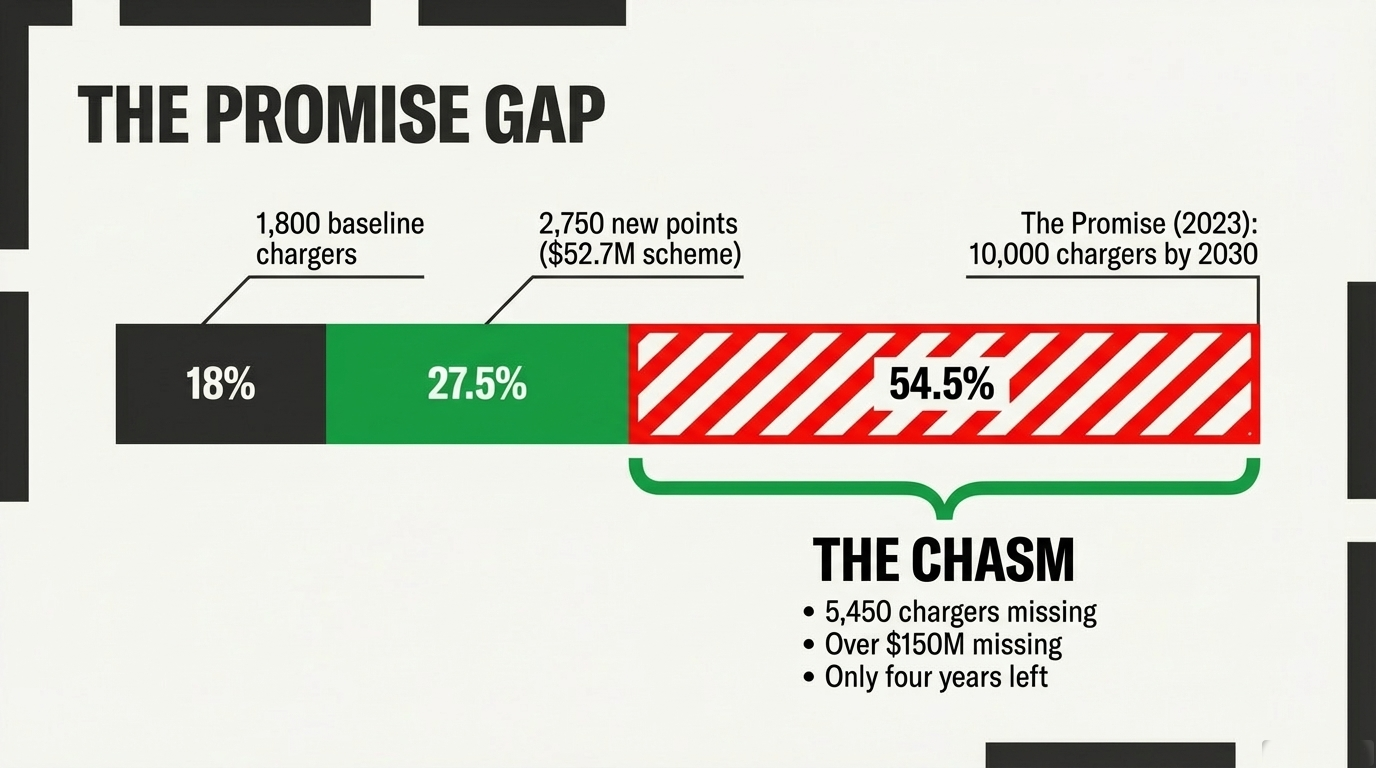
National promised 10,000 EV chargers by 2030 if elected. We currently have around 1,800. This $52.7M scheme will take us to roughly 4,550.
Drive Electric chair Kirsten Corson said the government had previously promised more than $200M for fast chargers — this project accounts for only $52M of that. She called achieving 10,000 chargers by 2030 "very unlikely." Bishop himself admits the target is "ambitious" and would "require additional Crown investment" yet to be budgeted.
In other words: they killed EV demand, they're not going to meet their charger promise, and they're using a fuel supply crisis of their own making as a PR moment.
Connection 5: The Timing is Political Cover, Not Climate Action
Bishop said the timing of this announcement was "fortuitous" given surging fuel costs from the Middle East conflict. But this is not climate leadership — it's crisis management. The Clean Car Discount, if still in place, would have meant hundreds of thousands more New Zealanders already in EVs and already insulated from petrol price spikes. The government's own decision in December 2023 left New Zealanders vulnerable to exactly this kind of fossil fuel shock.
The government's own fiscal review from 2024 shows they saved just $10M by scrapping the Clean Vehicle Discount — a rounding error — while the societal costs of locking hundreds of thousands more people into fossil fuel dependency grows by the week.
Ko Wai Ngā Kaiwhara: Who Gets Hurt
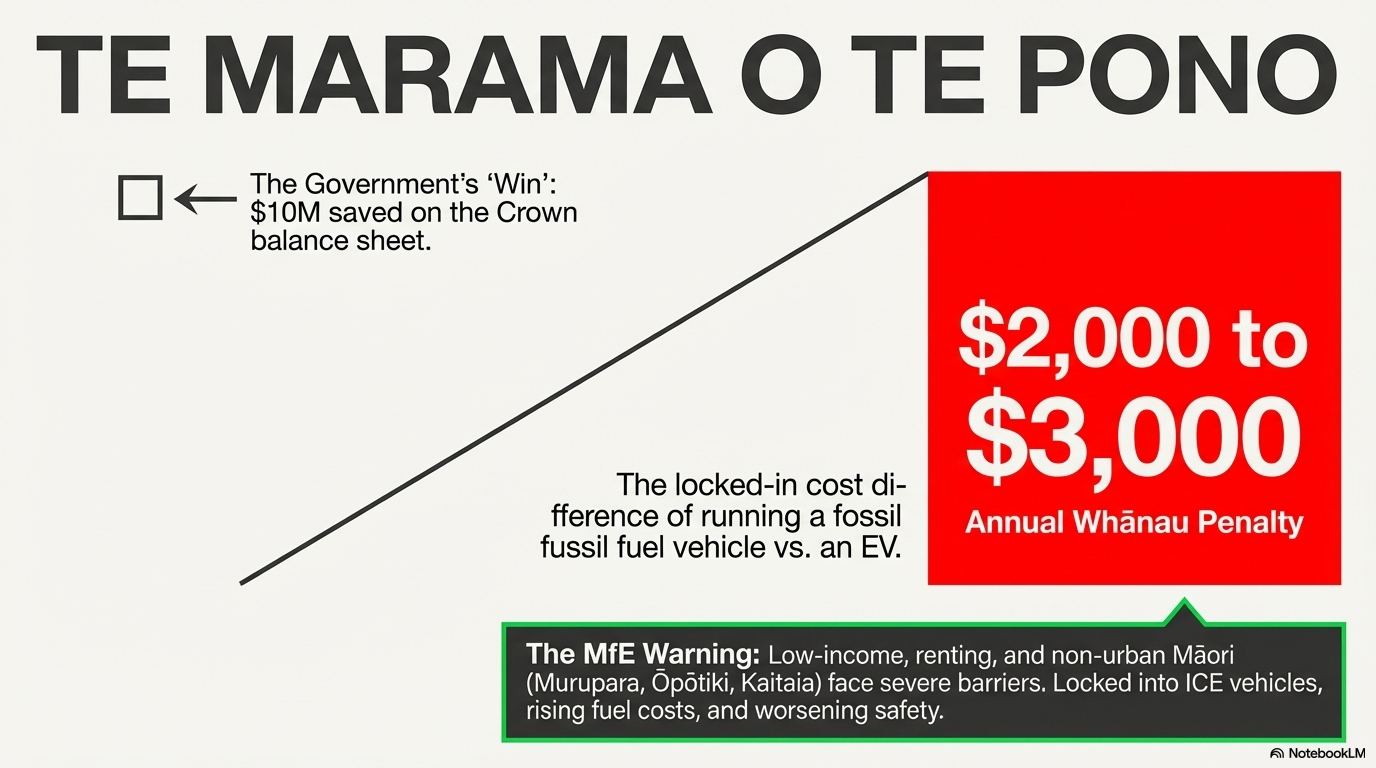
This is not an abstract policy debate. There are human beings — many of them our whānau — absorbing the consequences.
Ministry for the Environment's own research confirmed that low-income, renting, and non-urban Māori face "significant barriers to EV uptake, potentially locking them in to using ICE vehicles — made worse by predicted fuel price increases, worsening safety, increased incarceration risk, and rising emissions as vehicles age." The researchers identified that Māori households with strong reliance on private cars for transport — because public transport doesn't reach their communities — are at particular risk of being locked into fossil fuel costs.
The average household spends $3,000 to $4,000 a year on petrol or diesel. Electrification would cost around $1,000 a year. That $2,000-$3,000 difference is not an abstraction for a whānau in Murupara, Ōpōtiki, or Kaitaia. It's the difference between keeping the power on and not.
When this government killed the Clean Car Discount, it slammed the door on the most accessible pathway for working Māori whānau to escape fossil fuel dependency. The window to buy a subsidised Nissan Leaf for $5,000 closed at midnight on December 31, 2023. The fuel price spike that followed was not a surprise. It was a predictable, predicted consequence.
Māori, Pacific, and low-income groups face greater adverse health impacts from climate change — and they face greater economic impacts from the fossil fuel dependency that climate policy is meant to address. This government delivered both harms simultaneously: accelerating climate failure while locking our whānau into fossil fuel costs.
Te Tūāhuatanga: The Fallacy Named
The government's narrative relies on a core logical fallacy: the false premise of a neutral starting point.
Bishop frames this EV charger scheme as breaking a "chicken-and-egg" deadlock — charger companies won't invest without EVs, buyers won't buy EVs without chargers. But this "deadlock" did not exist eighteen months ago. The Clean Car Discount was driving demand up sharply. EV sales were at 10-27% of the market. The infrastructure was building to match.
The government shot the chicken, killed the egg, then announced a hen-house and called it innovation.
The Automobile Association's own spokesperson said the Clean Car Discount had "rapidly increased the number of low-emissions vehicles on our roads, normalised them for buyers, and attracted more manufacturers to the New Zealand market." Independent economist research confirmed it. The market was working.
Calling this week's announcement "sophisticated" does not make it sophisticated. Calling a problem you created a "chicken-and-egg deadlock" does not make it one.
He Kupu Whakakapi: Rangatiratanga Action
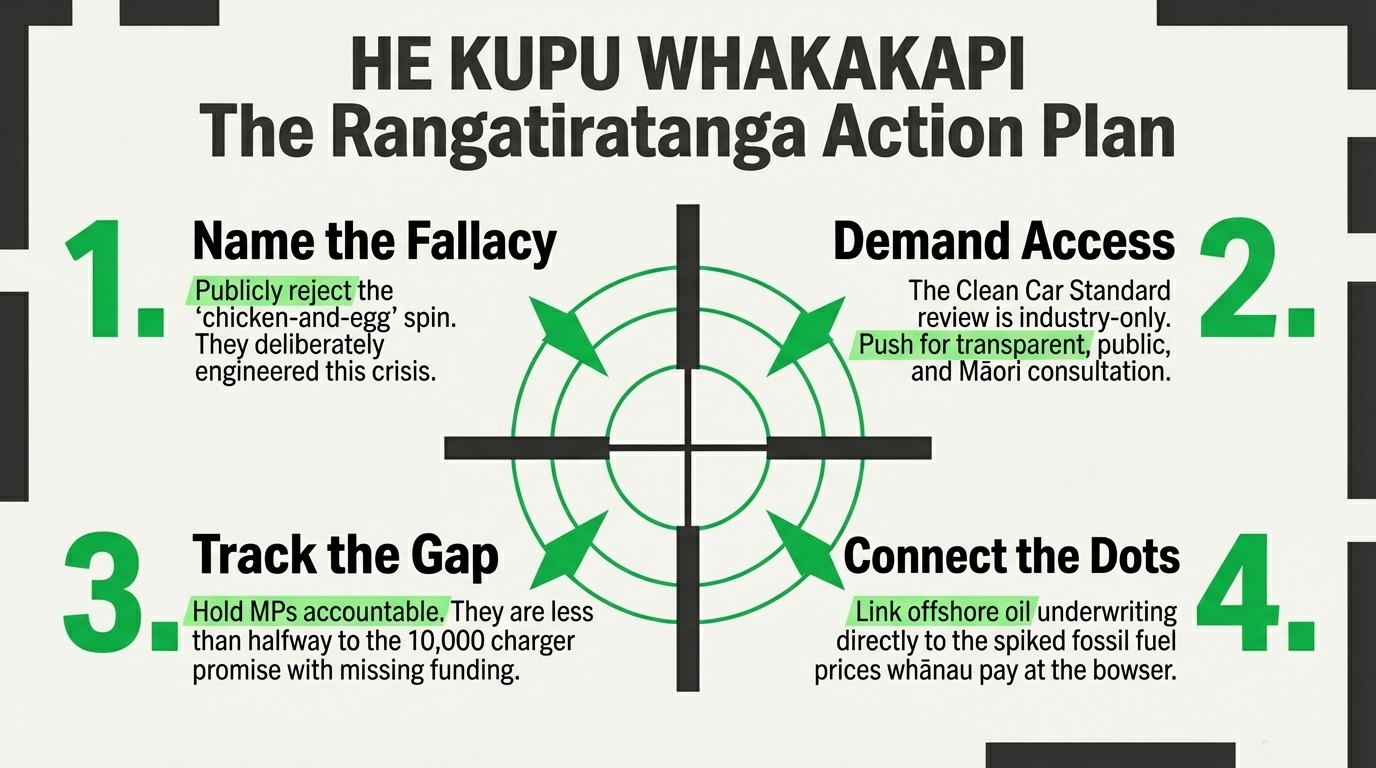
The taiaha is lowered. But it is not sheathed.
The action pathways for whānau, hapū, and iwi are clear:
- Name the fallacy publicly. Every time a Minister claims credit for solving a crisis they engineered, call it what it is. In your community meetings. In your letters to MPs. In your own Substack.
- Demand that Drive Electric's calls are heard. The government has been consulting only with vehicle industry stakeholders on the Clean Car Standard review — not the public, not EV advocates, not Māori communities. Push for public submissions.
- Track the 10,000 charger promise. At 4,550 chargers (if this scheme delivers in full), they are less than halfway to a 2030 target they promised. With four years to go and no additional budget allocated, this promise is dead. Mark it so.
- Connect the fossil fuel dots. Every time Shane Jones uses public money to de-risk oil and gas exploration, connect it to the fuel price your whānau is paying at the bowser. The two policies are not separate. They are the same government, serving the same interests.
This government did not just fail on climate. It reversed progress we had already paid for. It locked our people into costs that were avoidable. It chose fossil fuel donors and ute-driving electorates over our future.
And now it wants credit for the chargers.
Kāo. Ka whawhai tonu mātou.
💚 Koha Consideration

This mahi — the research, the citations, the late nights tracing the networks of power that work against our whānau — is not funded by a think tank. It is not backed by a corporate sponsor. There is a lone nzer writing cheques for uncomfortable truths.
It is funded by people like you.
Every koha is a political act. It signals that whānau are ready to fund the accountability that Crown and corporate structures will never provide for themselves. It signals that rangatiratanga is not just a concept — it includes the power to fund our own truth-tellers.
If you are able, consider a koha here. No amount is too small. Every contribution keeps the taiaha sharp and the Ring charged.
If you cannot koha right now — no worries, none at all. Aroha mai. There are other ways to stand alongside this work:
📬 Subscribe to The Māori Green Lantern on Substack — it's free, and it grows the reach of every piece
🔁 Share this essay with your whānau, your friends, your networks — that is koha in itself
💬 Kōrero — leave a comment, a response, a challenge. Engagement keeps this voice visible
This kaupapa survives through collective action. That is, after all, exactly what we are trying to protect.
Kia kaha. Stay vigilant. Stay connected.
Research conducted March 23, 2026. Sources: RNZ, 1News, CleanTechnica, Ministry for the Environment, NZ Transport Agency, MPI. All URLs verified at time of publication.