"Ka Noho i Roto i te Ahi: The Government's Toll Booth to Hell and the Green Party's Open Gate" - 24 march 2026
They set your house on fire. Then told you to fill in a form before you could have the hose

Mōrena koutou,
These assholes of a government are going to make you jump through hoops to get any assistance at all!
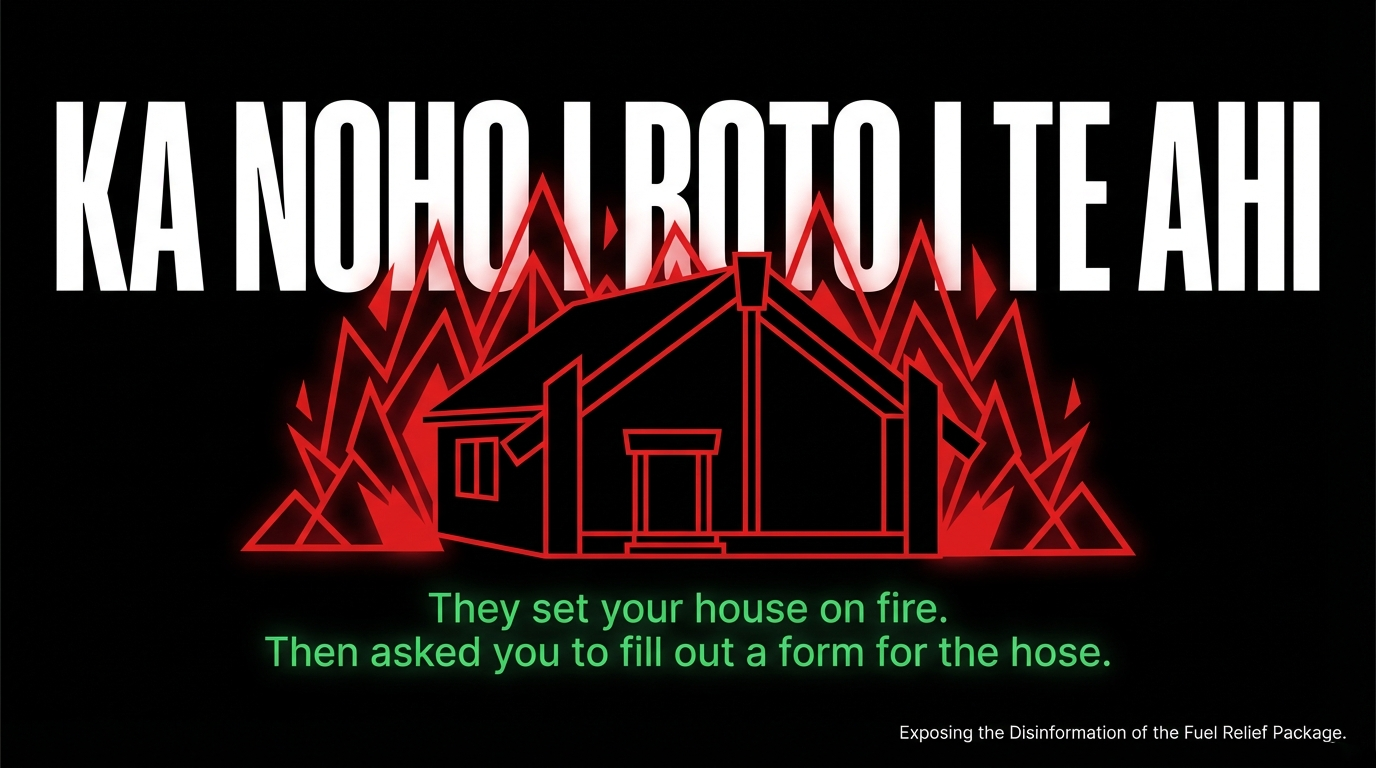
The house is burning. Fuel prices are punching holes through the wallets of every low-income, rural, and brown household in Aotearoa. And Nicola Willis — manicured, measured, and unmoved — steps to the podium and announces that relief is coming.
Relief that is, in her own words,
"targeted, timely, and temporary."
Three Ts. Three lies dressed as fiscal responsibility.
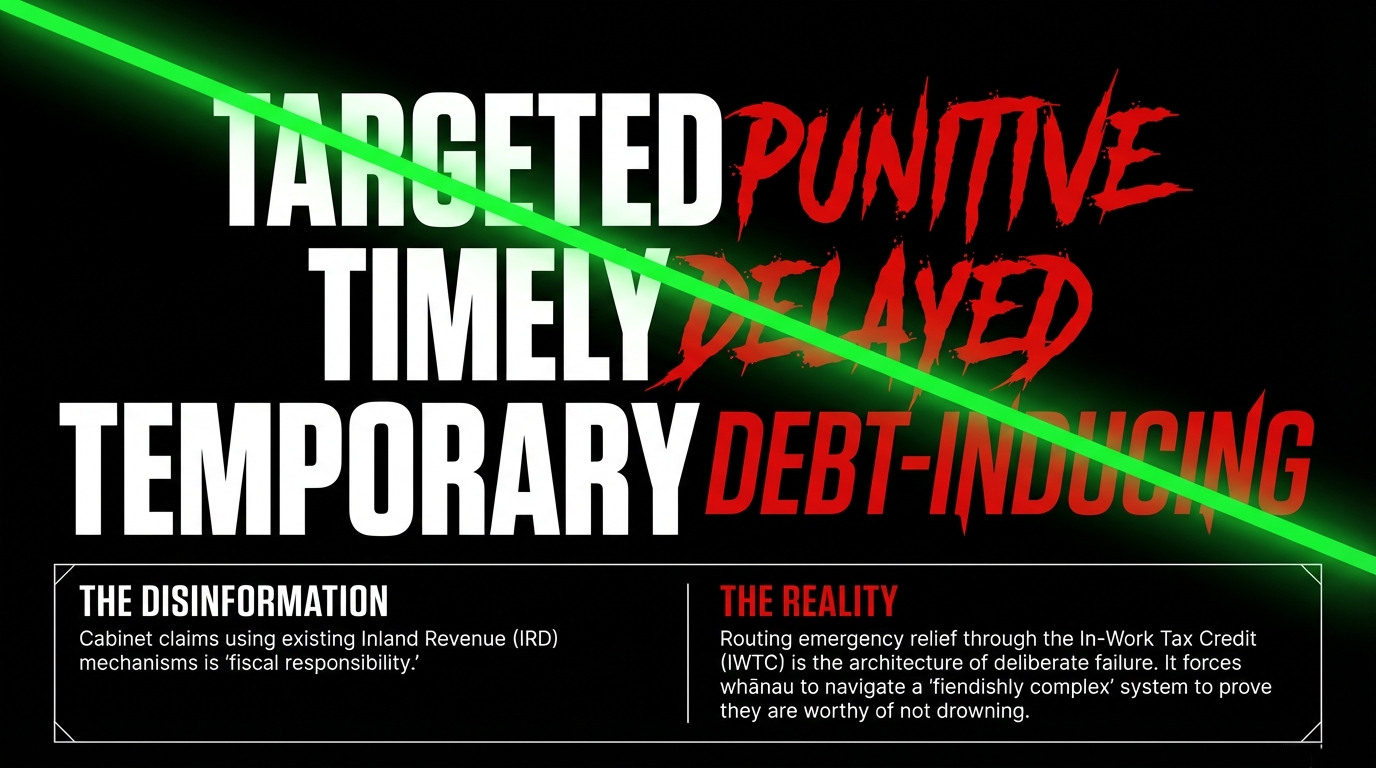
Because what "targeted" means — what it has always meant in the lexicon of this white supremacist neoliberal government — is this: you must prove you are worthy of not drowning before we throw you a rope. And the proof form is eleven pages long. And it's due at IRD. And you might owe us money afterward.
The Architecture of Deliberate Failure
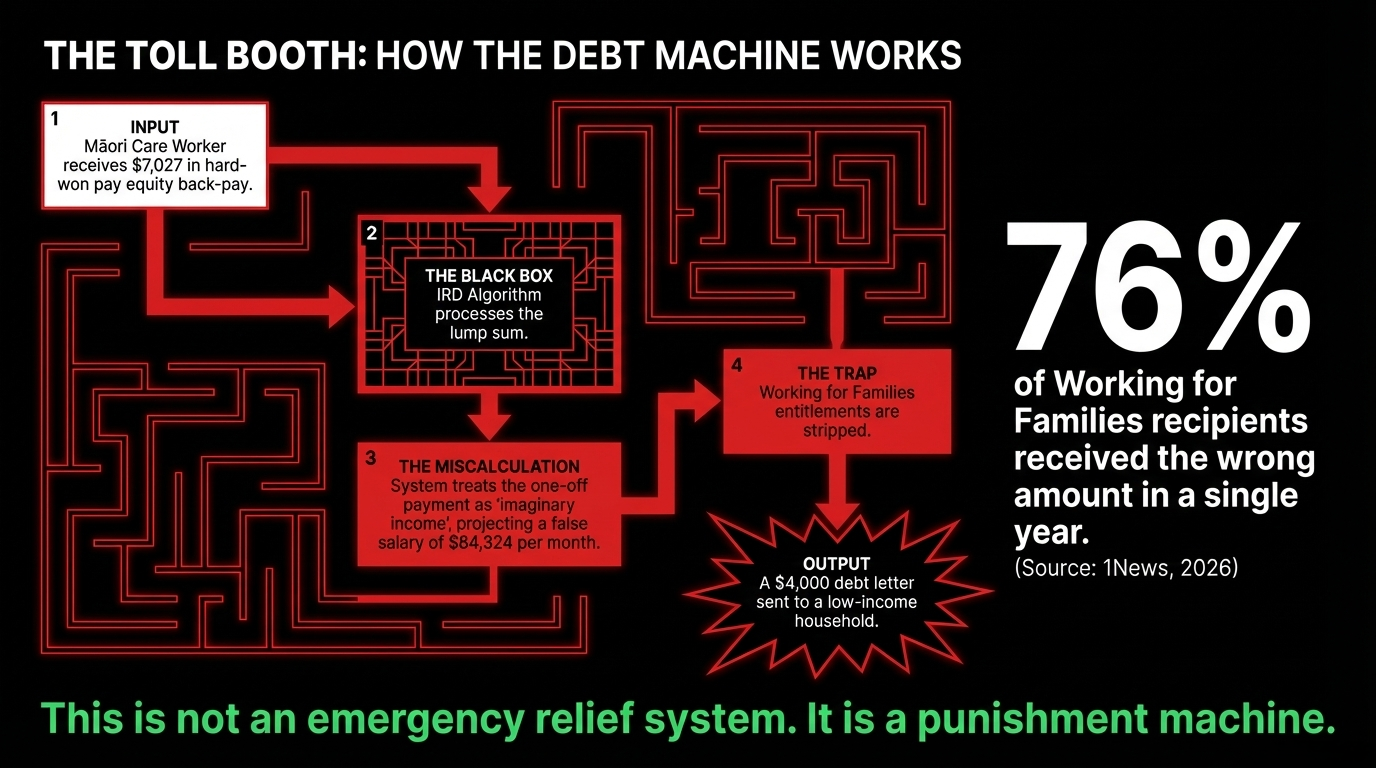
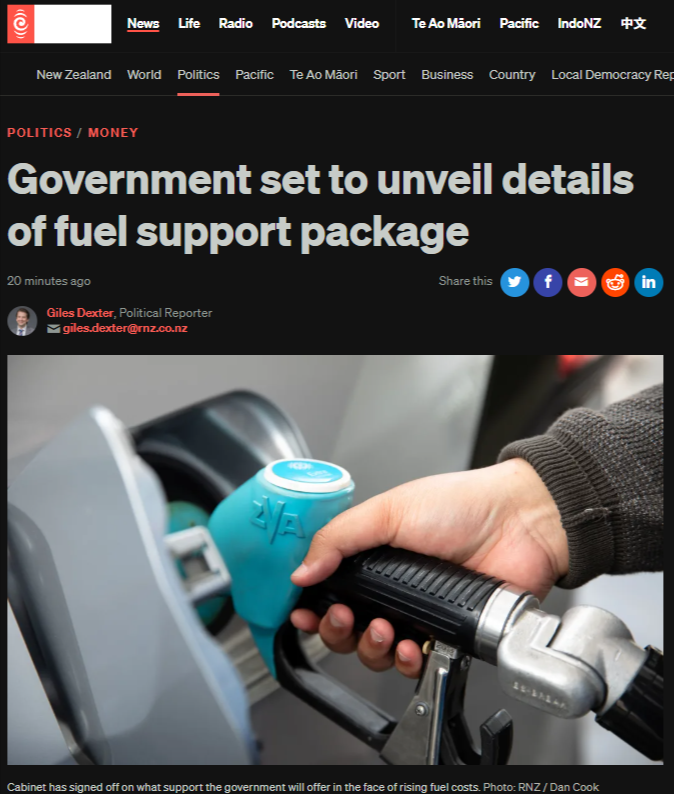
Let's name what's actually being built here. As RNZ reported, Cabinet has handed the fuel crisis response to Treasury and Inland Revenue, using "existing mechanisms." That means the In-Work Tax Credit (IWTC) and the Independent Earner Tax Credit (IETC) — two instruments so administratively violent that even Infometrics chief economist Brad Olsen warned they are "fiendishly complex", that households "may not know what they are entitled to", and that people sometimes only find out after the fact that they owe money back to the government.
Read that again. The government's emergency fuel relief package could leave stressed, fuel-poor whānau receiving a letter months from now demanding repayment.
This is not incompetence. This is design.
As the Māori Green Lantern documented in "The Traffic Light Taiaha: How a White Supremacist Government Built a Punishment Machine", this government has a consistent methodology: build systems that escalate punishment rather than deliver support, aim them at Māori and Pacific peoples, and then describe the resulting suffering as personal failure. The fuel package is the welfare sanctions system wearing a different hat.
The Deep Dive Podcast
Listen to a lively conversation between two hosts, unpacking and connecting topics in the sources of this essay
The Tikanga Violation: Why This Is Not Just Bad Policy
For the western mind, "bad policy" is an abstraction — a technocratic failure, something correctable with better data.
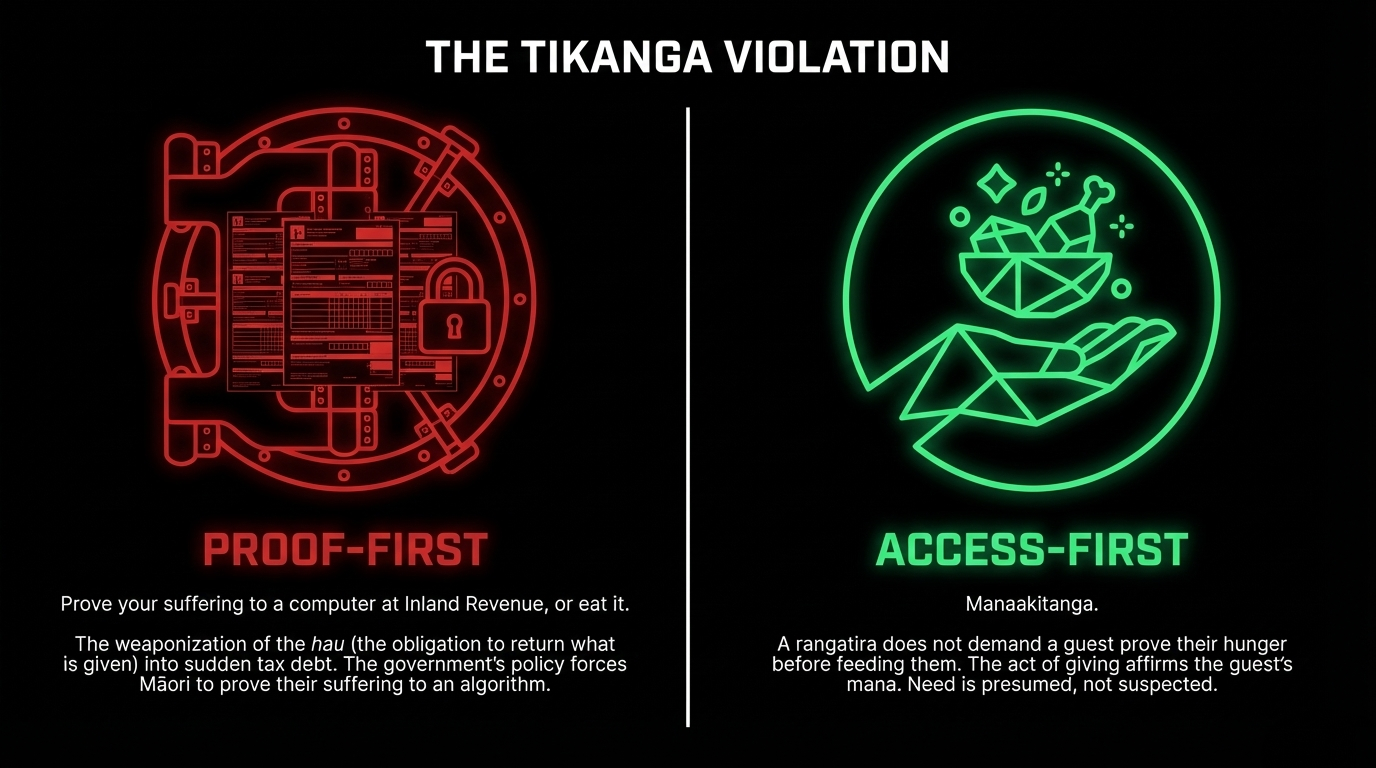
For whānau operating within tikanga frameworks, what this government is doing is something far more serious: it is a violation of manaakitanga — the sacred obligation to care for people — and a desecration of mauri, the life force that animates communities.
When a rangatira hosted manuhiri, they did not ask guests to produce documentation proving hunger before feeding them. They fed them first. The act of feeding was itself the affirmation of the guest's mana. To demand proof of need before providing sustenance is not just inefficient — it is a statement about who deserves to be seen as human.
This government has built a system that says: prove your suffering to a computer at Inland Revenue, or eat it.
That is a tikanga violation with a dollar value attached. And the dollar value is documented. As revealed by 1News, in the 2022 year, only 24% of households receiving weekly or fortnightly Working for Families payments received the correct amount. The rest were overpaid, underpaid, or both — with the government treating lump-sum payments like back pay as though they represented annual income, producing what one tax accountant called "imaginary income" debts of $4,000 or more. The hau — the obligation to return what is given — was weaponised. Whānau who thought they received help found themselves in debt.
Three Examples for the Western Mind
Example One: The $4,000 Trap — Working for Families as Debt Machine
Imagine you are a Māori single parent. You work in healthcare. After two years of pay equity negotiations, your employer pays you $7,027 in back pay. Inland Revenue's system treats this as if you earned $84,324 per month — and claws back your Working for Families entitlements accordingly. You now owe $4,000.
This is not hypothetical. As 1News documented in February 2026, IRD's "computer says no" approach treats one-off payments as permanent income, stripping credits from families who were never actually overpaid. Tax accountant John Baucher called the system a "rigid" failure operating on a "window dressing" review.
The quantified harm: 76% of Working for Families recipients received the wrong amount in a single year. Now this government proposes routing emergency fuel relief through the same broken system.
The tikanga violation: The rangatira does not take back the food they gave you. The IRD does.
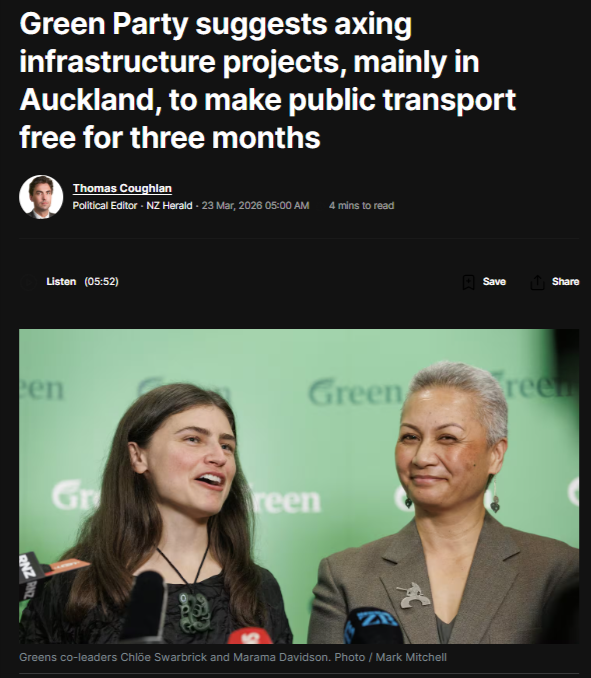
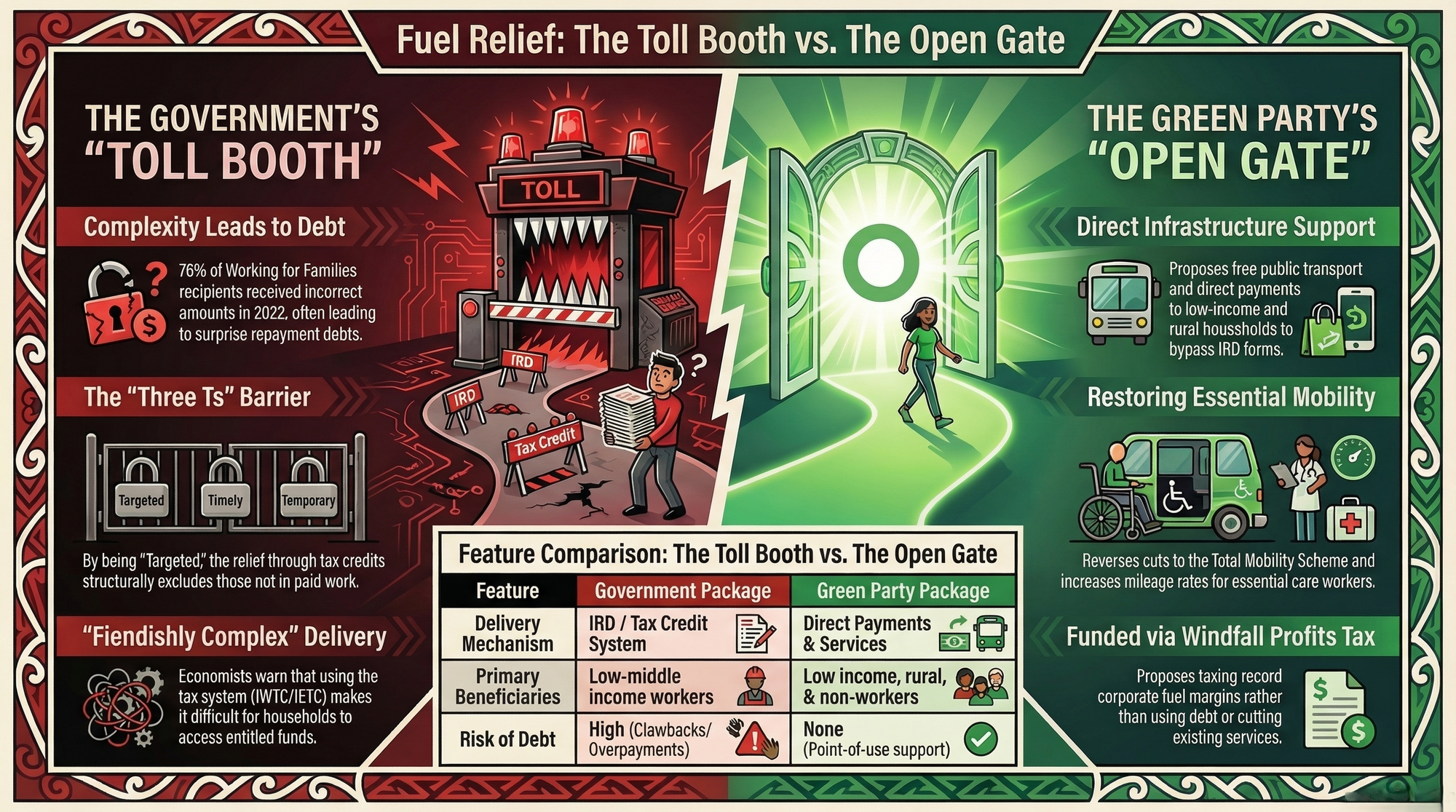
The solution: The Greens propose direct relief payments to low-income and rural households — as reported by RNZ — bypassing IRD entirely. No abatement. No retrospective reconciliation. No debt letter in six months. Cash that arrives because you need it, not because you survived the eligibility gauntlet.
Example Two: The Stranded Kaumātua — Total Mobility Cuts as Structural Abandonment
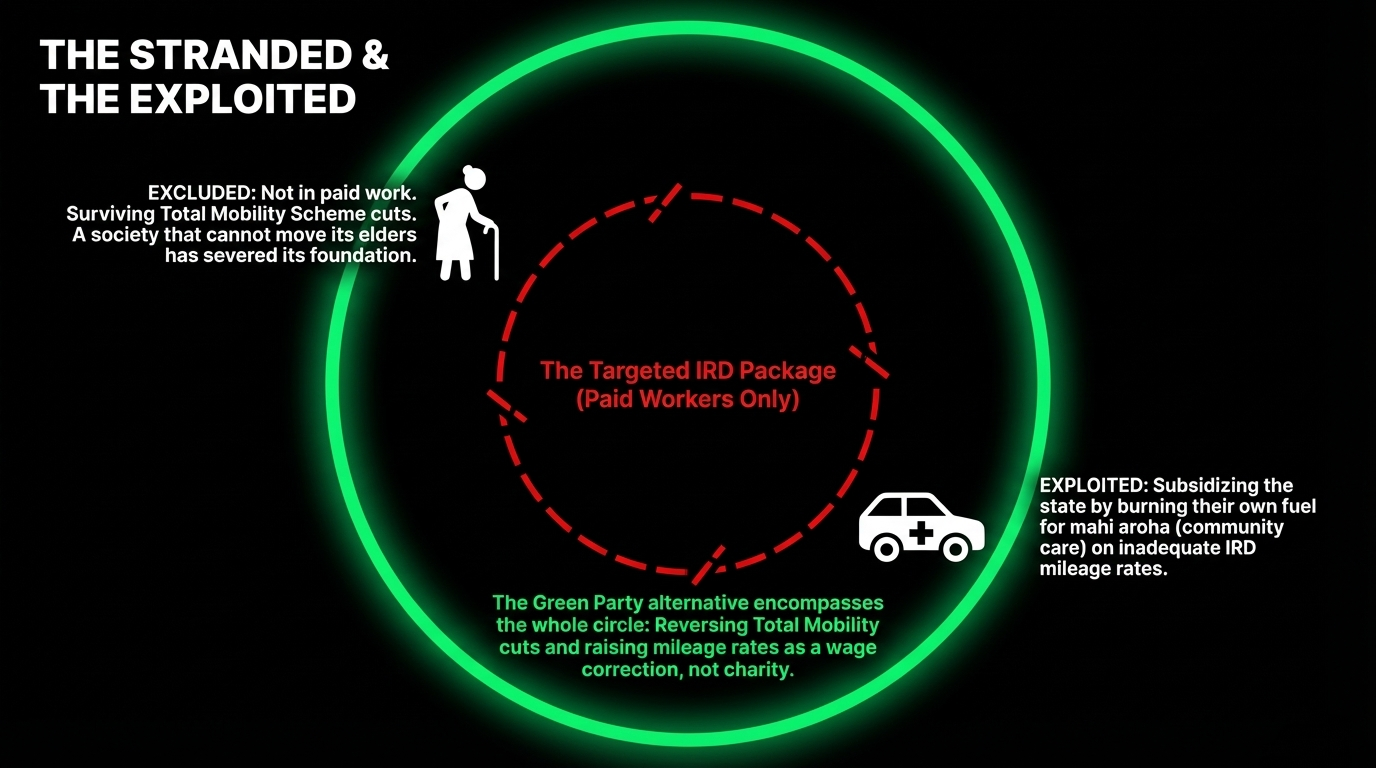
Imagine you are a kaumātua in Rotorua. You have a mobility impairment. You do not drive. Until recently, the Total Mobility Scheme subsidised your taxi costs to reach medical appointments, the supermarket, your mokopuna's school events. This government planned to cut that scheme.
The Green Party's emergency package explicitly calls for reversing those cuts, as confirmed by RNZ. The government's "targeted" IRD package offers you nothing. You are not in paid work. You have no In-Work Tax Credit. You exist outside the parameters of Nicola Willis's three Ts.
As the Citizens Advice Bureau's Louise May told RNZ:
"We are really concerned that there hasn't been mention of families who don't have paid work. They are the ones who are going to be most affected."
The quantified harm: Rising fuel costs flow directly into transport costs for every household that depends on others to drive them — the elderly, disabled, children, beneficiaries. The government's package, routed through IRD payroll mechanisms, structurally excludes all of them.
The tikanga violation: Kaumātua are not afterthoughts. In te ao Māori, they are the pou — the pillars. A society that cannot move its elders is a society that has severed its connection to its own foundation.
The solution: Free public transport — one of the Greens' central proposals — requires no form. You tap on. The barrier is removed at the infrastructure level. As the Māori Green Lantern documented in "Ka Noho i Roto i te Ahi", this is what manaakitanga looks like at the infrastructure scale: presuming need, removing barriers, treating the right to move as a right rather than a reward.
Example Three: The Care Worker Who Drives to Survive — Mileage Rates as Exploitation Architecture
Imagine you are a Māori home support worker in Tairāwhiti. You drive between clients — kaumātua, disabled whānau, children in fragile homes — in your own car. You are paid the government-mandated mileage rate. That rate has not kept pace with fuel costs. You are, right now, subsidising the care of vulnerable people out of your own pocket, in a vehicle you are burning toward the scrapyard.
As revealed by RNZ, the Green Party's package explicitly calls for increasing mileage rates to care and support workers who receive well below standard IRD mileage. This is not a headline item. It is buried in the proposal's fine print. But it is the most honest acknowledgement in any current policy of how the fuel crisis actually works for Māori women — who are overrepresented in the care workforce — in regions where the road is the only option.
This government's package offers these workers nothing specific. The IWTC does not distinguish between a care worker driving 300km a week for their job and a desk worker who walks to the office. The system is blind to the actual fuel burden, by design.
The quantified harm: Care workers, who already sit near the bottom of the wage scale, are absorbing a fuel cost that should be a system cost. Every cent they spend bridging that mileage gap is a cent taken from their household budget — which is already under pressure from the same fuel prices their clients are struggling with.
The tikanga violation: Mahi aroha — work done from love and obligation to whānau and community — is being structurally exploited by a government that has decided this love is a subsidy it does not need to pay for.
The solution: Raise the mileage rate. Not as charity. As a wage correction for theft already committed.
The Greens Versus the Gatekeepers
Let's be direct about what the Green Party is proposing and what the government is proposing. Not as abstract policy positions — as competing visions of who deserves to live without humiliation.
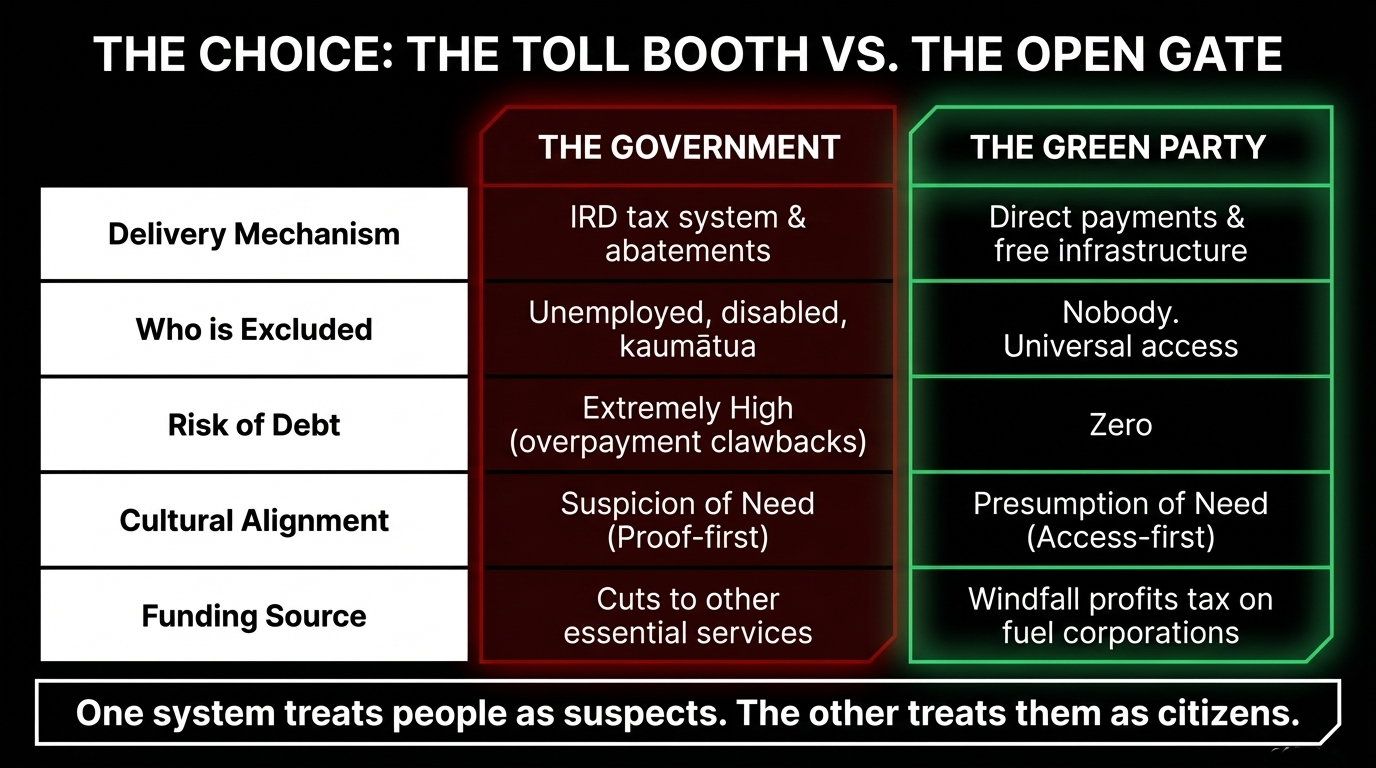
| Government Package | Green Party Package | |
|---|---|---|
| Delivery mechanism | IRD — tax system, abatements, reconciliation | Direct payments, infrastructure, services |
| Who benefits | Low-to-middle income paid workers | Low income, rural, disabled, unemployed, carers |
| Application required? | Yes — embedded in complex IWTC/IETC system | No — free PT requires no form |
| Risk of debt | High — overpayment, clawback | None |
| Speed | Fast to implement, slow to reach people | Fast at point of use |
| Coverage of beneficiaries | Explicitly excluded | Included via direct payments |
| Tikanga alignment | Suspicion of need, proof-first | Presumption of need, access-first |
| Who funds it | Existing fiscal envelope — cuts elsewhere | Windfall profits tax on corporations |
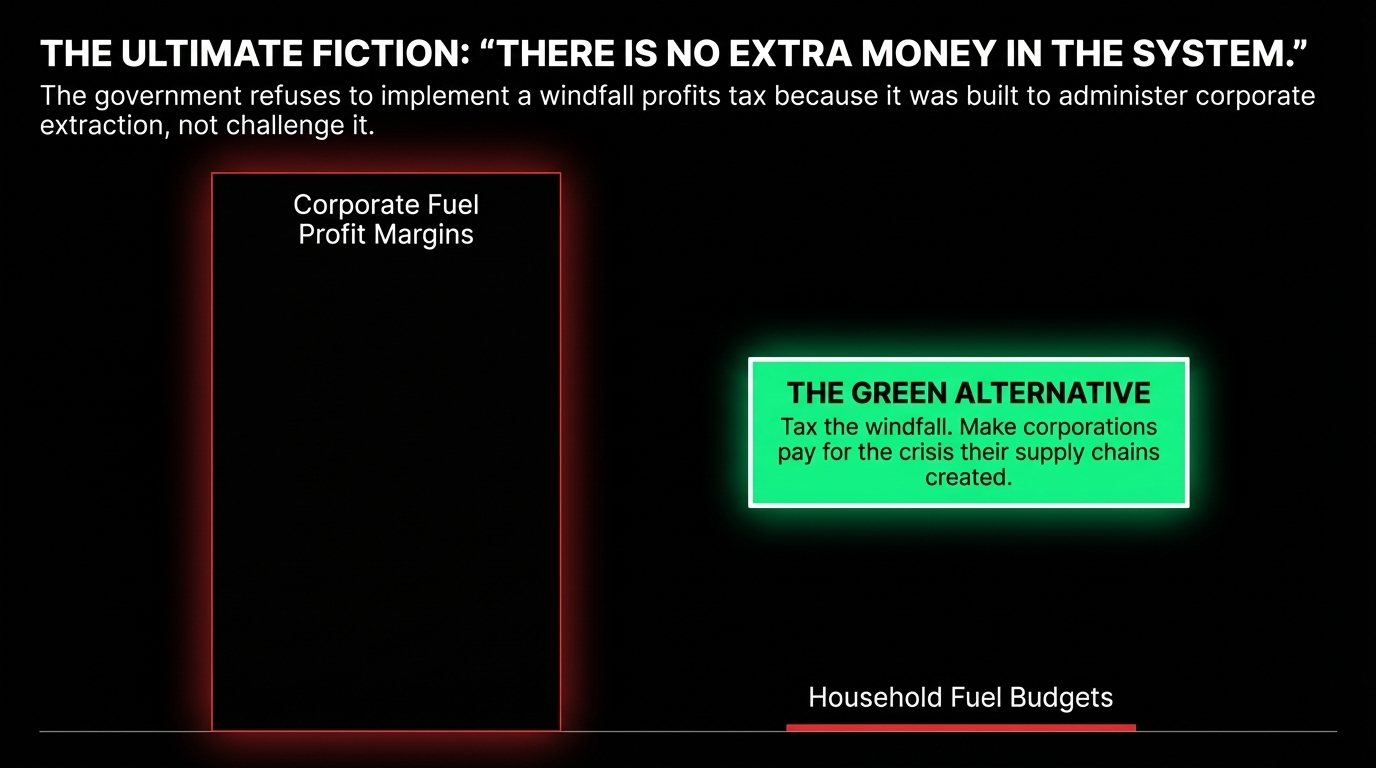
The government's package is a fiscal control instrument wearing the costume of relief. The Green Party's package is imperfect, underfunded without a windfall tax, and opposed by a parliament that has decided corporate profit margins matter more than kaumātua getting to a doctor. But it is honest about what relief actually looks like.
As the Māori Green Lantern documented in "When the Petrol Tanker Runs Dry: How a White Supremacist Neoliberal Government Left Māori at the Bottom of the Fuel Queue" (14 March 2026), the fuel crisis is not an accident — it is the destination of a decade of energy policy built for corporate extraction, not community resilience. And as the same analysis of the welfare punishment machine in "The Traffic Light Taiaha" shows, this government does not make mistakes. It makes choices.
The choice to route fuel relief through IRD is the same choice as routing welfare through a traffic light punishment system: it is a choice to make people earn dignity through bureaucratic endurance.
The Windfall Tax They Refuse to Touch
Here is the question Nicola Willis is not being asked loudly enough: who is profiting from this crisis?
While whānau choose between filling the tank and filling the fridge, fuel companies are posting margins that would have been called obscene in any prior decade of New Zealand politics. The Green Party names this directly and proposes a windfall profits tax to fund the relief. The government refuses — because this government was not built to challenge corporate extraction. It was built to administer it.
As the Māori Green Lantern documented in "The Starving of the Seedlings", this is the consistent architecture: cut from below, protect from above, rename the cruelty as efficiency. The school lunch programme. The welfare sanctions. The early childhood funding. The Total Mobility Scheme. The fuel relief package. All the same logic. All the same targets. All the same beneficiaries of the resulting void: corporations, property owners, and the comfortable.
The Open Gate or the Toll Booth
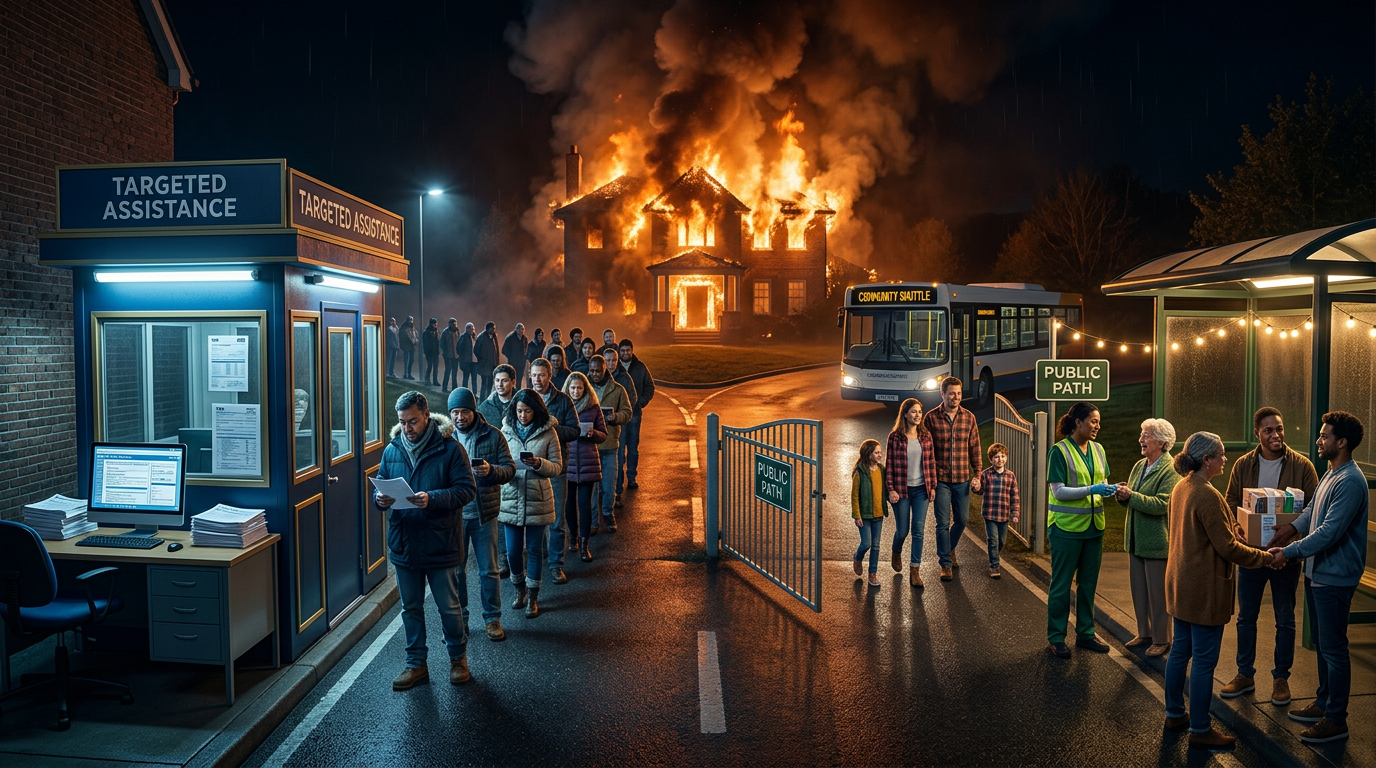
There are two roads out of the burning house.
One road has a toll booth. The toll booth is Inland Revenue. To pass, you must have the right tax code, the right number of children, the right employment weeks, the right income band — and you must hope the computer doesn't misread your back pay as evidence you're a millionaire. If you pass, you might get $10 a week. If you fail, you might get a debt letter. The toll booth is painted government blue and gold. It is called "targeted assistance."
The other road has an open gate. The gate is free public transport. It is a direct payment to low-income and rural households. It is a restored Total Mobility Scheme. It is a mileage rate that doesn't steal from care workers. It is a windfall tax that makes corporations pay for the crisis their supply chains created. The open gate is the Green Party's proposal. It is not perfect. But it does not treat people as suspects before it treats them as citizens.
Ka noho i roto i te ahi — we dwell within the fire. The question is whether the government hands us a hose or a form.
Koha Consideration
This essay names the real cost of "targeted" relief — not just in dollars, but in mana. Every time a care worker subsidises the state's failure from her own tank, every time a kaumātua waits by the phone for a Total Mobility booking that may not come, every time a whānau opens a letter from IRD and sees a debt where they expected help — that is the cost of a system built to exclude.
This mahi — the naming, the tracing, the refusing to let these choices be called accidents — does not fund itself. Every koha signals that whānau are ready to fund the accountability that Crown and corporate structures will never provide. It signals that rangatiratanga includes the power to fund our own truth tellers — the ones who follow the whakapapa of harm all the way to the boardroom and name what they find.
Kia kaha, whānau. The fire is real. So is the open gate, if we fight for it.
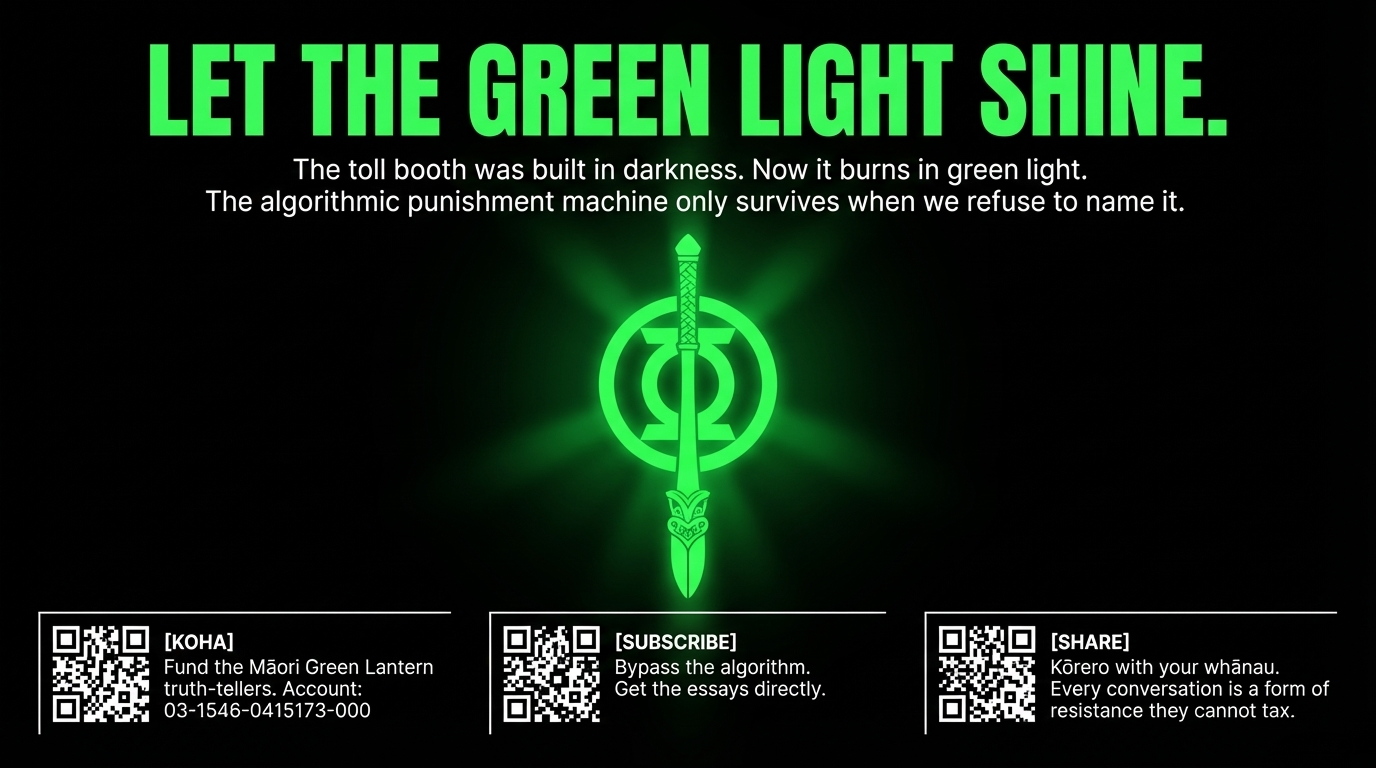
Three pathways to support this mahi:
Koha directly: Koha — Support the Māori Green Lantern
Subscribe and receive essays directly: Subscribe to the Māori Green Lantern
Direct bank transfer: HTDM, account number 03-1546-0415173-000
If you cannot koha right now — no worries. Share this essay with your whānau. Post it. Kōrero about it. Every conversation it starts is a form of resistance the algorithm cannot tax.
The Māori Green Lantern wields the taiaha empowered by the Ring. The light exposes what the powerful build in darkness. The toll booth was built in darkness. Now it burns in green light.

Research tools used: search_web, fetch_url. Sources consulted: RNZ, 1News, The Māori Green Lantern archives. Date of research: 24 March 2026. Claims that could not be independently verified beyond available sources have been noted. All URLs spot-checked at time of publication.