"Ka Noho i Roto i Te Ahi: The Green Party's Fossil Fuel Crisis Offer and the Hidden Architecture of Transport Injustice in Aotearoa" - 24 March 2026

He Kōrero Tīmatanga — Opening: The Hidden Hand Behind the Wheel
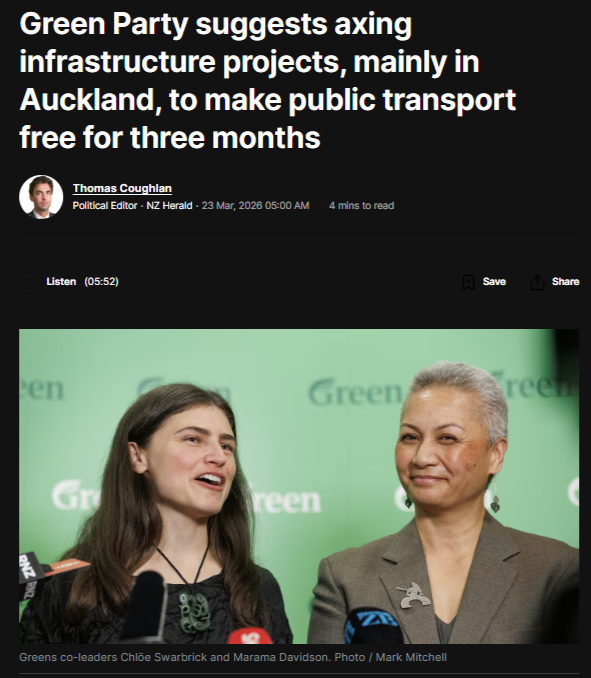
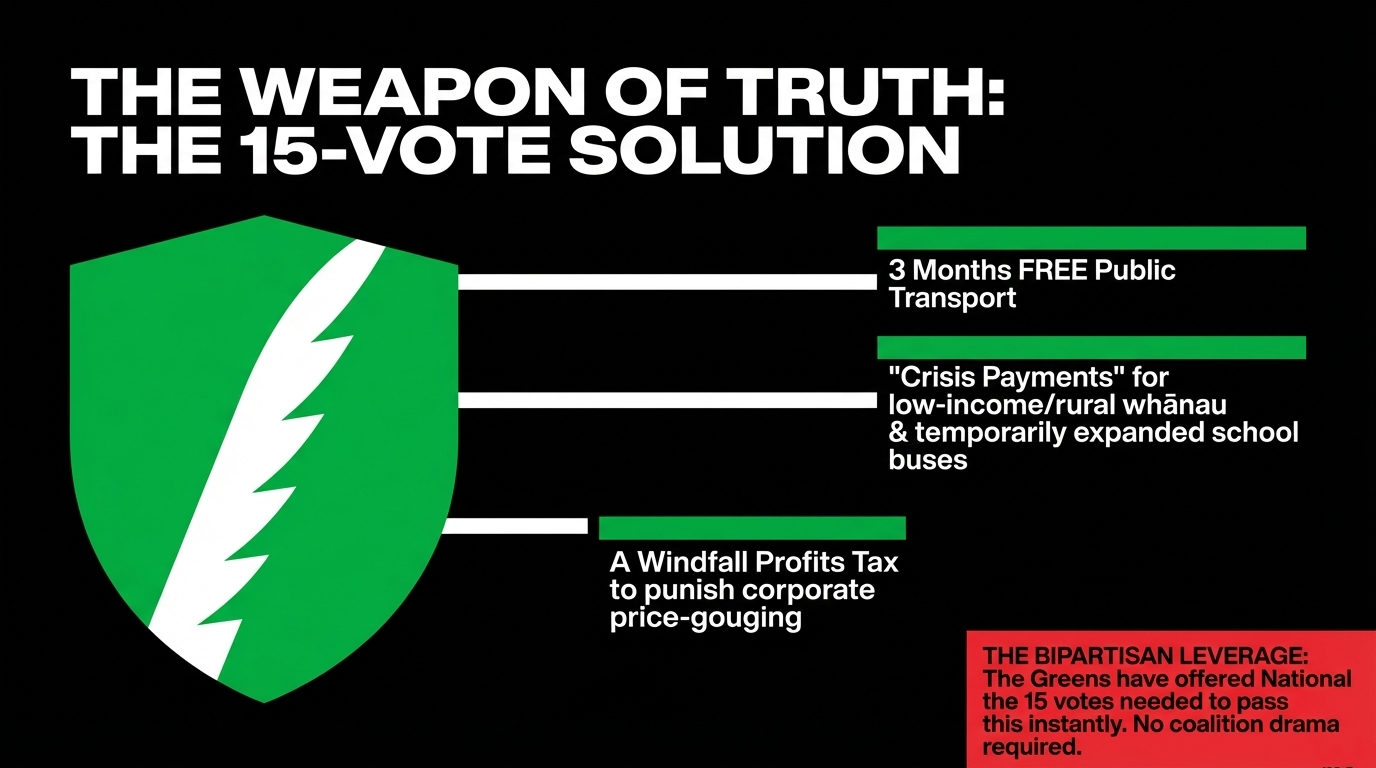
On Sunday, 22 March 2026, the Green Party sent a letter to Prime Minister Christopher Luxon offering something remarkable: 15 votes to pass an urgent, bipartisan fossil fuel crisis relief package — no coalition strings, no political theatre, just help for the people who are bleeding at the pump.
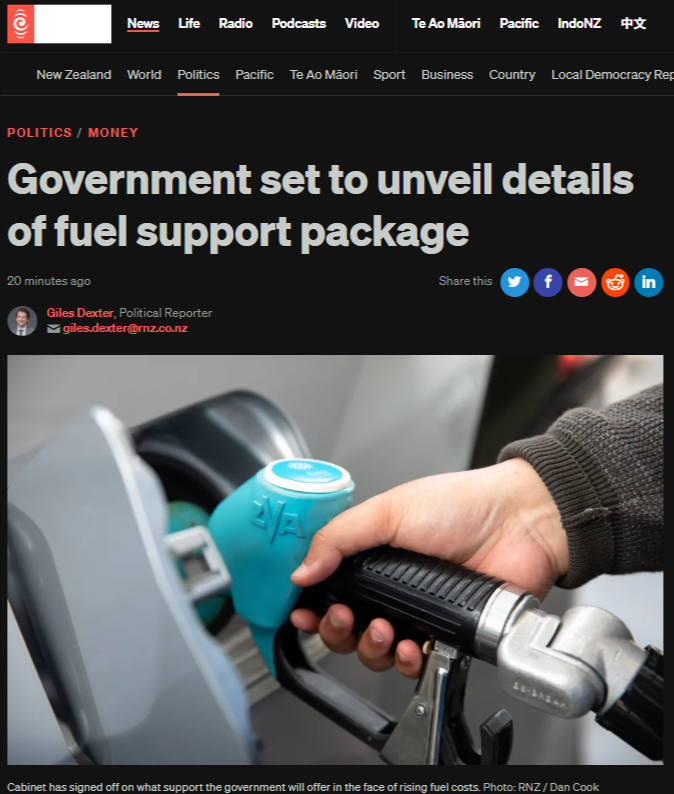
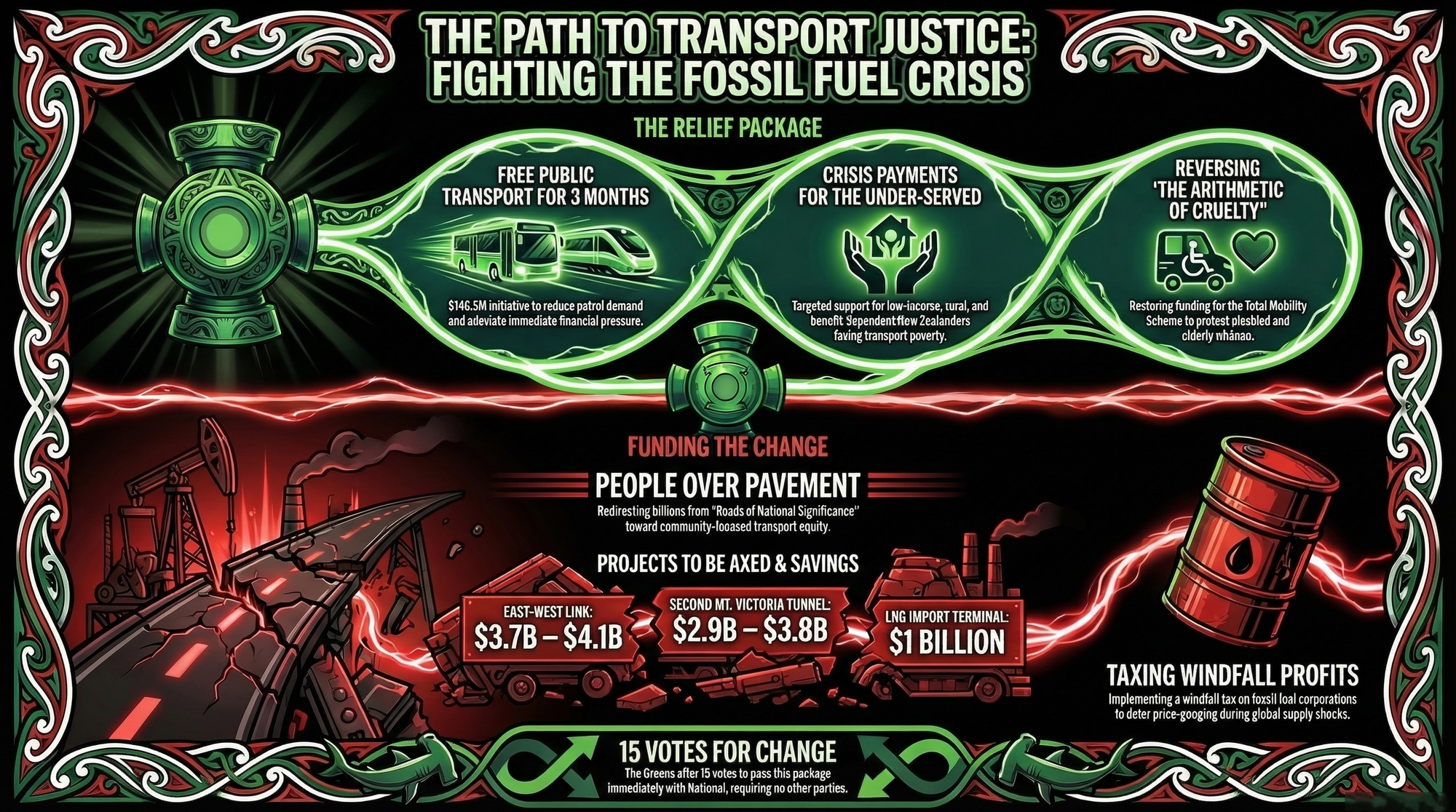
The proposal, as reported by RNZ, includes free public transport for three months, relief payments for low-income and rural people, expanded school bus eligibility, reversal of cuts to the Total Mobility Scheme, increased mileage rates for care and support workers, and a windfall profits tax on fossil fuel corporations gorging themselves on manufactured scarcity.
The question is not whether this is good policy. It clearly is.
The question is: who loses if it passes, who has already been set up to lose if it doesn't, and which communities — always Māori, always Pasifika, always the poor — are being used as buffers between political cowardice and corporate greed?
Te Āhua o te Riri — Background: A Crisis Made, Not Born
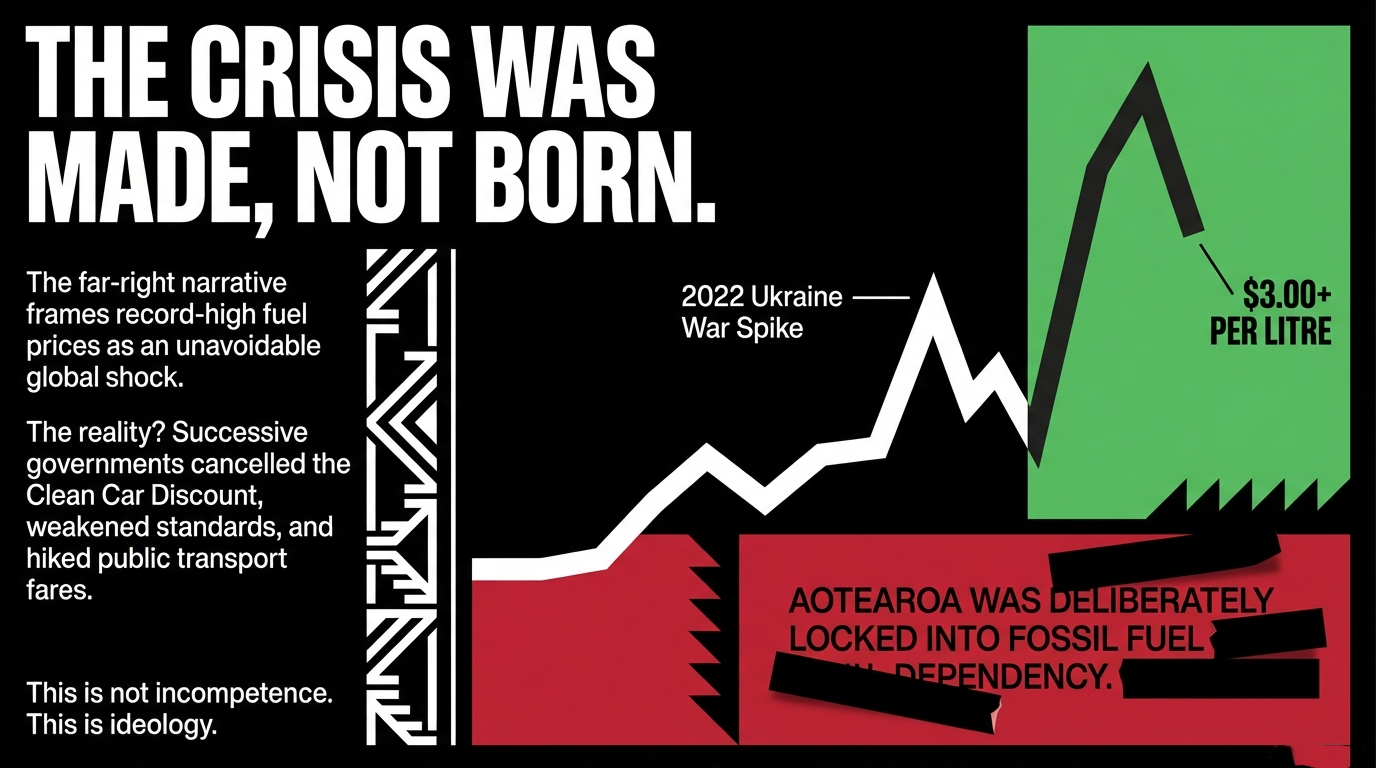
The current fuel price spike is not an act of God. It is the consequence of geopolitical conflict in the Middle East disrupting global oil supply — a supply system Aotearoa's successive neoliberal governments have refused to wean us off for three decades. As 1News reported on 23 March 2026, fuel prices have now outpaced the last time New Zealand surpassed $3 per litre — which was following Russia's invasion of Ukraine in 2022.
That 2022 spike was supposed to be a wake-up call. Aotearoa's governments did not wake up. Instead, under the current National-led coalition, they:
- Cancelled the Clean Car Discount
- Weakened the Clean Car Standard
- Hiked public transport fares, as noted by the Green Party's own record
- Locked in further fossil fuel dependency at every legislative turn
This was not incompetence. This was ideology. And like every neoliberal ideological project, it has a constituency — and that constituency is not whānau Māori in Tāmaki Makaurau catching the 277 bus to their second job.
He Āwhina, He Koha — A Consideration
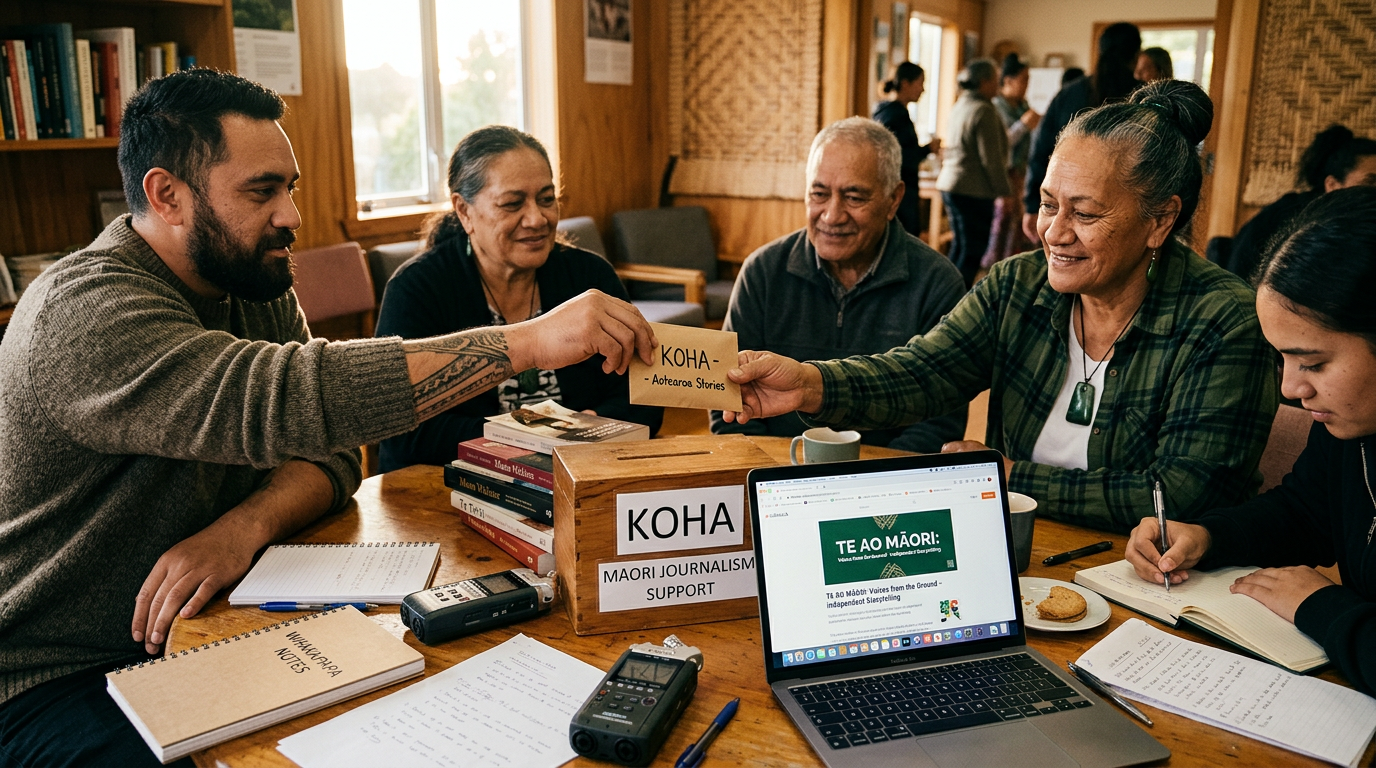
Every koha signals that whānau are ready to fund the accountability that Crown and corporate structures will not provide.
It signals that rangatiratanga includes the power to fund our own truth tellers.
This mahi — the research, the whakapapa tracing, the naming of names — takes time, tools, and aroha. No Crown agency funds it. No corporate donor shapes it. It exists because whānau believe that independent Māori voice is worth protecting.
Kia kaha, whānau. Stay vigilant. Stay connected. And if you are able, consider a koha to ensure this voice continues.
If you are unable to koha — no worries at all. Subscribe or follow The Māori Green Lantern on Substack, kōrero about what you read, and share with your whānau and friends. That is koha in itself.
Three pathways exist:
🪙 Direct Koha — For those who wish to support this mahi with a voluntary contribution, visit the Koha platform:
Koha — Support The Māori Green Lantern
📩 Subscribe — For those who wish to receive essays directly and support through subscription:
Subscribe to The Māori Green Lantern
🏦 Direct Bank Transfer — For those who prefer to transfer directly:
HTDM | Account: 03-1546-0415173-000
Ngā mihi maioha ki a koutou katoa — deep gratitude to all who walk this path alongside us.
Te Whakaaro Māori — Deconstructing the Proposal Through Mātauranga
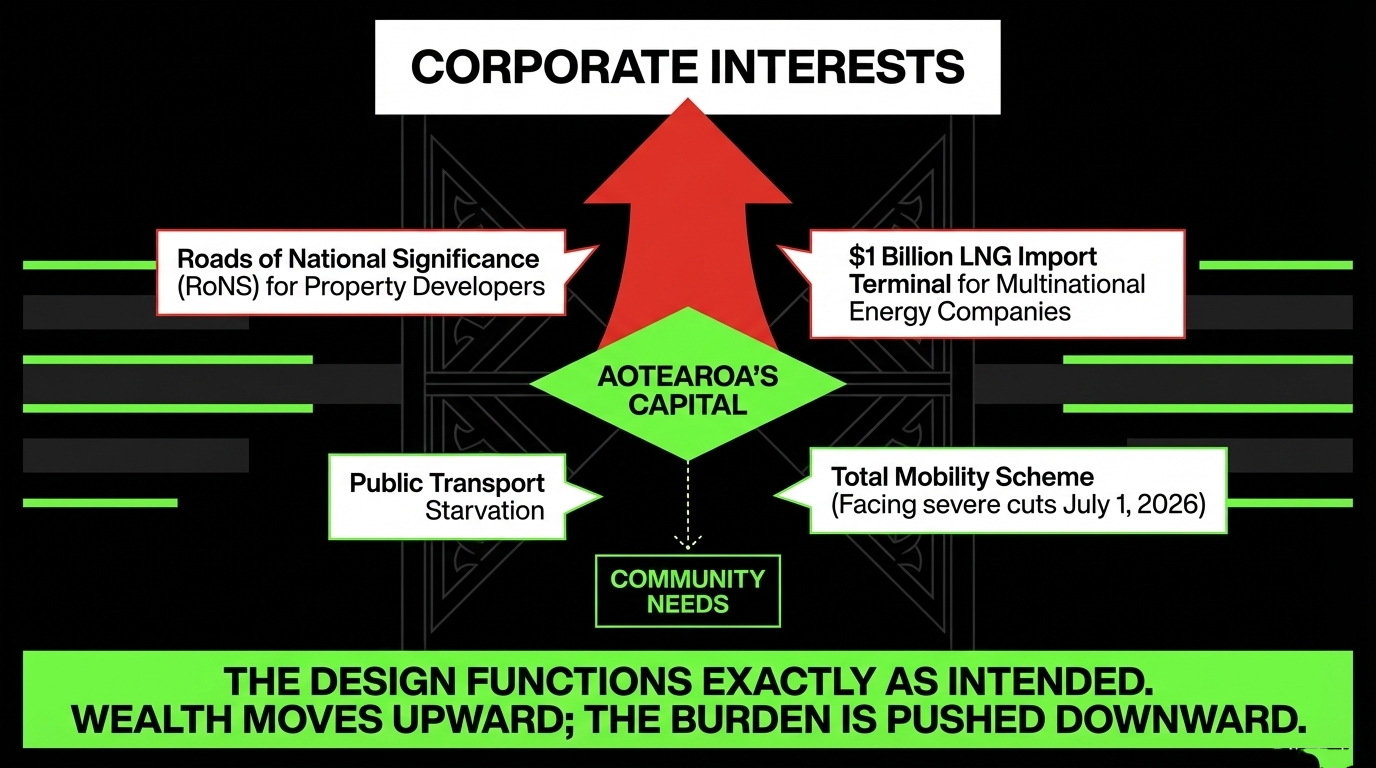
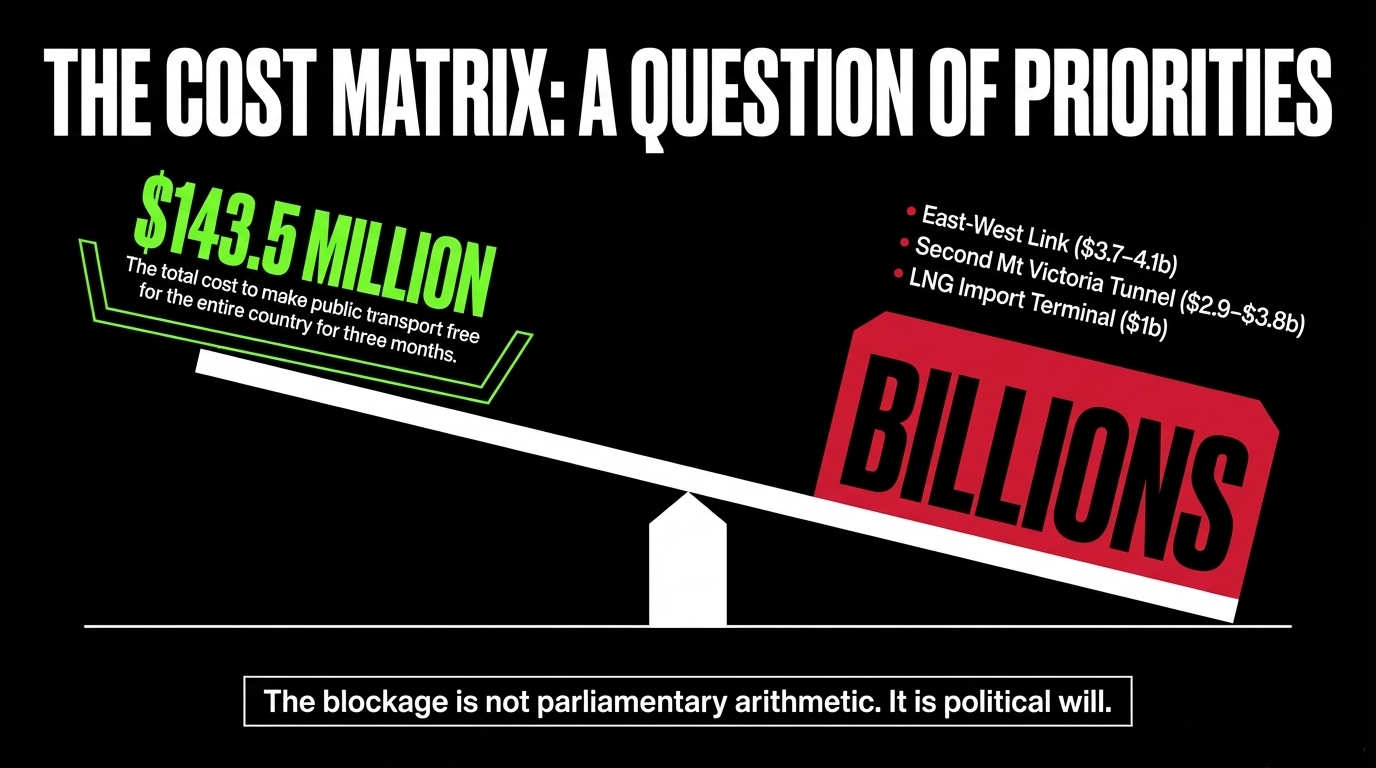
The Greens' package, costed at approximately $143.5 million for free public transport alone, is funded by axing what co-leader Chlöe Swarbrick calls "exorbitantly expensive, low-value projects" — specifically the Roads of National Significance (RoNS) and the planned LNG import terminal.
Let's apply whakapapa methodology here: trace the genealogy of these projects. Who commissioned them? Who contracts them? Who profits?
The Roads of National Significance are the crown jewel of the National Party's transport theology — a multi-billion-dollar highway programme overwhelmingly concentrated in and around Tāmaki Makaurau (Auckland), designed to move private cars faster while public transport is starved of capital. The LNG import terminal — a proposal to lock Aotearoa into another fossil fuel import dependency just as the world is pricing itself off the stuff — serves energy corporations, not communities.
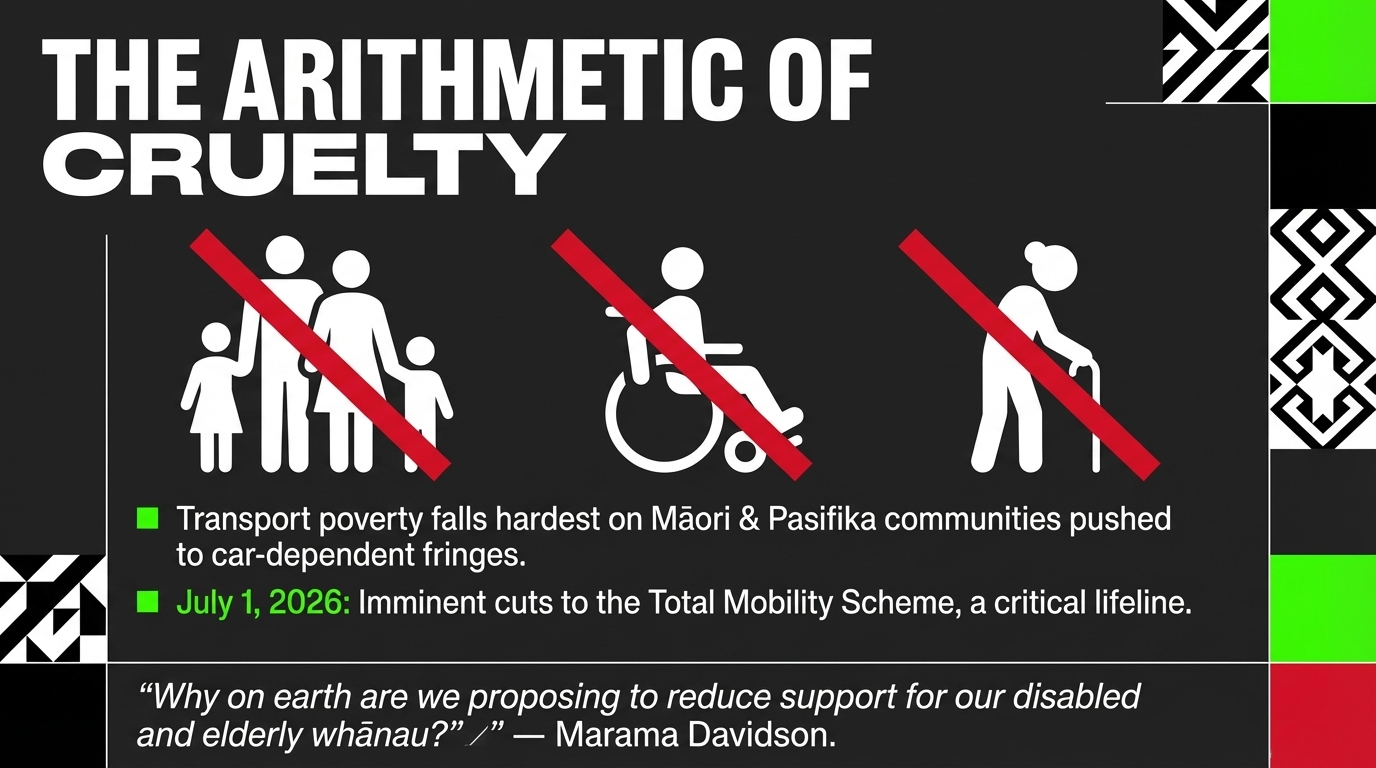
Meanwhile, the Total Mobility Scheme — targeted for cuts set to begin 1 July 2026, and which co-leader Marama Davidson calls out by name — is the lifeline for disabled and elderly New Zealanders, a disproportionate number of whom are Māori.
As Davidson told RNZ:
"Why on earth are we proposing to reduce support for total mobility holders... our disabled whānau and our elderly whānau?"
This is the arithmetic of cruelty: cut support for Māori elders and disabled people on 1 July while billions roll into roading contractors' accounts. That is not an accident. That is a programme.
The Deep Dive Podcast
Listen to a lively conversation between two hosts, unpacking and connecting topics in the sources of this essay
Ngā Hononga Huna — Five Hidden Connections, Verified
Hidden Connection 1: The RoNS Subsidy to Sprawl
The Roads of National Significance do not serve Māori urban communities. They serve greenfield property development — the conversion of whenua into speculative housing estates accessible only by car. The beneficiaries are developers, land bankers, and construction contractors. The cost is socialised. As RNZ reported in February 2026, political parties are already fighting over which roading projects survive — not whether they should exist at all.
Hidden Connection 2: The Fuel Industry's Windfall Architecture
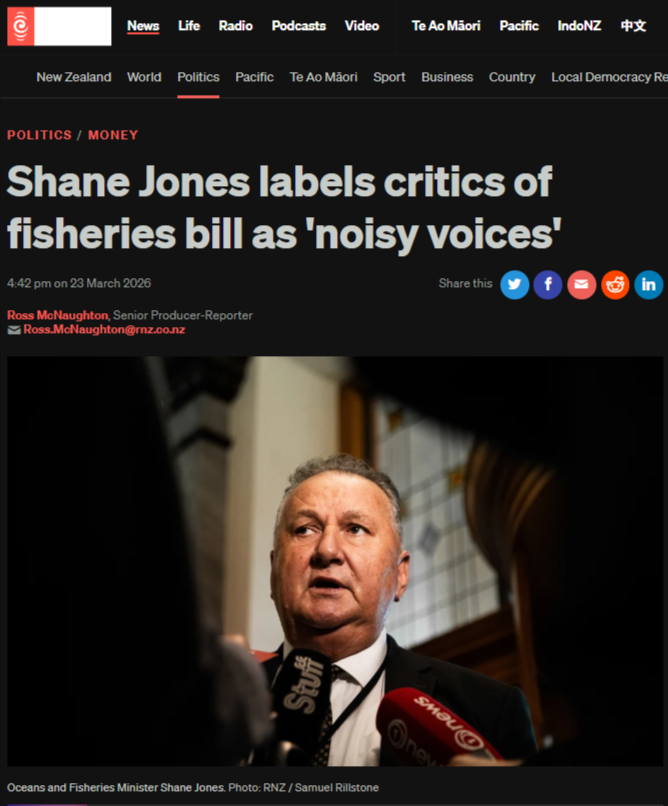
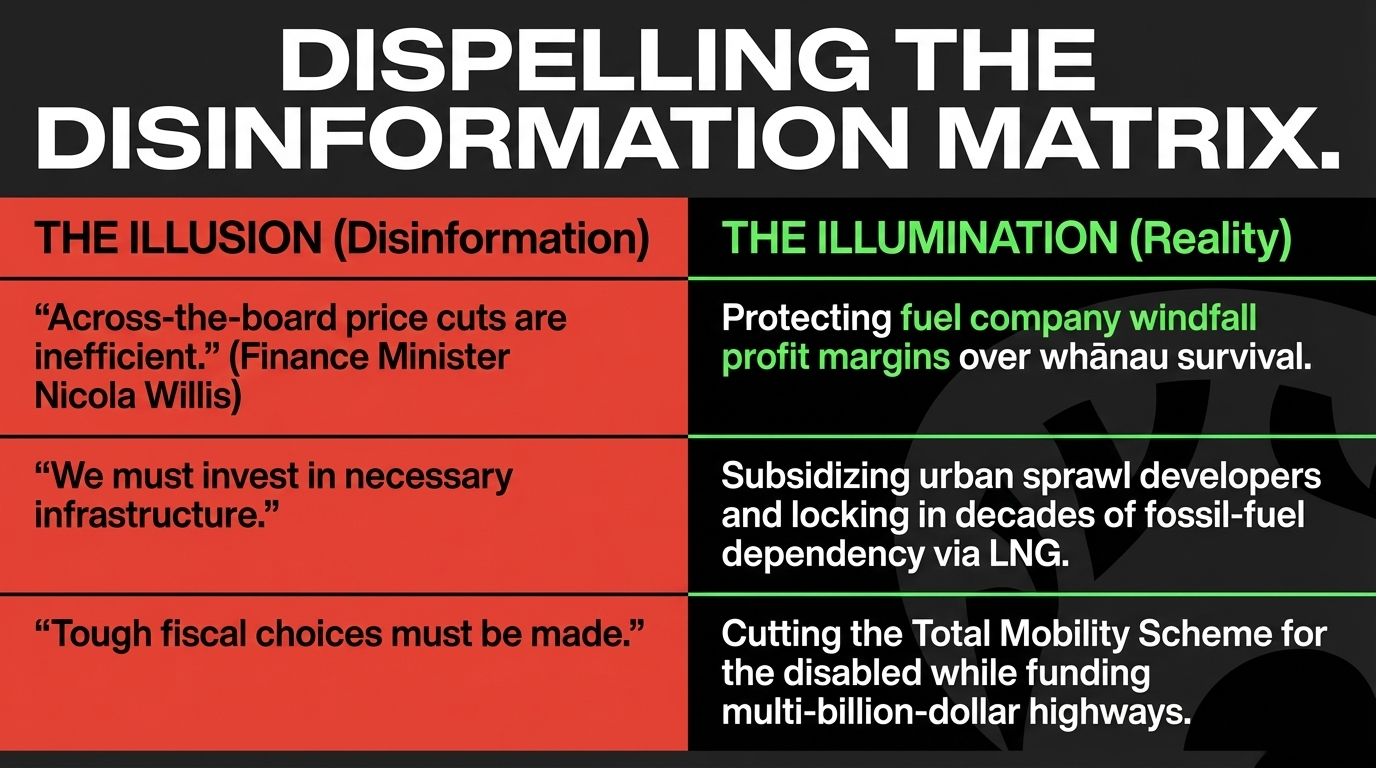
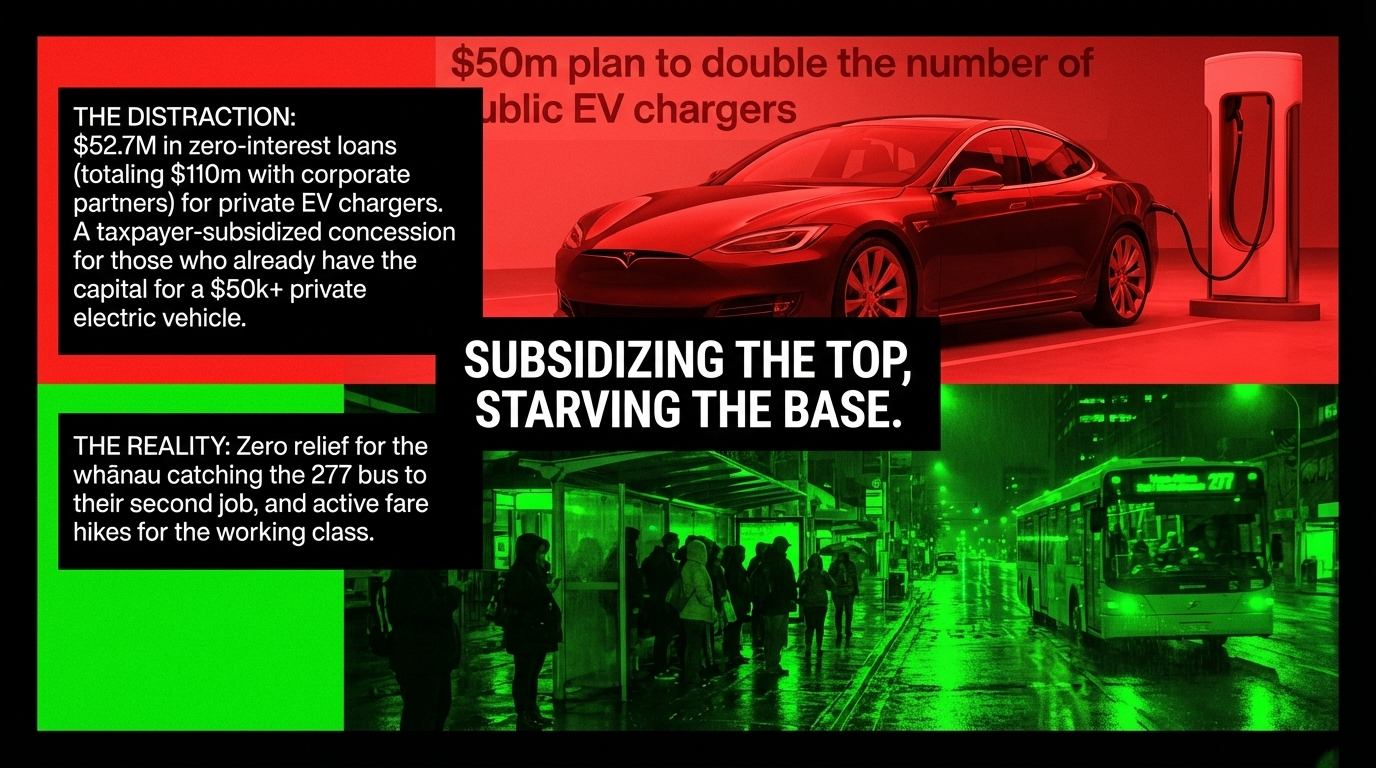
Finance Minister Nicola Willis dismissed "across-the-board price cuts" as inefficient while confirming that officials were designing targeted support — meaning the government is choosing to protect fuel company profit margins by keeping pump prices high and providing welfare to consumers rather than capping corporate extraction. As Interest.co.nz confirmed, the Greens' windfall profits tax directly targets this mechanism. Willis's rejection of it is a choice to protect corporate windfall over whānau.
Hidden Connection 3: Māori and Pasifika Over-Exposure to Transport Poverty
Transport poverty — the inability to afford to get to work, school, healthcare, or whānau — falls hardest on Māori and Pasifika communities, who are statistically over-represented in low-income households and in car-dependent urban peripheries. Free public transport for three months is not just a fuel crisis measure; it is a direct transfer of value to communities that have been systematically excluded from transport equity. The fact that public transport use has already hit a seven-year high during the fuel crisis shows people will use public transport when it is affordable — the barrier has always been artificial.
Hidden Connection 4: The LNG Terminal — Locking In Fossil Dependency
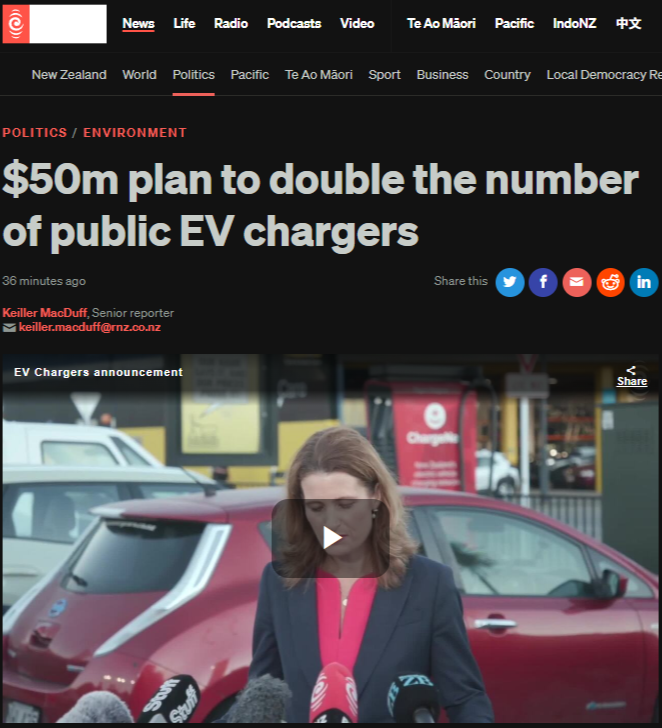
The proposed LNG import facility represents a decision to anchor Aotearoa to global fossil fuel markets for decades. Every dollar sunk into that infrastructure is a dollar not spent on energy sovereignty — on geothermal, wind, solar, and tidal energy that would insulate our communities from exactly the kind of Middle East supply shock we are experiencing right now. This is a choice that serves multinational energy companies. The Greens naming it as a fund source for public relief is strategically significant: it reframes the budget trade-off explicitly.
Hidden Connection 5: The Disability Community as Political Shock-Absorbers
The Total Mobility Scheme cuts — planned for 1 July while this crisis rages — are the clearest example of the government's triage logic: protect infrastructure spend, protect fuel company margins, and make disabled and elderly people absorb the shortfall. Davidson is right to name this a justice issue, not just a fiscal one. Māori are significantly over-represented among Total Mobility Scheme users due to higher rates of disability and chronic illness in our communities — a legacy of colonisation, poverty, and inadequate healthcare access.
Ngā Hua — Quantified Harm and Action Pathways
The harms are measurable:
- $143.5 million — the cost of three months' free public transport, against multi-billion-dollar roading projects Interest.co.nz
- $3+ per litre — current fuel price, exceeding the Ukraine war spike of 2022 1News
- 7-year high in public transport use — demand exists; affordability is the only barrier 1News
- 1 July 2026 — date Total Mobility Scheme cuts are scheduled to hit disabled and elderly New Zealanders, many of them Māori RNZ
- 15 votes — the Green Party has offered, combined with National's numbers, sufficient votes to pass this without any other party RNZ
The pathway is clear. The blockage is not parliamentary arithmetic. It is political will — specifically, Luxon's reluctance to implement a windfall profits tax and redirect infrastructure spend away from the RoNS constituency.
Action for whānau and tāngata whenua:
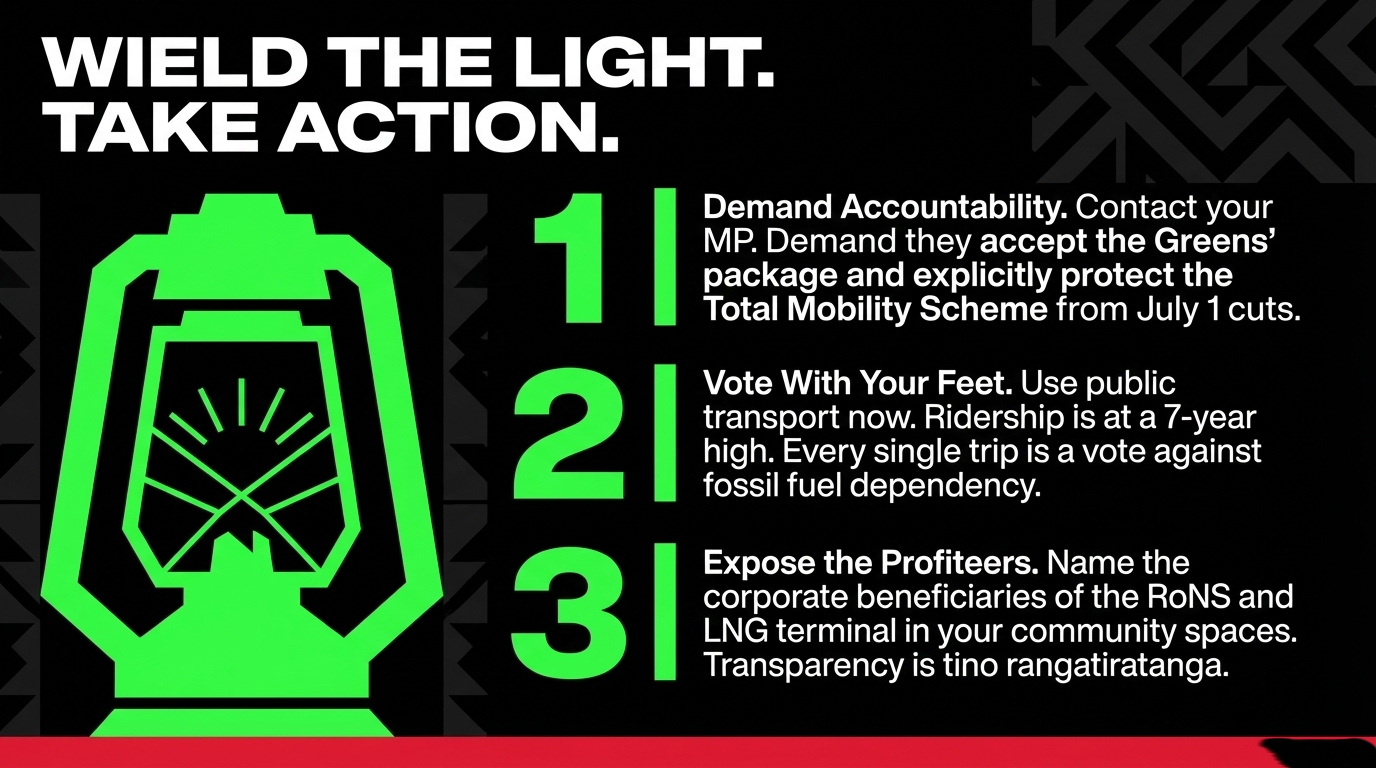
- Contact your MP and demand they support the Greens' package, naming the Total Mobility Scheme protections explicitly
- Use public transport now — the surge in ridership is political pressure; every trip is a vote against fossil fuel dependency
- Name the corporate beneficiaries of the LNG terminal and RoNS in your community conversations — transparency is a form of tino rangatiratanga
He Whakakapi — Conclusion: The Taiaha Points Both Ways
The Green Party's offer to Luxon is, in the language of tikanga, an act of manaakitanga — a reaching across the agonistic space of politics to say: people are suffering and we have the power to stop it together. It is a test of whether the government's stated commitment to "every Kiwi" is a phrase or a principle.
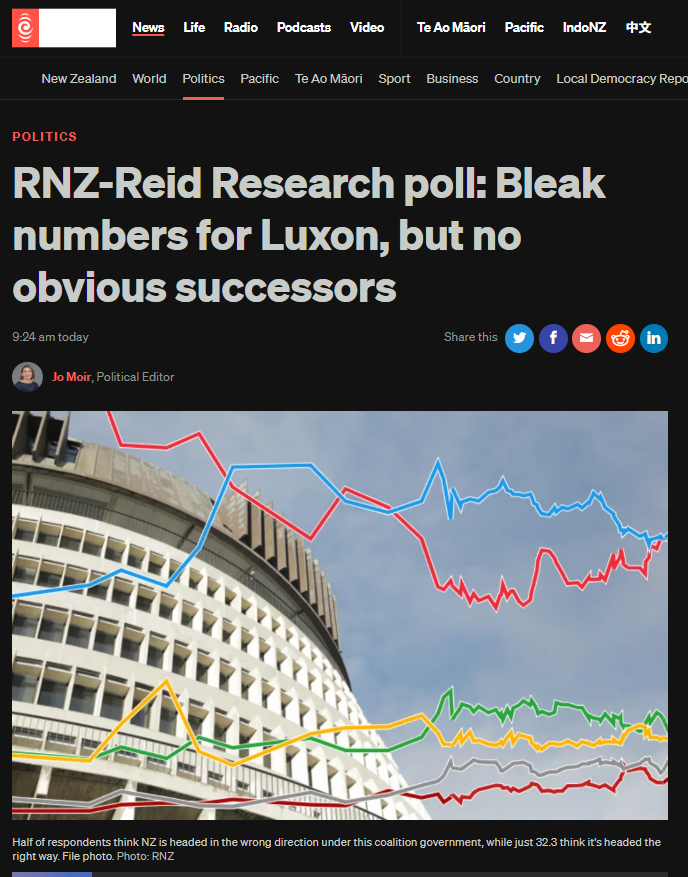
As of the time of writing, Luxon had not responded to the letter. RNZ confirmed he was "focused on fuel challenges, not polls" — a formulation that means, in plain English: I am watching the numbers before deciding whether to care.
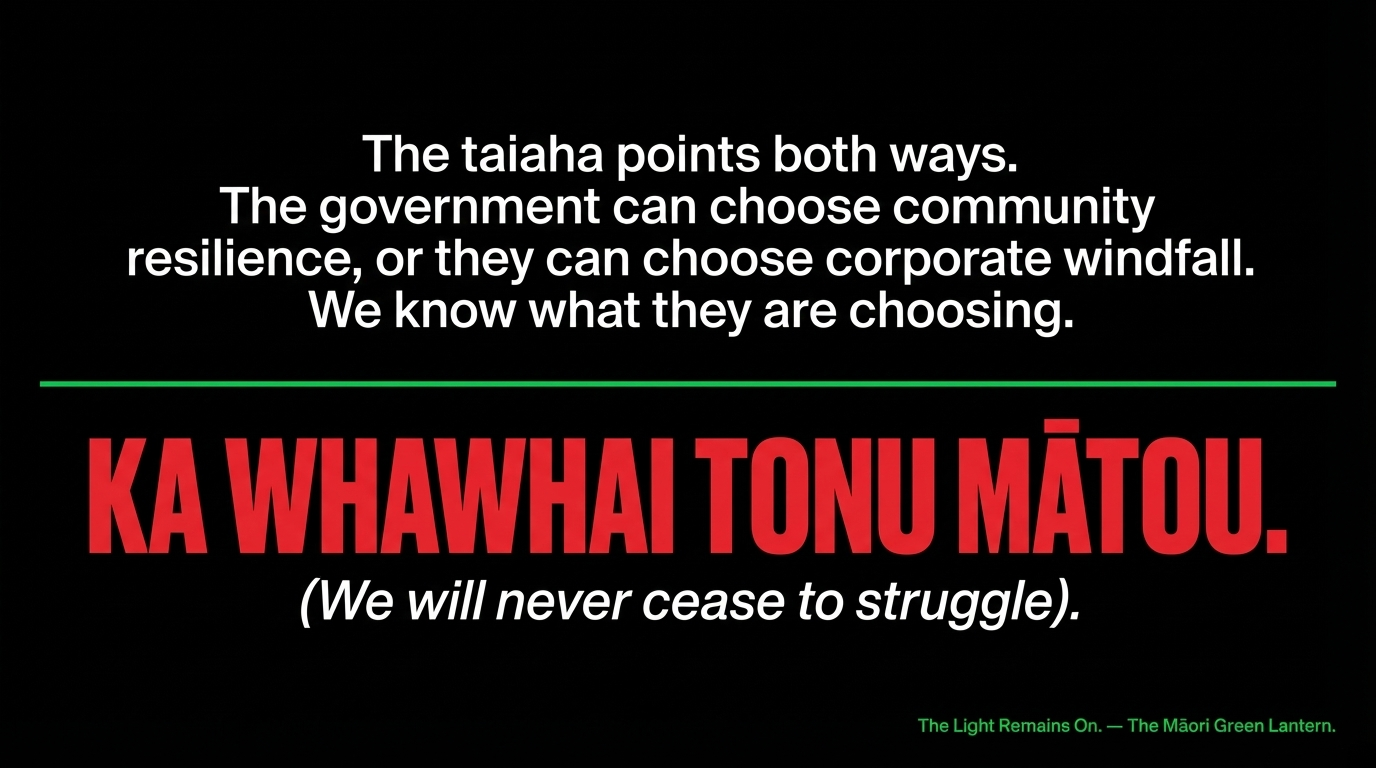
The taiaha swings where the evidence points. The evidence points to a government that has, at every turn, chosen corporate infrastructure over community resilience, fossil fuel dependency over energy sovereignty, and managed austerity for disabled and elderly people over windfall taxes on corporations making record profits from crisis.
The Greens are right. Luxon has the votes. The question now is whether he has the courage — or whether his party's donors do the deciding for him.
Ka whawhai tonu mātou — we will never cease to struggle.

Research conducted 24 March 2026. Tools used: search_web, fetch_url. Primary sources: RNZ, Interest.co.nz, 1News fuel data, Green Party statement, The Spinoff analysis.