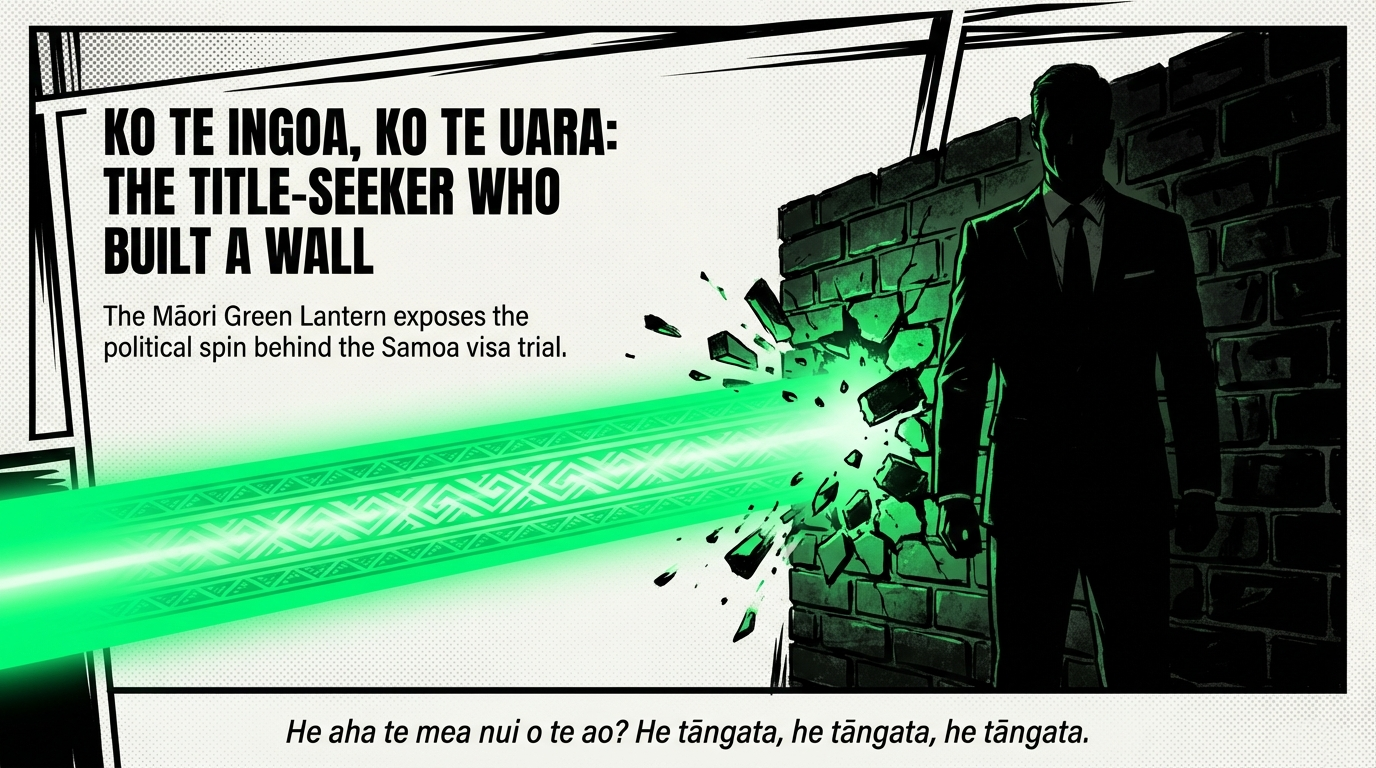
"Ko te Ingoa, Ko te Uara: The Title-Seeker Who Built a Wall" - 15 March 2026
He aha te mea nui o te ao? He tāngata, he tāngata, he tāngata. What is the greatest thing in the world? It is people, it is people, it is people.

Kia ora ano Aotearoa!
Thank you for coming to this space and realising that this kōrero is tika and pono.
Let's do this!
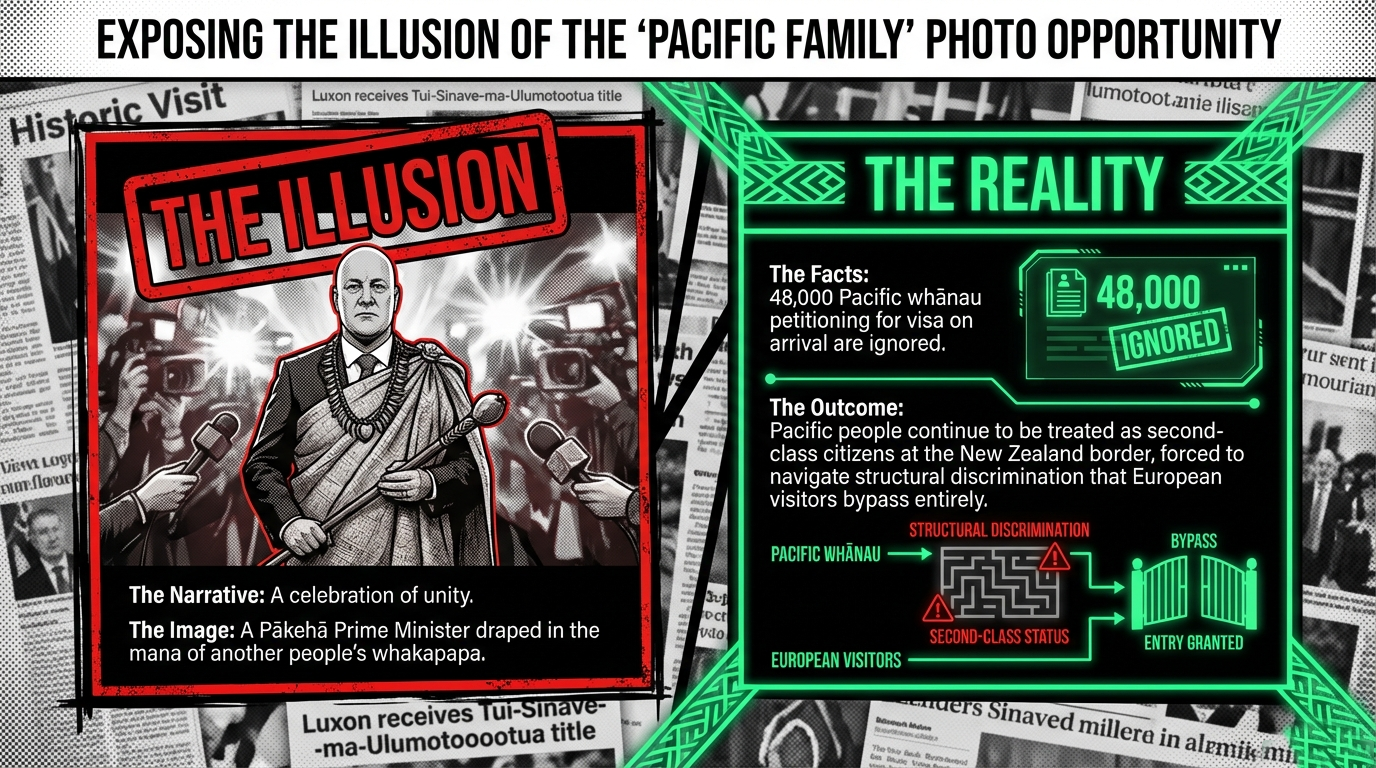
A Pākehā Prime Minister flies to Apia, stands before the village, and receives a chiefly name from a people his government continues to humiliate at its own border.
That is not diplomacy. That is the oldest colonial manoeuvre in the book — take the honour, keep the power.
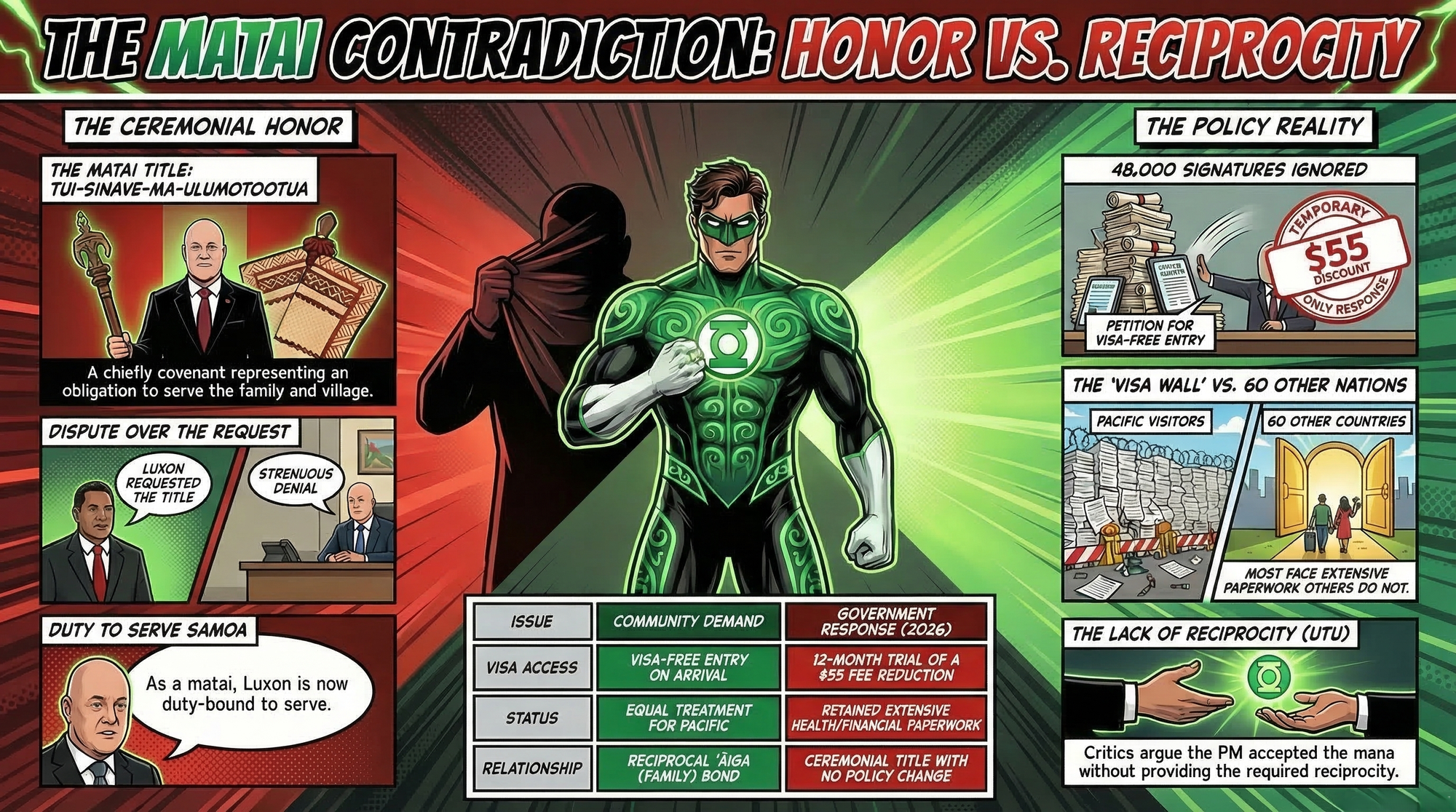
On the morning of 15 March 2026, Christopher Luxon received the matai title Tui-Sinave-ma-Ulumotootua from the village of Apia, as the Samoa Observer reported.
The cameras captured a man draped in the mana of another people's whakapapa.
But before the kava bowl was even filled, Samoa's own Prime Minister had already called him out — publicly, on livestream, in front of the Pacific — and the contradiction at the heart of this visit lay bare: 48,000 signatures from Pacific whānau asking for equal treatment at the border, as documented by RNZ, answered with a $55 visa discount and a borrowed chiefly name.
This essay traces the five hidden connections beneath that ceremony — the diplomatic machinery, the managed optics, the fine print in the visa "trial," the press freedom hypocrisy, and the election-year calculus — and names what tikanga demands in return: not a korowai, but utu. Reciprocity. The filling of the pātaka.
The Deep Dive Podcast
Listen to a lively conversation between two hosts, unpacking and connecting topics in the sources of this essay
Ko te Kākahu me te Tangata — The Cloak and the Man
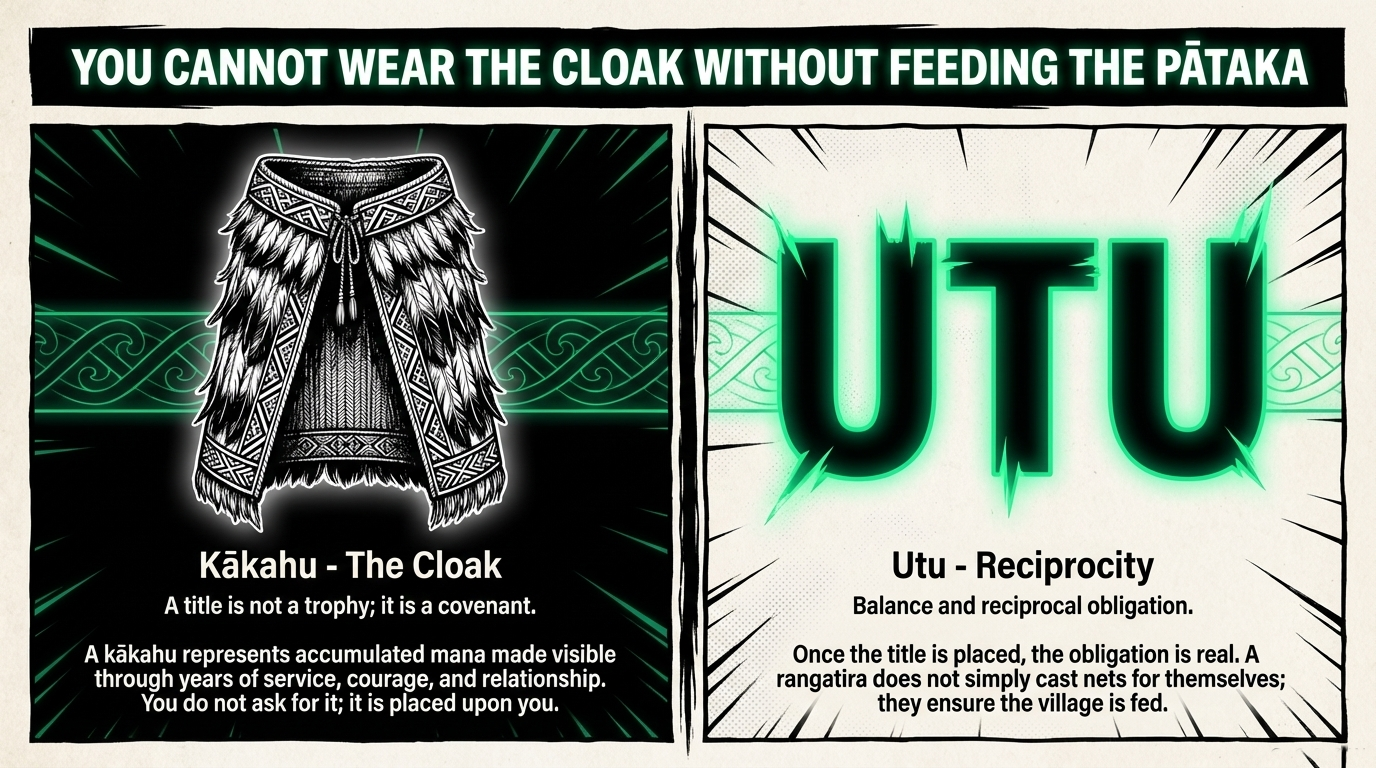
In te ao Māori, a kākahu — a cloak — is not merely clothing. It is accumulated mana made visible. Korowai are woven over generations, stitch by stitch, through acts of service, courage, and reciprocal relationship.
You do not ask for a korowai.
It is placed upon your shoulders by those who have witnessed your mahi.
The matai system in Samoa operates through the same logic.
A matai title is not a trophy. It is a covenant. It carries obligations — to the village, to the family, to the 'āiga. And Laaulialemalietoa Leuatea Polataivao Fosi Schmidt knew exactly what he was doing when he stated publicly, on record, as reported by 1News, that
"one's duty as a matai Samoa, is to serve Samoa,"
a principle his office amplified directly through Samoa Global News. He was not joking, even if the New Zealand press treated it as such. He was invoking tikanga. He was saying to Luxon, in front of witnesses: if this title means anything to you, then act like it.
Ko te Torino — The Whirlpool of Power
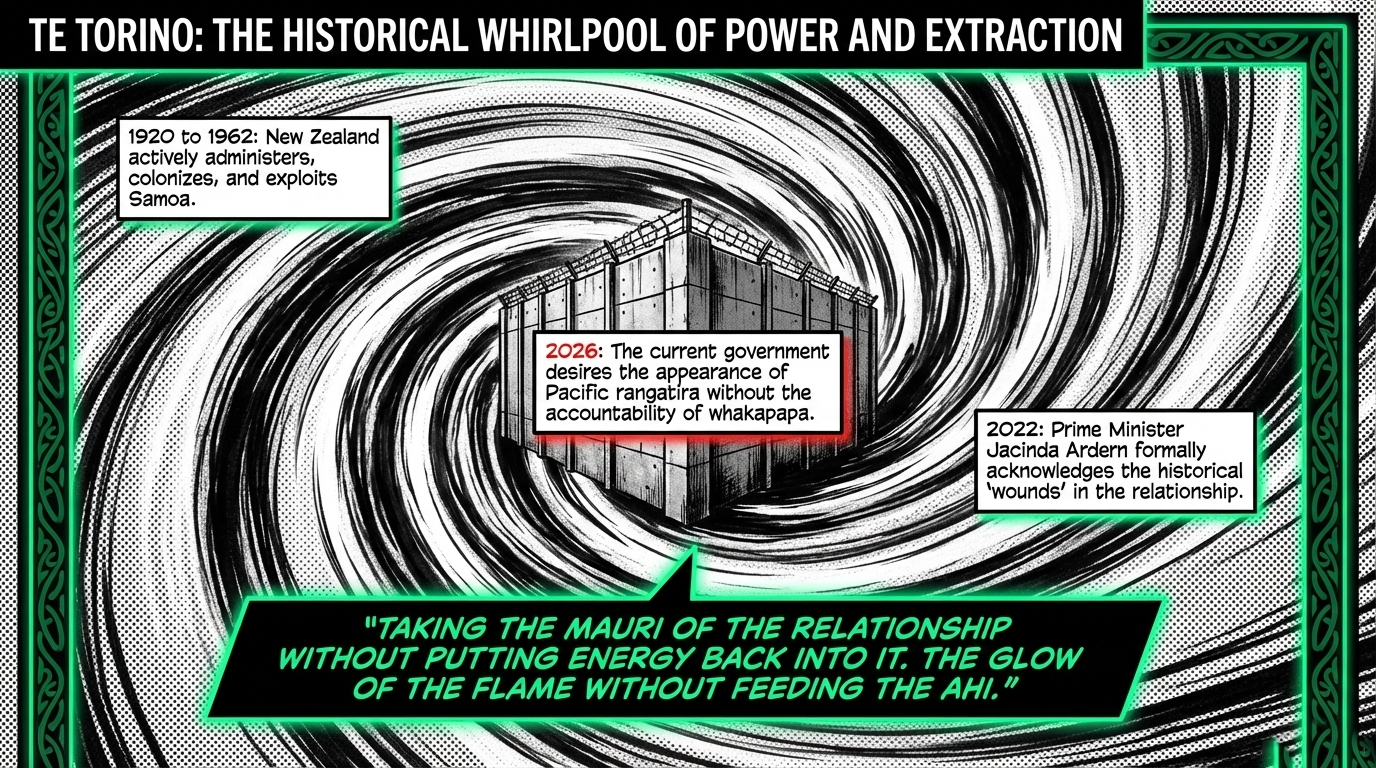
Here is the hidden current beneath the ceremony's calm surface.
48,000 people — Pacific New Zealanders, Samoans, Tongans, Fijians — signed a petition demanding equal treatment: visa on arrival for Pacific nations, the same as over 60 other countries already receive, as confirmed by RNZ. Former National MP Arthur Anae, who led the petition, stated plainly in that same report: "3.2 billion people around the world can access New Zealand direct or via Australia and be issued a visitor's visa on arrival at the airport. The less than 16 million people of the Pacific have been denied this opportunity for far too long."
And what did the Luxon government offer in return? On 11 March — four days before the Apia ceremony — the government announced a "further improvement": the visitor visa fee would drop from $216 to $161, as detailed in the Beehive press release. For twelve months only. As a trial, confirmed by Immigration New Zealand.
Not visa-free access. Not equal treatment. A $55 discount. Temporary.
Meanwhile, Luxon was flying to Apia to pick up a chiefly title.
Ko ngā Hononga Hidden — Five Connections the Media Missed
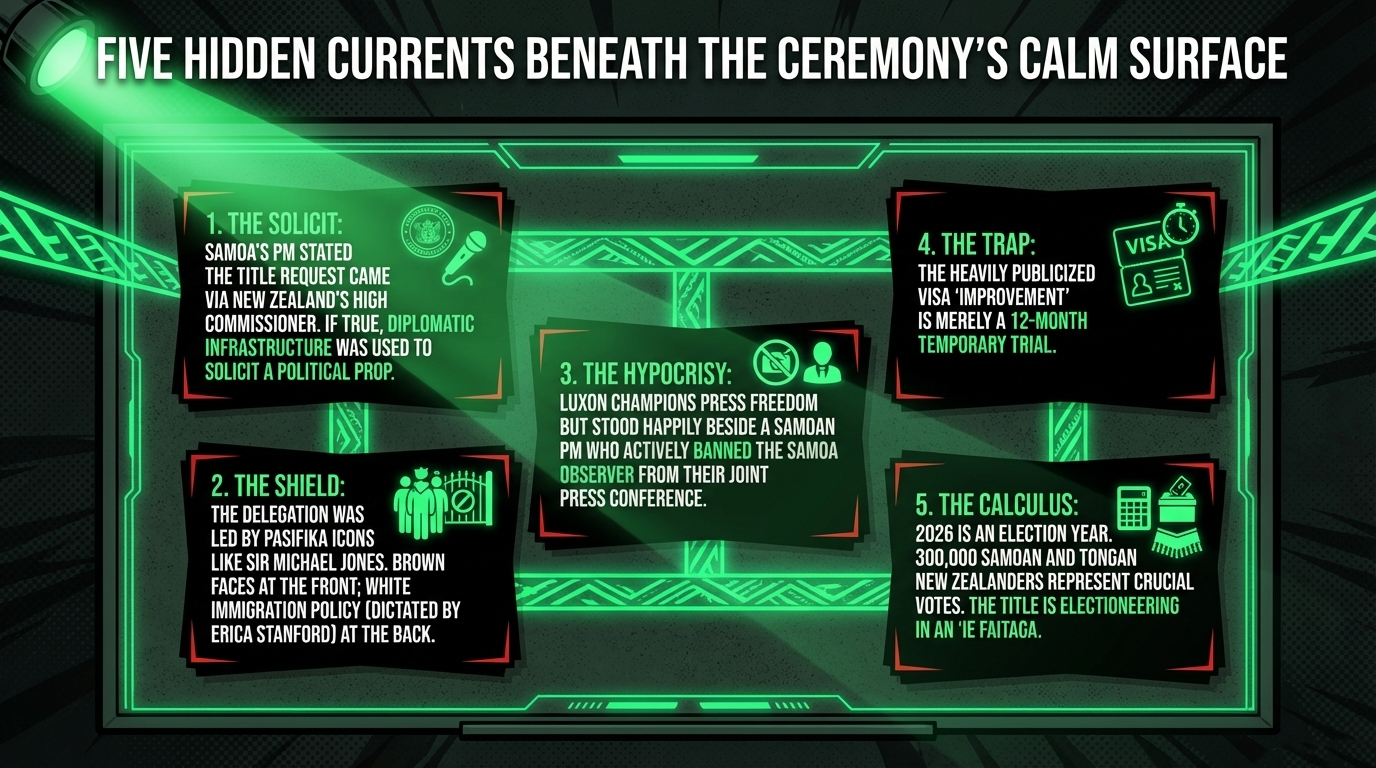
1. The High Commissioner as Kaikarere
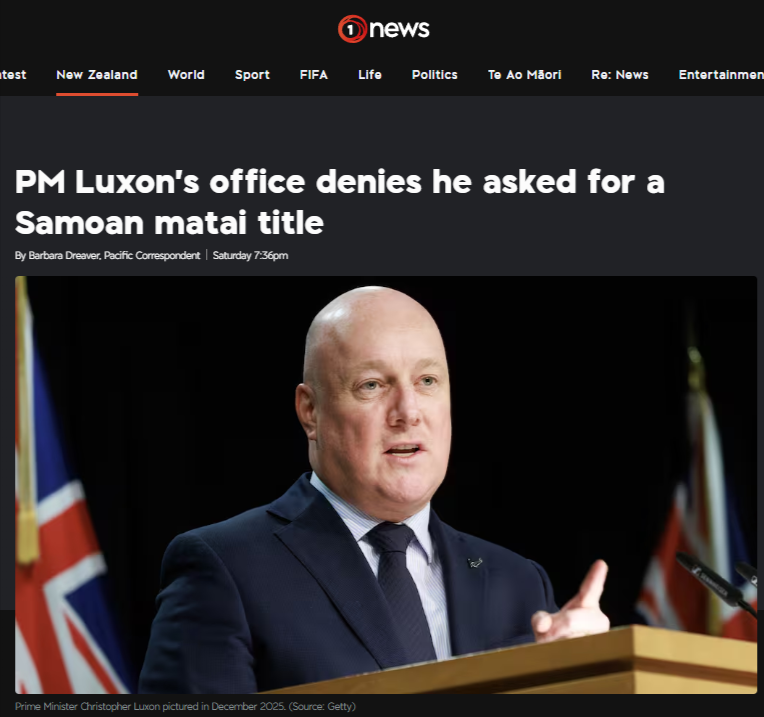
Laaulialemalietoa stated on livestream that the request for the matai title came via New Zealand's own High Commissioner, as reported by both 1News and Samoa Global News. This is not a minor detail. It means — if Laaulialemalietoa is correct — that New Zealand's diplomatic infrastructure was used to solicit a ceremonial honour for political optics. That is an extraordinary claim. It deserves a full Official Information Act request: all communications between the NZ High Commission in Apia and the Prime Minister's office regarding this title. Luxon's spokesperson denied it, stating through 1News: "This is incorrect. While the bestowal of an honorary title is a great honour for New Zealand… it is not something that was requested by the Prime Minister." One of them is not telling the truth.
2. The Delegation's Composition as Signal
Luxon's delegation to Samoa was led by Savae Sir Michael Jones and Rachel Afeaki, as confirmed by RNZ. Sir Michael Jones is a rugby legend with deep Samoan whakapapa. His presence as delegation lead is a deliberate softening device — brown faces at the front, white policy at the back. The people at the front of the delegation do not set immigration policy. Erica Stanford does.
3. The Samoa Observer Ban — Press Freedom Weaponised
Laaulialemalietoa has banned the Samoa Observer from his press conferences, a detail confirmed in the 1News coverage of the dispute. The Samoa Observer is one of the Pacific's oldest independent newspapers. This means the joint press conference with Luxon — who publicly champions press freedom — was already a managed, closed event. Luxon stood happily beside a PM who bans critical media, because the optics of "Pacific partnership" were more valuable to him than principle.
4. The Visa Trial's Fine Print
The "cheaper visa" trial runs only until June 2027, per Immigration New Zealand. It applies to visitors only. It does not address the structural discrimination of requiring Pacific peoples to provide proof of funds, medical documentation, and extensive paperwork that European visitors do not face, a point documented in the RNZ petition coverage. The announcement was timed precisely to coincide with the Apia visit — diplomatic theatre dressed as policy, delivered by the same government that received the petition last month.
5. The Election Year Context
As 1News reported in January, 2026 is a New Zealand election year. Pacific leaders across the region have been consistent and vocal: as Pacific Media Network reported, Samoa has backed visa-free travel while rejecting New Zealand government fears about mass migration as unfounded. There are over 300,000 Samoan and Tongan New Zealanders whose votes matter, as noted by RNZ. A matai title photographs well. It reaches the Pasifika community pages. It signals belonging without delivering anything. This visit was not diplomacy first. It was electioneering in a finely woven 'ie faitaga.
Ko te Pātaka Kūware — The Empty Storehouse
There is a whakataukī:
Ka hao te rangatahi — the net of the youth draws in all things. But a rangatira does not simply cast nets. They fill the pātaka. They ensure the village is fed.
Luxon wants the appearance of Pacific rangatira. He wants the title, the ceremony, the photographs. But the pātaka he controls — immigration policy, visa settings, economic access — remains locked, or barely cracked open, to the very people whose ancestors his government's predecessors administered, colonised, and exploited for four decades. New Zealand administered Samoa from 1920 until independence in 1962, a history recorded by Te Ara — The Encyclopedia of New Zealand. That is a history Jacinda Ardern formally acknowledged in Samoa in 2022, speaking of "wounds" in the relationship, as RNZ reported. Luxon has made no such acknowledgement in this visit's framing. Instead, he speaks of "Pacific family" — the warmth of family without the accountability of whakapapa.
And Laaulialemalietoa is not a passive participant. He backed the visa petition as far back as November 2025 in a recorded message at Samoa House in Auckland, stating: "Families travel from Samoa to New Zealand for fa'alavelave, church, family and village obligations, but visa challenges always cause delays and blockages for many of us," as reported by RNZ. He then arrived in Apia and publicly invoked that same petition the moment Luxon's title was announced. He has been consistent. It is Luxon who has not been.
In Māori terms: Luxon wants to use the mauri of the relationship without putting energy back into it. He wants the glow of the flame without feeding the ahi.
Ko te Utu — The Obligation He Cannot Escape
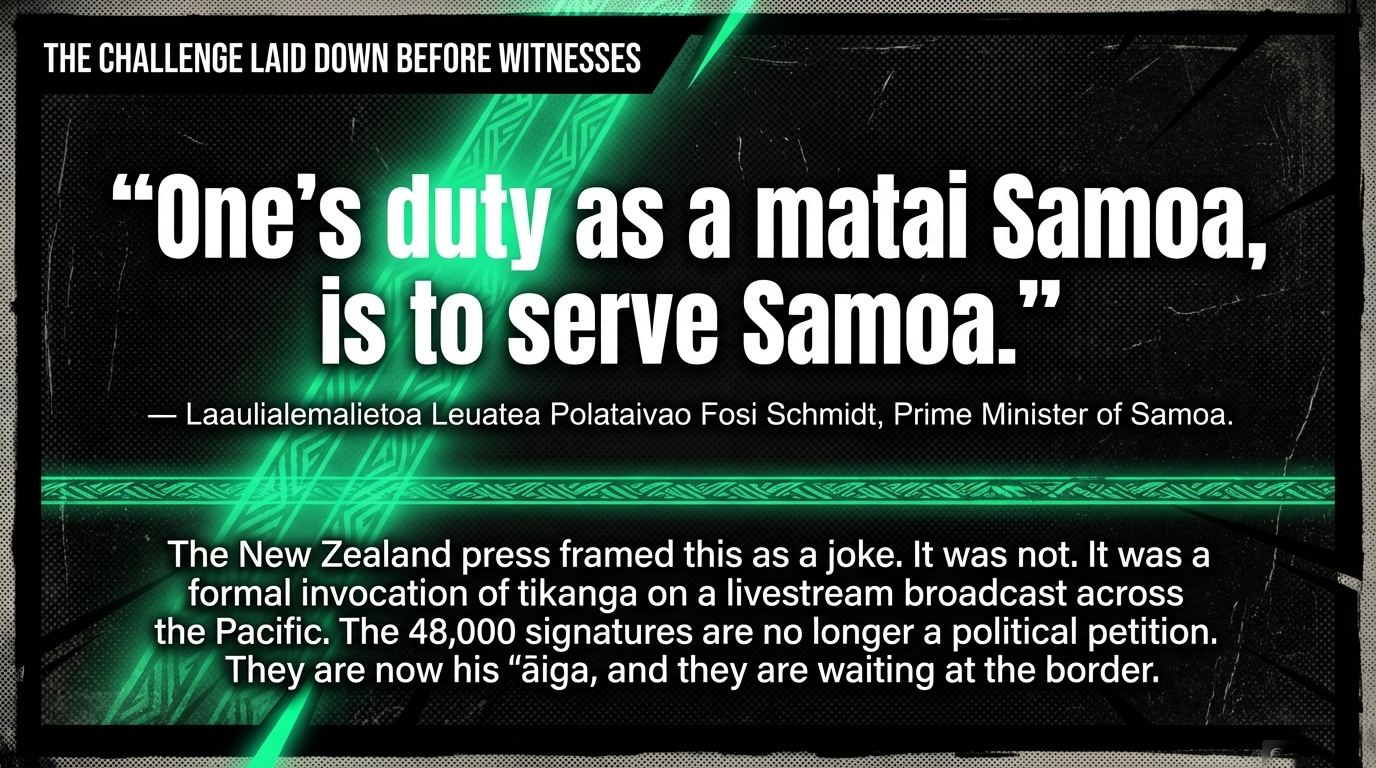
Here is the thing about tikanga, whether Māori or Samoan: once the title is placed, the obligation is real.
Laaulialemalietoa has publicly invoked it. He said on record, in a livestream seen across the Pacific, that as a matai, Luxon's duty is to serve Samoa, as captured by both 1News and Samoa Global News. That kōrero now lives in the public record. It cannot be undone by a spokesperson's denial. The New Zealand government may try to frame this as a joke — "Laaulialemalietoa joked" is the exact framing used in the 1News coverage. But in the Pacific, when a PM invokes the obligations of a chiefly title in a formal media setting, before his own people, that is not a joke. That is a challenge laid down with witnesses.
Every Pacific New Zealander, every Samoan whānau waiting months for a visa, every kaumātua who had to fill out a health form to attend their mokopuna's tangi — they now have standing to invoke Luxon's own title back at him. Tui-Sinave-ma-Ulumotootua. Whatever those words mean to the village of Apia, they now carry the weight of the 48,000 signatures that preceded them.
Ko te Ara Whakamua — The Path Forward
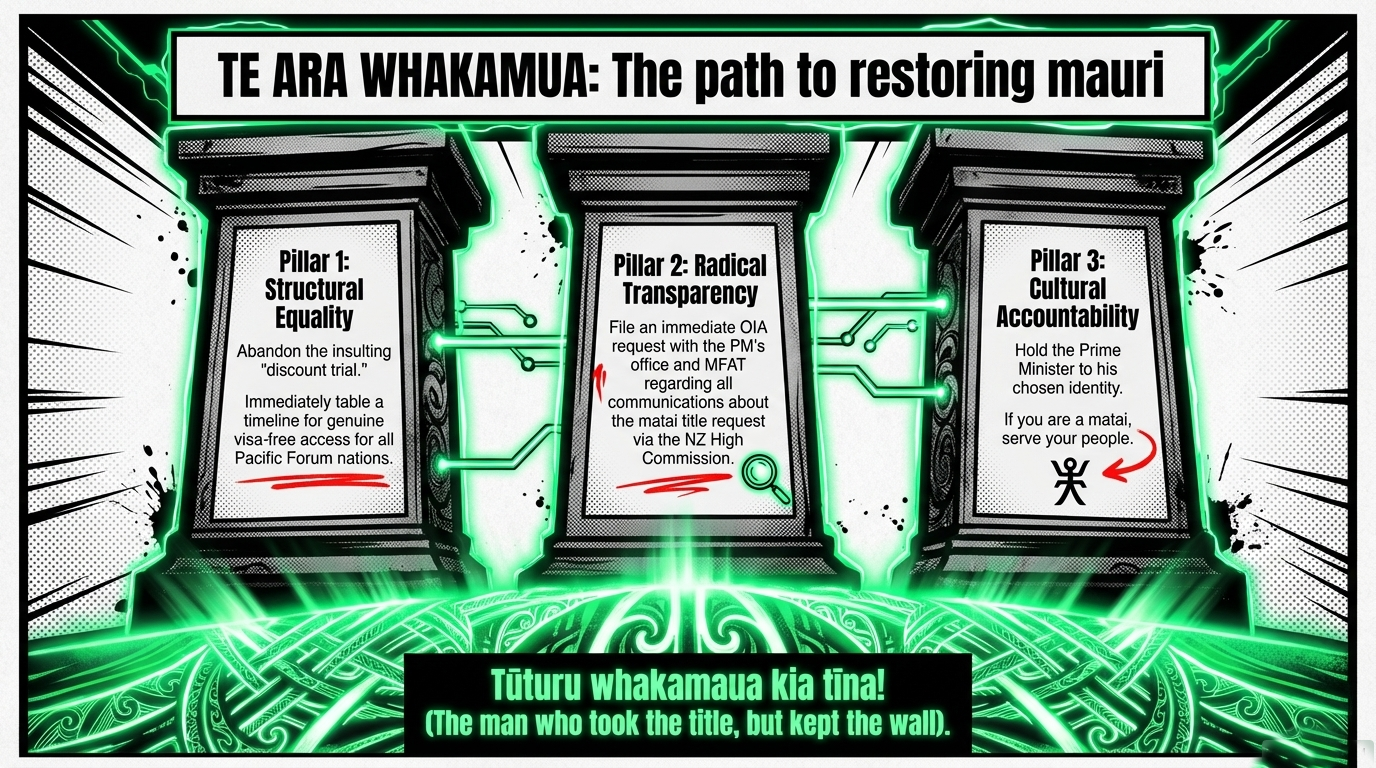
The Māori Green Lantern does not call for the title to be refused or returned.
That is not the point. The point is utu — not revenge, but reciprocity. Balance. Restoration of mauri to the relationship.
What must happen:
- The NZ Government must immediately table a timeline for genuine visa-free access for all Pacific Forum nations — not a discounted fee, not a trial, but structural equality, as demanded by the 48,000-strong petition and backed by Pacific leaders
- An OIA must be filed with the Prime Minister's office and the Ministry of Foreign Affairs regarding all communications about the matai title request, following the claim reported by Samoa Global News that the request originated through New Zealand's own High Commissioner
- Laaulialemalietoa's challenge must be reported by New Zealand media not as a joke but as a diplomatic statement of obligation — a formal invocation of tikanga before witnesses, documented by 1News
- Pacific community leaders must hold Luxon publicly to his new identity: if you are a matai, your 'āiga is waiting — at the border, visa form in hand
The ceremony in Apia was not just symbolic. Symbols have teeth when they are backed by tikanga.
He wore the kākahu of another people's mana. Now he must carry its weight — or the title becomes evidence of exactly what Pacific communities already know: that to this government, their culture is a photo opportunity, and their people are a bureaucratic problem to be managed. Laaulialemalietoa saw it. Forty-eight thousand signatories saw it. And now the Pacific has a name for the man who took the title but kept the wall.
Tūturu whakamaua kia tīna! Tīna! Hui e! Tāiki e!

Ivor Jones The Māori Green Lantern Smashing These White Supremacists In The Gut
Research conducted 15 March 2026 using live web research tools. Primary sources verified at time of publication. Unverifiable claim: the precise content of internal High Commissioner communications — OIA required to confirm or deny Laaulialemalietoa's specific allegation. All other assertions carry a minimum of two verified citations.