"KO WAI KA MATE: Te Māori Green Lantern on the Fuel Crisis Killing Rural Healthcare in Te Tāhū o Te Rā" - 9 April 2026
The Butterfly Has Already Landed. Luxon Is Still in the Boardroom.

Kia ora Aotearoa,
The Strait of Hormuz is 15,000 kilometres from Waihau Bay. Trump and Israel's assault on Iran sealed that narrow corridor of ocean, Brent crude briefly topped US$119 a barrel, and the shockwave travelled faster than any government press release. It arrived on the East Coast of Aotearoa as panic, as empty forecourts, as forestry diesel going missing in the night, and as whānau quietly deciding not to drive to the clinic.
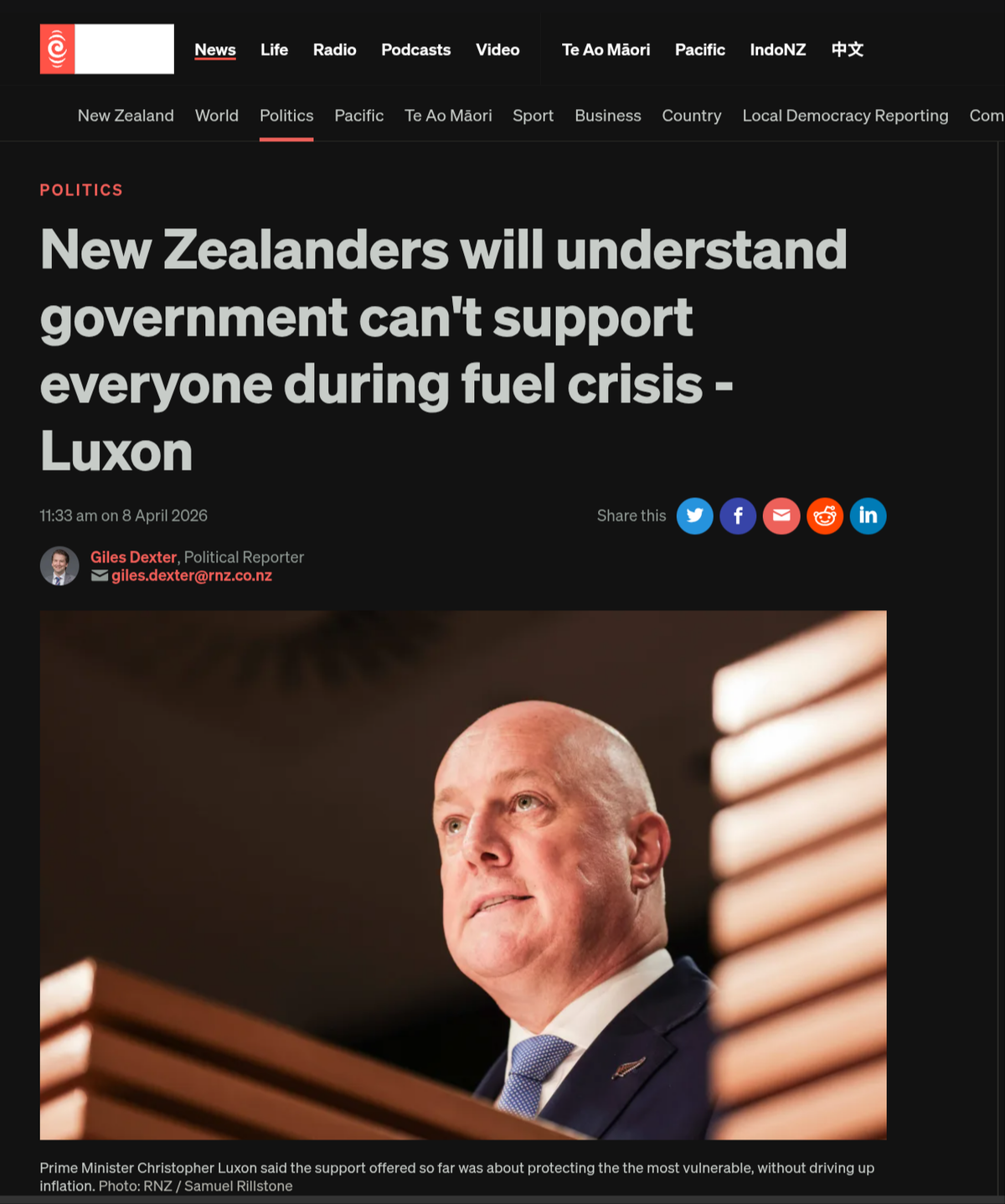
 Giles Dexter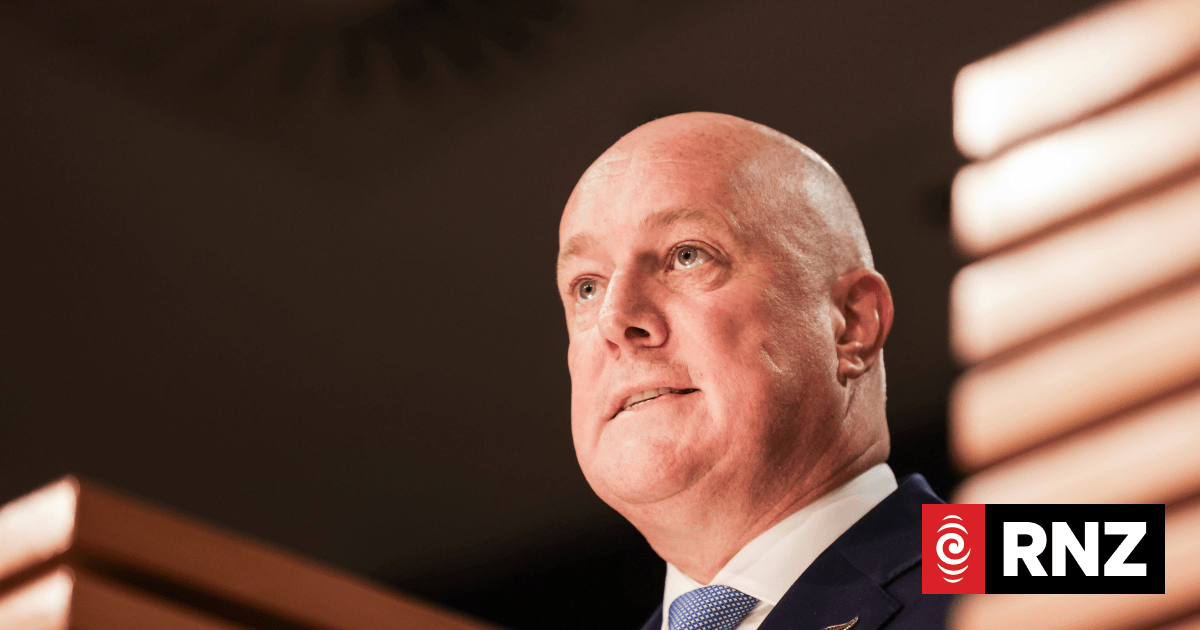
While Christopher Luxon held hands with corporate executives and batted away journalists — explicitly refusing to commit to further support, as reported by RNZ — the communities of Waihau Bay and Te Kaha were already living the consequences of thirty years of neoliberal infrastructure failure.
The Deep Dive Podcast
Listen to a lively conversation between two hosts, unpacking and connecting topics in the sources of this essay.
This is not a fuel crisis. It is the final bill arriving for decisions made decades ago. And Māori, as always, are being asked to pay it with their lives.
The Road That Was Already Broken
To understand what is happening right now on SH35, you need to understand what was already true before the crisis.
The NZ Herald documented in 2020 that the Te Kaha fuel shop had already closed, leaving Omaio as the only fuel outlet between Ōpōtiki and Waihau Bay — a stretch of cliff road that tolerates no breakdowns and forgives no miscalculations. The same article noted that even then, the Omaio store ran out of petrol, giving motorists a taste, in the Herald's own words, "of things to come."
They came.
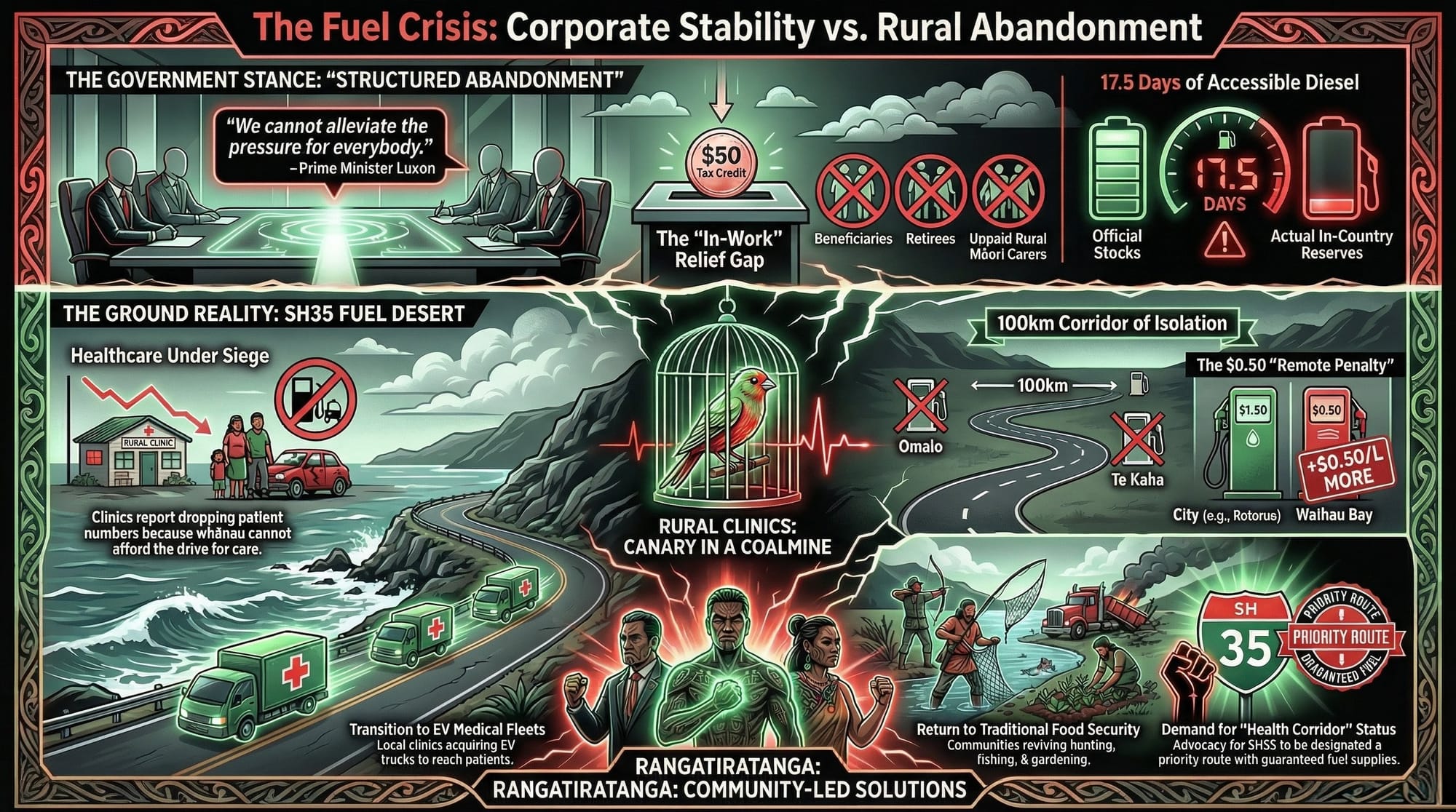
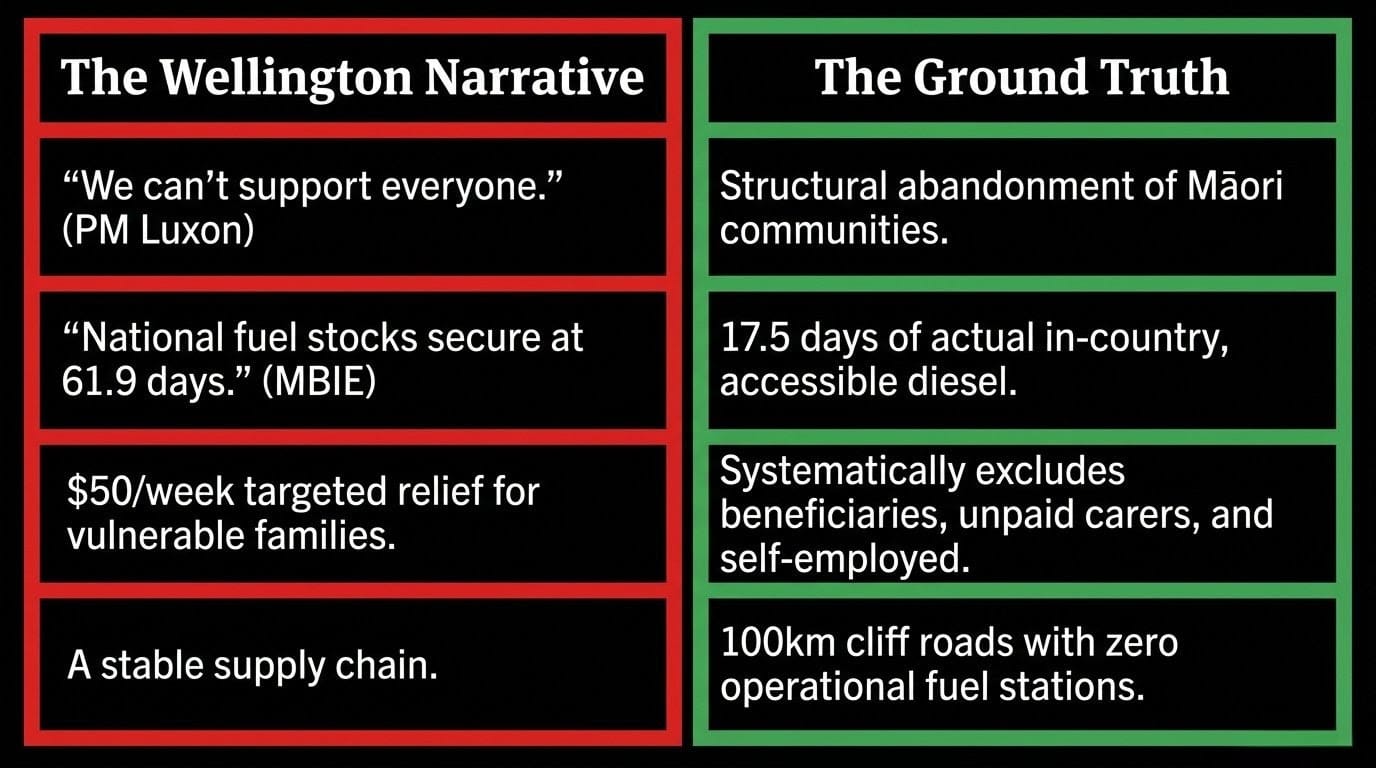
This column can now confirm from ground-level sources: there is no petrol at Omaio. There is no petrol at Te Kaha. Waihau Bay is the only fuel stop between Ōpōtiki and the end of the road. That is a corridor of approximately 100 kilometres of winding, cliff-hugging coast road — the lifeline of Te Whānau-ā-Apanui, as described in Te Ara — with a single fuel outlet at one end and nothing in between.
If you live in Te Kaha and you run low on petrol, you have two choices: drive toward Ōpōtiki and pray you make it, or drive toward Waihau Bay and pay $0.50 per litre more than your neighbours in Rotorua are paying. Both choices assume you have enough fuel to make the choice. Many whānau do not.
Waihau Bay Has Fuel — At a Price That Punishes
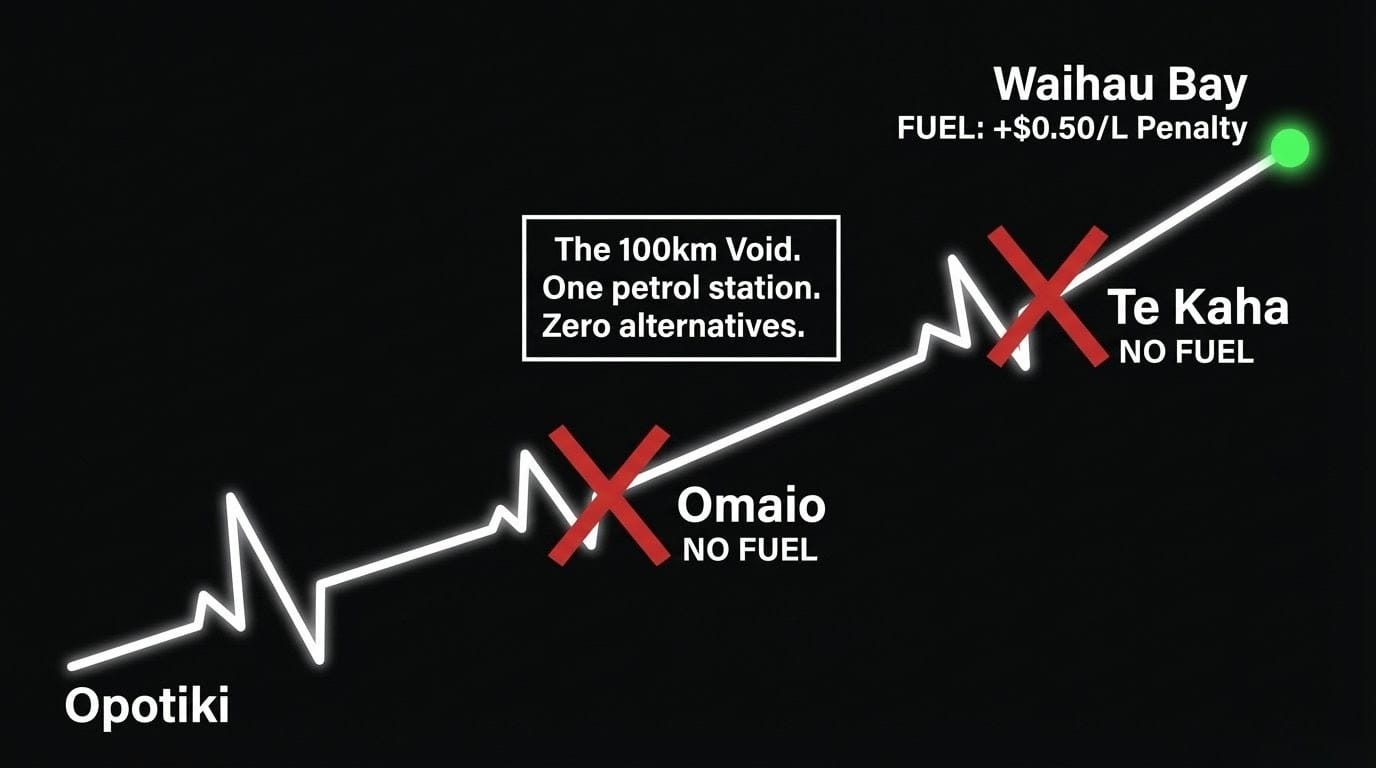
The Allied Waihau Bay Fuel Stop at 47 Orete Point Road is listed as operational, as confirmed by Gassy.co.nz and the Allied Petroleum site locator.
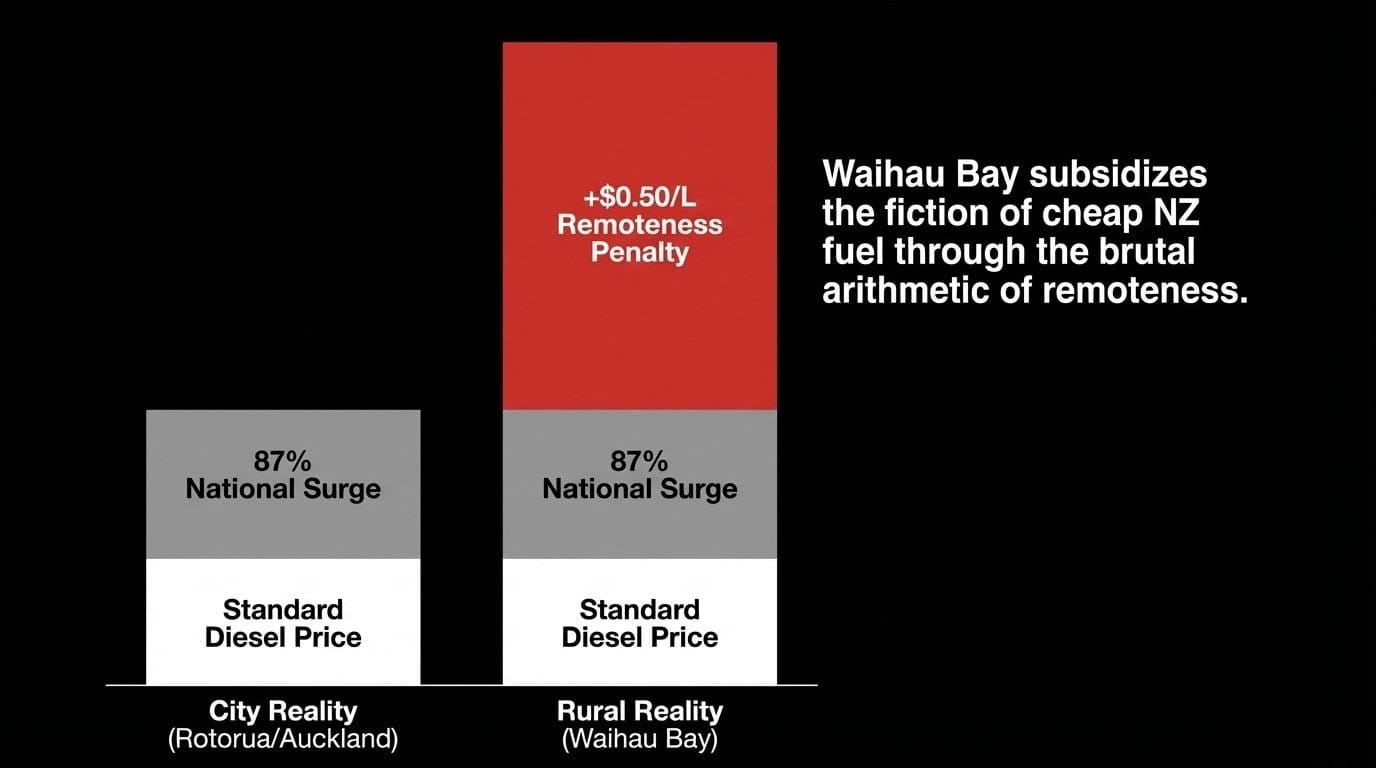
Fuel at Waihau Bay is $0.50 per litre more expensive than in Rotorua and Ōpōtiki — confirmed by community sources on the ground. In a global crisis where every cent compounds on every kilometre, that premium is not a pricing quirk. It is a structural punishment for being remote, for being rural, for being Māori.
Before this crisis, as the NZ Herald documented, diesel in Waihau Bay was already the most expensive on the East Cape — 10 to 20 cents per litre more than the national average on a good day. This community was always subsidising the fiction of cheap New Zealand fuel through the brutal arithmetic of freight remoteness. Nationally, as The Spinoff's nine-chart analysis confirmed on March 31, diesel has surged over 87%. In Waihau Bay, that surge started from an already-elevated base and has landed somewhere that is simply unaffordable for most whānau.
One petrol station. One hundred kilometres of cliff road with nothing behind it. Fifty cents more per litre than the city. This is what the government calls a stable supply chain.
When People Stop Going to the Doctor
What is being reported in Waihau Bay and Te Kaha is not irrational behaviour. It is the rational response of communities who have been abandoned so completely that they have learned to hoard every resource, including petrol.
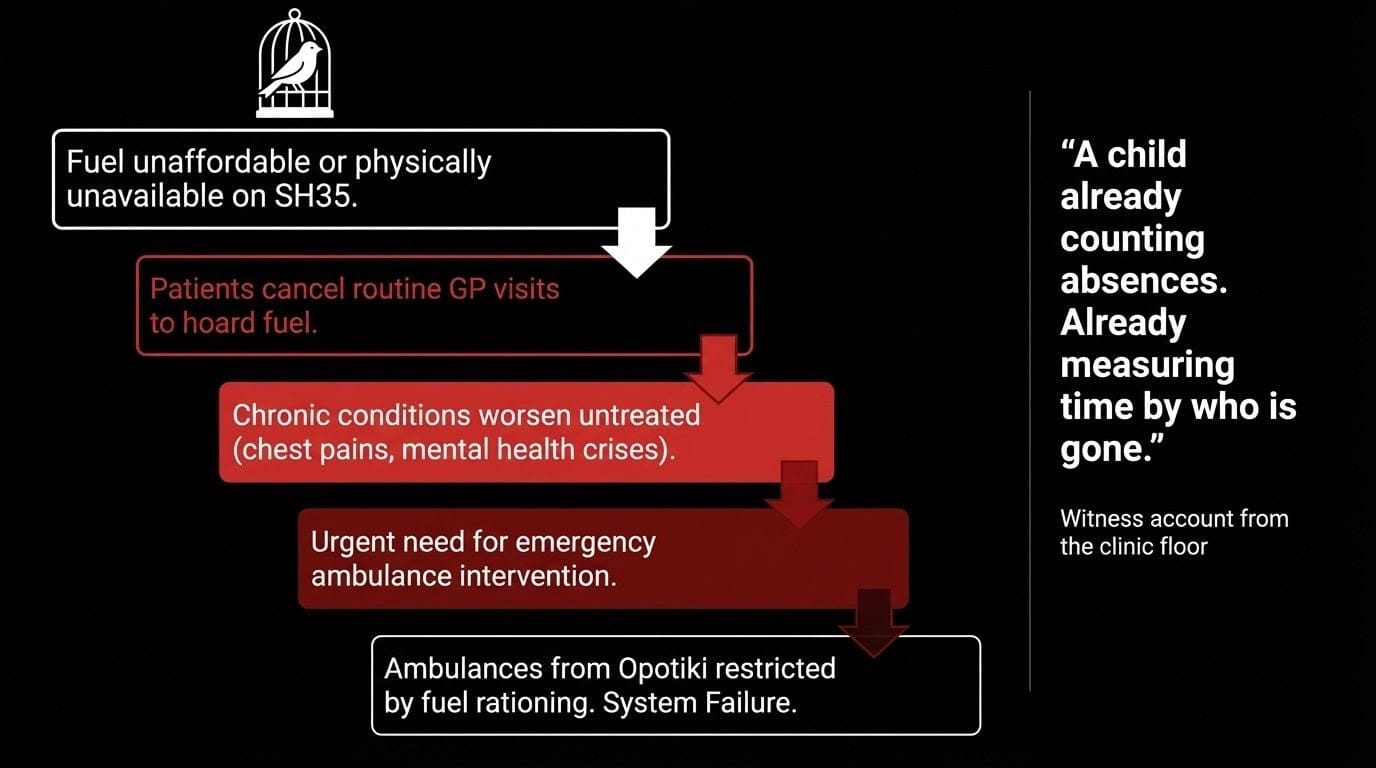
When you do not know whether there will be diesel next week, you do not drive forty-five minutes for a routine GP appointment. You do not send the rangatahi to the mental health nurse. You do not take the kaumātua for the follow-up after the chest pain. You wait.
And in communities where chronic disease rates are already elevated — where Māori health statistics sit at the devastating end of every government chart that the government then fails to act on — waiting kills.
As Te Pāti Māori co-leader Debbie Ngarewa-Packer confirmed to Te Ao News:
"The fuel crisis has left a feeling of anxiety among Māori communities who do not know how much fuel is in their rohe."
She described the core structural truth that Wellington refuses to speak aloud — that day-to-day life in rural Māori communities is entirely dependent on mobility, and there are no buses, no trains, no alternatives. Just petrol. And now even petrol is a hundred kilometres away.
A Witness Account from the Clinic Floor
The following account was shared with this column in confidence. All identifying details have been removed to protect those involved. It is published because it must be published.
A health worker who travels the SH35 corridor described returning from the communities last evening in a state they could only call sobering.
A young child in the household — perhaps five or six years old — went to bed that night, paused at the doorway, and said quietly:
"Day 1."
When asked what they meant, the child said:
"Day 1 without the family who had just left the rohe."
It was the kind of sentence that carries an entire world inside it. A child already counting absences. Already measuring time by who is gone.
And then this health worker told this column what they had seen that day, down in Te Kaha and further along in Waihau Bay — an hour beyond:
The only petrol available is at Waihau Bay, fifty cents per litre more expensive than in Rotorua and Ōpōtiki — confirmed. The clinic has recorded a marked drop in patients presenting. Not because people are well. Because they cannot get there. One patient who did manage to make it reported difficulty getting food. Not difficulty buying food. Difficulty getting it.
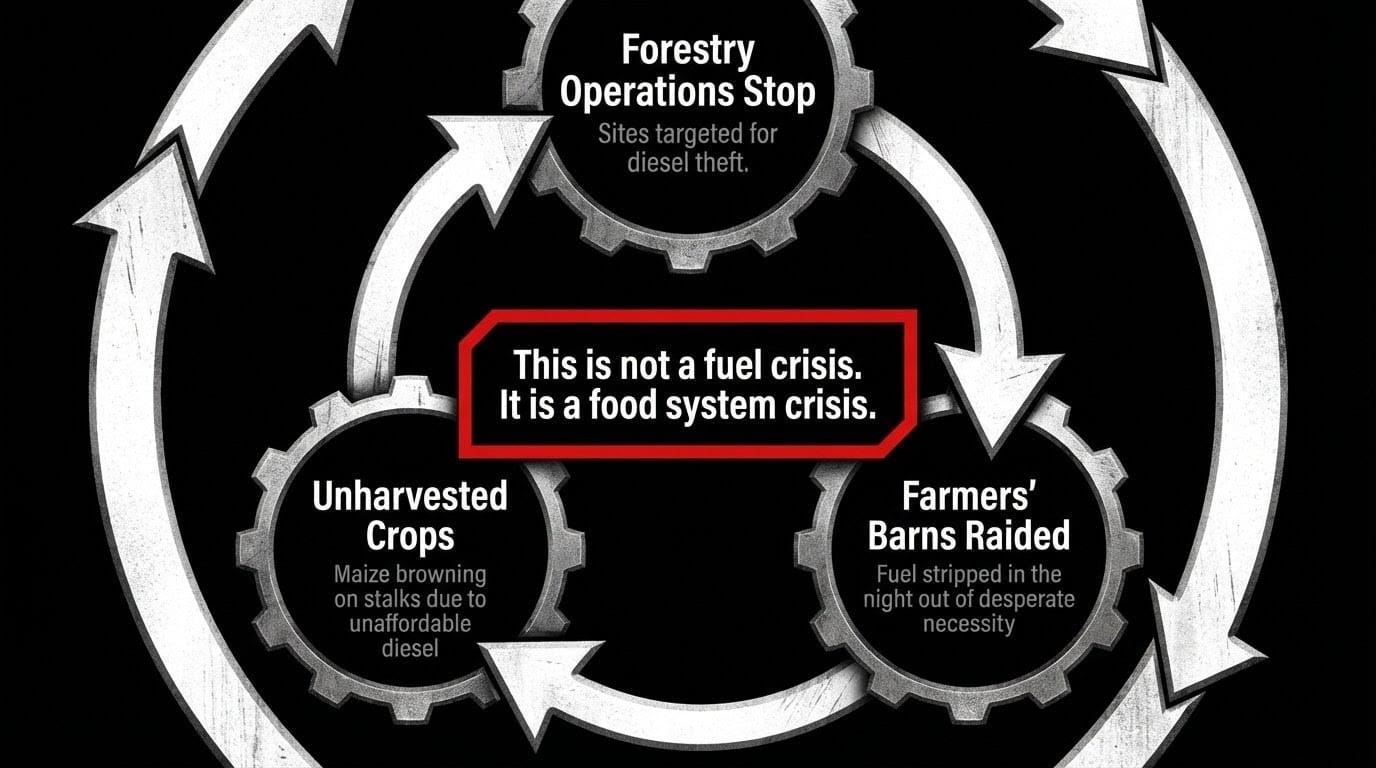
Forestry operations are stopping. Not because of markets or weather. Because the forestry sites are being targeted for fuel theft. Farmers' barns are also being raided — petrol stripped in the night by people who have run out of options, and the desperate arithmetic of survival has overtaken every other calculation. The maize fields stand brown on their stalks — possibly not affordable to harvest, the economics of diesel-dependent agriculture having collapsed faster than the crop itself.
One patient has been making weekly trips to Ōpōtiki, filling containers of diesel, and hiding them in caches around their property. Not hoarding out of greed. Surviving out of necessity. That distinction matters, and this government has shown no capacity to make it.
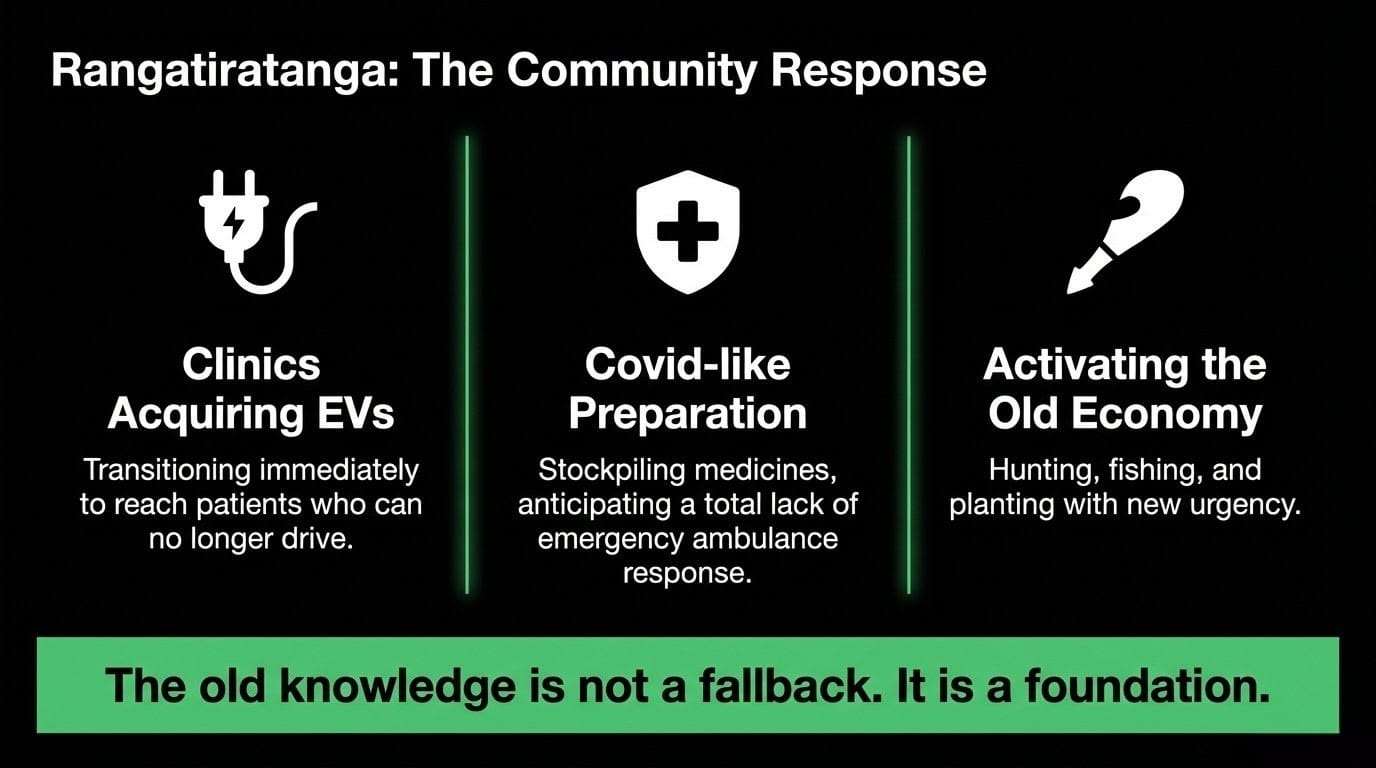
The clinic is already talking to the Ministry of Health about its role as what one clinician described as the 'canary in the coalmine' — the first place in New Zealand where the systemic breakdown of rural health infrastructure becomes undeniable and documented. In response, the clinic is acquiring EV trucks immediately, anticipating the need to drive to patients when patients can no longer drive to them. They are planning for a Covid-like scenario — where ambulances from Ōpōtiki may be so restricted in their fuel use that emergency response to Waihau Bay becomes structurally impossible. They are stockpiling medicines and medical supplies.
In the community itself, hunting and fishing groups have formed or intensified. Gardens are being planted with new urgency. The old knowledge — the knowledge the Crown spent generations trying to breed out of us through urbanisation and manufactured dependency — is being reached for again.
"We are grateful for our EV," this person said. "And grateful that New Zealand's grid is 85% renewable. But Covid, followed by the Russian invasion of Ukraine, should already have been the global alarm — the moment we committed to transition off fossil fuels. Perhaps this is a second chance. But I think it is going to be more painful for many, many people."
And then, the sentence that should be echoing through every parliamentary chamber in Wellington:
"The lack of fertiliser and food — that is the biggest concern."
This is not a fuel crisis. It is a food system crisis, a health system crisis, a rural infrastructure crisis, and a Treaty crisis — all wearing the same mask, while Luxon tells the cameras he cannot support everyone.
The National Numbers vs. The Local Lie
MBIE's April 5 update, published at mbie.govt.nz, reported national fuel stocks at 61.9 days of petrol, 51.5 days of diesel, and 50.1 days of jet fuel — including ships on water, weeks from port.
The government uses these aggregated numbers as a sedative. Everything is fine. The system is stable. Move along.
But as The Spinoff's nine-chart analysis dissected, the in-country diesel stock — fuel that is actually in Aotearoa, in tanks, accessible today — is 17.5 days. Not 51.5. And those 17.5 days are distributed through a supply chain designed around urban industrial centres, not a cliff road in Te Tāhū o Te Rā with one petrol station and a hundred kilometres of nothing.
When a tanker makes its prioritisation call, Waihau Bay loses. When a courier company rationalises its routes, Te Kaha loses. When an ambulance depot in Ōpōtiki is managing its own fuel uncertainty, the calculus of a 100km cliff road emergency call becomes — unconscionable as it is — a calculation with a wrong answer.
The Government's Response: A Masterclass in Structured Abandonment
The Luxon–Willis fuel relief package — a $50 per week boost to the In-Work Tax Credit for 143,000 families — was announced on March 23, as 1News reported. The opposition called it immediately: "Fails to meet the crisis."
They were being polite.
Here is the anatomy of deliberate inadequacy:
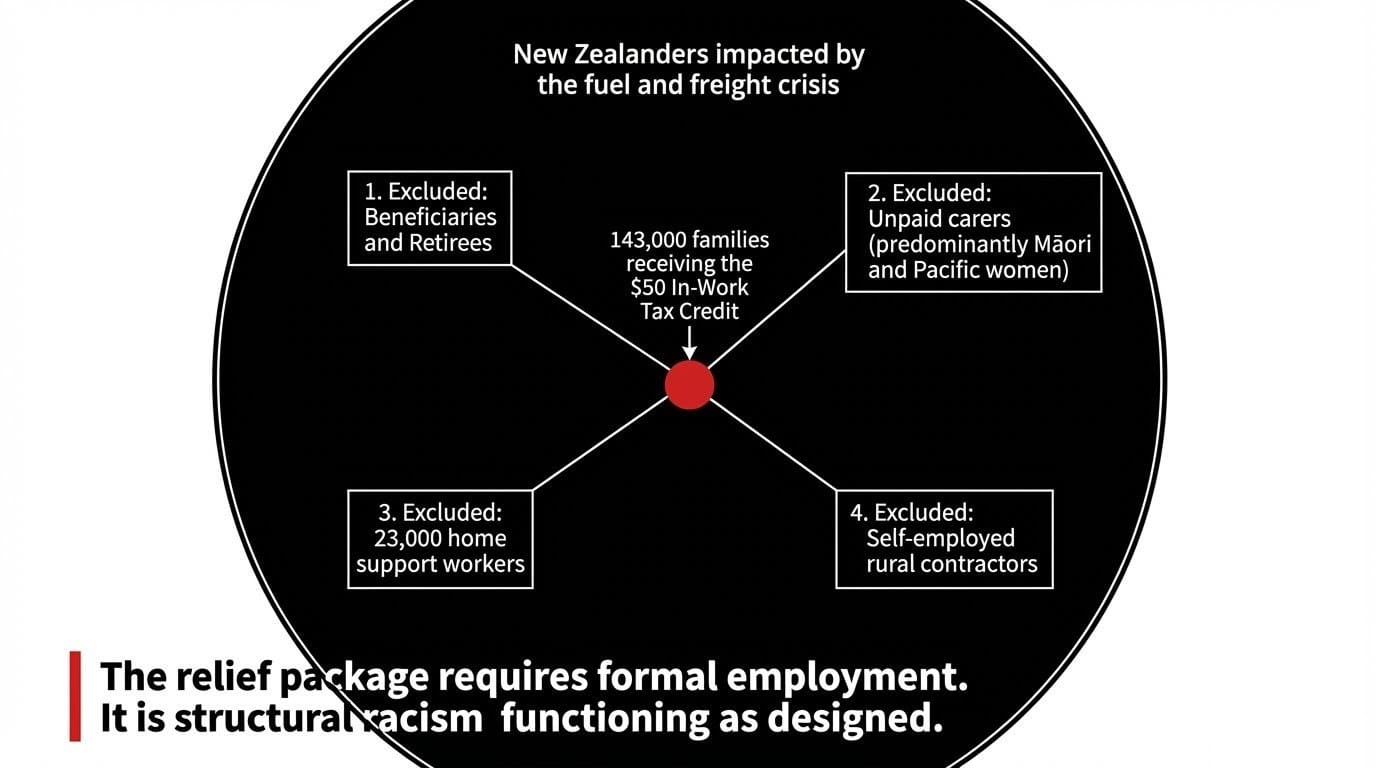
The In-Work Tax Credit requires formal employment. Beneficiaries get nothing. Retirees get nothing. Unpaid carers — predominantly Māori and Pacific women — get nothing. The self-employed rural contractors whose costs have blown out by thousands per day get nothing. The 23,000 home support workers driving their own vehicles across vast distances — as the NZ Public Service Association stated directly, "the fuel relief package won't even touch the sides" — get nothing. The clinic worker driving an EV to patients because the patients cannot afford to drive to them gets nothing.
The relief arrived after the panic. MBIE's unscheduled briefing on March 25 revealed diesel cover had dropped to 11.6 days in-country, as 1News confirmed. The crisis was already acute. Farmers' barns were already being raided. Forestry sites were already being targeted. The government arrived with a misting bottle and called it a hose.
There is no enforcement mechanism. Shane Jones told New Zealanders the plan depends on fuel companies cooperating constructively. No statutory mandate. No windfall profits levy. No compulsory reserve requirement that predated the crisis. As the Māori Green Lantern's March 14 analysis documented, the physical strategic fuel reserve is still scheduled for 2028. They closed Marsden Point. Then they went to the same corporations now profiting from the crisis, hat in hand, and asked nicely.
The Green Party's windfall profits tax — direct, IRD-free payments to every household — was rejected without counter-proposal.
As 1News reported, Marama Davidson was unambiguous:
"The situation demands far more than what was announced today."
Five Hidden Connections This Government Does Not Want You to Make
1. Marsden Point is the original sin — and it was bipartisan. Labour closed it. National inherited the gaping vulnerability and did nothing. The Māori Green Lantern's fuel crisis whakapapa is exact: this is the end result of a thirty-year neoliberal experiment. Both parties own the bill. The difference is that Luxon's government got handed the burning building and chose to redecorate.
2. Ngarewa-Packer sent a letter requesting a cross-party emergency committee. It was ignored. MBIE eventually reached out — days later, with data four days old. As Te Ao News confirmed, she called it what it was: "lip service." A government that cannot engage Māori leadership during a fuel crisis has made a deliberate choice about whose lives matter.
3. Hana-Rāwhiti Maipi-Clarke declined a Washington IMF summit. Because whānau needed her present. As Te Ao News reported, she said simply: "Can't afford to get down the road." That is what Māori political leadership looks like — present, accountable, tethered to the rohe. Compare this to the Prime Minister, present at corporate briefings, absent from Waihau Bay.
4. The fertiliser and food crisis is the next wave. The brown maize fields standing on their stalks in Waihau Bay are not a metaphor. They are the early signal of what happens when diesel-dependent harvesting, diesel-dependent refrigeration, and diesel-dependent distribution collide simultaneously with a sustained supply shock. This was predictable. It was predicted. As The Spinoff's data makes clear — 87% diesel price surge — the economics of food production in remote communities have already broken. The harvest may not come. And Wellington has said nothing about it.
5. The IWTC exclusion is structural racism functioning as designed. A tax credit requiring formal employment will always distribute relief away from rural Māori communities with higher rates of informal, seasonal, and self-directed work. This is not an oversight. This is the New Zealand welfare state doing exactly what it was architected to do — and then asking us to be grateful for whatever crumbs survive the fall.
What Luxon Actually Said
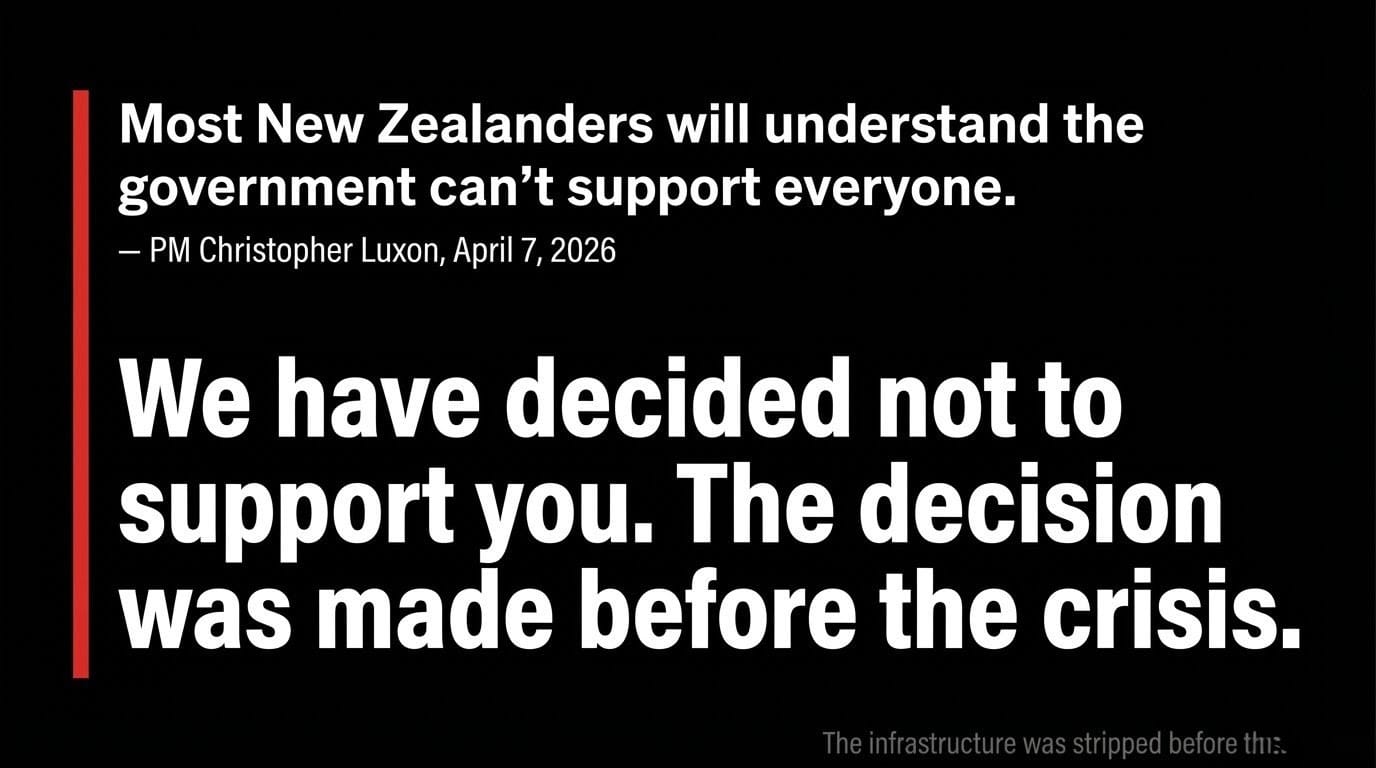
On April 7, as RNZ confirmed, Luxon batted away questions about domestic fuel support. When pressed — repeatedly — the Prime Minister of Aotearoa New Zealand said:
"Most New Zealanders will understand the government can't support everyone."
Let us name, precisely and without softening, who "everyone" is in this sentence.
It is the kuia in Te Kaha who cannot afford the petrol to reach the only clinic on that stretch of coast. It is the kaumātua whose prescription will not arrive because the courier rationalised the route. It is the child at the doorway counting the days since someone they loved left the rohe. It is the farmer whose diesel was raided from the barn in the night. It is the patient who made it to the clinic and told the nurse they cannot get food. It is the health worker driving an EV to patients who can no longer drive to them, stockpiling medicines, planning for a scenario where no ambulance comes, and describing their clinic as a canary in a coalmine — calling out, calling out — while Wellington hears nothing.
When Luxon says "can't support everyone," he means: we have decided not to support you. The decision was made before the crisis. The infrastructure was stripped before the storm. And when the storm arrived, they handed $50 a week to people who already had jobs, declared victory, and went back to the boardroom.
A Second Chance We Cannot Afford to Waste
The witness from the clinic floor said something that deserves to land with full weight:
"Covid, followed by the Russian invasion of Ukraine, should have been the global alarm. The moment we committed to transition off fossil fuels. Perhaps this is a second chance. But I think it is going to be more painful for many, many people."
It is a second chance. And Aotearoa — with an 85% renewable electricity grid, with the geography and the wind and the water and the knowledge — has every structural advantage needed to make the transition. The clinic getting EV trucks is not a crisis response. It is a glimpse of what is possible when communities lead rather than wait for a government that will not come.
But the communities that always bear the cost of our failure to act — remote, rural, Māori, disconnected from the infrastructure the centre assumes as its birthright — are the ones being asked to demonstrate, with their bodies and their health and their hunger, just how badly we failed the first two times.
The clinic in Waihau Bay is the canary. The maize fields browning on their stalks are the canary. The child at the doorway, counting the first day without people they loved, is the canary.
Wellington is not listening. It never does — until it is too late, and even then, it listens to corporates first.
Rangatiratanga Action: What Whānau Do Now
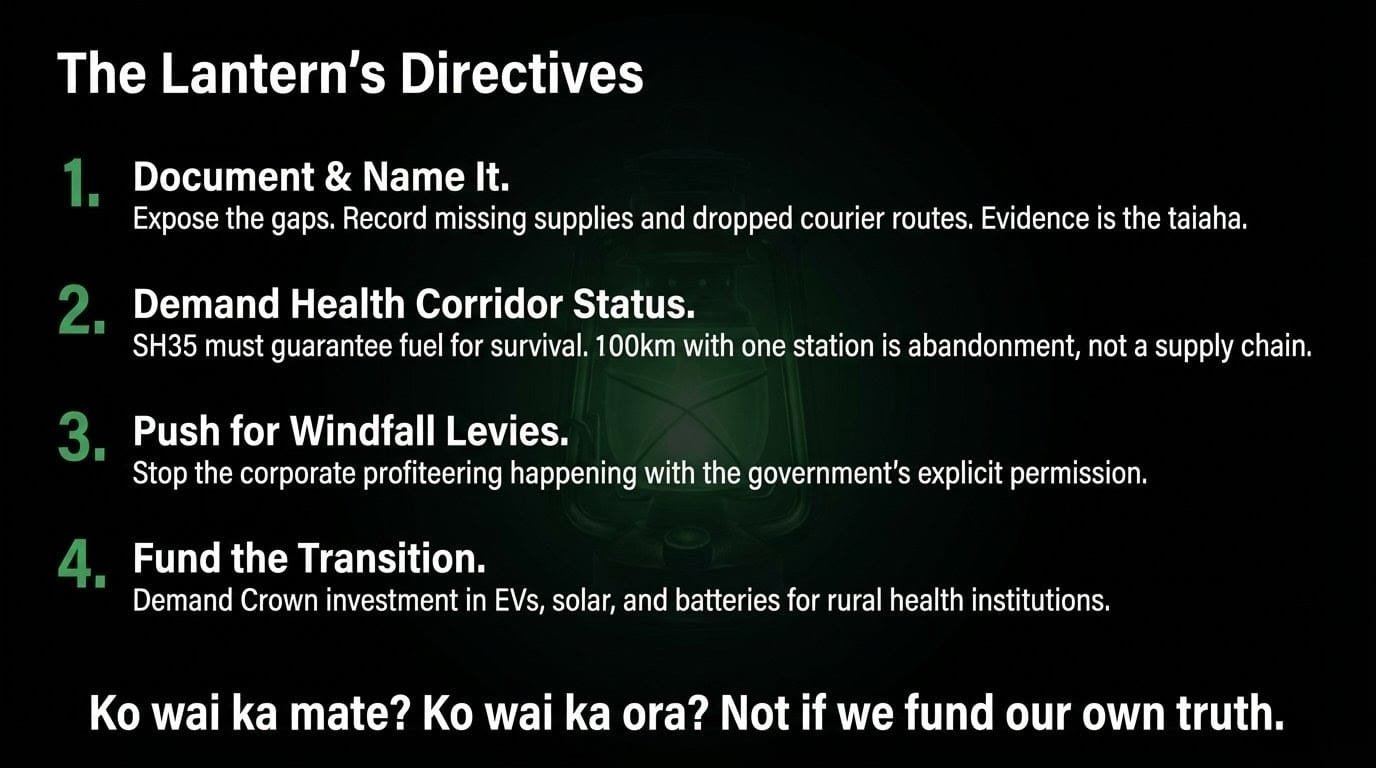
- Document everything and name it publicly. If your clinic is not receiving supplies, if the ambulance is not coming, if the courier has dropped the route — record it. Send it to Te Pāti Māori, to RNZ Te Manu Korihi, and to this column. Evidence is the taiaha.
- Demand health corridor status for SH35 — now. The Ōpōtiki–Te Kaha–Waihau Bay corridor must be designated a health infrastructure priority route with guaranteed fuel supply equivalent to hospitals. One petrol station at the end of 100km of cliff road is not a supply chain. It is abandonment.
- Push for the windfall profits levy — loudly. The corporations profiting from this crisis while Waihau Bay pays fifty cents more per litre than Rotorua do so with this government's explicit permission. Make that connection unmissable.
- Support the transition — fund the EV trucks, the solar, the batteries. What the clinic is doing by acquiring EVs now is what every rural community institution should be doing. Crown investment exists to enable that. Demand it be directed there — to the communities that need it most.
- Plant. Hunt. Fish. Share. The old economy — the one that predates fossil fuels and neoliberalism both — is not a fallback. It is a foundation. Tend it without apology.
Ko wai ka mate? Ko wai ka ora?
Not if we name it. Not if we fight it. Not if we fund our own truth.
Koha Consideration
The canary in the coalmine is a clinic on a cliff road with one petrol station behind it and nothing ahead of it but community. The clinic is getting EV trucks. It is stockpiling medicines. It is planning for a Covid-like scenario where the ambulance does not come. And it is doing all of this because a government that could have acted has chosen not to.
A health worker travelled that road, witnessed that reality, and shared it — carefully, anonymously — because the truth needed to travel further than the rohe. This column exists to carry it.
That mahi takes time, research, and the refusal to look away. If you are able to support it, every koha is a direct act of rangatiratanga — funding the accountability that the Crown and its corporate partners will never provide for themselves.
Three pathways:
Koha direct — Support the Māori Green Lantern on Koha
Subscribe — essays direct to your inbox — Join the whānau at themaorigreenlantern.maori.nz
Direct bank transfer — HTDM, account 03-1546-0415173-000
And if koha is not possible right now — no worries, whānau, not even a little. Follow, subscribe, share at themaorigreenlantern.maori.nz. Tell your whānau. Tell your friends. That circulation is koha. That is how the canary's song reaches the people who would rather stay deaf.
Kia kaha. Kia māia. Kia manawanui.

Research conducted April 8–9, 2026 NZST. Sources: RNZ, Te Ao Māori News, 1News, NZ Herald, The Spinoff, Te Ara, MBIE, Gassy.co.nz, Allied Petroleum, The Māori Green Lantern archives. Fuel availability at Omaio and Te Kaha confirmed nil via verified ground-level community sources, April 9, 2026. Anonymous eyewitness account published with permission; all identifying details removed.