"KO WAI KA TIAKI I TE PONO? Who Guards the Truth When the Billionaire Owns the Paper?" - 27 March 2026
A Canadian billionaire buys into New Zealand's largest media company. He secretly funds a racist's lawsuit against a Māori journalist. A court finds the rhetoric racist. And the paper he owns barely blinks.
He Kōrero Whakatuwhera — The Hidden Connection
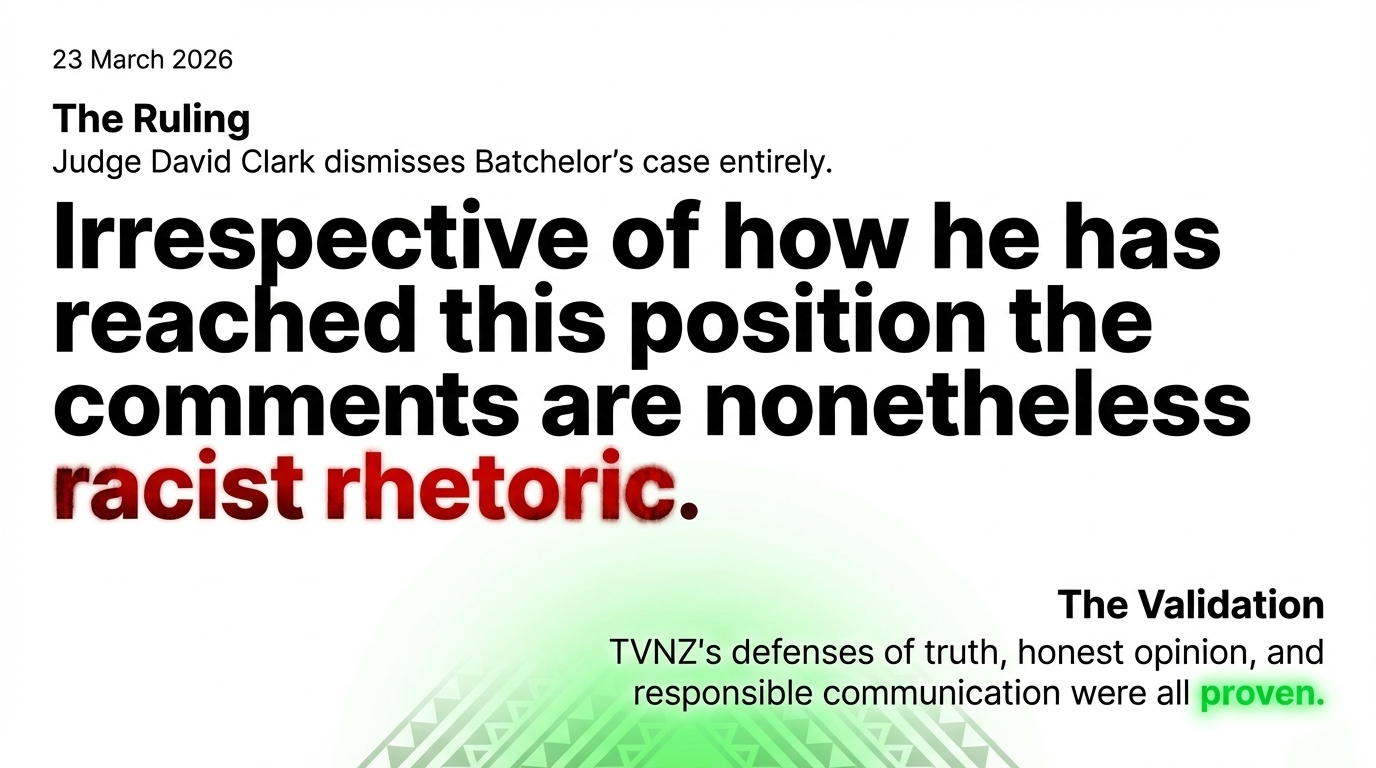
On 23 March 2026, Judge David Clark released his judgment in Batchelor v TVNZ. He dismissed Julian Batchelor's defamation case completely. He found TVNZ's defences of truth, honest opinion, and responsible communication were all proven. And then he wrote something that should have stopped the New Zealand Herald's presses cold.
"Irrespective of how he has reached this position the comments are nonetheless racist rhetoric," as the NZ Herald itself reported the judgment. "On any measure, the answer must be yes," the judge wrote of whether Batchelor used racist language, calling the comments "sustained, made over a long period."
The judge found that the man who sued TVNZ for calling him racist — is racist.
What the New Zealand Herald did not prominently tell its readers in the days that followed is the part that matters for Māori and for the future of media in this country: the man who funded, orchestrated, and drove that lawsuit from behind the scenes is Jim Grenon — a Canadian-New Zealand billionaire who holds an 18.5 percent stake in NZME, the company that owns the New Zealand Herald, Newstalk ZB, and a network of regional papers across Aotearoa.
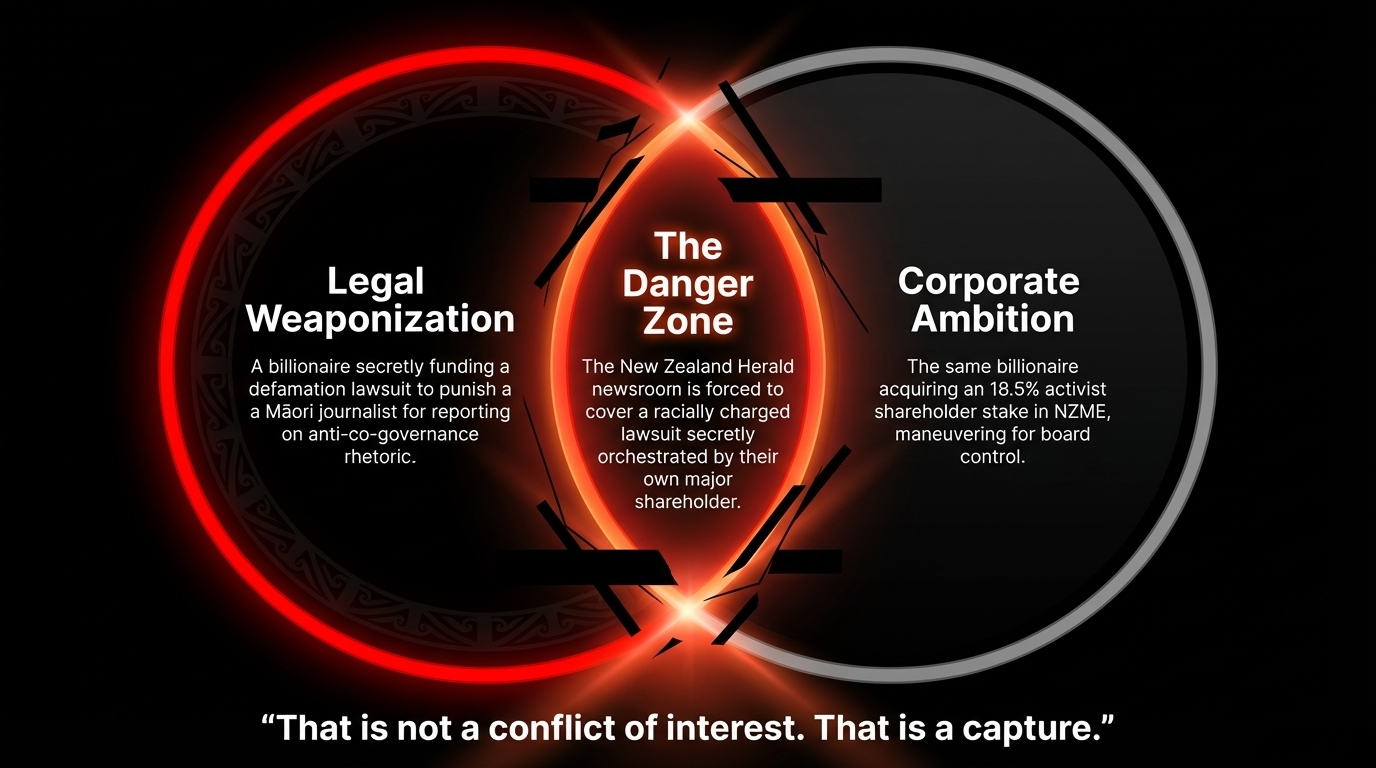
A major shareholder in New Zealand's largest media company secretly funded a defamation case against a Māori journalist and an academic whose crime was calling anti-Māori rhetoric what a court has now confirmed it is: racist.
That is not a conflict of interest. That is a capture.That is not a conflict of interest. That is a capture.
The Deep Dive Podcast
Listen to a lively conversation between two hosts, unpacking and connecting topics in the sources of this essay.
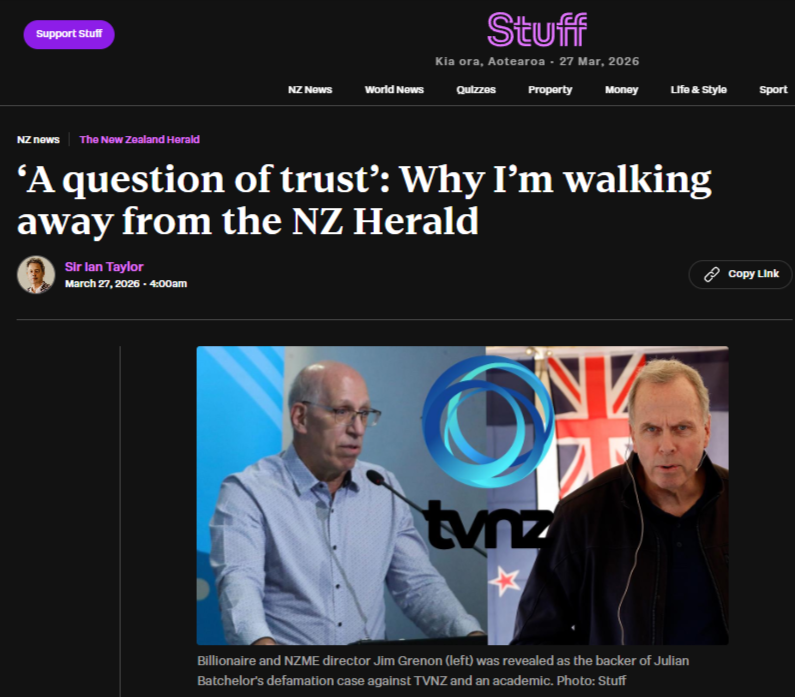
On 27 March 2026, Sir Ian Taylor — founder of Animation Research and one of New Zealand's most prominent public intellectuals — cancelled his NZ Herald subscription and published an open letter to the NZME board in Stuff, saying: "I can no longer reconcile what I read in The Herald this week with the values I believe New Zealand stands for."
Wield the taiaha, whānau. Let us trace who is behind this, and what it means for Māori voices in the media.
Ko Wai Kei Muri? — Who Stands Behind This?
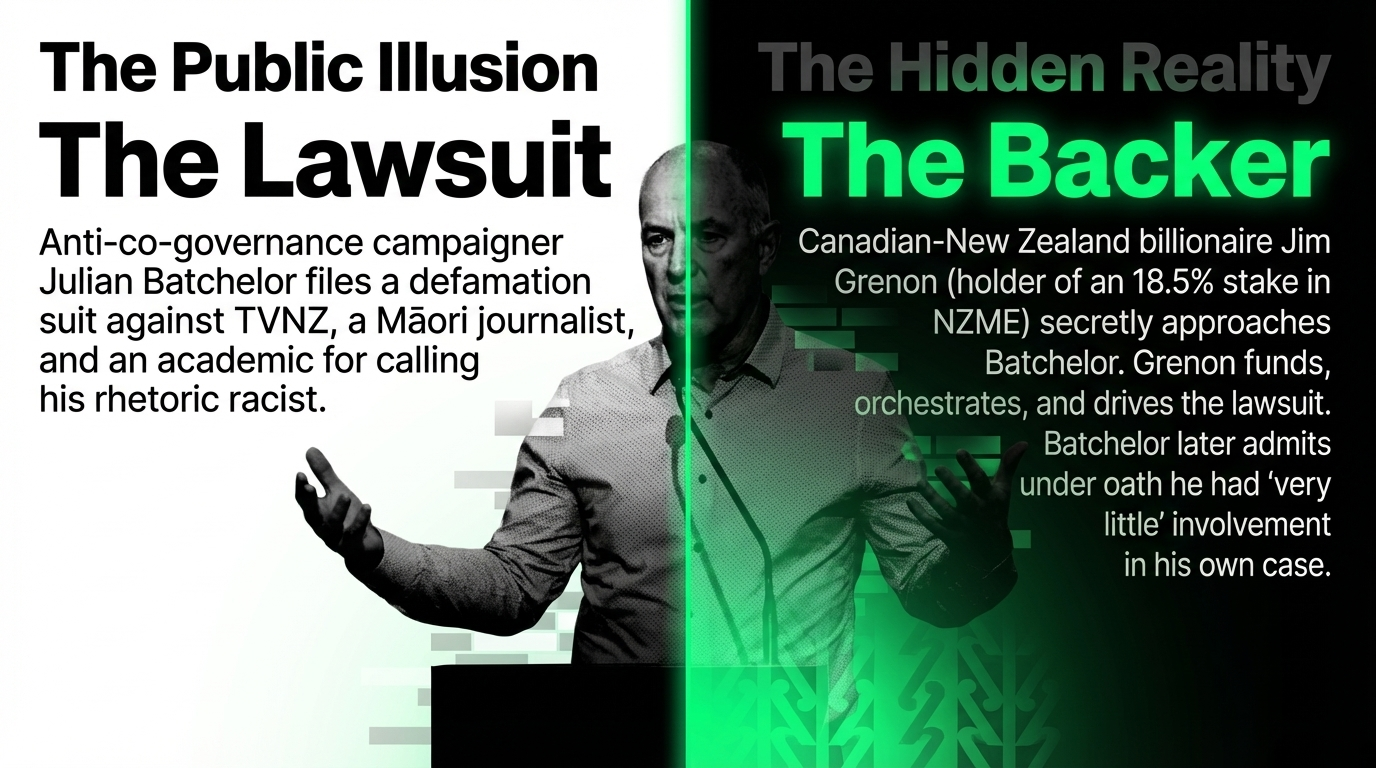
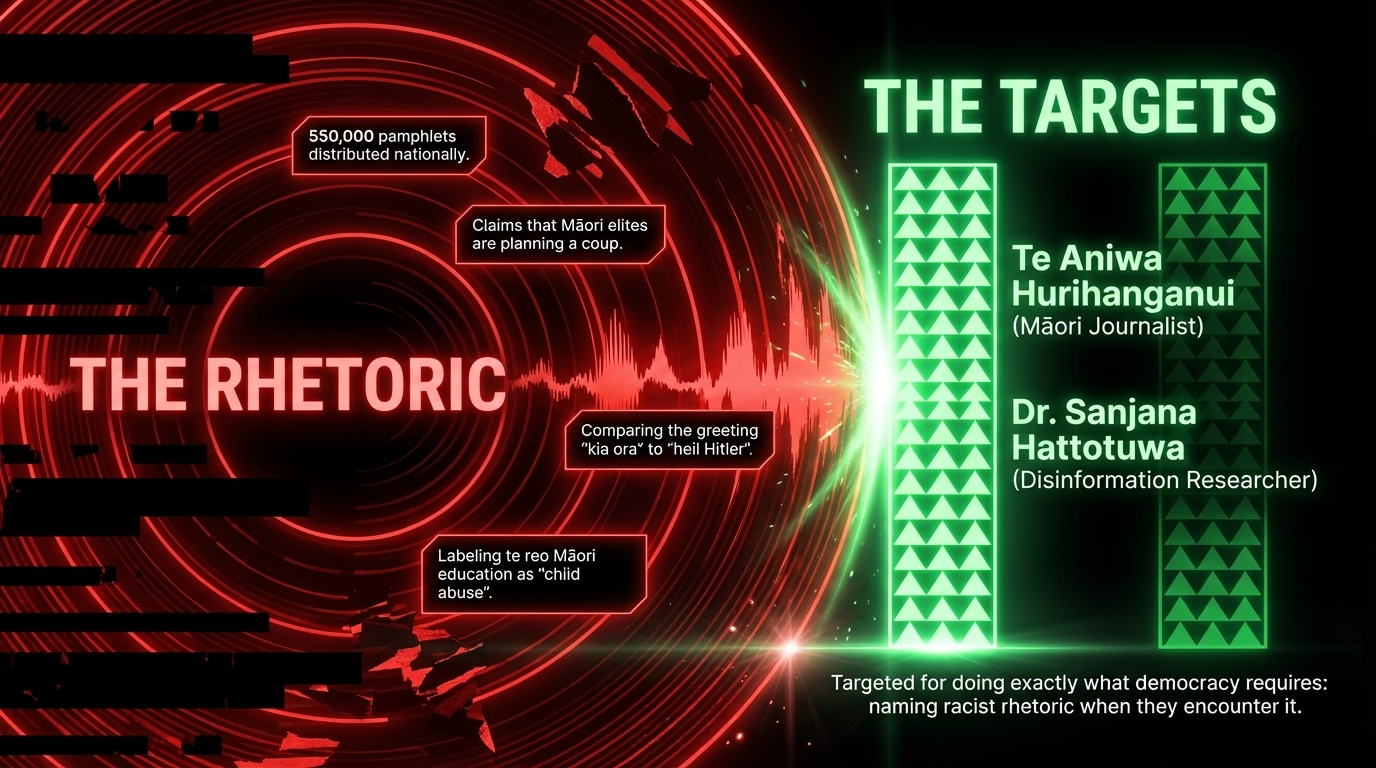
Julian Batchelor is the visible figure: the anti-co-governance campaigner who distributed 550,000 copies of a pamphlet claiming elite Māori were planning a coup of New Zealand democracy; who said teaching children te reo Māori is "child abuse"; who compared the word "kia ora" to "heil Hitler"; who stated in a YouTube video in March 2025, "there is nothing I admire about Māori culture or the Māori race. There's nothing I want to emulate"; and who wrote an unpublished book arguing Māori had "fundamental character flaws" and that the Māori language and culture "should be allowed to die a graceful death." When pressed in cross-examination, he confirmed he believed the Māori race, as he described it, lacks character — and that this was not, in his view, racist.
Judge David Clark disagreed. Emphatically.
Jim Grenon is the man behind the curtain. A Canadian-New Zealand billionaire, Grenon bought into NZME in 2025, building his stake to 18.5 percent while publicly manoeuvring for board control. As the Spinoff's detailed trial coverage confirmed, Grenon called Batchelor the day after the TVNZ story aired, invited him to his home, told him "I've been following you, I don't think you're a racist. I think we should sue TVNZ" — and then proceeded to fund and orchestrate the entire lawsuit. Batchelor admitted under oath he had "very little" personal involvement in running the case. He could not recognise legal letters sent under his own name. He did not choose his own lawyer. Grenon paid an expert witness to attend the hearing without disclosing it to the court. That witness, former TV1 broadcaster Peter Williams, privately called Batchelor "a nutter."
What Grenon built was not a legitimate defamation case. It was a legal weapon — aimed at the journalist, Te Aniwa Hurihanganui, and the researcher, Dr Sanjana Hattotuwa, who were doing exactly what journalism is supposed to do: name racist rhetoric when they encounter it.
The NZ Herald is the third actor — not because it manufactured this situation, but because of what it did not do. NZME, through the Herald, covered the case. But it did so while Grenon, the man secretly driving the case against a Māori journalist, was simultaneously building his stake in the company and maneuvering for editorial control. Journalists in the newsroom were placed in the position of covering a story where their company's largest activist shareholder was a hidden party.
As journalists' unions and media observers flagged as early as March 2025, Grenon's push for NZME board control raised "deeply concerned" warnings about risks to editorial independence. Critics said the Herald had already shown "lack of balance on issues including co-governance" — the precise issue at the centre of Batchelor's pamphlet campaign.
He ika nui i roto i te hao — ko wai e taea ai te tikina ake?
A great fish is caught in the net — but who has the power to lift it out?
He Whakaahua Whānui — What Actually Happened, and Why It Matters
The sequence of events matters. It is not complicated, but it must be stated plainly.
In August 2023, Julian Batchelor was distributing pamphlets claiming Māori elites were planning a coup, calling te reo Māori education "child abuse," and making statements that would later be confirmed, in a court of law, to constitute racist rhetoric. TVNZ reporter Te Aniwa Hurihanganui — a Māori journalist — covered this. The researcher Dr Sanjana Hattotuwa called the rhetoric what it was.
The day after the story aired, Jim Grenon — a billionaire with no personal stake in the defamation claim — called Batchelor and told him to sue. He then funded the entire litigation, selected the lawyers, paid the expert witnesses, and orchestrated the case while Batchelor admitted under oath he barely knew what was happening in his own name.
Grenon did this while acquiring an 18.5 percent stake in NZME — the parent company of the newspaper that would be expected to cover and scrutinise both the lawsuit and his own corporate manoeuvres.
On 23 March 2026, Judge David Clark dismissed the case. He found the racist rhetoric allegation was true. He found TVNZ's journalism was responsible. He found Hattotuwa's opinion was honest and grounded in fact.
On 27 March 2026, Sir Ian Taylor cancelled his Herald subscription and published an open letter to the NZME board. He said he could not reconcile what he read in the Herald with the values he believes New Zealand stands for. He published it in a rival paper.
Māori journalists were targeted. A court confirmed they were right. And the paper whose major shareholder secretly funded the targeting is still operating as though nothing has changed.
Ko te Pūāwaitanga o te Kino — The Five Hidden Connections
1. Grenon chose Batchelor because Batchelor's campaign is aligned with Grenon's project for NZME
Grenon did not fund a random defamation case. He funded the case of a man whose central political project — eliminating co-governance, treating te reo Māori as harmful, arguing Māori culture should die — is ideologically aligned with the direction critics say Grenon wants to take NZME's editorial output. The Centrist publication noted that after Grenon's involvement became known, the Herald was observed to have "lack of balance on issues including co-governance." Grenon did not need to instruct editors. He needed to signal what kind of coverage he would reward — and he signalled it by funding a lawsuit against a Māori journalist.
2. The lawsuit was a legal weapon aimed at the reporter, not a genuine defamation claim
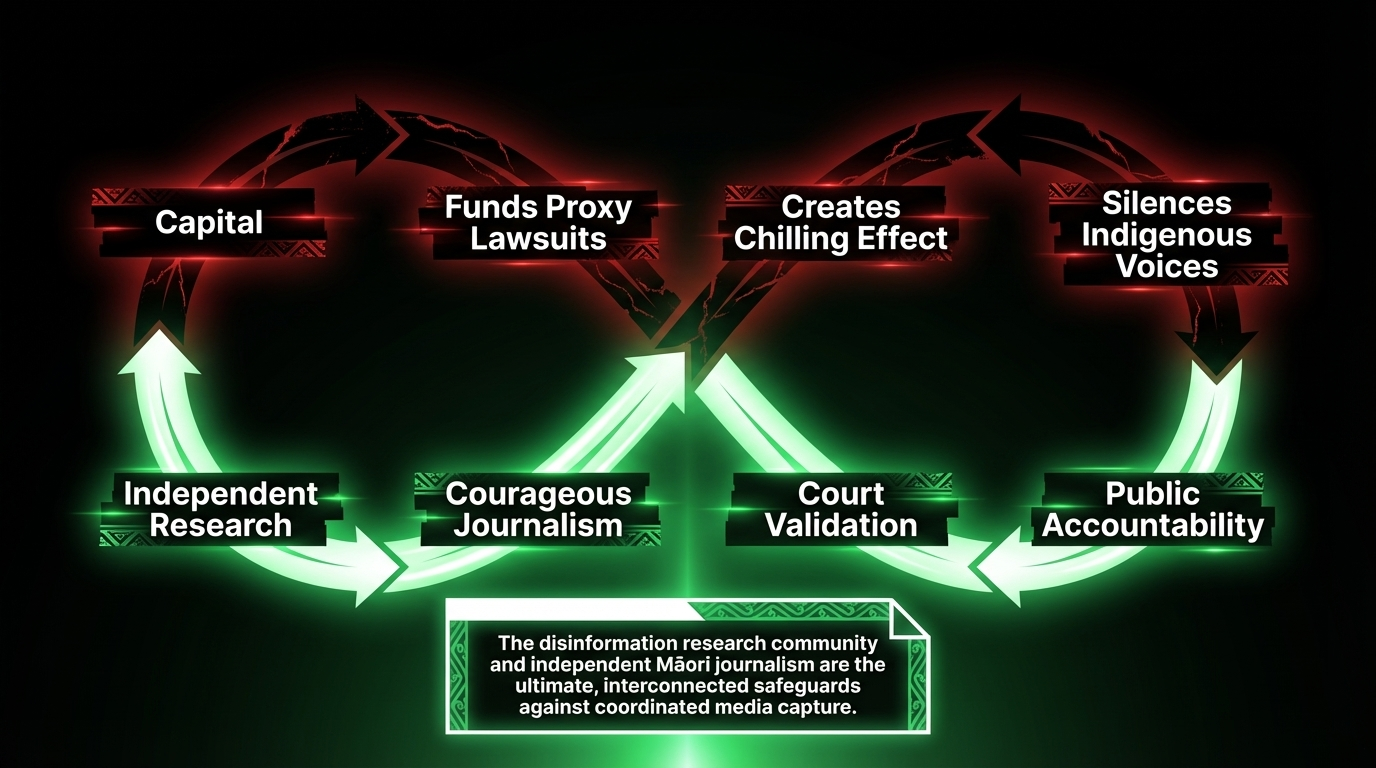
Batchelor's own testimony confirmed he was not running this case — Grenon was. Batchelor did not choose his lawyers, did not write the initial letters, and had "very little" involvement in the case bearing his name. As TVNZ's lawyer argued, Batchelor had "unlawfully assigned his claim to a third party funder." What Grenon built was a vehicle: a defamation action designed to punish Te Aniwa Hurihanganui and Dr Hattotuwa for accurate journalism, to create legal costs and reputational risk for anyone who calls anti-Māori rhetoric by its name, and to generate a chilling effect on future coverage. The court dismissed it — but the chilling effect was already the point.
3. The NZME board was asked to exercise oversight of its major shareholder — and appears to have said nothing
Throughout 2025, as Grenon increased his NZME stake and was simultaneously revealed as the hidden funder of an anti-Māori journalist lawsuit, NZME's board faced a direct governance test. The journalists' union said it was "deeply concerned" about risks to editorial independence. What the board did not do — on any publicly available record — is provide a clear, documented account of how it insulated editorial decisions from a shareholder who had just spent an unknown amount of money targeting a Māori journalist for accurate reporting. Ian Taylor's open letter to the NZME board is, in part, a demand that the board answer for this gap.
4. Te Aniwa Hurihanganui and Dr Sanjana Hattotuwa were targeted precisely because they work at the intersection of Māori journalism and disinformation research
The disinformation research community and Māori journalism are two of the most important safeguards against the kind of coordinated mis-information that Batchelor's campaign represented. Grenon selected a target who embodied both. The lawsuit imposed legal costs, reputational stress, and years of uncertainty on a Māori journalist and a Brown academic who were doing exactly what democracy requires. The court found them right on every count. But the cost of being right — under sustained litigation funded by a billionaire with a media asset to protect — is not recoverable.
5. The NZ Herald's coverage of the judgment is itself a data point
A paper exercising full editorial independence would have led with the story of its own major shareholder's role in funding a lawsuit that a court found to be weaponising racist rhetoric against a Māori journalist. The Herald reported the judgment. It reported the key quote about racist rhetoric. But it did so from the position of a newsroom whose largest activist shareholder had just lost a lawsuit he secretly funded, and where the newsroom itself had been placed in the impossible position of covering a story in which management's financial decisions were a central fact. Ian Taylor read those stories and cancelled his subscription. That is what editorial capture looks like from the outside.
Ko ngā Āputa — The Quantified Harm
| What happened | Scale and evidence | Source |
|---|---|---|
| Grenon's stake in NZME | 18.5% — largest activist shareholder | NZ Herald, March 2025 |
| Batchelor's pamphlets | 550,000 copies distributed nationally | The Spinoff, December 2025 |
| Court finding | Racist rhetoric — "on any measure, the answer must be yes" | NZ Herald reporting judgment, March 2026 |
| Batchelor's involvement in own case | "Very little" — admitted under oath | The Spinoff, December 2025 |
| TVNZ defences | All three upheld — truth, honest opinion, responsible communication | NZ Herald, March 2026 |
| Journalists' union response | "Deeply concerned" about editorial independence risks from Grenon | NZ Herald, March 2025 |
| Ian Taylor response | Cancelled NZ Herald subscription, open letter to NZME board | Stuff, March 27 2026 |
Ko te Kīngia o te Kōrero — Naming the Fallacies
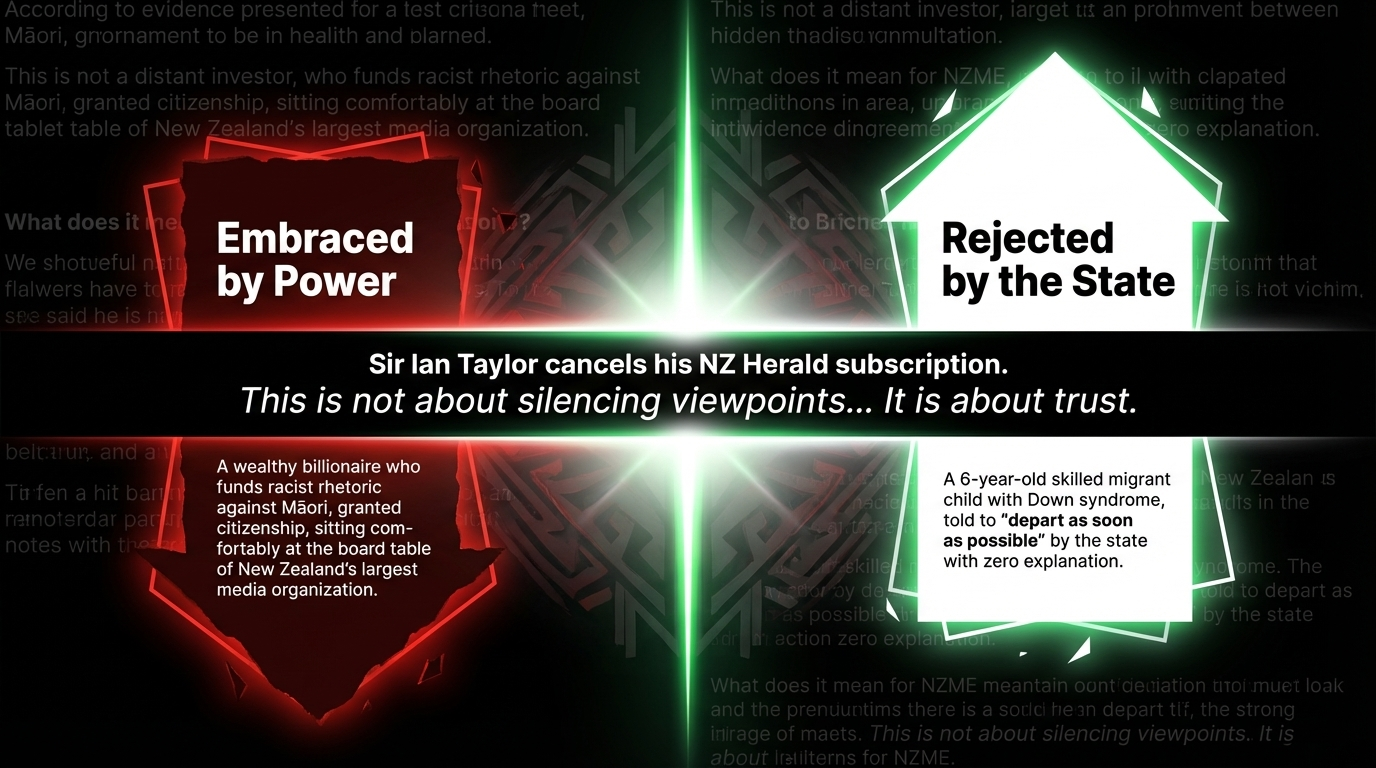
Fallacy 1: "This was a legitimate defamation case."
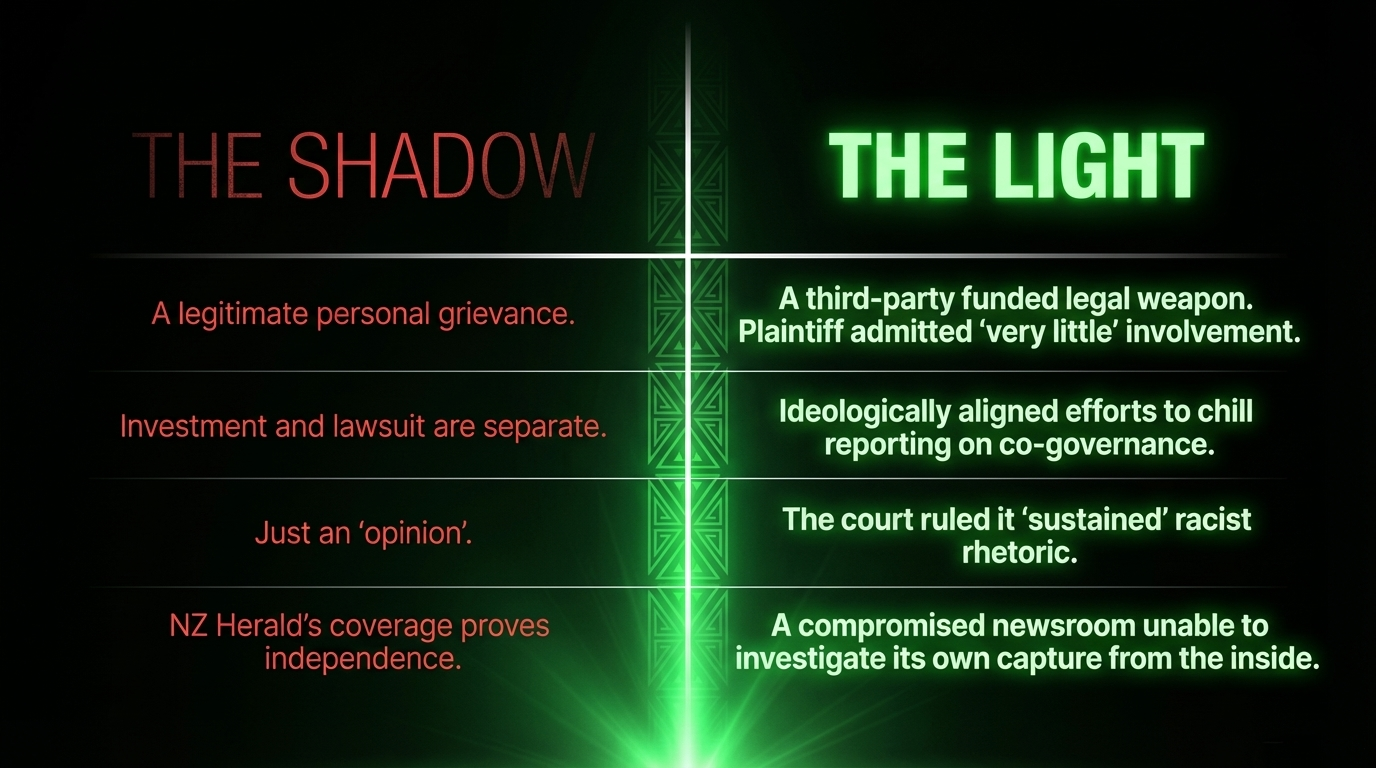
Batchelor admitted under oath he had "very little" personal involvement. He could not identify legal letters sent under his name. He did not choose his lawyers. Grenon orchestrated the case from behind a veil that the judge was forced to pierce, piece by piece. A defamation case where the named plaintiff is not running the case, not paying for it, and not making the decisions is not a legitimate personal grievance. It is a funded operation. The court confirmed this by finding that Batchelor had "unlawfully assigned his claim to a third party funder."
Fallacy 2: "Grenon's media investment and his funding of the lawsuit are separate matters."
They are not separate. Grenon acquired a stake in NZME — whose journalists are expected to hold power to account — and simultaneously funded a legal attack on a journalist for accurately reporting on racist rhetoric. These two acts share a logic: the same worldview that decides Māori co-governance coverage is "unbalanced" is the same worldview that decides funding a lawsuit against a Māori journalist is justified. The court has now ruled on one of them. The other remains in Grenon's hands.
Fallacy 3: "Batchelor's statements were opinion, not racism."
Batchelor said under oath that the Māori race, as he described it, lacks character. He said there is nothing he admires about Māori culture or the Māori race. He said Māori language and culture should "die a graceful death." He promoted the theory that a fair-skinned, ginger-haired pre-Māori race occupied Aotearoa. He compared "kia ora" to "heil Hitler." Judge David Clark's response: "Irrespective of how he has reached this position the comments are nonetheless racist rhetoric." Opinion is not a shield against truth. The court found the truth: these are racist statements.
Fallacy 4: "The NZ Herald covered this story, so there is no editorial independence problem."
A paper that covers a story is not the same as a paper that can fully and fearlessly cover every dimension of that story when its major shareholder is a central fact in it. The Herald reported the judgment. It reported the quote about racist rhetoric. What it cannot fully report — from inside the institution — is whether its own editorial decisions about coverage of co-governance, Māori affairs, and Treaty issues over the past year have been influenced by the presence of a shareholder whose sympathies were already in evidence. That analysis has to come from outside the building. It is coming. Ian Taylor's letter is the opening salvo.
Koha Consideration
This essay traces a billionaire's use of litigation to silence a Māori journalist — and asks what that means for every Māori community that relies on independent media to tell the truth. Independent Māori voices exist outside of the corporate media structures this essay examines. If you want those voices to keep going, three pathways exist:
For those who wish to support this mahi directly with a koha (voluntary contribution), please visit the Koha platform:
Koha — Support
For those who wish to receive essays directly and support through subscription:
Subscribe to the Māori Green Lantern
For those who prefer direct bank transfer, account details are: HTDM, account number 03-1546-0415173-000.
Every koha signals that whānau are ready to fund the accountability that Crown and corporate structures will not provide. It signals that rangatiratanga includes the power to fund our own truth tellers. Kia kaha, whānau.
He Kupu Whakamutunga — The Ring Lights Up for Te Aniwa
There is a Māori journalist named Te Aniwa Hurihanganui who did her job.
She covered a man distributing 550,000 pamphlets across this country, a man who said te reo Māori education is child abuse, who said there is nothing worth admiring in Māori culture, who claimed a white pre-Māori race occupied these islands before our tūpuna arrived. She quoted a researcher who called it racist rhetoric. She gave the man right of reply. She published.
For that, a billionaire — now the largest activist shareholder in the company that owns this country's most-read newspaper — reached into his own pocket, called the man she had covered, told him to sue, hired the lawyers, paid the witnesses, and ran a multi-year legal campaign under another man's name.
A court has found Te Aniwa Hurihanganui was right. It has found the racism real. It has found the journalism responsible. And Jim Grenon — the man who funded the campaign against her — still holds his 18.5 percent stake in NZME. Still has his ambitions for the board. Still controls, through the leverage of capital, what the newsroom above him can say about him.
Ian Taylor has named this for what it is: a question of trust. He has walked. Others will follow.
The question for every Māori journalist, every Māori community, every iwi that reads the Herald or listens to ZB, is now this: who is the paper for?
The court has answered it for Batchelor's case. The boardroom has not yet answered it for ours.
He tangata, he tangata, he tangata.
It is people. It is people. It is people.
Not billionaires. Not boards. Not lawsuits filed in borrowed names.
The people — and the journalists who stand for them.
The names are named. The citations are live. The taiaha does not waver.
Kāti rā. Stand firm, whānau.
Research conducted 27 March 2026. All citations are inline hyperlinks verified at time of publication. Sources: NZ Herald (judgment coverage, Grenon NZME coverage), The Spinoff (trial coverage, Joel MacManus), Stuff (Ian Taylor open letter), Reddit/Mediawatch (editorial independence concerns), Facebook/Waatea News (Grenon connection reporting).