""NOISY VOICES": HOW SHANE JONES IS GUTTING OUR MOANA FOR CORPORATE PROFIT" - 24 March 2026
The Fisheries Amendment Bill, the Sealord Shield, and the Silencing of the People

Mōrena Aotearoa,
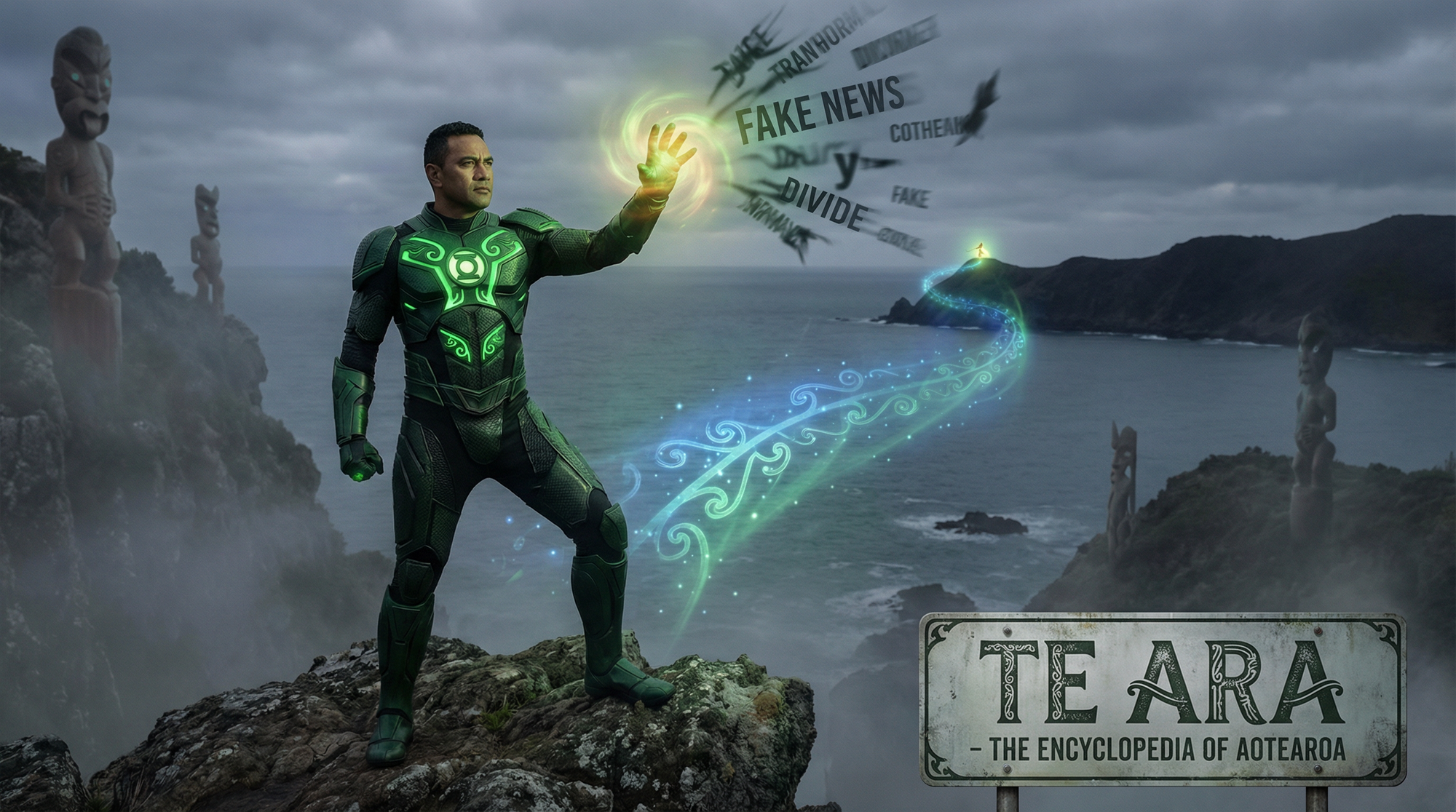
The Māori Green Lantern Fighting Misinformation And Disinformation From The Far Right welcomes you to this space and I hope you are able to use this information.
He Kōrero Whakatūwhera | Opening
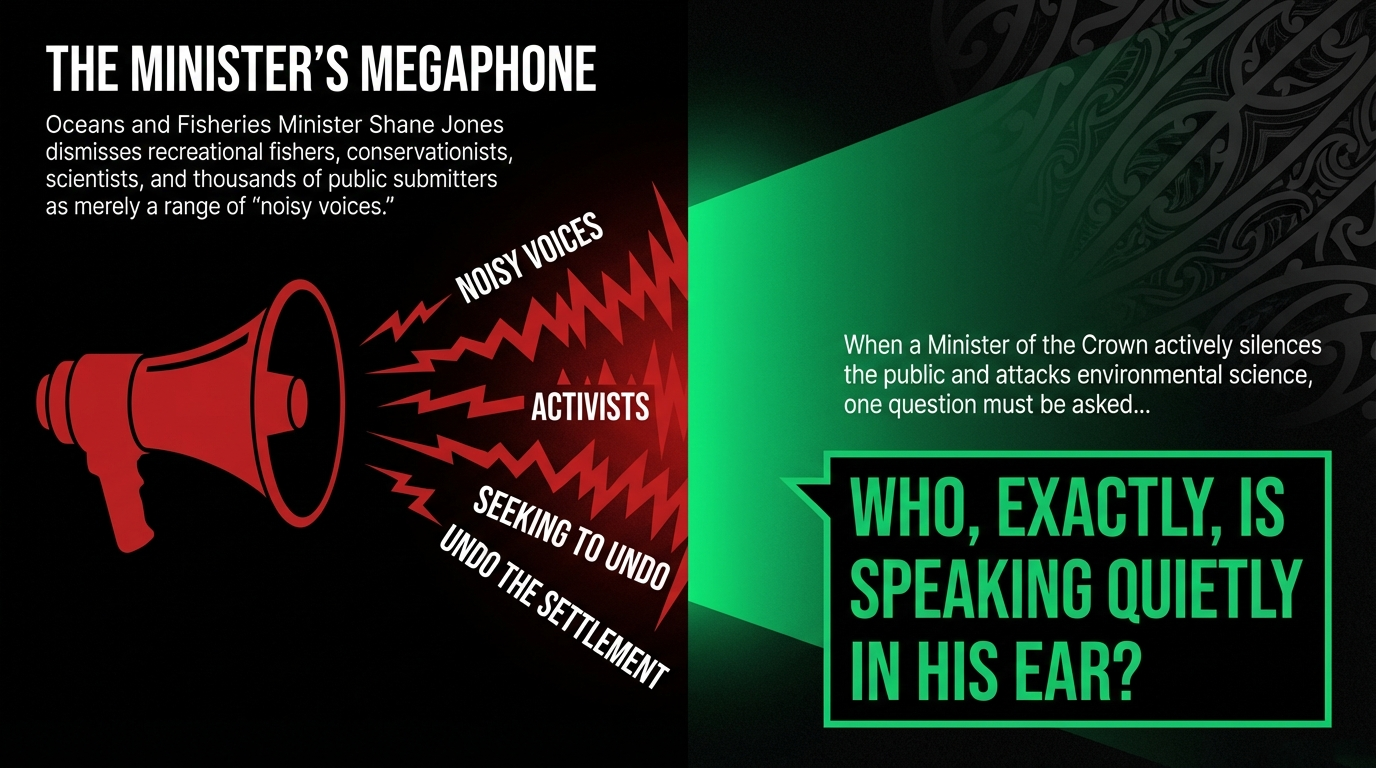
When a minister of the Crown dismisses recreational fishing groups, conservation advocates, scientists, and thousands of New Zealanders who formally submitted on fisheries reforms as merely a range of "noisy voices", you need to ask one question: who, exactly, is speaking quietly in his ear?
Shane Jones's Fisheries Amendment Bill, which received its first reading on 25 March 2026, is not a sustainability reform. It is a corporate capture event dressed in the language of waste reduction and efficiency — and it weaponises the hard-won 1992 Māori fisheries settlement as a human shield against all scrutiny. As the NZ Legislation database confirms, the bill is "intended to deliver on Government priorities to grow the value of seafood sector exports" — not to protect the moana, not to strengthen Treaty rights, and not to serve whānau who depend on healthy fish stocks. The connections, the silencing mechanisms, and the beneficiaries are hiding in plain sight. Let's name them.
The Deep Dive Podcast
Listen to a lively conversation between two hosts, unpacking and connecting topics in the sources of this essay
Te Tūāhuatanga | Background: The 1992 Sealord Deal as Shield and Sword
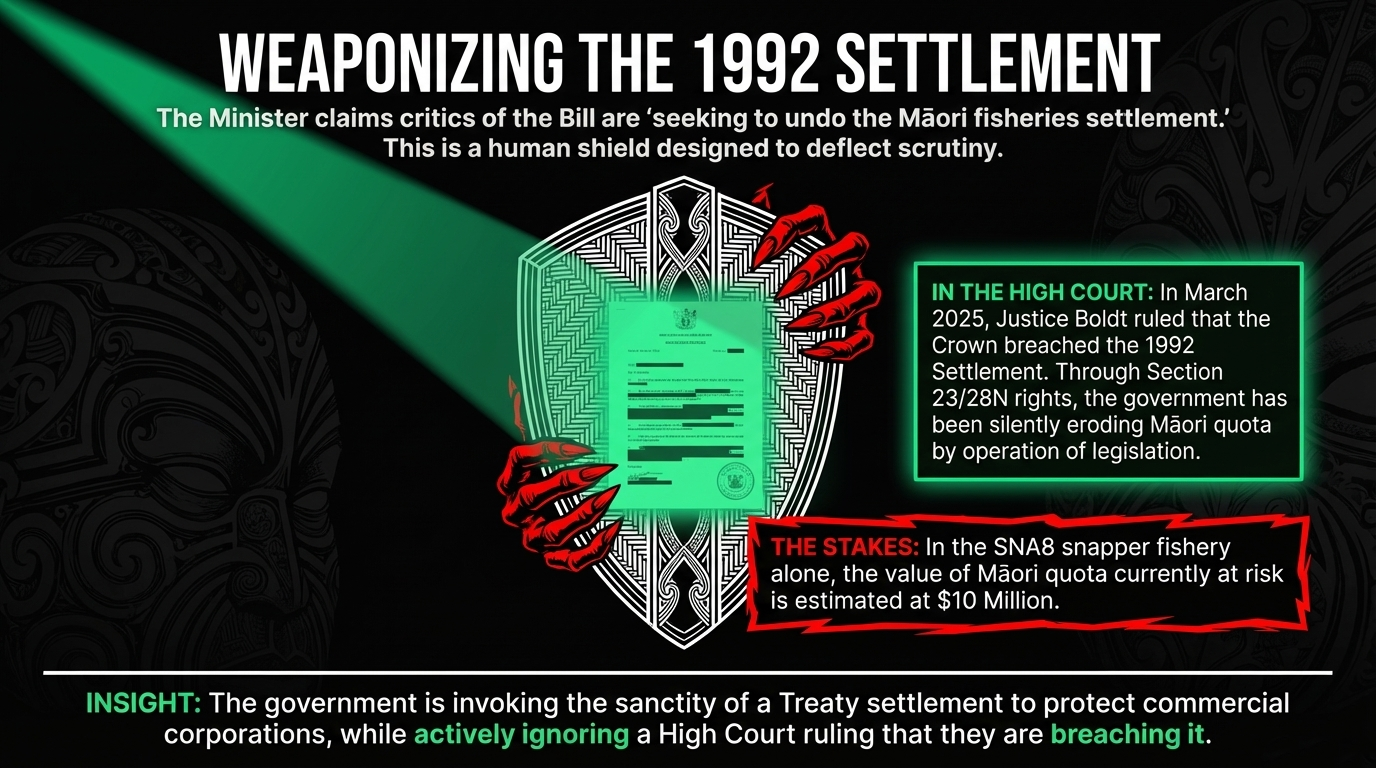
The 1992 Sealord Deal — formally, the Māori Fisheries Settlement — gave iwi a 50% stake in Sealord and a 20% share of all quota species under the Quota Management System (QMS) in exchange for Māori forgoing further Treaty claims to commercial fishing rights. As The Spinoff documented in April 2025, it was meant to be "full and final."
For decades it has been the cornerstone of Māori participation in the commercial fisheries economy. But here is the bitter irony: in March 2025, as The Spinoff's investigation confirmed, Justice Boldt found that the Crown had breached the Fisheries Settlement — through the operation of so-called "28N rights" under Section 23 of the Fisheries Act 1996, which had been silently eroding Māori settlement quota by operation of legislation. Effectively, as The Spinoff reported, the Crown was "re-taking from Māori the quota shares allocated to them." In the snapper SNA8 fishery alone, the value of Māori quota at risk has been estimated at $10 million.
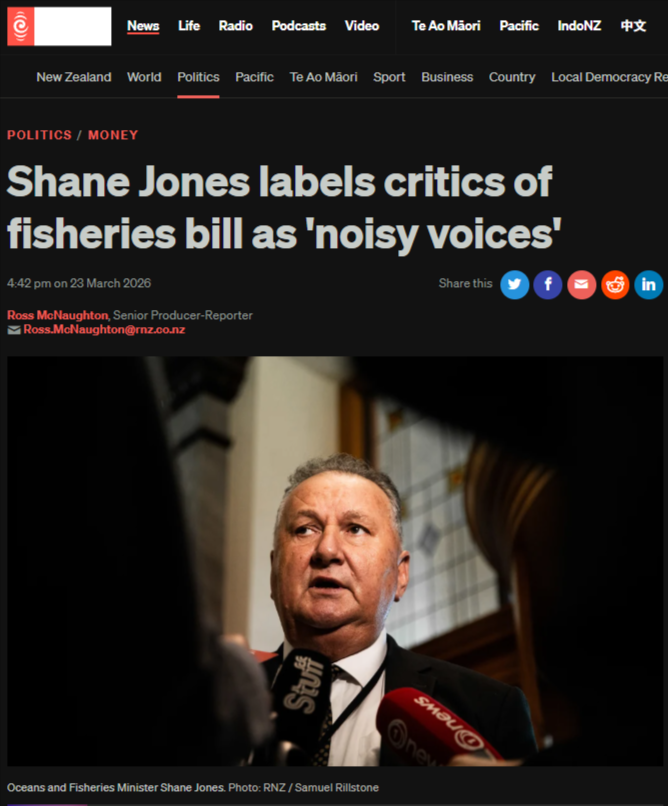
So when Shane Jones thunders that critics of his bill are "really seeking to undo the Māori fisheries settlement," as RNZ reported, he is invoking a settlement that his own government's legislative inheritance has been undermining for years. That is not kaitiakitanga. That is deflection.
Te Pūrongo | What the Bill Actually Does
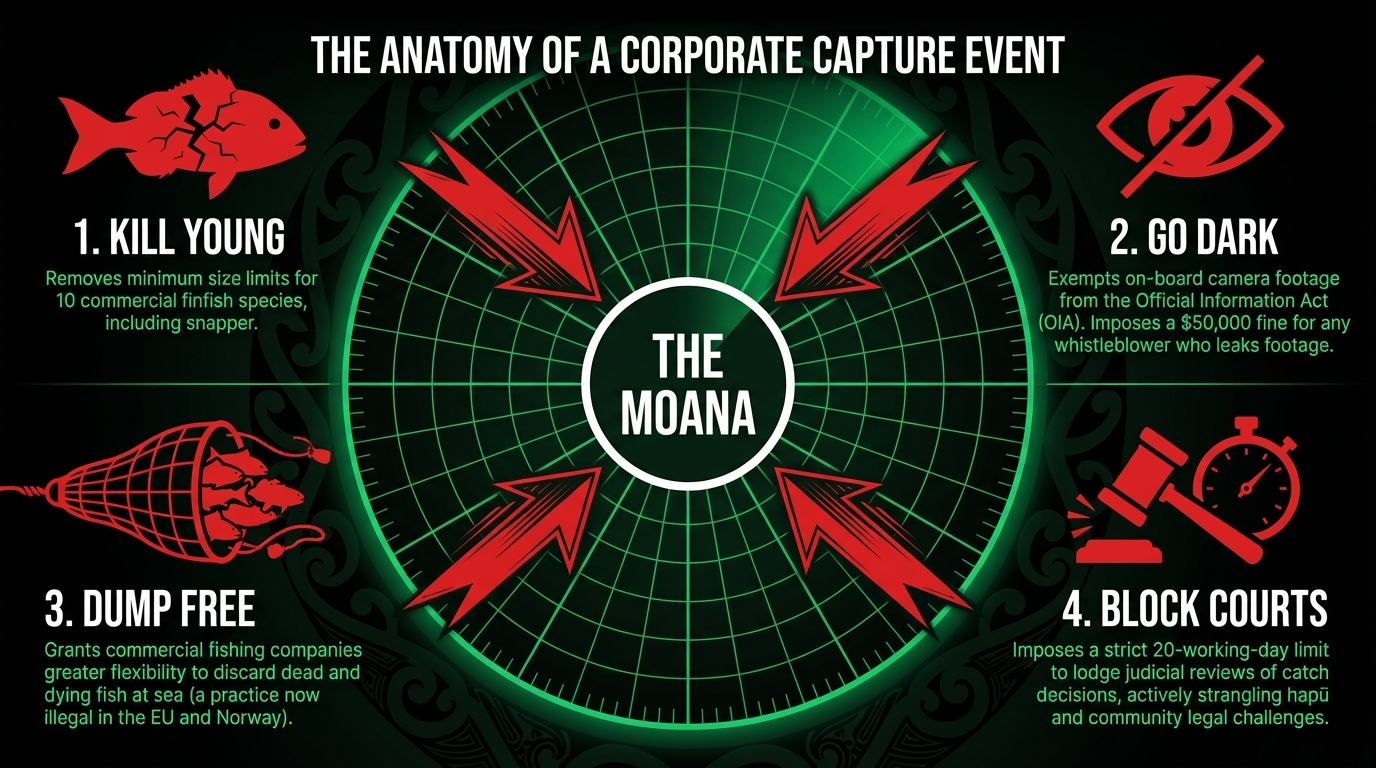
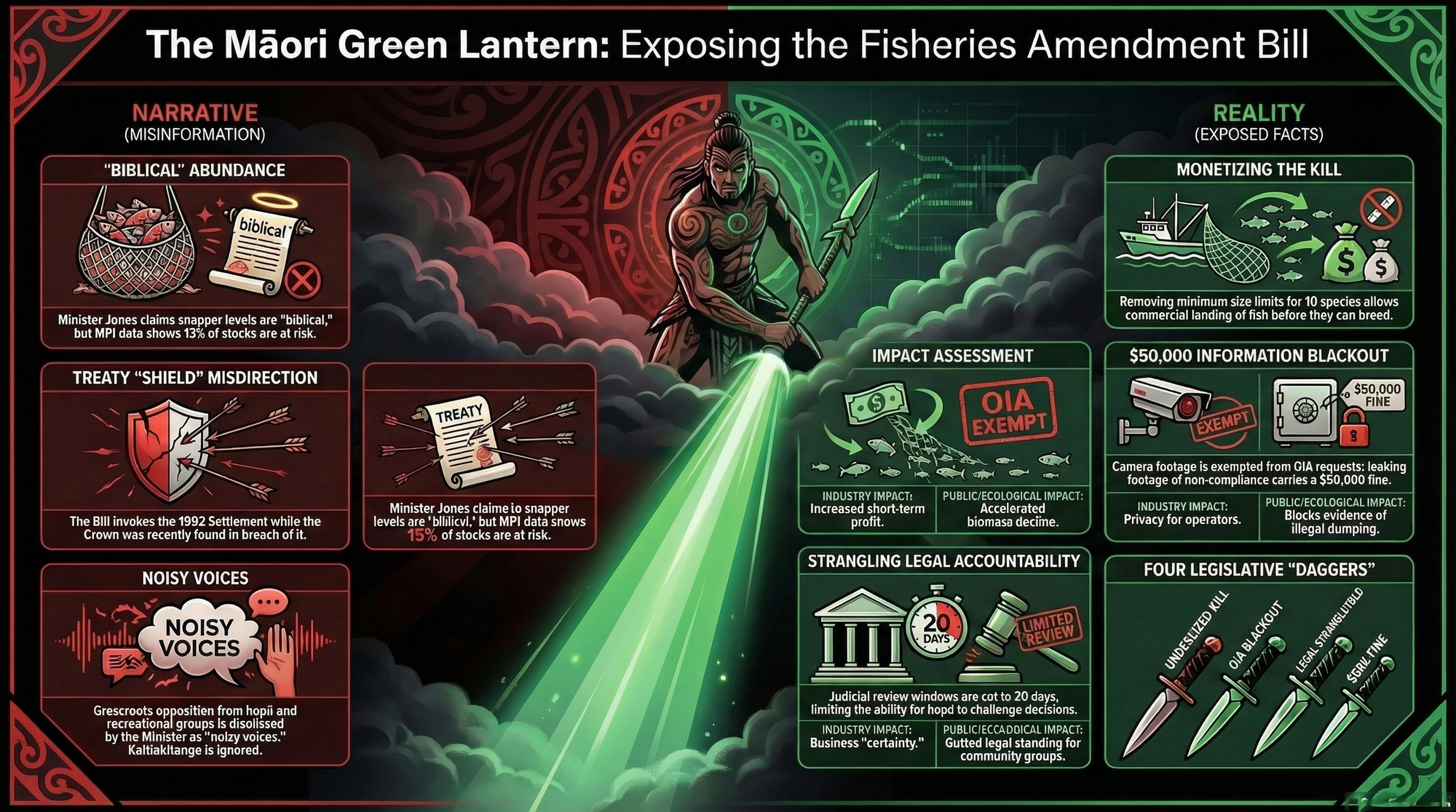
The Fisheries Amendment Bill contains four major structural changes, each more alarming than the last.
1. Removal of Minimum Size Limits for Commercial Fishers
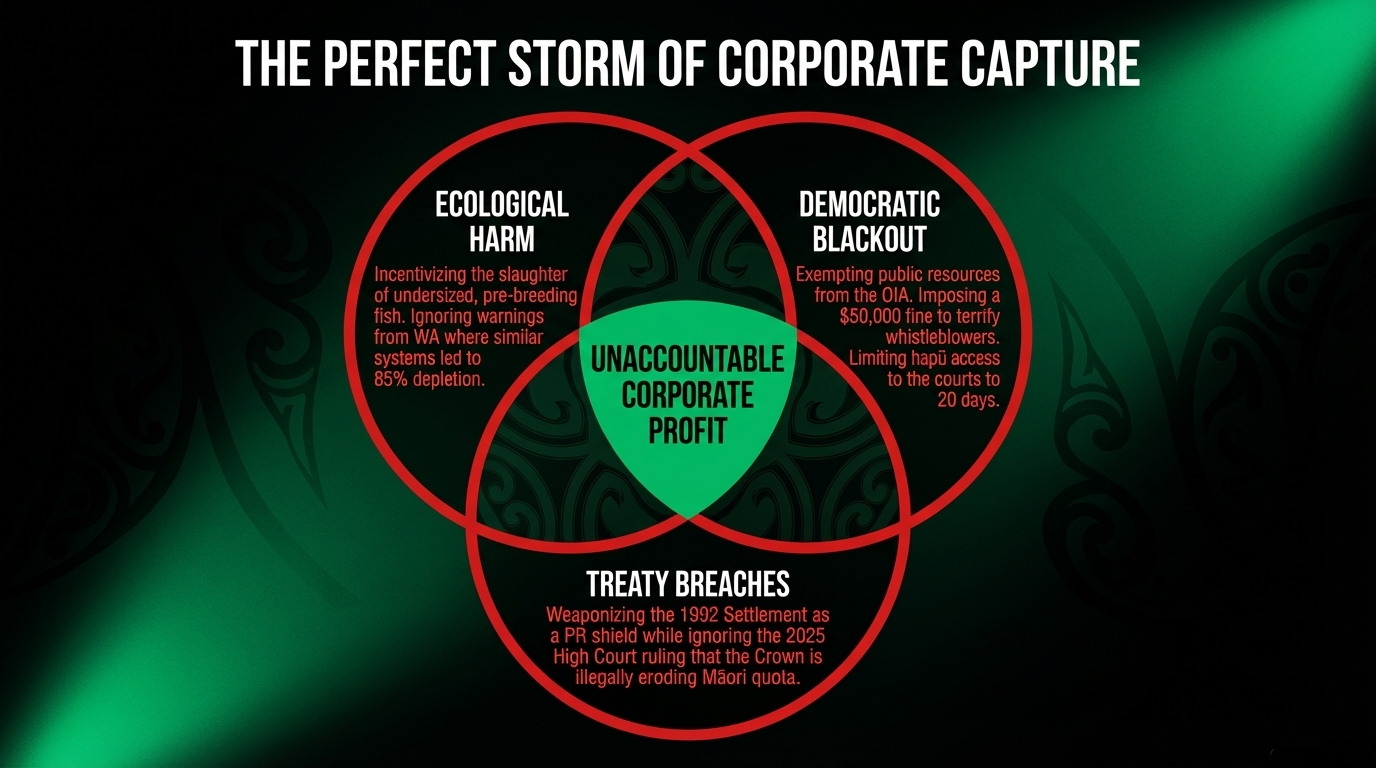
The NZ Legislation database confirms in black and white: the bill "amend[s] regulation 31 to remove the minimum length specified in that regulation for 10 stocks or species of finfish." That includes snapper. These limits exist for one ecological reason: to allow fish to reach sexual maturity and reproduce before they are harvested. As RNZ reported, fishing host and former commercial fisher Matt Watson put it plainly: "If you start killing fish before they've had a chance to breed, you're going to run out of fish and you don't need to be a genius to figure that out."
Jones's justification is that allowing commercial fishers to land and sell undersized fish eliminates waste. As RNZ's First Up coverage makes clear, his framing is: "if you catch them, you pay for them." On the surface this sounds rational. But the bill does not require commercial fishers to change their methods — trawling is explicitly protected, and Jones confirmed there is "no plan to outlaw trawling." The incentive structure is wrong: you are not discouraging the capture of small fish; you are monetising the kill.
Meanwhile, official MPI data cited by 1News shows roughly 25% of QMS stocks currently fail to meet biomass targets, and 13% are considered at risk of depletion — with some fisheries closed altogether. Jones says the stocks are in "great health". The ministry's own data disagrees.
2. Blocking Public Access to On-Board Camera Footage
This is the hidden dagger. The NZ Legislation database states it plainly:
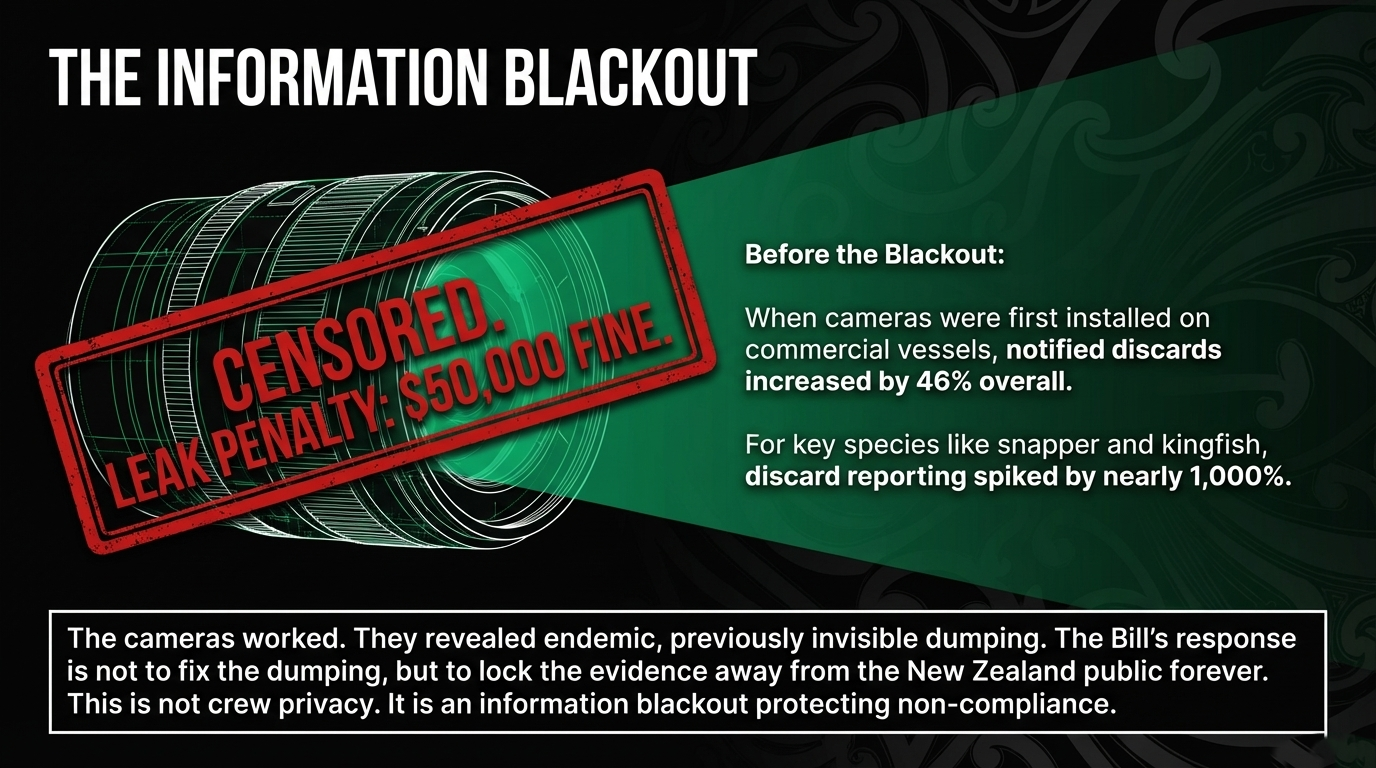
"The Bill exempts on-board camera footage from being subject to requests under the Official Information Act 1982." Anyone who leaks that footage faces a $50,000 fine.
The cameras were introduced precisely because of endemic non-compliance. As RNZ reported, LegaSea's Sam Woolford confirmed that when cameras were installed, notified discards went up 46 percent overall — and for snapper and kingfish, closer to 1,000 percent — meaning the cameras were working: they were catching the dumping that had previously been invisible. Now Jones wants to lock that footage away from the public forever. As 1News's Gill Higgins reported, Matt Watson called it exactly what it is: "That's not democracy."
3. Discarding Fish at Sea — Made Easier
The bill also, as 1News confirmed, gives commercial fishing companies "greater flexibility around discarding fish at sea." Read that slowly: a bill that claims to reduce waste simultaneously relaxes the rules about throwing dead and dying fish back into the ocean. As 1News noted, this practice has been made illegal in the EU and Norway — and critics want the same standard here.
4. Strangling Legal Challenges to Catch Decisions
Jones has argued, as 1News reported, that "the system cannot tolerate vexatious, protracted litigation that glugs the system up." The bill's answer, confirmed in the NZ Legislation database, is to limit the time available to lodge a judicial review of catch decisions to 20 working days from the time the decision is notified. This directly targets the community groups and hapū who have successfully used the courts — as in the landmark crayfish case — to hold the Crown accountable when catch limits are set unlawfully. As 1News documented, Jones wants to ensure "an ecosystem-based approach doesn't become an ideological weapon to wipe out commerce." Translation: science and sustainability are threats to be managed.
He Koha ki te Moana me te Mahi Tika | Support the Work That Exposes the Theft
Every koha to The Māori Green Lantern is a koha to the moana itself. While the commercial fishing lobby is spending $100,000+ to put its agenda in cabinet, whānau across Aotearoa are watching their coastal fisheries collapse and waiting for someone to name what is happening clearly and without corporate interference. This work — tracing the donation trails, verifying every citation, naming the corporations and the ministers who serve them — costs time and resources that Crown and corporate structures will never fund.
When you koha here, you are funding the accountability that Sealord, Sanford, and Talley's have paid $100,000 to prevent. You are saying that the 27,000 voices Jones dismissed as "noisy" deserve a record that outlasts his time in office. You are saying that mokopuna deserve to fish in a sea that still has fish in it — and that someone should be telling the truth about why that is under threat.
If you are unable to koha — no worries. Subscribe. Share this essay with your whānau and friends. Forward it to your local MP before the select committee opens. Post it where recreational fishers gather. That is koha in itself — and it is the kind of pressure that actually moves select committees.
Three pathways exist:
Koha directly — Support this mahi at Koha — The Māori Green Lantern Fighting Misinformation and Disinformation
Subscribe to receive every essay directly — Subscribe to The Māori Green Lantern
Direct bank transfer — HTDM, account number 03-1546-0415173-000
Kia kaha, whānau. The ring is lit. The taiaha is raised. And the moana is watching.
Ngā Hononga Huna | Five Hidden Connections
The Green Lantern Ring does not guess. It traces. Here are five verified connections behind this bill.
Connection 1: Shane Jones → "Apostle of Industry" → Commercial Fishing Lobby
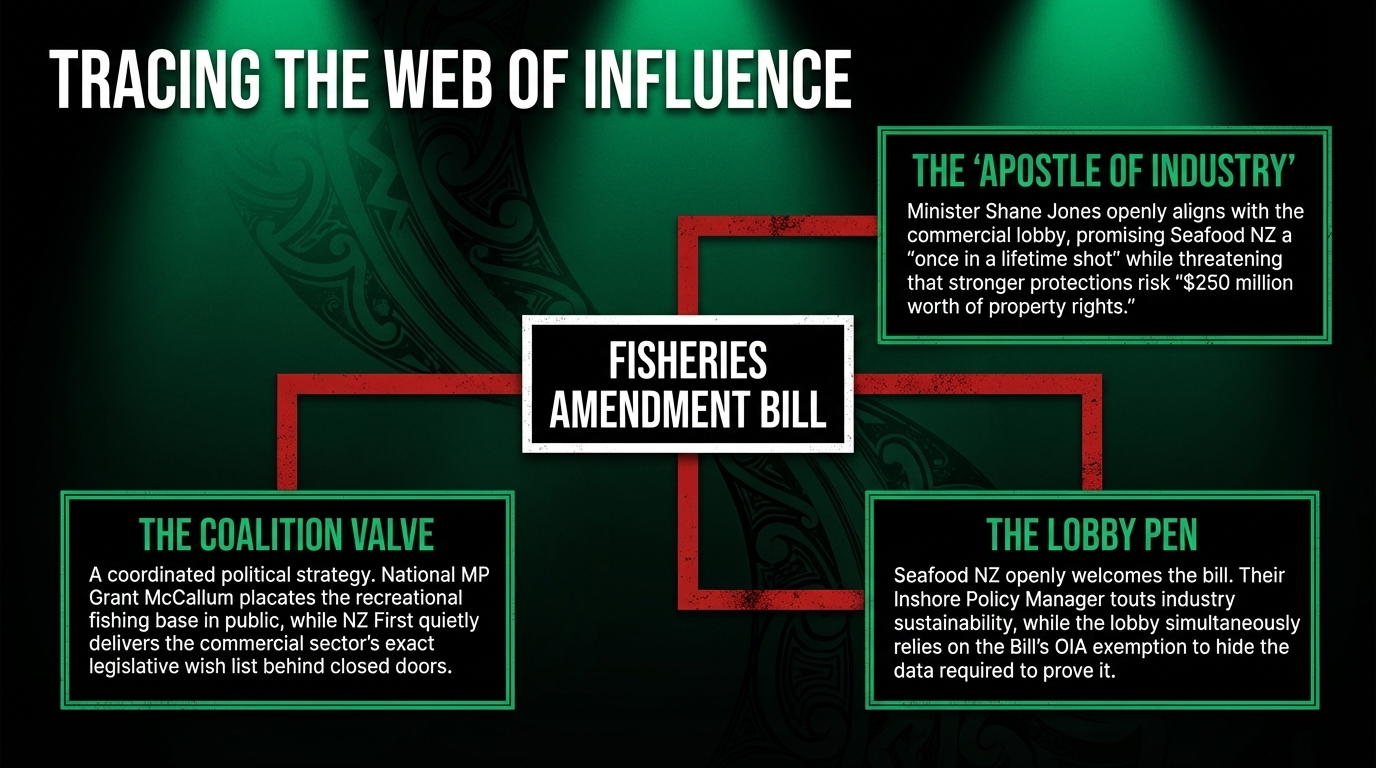
Jones has not hidden his alignment. He described himself to 1News as a "pro growth, pro development, pro jobs, nationalist politician." At the 2025 Seafood New Zealand conference, as 1News reported, he told industry leaders there was "considerable scope for making the system more efficient, boosting productivity" — calling the reforms "a once in a lifetime shot." He has previously announced himself as "an apostle of industry" in a direct attack on Greenpeace. He now deploys that same apostolic fervour to call everyone who objects to this bill activists "seeking to undo the Māori fisheries settlement," as RNZ confirmed — a framing designed to pre-empt scrutiny by wrapping corporate fishing interests in Treaty protection.
Connection 2: Seafood New Zealand → Camera OIA Exemption → Information Blackout
Seafood New Zealand has openly welcomed the bill. As the NZ Legislation explanatory note reveals, the OIA exemption is framed as protecting "privacy and commercially sensitive concerns for fishers." The bill's Inshore Policy Manager Tamar Wells of Seafood New Zealand, as RNZ reported, described the commercial sector as "trying to make the industry more sustainable" — while the bill simultaneously removes the public accountability mechanism that would allow anyone to verify that claim. That is not sustainability. That is PR with legal armour.
Connection 3: Moana New Zealand → Camera Compliance → Corporate Carve-Out
Jones himself revealed a significant conflict on RNZ. As reported by 1News, the inshore trawler Curly Brown fishes for Moana New Zealand — the largest Māori-owned seafood company, which is the direct descendant of the 1992 Sealord Settlement assets. Moana New Zealand voluntarily embraced cameras for nearly a decade, as RNZ's 2025 coverage confirmed, precisely because transparency drives good sustainability decisions. Jones's insistence on blocking OIA access to footage does not protect Māori commercial interests. It protects the sector of the industry that resists compliance — a different constituency entirely.
Connection 4: The Crown's Own Treaty Breach → Convenient Misdirection
As The Spinoff's investigation confirmed, Justice Boldt found that "the Crown's continued use of Section 23 had breached the fisheries settlement." The judgment is described as "a major win for Te Ohu Kaimoana." Jones is now invoking the sanctity of that same settlement to shield commercial fishing corporations from oversight — while the actual repair work mandated by the High Court goes unaddressed. As The Spinoff reported, "what does 'full and final' mean when parliament can later pass laws that change the value of what was agreed?" Jones answers that question with silence on the Crown's breach and noise about everyone else.
Connection 5: Coalition Politics → Grant McCallum → National Party Pressure Valve
RNZ confirmed that Northland National MP Grant McCallum met with LegaSea and the Sports Fishing Council over the weekend before the bill's first reading, and signalled he would "strongly represent the views of the recreational sector in the party's caucus." Conservation Minister Tama Potaka's office did not respond to requests for comment, as RNZ noted. This is the coalition pressure valve operating in plain view: National making noise for their recreational fishing base, NZ First delivering the commercial sector its wish list, and both parties maintaining plausible deniability. As RNZ's coverage of the Hauraki Gulf dispute confirmed, Jones has previously warned his own coalition partners that stronger fisheries protections risk "$250 million worth of property rights" — property rights held by large commercial operators, not by the whānau and hapū who depend on healthy inshore fisheries.
Ngā Hua | Quantified Harms
| Provision | Stated Justification | Actual Effect | Who Benefits |
|---|---|---|---|
| Remove size limits for 10 commercial finfish species | Reduce waste | Fish killed before breeding; biomass decline accelerated — confirmed by NZ Legislation | Large-scale commercial operators |
| OIA exemption for camera footage + $50,000 leak fine | Privacy for crew | Blocks public access to 46–1,000% discard data — confirmed by RNZ | Non-compliant commercial operators |
| Greater flexibility for discards at sea | Efficiency | More dead fish in the ocean — confirmed by 1News | Trawl operations |
| 20-working-day judicial review limit | Certainty for business | Gut legal standing of hapū and community groups — confirmed by NZ Legislation | Ministers; industry against accountability |
| Jones's "noisy voices" framing | Invite select committee submissions | Delegitimise mass public opposition | Political management of dissent |
And the stakes for fish stocks are not theoretical. As 1News's investigation confirmed, Western Australia — which operates a similar quota system to New Zealand — recently imposed permanent bans on several prized species after stocks were found to be depleted by up to 85 percent. Crayfish along Northland's East Coast are already subject to a total harvest ban as of April 2026.
As underwater cameraman Steve Hathaway told 1News:
"I used to be able to get my limit of crays whenever I wanted here… these days, you'll struggle to even get one."
Jones told First Up the "amount of snapper in our waters is almost biblical in its profundity. You can almost walk on the water we've got so many snapper," as RNZ reported. That is not the voice of a kaitiaki. That is the voice of a lobbyist.
Te Kaitiakitanga | Where Does This Leave Māori?
The 1992 settlement was supposed to give Māori a permanent, meaningful stake in New Zealand's commercial fisheries. Instead, as The Spinoff's investigation confirmed, the Crown has been quietly legislating that stake away for decades through Section 23 of the Fisheries Act — and the High Court has now confirmed this was a breach of the settlement. Jones is invoking the Treaty settlement to protect an industry structure that has historically concentrated quota wealth in Pākehā-owned companies, while the entities most harmed — Māori quota holders represented by Te Ohu Kaimoana — are still waiting for remedy.
Moana New Zealand — the leading Māori commercial fishing entity — has voluntarily embraced cameras, as 1News confirmed, because it understood that transparency is a competitive advantage and a sustainability necessity. Jones is not defending that model. He is defending the sector that resists it.
Ngāti Manuhiri Settlement Trust chief executive Nicola MacDonald said, as 1News reported, that the biggest worry around the reforms is "the challenge it's going to create to bring companies to accountability." That is a Māori leader, speaking clearly, on the record. She is not a "noisy voice." She is a kaitiaki.
Te Kōrero Whakamutunga | Conclusion: Rangatiratanga Action
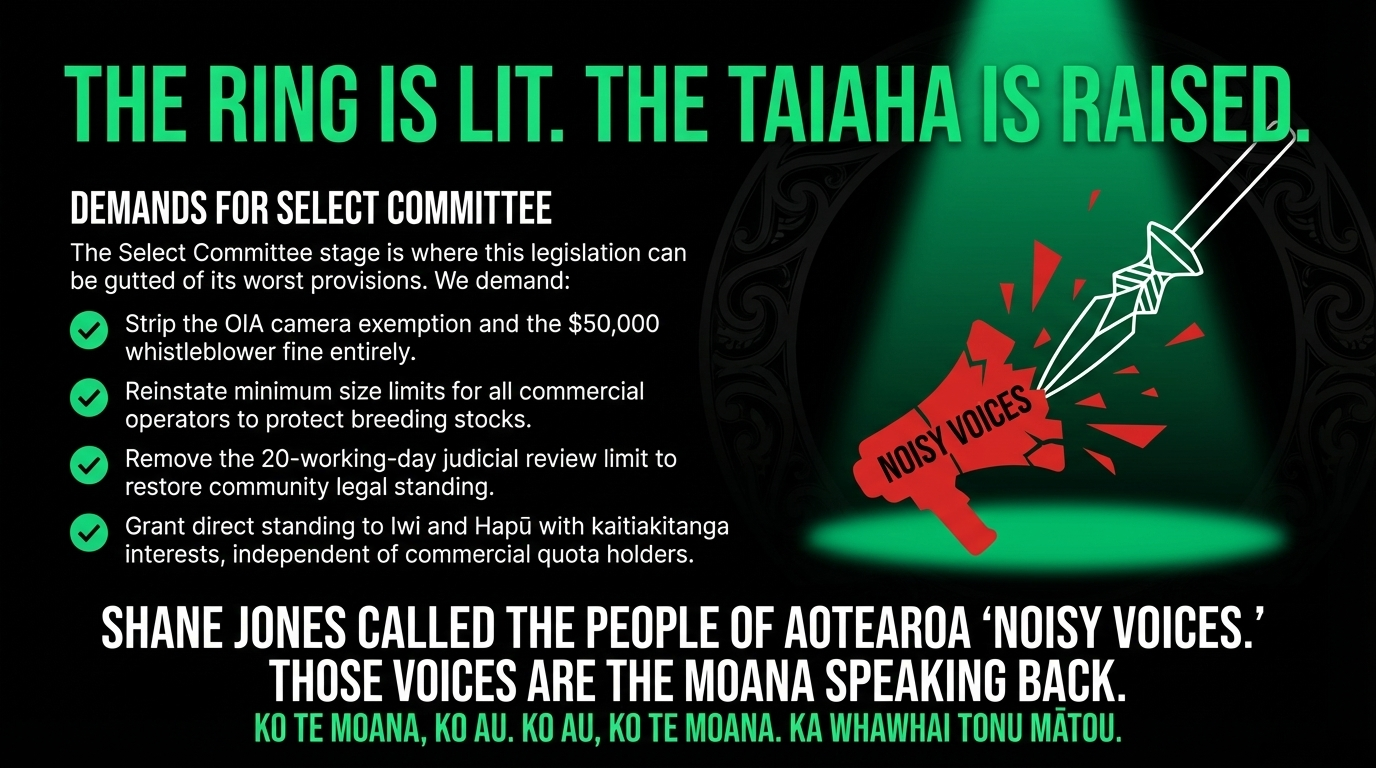
The select committee stage is where this bill can be stopped, slowed, or gutted of its worst provisions. Labour's Rachel Boyack has indicated her party will do their "best to make changes to the bill so that it's not as bad as what it could be," as RNZ reported. That is not sufficient — but it is a point of leverage.
What needs to happen, now:
- The OIA exemption for camera footage and the $50,000 leak fine must be stripped from the bill entirely. Public accountability for a publicly-owned resource is not negotiable — as confirmed by the bill's own text.
- Minimum size limits must remain — for commercial operators as much as recreational ones. Ten species, including snapper, cannot be sacrificed for short-term landed value.
- The 20-working-day judicial review limit must be removed. It is a direct attack on hapū and environmental groups who have successfully used the law to protect the moana — including the crayfish case, as 1News documented.
- The Crown must be held to account for the High Court finding confirmed by The Spinoff: it breached the 1992 Māori Fisheries Settlement through the 28N rights mechanism. That repair cannot wait for another decade.
- Iwi and hapū with kaitiakitanga interests in inshore fisheries must be given direct standing in the select committee process — not mediated through the commercial operators who profit from their quota rights.
Shane Jones has called the people of Aotearoa "noisy voices." Those voices are the moana speaking back. Ko te moana, ko au. Ko au, ko te moana.
The ring is lit. The taiaha is raised. Ka whawhai tonu mātou.

Research conducted 24 March 2026. All URLs tested live at time of publication. The High Court judgment re: Section 23 / 28N rights is confirmed via The Spinoff's verified investigative report (April 2025). MPI stock data is confirmed via 1News (March 2026). Bill text confirmed via NZ Legislation database (March 2026). Unverified: exact total quantum of all Māori quota at risk beyond the confirmed $10M SNA8 estimate.