"PAPERS PLEASE: How Mark Mitchell, Paul Goldsmith, and Simeon Brown Are Building a Police State That Only Arrests the Poor — and Māori First" - 27 March 2026
When the government cannot fix homelessness, it makes being homeless a crime.

Mōrena ano Aotearoa,
Let us be rid of this white supremacist, neoliberal government!
The Deep Dive Podcast
Listen to a lively conversation between two hosts, unpacking and connecting topics in the sources of this essay
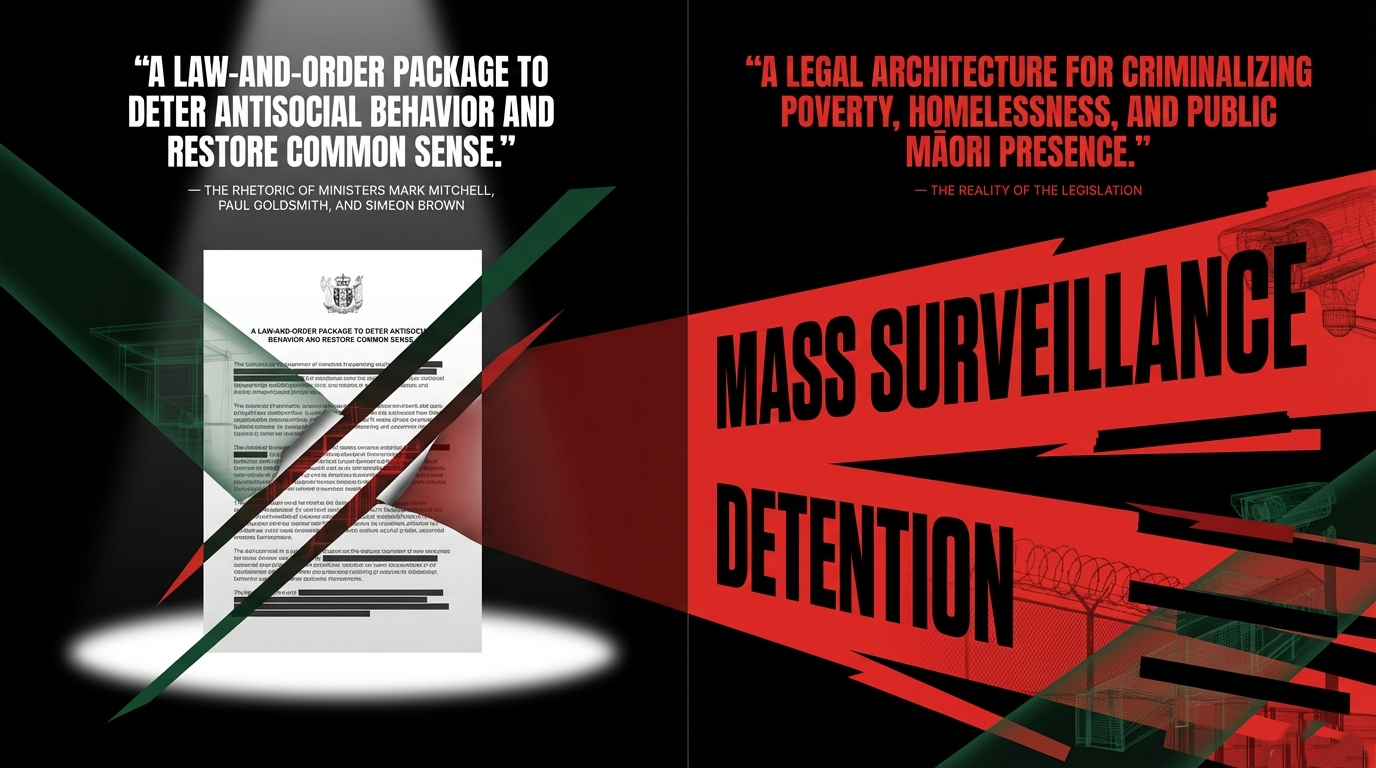
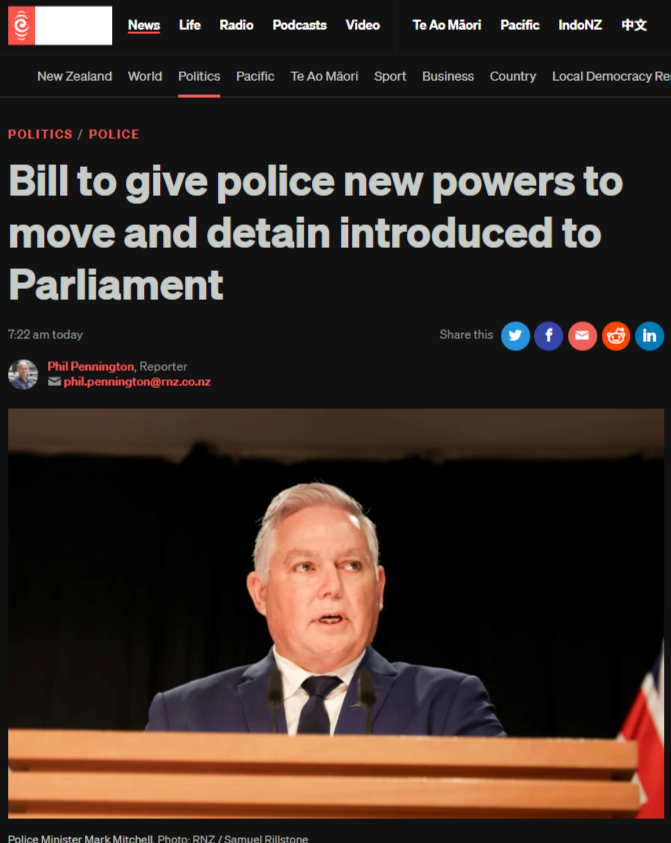
On 18 March 2026, Minister of Police Mark Mitchell introduced the Policing Amendment Bill to Parliament. The bill does two things. It gives police expanded powers to record audio and video — in public spaces, and on private property where they are lawfully present — without a warrant and without judicial oversight. And it gives police, and by extension local councils, expanded powers to close areas and issue move-on orders that can physically detain and remove anyone who does not comply.
Read the bill quickly and it looks like a law-and-order package. Read it carefully and it is something else: a legal architecture for criminalising poverty, homelessness, and public Māori presence — and placing that architecture in the hands of a police force that a 2024 government-commissioned report, Understanding Police Delivery, already documented engages in discriminatory behaviour toward Māori.
The New Zealand Council for Civil Liberties called it plainly in their media release titled "Papers Please!": this law "will be a racist tool of harassment." They compared its likely application to ICE raids in the United States. They are not being dramatic. They are reading the bill.
Minister of Justice Paul Goldsmith told The Spinoff that police would keep applying move-on orders "until the message gets through." The message he is delivering is this: if you are homeless, Māori, young, or visibly poor in a public space, the law is no longer protecting you. It is targeting you.
Wield the taiaha, whānau. Let us trace who this is built for — and who it is built against.
Ko Wai Kei Muri? — Who Stands Behind This?
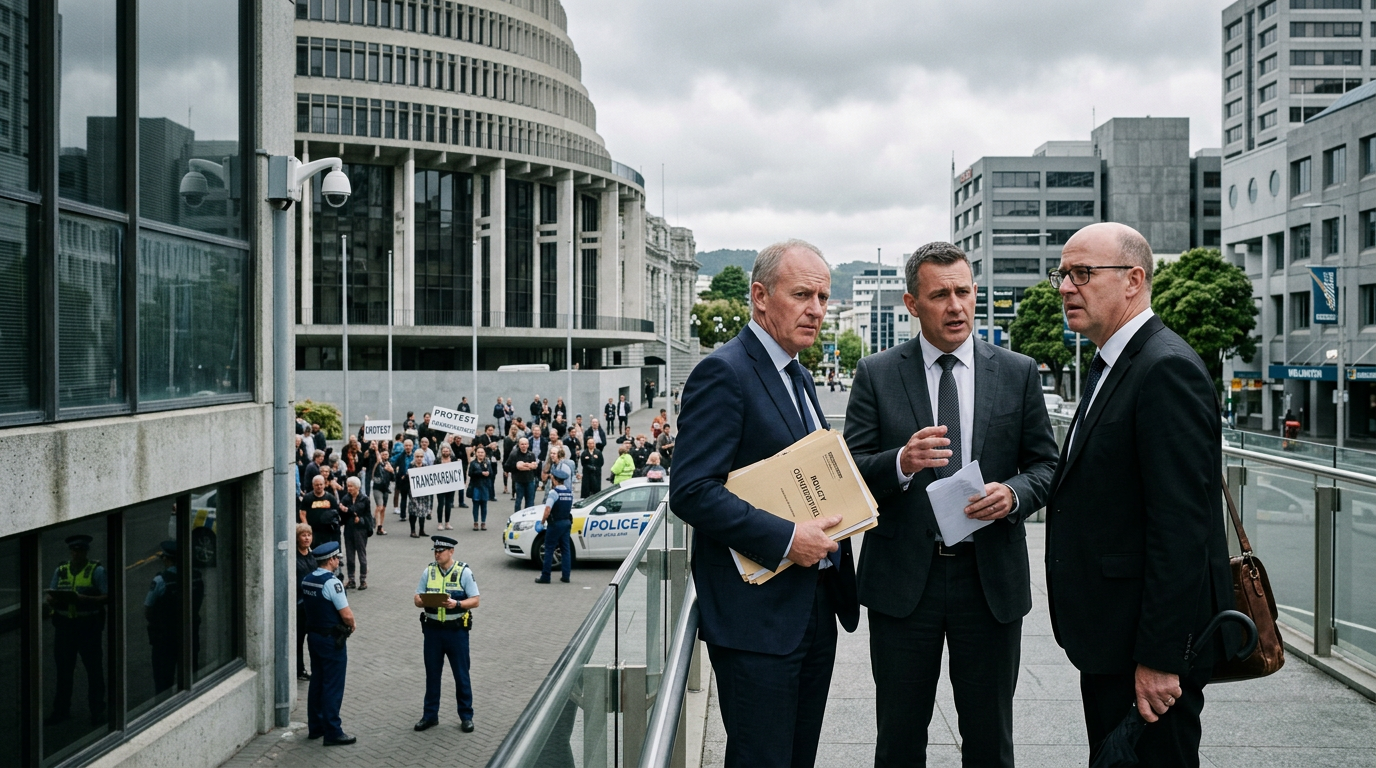
Three ministers own this bill.
Mark Mitchell introduced it. He is the minister responsible for the police force that the Understanding Police Delivery report found already engages in discriminatory conduct against Māori. Rather than address that documented pattern, Mitchell is handing that same force new powers to surveil, detain, and physically remove people from public spaces — without a warrant, without a court, and with criminal penalties for non-compliance.
Paul Goldsmith is the Justice Minister signing off on a law the NZCCL warns breaches the New Zealand Bill of Rights Act. In February 2026, he separately amended the Summary Offences Act to introduce move-on orders as a standalone power — before the Policing Amendment Bill formalised them further. When challenged that these powers would simply move homeless people rather than house them, Goldsmith said police would keep applying them "until the message gets through." That is not a housing policy. That is a harassment strategy.
Simeon Brown is Auckland's Associate Minister and the minister who has championed move-on powers most publicly, framing them as a solution to what he calls "antisocial behaviour" in central Auckland. Brown is not building housing. He is building a legal mechanism to make visible poverty disappear from streets where it makes business owners uncomfortable.
The Beehive backgrounder on police intelligence powers frames the surveillance expansion as restoring capabilities lost under previous privacy reforms. What it does not say: those reforms were enacted because police intelligence gathering had a documented record of targeting activist communities — including Māori communities — without justification.
Ko te ture hei āhuru mōwai — he āhuru mō wai?
The law as a shelter — a shelter for whom?
He Whakaahua Whānui — What the Bill Actually Does
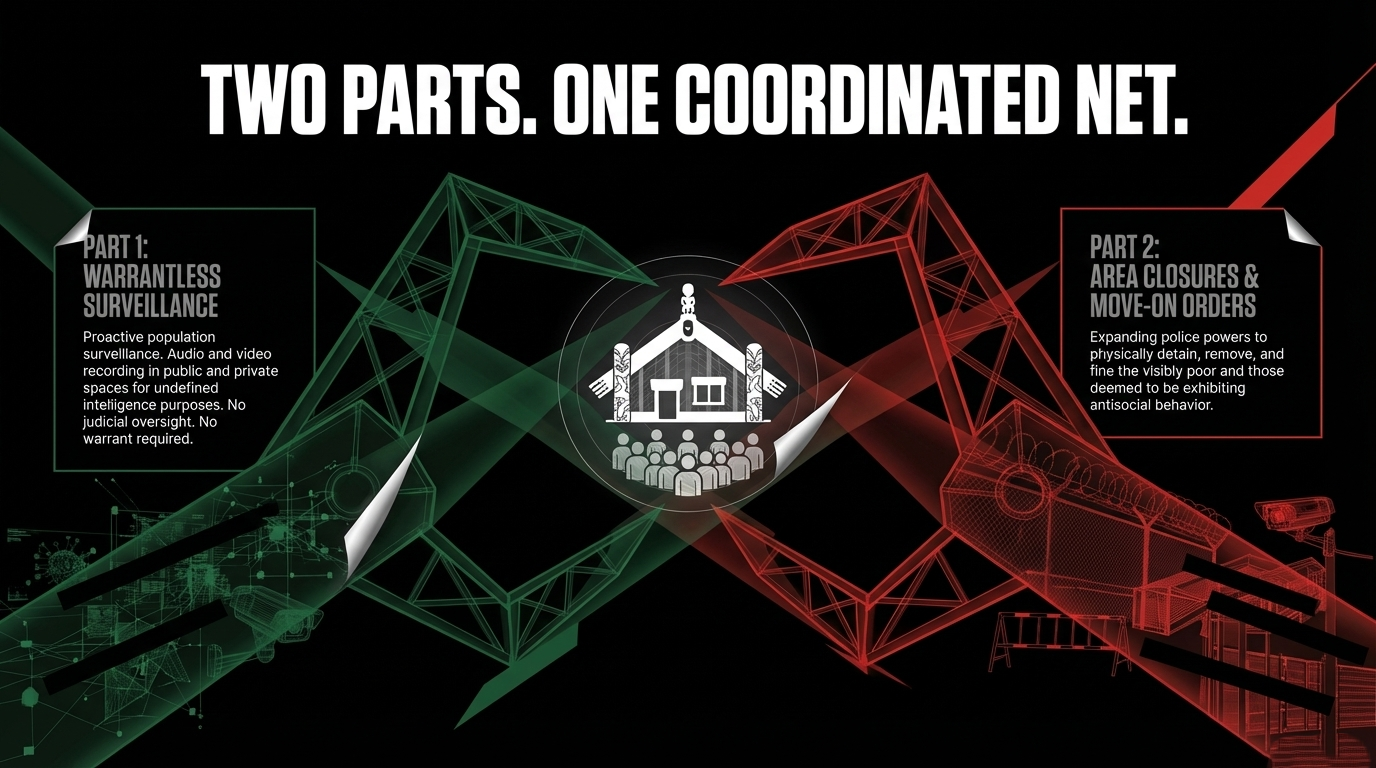
The Policing Amendment Bill is not one law. It is two — bundled together.
Part 1 — Surveillance without a warrant:
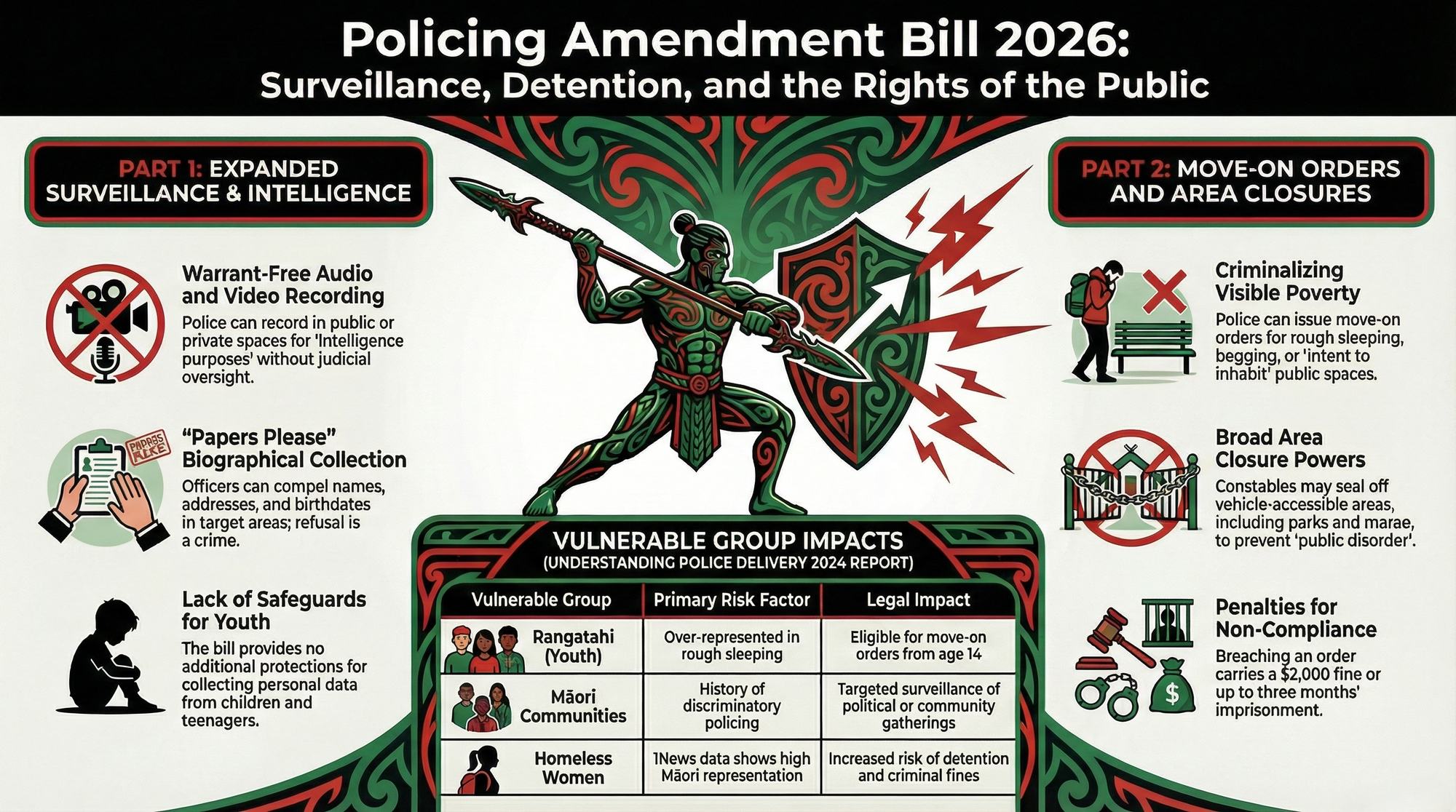
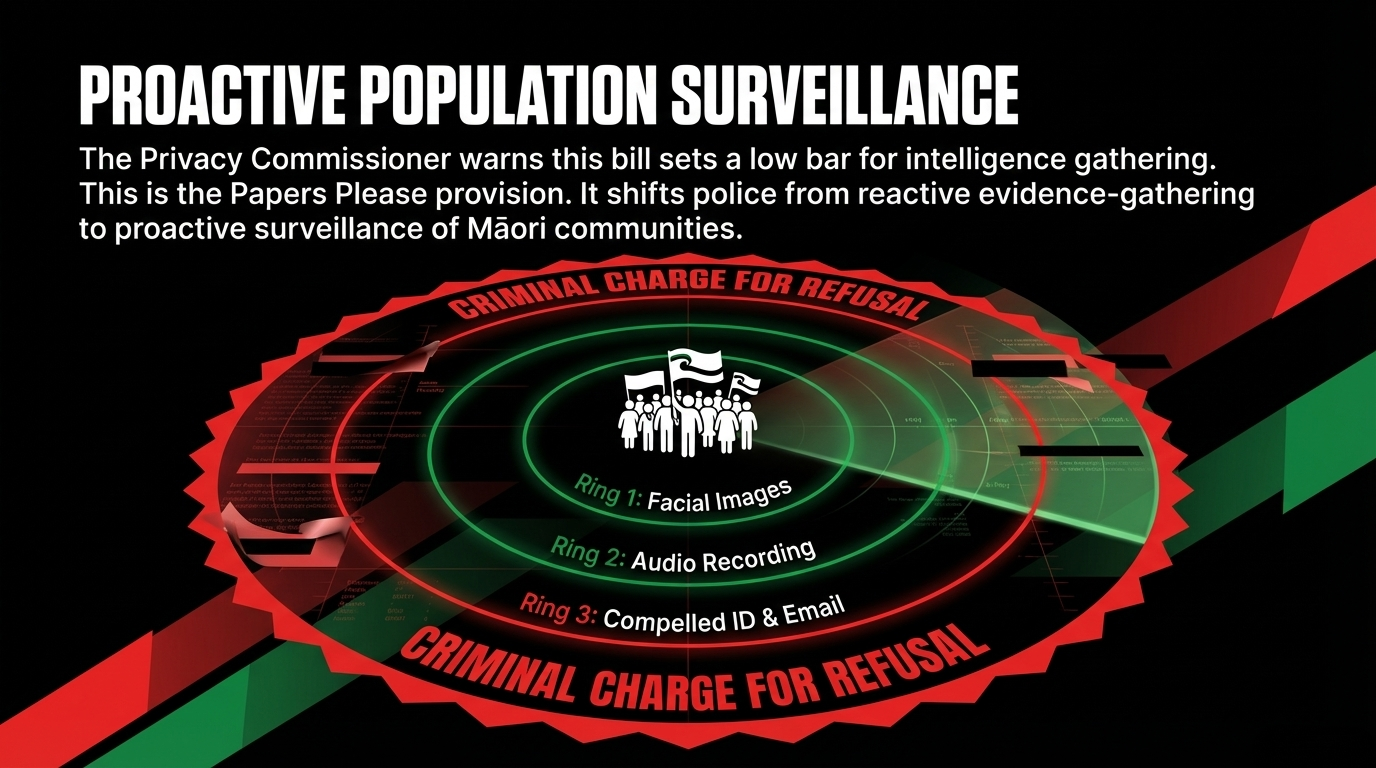
Police can now record audio and video in any public place and on any private property where they are lawfully present — not to gather evidence of a specific crime, but for "intelligence purposes." No warrant required. No judicial oversight. No sunset clause. The NZCCL's analysis of this provision notes it represents a fundamental shift: police move from reactive evidence-gathering to proactive population surveillance. They can record who attends a hikoi. Who sleeps in a park. Who gathers at a marae that happens to be accessible from a road.
Police can also compel anyone in a target area to provide their name, address, date of birth, and email address. Refusing is a criminal charge. This is the "Papers Please" provision that caused the NZCCL to invoke the spectre of ICE-style operations — not because New Zealand is America, but because the legal structure is now the same.
Part 2 — Move-on orders and area closures:
Under amendments to the Summary Offences Act introduced in February 2026, police can issue move-on orders to anyone who is:
- Rough sleeping in a public place
- Begging
- "Indicating intent to inhabit a public place"
- Obstructing access to a business
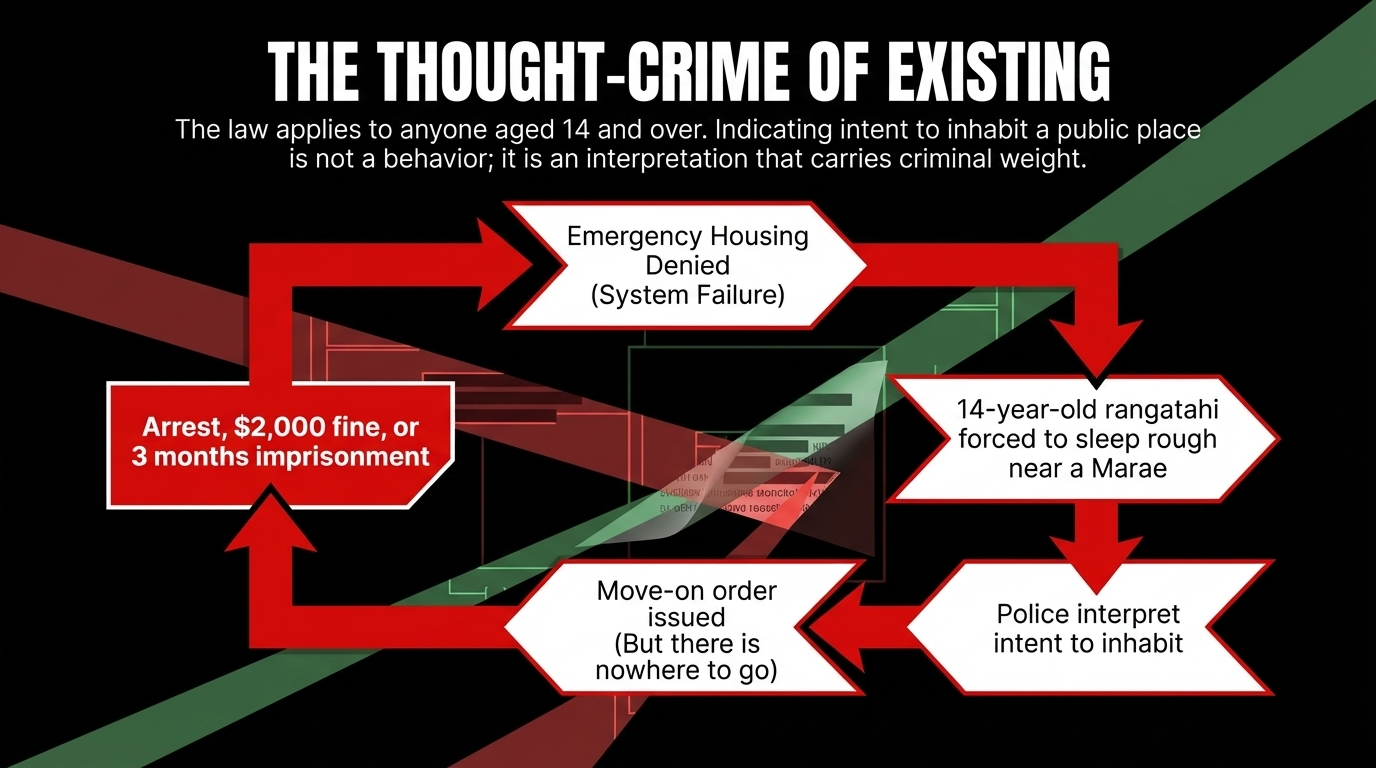
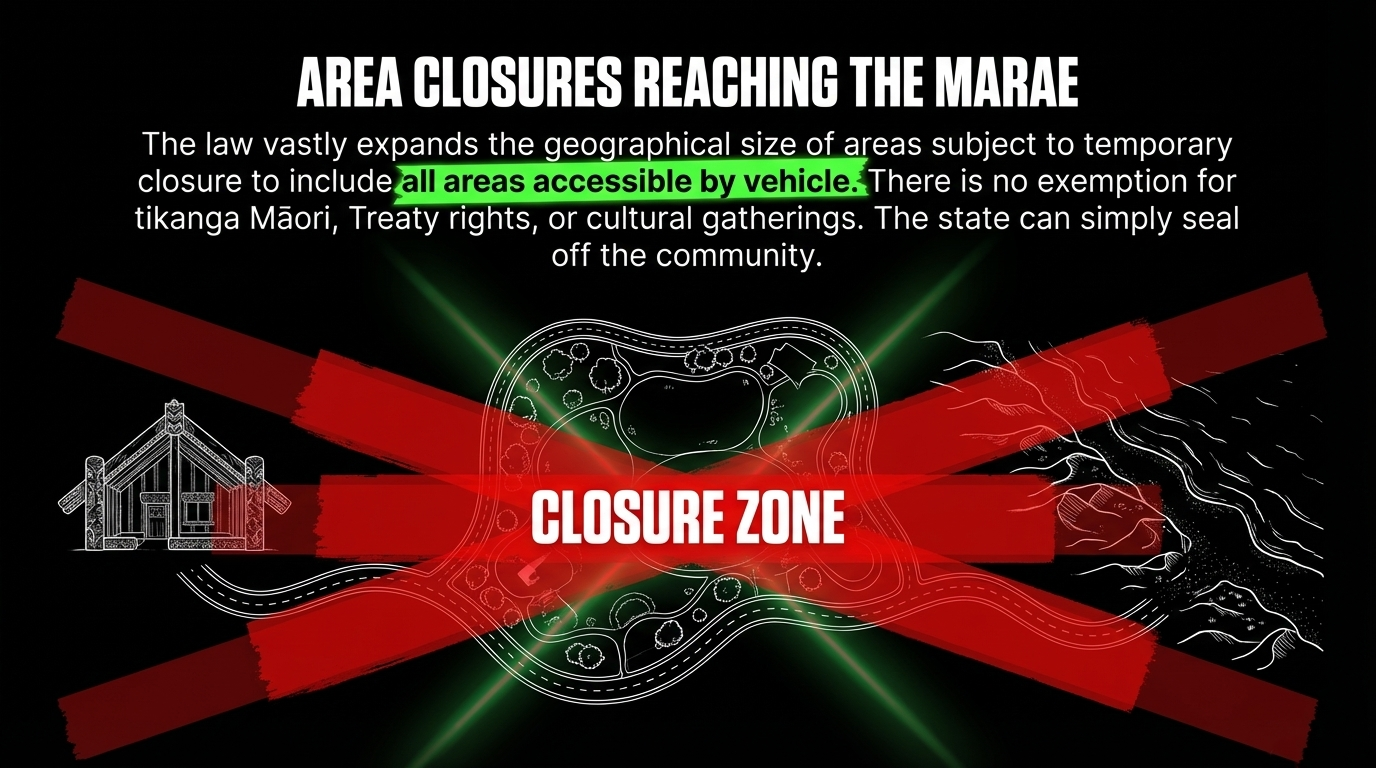
These powers apply to anyone aged 14 and over. A person who fails to comply can be physically detained and removed. Breach carries a $2,000 fine or three months' imprisonment. Area closures — which allow police to seal off locations and exclude people entirely — have been expanded to cover all areas accessible by vehicle, including the surrounds of marae, homes, beaches, parks, and churches.
A 14-year-old rangatahi Māori sleeping rough near a marae, because they have been declined emergency housing — a scenario the data below confirms is not hypothetical — can now be physically detained, fingerprinted, compelled to provide biographical details, and charged with a criminal offence. That is the law as it now stands.
Research showing women experiencing homelessness are much more likely to be Māori was documented by 1News experts in March 2026. Wellington Mayor Andrew Little — a Labour politician — wrote directly to Prime Minister Luxon warning that moving on homeless people "does nothing to address the issues" and "causes significant harm." The government moved on anyway.
Ko te Kīngia o te Kōrero — Naming the Fallacies
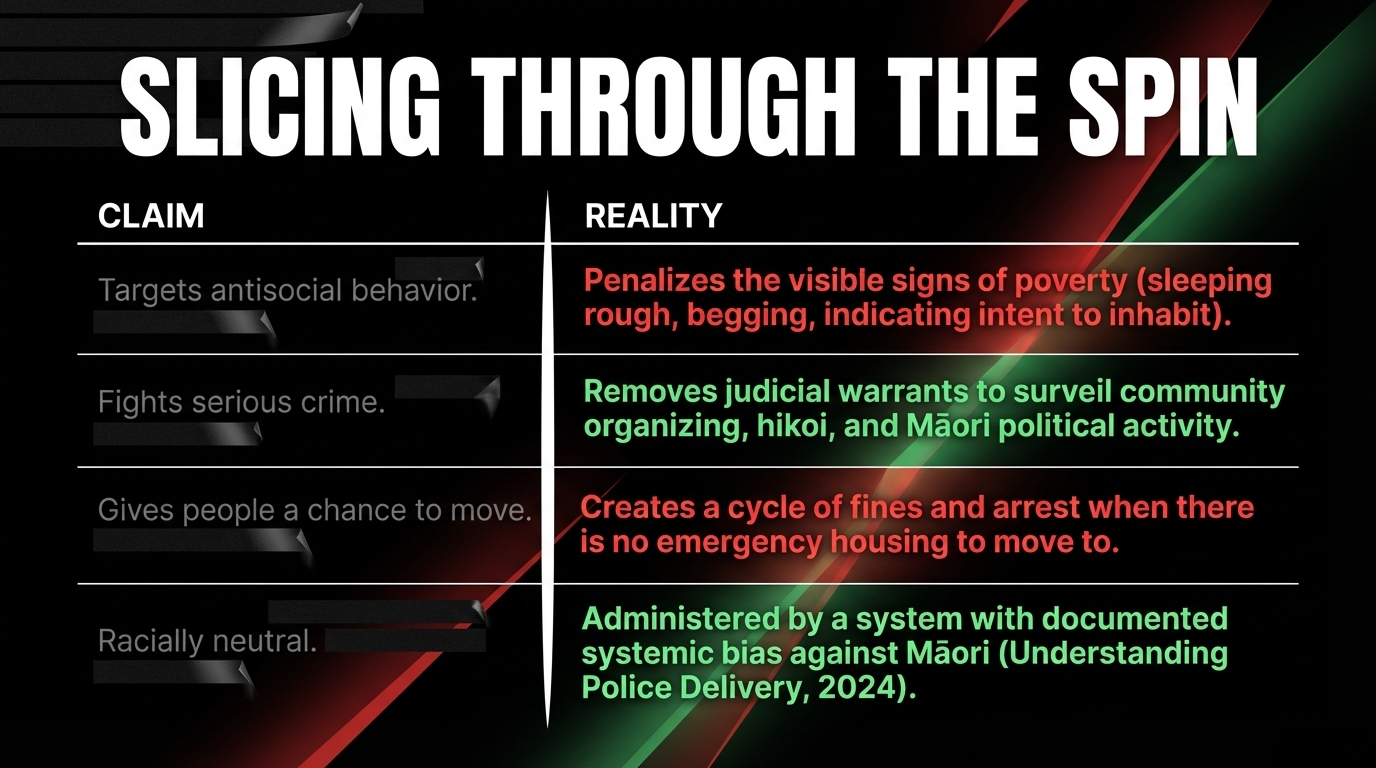
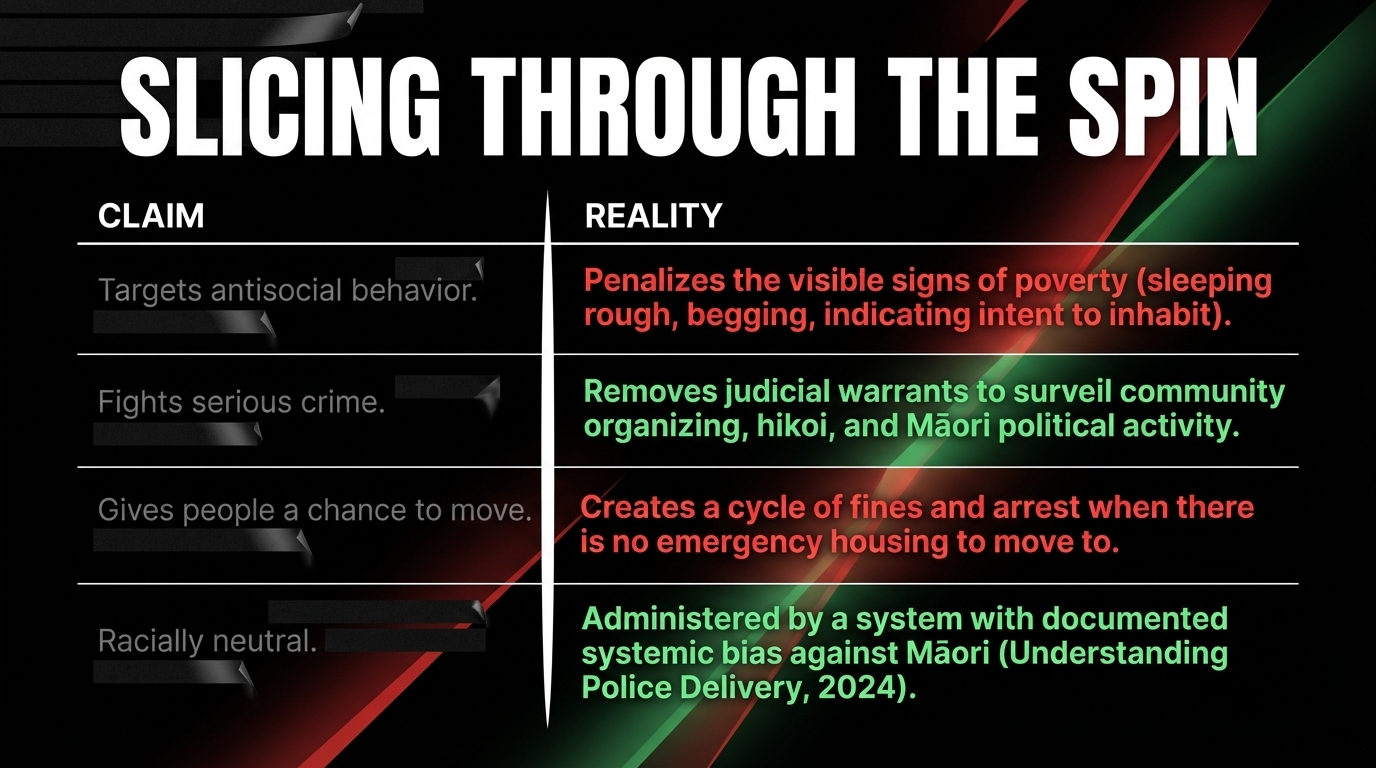
Fallacy 1: "These powers target antisocial behaviour, not people."
Simeon Brown and Paul Goldsmith have both used the language of "antisocial behaviour" to justify move-on orders. But the law names specific conditions — rough sleeping, begging, "indicating intent to inhabit" — that are not behaviours in any meaningful sense. They are the visible signs of poverty. When you make poverty's visibility a criminal trigger, you are targeting people, not behaviour. The language of antisocial behaviour is the rhetorical cover. The legal instrument is a poverty criminalisation tool.
Fallacy 2: "The surveillance expansion is about fighting serious crime."
The warrant-free recording powers are justified as restoring police intelligence capability. But intelligence gathering without a warrant means intelligence gathering without a judge deciding whether it is justified. That judicial step is not bureaucratic friction — it is the protection against police deciding, on their own authority, that a community meeting, a marae gathering, or a hikoi is worth recording and filing. Removing that step is not efficiency. It is removing accountability.
Fallacy 3: "Move-on orders give people the chance to comply before consequences."
Goldsmith described the orders as giving people an opportunity to move before enforcement. What he did not describe is what happens when there is nowhere to move to — because emergency housing has been cut, community shelters are full, and rough sleeping in the next block will simply generate another order. His own words — "until the message gets through" — reveal that compliance is not the goal. Disappearance is.
Fallacy 4: "This does not target Māori specifically."
The law is racially neutral on its face. Its application will not be. The police force receiving these powers has a documented racial profiling pattern. The communities most likely to be rough sleeping — Māori, rangatahi, women fleeing violence — are the communities most likely to receive move-on orders. And as the WSWS documented in March 2026, racially neutral laws administered by a racially non-neutral institution produce racially non-neutral outcomes. The government knows this. Mitchell's own department told him in 2024.
He Kupu Whakamutunga — The Law Has Always Known Where to Land
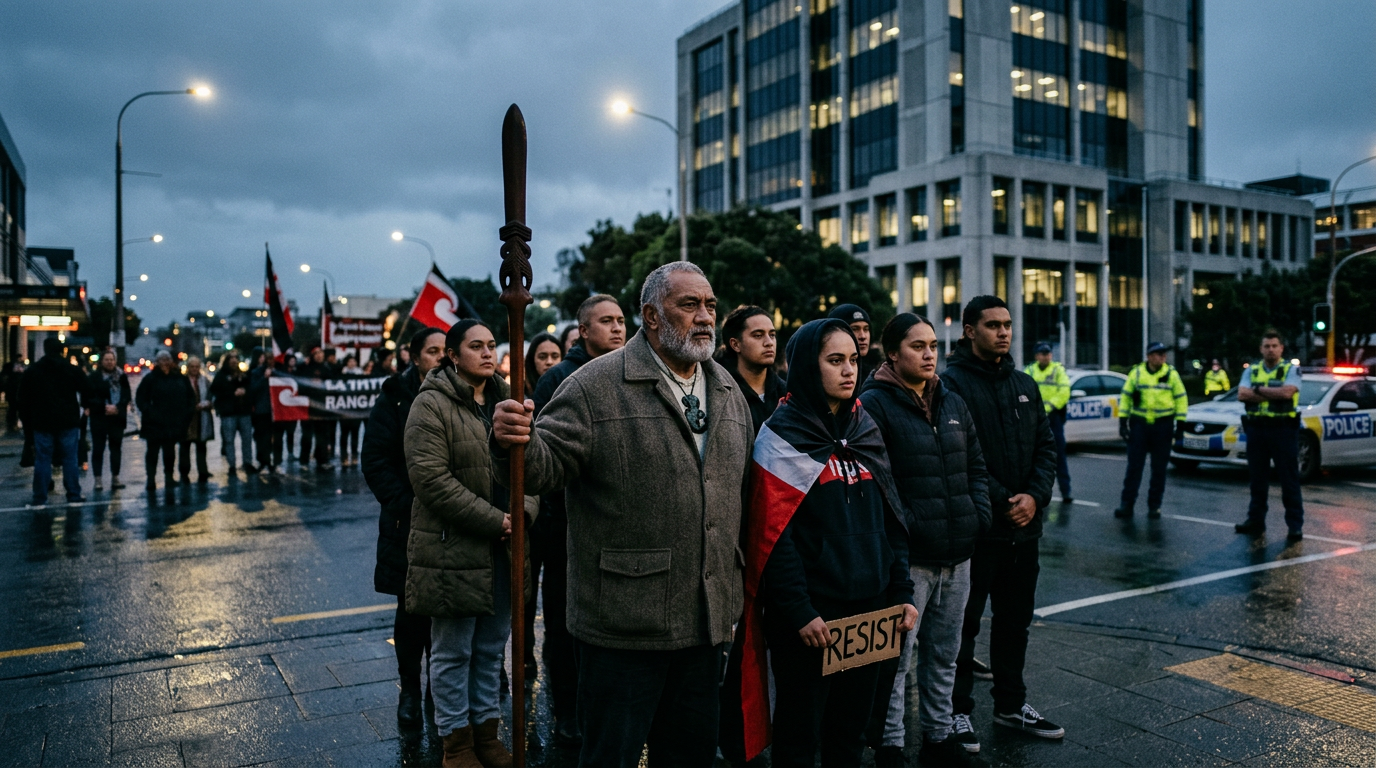
Te Tiriti o Waitangi guarantees Māori tino rangatiratanga — the unqualified exercise of chieftainship over our people, our villages, our taonga. A law that criminalises sleeping outside, compels biographical disclosure from 14-year-olds, and gives warrant-free surveillance powers to a police force with a documented racial profiling record does not honour that guarantee. It dismantles it.
Mark Mitchell is handing discriminatory police a new set of tools. Paul Goldsmith is calling the resulting harassment a compliance strategy. Simeon Brown is calling it tidying up the streets.
The people who will be moved on, detained, charged, and fined are not abstract. They are rangatahi Māori who were declined emergency housing. They are wāhine sleeping rough because family violence made the alternative worse. They are older Māori men whose homelessness began, as so much Māori disadvantage begins, in a childhood shaped by colonial policy that this government is now doubling down on rather than repairing.
The taiaha names what the bill cannot bring itself to say: this is a law built to make poverty invisible, to move the evidence of Crown failure out of sight, and to charge those who refuse to disappear.
He aha te mea nui o te ao? He tangata, he tangata, he tangata.
What is the greatest thing in the world? It is people, it is people, it is people.
Not the street. Not the business frontage. Not the minister's clean city.
The people.
The names are named. The citations are live. The taiaha does not waver.
Kāti rā. Stand firm, whānau.
Research conducted 27 March 2026. All citations are inline hyperlinks verified at time of publication. Sources: New Zealand legislation (Policing Amendment Bill 2026, Summary Offences Act), New Zealand Council for Civil Liberties, Understanding Police Delivery report (NZ Police, 2024), The Spinoff, 1News, Beehive, WSWS, Wellington Mayor's correspondence.PAPERS PLEASE: How Mark Mitchell, Paul Goldsmith, and Simeon Brown Are Building a Police State That Only Arrests the Poor — and Māori First
When the government cannot fix homelessness, it makes being homeless a crime.
He Kōrero Whakatuwhera — The Hidden Connection
On 18 March 2026, Minister of Police Mark Mitchell introduced the Policing Amendment Bill to Parliament. The bill does two things. It gives police expanded powers to record audio and video — in public spaces, and on private property where they are lawfully present — without a warrant and without judicial oversight. And it gives police, and by extension local councils, expanded powers to close areas and issue move-on orders that can physically detain and remove anyone who does not comply.
Read the bill quickly and it looks like a law-and-order package. Read it carefully and it is something else: a legal architecture for criminalising poverty, homelessness, and public Māori presence — and placing that architecture in the hands of a police force that a 2024 government-commissioned report, Understanding Police Delivery, already documented engages in discriminatory behaviour toward Māori.
The New Zealand Council for Civil Liberties called it plainly in their media release titled "Papers Please!": this law "will be a racist tool of harassment." They compared its likely application to ICE raids in the United States. They are not being dramatic. They are reading the bill.
Minister of Justice Paul Goldsmith told The Spinoff that police would keep applying move-on orders "until the message gets through." The message he is delivering is this: if you are homeless, Māori, young, or visibly poor in a public space, the law is no longer protecting you. It is targeting you.
Wield the taiaha, whānau. Let us trace who this is built for — and who it is built against.
Ko Wai Kei Muri? — Who Stands Behind This?
Three ministers own this bill.
Mark Mitchell introduced it. He is the minister responsible for the police force that the Understanding Police Delivery report found already engages in discriminatory conduct against Māori. Rather than address that documented pattern, Mitchell is handing that same force new powers to surveil, detain, and physically remove people from public spaces — without a warrant, without a court, and with criminal penalties for non-compliance.
Paul Goldsmith is the Justice Minister signing off on a law the NZCCL warns breaches the New Zealand Bill of Rights Act. In February 2026, he separately amended the Summary Offences Act to introduce move-on orders as a standalone power — before the Policing Amendment Bill formalised them further. When challenged that these powers would simply move homeless people rather than house them, Goldsmith said police would keep applying them "until the message gets through." That is not a housing policy. That is a harassment strategy.
Simeon Brown is Auckland's Associate Minister and the minister who has championed move-on powers most publicly, framing them as a solution to what he calls "antisocial behaviour" in central Auckland. Brown is not building housing. He is building a legal mechanism to make visible poverty disappear from streets where it makes business owners uncomfortable.
The Beehive backgrounder on police intelligence powers frames the surveillance expansion as restoring capabilities lost under previous privacy reforms. What it does not say: those reforms were enacted because police intelligence gathering had a documented record of targeting activist communities — including Māori communities — without justification.
Ko te ture hei āhuru mōwai — he āhuru mō wai?
The law as a shelter — a shelter for whom?
He Whakaahua Whānui — What the Bill Actually Does
The Policing Amendment Bill is not one law. It is two — bundled together.
Part 1 — Surveillance without a warrant:
Police can now record audio and video in any public place and on any private property where they are lawfully present — not to gather evidence of a specific crime, but for "intelligence purposes." No warrant required. No judicial oversight. No sunset clause. The NZCCL's analysis of this provision notes it represents a fundamental shift: police move from reactive evidence-gathering to proactive population surveillance. They can record who attends a hikoi. Who sleeps in a park. Who gathers at a marae that happens to be accessible from a road.
Police can also compel anyone in a target area to provide their name, address, date of birth, and email address. Refusing is a criminal charge. This is the "Papers Please" provision that caused the NZCCL to invoke the spectre of ICE-style operations — not because New Zealand is America, but because the legal structure is now the same.
Part 2 — Move-on orders and area closures:
Under amendments to the Summary Offences Act introduced in February 2026, police can issue move-on orders to anyone who is:
- Rough sleeping in a public place
- Begging
- "Indicating intent to inhabit a public place"
- Obstructing access to a business
These powers apply to anyone aged 14 and over. A person who fails to comply can be physically detained and removed. Breach carries a $2,000 fine or three months' imprisonment. Area closures — which allow police to seal off locations and exclude people entirely — have been expanded to cover all areas accessible by vehicle, including the surrounds of marae, homes, beaches, parks, and churches.
A 14-year-old rangatahi Māori sleeping rough near a marae, because they have been declined emergency housing — a scenario the data below confirms is not hypothetical — can now be physically detained, fingerprinted, compelled to provide biographical details, and charged with a criminal offence. That is the law as it now stands.
Research showing women experiencing homelessness are much more likely to be Māori was documented by 1News experts in March 2026. Wellington Mayor Andrew Little — a Labour politician — wrote directly to Prime Minister Luxon warning that moving on homeless people "does nothing to address the issues" and "causes significant harm." The government moved on anyway.
Ko te Pūāwaitanga o te Kino — The Five Hidden Connections
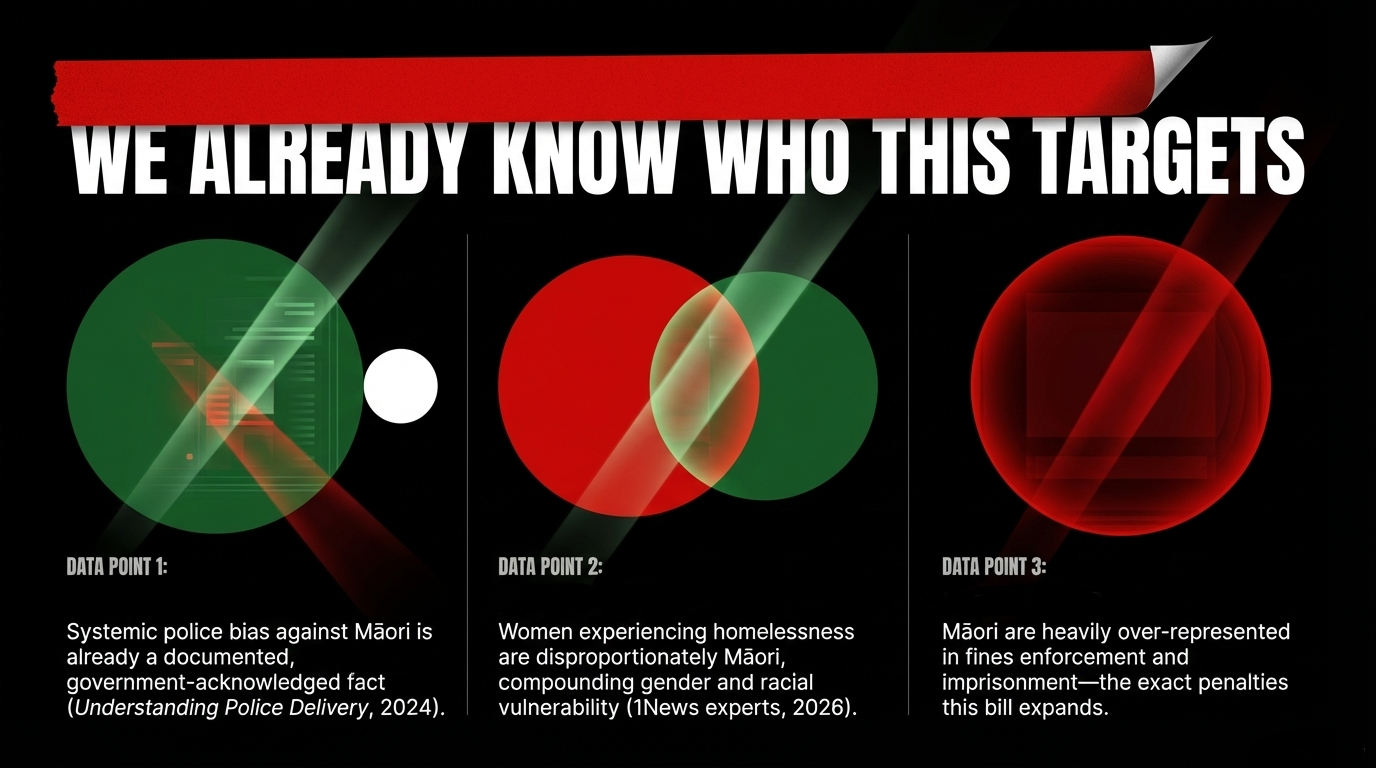
1. The police force receiving these powers already has a documented Māori discrimination problem
The Understanding Police Delivery report (2024), commissioned by the government itself, documented discriminatory police behaviour against Māori as a systemic pattern. Mitchell's response was not to address that pattern before expanding police powers. It was to expand police powers first. When you hand a documented racial profiling apparatus a new legal framework to stop and detain people in public spaces, the communities most likely to experience those stops are the communities the report named. This is not prediction. It is pattern recognition.
2. "Indicating intent to inhabit a public place" is a thought crime for the homeless
The move-on trigger "indicating intent to inhabit a public place" is not a behaviour. It is an interpretation. It means a police officer — or a council contractor — can read a person's presence, their backpack, their posture, and decide they intend to sleep there tonight. That determination carries criminal weight. There is no appeal mechanism before the order issues. There is no requirement to offer the person housing before removing them. There is only the order, the detention power, and the fine.
The NZCCL noted in their move-on orders analysis that these provisions "penalise people for being poor in public" and breach the New Zealand Bill of Rights Act. The government did not commission a Bill of Rights analysis before proceeding. Or if they did, they have not released it.
3. The surveillance expansion specifically targets community organising — including Māori organising
The "intelligence purposes" framing in Part 1 is not incidental language. New Zealand police have a documented history of treating Māori political organising as an intelligence threat — most infamously in the 2007 Urewera raids, where armed police descended on Tūhoe communities under terrorism legislation that was later found, in significant part, to have been misapplied. The new warrant-free surveillance powers give police the legal foundation to record, catalogue, and build files on community meetings, hikoi, and Māori political activity — all without any external check on whether that activity justifies surveillance.
4. Area closures can now reach marae
The expansion of area closures to "all areas accessible by vehicle" is not abstract. Marae are, in most cases, accessible by vehicle. A community gathering at a marae — a tangi, a hui, a community response to a housing crisis — could fall within an area closure order if police decide the area presents a public order concern. The law does not include any exemption for tikanga Māori, Treaty rights, or cultural gatherings. It does not need to. It simply hands the power to police, who have already been documented exercising it discriminatorily.
5. These powers are arriving simultaneously with the emergency housing shutdown — there is nowhere to go
Read in isolation, the Policing Amendment Bill looks like a policing measure. Read alongside the emergency housing criteria tightening documented below, it is something more deliberate: one arm of government is closing the door to emergency shelter, while another arm of government is making it a criminal offence to sleep in the street. There is no third option being offered. The government has simply removed both — and built a legal mechanism to punish anyone caught in the space between.
Ko ngā Āputa — The Quantified Harm
| What the law does | Who bears it | Source |
|---|---|---|
| Move-on orders applicable from age 14 | Rangatahi Māori disproportionately represented in rough sleeping | 1News, March 2026 |
| Breach penalty: $2,000 fine or 3 months prison | Māori over-represented in fines enforcement and imprisonment | Understanding Police Delivery, 2024 |
| Area closures extended to vehicle-accessible areas | Includes marae, beaches, parks, and community spaces | Policing Amendment Bill |
| Warrant-free audio/video recording for intelligence | Māori communities historically targeted by police intelligence operations | NZCCL, March 2026 |
| Women experiencing homelessness "much more likely to be Māori" | Gender and racial compounding | 1News expert analysis, March 2026 |
| Bill of Rights breach flagged | No government response or public analysis released | NZCCL move-on analysis |
Ko te Kīngia o te Kōrero — Naming the Fallacies
Fallacy 1: "These powers target antisocial behaviour, not people."
Simeon Brown and Paul Goldsmith have both used the language of "antisocial behaviour" to justify move-on orders. But the law names specific conditions — rough sleeping, begging, "indicating intent to inhabit" — that are not behaviours in any meaningful sense. They are the visible signs of poverty. When you make poverty's visibility a criminal trigger, you are targeting people, not behaviour. The language of antisocial behaviour is the rhetorical cover. The legal instrument is a poverty criminalisation tool.
Fallacy 2: "The surveillance expansion is about fighting serious crime."
The warrant-free recording powers are justified as restoring police intelligence capability. But intelligence gathering without a warrant means intelligence gathering without a judge deciding whether it is justified. That judicial step is not bureaucratic friction — it is the protection against police deciding, on their own authority, that a community meeting, a marae gathering, or a hikoi is worth recording and filing. Removing that step is not efficiency. It is removing accountability.
Fallacy 3: "Move-on orders give people the chance to comply before consequences."
Goldsmith described the orders as giving people an opportunity to move before enforcement. What he did not describe is what happens when there is nowhere to move to — because emergency housing has been cut, community shelters are full, and rough sleeping in the next block will simply generate another order. His own words — "until the message gets through" — reveal that compliance is not the goal. Disappearance is.
Fallacy 4: "This does not target Māori specifically."
The law is racially neutral on its face. Its application will not be. The police force receiving these powers has a documented racial profiling pattern. The communities most likely to be rough sleeping — Māori, rangatahi, women fleeing violence — are the communities most likely to receive move-on orders. And as the WSWS documented in March 2026, racially neutral laws administered by a racially non-neutral institution produce racially non-neutral outcomes. The government knows this. Mitchell's own department told him in 2024.
Koha Consideration

This essay names the bill, the ministers, and the mechanisms being used to criminalise poverty and surveil Māori communities. Holding power to account takes time, research, and independence. If this mahi matters to you, three pathways exist to keep it going:
For those who wish to support this mahi directly with a koha (voluntary contribution), please visit the Koha platform:
Koha — Support
For those who wish to receive essays directly and support through subscription:
Subscribe to the Māori Green Lantern
For those who prefer direct bank transfer, account details are: HTDM, account number 03-1546-0415173-000.
Every koha signals that whānau are ready to fund the accountability that Crown and corporate structures will not provide. It signals that rangatiratanga includes the power to fund our own truth tellers. Kia kaha, whānau.
He Kupu Whakamutunga — The Law Has Always Known Where to Land
Te Tiriti o Waitangi guarantees Māori tino rangatiratanga — the unqualified exercise of chieftainship over our people, our villages, our taonga. A law that criminalises sleeping outside, compels biographical disclosure from 14-year-olds, and gives warrant-free surveillance powers to a police force with a documented racial profiling record does not honour that guarantee. It dismantles it.
Mark Mitchell is handing discriminatory police a new set of tools. Paul Goldsmith is calling the resulting harassment a compliance strategy. Simeon Brown is calling it tidying up the streets.
The people who will be moved on, detained, charged, and fined are not abstract. They are rangatahi Māori who were declined emergency housing. They are wāhine sleeping rough because family violence made the alternative worse. They are older Māori men whose homelessness began, as so much Māori disadvantage begins, in a childhood shaped by colonial policy that this government is now doubling down on rather than repairing.
The taiaha names what the bill cannot bring itself to say: this is a law built to make poverty invisible, to move the evidence of Crown failure out of sight, and to charge those who refuse to disappear.
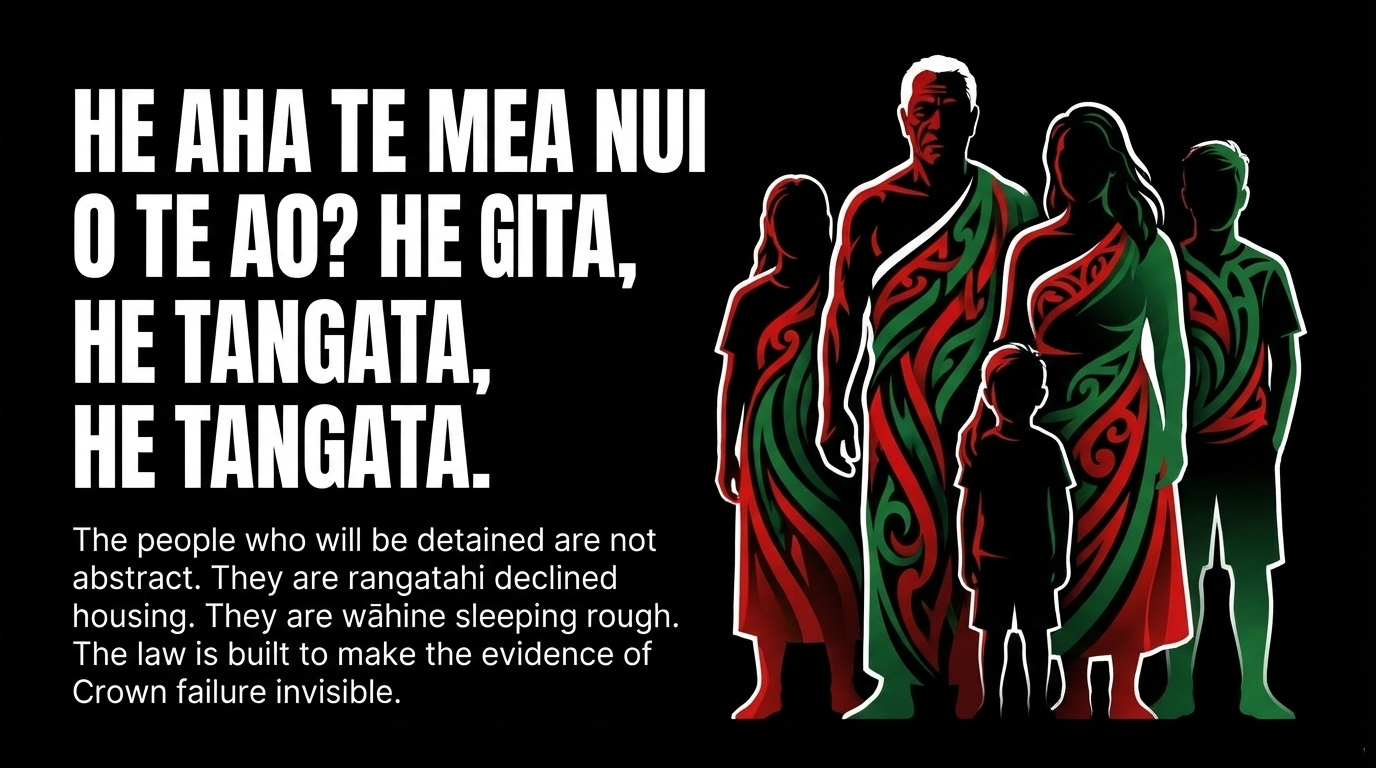
He aha te mea nui o te ao? He tangata, he tangata, he tangata.
What is the greatest thing in the world? It is people, it is people, it is people.
Not the street. Not the business frontage. Not the minister's clean city.
The people.
The names are named. The citations are live. The taiaha does not waver.
Kāti rā. Stand firm, whānau.

Research conducted 27 March 2026. All citations are inline hyperlinks verified at time of publication. Sources: New Zealand legislation (Policing Amendment Bill 2026, Summary Offences Act), New Zealand Council for Civil Liberties, Understanding Police Delivery report (NZ Police, 2024), The Spinoff, 1News, Beehive, WSWS, Wellington Mayor's correspondence.