
"SIX HUNDRED HOLES IN THE GROUND" - 22 May 2026
The Contaminated Sites Register, the Cleanup Bill Nobody Wants to Pay, and the Communities Left Standing in the Poison

Mōrena Aotearoa,
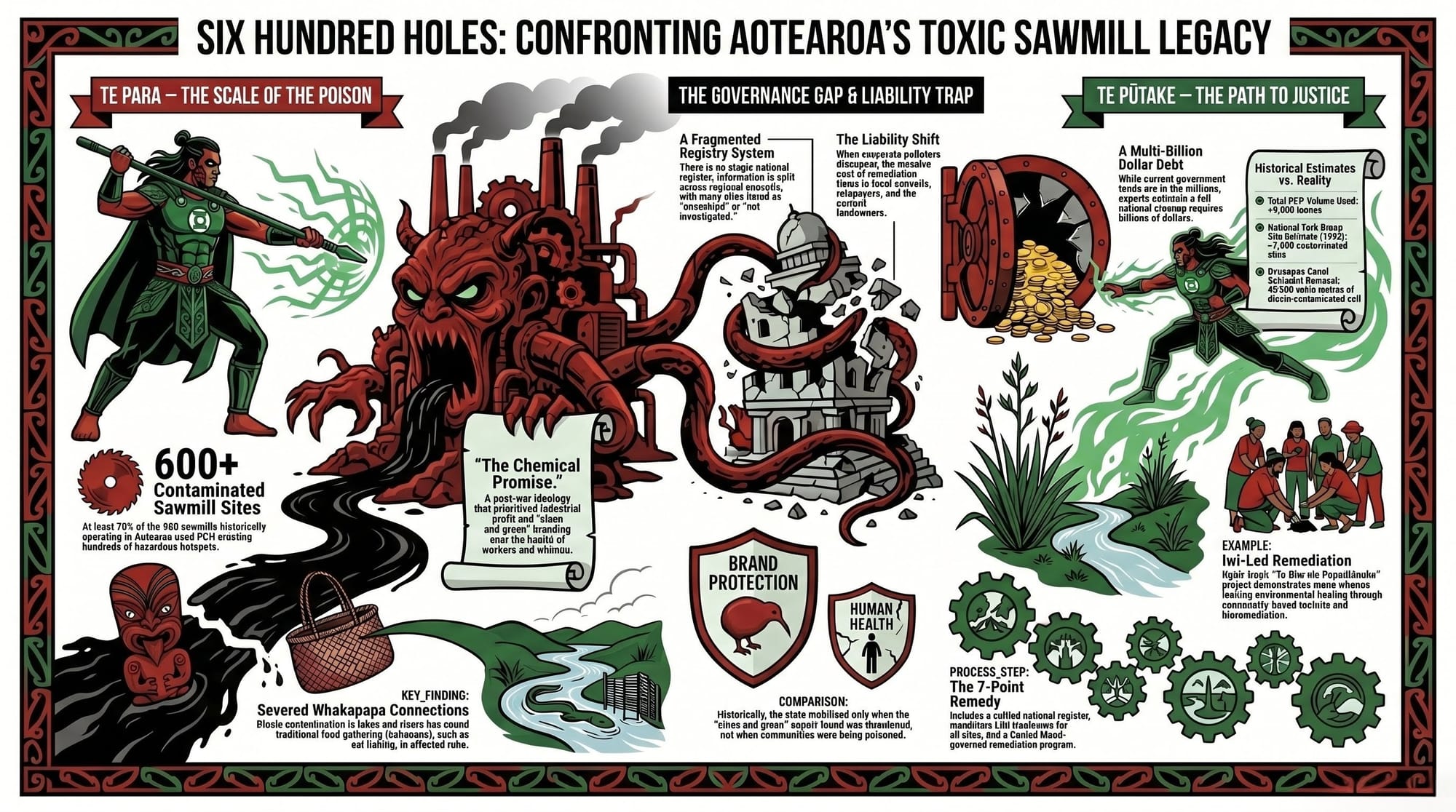
The poison was dumped for profit. The register was built for administration. The cleanup bill is being pushed onto the communities who were poisoned first.
This essay examines contaminated ancestral land because it directly affects Māori whānau, democratic accountability in local government, and the public liability created when polluters are allowed to disappear.
This is the third essay in the Deadly Legacy series, published in the public interest under the Defamation Act 1992 (NZ) and Durie v Gardiner NZCA 278.
The Deep Dive Podcast
Listen to a lively conversation between two hosts, unpacking and connecting topics in the sources of this essay. I apologise in advance for the AI's very harsh pronounciation of reo. Please dont shoot me, :).
Ko Te Para, Ko Te Pūtake — The Poison and Its Origin
I want to start not with a register, but with a promise.
A University of Canterbury PhD thesis analyses New Zealand's dioxin history and describes what geographer Bruce Wild-Blood Crawfor calls the
"chemical promise"
— the post-war utopian ideology that agrochemicals, herbicides, and timber preservatives would deliver unlimited social and material progress.
In New Zealand, that promise was underwritten by government, embedded in agricultural subsidies, and enforced through a risk-assessment governance system specifically designed to make toxics look manageable, as documented in Bruce University of Canterbury thesis on dioxin governance.
The chemical that concerns me in this essay
— pentachlorophenol (PCP) —
was a dioxin-contaminated wood preservative used at sawmills across New Zealand from the 1950s through to the 1990s.
I want to be clear about who started this fight.
Gordon Jackman kicked off the campaign to expose PCP's legacy in 1992 with The Deadly Legacy: A Report on the Toxic Contamination of New Zealand by the Indiscriminate Use of Pentachlorophenol (PCP), published by Greenpeace New Zealand.
That report was foundational — cited in peer-reviewed academic work and referenced in government investigations, as confirmed by Dew's Canterbury thesis, which lists Jackman 1992 and 1993 as primary sources.
The campaign has been carried on by many since — and it is still going.
Jackman's 1992 report was not a lone act. The thesis records that it emerged as part of a broader wave of social movement challenges — from sawmill workers, Vietnam veterans, and New Plymouth residents — that collectively broke the silence around New Zealand's dioxin and organochlorine contamination legacy, as detailed in Dew's analysis of social movement activism.
Those movements demanded not just cleanup but accountability: apologies, a full accounting of past government and industry practices, and recognition that the harm extended beyond the environment to the workers and whānau who lived and breathed inside it.
The Silence Was a System
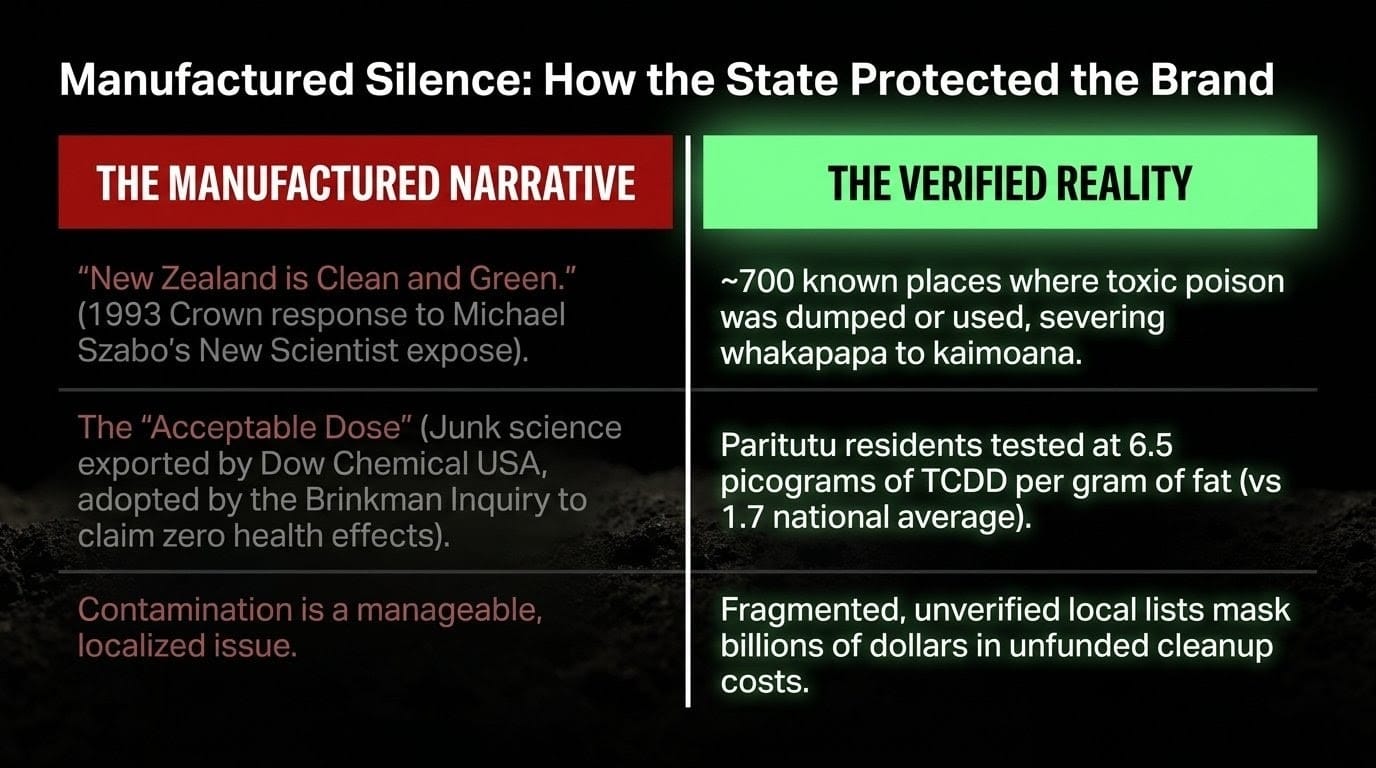
I need you to understand something clearly: dioxin contamination in New Zealand was not an accident of ignorance.
The Canterbury thesis documents in detail how it was the managed product of a governance system that prioritised industrial continuity over human health.
The key tool was what Dew's thesis calls the "acceptable dose" discourse — the idea, formulated in Dow Chemical USA's analytical laboratories and exported globally, that a known quantity of dioxin could be managed without causing human harm.
In New Zealand, the Agricultural Chemicals Board and the Department of Health were not proactive regulators. They were reactive followers of American chemical industry science.
As Dew's thesis documents, they relied for several years on Dow technology itself to analyse dioxin levels in New Zealand products. That is not regulation.
That is regulatory capture by another name: the polluter owned the instruments of measurement.
The result was predictable. The Canterbury thesis records that when a 1985 explosion at the Ivon Watkins-Dow (IWD) plant in Paritutu, New Plymouth, released an estimated one kilogram of dioxin inside the factory, the government's Ministerial Committee of Inquiry
— the Brinkman Inquiry —
concluded that the accident and historic 2,4,5-T production had caused no health effects amongst local residents, as Dew documents in detail.
Thirty years of denials were overturned only in September 2005 when, as the thesis records, the Ministry of Health finally acknowledged that Paritutu residents had been exposed to higher dioxin levels than other New Zealanders.
The pattern for sawmill contamination was identical.
The state mobilised when the "clean and green" brand was threatened. It did not mobilise when workers and communities were being poisoned.
I want to quote Dew's thesis directly here:
"a contaminated environment threatened business and political interests that relied on the clean and green image, and thus a series of responses to remedy the problem was mobilised. However, a cleaning up of the people was not necessary or even rendered visible, because human health did not have similar cultural and economic resonance as the clean and green myth."
That sentence is the architecture of the injustice. Write it down. It has not changed.
Te Āhua o te Para — The Verified Inventory: 600 Holes They Cannot Deny
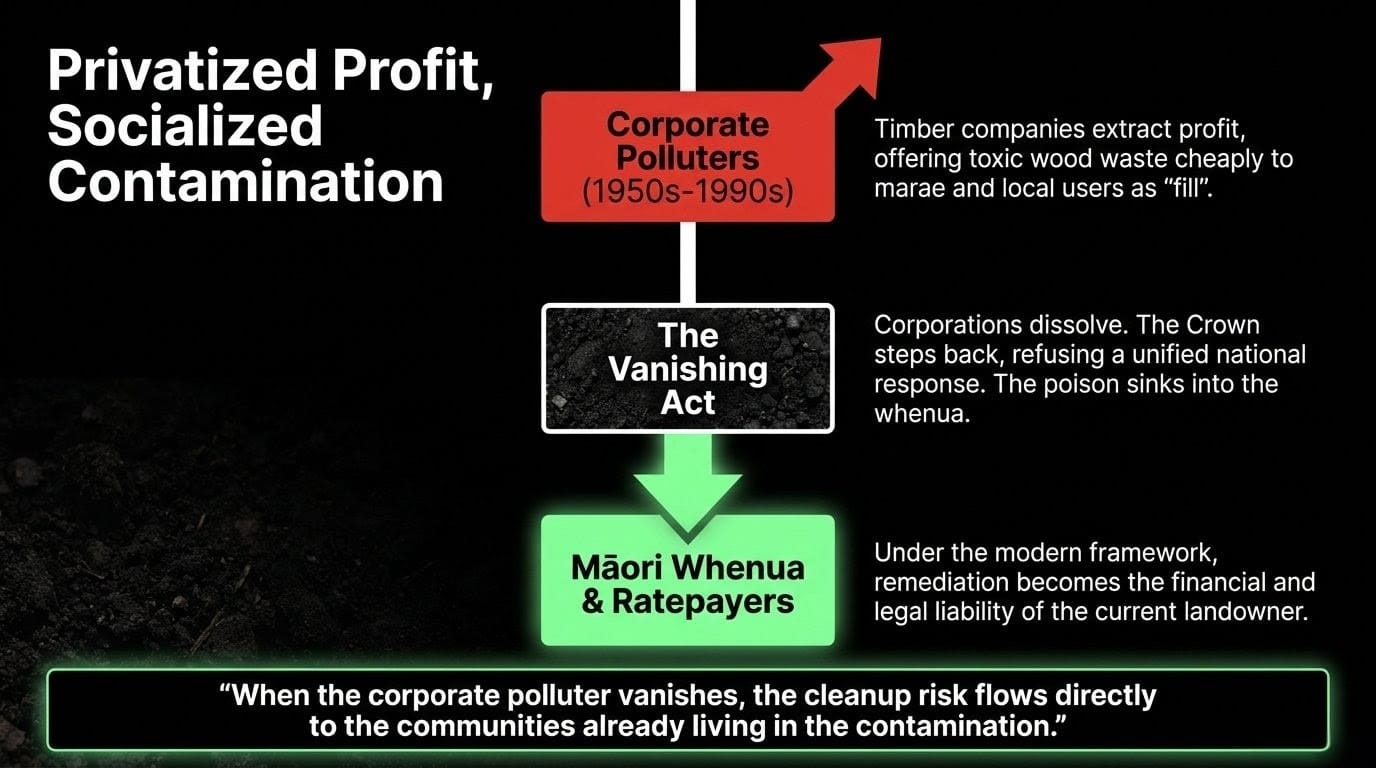
I want you to imagine 600 holes cut into the body of the motu, each one filled with a chemical legacy designed to outlive the men who handled it, the companies that profited from it, and the ministers who signed off on it.
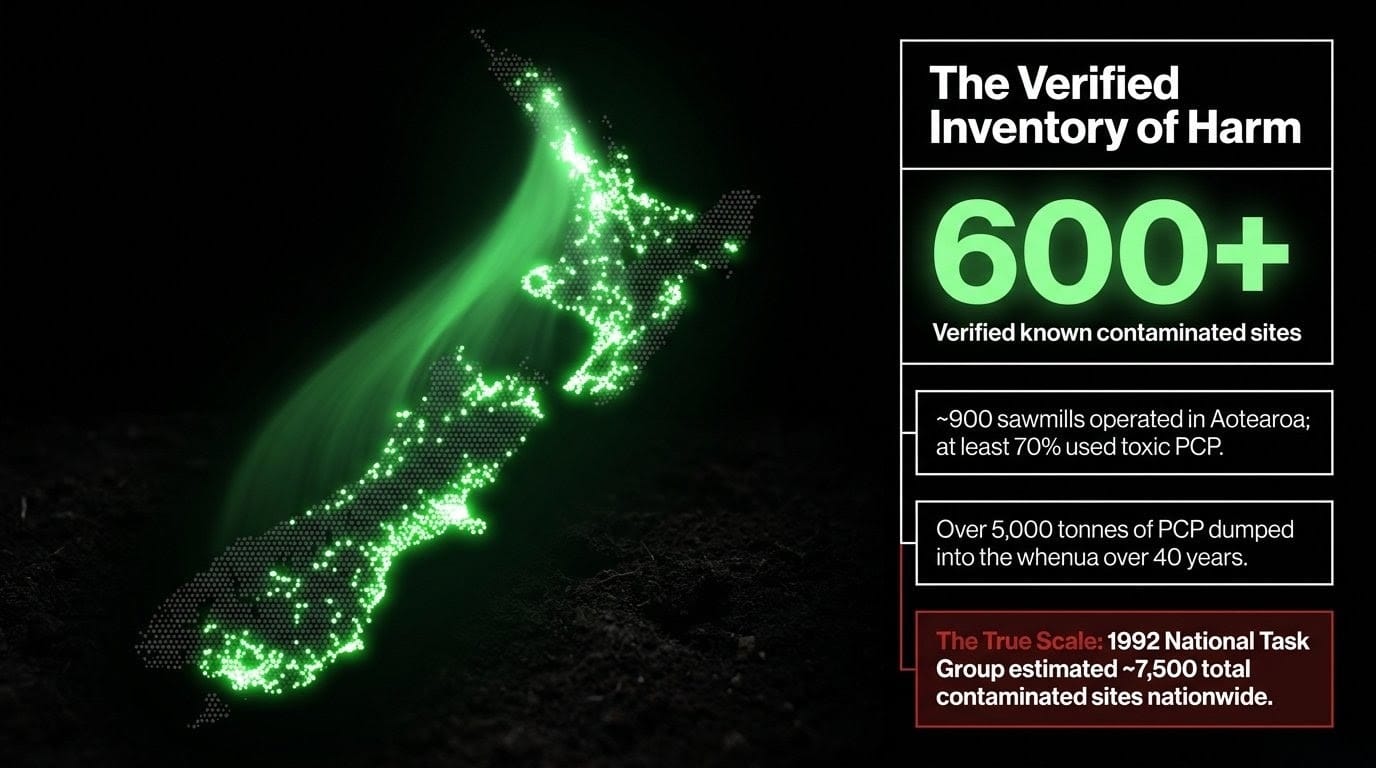
As recorded in the SWAP submission to the People's Inquiry, about 900 sawmills operated in Aotearoa and at least 70 percent used PCP — which means more than 600 contaminated sites across the country.
As Catherine Delahunty wrote for E-Tāngata, at least 700 places are known where the poison was dumped or used, and there are likely more.
This is not a rumour and it is not a metaphor.
According to the SWAP submission to the People's Inquiry, the timber industry used about 5,000 tonnes of PCP over roughly 40 years, and the Ministry for the Environment's own assessment identified 255 sawmills that had used NaPCP or PCP, with about 35 relatively large users posing the highest risk to human health and the environment.
But here is the number that stopped me cold.
The 1990 National Task Group — set up to assess the extent of sawmill and timber treatment site contamination — estimated there were around 7,500 contaminated sites across New Zealand by 1992, as cited in Dew's thesis.
The Waipa Mill outside Rotorua was selected for detailed study, and the high levels of PCP contamination onsite were subsequently found to have affected nearby Lake Rotorua, resulting in recommendations to eat only limited quantities of fish from the lake — also documented in Dew's thesis.
That is the entry in the register that tells you the eel can no longer be gathered. That the lake is no longer food. That the whakapapa relationship between iwi and kaimoana has been severed by someone else's chemistry.
Gordon Jackman wrote to me directly in response to this essay, and I want to reproduce his words exactly, because they correct a figure I had previously cited in a draft:
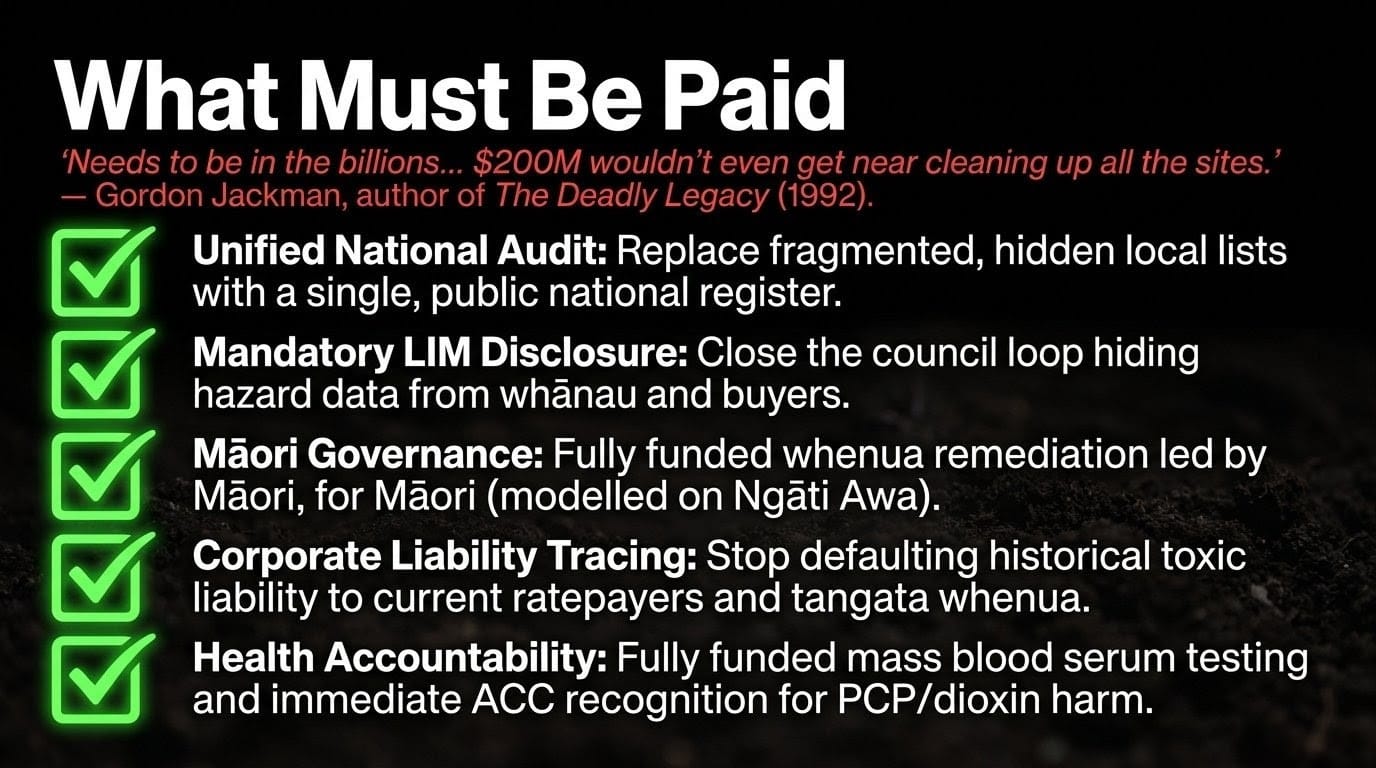
"$200M wouldn't even get near cleaning up all the sites, may be a few dozen — all depends on the sites in all their complexity, as well as their neighbours. Needs to be in the billions."
That is the expert assessment of the man who wrote the founding report in 1992, whose Deadly Legacy is cited throughout academic and government literature on PCP contamination. The state's current allocation is not even in the same dimension as the problem.
The ground story is also a people story.
As the SWAP submission to the People's Inquiry documents, contaminated wood waste was offered cheaply to marae and other local users as fill, and whānau later described springs dying, eel gathering stopping, and communities only discovering the danger after the dumping had already happened. In Whakatāne alone, SWAP recorded 33 known dump sites linked to the old mill legacy.
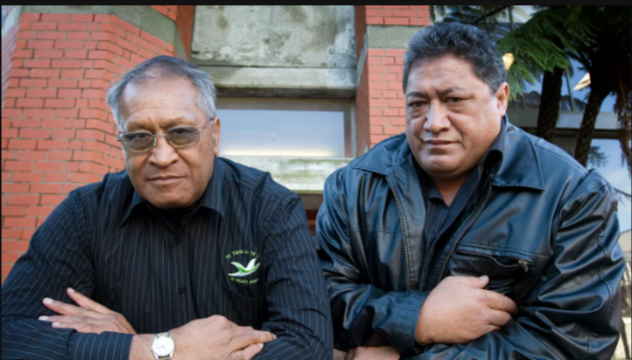
Kereama Akuhata's evidence, recorded in the SWAP submission, ties the land story back to the worker story. Large-scale dumping occurred for years before anyone tracked it properly, and many of the drivers and decision-makers connected to the early dumping are now dead, leaving communities with the residue and no living chain of accountability.
As Catherine Delahunty's account in E-Tāngata records, Kereama Akuhata and Marama Cook carried the struggle forward after Joe Harawira, building a body of evidence about worker exposure, reproductive harm, and poisoned whenua when institutions would not.
The Register State: Administration Without Action — Two Regional Case Studies
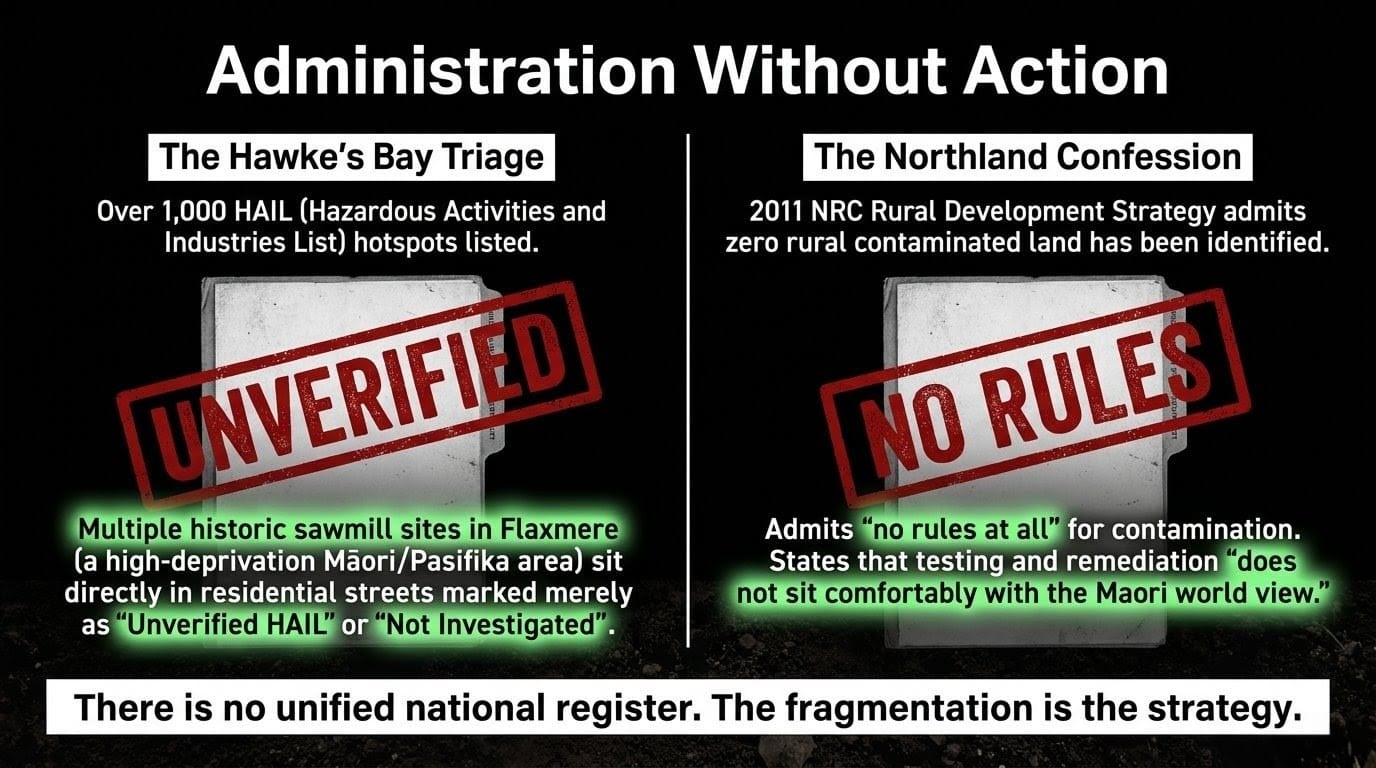
When I talk to people about the Contaminated Sites Register, they often assume it is one national instrument — a single map, a single list, a single place where you can go to find out what is under the ground near your home or your marae.
It is not.
As the Ministry for the Environment's contaminated land guidance makes clear, New Zealand operates through a fragmented network of regional and territorial authority systems tied to HAIL, the Hazardous Activities and Industries List, with no single unified national register that gives communities a complete live picture of risk.
I now have in front of me two regional datasets — one from Hawke's Bay and one from Northland — that make this fragmentation visible with specific, verified, local data.
What follows is what the register system looks like when you open the actual files.
Hawke's Bay: Over 1,000 Sites, Dozens Unverified, Sawmills in the Streets
The Hawke's Bay HAIL hotspots register — a 21-page dataset released under the title 20091009 HOTSPOTs for Release
— lists over 1,000 individual sites across Hastings, Napier, Havelock North, and Wairoa, as contained in the Hawke's Bay contaminated and potentially contaminated sites.
The register categories range from garages, service stations, and dry cleaners to agricultural contractors, landfills, and
— critically — Timber Merchants & Sawmills, listed at multiple addresses including Caroline Road Hastings, Charles Street Hastings, Ferguson Street Hastings, Heretaunga Street West Hastings, and Gloucester Street Greenmeadows Napier.
The classification assigned to most of these sites is stark in its honesty: "Unverified HAIL."
That means the site has been identified as likely hazardous on the basis of the activity that once occurred there, but no investigation has been completed to determine what is actually in the ground. Alongside "Unverified HAIL," many sites carry the classification "Not investigated" — meaning not even the preliminary verification step has been taken.
There are also sites across Flaxmere — a predominantly Māori and Pasifika suburb of Hastings — listed in this same register. Flaxmere already carries some of the highest indices of socioeconomic deprivation in the Hawke's Bay region, as confirmed by Stats NZ deprivation data.
HAIL sites within Flaxmere include transport operators, automotive dismantlers, waste disposal sites, and iron manufacturers — all sitting in a residential community, most carrying the status "Unverified HAIL" or "Not investigated."
That is not environmental protection. That is environmental triage — and communities like Flaxmere are at the back of the queue.
A further critical detail: the register covers Wairoa District, which is home to significant Māori landholdings and communities, including areas within the rohe of Ngāti Kahungunu.
The Wairoa section of the Hawke's Bay register includes power stations, transport operators, fellmongers, and landfills — many carrying no investigation status at all. The register is the only public tool available to those communities. It is incomplete, unverified, and does not automatically trigger LIM disclosure.
Northland: A Council That Named Its Own Failure
The Northland document in this thread is even more damning, because it is not an NGO critique or an activist report. It is a Northland Regional Council policy planning document — a January 2011 Rural Development Strategy issues paper — and it reads like a confession.
The document states directly: "given the fact that no contaminated land has yet been identified within the rural areas of the Whangarei District, it is questionable whether NRC is meeting its requirements under the RMA." It then names the specific knowledge gap: "Of particular relevance are the historic activities of livestock dipping, and use of persistent herbicides and pesticides that were commonplace in the rural areas of the District. Without accurate information or data on these locations, there is a real danger of exposing people and the environment to contaminants if and when development occurs."Northland-Contaminated-sites.pdf
The same document confirms that out of 73 district councils at the time, "the vast majority had no rules at all, and no rules for section 31 functions" in relation to contaminated land. This is a Crown-mandated local government system admitting — in its own planning documents — that it cannot find the poison and does not have the rules to manage it when it does.Northland-Contaminated-sites.pdf
The Northland document also contains a passage I want every iwi legal team and every community health advocate in this country to read. Discussing iwi management plans in the Whangarei District, the council writes: "Although none of these plans make specific mention of (historically) contaminated land, the emphasis placed on the integrity of land, soils, water and air, and the plans' holistic approach to managing human activities within the natural environment, would suggest that contaminated land does not sit comfortably with the Maori world view."Northland-Contaminated-sites.pdf
"Does not sit comfortably." That is a council planning document's description of dioxins and PCP under Māori land. The understatement is almost beyond comprehension.
The Fragmentation Is the Strategy
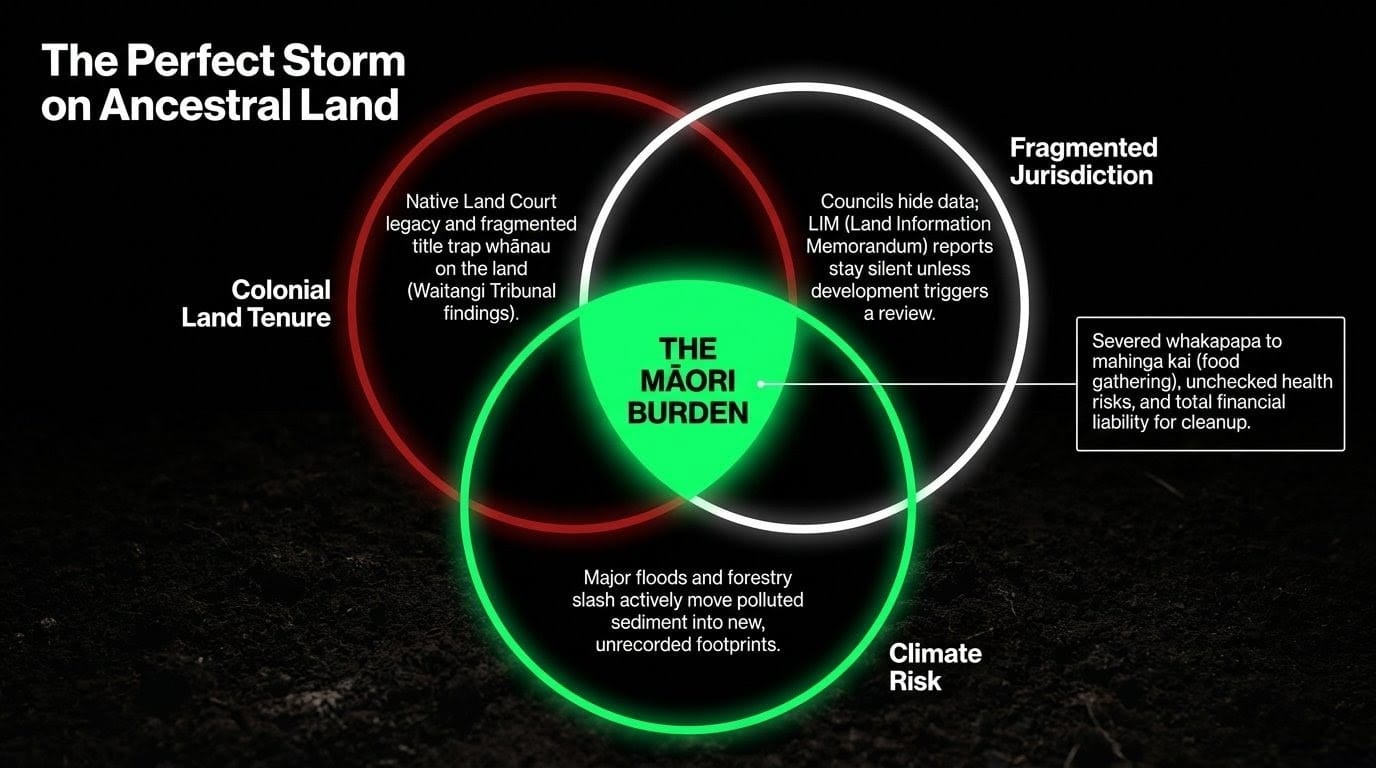
That same Ministry for the Environment guidance says regional councils were required under the RMA, and then under the Natural and Built Environment framework from August 2023, to identify HAIL land in their regions and maintain publicly available information about it.
In practice, councils run their own separate versions — as described by Waikato Regional Council's Land Use Information Register, which holds more than 8,000 historical and current HAIL sites — each system operating separately, each with different disclosure rules.
As Waikato Regional Council states explicitly, its register is independent of LIMs produced by district and city councils, and those councils may choose whether to include reference to it when issuing LIMs.
The Northland Rural Development Strategy confirmed the same gap in its own region: the NRC database was acknowledged to be "a copy" held by the district council — meaning if NRC missed a site, the district council missed it too, and the LIM would be silent.Northland-Contaminated-sites.pdf
The planning trigger is another trap I want to name clearly.
The Ministry for the Environment's contaminated land framework explains that national contaminated soil standards mainly bite when land is subdivided, developed, or subject to significant soil disturbance. That means land that remains a papakāinga site, a marae edge, a riverbank, or a rural Māori holding can sit with contamination for decades without automatic testing, funded remediation, or meaningful public warning.
The legal machinery is designed to wake up at development time — not at exposure time.
The Ministry's 2023 contaminated land briefing presents the newer framework as stronger because of its polluter-pays language
— stating that once land is declared significant contaminated land, the EPA can step in and recover costs from the polluter — but if that cannot be done, the EPA may recover costs from the relevant local authority.
I want to be very direct about what that means: when the corporate polluter has vanished, the cleanup risk flows to councils and therefore to ratepayers, including the same Māori communities already living with the contamination.
As the Northland document confirms from its own experience:
"there will always be a cost. Whether this cost is manifested in terms of ill-health and necessary medical treatment for members of our community, or is expressed in monetary terms as a financial cost for clean-up or as an opportunity cost in relation to development foregone due to the inability to use the land, New Zealand's legacy with contaminated land is not just going to disappear."
I name this plainly: it is the operating logic of a white supremacist neoliberal system. Profit is privatised on the way up, and contamination is socialised on the way down.
The original remediation fund was limited, later governments repeatedly underspent cleanup money, and the 2024 replacement fund focused heavily on vulnerable landfills rather than a full reckoning with the PCP estate still embedded in Māori communities. As the Beehive itself confirmed when announcing contaminated sites prioritisation in 2013, identification and management of contaminated sites are the responsibility of local and regional councils
— and remediation is generally at the cost of the landowner.
The Science Designed to Fail Communities
The Canterbury thesis gives me the deep historical explanation for why science-only approaches to this contamination have repeatedly failed our communities.
As Dew documents, the "acceptable dose" governance strategy was created by Dow Chemicals USA, exported to New Zealand, and adopted uncritically by the Agricultural Chemicals Board and the Department of Health — functioning to silence communities, discredit critics, and delay accountability for decades.
The thesis identifies how voices critiquing the dominant acceptable-dose approach were
"universalised as non-rational and emotive" — despite many of their precautionary arguments being grounded in scientific logic.
When two rural physicians in New Zealand raised concerns about birth defects linked to 2,4,5-T use, the Agricultural Chemicals Board and Department of Health responded not by investigating, but by reiterating the principles of toxicology and epidemiology. The repetition of official doctrine was the strategy. It worked for thirty years.
The Canterbury thesis also records something I find particularly damning.
As Dew documents, in 1993 a single article in the New Scientist
— "New Zealand's Poisoned Paradise" by Michael Szabo — triggered a national crisis, not because it put new science on the table, but because it threatened New Zealand's clean and green brand.
The Minister for the Environment wrote in direct rebuttal:
"New Zealand is clean and green. There are no poisonous chemical waste dumps lurking behind every picturesque scene."
The president of Federated Farmers called the article an economic threat to New Zealand trade.
I want to be precise about what that tells us. The state was not protecting people. It was not protecting whenua. It was protecting the brand.
Science was only permitted to resolve what the brand allowed it to resolve.
As Dew's thesis records, blood serum testing of Paritutu residents conducted between 2001 and 2006 showed that the average TCDD level of 52 past and present New Plymouth residents was 6.5 picograms per gram of fat
— compared with a national average of 1.7 for similar age and sex.
That result took thirty years of activism, lawsuits, and persistent citizen science to produce.
Then it produced no compensation. No formal apology. No funded mass remediation.
The Mortality in employees at the Ivon Watkins-Dow plant study published in PMC confirms the ongoing concerns about cancer risk that decades of regulatory minimisation had failed to resolve.
The Legal Trap
For iwi and hapū, I want to be clear: managing contaminated ancestral land is not simply an environmental task. It is a legal minefield built on colonial title systems, fractured jurisdiction, and a liability framework that can leave the current landowner paying for someone else's poison.
As the Beehive's own contaminated sites remediation framework confirms, remediation is generally at the cost of the landowner — and if the original polluter no longer exists, the present owner may carry the whole burden.
The Northland planning document names this liability trap explicitly in its own policy analysis:
"The lack of knowledge on contaminated or potentially contaminated land poses a possible liability issue for Council where applications for subdivisions and/or land use changes are approved without reasonable investigation of potential contamination issues, and the site is subsequently found to contain contaminated soils."
If a regional council worries about its own liability from incomplete knowledge of contaminated sites — what is the position of an iwi or a whānau trust holding papakāinga land adjacent to a former sawmill site carrying "Unverified HAIL" status, like multiple sites in the Hawke's Bay register?
That burden lands on land tenure already damaged by the Native Land Court legacy.
The Waitangi Tribunal's work on Treaty claims has consistently found that Crown interventions risked undermining mechanisms intended to retain Māori land and protect collective ownership structures. That is not Māori dysfunction. That is colonial design meeting modern contamination liability.
Climate risk compounds the legal trap.
As Te Ao Māori News confirmed in reporting on sawmill whānau who are still fighting for recognition, the barriers are legal, procedural, and institutional — and on contaminated land, every major flood or slash event can move polluted sediment, widen the footprint of damage, and create new liability arguments over land that Māori communities did not poison.
The Remediation Front: Iwi Leading When the State Will Not
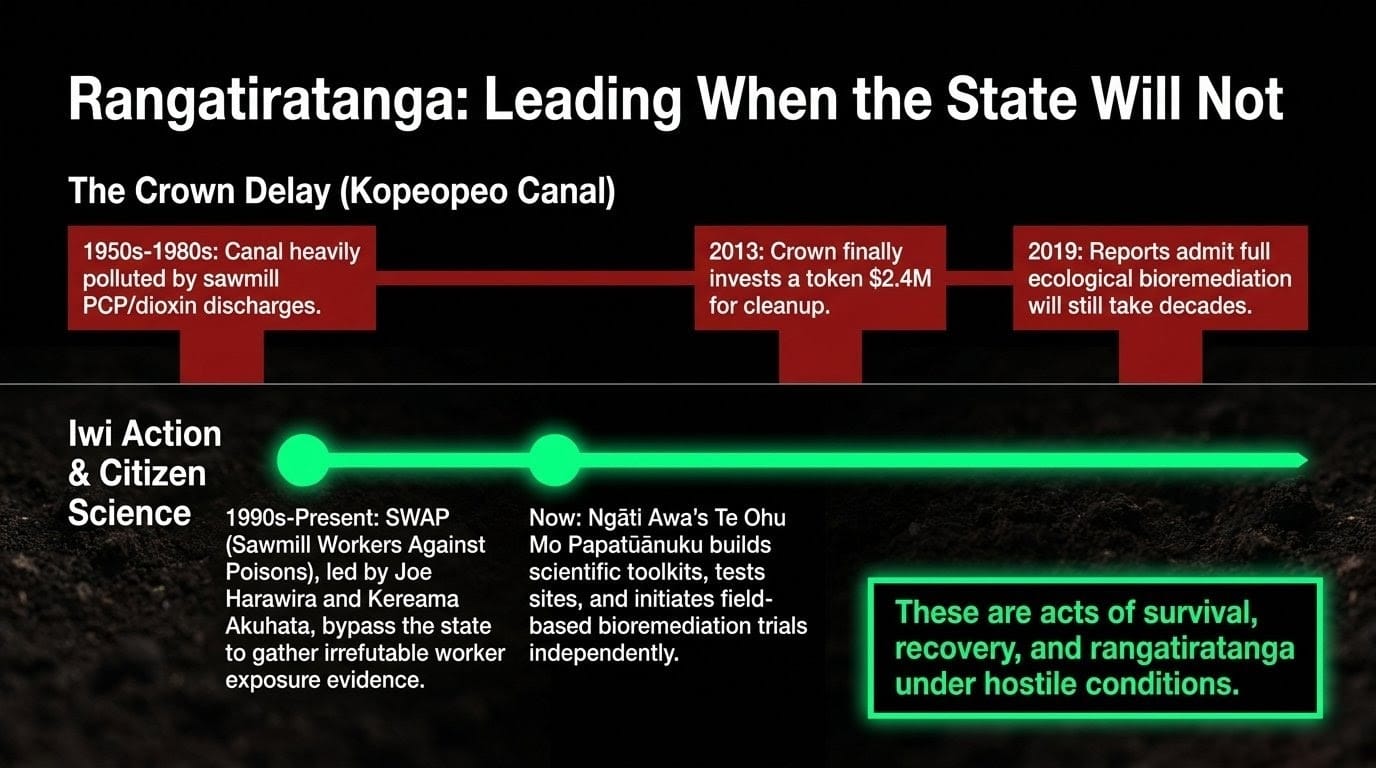
I want to be honest about what I see when I look at iwi-led remediation projects. Against the legal and governance backdrop I have just described, these are not acts of administrative tidiness. They are acts of survival, recovery, and rangatiratanga under hostile conditions.
The Kopeopeo Canal project in Whakatāne is the clearest case study I know of how long justice takes when poisoned Māori waterways meet bureaucratic time.
As Bay of Plenty Regional Council documents on the Kopeopeo Canal Remediation Project, the canal was contaminated between the 1950s and late 1980s by stormwater discharges from a former sawmill using PCP, with the project removing up to 40,000 cubic metres of dioxin-contaminated sediment. As the Beehive confirmed in its 2013 announcement, the Crown invested a total of $2.4 million toward the project.
BOPRC's project flyer states clearly that the purpose is
"to safely remove and treat a legacy of industrial dioxin pollution" — and as Scoop reported in 2019, the bioremediation stage could take 15 years from that point alone.
That is what institutional delay looks like in material terms.
The contamination began in the mid-twentieth century, and full ecological restoration is still a multi-decade project in the twenty-first.
When the SWAP submission recorded elevated dioxin contamination in tuna from connected waterways, they were not just recording an environmental data point. They were recording the partial destruction of a food system, a relationship, and a whakapapa practice that no remediation timeline can fully restore.
I have enormous respect for what Ngāti Awa is doing through their Te Ohu Mo Papatūānuku project. As the Health Research Council records, it is a project designed to help tangata whenua within the Ngāti Awa rohe directly address contamination issues on their lands through toolkit development, knowledge transfer, and capacity building
— including identification of contaminants and remedial options across three sites and a field-based bioremediation trial.
As confirmed in the Ngāti Awa iwi's own community communications, this is mana whenua leading the way in environmental healing — not consultation after the fact, but Māori communities building their own technical and decision-making capability and refusing to wait for the state to act.
The story of Joe Harawira — documented in his Te Ara biography as the leader and organiser of SWAP who devoted his life to winning official recognition of PCP harm — is the founding whakapapa of this fight.
As Te Ara records, he and his fellow Whakatāne sawmill workers were exposed for decades to PCP, which produced a variety of ongoing serious health problems, and the same pollutants were released into waterways and the soil.
Joe is gone. The poison is still there.
What the Canterbury Thesis Proves About Governance
The Canterbury PhD thesis gives me the academic framework to say precisely what I have always known from lived experience.
As Dew argues, environmental injustices must be understood as "socio-historic" — not discrete local events, but complex webs of power-knowledge relationships enacted across time and through multiple institutions.
The thesis demonstrates that the chemical industry and government worked through the risk-assessment governance strategy to silence communities, discredit critics, and delay accountability for decades.
I have watched this applied to Gordon Jackman. I have seen it applied to Joe Harawira. I have seen it applied to the whānau of Paritutu. The thesis names this as the "junk science" strategy — ridiculing researchers whose findings threaten powerful interests, irrespective of the quality of their research.
The thesis also identifies a structural silence about the 1965–1970 period — when military demand for Agent Orange precursors caused the IWD plant to run dirty manufacturing processes producing exponentially more dioxins — as deliberately maintained by the chemical industry.
That same structural silence operates in the PCP record: the exact quantities used, the dump locations, the full health effects on workers and whānau.
The Canterbury thesis gives me the intellectual framework to name this pattern not as oversight, but as governance of silence.
I want to close this section with a line from the thesis itself:
"Our stupidity, in Moller's analysis, lies perhaps in our overestimation of the ability of rationalistic thinking to sufficiently understand the complexities inherent in human-chemical-society interactions."
I appreciate the generosity of that framing. But I will say what the thesis stops short of saying: it was not stupidity. It was strategy.
What Must Be Paid
The core political lie in this whole field — and I have watched it operate for decades — is that the register is the remedy.
It is not.
The Hawke's Bay hotspot register shows over 1,000 sites, the majority either unverified or not investigated, with sawmill sites carrying "Unverified HAIL" status sitting in residential streets and near water.
The Northland policy document shows a regional council admitting it cannot locate contaminated rural land and has no systematic plan to do so.
And the Ministry for the Environment's own contaminated land guidance reveals through what it cannot promise: a register is an inventory of hazard, a map of incomplete knowledge, and a record of how much the state is prepared to know without being prepared to act.
The other lie is that orphaned contamination is nobody's fault now.
It was somebody's profit then, and that historical profit trail should be the starting point for any serious successor-liability work
— not an excuse to push the bill onto councils and whānau.
Gordon Jackman told me directly in his 22 May 2026 correspondence that the real cleanup cost is in the billions, not the millions. The state's current allocation does not exist on the same scale as the problem. That gap is a political decision, not a fiscal accident.
So I am stating clearly what the remedy requires:
- A complete audit of known and suspected PCP sites — all 7,500-plus of them as estimated by the National Task Group in 1992, cited in Dew's thesis — with full public access and a single unified national register replacing the fragmented regional system.
- Mandatory cross-linking between all regional contaminated land records and LIM disclosure — closing the gap that Waikato Regional Council itself acknowledges and that the Northland planning document confirmed has been unresolved since at least 2011.
- Proactive testing and notification for Māori communities on or beside HAIL land — including every "Unverified HAIL" and "Not investigated" site adjacent to papakāinga, marae, or community waterways, like multiple sites visible in the Hawke's Bay register.
- A funded Māori whenua remediation programme under Māori governance — not Crown governance, not council governance, Māori governance — modelled on Ngāti Awa's Te Ohu Mo Papatūānuku project.
- ACC recognition of the wider spectrum of PCP and dioxin harm documented by SWAP and their members' whānau.
- Aggressive legal tracing of corporate successor liability rather than automatic default to councils and ratepayers, as currently structured under the Beehive's own contaminated sites framework.
- A funded mass blood serum testing programme for exposed communities — modelled on the Paritutu study as described in Dew's thesis — with actual resources to act on what is found.
This is where public morality becomes plain. Gordon Jackman, Joe Harawira, Kereama Akuhata, Marama Cook, Māori timber workers, and affected iwi communities did not create this contaminated geography.
As documented by E-Tāngata and the SWAP submission, they exposed it, survived it, and kept naming it while governments stalled.
The communities left standing in the poison are being asked to prove, register, litigate, and often partially fund the cleanup of contamination they did not consent to and did not profit from.
That is why the title matters. There are six hundred holes in the ground — perhaps more than seven thousand in total when all contaminated sites are counted, as estimated in the National Task Group's 1992 figure cited by Dew. Each one is also a hole in local governance, in Crown accountability, and in the moral story this country tells about itself.
The register shows where the poison is known — and the Hawke's Bay register and Northland planning document show exactly how incomplete that knowledge is. The law shows how the burden is shifted. The thesis shows how the silence was manufactured. The remediation work at Kopeopeo and with Ngāti Awa shows that iwi will lead when they must.
The question I put to the Crown and to every council in this country is simple: will you finally pay what is owed — in the billions, as Gordon Jackman says — or will you keep leaving Māori communities standing in the poison?
Tautoko / Support This Work
Every koha funds rangatiratanga's own truth tellers.
I write these essays because whānau deserve to know what is buried in their whenua, who put it there, and who refuses to pay to clean it up. If you cannot koha — subscribe, follow, kōrero, share. That is koha.
Koha: app.koha.kiwi/events/the-maori-green-lantern
Subscribe: themaorigreenlantern.maori.nz/#/portal/support
Bank (HTDM): 03-1546-0415173-000
Facebook: facebook.com/Themaorigreenlantern/subscribe

PRIMARY SOURCES — UPLOADED FILES (in this thread)
- Hawke's Bay Contaminated or Potentially Contaminated Sites Register (HAIL Hotspots, 21 pages) —
file:848/file:849in this thread. Your uploaded file. - Northland Contaminated Sites — Rural Development Strategy Issues and Options (Whangarei District Council / NRC, January 2011) —
file:850in this thread. Your uploaded file. - The Deadly Legacy (Gordon Jackman, 1992) —
file:597in this thread. Your uploaded PDF. - New Zealand's Poisoned Paradise (Michael Szabo, New Scientist) —
file:596/file:582in this thread.
ACADEMIC
- Bruce Wild-Blood Crawford — University of Canterbury PhD thesis on dioxin governance in New Zealand
https://ir.canterbury.ac.nz/server/api/core/bitstreams/d3527cb0-a12f-451a-8009-af447e9fcfaf/content - Mortality in employees at the Ivon Watkins-Dow plant (PMC / PubMed Central)
https://pmc.ncbi.nlm.nih.gov/articles/PMC2686742/
GOVERNMENT & REGULATORY
- Ministry for the Environment — Contaminated Land Guidance (2023)
https://environment.govt.nz/assets/publications/RM-system-2023/Contaminated-land.pdf - Beehive — Initiative to Prioritise Contaminated Sites Remediation (2013)
https://www.beehive.govt.nz/release/initiative-prioritise-contaminated-sites-remediation - Beehive — Government Invests $2.4M to Clean Kopeopeo Canal
https://www.beehive.govt.nz/release/government-invests-24m-clean-kopeopeo-canal - Stats NZ — NZDep and Urban Rural Indicator Files
https://www.stats.govt.nz/tools/nzdep-and-urban-rural-indicator-files/ - Waikato Regional Council — Hazardous Activities and Industries List (HAIL)
https://www.waikatoregion.govt.nz/services/waste-hazardous-substances-and-contaminated-sites/contaminated-sites/hazardous-activities-and-industries-list/
REGIONAL COUNCIL
- Bay of Plenty Regional Council — Kopeopeo Canal Remediation Project
https://www.boprc.govt.nz/environment/rivers-and-drainage-management/whakatane-tauranga-rivers-scheme/kopeopeo-canal-remediation-project/ - BOPRC — Kopeopeo Project Update Flyer (PDF)
https://www.boprc.govt.nz/media/612315/4762-kopeopeo-a4-to-dle-update-flyer-web.pdf
IWI / HEALTH RESEARCH
- Health Research Council — Te Ohu Mo Papatūānuku (Ngāti Awa contaminated site toolkit)
https://www.hrc.govt.nz/resources/research-repository/te-ohu-mo-papatuanuku-contaminated-site-toolkit-community-use - Waitangi Tribunal
https://www.waitangitribunal.govt.nz/
NGO / COMMUNITY SUBMISSIONS
- SWAP — Sawmill Workers Against Poisons, submission to the People's Inquiry 2020
https://peoplesinquiry2020.nz/wp-content/uploads/2024/02/no.-58-submission-swap-sawmill-workers-against-poisons-overview.pdf
JOURNALISM / MEDIA
- E-Tāngata — Catherine Delahunty, "Fighting Poison"
https://e-tangata.co.nz/reflections/fighting-poison/ - Te Ao Māori News — Whānau of sawmill workers poisoned by chemicals still fight for recognition
https://www.teaonews.co.nz/2021/09/05/whanau-of-sawmill-workers-poisoned-by-chemicals-still-fight-for-recognition/ - Scoop — Working on the Night Moves (Kopeopeo bioremediation, 2019)
https://www.scoop.co.nz/stories/AK1905/S00200/working-on-the-night-moves.htm
TE ARA / BIOGRAPHY
- Te Ara — Joe Harawira biography
https://teara.govt.nz/en/biographies/6h13/harawira-hohepa-joseph-joe
LEGAL
- Durie v Gardiner NZCA 278 — responsible communication defence (no public URL needed; cite by case name)
- Defamation Act 1992 (NZ) — available at https://www.legislation.govt.nz/act/public/1992/0105/latest/whole.html
Views expressed constitute honest opinion on matters of public interest under the Defamation Act 1992 (NZ) and Durie v Gardiner NZCA 278. All factual claims are sourced and cited above. Named individuals and organisations are referenced solely in their public, professional, or governance capacities. Errors or corrections: Ivor.Jones@htdm.maori.nz