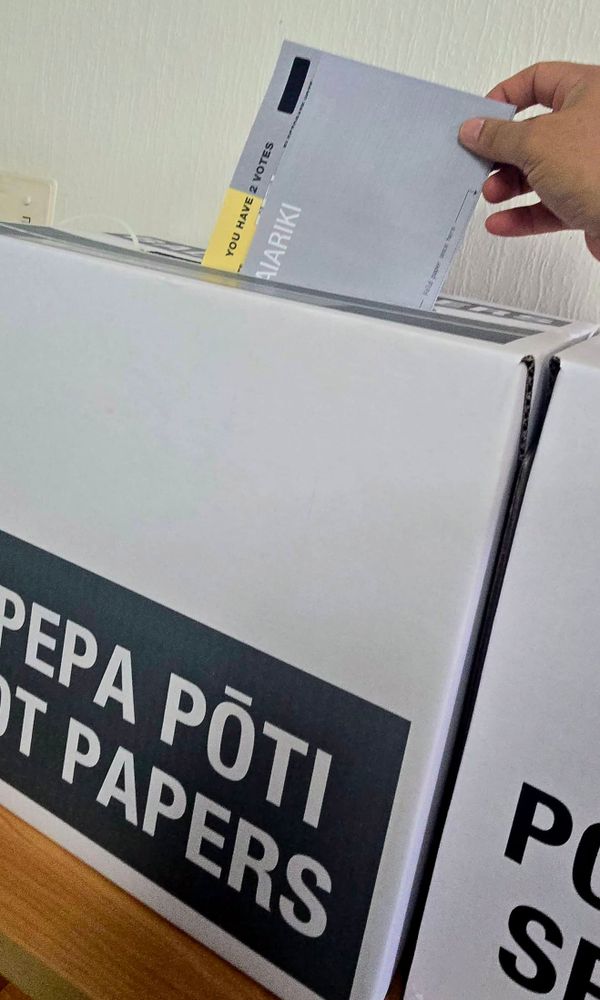
The Coalition’s Damage Diary - 1 November 2026
Why Aotearoa Needs A Different Government


Mōrena Aotearoa,
New Zealand is not better off because a government passes legislation quickly, abolishes institutions or announces savings.
It is better off when people become more secure, public services become more reliable, rights are protected and those exercising power can demonstrate that their decisions improved lives.
On that test, the National–ACT–New Zealand First coalition has failed.
The economic record contains genuine improvements: inflation is lower than before the coalition took office, and recent economic growth is positive. But employment conditions have deteriorated, important protections have been weakened, and repeated investigations have identified serious failures in the Crown’s treatment of Māori. Stats NZ’s inflation history, economic accounts, labour-market results and the Waitangi Tribunal’s findings on Māori health arrangements.
What follows is a chronological record of significant decision days, implementation dates and subsequent findings. It is not an invented scandal for every calendar day, nor an allegation of personal misconduct against every minister. The named decisions are attributed to those responsible; the wider programme belongs to the coalition that enabled it.
Some entries establish incompetence. Others establish deliberate political choices. Some show promises that failed scrutiny. Where allegations remain unresolved or outcomes are not yet measurable, that distinction is preserved.
The record is damaging enough without exaggeration.
2023: The Foundations Of The Damage

27 November 2023 — Luxon Sets The Standard
Christopher Luxon was sworn in as prime minister, with Winston Peters becoming deputy prime minister and David Seymour joining the executive.
Luxon told ministers to deliver “clear, demonstrable and measurable improvements” in New Zealanders’ lives. RNZ’s contemporaneous account of the swearing-in.
That is the standard against which this Government should be judged.
Not how many programmes it renamed. Not how many announcements it issued. Whether people’s lives improved.

28 November 2023 — Three Parties Accept Shared Responsibility
Cabinet endorsed the coalition agreements and Cabinet Manual as the basis of government. The subsequently published operating arrangements required consultation among National, ACT and New Zealand First on legislative proposals, alongside collective responsibility unless an agreed exception applied. The Cabinet Office’s coalition operating arrangements.
This removes a convenient escape route.
National cannot describe itself as a spectator to policies it enabled. ACT cannot claim credit for a programme while treating its consequences as somebody else’s implementation problem. New Zealand First cannot distance itself from decisions reached through the governing arrangement it helped construct.
29 November 2023 — Dismantling Becomes A Measure Of Success
Luxon’s 100-day programme listed 49 actions. They included repealing Fair Pay Agreements, extending employment trials, introducing legislation to disestablish the Māori Health Authority and reversing major smokefree amendments. The programme also included school cellphone restrictions, teaching requirements and health targets. The published 100-day programme.
The direction was clear: removing existing arrangements would demonstrate action.
But demolition is not evidence of improvement. That depends on what follows.
The Deep Dive Podcast
Listen to a lively conversation between two hosts, unpacking and connecting topics in the sources of this essay. I apologise in advance for the AI's very harsh pronounciation of reo. Please dont shoot me, :).
Youtube Video
Like video? Here is a short video suppporting the essay. Again, don't shoot the messenger please because of AI's pronounciation. :)
13 December 2023 — Willis Stops The Ferry Programme

Finance Minister Nicola Willis declined KiwiRail’s request for another $1.47 billion for the Interislander replacement programme. Her announcement put total costs at approximately $3 billion, with much of the escalation associated with harbourside infrastructure. KiwiRail would wind down the project and review its plans. Willis’s announcement and explanation.
The inherited escalation deserved scrutiny.
The coalition nevertheless assumed responsibility for its chosen response: unwinding contracts, absorbing exit costs and delivering a replacement.
Cancelling an expensive project and securing a better alternative are different achievements.
14 December 2023 — ACT Removes Fair Pay Agreements
Workplace Relations and Safety Minister Brooke van Velden announced passage of the repeal, identifying a National–ACT commitment. No Fair Pay Agreement had been finalised, so repeal did not cancel an existing sector-wide settlement. It removed the mechanism through which workers could negotiate those standards. The minister’s explanation of the repeal.
The Government promised flexibility and employment.
Workers immediately lost a prospective bargaining protection. Any compensating benefit remained something to demonstrate.
2024: Warnings Are Issued, Decisions Proceed
27 February 2024 — National Moves Against Te Aka Whai Ora
Health Minister Shane Reti announced legislation to disestablish the Māori Health Authority and transfer functions to Health New Zealand and the Ministry of Health. He promised arrangements closer to communities and identified commitments in both coalition agreements. Reti’s announcement of the replacement approach.
The Government did not abolish every Māori health provider or advisory mechanism. It removed a particular institution through which Māori authority and health-system accountability had been organised.
Whether the replacement would be better required evidence—not merely a description of the institution as bureaucracy.
27 February 2024 — New Zealand First Introduces The Smokefree Rollback
Associate Health Minister Casey Costello introduced legislation removing three planned measures before they commenced: reduced tobacco retail availability, denicotinisation and the smokefree-generation policy. She defended existing cessation measures and vaping as a more practical approach. Costello’s announcement.
This was not the abolition of every tobacco control. It was a deliberate decision to prevent additional restrictions from taking effect.
New Zealand First supplied the minister. The coalition supplied the authority.
5 March 2024 — Māori Health Repeal Gets Ahead Of Scrutiny
The Waitangi Tribunal later recorded that the disestablishment legislation passed into law under urgency on 5 March. Introducing the Bill had removed its jurisdiction over the urgent claims before it; scrutiny resumed after enactment. The Tribunal’s account of the legislative sequence.
That sequence does not, by itself, prove anyone’s private motive.
It establishes the practical consequence: the institution was legislatively dismantled before the urgent inquiry could be completed.
10 March 2024 — Landlords Receive A Direct Tax Commitment
Seymour announced restoration of residential investment interest deductibility: 80 per cent from April 2024 and 100 per cent from April 2025. He argued that lower landlord costs would ease rental pressure and encourage supply. Seymour’s announcement.
There is a legitimate tax argument for deducting expenses incurred in earning income.
There is also an important distributional distinction: the benefit to qualifying property owners was direct. The benefit promised to tenants depended on the market response.
17 May 2024 — The Tribunal Warns On Māori Wards
The Tribunal found that the Crown prioritised coalition commitments over consultation with Māori. It identified the inequity of requiring polls for Māori wards without equivalent requirements for other ward types and recommended stopping for proper consultation. The Māori wards findings.
The warning was specific.
The Government could not reasonably claim the Treaty implications had never been explained.
30 May 2024 — The First Budget Establishes Its Defence

Budget 2024 combined tax relief, additional service funding and what the Government described as $23 billion in enduring savings over four years. It included substantial multi-year health allocations and additional education and law-and-order funding. The Government’s Budget announcement.
Those allocations belong in an honest record. “They cut everything” is false.
The questions are whether funding met need, what was reduced to pay for other priorities, and whether the promised improvements reached people.
9 June 2024 — Shane Jones Announces The Petroleum Reversal
Resources Minister Shane Jones announced proposed changes reversing the ban on new petroleum exploration outside onshore Taranaki. The package also proposed changing decommissioning obligations, including limiting trailing liability to the most recent transferor. He argued that declining gas reserves threatened energy security. Jones’s announcement.
Energy security is a genuine concern.
It does not follow that every concession to petroleum investors is necessary, or that changing their liabilities automatically serves the public.
30 July 2024 — Māori Ward Legislation Proceeds Anyway
Local Government Minister Simeon Brown announced passage of legislation restoring polls on Māori wards and requiring affected councils to hold binding polls alongside the 2025 local elections. He identified commitments in both National’s ACT and New Zealand First agreements. Brown’s announcement.
Three parties were implicated in a policy that proceeded after an authoritative Treaty warning.
That is documented collective responsibility—not guilt by association.
30 July 2024 — Costello Defends A Tobacco Tax Concession
Costello defended a 50 per cent excise reduction for heated tobacco products, with a $216 million contingency for potential forgone revenue over four years. She said the actual cost could be lower and presented the measure as a trial intended to encourage smokers to switch products. Costello’s explanation.
The $216 million was not a verified cheque paid to a tobacco company, nor an established final loss.
It was a contingency supporting a policy whose health rationale and commercial beneficiaries required rigorous scrutiny.
12 August 2024 — Welfare Savings Include People Losing Access
The Government’s welfare package included traffic lights, sanctions, expanded recording of obligation failures and proposed six-monthly Jobseeker Support reapplications. It also funded employment support and case management. Its factsheet anticipated approximately $38 million in savings over five years from people dropping off support through non-compliance with reapplication requirements. The Government’s welfare factsheet.
Finding a job and losing a payment through an administrative requirement are not equivalent outcomes.
A government that reports only fewer recipients can conceal whether lives improved or income simply disappeared.
16 August 2024 — The Treaty Programme Receives A Damning Assessment
The Tribunal found that the Treaty Principles Bill policy lacked a justifying policy imperative, rested on flawed rationales, distorted the Treaty text and was fashioned on a “disingenuous historical narrative”. It also found breaches concerning the separate Treaty clause review. The Tribunal’s findings.
These were not criminal findings. They were findings about the Crown’s Treaty conduct and the foundations of its policy.
They required an answer more substantial than another slogan about equality.
19 September 2024 — The Ombudsman Reprimands Costello
Chief Ombudsman Peter Boshier criticised Costello’s handling of a tobacco-policy document whose authorship and route into her office she said she could not explain. He raised concerns about provenance records and notified the Chief Archivist. RNZ also recorded an earlier finding that withholding information had been “unreasonable and contrary to law”. The Ombudsman findings reported by RNZ.
This was not merely disagreement over public health.
It concerned a minister’s ability to explain where policy material came from and meet her disclosure obligations.
30 September 2024 — Officials Identify The Principal Commercial Beneficiary
Treasury advice obtained by RNZ warned that Philip Morris, then the sole supplier of heated tobacco products in New Zealand, would be the principal commercial beneficiary of the concession. Officials questioned whether the tax reduction would reach consumers and challenged the claimed cessation benefits. Costello denied tobacco-industry involvement and said her purpose was helping people quit. The official advice and ministerial response.
The evidence establishes a policy pursued despite serious official warnings.
It does not establish that the minister was bought.
3 October 2024 — The Alternative Tobacco Advice Is Exposed
When Costello’s “independent advice” was released, RNZ found five articles involving different products, older evidence or qualified support—not decisive evidence for the policy as promoted. RNZ’s examination of the released material.
A minister can disagree with officials.
But the alternative evidence must bear the weight placed on it.
7 November 2024 — The Treaty Principles Bill Is Introduced
The Government introduced the Bill based on ACT policy under its agreement with National. The Ministry of Justice’s official chronology.
ACT supplied the proposal.
The coalition supplied its route into Parliament.
14 November 2024 — The Bill Advances
The Bill passed its first reading and went to select committee. The coalition commitment was to support it to that stage, not necessarily to enactment. The Ministry’s account of the agreed support.
It would therefore be false to say the Treaty had already been rewritten in law.
The established criticism is that the governing arrangement advanced a constitutional proposal despite serious warnings about its premises and consequences.
29 November 2024 — The Māori Health Process Fails Its First Major Test
The Tribunal’s first Hautupua report found that the Crown had not acted in good faith, had not consulted Māori and had not gathered substantive official advice before deciding Te Aka Whai Ora was unnecessary. It described an agenda based on political ideology rather than evidence. The findings on disestablishment.
Reform itself was not forbidden.
The failure lay in removing an institution established as redress without the informed, Treaty-consistent process such a decision required.
12 December 2024 — Tenants Lose A Protection
Housing Minister Chris Bishop announced passage of legislation restoring the ability to end periodic tenancies with 90 days’ notice without specifying a reason, and to end fixed-term tenancies at expiry without specifying a reason. Other changes included shorter tenant notice and new pet arrangements. Bishop’s explanation.
He argued that greater landlord confidence would encourage supply.
The immediate legal change strengthened owners’ termination powers. The promised tenant benefit depended on what happened afterwards.
17 December 2024 — Fast-Track Passes

Bishop and Jones announced passage of the Fast-track Approvals Bill, identifying a National–New Zealand First commitment. Its initial list contained 149 projects. Expert panels would still assess applications before granting consent. The Government’s account of the framework.
Listing was not consent. Development was not automatically corruption.
But the coalition had created a special pathway whose selection decisions, safeguards and commercial beneficiaries demanded close scrutiny.
2025: The Promises Meet Their Tests
30 January 2025 — No-Cause Termination Returns
The restored tenancy rules took effect. The Government’s implementation timetable.
For tenants, a parliamentary decision became a changed relationship with the person controlling their home.
A specific protection had been removed, regardless of whether every landlord used the new power.
30 January 2025 — Seymour Launches The Cheaper Lunch Model
Seymour promoted the revised school lunch programme as delivering the same outcomes for less money, including more than $130 million in annual savings. His launch announcement.
That established the test.
The issue was not whether lower spending was inherently wrong. It was whether the same outcomes could actually be delivered.
1 April 2025 — Full Interest Deductibility Returns

The timetable announced by Seymour restored full deductibility of qualifying residential investment interest from this date. The published restoration schedule.
Placed beside the tenancy changes, the distribution is clear: qualifying owners received a direct fiscal benefit and greater legal flexibility.
Whether renters benefited sufficiently requires separate outcome evidence.
10 April 2025 — The Treaty Principles Bill Is Defeated
The Bill failed its second reading by 112 votes to 11. The Ministry of Justice’s record.
ACT did not succeed in getting its proposed principles enacted.
That defeat belongs in the ledger. It does not erase the coalition’s decision to advance the proposal.
30 April 2025 — Goldsmith Announces Blanket Prisoner Disenfranchisement
Justice Minister Paul Goldsmith announced Cabinet agreement to reinstate a voting ban for sentenced prisoners. He defended it as a consequence of breaching civic responsibilities, rejecting the direction favoured by the Independent Electoral Review and Waitangi Tribunal and the reasoning behind the earlier judicial finding against a blanket ban. Goldsmith’s announcement and explanation.
This was a decision to remove a democratic right from a defined group.
“Rights come with responsibilities” is a political argument, not an answer to every rights-based objection.
4 May 2025 — Lunch Safety Failures Are Documented
RNZ reported 17 food-safety complaints investigated by MPI during the first term, with 12 still under investigation. Concluded cases included a student burned by an overheated meal, melted plastic, broken seals and mislabelled special-diet meals. The documented incidents.
Officials also said escalation was more stringent than before, New Zealand Food Safety identified no reports of illness from those investigations, and the provider said improvements were underway. The qualifications and responses.
Those qualifications prevent inflated comparisons.
They do not make the failures disappear.
6 May 2025 — Pay Equity Is Reset To Reduce Crown Costs
Van Velden announced urgent changes discontinuing existing claims, raising the female-dominated workforce threshold from 60 to 70 per cent, requiring that predominance over ten consecutive years and making existing settlement review clauses unenforceable. New claims could proceed under revised criteria. The minister’s announcement.
She also said the changes would “significantly reduce costs to the Crown”. The stated fiscal effect.
The Crown was not simply a neutral referee improving procedure.
It was reducing its exposure to claims while changing the rules governing those claims.
12 May 2025 — Fast-Track Decisions And Party Donations Intersect
RNZ reported that Jones and Bishop continued making decisions concerning some projects despite their parties receiving donations linked to applicants. Jones declared conflicts and stood aside for eight projects. Both ministers said they followed Cabinet Office advice; party donations were generally not treated as individual ministers’ pecuniary conflicts. The donations, decisions, recusals and explanations.
The rules themselves therefore become part of the public-confidence question.
Compliance with a narrow conflicts definition does not automatically resolve concerns about political access and commercial benefit.
13 May 2025 — The Auditor-General Identifies The Limits Of The Case
The Auditor-General found the overall conflicts-management system sound, with good oversight, while identifying late declarations, transparency weaknesses and risks around participation in discussions. The report warned that perceived favourable treatment of political donors erodes trust, particularly where decisions benefit specific businesses. The Auditor-General’s assessment.
This finding cannot honestly be suppressed.
The evidence does not prove donations purchased approvals. It establishes financial relationships and a structural confidence problem requiring stronger safeguards.
16 May 2025 — Regulatory Standards Receives A Treaty Warning
The Tribunal found that developing Regulatory Standards legislation without targeted Māori engagement breached partnership and active protection. It described the proposal as constitutionally significant and recommended meaningful engagement before advancement. The Tribunal’s interim findings.
A proposal presented as improving lawmaking had itself been developed through a process found deficient.
22 May 2025 — KiwiSaver Support Is Reduced
Willis announced higher default employee and employer contributions, phased towards 4 per cent, while halving the maximum annual government contribution to $260.72 and removing it for people earning more than $180,000. Participation would expand for working 16- and 17-year-olds. The KiwiSaver package.
Higher contributions could produce larger balances.
They did not alter the direction of the public contribution: workers and employers would contribute more while the Crown contributed less.
17 June 2025 — Brown’s Private-Hospital Direction Becomes Public
RNZ reported that Health Minister Simeon Brown directed Health NZ towards longer private-provider agreements, initially around three years and ultimately around ten. Brown defended outsourcing as a way to get patients treated. Health NZ argued longer contracts could support capacity and competitive pricing. The direction and official defence.
The Royal Australasian College of Surgeons warned that outsourcing was not a solution to an inadequately funded system and raised training and public-capacity concerns. The surgeons’ response.
Private provision already existed. The policy change was greater long-term certainty for private providers.
1 July 2025 — The Lower KiwiSaver Contribution Begins
The reduced government contribution settings took effect, without changing the contribution earned for the preceding year. The implementation schedule.
An announcement had become a reduction in what the Crown would contribute to eligible savers.
2 July 2025 — Health Legislation Again Interrupts Tribunal Reporting
The Tribunal later recorded that introduction of the Healthy Futures (Pae Ora) Amendment Bill removed its jurisdiction to report during the second stage of its Māori health inquiry. Reporting resumed after enactment. The Tribunal’s account.
The practical consequence was another restriction on contemporaneous Treaty scrutiny while legislation advanced.
15 August 2025 — The Ferry Exit Cost Is Confirmed
KiwiRail and the Government confirmed a $144 million final settlement for breaking the Hyundai contract. Total spending on the terminated iReX programme reached $671 million: $449 million on landside infrastructure, project management and wind-down, and $222 million paid to Hyundai, including the earlier deposit and settlement. The confirmed breakdown.
These figures must not be added together again. The $144 million is within the $222 million, which is within the $671 million.
Nor is every dollar of the total automatically attributable to the coalition or devoid of residual value.
But a $144 million contract settlement is a substantial, identifiable cost of the chosen exit. Peters defended it as fair compensation within a cheaper replacement approach; Willis blamed inherited mismanagement. Their responses.
25 September 2025 — Goldsmith’s Electoral Rationale Meets Contradictory Evidence
The Electoral Commission told Parliament that an earlier enrolment deadline would not bring official results forward under its forecasts and would increase the number of people unable to vote or whose votes were disallowed. Senior Crown Counsel identified likely disenfranchisement and Bill of Rights concerns. Goldsmith argued that without changes counting could take longer and said voters had time to enrol. The official evidence and ministerial response.
The burden was being shifted towards requiring voters to fit a more restrictive system.
4 November 2025 — Stanford Removes An Explicit Treaty Obligation
Education Minister Erica Stanford announced removal of school boards’ explicit obligation to give effect to Te Tiriti. She argued that Treaty obligations belonged to the Crown and that other requirements concerning Māori outcomes, language provision and cultural competence would remain. Seymour welcomed the change. Education representatives warned of harm. The announcement and responses.
The issue was not whether Māori culture was prohibited.
It was whether an explicit institutional duty would remain enforceable.
13 November 2025 — Regulatory Standards Passes
The Regulatory Standards Act passed Parliament, receiving royal assent on 18 November. International IDEA recorded constitutional criticism while noting that its principles were not directly enforceable in court. International IDEA’s account.
This was not an automatic judicial veto over public-interest law.
Its significance lay in the standards against which regulation would be assessed and justified.
27 November 2025 — Private Health Contracts Gain Written Certainty
Brown’s written expectations required an initial cohort of long-term private health contracts providing at least five years’ certainty. The letter also said health infrastructure should consider all funding and financing options, including long-term leases and public-private partnerships. Brown’s letter of expectations.
This is primary evidence of deliberate policy direction.
It is not proof that the entire public system had been sold. It is evidence that longer-term commercial participation was being actively expanded.
10 December 2025 — Fast-Track Is Accelerated Again
Willis, Bishop and Jones welcomed amendments intended to streamline processing, including a pathway supporting supermarket competition. Officials estimated combined processing and consideration times could fall by six weeks or more. The Government’s explanation.
Faster decisions can be useful.
Speed alone does not establish sound decisions, competition or public benefit.
2026: The Consequences Accumulate
17 February 2026 — Employment Protections Change Again
Van Velden announced employment changes covering contractor status, misconduct-related remedies, a $200,000 threshold for unjustified-dismissal grievances and removal of the 30-day rule. She defended greater employer confidence to hire. The minister’s explanation.
Again, the proposition was that reducing constraints on employers would benefit workers.
That proposition could not become an established outcome merely through repetition.
1 April 2026 — Higher KiwiSaver Contributions Begin
The default employee and matching employer contribution rose from 3 to 3.5 per cent, with an option to remain temporarily at 3 per cent. The contribution timetable.
For workers under immediate financial pressure, more retirement saving also meant committing more current income.
Both effects matter.
21 April 2026 — Luxon Calls A Confidence Vote In Himself
After nearly three hours in caucus, Luxon announced that a confidence motion he had moved had passed. He left without taking questions. Willis said the vote was secret and only scrutineers knew the numbers; collective support afterwards did not establish a unanimous ballot. RNZ’s report of the vote.
This was a documented leadership crisis.
It was not evidence for an invented vote count or a named opponent who had not publicly contested.
23 April 2026 — A Community Wins In Court, But Another Approval Remains
Ours Not Mines won a Court of Appeal challenge to a council licence allowing OceanaGold to use a paper road for mine ventilation infrastructure. The original licence dated from 2021, before this coalition. The court found unlawful interference with public access. OceanaGold said its separate December 2025 fast-track approval meant the project could continue. The court outcome and company response.
The coalition did not create the original unlawful licence.
The significance is that a community could win against one permission while the company relied on another pathway created under this Government.
30 April 2026 — Brownlee Suspends A Senior Journalist
Speaker Gerry Brownlee announced a five-day suspension of TVNZ political editor Maiki Sherman from parliamentary coverage, effective 1–6 May, over conduct connected with seeking an interview during the National leadership controversy. He said she breached press-gallery rules and acknowledged and accepted the ruling. Reuters’ account.
The Speaker is an officer of Parliament, not a minister directing a Crown portfolio.
The incident does not establish a general media ban or prove party-directed censorship. It does show a serious restriction on a senior journalist covering governing-party instability.
That power requires proportionate enforcement and public scrutiny.
6 May 2026 — Stanford Confronts Broad Curriculum Opposition
Subject associations called for major changes to draft curriculum documents, while organisations representing thousands of teachers and principals urged a pause. Stanford said consultation would produce changes but rejected retreat from the knowledge-rich approach, describing opponents as a vocal minority. The objections and ministerial response.
Ministers can disagree with professional organisations.
Competent reform nevertheless requires testing criticism on its merits—not treating opposition as a communications obstacle.
19 May 2026 — Willis Announces A Further Public-Service Squeeze
Willis set a target of no more than 55,000 full-time-equivalent core public servants by July 2029, 8,700 fewer than the December 2025 figure she cited. Most agencies faced operating-budget reductions of 2 per cent, followed by a further 5 per cent in each of the following two years. Teachers, nurses, doctors, police and Crown-entity employees were excluded from the workforce target. Willis’s speech.
Those exclusions prevent an exaggerated claim about thousands of frontline clinical dismissals.
They do not prove administrative capacity can be removed without affecting services.
“Back-office” is a location, not evidence of uselessness.
21–22 May 2026 — Social Housing Tenants Are Asked To Fund Greater Fairness
Bishop and Upston announced a housing-support shake-up increasing income-related rent contributions from 25 to 30 per cent of income. RNZ reported approximately 84,000 social housing tenants would be about $30 a week worse off, helping fund an average $15 accommodation-support increase for 111,000 low-income renters. The rent increase was scheduled for April 2027, not already being deducted. The announced redistribution and implementation timing.
There was a genuine disparity between some private renters and social housing tenants.
The Government’s response was to reduce affordability for one low-income group to assist another. Providers warned of debt, food-budget pressure and instability. Willis regretted describing social housing tenants as having “won the lotto”. The competing arguments and responses.
Fairness does not require pulling the relatively secure down towards the insecure.
26 May 2026 — The Fast-Track Donation Picture Expands
RNZ identified more than $1 million in donations since 2022 linked to people or entities associated with fast-track projects. Approximately $400,000 went to National and New Zealand First in 2025. Seven of 23 approved projects were linked to a donor at the time of reporting. Donors offered explanations including event tickets and general political support, and several denied expecting influence. The updated analysis and responses.
These totals overlap earlier reporting and must not be added as separate pots.
They do not prove purchased approvals. They demonstrate why political-finance safeguards matter when ministers oversee decisions benefiting identifiable businesses.
4 June 2026 — Goldsmith’s Treaty Clause Programme Faces Scrutiny
Reporting on the Treaty clause inquiry described proposed shifts from obligations to “give effect to” Treaty requirements towards “taking into account” formulations. Claimants argued that enforceable duties would be diminished; Goldsmith presented the programme as providing consistency and certainty. The reported proposals and inquiry evidence.
Those were proposals and submissions, not a final judicial finding.
The question remains: certainty for whom? A weaker duty can provide certainty to the Crown precisely by reducing what it owes.
18 June 2026 — Jones Delays Fisheries Legislation After Backlash
Jones sought a delay to his Fisheries Amendment Bill and accepted that it needed more work. The coalition had already backed away from removing most minimum size limits for commercial fishers. Other disputed provisions included tighter judicial-review timeframes and restrictions on releasing onboard camera footage. Industry defended efficiency measures; critics challenged the secrecy provisions. The proposals, reversal and delay.
The delay means the provisions should not all be described as enacted.
It also demonstrates that public opposition could change the programme.
19 June 2026 — Stanford’s Consultancy Relationship Becomes An Accountability Problem
Newsroom reported approximately $2.2 million in curriculum-related services from Australian firm Learning First, procured without open tender. Documents showed advice extending into design, implementation and messaging, including an offer to help “win hearts and minds”. The procurement and correspondence reporting.
Stanford described procurement as operational. The ministry maintained that the firm was advisory, did not control content decisions and that New Zealanders designed and wrote the curriculum. The responses.
The evidence raises questions about procurement, influence and public explanations.
It does not establish an unlawful contract or prove every dollar was wasted.
1 July 2026 — Health And Safety Reform Passes
Van Velden announced legislation focusing on critical risks and changing expectations for small businesses, directors and regulatory guidance. Commencement was announced for April 2027. The Government’s account.
Because commencement remained ahead, existing injury trends cannot responsibly be attributed to these provisions.
The policy should be tested against the protection it changes and the evidence supporting its promised benefits.
29 July 2026 — Leave Reform Passes
Van Velden announced an hours-based leave package, specified leave from the first day, itemised pay statements and a 12.5 per cent leave-compensation payment for additional and casual hours, with a 24-month transition. The minister’s explanation.
Some features offered potential benefits.
A credible indictment must acknowledge them and assess the distribution of gains and losses rather than declaring every provision harmful.
12 August 2026 — Luxon Survives Again, Then Removes Penk
After another emergency caucus meeting and confidence vote, Luxon remained leader. He announced that Chris Penk had launched a challenge and removed his portfolios. Penk announced he would not seek re-election, without addressing the challenge allegation in that statement. Bishop denied claims that Penk acted for him. The sequence, statements and denials.
This was the second confidence crisis in four months.
A caucus retaining its leader establishes survival, not successful government.
15 August 2026 — Lawyers Explain The Coastal Burden
McCaw Lewis explained that the 2025 customary marine title amendments raised the threshold applicants had to establish and applied retrospectively to decisions after 25 July 2024, requiring some rehearings and adding cost and delay. The legal analysis.
The same analysis explained that customary marine title cannot be sold and does not ordinarily remove public access, fishing or recreation, subject to lawful restrictions such as protecting wāhi tapu. The explanation of the rights involved.
Debate should begin with those actual rights—not a manufactured picture of every beach becoming private property.
3 September 2026 — A Settlement Supplies Necessary Counter-Evidence
Treaty Negotiations Minister Paul Goldsmith announced final passage of the Ngāti Ruapani mai Waikaremoana settlement legislation, including approximately 12,000 hectares added to Te Urewera and $24 million in financial and commercial redress. The settlement announcement.
This disproves the sweeping claim that the Government did nothing advancing Māori interests.
Historical redress does not, however, discharge the separate duty to avoid present-day Treaty breaches.
14 September 2026 — MSD’s Failures Become A Catalogue
RNZ reported more than 30,000 wrongly suspended payments worth over $2 million, affecting more than 16,000 pensioners, following failure to identify a necessary winter energy payment exemption. Its account also covered food-grant refusals, exposure of abuse claimants’ names, threatened counselling losses and an incorrect accommodation-supplement decision. Upston accepted ministerial responsibility. The documented failures and response.
These were not abstract administrative imperfections.
For recipients, mistakes could mean missing income, fear, repeated eligibility demands and time spent trying to correct the state.
18 September 2026 — Goldsmith’s Move-On Powers Pass Under Urgency
Move-on legislation passed its third reading, covering disorderly behaviour, begging and rough sleeping, with prosecution possible for non-compliance. Goldsmith said it did not criminalise homelessness because an order itself was not a criminal charge. A proposed requirement for MSD assistance to everyone receiving an order was voted down. The legislation, defence and objections.
Public places should be safe.
Moving poverty somewhere less visible is not the same as resolving it.
25 September 2026 — Curriculum Transparency Is Disputed
RNZ reported that Stanford refused information about curriculum discussions because her office held no documentation, while acknowledging that feedback was often verbal and meetings were not formally minuted. A requester complained to the Ombudsman. Stanford maintained compliance with the OIA. The request, refusal and response.
This was a disputed transparency matter, not a completed finding that she personally acted unlawfully.
It nevertheless exposed a problem: major public decisions cannot become effectively untraceable simply because discussion was verbal.
25 September 2026 — The Māori Health Replacement Fails Tribunal Scrutiny
The second Hautupua report found that the Crown failed to produce a clear alternative Māori health plan in a timely manner or consult meaningfully. It found breaches involving tino rangatiratanga, good government, partnership, active protection, equity and options. The Tribunal’s findings.
The alternative promised in February 2024 had now been examined.
It was found seriously deficient.
27 October 2026 — Private Health Funding Comes Under Scrutiny
A Public Futures Aotearoa and CICTAR report estimated that private providers received $2.4 billion of a $3 billion increase in combined Health NZ and ACC spending over the period examined—80 per cent of the increase, not 80 per cent of all health spending. Its categories included general practice, aged care and other longstanding private provision. RNZ’s account of the report.
The report was advocacy-linked. Brown’s office pointed instead to 43,819 outsourced procedures in 2025/26 and fewer people waiting more than four months than at the peak. The Government’s counter-evidence.
Those treatments matter.
The strategic question is whether public money is building durable public capacity or increasing dependence on commercial capacity.
28 October 2026 — The Replacement Ferries Face Their Own Warning
Reporting on released Ferry Holdings documents showed the replacement programme had reached its funding ceiling and excluded potentially beneficial enhancements. A Gateway review identified the absence of a clear economic framework such as cost-benefit analysis and limited confidence that the scope represented the best outcome. Peters defended a fit-for-purpose programme deliverable in 2029. The documents, review and response.
The review did not establish that the funded ships would be unsafe.
It did undermine the claim that cancelling the previous programme was, by itself, evidence of superior management.
30 October 2026 — School Boards’ Treaty Removal Returns As Another Breach
RNZ reported that the Tribunal found the Crown acted abruptly, unilaterally and without Māori consultation when removing school boards’ explicit Treaty obligation. It recommended an apology and restoration. The reported findings.
The same governing failure had reappeared in another portfolio.
Decide first. Remove the duty. Leave those affected seeking repair afterwards.
The Verdict At The End Of The Ledger

The clearest material deterioration is employment security.
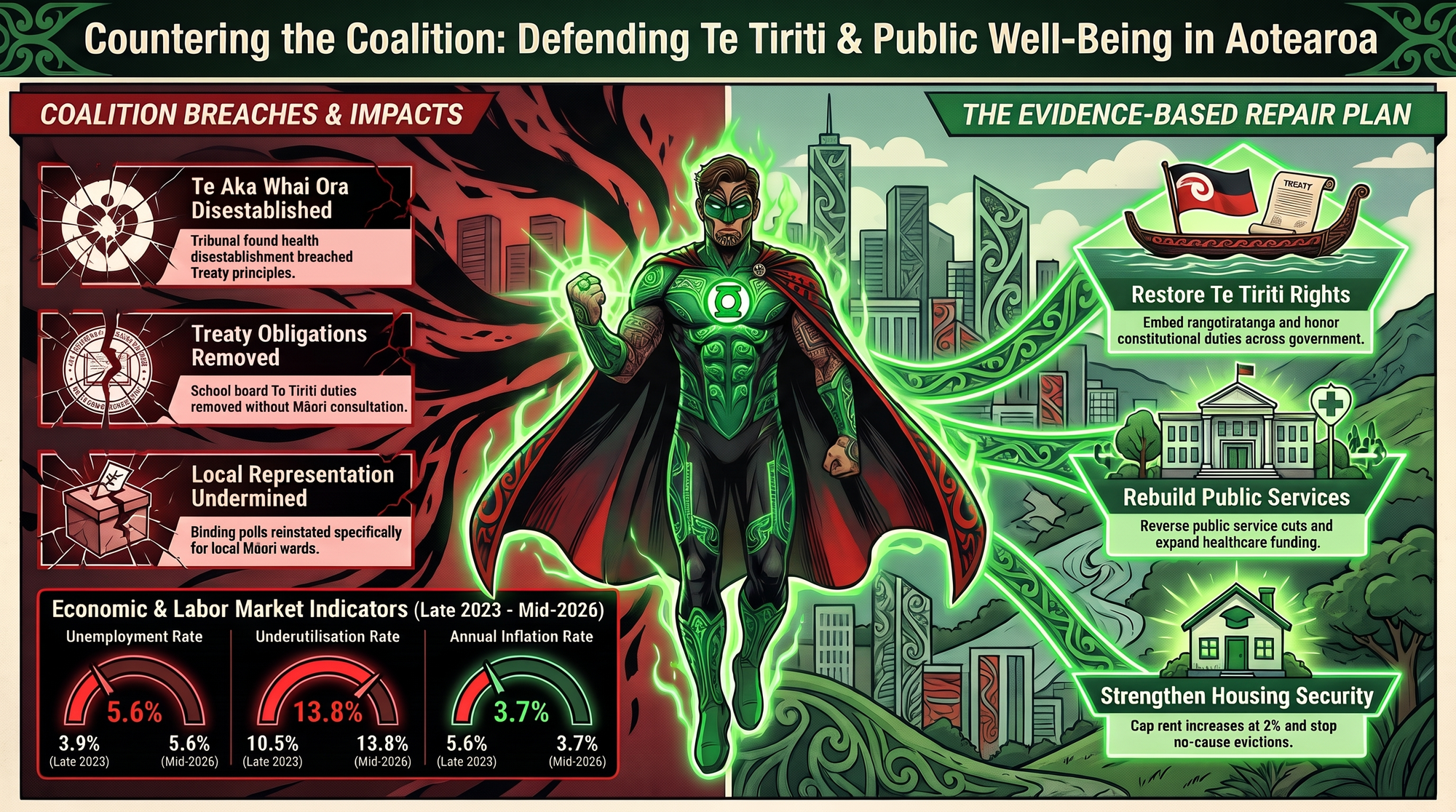
Using the historical series in the June 2026 release, unemployment rose from 3.9 per cent in September 2023 to 5.6 per cent in June 2026. The employment rate fell from 69.2 to 66.7 per cent, while underutilisation rose from 10.5 to 13.8 per cent. Stats NZ’s comparable labour-market series.
That does not establish sole coalition responsibility for every job loss. Unemployment was already rising before it took office. The September 2023 release.
Inflation fell from 5.6 per cent in September 2023 to 3.7 per cent in September 2026, and recent GDP and national-income results improved. Those are genuine positives. They do not prove that prices returned to earlier levels or that recovery was evenly shared. The inflation series and economic accounts.
Nor can a single aggregate cancel the institutional record.
Tenant protections were reduced. Workers lost bargaining and claim mechanisms. Māori institutions and obligations were diminished through processes repeatedly found wanting. Vulnerable people experienced avoidable payment failures. Major projects incurred cancellation costs and then faced further questions about appraisal and scope.
The evidence does not establish that every service worsened or every minister acted improperly.
It does support this judgement: on balance, New Zealand is not better off than before this coalition took power.
That judgement weighs security, rights, public capacity and equitable participation—not merely the fortunes of those who received direct concessions.
Why Party Vote Green Follows From This Record

Removing the coalition is necessary, but removal alone is not a repair programme.
The alternative should be judged against the failures documented here: housing insecurity, weakened worker protections, pressure on public services, Treaty breaches, environmental concessions and inadequate safeguards against concentrated economic influence.
The Green Party offers a coherent electoral alternative on those questions. Its 2026 manifesto commits to stronger public services, accessible healthcare, employment protections, environmental restoration and governing arrangements grounded in Te Tiriti and rangatiratanga. Those are commitments, not completed achievements, and a Green government would have to be held to them. The Green Party’s 2026 manifesto.
Its housing programme directly addresses part of this ledger: reversing no-cause evictions, introducing a Renter’s Rights Bill, capping rent increases at 2 per cent, establishing a rental warrant of fitness and expanding public housing. These are proposed remedies, not guarantees that the housing crisis would disappear overnight. The Greens’ published housing programme.
The party has also pledged to reverse the public-service cuts rather than continue treating the workforce as a numerical target. The Greens’ public-service commitment.
The reason to support that direction is not that the Greens are beyond criticism. No party deserves a blank cheque.
It is that the solution must reverse the governing logic exposed by this diary: certainty for commercial interests, insecurity for those dependent on wages, affordable homes, public services and enforceable rights.
The Election Must Be About Repair

Some of this Government’s failures were incompetence. Others were deliberate choices.
The distinction matters. Better administration can correct a broken payment process. It cannot restore a right Parliament intentionally removed. That requires a different political decision.
The next government must be expected to do more than manage the damage more politely.
It must rebuild public capacity, restore protection, honour Te Tiriti and demonstrate that public money serves the public—not simply that expenditure has been shifted elsewhere.
That is the conclusion of this ledger and the electoral argument that follows from it.
Aotearoa is not better off under this coalition. The direction must change.
Party vote Green—not as an act of faith in flawless politicians, but as a vote for the public investment, stronger protections, environmental responsibility and Treaty-grounded government this record shows we need.
Koha Consideration

Who supports the mahi behind this coalition damage diary? You do, whānau—not corporate sponsors.
Tracing ferry cancellation costs, welfare failures, weakened protections and Treaty breaches takes sustained research. Your koha supports the checking, writing and public record that lets us challenge political slogans with evidence.
It also helps preserve a repository for our mokopuna, so they can look back and see that the decisions were documented, the consequences challenged and the warnings raised.
Rangatiratanga includes the power to support our own truth tellers—and to hold them accountable to the evidence.
If you are able, please consider a koha. If money is tight, there is no pressure: subscribe, follow, kōrero and share this essay with your whānau and friends. That is koha too.
Four pathways to support this mahi:
Give a voluntary koha through the Koha platform.
Support through a Māori Green Lantern subscription.
Direct bank transfer: Ivor Jones — 03-1395-0099387-000.
Subscribe through Facebook.
Kia kaha, whānau. Stay vigilant. Stay connected. Keep the record alive.
Disclaimer: This essay is political commentary based on the linked sources available at publication. It distinguishes documented events and official findings from allegations and interpretation. Its assessment of the coalition and recommendation to party vote Green are editorial opinions, not claims to speak for all Māori, any iwi or hapū. Corrections supported by reliable evidence are welcome.