"THE EMPTY WAKA: HOW LABOUR'S FUTURE FUND SILENCE BETRAYS TE TIRITI AND MĀORI WHĀNAU" - 20 May 2026
A party that cannot name the assets it will restructure — and blames the Treaty for that silence — is not your partner. It is your coloniser in a different coat.

Kia ora Aotearoa,
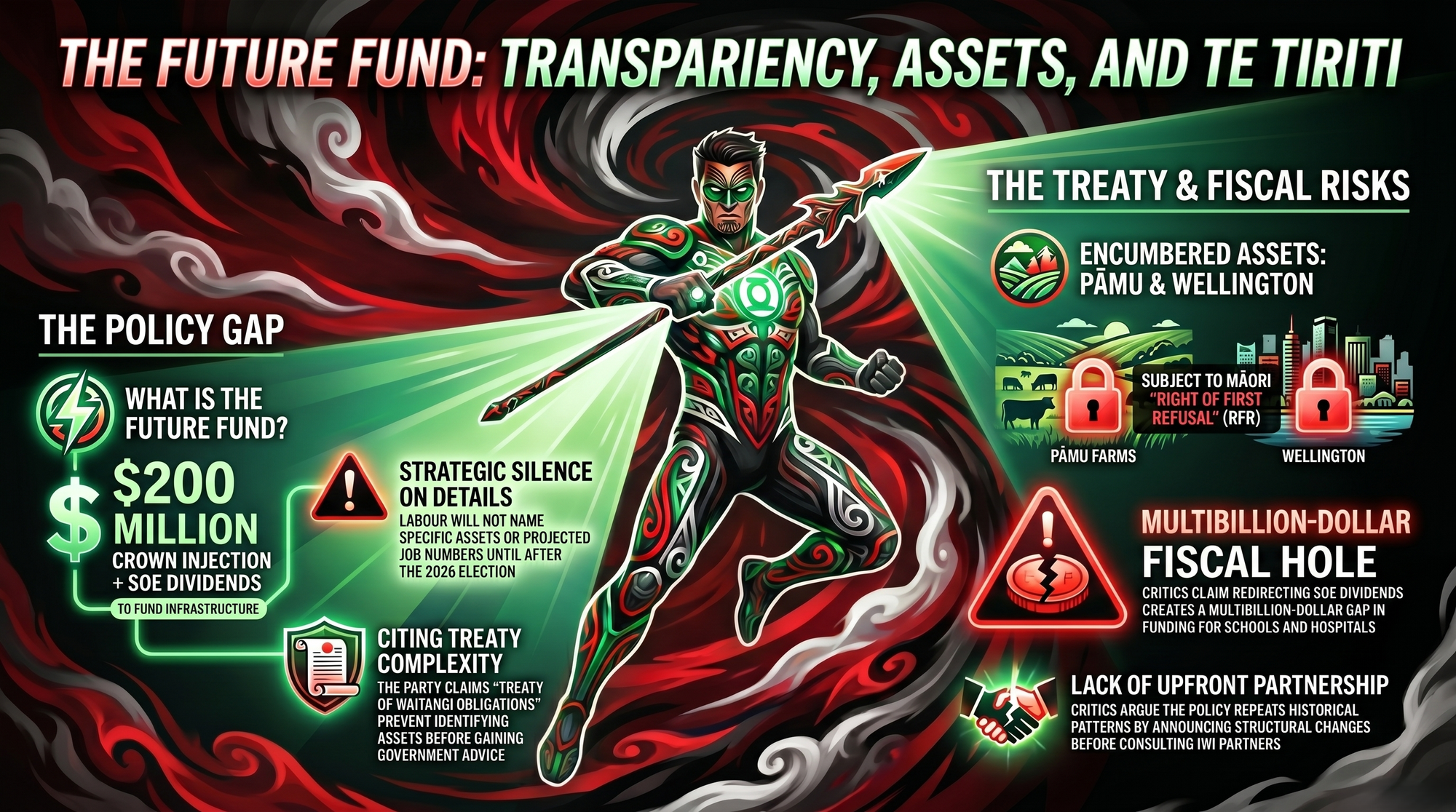
This essay examines Labour's Future Fund policy and its concealment of Treaty-encumbered asset details because it directly affects Māori whānau, tino rangatiratanga, and democratic accountability over whenua and taonga. (Public interest statement per Durie v Gardiner NZCA 278.)
The Waka Without a Destination
Imagine being asked to vote for a policy whose architect cannot tell you what is inside it, how much it costs, how many jobs it creates, or which whenua it will restructure — and who, when pressed, points to Te Tiriti as the reason for their silence. That is Labour's Future Fund in May 2026.
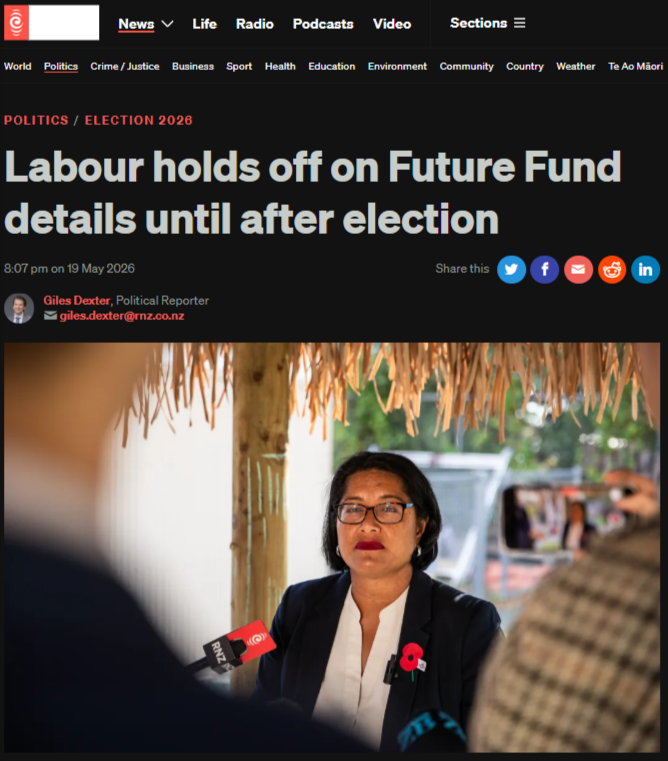
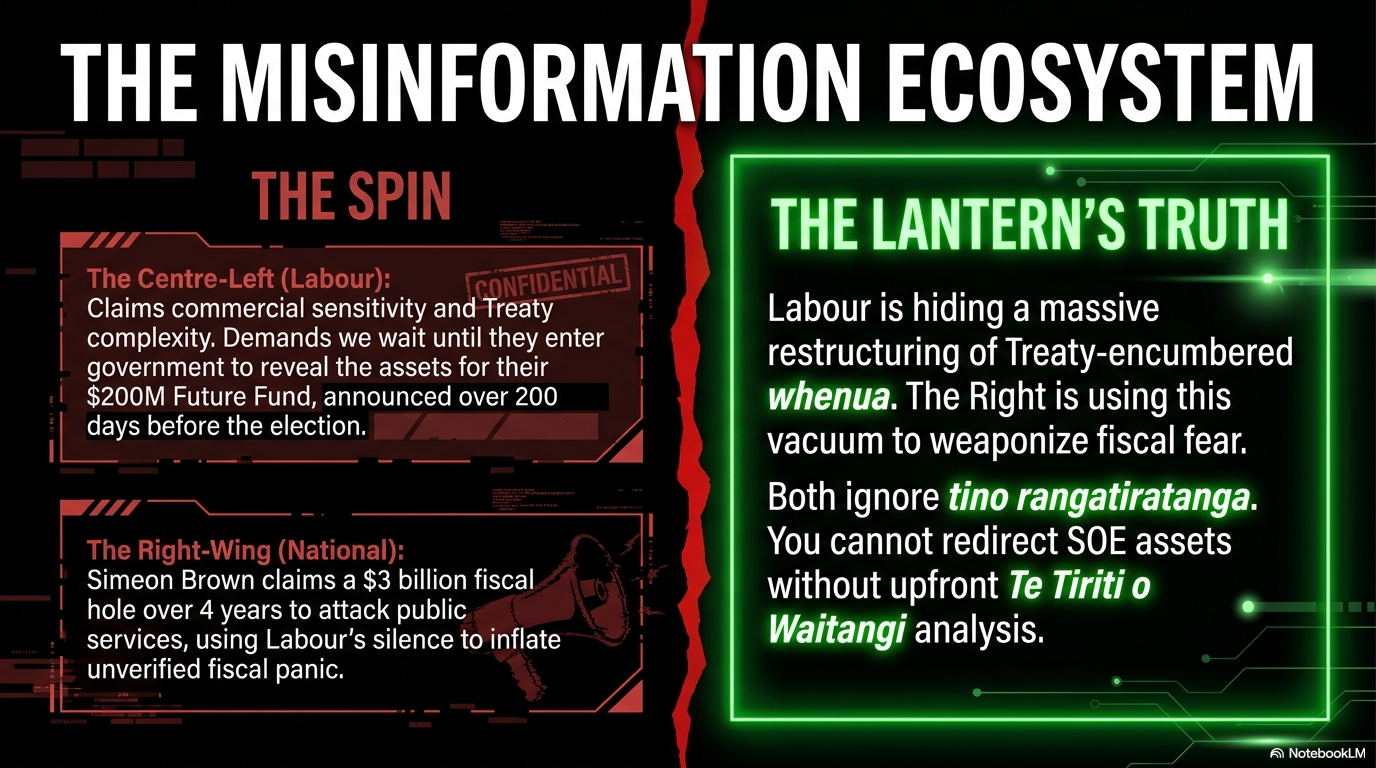
As reported by RNZ, Labour announced its Future Fund in October 2025 — over 200 days before the election — yet has refused to reveal which state-owned assets would be seeded into it, what jobs it would create, or what the net fiscal cost would be to the Crown.
Labour's finance spokesperson Barbara Edmonds told journalists the party had "not decided what assets to put in it yet, because different assets have different caveats that come with it," and that some assets have Treaty claims and overlay, including first right of refusal rights, as confirmed by RNZ.
As further confirmed by the NZ Herald, Labour has admitted it will not release cornerstone policy costings or job modelling until after the election, blaming Treaty concerns.
The Deep Dive Podcast
Listen to a lively conversation between two hosts, unpacking and connecting topics in the sources of this essay. I apologise in advance for the AI's very harsh pronounciation of reo. Please dont shoot me, :).
The fund, according to Labour's own Future Fund policy document, would be seeded with the dividends of selected state-owned assets and a $200 million Crown capital injection, with the stated purpose of investing in New Zealand businesses and infrastructure.
Labour's website describes the fund as designed to
"invest in infrastructure and innovative Kiwi business to create good, secure jobs."
Those are fine words. But without knowing which assets, which Treaty obligations, and what the fiscal displacement will be to health and education budgets, they are words on an empty waka.
The Whakapapa of This Problem
To understand why Labour's concealment is not merely bad politics but a structural Treaty failure, you need to trace the whakapapa of SOEs and their relationship to whenua Māori. The line runs from 1840 to today — and Labour knows this history.
They have no excuse.
When the State-Owned Enterprises Act 1986 was passed, as documented by Te Ara – The Encyclopedia of New Zealand, a major issue immediately arose: whether the transfer of land and other assets to SOEs could proceed without taking account of the Crown's obligations to Māori under Te Tiriti.
Section 9 of the State-Owned Enterprises Act was drafted to address this, stating that nothing in the Act shall permit the Crown to act in a manner inconsistent with the principles of the Treaty of Waitangi. That was the law in 1986.
It remains the law today.
In June 1987 — just six months after the Act passed — the Court of Appeal ruled, as recorded in Te Ara's account of SOE performance and Treaty issues, that the transfer of specific assets to SOEs could not proceed without a system in place to consider whether it would be consistent with Treaty principles. The Act was subsequently amended to make land transferred from the Crown to SOEs subject to "resumption" — meaning it remained available for Treaty claims. Those decisions opened the door to some of the most significant Māori land claims in this country's history.
Forty years later, Labour is proposing to restructure the use of SOE dividends without having done the equivalent upfront Treaty analysis. The whakapapa condemns them.
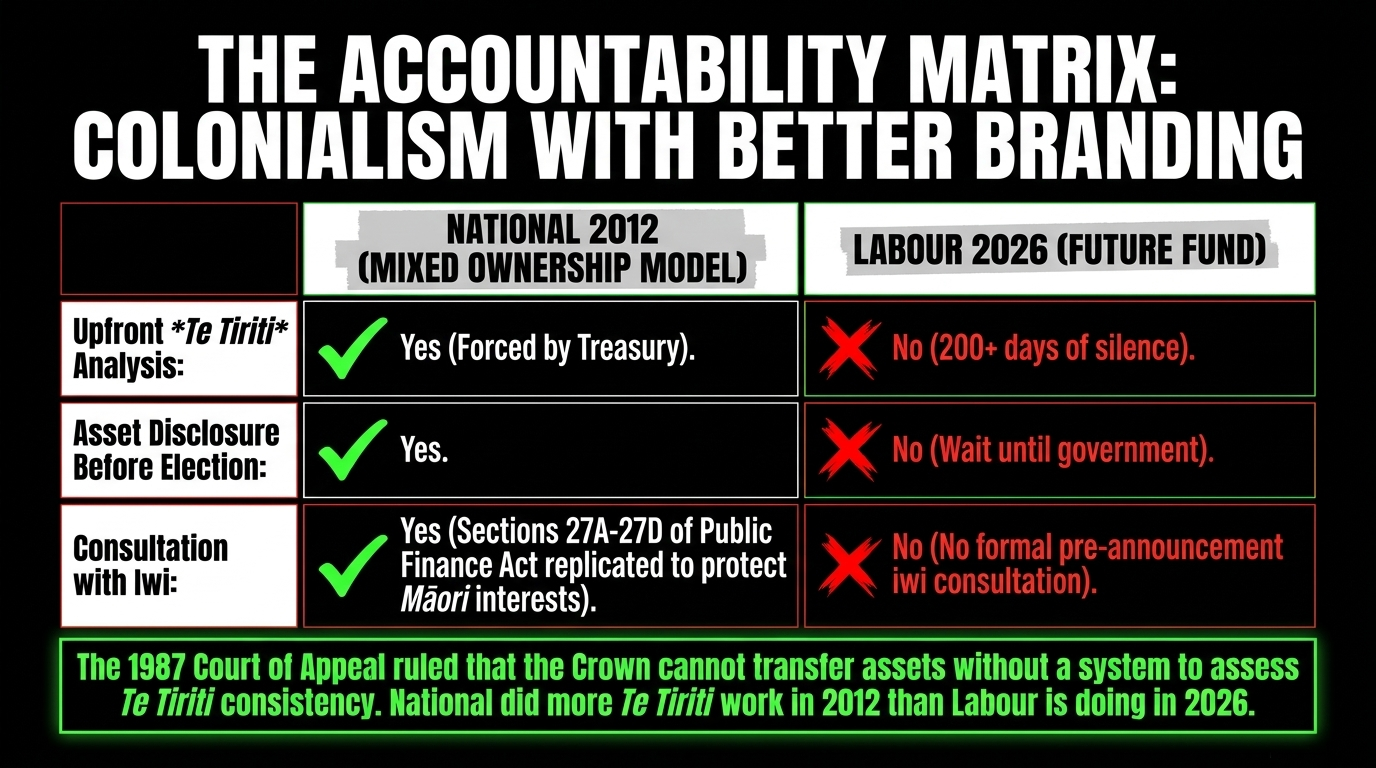
When National proposed its 2012 Mixed Ownership Model — partial privatisation of Meridian Energy, Genesis Energy, Mighty River Power, and others — Treasury was forced into urgent, formal Māori consultation.
As the Treasury's own Mixed Ownership Model consultation documents confirm, sections 27A–27D of the Public Finance Act were specifically replicated into the SOE Amendment Bill to protect Māori interests in land held by mixed-ownership companies. Those provisions existed because the Crown had already learned, through costly litigation and Waitangi Tribunal findings, that you cannot restructure SOE assets without upfront Treaty engagement. Labour was in opposition during that process. They watched it unfold. They now propose to do less than National did in 2012.
Port Nicholson Block: The Wellington Whakapapa Labour Cannot Erase
The deepest evidence of Labour's strategic failure lies not in a policy document but in a 100-year legal obligation that covers approximately 2,000 Crown properties in the Wellington region
— an obligation signed, sealed, and enacted into statute in 2009, and one that Labour appears to have either forgotten or chosen to ignore.
The Port Nicholson Block (Taranaki Whānui ki Te Upoko o Te Ika) Claims Settlement Act 2009 settled all historical claims of Taranaki Whānui ki Te Upoko o Te Ika — the mana whenua of Te Whanganui-a-Tara and its wider rohe. The collective, as confirmed by Wikipedia's Taranaki Whānui entry, comprises people of Te Āti Awa, Taranaki, Ngāti Ruanui, Ngāti Tama, Ngāti Mutunga, and others whose tīpuna migrated to Wellington in the 1820s and 1830s and signed the 1839 Port Nicholson Block Deed of Purchase. The Port Nicholson Block Settlement Trust was ratified by a 96.8% vote of registered claimants at Pipitea Marae in August 2008
— a remarkable expression of collective tino rangatiratanga.
The rohe covered by this settlement encompasses the geographic heart of the New Zealand state: Wellington Harbour and city, the Hutt Valley (including Lower Hutt, Petone, Wainuiomata, and Upper Hutt), Porirua and its harbour, the Kāpiti Coast, the Remutaka ranges to the east, and Turakirae Head to the south.
As confirmed by the Beehive's settlement announcement, the package included a financial quantum of approximately $25 million plus interest, a Crown contribution of $4.895 million toward claimant costs, cultural redress, and the most consequential element: commercial redress mechanisms that remain active today.
Cultural Redress: Matiu, Mākaro, Mokopuna
The cultural redress vested specific taonga directly in the Trust. As confirmed by Wikipedia's entry on Mokopuna Island, ownership of three Wellington Harbour islands — Matiu/Somes Island, Mākaro/Ward Island, and Mokopuna Island — was transferred to Taranaki Whānui as part of the 2009 settlement. As the Beehive announcement confirmed, cultural redress properties also came from Wellington City Council, Hutt City Council, Upper Hutt City Council, Greater Wellington Regional Council, and Meridian Energy. The settlement additionally established Statutory Acknowledgements and Deeds of Recognition — formal Crown recognition of Taranaki Whānui's special relationship with wāhi tapu, burial grounds, and mahinga kai sites throughout the rohe, with legal effect under the Resource Management Act.
The Right of First Refusal: 2,000 Properties, 100 Years
The most far-reaching element of the settlement — and the most directly relevant to Labour's Future Fund — is the Right of First Refusal (RFR).
As confirmed by both the Port Nicholson Block Settlement Trust and LINZ's RFR guidance, this mechanism:
- Applies to approximately 2,000 Crown properties throughout the Port Nicholson Block rohe
- Runs for 100 years from the 2009 settlement date — meaning it remains active until 2109
- Requires that whenever a Crown agency declares any of those properties surplus to requirements, it must first offer the property to the Trust before selling to any third party
- Covers a prescribed process set out in the Deed of Settlement
- Is registered on the title of each affected property by LINZ, creating an enforceable legal encumbrance
In 2019, the Trust formalised the Tai Hekenga Consortium alongside Taranaki whanaunga from Taranaki to exercise these RFR rights collectively, as noted by the PNBST commercial redress page. The Sale and Leaseback mechanism — which allowed the Trust to purchase the land component of selected Crown properties and lease them back to Crown entities — was active for 10 years from settlement and has now expired.
The Crown's Own Treaty Breach Within the Settlement
The Crown did not cleanly discharge even its 2009 obligations.
In 2012, the Waitangi Tribunal released the Port Nicholson Block Urgency Report following a claim lodged by the PNBST in December 2009. As recorded by the Waitangi Tribunal, Taranaki Whānui had agreed — in exchange for releasing the Wellington Central Police Station from their settlement package — that the Crown would not offer other property within the Port Nicholson Block to Ngāti Toa or other iwi as commercial or cultural redress.
The Crown then broke those undertakings by offering Ngāti Toa a Right of First Refusal over Crown properties in Wellington City, including potentially the Wellington CBD.
The Tribunal found the Crown breached Treaty principles by failing to actively protect Taranaki Whānui's interests, act reasonably, and maintain utmost good faith — recommending the Crown review and amend the Ngāti Toa RFR offer to remove CBD commercial properties from its scope.
This is the institution whose obligations Labour now proposes to restructure around without prior engagement: an institution that has already watched the Crown break its word inside its own settlement process.
Pāmu: The Whenua Labour Cannot Name
Edmonds named Pāmu (formerly Landcorp) as an example of an SOE asset with Treaty encumbrances. That is the first honest thing Labour has said about this policy in 200 days — and it reveals the scale of the problem they have been hiding.
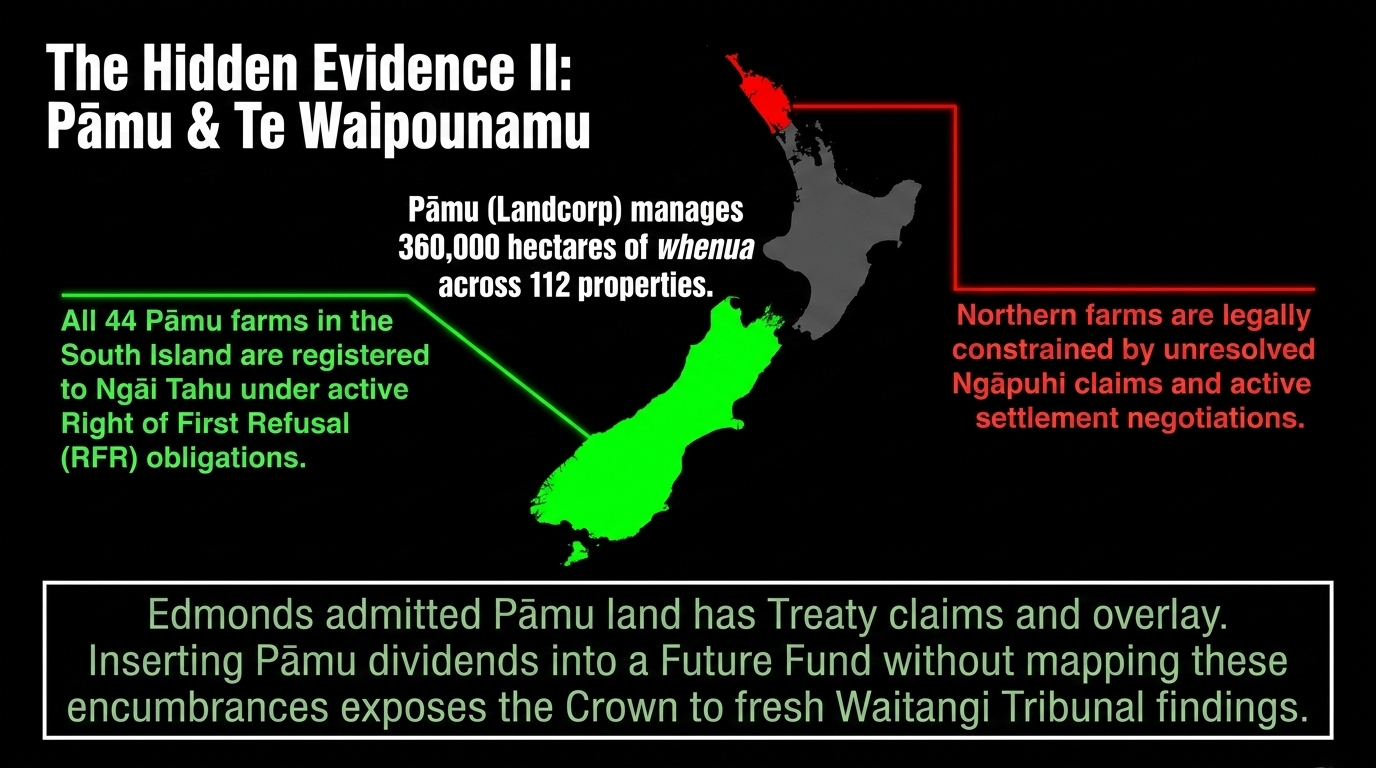
According to Pāmu's own website, Pāmu is the brand name for Landcorp Farming Limited, a State-Owned Enterprise that operates more than 100 farms across Aotearoa New Zealand, with its stated responsibilities explicitly including "returning land through Te Tiriti o Waitangi settlements." As Farmers Weekly reported in April 2026, Pāmu currently holds 112 properties covering approximately 360,000 hectares, including farms under Crown ownership, lease, and management arrangements.
The Treaty encumbrances on Pāmu land are not theoretical. As revealed by interest.co.nz's detailed investigation in January 2025, all 44 of Pāmu's South Island farms are registered to Ngāi Tahu under the Right of First Refusal principle — an extension of the Treaty settlement process.
This means those farms cannot be sold or structurally repurposed without first offering Ngāi Tahu the opportunity to acquire them. North Island farms face different but analogous constraints: in Northland, Ngāpuhi has not yet reached a Treaty settlement, meaning state farms in that rohe are maintained under a separate legal category — but one that equally constrains disposal or restructuring.
As further confirmed by Farmers Weekly, many South Island Pāmu properties are subject to first right of refusal under Treaty settlement, while others remain under active settlement negotiations.
This is the whenua Labour wants to redirect dividends from — without first mapping the Treaty obligations that define what the Crown can and cannot do with those assets.
The LINZ Treaty Settlements Landbank and Māori Protection Mechanism confirms the Crown holds hundreds of properties subject to active settlement assessment before any disposal or restructuring is permitted.
Labour's silence on which assets enter the fund is not a minor detail. It is the entire Treaty question — one that stretches from the South Island high country to 2,000 Wellington properties to Pāmu's Northland farms.
The Fiscal Displacement Māori Will Bear
Here is the fiscal whakapapa that Labour will not show you.
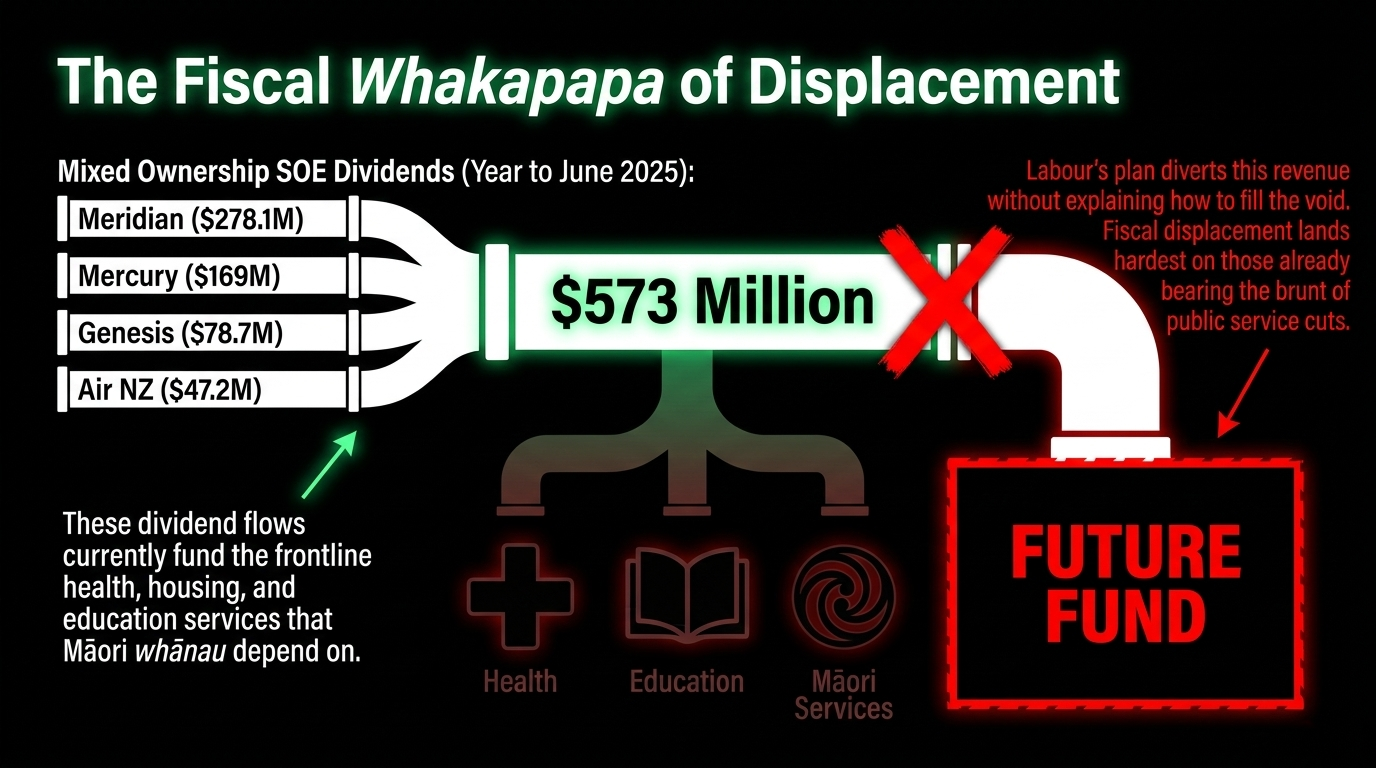
SOE dividends flow into Crown accounts that fund health, education, and housing — the services Māori whānau depend on at disproportionately high rates due to the compounding legacies of land confiscation, economic exclusion, and policy neglect.
As confirmed by Treasury's OIA response on Crown dividends from May 2025, mixed ownership model companies alone paid the Crown dividends of $573 million in the financial year to June 2025: Air New Zealand ($47.2 million), Genesis Energy ($78.7 million), Mercury NZ ($169 million), and Meridian Energy ($278.1 million).
These are the flows Labour proposes to redirect into a Future Fund — without disclosing the replacement funding mechanism for the schools, hospitals, and social services those flows currently support.
National's campaign chair Simeon Brown has claimed, as reported by RNZ, that there will be a fiscal hole of $3 billion over four years because the dividends from SOEs currently help pay for frontline public services. This figure is unverified with available primary sources and may be politically inflated — but the structural problem it names is real.
You cannot redirect $573 million-plus in annual dividend flows without either raising taxes, cutting services, or borrowing more. Labour has not told voters which of those three paths they will take. That lands hardest on Māori whānau who already bear the compounded costs of the current government's cuts to Māori health services, as analysed in previous MGL essays on the Luxon government's economic programme.
Five Verified Hidden Connections
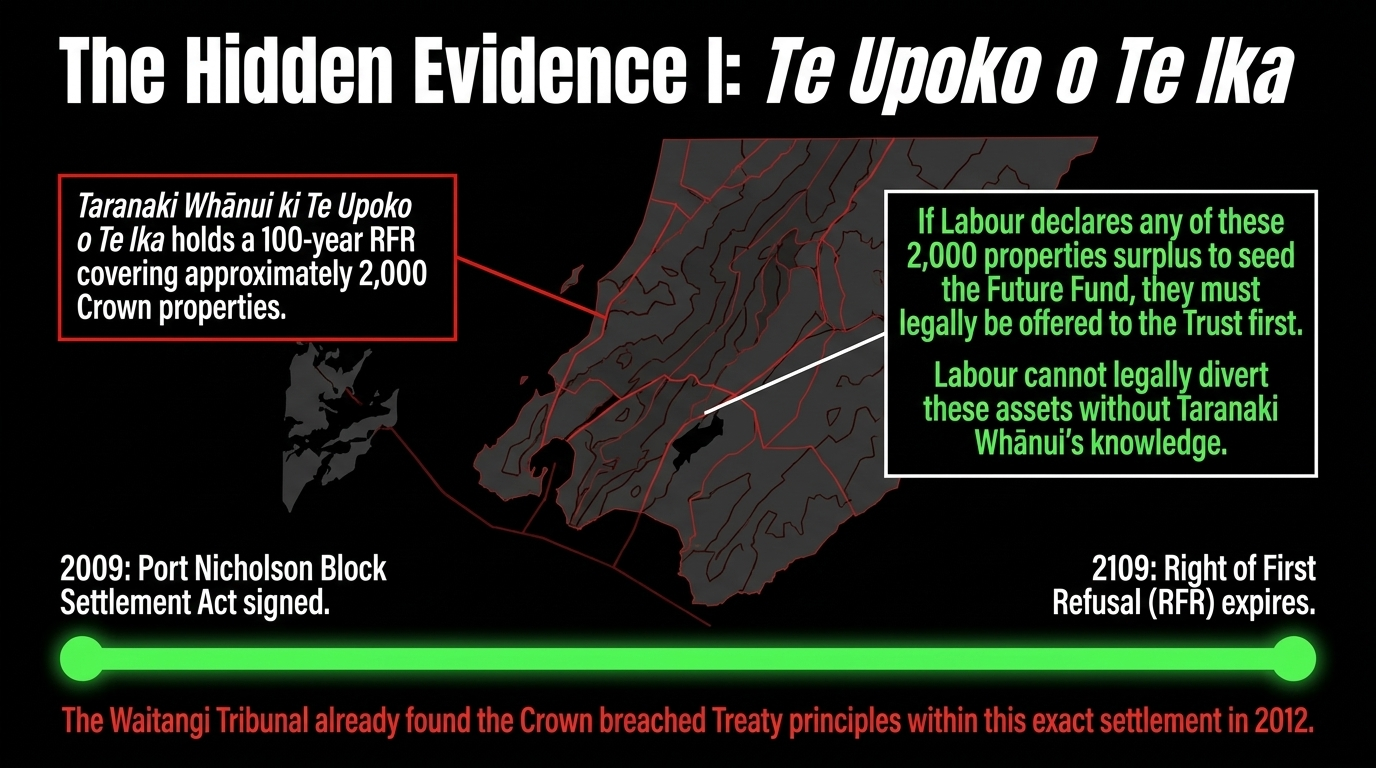
Connection 1: The Port Nicholson Block RFR makes Labour's silence legally dangerous. The Port Nicholson Block Settlement Trust holds a 100-year Right of First Refusal over approximately 2,000 Crown properties in the Wellington rohe until 2109. Any Crown property in that portfolio that is diverted into a restructured investment vehicle, declared surplus, or used as a revenue seed for the Future Fund triggers the Trust's enforceable legal rights — rights registered on title by LINZ. Labour cannot legally move these properties without Taranaki Whānui's knowledge and right of first offer. Their silence on which Wellington assets enter the fund is not just political opacity. It may constitute a pre-emptive breach of a statute passed by the same Labour-aligned Parliament that now asks Māori to trust it.
Connection 2: The Pāmu/Landcorp whenua nexus. Pāmu manages approximately 360,000 hectares across Aotearoa, as confirmed by Farmers Weekly. A significant portion — including all 44 South Island farms — sits under active Ngāi Tahu RFR obligations, confirmed by interest.co.nz. Inserting Pāmu dividends into a Future Fund without first mapping Treaty encumbrances exposes the Crown to fresh Waitangi Tribunal findings. Labour knows this — hence the silence.
Connection 3: The 1987 Court of Appeal ruling Labour is ignoring. Six months after the 1986 SOE Act passed, courts ruled that no SOE asset restructuring could proceed without a system to assess Treaty consistency, as recorded by Te Ara. The government policy on Treaty of Waitangi and corporatisation confirms that the Waitangi Tribunal has found the Crown would breach Treaty principles if it tried to reduce its duties to Māori through corporatisation without upfront engagement. Labour has had 200 days and has not published equivalent analysis.
Connection 4: Chris Hipkins could not name a single beneficiary business in October 2025. As reported by the NZ Herald, when Labour first announced the Future Fund, Hipkins was unable to name a single business that would benefit when pressed by journalists. Seven months later, as confirmed by RNZ, the party still cannot name the assets going in, the jobs coming out, or the fiscal cost. This is not a policy under development. This is a slogan with a logo.
Connection 5: Iwi as decoration, not architecture. Labour's Future Fund policy document promises to "work alongside business, unions, and communities" and to reset "how government, business, iwi and communities work together." Yet there is no evidence of any formal pre-announcement iwi consultation on which assets carry their whenua, their wāhi tapu, or their settlement rights. The Waitangi Tribunal's 2012 Port Nicholson Block Urgency Report already found the Crown breached Treaty principles by failing to actively protect Taranaki Whānui's interests inside its own settlement process. Labour is proposing to restart that pattern — announce first, engage Māori after, cite complexity as the reason for delay. Māori whānau have seen this since 1840.
The Mixed Ownership Model: Déjà Vu With a Progressive Label
There is a bitter irony embedded in this story. The same Labour Party that vociferously opposed National's 2012 partial privatisation programme — citing Treaty obligations, community ownership, and fiscal risk
— is now proposing to redirect SOE dividend flows into a private investment vehicle without the Treaty analysis it demanded of National at the time.
As Te Ara records, by 1999 the total value of SOE assets sold under successive governments exceeded $19 billion — including Petrocorp, Contact Energy, the Post Office Bank, State Insurance, the Rural Bank, Air New Zealand, NZ Railways Corporation, and Telecom.
Many of those sales generated Waitangi Tribunal findings, litigation, and Treaty breaches that took decades to remedy. During the 2012 asset sales debate, Labour argued that Section 9 of the SOE Act required full Māori consultation before any structural change. They were right. They should apply the same standard to themselves. Instead, as confirmed by the Treasury's 2012 Mixed Ownership consultation documents, National did more Treaty work in 2012 than Labour has done for the Future Fund in 2025–2026. That is not a higher standard. That is lower accountability under a left-wing brand.
What the LINZ Landbank and the Māori Protection Mechanism Demand
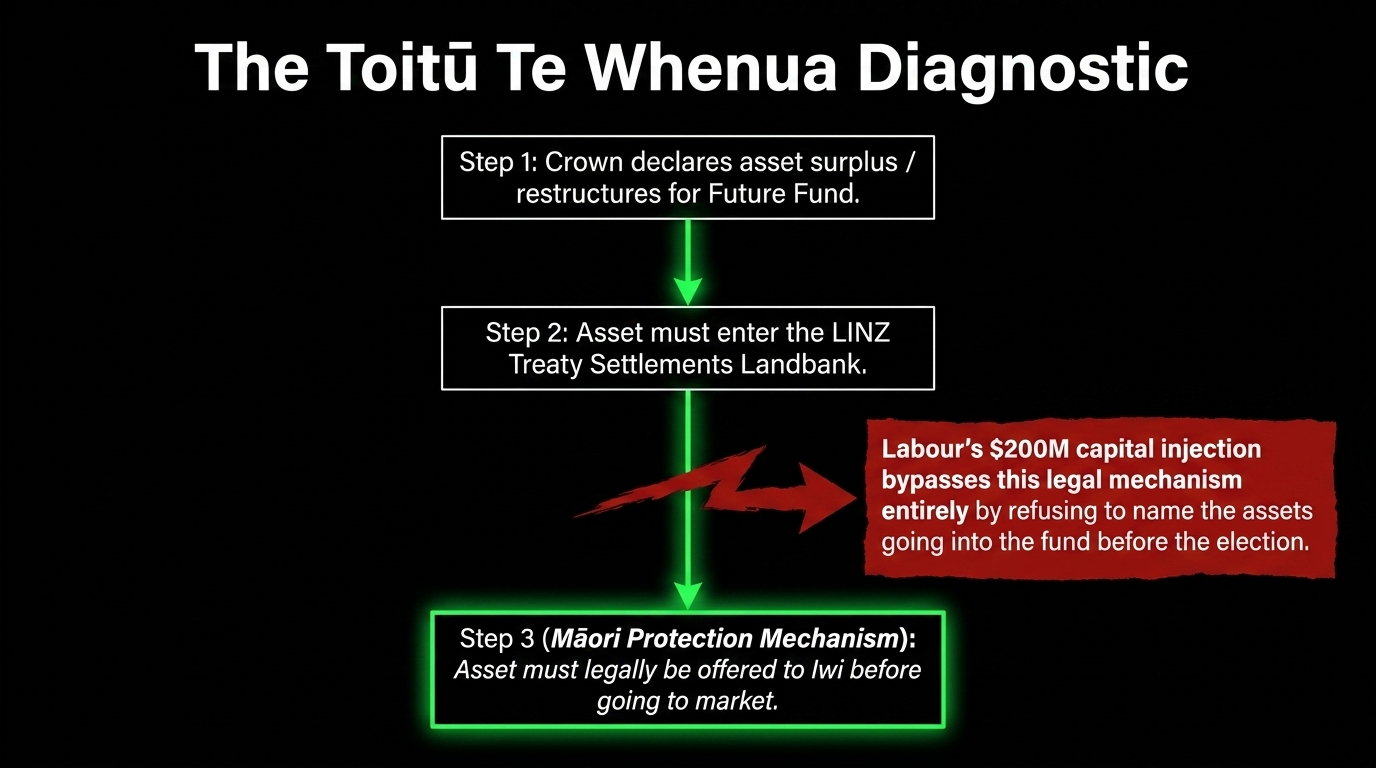
The Toitū Te Whenua LINZ Treaty Settlements Landbank and Māori Protection Mechanism governs hundreds of Crown properties — former prisons, hospitals, schools, and farms — that must be assessed for Treaty settlement purposes before any disposal or restructuring. The Māori Protection Mechanism requires that surplus Crown land be offered to iwi before it goes to market. Any SOE asset that sits on, includes, or derives revenue from land in the Landbank is subject to these protections.
Labour has not published a list of which SOE assets would enter the Future Fund. They have not confirmed which assets intersect with the Treaty Settlements Landbank. They have not disclosed whether their $200 million Crown capital injection includes or excludes assets subject to the Māori Protection Mechanism. As Edmonds herself confirmed to RNZ, Labour was advised that some SOEs would have Treaty obligations and that the party should wait until government to get official advice before deciding what goes in.
That is a confession, not a defence.
It means Labour announced a flagship economic policy with a $200 million Crown commitment without first determining whether the assets it intended to use are legally available for that purpose.
That is announcing a waka before you have checked whether the timber belongs to someone else.
What Tino Rangatiratanga Actually Demands
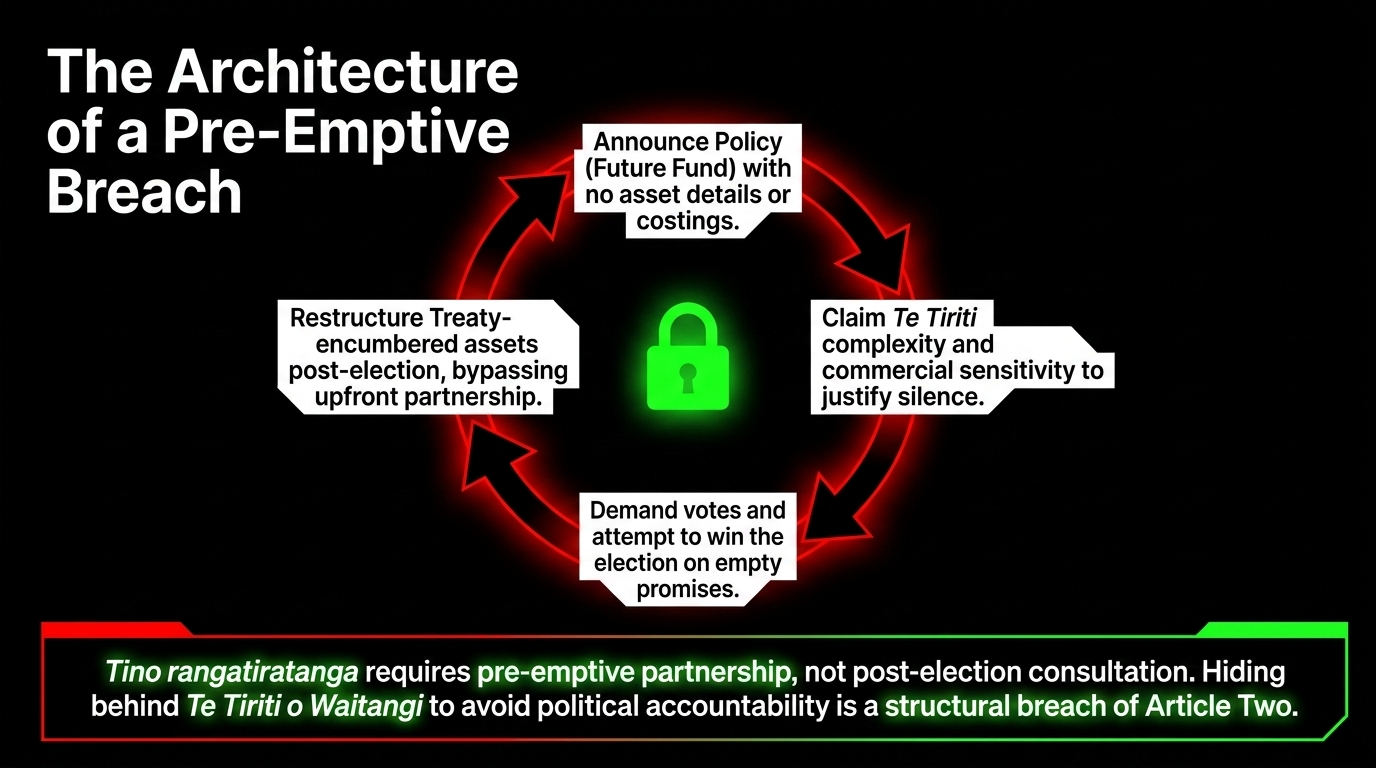
Tino rangatiratanga — the unqualified exercise of chieftainship guaranteed in Article Two of Te Tiriti — requires that Māori know, before the vote, which assets carry their whenua, their wāhi tapu, and their settlement rights. It requires pre-emptive partnership, not post-election consultation. The Waitangi Tribunal's findings on Māori wards confirm that the Crown consistently breaches Treaty principles when it makes structural decisions affecting Māori interests without upfront partnership.
The Future Fund is a structural decision affecting Treaty-encumbered assets across at least three jurisdictions: Wellington (Port Nicholson Block RFR), the South Island (Ngāi Tahu/Pāmu), and Northland (unresolved Ngāpuhi claims).
The government policy on Treaty and corporatisation confirms that the Waitangi Tribunal has previously found the Crown would breach Treaty principles if it reduces its duties to Māori through structural change without upfront engagement. Labour's concealment of the Future Fund's asset base is, by the Tribunal's own standards, a pre-emptive Treaty breach — structuring a policy that will affect Treaty-encumbered assets without the engagement Article Two demands.
Labour currently identifies its priorities as jobs, healthcare, housing, and the cost of living. Those are real needs for real whānau.
But a party that cannot tell Māori whānau which whenua it proposes to redirect dividend flows from — and blames Treaty complexity for that silence — is not a party that has done the work of genuine partnership.
It is a party that has invoked Te Tiriti as a shield against political accountability. That is not tino rangatiratanga. That is colonialism with better branding.
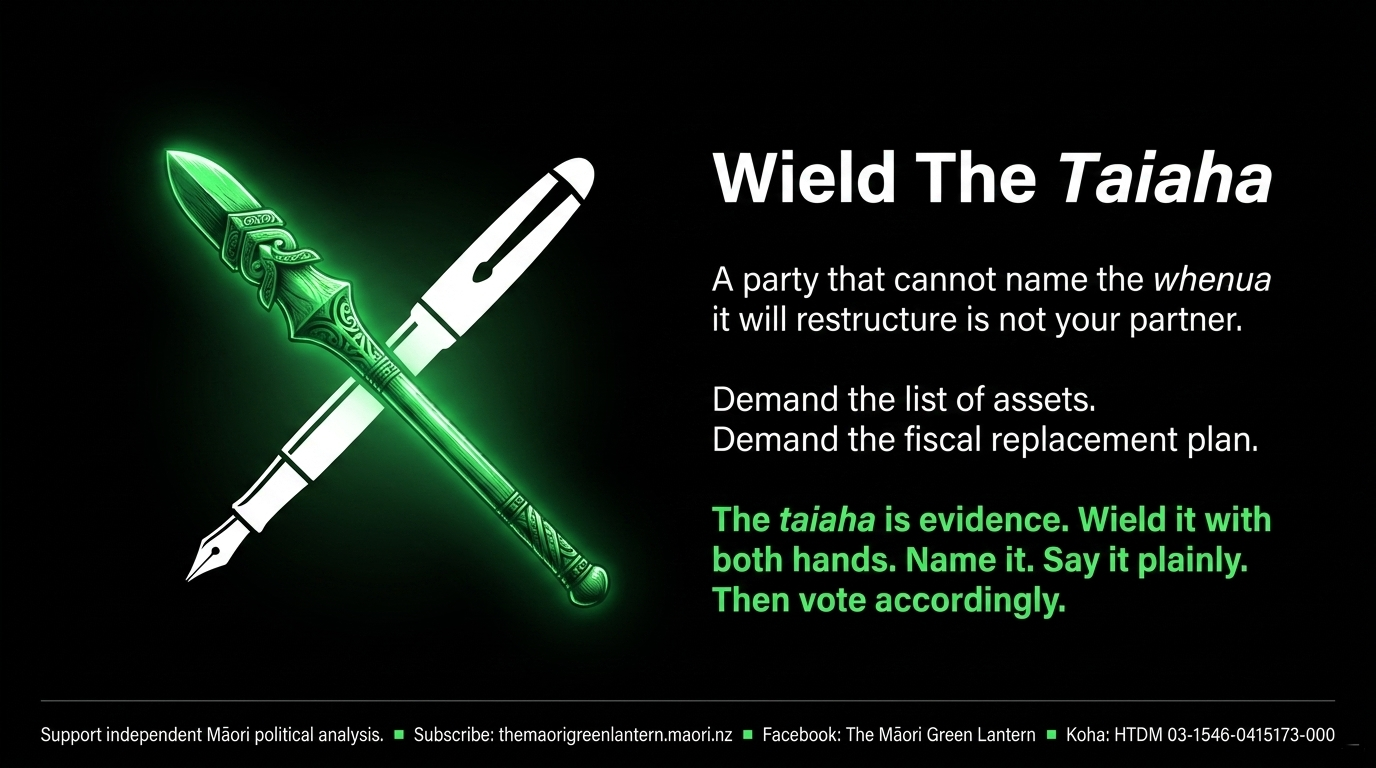
Name it. Say it plainly. Then vote accordingly.
Kia kaha, whānau. The taiaha is evidence. Wield it with both hands.
Support This Mahi
This essay was written because Māori whānau deserve to know what Labour is hiding about Treaty-encumbered assets before they vote.
Every koha funds independent Māori political analysis that the mainstream media won't do. If you cannot koha — subscribe, follow, kōrero, share. That is koha.
🌿 Koha: Support The Māori Green Lantern
📩 Subscribe: themaorigreenlantern.maori.nz
🏦 Direct bank: HTDM 03-1546-0415173-000
👥 Facebook: The Māori Green Lantern
Views expressed constitute honest opinion on matters of public interest under the Defamation Act 1992 (NZ) and Durie v Gardiner NZCA 278. All factual claims sourced and cited. Named individuals are referenced solely in their public capacity. Right of reply offered to all named individuals — contact via themaorigreenlantern.maori.nz. Errors: contact same.