"The Government That Burned Our Healing House Is Now Selling You a Box of Band-Aids" - 17 March 2026
The government stole billions from our health system, fired thousands of healers, and silenced the voices of Māori medicine — then announced $25 million and expected applause

Tēnā koutou katoa, whānau.
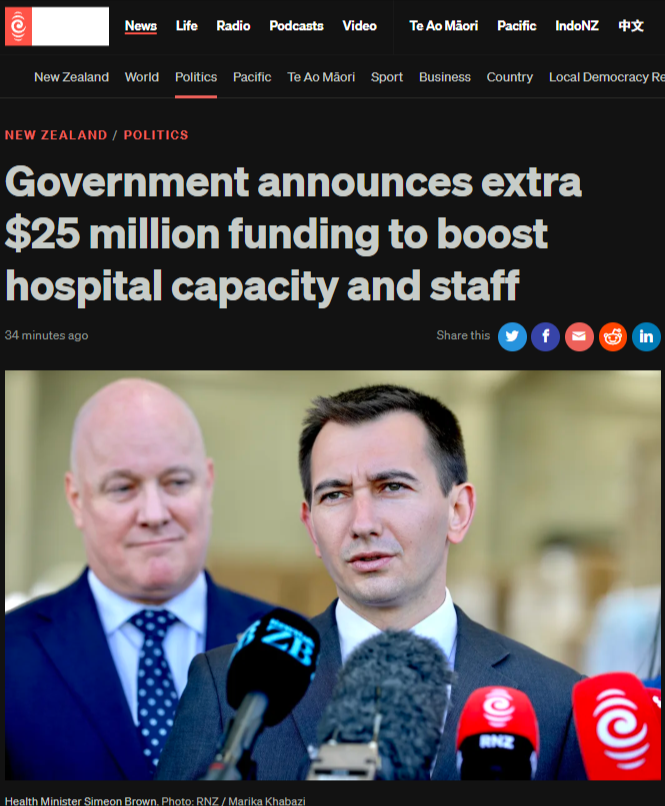
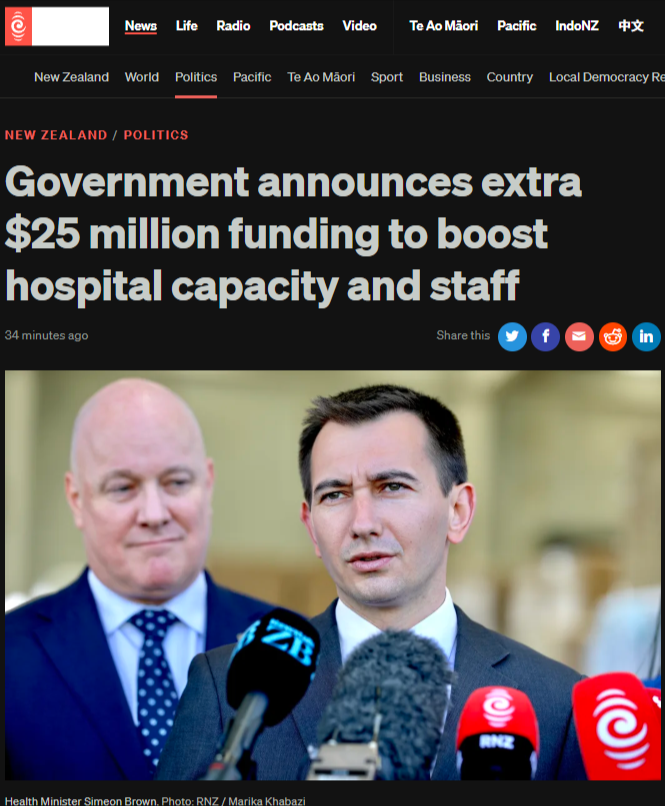
Today, Health Minister Simeon Brown stood at a podium and announced $25 million in extra hospital funding ahead of winter — 378 new staff, 71 extra beds across four hospitals — and called it a plan. He expected us to be grateful. He expected us to look at that number and feel something other than contempt. He expected us to forget.
We do not forget.
This investigation responds directly to RNZ's report of 17 March 2026 on the government's $25 million hospital announcement, and to the companion story, also published today by RNZ, revealing that internal papers show Health NZ faces "extreme risk" around its own decentralisation plans. Two stories.
One verdict: this government manufactured the health crisis, and today's announcement is not a solution. It is a performance.
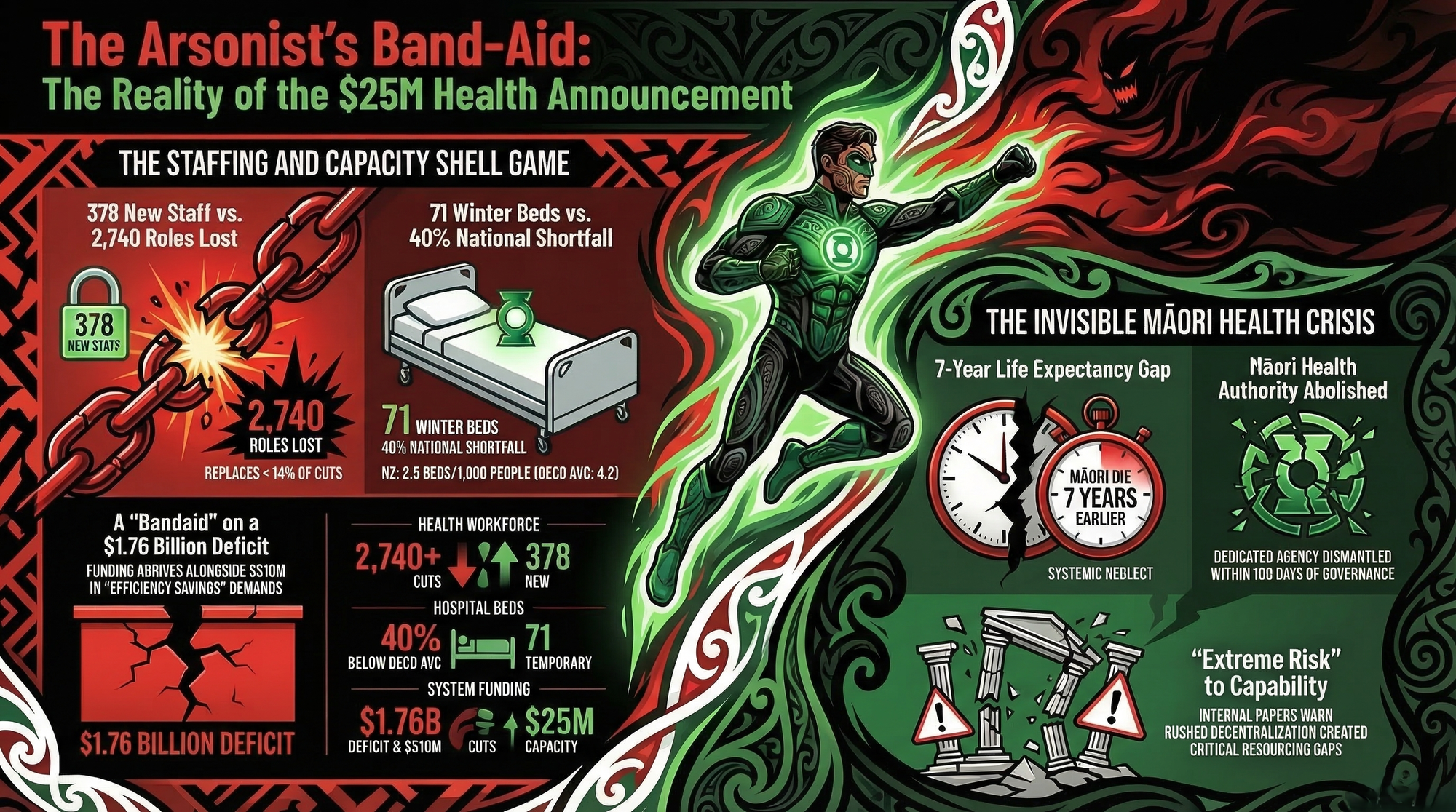
This essay exposes $25 million as the fiscal equivalent of a plaster on a severed artery. The same coalition government that dismantled the Māori Health Authority, forced over 2,740 health workers out the door, left $538 million in wages unspent while demanding another $510 million in cuts, accused striking doctors of being unethical, and presided over a $1.76 billion Health NZ deficit, now claims credit for a token investment that would not fill the holes it deliberately dug. New Zealand's hospitals have 2.5 beds per 1,000 people against an OECD average of 4.2. Māori carry a seven-year life expectancy gap and hospitalisation rates 74% higher than the general population. Seventy-one beds across an entire country — the same country where Wellington Hospital's emergency department hit 223% capacity last winter — is not a winter plan. It is an insult dressed in a press release.
The Deep Dive Podcast player
TE WHARE HAUORA — THE HEALING HOUSE THEY BURNED DOWN
There is a whakataukī that I return to often in these dark seasons of governance:
Ka hinga te tōtara o te wao — when the great tōtara falls in the forest, the whole canopy shifts. Our health system was once a tōtara — imperfect, yes, but standing, bearing weight, giving shelter.
This government took to it with an axe.
Picture it in te ao Māori terms, whānau. Our public health system is a whare — a meeting house, a healing house, a place where manaaki (to show respect and care) was the guiding principle. The pou (posts) of that whare were the Māori Health Authority, the pay equity agreements, the thousands of nurses and allied health workers, the community health providers embedded in our rohe (territories). One by one, this government stripped those pou out. They removed the thatching. They weakened the foundations. They dismissed the tohunga — the healers — as unethical troublemakers. And now, after they watched the walls buckle and the roof cave in on the very people inside, they have arrived at the ruins with a single weatherboard and a hammer, calling it a renovation.
$25 million. That is the weatherboard. That is the renovation. That is the plan.
NGĀ TATAU KŌRERO — THE NUMBERS THAT INDICT
Let me place this $25 million in context, because context is what this government desperately hopes you will not find.
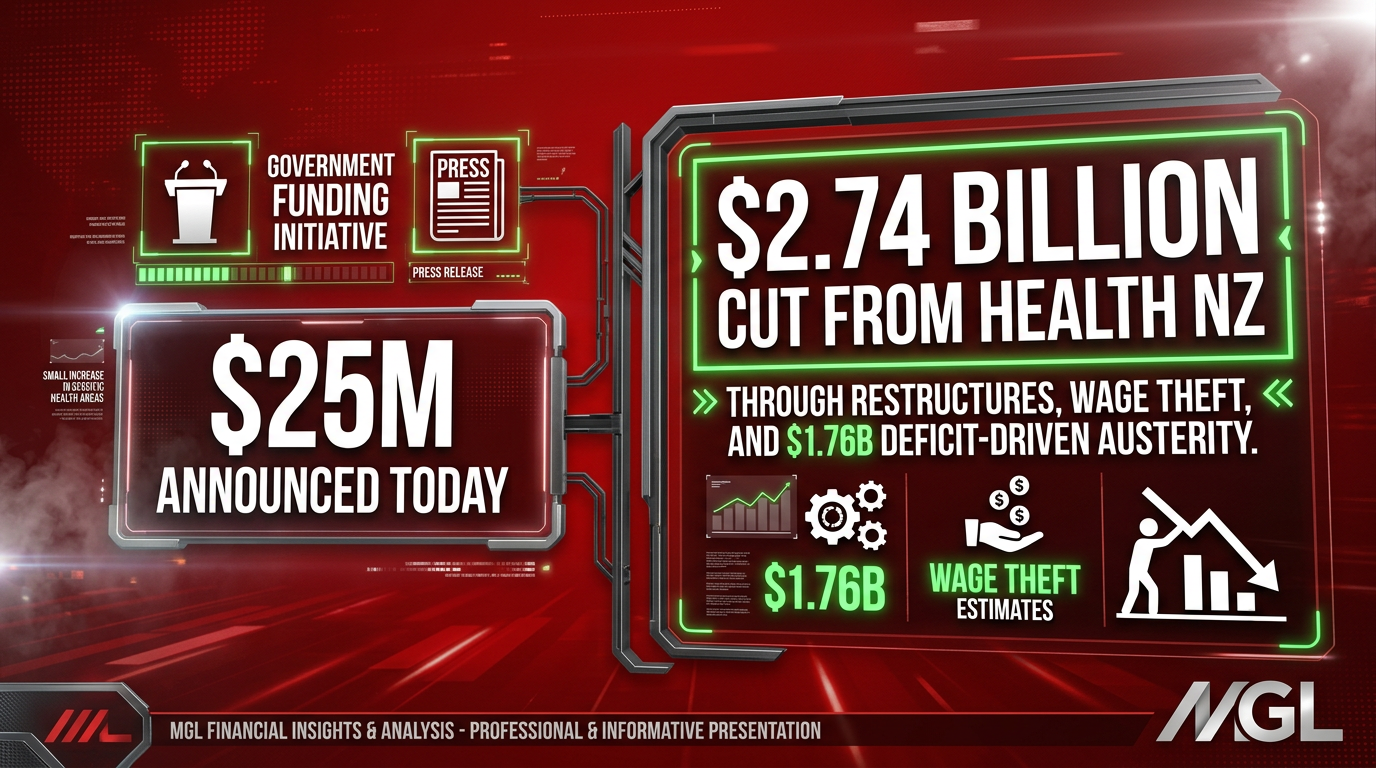
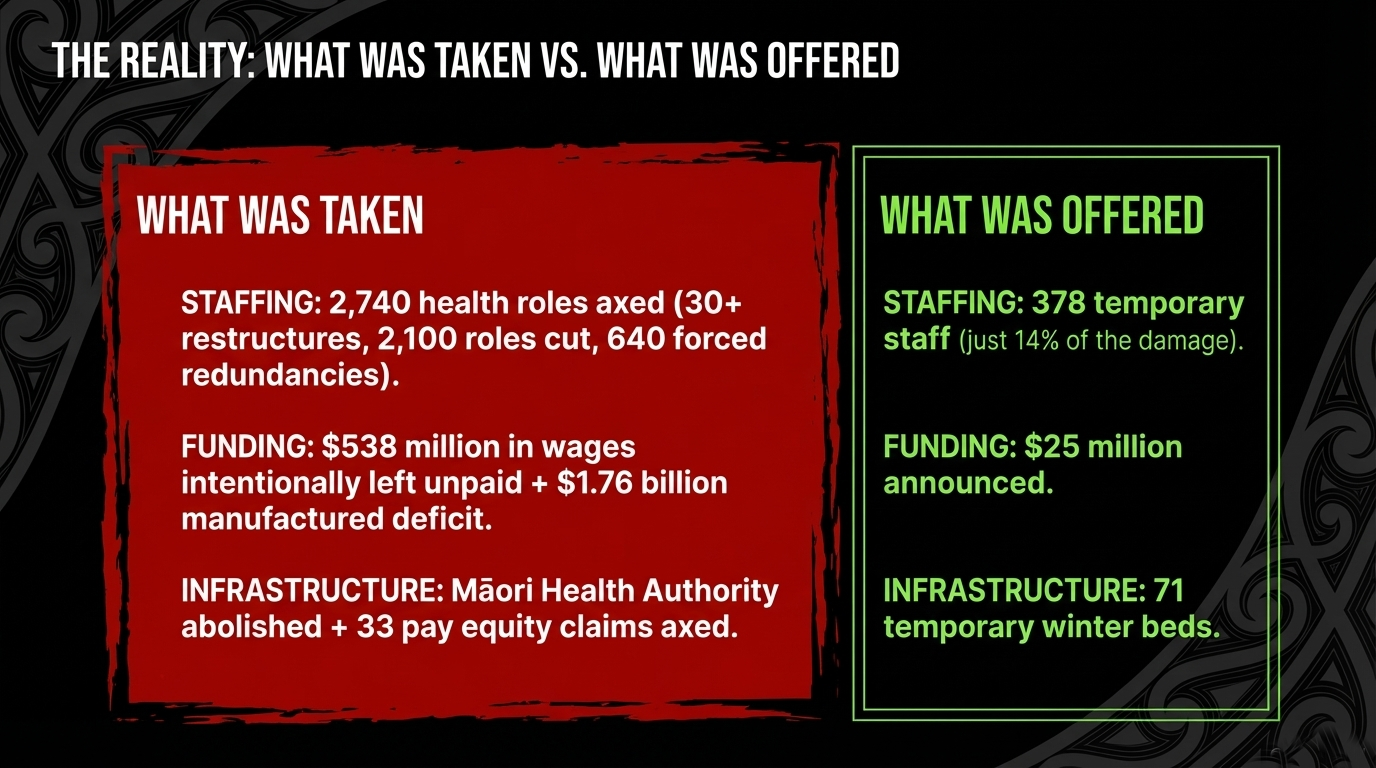
2,740 health workers gone. As reported by the PSA in January 2026, the government's funding cuts forced Health NZ to run more than 30 restructures over two years. Around 2,100 full-time equivalent roles were cut. A further 640 health workers took voluntary redundancy. The PSA was explicit: this number may underestimate the total roles lost. The government is now announcing 378 new staff — a fraction, less than 14%, of what it destroyed.
$538 million in wages left unspent while demanding $510 million more in cuts. As revealed by RNZ in December 2025, Health New Zealand underspent $538 million earmarked for staff salaries in 2024/25 — money that should have gone to nurses and doctors — because it refused to settle collective contracts, leaving positions vacant. Simultaneously, it overspent $162 million on expensive outsourced contractors and locums to plug the gaps. And simultaneously, hospitals were told to find another $510 million in "efficiency savings." This is not fiscal management. This is a manufactured crisis, as I documented in my December 2025 investigation.
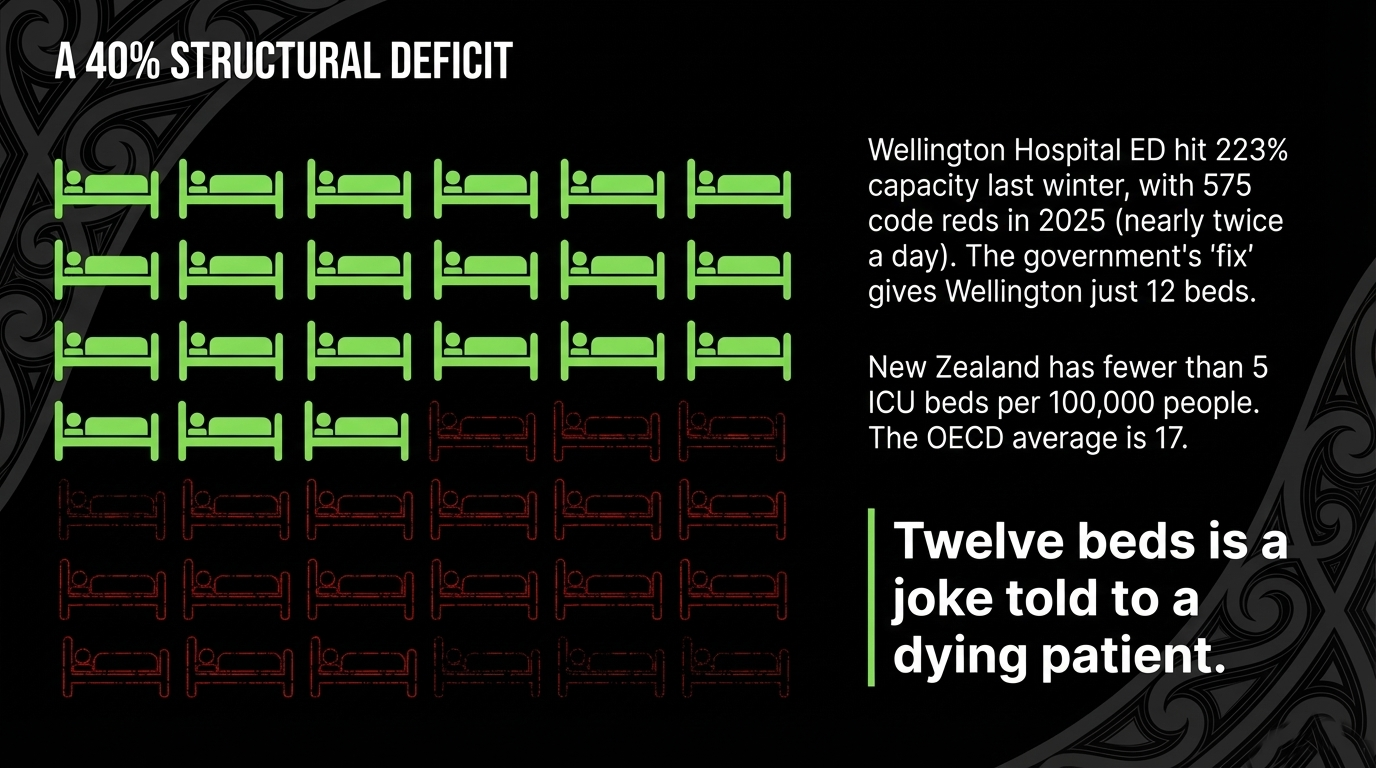
71 beds across the entire country. New Zealand has 2.5 hospital beds per 1,000 population, compared to the OECD average of 4.2 — a shortfall of over 40%. When it comes to ICU beds, New Zealand has fewer than 5 per 100,000 people, compared to an OECD average of 17. Last winter, Wellington Hospital's emergency department hit 223% capacity. Waikato ran at 150% most days. Dunedin hit 187%. And the government's answer, announced today, is 12 beds for Wellington and 25 for Waikato. Wellington's ED recorded 575 code reds between January and October 2025 — nearly twice a day. Twelve beds is not a solution. Twelve beds is a joke told to a dying patient.
$1.76 billion deficit — created by this government's own chaos. When the coalition installed Commissioner Lester Levy in July 2024, the projected deficit had already climbed to $1.4 billion. By October 2024, it had ballooned to $1.76 billion. They blamed the previous government. But it was this government that refused to settle fair pay agreements, leaving $538 million on the table, that outsourced 31,600 surgeries to private hospitals while public capacity was cut, that installed a commissioner instead of a democratic board.
11,500 allied health workers on strike. In October 2025, over 11,500 allied health workers voted to strike for 24 hours, joining what became the largest strike New Zealand had seen since 1979 — over 100,000 workers in health, education, and public services walking out together. They were not striking for luxury. They were striking because, as PSA secretary Fleur Fitzsimons stated: "There are simply not enough health workers to provide the level of care New Zealanders need." Brown's response was to accuse senior doctors of crossing an "ethical line" and to threaten legislation to remove doctors' right to strike. An ex-banker lecturing rooms full of doctors and nurses about medical ethics. This is who is now announcing 378 new staff and expecting gratitude.
TE HUKIHUKI O TE TŌRANGAPŪ — THE ARSONIST AND THE FIRE BRIGADE
Simeon Brown is the arsonist who called the fire brigade and wants a medal.
Let me trace the timeline carefully, because this government's strategy depends on amnesia.
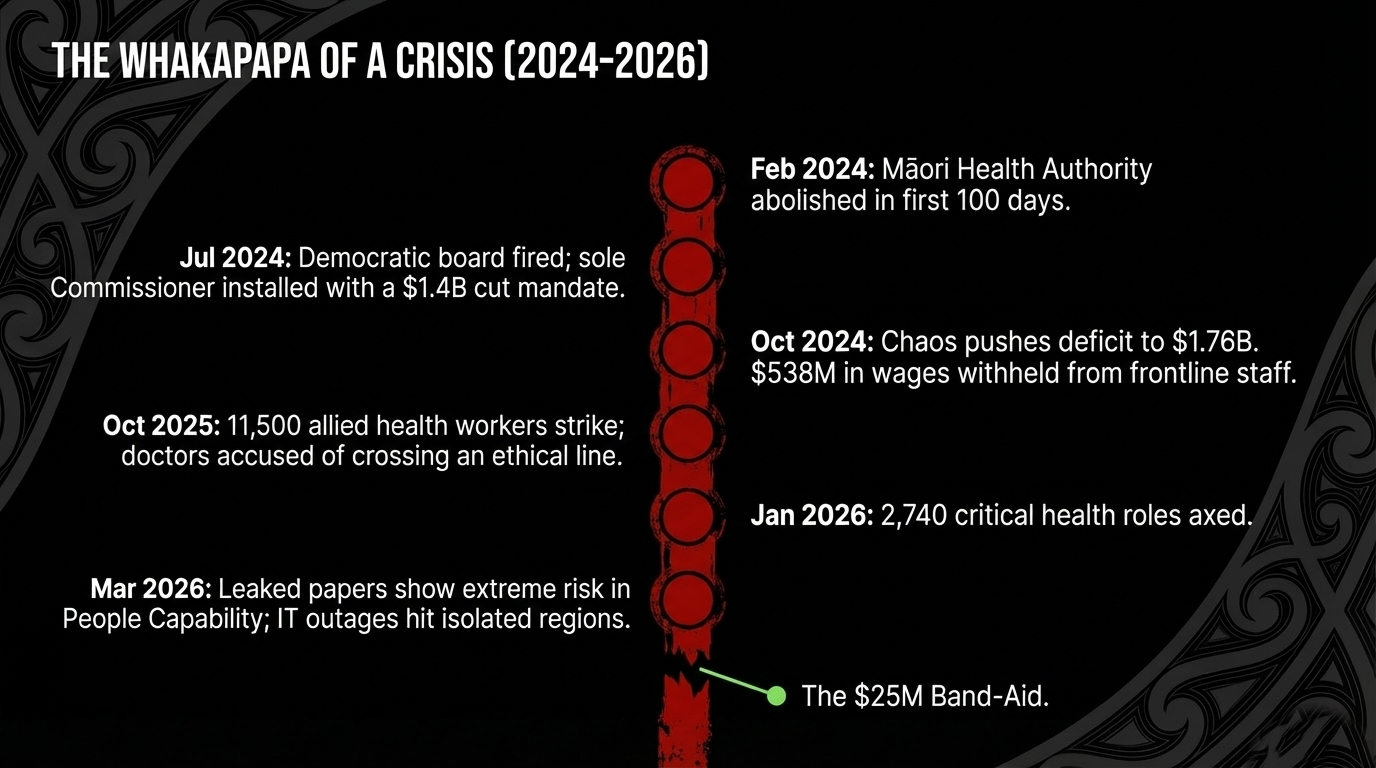
In January 2024, within the coalition's first 100 days, the government legislated to disestablish the Māori Health Authority — the dedicated Crown agency established to address Māori health inequities. The Pae Ora (Disestablishment of Māori Health Authority) Amendment Act was passed on 28 February 2024 and came into force on 30 June 2024. The Māori health equity infrastructure — built over years of advocacy, koha, and blood — was dismantled in the time it takes to complete a probationary period. Gone.
The Māori Public Health team at the Ministry of Health was cut from six roles to two. The Emergency Management team went from eleven roles to two. Twenty-one roles in total cut from the Ministry's Public Health Agency — less than three weeks before Christmas 2025, as if cruelty had a calendar preference.
In September 2024, Health Minister Shane Reti — replaced in January 2025 by the more ideologically aggressive Simeon Brown — installed Commissioner Levy with a $1.4 billion savings mandate. Democratic oversight replaced by a sole corporate operator. No board. No community voice. No Te Tiriti obligation. Just a commissioner instructed to cut.
Cut IT infrastructure. Internal documents released under the Official Information Act showed Health NZ knew that slashing IT roles from 2,000 to 1,460 — a third of the digital workforce — would "increase risks to patient care and hospital resilience." The documents warned of vulnerabilities in isolated communities including Rotorua, Gisborne, and New Plymouth. The government ignored the warnings. Within months, there was a six-hour IT outage in the lower North Island, a 12-hour outage in Auckland and Northland, and another Auckland/Northland outage — all in the first two months of 2026. Systems that keep patients alive, failing, because Brown's government ignored its own internal warnings.
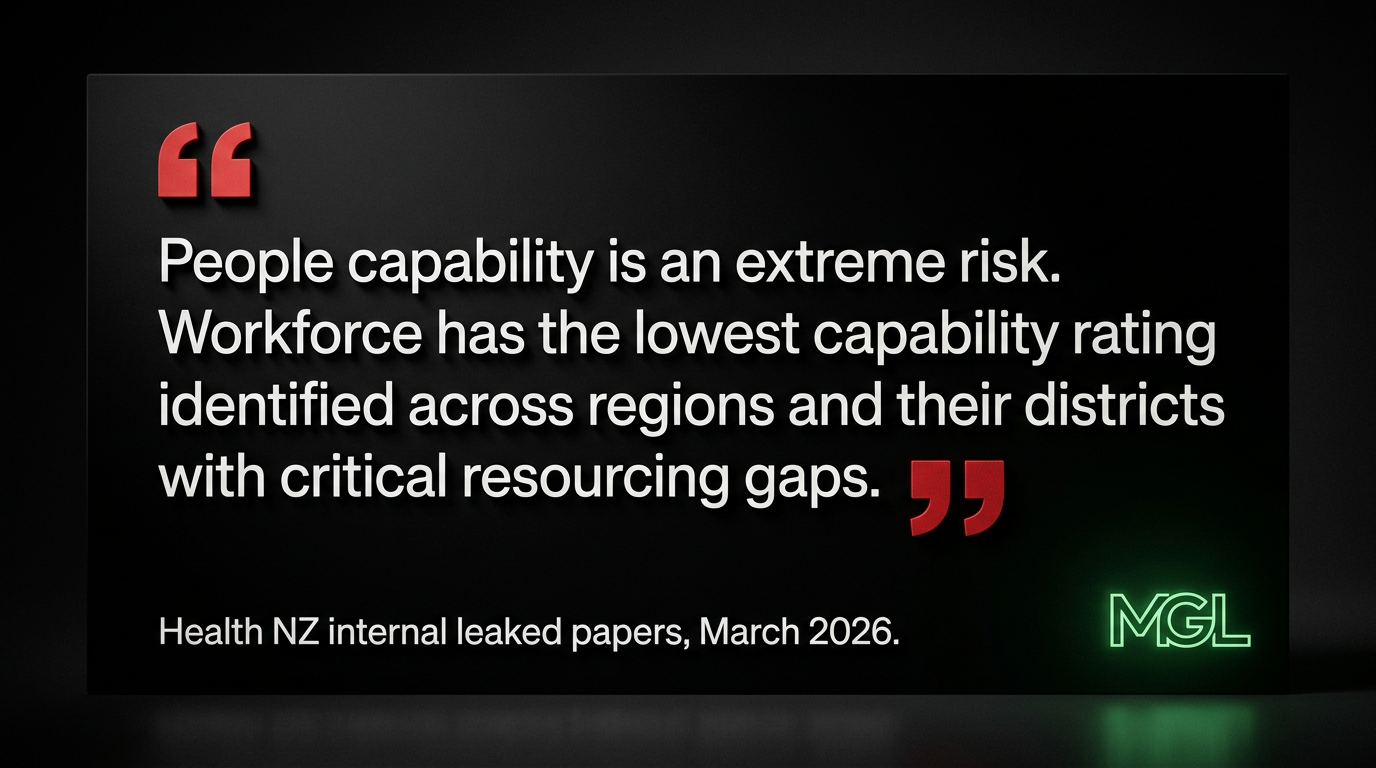
And today — the same day the $25 million band-aid was announced — RNZ published leaked internal Health NZ papers rating "People capability" as an "extreme risk." The papers describe a workforce with "the lowest capability rating identified across regions and their districts with critical resourcing gaps" — a direct consequence of the very restructures this government ordered. Brown pushed for "rapid devolution" of decision-making back to districts. But the internal assessment said there was "a feeling that basics need to be in place first." The rushed devolution "may remove current controls and undermine effective oversights" — including around finances. ASMS executive director Sarah Dalton called it "a massive concern that this is just pushing responsibility onto districts without any realistic means of achieving what needs to be done."
This is the system into which Simeon Brown has announced $25 million. Not a system that was functioning and needs support. A system this government deliberately broke — through 30+ restructures, through 2,740 job losses, through refusing pay settlements, through Commissioner rule, through abolishing Māori health infrastructure — and is now claiming credit for marginally bandaging.
TE HAUORA MĀORI — THE WOUND WITHIN THE WOUND
Here is what Simeon Brown's press conference did not mention: Māori.
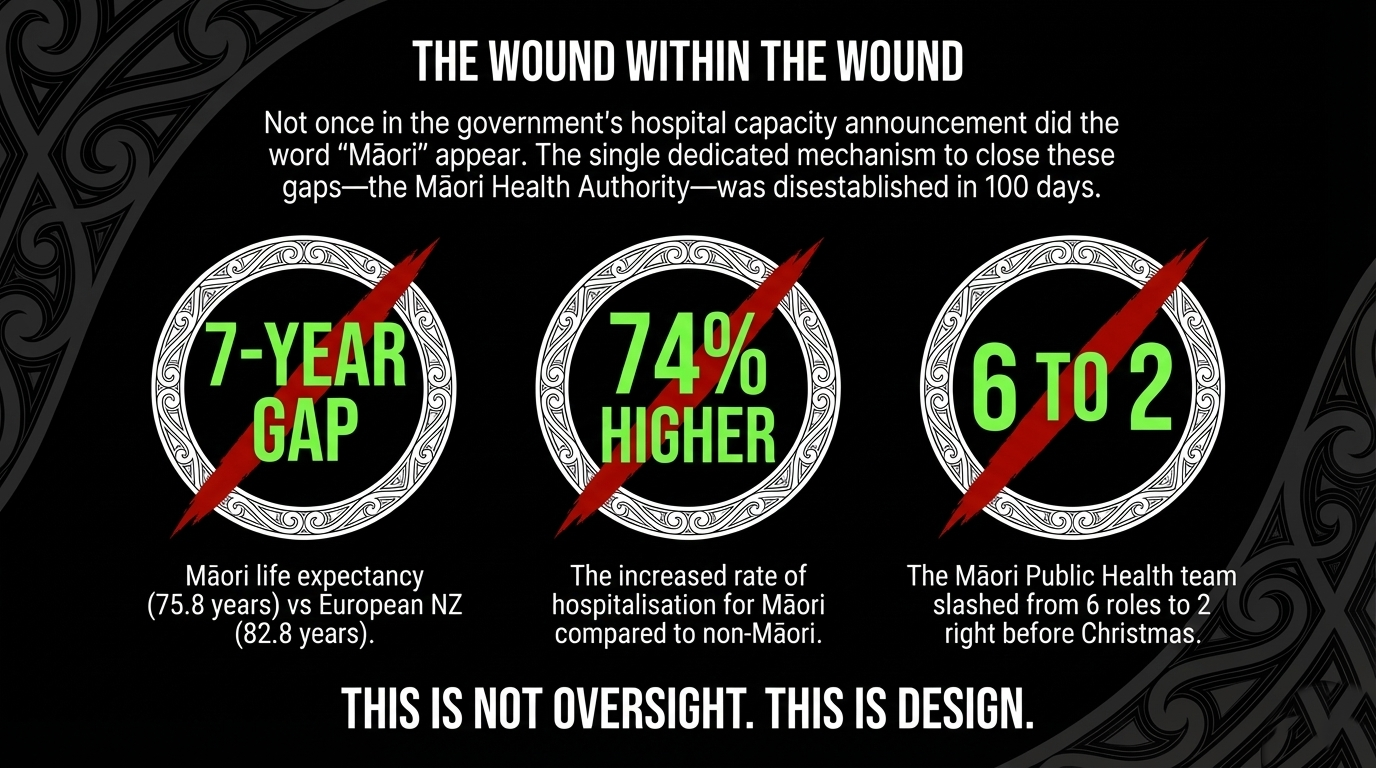
Not once in the government's announcement about hospital capacity did the word "Māori" appear. Not in the statement about 378 new staff. Not in the discussion of 71 new beds. Not in the framing of which hospitals and which "pressured areas" receive the $16.8 million. Māori are invisible in the solution, even as Māori are disproportionately represented among those who suffer the crisis.
The numbers are damning and they are documented:
Life expectancy gap: 7 years. According to Te Whatu Ora's own analysis, the life expectancy gap between Māori and non-Māori/non-Pacific New Zealanders remains at approximately 7 years. In 2022–2024, Māori life expectancy at birth was 75.8 years, compared to 82.8 years for European or Other ethnicities. This is not nature. This is policy. This is the accumulated consequence of decades of underfunding, overcrowding, and systemic neglect — accelerated sharply by this government's austerity agenda.
Hospitalisation rates 74% higher. Research cited in NZ's COVID-19 Royal Commission found that Māori had a 74% increased rate of hospitalisation compared to non-Māori, even after adjusting for age and sex. Māori children experience consistently higher rates of hospitalisation for medical conditions than non-Māori peers. These are not statistics from a distant history. These are the people waiting in 223%-capacity emergency departments. These are the whānau in the corridors of Middlemore and Wellington and Waikato.
The Māori Health Authority abolished: the single dedicated mechanism for closing these gaps, gone. The Waitangi Tribunal had documented how breaches of Te Tiriti o Waitangi drive inequitable health outcomes for Māori. The Māori Health Authority was the institutional response to those breaches. This government disestablished it in 100 days. Then slashed the Māori Public Health team at the Ministry of Health from six to two. Then announced a hospital capacity plan that does not mention Māori health equity once.
This is not oversight. This is design.
NGĀ TAUIRA MĀRAMA — THREE EXAMPLES FOR THE WESTERN MIND
Whānau, I am aware that not everyone who reads this analysis arrives with full context on how Māori concepts of health and governance intersect with what appears to be a standard funding announcement. So let me translate, with three concrete examples.
EXAMPLE 1: The Abolition of the Māori Health Authority — Tikanga Destroyed, Harm Quantified
The point: The government abolished the only Crown institution specifically designed to close Māori health gaps, then announced a winter beds plan that ignores Māori health equity entirely.
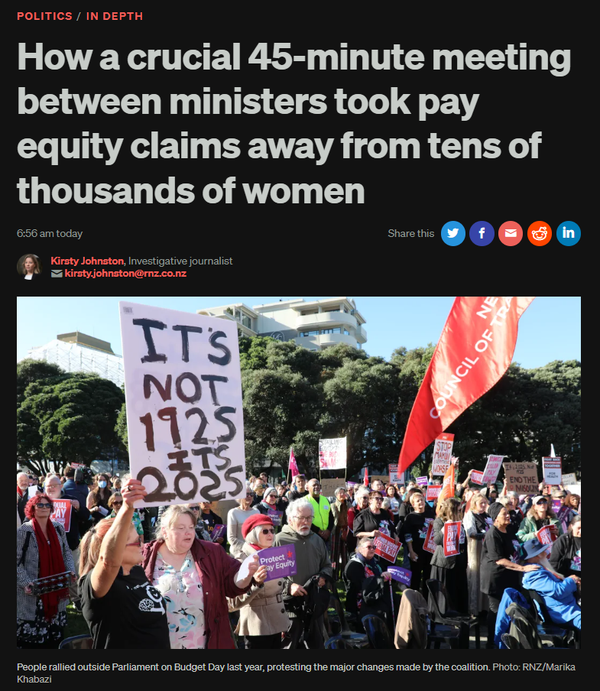
The quantified harm: As I documented in November 2025, the same government axed 33 pay equity claims — saving itself $12.8 billion while stripping wages from predominantly female, Māori, and Pacific health workers. The Māori Health Authority, established under the Pae Ora Act 2022 to directly address a 7-year life expectancy gap, was abolished by February 2024. The Māori Public Health team cut from 6 roles to 2. Māori-led health organisations that depended on the Authority for navigation and advocacy lost their institutional champion overnight.
The tikanga impact, explained for Western readers: In te ao Māori, health is not the individual absence of disease. It is whakaora — the restoration of life force across four dimensions: taha tinana (physical), taha hinengaro (mental), taha wairua (spiritual), taha whānau (family/community). The Māori Health Authority represented institutional manaakitanga — the Crown taking responsibility for care of those it had harmed. Dismantling it is not just a bureaucratic reorganisation. It is the Crown withdrawing its obligation. In a Western frame: imagine if, after decades of discrimination against a specific ethnic group in medical settings, the government created a dedicated ombudsman — then abolished it within two years because it was politically inconvenient. The harm is not just structural. It is a message: your health does not matter enough for a dedicated institution.
The solution: Restore the Māori Health Authority with Treaty-based obligations and dedicated funding. Honour all 33 pay equity claims. Implement the Waitangi Tribunal's Hauora report recommendations in full, beginning immediately.
EXAMPLE 2: 2,740 Health Workers Lost vs. 378 Promised — The Staffing Shell Game
The point: This government destroyed 2,740+ health roles through austerity, then today announced 378 replacements — 14% of the damage — and called it an investment.
The quantified harm: The PSA data is unambiguous: 30+ restructures, approximately 2,100 roles cut, 640 voluntary redundancies. The $538 million wage underspend confirms Health NZ refused to fill positions while leaving the money sitting — then spent $162 million extra on expensive contractors and locums. As I exposed in my investigation into Brown's authoritarian gambit against medical unions, health workers were offered a 2% pay rise in 2025 and 1% in 2026 — well below inflation — while being lectured by a former banker about ethics. Today's 378 staff announcement does not reverse this destruction. It does not even begin to address the institutional knowledge lost when thousands of experienced health workers left.
The tikanga impact: In te ao Māori, the healer — the tohunga — holds accumulated knowledge across generations. When you drive tohunga from the healing house through exploitation, that knowledge does not simply wait to be re-hired. It goes to Australia, to private practice, to early retirement. It is lost to our communities. In the Western frame: it is equivalent to firing 2,740 firefighters during a drought, spending the savings on consultants to assess fire risk, and then hiring 378 new recruits when the fires start. The new recruits are inexperienced. The institutional memory is gone. And the person who fired the firefighters is now being credited for hiring their replacements.
The solution: Settle all outstanding collective agreements immediately. End the recruitment freeze. Cancel the $510 million cuts and redirect those resources to frontline staffing. Prioritise Māori and Pacific health workforce development as a Treaty obligation.
EXAMPLE 3: 71 Beds vs. 40%-Below-OECD Capacity — The National Shame
The point: New Zealand has one of the lowest hospital bed ratios in the developed world. 71 temporary winter beds across four hospitals is not a solution to a structural emergency.
The quantified harm: New Zealand has 2.5 hospital beds per 1,000 population against the OECD average of 4.2 — a 40% deficit. For ICU beds, New Zealand has fewer than 5 per 100,000 people compared to the OECD average of 17 — a 70%+ shortfall. Last winter, Wellington ED hit 223% capacity, Dunedin hit 187%, Waikato routinely ran at 150%+. Wellington Hospital alone recorded 575 code reds in 2025 — nearly twice a day on average. Against this, Brown announced 12 beds for Wellington.
The tikanga impact: In te ao Māori, the concept of utu — reciprocity — is not revenge. It is balance. When a person is harmed, restoration requires an equivalent response. When a system is broken at the scale New Zealand's hospital infrastructure is broken — 40% below OECD standard, emergency departments running at twice capacity, code reds twice daily — the response must match the scale of the wound. Twelve beds for Wellington is not reciprocity. It is an insult. In the Western frame: if your house needed 10 structural repairs to be safe and the government funded one, you would not call that a renovation. You would call it neglect with a press release.
The solution: A capital investment programme to bring New Zealand hospital bed capacity to the OECD average — requiring the construction of approximately 7,000 net additional beds nationwide. Prioritise hospitals serving high-Māori-population districts. Reverse the cuts to Hospital-in-the-Home capacity that this same government oversaw as a substitute for structural investment. Fund this through the $12.8 billion saved from stripping pay equity — money that was taken from the health workforce and should be returned to it.
TE AO MĀORI FRAMEWORK — SEEING THROUGH THE COLONIAL LENS
Let me name this through the frameworks that te ao Māori gives us, because they are more diagnostic than any economist's model.
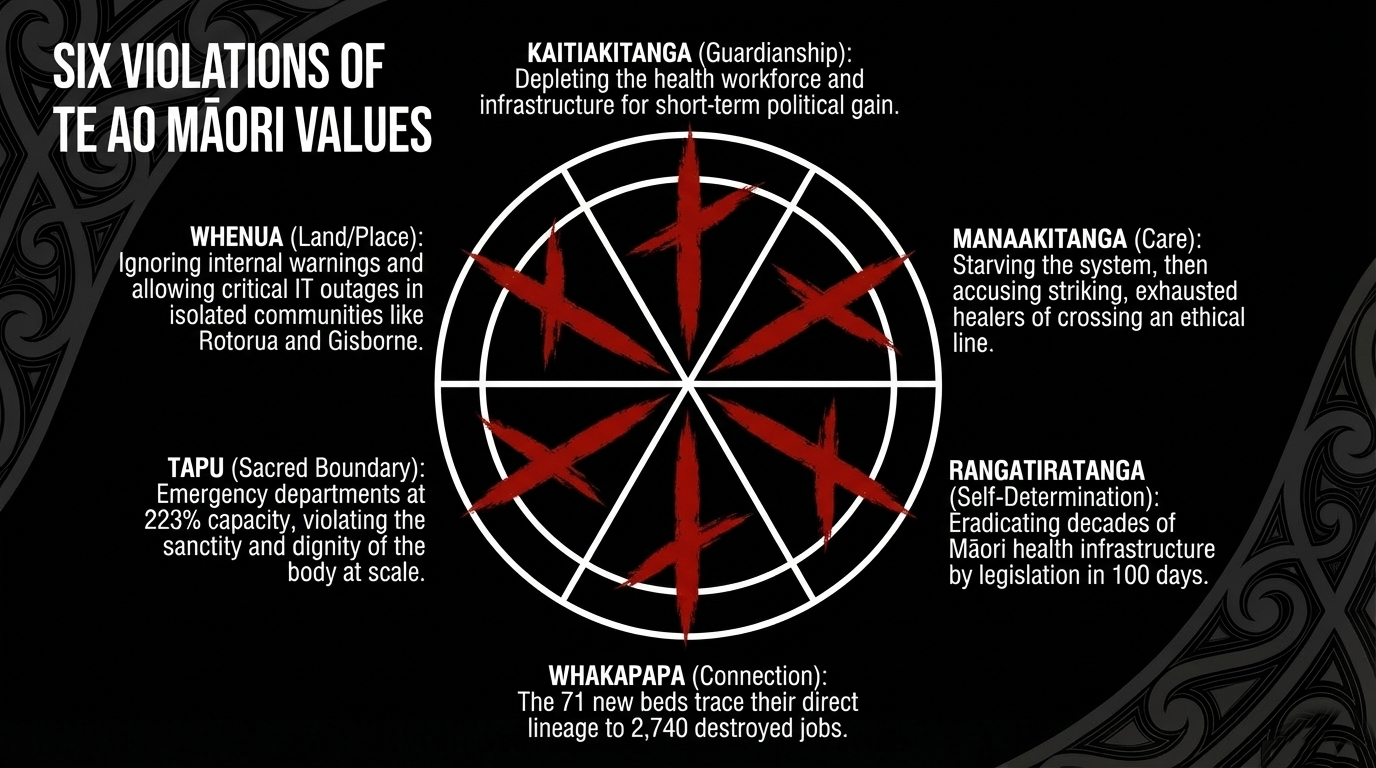
Kaitiakitanga — Guardianship. The Crown holds the health system in trust for all people of this land. Kaitiakitanga requires that the resources are not depleted for short-term political gain, that the infrastructure is maintained for future generations. This government has failed kaitiakitanga completely. It has depleted the workforce, degraded the infrastructure, manufactured a financial crisis, and is now asking us to celebrate sticking plasters.
Manaakitanga — Care and Dignity. Brown accused striking doctors and nurses of being unethical. He stood before a room of healers who had kept New Zealand alive through a pandemic and told them they were "crossing an ethical line" by demanding safe staffing. As Dr Elizabeth Fenton of Otago University's bioethics department wrote in October 2025, "the real ethical issue is successive governments' failure to address these conditions and their impact on patient care." Manaakitanga was violated not by the strikers. It was violated by the minister who starved the system and then blamed those trying to hold it together.
Rangatiratanga — Self-Determination. The dismantling of the Māori Health Authority is a direct attack on rangatiratanga over hauora (health). Māori had built, over decades, the institutional architecture for self-determination in health services. This government removed it by legislation in its first 100 days. Today's $25 million announcement — silent on Māori health equity — confirms that rangatiratanga remains unrecognised in this government's health framework.
Whakapapa — Genealogy/Connection. Every political decision has whakapapa. Today's 71 beds trace their lineage to: the Commissioner appointed in 2024, the 30+ restructures that destroyed 2,740 jobs, the pay equity claims that were axed to fund tax cuts for landlords, the Māori Health Authority abolished in a hundred days. To understand the band-aid, you must understand the wound. The whakapapa of today's announcement is not generosity. It is damage control.
Tapu — Sacred Boundary. In te ao Māori, the body is tapu — sacred. The healing of the body is a sacred obligation. There is no greater violation of tapu than the deliberate withdrawal of health resources from vulnerable communities for ideological reasons. When hospital emergency departments run at 223% capacity, when people wait for hours in corridors next to gastro patients, when code reds happen twice a day — the tapu of the body has been violated at scale. $25 million does not restore that tapu. It does not even acknowledge it.
NGOI KŌRERO — THE PRESSURE BEHIND THE PERFORMANCE
There is a reason this announcement happened today. There is always a reason in politics, and it is rarely the stated one.
As the Waatea News analysis in May 2025 noted, the health system has been under mounting public pressure, with multiple strikes, record ED presentations, and growing media scrutiny. The government's own health targets — the metric Brown claims has "improved" emergency department performance — are still being missed comprehensively. Wellington Capital and Coast achieved just 53% of patients seen within six hours against a 95% target. Most hospitals remain well below target.
The $25 million announcement comes on the same day that internal leaked papers show "extreme risk" in Health NZ's own restructuring plan. It comes weeks after IT outages caused by cuts the government was warned about. It comes months after 100,000 workers struck. It comes after the World Socialist Web Site noted that Simeon Brown was installed specifically to lead "the next phase of austerity measures, designed to eviscerate the health system and prepare large chunks of it for privatisation."
The $25 million is political management. It is designed to supply a counter-narrative. "See — we ARE investing in hospitals." It allows Brown to stand at a podium and say "emergency department performance has improved since health targets were reintroduced" — a statement that conveniently ignores that the system is in structural crisis, that Wellington hit 223% capacity last winter, that the targets are being missed badly, and that the modest improvements cited were made by the same health workers Brown called unethical.
TE WHAKAARO WHAKAKAPI — CLOSING: THE HEALER'S OBLIGATION
Whānau, I want to be clear about what I am not saying.
I am not saying 378 new health workers are bad. They are not. Those are 378 people who will show up and try to care for the sick under conditions this government has made worse than they needed to be. Every bed matters when someone needs it. Every nurse matters when a patient is in a corridor.
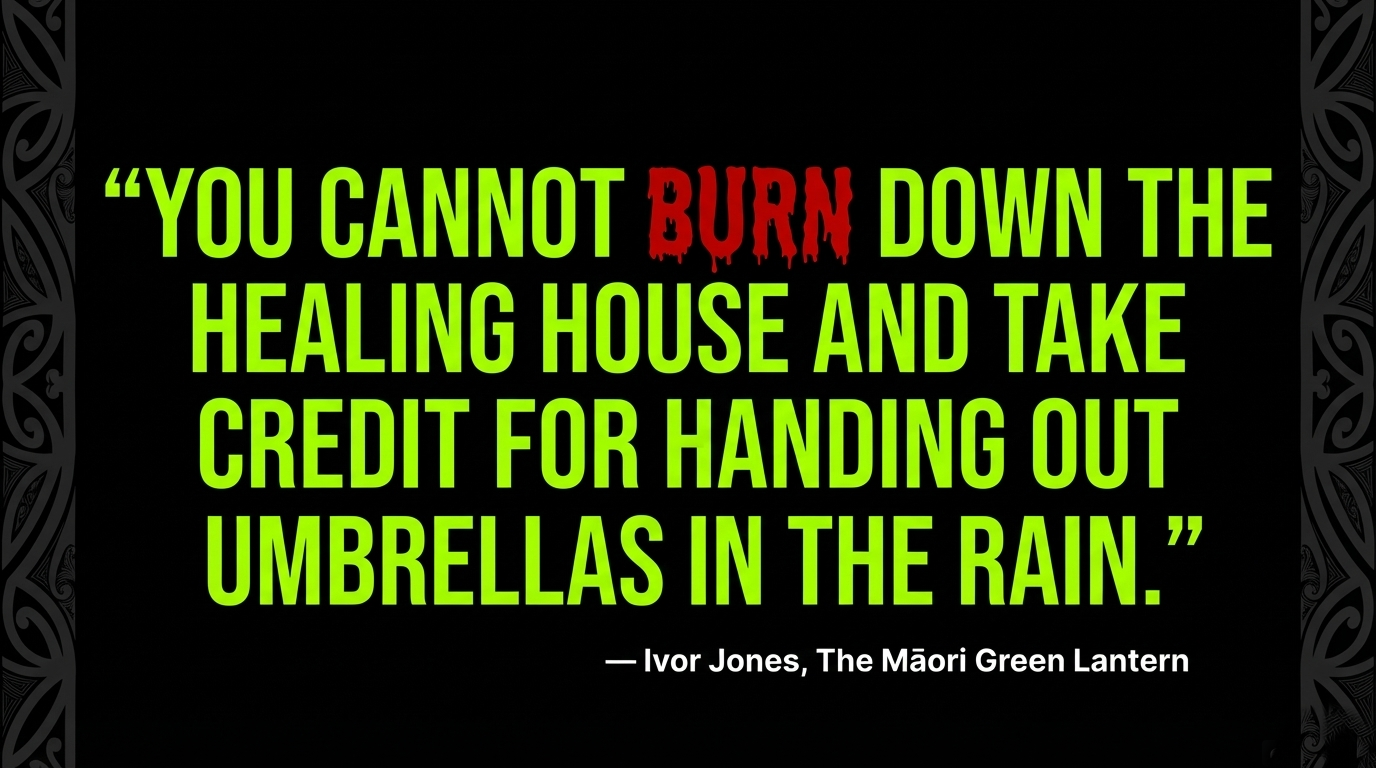
What I am saying is this: you cannot burn down the healing house and take credit for handing out umbrellas in the rain.
As the PSA said in January 2026, 2,740 health roles were axed. As I documented in December 2025, $538 million was left unspent while $162 million was spent on contractors and another $510 million in cuts was demanded. As the leaked papers from today confirm, Health NZ is at extreme risk of not being able to implement its own restructuring — because this government cut the very people needed to do it. As the OECD confirms, New Zealand has 2.5 hospital beds per 1,000 people — 40% below the developed world average.
The Māori Health Authority is gone. The 7-year life expectancy gap remains. The hospitalisation rate for Māori is 74% higher. The emergency departments will overflow again this winter. The code reds will keep sounding. And when they do, Simeon Brown will stand at another podium and tell us that performance has improved since health targets were reintroduced.
This is Te Kore — the void that this government has created at the centre of our health system. Before we reach Te Ao Mārama — the world of light, of restored health — we must pass through Te Pō — the darkness of naming what has been done. Today I name it.
The $25 million is an insult. The 71 beds are a joke. The 378 staff are a fraction of what was taken. And the person announcing it as an achievement is the same person who called the tohunga unethical while driving them from the healing house.
Ka whawhai tonu mātou — we will not stop fighting.
TE KOHA — THE OBLIGATION OF TRUTH-TELLING

Whānau, the health system this government is dismantling is the same system that carries our whānau through illness, birth, and death. When it fails — and it is failing — it is our people who bear the weight first. Māori, Pacific, rural communities, those without resources to go private.
The mahi of The Māori Green Lantern is to ensure that those in power cannot act in the shadows. Every investigation I publish — into the $538 million underspend, into Brown's attacks on doctors, into the abolition of the Māori Health Authority, into the manufactured financial crisis — is an act of kaitiakitanga. I am guarding the record. I am protecting the narrative from those who wish to control it.
This mahi is not funded by corporate sponsors. It is not backed by a media conglomerate. It is funded by people like you — whānau who understand that the accountability our system refuses to provide must be funded by those who believe in it.
Every koha signals that whānau are ready to fund the accountability that Crown and corporate structures will not provide.
It signals that rangatiratanga includes the power to fund our own truth-tellers — the tohunga kōrero who stand in the gap between power and our people.
Kia kaha, whānau. Stay vigilant. Stay connected. And if you are able, consider a koha to ensure this voice continues.
If you are unable to koha, no worries — share this essay with your whānau. Post it where the decision-makers will see it. Tag your local MPs. That is koha in itself.
Three pathways exist:
For those who wish to support this mahi directly with a koha (voluntary contribution), please visit:
Koha — Support The Māori Green Lantern: https://app.koha.kiwi/events/the-maori-green-lantern-fighting-misinformation-and-disinformation-ivor-jones
For those who wish to receive essays directly and support through subscription:
Subscribe to The Māori Green Lantern: https://www.themaorigreenlantern.maori.nz/#/portal/support
For those who prefer direct bank transfer:
HTDM, account number 03-1546-0415173-000
Nō reira, tēnā koutou, tēnā koutou, tēnā koutou katoa.

NGĀ KŪAHA KŌRERO — SOURCES
Primary Source
Health NZ Crisis & Financial Collapse
- Leaked papers show 'extreme risk' around Health NZ decentralisation — RNZ, 17 March 2026
- Documents reveal Health NZ knew IT job cuts would risk patient care and hospital resilience — RNZ, 12 March 2026
- Hospitals asked to save $510 million despite $538 million going unspent — RNZ, December 2025
- National health plan fails to meet Auditor-General's expectations — RNZ, August 2025
- Improved efficiencies needed — Commissioner Lester Levy — RNZ, October 2024
- Commissioner replaces Health NZ Board — Beehive, July 2024
- Health NZ finances worse than thought — Te Ao News, August 2024
Workforce & Job Cuts
- New data shows Government axed thousands of critical health roles — PSA, January 2026
- Ministry of Health proposes slashing top public health experts — PSA, December 2025
- 11,500 essential health workers vote to strike on 23 October — PSA, October 2025
- Budget confirms $12.8 billion theft of wages from women — PSA, May 2025
- Mega strike in New Zealand demands funding for public services — Labor Notes, November 2025
Simeon Brown's Record
- Simeon Brown accuses striking doctors of 'crossing an ethical line' — Centrist NZ, October 2025
- Doctors follow nurses' lead in turning their back on finger-wagging minister — Kaitiaki, October 2025
- Health minister unethical over medical ethics — Otaihanga Second Opinion, October 2025
- New Zealand government installs new far-right health minister — World Socialist Web Site, January 2025
Māori Health Authority Abolition
- New Zealand moves to abolish Maori health authority despite protests — Al Jazeera, February 2024
- Pae Ora (Disestablishment of Māori Health Authority) Amendment Bill — NZ Parliamentary Counsel Office, 2024
- Disestablishment of the Māori Health Authority — Ministry of Health, August 2024
Māori Health Outcomes
- Life Expectancy in Aotearoa New Zealand — Te Whatu Ora Technical Report, November 2024
- Māori life expectancy increases more than other ethnic group — RNZ, August 2025
- Māori have highest increases in life expectancy — Stats NZ
- Hospitalisation and death rates by socio-demographic groups — COVID-19 Royal Commission
- Hospitalisation rates for Māori and deprivation — Journal of Paediatrics and Child Health, 2022
- Māori health data and statistics — Ministry of Health NZ
- Hauora Māori Health Strategy submission — ASMS, October 2024
Hospital Capacity & OECD Comparisons
- OECD Health at a Glance 2025 — New Zealand Country Note
- Hospital beds and occupancy: OECD Health at a Glance 2025
- Overcapacity emergency departments flooded by record patients — RNZ, September 2025
- Wellington Hospital ED went into code red nearly twice a day in 2025 — NZ Herald, January 2026
- How Well is the NZ Healthcare System Doing? An International Comparison — Easton BH, March 2025
- State of NZ's Health System in 2025 — Waatea News, May 2025
Previous MGL Investigations (Must Read)
- "The Manufactured Crisis: How Health NZ Underspent $538 Million While Demanding Another $510 Million in Cuts" — The Māori Green Lantern, December 2025
- "When a Health Minister Accuses Healers of Being Unethical" — The Māori Green Lantern, October 2025
- "The Great Health Heist" — The Māori Green Lantern, September 2025
- "Government Incompetence Exposed: How Simeon Brown's Health Appointment Reveals a System Built to Fail Māori" — The Māori Green Lantern, September 2025
- "Brown's Authoritarian Gambit to Crush Medical Unions" — The Māori Green Lantern, September 2025
- "$12.8 BILLION STOLEN: How the Coalition Gutted Pay Equity, Destroyed Māori Health Services" — The Māori Green Lantern, November 2025
- "Health NZ Apologises to the Nurses' Union" — The Māori Green Lantern, September 2025
- "Coalition of Cruelty: When Neoliberal Vultures Feast on the Vulnerable" — The Māori Green Lantern, September 2025