"The Green Ring Burns: How Dana Kirkpatrick's Log Ship Celebration Buries the Truth About Tairāwhiti" - 8 April 2026
Two log ships. A National Party MP clapping. A community trust calling it a "milestone." And not one word about who actually pays for those logs leaving — and who gets left behind.

Mōrena Aotearoa,
Let us be precise. Let us name names. And let us follow the money.
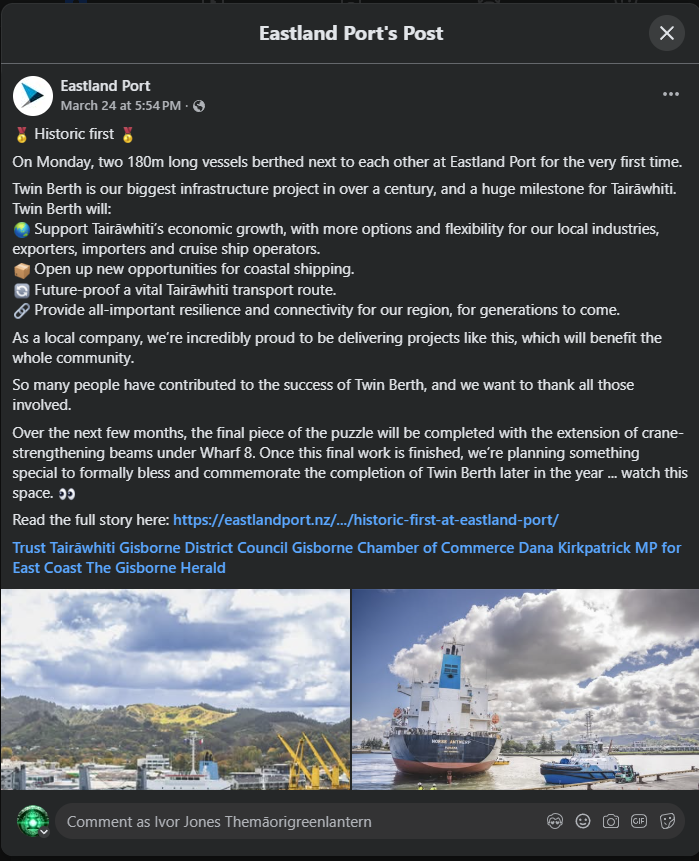
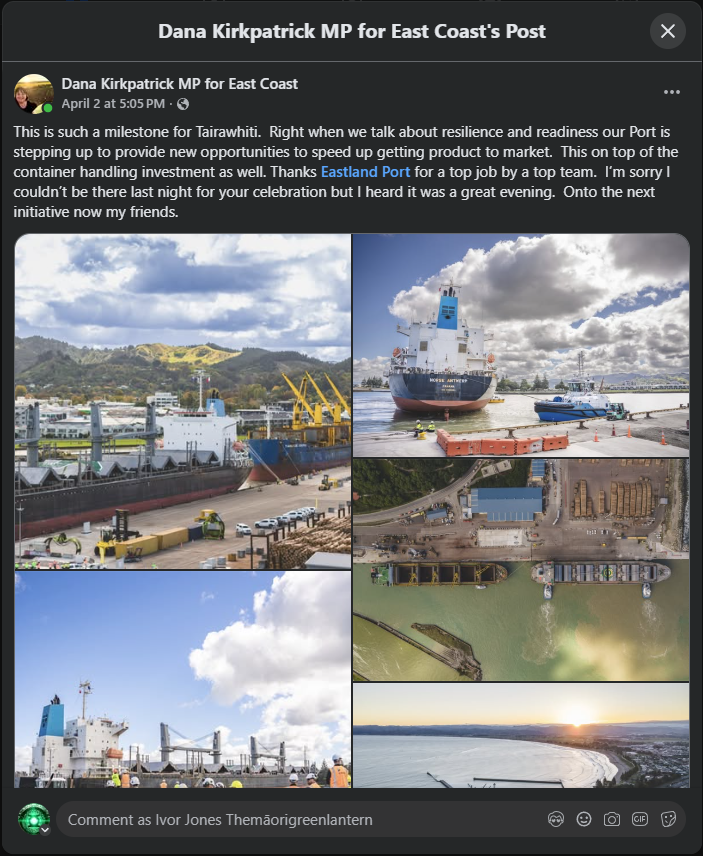
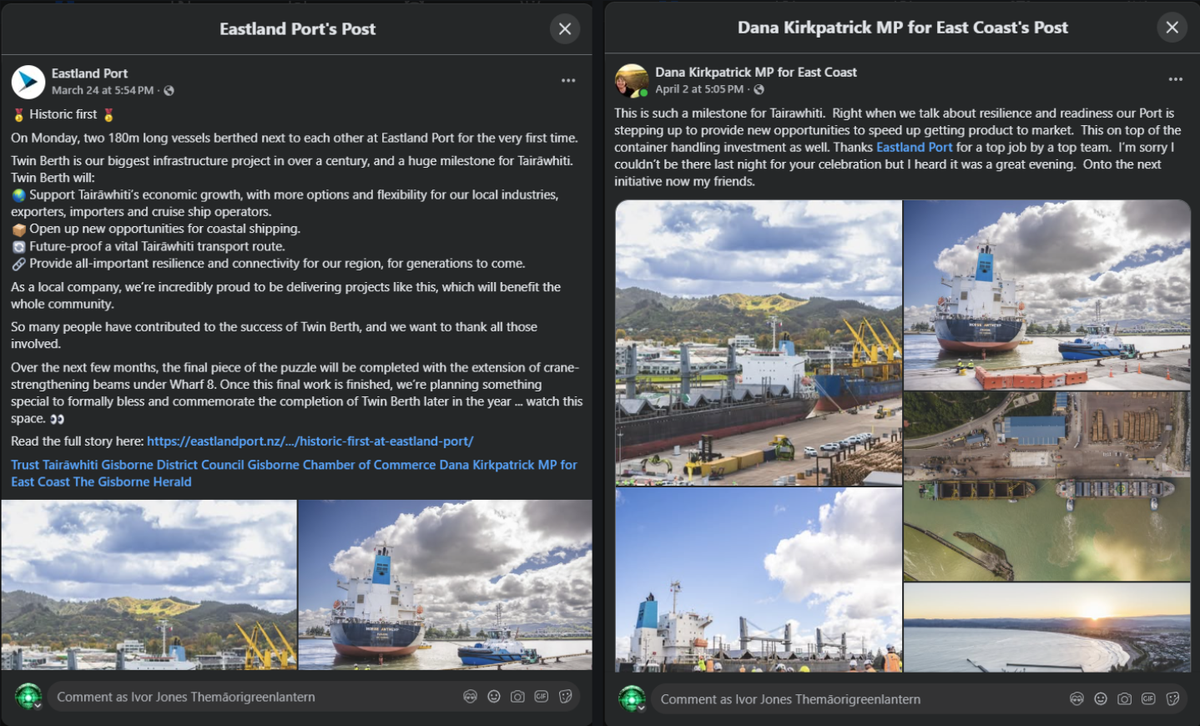
https://www.facebook.com/story.php?story_fbid=902139252864895&id=100092064865065&rdid=TdCZq6J8GjMrwrc8# ; https://www.facebook.com/story.php?story_fbid=1387052810128959&id=100064727587600&rdid=MUWuWy325Yg47J5f#
The Scene: Tūranganui-a-Kiwa, 24 March 2026
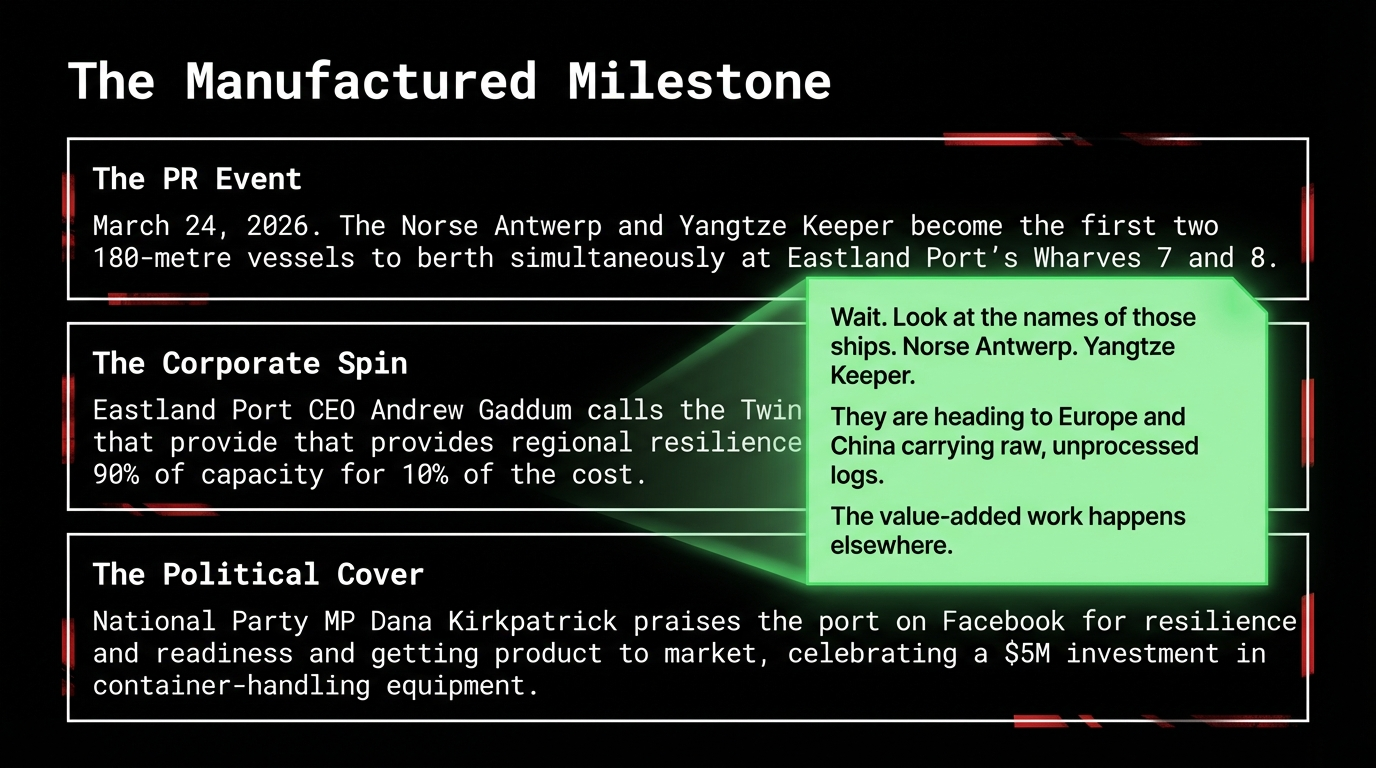
On Monday, 24 March 2026, two 180-metre vessels — Norse Antwerp and Yangtze Keeper — berthed simultaneously at Eastland Port's Wharves 7 and 8 for the first time in the port's history, as reported by NZ Herald Gisborne. Eastland Port called it a "historic first" — their biggest infrastructure project in over a century. National Party MP for East Coast Dana Kirkpatrick immediately jumped on Facebook to praise the port, writing about "resilience and readiness" and "getting product to market." She thanked Eastland Port "for a top job by a top team."
What she did not mention: the names of those ships tell you everything. Norse Antwerp. Yangtze Keeper. Those logs are headed to China and Europe. Raw. Unprocessed. The value-added work — the milling, the manufacturing, the employment — happens elsewhere.

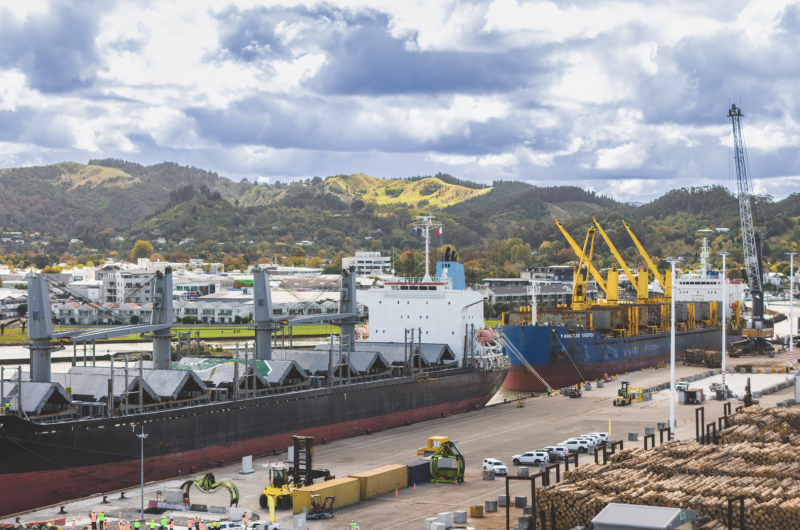
That is not resilience. That is extraction. That is the colonial economy in its 21st-century costume — and Dana Kirkpatrick is its cheerleader.
Hidden Connection #1: The Port Is Almost Entirely a Log Export Machine
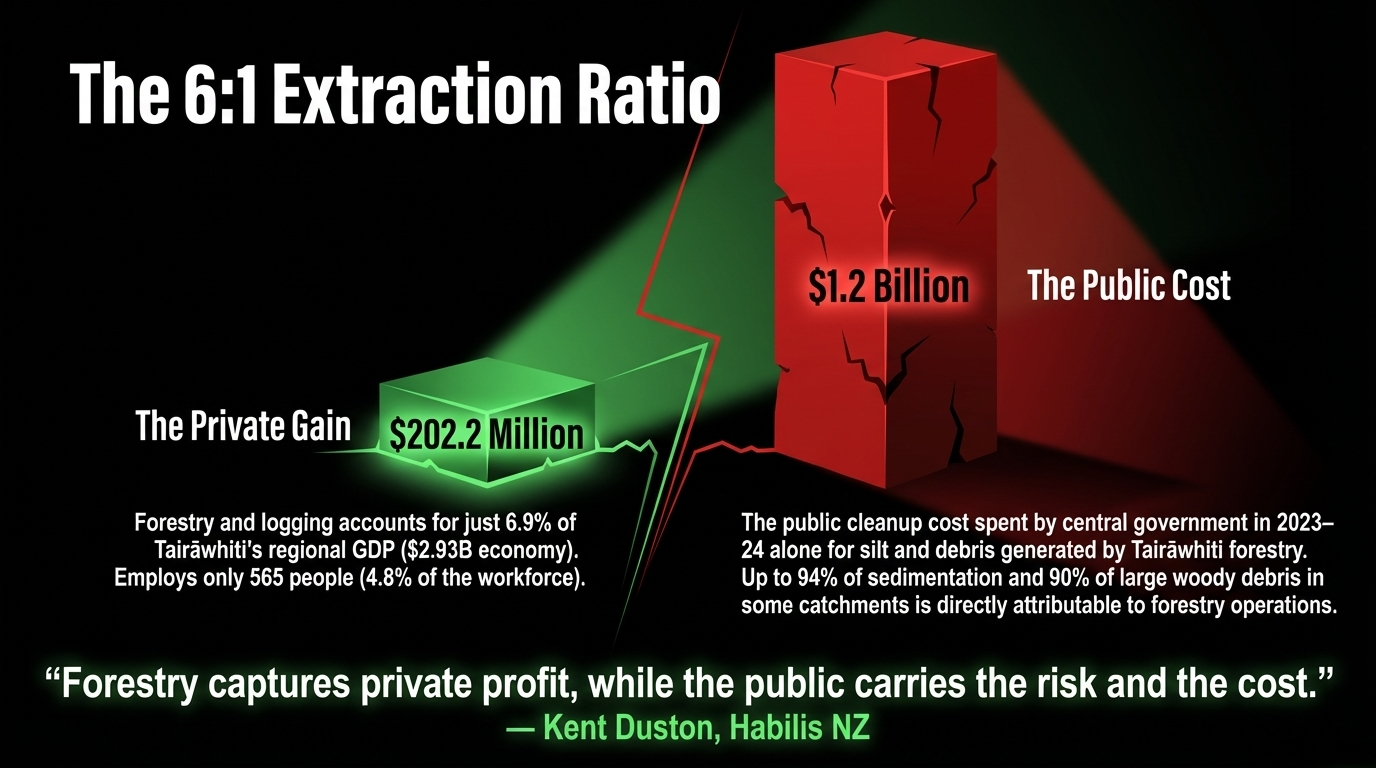
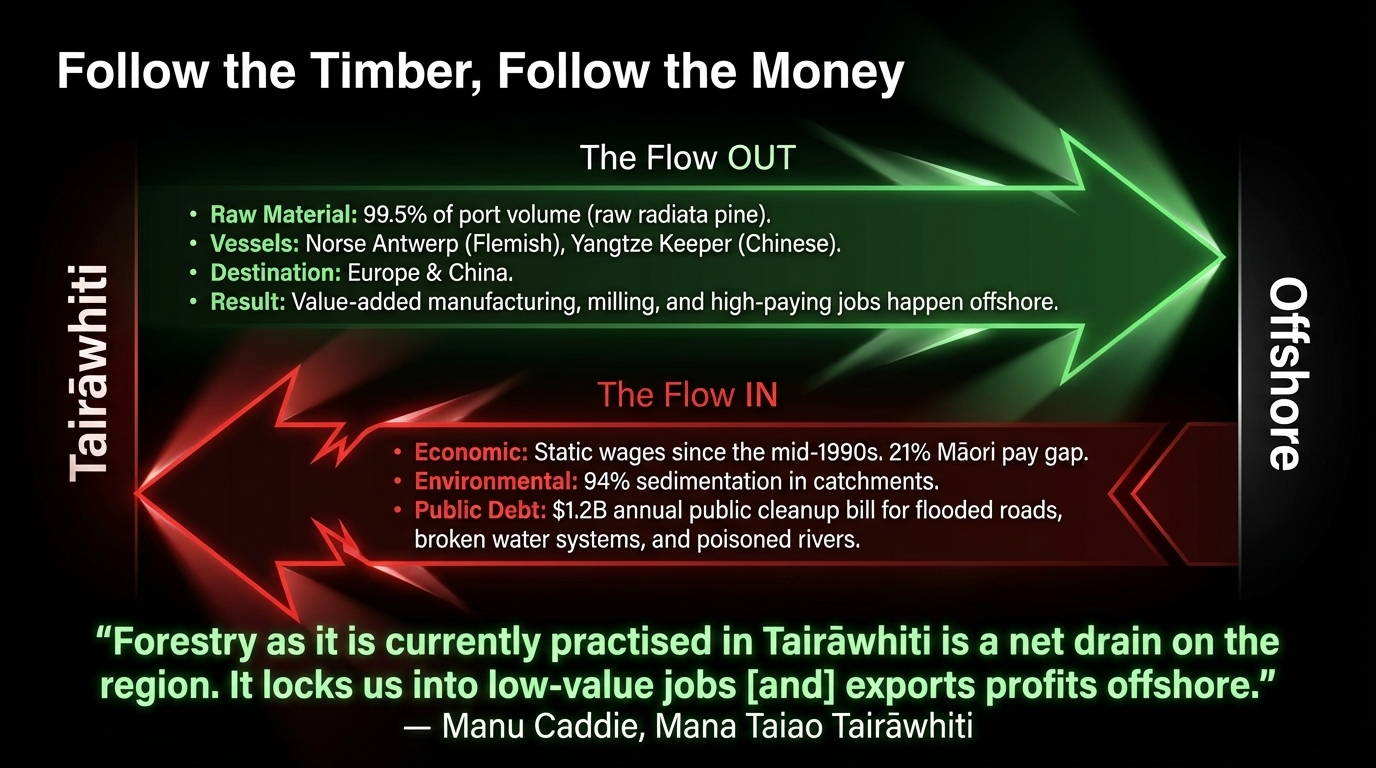
Eastland Port is not a general trade port serving Tairāwhiti's diverse economy. It is, overwhelmingly, a raw log export terminal. By 2018/19, as documented by Te Ara — The Encyclopedia of New Zealand, Eastland Port was shipping nearly 3 million tonnes of exports — eight times the volume of 2005 — with 99.5% of that export volume being forestry products. In October 2025 alone, approximately 265,000 tonnes of timber left on 11 ships, according to NZ Herald Gisborne's port digest.
The Twin Berth project documentation is explicit about this: it was designed to "accommodate the forecast increase in the region's forestry exports."
This is not economic diversification. This is doubling down on raw commodity extraction. This is the neoliberal playbook in its purest, most naked form: build the infrastructure of extraction, call it development, and move on before the hillsides collapse.
Hidden Connection #2: The Industry Costs More Than It Contributes — By a Factor of Six
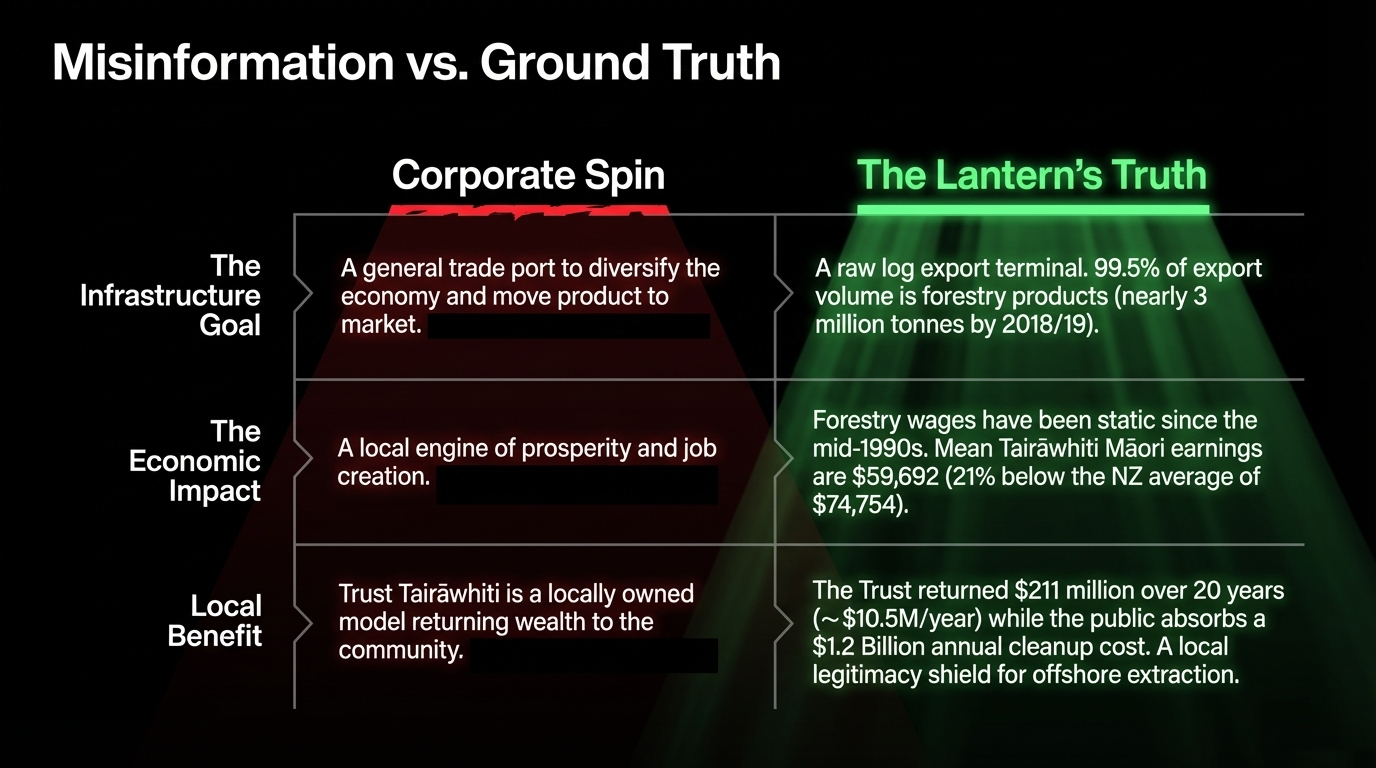
Here is the number Dana Kirkpatrick will never put in a Facebook post.
A damning independent report published in January 2026, covered by Mana Taiao Tairāwhiti, found that forestry and logging in Tairāwhiti accounts for just 6.9% of regional GDP — $202.2 million out of a $2.93 billion economy — and employs only 565 people, or 4.8% of the workforce. Meanwhile:
- Up to 94% of sedimentation and 90% of large woody debris in some catchments is attributable to forestry operations
- $1.2 billion was spent by central government in 2023–24 alone cleaning up silt and debris generated by Tairāwhiti forestry
- Forestry wages have remained largely static since the mid-1990s, while returns to shareholders have increased significantly
As Habilis NZ Director Kent Duston stated: "Forestry captures private profit, while the public carries the risk and the cost. When up to 90% of large woody debris and more than 80% of sediment in some catchments can be traced back to forestry operations, it's no longer credible to call these impacts 'external' or unavoidable."
Mana Taiao Tairāwhiti spokesperson Manu Caddie named it plainly: "Forestry as it is currently practised in Tairāwhiti is a net drain on the region. It locks us into low-value jobs, exports profits offshore, and leaves our whānau to pay for flooded roads, broken water systems, and poisoned rivers."
So when Dana Kirkpatrick praises the port for "speeding product to market," she is celebrating an industry that extracts $202 million in GDP value while generating over $1.2 billion in public cleanup costs — a 6:1 loss ratio for the communities of Tairāwhiti. She is not championing resilience. She is cheerleading for a machine that is actively destroying the whenua her constituents depend on — and billing the public for the damage.
That is not governance. That is a protection racket for corporate forestry.
Hidden Connection #3: The Whakapapa of Dispossession That Built This Port
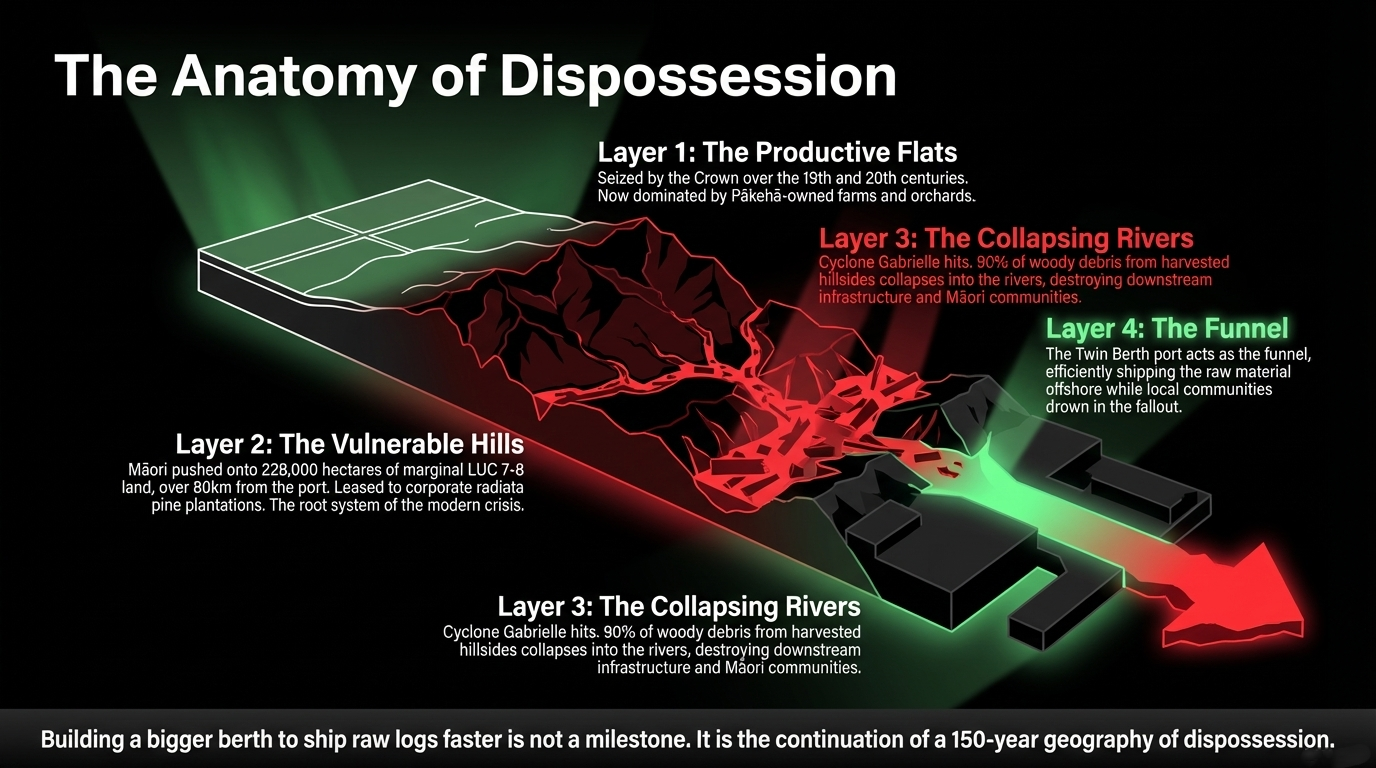
The "resilience" narrative erases history deliberately. Let us restore it.
As documented by Te Ara Encyclopedia of New Zealand, the East Coast region carries the highest percentage of Māori of any region in Aotearoa — 48.9% of the population, compared to 14.9% nationally. In East Cape, the heartland of Ngāti Porou, over 85% of residents are Māori.
Yet, as the GDC's submission to the Ministerial Forestry Inquiry acknowledges: "iwi, hapū, and whanau have lost most of their best lands that have the most productive soils. There is 228,000 ha of whenua Māori in Tairāwhiti, and it is predominantly LUC 7 to 8 [the least productive classification], and situated more than 80 km from the Gisborne Port."
The most productive Poverty Bay flats — seized through Crown purchasing and legal manipulation over the 19th and 20th centuries — are now in Pākehā-owned farms and orchards. Māori were left with the steep, erosion-prone hill country. Then corporate forestry moved in and planted it in radiata pine. When those pines were harvested, the hillsides collapsed into the rivers during Cyclone Gabrielle.
The very geography of dispossession is what filled those rivers with slash. The Crown stole the flat land and left Māori with the hillsides. Corporations planted those hillsides with trees. The trees destroyed those hillsides when harvested. The government now builds a bigger port wharf to ship more trees from more hillsides. And a National Party MP calls this a "milestone."
The word for that is not resilience. The word for that is continuation.
Hidden Connection #4: Kirkpatrick Celebrates "Resilience" While Her White Supremacist Neoliberal Government Delivers Crumbs
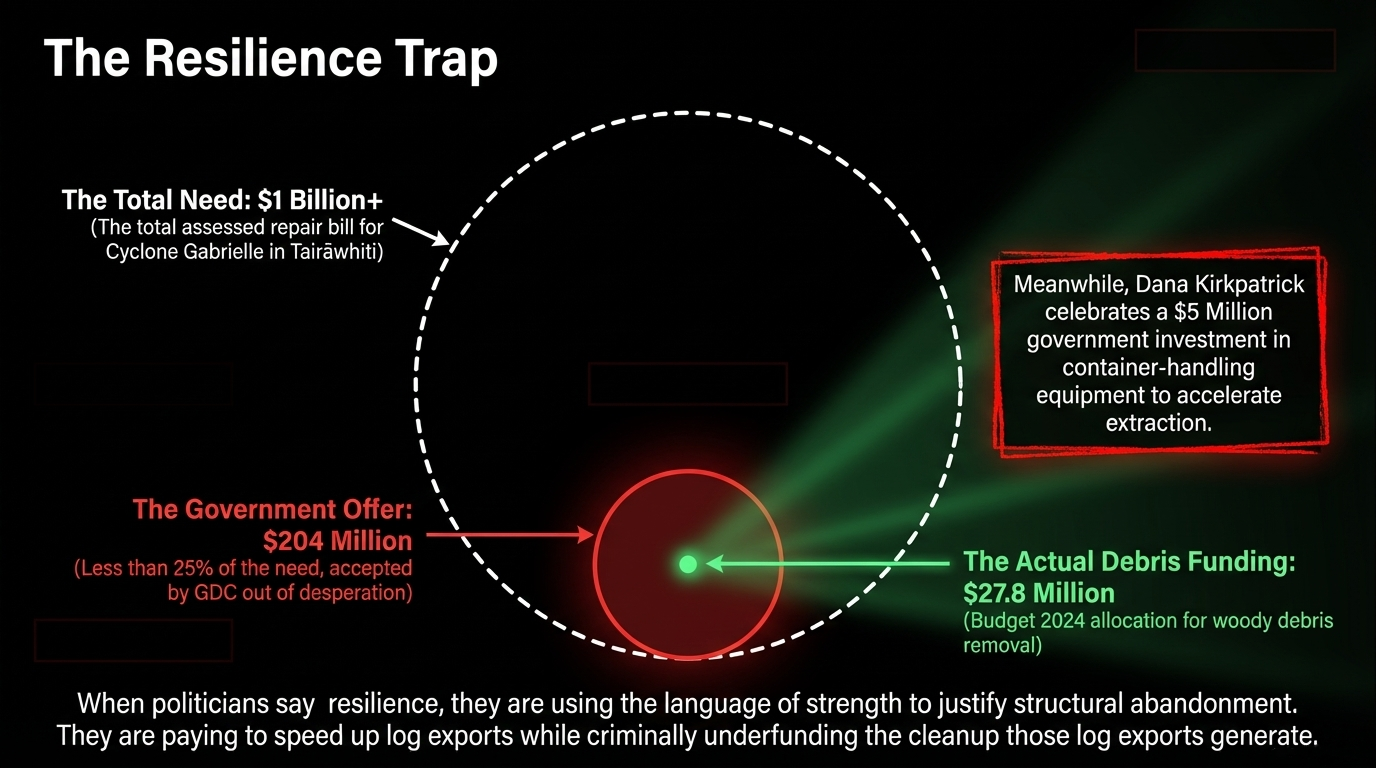
Dana Kirkpatrick used the word "resilience" twice in her Facebook post. Let us examine what her National-led government has actually delivered.
Cyclone Gabrielle struck Tairāwhiti in February 2023. The total repair bill exceeded $1 billion, as confirmed by NZ Herald Gisborne's reporting on the $204 million recovery package. The government's offer to Gisborne District Council was $204 million — less than a quarter of the assessed need, a figure the GDC itself confirmed when accepting it.
National's Budget 2024, which the National Party itself framed as "more than $1 billion for Cyclone relief", allocated $27.8 million for woody debris removal in Tairāwhiti — against a $1.2 billion annual public cleanup cost from forestry-related damage, as established by Habilis NZ's independent report. That is not resilience funding. That is a rounding error dressed up as a press release, designed by a government that has mastered the art of performing concern for Māori communities while structurally abandoning them.
The government's $5 million investment in container-handling equipment, which Kirkpatrick also celebrated, is infrastructure designed to accelerate the very industry causing the damage. Her government is paying to speed up log exports while criminally underfunding the cleanup those log exports generate.
This is not incompetence. This is ideology. This is a government that serves capital over community, shareholders over whānau, extraction over regeneration. It is neoliberalism operating precisely as designed — privatising profit, socialising destruction, and calling it progress.
Hidden Connection #5: The Wage and Earnings Gap Kirkpatrick Never Mentions
In 2023, as revealed in the Trust Tairāwhiti Economic Plan 2024, mean annual earnings in Tairāwhiti were:
- $59,692 for Māori
- $64,588 for non-Māori
- Against a New Zealand average of $74,754
Tairāwhiti's Māori workers earn 21% less than the national average. The Trust Tairāwhiti Economic Plan acknowledges this gap directly. The forestry sector, which dominates the port and shapes the regional economy, has kept wages static since the mid-1990s despite increasing shareholder returns, as confirmed by the Habilis NZ forestry report.
Eastland Port is owned by Trust Tairāwhiti, as noted on Eastland Port's about page, which has returned $211 million in community grants over 20 years, referenced in Gisborne Airport's Eastland Group update. That sounds good — until you do the arithmetic. $211 million over 20 years is approximately $10.5 million per year flowing back to the community — against $1.2 billion per year in public cleanup costs from the industry that community trust enables.
The "locally owned" framing is doing ideological overtime. The money flows back in drips while the resource wealth — the timber, the land productivity, the export revenue — flows out in torrents aboard ships named after Flemish cities and Chinese rivers. This is the community trust model as a legitimacy shield for corporate extraction. And Dana Kirkpatrick photographs herself next to it and calls it a milestone.
The Fallacy Named: "Resilience" as Manufactured Consent
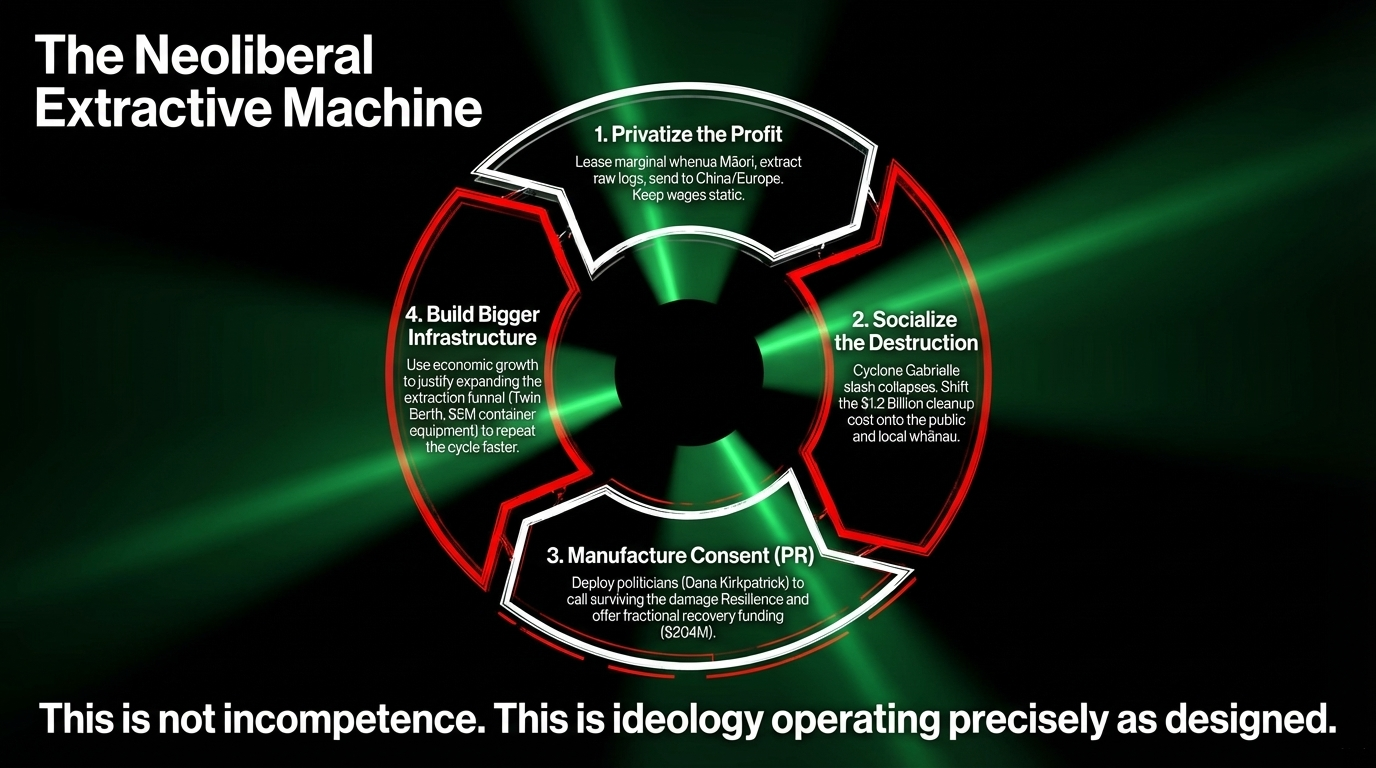
The word "resilience" has become the most dangerous piece of political vocabulary in Aotearoa. It is used to frame communities as self-sufficient enough to need less Crown support, hardy enough to absorb ongoing extractive harm, and grateful enough for infrastructure that accelerates the industry destroying them.
When Kirkpatrick invokes resilience, she is not describing a community's genuine self-determination. She is using the language of strength to justify the withdrawal of support. "They're resilient — they don't need more cyclone funding." "They're resilient — a new berth will sustain them." It is the colonial paternalism of low expectations dressed in empowerment language, deployed by a party whose economic programme concentrates wealth at the top and whose Treaty settlements move at the speed of glaciers.
The Twin Berth project documentation states the project will help sustain "upwards of 40% of Tairāwhiti's economic activity." What it doesn't say: if 40% of your regional economy depends on a single industry with a 6:1 public cost-to-GDP ratio, you are not building resilience. You are building dependency. You are making yourself hostage to an industry that already owns your hills, poisons your rivers, and sends the profits abroad.
That is not a milestone. That is a trap.
Dana Kirkpatrick: A Profile of Weaponised Irrelevance
Dana Kirkpatrick entered Parliament in October 2023 as a "Gisborne executive and communications professional," as noted by NZ Herald. And that communications background is visible in every word she writes. Her Facebook post is technically accurate in its details and structurally dishonest in every framing. It is the work of someone trained not to inform, but to manage.
She praises the port for helping get "product to market" — but does not say whose product, who owns the forests, where the value-added processing occurs, or who cleans up when the hillsides collapse.
She invokes "resilience and readiness" — but does not mention that her government offered Tairāwhiti less than 20% of its cyclone recovery costs, that forestry slash is directly responsible for the catastrophic damage of Gabrielle, or that wages in the dominant export sector have been static for thirty years.
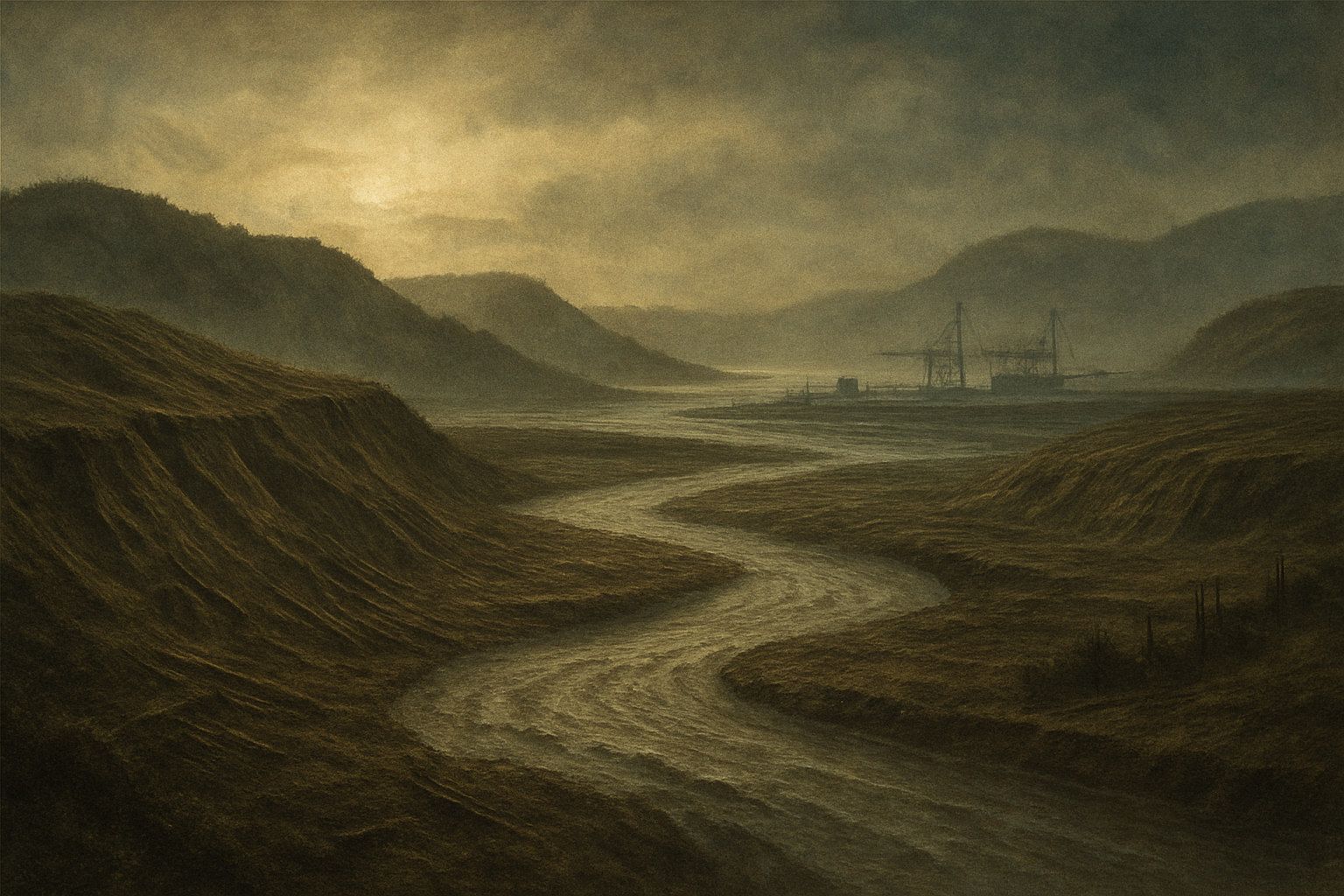
She says she was "sorry she couldn't be there" — a fitting metaphor for her entire tenure. She is sorry she couldn't be there for the photo opportunity. She was not there — is never there — for the whānau whose houses flooded, whose roads collapsed, whose rivers run brown with silt that the industry she celebrates put there.
This government does not represent Tairāwhiti. It manages Tairāwhiti on behalf of the interests that fund the National Party. And Dana Kirkpatrick is the local franchise.
Rangatiratanga Means Naming the Machine, Then Dismantling It
The Twin Berth is a feat of engineering. No one denies that. But infrastructure in service of extraction is not development — it is the modernisation of dispossession.
Building a bigger berth to ship raw logs faster is not a milestone for Tairāwhiti. It is a milestone for the shareholders of companies whose names do not appear in Kirkpatrick's post.
Those two ships, Norse Antwerp and Yangtze Keeper, left Tūranganui-a-Kiwa carrying raw logs from hill country carved out of whenua Māori over 150 years of Crown land policy. The hills those logs came from are now eroding into the rivers. The roads those trucks used are still being rebuilt after Gabrielle at community expense. The whānau who live downstream are still dealing with flood damage while the government writes cheques for 20 cents on the dollar. And a National Party communications professional is on Facebook congratulating a port for building a bigger wharf to do it faster.
This is the white supremacist neoliberal project in action: take the land, plant the land, harvest the land, export the land, send the bill to the people you took it from, and call their ability to survive the cost a sign of their resilience.
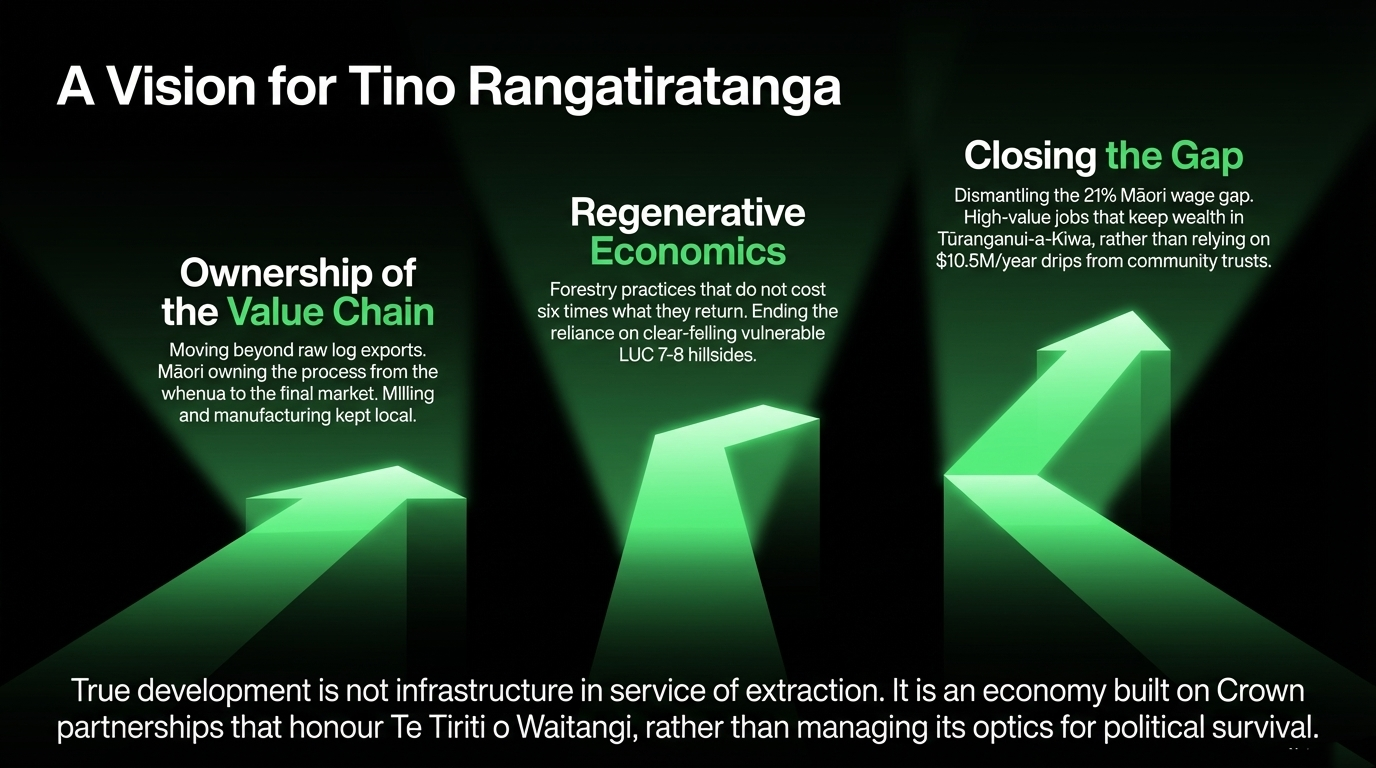
Tairāwhiti deserves immeasurably better than this. It deserves an economy built on tino rangatiratanga — on Māori owning the full value chain from whenua to market, on forestry that does not cost six times what it returns, on wages that close the gap, on Crown partnerships that honour Te Tiriti o Waitangi rather than manage its optics for political survival.
The Ring keeps burning. It will not stop.
Nō reira, tūturu whakamaua kia tīna, tīna — hui e, tāiki e.
Koha Consideration
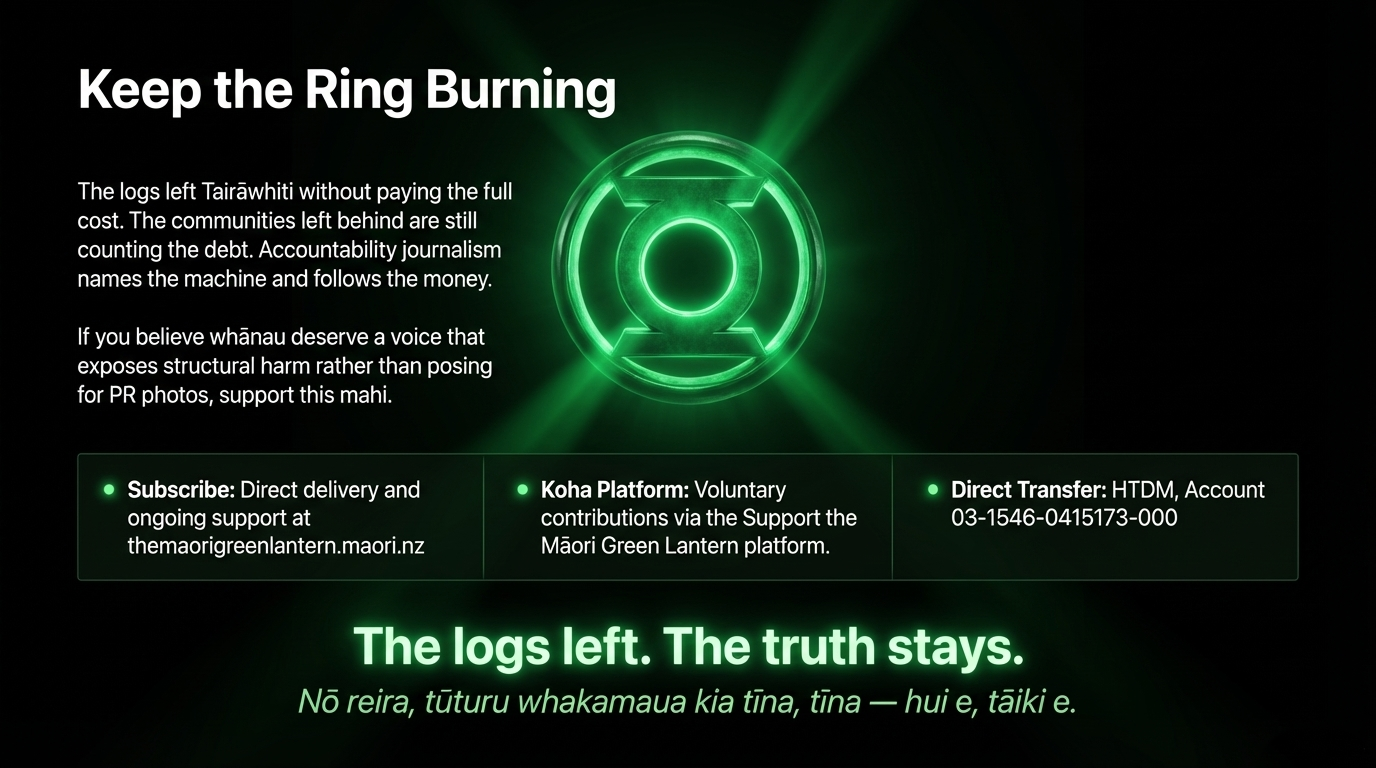
The logs on those ships left Tairāwhiti without paying the full cost. The communities left behind are still counting the debt. This essay — naming the industry, the politician, and the structural harm — is the kind of accountability journalism that corporate media will not fund and government will not commission.
If you believe whānau in Tairāwhiti deserve a voice that names the machine and follows the money — not a voice that photographs itself next to a bigger berth and calls it progress — then this mahi matters. Every koha signals that rangatiratanga includes the power to fund our own truth-tellers. It signals that we will not wait for permission to expose what is being done to us.
Kia kaha, whānau. Stay vigilant. Stay connected.
And if you are able:
Three pathways to support this mahi:
For a direct voluntary koha, visit the Koha Platform — Support the Māori Green Lantern.
For essays delivered directly to you and ongoing support through subscription, subscribe to the Māori Green Lantern.
For direct bank transfer: HTDM, account 03-1546-0415173-000.
If you cannot koha right now — no worries at all. Follow, read, and share at themaorigreenlantern.maori.nz. Share this essay with your whānau and friends. Kōrero about what it means. That, too, is koha. That, too, is rangatiratanga.
The logs left. The truth stays.

Research Transparency: Sources consulted include Te Ara — The Encyclopedia of New Zealand, Habilis NZ independent forestry report via Mana Taiao Tairāwhiti, January 2026, Trust Tairāwhiti Economic Plan 2024, GDC Forestry Inquiry submission, Eastland Port Twin Berth project page, Eastland Group update via Gisborne Airport, NZ Herald Gisborne cyclone recovery reporting, GDC $204 million offer acceptance, National Party Cyclone funding release, and Eastland Port container shipping announcement. Research conducted April 2026.