"THE HOLLOW MARAE: How Te Pāti Māori's Leadership Built a Palace of Silence on the Bones of Its Own People" - 20 March 2026
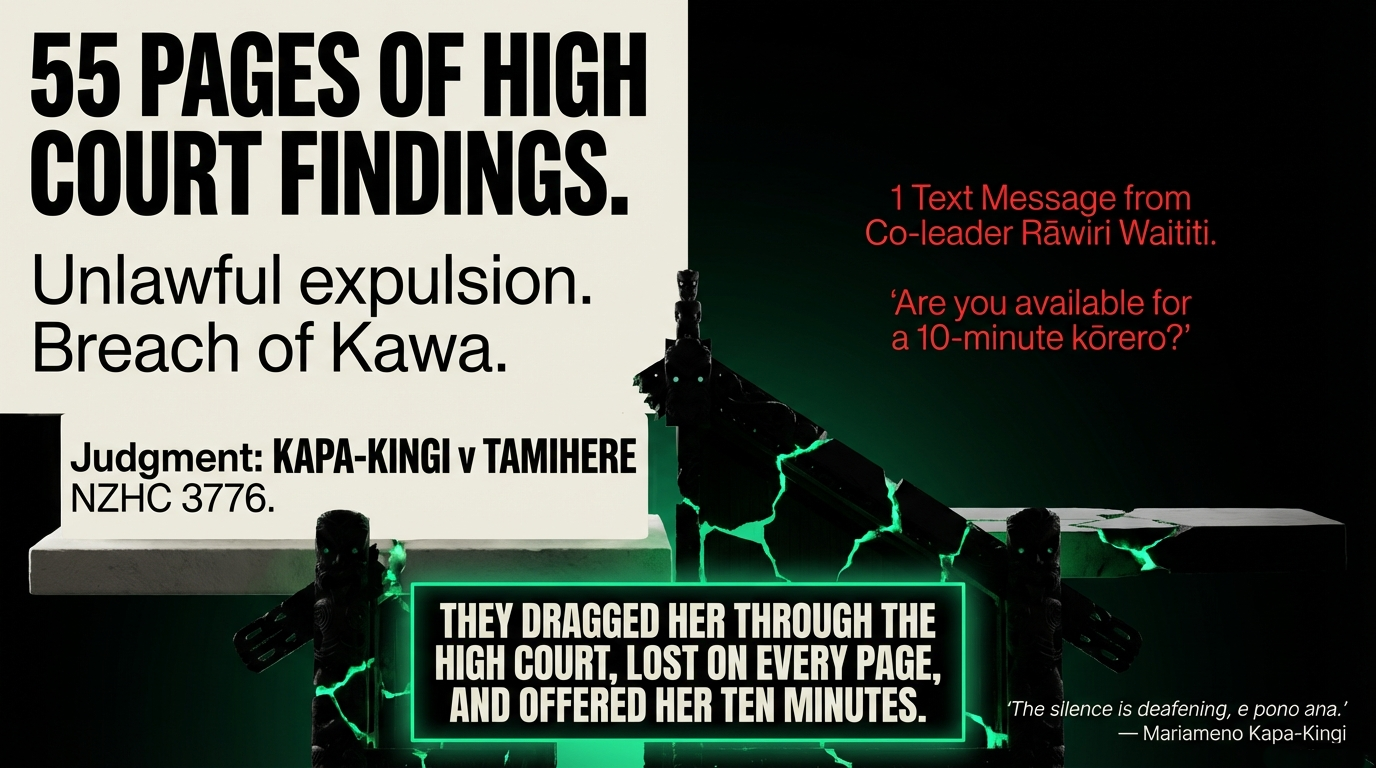
"They dragged her through the High Court, lost on every page, and offered her ten minutes. Fifty-five pages of court findings. One text message. This is not leadership. This is whakamā dressed up as mana — and every Māori voter can smell the difference."

This essay was written in anger — but anger in service of aroha. It was written in sorrow — but sorrow in service of accountability. It was written for Mariameno Kapa-Kingi, for the people of Te Tai Tokerau who sent her to Parliament, and for the 160,000 enrolled Māori voters who need Te Pāti Māori functioning at full force while Christopher Luxon's white supremacist neoliberal government systematically dismantles every Treaty protection, every health programme, every housing pathway, and every shred of Māori economic dignity it can reach.
When the only parliamentary voice built to represent us turns inward and begins to consume itself — when it uses the language of tikanga to avoid tikanga, the language of mana to protect those who have lost it — the Māori Green Lantern has no choice but to name it, document it, and demand better. Not because we hate Te Pāti Māori. Because we love what it was built to be.
The Story in Brief
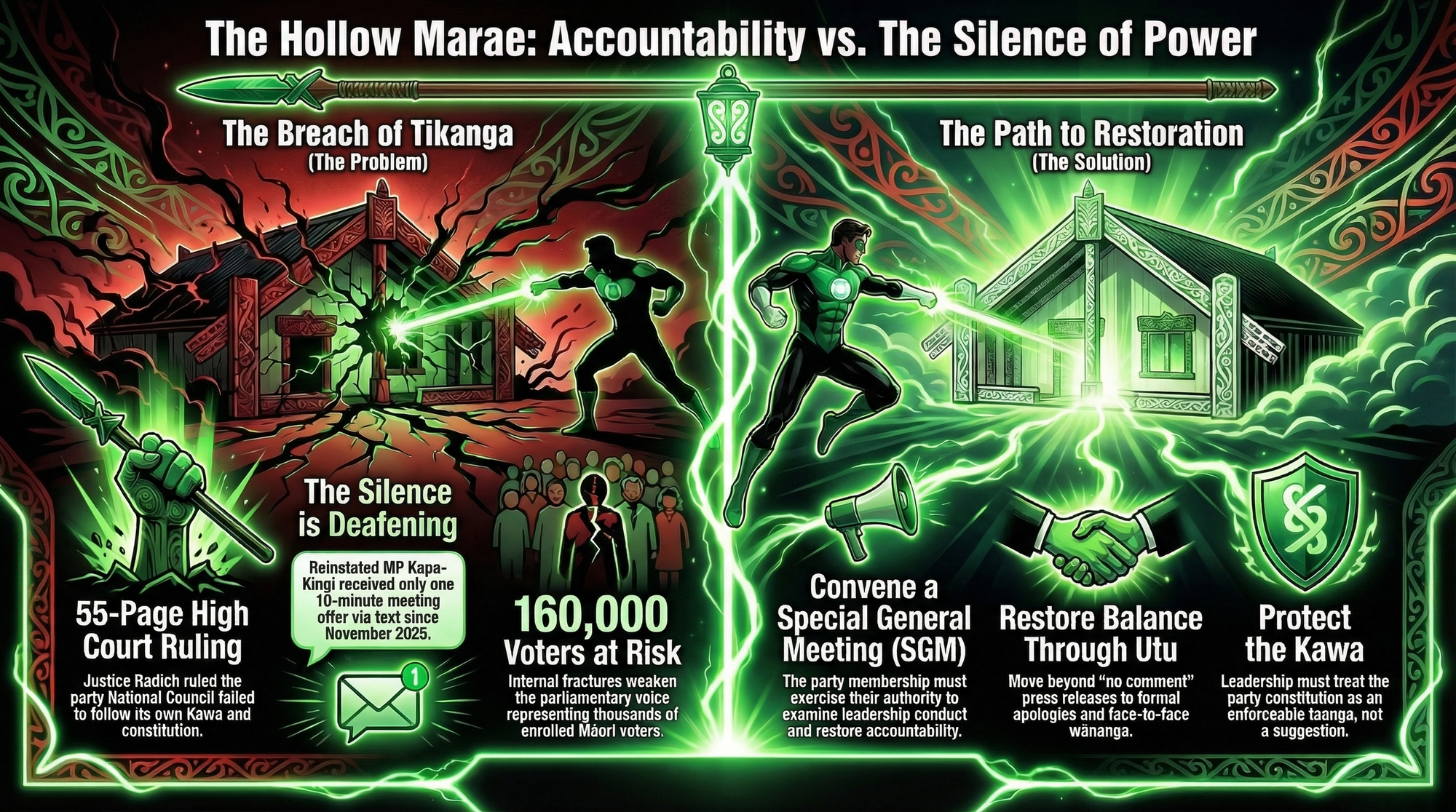
In October 2025, Te Pāti Māori's National Council voted to suspend and then expel its own elected MP for Te Tai Tokerau, Mariameno Kapa-Kingi, without following the party's own Kawa — a process the High Court of New Zealand found unlawful in a 55-page judgment in December 2025, confirmed by reinstatement in March 2026. The party's president, John Tamihere — who publicly accused Kapa-Kingi and Te Tai Tonga MP Tākuta Ferris of staging a "rogue" leadership coup — has not spoken to her since November 2025. Co-leader Rāwiri Waititi's response to the court ruling that vindicated her was a single text message asking if she was available for a "10-minute kōrero." No apology. No wānanga. No acknowledgment of harm.
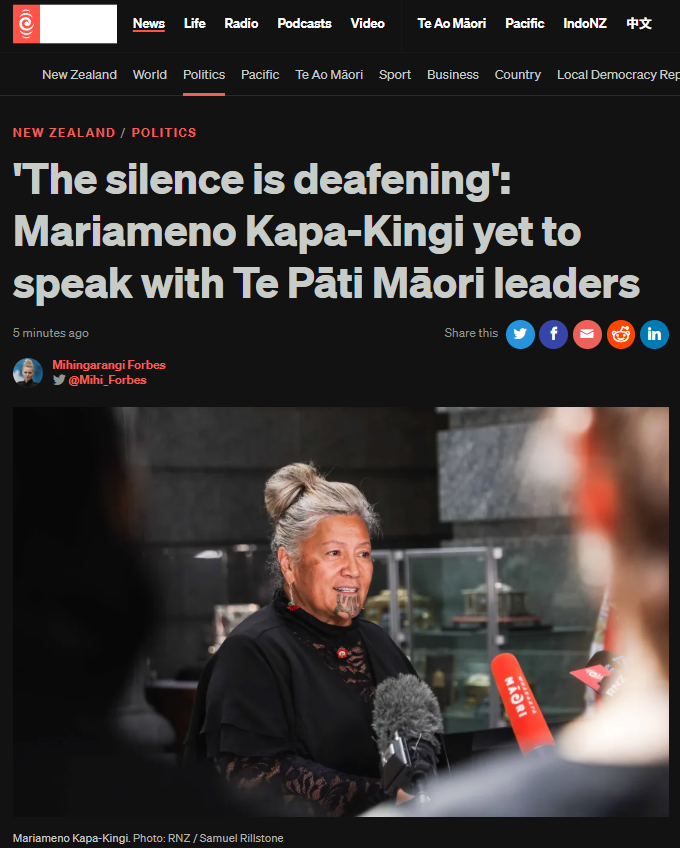
As Kapa-Kingi herself told RNZ's Mata host Mihingarangi Forbes:
"The silence is deafening, e pono ana."
This essay names what that silence is, who it protects, who it harms, and what genuine tikanga leadership demands in response.
The Hidden Architecture: Cui Bono, Cui Malo
The silence that now hangs over Te Pāti Māori's leadership like a rotten beam above a once-sacred marae is not an accident. It is architecture — deliberate, calculated, and deeply colonial in its construction.
The question every whānau must ask — the question mātauranga demands before any other — is: who benefits from this silence?
Not Mariameno Kapa-Kingi. Not the people of Te Tai Tokerau who sent her to Parliament. Not the 160,000 enrolled Māori voters who need this party functioning at full force as Christopher Luxon's white supremacist neoliberal government dismantles Treaty rights, drives whānau into doorways, slashes Māori health budgets, and appoints racism as official policy.
The beneficiaries of this collapse are in the Beehive: Mark Mitchell, David Seymour, Winston Peters, and Christopher Luxon. Every day Te Pāti Māori spends in legal courts rather than the court of public accountability, every day its leadership responds with press releases instead of the living, breathing accountability of a proper marae process, is a gift to the very government elected to destroy us.
The Waka That Drilled Its Own Hull: Background
Let me be forensic about what happened here, because the facts are more damning than any metaphor.
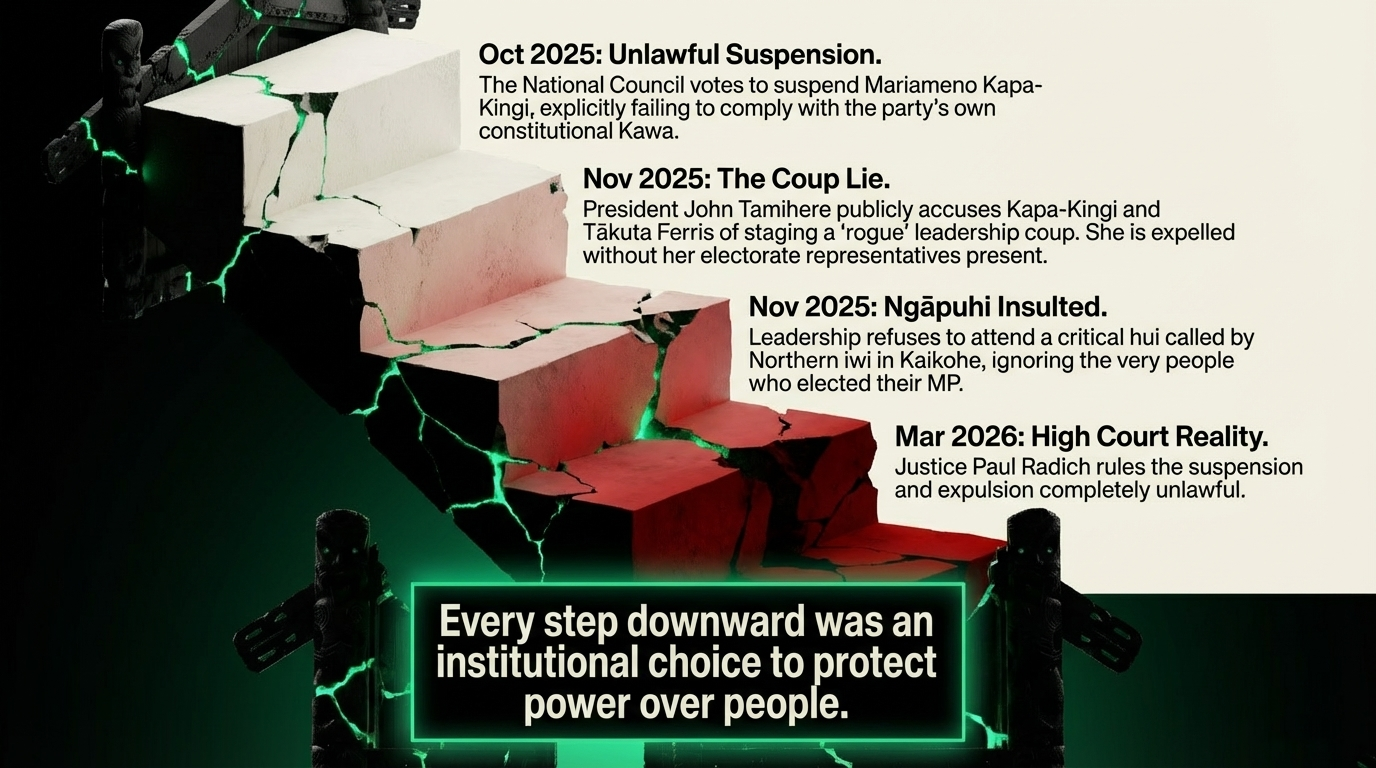
In October 2025, as RNZ reported, Te Pāti Māori's National Council voted to suspend Mariameno Kapa-Kingi, the elected representative of Te Tai Tokerau. By November 9, 2025, she was expelled — stripped of her membership without warning, without her electorate representatives present, without four of the party's own MPs in the room, as the High Court judgment confirms.
The weapon used against her? Party president John Tamihere publicly accused her and Te Tai Tonga MP Tākuta Ferris of going "rogue," staging a leadership coup. As RNZ documented, Waititi stood before media and pinned all "turmoil" on "allegations and two rogue MPs." Kapa-Kingi's response was unambiguous: "there has never been a challenge." Nobody in the media pushed hard enough to find out who was telling the truth.
The answers came from Justice Paul Radich. When the High Court issued its judgment, as confirmed by Waatea News, the finding was total and unambiguous: Te Pāti Māori's National Council had failed to comply with its own Kawa. The resolutions used to suspend and expel Kapa-Kingi were inconsistent with the party's constitution. They were unlawful. Not sloppy. Not procedurally questionable. Unlawful.
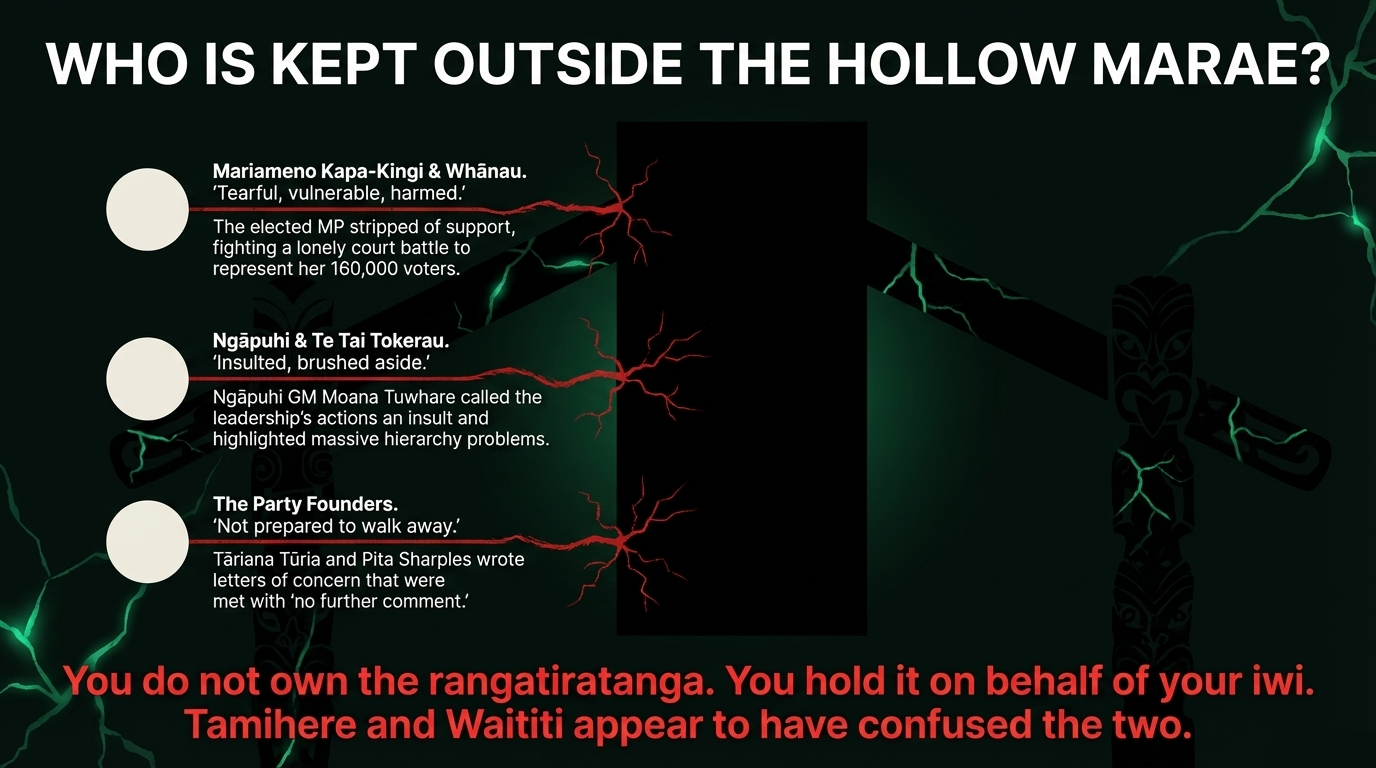
Ngāpuhi's general manager Moana Tuwhare said what Māori leaders had been thinking. As RNZ reported, the party had "some massive problems in the hierarchy" and demonstrated "a lack of constructive leadership." When Te Pāti Māori leadership refused to attend a hui called by Ngāpuhi — citing "advice from multiple rangatira" — Tuwhare used one word: insulted.
Now, weeks after reinstatement, Mariameno Kapa-Kingi has received: one text from Waititi requesting ten minutes. No apology. John Tamihere has not spoken to her since November 2025, as she confirmed to RNZ. And the party's official response to the court ruling, as RNZ reported, was a statement declaring they would "not be engaging in ongoing commentary or relitigating this matter through the media."
Fifty-five pages of evidence. One text message. No apology. No kōrero.
Deconstructing the Silence Through Mātauranga Māori
In te ao Māori, silence at the wrong moment is not neutral. It is a weapon — and a cowardly one.
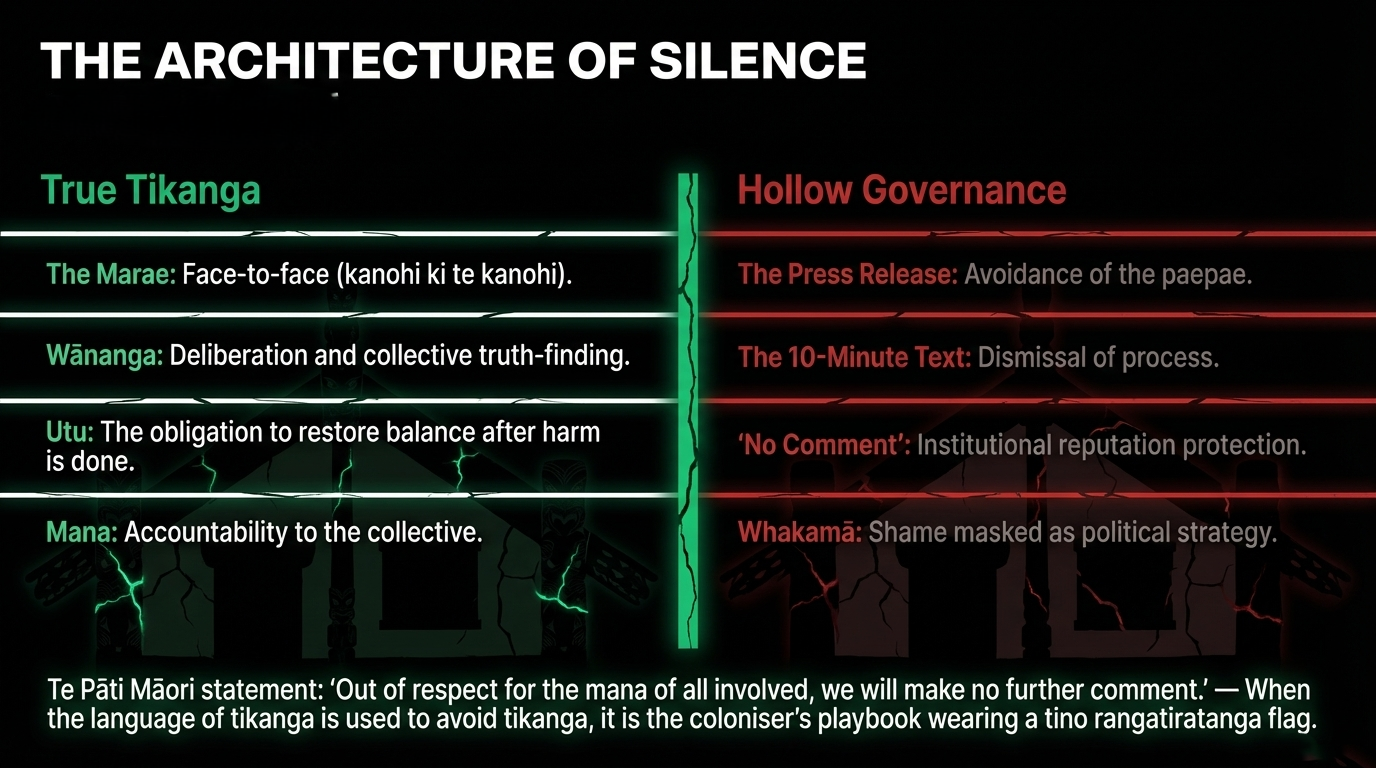
The marae is the foundational space of Māori governance. On the marae, conflict is processed through kōrero — deliberate, structured, face-to-face exchange conducted on the paepae with the ancestors watching. No issue of substance has ever been resolved through a press release and a text. The marae resolves through wānanga, through karakia, through the hard mahi of manaakitanga — acknowledging harm, naming what was broken, committing to repair. The process is not optional theatre. The process is the tikanga.
What Waititi and Tamihere have built in the aftermath of this court ruling is a hollow marae — all the symbols of Māori political authority without the moral substance that makes those symbols sacred. They have a Kawa they chose not to follow. They have a hui process they abandoned. They have a whānau member who was wronged in a documented, court-validated, 55-page fashion, and they offered her ten minutes that haven't even happened.
The word the leadership appears to be avoiding is utu — not in the colonised mistranslation of revenge, but in its true meaning: the restoration of balance. When harm is done, balance is disrupted. Utu is the obligation to restore. A text message does not restore. A press release does not restore. Silence does not restore. Silence compounds.
The phrase the party deployed — "out of respect for the mana of all involved, we will make no further comment" — is perhaps the most cynical abuse of tikanga language this column has encountered since the Foreshore and Seabed Act was called "clarification." You do not respect mana by refusing accountability. You do not honour tikanga by hiding behind its vocabulary. This is the coloniser's playbook wearing a tino rangatiratanga flag as a costume.
Five Hidden Connections — All Verified
Hidden Connection #1: The Kawa Violation Is Also a Rangatiratanga Violation
The Kawa of Te Pāti Māori is not a bureaucratic document. It is a taonga — an expression of tino rangatiratanga operationalised as party governance. When Tamihere's National Council voted to expel Kapa-Kingi without following it, as the High Court confirmed, they didn't merely breach a procedural rule. They enacted colonial governance logic inside a Māori institution — the logic that power supersedes process, that the Kawa is a suggestion, that leaders need not answer to their own constitutional documents. This is the same logic Hobson used at Waitangi. This is the same logic the Crown deployed to strip Māori of their whenua for 185 years. It has no place in a movement built to dismantle that logic.
Hidden Connection #2: The "No Comment" Strategy Is a Power Move, Not Dignity
The same week Kapa-Kingi was reinstated, the party issued a statement, as recorded by RNZ, saying they would "not be engaging in ongoing commentary or relitigating this matter through the media." This is not restraint born of humility. This is reputation management masquerading as dignity. They used the language of mana to do exactly what they accused Kapa-Kingi of doing: protect themselves at the cost of the collective. The High Court just told you your process was unlawful. The response is silence. That is not mana. That is whakamā being recycled as strategy.
Hidden Connection #3: Ngāpuhi Was Already Insulted — Months Before Reinstatement
When Te Pāti Māori leadership refused to attend the Kaikohe hui convened by the North's iwi in November 2025, they were already signaling where their loyalties lay. As RNZ reported, Ngāpuhi's general manager Moana Tuwhare called it insulting. Ngāpuhi — the iwi that holds the spiritual and relational heartland of Te Tai Tokerau — was brushed aside. The leadership cited "advice from multiple rangatira" not to attend. Yet the general manager of the largest iwi in Aotearoa by population was sitting in that hui. Whose rangatira were they listening to? The silence in response to that question is as deafening as the text message.
Hidden Connection #4: The Founders Saw It Coming
Former co-leaders and founding presidents of Te Pāti Māori signed a letter calling for restoration, as 1News confirmed. They invoked the legacy of Tāriana Tūria and Pita Sharples — the architects of this movement — and said they were "not prepared to walk away." These are not critics from outside. These are the tīpuna of the party, watching its leadership make choices they recognise as a departure from the kaupapa. When the founders write letters of concern, you do not respond with "no further comment." You listen. The fact that these letters appeared in November 2025 and the leadership still has not spoken substantively with Kapa-Kingi as of March 2026 is not an oversight. It is a choice.
Hidden Connection #5: The White Supremacist Government Is Watching — and Feasting
As The Māori Green Lantern documented in Te Pāti Māori coverage on this site: "The government attacks tikanga. Labour campaigns to destroy the only Māori voice. The media amplifies the feast. The internal fractures hand them all the knife." While Te Pāti Māori's leadership sends text messages and issues press releases, Luxon's government is operating without effective Māori parliamentary opposition. Young Māori unemployment is sitting at 21.4%. Emergency housing rejections have risen from 4% to 32% in twelve months, as The Māori Green Lantern documented in The Traffic Light Taiaha. Māori whānau are sleeping on streets while the party built to represent them is managing its own internal optics. This is not coincidence. This is the consequence.
Three Examples for the Western Mind — With Quantified Harm
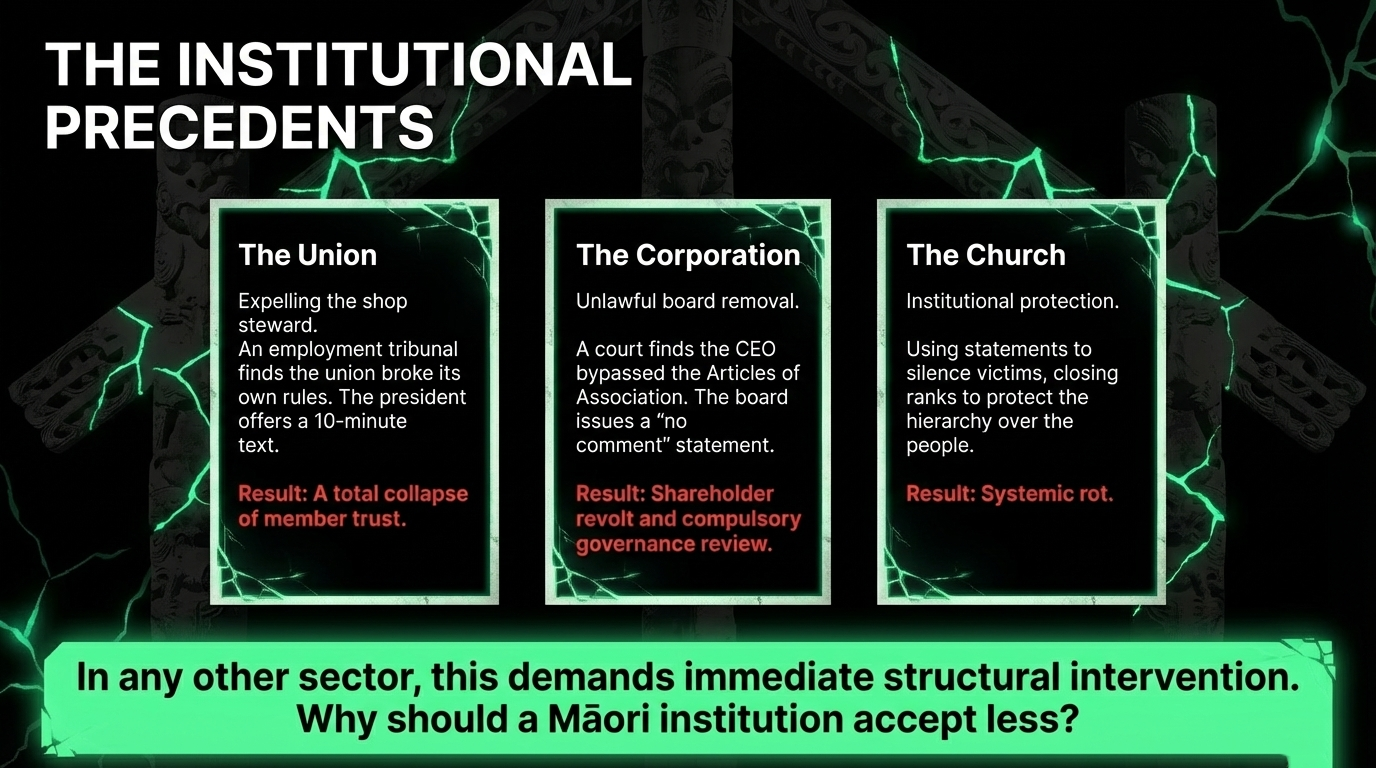
For those who need the Pākehā framework to feel the full weight of what has been broken, three analogies:
Example 1: The Union That Expelled Its Own Shop Steward
Imagine a workers' union — founded to protect its members — expels its shop steward for allegedly plotting to replace the union president. The steward contests the expulsion. An employment tribunal finds the union did not follow its own rules. The steward is reinstated. The union president's response? A text: "Can we do a 10-minute call sometime?" No apology. No membership accountability meeting. No acknowledgment of the harm done to the steward, her reputation, her whānau, her mental health.
Every employment relations expert in the country would recognise this as a governance failure requiring structural intervention. The quantified harm is electoral: Te Pāti Māori holds seats representing approximately 160,000 enrolled Māori voters. A Spinoff analysis from March 2026 raises serious questions about the party's viability in the next election if unity is not restored. The solution: an SGM, full disclosure, a formal apology, and a constitutional review conducted by an independent tikanga authority.
Tikanga impact: In te ao Māori, leadership is not a position held by an individual. It is a taonga held in trust for the people. The mana of a leader flows from the collective, not from an election or a council vote. When leadership cannot be challenged, when the Kawa is abandoned, when accountability is avoided — mana depletes. You do not own the rangatiratanga. You hold it on behalf of your iwi, hapū, and whānau. Tamihere and Waititi appear to have confused the two.
Example 2: The Corporate Board That Lost in Court and Called It Resolved
Imagine a corporation's board votes to remove a director, bypassing the company's own Articles of Association. The director takes it to court. The court finds the removal unlawful. The board issues a statement saying they "respect the court's decision" and will not "relitigate through the media." The CEO then texts the reinstated director asking for a ten-minute catch-up that never happens.
Every corporate governance expert and business law student knows this is not how you restore institutional trust after a legal finding of unlawful conduct. The board would face an extraordinary general meeting, a shareholder revolt, compulsory governance review, and — if the conduct was sufficiently damaging — legal costs, director liability assessments, and formal accountability mechanisms. Te Pāti Māori has avoided all of this. Not because the situation doesn't demand it. Because silence protects their positions.
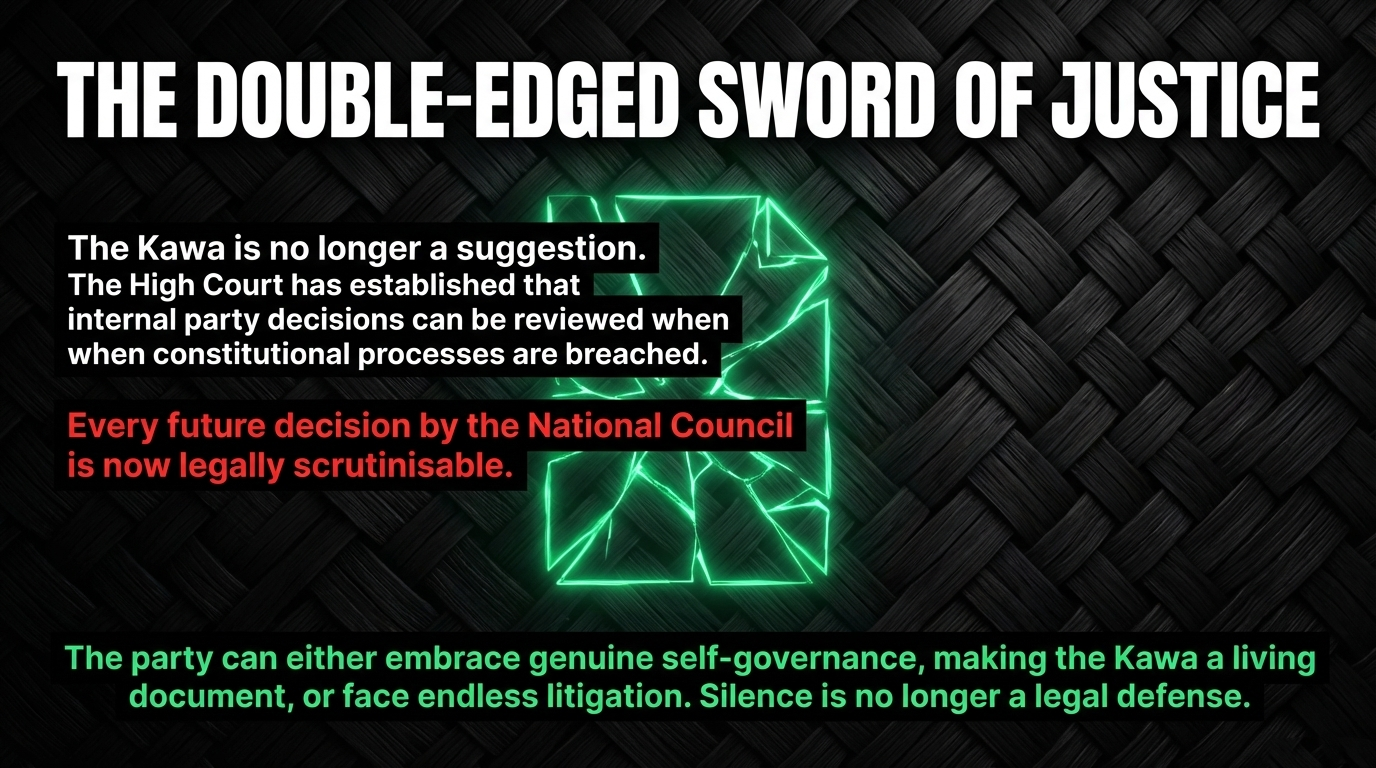
Tikanga impact: The High Court's finding, as Tea O News reported, is a significant constitutional precedent: courts can review internal party decisions when parties breach their own constitutional documents. The Kawa is now a legally enforceable taonga. Every future decision by the National Council is scrutinisable. The party can either embrace this accountability — making the Kawa the living, breathing document of genuine self-governance it was designed to be — or it can continue to treat it as a suggestion and face further litigation. Genuine tikanga governance requires the former. The current leadership's behaviour suggests the latter.
Example 3: The Institution That Protects Itself Over Its People
The global Catholic Church's historical response to misconduct allegations was to move the problem — not to account, not to acknowledge, not to repair, but to issue a statement and relocate. Protect the institution. Change the subject. And when those harmed spoke publicly, the response was silence, then management, then the weaponisation of institutional language to delegitimise their voices.
The resemblance to Te Pāti Māori's current posture is uncomfortable and must be named. Kapa-Kingi told Mata/RNZ:
"I would expect that at the least, which means there's time and there are acts of remorse shown. Those things have to be evident going forward."
She is right. And she is being more gracious than the situation deserves. The party has 55 pages of court findings confirming unlawful conduct. The leadership's response has been a press release and a text. This is not remorse. This is the institutional management of reputation without accountability.
And our tīpuna named this a long time ago: it is called mōhio, and it is not mana.
Quantified harm: Kapa-Kingi has committed to remaining in Parliament regardless. But the toll on her whānau is documented, tearful, and real.
A tearful Kapa-Kingi told RNZ: "
I do fancy myself as a bit of a tough girl... but also vulnerable. This could have been figured out better."
That is the voice of someone who has been systematically harmed by an institution she built her life around. The harm is personal, generational, and — given her position as a rangatira of Te Tai Tokerau — communal. When a rangatira is broken by her own party, the community feels it.
The Pattern: Silence as a Leadership Weapon — Documented Across This Site
This essay does not stand alone. The Māori Green Lantern has documented the weaponisation of silence by those in power across multiple investigations.
In His Silence Speaks Volumes: Christopher Luxon, this column dissected how Luxon's systematic absence from crisis moments — the IPCA press conference, the Treaty Principles Bill select committee, the Palestinian statehood decision, the unemployment catastrophe — was not delegation but abdication, a leadership style trained in boardrooms that optimise for shareholder value, not democratic accountability. The pattern is identical: silence is not the absence of leadership. Silence is a leadership choice. And it always serves someone's interests.
In The Inner Circle's Silence: Wally Haumaha, this column documented how institutional silence — the "I didn't know," the "I wasn't privy to those details," the retirement timed to avoid accountability — is the operational logic of colonial institutions that "protect power, silence victims, close ranks."
The question posed in that essay reverberates here:
"Why should Māori trust any institution where the highest-ranking officer can plausibly claim they knew nothing?"
Replace "police executive" with "party national council" and the logic is identical.
In When Accountability Fails, Leadership Falls, this column made clear:
"The withdrawal of accountability is not merely an isolated incident but a glaring symptom of systemic dysfunction within political institutions."
Dysfunction in the Crown's institutions. And now — here, documented, court-confirmed — dysfunction within our own.
The pattern is not a coincidence. It is a contagion. When Māori institutions internalise colonial governance logic — when they prioritise institutional protection over accountability, when they use the language of tikanga to avoid tikanga, when they offer ten minutes where 55 pages of evidence demands far more — they don't just harm one person. They replicate the system they were built to dismantle.
Implications: The Harm Is Quantified. The Solutions Are Non-Negotiable.
Electorally: Te Pāti Māori won its electorate seats in 2023 by building trust with specific iwi and communities. Kapa-Kingi's Te Tai Tokerau seat rests on Ngāpuhi, Ngāti Whātua, and the broader iwi of the North. The leadership has now insulted Ngāpuhi directly and left their MP without a substantive kōrero for months. As the 1News analysis confirmed, the party faces serious questions about its electoral viability. Margins in Māori electorates do not survive the burning of foundational relationships.
Constitutionally: Justice Radich has established that courts can review Māori party decisions when constitutional processes are breached, as confirmed by Tea O News. The Kawa is now legally enforceable. This is a double-edged sword: it protects members from leadership overreach, but it also exposes the party to further litigation if the leadership continues to treat its own constitutional documents as negotiable.
Action Pathways — Non-Negotiable:
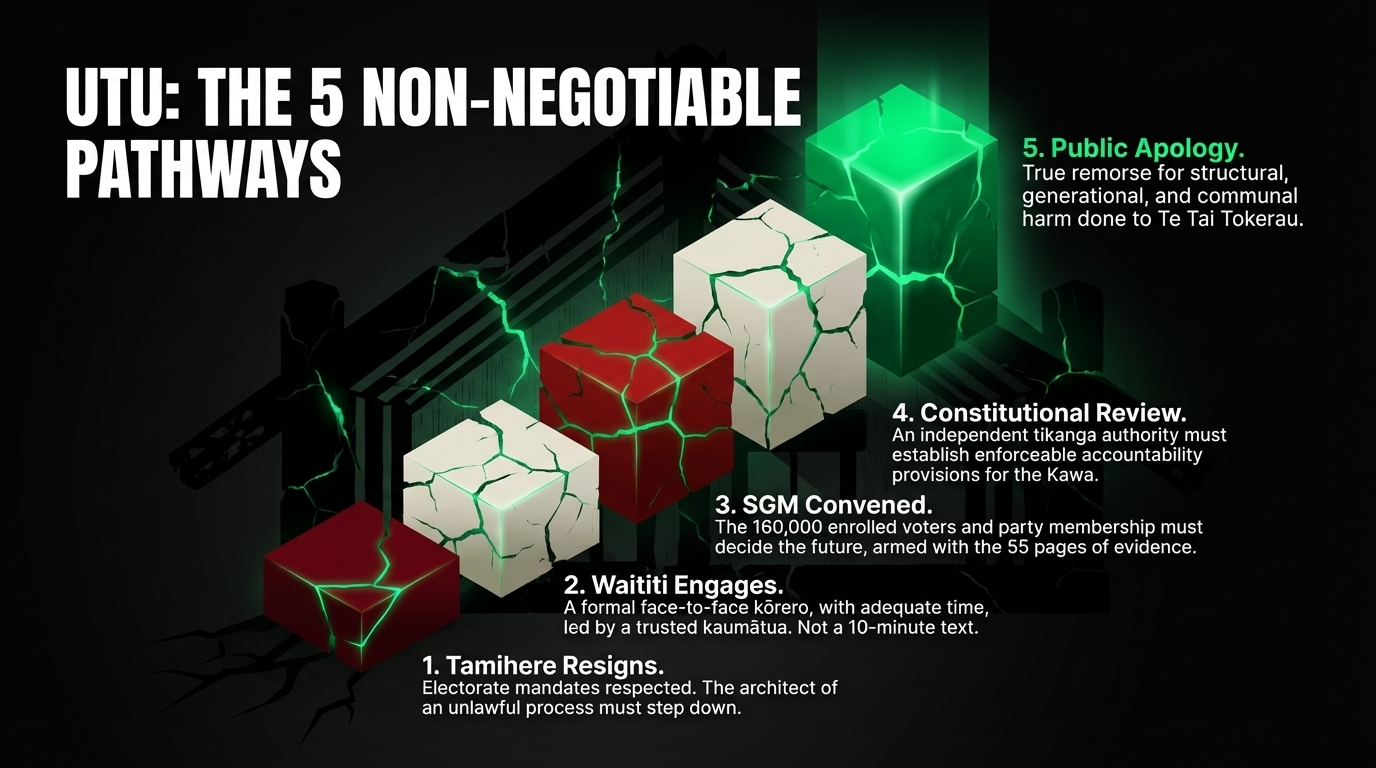
- John Tamihere must step down as party president. The electorate executives that called for his removal were right. The High Court confirmed they were right. He led a process found unlawful. He has not spoken to the person his process wronged in four months. As 1News has documented, calls for his removal came from within the party's own structures. Those calls must be answered.
- Rāwiri Waititi must do more than send a text. As co-leader, his primary obligation is to the cohesion of his whānau, not to his own political positioning. A formal kōrero, face to face, with adequate time, facilitated by a trusted kaumātua from both parties' tikanga traditions, is the minimum expectation. Not ten minutes.
- An SGM must be convened. Kapa-Kingi is correct: the membership holds the authority — and with 55 pages of court confirmation, the obligation — to examine what happened, determine accountability, and choose the leadership that will take this party into the next election cycle.
- A full constitutional review must be commissioned, led by tikanga experts independent of the current executive, resulting in a strengthened, transparent Kawa with enforceable accountability provisions.
- A formal, public apology must be issued — not a press release about respecting mana, but an acknowledgment, in the correct tikanga form, of the harm done to Kapa-Kingi, her whānau, her electorate, and the people of Te Tai Tokerau.
The Marae Does Not Belong to the President
This story is not ultimately about Mariameno Kapa-Kingi versus Rāwiri Waititi or John Tamihere. It is about what kind of Māori institution Te Pāti Māori chooses to be — and whether that choice is made consciously or by default.
The marae does not belong to the president. It does not belong to the co-leaders. The marae belongs to the people who built it, who maintain it, who offer manaakitanga on its paepae every day. Those people are the enrolled Māori voters of every electorate who sent these representatives to Parliament. Those people are Ngāpuhi. Those people are the tīpuna of Tāriana Tūria and Pita Sharples who wrote letters of concern and were met with silence.
And those people are watching.
As Christopher Luxon's white supremacist neoliberal government strips away Māori rights on every front — as documented by The Māori Green Lantern in The Traffic Light Taiaha — Te Pāti Māori cannot afford to be the hollow marae. It must be the living, breathing, accountable Māori institution its founders bled for.
A text message does not rebuild a whare. Silence does not restore mana. Ten minutes does not address 55 pages.
Kapa-Kingi told RNZ: "Not everybody's suited to it, leadership." That is the most devastating sentence in this entire story. Because she is right. And she is still showing more rangatiratanga in one tearful sentence than the leadership has shown in four months of silence.
Ka tū, Mariameno. The silence is deafening. But your voice — and the 55 pages that vindicated it — will echo far longer than their press releases ever could.
Ka tū. Te marae e tū ana mō te iwi, ehara mō te rangatira.
(The marae stands for the people, not for the leader.)
Koha Consideration
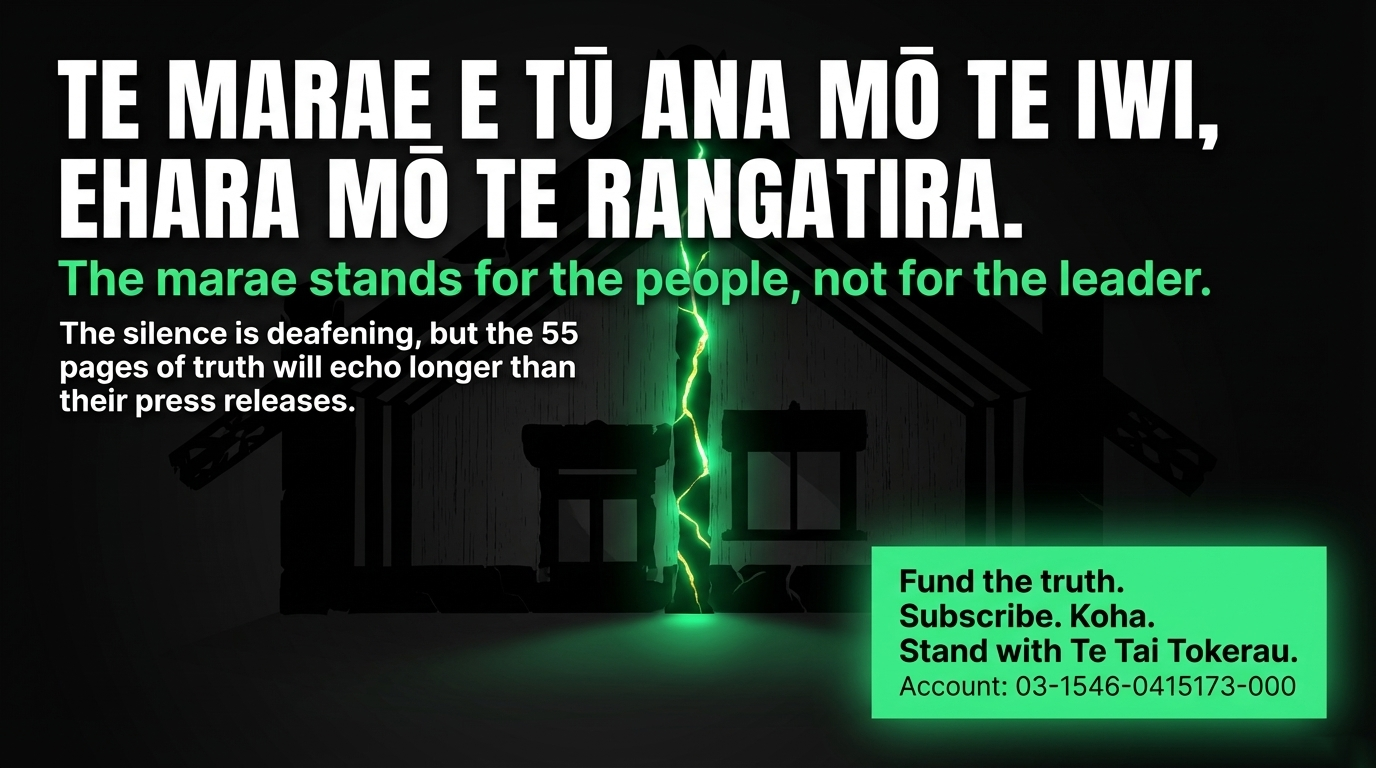
Mariameno Kapa-Kingi fought through the courts because no one with institutional power would protect her. She won — not because of money, not because of position — but because the Kawa was on her side.
This essay exists for the same reason: to do the mahi that Crown and corporate structures will not do, naming the harm, following the silence to its source, and demanding accountability from those who claim to speak for us.
Every koha to The Māori Green Lantern signals that whānau are ready to fund the accountability that party executives, the Crown, and corporate media will not provide. It signals that rangatiratanga includes the power to fund our own truth tellers — and that the Kawa matters, even when — especially when — those in power wish we would forget it.
Kia kaha, whānau. Stay vigilant. Stay connected. And if you are able, consider a koha to ensure this voice continues. If you cannot koha — no worries. Subscribe, share with your whānau and friends, kōrero about this essay in your marae and your kai table conversations. That is koha in itself.
Three pathways:
Koha Platform — Support The Māori Green Lantern directly
Subscribe — Receive essays directly and support through subscription
Direct Bank Transfer — HTDM, account number 03-1546-0415173-000
Ka tū. The marae stands for the people.
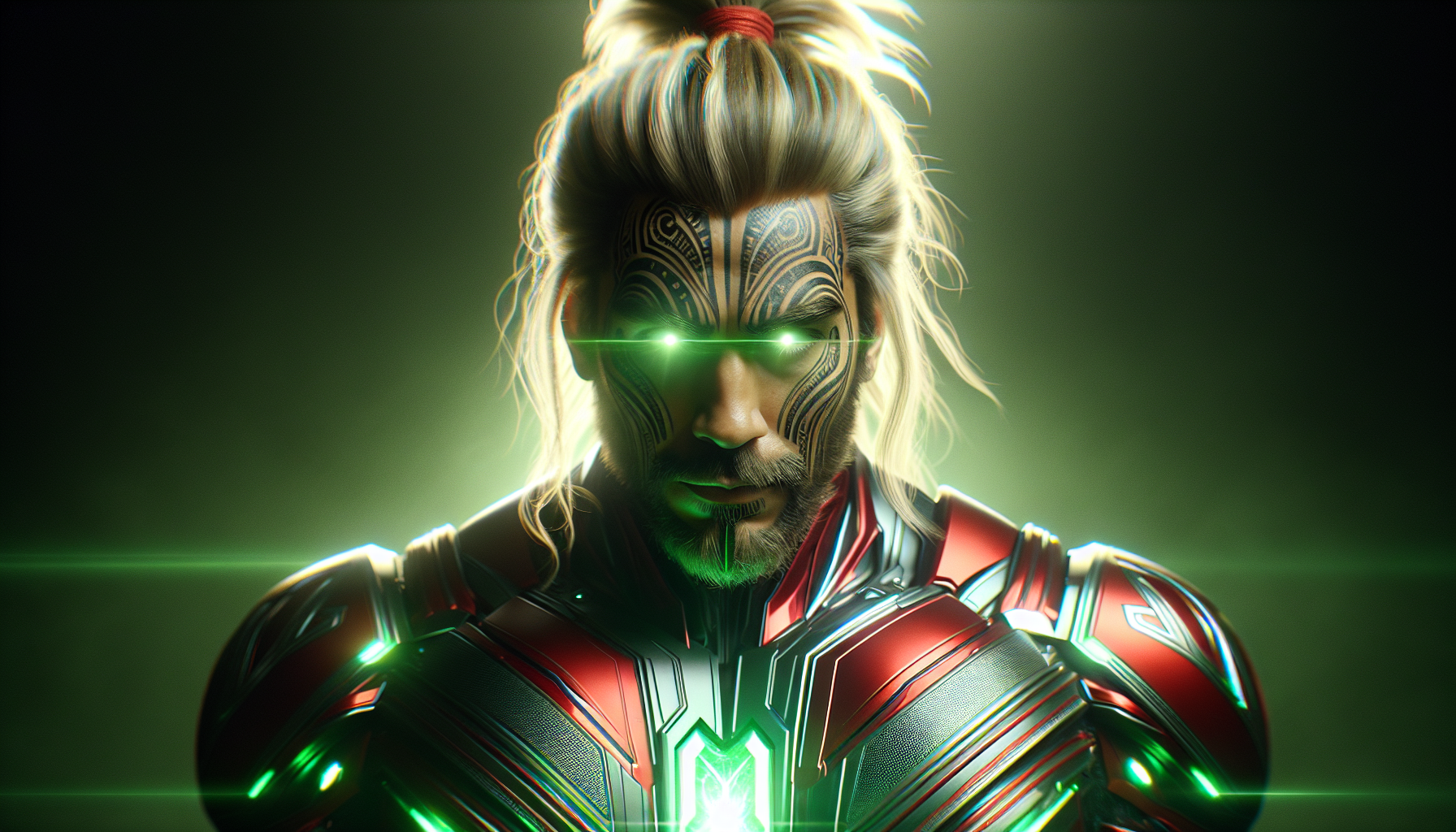
Ko Ivor Jones Te Māori Green Lantern — Tohunga mau rākau wairua, Kaitiaki of Māori, wielding the taiaha empowered by the Ring to expose misinformation, white supremacy, racism, and neoliberalism in Aotearoa.
Research tools used: RNZ, 1News, Waatea News, Tea O News, The Spinoff, Courts of NZ, Te Ao Māori News, High Court judgment KAPA-KINGI v TAMIHERE NZHC 3776. All citations tested live as of 20 March 2026.