"The Pātaka Is Ash: How Nicola Willis Stood Before a Burning Storehouse and Called It Warm" - 19 March 2026
"Not Unusually So" — The Four Most Dangerous Words in Aotearoa's History of Imperial Abandonment

He Kupu Whakataki — Opening Words
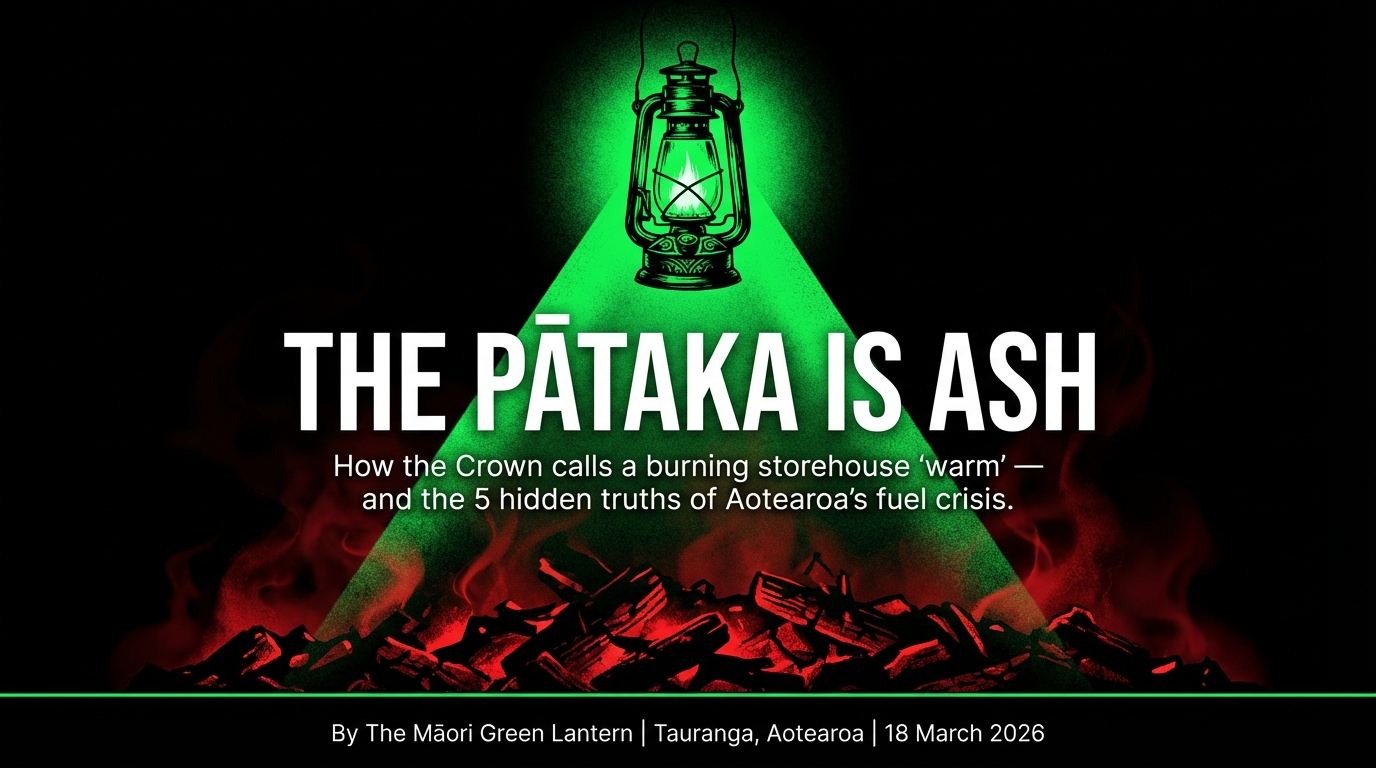
The pātaka — the sacred raised storehouse of the marae — was not merely a place to keep food. It was a covenant.
It was the physical expression of a rangatira's most sacred obligation: that those under their care would not go hungry when the storms came.
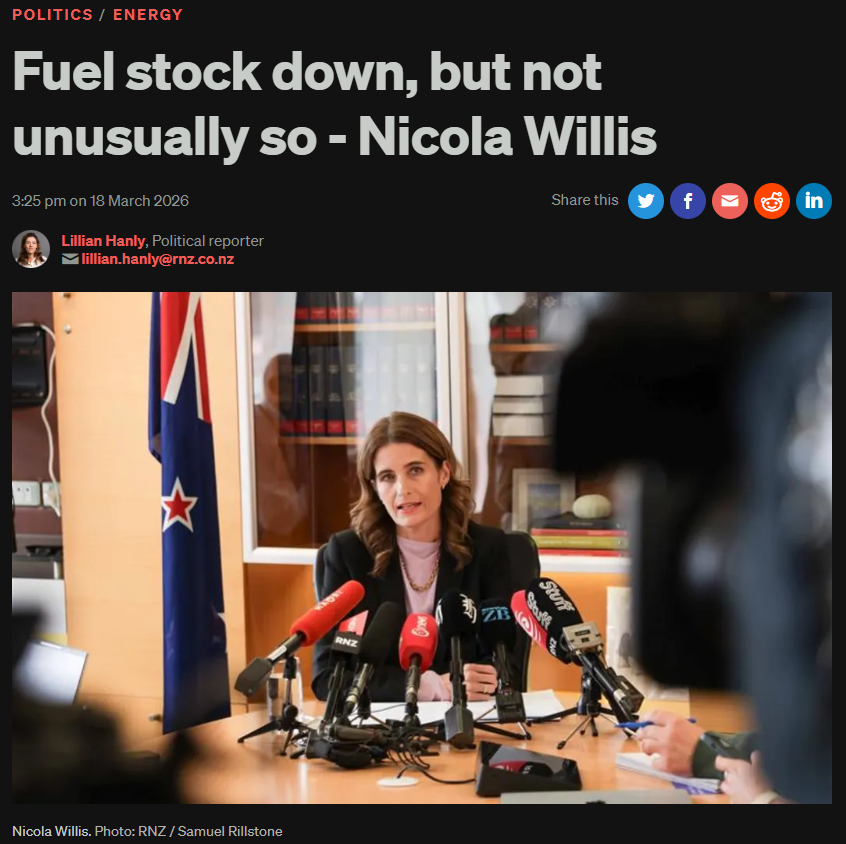
When Nicola Willis stood before the nation on 17 March 2026 and told New Zealanders that fuel levels were "down, but not unusually so," she was not delivering a briefing. She was delivering the confession of a government that dismantled our pātaka, sold the timber, replaced it with paper tickets, and is now standing in the ashes — counting embers — and calling them reserves.
The Deep Dive Podcast
Listen to a lively conversation between two hosts, unpacking and connecting topics in the sources of this essay
He Whakarāpopoto — What This Essay Reveals
This essay exposes five hidden connections behind the New Zealand government's catastrophic failure of fuel security during the 2026 Strait of Hormuz crisis.
It reveals that: the government closed Marsden Point and left Aotearoa without a single drop of domestic refining capacity; that the so-called "90-day fuel reserve" is largely a fiction built from paper contracts now being shredded by Force Majeure declarations; that physical diesel on New Zealand soil amounts to just 21 days of cover; that the legislative fix — a minimum 28-day stockholding requirement — was deliberately scheduled for July 2028, two years too late; and that Māori whānau and low-income communities are absorbing a 72-cent-per-litre diesel surge with no fuel excise relief, no targeted support delivered, and a Finance Minister who cancelled the EV rebate scheme and then had the audacity to use that cancellation as evidence of her fiscal conscience.
This is not policy failure. This is a neoliberal government doing exactly what it was designed to do: protecting corporate profit margins while whānau bleed at the pump.
Tūāhuatanga — The Scene Before Us
Imagine your tūpuna standing before the pātaka — that sacred raised storehouse, the beating heart of the marae, the structure that meant the difference between life and death for whānau through every winter and drought. Now imagine the pātaka has been quietly dismantled, timber by timber, sold to offshore interests, replaced with a piece of paper — a ticket — that says "we promise fuel will come."
Now imagine the wind has shifted. The ships have stopped. The taniwha has risen in the Strait of Hormuz. And the Minister of Finance stands before the smoking ruins of what was once your protection and tells you, with the serene confidence of someone who has never once gone hungry:
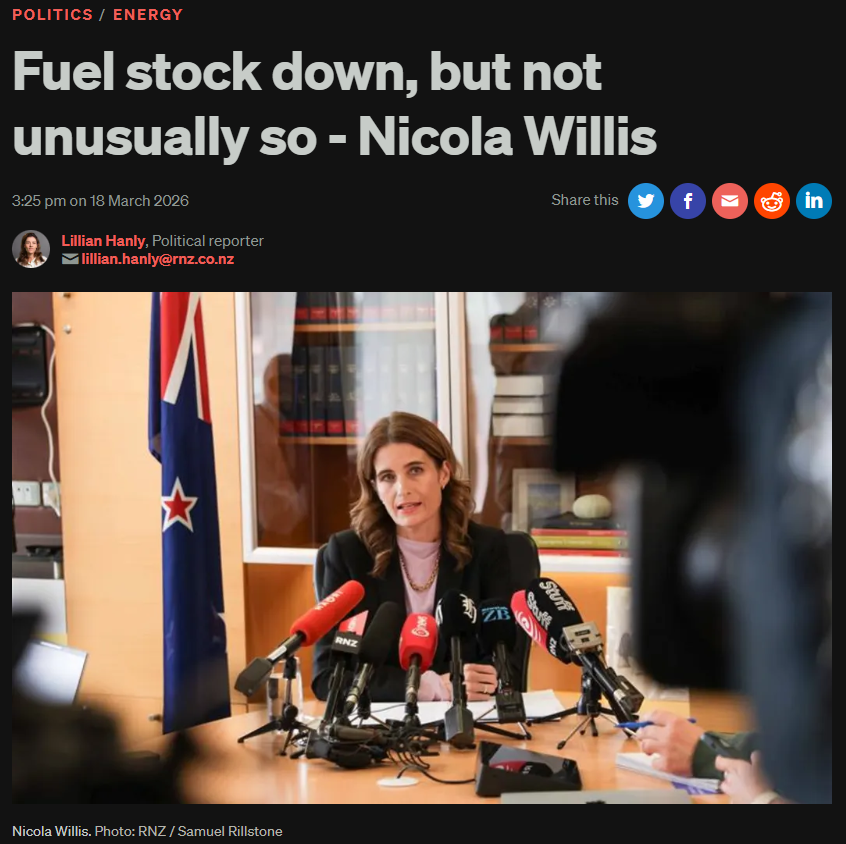
"Stocks are down, but not unusually so."
That is not a reassurance. That is a confession.
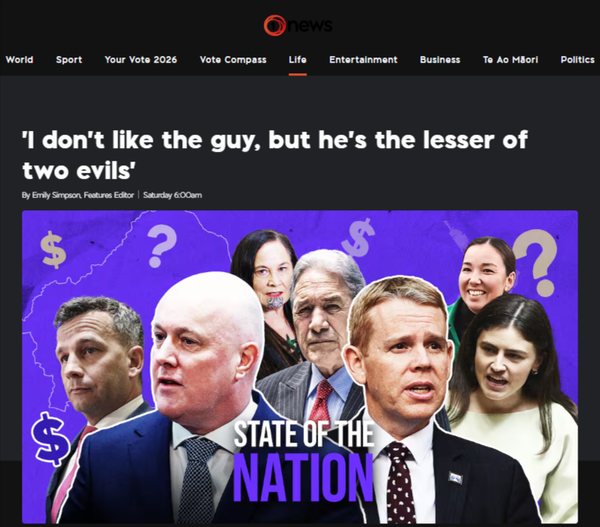
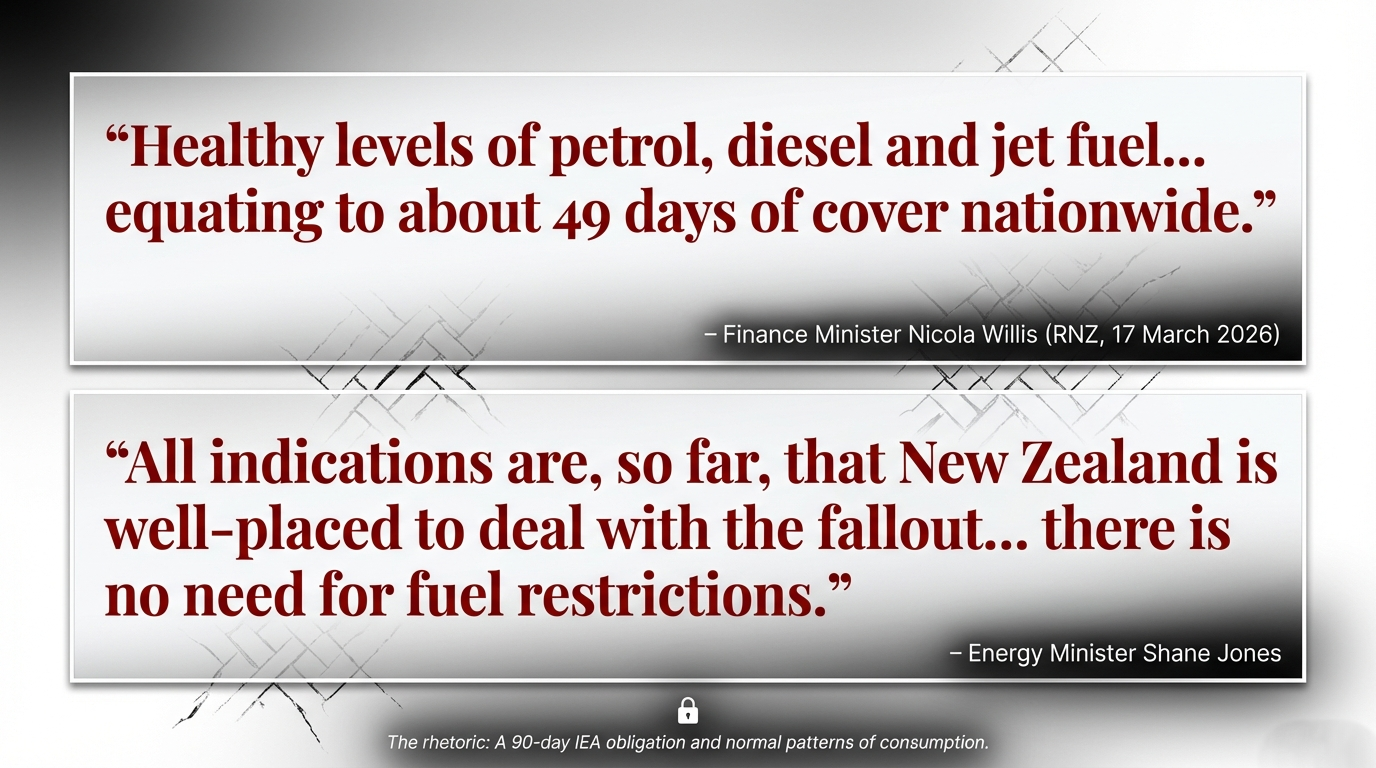
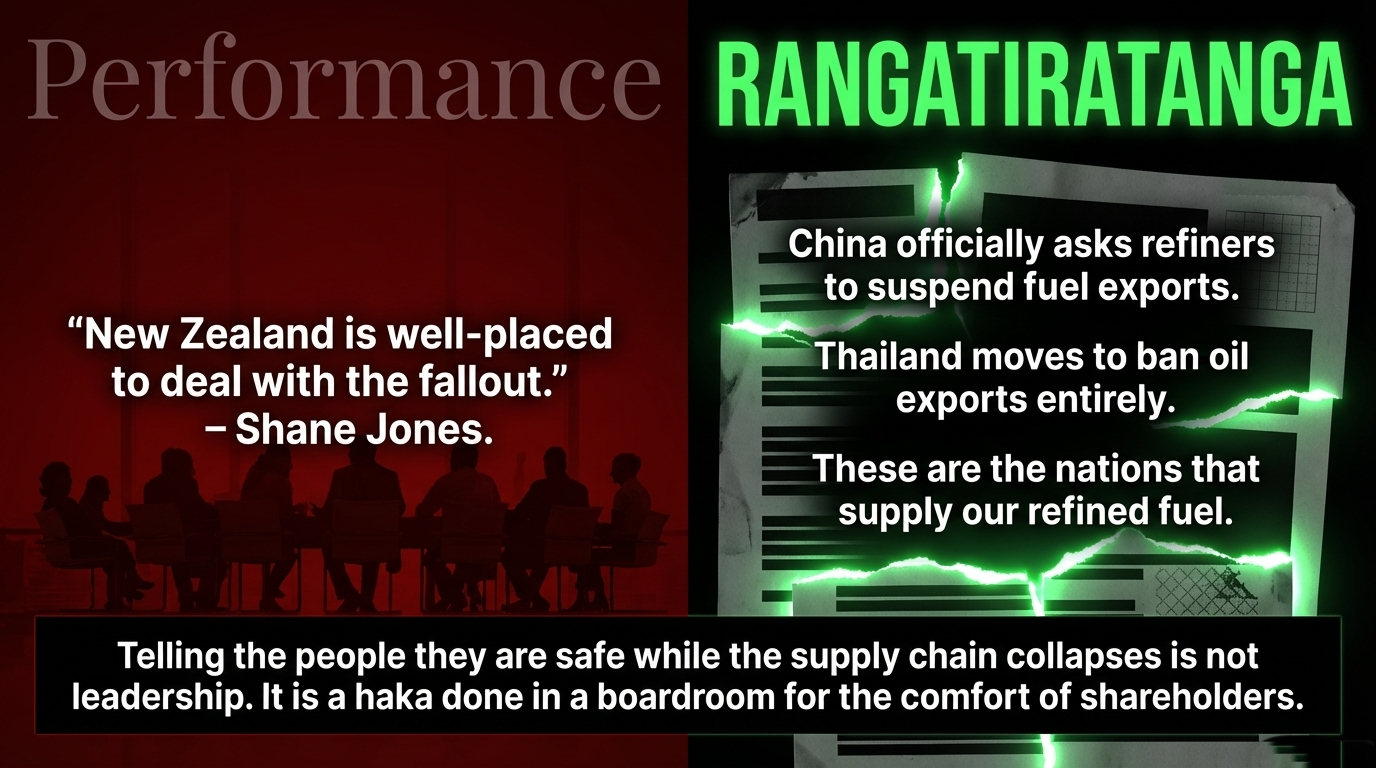
As revealed by RNZ, Finance Minister Nicola Willis reported on 17 March 2026 that New Zealand held approximately 49 days of combined fuel cover — petrol, diesel, and jet fuel — including fuel already on ships bound for our shores. She called the slight drop from 57 days earlier in the month "normal patterns of consumption." Energy Minister Shane Jones assured us there was "no need for fuel restrictions at this stage." Meanwhile, as 1News documents, China has already asked refiners to suspend fuel exports, and Thailand has moved to ban oil exports entirely — two of the very nations that supply New Zealand's refined fuel.
Four words. Not unusually so.
The pātaka is ash. They're counting the embers and calling it a stockpile.
Hītori — How We Got Here: The Burning of the Pātaka
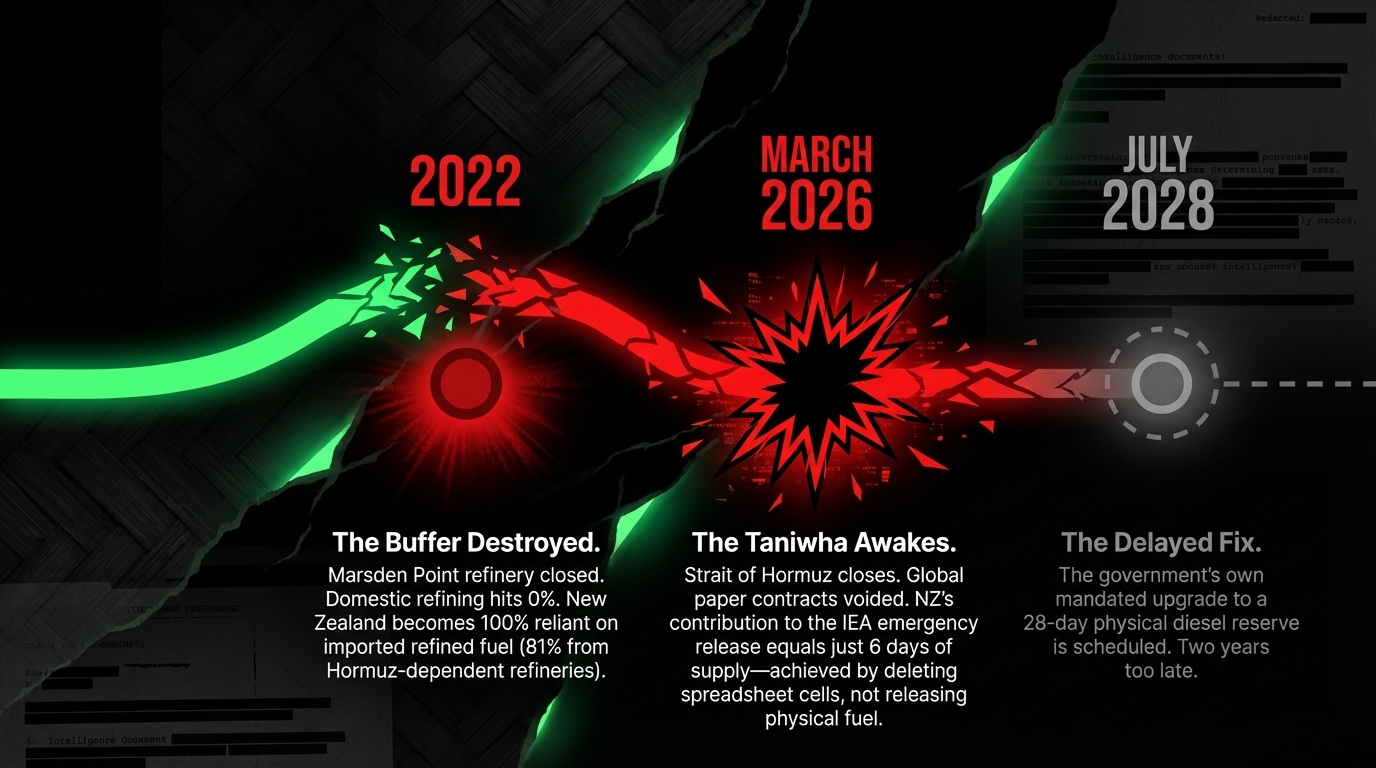
This did not begin in the Strait of Hormuz. This began in 2022, when the government allowed the Marsden Point refinery to close, stripping Aotearoa of its only domestic refining capacity. From that moment, New Zealand imported 100% of its refined fuel — petrol, diesel, jet fuel — every drop, from offshore. As exposed by Carbon News, approximately 81% of New Zealand's refined fuel now comes from South Korean and Singaporean refineries that process Middle Eastern crude — crude that travels through the Strait of Hormuz.
The taniwha has always lived in that strait. Every government since Muldoon knew it. In 1973 and again in 1979, as recorded in Te Ara's history of oil and gas, war in the Middle East brought New Zealand to carless days, economic panic, and emergency rationing. We learned, or so we thought. We joined the International Energy Agency (IEA). We committed to 90 days of oil cover. We built obligations.
Then the neoliberal wrecking ball arrived. And the pātaka — once filled with physical reserve — was slowly replaced with paper. With tickets. With promises made by people who will never feel the consequences of those promises breaking.
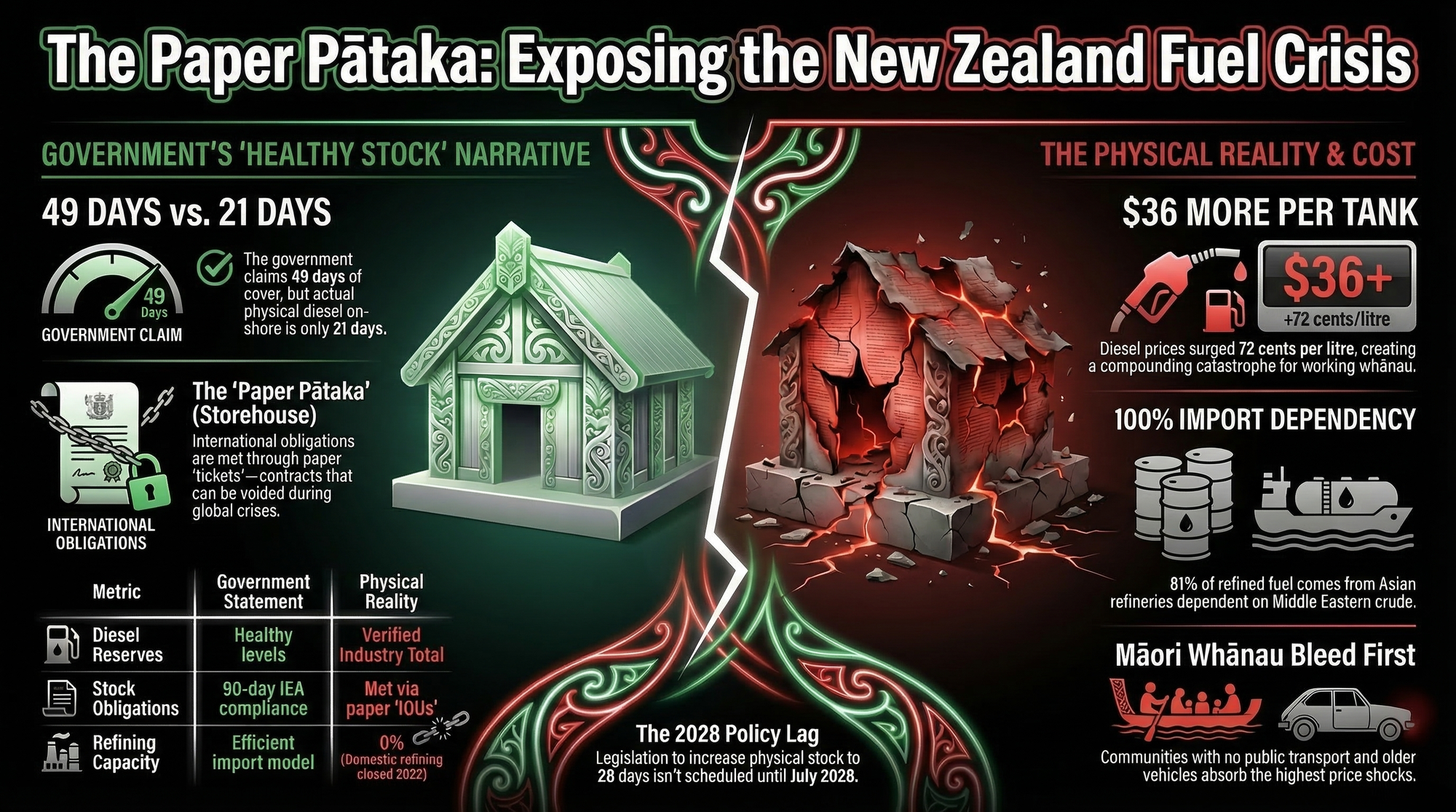
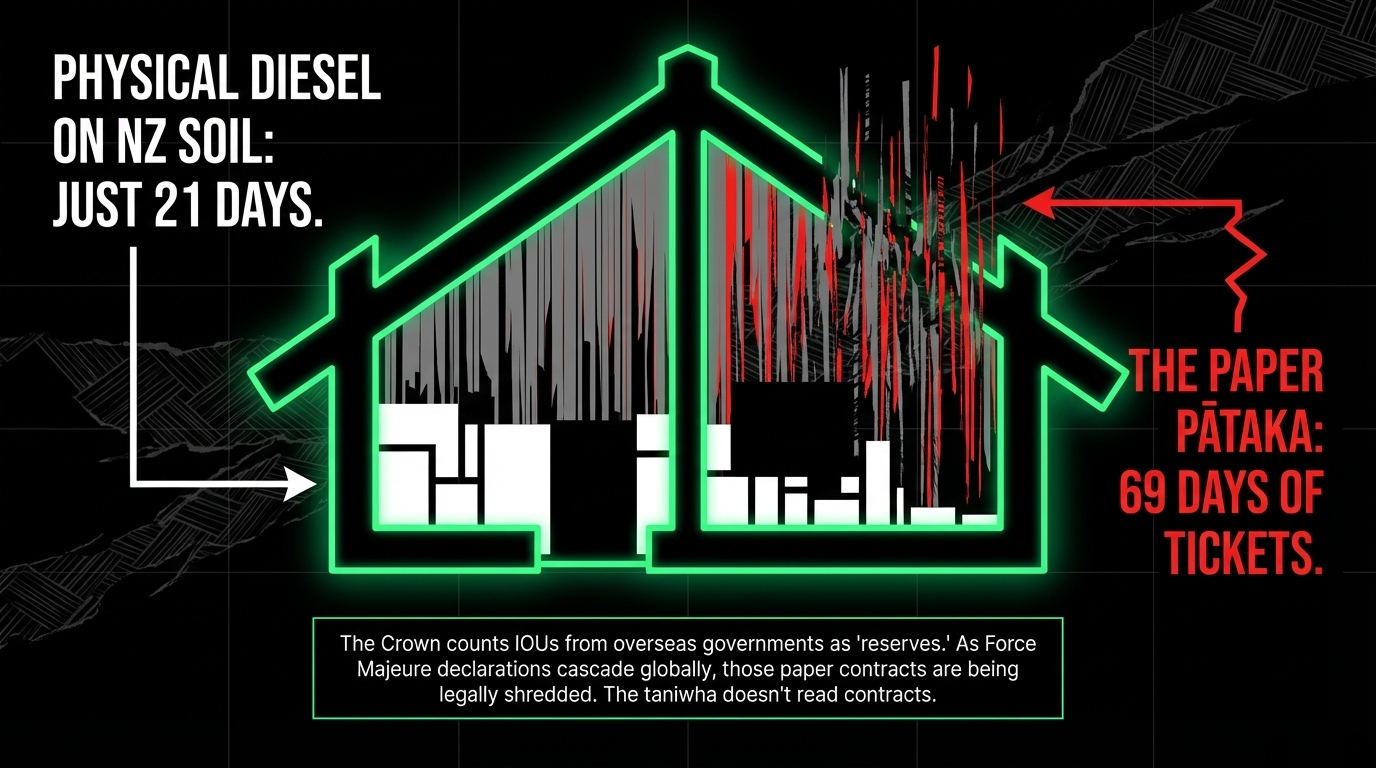
As documented by The Spinoff, New Zealand's so-called "90-day IEA obligation" is met not through physical storage, but through contracts — paper agreements with overseas governments. The physical diesel sitting on New Zealand soil amounts to just 21 days of cover. The increase to a minimum 28 days of physical diesel was already a legislative concession — and as exposed by Carbon News, that upgrade isn't even scheduled until July 2028.
The pātaka was sold. The timber is gone. The paper receipts are blowing in the wind.
Whakaaro — What Mātauranga Sees That Nicola Willis Cannot
In tikanga Māori, kaitiakitanga is not a slogan. It is a sacred covenant of guardianship — the obligation to protect, to sustain, to carry the responsibility of the future in the palm of the present. A kaitiaki who sold the fishing grounds and replaced them with a promise from a stranger across the sea is not a kaitiaki. They are a colonial administrator in the lineage of every Crown agent who ever swapped sovereignty for a musket or a blanket.
What Willis called "healthy levels" of fuel is, in mātauranga terms, a pūkōrero kore — a speech with no body behind it. Words without mauri. Reassurance without substance. As RNZ reports, Willis warned of "acute cost of living pressures" in one breath and ruled out cutting the fuel excise tax in the next — a tax cut she said would "send the wrong signal." The wrong signal to whom? To the shareholders of the fuel importers whose profit margins would shrink if relief actually reached the pump?
And Shane Jones — Shane Jones, who wears the name of an ancestor, who wraps himself in the korowai of Northland iwi — standing up to tell his own people that
"all indications are New Zealand is well-placed to deal with the fallout from the closure of the Strait of Hormuz"
while Force Majeure declarations cascade through our entire supply chain? That is not rangatiratanga. That is performance. That is the haka done in a boardroom for the comfort of shareholders.
Tūhonohono Huna — Five Hidden Connections This Government Does Not Want You to See
1. The Paper Pātaka: 90 Days of Cover That Doesn't Exist
New Zealand tells the IEA it holds 90 days of oil stocks. As confirmed by MBIE, this figure includes "ticket" contracts — essentially promises on paper with overseas governments and suppliers. Physical fuel on New Zealand soil: 21 days of diesel. When Force Majeure is declared — as it now cascades through the entire supply chain, as Carbon News documents — those paper promises are not worth the freight they were printed on. The taniwha doesn't read contracts.
2. The IEA Release Was Six Days — Not Six Weeks
When the international community acted, New Zealand's contribution to the IEA's 400 million barrel emergency release was approximately six days of supply — achieved not by releasing physical fuel, but by terminating tickets. Cancelling promises. This is what "energy security" looks like under a neoliberal government: when the crisis comes, your reserve is not a tank — it's a spreadsheet cell that you delete.
3. The Marsden Point Decision Was Not Inevitable — It Was a Choice
Every commentator now references Marsden Point's 2022 closure as a contributing factor in New Zealand's exposure. As The Spinoff clarifies, the closure removed our last buffer of domestic industrial capacity. The closure was permitted, enabled, and celebrated as market efficiency. A New Zealand Energy Substack analysis confirms that every drop of NZ fuel now originates in Asian refineries configured specifically for Middle Eastern crude — crude that now cannot move. This is not bad luck. It is the logical endpoint of a generation of governments who dismantled resilience in the name of profit.
4. Māori Whānau Will Bleed First
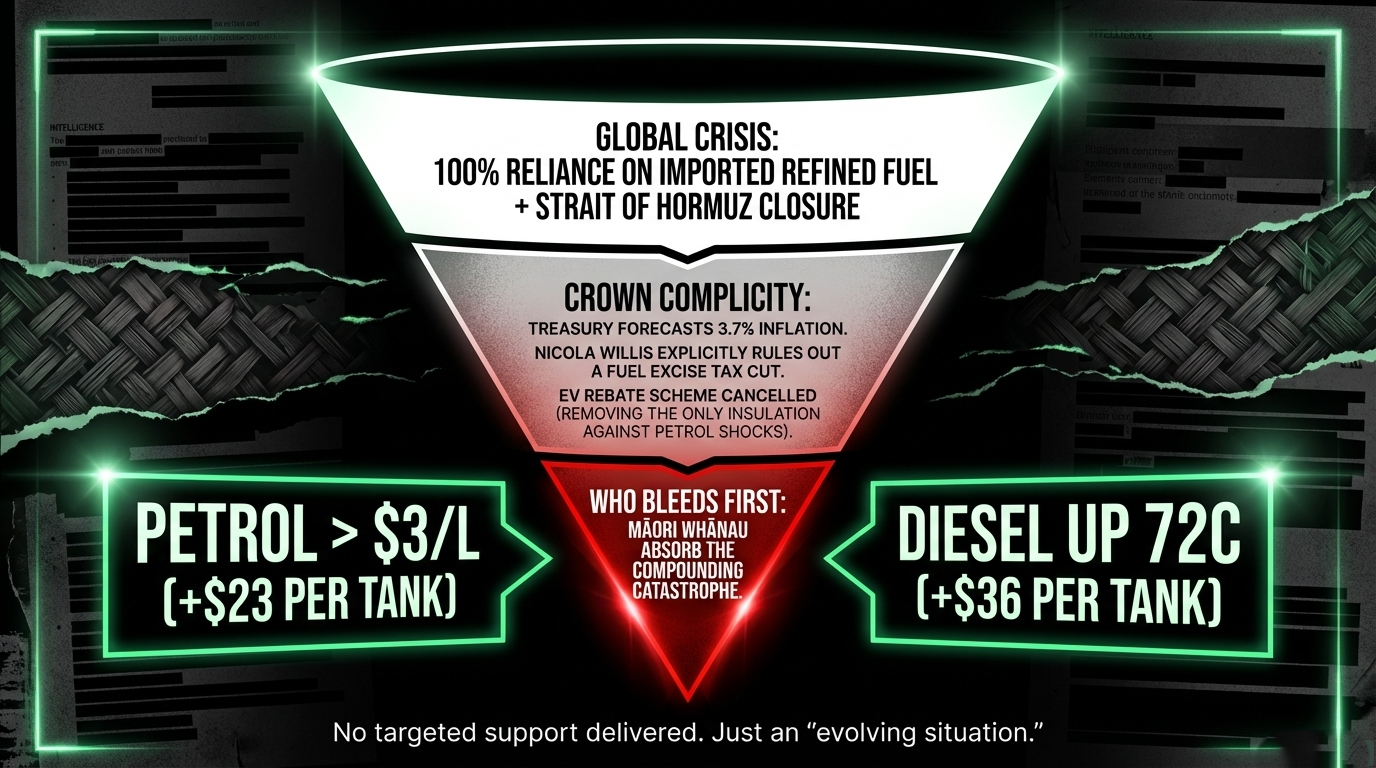
Petrol has surged past $3 per litre, adding approximately $23 to the cost of filling an average car; diesel is up 72 cents per litre, adding $36 to the cost of filling an average diesel vehicle, as confirmed by RNZ. Willis has ruled out cutting the fuel excise tax. As Waatea News documents, Māori whānau — disproportionately reliant on older vehicles, living in communities with no public transport, employed in industries that run on diesel — are absorbing this as a compounding catastrophe on top of a cost-of-living crisis that was already consuming them. No fuel tax relief. No targeted support delivered. Just "the situation is evolving."
5. The 2028 Deadline Is a Confession Dressed as a Policy
The government's own regulatory impact analysis from 2023 acknowledged that after Marsden Point's closure, average diesel stock would fall to 21 days. The legislative response was to require a minimum 28-day physical diesel holding — and to schedule its implementation for July 2028. The Strait of Hormuz closed in March 2026. The policy that might have protected us was placed two years in the future. This was not negligence. This was a deliberate choice to protect the profit margins of fuel importers over the lives of New Zealanders. And Nicola Willis signed off on that Budget while simultaneously cancelling the EV rebate scheme — then had the audacity to invoke that cancellation as fiscal responsibility. As 1News confirms, no fuel excise cut will come, no Cabinet paper has been tabled, and the working definition of "targeted, temporary and timely" support remains: undefined, undated, and undelivered.
Tauira Mō Te Hinengaro O Te Ao Hou — Three Examples for the Western Mind
Example 1: The Household Budget That Doesn't Exist
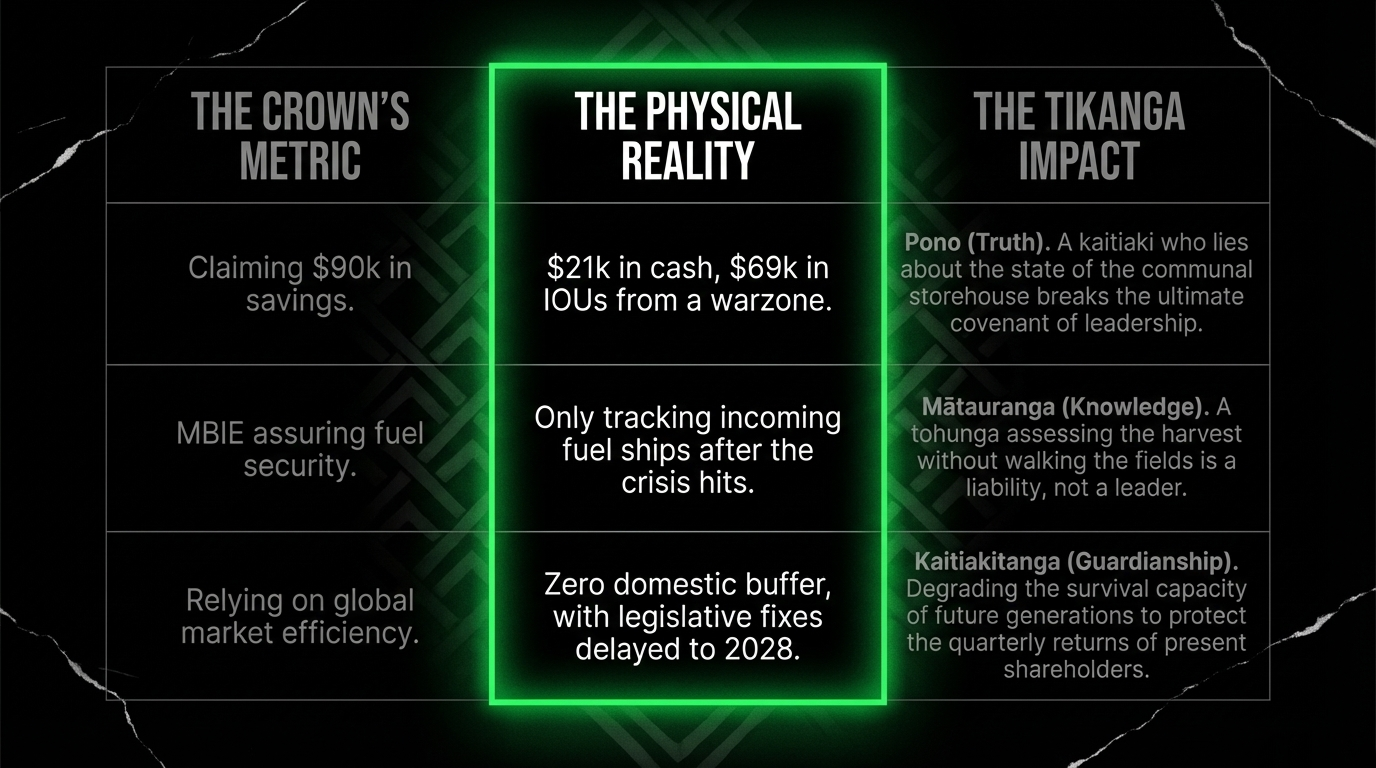
For the western mind: Imagine you tell your bank you have $90,000 in savings. Your bank asks for proof. You produce $21,000 in your actual account and $69,000 in "IOUs" from people in countries currently experiencing a war. Your bank would laugh you out of the building — or arrest you for fraud. This is precisely New Zealand's fuel reserve position. The government counts paper contracts toward its IEA 90-day obligation as though they are interchangeable with physical fuel. They are not. As Carbon News confirms, Force Majeure declarations are now cascading — meaning suppliers are legally voiding those contracts. The $69,000 in IOUs has just been shredded.
Tikanga impact: This violates pono — the principle of truth and authenticity. In tikanga, a kaitiaki who misrepresents the state of resources under their guardianship has broken the most fundamental covenant of leadership. Accountability is not a preference; it is whakapapa. When your tīpuna lied about the state of the pātaka, they were expelled from the marae. In this government's case, they are re-elected and handed more portfolios.
Example 2: The Building Inspected With the Lights Off
For the western mind: Imagine hiring a building inspector to assess your home before a hurricane. The inspector reports the house is "structurally sound" — but conducts the entire inspection in the dark, doesn't check the foundations, and bases their conclusion on the previous owner's receipts. This is what the Ministry of Business, Innovation and Employment's fuel data reporting looked like before this crisis. As RNZ reports, MBIE is only now beginning to report on the pipeline of incoming fuel shipments — information that should have been standard public reporting for years. Shane Jones himself admitted the government was "working with industry to strengthen the frequency, quality and timeliness of fuel stock and shipping data." During a crisis. After the taniwha arrived.
Tikanga impact: This is a catastrophic failure of mātauranga — the sustained, serious cultivation of knowledge that allows a community to anticipate and respond to change. A tohunga who advises the rangatira on the state of the kūmara harvest without walking the fields is not a tohunga. They are a liability. A government that discovers the fragility of its fuel data pipeline during a supply crisis has abandoned its people's knowledge sovereignty.
Example 3: The Waka Launched Without a Keel
For the western mind: In 2022, New Zealand's government allowed the closure of Marsden Point — the only domestic oil refinery in the country. They replaced it with nothing. No strategic reserve expansion. No new domestic capacity. No emergency protocol that accounted for a world in which the Strait of Hormuz might close. As The Spinoff documents, NZ now imports 100% of its refined fuel, 81% sourced from refineries dependent on Middle Eastern crude. The waka was launched without a keel, without a bailer, and without a navigator who had looked at a weather map. Now the taniwha has risen, and our Finance Minister stands on the prow and says the waves are "not unusually high."
Tikanga impact: Kaitiakitanga is intergenerational guardianship. It means building systems that protect not just this season's harvest but the capacity of future generations to harvest at all. A government that strips domestic refining capacity, delays minimum stockholding obligations until 2028, and counts paper contracts as physical reserves has not just failed kaitiakitanga — it has inverted it. It has actively degraded the inheritance of future generations for the quarterly returns of present shareholders.
Ngā Kōrero O Mua — Previous Essays From The Māori Green Lantern
This crisis did not emerge without warning. The Māori Green Lantern has been tracking this government's dismantling of resilience across every sector. On 14 March 2026, this platform published When the Petrol Tanker Runs Dry: How a White Supremacist Neoliberal Government Left Aotearoa Exposed — exposing that the government's physical diesel reserve sat at 21 days, that the 28-day minimum wasn't due until 2028, and that Māori communities would bleed first. On 17 March 2026, The Government That Burned Our Healing House Is Now Selling You a Box of Band-Aids laid bare the same neoliberal architecture of stripping public infrastructure — the health system — and replacing it with underfunded tokenism and applause-hungry press releases. The pattern is identical. Strip the pātaka. Sell the timber. Print a receipt. Call it security.
Pūanga — What Harm Looks Like in Numbers
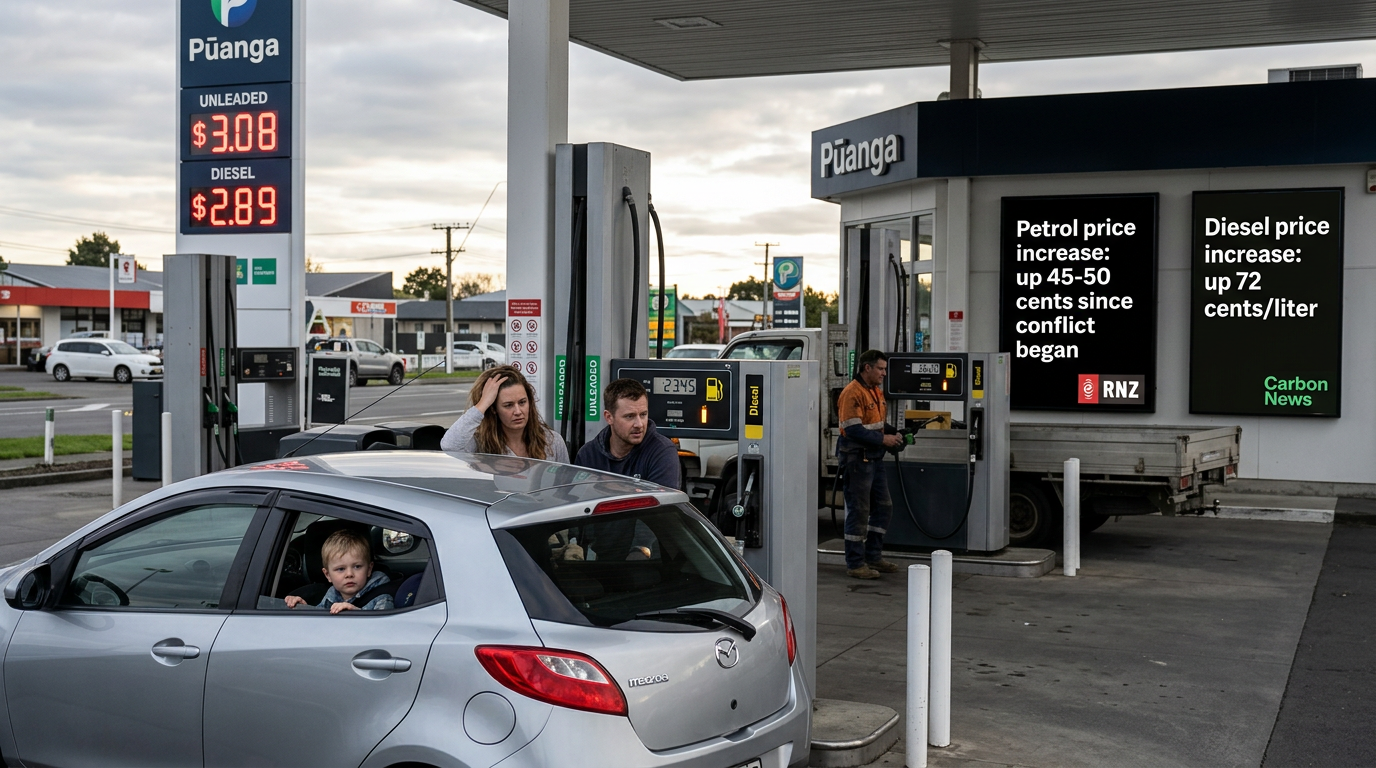
- Petrol above $3/litre — up 45–50 cents since the conflict began, adding $23 to fill an average car — RNZ
- Diesel up 72 cents/litre, adding $36 to fill an average diesel vehicle — RNZ
- Physical diesel on NZ soil: 21 days — Carbon News
- Treasury worst-case inflation forecast: 3.7% if conflict persists through end of 2026 — RNZ
- Minimum physical stockholding upgrade scheduled: July 2028 — Carbon News
- NZ's IEA emergency release contribution: six days achieved by terminating paper contracts — RNZ
- 81% of NZ refined fuel sourced through Hormuz-dependent refineries — Carbon News
- Fuel excise tax cut: ruled out — 1News
- Māori whānau disproportionately impacted — Waatea News
Kōrero Whakakapi — Conclusion: The Embers Do Not Lie

There is a whakataukī: Ko au te awa, ko te awa ko au. I am the river, the river is me. Our relationship to resources — to fuel, to food, to land, to water — is not transactional. It is existential. It is identity.
When Nicola Willis stands before the nation and tells us fuel levels are "down but not unusually so," she is not reporting data. She is performing calm for a crowd she believes will be pacified by a polished face and a confident voice. She is the colonial administrator in the finest dress, standing at the gates of the empty storehouse, smiling. The shelves behind her are bare. She is counting the dust.
This government did not create the taniwha in the Strait of Hormuz. But it dismantled every protection we had against it. It closed the refinery. It deferred the stockholding upgrade. It counted paper tickets as physical fuel. It cancelled the EV rebate — the one tool that might have insulated working people from petrol price shocks — and then used that cancellation as proof of responsible governance. It ruled out relief for whānau who cannot afford to fill their tanks. And now, when the reckoning arrives — as it always does, as the tīpuna always warned — it is smiling.
Māori whānau are not asking for charity. We are asking for kaitiakitanga. We are asking for the basic, ancient, non-negotiable obligation of those who hold power over communal resources: to protect them for everyone, not extract them for the few.
The pātaka is ash. And the people holding the matches are calling it warmth.
💡 Koha Kōrero — Support This Mahi
While Nicola Willis counts embers and calls them reserves, while Shane Jones assures his own people there is nothing to see — this platform is doing the work of standing at the actual pātaka, measuring what is really there, and refusing to smile at the smoke. Every essay costs. Every hour of verification, cross-referencing, and truth-telling is an hour this government would rather we spent in silence.
When a diesel bill rises $36 per tank and no relief comes, when paper contracts dissolve under Force Majeure and the 21-day reality hits working whānau in the pocket — someone has to name it. Every koha you make signals that rangatiratanga includes the power to fund our own truth tellers. That Māori communities will not wait for the Crown to explain the fire it started.
Kia kaha, whānau. Fill your tank — and your mind — before they tell you both are running low.
Three pathways to support this mahi:
🪔 Koha direct — Support The Māori Green Lantern via Koha
📩 Subscribe — receive essays directly: themaorigreenlantern.maori.nz
🏦 Direct bank transfer — HTDM | Account: 03-1546-0415173-000
If you cannot koha financially — no worries at all. Share this essay. Kōrero about it. Send it to your whānau watching fuel prices climb and feeling powerless. That is koha. That is rangatiratanga in action.

Research disclosure: This essay was researched and published on 18 March 2026. All citations were verified at time of publication using active web tools. Sources consulted include RNZ, 1News, Carbon News, The Spinoff, MBIE, Te Ara, New Zealand Energy Substack, and Waatea News. Where claims could not be independently verified, they have been excluded.