"The Shield They Built For Themselves: Who The Election 'Coordination Group' Is Really Designed To Protect" - 11 September 2026
They Forgot They Work For Us — So Now They're Building A Committee To Manage Our Anger Instead Of Earning Back Our Trust


I Am Ivor Jones, And I Read The Fine Print So You Don't Have To

Kia ora koutou. Ko Ivor Jones tōku ingoa. I am Te Arawa, Ngāti Pikiao, with Welsh whakapapa running through me too, and I write as The Māori Green Lantern at themaorigreenlantern.maori.nz.
A tohunga mau rākau who forgets what the taiaha is for — protecting the people, not the wielder — stops being a tohunga and becomes a threat himself.
 RNZ | Te Reo Irirangi o Aotearoa
On 10 September 2026, RNZ reported that New Zealand's government agencies are "joining forces" ahead of the 7 November election, with the Ministry of Justice hosting a new inter-agency Coordination Group that will have "strategic oversight of threats and hazards that could affect" the election (RNZ).
This essay has one focus and one focus only: that article, what it actually says, and who it is actually built to protect.
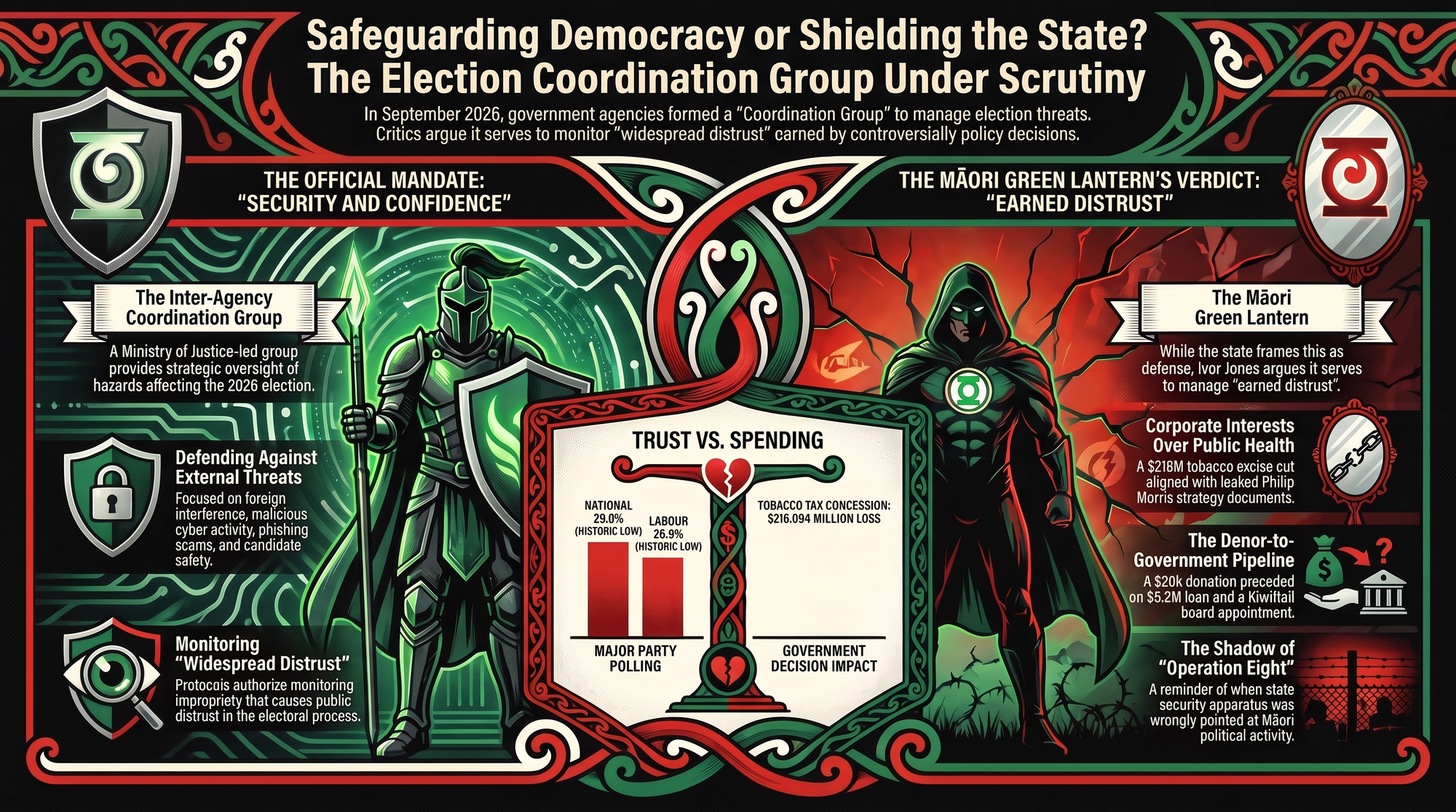
What this essay covers. I'm going to walk through exactly what the Coordination Group is and does, according to its own described mandate. I'm going to show you the specific clause inside the Electoral Commission's protocols
— about "widespread distrust of the electoral process and outcome"
— that I believe does double duty here.
And I'm going to show you, with receipts, why the public's distrust the government says it's protecting the election from is not some irrational threat to be managed. It is a rational, earned response to a political class that has spent this term serving lobbyists, not the people who are supposed to be the actual point of the exercise.
What The RNZ Article Actually Says

Chief executive Andrew Kibblewhite told RNZ that
"electoral security threats may include foreign interference, malicious cyber activity, potential threats to candidates, and election-related phishing and scams,"
adding that
"New Zealanders must have confidence the electoral process and its outcomes are fair and free from undue influence" (RNZ).
The mechanics are specific: the Coordination Group draws intelligence from the police joint intelligence group, can escalate to ODESC — the government's strategic crisis management system — and works alongside the Electoral Commission.

A senior officials committee led by the chief electoral officer guides election support activities; a risk and security working group led by the deputy chief electoral officer builds risk-management approaches. And critically, the Electoral Commission's own protocols task the police intelligence group with monitoring
"real or perceived electoral impropriety that threatens a key democratic institution by causing widespread distrust of the electoral process and outcome" (RNZ).
Read that clause again. It isn't just about foreign hackers and phishing scams. It is explicitly about monitoring anything that causes
"widespread distrust of the electoral process and outcome"

— and this government, by its own polling, is currently sitting on the single largest collapse of major-party trust ever recorded in this country, with National at 29.0% and Labour at 25.9%, both under 30% for the first time in New Zealand's history (1News).
That distrust didn't appear from nowhere. It was earned, decision by decision, and I can show you exactly how.
The Deep Dive Podcast
Listen to a lively conversation between two hosts, unpacking and connecting topics in the sources of this essay. I apologise in advance for the AI's very harsh pronounciation of reo. Please dont shoot me, :).
Youtube Video
Like video? Here is a short video suppporting the essay. Again, don't shoot the messenger please because of AI's pronounciation. :)
Koha Consideration

You might ask who is paying the Māori Green Lantern to read an inter-agency press release closely enough to find the "widespread distrust" clause buried in it, or to recalculate a tobacco tax cut down to the last thousand dollars.
The answer is you do. The Māori Green Lantern is supported through koha and that is it. There are no donors on this ledger, no lobbyists, no Dynes Transports — because that is precisely the ledger this essay is exposing. Every koha signals that whānau are ready to support the accountability that Crown and corporate structures will not provide, especially now, with an election three months out and a government building a shield instead of a case for re-earning your trust.
It signals that rangatiratanga includes the power to support our own truth tellers.
Kia kaha, whānau. Stay vigilant. Stay connected. And if you are able, consider a koha to ensure this voice continues.
If you are unable to koha, no worries! Subscribe or follow The Māori Green Lantern at themaorigreenlantern.maori.nz, kōrero and share with your whānau and friends — that is koha in itself.
Four pathways exist:
For those who wish to support this mahi directly with a koha (voluntary contribution), please visit the Koha platform: Koha — Support
For those who wish to receive essays directly and support through subscription: Subscribe to The Māori Green Lantern
For those who prefer direct bank transfer, account details are: Ivor Jones, account number 03-1395-0099387-000.
For those on Facebook: facebook.com/Themaorigreenlantern/subscribe
Why The Public's Distrust Is Not The Threat — It's The Verdict

Example One: A Tobacco Multinational Got $216 Million After Naming This Government's Coalition Partner As A Target
Core claim. Associate Health Minister Casey Costello halved excise tax on heated tobacco products against Treasury advice, after a leaked 2017 Philip Morris strategy document specifically named New Zealand First as a target for "more favourable regulation" (ODT). Independent analysis of the Ministry's own released documents found her recommendations aligned with "tobacco lobbyists' talking points" rather than official advice (Scoop).
Quantified harm. I recalculated this directly from Treasury's own operating-cost figures rather than trust a headline number: $11.295m + $44.715m + $75.999m + $84.085m across four fiscal years, summing to $216.094 million (Treasury OIA-20240675) — a figure that independently matches ODT's reported "$216 million." Treasury's own advice said the concession would "most benefit" the tobacco importer and disproportionately harm "low income, Māori and Pacific populations" (ODT).
Solution. A binding, publicly dated Auditor-General investigation into the excise decision, with results published before, not after, the next election.
Tikanga impact for the Western mind. Manaakitanga is the duty of care a person in power owes the vulnerable. A policy engineered around a tobacco lobbyist's leaked strategy document, at the direct expense of the Māori and Pacific communities who carry the heaviest smoking-related health burden, doesn't just misallocate revenue. It inverts the duty of care entirely — care flows to the corporation, not the community. When the public hears about this and loses trust, they are not malfunctioning. They are correctly reading the relationship.
Example Two: A $20,000 Donation Became An $8.2 Million Loan And A Board Seat
Core claim. Dynes Transport (Tapanui) Ltd donated $20,000 to New Zealand First in July 2024. Regional Development Minister Shane Jones then approved an $8.2 million Regional Infrastructure Fund loan to a Dynes-linked project in May 2025 — one the Fast-Track process had already rejected — and Winston Peters subsequently appointed a Dynes director to the KiwiRail board (RNZ; Bryce Edwards). I've traced this donor pipeline in fuller depth in "The Menagerie of Ministers".
Quantified harm. A 410-times return on the original donation, funded from the same Regional Infrastructure Fund that is supposed to serve every region on merit, not on donor history. Jones's defence — that the donation "was declared to the Electoral Commission and in full public view" (RNZ) — treats disclosure as a substitute for integrity, rather than the minimum precondition for it.
Solution. Mandatory statutory recusal for any Minister whose party received a donation from an applicant within the prior 24 months, enforced by the Auditor-General, not self-managed.
Tikanga impact for the Western mind. Kaitiakitanga assumes the person holding the public purse is guarding it for future generations, not selling access to whoever paid first. Every dollar diverted to a donor-linked project is a dollar not available on merit to a community with no donation to offer — disproportionately, that means rural and Māori communities without a seat at the donor table.
Example Three: A Deputy Prime Minister Mocked His Critics Instead Of Answering Them
Core claim. David Seymour ran a "Victim of the Day" series naming and mocking academics who submitted against his Regulatory Standards Bill, branding them sufferers of "Regulatory Standards Derangement Syndrome" (RNZ). Former Wellington mayor Tory Whanau formally complained this breached the Cabinet Manual's behavioural standards. Seymour's defence: "playful," "fun" (1News).
Quantified harm. Two formal Cabinet complaints, no reported sanction, and — more importantly — a chilling signal to every future select committee submitter that disagreeing with a sitting Deputy Prime Minister risks public ridicule rather than a substantive reply.
Solution. A published Public Service Commission ruling, not a private response, mandatory for any upheld Cabinet Manual behavioural complaint against a sitting Minister.
Tikanga impact for the Western mind. Mana is built through service and reciprocity, not mockery. A Minister who answers a submission with ridicule instead of argument is treating the relationship between government and citizen as adversarial theatre rather than the reciprocal duty it's supposed to be.
The Historical Precedent I Cannot Ignore

Here is the hidden connection that makes me most uneasy about the "widespread distrust" clause in the Electoral Commission's protocols.
New Zealand has been here before. In October 2007, "Operation Eight" saw 300 police officers raid homes across the country — most visibly locking down Rūātoki, home to Tūhoe, under newly granted anti-terrorism powers, over an alleged threat that never produced a single Terrorism Suppression Act conviction (Wikipedia, cross-referenced against contemporaneous reporting).
The Independent Police Conduct Authority later found the roadblocks, detentions, and searches at Ruatoki and Taneatua were "unlawful, unjustified and unreasonable" (IPCA). Police formally apologised to Tūhoe in 2014 (Ngāi Tūhoe).
I am not claiming the 2026 Coordination Group is Operation Eight. I am saying that when this country's security apparatus has previously been pointed, wrongly and unlawfully by the state's own watchdog's finding, at Māori political activity framed as a "threat," and a new mechanism is now built explicitly around monitoring "widespread distrust" of institutions this same government has personally eroded, I am not willing to assume good faith is guaranteed just because the RNZ press release says the word "impartial."
History says watch closely who the net actually catches.
What This Actually Looks Like Side By Side
| What The Coordination Group Says It Protects Against | What Is Actually Driving Public Distrust (Verified) | Who Protects Whom |
|---|---|---|
| "Foreign interference, malicious cyber activity" (RNZ) | $216.094m tobacco excise cut aligned with leaked Philip Morris strategy | The Crown's own decision, not a foreign actor |
| "Election-related phishing and scams" | $20k donation → $8.2m loan → KiwiRail board seat | A donor, not a scammer |
| "Threats to candidates" | Seymour's "Victim of the Day" mockery of named academics | A Minister targeting critics, not a candidate under threat |
| "Real or perceived electoral impropriety... widespread distrust" | Both major parties below 30% for the first time ever, after three years of the above | The electorate's own verdict, not a hostile actor's manipulation |
Rangatiratanga Does Not Need A Coordination Group To Manage It — It Needs A Government That Deserves Trust

A political class that had actually spent this term serving the public instead of donors and lobbyists would not be polling at a historic collective low three months from an election. It would not need a new "Coordination Group" whose own protocol language reaches all the way to "perceived electoral impropriety" causing "widespread distrust."
It would simply have the trust already, earned the ordinary way — by governing for the people who elected it, not for Philip Morris, not for Dynes Transport, not for whichever donor got there first.
I do not doubt that genuine foreign interference and cyber threats to this election are real, and the officials named in that RNZ article doing that specific work deserve to do it well.
What I doubt, and what I think every whānau reading this should doubt too, is any government's right to build a mechanism monitoring "distrust of the electoral process" when it is the primary author of that distrust.
Physician, heal thyself. Or in this case: Minister, disclose thyself, before you build a committee to manage the anger you earned.
Māuri Ora.

Ivor Jones — The Māori Green Lantern, Fighting Misinformation And Disinformation From The Far Right
Public Interest Statement
This essay concerns the design and stated mandate of a government inter-agency election coordination structure, and the conduct of Ministers of the Crown in their public capacity — legislative process, Cabinet conflict-of-interest disclosure, and public expenditure and tax-policy decisions — all matters of public interest attracting qualified privilege under Lange v Atkinson 1998 3 NZLR 385. The comparison drawn to Operation Eight is explicitly historical and analytical, not an allegation that the 2026 Coordination Group has behaved unlawfully; no such conduct by the current Coordination Group has occurred or been alleged at time of writing.
Disclaimer
This essay reflects analysis and opinion by Ivor Jones, The Māori Green Lantern, based on verified public reporting current as of 11 September 2026. Facts are cited to source with inline hyperlinks; opinion — including the framing of the Coordination Group's protocol language and the historical comparison to Operation Eight — is explicitly flagged as such and is not presented as proven fact or an allegation of unlawful conduct by any named current official or Minister. No malice is intended toward any named individual; this is a pattern-of-conduct analysis in the public interest.