"Two Thrones, One Cage: I Found A Trust Paying Itself More Than The Prime Minister While Your Tamariki Went Hungry" - 11 September 2026
They Built Two Palaces Out Of Your Whakapapa, Charged You Rent To Live In Them, And Called The Invoice Mana


What I'm About To Show You

Whānau,
I am Ivor Jones, The Māori Green Lantern — Te Arawa, Ngāti Pikiao, Welsh whakapapa. I investigate where power hides behind tikanga, wherever it's found, because rangatiratanga means holding our own institutions to account, not just the Crown's.
I am angry, and I want you to know exactly why before I say another word.
This essay covers three things, in this order.
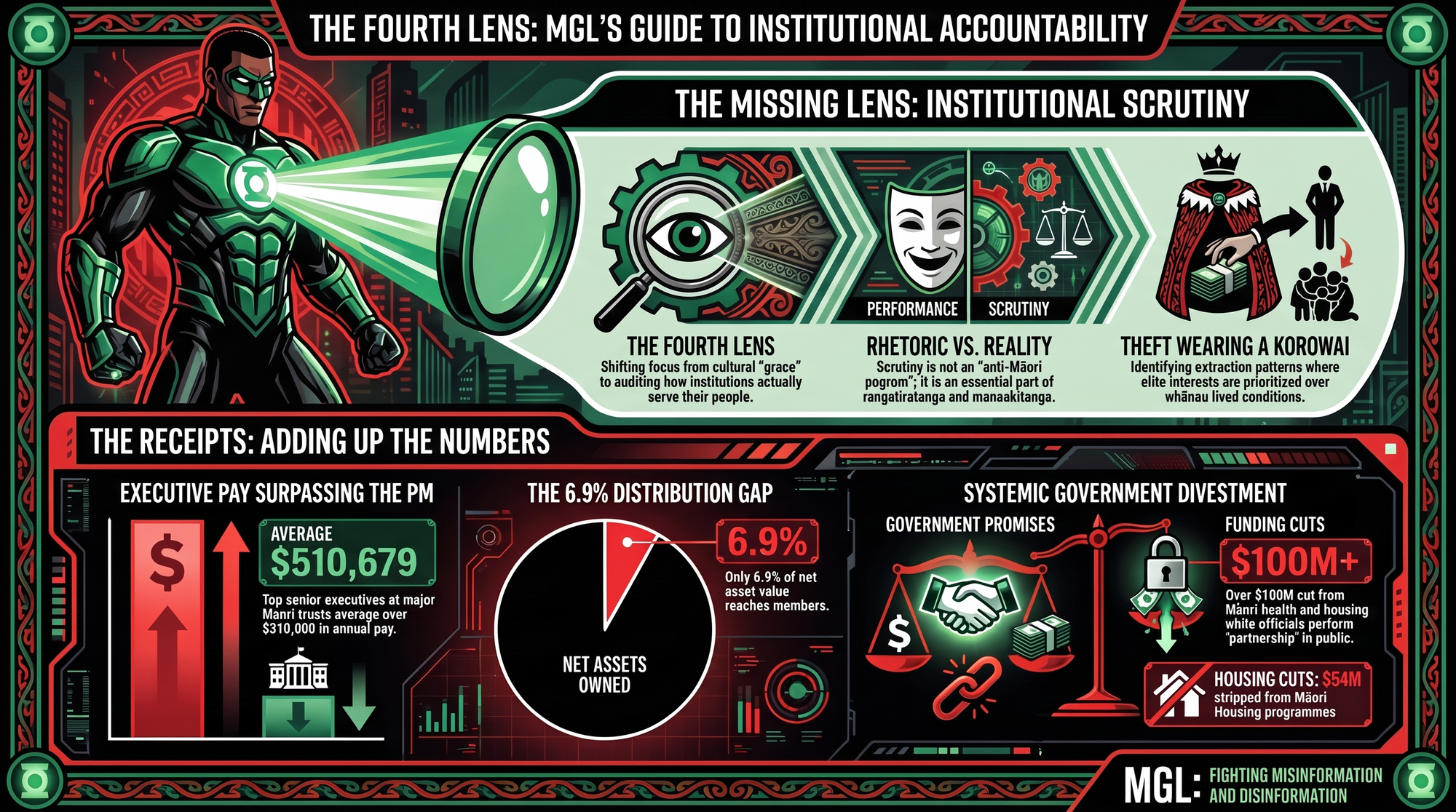
First, a charitable trust whose own filed accounts show its executives paying themselves more, on average, than the Prime Minister, in the same year its chief executive was found to have taken interest-free loans from the trust to fund his own campaigns.
Second, a 167-year-old movement built to keep colonisers off your land that now sits on a paper fortune while paying out less than seven cents on every dollar it holds.
Third, the government sitting above both of them, gutting Māori health and housing funding while calling the survivors of that gutting an "economic success story."
I will show you every number. I will show you where every number came from.
Then I will show you exactly who benefits, and exactly who starves.
No malice, stated plainly: every person named here is named in their public role — as a charity chief executive, an elected MP, a party officer, or a government minister — and every claim is backed by a regulator's own finding, a trust's own published accounts, or a government's own budget papers.
Public interest framing: this is Crown money, charitable-sector money, and Treaty-settlement money. It belongs to the public conversation, not to the boardroom (Durie v Gardiner NZCA 278).
The Post That Started This

Before the numbers, one more thing.
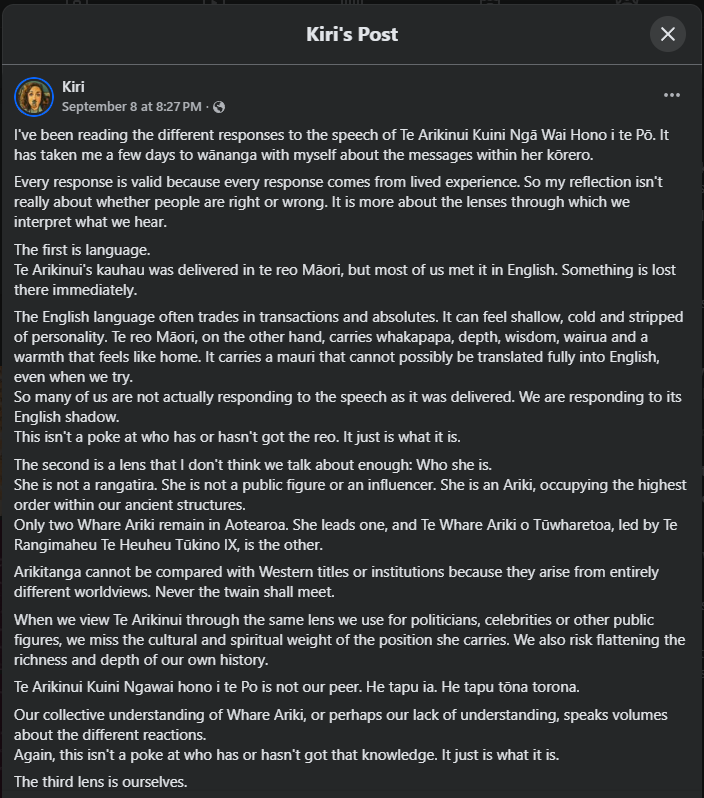
A social media reflection did the rounds this week from Kiri Tamihere-Waititi, General Manager of Te Pāti Māori, gently asking the country to slow down before judging Te Arikinui's Koroneihana kōrero
— offering three lenses: language lost in translation, the untouchable tapu of Arikitanga, and our own trauma projected onto someone else's words.
Beautifully written. Genuinely reo-literate.
And missing, entirely, on purpose or not, a fourth lens: whether the institution itself might deserve scrutiny.

That omission is not a coincidence. It is the house style of a family whose own trust, when scrutiny over executive pay and campaign loans arrived, had its chief executive call the questioning an "anti-Māori pogrom" rather than explain the numbers.
Example One For The Western Mind — The Trust That Pays Itself More Than The Prime Minister

Core claim: John Tamihere runs Te Whānau o Waipareira Trust as chief executive while serving as President of Te Pāti Māori. The trust's own filed annual report confirmed it advanced its chief executive $385,307 in interest-free loans, used to fund his 2019 Auckland mayoral bid and the 2020 general election campaign, alongside further funding directed to Te Pāti Māori's own campaign that year.
Quantified harm: In the very same reporting period this loan controversy broke, Waipareira's own filed accounts showed average pay across its 13.3 senior executives had risen by 77%, reaching an average of $510,679 a year
— making Waipareira's executive team, by an independent Herald-sourced ranking, the highest-paid charity executives in New Zealand, ahead of the University of Auckland's, and higher on average than the salary of the Prime Minister of New Zealand.
Confronted with this, Tamihere did not explain the pay rise. He called the scrutiny an "anti-Māori pogrom." Charities Services' four-year investigation into the loans concluded in July 2024 and was referred to the Charities Registration Board, which moved toward deregistering Waipareira Trust over the political donations
— not a closed matter, but an active deregistration bid still working through the system in the trust's most recent public accounts.
Solution: No charity holding a Crown service contract and a political party presidency in the same set of hands should ever be legally permitted to lend that party or its officers a single dollar
— not an interest-free loan, not an unexplained 77% pay rise.
Real-time public disclosure of executive remuneration trends alongside beneficiary service outcomes, enforced by a regulator whose deregistration threats actually land
— not one that spends four years investigating, refers the matter upward, and lets a charity keep operating while the deregistration bid grinds on."
Tikanga impact for the Western mind: Manaakitanga means you feed the person in front of you before you feed your own bank account. A charity whose executives out-earn the Prime Minister, in the same year its chief executive borrowed interest-free from the whānau-services fund to run his own campaign, is not practising manaakitanga.
Explain that to a Western auditor and they will call it a related-party governance failure. Explain it to a kaumātua and they will call it exactly what it is: theft wearing a korowai.
Related MGL coverage: This is the same extraction pattern I documented in The Gilded Waka: How the Māori Ruling Class Sailed to Buckingham Palace While Your Tamariki Went Hungry — a different family, a different building, the identical machine.
The Deep Dive Podcast
Listen to a lively conversation between two hosts, unpacking and connecting topics in the sources of this essay. I apologise in advance for the AI's very harsh pronounciation of reo. Please dont shoot me, :).
Youtube Video
Like video? Here is a short video suppporting the essay. Again, don't shoot the messenger please because of AI's pronounciation. :)
Koha Consideration

You might ask who is paying the Māori Green Lantern to trace executive pay rises, 6.9% distribution rates, and Treaty-breach findings across two elite Māori institutions and a government cutting Māori funding at the same time.
The answer is you do. This desk is supported through koha and that is it. There is no line of corporates or party machines lavishly supporting Ivor to do this — there are no corporates behind this mahi, which is exactly why it can name the ones that are behind theirs.
Every koha signals that whānau are ready to support the accountability that Crown and corporate structures will not provide. It signals that rangatiratanga includes the power to support our own truth tellers.
Kia kaha, whānau. Stay vigilant. Stay connected. And if you are able, consider a koha to ensure this voice continues.
If you are unable to koha, no worries. Subscribe or follow the Māori Green Lantern at themaorigreenlantern.maori.nz, kōrero and share this with your whānau and friends — that is koha in itself.
Four pathways exist:
For those who wish to support this mahi directly with a koha (voluntary contribution): Koha — Support
For those who wish to receive essays directly and support through subscription: Subscribe to the Māori Green Lantern
For those who prefer direct bank transfer: Ivor Jones, account number 03-1395-0099387-000.
For those on Facebook: The Māori Green Lantern
Example Two For The Western Mind — The Movement That Forgot Its Own Purpose

Core claim: The Kīngitanga was raised in 1858 to stop the Crown from stealing your land. Its commercial arm, Tainui Group Holdings, now sits on an asset base built from the 1995 Raupatu settlement plus $220 million in additional Crown top-ups, with $20,852 in net assets sitting on paper against every one of its roughly 96,000 members.
Quantified harm: In 2024, Waikato-Tainui distributed just $138 million to its beneficiaries. Multiply $20,852 by 96,000 members and you get roughly $2.00 billion in total member-equivalent net assets.
Divide $138 million by $2.00 billion and you get 6.9% — not quite seven cents distributed for every dollar the tribe supposedly owns.
In 2020, an internal report found Te Arataura raised its own honoraria by $15,000 and doubled its own meeting fees while distributions to actual members were falling, prompting a former CFO to call the whole structure "an autocracy."
Solution: Publish, every year, one number: the percentage of total net assets actually distributed to members. Not buried in a consultancy PDF. On the front page of the annual report, next to executive remuneration, so every beneficiary can see exactly what their "growing Māori economy" bought them this year.
Tikanga impact for the Western mind: Whanaungatanga is not a balance sheet. It is the obligation between generations to hand down more than paperwork.
A trust structure that grows richer on paper every year while its own members' lived conditions do not move is not honouring whakapapa — it is laundering neglect through an accountant.
Related MGL coverage: I traced this exact pattern of electoral and institutional capture, using the Kīngitanga's mana as political cover, in He Hinaki Māori: The Trap Woven in Silk Feathers, where Labour used the Kīngitanga's blessing in a byelection while quietly dropping the condition attached to it.
Example Three For The Western Mind — The Government Cutting Māori Off At The Knees While Applauding The Fund

Core claim: While these two institutions performed unity at Waitangi and Rātana, the National-led coalition government disestablished Te Aka Whai Ora, the Māori Health Authority, under urgency in February 2024
— a decision the Waitangi Tribunal itself found breached Treaty principles including tino rangatiratanga, partnership, and active protection, ruling that Māori were never properly consulted.
Quantified harm: Budget 2025 cut $20 million from the Māori Development Fund, $33 million from Māori housing, and ended the Whai Kāinga Whai Oranga Māori Housing Programme entirely, a further $54 million gone.
Hauora Māori services received an increase of less than 1% in real terms
— a cut once inflation is counted — on top of a health system where Māori-specific funding already sat at just 3% of the total operational health budget in 2024.
This is the same government whose Finance Minister stood at Rātana months later and praised the Māori Queen's "economic vision."
Solution: Every Treaty-relations announcement, every Rātana appearance, every ministerial photo op with Māori leadership should be required to carry a public, simultaneous disclosure of that same government's current Māori-specific funding trend line. No praise without the receipts sitting next to it.
Tikanga impact for the Western mind: This is a government dismantling the very institutions built to correct a documented history of unequal treatment, while performing partnership in public
— a pattern this desk names plainly as neoliberal in method and, in its documented, Tribunal-confirmed disregard for Māori consultation and welfare, indistinguishable in outcome from the racial hierarchies it claims to have moved past.
The Waitangi Tribunal's own finding of a Treaty breach, and the quantified funding cuts above, are the evidence; the characterisation of the pattern is this essay's judgement.
Related MGL coverage: The same government-and-iwi-elite performance of unity is unpacked in He Hinaki Māori, where I traced how political parties borrow Kīngitanga mana at election time while the underlying material conditions for Māori don't move an inch.
Who Eats, Who Doesn't

Named in their public capacities only, evidenced by regulator-referenced filings and their own institutions' published figures:
John Tamihere (CEO, Waipareira Trust; President, Te Pāti Māori); Rawiri Waititi (Co-leader, Te Pāti Māori); Kiri Tamihere-Waititi (General Manager, Te Pāti Māori); Waikato-Tainui's Te Arataura executive; and the ministers of the current coalition government whose budget papers are cited above.
Every one of them gains prestige, funding, or political cover from a system that, on its own filed numbers, pays its executives more than the Prime Minister in one house and returns 6.9 cents on the asset dollar in the other
— while cutting tens of millions from the Māori families with the least capacity to absorb it.
Kōrero Whakamutunga — Two Thrones, One Cage

I am not attacking a young Ariki still learning her role, and I am not attacking anyone's whakapapa.
I am attacking a machine that has learned to wear whakapapa as a disguise.
Two elite families, two "unity" institutions, one government cutting the ground out from under all of it while cashing in the photo opportunities
— and every single number above came from their own filed accounts, their own regulators, and their own budget papers.
Nobody needs to invent a conspiracy when the receipts are already public. They just need someone to actually add them up.
Kia kaha, whānau. Two thrones, one cage — and the only people who were never invited into either one are the ones paying for both.

Disclaimer: This essay is opinion and analysis grounded in cited, verifiable sources current as of publication date, including Waitangi Tribunal findings, Waipareira Trust's own Charities Register filings as reported by Te Ao Māori News, published iwi accounts, and government budget papers. Facts are attributed to their reporting source; opinions — including the essay's characterisation of government policy as neoliberal and its impact as harmful to Māori — are explicitly flagged as opinion, with the factual basis for that opinion stated alongside it. This is not a finding that any named individual acted unlawfully beyond what the cited regulator findings and reporting establish.