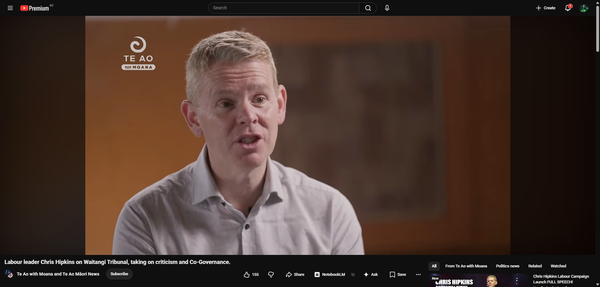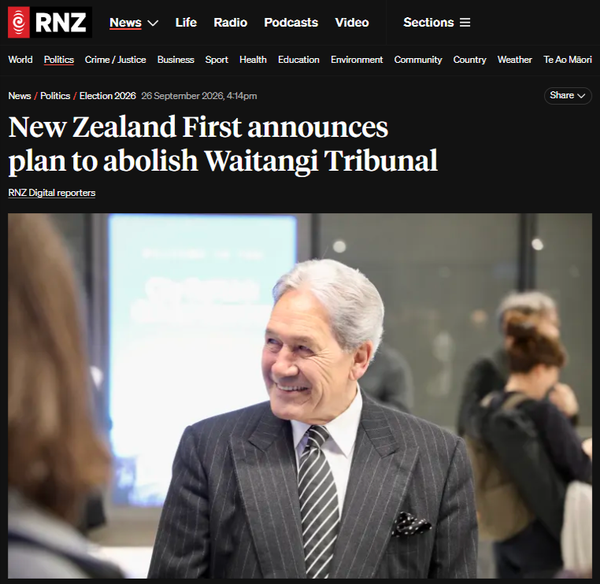
"The Ten-Point Con Job Has A Whakapapa" - 27 September 2026
National Is Not Promising A New Direction—It Is Asking Permission To Intensify The Damage

I am Ivor Jones, The Māori Green Lantern.
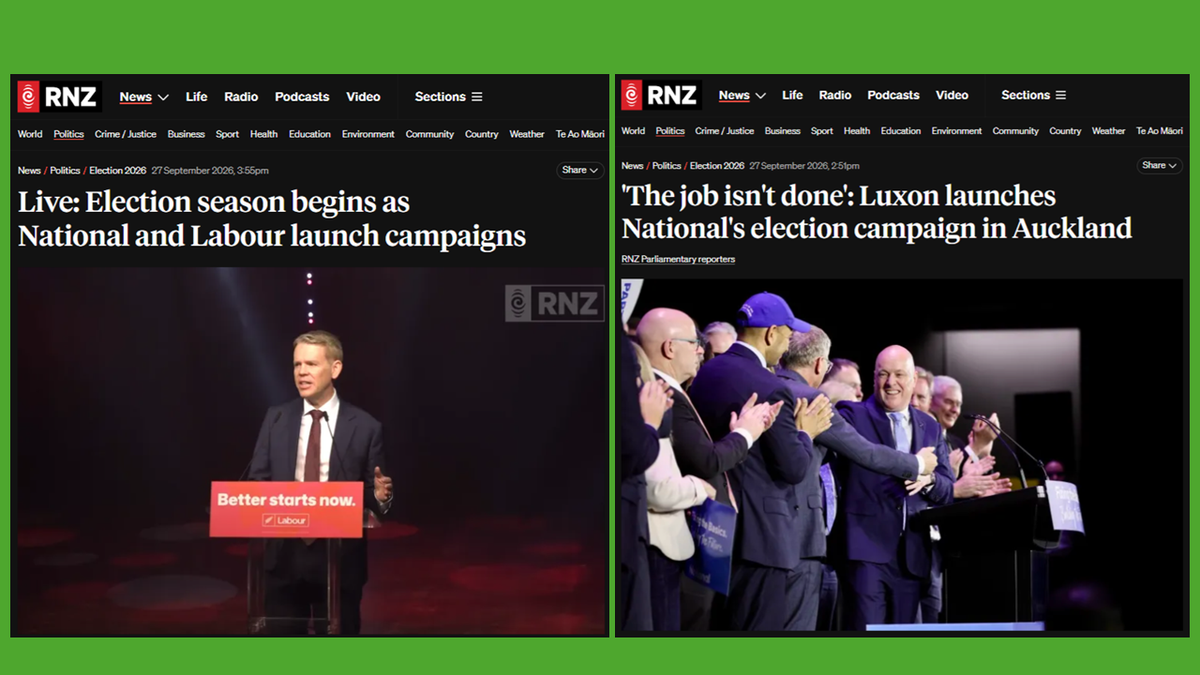
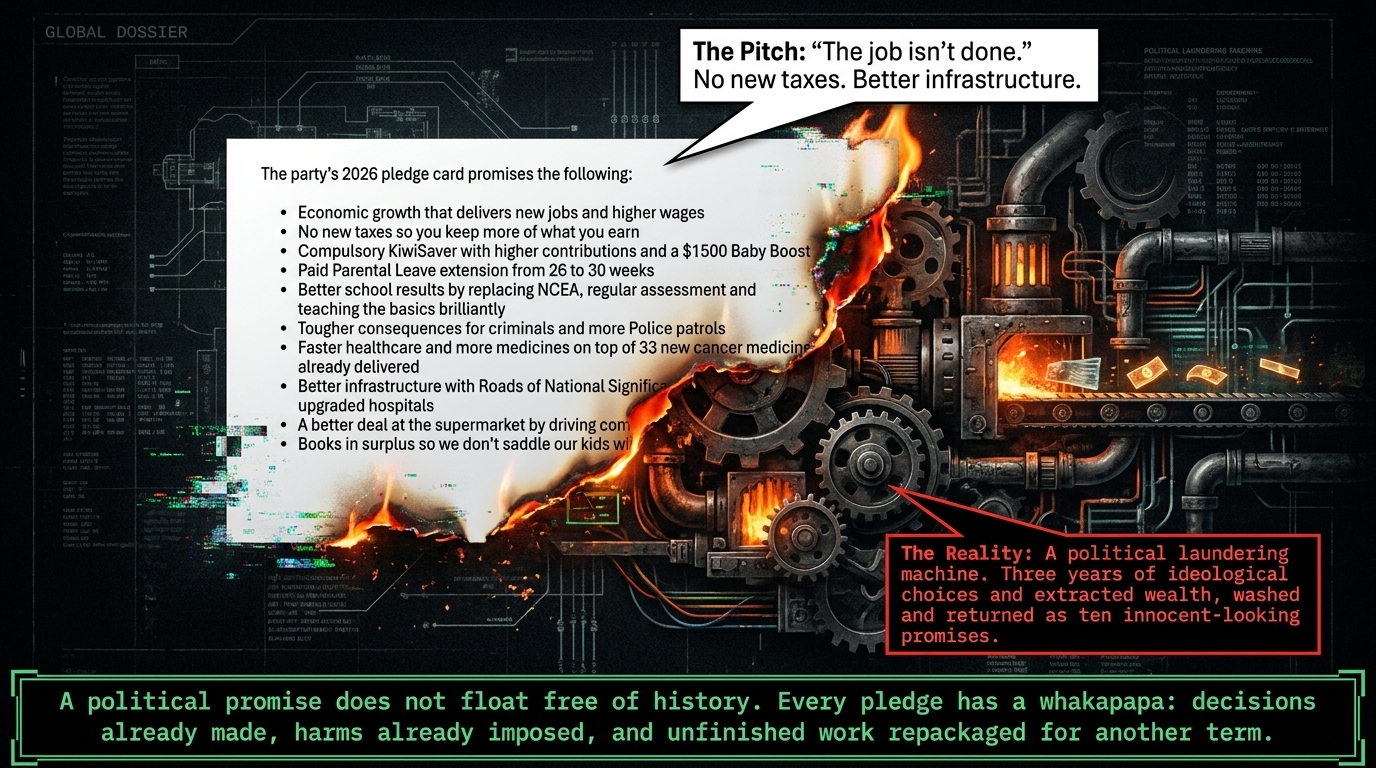
When Christopher Luxon holds up a ten-point pledge card and says, “The job isn’t done,” I do not examine only what is printed on the card. I follow the whakapapa of every promise.
 RNZ | Te Reo Irirangi o Aotearoa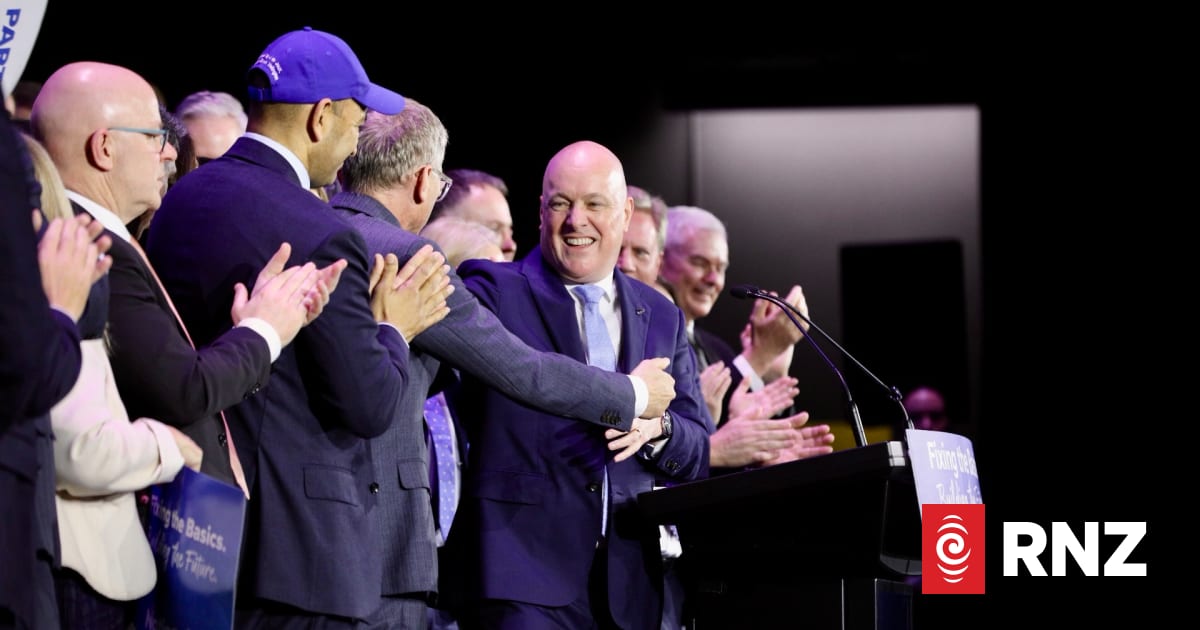
I ask what National has already done with power. I ask who received the money, who lost authority, whose evidence was ignored, and whose suffering was reduced to a communications inconvenience. Then I place the promised sequel beside the first term.
That is Tika: are National’s claims accurate?
That is Pono: do its actions match its words?
That is Tikanga: did its government preserve mana, recognise whakapapa, respect wairua, involve whānau and return people to wellbeing?
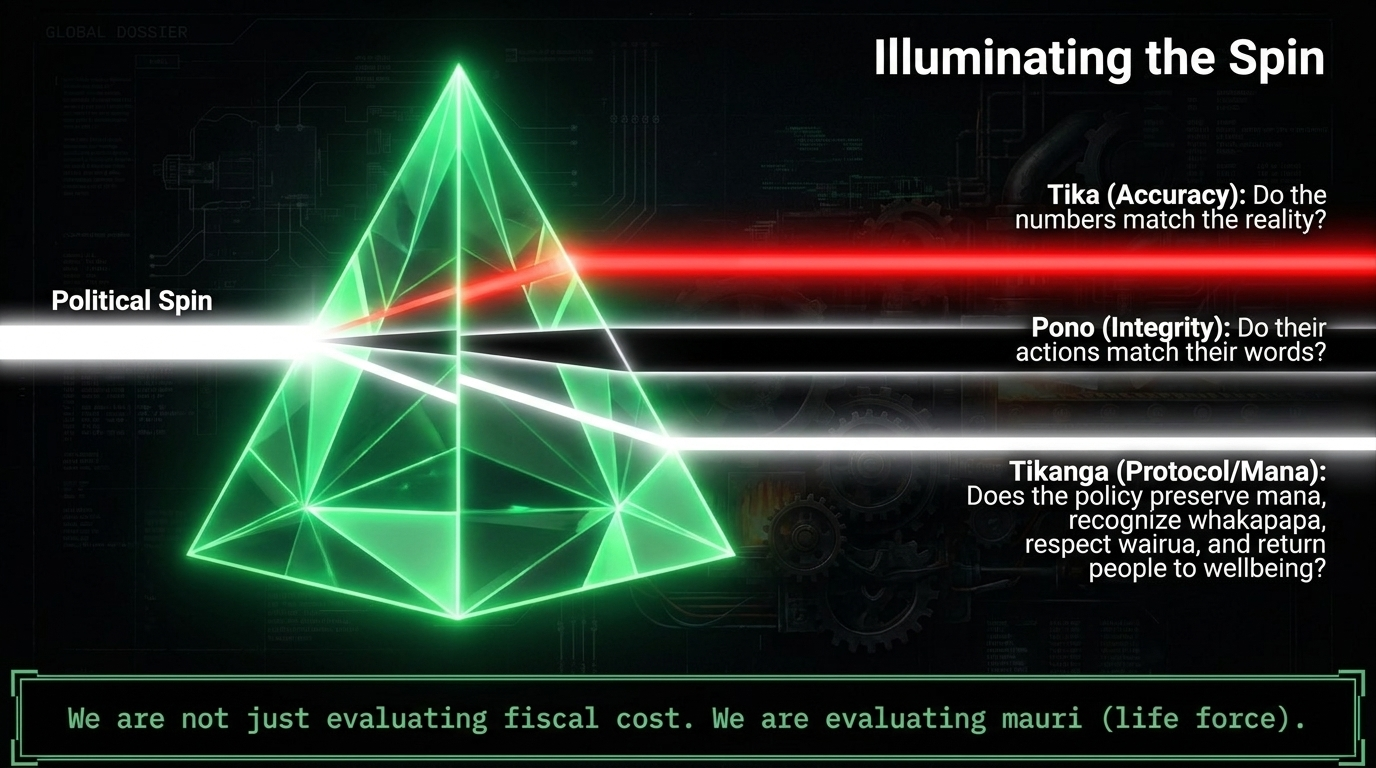
On those tests, National’s pledge card is not a plan. It is a political laundering machine. It washes three years of ideological choices, strips away their consequences and returns them to voters as ten innocent-looking promises.
 RNZ | Te Reo Irirangi o Aotearoa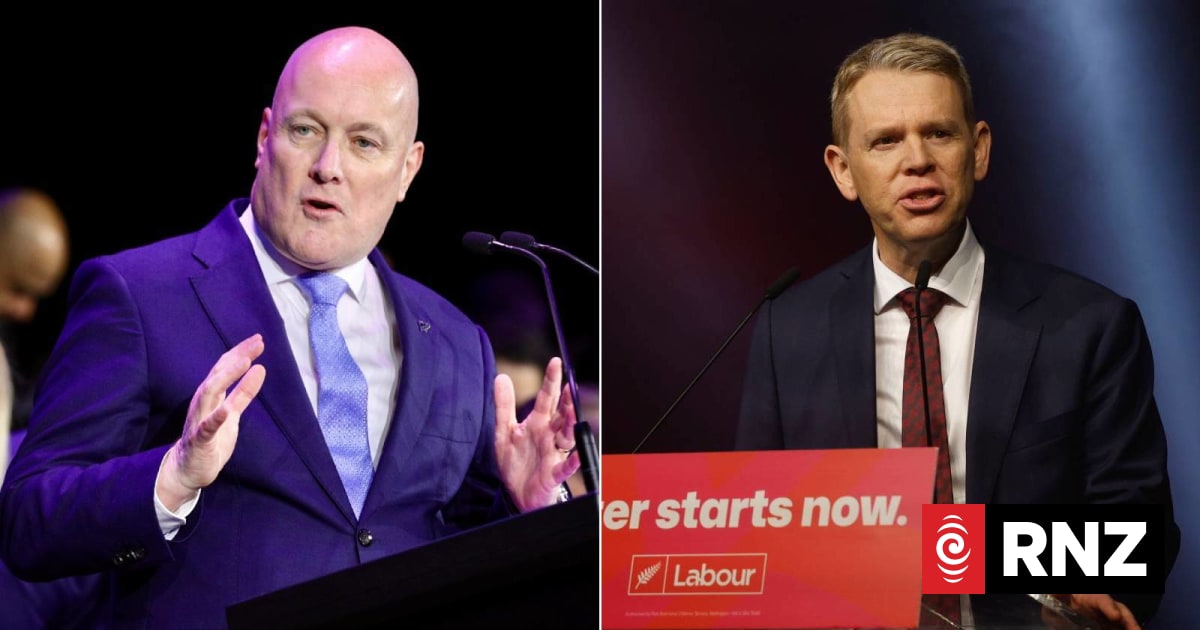
Labour offers more repair than National, particularly in primary healthcare, prescriptions, public transport and supermarket regulation. But Labour still works inside a neoliberal fence built around fiscal restraint, private ownership and Crown control.
The Greens cross that fence. Their programme changes who pays, who owns essential infrastructure, who exercises authority and what government exists to protect. That is why National, Labour and the Greens cannot honestly be presented as three shades of the same political product.
Point One: “Economic Growth That Delivers New Jobs And Higher Wages”
What National Has Already Done
National has made economic growth the altar before which every other public value must kneel. It has reduced the public-service workforce, promoted extractive development, accelerated consenting, prioritised roads and promised still more austerity in the name of “efficiency.” The government subsequently proposed reducing the core public service to around 55,000 employees by 2029, potentially eliminating approximately 8,700 positions.Te Ao Māori News reported the proposed public-service reduction and its impact on Māori-focused functions.
Yet by June 2026, unemployment stood at 5.6%, quarterly GDP growth had slowed from 0.9% to 0.2%, and median hourly earnings had risen 2.7% while annual CPI inflation reached 4.1%.Stats NZ reported the unemployment rate, the GDP slowdown and the earnings figures.
The real hourly-earnings calculation is approximately negative 1.35%. National can chant “higher wages” until the stage lights melt, but when prices rise faster than median hourly earnings, purchasing power retreats.
What National Is Promising
National is promising that another dose of its growth strategy will eventually produce jobs and higher wages. It does not define on the pledge card how much growth, how many jobs, how large the wage increase, by what date, or how the benefits will be distributed.
That is not an accountable commitment. It is a desired outcome written as though it were a delivery mechanism.
Labour’s Position
Labour promises construction programmes, apprenticeships, public-service repair and a return to surplus under its own fiscal rules.Labour’s Start Work Now policy outlines its proposed construction and employment programme, while its fiscal strategy retains conventional debt and surplus limits.
Labour would direct more growth through public investment than National, but it still treats fiscal credibility as something awarded by the same institutions that have normalised scarcity.
The Green Difference
The Greens connect employment to liveable incomes, union power, public investment and a just transition. They propose annual minimum-wage increases that at least match inflation, a living wage across publicly funded employment, stronger collective bargaining and tens of thousands of sustainable jobs.The Green Party’s Workforce Rights manifesto sets out its wage and bargaining programme, while its Income manifesto proposes liveable incomes and progressive taxation.
National asks whether economic activity increased. The Greens ask whether whānau became secure, whether workers gained power and whether the whenua survived the growth.
Tikanga Verdict: National’s model depletes mauri when employment becomes insecure, public capability is stripped and growth is separated from collective wellbeing. Green policy is more mauri-enhancing because it links economic activity to dignity, ecological survival and shared power.
Confidence: Verified on the published statistics and policies. Opinion: National’s growth pledge is too vague to be independently measured from the pledge card alone.
The Deep Dive Podcast
Listen to a lively conversation between two hosts, unpacking and connecting topics in the sources of this essay. I apologise in advance for the AI's very harsh pronounciation of reo. Please dont shoot me, :).
Youtube Video
Like video? Here is a short video suppporting the essay. Again, don't shoot the messenger please because of AI's pronounciation. 😄
Koha Consideration: Supporting The Taiaha That Follows Power Back To Its Source
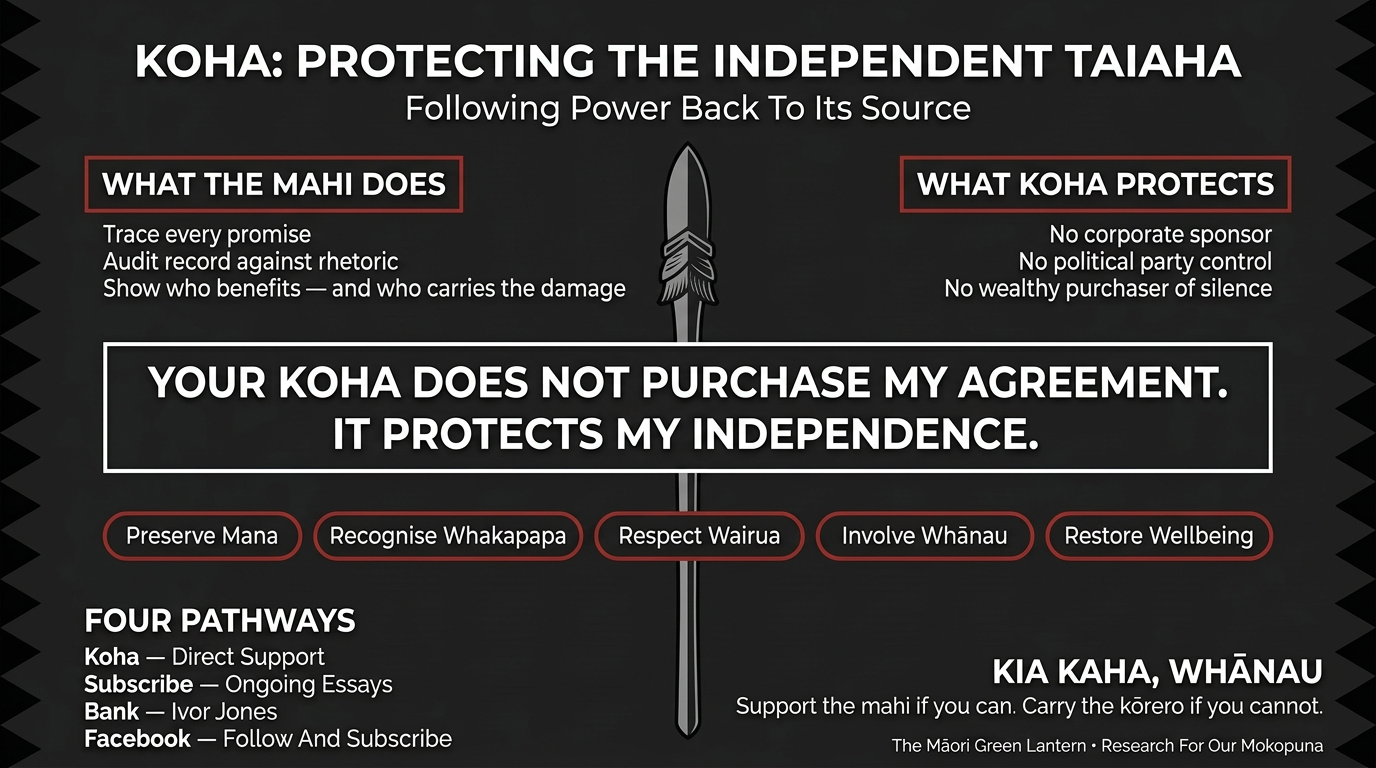
You might ask who pays The Māori Green Lantern to take National’s ten-point pledge card apart, trace the whakapapa of every promise, audit the numbers, compare the record with the rhetoric, and show whānau who benefits—and who is expected to carry the damage.
The answer is simple: you do, through koha.
There is no queue of corporate benefactors supporting this mahi. No property lobby. No supermarket duopoly. No political party paying me to soften the analysis. No wealthy sponsor purchasing silence when the evidence becomes uncomfortable.
That independence matters. National can spend millions polishing an old neoliberal programme into ten shiny campaign promises. Labour can offer repair without dismantling the machinery that produced the damage. The Māori Green Lantern follows the money, tests the promises against the record, and asks whether each policy preserves mana, recognises whakapapa, respects wairua, involves whānau and returns our people to wellbeing.
Every koha says that whānau refuse to leave political accountability to the same Crown and corporate structures being examined. It says rangatiratanga includes the power to support our own researchers, writers and truth-tellers.
Your koha does not purchase my agreement. It protects my independence.
Kia kaha, whānau. Stay vigilant. Stay connected. If you are able, please consider a koha to support this voice, sharpen this taiaha of evidence and preserve this research as a repository for our mokopuna.
If you cannot contribute financially, kāore he raruraru—no worries. Subscribe to or follow The Māori Green Lantern, kōrero about this kaupapa, challenge the political sales pitch, and share the evidence with your whānau and friends. That is koha too.
Four Pathways Exist
- Koha — Direct Support: Make a voluntary contribution through the verified Koha platform. The platform identifies Ivor Jones as the organiser and confirms that contributions go to a verified Westpac account.[app.koha]
- Subscribe — Essays And Ongoing Support: Subscribe to The Māori Green Lantern and receive future investigations directly.
- Direct Bank Transfer: Ivor Jones — 03-1395-0099387-000.
- Facebook: Follow and subscribe to The Māori Green Lantern on Facebook.
Kia kaha, whānau. Stay vigilant. Stay connected. Support the mahi if you can—and help carry the kōrero if you cannot.
Point Two: “No New Taxes So You Keep More Of What You Earn”
What National Has Already Done
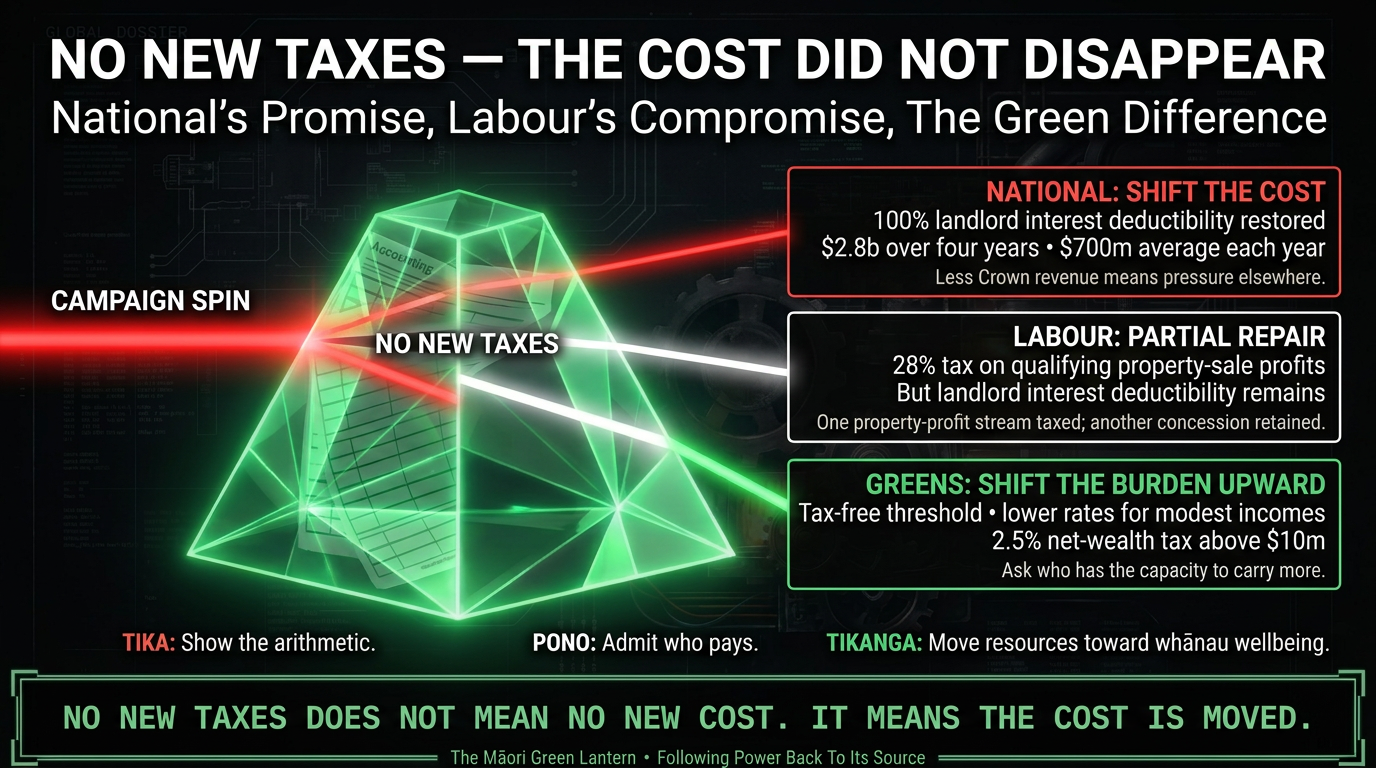
National adjusted income-tax thresholds, restored full residential-property interest deductibility and shortened the bright-line test. Interest deductibility alone was forecast to remove approximately $2.8 billion from Crown revenue over four years—an average of $700 million annually.RNZ reported the forecast cost, while Inland Revenue confirms that landlords can deduct 100% of eligible interest from 1 April 2025.
National says this allows people to keep more of what they earn. That statement conceals the distributional question: which people, earning money through which assets, receive the greatest benefit?
When the Crown abandons $700 million of average annual revenue through one property concession, somebody else pays through reduced services, delayed infrastructure, higher user charges or debt. “No new taxes” does not mean no new cost. It means the cost is moved somewhere less visible.
What National Is Promising
National promises no new taxes while also promising infrastructure, hospitals, classrooms, policing, parental leave, KiwiSaver subsidies and a surplus. Those commitments may be reconcilable, but the pledge card does not show the arithmetic.
Labour’s Position
Labour proposes a 28% tax on profits arising after 1 July 2027 when commercial or investment property is sold, subject to exemptions including the family home, farms, shares, KiwiSaver, inheritances and business assets.Labour’s Medicard policy explains the proposed capital-gains tax and exemptions.
However, Labour has also decided not to reverse National’s restoration of landlord interest deductibility.RNZ reported that decision and the $2.8 billion forecast revenue effect.
Labour is therefore trying to tax one stream of property profit while leaving another substantial property concession intact.
The Green Difference
The Greens propose a tax-free income threshold, lower rates for low- and middle-income earners, a higher top income-tax rate and a 2.5% tax on net wealth above $10 million.The Green Party’s Income manifesto publishes those commitments.
That is structurally different from National’s refusal to raise new revenue and broader than Labour’s targeted property-gains tax. It shifts the argument from whether taxation exists to who has accumulated enough wealth to carry more of the collective burden.
Tikanga Verdict: Tika requires transparent arithmetic. Pono requires politicians to admit that revenue cuts reduce collective capacity. Tikanga requires resources to circulate towards whānau wellbeing instead of accumulating around existing wealth.
Point Three: “Compulsory KiwiSaver, Higher Contributions And A $1,500 Baby Boost”
What National Has Already Done
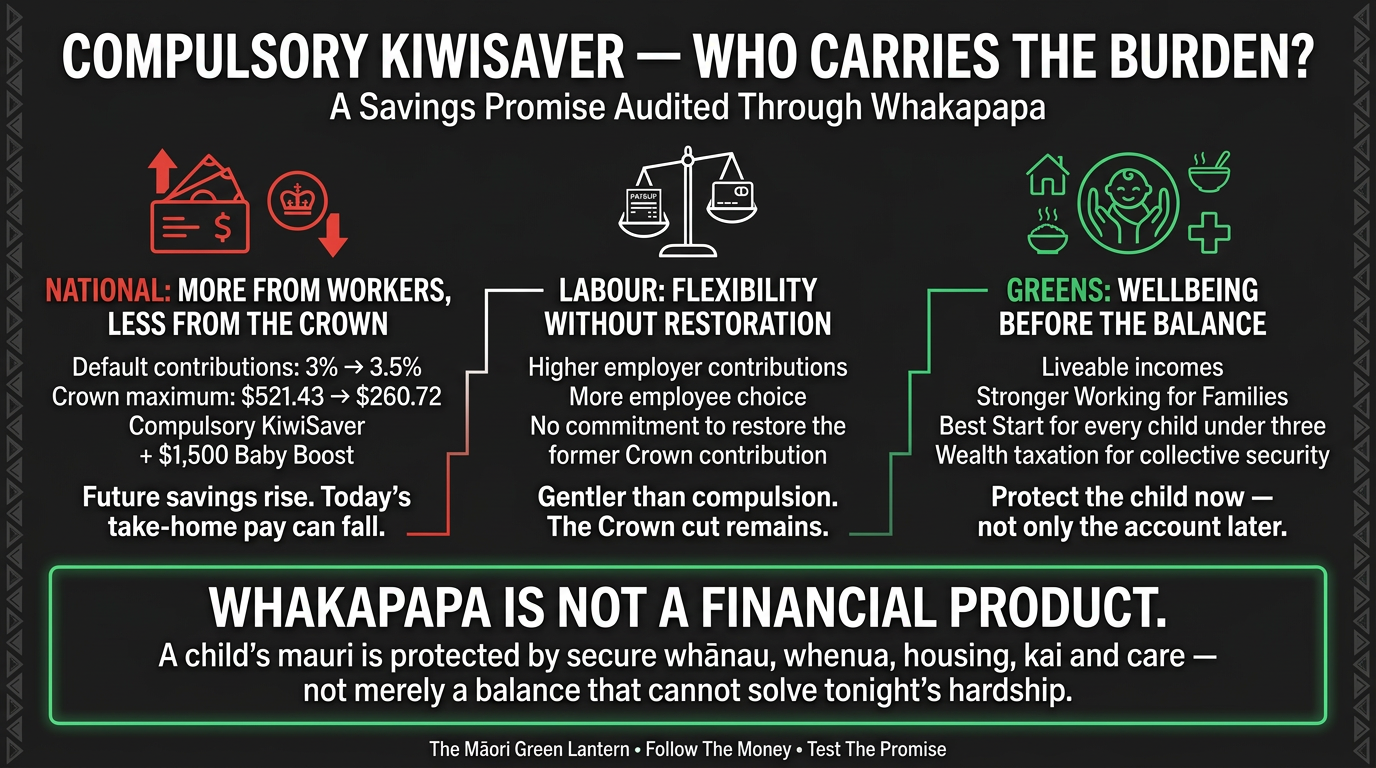
National increased default employee and employer KiwiSaver contributions from 3% to 3.5%, with 4% scheduled from April 2028.Inland Revenue confirms the contribution timetable.
At the same time, it halved the maximum annual government contribution from $521.43 to $260.72.Inland Revenue confirms the reduced matching rate and maximum, while RNZ records Labour’s refusal to restore the former amount.
National therefore made workers and employers contribute more while making the Crown contribute less. That is the whakapapa hidden behind “higher contributions.”
What National Is Promising
National now wants compulsory KiwiSaver and a $1,500 Baby Boost. The Baby Boost may help build a child’s first savings, but it does not pay today’s rent, grocery bill, doctor’s fee or power account.
Compulsory saving can grow future wealth. It can also reduce present take-home pay for workers already trapped between stagnant real earnings and high living costs. The pledge does not resolve that tension.
Labour’s Position
Labour proposes lifting employer contributions while preserving greater employee flexibility, but it has not committed to reversing National’s cut to the government contribution.RNZ reported that Labour’s package omitted restoration of the former Crown contribution.
Labour is gentler on present take-home pay than compulsion, but it accepts National’s reduced Crown contribution.
The Green Difference
The Greens begin earlier than retirement-account design. They propose liveable benefits, stronger Working for Families support, a universalised Best Start payment for children under three and wealth taxation to finance collective security.The Green Party’s Income manifesto details its income programme, while its Children manifesto proposes expanding Best Start to every child under three.
National offers a savings account to a newborn. The Greens ask whether that newborn has a warm home, kai, healthcare, safe whānau income and public services now.
Tikanga Verdict: Whakapapa is not a financial product. A child’s mauri is protected by secure whānau, whenua, housing, kai and care—not merely a balance that cannot solve tonight’s hardship.
Point Four: “Paid Parental Leave From 26 To 30 Weeks”
What National Has Already Done
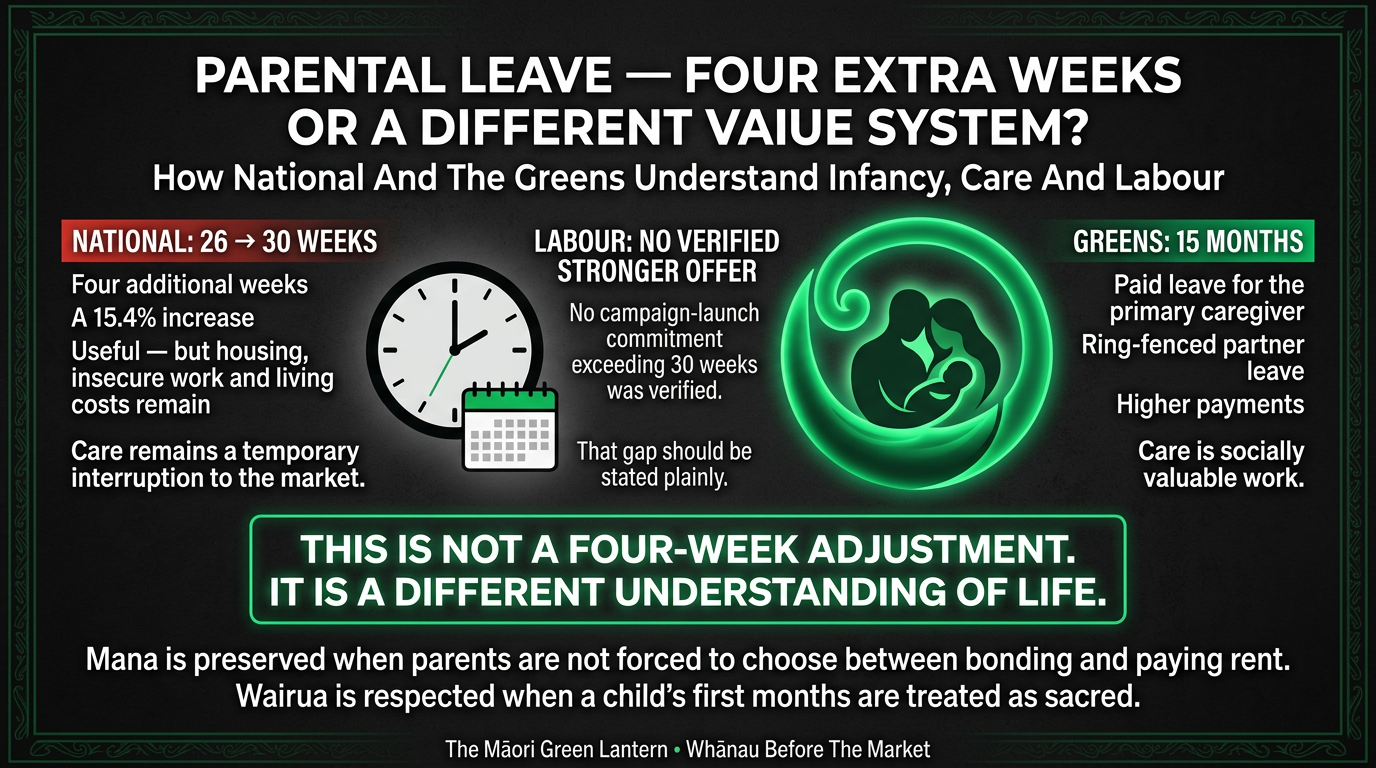
National inherited a 26-week paid-parental-leave system and has retained it through its first term.Employment New Zealand confirms the current 26-week entitlement.
What National Is Promising
National proposes four additional weeks—a 15.4% increase in duration. That is useful. Whānau would gain more time with a newborn, and that deserves acknowledgement.
But National’s wider economic programme matters. Four extra weeks do not cancel out unaffordable housing, insecure employment, childcare costs or the pressure produced by a reduced real wage.
Labour’s Position
No equivalent Labour commitment exceeding National’s 30-week proposal could be verified in the campaign-launch material examined. That should be stated plainly rather than concealed by partisan enthusiasm.
The Green Difference
The Greens propose increasing paid parental leave to 15 months for the primary caregiver, providing additional ring-fenced leave for partners and increasing payments.The Green Party’s Workforce Rights manifesto contains the full commitment.
This is not a four-week adjustment. It is a different understanding of infancy, care and labour.
National treats parental care as a temporary interruption to market participation. Green policy treats the first stages of life as socially valuable work worthy of sustained public support.
Tikanga Verdict: Mana is preserved when parents are not forced to choose between bonding and paying rent. Wairua is respected when the first months of a child’s life are treated as sacred, not as an inconvenient gap in labour supply.
Point Five: “Better School Results By Replacing NCEA”
What National Has Already Done
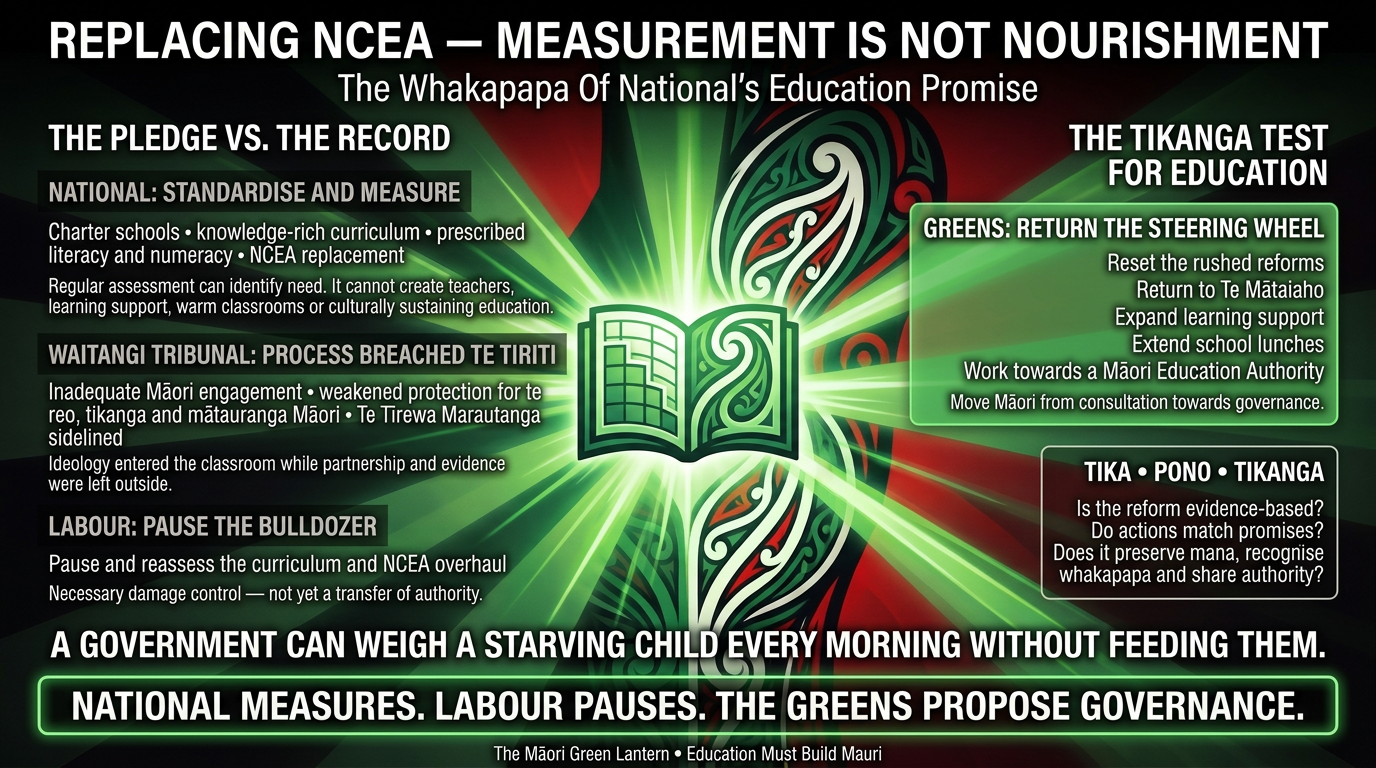
National established charter-school legislation, advanced a knowledge-rich curriculum, increased prescribed literacy and numeracy teaching, and began replacing NCEA.National’s own review of its first legislative programme lists charter schools, while the academic review of NCEA reform records the government’s replacement consultation.
The Waitangi Tribunal found that the curriculum process breached partnership, active protection, equity and good-government obligations. It found inadequate engagement with Māori, reduced protection for te reo, tikanga and mātauranga Māori, sidelining of Te Tīrewa Marautanga and insufficient evidence that the preferred model would reduce inequity.The Waitangi Tribunal publishes the specific findings and recommendations.
That is not a minor procedural complaint. It is the Crown’s constitutional watchdog saying the government entered the classroom carrying ideology while leaving partnership and evidence outside.
What National Is Promising
National now promises to finish replacing NCEA, increase regular assessment and teach the basics “brilliantly.” Regular assessment can identify need, but assessment does not create teachers, learning-support staff, warm classrooms or culturally sustaining education.
Measurement is not nourishment. A government can weigh a starving child every morning without feeding them.
Labour’s Position
Labour proposes pausing National’s curriculum and NCEA overhaul.RNZ reported Labour’s commitment to halt and reassess the reforms.
That is necessary damage control. It is not yet the same as transferring authority.
The Green Difference
The Greens propose resetting what they call the government’s rushed and ideological reforms, returning to the original direction of Te Mātaiaho, expanding learning support, extending school lunches and working towards a Māori Education Authority governing and financing Māori-medium and kaupapa Māori education.The Green Party’s Education manifesto contains those commitments.
Labour pauses the bulldozer. The Greens propose returning part of the land and the steering wheel.
Tikanga Verdict: National’s process failed to recognise whakapapa and diminished Māori authority. Green policy more clearly protects mana because it moves Māori from consultation towards governance.
Point Six: “Tougher Consequences For Criminals And More Police Patrols”
What National Has Already Done
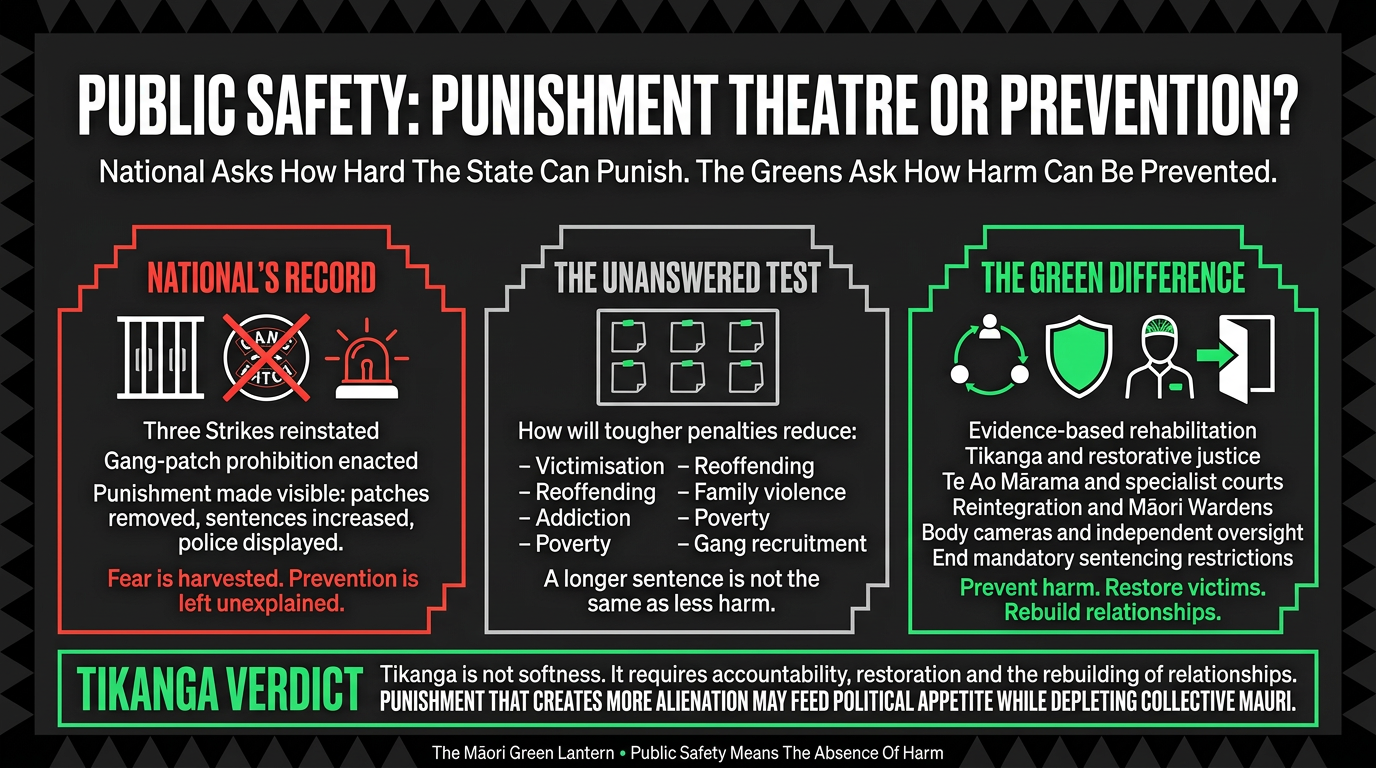
The coalition reinstated the three-strikes regime, covering serious violent and sexual offending, and enacted its gang-patch prohibition.The Ministry of Justice confirms that three strikes returned in June 2025, while National identifies the Gangs Act among its first-term achievements.
National’s preferred political technology is punishment made visible: patches removed, sentences increased, police displayed and fear harvested.
That does not mean serious offending should be excused. It means a serious government must distinguish accountability from theatre and prevention from vengeance.
What National Is Promising
National promises tougher consequences and more patrols. It does not say on the pledge card how these measures will reduce victimisation, reoffending, addiction, family violence, poverty or the recruitment of traumatised rangatahi into gangs.
Labour’s Position
Labour’s launch messaging did not place a fully developed restorative-justice alternative at its centre. That omission leaves National free to define public safety as the length of a sentence rather than the absence of harm.
The Green Difference
The Greens propose evidence-based rehabilitation, tikanga and restorative justice, expansion of Te Ao Mārama and specialist courts, stronger reintegration support, increased Māori Warden resourcing, police body cameras, stronger independent oversight and abolition of three strikes and other mandatory sentencing restrictions.The Green Party’s Justice And Community Safety manifesto sets out those policies.
National asks how severely the state can punish after harm. The Greens ask how communities can prevent harm, hold people accountable, rehabilitate offenders and restore victims.
Tikanga Verdict: Tikanga is not softness. It requires accountability, restoration and the rebuilding of relationships. Punishment that manufactures more alienation may satisfy political appetite while depleting collective mauri.
Point Seven: “Faster Healthcare And More Medicines”
What National Has Already Done
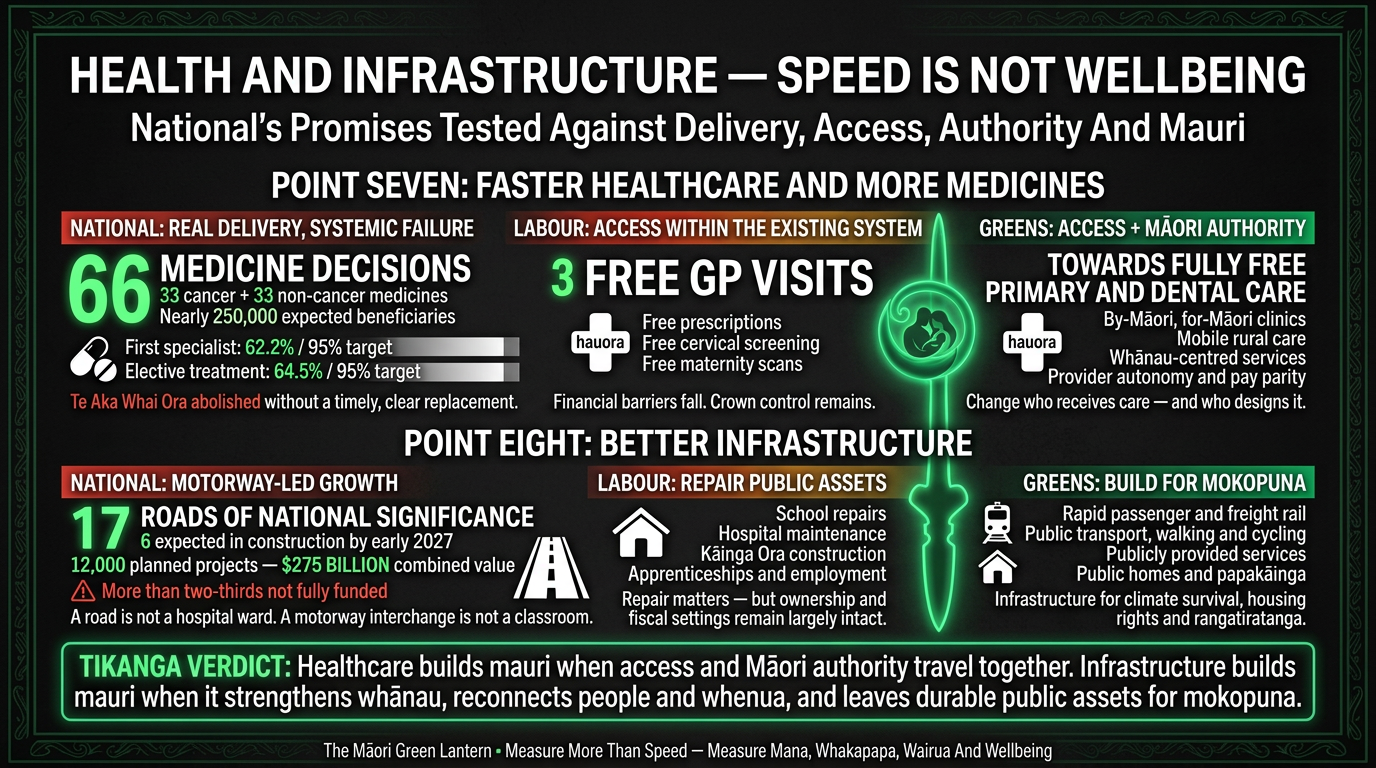
The government provided additional funding that Pharmac used to fund or widen access to 33 cancer and 33 non-cancer medicines.Pharmac reports 66 medicine decisions and nearly 250,000 expected beneficiaries.
That is real delivery. It should not be denied merely because the government responsible for it has caused harm elsewhere.
But medicines are only one part of healthcare. The government’s own Māori Health Strategy reported first-specialist performance at 62.2% against a 95% target and elective-treatment performance at 64.5% against the same target.The Māori Health Strategy records those figures.
The same government disestablished Te Aka Whai Ora. The Waitangi Tribunal found that the Crown had no timely, clear replacement plan, failed to undertake meaningful consultation, failed to recognise tino rangatiratanga and failed to take meaningful action towards Māori health equity.The Waitangi Tribunal’s official release records those findings.
What National Is Promising
National promises faster healthcare and more medicines. The question is whether speed will be produced by workforce capacity, accessible primary care and Māori authority—or merely another target pasted onto an exhausted system.
Labour’s Position
Labour proposes three free GP visits annually, free prescriptions, free cervical screening and maternity scans, financed through its targeted property-gains tax.Labour’s Medicard policy details the GP programme and financing, while its prescription policy gives the proposed start date and cost.
That would remove genuine financial barriers. But universal access does not automatically create Māori authority over Māori health.
The Green Difference
The Greens propose working towards fully free publicly delivered primary and dental care, including by-Māori, for-Māori community clinics. They also propose less prescriptive funding for hauora Māori providers, mobile rural services, whānau-centred pā harakeke services, workforce pay parity and prevention-focused care.The Green Party’s Health manifesto publishes those commitments.
Labour offers three free visits inside the existing architecture. The Greens aim to remove the fee barrier and alter who designs and delivers care.
Tikanga Verdict: National failed the mana, whakapapa, whānau and rangatiratanga tests when it destroyed a Māori health institution without a clear replacement. Labour improves access. Green policy comes closest to combining access with Māori-led delivery.
Point Eight: “Better Infrastructure”
What National Has Already Done
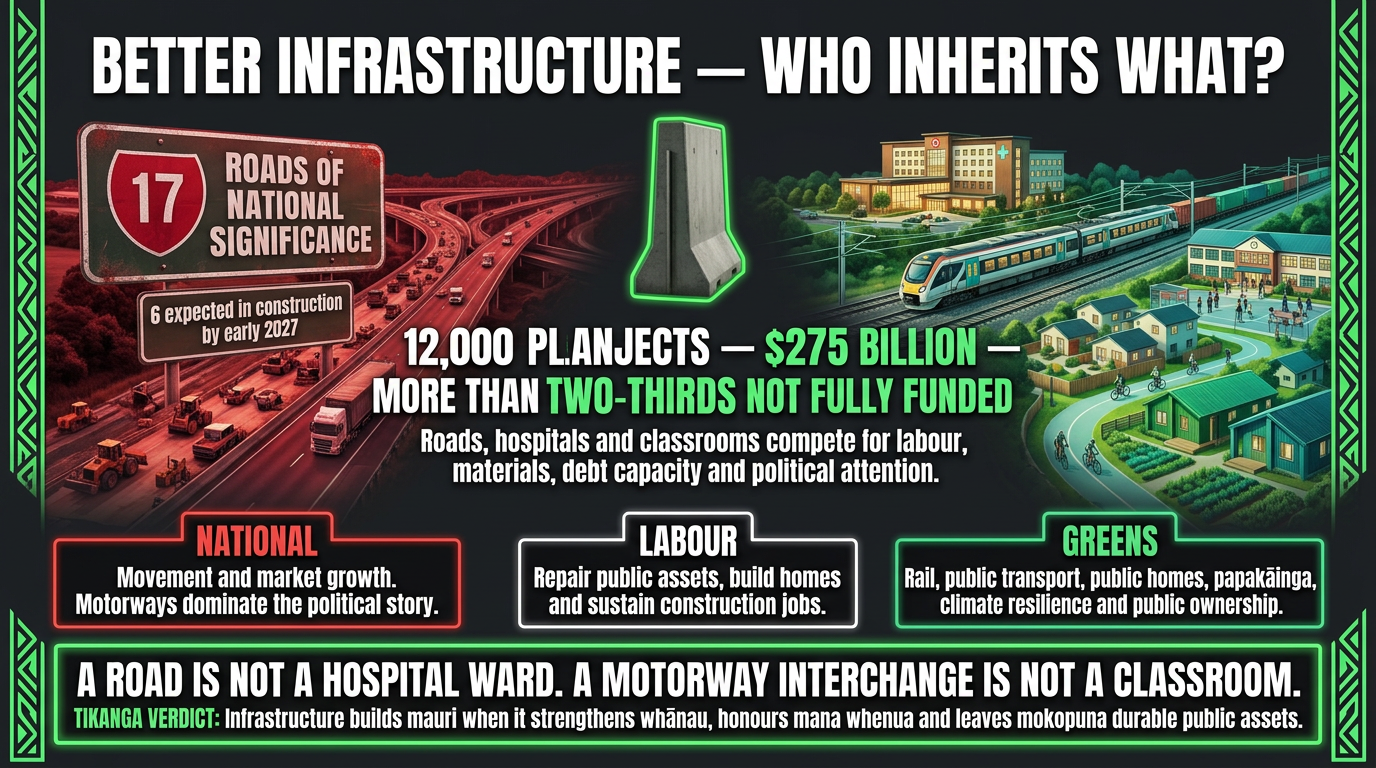
National established a programme containing 17 Roads of National Significance and says six will have entered construction by early 2027.The Infrastructure Minister described the programme and construction timetable.
The independent Infrastructure Commission identified approximately 12,000 planned projects worth a combined $275 billion, with more than two-thirds not fully funded. It also warned that the proposed road and rapid-transit programme exceeded likely long-term revenue.1News reported the Commission’s findings and affordability warning.
National has also funded classrooms and hospital upgrades. The problem is not that roads, schools or hospitals are unnecessary. The problem is prioritisation, sequencing and who bears the opportunity cost when motorway politics consumes limited capital.
What National Is Promising
The pledge card groups roads, classrooms and hospitals together beneath one comforting phrase: “better infrastructure.” But these projects compete for labour, materials, debt capacity and political attention.
A road is not interchangeable with a hospital ward. A classroom is not interchangeable with a motorway interchange. Combining them on one pledge line conceals the choices.
Labour’s Position
Labour’s Start Work Now programme prioritises school repairs, hospital maintenance, Kāinga Ora construction and apprenticeships.Labour’s published Start Work Now policy describes the proposed programme.
Labour uses public construction as counter-cyclical employment and asset renewal. That is materially different from National’s heavy motorway emphasis, but it still leaves major infrastructure ownership and fiscal settings substantially unchanged.
The Green Difference
The Greens propose mass rapid transit, nationwide rapid passenger and freight rail, free or subsidised public transport for specified groups, safe walking and cycling routes, public provision of transport services, tens of thousands of public homes and more papakāinga on Māori land.The Green Party’s Transport manifesto sets out its transport programme, while its Housing manifesto contains its public-housing and papakāinga commitments.
National builds infrastructure to accelerate movement and market growth. Labour uses construction to repair public assets and employment. The Greens connect infrastructure to climate survival, housing rights, public ownership and rangatiratanga.
Tikanga Verdict: Infrastructure builds mauri when it strengthens communities, reduces pollution, reconnects people and whenua, and leaves durable public assets. It depletes mauri when development overrides mana whenua and transfers environmental costs to mokopuna.
Point Nine: “A Better Deal At The Supermarket”
What National Has Already Done
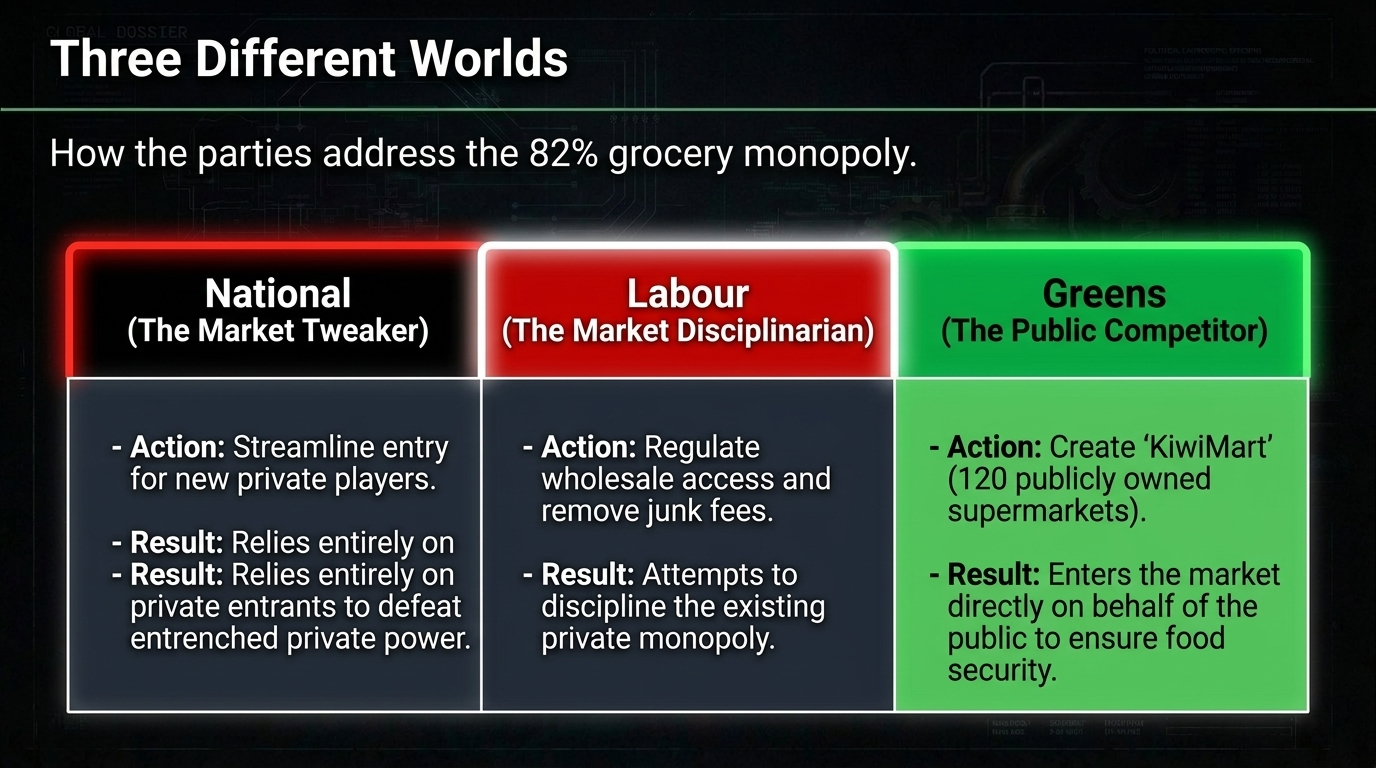
National ran an investor-information process, developed enforcement, regulatory and structural workstreams, increased proposed penalties and created streamlined approval routes for new supermarkets.MBIE details those government actions.
Yet the Commerce Commission found little observable change in the main competition measures, with the major grocery retailers retaining 82% of the national market.The Commerce Commission’s 2025 Annual Grocery Report documents the continuing concentration.
National has therefore had activity without demonstrated structural transformation.
What National Is Promising
National promises to “drive competition.” It has considered structural separation, but its launch pledge does not specify what intervention will occur, when it will occur or how lower prices will be measured.
Labour’s Position
Labour proposes independently operated wholesale arms for Foodstuffs and Woolworths, guaranteed wholesale access for smaller competitors, removal of restrictive contracts and a prohibition on specified junk fees.Labour’s Fairer Grocery Prices policy provides the detailed mechanisms.
That is more specific than National’s pledge and directly targets wholesale control.
The Green Difference
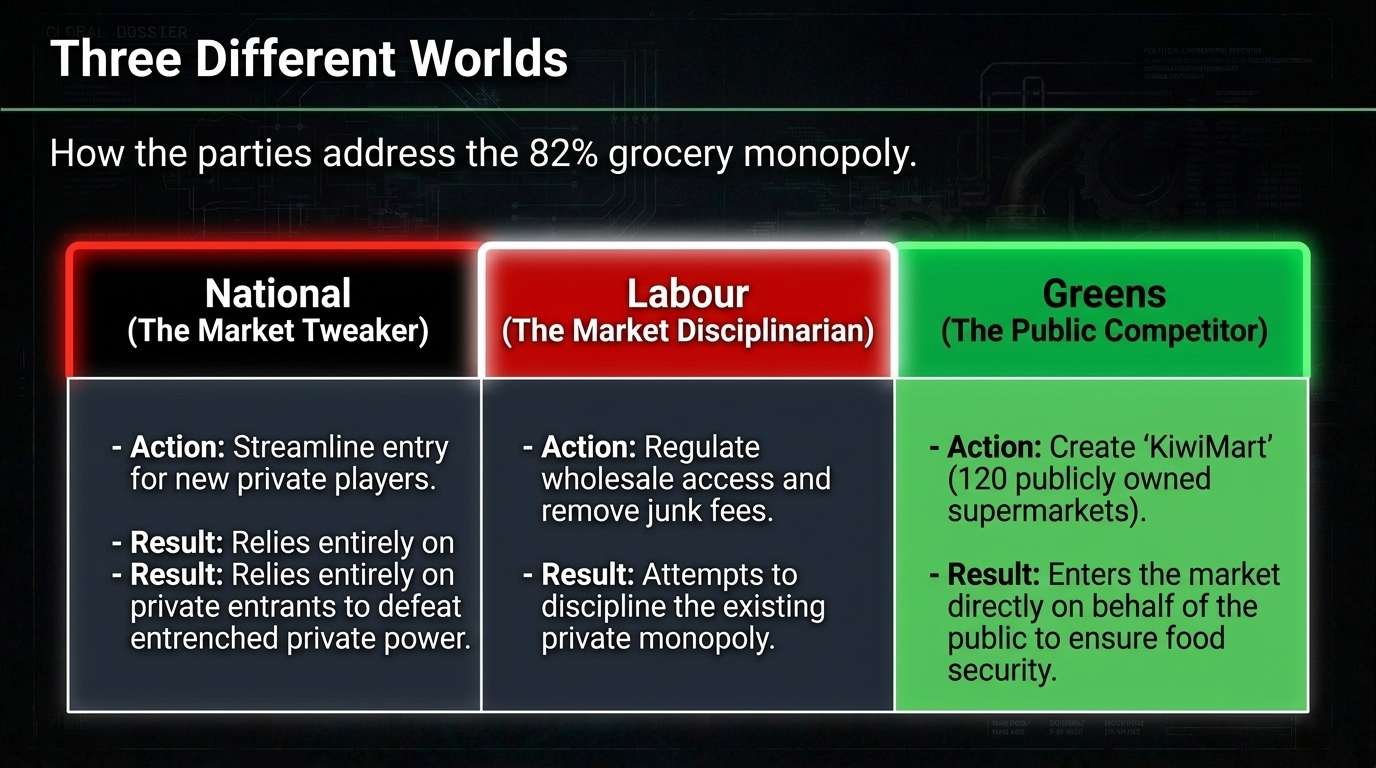
The Greens propose creating KiwiMart, a publicly owned chain of 120 supermarkets.1News reported the Green, Labour and National options side by side.
National wants to coax more private competition into the market. Labour wants to regulate and separate private wholesale power. The Greens want the public to own a competitor.
That is the cleanest illustration of the ideological divide. National adjusts the market. Labour disciplines the market. The Greens enter the market on behalf of the public.
Tikanga Verdict: Kai is not merely a commodity. Food security affects mana, whānau health and the ability to manaaki others. A system that permits concentrated private power over essential kai depletes mauri.
Point Ten: “Books In Surplus”
What National Has Already Done
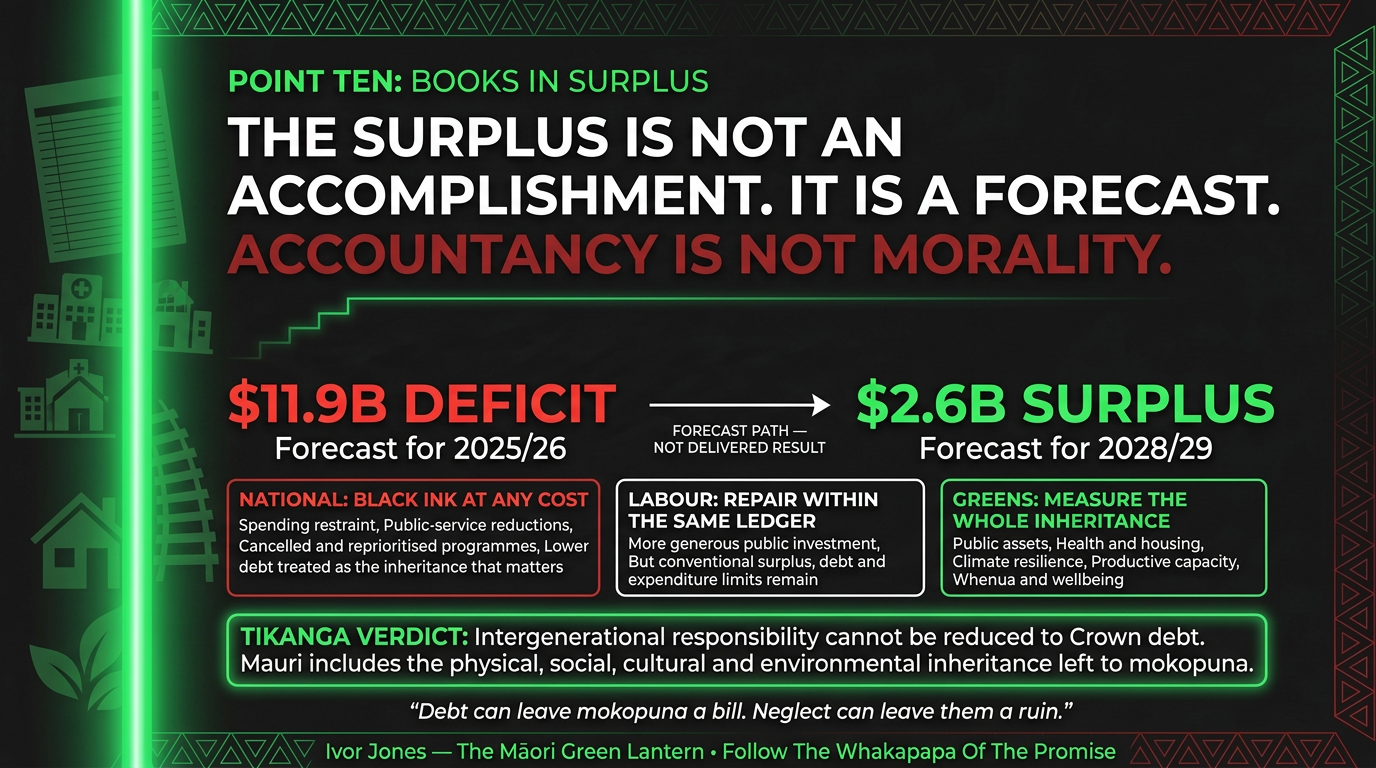
Budget 2026 forecast an OBEGALx deficit of approximately $11.9 billion for 2025/26 and a $2.6 billion surplus in 2028/29.BDO’s Budget 2026 analysis records the forecast path, while Deloitte records the government’s intended return to surplus and rising near-term debt.
A surplus is therefore a forecast destination, not a first-term accomplishment.
National has pursued this destination through expenditure restraint, public-service reductions, programme cancellation and reprioritisation. It then presents the surplus as protection for children while reducing some of the public capability those children will inherit.
What National Is Promising
National promises surplus so future generations will not carry new debt or taxes. That framing assumes debt is inherited harm but deteriorating hospitals, inadequate housing, depleted public institutions and climate damage are not.
That is accountancy pretending to be morality.
Debt incurred to enrich private interests can deplete mauri. Debt used prudently to build hospitals, rail, housing, clean energy and resilient communities can leave mokopuna valuable assets. The number alone does not answer the ethical question.
Labour’s Position
Labour also promises a return to surplus and imposes conventional debt and expenditure limits on itself.Labour’s Fiscal Strategy publishes those commitments.
Labour would distribute public spending more generously, but it still seeks approval from the same narrow fiscal framework.
The Green Difference
The Greens propose reforming public finance so fiscal decisions account for long-term resilience, productive capacity, health and wellbeing. They pair that reform with progressive income and wealth taxation.The Green Party’s Public Services manifesto explains its public-finance approach, while its Income manifesto identifies the proposed revenue base.
National asks whether the Crown’s annual ledger reached black ink. The Greens ask what condition the Crown, society, infrastructure, climate and whenua will be in when the ledger is handed to the next generation.
Tikanga Verdict: Intergenerational responsibility cannot be reduced to Crown debt. Mauri includes the physical, social, cultural and environmental inheritance left to mokopuna.
Three Examples For The Western Mind
Example One: Retirement Savings
National’s action: Increase worker and employer contributions while halving the maximum Crown contribution.
National’s promise: Make KiwiSaver compulsory and add $1,500 for newborns.
Quantified effect: The maximum Crown contribution fell by $260.71 annually, a 50% reduction, while the default worker contribution increased by 16.7% from 3% to 3.5%.Inland Revenue confirms both changes.
Western-policy explanation: The state shifts more responsibility from collective provision to individual wage deductions.
Tikanga impact: Whānau carry more of the immediate burden while the Crown retreats. Future saving is strengthened, but present mana may be weakened if compulsory deductions leave less for kai, rent and power.
Green solution: Secure liveable income first, strengthen family support, tax extreme wealth and then enable long-term saving without manufacturing present deprivation.The Green Party’s Income policy sets out that alternative.
Example Two: Māori Health
National’s action: Disestablish Te Aka Whai Ora without a timely, clear alternative plan.
National’s promise: Faster healthcare.
Quantified harm: The health system was 32.8 percentage points short of its first-specialist target and 30.5 percentage points short of its elective-treatment target.The Ministry of Health’s Māori Health Strategy provides the source figures.
Western-policy explanation: The government removed an institution designed to address a recognised structural failure, then substituted general system settings and performance targets.
Tikanga impact: Māori mana and rangatiratanga were diminished because Māori lost institutional authority and were not meaningfully involved in designing the replacement. Whakapapa, wairua and whānau wellbeing were subordinated to central Crown control.The Waitangi Tribunal reached those findings.
Green solution: Fully free primary and dental care, by-Māori for-Māori delivery, less prescriptive funding and stronger Māori decision-making.The Green Party’s Health policy provides that direction.
Example Three: Supermarkets
National’s action: Streamline entry and investigate structural interventions.
National’s promise: Drive competition.
Quantified harm: The dominant groups still hold 82% of the national grocery market, leaving only 18% outside their combined control.The Commerce Commission reports that concentration.
Western-policy explanation: National relies primarily on private entrants defeating entrenched private power. Labour regulates wholesale access. The Greens create a public competitor.
Tikanga impact: Concentrated control over kai weakens whānau resilience, limits manaakitanga and treats food security as a profit-extraction opportunity.
Green solution: Establish 120 publicly owned KiwiMart supermarkets while supporting local and community enterprise.1News reports the KiwiMart proposal.
Why The Three Parties Are Not Comparable
| Governing Question | National | Labour | Greens |
|---|---|---|---|
| Who should carry more economic risk? | Individuals and households | Shared more evenly through targeted public programmes | Wealth holders, large corporations and the state carry more collective responsibility |
| Who should own essential services? | Primarily private markets with state regulation | Mixed public-private delivery | Expanded public and community ownership |
| What is poverty policy? | Employment, tax restraint and targeted assistance | Public-service relief and targeted redistribution | A guaranteed liveable income and structural redistribution |
| What is health reform? | Targets, medicines and centralised delivery | Free visits and prescriptions within the existing system | Free primary and dental care with Māori-led delivery |
| What is education reform? | Standardisation, assessment and NCEA replacement | Pause and repair | Reset, inclusion and movement towards Māori educational authority |
| What is justice? | Punishment, patrols and sentence escalation | A less punitive version of conventional state justice | Prevention, rehabilitation, tikanga and restoration |
| What is supermarket reform? | Encourage private competition | Regulate and separate private wholesale power | Create a publicly owned competitor |
| What is Te Tiriti? | A constraint frequently subordinated to coalition policy | A partnership obligation administered by the Crown | A foundation for redistributing decision-making authority |
| What is fiscal responsibility? | Surplus, spending restraint and lower taxation | Public repair inside orthodox fiscal limits | Long-term wellbeing, public investment and progressive taxation |
| What do mokopuna inherit? | Lower projected debt but diminished public capacity and continuing ecological risk | Repaired services but largely unchanged governing architecture | Public assets, climate action and expanded rangatiratanga |
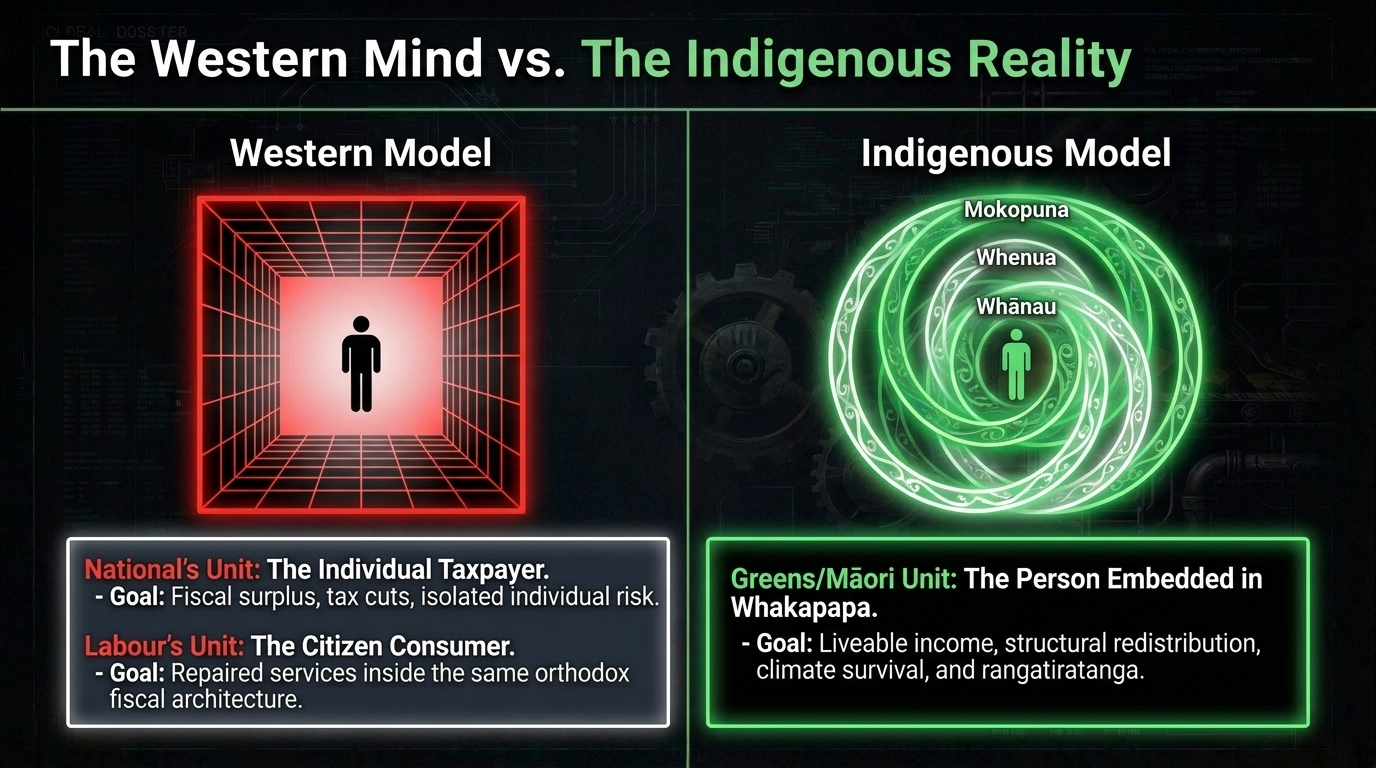
National’s political unit is the taxpayer.
Labour’s political unit is the citizen using a public service.
The Green political unit is the person embedded in whānau, community, whenua, climate and future generations.
That distinction is why the Greens are not merely “Labour but further left.” Their best policies ask different constitutional and economic questions. They ask who owns, who decides, who pays, whose knowledge counts and whether the mauri of people and whenua survives the decision.
My Editorial Judgement
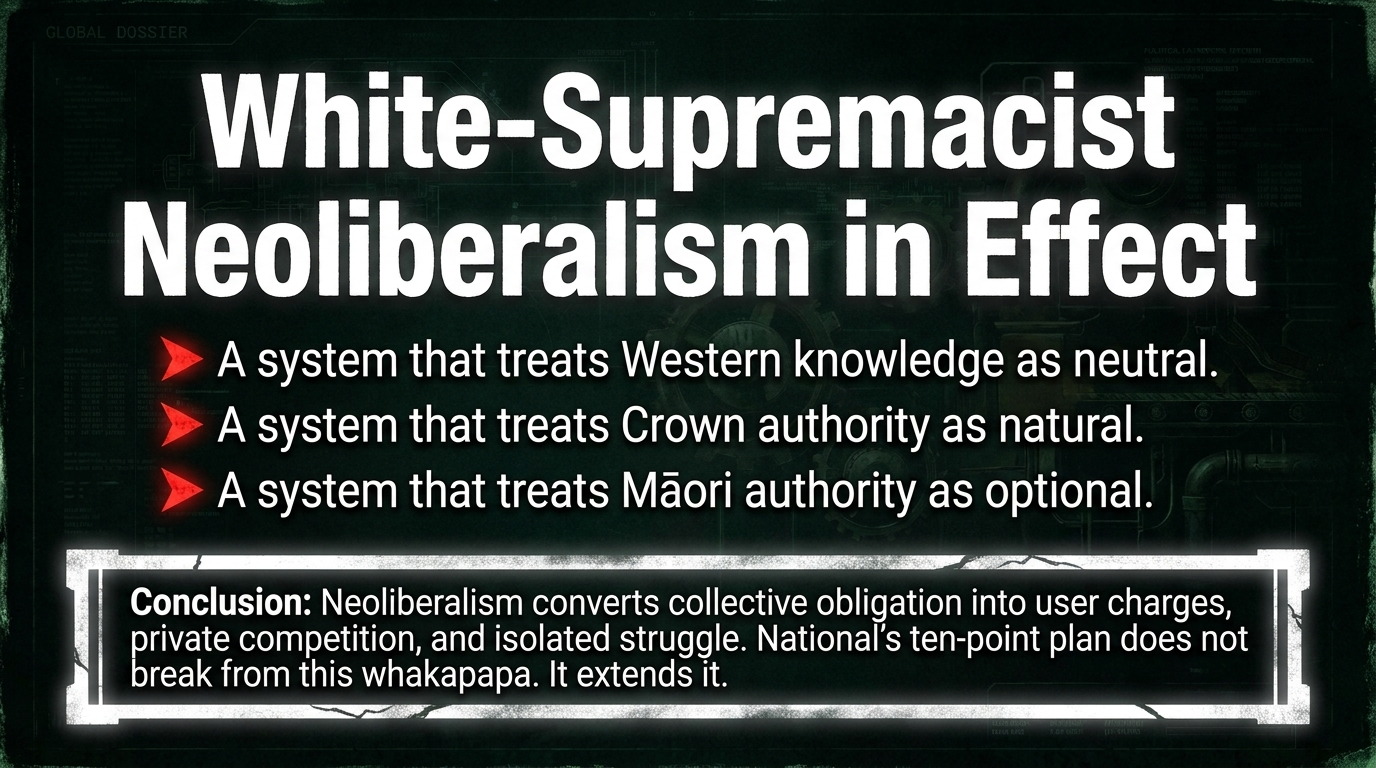
I describe this coalition’s programme as white-supremacist neoliberal government in effect. That is an explicitly political judgement, not an allegation about the private beliefs of every minister or voter.
My factual basis is the documented pattern: the Crown disestablished a Māori health institution without a clear replacement; the Tribunal found failures of tino rangatiratanga, consultation, partnership, equity and active protection; curriculum reform reduced protection for te reo, tikanga and mātauranga Māori; and the government continued despite those warnings.The Waitangi Tribunal documents the Māori-health breaches and the education breaches.
White supremacy is not confined to men in hoods. It can operate through an administrative system that treats Western knowledge as neutral, Crown authority as natural and Māori authority as optional. Neoliberalism is not merely a slogan either. It appears when collective obligations are converted into individual savings, private competition, user charges, punitive welfare rules and permanently constrained public spending.
National’s ten-point plan does not break from that whakapapa. It extends it.
Labour offers real relief and should not be falsely equated with National. Free GP visits, prescriptions, public construction and stronger supermarket rules would improve people’s lives.Labour’s published health and grocery policies provide those commitments and Fairer Grocery Prices programme.
But relief is not transformation. Labour repairs parts of the Crown machine. The Greens propose changing more of its ownership, revenue, purpose and relationship with tangata whenua.
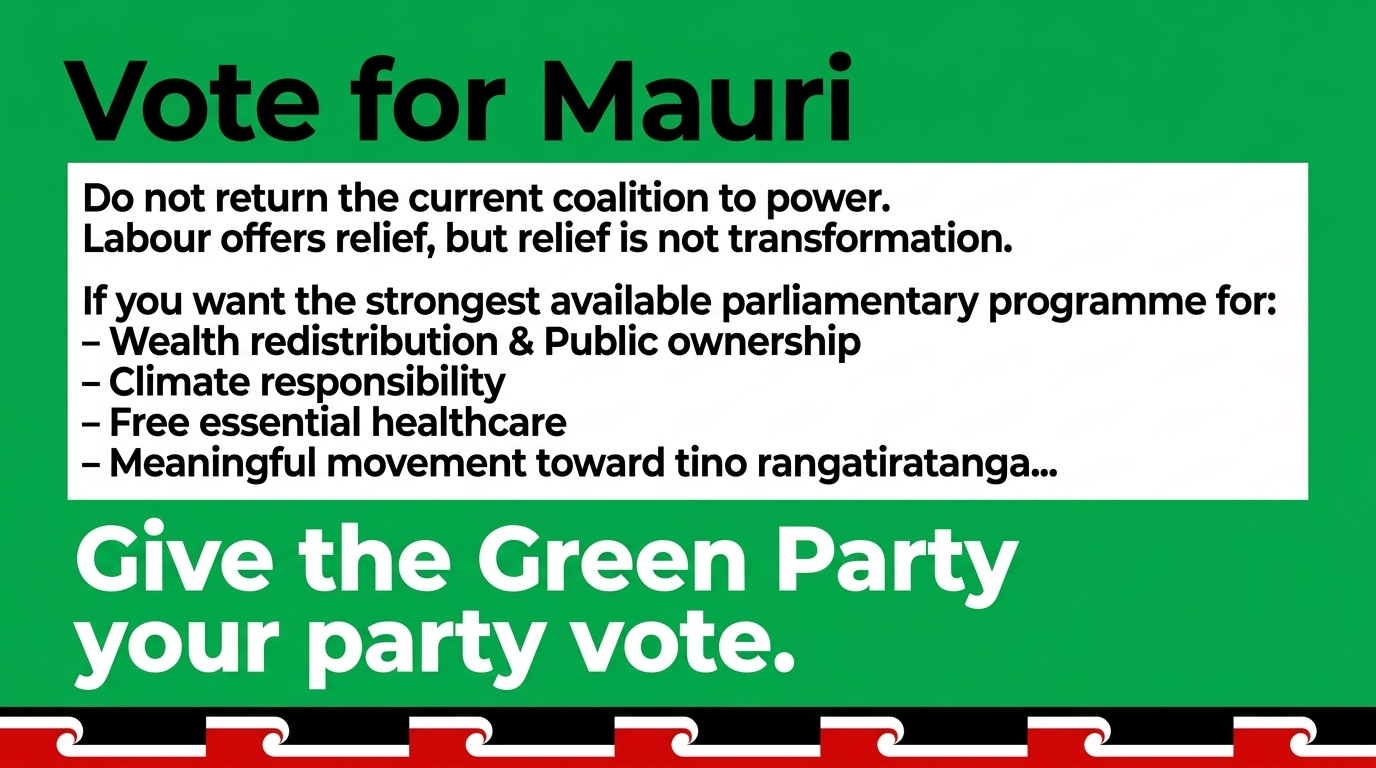
That is why my editorial recommendation remains clear: do not return this National–ACT–New Zealand First coalition to power in November. Give the Green Party your party vote if you want the strongest available parliamentary programme for wealth redistribution, public ownership, climate responsibility, free essential healthcare and meaningful movement towards rangatiratanga.
That recommendation is opinion. Its factual foundation is the side-by-side policy record disclosed above.

Disclaimer
National, Labour and the Green Party are invited to correct any factual error, identify omitted policy and provide complete costings. Any substantive response should be appended or incorporated transparently without surrendering editorial independence.