"THE TRAFFIC LIGHT TAIAHA: How a White Supremacist Government Built a Punishment Machine That Creates No Jobs, Finds No Work, and Feeds Only on Brown Bodies" - 28 February 2026
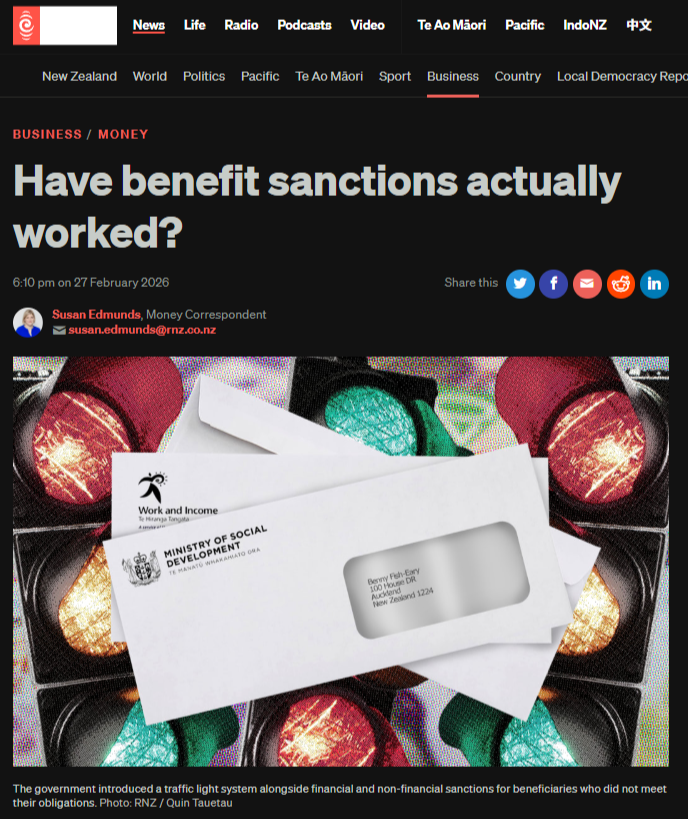
They slashed 7,000 public sector jobs. They watched unemployment climb to a decade-high. Then they built a traffic light system to punish the people they threw out of work for not finding the jobs they destroyed — and called it "accountability."

Kia ora e te whānau,
The Mauri Is Dying
Picture a pā under siege. Not by muskets — those at least announced themselves honestly. This siege comes wrapped in spreadsheets and press releases. The attackers wear suits. They carry traffic lights.
A lively conversation between two hosts, unpacking and connecting topics this essay
In te ao Māori, when a rangatira imposes a penalty on someone, there is an obligation — utu — that runs both ways. The one who punishes must also provide. The one who demands compliance must first create the conditions for compliance to be possible. This is not optional kindness. It is the architecture of a functioning society. It is tikanga.
This government has built something different entirely. It has built a machine that punishes people for failing obligations the government itself made impossible to meet — in a labour market the government itself destroyed — using a system that cannot even measure whether it works. Then it pointed the machine disproportionately at Māori, Pacific peoples, young people, and women, and called it "reform."
This is not incompetence. This is the design.
Koha — Support This Mahi
Every sanction this government imposes goes unmeasured and unaccounted for. Every essay The Māori Green Lantern publishes holds the numbers, names the names, and traces the whakapapa of harm from ministerial office to whānau kitchen table.
Every koha signals that whānau are ready to fund the accountability that Crown and corporate structures will not provide — accountability for the 14,400 sanctions, the 169,300 children in hardship, the 11.2% Māori unemployment rate this government refuses to see as its own creation.
It signals that rangatiratanga includes the power to fund our own truth-tellers — because when the state builds punishment machines, someone must count the bodies it produces.
Kia kaha, whānau. Stay vigilant. Stay connected. And if you are able, consider a koha to ensure this voice continues.
If you are unable to koha, no worries! Subscribe or follow The Māori Green Lantern, kōrero and share with your whānau and friends — that is koha in itself.
Three pathways exist:
For those who wish to support this mahi directly with a koha (voluntary contribution), please visit the Koha platform:
Koha — Support: https://app.koha.kiwi/events/the-maori-green-lantern-fighting-misinformation-and-disinformation-ivor-jones
For those who wish to receive essays directly and support through subscription:
Subscribe to the Māori Green Lantern: https://www.themaorigreenlantern.maori.nz/#/portal/support
For those who prefer direct bank transfer, account details are: HTDM, account number 03-1546-0415173-000.
The Anatomy of a Broken Machine
In August 2024, Social Development Minister Louise Upston introduced the Traffic Light System for beneficiaries. Green means compliant. Orange means a breach — five days to fix it. Red means your benefit is cut, suspended, or cancelled, as detailed on the Ministry of Social Development website.
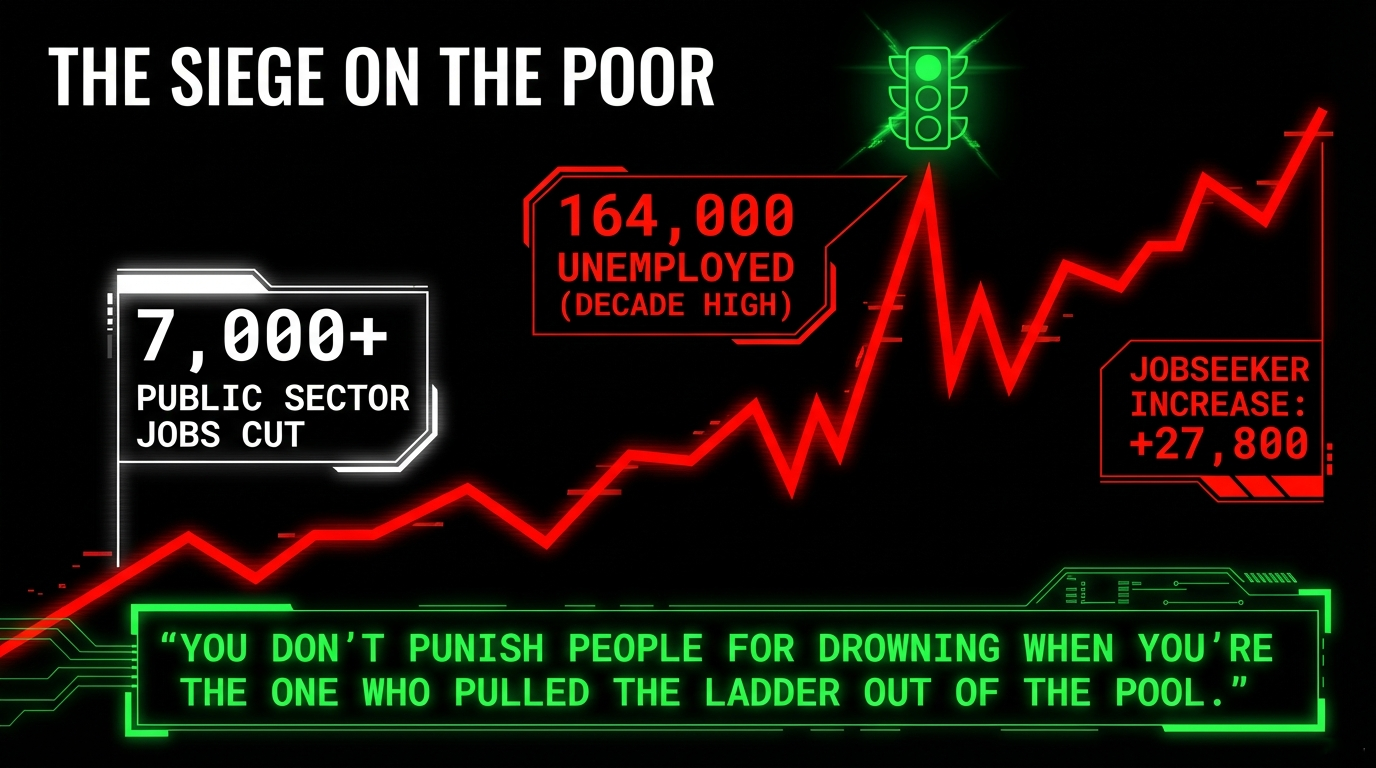
The numbers tell the story of a system designed to escalate punishment, not create employment.
In the September 2024 quarter — just weeks after the system launched — 14,400 sanctions were imposed. By September 2025, that had settled to 12,900 — still double the pre-system average, as Infometrics principal consultant Rob Heyes documented. Te Pāti Māori reported MSD data showing a 133% increase in sanctions over the prior year, with over 14,000 sanctions in just three months. By July 2025, MSD's own quarterly snapshot confirmed sanctions had increased 27.1% to 13,200.
Three-quarters of those sanctioned had their benefit reduced. Two-thirds of all sanctions were for not attending Work and Income appointments or not "preparing for work" — not for refusing actual employment, because actual employment does not exist.
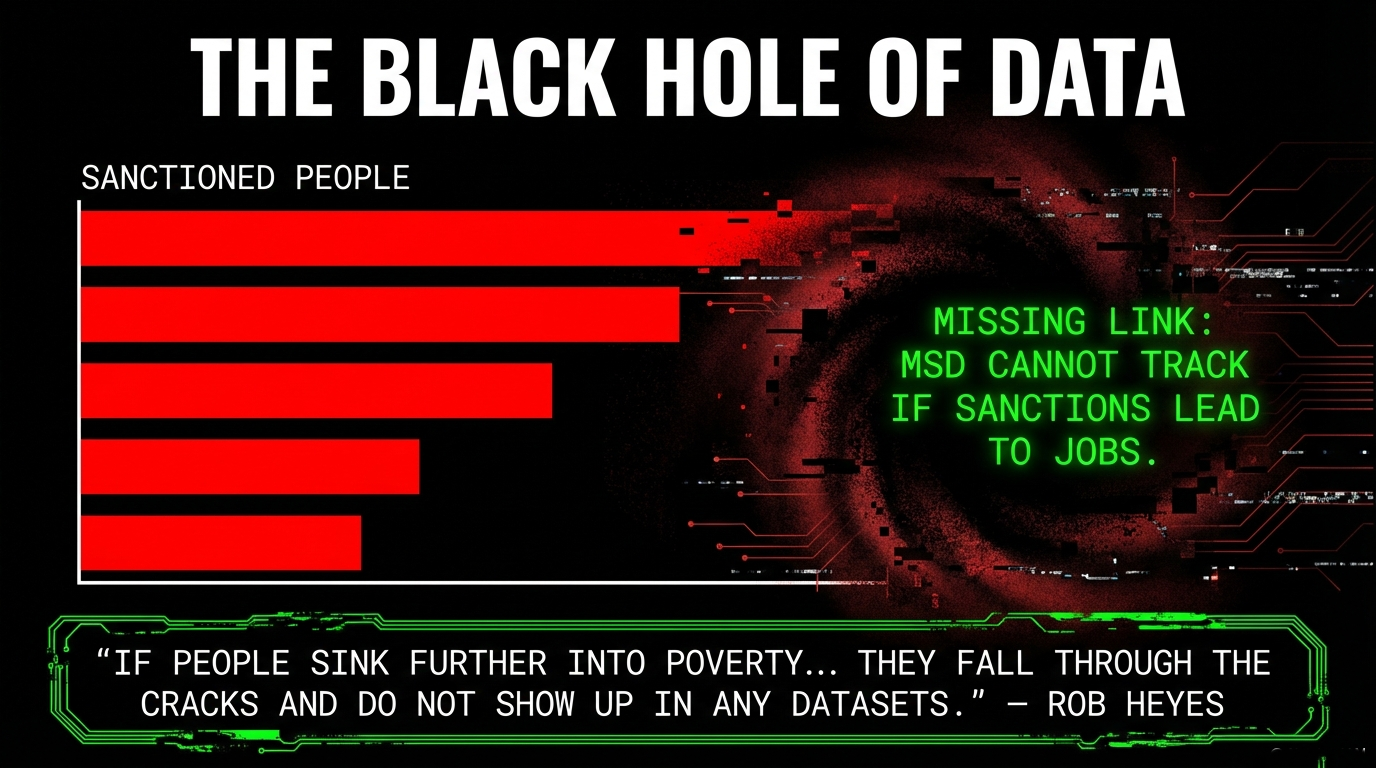
And here is the detail that should make every New Zealander stop and stare: MSD cannot even tell you whether people who get sanctioned eventually find work. It cannot link the sanction to the outcome. As Heyes stated plainly: "If it is difficult to track someone who enters work, it will be even harder to track other outcomes. If people sink further into poverty and more vulnerable circumstances, they are more likely to fall through the cracks and therefore not show up in any datasets."
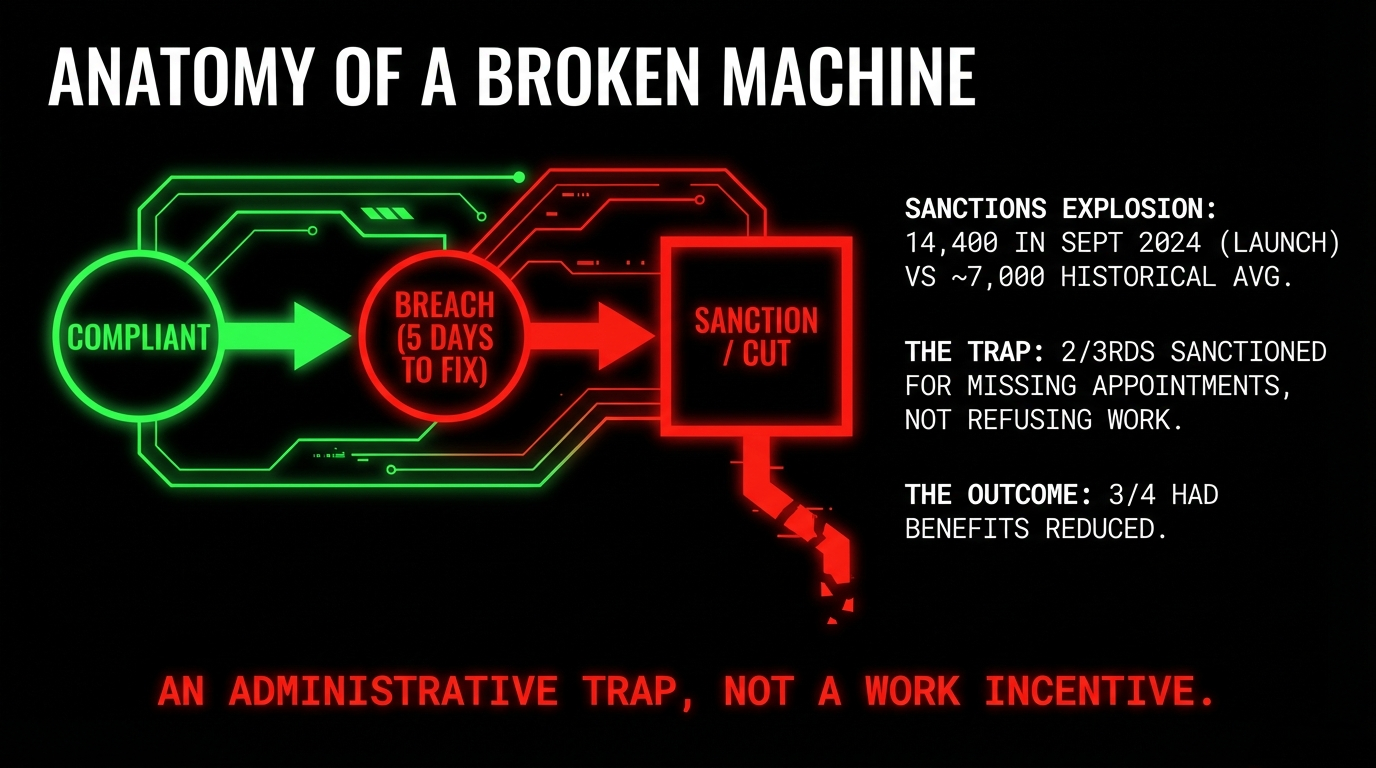
The government built a punishment machine with no feedback loop. It cannot measure success because success was never the point.
The Target on Brown Backs
Now examine who this machine consumes.
People aged 15 to 24 make up just 19% of beneficiaries — but 46% of all sanctions. Men are 45% of beneficiaries but receive 68% of sanctions. Māori and Pacific peoples are sanctioned at rates far exceeding their representation in the beneficiary population.
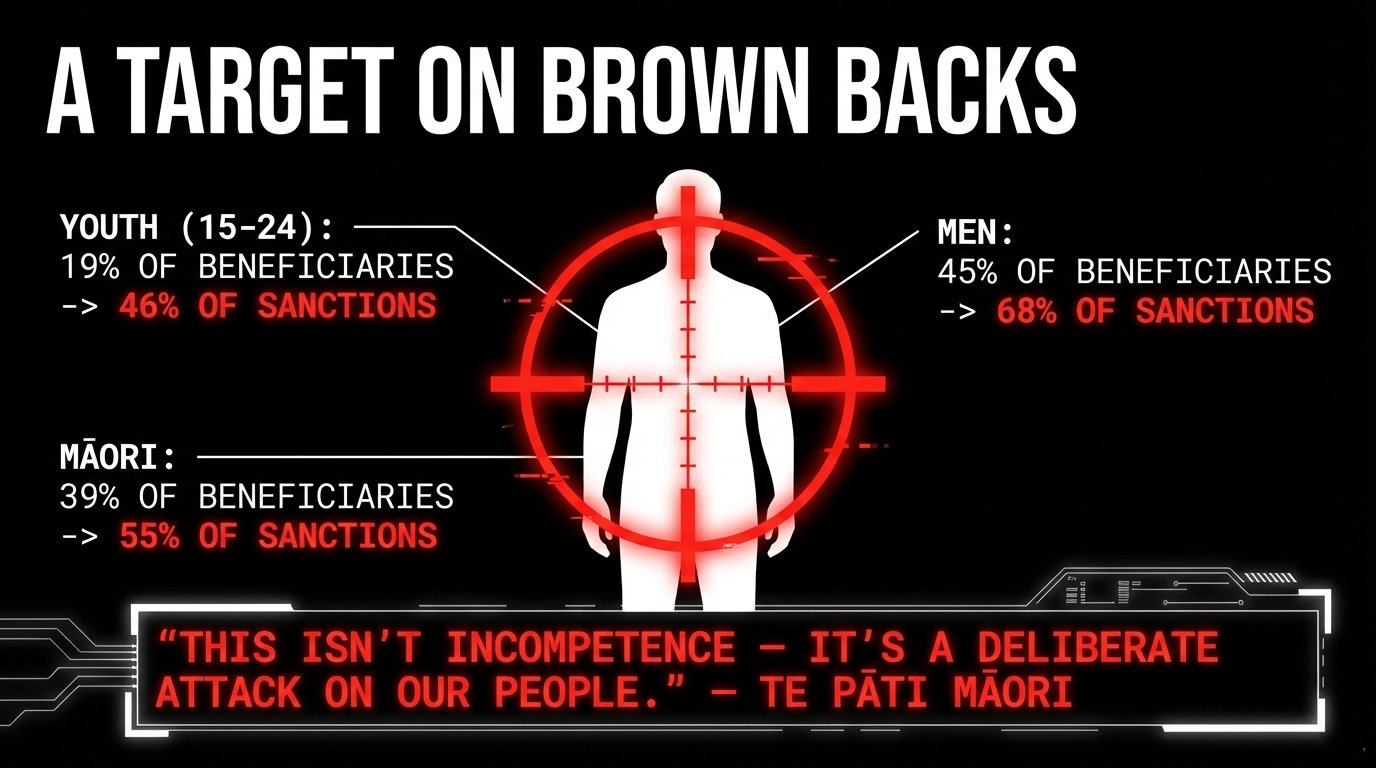
The CERD shadow report submitted to the United Nations in 2025 is devastating in its precision: Māori comprise 39% of beneficiary recipients but 55% of all benefit sanctions imposed. Pacific peoples and African communities are also overrepresented.
Rob Heyes called this a "double whammy" — already over-represented in beneficiary statistics, then over-represented again in sanctions. Te Pāti Māori co-leader Rawiri Waititi cut through the euphemism:
"This isn't incompetence — it's a deliberate attack on our people. They've built a system designed to fail, and they're celebrating the suffering they've caused."
Debbie Ngarewa-Packer was equally direct:
"The traffic light system is a dead end, a road to nowhere, a tool designed to punish whānau for not finding jobs the government itself has destroyed."
Even Te Puni Kōkiri — the Crown's own Māori development agency — has noted concerns about Māori clients being disproportionately affected by sanctions. MSD is now "undertaking an evaluation." How generous — to evaluate the damage after inflicting it.
The Jobs That Don't Exist
The government set a target: 50,000 fewer people on JobSeeker Support by 2030, using a December 2023 baseline of 190,000.
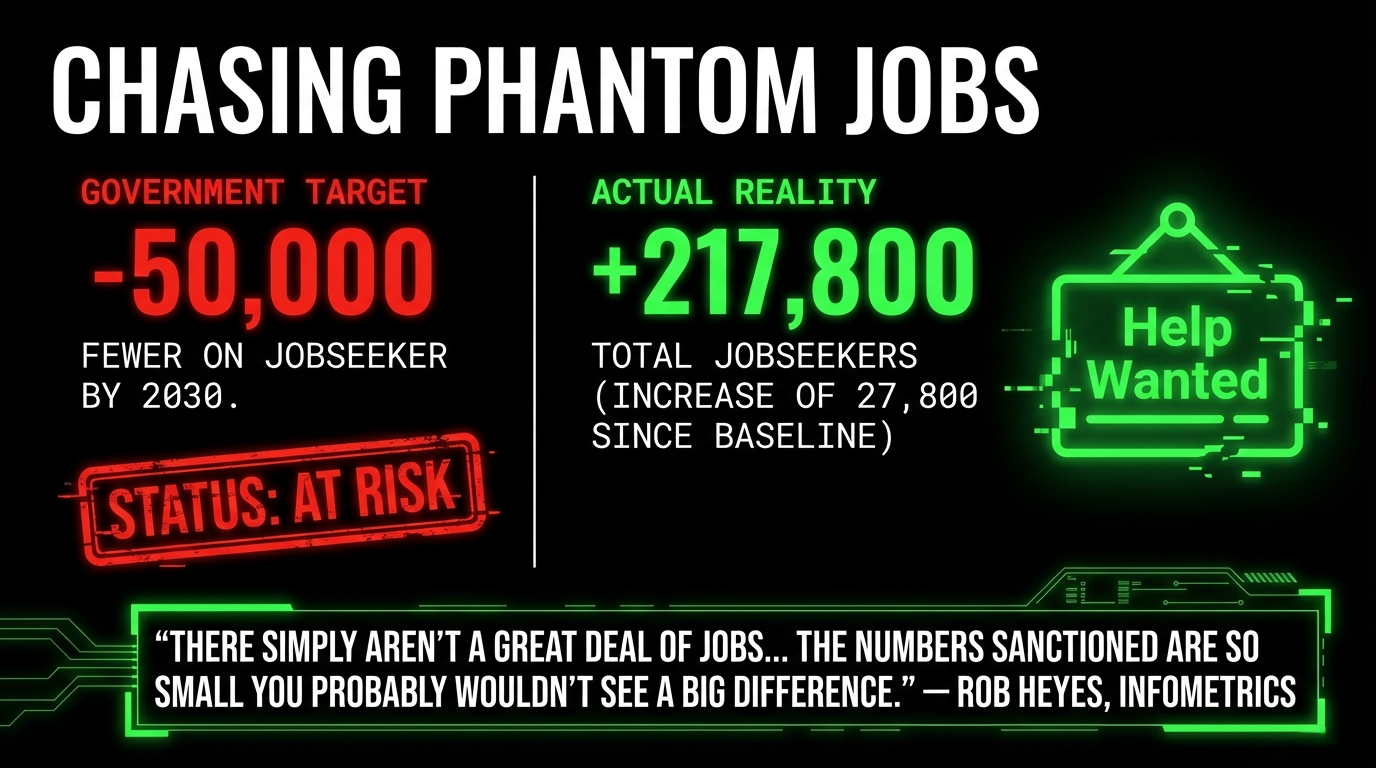
Here is what actually happened.
When the Traffic Light System launched in September 2024, JobSeeker numbers had risen to 205,000. By September 2025, they had climbed again to (https://www.dpmc.govt.nz/sites/default/files/2025-11/gt-factsheet-target-5-sep25.pdf). The government's own performance tracker now labels this target "At Risk" — a bureaucratic euphemism for "failing catastrophically."
That is not a reduction of 50,000. That is an increase of nearly 28,000 people since the baseline — while sanctions doubled.
Māori unemployment hit 11.2% in December 2025 — more than twice the national average. The NZCTU confirmed 13,800 more Māori are unemployed than two years ago. National unemployment reached 164,000 — a decade high. MBIE's Māori Labour Market Snapshot for September 2025 showed a Māori NEET rate of 24.8% for those aged 20-24 — nearly one in four young Māori not in education, employment, or training.
Meanwhile, the Salvation Army's State of the Nation 2025 report found more than 400,000 people needing welfare support in December 2024 — the highest since the 1990s. And what does this government do with 400,000 people on welfare and vanishing jobs? It builds more sanctions.
As Heyes concluded:
"There simply aren't a great deal of jobs for people to go into."
You don't punish people for drowning when you're the one who pulled the ladder out of the pool.
Three Examples for the Western Mind
Example 1: The Young Māori Mother in Tauranga — Manaakitanga Destroyed
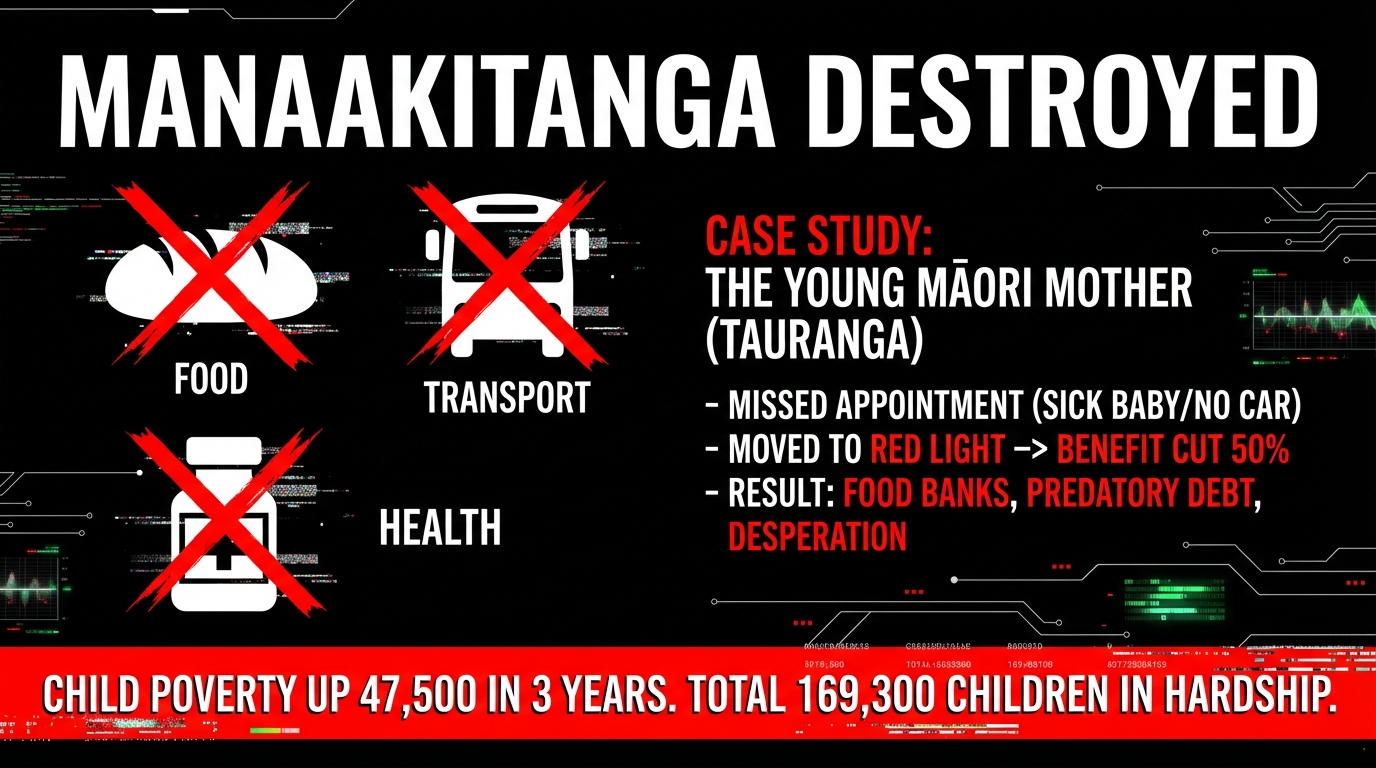
The scenario: A 22-year-old wāhine Māori with two tamariki receives Sole Parent Support. She misses a Work and Income appointment because her baby is sick and she has no car. She is moved to orange. She cannot get to the office within five working days because she has no bus fare — her benefit barely covers rent and food. She is moved to red. Her benefit is cut by 50%.
The quantified harm: The Beneficiary Advisory Service's landmark 2021 research found that sanctioned beneficiaries reported going without food, electricity, and medication. Respondents described using food banks, stealing, foraging, begging, taking out predatory loans, and — in one case — turning to prostitution. One participant ended up $11,000 in debt from a $150 payday loan. The Salvation Army confirmed: "People are coming to us who've had their benefits cut... that's not really helping anyone."
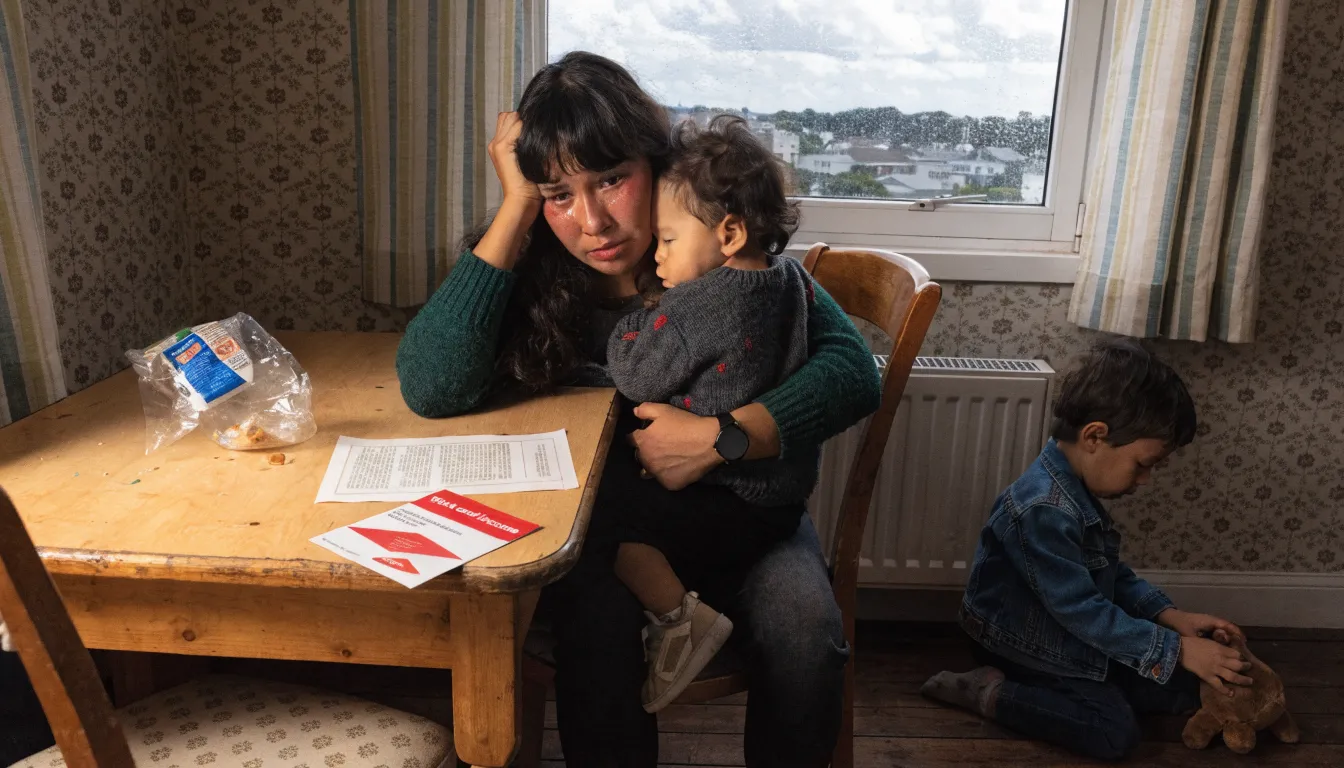
Data from 2023 showed that when sanctions targeted parents, 153 of 222 were imposed on women and 168 of 222 were imposed on Māori — overwhelmingly wāhine Māori. And 1News revealed the government does not even know how many children are in the families being sanctioned.
The tikanga impact: In te ao Māori, manaakitanga — the obligation of those with power to care for and uplift the vulnerable — is not a suggestion. It is the foundation of mana. When a mother cannot feed her tamariki because the state cut her income for missing an appointment she couldn't afford to attend, it is not the mother who has failed an obligation. It is the Crown. The government is not enforcing utu — it is committing muru without reciprocity: taking without giving, punishing without providing, stripping mana without restoring it. In tikanga Māori, a rangatira who behaved this way would lose their mana permanently. In Wellington, they get re-elected.
The solution: Immediately exempt parents with dependent children from financial sanctions. Fund free community transport to all MSD appointments. Establish whānau-centred case management that accounts for childcare, health, and housing barriers before imposing any obligation. Restore the previous government's removal of punitive parenting sanctions rather than building new ones on top.
Example 2: The Rangatahi in Northland — Whanaungatanga Severed
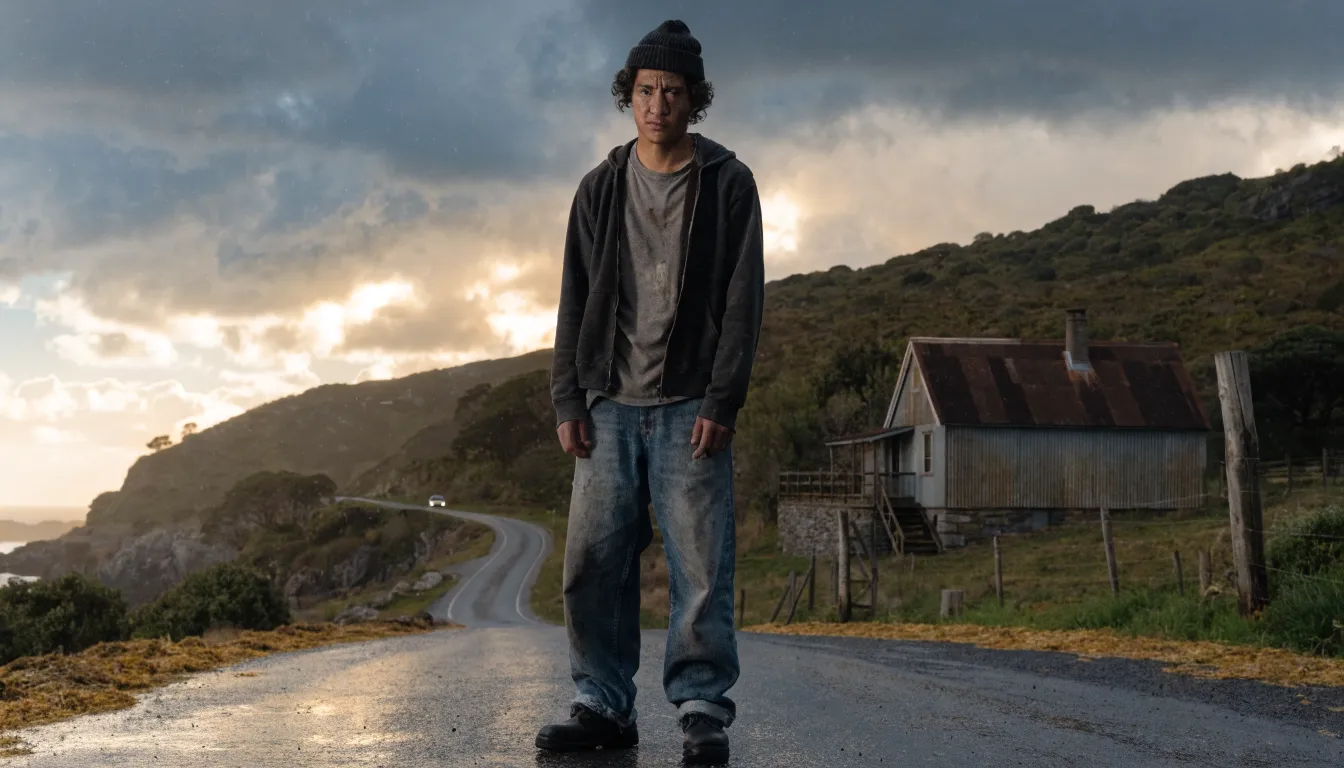
The scenario: A 19-year-old Māori man in Northland — the region with the highest JobSeeker rate at 11.3% — is on JobSeeker Support. He does not own a computer. He does not have a driver's licence. The nearest Work and Income office is 40 minutes away. He is sanctioned for not "preparing for work." Under the new sanctions from October 2025, he must now perform a minimum of three job-search activities per week for four weeks and report back to MSD, or attend five hours per week of employment-related training.
In 2027, under Upston's latest announcement, his benefit may be means-tested against his parents' income — parents he hasn't lived with since leaving state care at 17.
The quantified harm: Young people aged 15-24 make up 19% of beneficiaries but 46% of sanctions. Rangatahi Māori NEET rates sit at 24.8% for 20-24 year olds. Kaupapa Māori youth service E Tipu E Rea Whānau Services warned that means-testing against parental income would push young people onto the street. General manager Cindy Kawana stated: "It's just another way of denying their place in society. They're adult enough to join the army, they're adult enough to vote, but they aren't adult enough to get financial support from the government when they need it."
The tikanga impact: Whanaungatanga — kinship, connection, the reciprocal obligations that bind whānau, hapū, and iwi — requires that young people are held within the collective, not cast out of it. When the state removes a child into care, then abandons them at 18, then means-tests their survival against the parents they were taken from, it is committing a double violation. First the state severed the whakapapa by removing the child. Then it weaponises that same severed whakapapa to deny them support. For the Western mind: imagine an employer who fires you, then denies you unemployment insurance because your former employer won't vouch for you.
The solution: Scrap the parental means-testing for 18-19 year olds entirely. Fund dedicated rangatahi employment pathways with driver licence programmes, digital access, and culturally grounded mentoring. Restore and expand kaupapa Māori youth services like E Tipu E Rea. Ensure every care-leaver has guaranteed unconditional income support until age 25.
Example 3: The Phantom JobSeeker Target — Rangatiratanga Undermined
The scenario: The government announced a target of 50,000 fewer people on JobSeeker Support by 2030. Instead, numbers climbed from 190,000 to (https://www.dpmc.govt.nz/sites/default/files/2025-11/gt-factsheet-target-5-sep25.pdf). Louise Upston claims 80,700 people moved off benefit and into work in the last financial year — while simultaneously, benefit numbers increased because more people entered the system than left it. The proportion of working-age New Zealanders on a main benefit rose to 12.5% — over 400,000 people.
The quantified harm: Since taking office, this government has slashed more than 7,000 public sector jobs, then punished people for being unable to find employment. Child poverty data released just three days ago — 25 February 2026 — shows 169,300 children now live in material hardship, up from 121,800 in 2022. That is 47,500 more children in hardship in three years. For mokopuna Māori, 25.1% live in material hardship. For Pacific children, 31%. The Children's Commissioner is demanding urgent action. The government is building more sanctions.
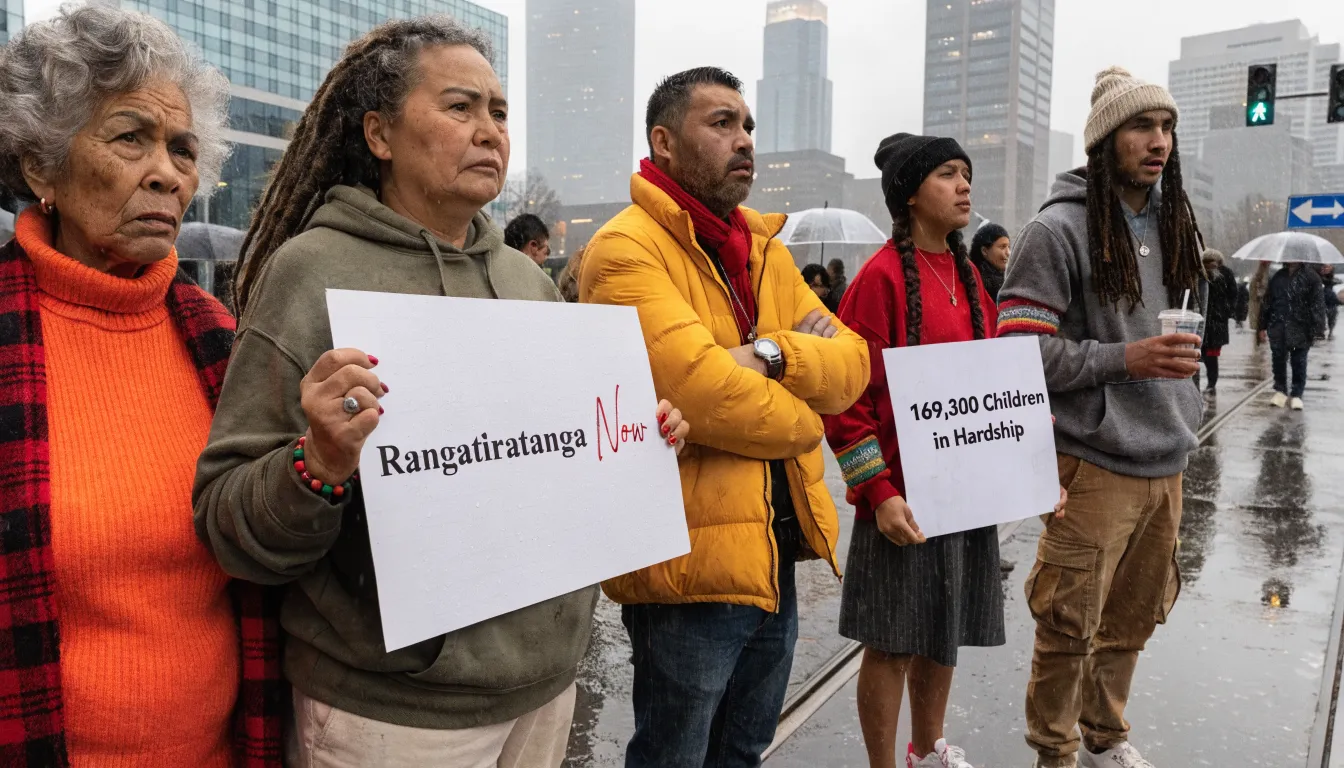
The tikanga impact: Rangatiratanga — self-determination, the authority guaranteed under Article Two of Te Tiriti — means Māori have the right to manage their own affairs, their own resources, and their own pathways to wellbeing. This government has systematically destroyed Māori self-determination in welfare policy: cutting over $1 billion in Māori-specific funding across two budgets, gutting Māori housing, dismantling Te Aka Whai Ora, and replacing all of it with a traffic light system that disproportionately punishes Māori while providing no culturally appropriate pathways to employment. For the Western mind: imagine your government closing your hospitals, defunding your schools, firing your neighbours, then fining you for getting sick.
The solution: Restore Treaty-compliant Māori-led employment and welfare programmes at minimum 2023 funding levels. Establish independent Māori governance over welfare services for Māori beneficiaries. Redirect the administrative cost of the sanctions regime into job creation, training, and whānau ora services. Stop counting sanctions as success and start counting people lifted from poverty.
The Hidden Connections
Connection 1: The Sanctions-to-Foodbank Pipeline. Research from the Beneficiary Advisory Service established an association between MSD sanction data and Salvation Army food bank demand. Sanctions go up, food parcels go up. The government is not reducing welfare dependency — it is manufacturing food bank dependency and calling it progress.
Connection 2: The Punishment-Homelessness Conveyor. RNZ reported in March 2025 that beneficiaries sanctioned with money management cards were often unable to pay rent, putting them at risk of homelessness. Meanwhile, the Salvation Army's 2026 State of the Nation report documents that the social housing waiting list has ballooned to more than 25,000. The government sanctions people into homelessness, then fails to house them.
Connection 3: The International Condemnation Loop. In December 2025, CERD — the UN Committee on the Elimination of Racial Discrimination — issued its strongest-ever rebuke of New Zealand, a 14-page report expressing "grave concern" about rising hate speech, weakened Treaty protections, cuts to Māori agencies, and the erosion of institutional safeguards. Lady Tureiti Moxon called it "unprecedented". The Aotearoa Centre for Indigenous Peoples and the Law submission stated the government is "actively and profoundly aggravating New Zealand's constitutionally racist foundation in a way we have not seen for at least half a century". Benefit sanctions that disproportionately target Māori at 55% while they are 39% of beneficiaries are explicitly identified in the CERD shadow report as evidence of systemic discrimination.
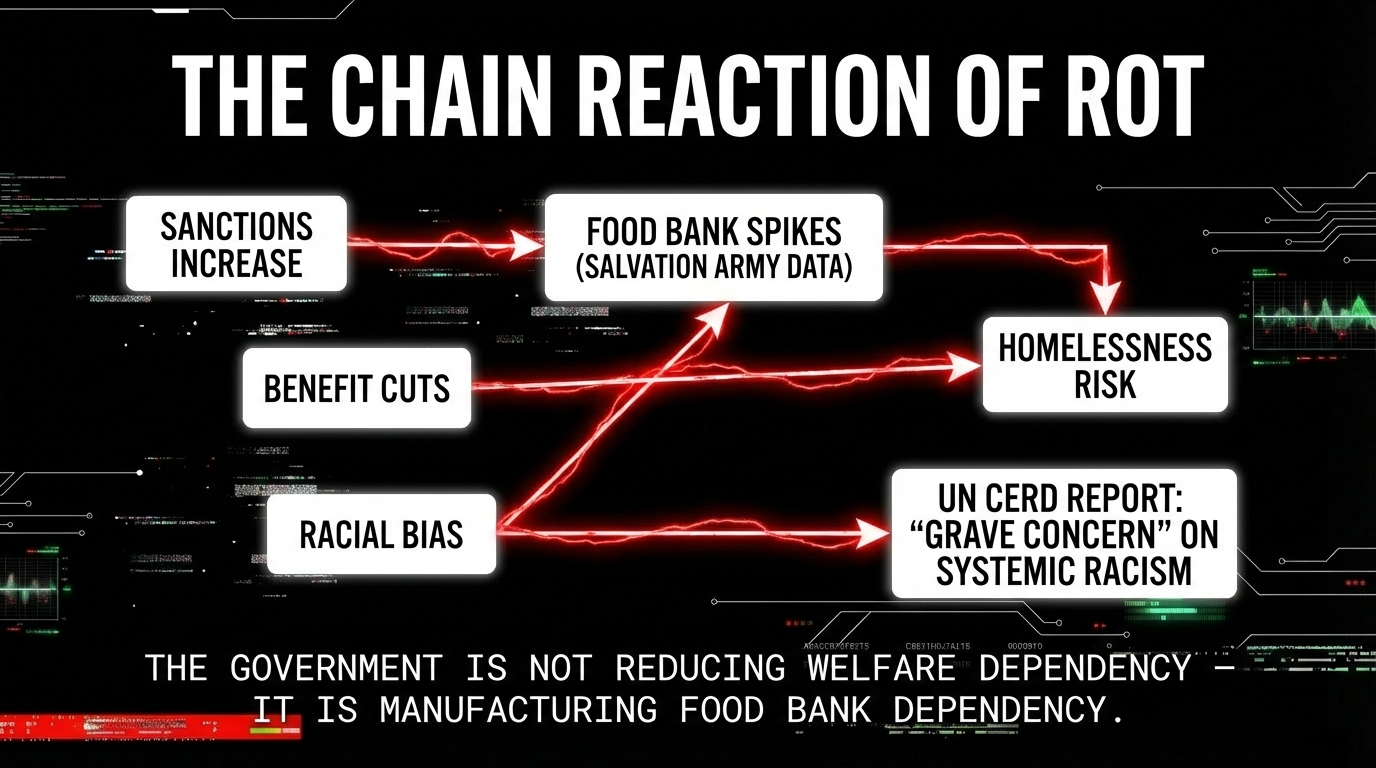
Connection 4: The Reviews-That-Prove-The-System-Is-Broken. The Beneficiary Advisory Service found that 83% of sanction reviews were successful — meaning the sanctions should never have been imposed. MSD's own 2018 data showed 97.6% of disputed obligation failures were overturned. Yet 60% of sanctioned people never reviewed their sanction — 52% because they didn't know they could. The system is not identifying non-compliance. It is punishing people who don't know their rights — and the people least likely to know their rights are Māori, young, and already marginalised.
Connection 5: The Fiscal Fraud. The government frames sanctions as fiscal responsibility. But the Welfare Expert Advisory Group found no evidence that the subsequent child policy reduced parents' time on benefits or led to better outcomes. MSD modelling showed it disproportionately impacted Māori and women and increased inequity. Officials warned the government against work-for-the-dole sanctions, stating they do not increase the chances of coming off welfare. Every piece of evidence — from New Zealand and internationally — tells this government that sanctions don't work. They do it anyway. Because punishment is the policy. The cruelty is the point.
The International Evidence the Government Ignores
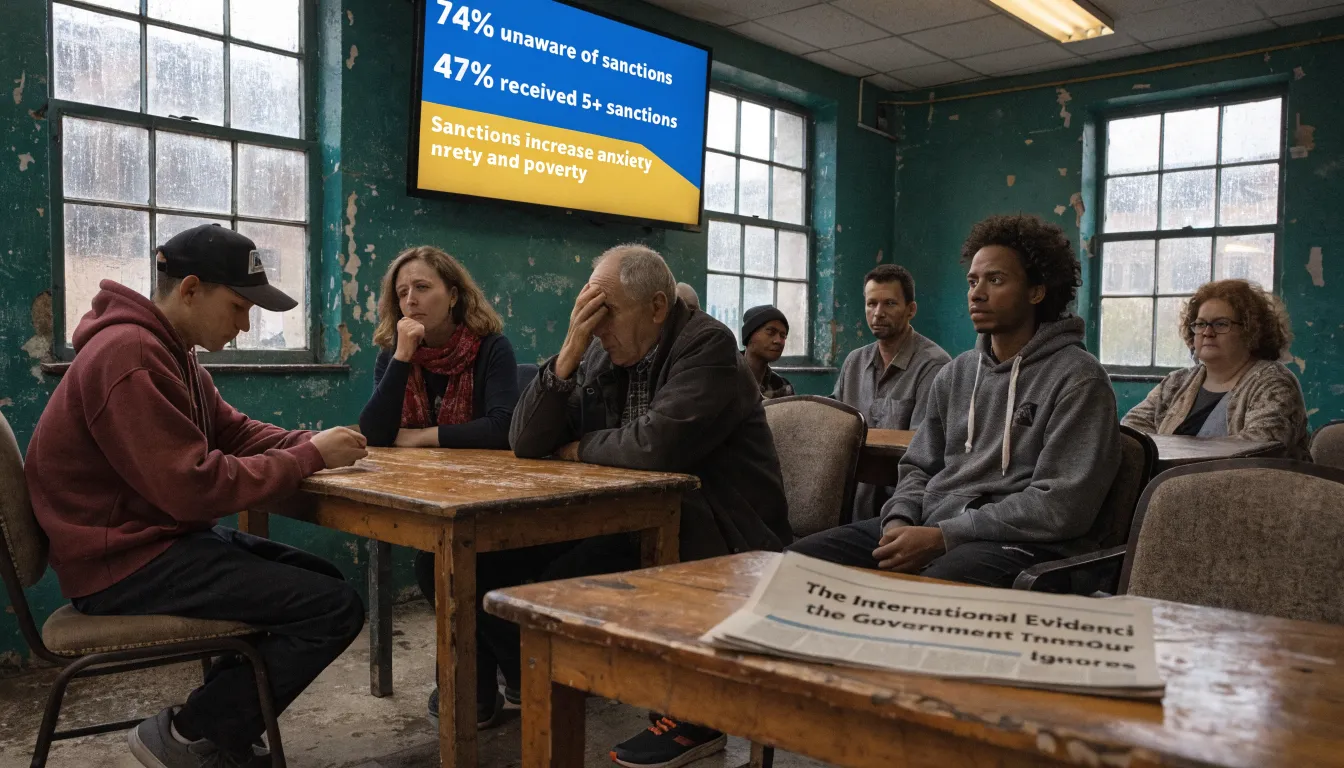
The Beneficiary Advisory Service's 2021 research — the most comprehensive New Zealand study of sanctions' impact — concluded that sanctions encourage "ineffectual compliance rather than positive job-seeking behaviour". 74% of respondents did not even know they could be sanctioned until it happened. 47% received five or more sanctions — proof the system produces repeat punishment, not behaviour change.
International evidence from the UK shows sanctions are associated with a rise in food bank usage. Sanctions increase anxiety, stress, drug and alcohol abuse, and poverty. The Green Party's Ricardo Menéndez March stated: "Sanctions do not work. They do not support people into meaningful employment, nor support them to participate fully in their communities."
Labour's Carmel Sepuloni pointed out the government relies on evidence more than a decade old, ignoring the most recent research from the Welfare Experts Advisory Group that found obligations and sanctions were "problematic."
Louise Upston's response? More sanctions. From May 2025, Money Management cards that put half a benefit on a restricted payment card. Community Work Experience — unpaid labour. From October 2025, mandatory job-search reporting and upskilling requirements. And obligation failures now count against a beneficiary for two years instead of one.
The cruelty escalates. The evidence is ignored. The bodies pile up. And Louise Upston "flatly refutes" it's punishment.
Cui Bono? Who Profits?
Not the 218,000 people on JobSeeker Support. Not the 169,300 children in material hardship. Not the 25.1% of mokopuna Māori growing up without the basics of life.
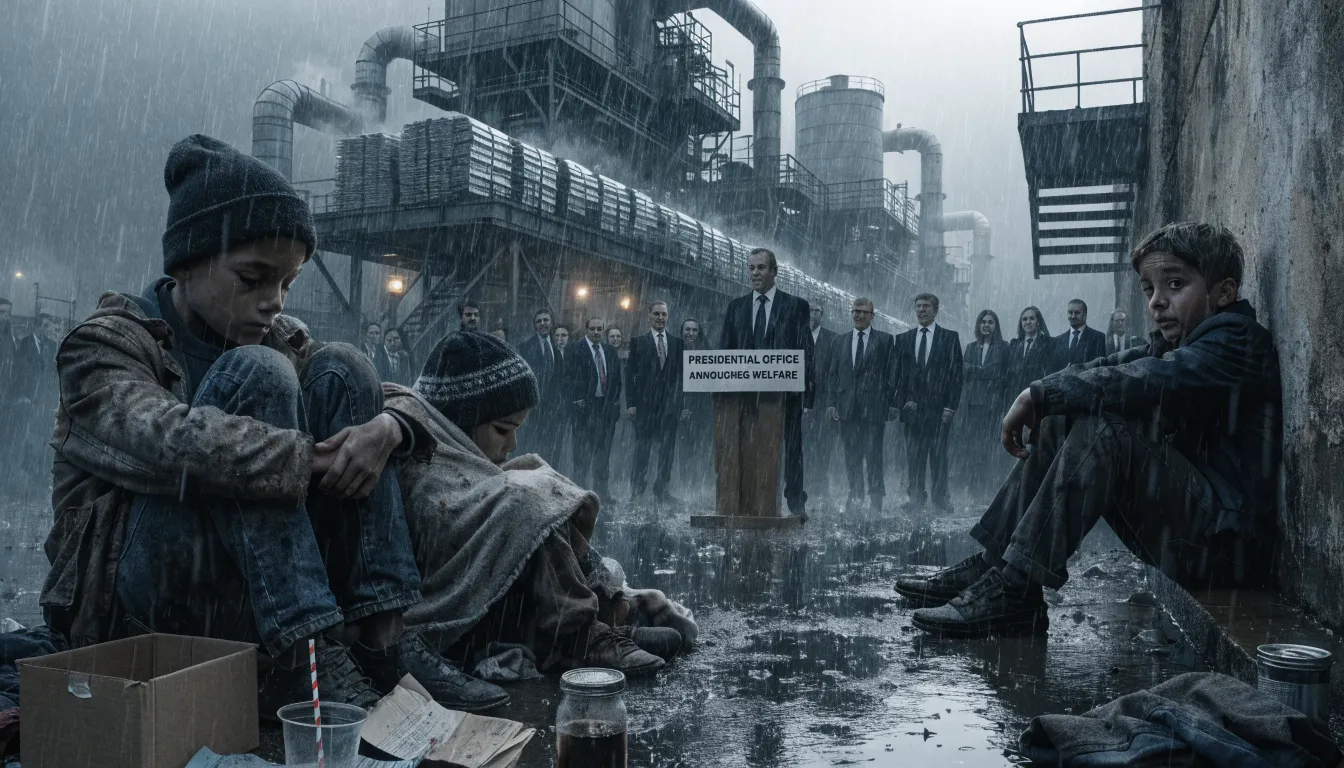
The beneficiaries of this system are the politicians who can stand at press conferences and announce "tougher welfare" to an electorate conditioned by three decades of neoliberal propaganda to believe that poverty is a moral failing rather than a structural outcome. Christopher Luxon gets to say he's "relentlessly focused on getting people into work." Louise Upston gets to claim 98.5% compliance as a success while the absolute number of beneficiaries rises. David Seymour gets to crow about "personal responsibility" from a parliamentary salary paid for by the same taxpayers whose children go hungry.
The machine runs on brown bodies. The fuel is suffering. The product is press releases.
Previous Investigations by The Māori Green Lantern
This pattern of state-inflicted harm on whānau Māori is not new, and The Māori Green Lantern has been documenting it systematically:
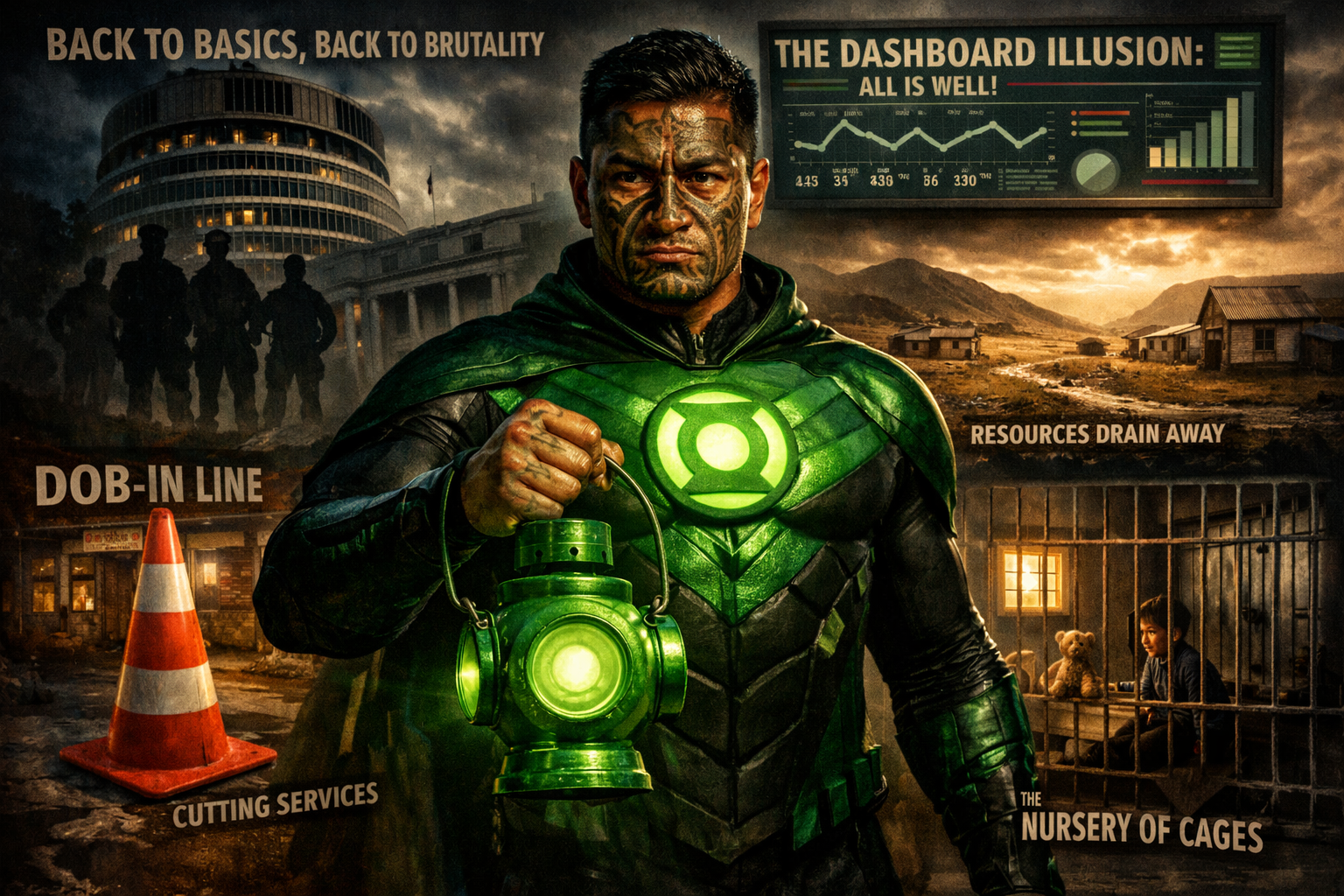
- "Back to Basics, Back to Brutality: How a 'Hodgepodge' of Bills Became the Most Coordinated Assault on Māori Rights, Workers, and Democracy in a Generation" — documenting how this coalition's legislative programme systematically strips protections from the most vulnerable, bill by bill, erasure by erasure.
- "The Dashboard Illusion: How Neoliberalism Sells Sovereignty While Stealing Resources" — investigating the fiscal extraction pattern where the government announces headline funding numbers while the real money flows away from Māori, documenting how Budget 2025 headlined "$700 million for Māori" while only $38 million was genuinely new money.
- "How a Road Cone Dob-In Line Became the Parable for Neoliberal New Zealand" — documenting how this government spends millions on performative surveillance while cutting the services that keep people alive — the same logic that drives the benefit sanctions regime.
- "The Nursery of Cages: How a White Supremacist State Built a Factory That Turns Brown Children into Prisoners" — exposing the pipeline from state care to prison that this sanctions regime feeds directly into: sanction the parent, destabilise the child, imprison the adult.
The Reckoning
The numbers are damning:
| Measure | Government Promise | Actual Outcome |
|---|---|---|
| JobSeeker target | 50,000 fewer by 2030 (to 140,000) | Increased to 217,800 — up 27,800 from baseline |
| Sanctions | "Accountability" tool | Doubled — 133% increase, disproportionately hitting Māori |
| Māori unemployment | Economic growth to benefit all | 11.2% — more than double national average |
| Child material hardship | Reduce to 9% | 14.3% nationally; 25.1% for Māori children |
| Children in hardship | Trending down | 169,300 — up 47,500 since 2022 |
| System tracking | Outcomes-based | MSD cannot link sanctions to employment outcomes |
Every target missed. Every promise broken. Every sanction falling hardest on those least able to bear it.
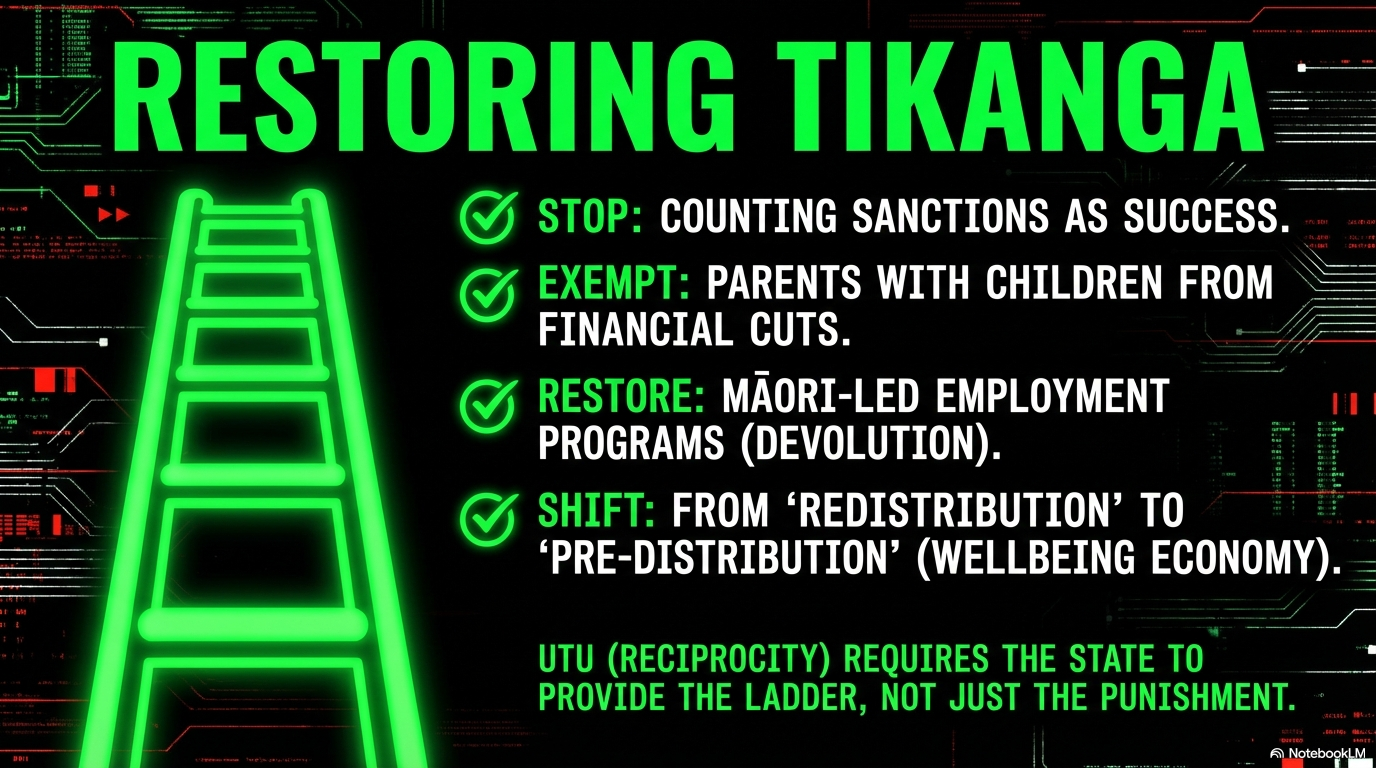
This government does not have a welfare policy. It has a whipping post. And it paints the post green, orange, and red so it looks like traffic management instead of what it is: the systematic punishment of poverty, the structural targeting of Māori, and the deliberate erosion of the social contract — all wrapped in the language of "personal responsibility" by people who have never missed a meal in their lives.
The mauri of the welfare system — its capacity to hold, protect, and restore people — has been deliberately destroyed. What remains is a machine. And the machine is working exactly as designed.

The Māori Green Lantern wields the taiaha empowered by the Ring. The light exposes what the powerful build in darkness. This traffic light was built in darkness. Now it burns in green light.
Mauri ora.
Research conducted: 28 February 2026 | Tools: search_web, get_url_content | Sources consulted: RNZ, 1News, Infometrics, MSD, Stats NZ, Salvation Army, Te Pāti Māori, CERD, Beneficiary Advisory Service, Beehive.govt.nz, NZCTU, MBIE, Children's Commissioner, CPAG