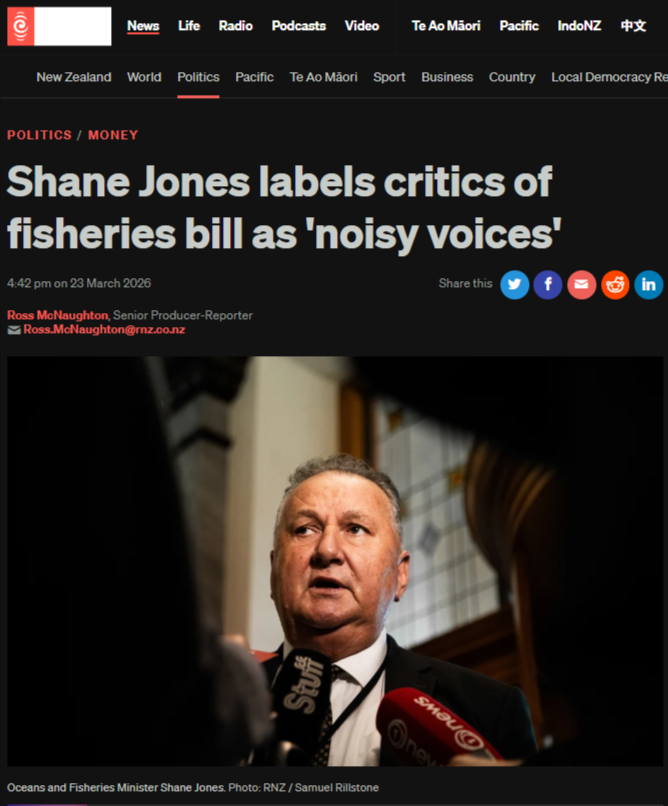
"The Van Velden Vanishing: What Her Departure Really Means for ACT" - 24 March 2026
It's about fucking time is all I can say! Yeah! ACT IS DEAD!

Kia ora ano Aotearoa,
Ding Dong the Witch Is Dead!

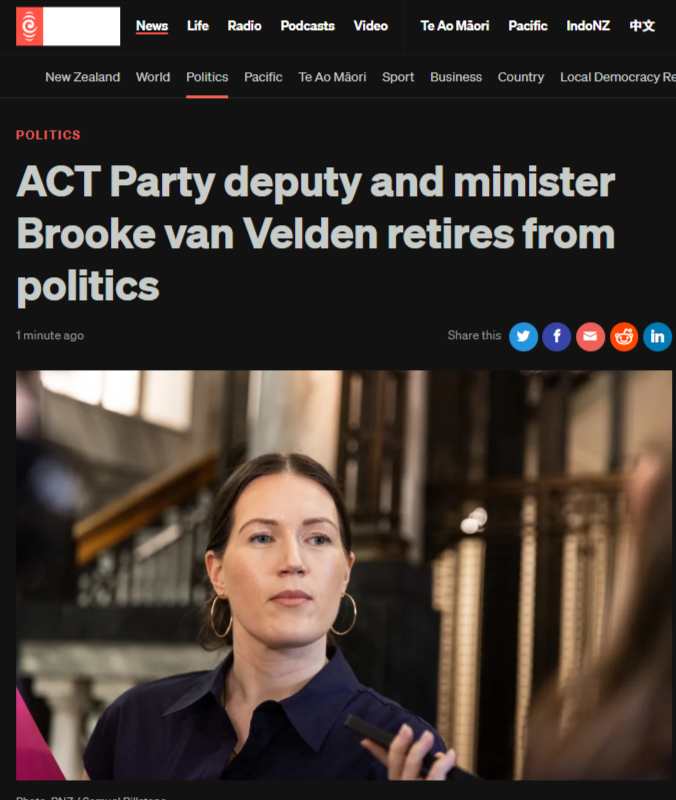
Brooke van Velden — ACT deputy leader, MP for Tāmaki, Minister of Internal Affairs, and Minister for Workplace Relations and Safety — has announced she will not contest the 2026 election. She frames it, as politicians always do when the ship is listing, as a personal decision. Time for herself. Time for something new.
Let us be precise about what is actually happening here. A 33-year-old woman, who reached the deputy leadership of a parliamentary party and a cabinet portfolio at 27, who won an electorate seat in 2023 in what ACT promoted as a historic upset, is walking away with eight months to go before a general election her party is polling at 7 percent.
That is not personal reinvention. That is a politician reading the numbers and choosing the exit door over the voting booth.
Who Was Brooke van Velden?

She was, in ACT's own telling, a wunderkind. She stumbled into the ACT Party at age 22 at what she described as "quite the chance encounter" — a bar also hosting an ACT function. She already supported the party. She got talking to David Seymour. Within five years, she was his deputy.
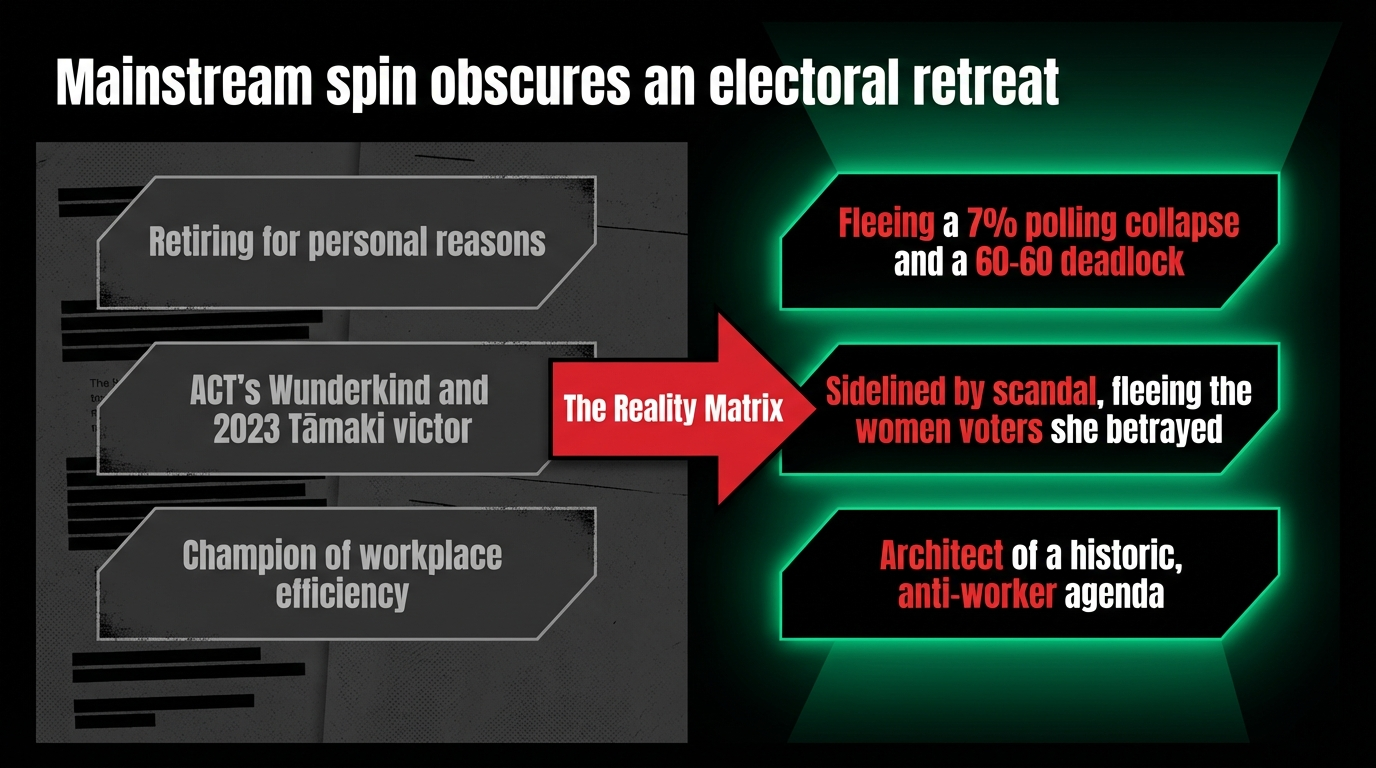
In 2023, she won the Tāmaki electorate, defeating National incumbent Simon O'Connor who had held it since 2011. She entered Cabinet in November 2023 with two of the most significant portfolios in government — Internal Affairs, and the one that would define her tenure and her legacy: Workplace Relations and Safety.
Tautoko Mai | Support This Mahi

Brooke van Velden stripped $12.8 billion from women's wages in 48 hours. She shut the door on 360,000 workers. She attacked judicial independence and refused to apologise. And she walked away before whānau could hold her accountable at the ballot box.
This essay exists because Crown structures, corporate media, and the ACT Party itself will never fund this kind of accountability. Every koha signals that rangatiratanga includes the power to fund our own truth tellers — people who will name names, verify the evidence, and refuse to let the powerful disappear quietly.
Kia kaha, whānau. Stay vigilant. Stay connected. And if you are able, consider a koha to ensure this voice continues.
If you cannot koha right now — no worries at all. Subscribe, follow, kōrero about this essay, and share it with your whānau and friends. That sharing is koha in itself. The more eyes on this work, the harder it is for the powerful to escape scrutiny.
Three pathways to support:
Koha direct — Support the Māori Green Lantern on Koha
Subscribe for essays direct to your inbox — The Māori Green Lantern on Substack
Direct bank transfer — HTDM, account number 03-1546-0415173-000
The Ministerial Record: A Demolition Derby on Workers' Rights
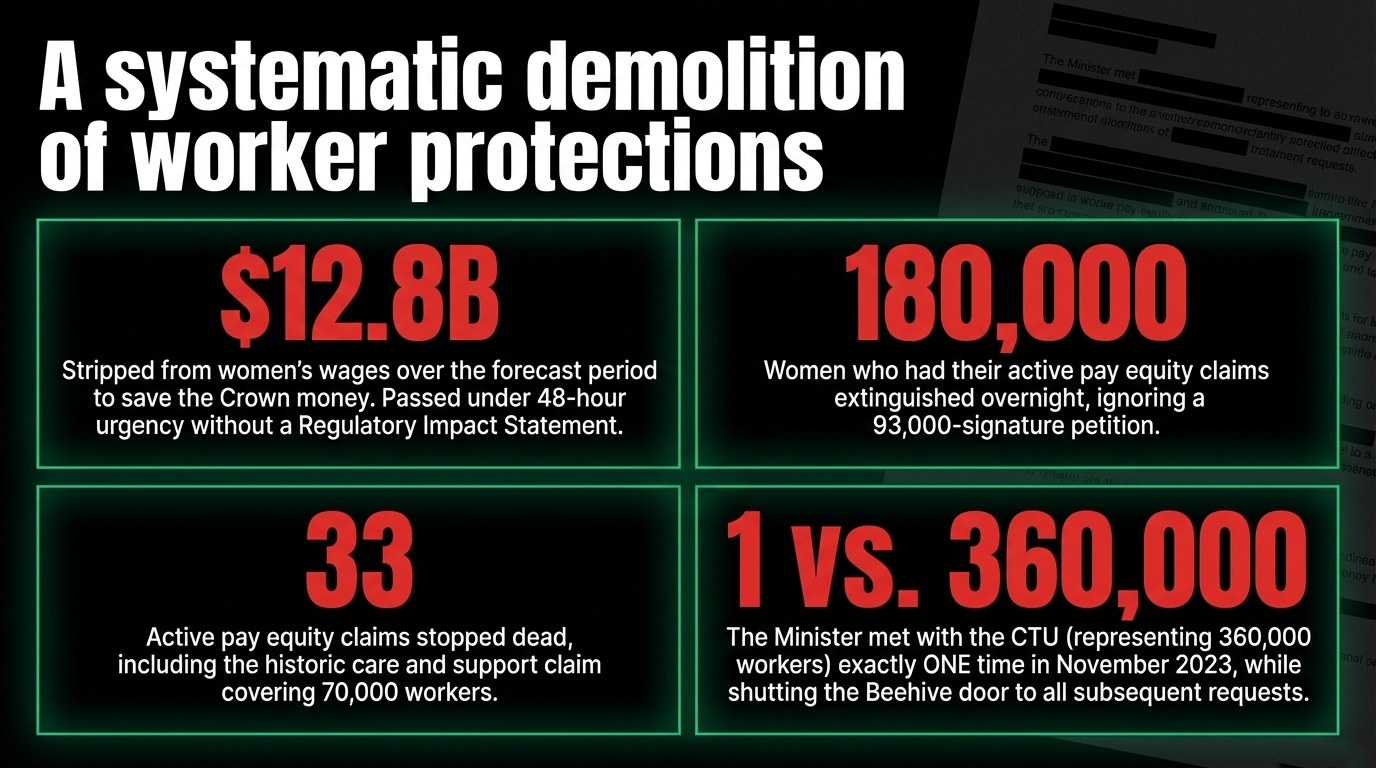
What followed was a systematic dismantling of the employment protections that generations of working New Zealanders had fought to secure.
Pay Equity: Axed Under Parliamentary Urgency
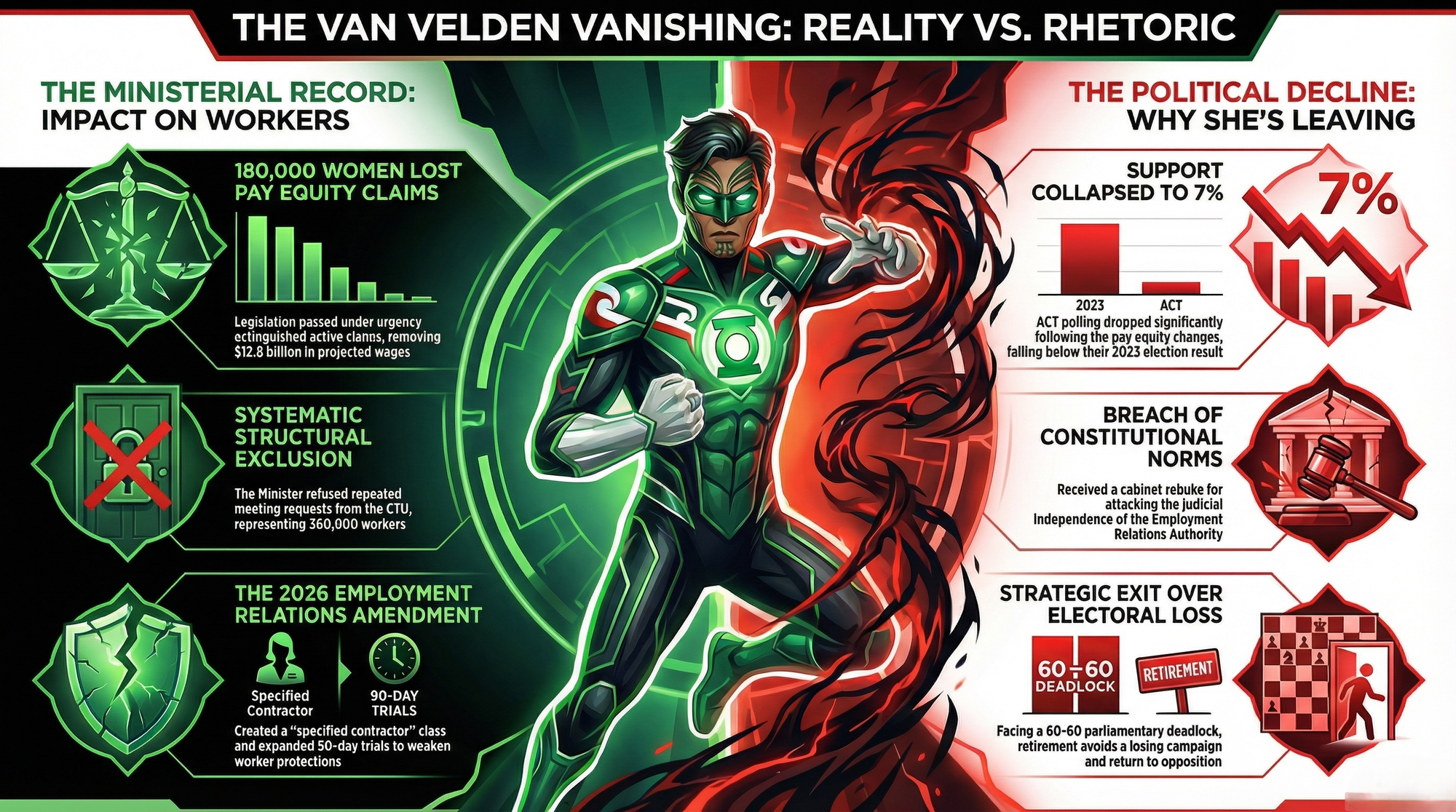
In May 2025, van Velden announced — with barely 48 hours of notice — that the government would raise the threshold for making pay equity claims. As RNZ reported, thirty-three active claims were stopped dead, and legislation was introduced and passed under urgency within two days, bypassing any public select committee process.
The Public Service Association national secretary Fleur Fitzsimons said this was "a dark day for New Zealand women". Kristine Bartlett, who won the landmark 2017 care and support settlement, was brought to tears. As RNZ confirmed, the care and support claim alone covered 70,000 workers and was cancelled outright. At Budget 2025, Finance Minister Nicola Willis revealed the changes saved $12.8 billion over the forecast period — the very savings the government swore were not the motive.
The process was kept secret to prevent a surge of claims, as officials confirmed to RNZ. There was no Regulatory Impact Statement. Canterbury University senior law lecturer Cassandra Mudgway called it "a very deliberate obfuscation of the issue" by the minister and the government.
More than 180,000 women had their active pay equity claims extinguished overnight. A 93,000-signature petition delivered to Parliament in July 2025 was dismissed by van Velden as "just a petition" that "won't change her mind."
In February 2026, a citizens' select committee of former female MPs found "flagrant and significant abuse of power" in how the changes were enacted.
The ERA Scandal: Attacking Judicial Independence
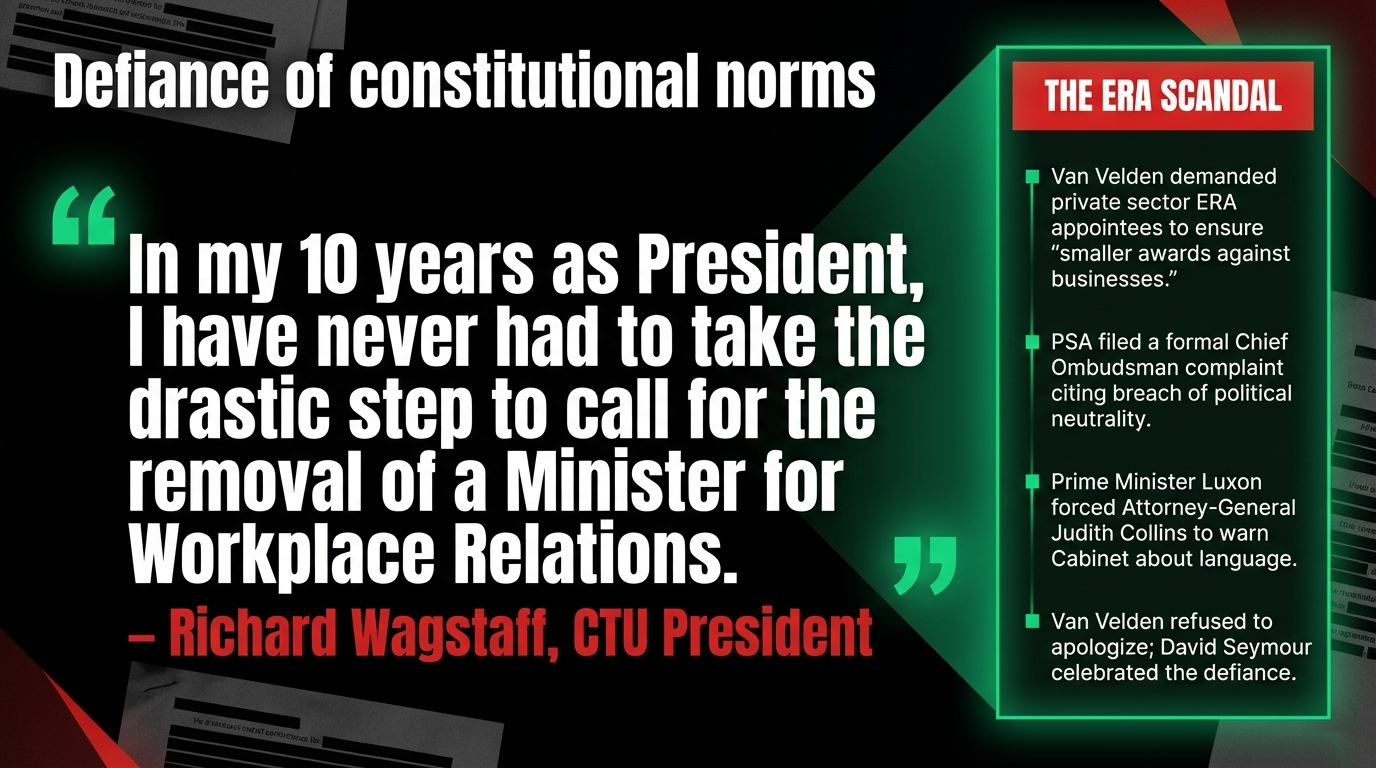
In August 2025, van Velden told media she hoped new Employment Relations Authority appointees with private sector backgrounds would lead to "smaller awards against businesses," adding that current members "believe that money grows on trees."
The PSA filed a formal complaint with the Chief Ombudsman, saying her statements "breach Cabinet Manual requirements for political neutrality." The NZCTU called on Prime Minister Luxon to sack her. CTU president Richard Wagstaff stated bluntly: in his 10 years as CTU President he had "never had to take the drastic step to call for the removal of a Minister for Workplace Relations."
The Prime Minister was forced to ask Attorney-General Judith Collins to warn Cabinet about "the need for careful use of language" — a barely disguised rebuke acknowledging her comments breached constitutional norms.
Van Velden neither retracted nor apologised. As the PSA noted 17 days later, her "defiance shows a concerning pattern where ideology and politics override cabinet rules and longstanding constitutional principles." Worse, ACT leader David Seymour celebrated her comments in a LinkedIn post he also failed to withdraw.
Shutting the Beehive Door on 360,000 Workers
Van Velden met with the CTU — New Zealand's largest democratic organisation, representing 360,000 workers — precisely once in her entire ministerial tenure: in November 2023, immediately after she was appointed. Despite the CTU requesting meetings "half a dozen or more times," she refused each one, instead meeting what Wagstaff described as "fringe organisations, with few members." Previous ministers under National-led governments had held regular meetings. This was a deliberate structural exclusion.
The Employment Relations Amendment Act 2026
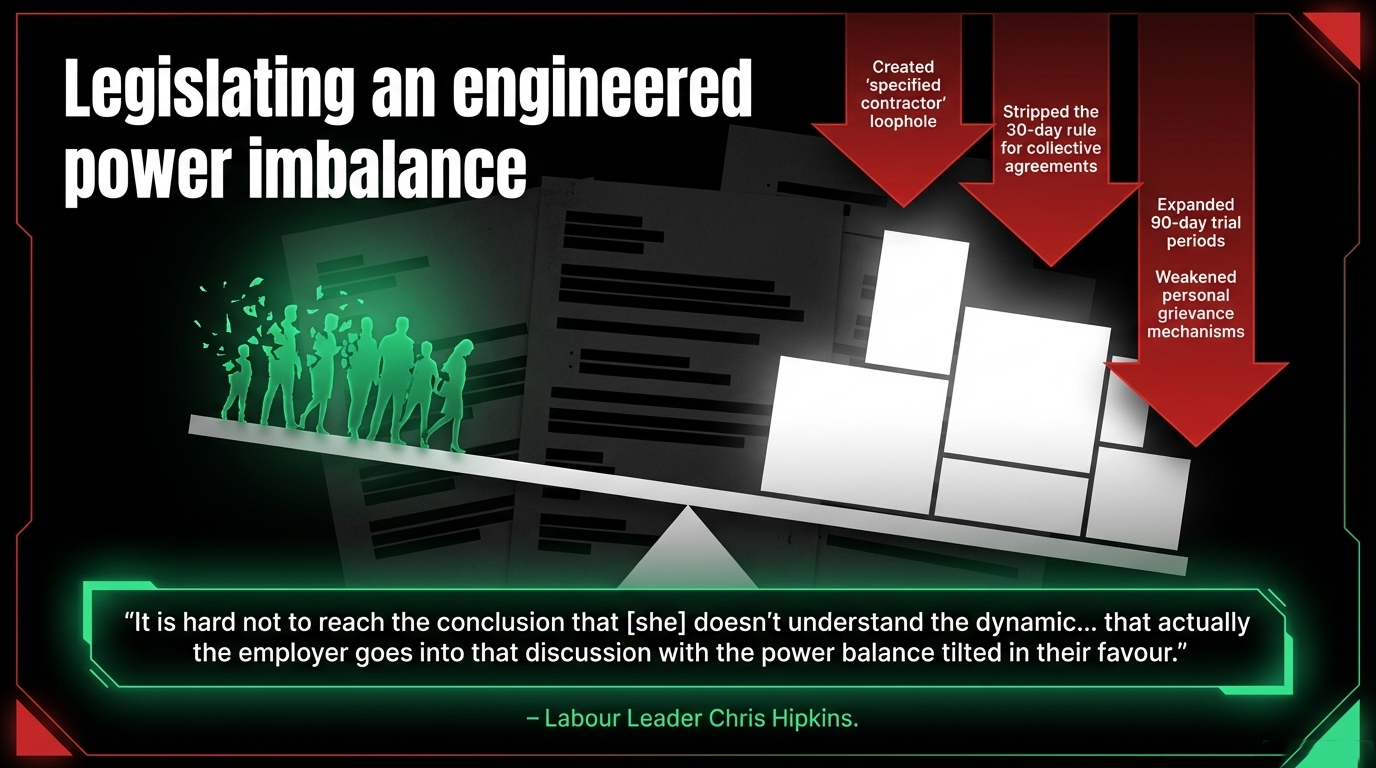
Passed in February 2026, this was van Velden's signature legislative achievement — in the eyes of business. As RNZ reported from the final debate, it created a new "specified contractor" class shut out of employment protections, stripped the 30-day rule extending collective agreement terms to new employees, weakened personal grievance mechanisms, and expanded 90-day trial periods. The NZCTU's full explainer described the bill as "incredibly imbalanced in favour of employers."
Labour leader Chris Hipkins told Parliament it was hard not to reach the conclusion that van Velden "doesn't understand the dynamic that exists between an employer and an employee — that actually the employer goes into that discussion with the power balance tilted in their favour."
Modern Slavery: "Not a Priority"
When a cross-sector leadership group chaired by former Air New Zealand CEO Rob Fyfe spent months developing a modern slavery reporting framework, van Velden disbanded the group in 2024, telling Parliament the issue was "not a priority." Fyfe had already resigned as chairman, saying it was "a source of embarrassment and disappointment" that politicians had shown "scant regard for victims of modern slavery." As recently as March 2026, the NZ Herald confirmed the number of labour inspectors has fallen, deepening the enforcement void she created.
The Holidays Act: Back to the Drawing Board — Twice
The Holidays Act overhaul was van Velden's most visible policy project, and it became an embarrassment. In December 2024, she sent officials back to the drawing board after consultation revealed her first exposure draft "was more complex and had higher compliance costs than the legislation we have now." In September 2025, the NZCTU called for a pause, warning the Employment Leave Bill "might mean that some workers, particularly vulnerable workers, have their holiday pay reduced." As RNZ confirmed, part-time workers will get less sick leave under the changed law.
The Polling Catastrophe: Why She's Really Leaving

Van Velden's departure cannot be separated from ACT's political freefall. The numbers tell the story plainly.
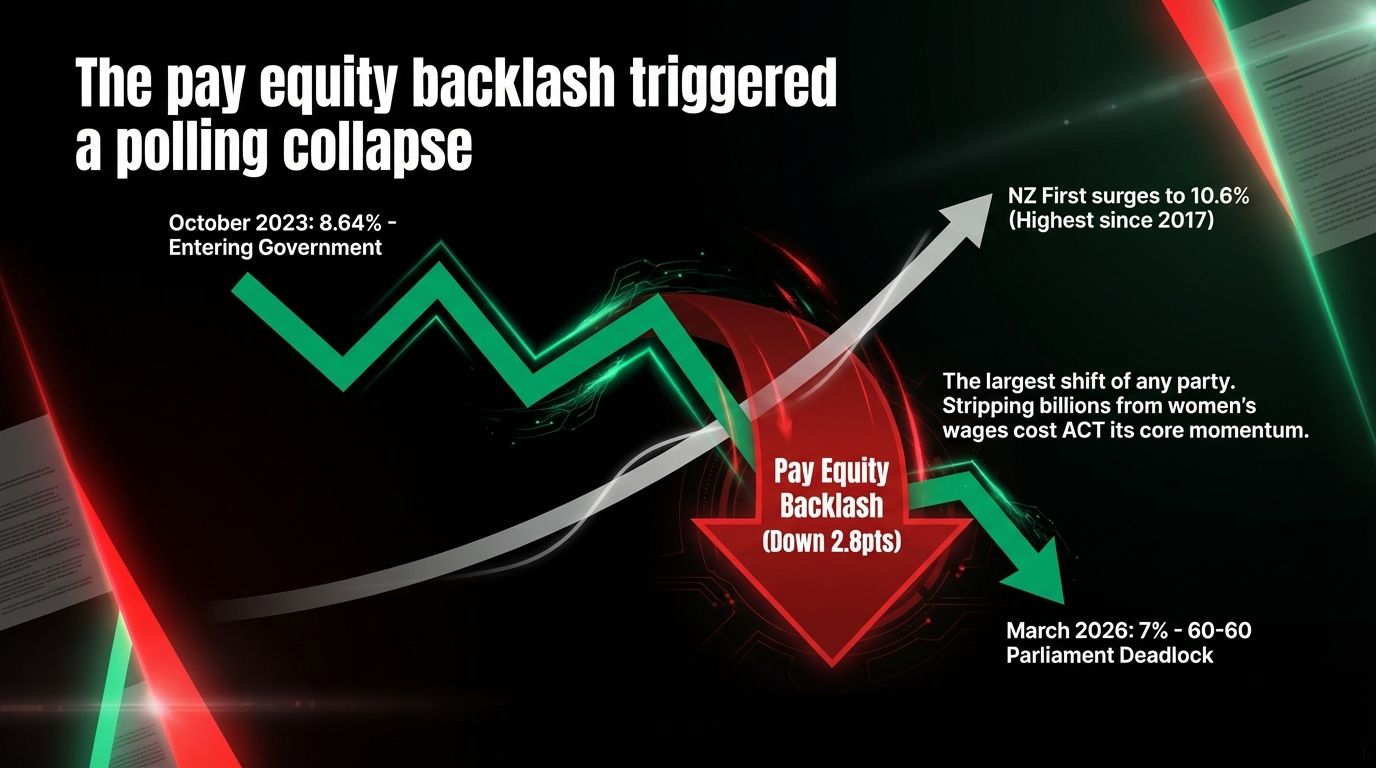
When ACT entered government in October 2023, it held 8.64 percent of the party vote. David Seymour had set a target of 15 percent for 2026.
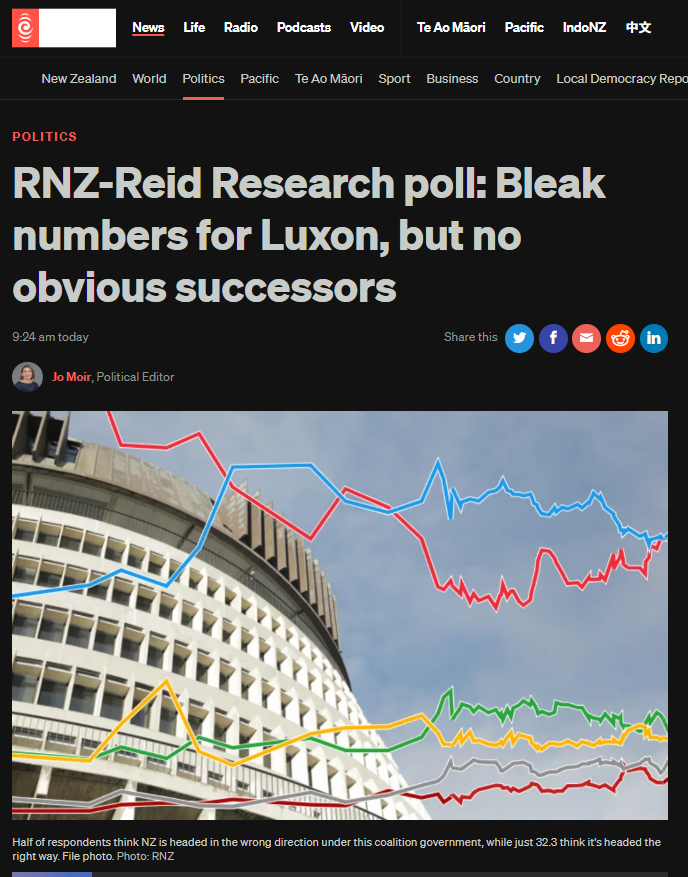
As of the RNZ-Reid Research poll published 22 March 2026 — two days before van Velden's retirement announcement — ACT is on 7 percent. Down from the election result. Not up. NZ First has surged past ACT to 10.6 percent — its highest level since July 2017. On those numbers, ACT would win nine seats in a 120-seat Parliament.
That same poll puts Labour at 35.6 percent, National at 30.8 percent, and produces a 60-60 deadlock. Half of respondents — 50 percent — say New Zealand is heading in the wrong direction. The Roy Morgan poll from February 2026 confirmed ACT at 8 percent, with women backing the Labour-led opposition by a 16-point margin.
It is not hard to understand why. As RNZ's analysis confirmed, ACT dropped 2.8 points — the largest shift of any party — immediately following the pay equity changes. The pay equity gutting was ACT's signature act. It cost them more votes than any other single policy.
The Five Hidden Connections

Five verified structural forces converge in this departure:
1. The Pay Equity Blowback Was Personal and Electoral.
Van Velden won Tāmaki partly on women's votes — on the backlash against a National incumbent seen as too conservative. As letters to the NZ Herald noted, she "rode women's wave to win Tāmaki." Eight months after her election, she stripped $12.8 billion from women's wages. The same voters who put her there would not return her.
2. ACT's Internal Culture Was Already Broken.
A June 2024 RNZ investigation found the ACT campaign had been a "train wreck" — with "a culture of fear," allegations of "unfair treatment for women," and multiple staff and volunteers resigning. A leaked recording captured two respected volunteers resigning and expressing "no confidence in the board." This is not a party in growth mode.
3. The ERA Scandal Made Her a Liability.
The PSA's Ombudsman complaint, the CTU's call for her sacking, the Prime Minister's implied rebuke through the Attorney-General — these are not the hallmarks of a minister who survived her scandals cleanly. These are the hallmarks of a minister whose party can no longer defend her as an asset.
4. Seymour's Coalition Position Is Weakening, Not Strengthening.
Seymour became Deputy Prime Minister in May 2025. His elevation has not translated into polling gains. NZ First is growing. As RNZ's analysis confirmed, NZ First was the only coalition party to grow after the Budget — liberated from the DPM role, unattached to van Velden's pay equity wreckage, and surging. The strategic logic of the ACT-in-government arrangement has demonstrably failed.
5. The 2026 Election Looks Like a Loss — and Van Velden Knows It.
The March 2026 poll would produce a 60-60 deadlock with Labour the largest party. Under any scenario where Labour forms a government with the Greens and Te Pāti Māori, van Velden loses her ministerial warrants. Rather than fight a losing campaign in Tāmaki and return to opposition, she has chosen the exit.
What This Means for Seymour and ACT
David Seymour is, objectively, in serious trouble. His deputy — the woman he called "the future of the party" — is leaving eight months before an election. ACT must now find a candidate for Tāmaki, a seat it has held for only one term, against what will be a highly motivated National and Labour campaign. Without van Velden, ACT loses its primary minister, its deputy leader, and its only electorate foothold in one announcement.
The CTU's Richard Wagstaff noted in August 2025 that in his decade as president, van Velden was the only minister for whom he had ever called for removal. She was not a victim of unfair attack. She was a minister whose actions justified every attack made against her.
The working people of Aotearoa — the nurses, the teachers, the cleaners, the 180,000 care workers whose pay equity claims she cancelled — will not mourn her departure. They will, rightly, demand that the next parliament repair what she broke.
The taiaha points clearly: this is not the fall of one minister. It is the beginning of the unravelling of the ACT project.

Research conducted 24 March 2026. Sources verified live. Sources include RNZ, 1News, The Spinoff, NZ Herald, PSA, CTU/NZCTU, TeAo Māori News, CathNews NZ, Roy Morgan, and Reid Research/RNZ polling. All hyperlinks confirmed working at time of publication.