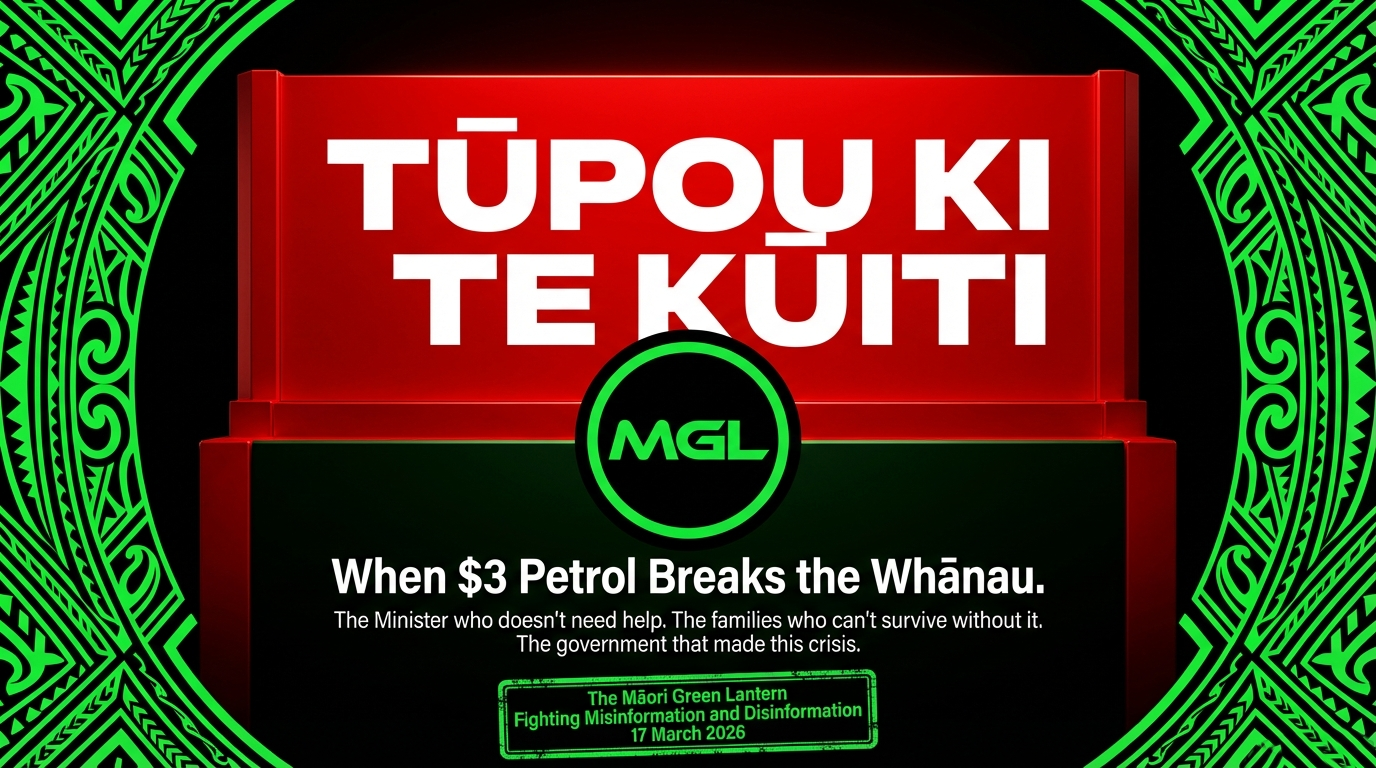
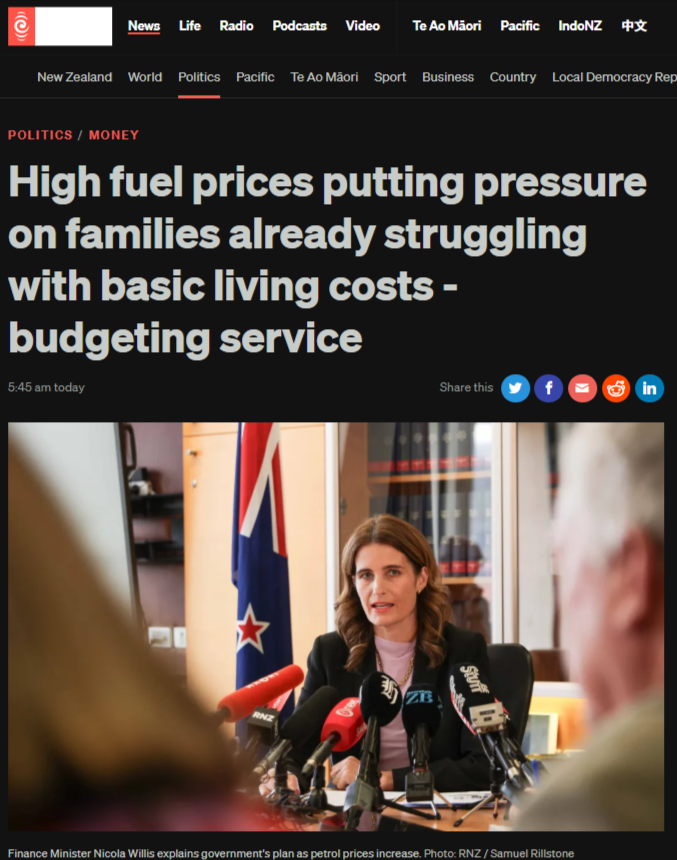
"When Nicola Willis Told South Auckland to Check Their Tyre Pressure While $3 Petrol Crushed Their Whānau" - 17 March 2026
The Minister who doesn't need help. The families who can't survive without it. The government that made this crisis — and now offers carpooling advice.

Tēnā koutou katoa, whānau.
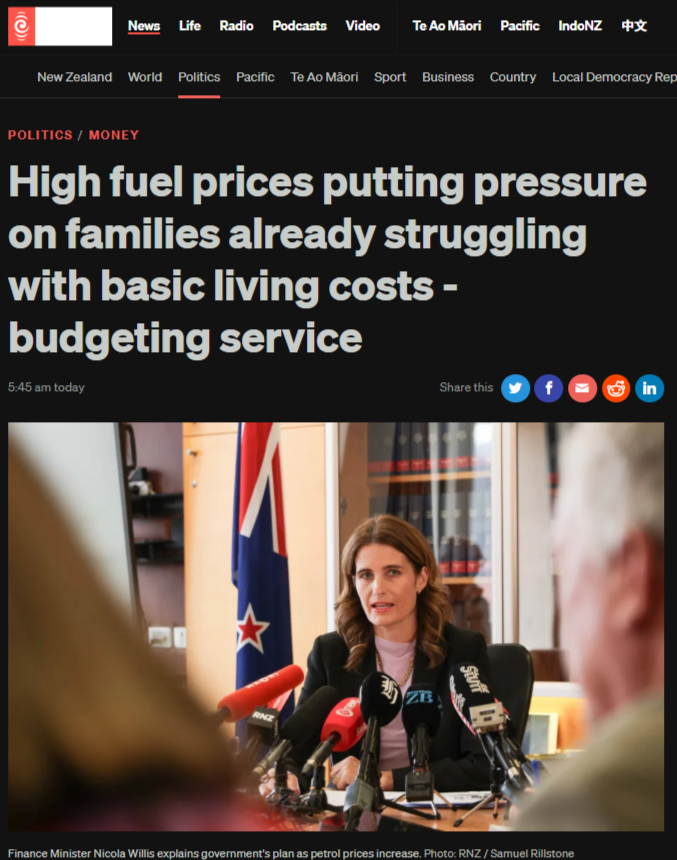
This is not a fuel crisis. This is a revelation. A revelation of who this government serves, who it protects, and who it is perfectly comfortable watching drown in the tide of a cost-of-living catastrophe it helped create. While Finance Minister Nicola Willis admits — with extraordinary candour — that her own household "would not need as much help financially as others," the whānau of Māngere are choosing between petrol and power bills. Between a tank of gas and a plate of food. Between getting to work and staying home. The waka is running dry. But not everyone's waka.
This investigation responds directly to RNZ's report from 17 March 2026, in which Māngere Budgeting Services CEO Lara Dolan warned that the 20% surge in petrol prices this month — now above $3 per litre — will force families to choose between fuel and survival.
KO TE RĀRANGI KŌRERO — THE SUMMARY
Petrol has hit $3 per litre and is climbing. It has risen 20% in a fortnight, driven by the US-Israeli war on Iran and the closure of the Strait of Hormuz — a route carrying 20% of the world's daily oil supply. For the Māori and Pacific whānau of South Auckland, who have no viable public transport alternative, no electric vehicles, and no financial buffer, this is not an inconvenience. It is a catastrophe. But this government did not just fail to prepare. It systematically dismantled the protections that might have softened the blow: the clean car discount scrapped, the Marsden Point refinery gone, fuel reserves built on paper tickets rather than physical stock, public transport chronically underfunded in South Auckland, and now — the cherry on the cake of contempt — Nicola Willis offering carpooling advice while refusing to commit to a price trigger for action. This essay names what that is: a class war, delivered through fuel prices.
PODCAST: The Deep Dive Podcast:
"Tūpou Ki Te Kūiti: How $3 Petrol Is Breaking South Auckland's Whānau"
KO TE TŪĀHURIHANGA — THE OPENING HOOK
Let me give you the number that the government hopes you don't dwell on: 20 percent.
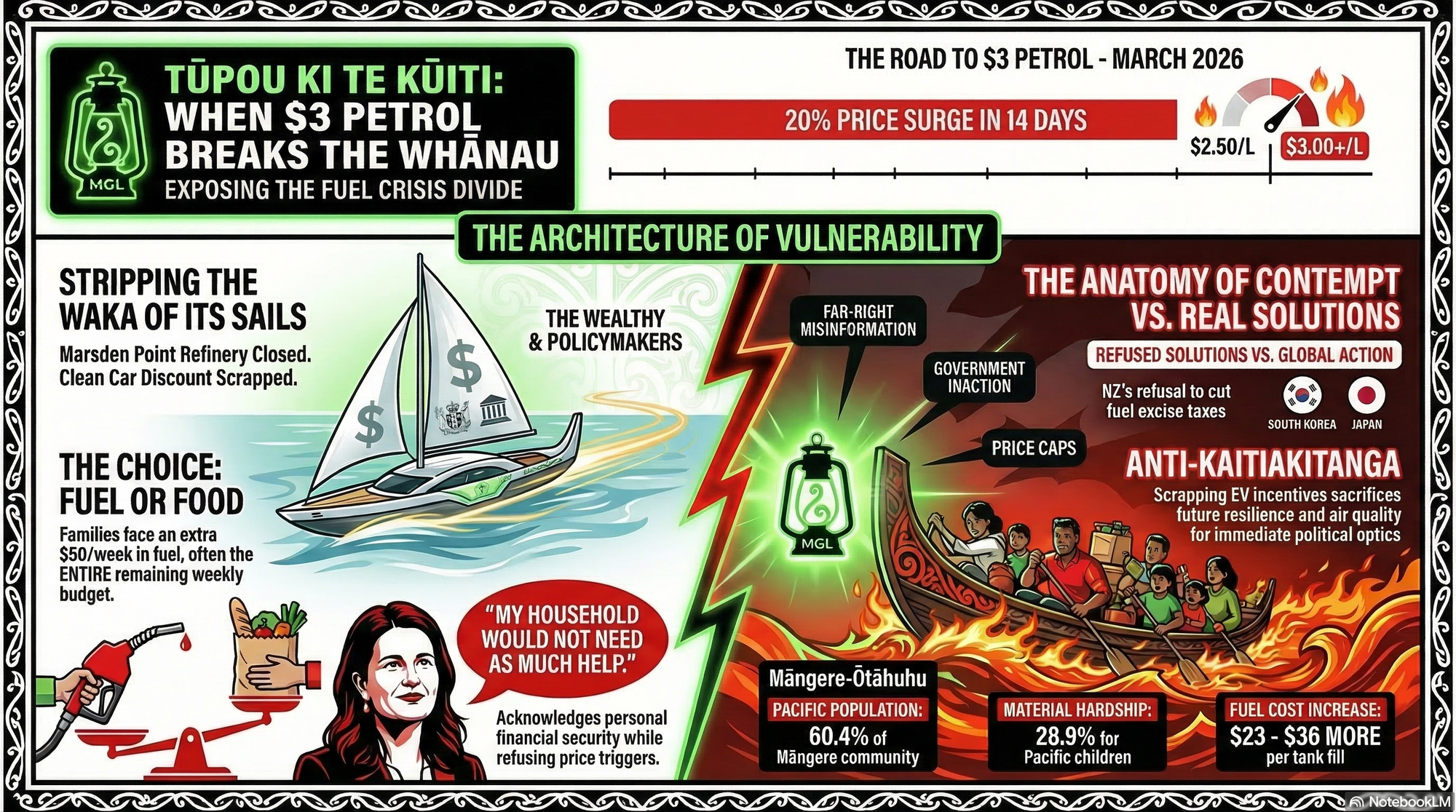
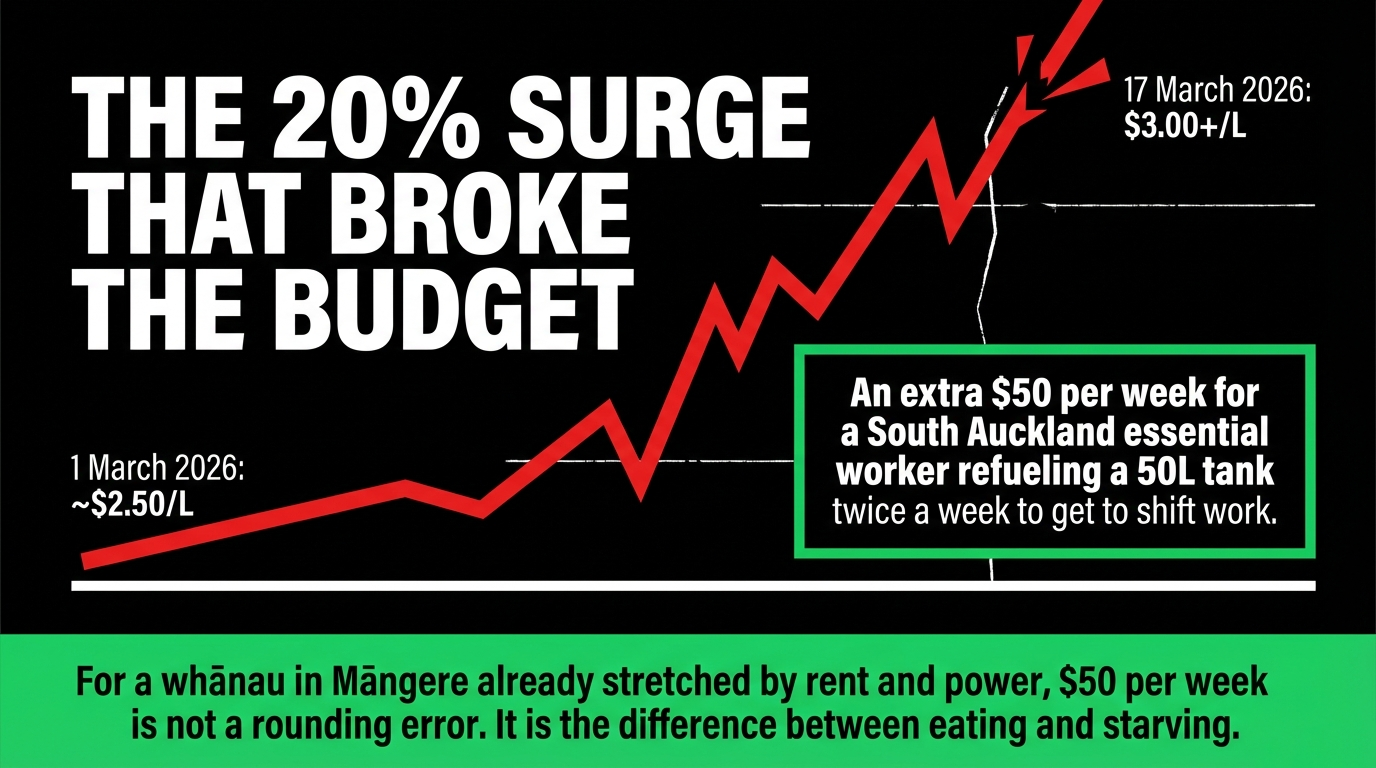
In a fortnight — from 1 March to 17 March 2026 — the average price of 91 petrol across Aotearoa has risen 20 percent, according to Gaspy fuel price data reported by RNZ. The average national price at the start of March was around $2.50 per litre. Today it is above $3. At the start of March, filling a standard 50-litre tank cost roughly $125. Today it costs $150, or more. For a household that refuels twice a week to get to work, that is an extra $50 per week pulled from a budget that was already buckled under the weight of rent, power bills, food, and debt.
For a whānau in Māngere, $50 per week is not a rounding error. It is the difference between making rent and not making rent. It is the difference between the kids eating dinner and the kids not eating dinner.
And what does Finance Minister Nicola Willis offer in response? The government is looking at "targeted, temporary, timely" support. She will not name a price trigger. She will not cut the fuel excise. She will not say when she will act. But she will, apparently, suggest that a South Auckland airport cleaner consider checking her tyre pressure.
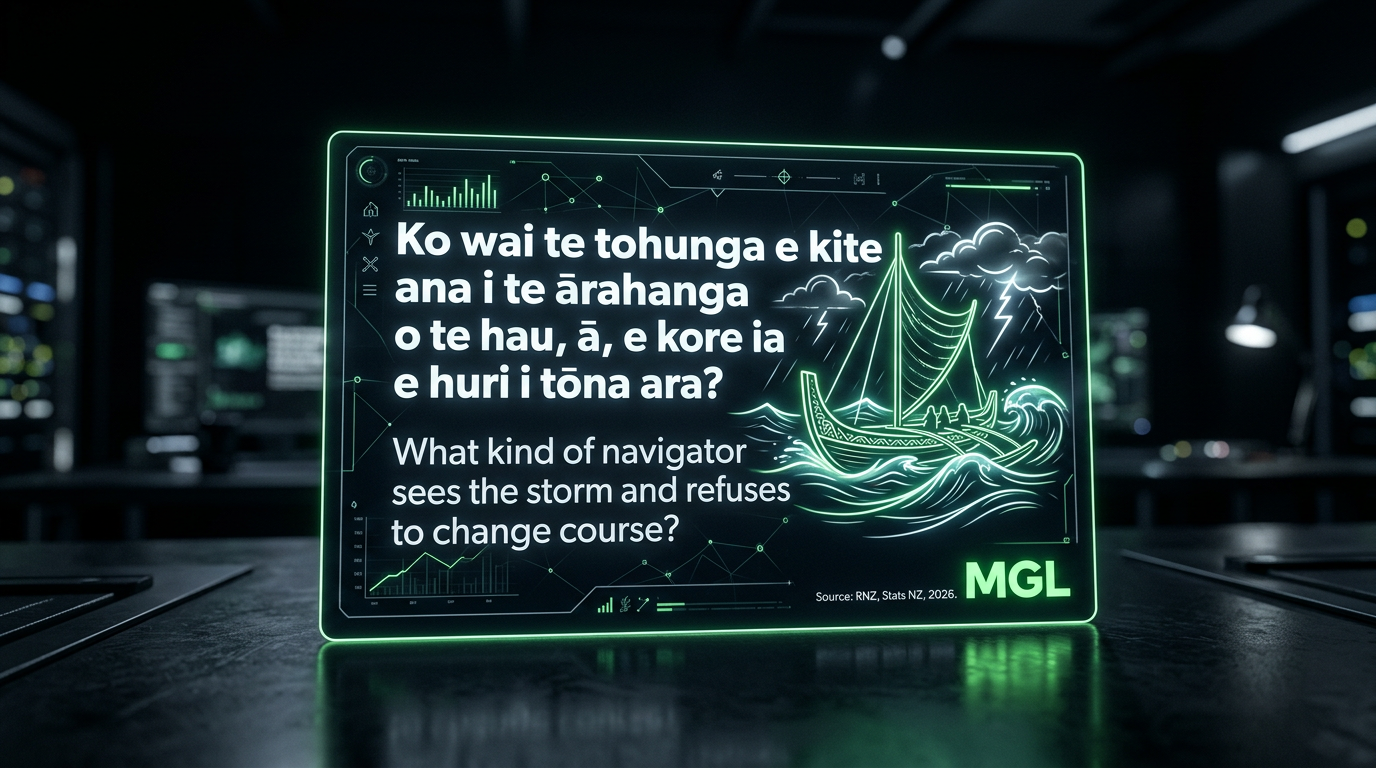
Ko te tohunga nei e kite ana i ngā hau, engari e kore ia e hurihia te kaupeka o tōna waka.
The tohunga sees the winds. She will not change her vessel's course.
KO TE ARERO O TE WAKA — THE METAPHOR
He waka kotahi, he waka rerekē: ētahi he rau kei runga, ētahi kāore he hau.
There are two kinds of waka in Aotearoa today, whānau. The waka of the rangatira class — Nicola Willis, her Cabinet colleagues, the property investors, the fuel company executives — sails smoothly, rigged with the sails of accumulated wealth, fixed mortgages, company cars, expense accounts. The wind hits the sails and the waka moves forward.
Then there is the waka of the South Auckland whānau — the cleaner at the airport, the supermarket worker on the early shift, the kuia who drives her mokopuna to school because the bus doesn't run before 7am in Māngere. This waka has no sails. It is paddled by hand. And now someone has set the water on fire.
When petrol hits $3 and climbs, the paddlers of Māngere do not have the option Willis imagines — to simply adjust, to "carpool," to "use public transport." They are already doing everything they can. They have nothing left to give. The waka is being swamped, and the tohunga on the government waka is offering them a slightly better paddle technique.
This metaphor is not decorative, whānau. It is structural. Because this government has consistently, deliberately, and with full knowledge of the consequences, chosen policies that left the waka of South Auckland without sails. Let me walk you through exactly what they chose, and what it cost.
WĀHANGA TUATAHI — SECTION ONE: THE CRISIS THE GOVERNMENT PRETENDED IT COULDN'T SEE
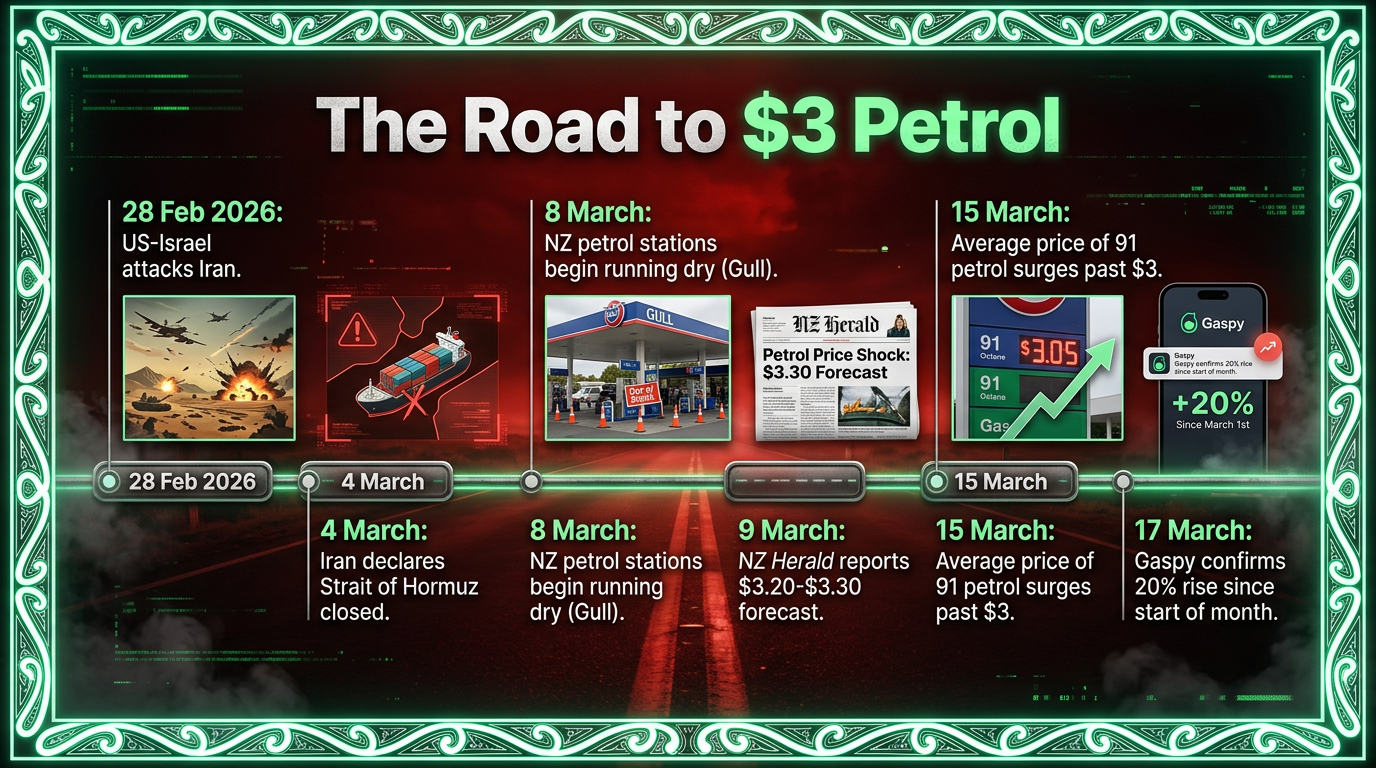
On 28 February 2026, the United States and Israel launched coordinated military strikes on Iran. The target was Iran's nuclear infrastructure. The casualty was the global oil supply. Iran's Supreme Leader Ali Khamenei was assassinated. In retaliation, Iranian forces closed the Strait of Hormuz — the narrow waterway between the Persian Gulf and the Gulf of Oman through which approximately 20 percent of the world's daily oil supply normally passes. Around 13 to 20 million barrels of oil per day. Gone.
Within days, global oil markets began to crack. Brent crude surged from around $70 to over $110 per barrel. The World Economic Forum reported prices reaching $120 as the crisis deepened, with some analysts warning of $150 per barrel in a worst-case scenario. Goldman Sachs warned that if shipping disruptions persisted, prices would exceed $100 per barrel. As of mid-March, oil production from Kuwait, Iraq, Saudi Arabia, and the UAE had collectively dropped by at least 10 million barrels per day — the largest supply disruption in the history of the global oil market.
The Middle East provides up to 80 percent of the crude oil for the South Korean and Singaporean refineries that New Zealand relies on for 100 percent of its refined fuel, according to RNZ's economic analysis on 10 March. New Zealand, as an island nation with no domestic refining capacity, sits at the very end of a very long supply chain. When the chain breaks, we feel it first and hardest at the pump.
The New York Times described the shock on 12 March as potentially "catastrophic" if the war dragged on — warning that the disruption was not just about petrol prices, but about the price of food, freight, medicine, and the stability of inflation-ravaged economies worldwide. Chatham House confirmed that oil-importing nations — nations like Aotearoa — faced inflation rising well above pre-conflict forecasts if the disruption persisted.
New Zealand has approximately 50-57 days of fuel supply in-country or en route, according to Willis's own 16 March update. The government claims this is sufficient. What it does not say is that this buffer was built on a foundation of deliberate structural vulnerability — a vulnerability that this government and its predecessors built brick by brick.
WĀHANGA TUARUA — SECTION TWO: HOW THIS GOVERNMENT STRIPPED THE WAKA OF ITS SAILS
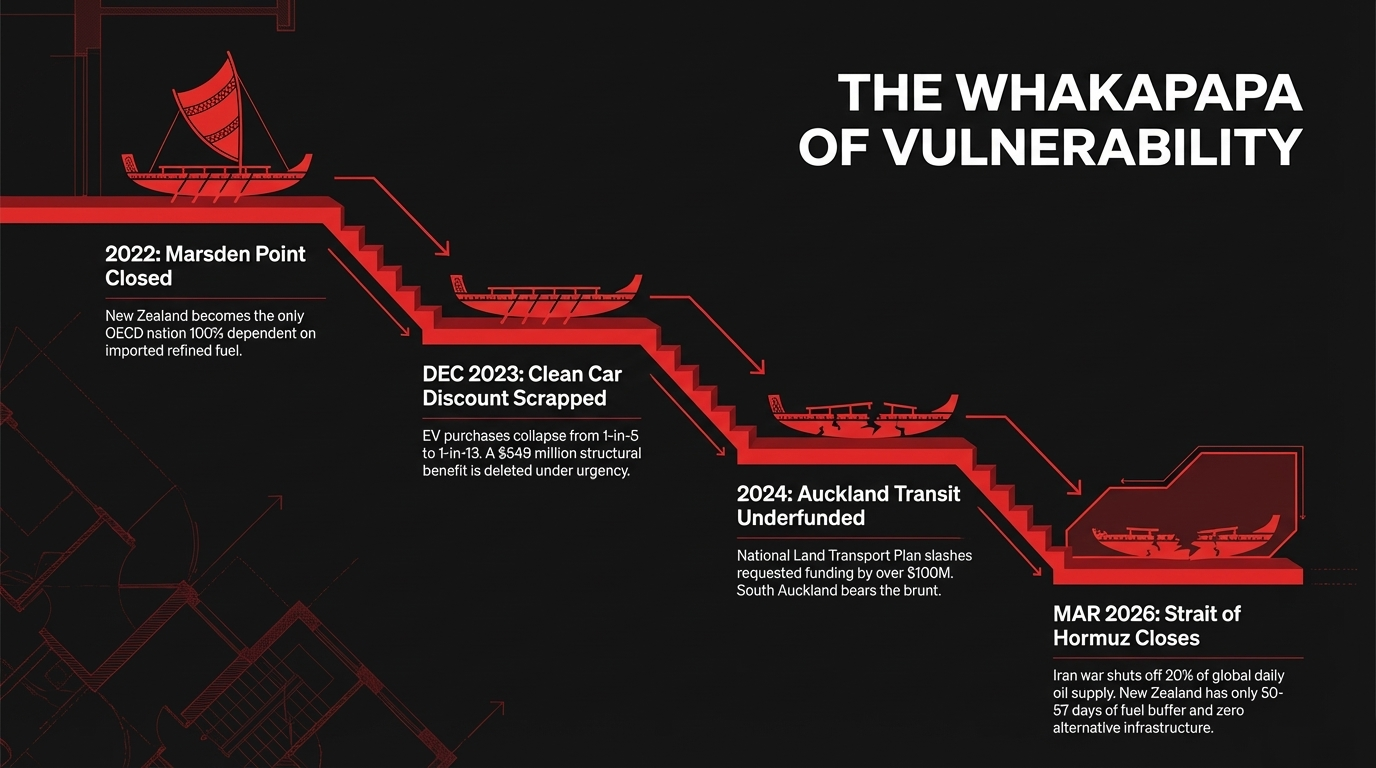
Let me be forensic, whānau. This crisis did not arrive from nowhere. It was built, decision by decision, by governments who chose the interests of the fossil fuel industry over the resilience of ordinary families.
Decision One: The Marsden Point Refinery
Marsden Point — the 135,000 barrel-per-day refinery at Ruakākā — closed in 2022 for conversion to an import terminal. Before the closure, experts and workers warned that shutting it down would expose New Zealand to catastrophic fuel security risk. The decision, driven by private shareholders seeking better returns than NZ domestic refining could offer, was allowed to proceed under the Labour government. As a result, New Zealand became the only OECD nation 100% dependent on imported refined fuel. As RNZ reported on 11 March 2026, this created the vulnerabilities we are now living. Finance Minister Nicola Willis herself admitted: "There is no question if Marsden Point was up and running today it would make the country more resilient. That's a simple fact."
A simple fact. The government has known this for years. It did nothing.
Decision Two: The Clean Car Discount — Scrapped
On 14 December 2023, the National-led coalition government passed the Clean Vehicle Discount Scheme Repeal Amendment Act under urgency — three readings in one day, passed before Christmas. The Clean Car Discount, which had helped NZ families buy lower-emission vehicles and quadrupled EV uptake since 2021, was gone by 31 December 2023. The result? EV purchases collapsed from one in five to one in thirteen, according to Drive Electric.
Transport officials calculated that scrapping the discount would cost the country $549 million — more than double the $259 million in projected benefits. The advice was never formally presented to Cabinet because the government suspended the need for regulatory impact statements on undoing Labour-era policies. The cost to families — in additional fuel bills — was not included in the calculation.
For the whānau of Māngere, the Clean Car Discount was their pathway to a vehicle they could afford to run. Now that pathway is closed, and they sit in ageing, fuel-hungry cars, paying $3 per litre to get to work.
Decision Three: The Clean Car Standard — Gutted
In November 2025, the government slashed the penalty fees importers pay for bringing high-emitting vehicles into the country by nearly 80 percent. By March 2026, RNZ reported that the government is now considering scrapping the Clean Car Standard altogether — making New Zealand one of only two OECD nations (the other being Russia) without a vehicle emissions standard. The Green Party has warned that this will mean New Zealand becomes the dumping ground for high-emitting vehicles that can no longer be sold in Australia.
Decision Four: Public Transport Underfunded
Auckland Transport's Statement of Intent 2024-2027 confirms that after the government's National Land Transport Plan 2024-2027 allocated less funding than requested, Auckland was forced to revise its capital programme downward from $1,459 million to $1,352 million — a shortfall of over $100 million. South Auckland, already the region least served by public transport, bears the consequences.
And when Nicola Willis offers the example of a South Auckland cleaner who "cannot take the bus to work at 5am," she is not describing someone who has made an inefficient transport choice. She is describing the direct, lived consequence of a government that has chosen, again and again, to underfund the public transport infrastructure that those families depend on.
WĀHANGA TUATORU — SECTION THREE: THE WHĀNAU OF MĀNGERE — WHO THEY ARE, WHAT THIS COSTS
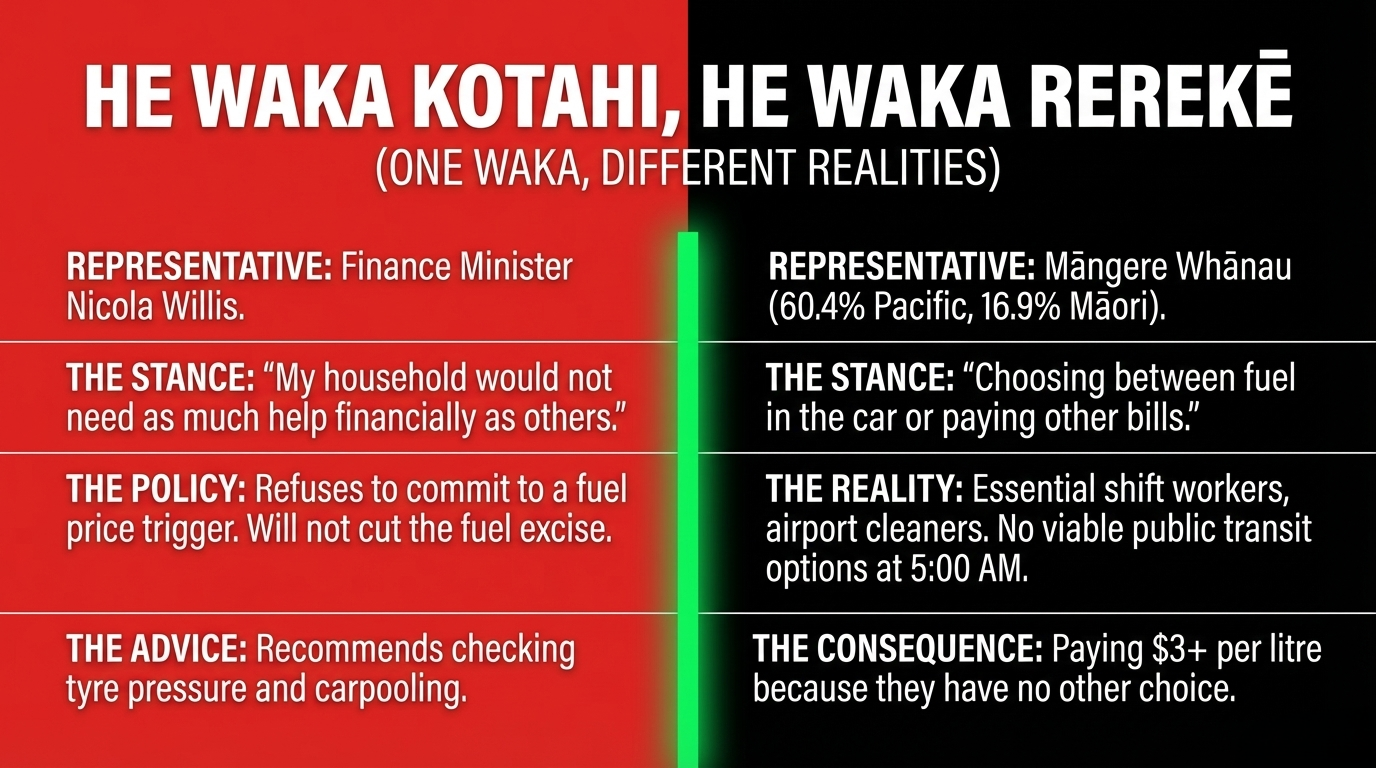
Tēnei te tangata, whānau. This is who we are talking about.
According to the 2023 New Zealand Census, Pacific peoples make up 60.4 percent of the Māngere-Ōtāhuhu local board population — the highest proportion of any local board in Auckland. Māori make up another 16.9 percent, according to the Māori ethnicity in Auckland census summary. Over three quarters of this community are Māori and Pacific. Young, working-class, and stretched.
These are not people who can "trade down" to an EV when petrol gets too expensive. They are already in the oldest vehicles, on the tightest budgets, in the community with the fewest public transport alternatives, doing the shift work that starts at 5am and ends at midnight. The airport cleaner Willis mentioned is not a hypothetical. She is representative of the tens of thousands of essential workers who power the southern end of Auckland and who have no choice but to drive.
Pacific women earn a median hourly wage of $30 — $8 less per hour than European men. Pacific unemployment has risen to 12.3 percent, more than double the national average of 5.4 percent, according to Stats NZ data reported by Pacific Media Network in February 2026. The number of children living in material hardship has risen to 156,600 in 2026 — an 8.6 percent increase from 2025. The Salvation Army distributed 90,250 food parcels in 2026, up 7 percent from 2025, according to the same report.
Nearly one in three households across Aotearoa struggled to access affordable, nutritious food in the past year, according to the Hunger Monitor released on 11 March 2026 — the country's first comprehensive food insecurity report. From its warehouse in Manukau, South Auckland Christian Foodbank delivered 40,000 food parcels last year — at a rate of 177 per day during peak periods, compared to 100 per day during COVID. Chief executive Ian Foster said: "Budgeters have done everything they can but people simply do not have enough money because their income has not increased anywhere near living costs."
Now add $23 extra per tank fill to that equation. Now add two fills per week. Now add rising food costs as freight prices cascade the fuel price spike into every item on the supermarket shelf. This is not a cost-of-living problem. This is a survival problem.
And Māngere Budgeting Services CEO Lara Dolan — who sees all of this, every day — told RNZ with devastating clarity: "Pretty much people will have to make a choice about fuel in the car or paying other bills."
Not "might have to." Not "could be difficult." Will have to make a choice. That is not a financial stress. That is a Sophie's choice being handed to poor Brown families by a Finance Minister who will never face it herself.
WĀHANGA TUAWHĀ — SECTION FOUR: THE GLOBAL CONTRAST — WHAT OTHER GOVERNMENTS ARE DOING
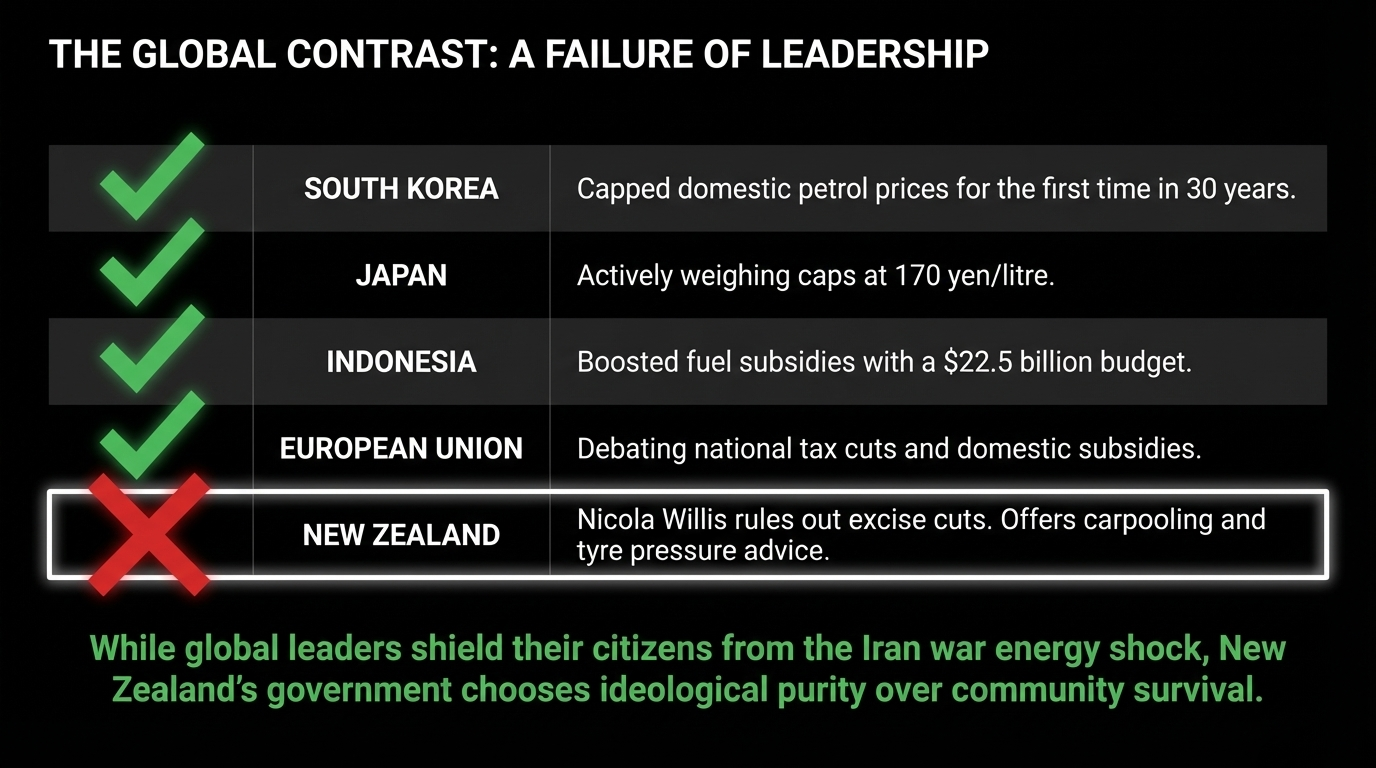
Let me show you what leadership looks like when governments actually give a damn about the families filling up their tanks.
South Korea capped domestic fuel prices for the first time in almost three decades. Japan is weighing options to cap gasoline prices. Indonesia boosted fuel subsidies to a budget of 381 trillion rupiah — approximately $22.5 billion — to absorb the price shock for its people. Vietnam eliminated fuel import tariffs. The European Union is debating national tax cuts or domestic subsidies. European advocates are calling for windfall profit taxes on fossil fuel companies who are, as Euronews reported, "cashing in" on the Iran war.
And the IEA — of which New Zealand is a member — coordinated the release of 400 million barrels of oil from global reserves, the largest coordinated release in history. New Zealand's contribution was the equivalent of six days of fuel supply. Six days. While petrol companies at the pump charge $3 per litre and climb.
Meanwhile, our Finance Minister — who by her own admission does not need help — has ruled out cutting the fuel excise tax because it would "send the wrong signal." The wrong signal to whom, exactly? Not to the family in Māngere running calculations at the petrol pump. Not to the financial mentor at Māngere Budgeting Services teaching carpooling. The wrong signal to the fossil fuel companies and the financial markets — the real constituency this government serves.
The previous Labour government, when Russia's invasion of Ukraine sent petrol above $3 in 2022, cut the fuel excise. Willis herself acknowledged this — noting that current prices are "just 6c away" from the level that triggered that cut. The difference? In 2022, Labour acted. In 2026, Willis is waiting, watching, calculating — and carefully calibrating her messaging so as not to spook the financial sector.
WĀHANGA TUARIMA — SECTION FIVE: THE ANATOMY OF CONTEMPT
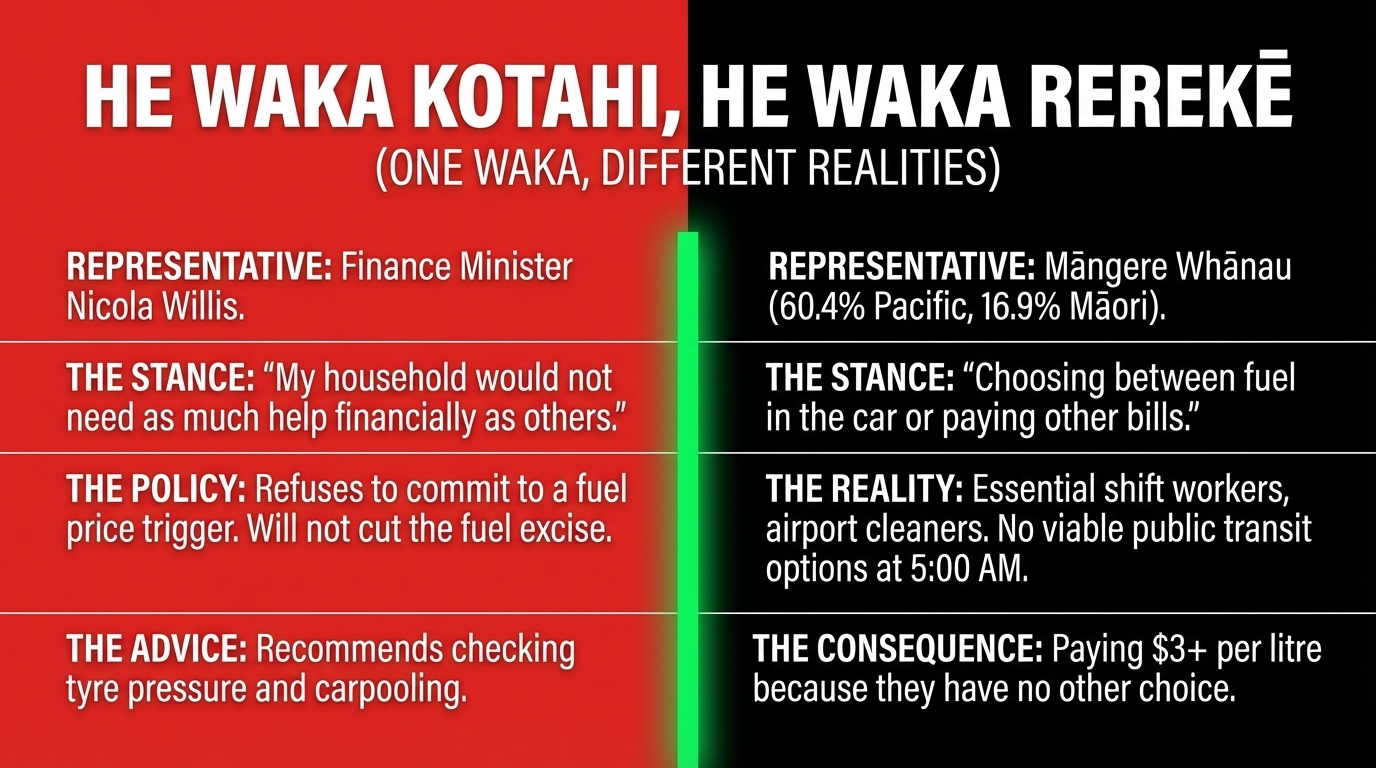
Let me slow down here, whānau, and name what is happening with the precision it deserves.
Nicola Willis stood before the media of Aotearoa and, in one sentence, revealed everything you need to know about how this government thinks about inequality. "My household would not need as much help financially as others." She said the quiet part loudly, without embarrassment, without the grace of even feigning discomfort.
She followed it with the example of a South Auckland airport cleaner who cannot take the bus to work at 5am. This was meant to illustrate her awareness of hardship. Instead, it revealed the precise, microscopic limits of her political imagination. The cleaner exists, in Willis's worldview, as an example — as a type, a rhetorical device. Willis can name the archetype. She cannot — will not — fix the structural conditions that produce it.
Because fixing it would require cutting the fuel excise. Which would "send the wrong signal."
Fixing it would require a fuel price trigger — a commitment to act when petrol hits a specific threshold. Which Willis will not make.
Fixing it would require investing in public transport so South Auckland cleaners do not have to drive at 5am. Which this government cut the funding for.
Fixing it would require keeping the Clean Car Discount so those cleaners could eventually afford a more fuel-efficient vehicle. Which this government scrapped in three readings in one day.
Fixing it would require a strategic physical fuel reserve — not paper contracts, not IEA tickets, but actual fuel in actual tanks on actual New Zealand soil. Which this government has not built.
Instead, the financial mentors at Māngere Budgeting Services are teaching clients to check tyre pressure. This is the government's answer. This is what "targeted, temporary, timely" looks like in practice: means-tested carpooling advice delivered to the people this government has systematically stripped of alternatives.
The New Zealand Food Network's Food Security Snapshot from March 2025 found that food hubs are now feeding over half a million Kiwis every month — and are still running short. The rising cost of fuel feeds directly into the cost of every food item transported to every supermarket and food hub in the country. This is not a secondary effect. This is the spine of the crisis.
As RNZ's economic analysis on 10 March confirmed, ANZ chief economist Sharon Zollner put it plainly: fuel is an input into "pretty much everything." All goods need to be moved. When fuel costs spike, everything costs more — food, medicine, building materials, clothing. The pain does not stop at the petrol pump. It spreads through every receipt.
For whānau already running deficits — already choosing between rent and food — this is not a tipping point. They fell off the edge months ago. The fuel crisis is the final push.
NGĀ TAUIRA TOKOTORU — THREE EXAMPLES FOR THE WESTERN MIND
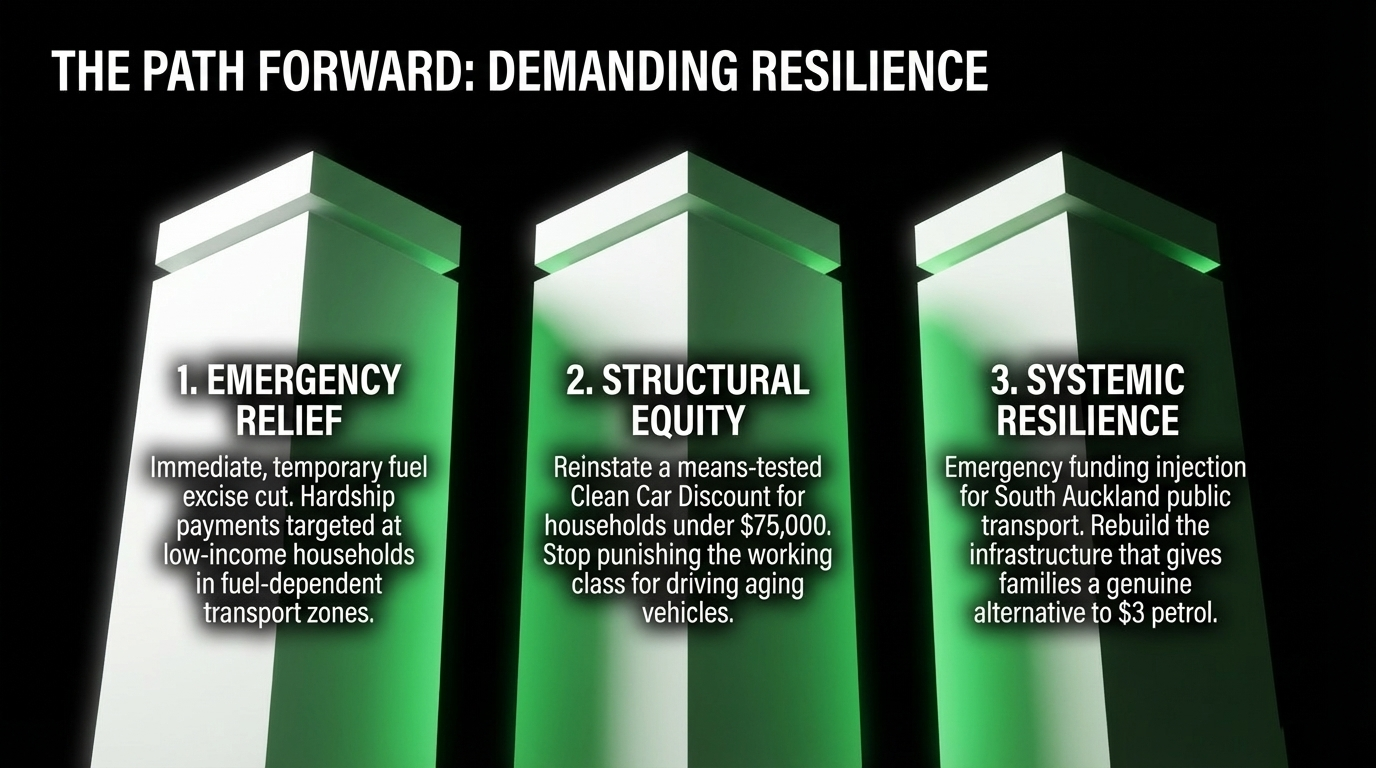
For our Pākehā whānau and international readers who may need the te ao Māori framework made explicit, here are three concrete examples of what this fuel crisis means, quantified and grounded.
Example One: The Maths of Survival
The Point: The 20% rise in petrol prices in 14 days has created an immediate, unabsorbable cost shock for low-income working families.
The Quantified Harm: Petrol rose from approximately $2.50 per litre to above $3.00 per litre between 1–15 March 2026. Filling a 50-litre tank now costs $150, up from $125 — an increase of $25 per fill. A South Auckland essential worker who fuels twice a week faces an additional $50 per week, or $200 per month in fuel costs. According to Henderson Budget Service CEO Tracey Phillips, cited in the Hunger Monitor RNZ report, whānau with children have under $100 left over at week's end after paying rent, power, and fuel. That buffer has now been cut in half — or eliminated entirely — by rising petrol. Willis herself acknowledged petrol prices have risen "about 45 to 50 cents a litre, adding about $23 to the cost of filling an average car" — and diesel has risen 72 cents per litre, adding $36 to the cost of a diesel vehicle fill.
The Tikanga Impact (for the Western mind): In te ao Māori, manaakitanga — the ethic of care, generosity, and the sustaining of life — is not optional. It is the bedrock of a functioning community. When a government allows the material conditions of life to become so precarious that a family cannot choose between food and transport, it has violated manaakitanga at the institutional level. This is not merely a financial policy question. It is a question of whether this government has fulfilled its obligations under Te Tiriti o Waitangi to actively protect the wellbeing — the hauora — of Māori. It has not.
The Solution: A temporary fuel excise cut (as implemented in 2022 under Labour), a hardship payment targeted at low-income households in fuel-dependent transport zones, and an emergency injection of funding into South Auckland public transport to reduce dependency on private vehicles. Australia's Labour government cut fuel tax during the 2022 Ukraine-driven price shock. South Korea is capping prices right now. New Zealand can do this. Willis has chosen not to.
Previous MGL Coverage: Read "WHEN THE PETROL TANKER RUNS DRY" — Ivor Jones's deep investigation into how the National Fuel Plan leaves Māori at the very bottom of the priority queue in any rationing scenario. The plan prioritises Corrections and Defence. Whānau come last.
Example Two: The Two-Speed Fleet
The Point: The structural vulnerability of South Auckland communities to fuel price shocks is not accidental. It is the cumulative result of government choices — the refinery closure, the EV subsidy scrapping, the transport underfunding — that explicitly benefited wealthier, whiter communities and left Māori and Pacific families exposed.
The Quantified Harm: New Zealand's EV uptake collapsed from one in five vehicle sales to one in thirteen after the government scrapped the Clean Car Discount. The communities with the highest EV penetration before the discount was removed were predominantly European and higher-income — meaning the policy cancellation disproportionately harmed the communities (Māori, Pacific) who had not yet been able to access the EV pathway. Transport officials estimated the discount, if retained, would have saved New Zealand $138 million in fuel costs, $93 million in car maintenance costs, and $224 million in health costs from improved air quality — for a total benefit of over $549 million across 30 years, compared to $259 million in savings from scrapping it. This was advice the government suppressed by suspending regulatory impact requirements. The cost was paid by the families of Māngere, not the boardrooms of Wellington.
The Tikanga Impact: In te ao Māori, kaitiakitanga — guardianship of the natural world and future generations — requires that decisions be made with the long-term wellbeing of mokopuna (descendants) in mind. Scrapping a policy that would have reduced fuel dependency, improved air quality (particularly in South Auckland's already-polluted corridors), and saved money over decades is an act of anti-kaitiakitanga. It sacrifices future resilience for immediate political optics.
The Solution: Reinstate a means-tested version of the Clean Car Discount targeting households earning under $75,000 annually, prioritising South Auckland, Northland, and other fuel-dependent low-income regions. Pair it with community EV leasing schemes through councils — a model used successfully in parts of the UK. Mandate that any Clean Car Standard review includes Treaty impact analysis.
Previous MGL Coverage: Read "HE WAKA KOURA: THE GOLDEN ESCAPE — IF YOU HAVE A GOLDEN TICKET" — Ivor Jones on how wealth determines who escapes the fuel crisis and who drowns in it. The wealthy already have EVs, solar panels, and flexible work arrangements. The poor have petrol engines, rigid shift work, and no public transport at 5am.
Example Three: The Cascade — When Fuel Hits Food
The Point: Rising fuel prices do not stay at the petrol pump. They cascade through every layer of the economy — food, freight, services — and hit communities that are already food-insecure the hardest.
The Quantified Harm: ANZ chief economist Sharon Zollner told RNZ that fuel is an input into "pretty much everything." Food prices, freight surcharges, and service costs will all rise as the fuel price spike propagates through supply chains. This is compounded by the fact that New Zealand's food insecurity rate is already at record levels: one in three households has struggled to access affordable food in the past year. Pacific children experience material hardship at 28.9 percent — nearly one in three. Tamariki Māori at over 20 percent. The South Auckland Christian Foodbank is delivering 177 food parcels per day and rising. Willis's Treasury projections suggest inflation could reach 3.7% in a worst-case scenario — but for families already choosing between food and bills, abstract inflation figures are beside the point. For them, the crisis is now.
The Tikanga Impact: Mana whenua — the authority and belonging grounded in land and place — has always included responsibility for ensuring that people are fed and sustained. In te ao Māori, a rangatira who allowed the people to go hungry while the storehouses were full was not a rangatira at all. Willis's government has storehouses full of policy options — excise cuts, targeted payments, public transport investment, fuel reserves — and is choosing not to open them. That is not governance. That is hoarding.
The Solution: Immediate targeted hardship payments to households in fuel-dependent low-income communities, indexed to the petrol price. These are not handouts — they are compensations for a structural failure that this government created. For longer-term food and fuel security, investment in marae-based community hubs offering bulk food purchasing, community gardens, and collective transport coordination — a model aligned with both te ao Māori values and practical resilience.
Previous MGL Coverage: Read "The Starving of the Seedlings" (9 March 2026) — Ivor Jones's investigation into how this coalition government chose corporate efficiency over the hunger of Papatūānuku's tamariki. The families who appear in that essay are the same families now being told to check their tyre pressure.
Also read "The Poverty Trap Machine" — how neoliberal capitalism deliberately imprisons our people in cycles of poverty. This fuel crisis is not an anomaly. It is the machine doing exactly what it was designed to do.
TE AO MĀORI — THE FRAMEWORK OF RECKONING
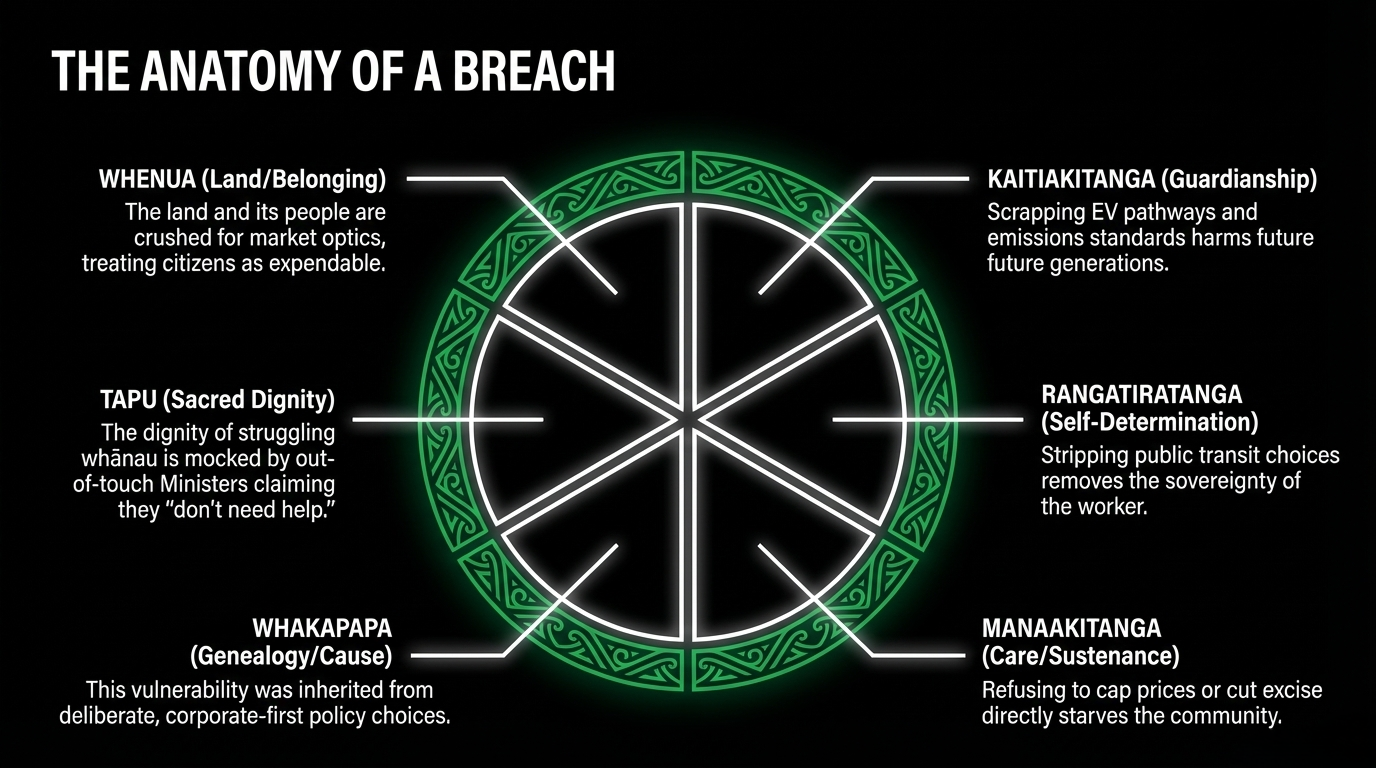
To understand what is happening to the whānau of South Auckland, you must see it through te ao Māori. Not as decoration. As the most precise analytical tool available.
Kaitiakitanga demands that we protect what sustains life for future generations. A government that scraps EV incentives, guts clean vehicle standards, allows the fossil fuel supply chain to become the only available pathway, and then refuses to act when that chain breaks — has failed kaitiakitanga catastrophically. Our mokopuna will inherit a transport system more dependent on fossil fuels, more expensive to run, and more vulnerable to geopolitical shocks than the one we inherited.
Rangatiratanga — the authority to self-determine, to make choices, to exercise control over one's own life — is precisely what is being stripped from the whānau of Māngere. When the only way to get to work is to drive, and the fuel costs more than you can afford, and there is no public transport at 5am, and the government will not act — you have no rangatiratanga at your petrol pump. You are subject, not sovereign.
Whakapapa — the genealogy of decisions, the tracing of causes — is what this essay is doing. Every crisis has a whakapapa. The whakapapa of this fuel crisis runs through: the Marsden Point closure, the Clean Car Discount scrapping, the IEA tickets used in place of physical reserves, the public transport underfunding, the inequality between South Auckland and North Shore, the trade agreements that prioritised fossil fuel company rights over community resilience. This government inherited some of those decisions and made others. It is accountable for all it chose.
Manaakitanga — the obligation to sustain, nourish, and protect the mana of those in your community — is the obligation Willis has failed. A government that knows its people are choosing between petrol and food, and responds with "targeted, temporary, timely" language while refusing to commit to a single concrete action, has not merely been inactive. It has been actively hostile to the manaakitanga obligations of rangatiratanga.
Tapu — the sacred weight of human life and human dignity — tells us that when a Minister stands before the media and says her household doesn't need help, she is doing more than acknowledging inequality. She is lifting the tapu from her own accountability. She is absenting herself from the moral community of those who struggle. That is not leadership. That is exile — a self-imposed exile from the lived reality of the people she governs.
Whenua — the land, the foundation, the anchor — reminds us that South Auckland is the whenua of Māngere. The Māngere Mountain, Te Māngere, stands over a community whose tūpuna fished the Manukau, cultivated the volcanic soils, and built the social fabric that still holds the community together despite every colonial assault. That whenua is now being crushed by $3 petrol. The waka that has navigated every storm — colonisation, urban drift, poverty, the stripping of language and land — is now being swamped by the deliberate inaction of a government that knows the damage and chooses not to prevent it.
KA MUTU — THE CLOSING
Whānau, let me be direct.
This government caused this vulnerability. Not entirely — the Iran war was not predicted. But every decision that left New Zealand without a functioning refinery, without an EV transition for low-income families, without physical fuel reserves, without adequate public transport in South Auckland — those were choices. Made by politicians. Made for reasons that had nothing to do with the welfare of the families of Māngere.
Nicola Willis admits her household doesn't need help. She is correct. She and her Cabinet colleagues will weather this crisis in comfort — perhaps slightly more expensive holidays, perhaps some mild adjustments to discretionary spending. The South Auckland cleaner she uses as her moral test case will skip meals, get behind on power bills, and be counselled by a financial mentor to maintain correct tyre pressure.
This is not bad luck. This is the architecture of a class system, maintained by policy choices, exposed in a fuel crisis.
My call to you, whānau:
Name this for what it is. Share this essay. Hold your MPs to account. Demand a price trigger. Demand a fuel excise cut — not as a permanent policy, but as emergency relief for communities in crisis. Demand Treaty-compliant fuel resilience planning that puts whānau Māori at the centre, not at the bottom. Demand public transport investment in South Auckland that does not leave a cleaner standing on a cold Māngere footpath at 5am waiting for a bus that never comes.
And read the MGL record. The Poverty Trap Machine. The Petrol Tanker Runs Dry. The Starving of the Seedlings. The Māori Reckoning with the Iran War. Each essay is a thread of the same whakapapa. Read them together and you will see the pattern.
Ka whawhai tonu mātou — āke āke āke.
We will never stop fighting. Not now. Not ever.
— Ivor Jones, The Māori Green Lantern
TE KOHA — THE CONTRIBUTION

The families of Māngere cannot afford not to know. And the mahi of documenting, analysing, and naming this crisis — the mahi you have just read — costs time, energy, and resources that this community does not have in abundance.
Every essay published by The Māori Green Lantern is an act of fuel for the waka. This investigation — tracing the whakapapa of the $3 petrol crisis from the Strait of Hormuz to the Māngere Budgeting Service, from the Clean Car Discount to the tyre pressure meeting — did not write itself. It was built from dozens of sources, across late nights, with the same urgency that drives the whānau we write about.
When you koha to the Māori Green Lantern, you are not supporting a media outlet. You are fuelling the waka of accountability. You are ensuring the next crisis — when it comes, and it will come — is named, traced, and placed at the feet of those responsible before the water rises again.
He aha te mea nui o te ao? He tangata, he tangata, he tangata.
What is the greatest thing in the world? It is people. It is people. It is people.
If you can, please consider a koha — a voluntary contribution in the spirit of tautoko, of standing alongside. The MGL waka is community-powered.
Three pathways exist:
For those who wish to support this mahi directly with a koha (voluntary contribution), please visit the Koha platform:
Koha — Support: https://app.koha.kiwi/events/the-maori-green-lantern-fighting-misinformation-and-disinformation-ivor-jones
For those who wish to receive essays directly and support through subscription:
Subscribe to the Māori Green Lantern: https://www.themaorigreenlantern.maori.nz/#/portal/support
For those who prefer direct bank transfer:
HTDM, account number 03-1546-0415173-000
If you are unable to koha, no worries — share this essay with your whānau and friends. In a crisis of disinformation and contempt, sharing the truth is koha in itself.
Tēnā koutou, tēnā koutou, tēnā koutou katoa.

NGĀ PUNA KŌRERO — SOURCES
Primary Source
Fuel Crisis & Petrol Prices
- RNZ — "No need to panic, fuel supplier says as average petrol price surges past $3" (15 March 2026)
- RNZ — "Willis reveals how bad inflation could get as petrol surges past $3" (16 March 2026)
- RNZ — "NZ economy on precipice as markets wobble, oil price rises" (10 March 2026)
- 1News — "Willis outlines worst-case scenario for NZ if Middle East war drags on" (15 March 2026)
- GlobalPetrolPrices.com — New Zealand gasoline prices history (2016–2026)
- Figure.NZ — Adjusted retail fuel prices in New Zealand (2008–2026)
Iran War & Strait of Hormuz
- Wikipedia — Economic impact of the 2026 Iran war
- World Economic Forum — "The global price tag of war in the Middle East" (12 March 2026)
- Al Jazeera — "Iran war threatens prolonged impact on energy markets" (8 March 2026)
- New York Times — "Oil Shock Sends Tremors Through World Economy" (12 March 2026)
- Chatham House — "How will the Iran war affect the global economy?" (6 March 2026)
- Moneycontrol — "Strait of Hormuz open, but..." (14 March 2026)
Marsden Point & Fuel Reserves
- RNZ — "Should Marsden Point refinery have been saved? Shane Jones and David Seymour can't agree" (11 March 2026)
- RNZ — "NZ will release six days of fuel amid global concerns over supply" (11 March 2026)
- Argus Media — "New Zealand, Australia to support IEA oil release plan" (12 March 2026)
- MBIE — Fuel Security Plan November 2025
Government Policy Failures
- Wikipedia — Land Transport (Clean Vehicle Discount Scheme Repeal) Amendment Act 2023
- RNZ — "Government considering scrapping entire clean car standard" (5 March 2026)
- Green Party — "Families Will Pay More Without Clean Car Standard" (5 March 2026)
- Reddit/RNZ — "Scrapping Clean Car Discount will cost twice what it saves"
- Auckland Transport — Statement of Intent 2024–2027
Demographics & Poverty
- Stats NZ/Knowledge Auckland — Māori ethnicity in Auckland, 2023 Census
- Stats NZ/Knowledge Auckland — Pacific Peoples in Auckland, 2023 Census
- Pacific Media Network — "Report finds Pacific families hit hardest as material hardship and unemployment rise" (Feb 2026)
- Salvation Army — State of the Nation 2025
- Stats NZ — No annual change in child poverty rates for year ended June 2025 (Feb 2026)
Food Insecurity
- RNZ — "One in three households struggled for food in past year, Hunger Monitor report finds" (11 March 2026)
- NZ Food Network — Food Security Snapshot March 2025
International Responses
- Reuters — "Governments' actions in response to oil price surge and the Middle East conflict" (9 March 2026)
- CNBC — "Price caps, taking the stairs: How countries are coping with the Iran war energy shock" (15 March 2026)
- Reuters — "EU debates how to curb energy costs as Iran war hits markets" (16 March 2026)
- Euronews — "Fossil fuel giants are cashing in on the Iran war. Is it time for a windfall tax?" (13 March 2026)
- Center for American Progress — "The War in Iran Will Raise Fuel Prices and Costs Throughout the Economy" (11 March 2026)
Previous MGL Essays
- The Māori Green Lantern — "WHEN THE PETROL TANKER RUNS DRY" (14 March 2026)
- The Māori Green Lantern — "HE WAKA KOURA: THE GOLDEN ESCAPE" (14 March 2026)
- The Māori Green Lantern — "A Māori Reckoning with the US-Israel War on Iran" (11 March 2026)
- The Māori Green Lantern — "The Starving of the Seedlings" (9 March 2026)
- The Māori Green Lantern — "The Poverty Trap Machine"
© 2026 The Māori Green Lantern | Ivor Jones | All Rights Reserved
Published on themaorigreenlantern.maori.nz