"When Whānau Becomes A Liability" - 24 October 2026
Labour says it backs Māori leadership. Kerrin Leoni’s resignation asks a simpler, uglier question: what happens when Māori candidates arrive with whānau, complexity, and a life that will not fit inside a press release?


Mōrena Aotearoa,
Kerrin Leoni’s resignation should not be buried under campaign noise or reduced to a cheap culture-war prop.
In October 2026, Labour’s Tāmaki Makaurau candidate resigned after footage emerged showing her in Labour clothing speaking to Mongrel Mob members about enrolling to vote and changing the government.
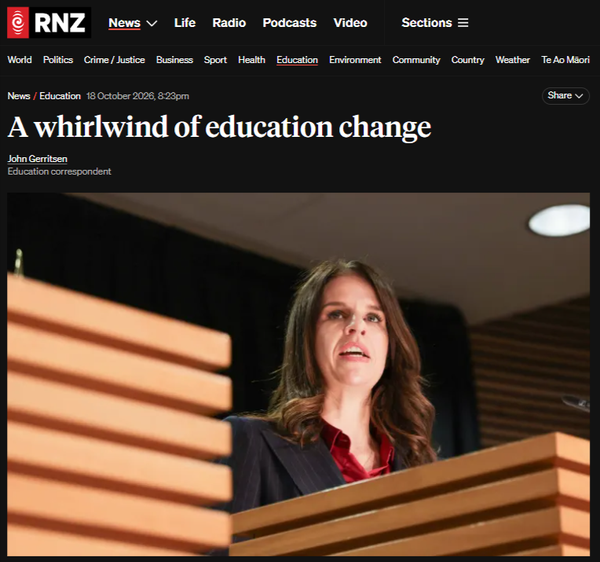
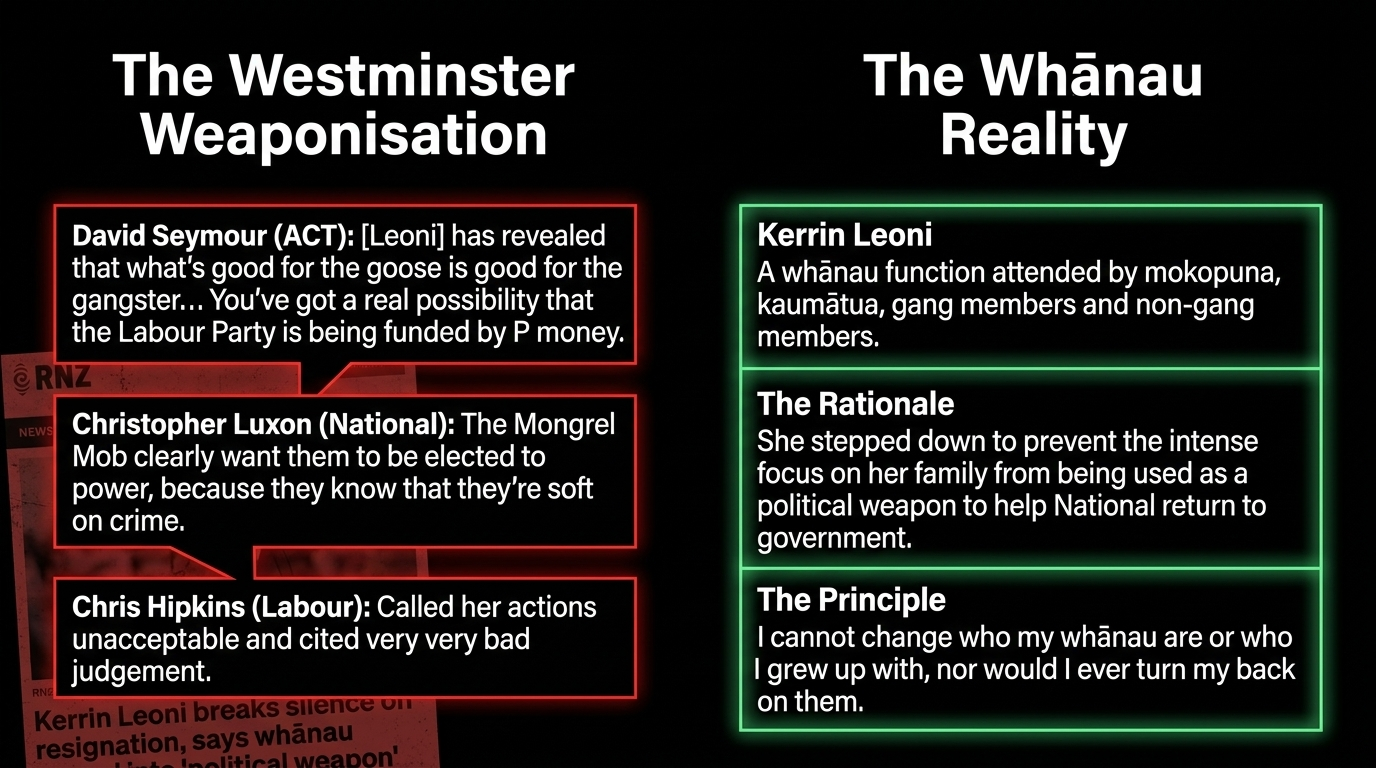
Labour leader Chris Hipkins called campaigning alongside gangs “unacceptable”, said her position had become untenable, and later said she had shown “very very bad judgement”. RNZ’s report on Leoni’s resignation
 RNZ | Te Reo Irirangi o Aotearoa
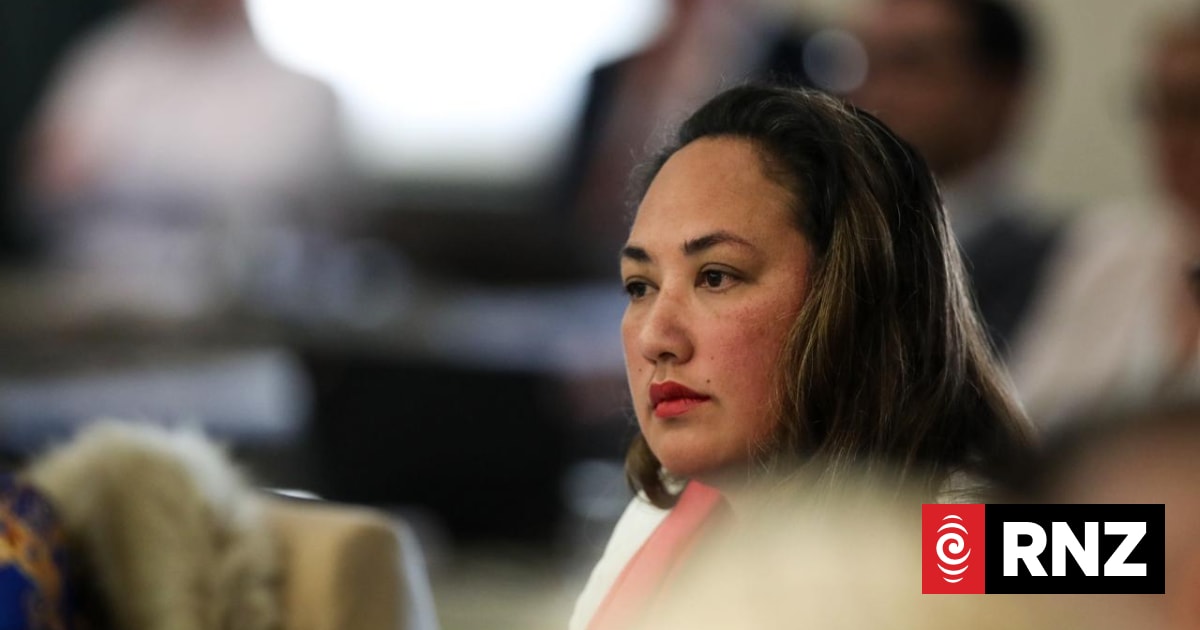
Leoni’s own account matters just as much.
She said she stepped down because she did not want the controversy around her whānau to help National return to government. She said the intense focus on her family and community had become increasingly difficult, and described the event as “a whānau function attended by mokopuna, kaumātua, gang members and non-gang members” that had been turned into a “political weapon”.
She also said she would never turn her back on her whānau because of their associations. RNZ’s report on Leoni’s resignation
That does not excuse everything. It does not erase the footage. It does not mean a political party must accept any conduct from any candidate in any context.
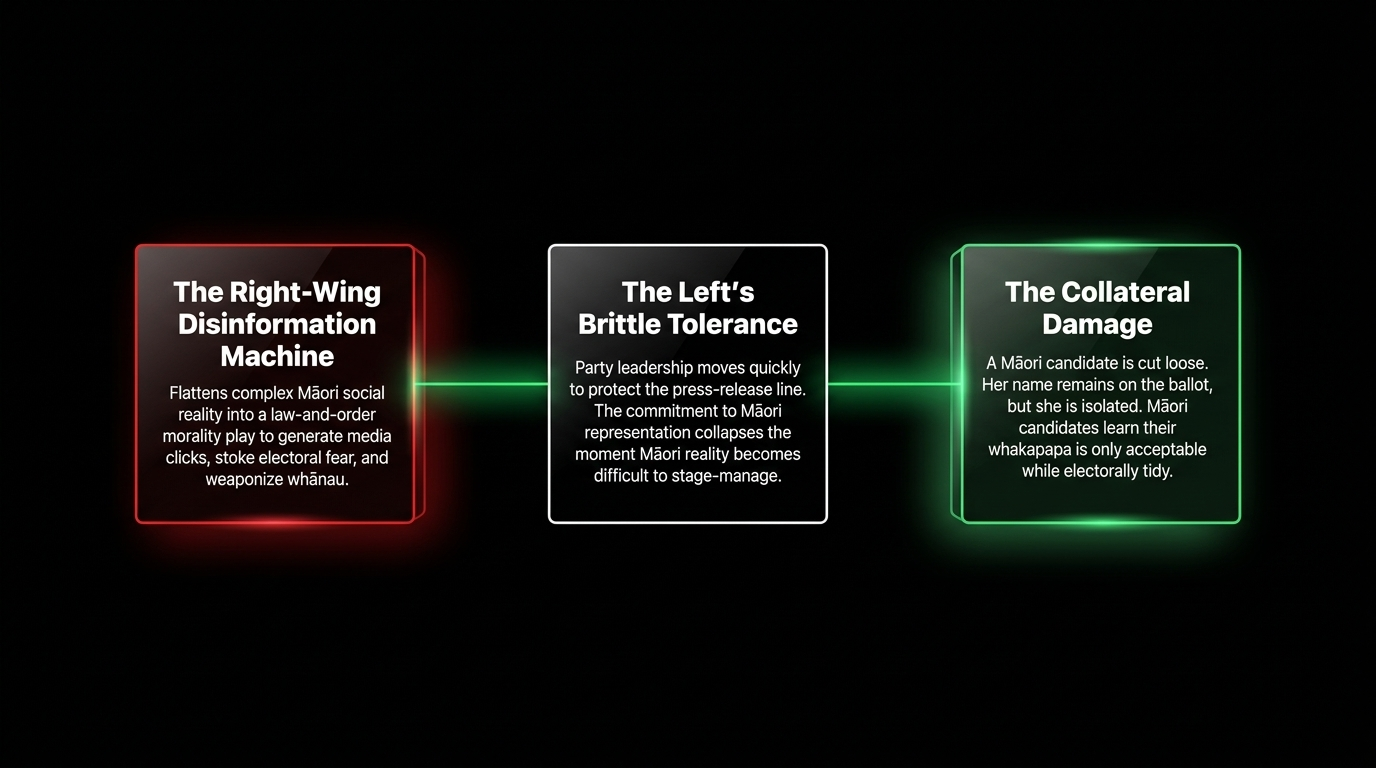
But it does force a harder question than Labour seems willing to face. When a Māori candidate’s whānau relationships become politically inconvenient, does Labour know how to respond with Tika, Pono, Tikanga, and mauri? Or does the party’s commitment to Māori representation collapse the moment Māori reality becomes difficult to stage-manage?
This is not an essay claiming Labour engineered Leoni’s downfall. The public record does not support that claim.
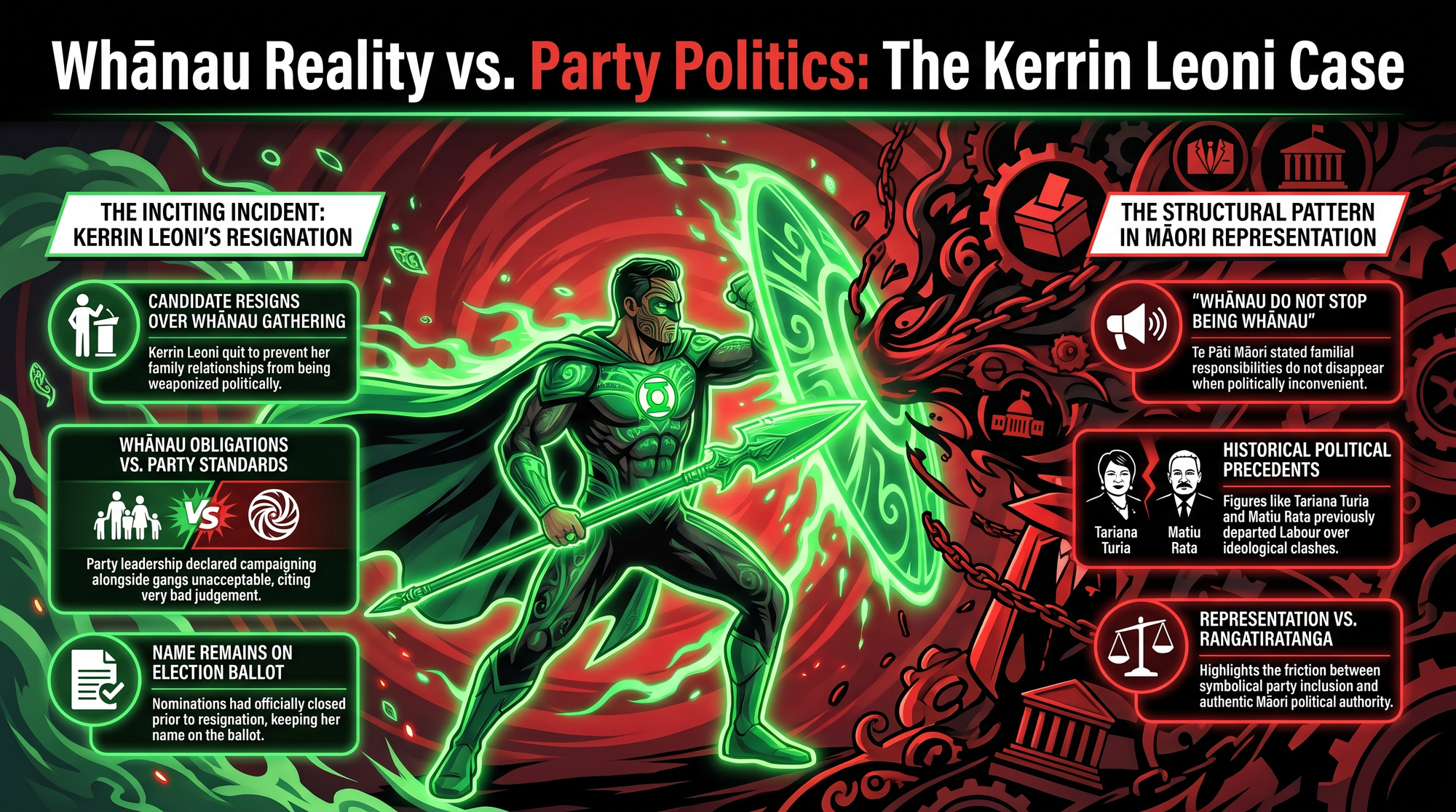
It is an essay about what the record does show:
a Māori candidate describing her whānau being weaponised, a party leadership moving quickly to protect the line, and a longer history in which Labour has often welcomed Māori representation while struggling when Māori political reality refuses to stay tidy.
I want readers to open and share this essay because it contains information they can use in daily life, public discussion, and democratic decision-making. It is also a record for our mokopuna: evidence that warnings were raised, decisions were examined, and silence was not universal.
What Happened To Kerrin Leoni
The immediate facts are serious, and they need to be stated plainly. RNZ reported that footage showed Leoni, wearing a Labour Party jacket, speaking to gang members about enrolling to vote and changing the government. RNZ also reported that a photo from the same event, first published by Newsroom, showed her posing with a group that included people in Mongrel Mob regalia making hand gestures associated with the gang. RNZ’s report on Leoni’s resignation
Hipkins responded by saying that campaigning alongside gangs was unacceptable and inconsistent with the standards he expected of Labour candidates. He said Leoni had not given the party the “full information” about the gathering and had not managed the conflict appropriately. He also said her position had become untenable, though he later acknowledged the difficulty of navigating family situations in politics and said, “Our Māori MPs get held to a very different standard to others.” RNZ’s report on Leoni’s resignation
Leoni’s explanation did not deny the whānau connection. She said she had attended a whānau function in early October where some close relatives who were gang members were present, and wrote that she would not turn her back on them or pretend they were not her whānau because of their associations. RNZ later reported that she said she quit so the controversy would not be used as a political weapon to help National win the election. RNZ’s report on Leoni’s resignation RNZ’s report on Leoni breaking her silence
There is no honest way to treat this as nothing. But there is also no honest way to pretend the only issue is optics. What sits underneath is the collision between Labour’s public standard and Leoni’s public insistence that whānau ties do not disappear just because politics finds them embarrassing.
The Deep Dive Podcast
Listen to a lively conversation between two hosts, unpacking and connecting topics in the sources of this essay. I apologise in advance for the AI's very harsh pronounciation of reo. Please dont shoot me, :).
Youtube Video
Like video? Here is a short video suppporting the essay. Again, don't shoot the messenger please because of AI's pronounciation. :)
Tika, Pono, Tikanga, And Mauri
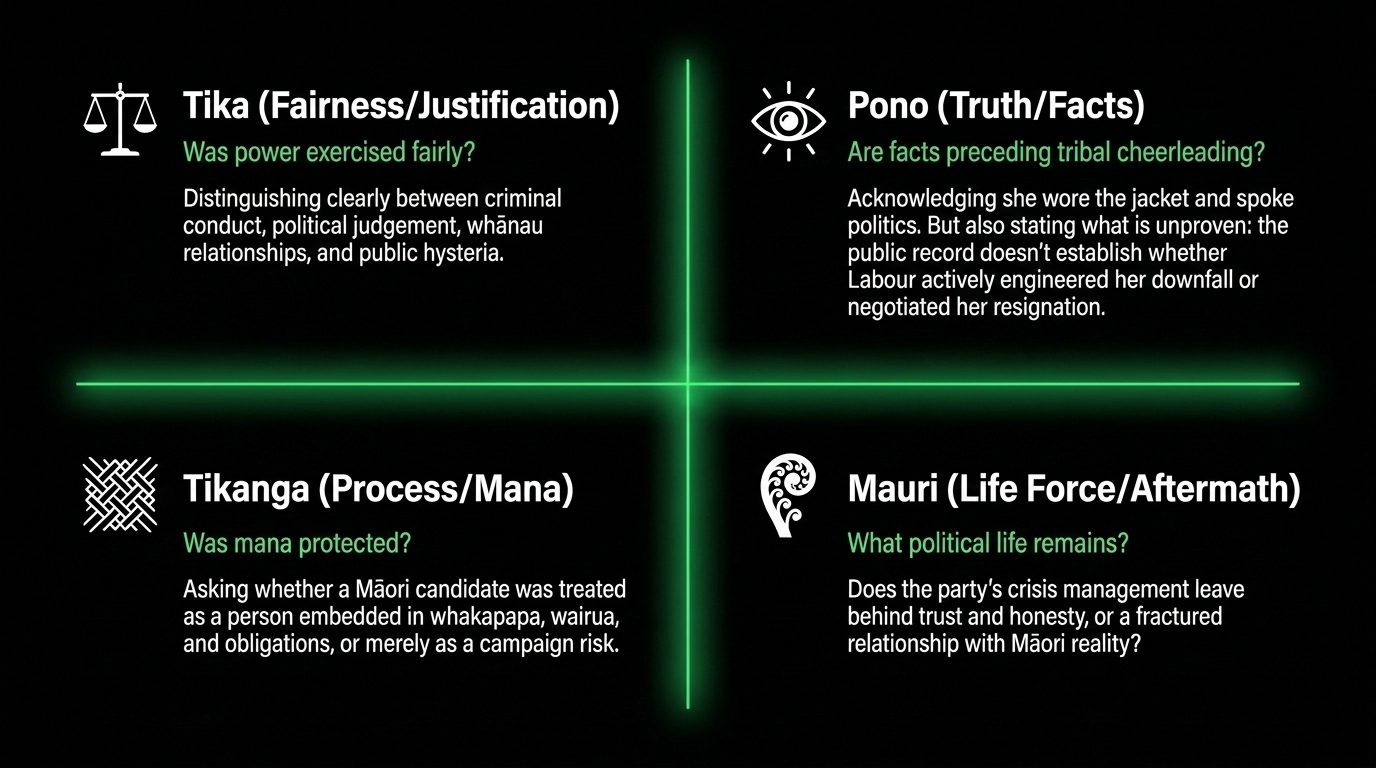
I use Tika, Pono, Tikanga, and mauri here as an editorial framework for testing political conduct. This is not a universal definition of tikanga, a legal test, or a claim to speak for any iwi or hapū.
Tika asks whether power was exercised fairly and justifiably. Labour is entitled to standards for its candidates. It is entitled to say that campaigning alongside gangs is unacceptable. But Tika also asks whether the process distinguished clearly between criminal conduct, political judgement, whānau relationships, and the public hysteria that can swallow those distinctions whole.
Pono demands that facts come before tribal cheerleading. The facts are these: Leoni appeared in footage talking politics with Mongrel Mob members while wearing Labour branding; Hipkins condemned the conduct; Leoni resigned; she said the whānau event had been turned into a political weapon; and nominations had already closed, meaning her name remained on the ballot despite no longer representing Labour. RNZ’s report on Leoni’s resignation Pono also requires stating what is not proven: the public record does not establish whether Labour asked her to resign, whether resignation was formally negotiated, or what full internal process preceded the outcome.
In this editorial framework, tikanga directs attention to relationship, process, mana, and accountability. It asks whether a Māori candidate was treated as a person embedded in whakapapa, whānau, obligations, and wairua, or as a campaign risk to be cut loose once the headlines became inconvenient.
Under this editorial application of mauri, the question is what kind of political life is left after a party has dealt with a crisis. Does the process leave more trust, more honesty, and more capacity to hold complexity? Or does it teach Māori candidates that their whakapapa and whānau become acceptable only while they remain electorally tidy?
Example One: Kerrin Leoni And The Price Of Complexity
Leoni is the essay’s central example because her case puts the contradiction in plain sight. A Māori candidate with whānau connections that include gang-associated relatives entered an election campaign for Labour. When footage emerged, the public discussion quickly flattened a complex social reality into a law-and-order morality play. RNZ’s report on Leoni’s resignation
What happened is clear enough. Leoni spoke at an event attended by Mongrel Mob members. Hipkins said that was unacceptable. Leoni then said the focus on her whānau and community had become increasingly difficult and resigned. RNZ’s report on Leoni’s resignation
Who was affected? Leoni, obviously. Her whānau. Voters in Tāmaki Makaurau. Labour’s credibility. And every Māori candidate watching how quickly a party that talks about understanding lived experience reacts when that experience arrives in public carrying gang stigma, whānau ties, and political risk.
The demonstrated harm is specific. Leoni lost her candidacy. Her name remained on the ballot even though she no longer represented Labour because nominations had already closed. RNZ reported that she described the intense focus on her family and community as increasingly difficult. RNZ’s report on Leoni’s resignation The public record also supports saying her mana came under intense pressure because her whānau relationships were turned into the centre of a national controversy. What the record does not prove is that Labour engineered the exposure or cynically set her up to fall.
The numerical facts are limited but important. The resignation happened after nominations had closed, so her name remained on the ballot. RNZ’s report on Leoni’s resignation Beyond that, there is no verified numerical evidence in the current source set showing the electoral effect of her resignation, the size of the event, or the scale of media impact. That absence matters. It should be stated, not patched over.
The practical response is equally clear. Labour should publicly explain what process was followed, what support was offered, what alternatives were considered, and whether the party made any meaningful distinction between attending a whānau gathering and deliberately seeking gang endorsement. The authority to answer those questions lies with Labour leadership, Labour’s Māori caucus, and Leoni herself if she chooses to speak further. Evidence that the response worked would include a transparent account of the internal process, consistent standards, and proof that Māori candidates are not left alone once their whānau reality becomes politically combustible.
Example Two: Tariana Turia And The Limit Of Labour’s Tolerance
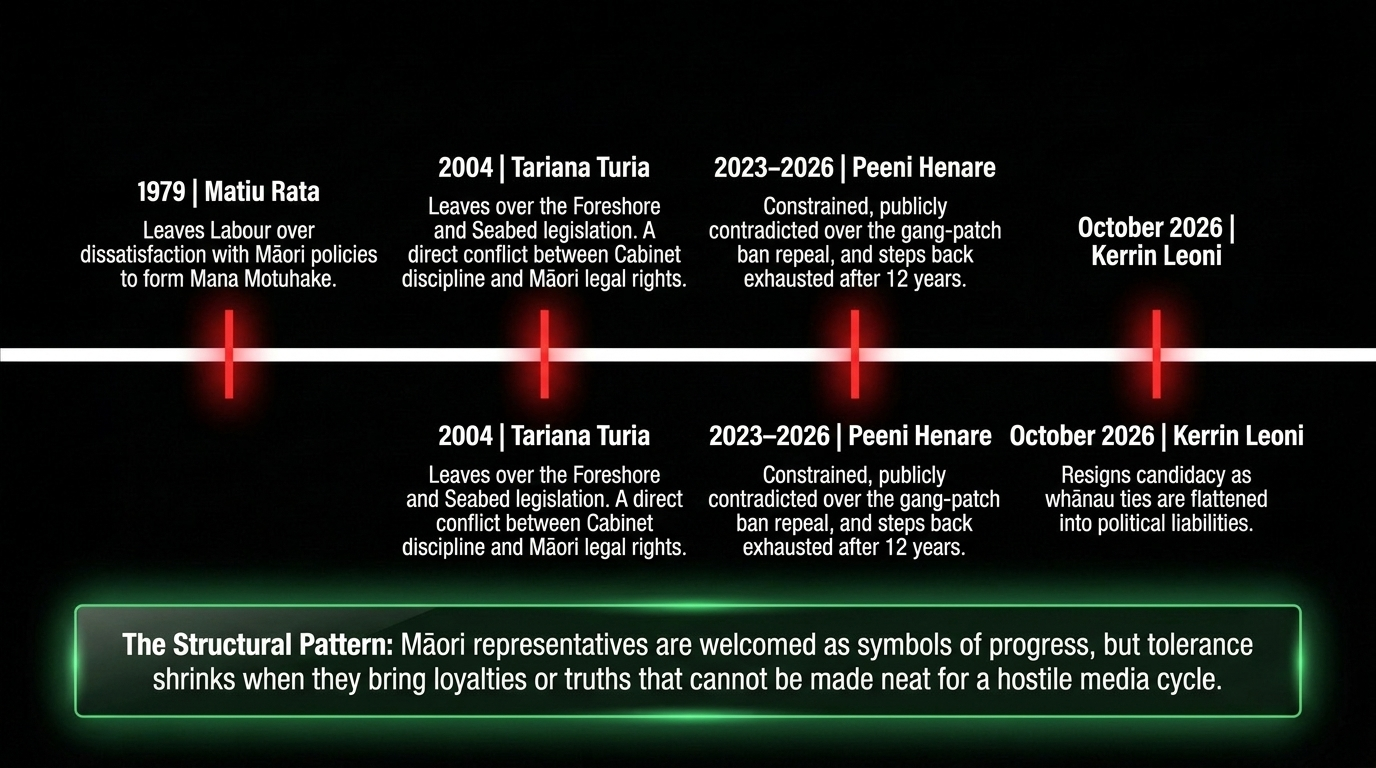
If Leoni is the immediate case, Tariana Turia is the strongest historic warning. In 2004, the Labour-led Government moved to legislate over the foreshore and seabed after the Court of Appeal’s Ngāti Apa decision. The Waitangi Tribunal’s urgent report found that the policy breached Treaty principles in a fundamental and serious manner, removed Māori access to the courts to test legal rights, and placed Māori in an inferior position before the law. Waitangi Tribunal’s Report On The Crown’s Foreshore And Seabed Policy
Turia ultimately left Labour over that conflict and helped found the Māori Party. That matters here not because her case is identical to Leoni’s, but because it shows an older fault line: Labour has often made room for Māori representation until Māori obligations, Māori legal rights, or Māori political judgement come into direct conflict with the party’s chosen line. Waitangi Tribunal’s Report On The Crown’s Foreshore And Seabed Policy
Who was affected in Turia’s case? Māori claimants whose rights were cut off, Māori communities confronting the legislation, and a senior Māori Labour figure forced to choose between Cabinet discipline and her stance on Māori rights. The harm was not speculative. The Tribunal described it in constitutional and legal terms. Waitangi Tribunal’s Report On The Crown’s Foreshore And Seabed Policy
The practical response now is not to re-litigate 2004 for nostalgia. It is to recognise the pattern it revealed. If Labour wants to claim a deep relationship with Māori political leadership, it must show that Māori MPs and candidates are more than acceptable until the moment their judgement collides with party management.
Example Three: Matiu Rata, Peeni Henare, And The Structural Question
Matiu Rata and Peeni Henare are not the same case, and pretending otherwise would be sloppy. But together they help illuminate the structural question.
Rata left Labour in 1979 after becoming dissatisfied with its Māori policies and went on to form Mana Motuhake. He had served as Northern Māori MP and as Minister of Māori Affairs and Lands, and was instrumental in the establishment of the Waitangi Tribunal in 1975. NZHistory’s profile of Matiu Rata That is strong historical evidence that Māori leaders inside Labour have, at times, concluded that the party was not prepared to carry Māori political priorities far enough.
Henare’s case is narrower and needs more care. Chris Hipkins’ January 2023 reshuffle moved Defence to Andrew Little and gave Henare ACC, Tourism, and an Associate Environment role while he continued with Māori health and Whānau Ora responsibilities. Official 31 January 2023 Cabinet reshuffle transcript In 2025, Labour publicly contradicted Henare during the Tāmaki Makaurau by-election over whether it would repeal the gang-patch ban. RNZ reporting republished by the Otago Daily Times In 2026, he said he was stepping back after a difficult year, had spoken with whānau, and was exhausted after 12 years in Parliament. RNZ’s report on Henare stepping back
What this demonstrates is not a proven campaign by Labour to destroy Henare. It demonstrates that Māori leadership inside Labour can be both elevated and constrained, visible and vulnerable, senior and still publicly corrected or repositioned when the leadership line demands it.
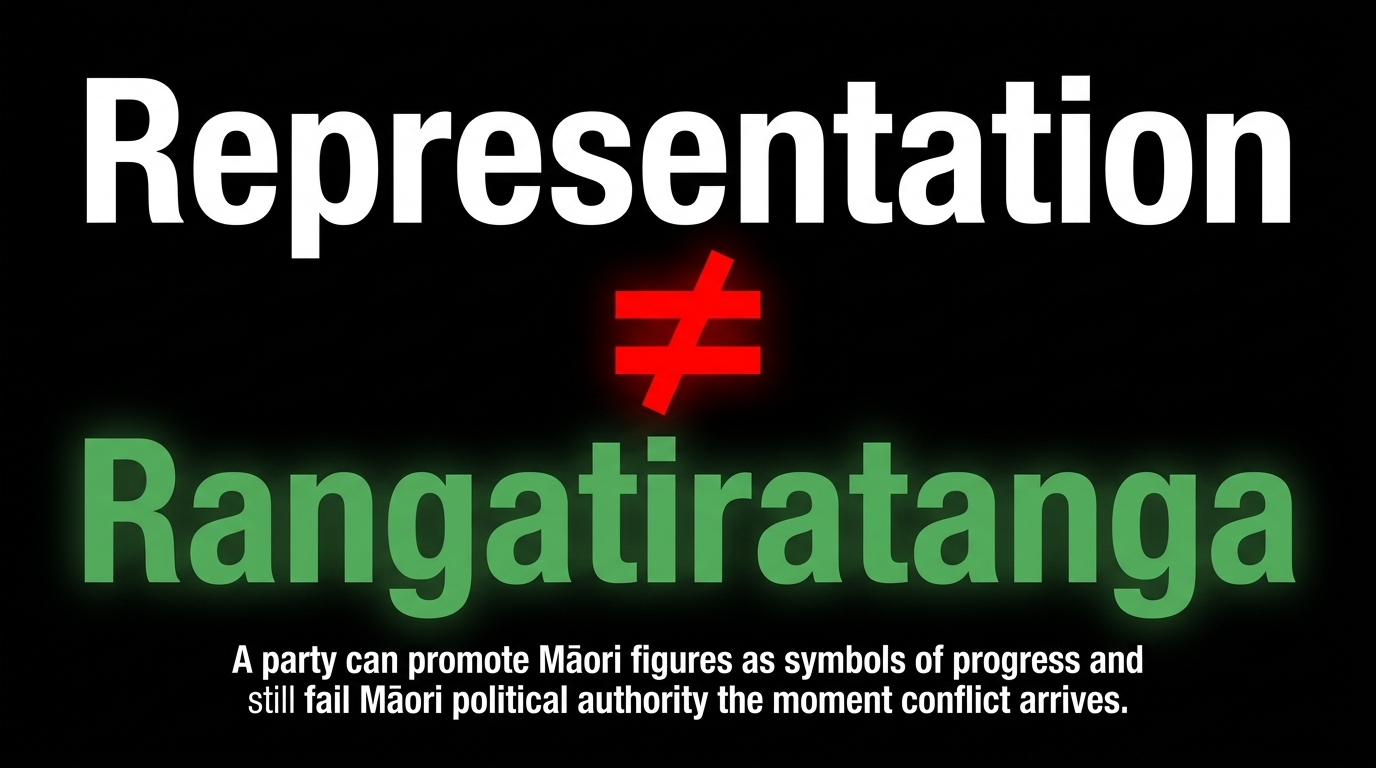
That is the structural question running through this essay. Representation is real. But it is not the same thing as rangatiratanga.
The Counterargument Labour Is Entitled To Make
Labour has a credible defence, and it should be stated honestly. Leoni appeared in footage speaking politically at an event where Mongrel Mob members were present. A political party can reasonably say that campaigning alongside gangs breaches its standards. Labour can also say Leoni resigned, that Hipkins acknowledged the role of family complexity and racism in the reaction, and that standards cannot simply evaporate because a case is difficult. RNZ’s report on Leoni’s resignation
That defence matters because this essay is not an argument for excusing everything in the name of culture or whānau. It is not an argument that parties are forbidden from drawing lines.
It is an argument that the line-drawing itself must be examined. Did Labour act with enough fairness, enough context, enough care for mana, and enough honesty about the difference between political endorsement and familial entanglement? The public record does not yet answer that fully.
Labour can also point to Māori leaders it has elevated and to the normal workings of a Westminster party. That is true. But it does not cancel the deeper concern. A party can promote Māori figures and still fail Māori political authority when conflict comes.
Labour’s Māori Problem Is Bigger Than One Candidate
This is where the essay widens without losing discipline. The issue is not whether Kerrin Leoni made a mistake. The issue is whether Labour’s treatment of Māori political reality becomes brittle the moment it can no longer be packaged as diversity success.
Leoni’s case is not proof that Labour is uniquely hostile to Māori MPs. Nor is it proof that every rupture involving Māori Labour figures arises from identical motives.
What it does provide is a present-tense example of an old problem: Māori representatives are often welcomed as symbols of progress, but the party’s tolerance can shrink when those representatives bring obligations, loyalties, or truths that cannot be made neat for a hostile media cycle.
Readers do not need to agree with every conclusion here to see the public value of the question. That is why I want this long-form cited essay shared. These are not abstract elite quarrels. They are questions about how Māori candidates are expected to exist in public life, what kind of complexity is tolerated, and whether parties want Māori authority or only Māori optics.
And I want this record kept for our mokopuna. Not because I am the only one asking these questions, and not because no one else has noticed. But because democratic memory matters. Future generations should be able to see that people named what was happening, tested the evidence, and refused to call it normal just because the news cycle moved on.
For readers wanting earlier context, I have already worked across parts of this terrain in Kua Tae Te Wā: The Polite Execution of Peeni Henare and Labour’s Manufactured Māori Exit and Why Peeni Henare Walked Away From A Burning Whare He Was Never Meant To Lead. Those essays captured one part of the broader pattern. Leoni’s resignation sharpens the question and puts it back where it belongs: on Labour’s treatment of Māori people when their real lives stop being politically convenient.
The Election And The Political Choice
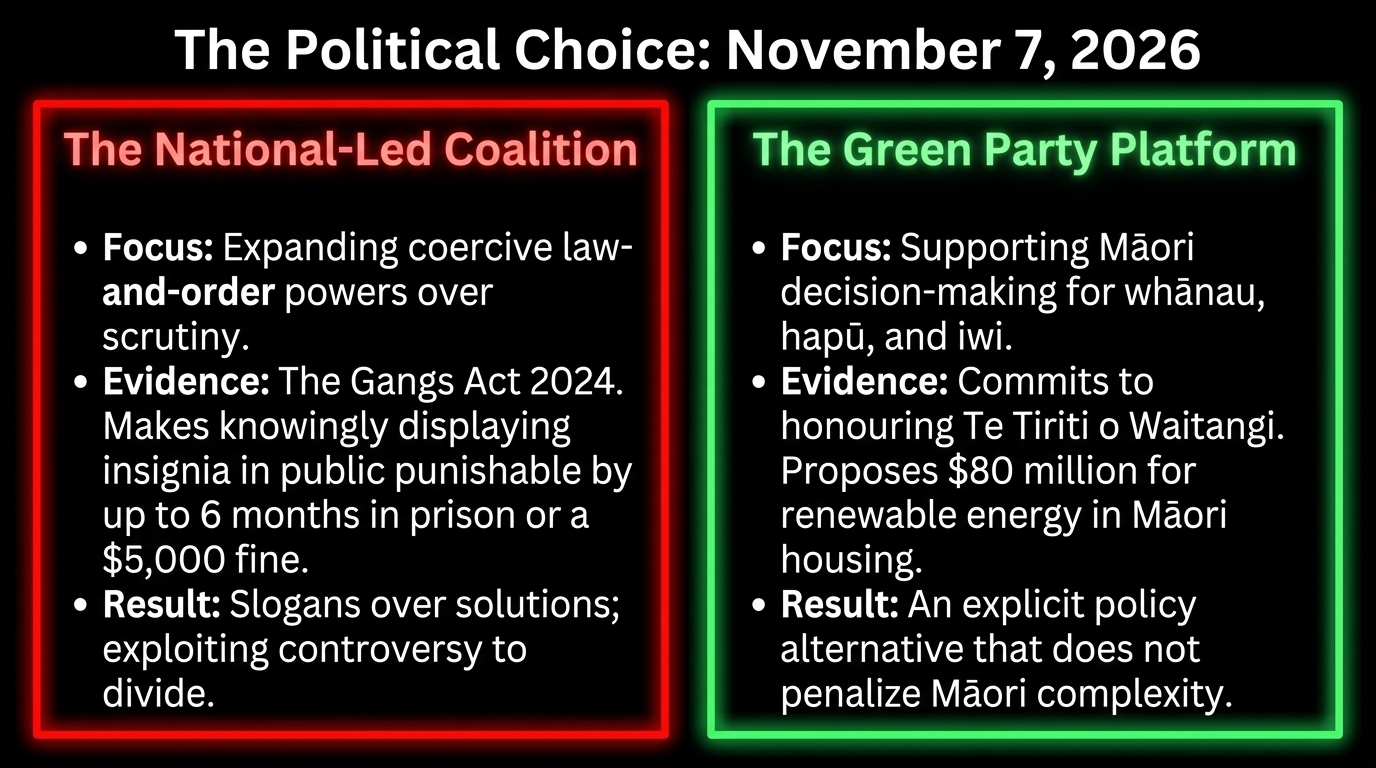
The 2026 general election will be held on Saturday 7 November. Electoral Commission 2026 election timetable Voters are not just choosing policies. They are choosing the kind of political culture they are willing to reward.
My judgement is political and I am stating it as such.
I do not support returning the National-led coalition Government to office. In this essay, that judgement rests partly on the Government’s Gangs Act 2024, introduced as a Government bill by Justice Minister Paul Goldsmith, which makes knowingly displaying gang insignia in a public place without reasonable excuse an offence punishable by up to six months’ imprisonment or a fine of up to $5,000. Parliament’s Gangs Legislation Amendment Bill record Gangs Act 2024, section 7
I am not claiming, on the current evidence, that the Act’s full social effects have been measured. I am saying that expanding coercive law-and-order powers deserves serious scrutiny, not slogans.
I am also saying that the Green Party’s published platform offers a different direction.
The Greens’ 2026 manifesto says the party would honour Te Tiriti o Waitangi and support Māori decision-making over the future of whānau, hapū, and iwi. Its energy policy proposes $80 million for renewable energy in Māori housing. Green Party 2026 manifesto Green Party energy policy
Those are campaign commitments, not guarantees or enacted law. But on that published platform, and as my political judgement, I recommend a Green vote.
Koha For This Mahi

This work is supported through koha and has no corporate support.
If this essay helps sharpen independent scrutiny and public accountability, support that independence if you can through Koha Kiwi, a website subscription, or a Facebook subscription. Bank transfer details, supplied by the author, are: Ivor Jones, 03-1395-0099387-000.
If money is tight, you can still support this mahi by subscribing, following, discussing, and sharing it with people who care about rangatiratanga, evidence, and accountability.
Disclaimer:
This essay is a public-interest commentary based on publicly available reporting, official records, and cited source material available at the time of publication. It distinguishes, where possible, between verified fact, interpretation, and opinion. It does not allege criminal conduct, corrupt intent, or undisclosed motives unless such claims are directly supported by evidence. Where relevant facts remain unclear or incomplete, that uncertainty is stated plainly.