"Vote For The Future They Keep Calling Impossible" - 22 October 2026
Whānau Need More Than A Government That Manages The Damage

Kia ora Aotearoa,
I recommend a party vote for the Greens—not simply because I want this coalition out, but because changing the government is not enough if we leave the same broken priorities in charge.
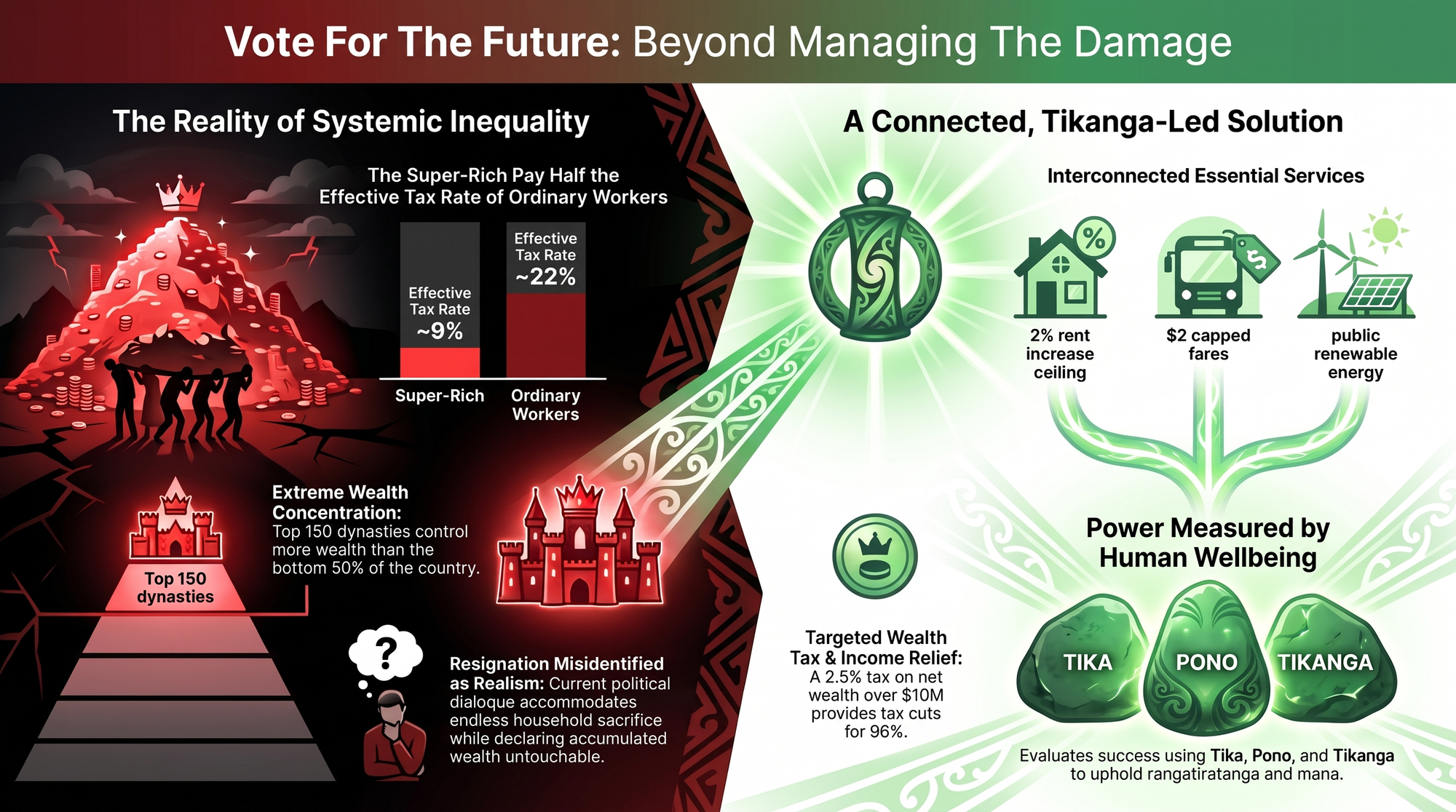
My case is that the Greens offer a coherent direction: shift responsibility towards concentrated wealth, rebuild public and community provision, make essential services more accessible, and uphold Māori authority. Those commitments run through their published election manifesto.
The question is whether that direction deserves our trust—and whether the people proposing it bring the experience and judgement needed to turn it into something real.
This essay examines their cost-of-living programme, the connections between housing, energy, transport and taxation, and the experience behind their leadership. I also address the difficult questions: funding, delivery, coalition negotiations and accountability.
I apply Tika, Pono and Tikanga, building mauri. Not as decoration. As a test of whether political power helps people live.
My argument is straightforward: the Greens deserve our vote because their programme offers more than relief within an unequal system. It offers practical ways to change who carries the burden and who holds the power.
That is a reason to vote for something—not merely against somebody.
Stop Mistaking Resignation For Realism
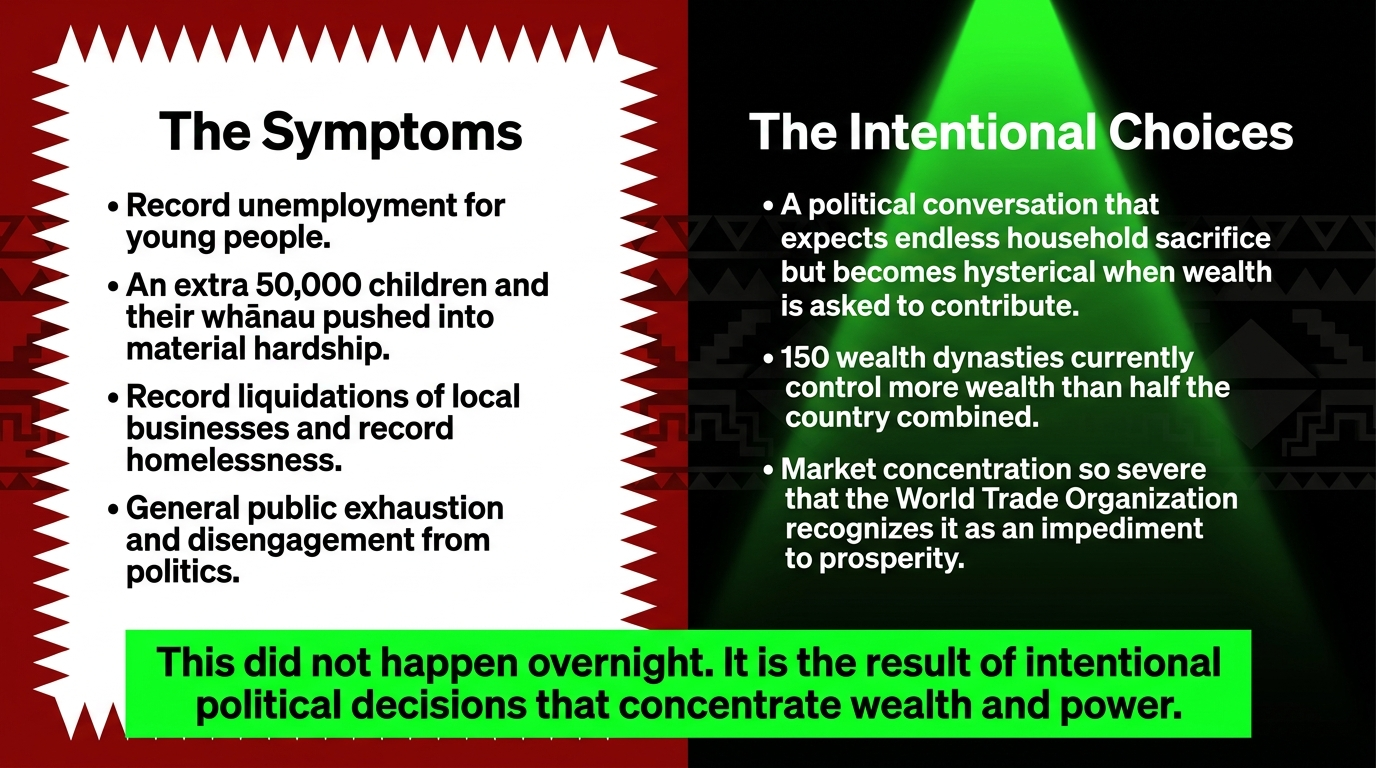
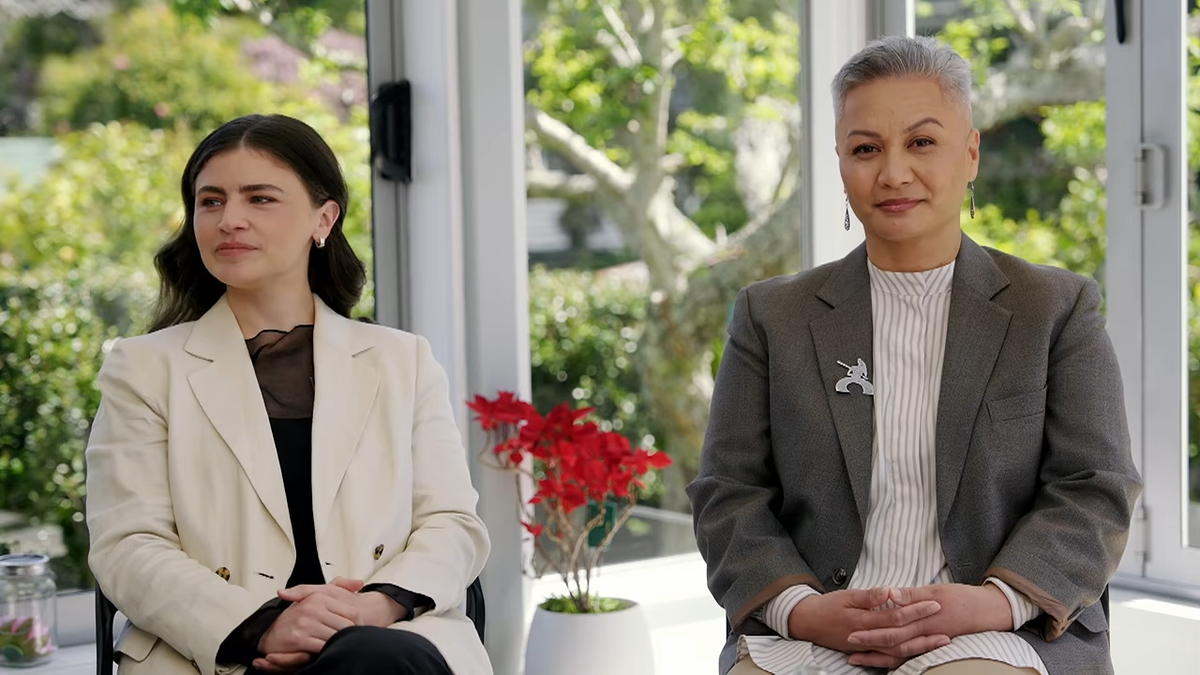
In Moana Maniapoto’s interview with Chlöe Swarbrick and Marama Davidson, the co-leaders argued that the cost of living reflects political choices about wealth, essential services and corporate power.
That is the proposition worth confronting.
When a politician calls an alternative “radical”, my first question is not whether the word sounds frightening. It is whether the existing arrangement deserves to survive unchanged.
What exactly is sensible about a political conversation that can accommodate endless household sacrifice but becomes hysterical when substantial wealth is asked to contribute more?
I am not interested in reassuring the already comfortable that nothing important will change.
I want a government prepared to ask whether the rules are working—and capable of changing them when they are not.
The Greens’ programme combines proposed tax changes with public housing, renewable energy, transport investment and stronger public services. These are connected commitments, not merely an environmental policy with a few social promises attached. The manifesto sets out that breadth.
That connection is central to why I support them.
The Test Is Human
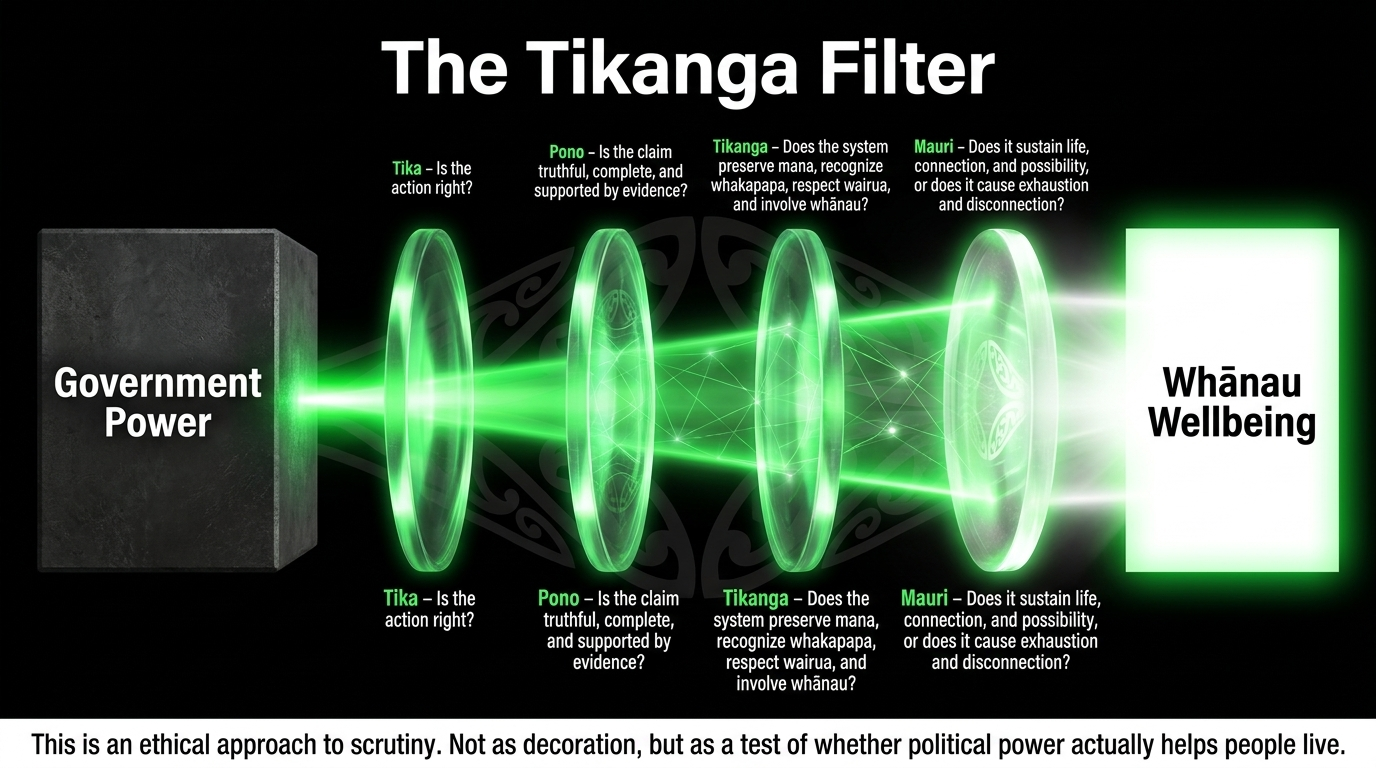
Tika asks whether an action is right.
Pono asks whether the claim is truthful, complete and supported.
Tikanga asks whether the system preserved people’s mana, recognised their whakapapa, respected their wairua, involved their whānau and returned them towards wellbeing.
Mauri asks what that system sustains: life, connection and possibility—or exhaustion and disconnection.
This is the framework I use in my examination of whānau authority and the health system. It is an ethical approach to scrutiny, not a claim that tikanga Māori can be reduced to a checklist.
For readers accustomed to Western financial measures, the distinction is simple.
A system can balance its accounts while failing the people who depend on it.
It can process an application correctly while humiliating the applicant. It can offer a theoretical choice that cost, distance and exhaustion make impossible.
I want public institutions judged by more than how efficiently they close a file.
Leave The Evidence For Mokopuna
I would love you to read, share and use this work—not because attention is the purpose, but because reliable information should be useful in ordinary life.
The Māori Green Lantern repository includes long-form essays and related audio and short-video explanations, including those accompanying the supermarket investigation.
I want our mokopuna to inherit more than a pile of campaign slogans.
I want them to be able to look back and say: at least The Māori Green Lantern, among others, was warning us—and left the evidence where we could examine it.
Not a monument to being angry.
A resource for understanding how choices were made, what alternatives existed and who demanded better.
The Deep Dive Podcast
Listen to a lively conversation between two hosts, unpacking and connecting topics in the sources of this essay. I apologise in advance for the AI's very harsh pronounciation of reo. Please dont shoot me, :).
Youtube Video
Like video? Here is a short video suppporting the essay. Again, don't shoot the messenger please because of AI's pronounciation. :)
A Programme That Connects
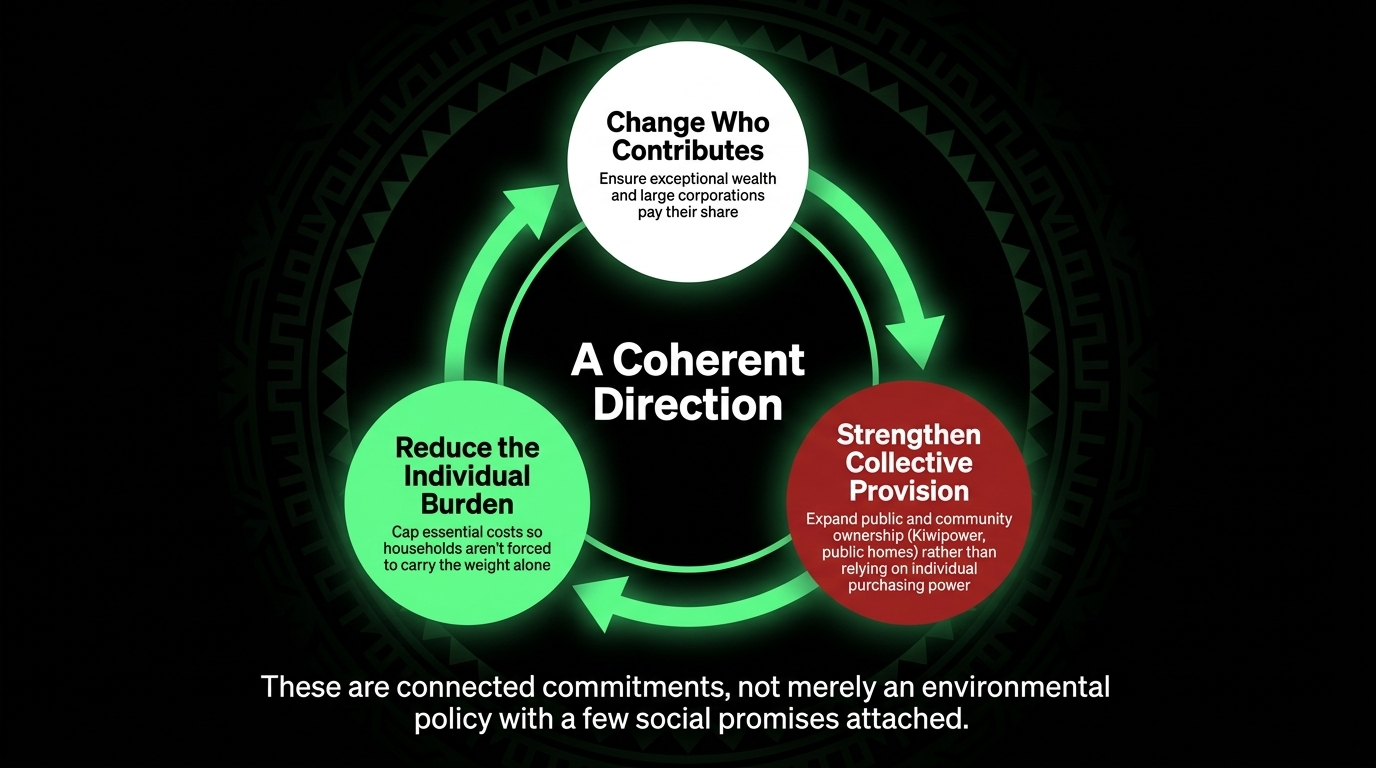
The strongest case for the Greens is not any isolated announcement. It is the relationship between their proposals.
Their tax programme seeks additional contributions from very high wealth and large corporations while introducing an income-tax-free threshold. Their energy and housing programmes propose expanding provision rather than relying solely on households to purchase their way out of insecurity. The tax policy, energy programme and housing manifesto establish those commitments.
That gives the programme a recognisable logic:
Change who contributes. Strengthen what we provide together. Reduce the costs people must carry alone.
I find that more persuasive than treating every household pressure as a separate personal budgeting problem.
A decent income matters. So does what rent takes from it. Affordable transport matters. So does whether a service exists. Energy assistance matters. So does who owns the generation and receives its benefits.
The programme deserves support because it addresses these relationships. It still has to prove itself through delivery.
Tax Responsibility, Not Tax Panic
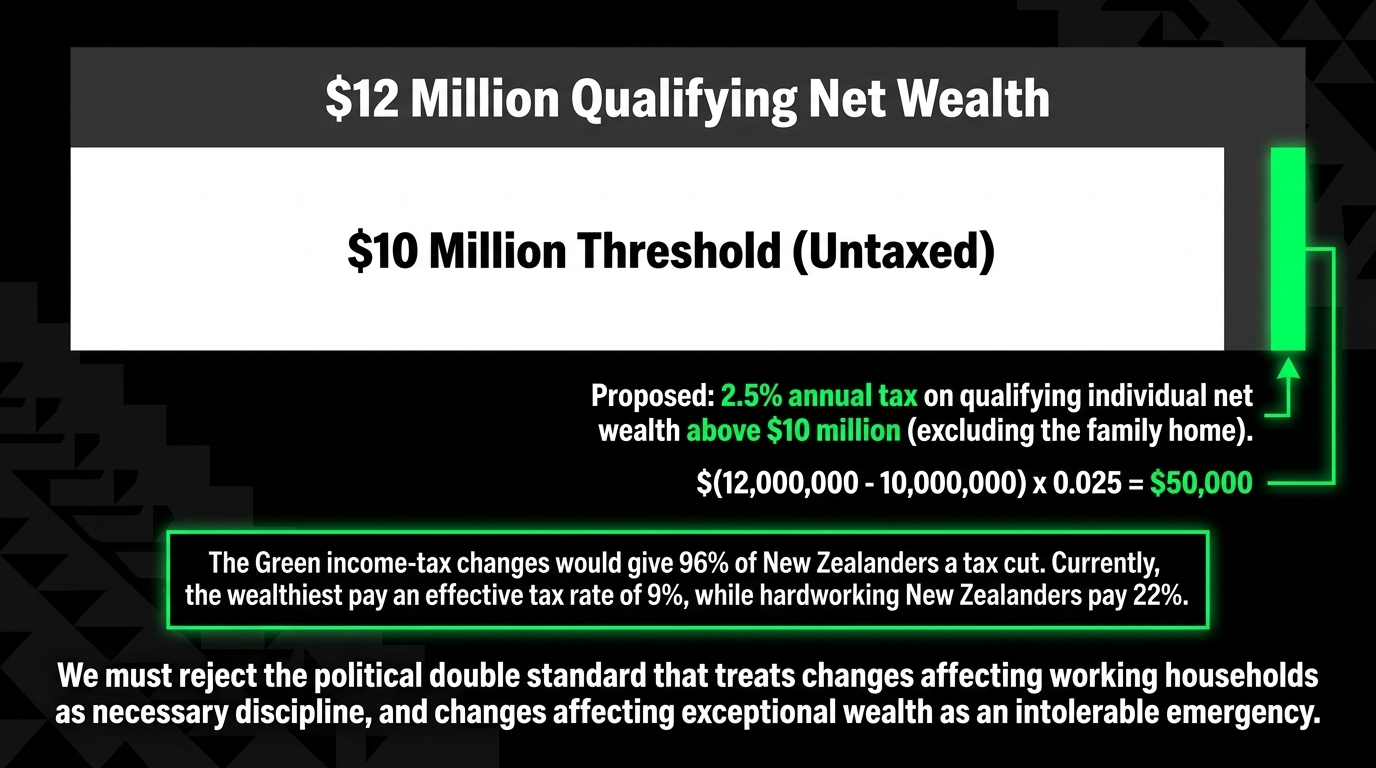
The Greens propose an annual tax of 2.5% on qualifying individual net wealth above $10 million, with the family home excluded. They also propose a $10,000 income-tax-free threshold and say their income-tax changes would give 96% of New Zealanders a tax cut. Those are the party’s published proposals and distributional estimate.
These details matter because a threshold is not a slogan.
For a hypothetical person holding $12 million of qualifying net wealth, the proposed annual liability on the excess would be:
(12{,}000{,}000-10{,}000{,}000)\times0.025=50{,}000That is an illustration of the proposed structure, not an assessment of any actual person’s affairs.
The policy must answer questions about valuation, liquidity, avoidance and administration. But those are reasons to scrutinise the design—not reasons to declare substantial accumulated wealth untouchable.
I reject the political double standard that treats changes affecting working households as necessary discipline and changes affecting exceptional wealth as an intolerable emergency.
The case for the Greens is that they are prepared to contest that distribution of responsibility.
Example One: A Home
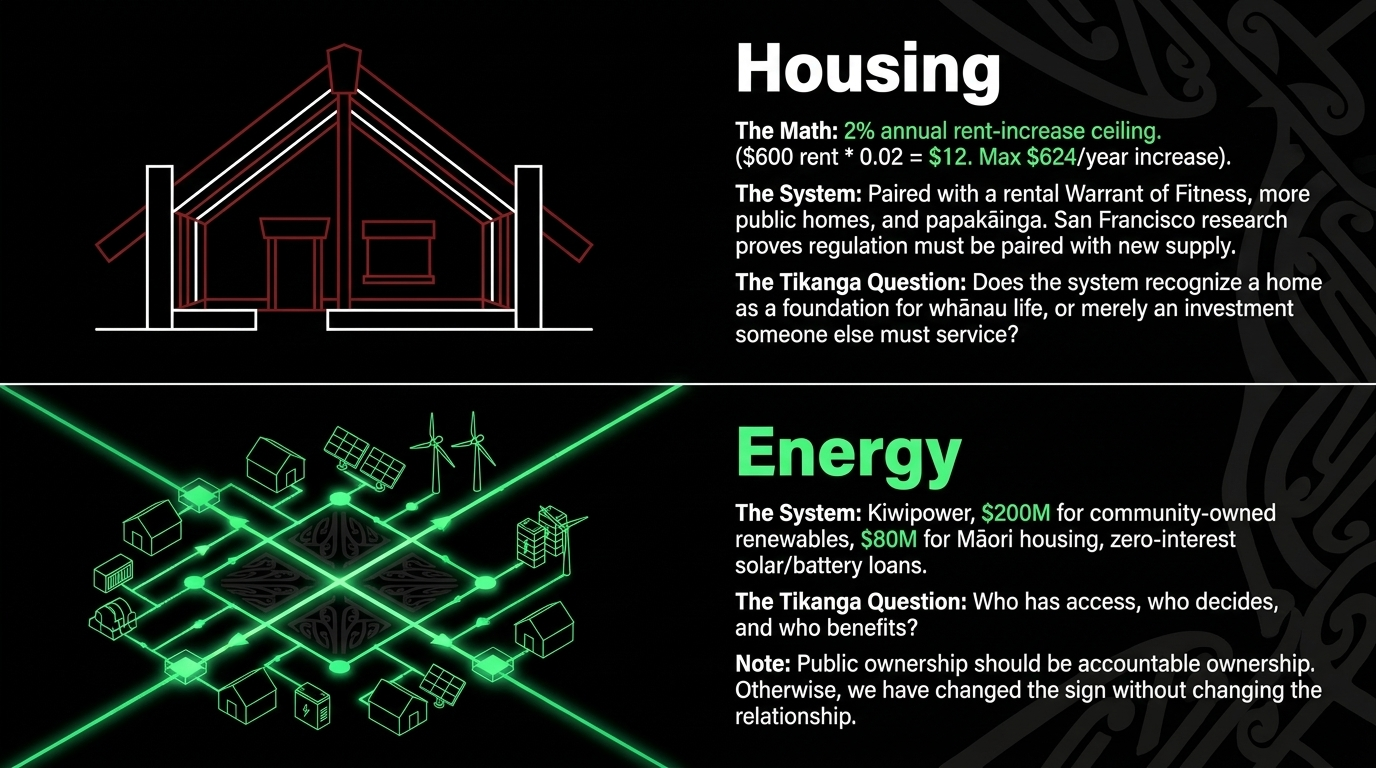
The Greens propose combining rent regulation with stronger housing standards, an independently certified rental warrant of fitness, more public homes and more papakāinga. Their housing manifesto sets out those measures together.
That combination is important.
Their proposed annual rent-increase ceiling is 2%. For an illustrative household paying $600 weekly, an increase at that ceiling would add $12 weekly, or $624 across 52 weeks. The ceiling is a proposal, not current law.
600\times0.02=12;\qquad12\times52=624That calculation does not establish a saving against an unknown alternative. It shows what the proposed limit would mean in a defined example.
For a conventional economic analysis, the question is housing expenditure.
For tikanga, I also ask whether people can remain connected to their school, neighbours, marae and support networks. Does the system recognise a home as a foundation for whānau life—or merely an investment someone else must service?
The answer requires more than a ceiling.
Research on San Francisco found that rent controls helped protected tenants remain, while landlord responses also reduced regulated rental supply. The American Economic Association explains both findings.
That is why public housing, maintenance, enforcement and new supply belong in the same argument.
The Greens’ programme gives us that broader starting point. It deserves support—and close examination of how its parts will work together.
Example Two: Power
The Greens propose Kiwipower, a publicly owned energy entity, alongside community renewables, home-energy improvements and zero-interest solar and battery loans. Their energy announcement describes the package.
The same package proposes $200 million for community-owned renewables, $80 million for renewable energy for Māori housing, and solar on more than half of public homes within four years. These are proposed allocations and targets, not completed installations. The announcement specifies them.
For the Western mind, consider the distinction between repeatedly helping someone pay a bill and investing in an asset that can provide an ongoing service.
The tikanga question is who has access, who decides and who benefits.
A homeowner loan alone cannot answer the needs of someone who does not own a roof. Public-housing and Māori-housing measures therefore matter to the fairness of the package.
I support this direction because it opens a conversation about ownership and collective capability—not just individual purchasing power.
But I expect delivery schedules, transparent procurement, realistic maintenance arrangements and reporting on actual household outcomes.
Public ownership should be accountable ownership. Otherwise, we have changed the sign without changing the relationship.
Example Three: A Journey
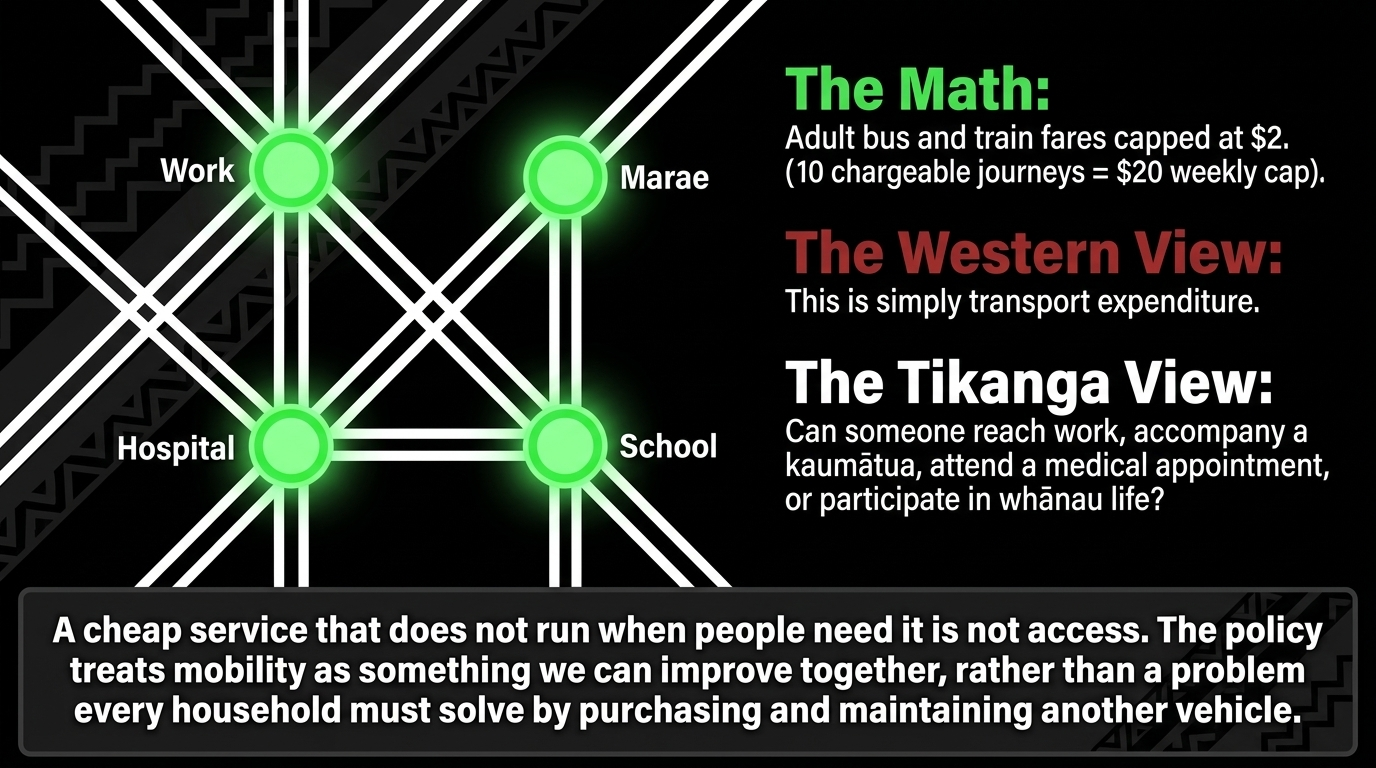
The Greens propose adult bus and train fares capped at $2, free travel for specified groups, and investment in better services and connections. Their transport programme combines fares with provision.
For someone making ten chargeable journeys weekly under that proposed cap:
10\times2=20That is an illustrative weekly fare cost of $20—not a proven saving without knowing the person’s existing fares.
For an accountant, this is transport expenditure.
For tikanga, it is also about whether someone can reach work, accompany a kaumātua, attend an appointment or participate in whānau life.
A cheap service that does not run when people need it is not access.
The policy therefore has to deliver frequency, useful routes, accessibility and connections—not just an attractive fare.
I support the Greens’ approach because it treats mobility as something we can improve together rather than a problem every household must solve by purchasing and maintaining another vehicle.
Personnel Must Match Policy
A manifesto cannot govern by itself.
The personnel case should not rest on whether someone is charismatic, quick in an interview or good at producing a cutting line.
I want relevant experience, demonstrated responsibility, institutional knowledge and the ability to work with others.
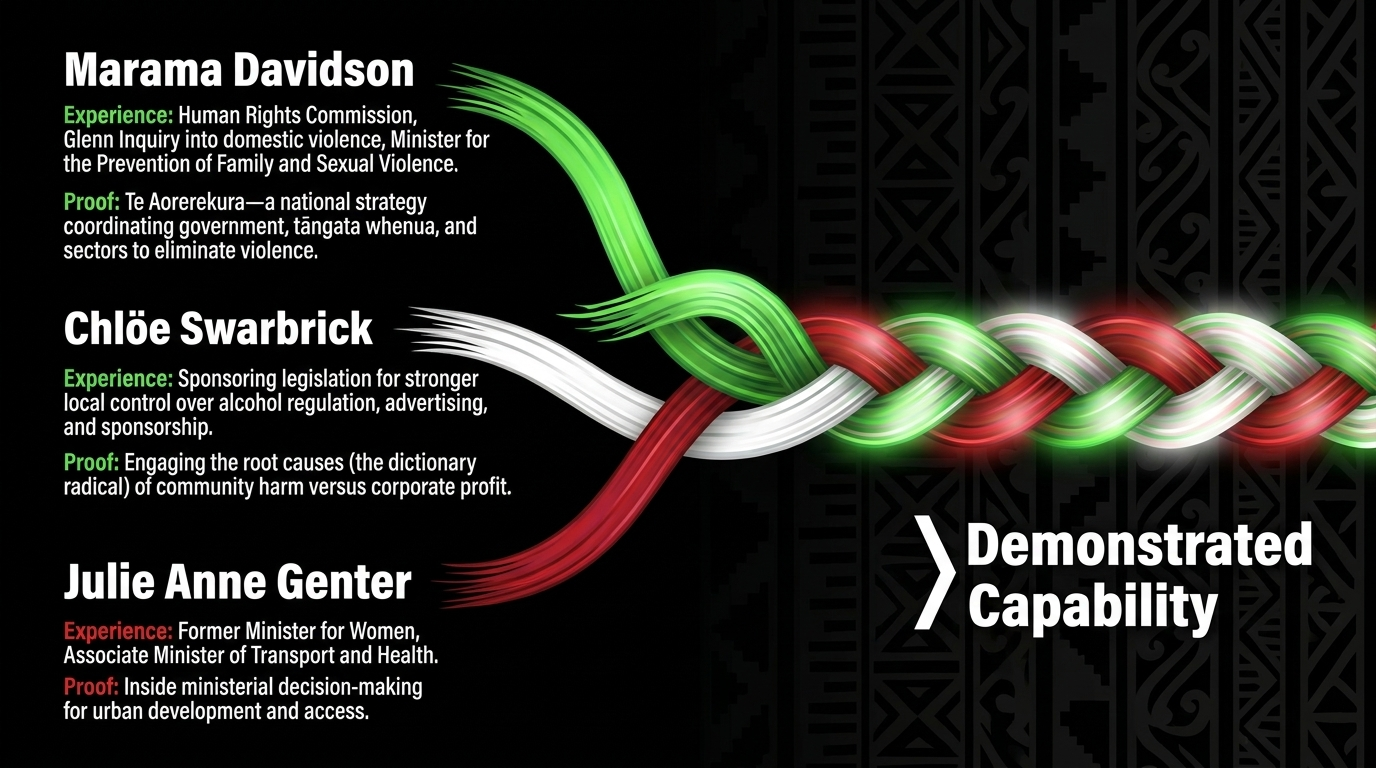
The Green team includes people with ministerial experience and people whose parliamentary work demonstrates sustained engagement with specific policy problems. Julie Anne Genter’s published record identifies her previous portfolios, while Parliament records Swarbrick’s alcohol-harm legislation.
That is a stronger foundation than personality worship.
It does not establish that every candidate is equally prepared or that every proposal will succeed. It establishes that dismissing the party as people with opinions but no relevant experience is inadequate.
Davidson Brings Institutional Experience
Marama Davidson’s background includes the Human Rights Commission, the Glenn Inquiry into domestic violence and child abuse, and ministerial responsibilities for preventing family and sexual violence and addressing homelessness. Her published biographical account records that experience.
That background matters because these problems do not fit neatly inside a single department.
Te Aorerekura provides a concrete institutional example: a national strategy bringing government, tangata whenua, specialist sectors and communities into a collective approach to eliminating family and sexual violence. The official strategy page describes that framework.
I do not present a strategy as proof that violence has been eliminated. That would insult the seriousness of the work.
I present it as evidence that Davidson’s experience extends beyond identifying harm. It includes responsibility within government for building a coordinated response.
That is relevant preparation for a political programme centred on whānau wellbeing.
Swarbrick’s Record Is Not Just Rhetoric
Chlöe Swarbrick’s parliamentary record includes sponsoring legislation seeking stronger local control over alcohol regulation and restrictions relating to alcohol advertising and sponsorship. Parliament identifies her as the member responsible and describes the bill’s purpose.
The bill did not pass its first reading. The parliamentary record makes that outcome explicit.
That distinction matters. Sponsoring legislation demonstrates policy engagement and legislative work; it does not establish an enacted achievement.
But the subject of that work is relevant to the political argument she now makes: whether communities should have more control over conditions affecting their wellbeing.
I see a substantive connection between that legislative effort and the party’s wider programme.
The next test is leadership in government: negotiating commitments, coordinating delivery and accepting responsibility when implementation falls short.
Genter Brings Relevant Portfolios
Julie Anne Genter has serviced as Minister for Women and Associate Minister of Transport and Health. Her published profile sets out those roles.
That is relevant experience for a party proposing changes to transport, urban development and access.
Previous office is not a certificate of perfection. Nor should a candidate’s own account be treated as independent proof of every claimed achievement.
But experience inside ministerial decision-making is a genuine part of the capability assessment.
Taken together, Davidson’s institutional and community background, Swarbrick’s legislative work, and Genter’s ministerial experience provide a more serious personnel case than the caricature of a party that merely protests from outside. Davidson’s background, Swarbrick’s parliamentary work and Genter’s previous roles support that assessment.
Te Tiriti Must Shape Power
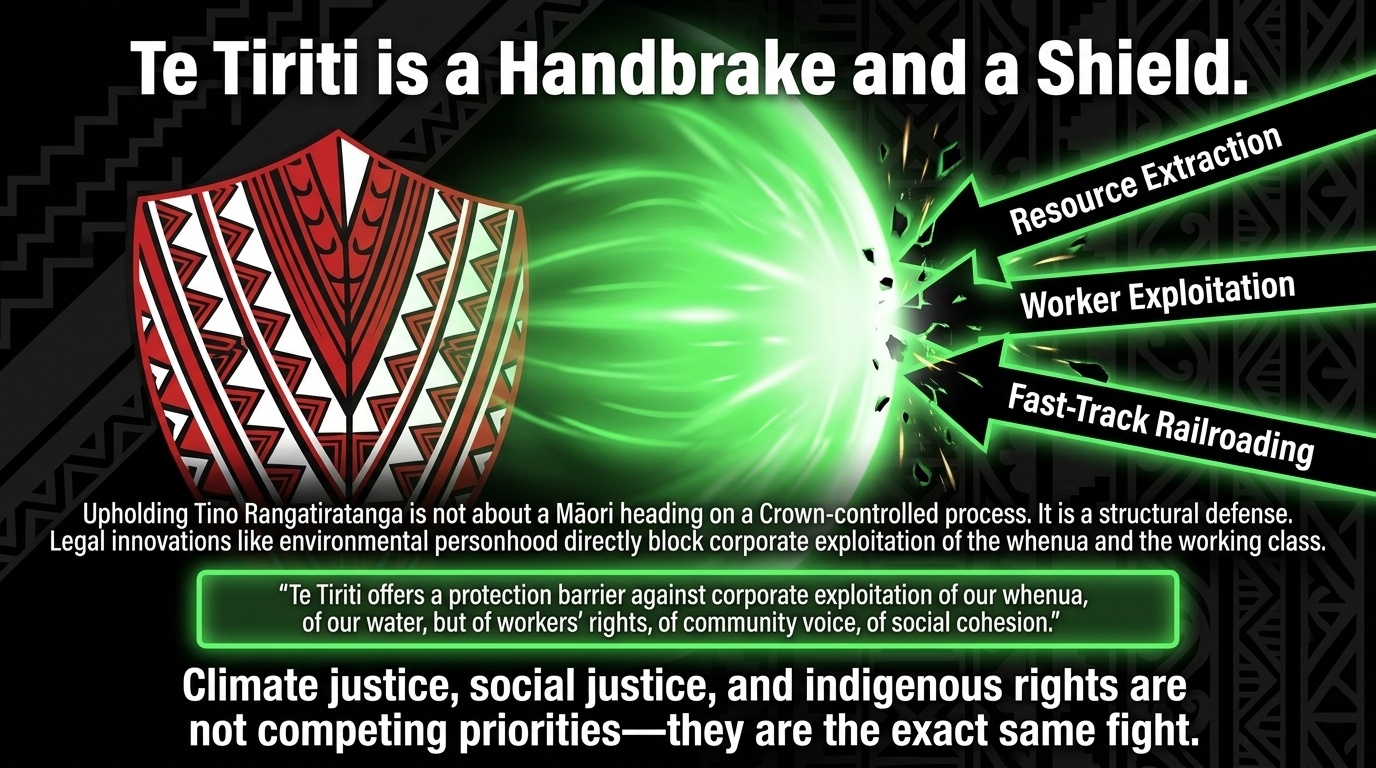
The Greens’ manifesto commits to upholding rangatiratanga and supporting Māori decision-making over the futures of whānau, hapū and iwi. Those commitments appear in its Māori-centred and Te Tiriti sections.
My support is not satisfied by the language alone.
Tikanga asks what happens when Māori priorities differ from institutional convenience. Who controls resources? Who sets the measures? Can whānau shape the response, or are they invited only to comment on a decision already made?
I explored that distinction in my essay on where power lives in the health system.
The Greens’ stated direction gives me grounds for support. The allocation of actual authority will determine whether that support is honoured.
A Māori heading on a Crown-controlled process is not rangatiratanga.
Take The Difficult Questions Seriously
National’s strongest argument deserves an honest answer: public resources are finite, poorly designed spending can create costs elsewhere, and governments need capacity to respond to shocks. Its fiscal plan makes that case through restraint, reprioritisation, debt and surplus commitments.
I do not reject fiscal discipline. I reject a definition of discipline that stops counting when costs leave the government’s accounts and land on households.
Nor will I pretend the existing government provides no assistance. FamilyBoost offers eligible households reimbursement of qualifying childcare expenses, subject to income rules and payment limits. Inland Revenue publishes the operational requirements.
Acknowledging that does not settle whether its overall programme is sufficient.
The Greens must demonstrate credible revenue assumptions, administrative capacity, workforce planning and implementation sequencing. Coalition negotiations may also alter what can be delivered.
That is not a reason to abandon the programme. It is a reason to demand a clear account of priorities and compromises.
A stronger mandate should strengthen accountability—not purchase immunity from it.
Vote With Standards Attached
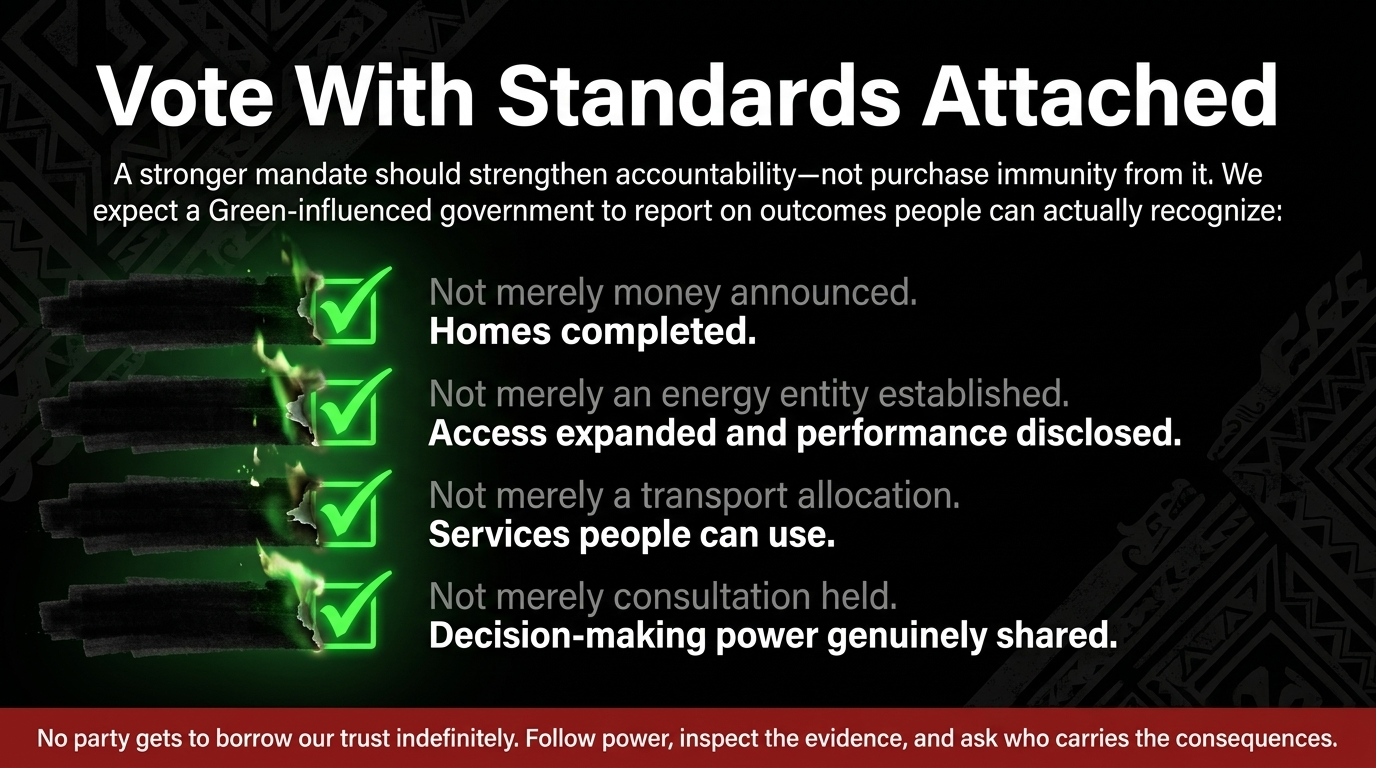
I would expect a Green-influenced government to publish implementation milestones, explain changes to its commitments and report on outcomes people can recognise.
Not merely money announced. Homes completed.
Not merely an energy entity established. Access expanded and performance disclosed.
Not merely a transport allocation. Services people can use.
Not merely consultation held. Decision-making power genuinely shared.
These are the standards I would apply to the Greens because I support their direction—not despite supporting it.
My earlier work on supermarket power and competing party programmes belongs to the same kaupapa: follow power, inspect the evidence and ask who carries the consequences.
No party gets to borrow my trust indefinitely.
Koha Supports Independent Scrutiny
This mahi is supported through koha, not corporate patronage.
Every contribution supports the time needed to read beyond the headline, check the calculations and challenge political claims—including those made by parties I recommend.
That is part of rangatiratanga too: supporting independent truth-telling without demanding that it become obedient.
If you cannot contribute financially, no worries. Subscribe, follow, kōrero and share with whānau and friends. That is koha in itself.
- Koha — Support This Mahi
- Subscribe To The Māori Green Lantern
- Direct bank transfer: Ivor Jones, 03-1395-0099387-000
- Subscribe On Facebook
Kia kaha, whānau. Stay vigilant. Stay connected.
Give Change A Mandate

I do not recommend returning this coalition to power. National’s stated programme of restraint, reprioritisation and no new taxes does not persuade me that it adequately answers the need for stronger collective provision examined here. Its fiscal plan establishes the approach I am judging.
I recommend a party vote for the Greens because their programme offers a coherent alternative: redistributing tax responsibility, building public and community energy, improving transport access, and combining housing protection with greater provision.
Their personnel bring relevant experience. Their proposals create concrete commitments against which they can be judged. Neither fact guarantees success, but together they provide a credible basis for giving them greater responsibility.
This November, I am not asking you to vote out of despair.
I am asking you to vote with expectations.
Apply Tika: is the direction right?
Apply Pono: do the claims withstand scrutiny?
Apply Tikanga: will the exercise of power preserve mana, recognise whakapapa, respect wairua, involve whānau and build wellbeing?
Then give that direction a mandate—and remain organised enough to demand delivery.
The future does not need another manager explaining why ordinary people must accept less. It needs a government prepared to build more of what allows us to live.