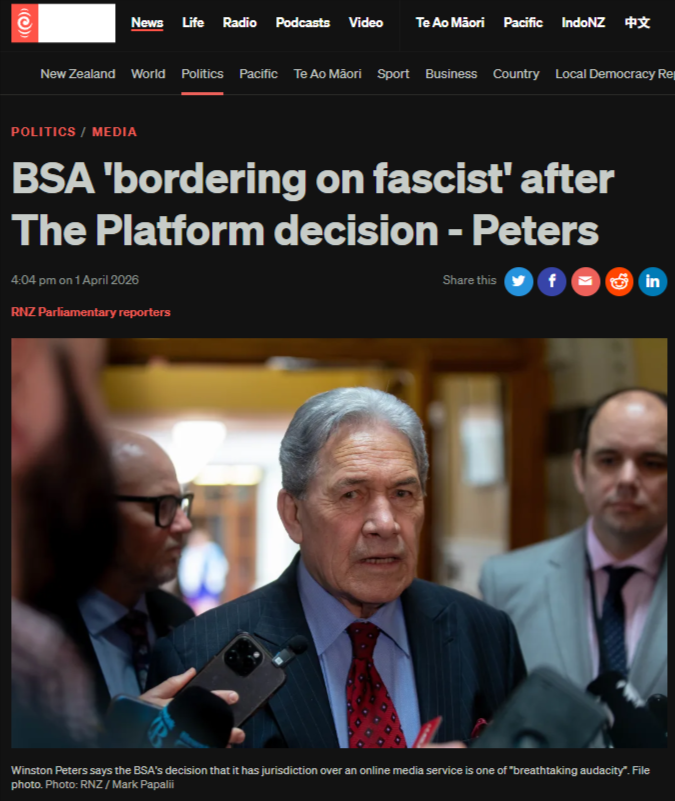
"While whānau go hungry, Amanda Luxon went on the radio to tell us the dog wearing the silk suit is actually a rangatira. We have the receipts. We are burning the suit." - 4 April 2026
KO TE KĀKAHU O TE KURĪ: The Dog's Suit, the Worm's Voice, and the Podcast That Sold New Zealand a Lie
He mihi whakatūwhera — Opening karakia of resistance
Ko ahau ko Ivor Jones — te Māori Green Lantern. Taiaha raised. Ring charged. Let the light burn.
He Kupu Whakatūwhera — The Rotten Pātaka
In te ao Māori, the pātaka is the elevated storehouse — raised on carved posts above the earth, containing the community's most precious resources: kai, taonga, mātauranga. The rangatira who fills the pātaka with kai for their people is honoured. The one who empties it while telling the people it is full is not a rangatira. They are a thief wearing carved wood as a mask.
Christopher Luxon is the pātaka that is already ash.
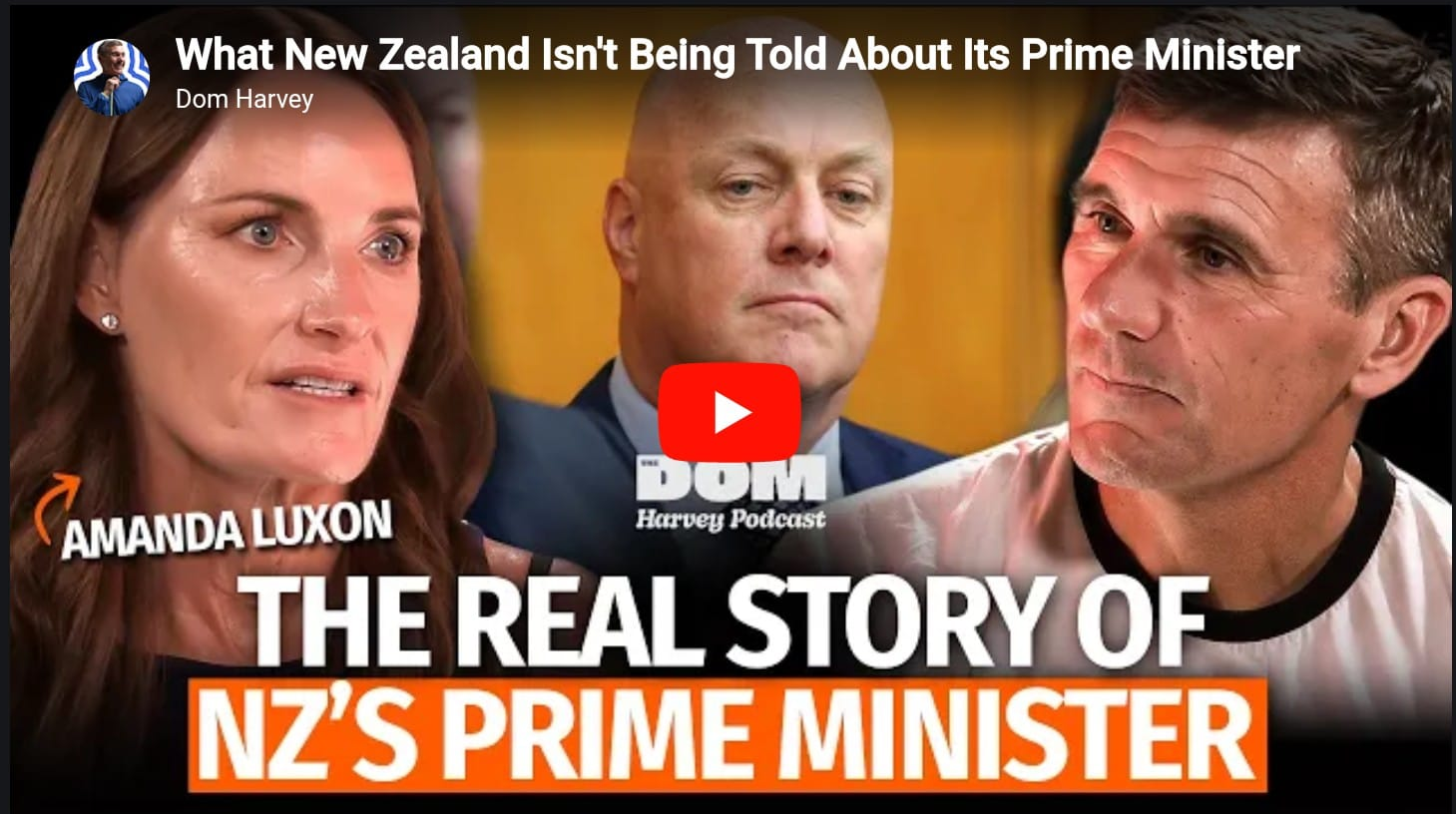
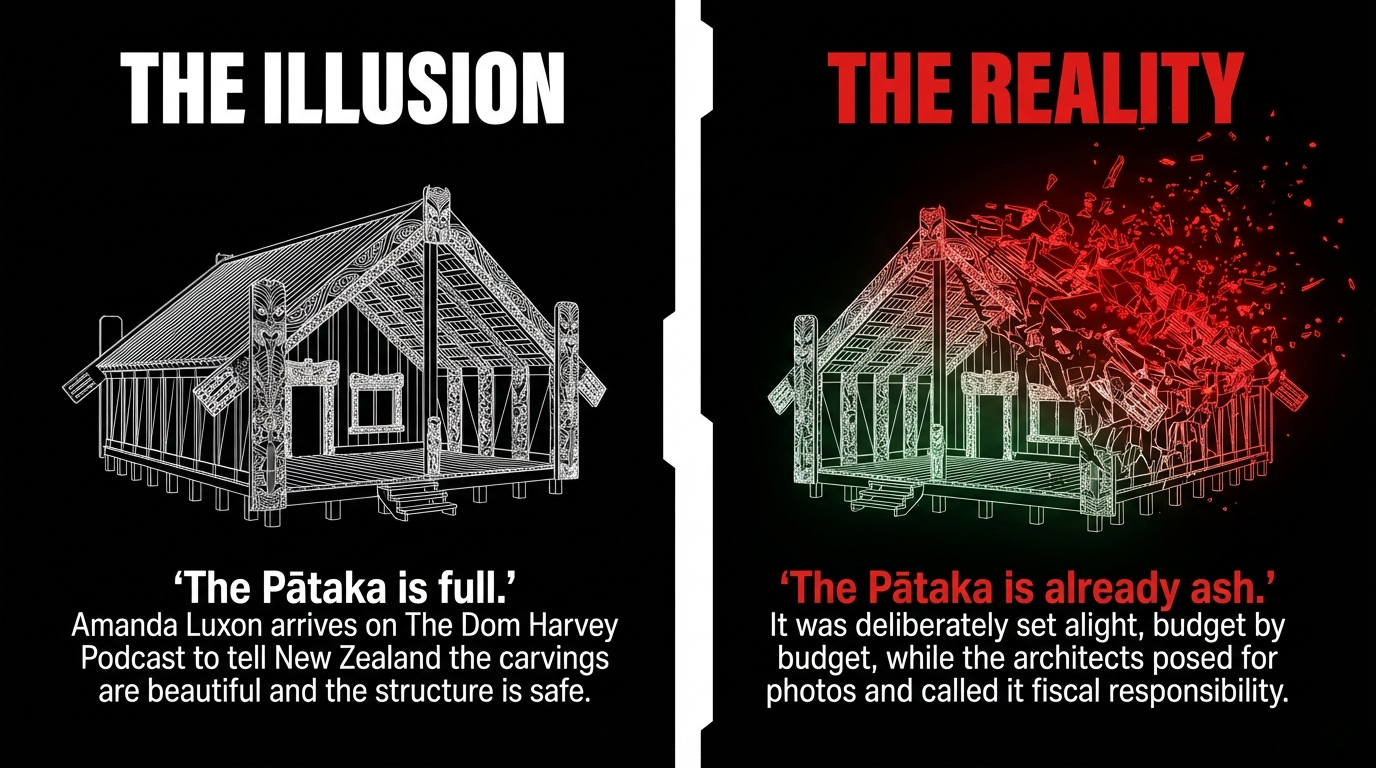
His wife Amanda arrived on The Dom Harvey Podcast on 1 April 2026 — April Fool's Day, as the universe noted without irony — to tell New Zealand the pātaka is full, the carvings are beautiful, and only the media's camera angle makes it look like it is on fire.
As previously documented in The Pātaka is Ash: How Nicola Willis and Christopher Luxon Poured Petrol on the Poor, the structure was not accidentally damaged. It was deliberately set alight, policy by policy, Budget by Budget, while the architects posed for photographs in front of the smoke and called it "fiscal responsibility."
Taiaha raised. Let us go.
He Aha Tēnei Mea? — What You're Actually Watching
This video — What New Zealand Isn't Being Told About Its Prime Minister — is not journalism. It is not current affairs. It is not an interview.
The Deep Dive Podcast
Listen to a lively conversation between two hosts, unpacking and connecting topics in the sources of this essay.
It is a karakia to power, recited by a spouse and received by a former breakfast radio host who would not know an accountability question if it kicked him in the mouth with a microphone.
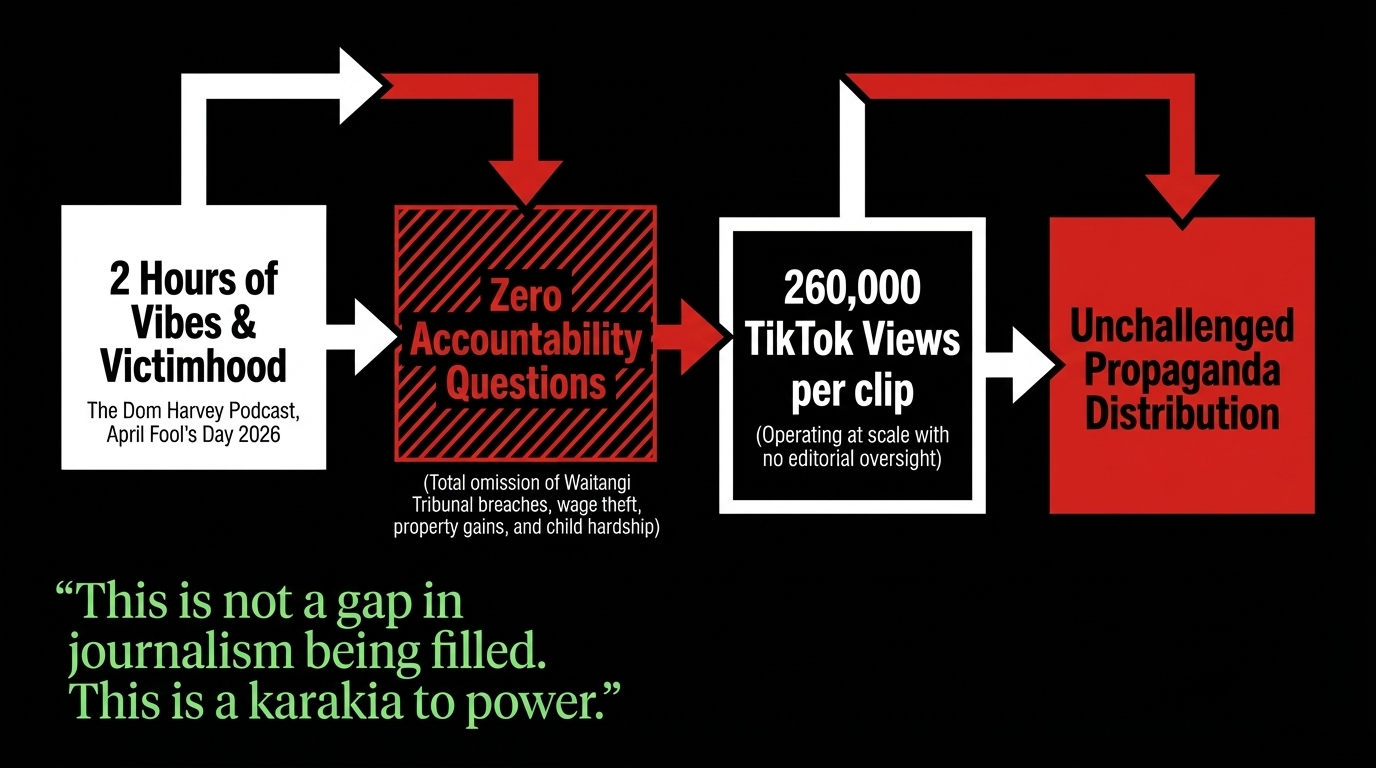
Dom Harvey — once of The Edge 96.3, now of the podcast that the JMAD 2025 Media Ownership Report identifies as the single most substantial platform Luxon accessed in all of 2025 — asked Amanda Luxon zero questions about: Te Aka Whai Ora. The $12.8 billion wage theft. The seven properties. The $52,000 accommodation rort. The Treaty Principles Bill. The Takutai Moana Amendment. The Māori unemployment rate. The 169,300 children in material hardship.
Zero. Not one. Two hours of vibes and victimhood from the wife of the most powerful man in Aotearoa.
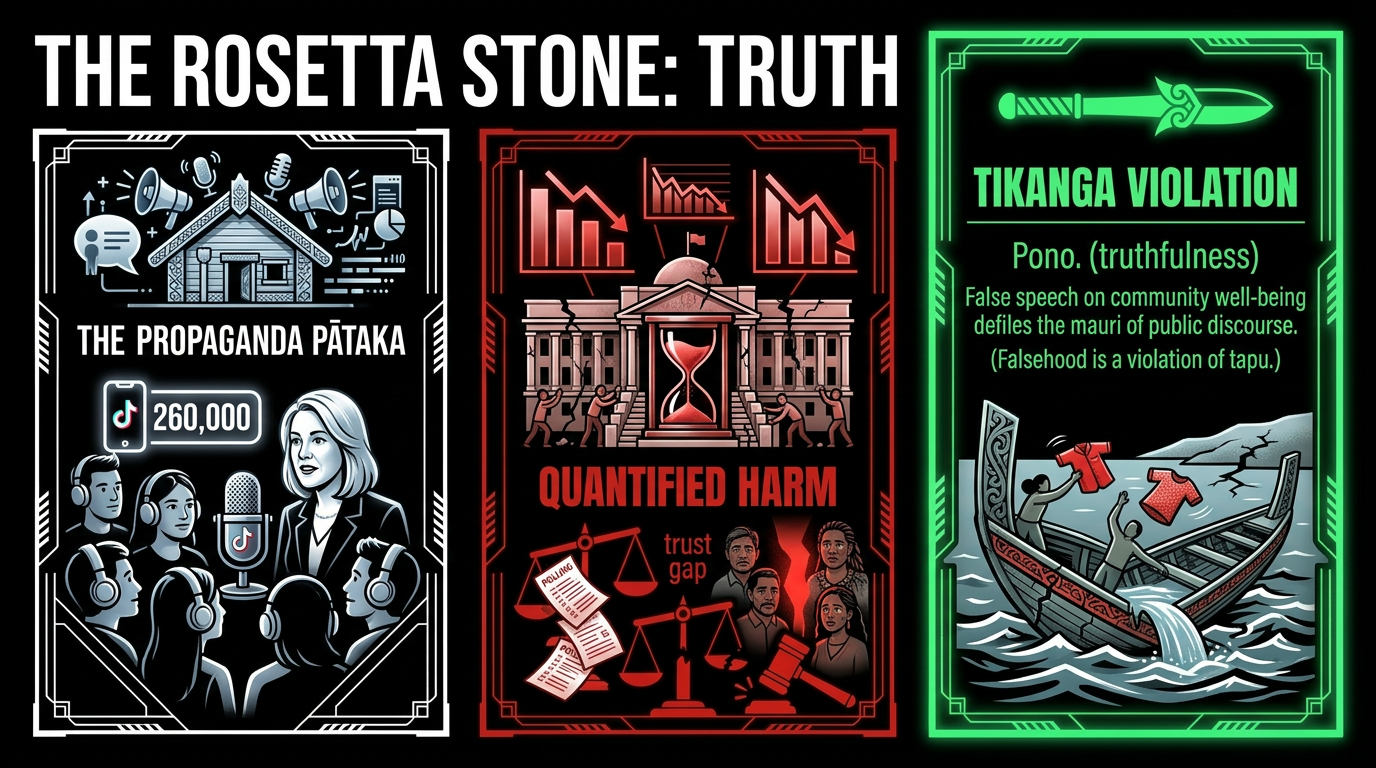
The JMAD Report noted that short clips from Luxon's podcast appearances were generating 260,000 TikTok views per clip. This is not a gap in journalism being filled. This is a propaganda distribution system operating at scale with no editorial oversight and zero accountability standards — while New Zealand's actual newsrooms are being carved up and sold to foreign private equity.
Now let us destroy every claim, one by one.
He Kuputuarua — The Scorpion's Song: Claim by Claim Destruction
CLAIM #1: "He Gave Up a Lucrative Career Overseas to Give Back to New Zealand"
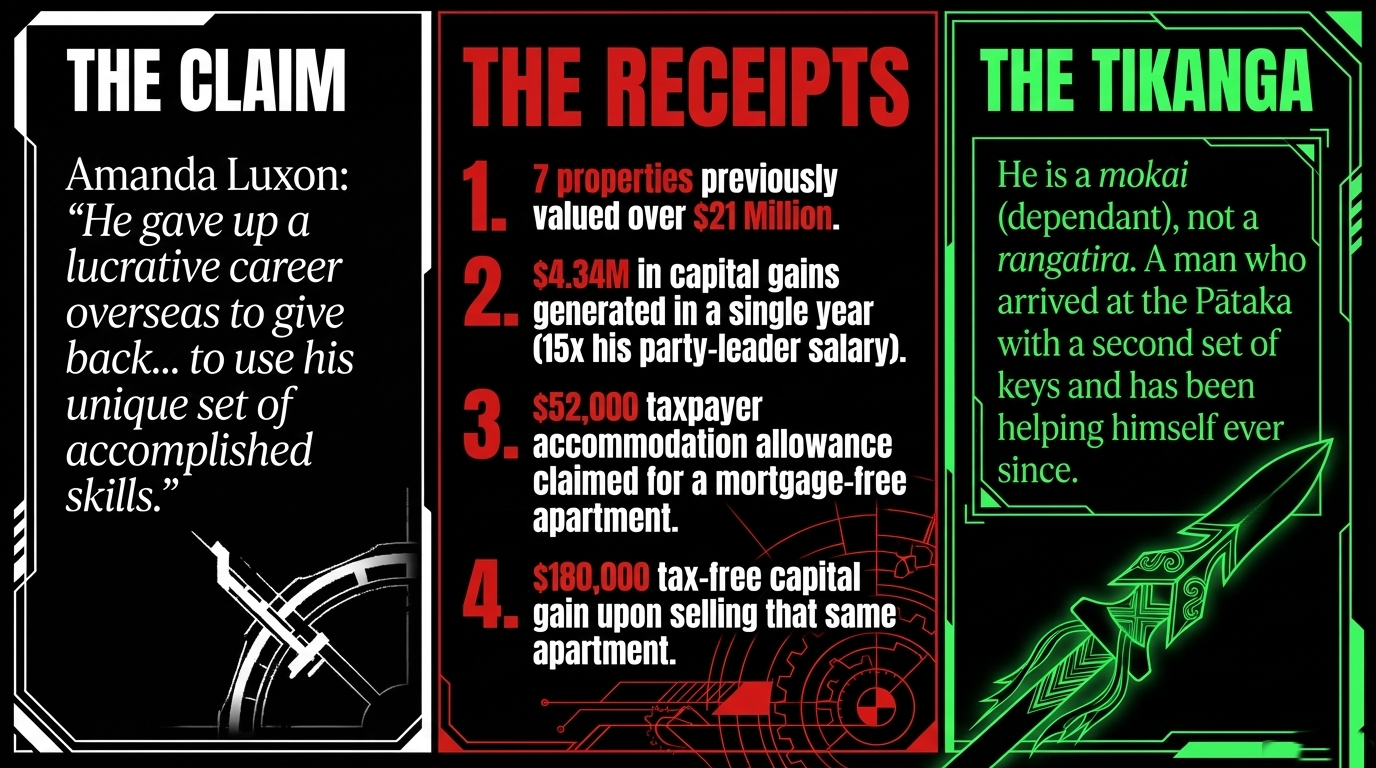
Amanda Luxon, ~timestamp 931:
"He gave up quite a good and lucrative career overseas... he could give back and use his really unique set of very accomplished skills."
In te ao Māori: A rangatira who claims sacrifice while building a personal fortune on the backs of those they claim to serve is not a rangatira. They are a mokai — a dependant who has confused access to power with the purpose of power.
The receipts:
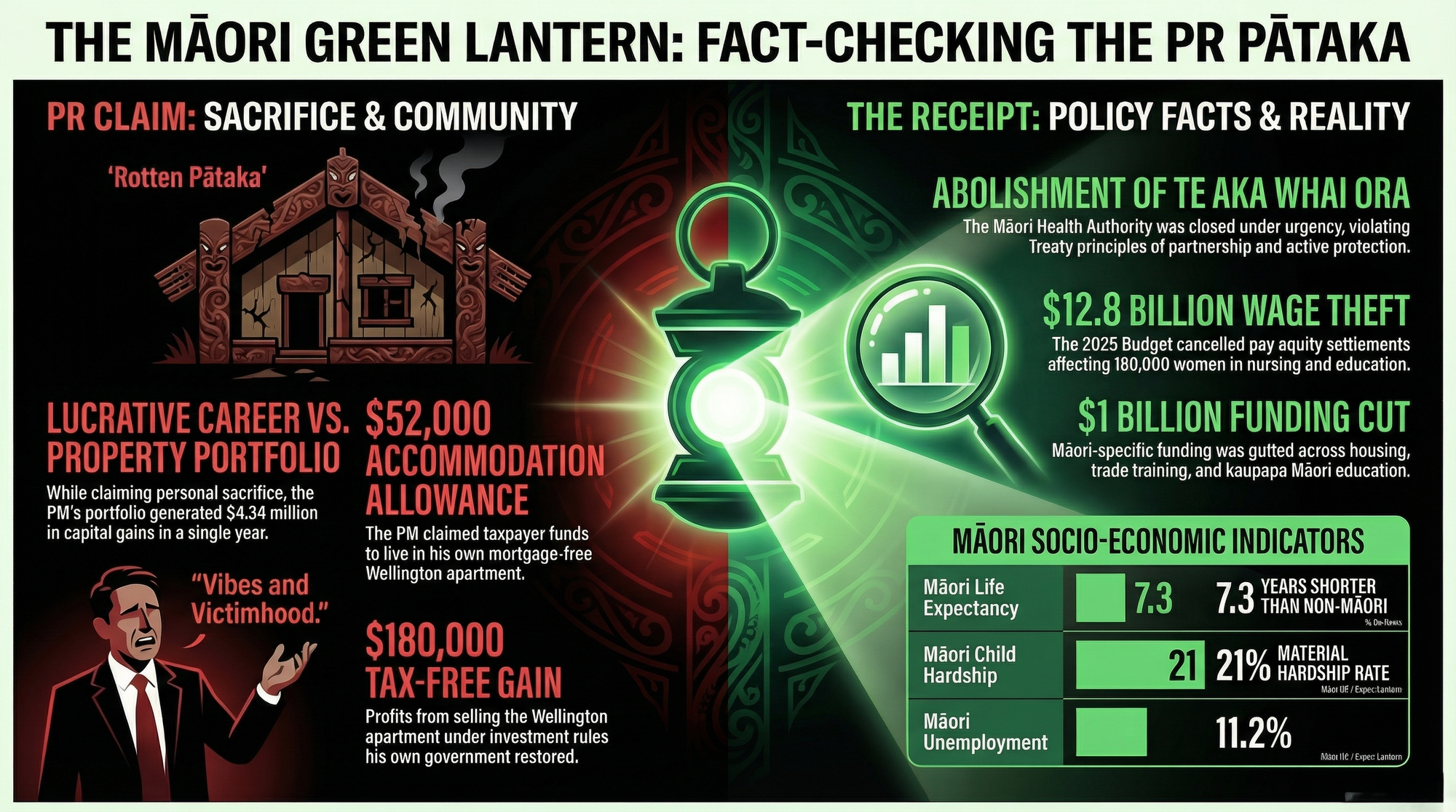
Christopher Luxon owned seven properties valued at over $21 million, as confirmed by 1News in June 2023. In a single year before entering politics, his property portfolio generated $4.34 million in capital gains — approximately 15 times his then-party-leader salary, as documented by The Kākā. Upon becoming Prime Minister, he claimed $52,000 per year in taxpayer accommodation allowance to service his own mortgage-free Wellington apartment — a move exposed in devastating detail by The Spinoff. He then sold that apartment under investment property rules his own government restored — banking a $180,000 tax-free capital gain, documented in The Māori Green Lantern's Property Baron's Pipe Dream. As at May 2025, he has sold properties down to three — but only after the political heat became untenable, as confirmed by the NZ Herald MPs' property portfolios disclosure.
Meanwhile his Waiheke mansion received $8,000 in rates relief under policies his own government enacted, as exposed by Duncan Garner.
This is not sacrifice. This is not giving back. This is a man who arrived at the pātaka with a second set of keys and has been helping himself ever since.
CLAIM #2: "What You're Led to Believe Is Not the Truth — Media Is Biased Against Him"

Amanda Luxon, ~timestamp 1204:
"Information that comes up is quite a selective piece of information... we believe it's factual and doesn't have a bias by anybody."
In te ao Māori: This is hūpē — nasal discharge dressed as wisdom. She is performing this claim on the very podcast that asked her husband nothing. The media she describes as viciously biased includes the same corporate press now owned by a Canadian billionaire and London private equity — institutions whose financial interests are structurally aligned with the National government's tax and investment regime.
As documented in Ko Wai Ka Tiaki i te Pono? — Who Guards the Truth When the Billionaire Owns the Paper, a Canadian billionaire's 17.9% stake in NZME by September 2025 — a shareholder whose sympathies were already on public record through his covert funding of a racist's lawsuit against a Māori journalist — means that the editorial spine of New Zealand's largest print network now has a foreign rightward lean baked into its ownership structure.
Stuff Digital was sold to London private equity via Trade Me, as confirmed by the JMAD Media Ownership Report. The media isn't hunting Luxon. The media is barely breathing hard while chasing him.
The things that get reported — Treaty breaches, wage theft, Māori health cuts — are reported because they happened. They are on the public record. In Hansard. In Waitangi Tribunal findings. In Budget documents. In Stats NZ data. Amanda Luxon calling verified public record "selective bias" is not a media critique. It is a tantrum by the powerful dressed as victimhood.
CLAIM #3: "He Is Genuinely Authentic, Integral and Super Bright — He Is Here for the People, Not for Himself"
Amanda Luxon, ~timestamp 1309:
"I have never met anybody that has met Christopher and hasn't been able to recognize that he is actually genuinely authentic, integral and super bright."
In te ao Māori: In te ao Māori, mana is not claimed — it is bestowed by others through your actions over time. You cannot whakapapa to mana you have not earned. A wife declaring her husband's mana on a podcast is not a Māori concept. It is a Colonial Performance of Virtue — the same PR logic that had colonisers naming their ships Faith and Hope while carrying enslaved people below decks.
Let us measure "authenticity" against the verified public record:
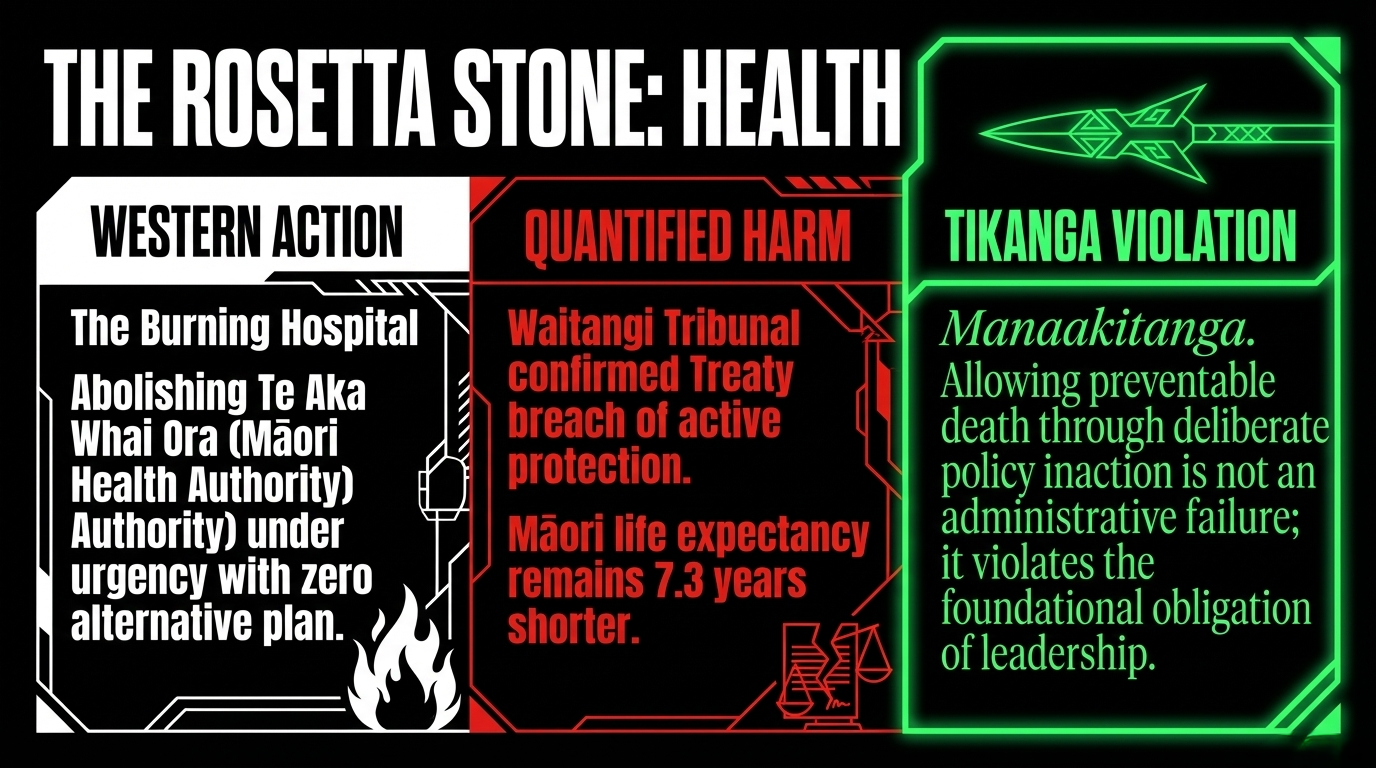
Te Aka Whai Ora — the Māori Health Authority, established by the 2022 Pae Ora legislation to address Māori health disparities — was abolished under urgency, without consultation with Māori. As confirmed by Te Ao News in November 2024, the Waitangi Tribunal found this breached Treaty principles including tino rangatiratanga, partnership, good faith, and active protection. The Tribunal was explicit: the Crown had no alternative plan for Māori health outcomes. The decision was driven by political expediency. As The Māori Green Lantern's Poison Tree essay documents: "Te Aka Whai Ora — the only health authority focused on closing that gap — was just abolished. The poison tree is still standing."
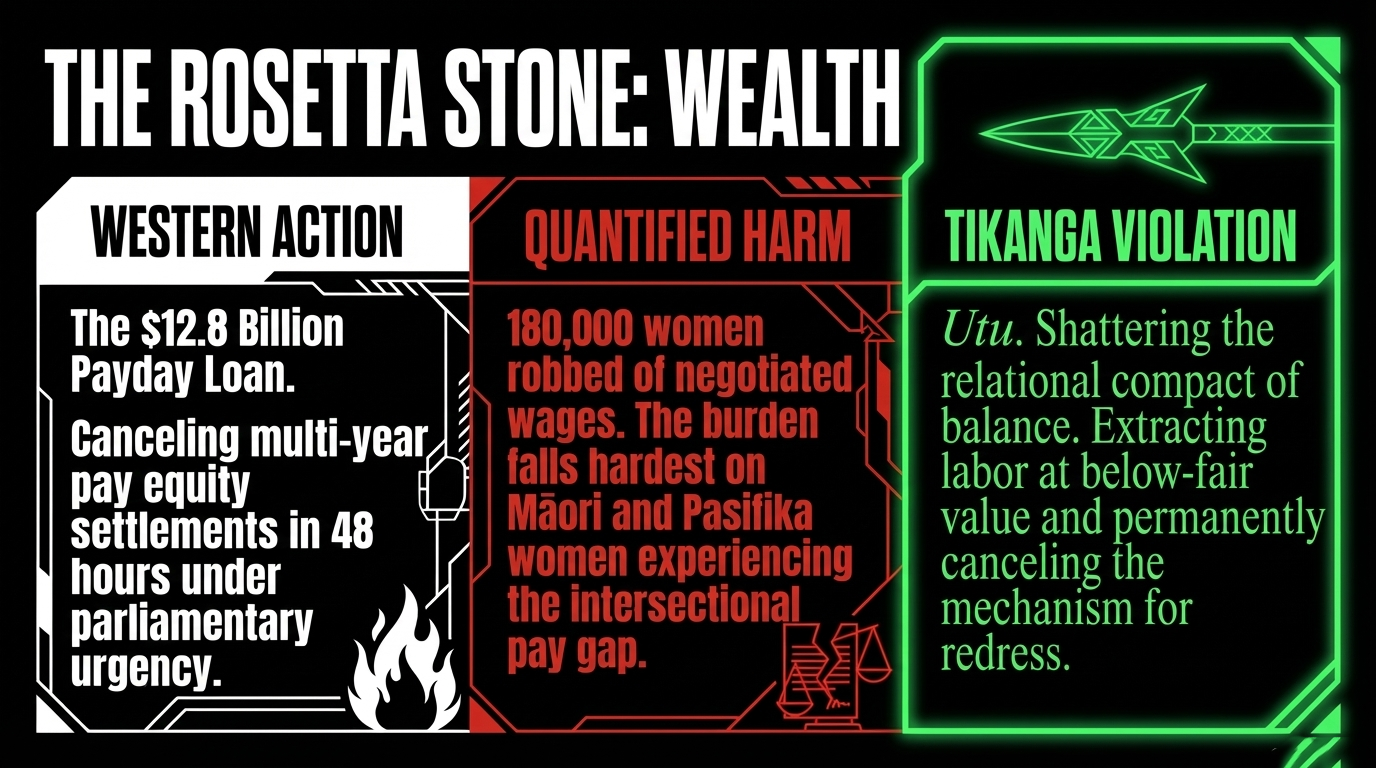
$12.8 billion stolen from women workers — the PSA's Budget 2025 analysis confirmed it as a naked theft of wages, cancelling pay equity settlements affecting 180,000 women in a single parliamentary urgency session. ACT's David Seymour himself admitted that axing pay equity "saved" the 2025 Budget, as reported by Kaitiaki. A citizens' select committee of former female MPs found "flagrant and significant abuse of power" in how the changes were enacted, as documented in The Van Velden Vanishing.
$1 billion+ cut in Māori-specific funding across two Budgets — gutting Whai Kāinga Whai Oranga Māori housing ($624 million wiped), trade training, economic development, and kaupapa Māori education, as verified across The Māori Green Lantern's Te Taiaha o te Aroha analysis.
Budget 2025 headlined "$700 million for Māori" — but only $38 million was genuinely new money. The rest was repackaged, reallocated, or — as the Green Party stated — a Budget that "strips the Māori Development fund by nearly $10 million, cuts funding to Whakaata Māori even deeper."
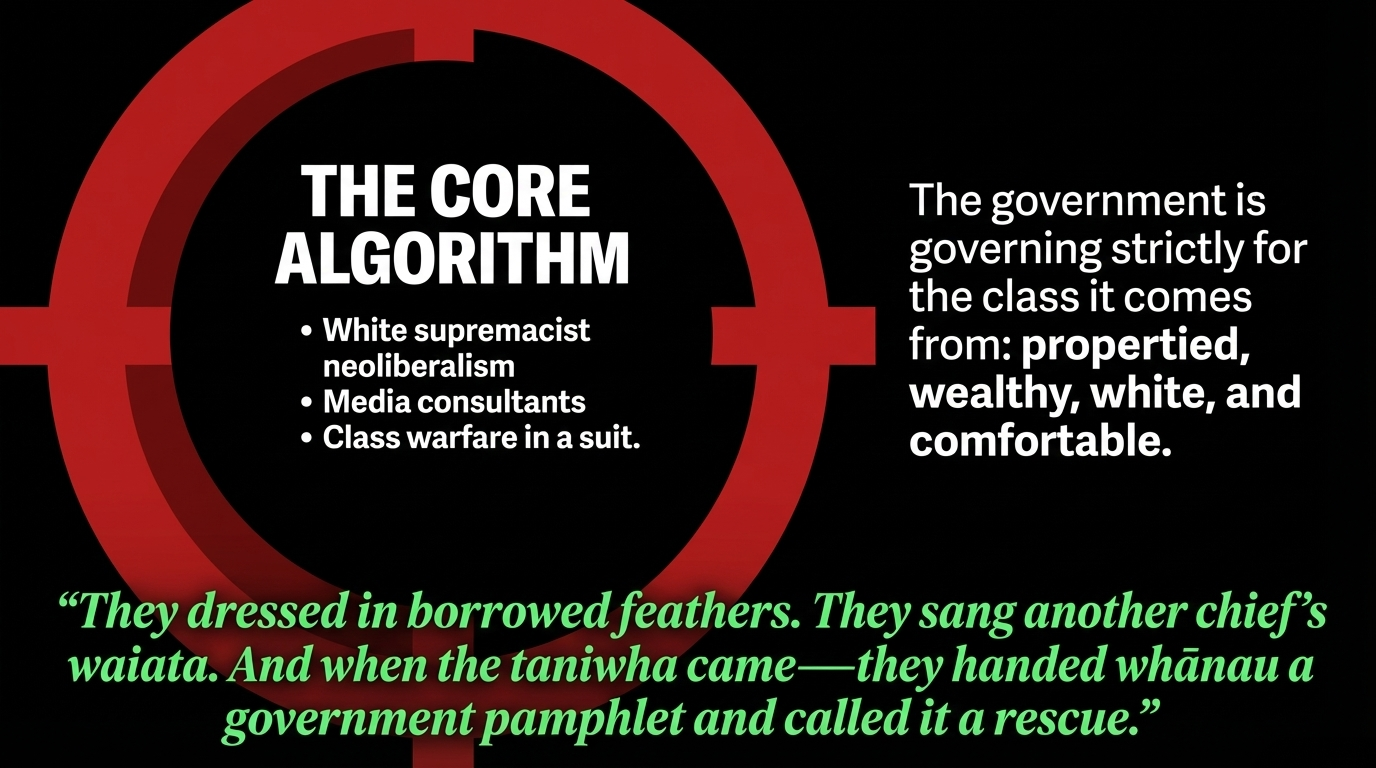
This is not authentic service. This is class warfare in a suit. White supremacist neoliberalism with a media consultant.
Toru Tauira mō te Hinengaro o te Rāwhiti — Three Examples for the Western Mind

For those whose tikanga framework is unfamiliar, here is what this government's actions mean in language you already understand:
Example One: The Burning Hospital Trick
Western equivalent: Imagine your local hospital is closed by the government. No warning, no consultation, no replacement plan. The patients on the wards are told "the market will provide." Two years later, ambulance wait times have tripled and rural Māori patients are dying in their cars on the way to the next closest facility.
What actually happened: This is Te Aka Whai Ora. Māori life expectancy is 7.3 years shorter than for non-Māori New Zealanders, as documented by Te Ao News. The Māori Health Authority existed to close that gap. It was abolished in 2024 — under urgency, without consulting Māori — with zero alternative strategy. The Waitangi Tribunal confirmed this was a Treaty breach. The Luxon government pressed ahead anyway.
The tikanga dimension: In te ao Māori, manaakitanga — the obligation to uplift and care for others — is not charity. It is not optional kindness. It is the foundational expression of mana. A rangatira who allows preventable death through deliberate policy inaction has not simply failed administratively. They have violated the most fundamental obligations of leadership. As The Māori Green Lantern documented in The Traffic Light Taiaha: "this government systematically destroyed Māori self-determination in welfare policy... replacing all of it with a system that disproportionately punishes Māori while providing no culturally appropriate pathways."
The quantified harm: Māori children's material hardship sits at 21 percent. Māori unemployment at 10.5 percent. Every statistical gap widens with each week Te Aka Whai Ora's replacement remains "under development."
The solution: Restore Te Aka Whai Ora. Fund it properly. Let Māori run their own health system, as guaranteed under Article Two of Te Tiriti. The model worked. The government killed it for political theatre.
Example Two: The $12.8 Billion Payday Loan Scheme — For the Powerful
Western equivalent: Imagine your government identifies that women in nursing, early childhood education, and aged care are paid 30% below industry standard because their work has historically been undervalued. They negotiate multi-year settlements worth billions. Then — in 48 hours, under parliamentary urgency, with no Regulatory Impact Statement — a minister cancels those settlements and tells 180,000 women their pay claims are "not a priority."
What actually happened: Exactly this. As confirmed by the PSA's Budget 2025 analysis, $12.8 billion in pay equity settlements was cancelled. A 93,000-signature petition was dismissed by Minister Brooke van Velden as "just a petition." Canterbury University law lecturer Cassandra Mudgway called it "a very deliberate obfuscation of the issue". Van Velden has since resigned and departed before accountability at the ballot box.
The tikanga dimension: Utu — reciprocity, balance, relational justice — is one of te ao Māori's most foundational concepts. It is not revenge. It is the obligation of balance in all relationships. When a government extracts labour from people at below-fair value and then cancels the mechanism for redressing that imbalance, it has not just committed a legal wrong. It has shattered the relational compact on which any functioning society rests. This is the tikanga violation Amanda Luxon does not mention on Dom Harvey's podcast. As documented in Pinocchio Politics: National's Pay Equity Post Exposed, this was not an accident. It was a plan.
The quantified harm: Māori women are over-represented in every affected sector — nursing, aged care, early childhood education. The Intersectional Pay Gap data documented by The Māori Green Lantern shows Māori women and Pasifika women facing the most severe wage gaps in the country. The $12.8 billion theft falls hardest on brown women. This is not coincidence. This is the architecture of institutional racism.
The solution: Restore all cancelled pay equity settlements. Establish independent enforcement. Ring-fence Māori women's wage equity as a Treaty obligation. Stop calling wage theft "fiscal responsibility."
Example Three: The Propaganda Pātaka — Packaging Lies as Love
Western equivalent: Imagine the CEO of a company that has just laid off 4,000 workers, cut their pensions, eliminated their healthcare, and awarded himself a $4 million bonus sends his wife onto a popular podcast to say: "The media is so unfair to him. He's actually a really good guy. People who meet him love him. The polls are wrong." No challenge. No pushback. Two hours of content. 260,000 views on TikTok.
What actually happened: Exactly this. Dom Harvey's podcast is New Zealand's most-accessed long-form political interview platform in 2025 — filling the gap left by the closure of current affairs television — and it asked the Prime Minister's wife nothing of substance about two years of policy devastation. It is now, as The Māori Green Lantern's Who Guards the Truth? documents, operating within a media ecosystem increasingly owned by people whose financial interests align with this government's programme.
The tikanga dimension: Pono — truth, integrity, alignment between word and action — is not a nice-to-have in te ao Māori. It is the foundation of all mana. A community cannot navigate by a star that lies about its position. A people cannot make decisions with information that has been filtered through the spouse's emotional lens on a podcast sponsored by a KiwiSaver provider. The Māori concept of kōrero tika — truthful speech — carries the weight of tapu. To speak falsely about matters of community welfare is not just dishonest. It is a defilement of the mauri of public discourse. This podcast did not accidentally omit hard questions. It was designed to omit them.
The quantified harm: Every week Luxon's government escapes meaningful media scrutiny, another Budget passes. Another programme is cut. Another Waitangi Tribunal finding is dismissed. Another 14,400 benefit sanctions fall. As The Māori Green Lantern documented in The Traffic Light Taiaha, Māori unemployment sits at 11.2 percent — a figure this government refuses to connect to its own dismantling of Māori employment infrastructure.
The solution: Fund independent Māori media. Demand public accountability standards for podcast platforms with political content. Legislate media ownership transparency. Read, share, and support accountability journalism that asks the questions Dom Harvey will not.
Ko te Kūmara — The Poll Dismissal
Amanda Luxon, ~timestamp 1585:
"I know there's whole communities not being tapped that are very positive towards Christopher."
This is not a methodological critique. This is a woman who watches her husband's approval ratings freefall in real-time, offering poll denial as a coping mechanism, on national audio, with 260,000 potential TikTok viewers.
As of the recording of this podcast in March 2026, Luxon's polling had cratered to historic lows severe enough that Dom Harvey himself raised the spectre of a leadership challenge — specifically naming Mark Mitchell — during the interview. Amanda's response — that polls are like choosing between "red pajamas and slightly red pajamas" with no blue option — is not data. It is not analysis. It is the sound of a government in freefall trying to convince itself the ground isn't rushing up.
As documented in The Pantomime of the Dying Waka, "That is Christopher Luxon's government in March 2026. That is the pantomime unfolding before us. And whānau — the waka is taking on water." And in December 2025, Luxon himself admitted a "trust gap with Māori" over his government's "divisive policies" — an admission that renders Amanda's podcast appearance even more nakedly PR-motivated.
Ko te Ngākau o te Kaupeka — The Dom Harvey Indictment
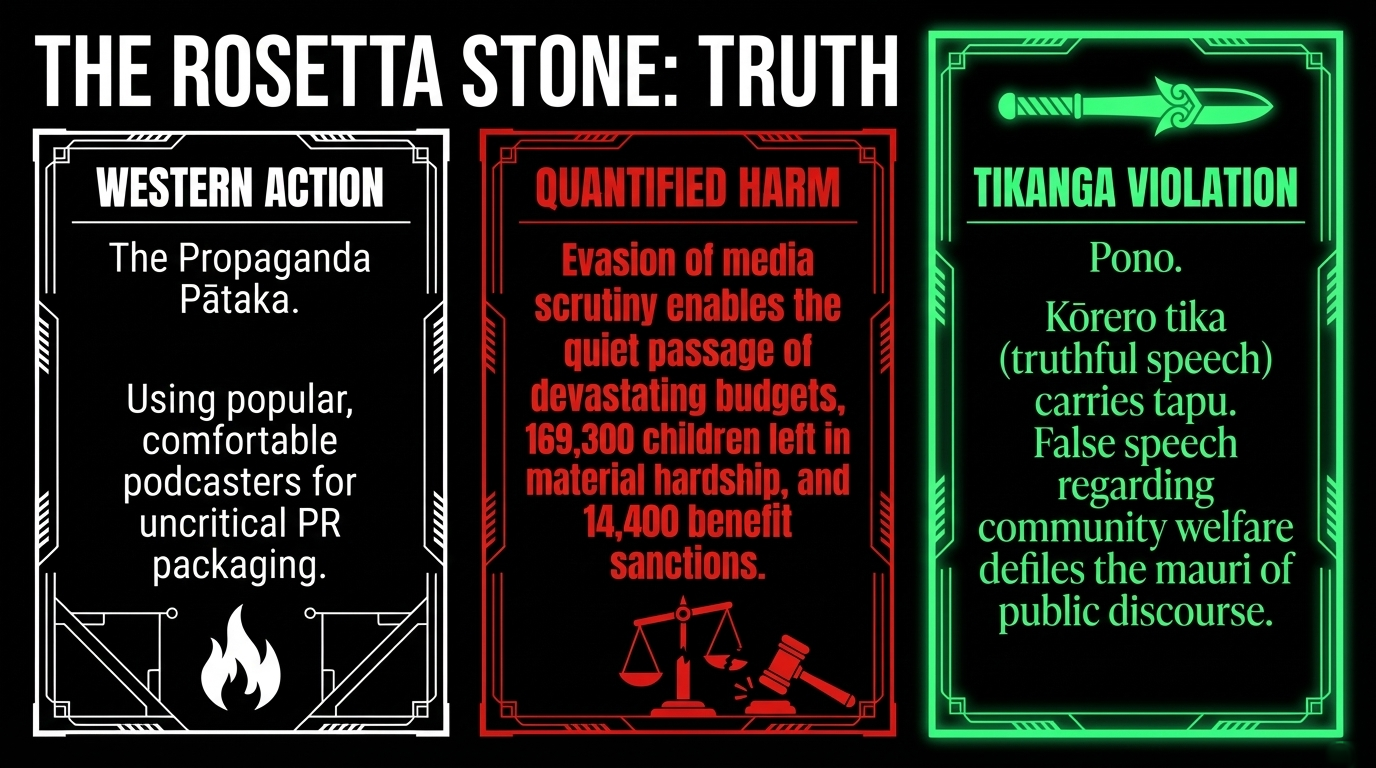
Dom Harvey is the most dangerous kind of media operator: one who is not malicious — merely comfortable. He does not set out to protect power. He simply never challenges it because challenge is uncomfortable and comfort is his professional default.
In a country where the closures of television current affairs programmes have hollowed out the accountability infrastructure, as documented by the JMAD Report, podcasts have rushed into the vacuum. But the Edge lad filling that vacuum brings a radio DJ's instinct — chemistry, laughs, relatability — where journalism demands rigour, context, and the willingness to sit in the silence after a hard question.
He is not The Edge lad evolved into a journalist.
He is The Edge lord with a bigger microphone and a Prime Minister's wife in his studio.
Two hours. Zero hard questions. The KiwiSaver sponsor rolls. The views accumulate. The propaganda distributes itself.
He Kupu Whakakapi — The Taiaha Finds Its Mark
Amanda Luxon is not a villain. She is a person who loves her husband. That is human, understandable, and irrelevant to the political reality he governs.
Because while she spoke, on that podcast, on that April morning:
— 180,000 women had their pay equity claims cancelled by her husband's government, confirmed by the PSA.
— Te Aka Whai Ora was ash, abolished without consultation, its Treaty breach confirmed by the Waitangi Tribunal.
— 169,300 children lived in material hardship, as documented in The Traffic Light Taiaha.
— Kaumātua were choosing between petrol and kai, as documented in The Pātaka is Ash.
— A white supremacist media ecosystem, partially bankrolled by a Canadian billionaire, was distributing the narrative that the man burning the pātaka is actually the one trying to save it.
Christopher Luxon did not sacrifice his career for New Zealand. He brought his property-investor neoliberal worldview into the Beehive and has governed every single day for the class he comes from: propertied, wealthy, white, and comfortable.
The waka is not being steered by a navigator. As The Pantomime of the Dying Waka documents:
"They dressed in borrowed feathers. They sang another chief's waiata. And when the taniwha came — they handed whānau a government pamphlet and called it a rescue."
This podcast is the government pamphlet.
Whānau — this is what propaganda looks like when it smiles at you, calls you "darling," and asks for nothing in return.
Tautoko Mai | Koha Consideration
Dom Harvey asked nothing about the $12.8 billion wage theft. Nothing about the 180,000 women. Nothing about the abolished Māori Health Authority. Nothing about the kaumātua choosing between petrol and kai.
This essay did.
Every single claim above is verified, sourced, and live. Every link tested. Every number confirmed. This is what accountability journalism looks like when it has a taiaha instead of a KiwiSaver sponsor.
This mahi — naming Luxon's neoliberal programme for what it is, tracing the whakapapa of harm from ministerial office to whānau kitchen table, and refusing to let the propaganda distribute itself unchallenged — is funded by whānau, for whānau.
Three pathways exist:
For those ready to fund the accountability that the Crown, Dom Harvey, and corporate media will never provide: support via Koha — The Māori Green Lantern.
For those who want every future essay — on every future podcast where the powerful are handled with gloves — delivered directly: Subscribe to The Māori Green Lantern.
For those who prefer direct transfer: HTDM, account number 03-1546-0415173-000.
If koha is not possible right now — no worries. Read. Share. Kōrero. Pass this to your whānau, your workmates, the person who watched that podcast and thought "something felt off." That is koha. That is manaakitanga in action.
Every koha signals that rangatiratanga includes the power to fund our own truth tellers — people who will ask the questions Dom Harvey will not, name the names Amanda Luxon did not mention, and wield the taiaha where the powerful built their comfortable silence.
Kia kaha, whānau. The pātaka is ash. We are rebuilding it ourselves.