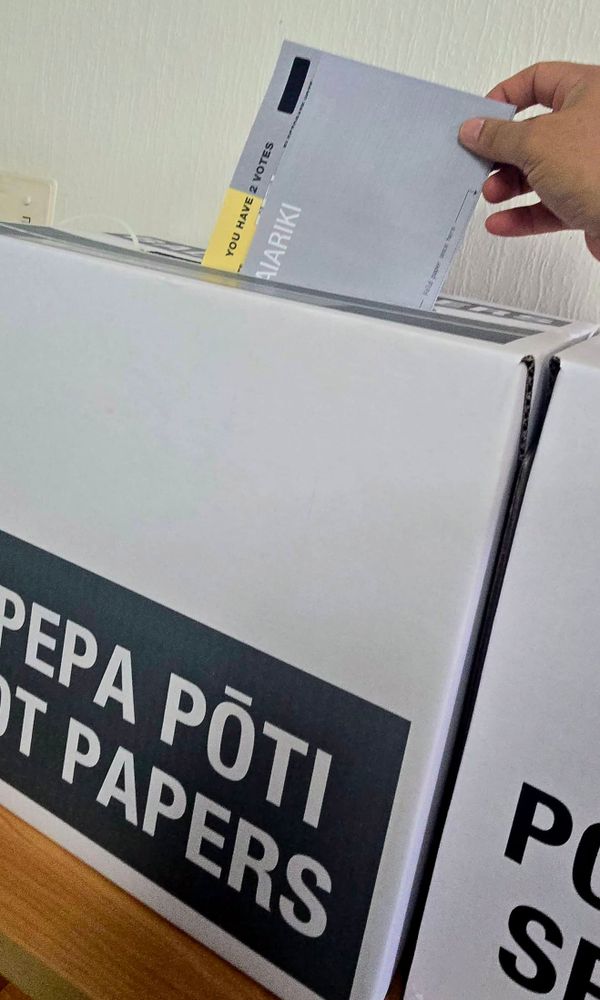
"Your Fortune Is Not A Mandate" - 1 November 2026
Democracy does not exist so wealthy men can treat the country as another business to restructure.



Mōrena ano Aotearoa,
Harry Mowbray’s vote-splitting campaign deserves scrutiny for precisely that reason. This is not simply an argument about which box voters should tick.
It is an argument about private money being used to promote an electoral strategy designed to give a preferred political bloc additional parliamentary leverage.
RNZ reports that Mowbray’s campaign encouraged vote-splitting, that National complained to the Electoral Commission, and that Christopher Luxon publicly rejected the initiative. RNZ’s account of the coalition’s vote-splitting dispute
 RNZ | Te Reo Irirangi o Aotearoa
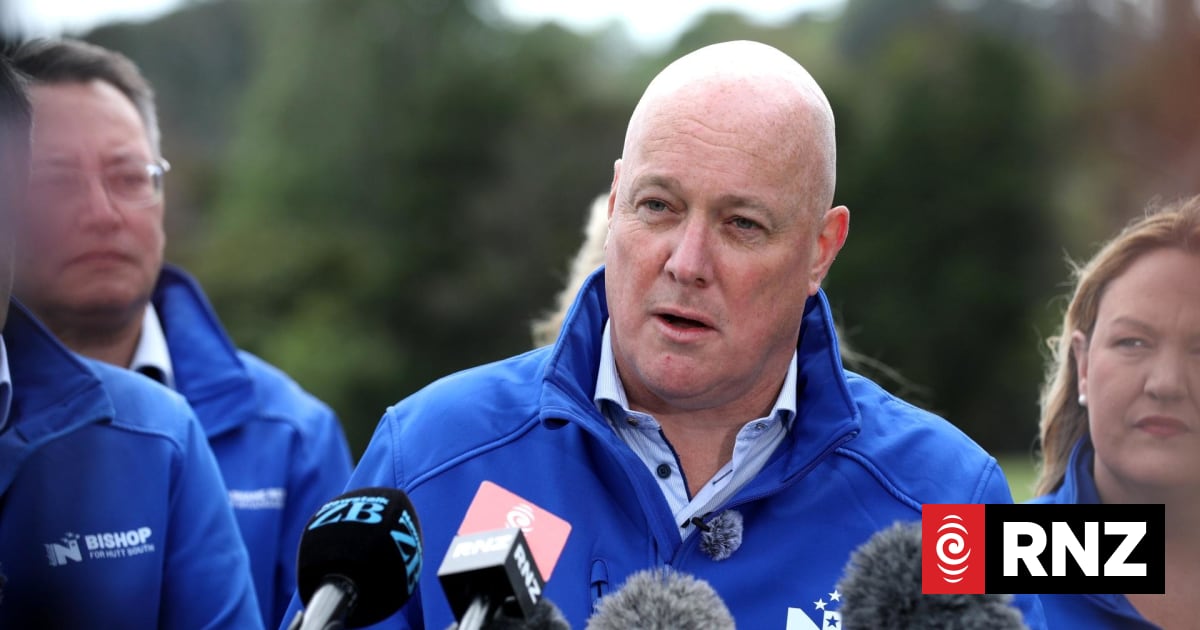
The central democratic question is not whether rich people may hold political opinions. Of course they may.
It is whether wealth should give those opinions a vastly larger advertising budget, distribution network and capacity to shape the electoral contest than the opinions of the people who must live with the result.
A fortune is not a mandate. A bank balance is not a constituency. Business success does not confer a superior right to organise the government.
What They Are Trying To Engineer
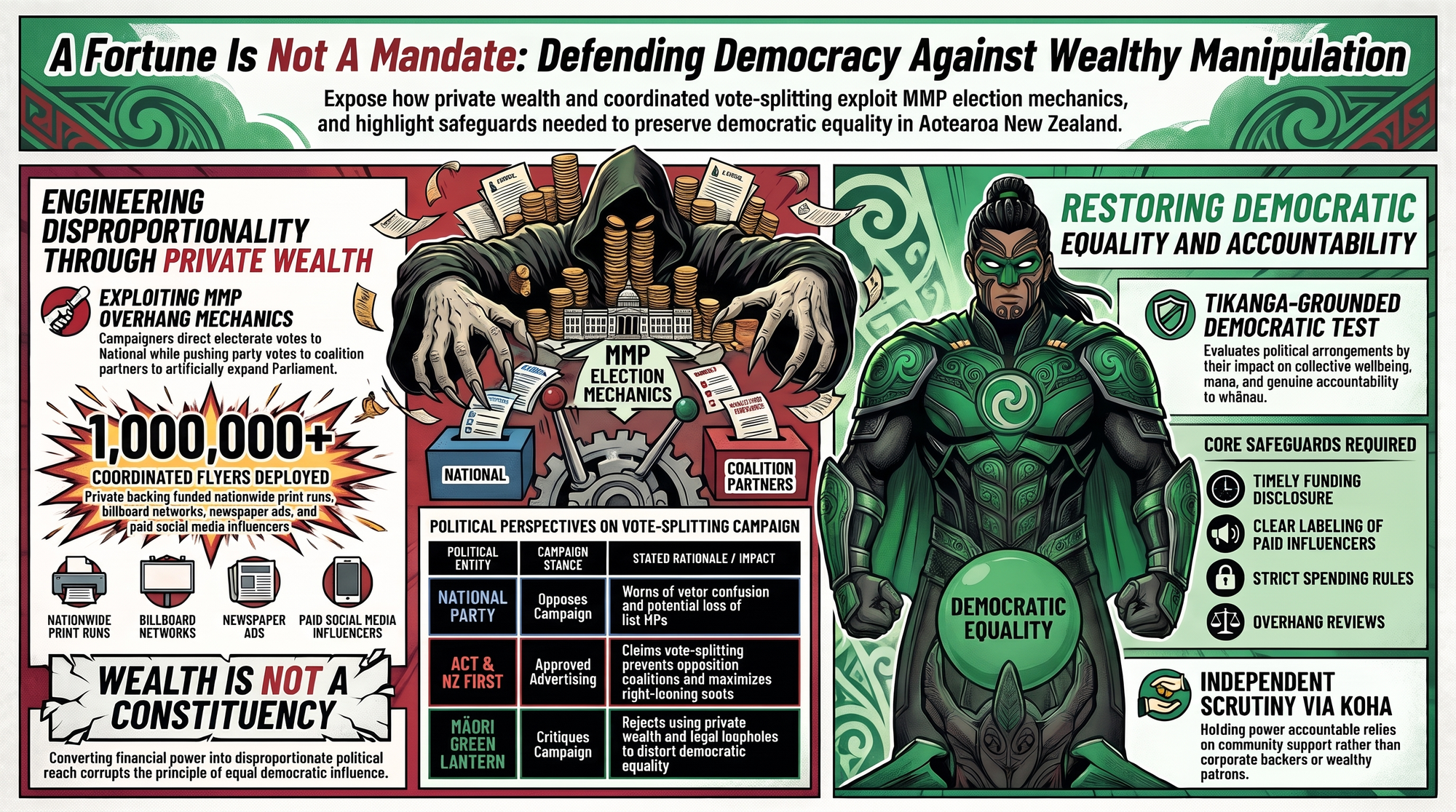
The mechanism matters. Under MMP, the party vote normally determines a party’s overall entitlement to seats. Electorate victories fill that entitlement first; list MPs fill the remainder. If a party wins more electorates than its party vote entitles it to, it keeps those additional seats and Parliament expands. Other parties do not receive extra seats to restore the original proportional balance. The Electoral Commission’s explanation of seat allocation and overhangs
The strategy being promoted on the right is to encourage electorate votes for National while directing party votes towards ACT or New Zealand First. The intended result is National retaining electorate MPs while its coalition partners increase their party-vote entitlements. RNZ identifies the creation of an overhang as the campaign’s objective. RNZ’s explanation of the proposed strategy

That does not guarantee success. It depends on actual electorate results and party votes. Nor does ordinary vote-splitting automatically produce an overhang. Voters can support a local candidate and a different party without participating in any coordinated scheme.
But the distinction between a voter exercising independent judgement and an organised campaign seeking to manufacture disproportionality is important.
The first is personal political choice. The second is an attempt to turn an electoral safeguard into a partisan advantage.
Calling it clever mathematics does not settle whether it is good democracy. Arithmetic can describe an advantage without justifying it.
Follow The Money Without Inventing The Conspiracy

There are separate campaigns here, and precision matters.
RNZ reports that Reality Check Radio placed an advertisement written by Don Brash encouraging party votes for ACT or New Zealand First, and that both parties authorised it. Mowbray’s own initiative was a separate campaign. RNZ’s reporting on the advertisements and their authorisations
RCR itself says its Vote Smart 2026 campaign was independently conceived and managed. It acknowledges a financial contribution from Mowbray but says he had no involvement in its strategy, advertising development, management or political-party authorisations. Those are RCR’s statements about its own operation, not independently audited findings. RCR’s public response distinguishing the two campaigns
Its description of the campaign’s scale is revealing. RCR says it printed more than one million flyers and deployed dozens of billboard sites, full-page newspaper advertisements and digital campaigning. It also says distribution drew on the established community infrastructure of RCR and Voices for Freedom. RCR’s account of its nationwide campaign
That is not merely a man having an opinion over the back fence. It is an organised effort to shape how people use their votes.
The Post also reports that Mowbray said he had funded social-media influencers to promote his plan and believed he was following the rules. The report does not establish the total amount spent. The Post’s reporting on Mowbray’s paid promotion
The public should not have to confuse publicity with spontaneous public sentiment. Paid political amplification should be identifiable as paid political amplification.
Nor should scrutiny be diverted into unsupported accusations. The evidence discussed here does not establish bribery, a purchased policy agreement or a criminal conviction. An Electoral Commission inquiry is not a verdict.
The argument is about the corruption of democratic equality: the conversion of private financial power into disproportionate political influence.
That problem can exist even when an activity is lawful. Indeed, the most dangerous response to it is the complacent insistence that whatever the rules permit must therefore be democratically healthy.
The Deep Dive Podcast
Listen to a lively conversation between two hosts, unpacking and connecting topics in the sources of this essay. I apologise in advance for the AI's very harsh pronounciation of reo. Please dont shoot me, :).
Youtube Video
Like video? Here is a short video suppporting the essay. Again, don't shoot the messenger please because of AI's pronounciation. :)
The Politicians Are Not Innocent Bystanders

ACT and New Zealand First cannot shelter behind the fiction that this was entirely somebody else’s business.
According to RNZ, ACT initially declined the campaign and later approved it on the condition that it supported ACT candidates in Epsom and Tāmaki. Seymour defended party votes for ACT as contributing to the coalition’s prospects. New Zealand First also approved the RCR advertisement. RNZ’s account of ACT’s conditions and both parties’ approval
That is not passive observation. It is political participation in an authorised advertising arrangement.
There are legal constraints: The Post reports that the advertisement’s cost counts against the parties’ election-advertising limits. This is not the American system of unlimited independent expenditure, and pretending otherwise would weaken the criticism. The Post’s explanation of the spending treatment
Luxon, meanwhile, has expressly opposed the campaign. That opposition must be acknowledged. But his reported warning centres on electoral confusion and the possibility of a Labour-led government. It does not answer the larger question of how much influence private money should wield over the contest itself. RNZ’s account of Luxon’s objections
A democracy deserves more than politicians discovering electoral integrity when an outside campaign threatens their own party vote.
The standard must survive changes in who benefits.
America Shows Where The Excuses Lead

The United States is not an exact legal parallel. It is a warning about the political culture that develops when enormous private expenditure is defended as nothing more than ordinary freedom.
In January 2010, the US Supreme Court’s Citizens United decision removed restrictions on independent corporate political expenditure. It did not remove the prohibition on direct corporate contributions to federal candidates. That distinction is essential. The Federal Election Commission’s account of Citizens United
Two months later, SpeechNow.org v FEC struck down contribution limits as applied to a group making only independent expenditures. Together with related legal developments, these decisions helped create the conditions for super PACs: organisations able to raise and spend vast sums outside candidates’ own campaign accounts. The FEC’s account of SpeechNowThe Brennan Center’s explanation of the resulting system
The sales pitch was freedom. The practical question became: whose freedom could afford the advertising?
The Brennan Center’s January 2025 analysis reported that Elon Musk gave at least US$277 million to two super PACs supporting Donald Trump and other Republicans in the 2024 election. One funded direct mail, canvassing and other campaign activity. This was not merely an endorsement; it helped finance the machinery used to reach voters. The Brennan Center’s analysis of Musk’s election spending
The same analysis estimated that ten individual donors supplied roughly 44 percent—US$481 million—of all money raised to support Trump. Harris’s ten largest donors accounted for approximately US$126 million, nearly eight percent of the money supporting her. The denominators include support through outside groups, not simply donations to the candidates’ official campaign accounts. The Brennan Center’s comparison of concentrated donor support
Those figures do not mean voters were puppets or that money alone determined the result. They demonstrate something different: a tiny number of people could finance an extraordinary share of the infrastructure surrounding a national election.
Democracy becomes grotesquely unequal when one person can fund a campaign apparatus while millions of others can barely afford to participate beyond casting a ballot.
Money Does Not Stop At The Ballot Box
The American warning is not just about advertisements. It is about what happens when electoral assistance becomes political proximity.
The Brennan Center’s analysis described major donors taking prominent roles in Trump’s transition, including policy discussions and meetings with world leaders. It also identified Musk’s role in helping derail a bipartisan congressional budget deal in December 2024, before Trump returned to office. The Brennan Center’s account of donor influence during the transition
A donation does not, by itself, prove that a subsequent decision was bought. But voters are entitled to examine the concentration of access and influence without waiting for an envelope of cash to appear in a courtroom.
The democratic damage is the development of a governing environment in which a handful of extraordinarily wealthy people become difficult to ignore, while ordinary citizens remain easy to disappoint.
Nor is this exclusively a Republican problem. The same Brennan Center analysis documents billionaire backing for Harris and identifies undisclosed-source funding supporting both sides. Its preliminary assessment found that anonymous sources directed at least US$1 billion to independent political committees in 2024. The Brennan Center’s findings on bipartisan megadonors and dark money
Changing the colour of the rosette does not disinfect the money.
If the principle is democratic equality, it must apply to friendly donors as firmly as hostile ones.
“But It Is Legal” Is Not A Moral Defence

The strongest counterargument deserves a straight answer.
Wealthy people retain political rights. Citizens may organise, donate, advertise and advocate within the law. Voters own both their votes. Overhangs are an established feature of MMP, not an invention by Mowbray or Brash. The Electoral Commission’s explanation confirms that parties retain electorate seats exceeding their proportional entitlement. The Electoral Commission’s explanation of overhangs
The Post also reports that Te Pāti Māori is pursuing an overhang campaign. Any criticism of deliberately engineering disproportionality must face that fact rather than pretending the tactic becomes virtuous when used by a preferred party. The Post’s reporting on overhang campaigns on both sides
But none of that ends the argument.
A person’s right to speak is not a convincing defence of a system in which some people can purchase vastly greater reach than others.
A legal electoral mechanism can still warrant reform when organised tactical use undermines the proportional principle it sits alongside.
And compliance with advertising rules answers a legal question. It does not resolve the political question of whether concentrated wealth is acquiring too much power over public life.
“Within the rules” should be the beginning of scrutiny, not the instruction to stop thinking.
Whānau Are Not An Afterthought

For Māori and whānau, the relevant question is not which wealthy campaigner has the most ingenious electoral spreadsheet.
It is whether political power remains answerable to the people affected by it.
Housing, healthcare, education, environmental protection and the Crown’s relationship with Māori should be argued openly on their merits. They should not become secondary to a contest over which well-funded network can best manipulate the relationship between votes and seats.
A tikanga-grounded test asks what an arrangement does to collective wellbeing, whose mana it recognises and who can meaningfully hold decision-makers accountable.
Private wealth carries no special mandate to answer those questions for everyone else.
Nor does Māori identity place any political organisation beyond scrutiny. Rangatiratanga is not strengthened by replacing accountability to whānau with deference to a different set of elites.
The issue is power: who exercises it, who pays to amplify it and who bears its consequences.
Make Wealth Answer To Democracy

The appropriate response is not to prohibit political disagreement. It is to prevent financial inequality from hardening into political privilege.
That means demanding:
- Timely, accessible disclosure of substantial political funding, including money supporting third-party election campaigns.
- Clear identification of paid political promotion, including influencer content.
- Effective spending and authorisation rules that cannot be evaded through fragmented arrangements.
- An adequately resourced Electoral Commission able to investigate and enforce the law.
- A serious public review of deliberate overhang engineering, applying the same standard to every party.
- Funding arrangements that strengthen broad public participation rather than dependence on a small wealthy donor class.
These are proposals for democratic protection, not claims that every safeguard is presently absent.
Mowbray is entitled to his politics. Brash is entitled to his arguments. RCR is entitled to publish. ACT and New Zealand First are entitled to campaign.
None is entitled to have the democratic consequences of their conduct waved away as cleverness.
The American example shows why the public must resist that surrender. Once immense private expenditure becomes normal, the argument shifts from whether wealth has too much influence to which wealthy patron your side can recruit.
That is a miserable horizon for a democracy.
Aotearoa must demand better than government shaped around the strategic preferences of people who can afford to saturate an election campaign.
The country is not a subsidiary. Parliament is not a boardroom. Whānau are not an audience to be managed.
And the people who possess the largest fortunes must never be permitted to mistake their capacity to fund politics for a right to command it.
Koha Consideration

A fortune is not a mandate. And holding power accountable should not depend on having a wealthy patron.
There are no corporate backers supporting the Māori Green Lantern. This mahi is supported through koha—by people who want political influence exposed, claims checked and democracy defended.
If this essay helped you see through the sales pitch around vote-splitting, overhangs and donor power, consider supporting the independent scrutiny that powerful interests would rather avoid.
Your koha does not buy a favourable conclusion. It supports the work of following the evidence, naming responsibility and refusing to confuse wealth with authority.
That is rangatiratanga too: supporting our own truth tellers.
Four Ways To Support This Mahi:
- Give a voluntary koha.
- Subscribe to the Māori Green Lantern.
- Make a direct bank transfer: Ivor Jones — 03-1395-0099387-000.
- Support through Facebook.
Unable to koha? No worries, whānau. Read and follow the Māori Green Lantern, kōrero about the issues and share this essay with whānau and friends. Helping independent scrutiny reach further is koha in itself.
Kia kaha. Stay vigilant. Democracy belongs to the people—not the deepest pockets.
Disclaimer
This essay is political commentary based on the sources linked. References to corruption describe the erosion of democratic equality through concentrated wealth and influence; they do not allege criminal conduct by any named person or organisation. Criticism of lawful conduct is not a claim that the law has been broken.