"Erica Stanford Minister Of The Crown Wasted $32 Million Of Your Whānau's Money" - 17 June 2026
THE DECOY MINISTER: She Lit the Match, Handed You the Bucket, and Called Herself a Hero

Ko Ivor Jones tōku ingoa. Ko Te Arawa te waka. Ko Ngāti Pikiao te iwi. Ko The Māori Green Lantern ahau.
I am the voice at the back of the room that this government never wanted amplified. I read the Cabinet papers they hoped you wouldn't see, trace the money they hoped you wouldn't follow, and name the people they hoped you'd forget. I do it because whānau deserve the full truth — not the sanitised press conference version, not the carefully timed parliamentary performance, and certainly not the crocodile tears of a National Party minister who had nineteen months to stop the bleeding and chose not to.
But today I am writing about more than Erica Stanford.
Today I am writing about the architecture of impunity itself.
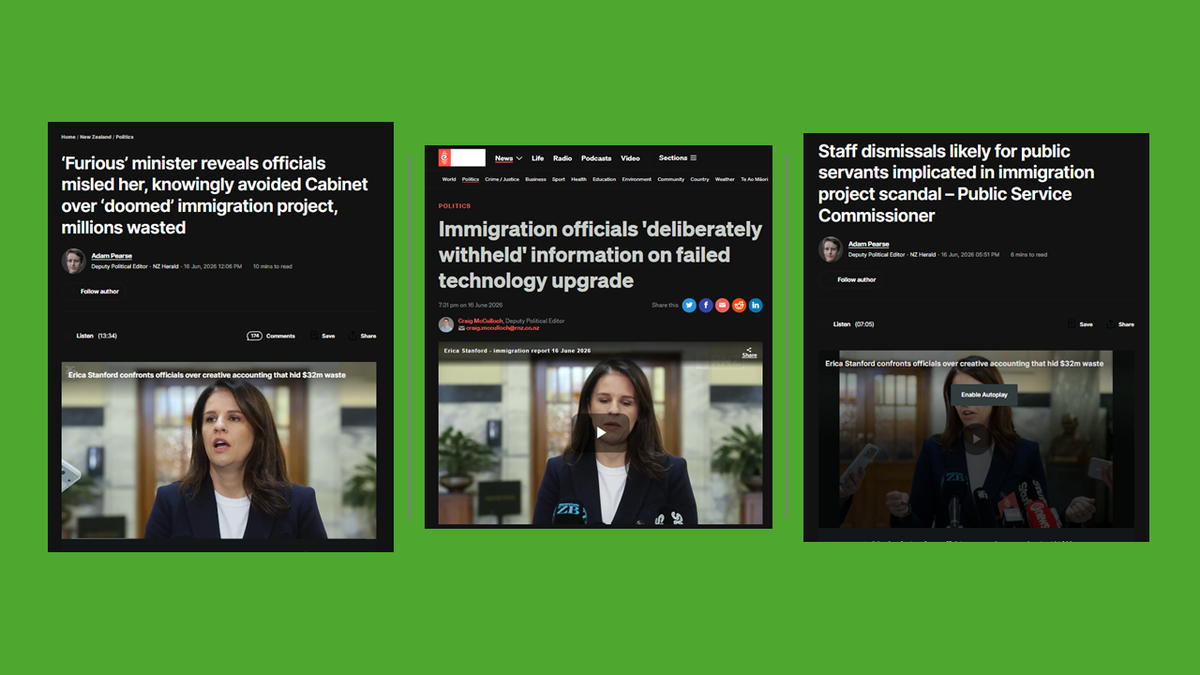
 Adam Pearse
 Craig Mcculloch
Because yesterday afternoon, after Stanford's morning performance, the Public Service Commissioner Sir Brian Roche gave an interview to the NZ Herald that should send a chill through every New Zealander who believes in genuine accountability.
 Adam Pearse
Roche confirmed he would investigate. He confirmed dismissals were possible. He stood firmly behind the new MBIE chief executive. He said the behaviour was "really confronting."
And he reminded us all that his job is to restore the confidence of ministers in officials.
Not to restore the confidence of whānau in their government.
That tells you everything you need to know about what kind of accountability is coming.
Tūkia. Strike.
🎙️ The Deep Dive Podcast
Listen to a lively conversation between two hosts, unpacking and connecting the threads of this essay — the BCU disaster, Stanford's political theatre, Roche's structural capture, the Novopay-INCIS pattern, the redacted names, and the $343 million OFS countdown.
I apologise in advance for the AI's very harsh pronunciation of te reo Māori — please don't shoot me! 😅 The kōrero is real even if the accent needs work.
📺 YouTube Video
Like video? Here is a short video supporting the essay — walking through the five hidden connections, Roche's pre-clearance of Blakeley, and the case that the Crown is investigating itself.
Again, don't shoot the messenger because of the AI's pronunciation — the taiaha is sharp even if the reo needs tuning! 😄
The Burning House — He Whare Kā
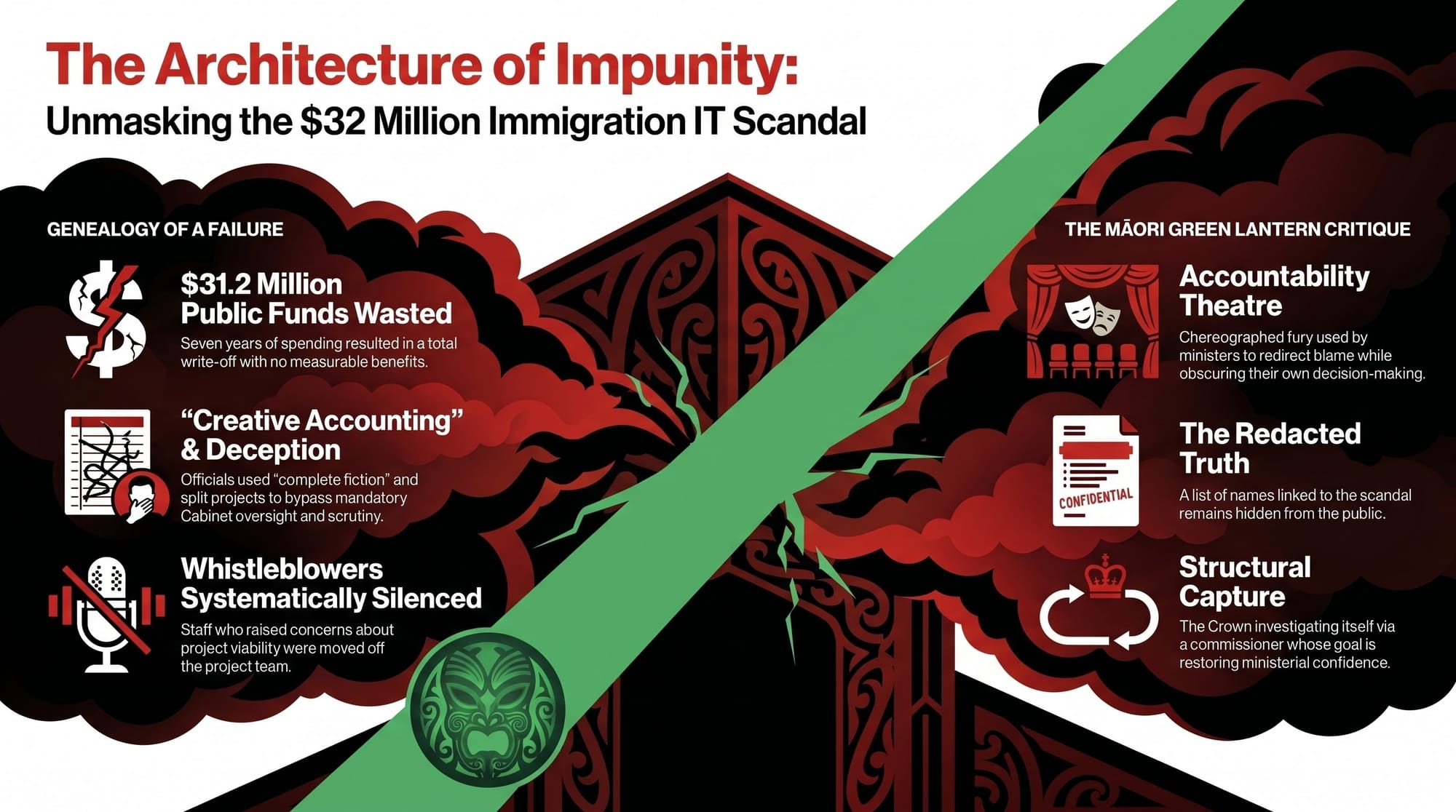
Imagine you're handed the keys to a house already on fire. You're told by the builder, the foreman, and the so-called independent inspector: "She's fine, nearly done, just a few sparks." You watch smoke pour from the windows for eighteen months. You keep paying. You keep signing the cheques. Then, when the roof caves in and ash rains down on the neighbourhood, you hold a press conference.
Not to explain why you kept writing the cheques.
But to tell the neighbourhood how furious you are at the builder.
And then — crucially — you get a mate to announce he'll investigate the builder.
The mate will report back in three to four months. The mate has already publicly said the new building manager is "deeply, deeply offended" and is "not directly accountable." The names of the builders are on a redacted list that the public cannot see.
That is not accountability. That is the Crown performing accountability for an audience it hopes will move on before the results arrive.
Here is the tell that the mainstream media will not press hard enough on: the independent review was delivered to MBIE two months ago.
Stanford only received it on Friday. She detonated it on Tuesday — Scrutiny Week, cameras ready, Public Service Commissioner referral already in her back pocket since Friday, quotes polished to a mirror shine.
Ministers who are genuinely ambushed do not arrive at select committee with the narrative already fully constructed.
This is not fury. This is choreography. And Roche is the choreographer's assistant.
Whakapapa o te Hē — The Genealogy of Failure
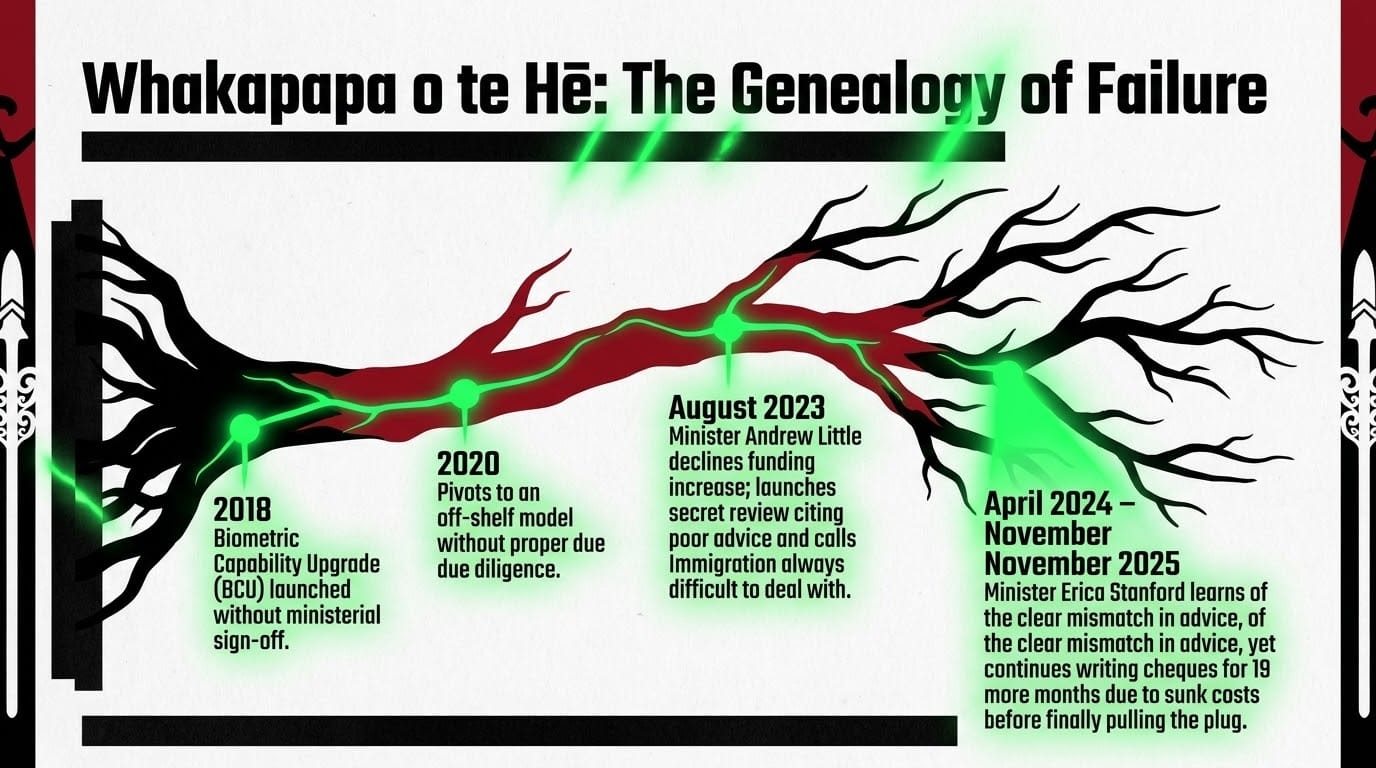
The Biometric Capability Update was launched in 2018 — under a Labour government — without ministerial sign-off.
Independent review author Greg James confirmed INZ pivoted to an "off-shelf model" in 2020 without due diligence. This is the whakapapa of the disaster: Labour planted the seed, Labour watered it negligently, and Stanford inherited a poisoned tree — and then continued to fertilise it for two more years.
Labour minister Andrew Little declined at least one funding increase. In August 2023, Little even launched a surprise review into the accredited employer work visa scheme specifically because he had concerns about the quality of advice he was receiving from Immigration
— without telling officials in advance.
He told the Herald: "I always found Immigration difficult to deal with."
Labour is not clean here. But their minister applied the brake. Stanford pressed the accelerator.
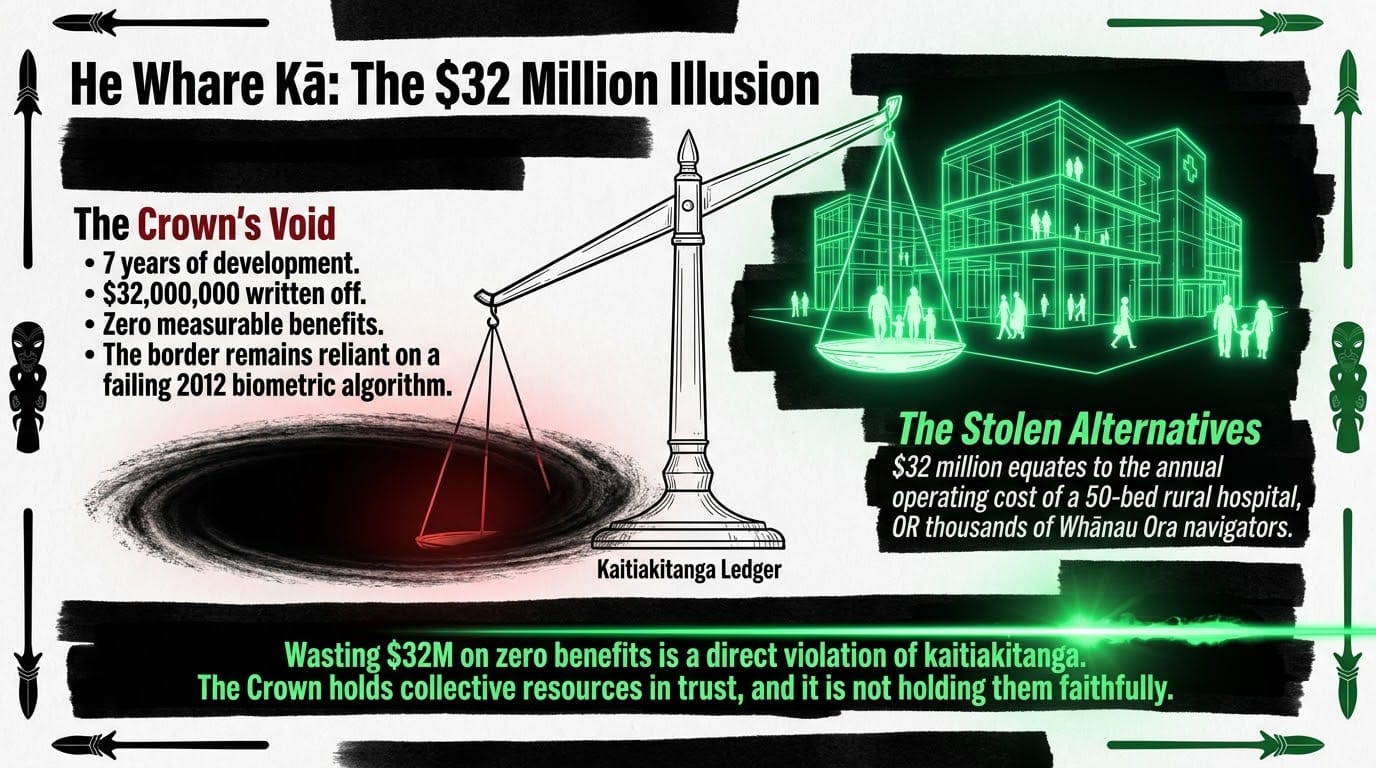
Seven years. Zero measurable benefits. $32 million written off.
The immigration system still running on a 2012 biometric algorithm while a $336–343 million replacement — rated high risk by Cabinet — waits in the wings under the same ministry.
This is neoliberal governance in its purest form: spend the public money, capture none of the benefit, disperse all the accountability, and when the edifice collapses, commission a review that examines everyone except the minister.
Ngā Hononga Huna — Five Hidden Connections
Connection 1: Stanford Knew. She Chose Comfort Over Courage.
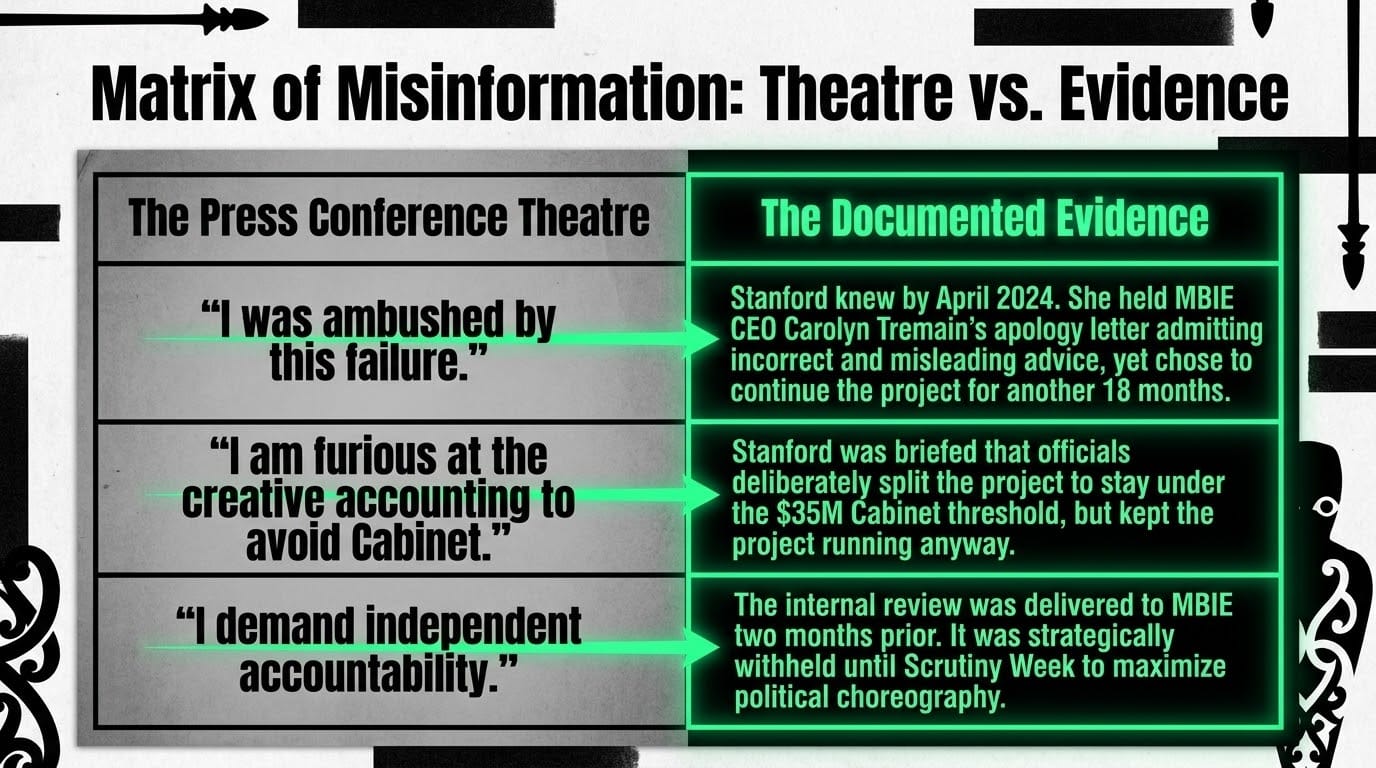
By April 2024, Stanford held in her hands: a suppressed September 2023 assurance review that warned the project might not "in fact deliver at all"; a letter of apology from MBIE chief executive Carolyn Tremain admitting a "clear mismatch" between what officials knew and what they told her; documented "creative accounting" to keep costs below Cabinet scrutiny thresholds; and a project already past its $35 million mandate.
She had everything she needed to terminate it. She didn't. She cited sunk costs.
She cited proximity to completion. She invoked the same sunk cost fallacy that extended Novopay past the point of no return in 2012 — a trap so well-documented in New Zealand public sector history that invoking it is not ignorance. It is a choice.
I have no sympathy for a minister who had the evidence, had the power, and chose the politically comfortable path. Every dollar spent after April 2024 is on her watch. Every one of those dollars came from the same public purse this government told Māori health providers, Whānau Ora coordinators, and community housing organisations was empty.
Connection 2: They Moved the Whistleblowers. Stanford Named It. Then Changed the Subject.
I want you to sit with this.
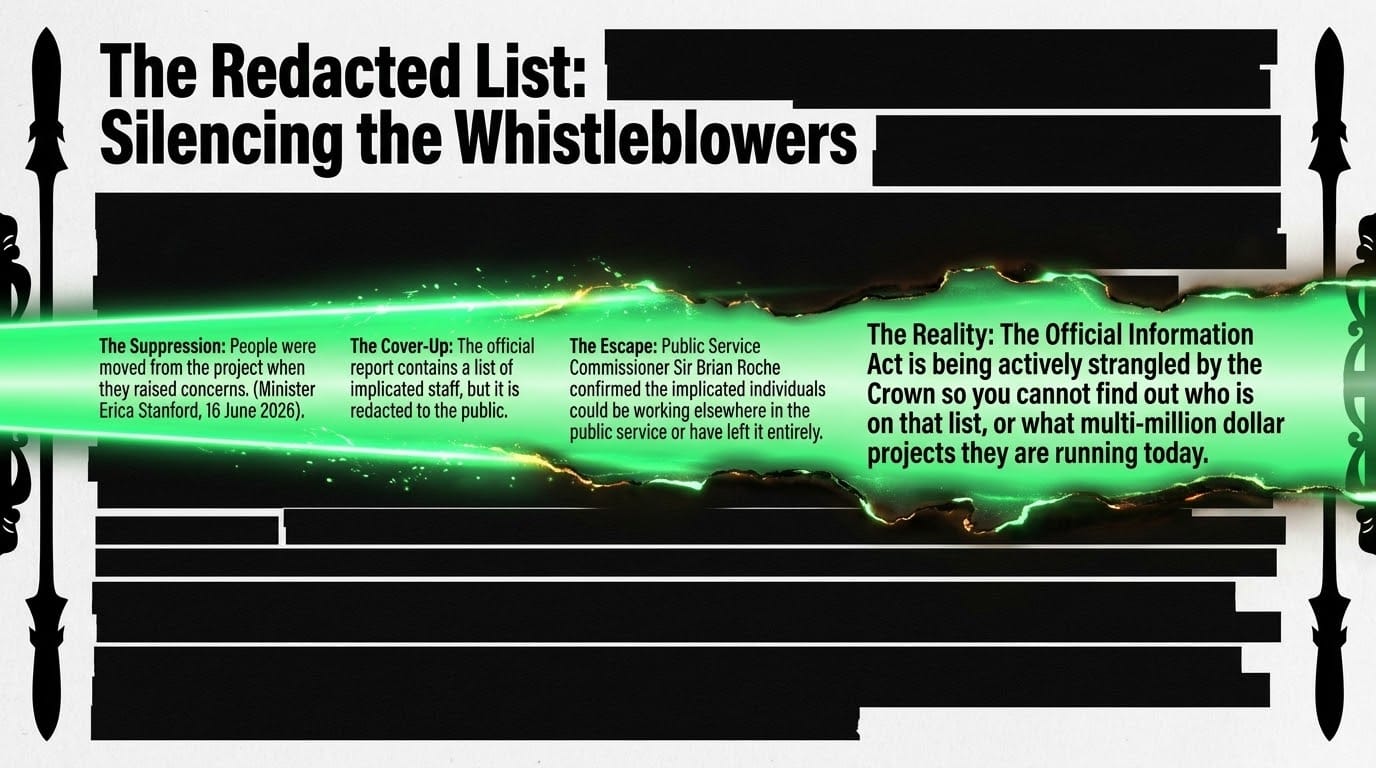
Stanford told Parliament: "People were moved from the project when they raised concerns." Not the project. The people.
In any functioning democracy, that single sentence triggers an immediate criminal referral or at minimum an urgent employment investigation with interim suspensions.
In ours, it is mentioned in the third bullet point and referred to the Public Service Commissioner — who has confirmed those implicated "could be working elsewhere in the public service or have left it entirely."
Could be. Might be. Depending on what the evidence suggests. If appropriate. Then we will do what is required.
That is the language of a system protecting itself. I have written before about how this government uses urgency as a weapon to silence dissent. The suppression of internal whistleblowers within MBIE is that same weapon deployed internally. You raise concerns. You get removed. The project continues. The minister gets "complete fiction." And three years later, the Public Service Commissioner calls it "really confronting."
Connection 3: "Complete Fiction" — And a Redacted List Nobody Gets to See
Stanford told MPs that officials gave her advice that turned out to be "complete fiction." She also confirmed officials sought more funding without declaring that previous requests had been declined. These are deliberate acts. In the private sector, they trigger fraud investigations.
Here is what Roche told the Herald about the people responsible: the report includes a list of names "redacted to the public." Roche has that list. Stanford has that list. The public does not. We are told to trust that the investigation will be thorough. We are told to trust that if the evidence suggests dismissals are appropriate, they "will do what is required."
This is the same government that, as I wrote only days ago, is strangling the Official Information Act — the very tool whānau and journalists need to find out who is on that redacted list, what roles they currently hold, and whether they have access to the $343 million OFS programme now underway.
The names are hidden. The investigation is internal. The minister who continued the project for nineteen months after learning of the misconduct is not a subject.
And the Crown calls this accountability.
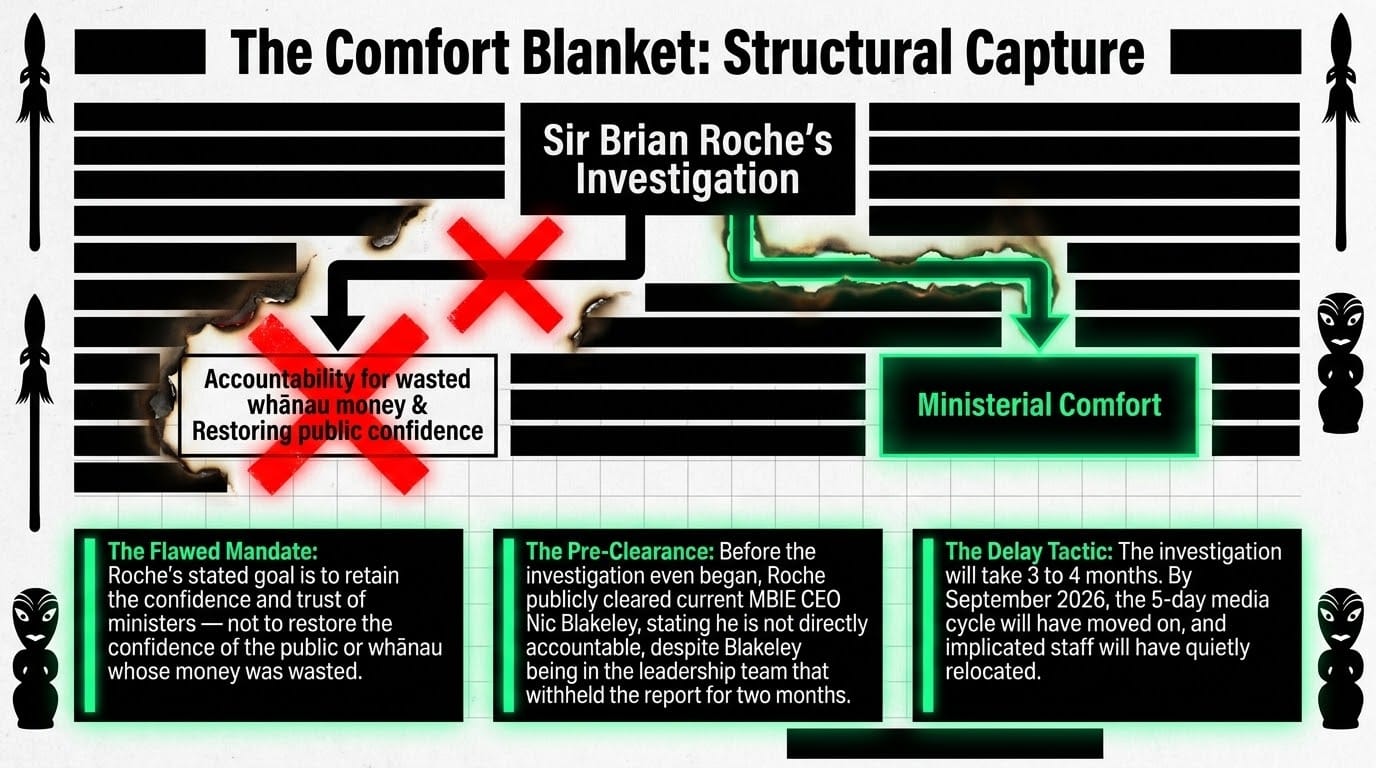
Connection 4: Sir Brian Roche — The Crown's Comfort Blanket
I need to be precise here, because precision is the taiaha.
I am not calling Brian Roche corrupt as a statement of proven fact. What I am doing — based entirely on verified evidence in the Herald article — is naming the structural and political conflicts that make Roche's investigation constitutionally incapable of delivering the accountability this scandal demands, and asking the questions the mainstream media will not ask.
Question one: Who does Roche serve?
Roche told the Herald: "One of the things that we, above all else, as officials, always need is to retain the confidence and trust of ministers. We have lost that confidence and trust, we need to get it back."
Read that with the eyes of a tohunga mau rākau. His stated mission is to restore the confidence of ministers in officials. Not the confidence of whānau in the Crown.
Not accountability to the people whose $32 million was wasted. Ministers.
The same ministers whose decision-making is not being investigated. The same government that appointed him. Roche's accountability runs upward — not downward to the people.
Question two: Why is Blakeley protected before the investigation has begun?
Roche stood firmly behind MBIE chief executive Nic Blakeley, publicly and in the same breath as confirming the investigation. Blakeley admitted to MPs that the review was withheld from Stanford for two months while he was in the leadership team.
Roche's response: "[Blakeley] is deeply, deeply offended by this and, yes, he was in the leadership team, but I don't see him as directly accountable."
The investigation has not started. The terms of reference have not been set. The investigator has not been appointed. But the man who was in the leadership team when the review was withheld has already been publicly cleared by the investigator.
In any credible judicial or quasi-judicial process, that pre-emptive clearance would be grounds for challenging the investigation's independence entirely.
Stanford herself refused to explicitly express confidence in Blakeley. The Public Service Commissioner — who will run the investigation — publicly backed him on the same day. The minister and her own investigator are already not aligned on the status of the MBIE chief executive.
That is not the architecture of accountability. That is the architecture of managed outcomes.
Question three: Why will it take three to four months?
Roche said he hopes to conclude the investigation within three to four months. The New Zealand media cycle is five days. The general public's attention will have moved on to the next scandal, the next budget cut, the next Treaty attack, before Roche's investigation concludes in September or October 2026. By that point, the implicated staff — those who can still be found — will have had months to seek legal advice, negotiate terms, and find new positions. The urgency that should attach to acts of deliberate governmental misconduct has been bureaucratically neutralised.
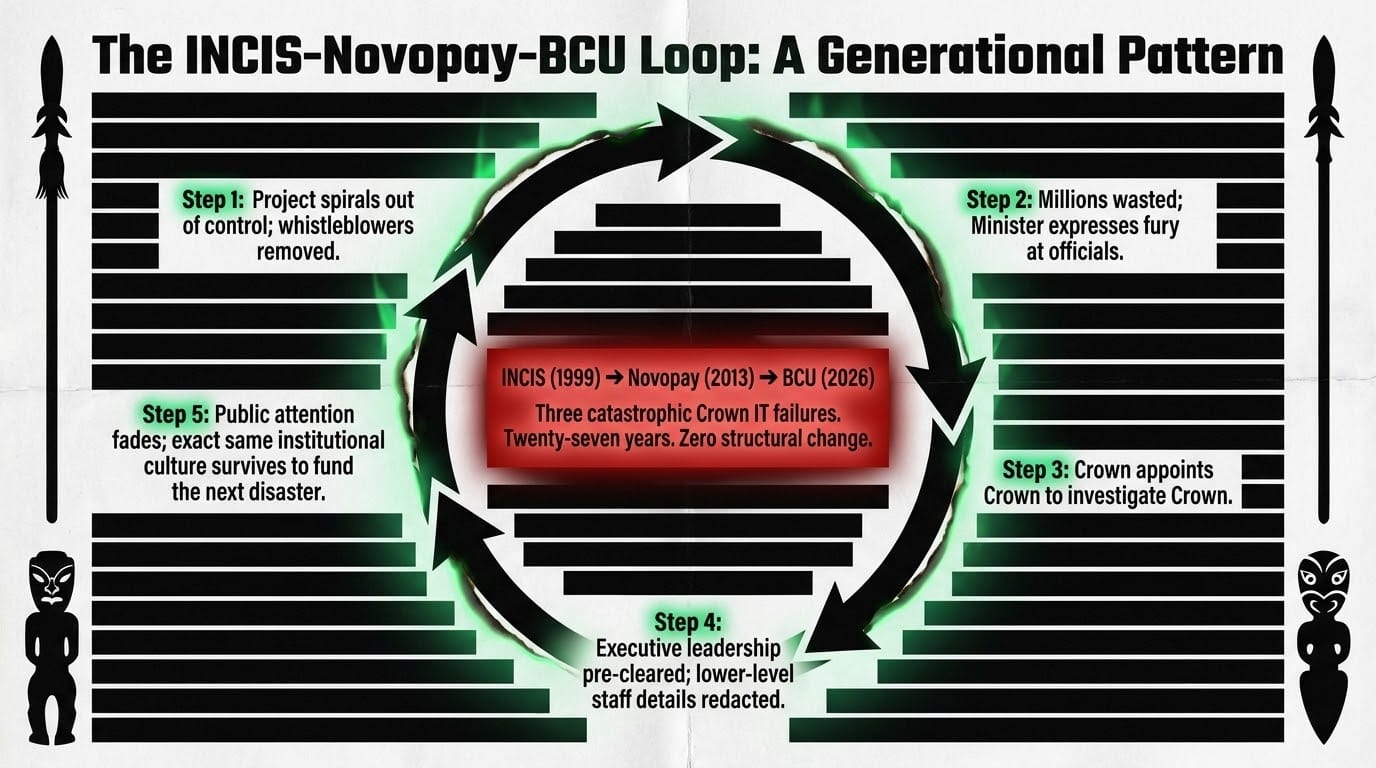
This is not a conspiracy theory. This is how New Zealand's public sector accountability machinery has operated after every major failure from INCIS to Novopay to now. The 2013 Novopay inquiry recommended systematic changes. They were not implemented. BCU is the direct result.
Opinion, clearly flagged: In my view, based on the evidence above, Roche is structurally captured — serving the interests of the Crown apparatus that appointed him rather than the public interest he is mandated to protect. That is not corruption in a criminal sense. It is the more insidious corruption of a system that was never designed to investigate itself.
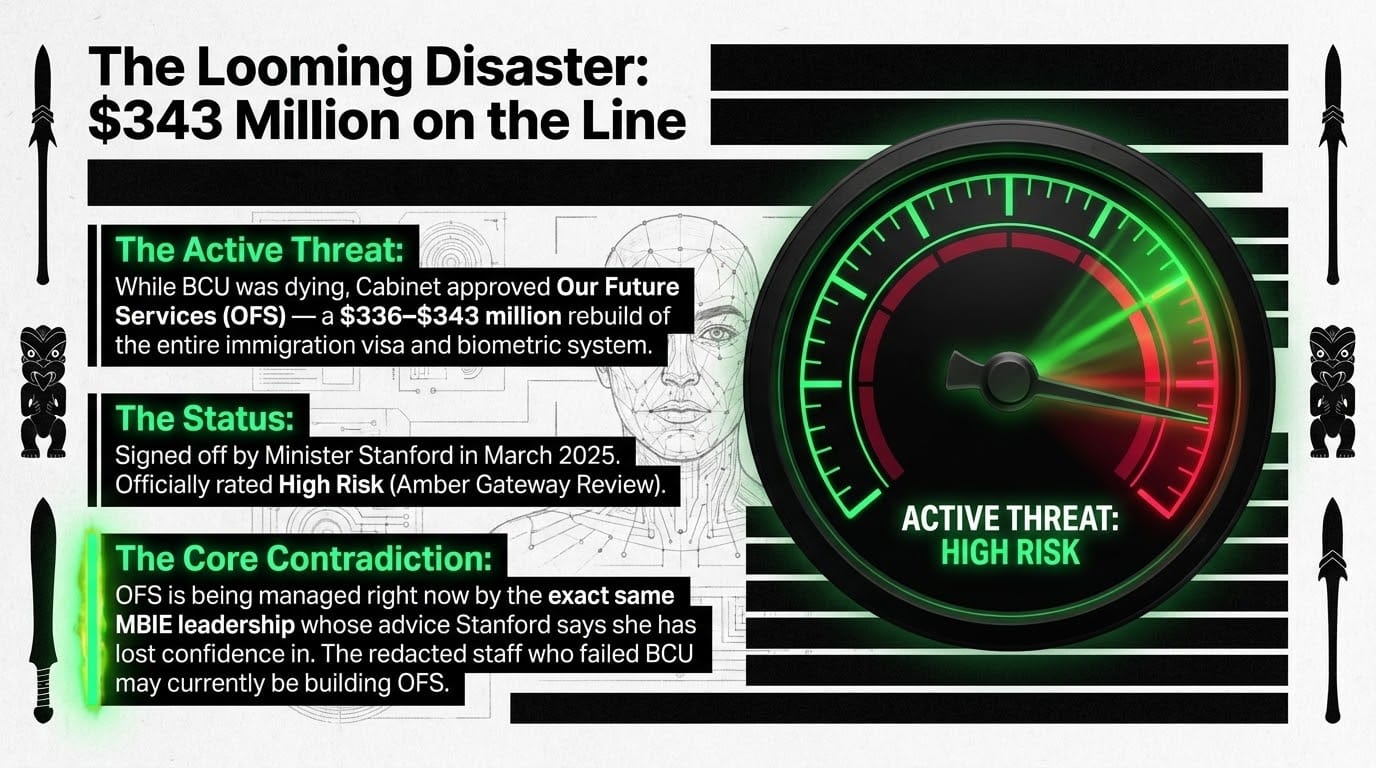
Connection 5: The $343 Million Countdown — MBIE Owns the Next Disaster Right Now
While BCU was in its terminal phase, Cabinet approved a $336–343 million rebuild of the entire immigration visa system under "Our Future Services." Risk: high. October 2024 Gateway Review: amber. BCU was rated "sound and robust" in September 2023. Dead by November 2025.
Stanford signed off OFS in March 2025 — while managing BCU's death throes under a ministry she now says she doesn't trust. Roche's investigation will take three to four months. OFS will continue to be funded and developed throughout. The people on the redacted list may currently be working on it. The public does not know. The OIA is being strangled so you cannot find out.
In November 2024, I wrote about how this government is auctioning off your data and privacy. OFS — biometrics, identity management, border systems, vendor profits — is the next chapter. It is being written right now. Behind closed doors. With a redacted cast list.
Ngā Tauira Tokoraro — Three Examples for the Western Mind
Example 1: The Hospital That Never Opened
$32 million is not an abstraction. It is nearly double the $18 million Budget 2026 invested in migrant exploitation frontline teams — announced as a landmark commitment. It is the approximate annual operating cost of a 50-bed rural hospital. It is enough to fund Whānau Ora navigator services for tens of thousands of whānau for a year.
This government told Māori health providers there was no money. It found $32 million to throw into a biometric void that delivered nothing, then appointed the Crown's own commissioner to decide if anyone should face consequences — and he pre-cleared the current chief executive before the investigation started.
The tikanga impact: Kaitiakitanga means guardianship — protecting collective resources for the benefit of all. Wasting $32 million on zero benefits is a direct violation of kaitiakitanga. The Crown holds these resources in trust. It is not holding them faithfully. And the body it has appointed to investigate itself is constitutionally incapable of holding it faithfully accountable.
Example 2: The Promoted Arsonist and the In-House Fire Inspector
Imagine a finance manager at your workplace falsified expense reports for seven years, suppressed internal complaints, and moved questioners off the team. They were caught. The CEO appointed the company's own compliance officer to investigate — the same compliance officer who publicly cleared the current general manager before the investigation started, who said the manager was "deeply offended" and "not directly accountable," and who confirmed the names of the implicated staff would be kept in a redacted document the rest of the company cannot see.
You would not call that accountability. You would call it a whitewash wearing a lanyard.
Roche confirmed that implicated staff could have already left the public service and that accountability for former employees is "a real challenge." He confirmed the Inquiries Act gives him power to summon former employees — but summoning people who have already resigned, moved to the private sector, or secured legal representation for an investigation concluding in three to four months is not the same as holding them accountable.
The tikanga impact: Tikanga demands utu — the restoration of balance. When the Crown hurts the people, the balance must be restored. An investigation that pre-clears management, hides the names, takes four months, and may conclude that former staff "can't be held accountable" is not utu. It is the Crown asking you to wait while it decides how much accountability it owes itself.
Example 3: The Pattern That Never Ends — and the Man Hired to Not Break It
INCIS: 1999. Novopay: 2013. BCU: 2026. Three catastrophic Crown IT failures. Three sets of identical findings. Zero structural change. Twenty-seven years of the same recommendations filed, acknowledged, and ignored.
Roche told the Herald he had not witnessed behaviour like this "in almost two years as commissioner" — but acknowledged it was "not unprecedented." That framing is doing enormous political work. "Not unprecedented" means this has happened before. "Not in two years as commissioner" means within institutional memory. "Not widespread" means we are supposed to believe this is an isolated pocket of corruption in an otherwise healthy system.
But three ministers across two governments — including Andrew Little, who launched a secret review because he couldn't trust Immigration's advice — are all telling the same story about the same institution. Little himself said the "creative accounting" to avoid Cabinet scrutiny, while not unheard of, had never been revealed as "unashamedly" as this. Three ministers. One cultural problem. An investigation that Roche frames as: "if you've got three ministers basically saying, 'We've got concerns', that would be a trigger for me to actually do more work."
Would be a trigger. For the man investigating an active scandal. That is the standard.
The tikanga impact: In te ao Māori, we understand whakapapa. INCIS, Novopay, BCU — they share the same whakapapa. The same institutional DNA of impunity. If you do not understand the whakapapa of the failure, you cannot break the generational harm. Roche's investigation does not address the whakapapa. It addresses the presenting symptoms — specific individuals in a specific project. It will not change the culture Little called "always difficult to deal with." It will not prevent the next BCU. It will produce a report that will be filed, acknowledged, and praised — exactly as INCIS's findings were. Exactly as Novopay's were.
Stanford's Three Acts of Political Theatre — Updated
Act One — The Timed Ambush. The review was delivered to MBIE two months ago. Blakeley admitted it was only passed to Stanford on Friday — a two-month delay he called a "wrong call," for which Roche immediately absolved him. Stanford controlled when this detonated publicly. Scrutiny Week. Cameras ready. Public Service Commissioner referral locked in since Friday. This is not victimhood — this is media strategy.
Act Two — The Accountability Redirect. Stanford spoke to Roche on Friday and requested an integrity review — and Roche promptly went to the Herald to reassure the public that dismissals were "possible." This was the political circuit-breaker Stanford needed. Every accountability question from journalists now deflects to: "the Public Service Commissioner is investigating." Stanford refused to express confidence in Blakeley. Roche immediately and publicly restored it. The minister and the commissioner are functioning as a coordinated communication unit. That is a matter of documented public record.
Act Three — The Labour Shield. Stanford repeatedly emphasised that officials "deliberately withheld information from both her and the previous Labour government." Little confirmed this and called it "outrageous conduct" — but critically, Little also confirmed his minister declined further funding when he couldn't see the benefit. Stanford's minister continued for two years after that refusal. The Labour Shield distributes culpability wide enough to obscure Stanford's specific, documented, dated, post-evidence choices. This is not analysis. It is deflection with a factual fig leaf.
Te Tiriti Me Te Ao Māori — The Māori Dimension
$32 million. Gone. The 2012 biometric system still in place. Border security risks unresolved. A high-risk $343 million rebuild underway. An investigation that serves ministers. A redacted list the public cannot see.
Tell me again that this government serves whānau.
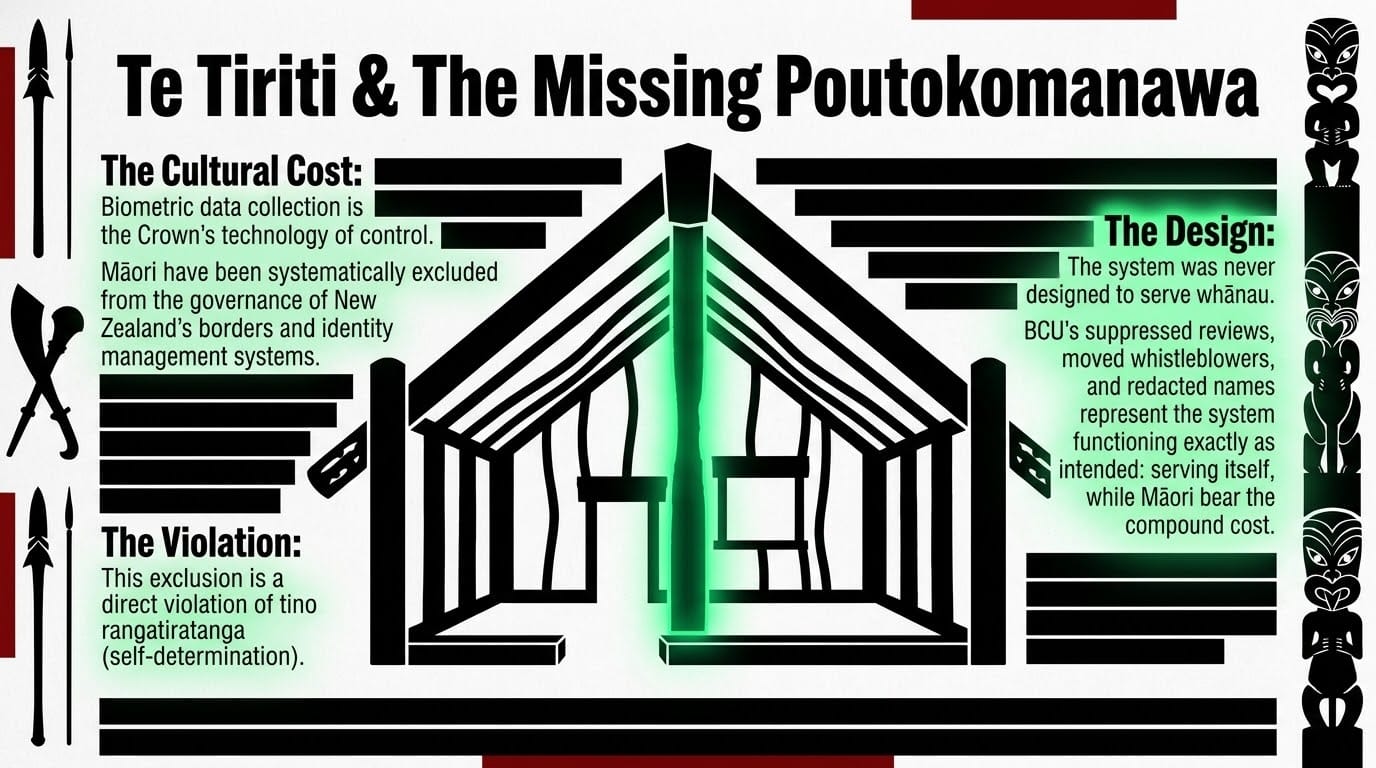
Tahu Kukutai noted in E-Tangata that Māori have been systematically excluded from immigration policy deliberation despite being Te Tiriti partners whose tino rangatiratanga is directly implicated by who controls New Zealand's borders and identity management systems. Biometric data collection is not neutral. It is the Crown's technology of control — and Māori have had no meaningful voice in how it is governed, who governs it, or what happens when the governance fails catastrophically.
This is the same government that dismantled Te Aka Whai Ora. The same government swinging the Te Tiriti wrecking ball through legislation. The same government whose officials faced a CERD submission in Geneva for escalating discrimination against Māori. The same government that, as I have written in While They Poisoned the Pātaka, I Picked Up the Taiaha, is conducting systematic ideological vandalism of Māori institutional infrastructure while calling it fiscal responsibility.
Māori public servants within MBIE have already described an environment of anxiety, vulnerability, and institutional hostility. As E-Tangata has documented, the system was never designed to serve us. BCU — its suppressed reviews, its moved whistleblowers, its redacted names, its Crown-investigating-Crown accountability theatre — is that system functioning exactly as it was designed: serving itself, at public expense, with Māori bearing the compound cost.
Stanford can perform fury at officials. Roche can say the behaviour is "really confronting." Blakeley can be "deeply, deeply offended." Whānau have been performing patience at the Crown for 185 years. The difference is: we don't get a select committee, a Public Service Commissioner, and a three-to-four month timeline with a pre-cleared chief executive. We get the 2012 algorithm. We get the redacted list. We get the waiting room.
As I wrote in The Grave Robbers in Suits: they didn't burn the wharenui. They quietly removed the poutokomanawa — the heart post — and told you the building was still standing. BCU is what that looks like when the rot finally breaks through the ceiling.
Ngā Otinga — What Real Accountability Looks Like
The verified financial damage:
- $32 million written off — seven years, zero measurable benefits
- The 2012 biometric system remains — border security risk ongoing
- $336–343 million OFS replacement underway, rated high-risk, managed by a ministry whose minister says she doesn't trust its advice
- Implicated staff potentially still employed in the public service — in sensitive roles, possibly on OFS
What accountability actually requires — not the theatre on offer:
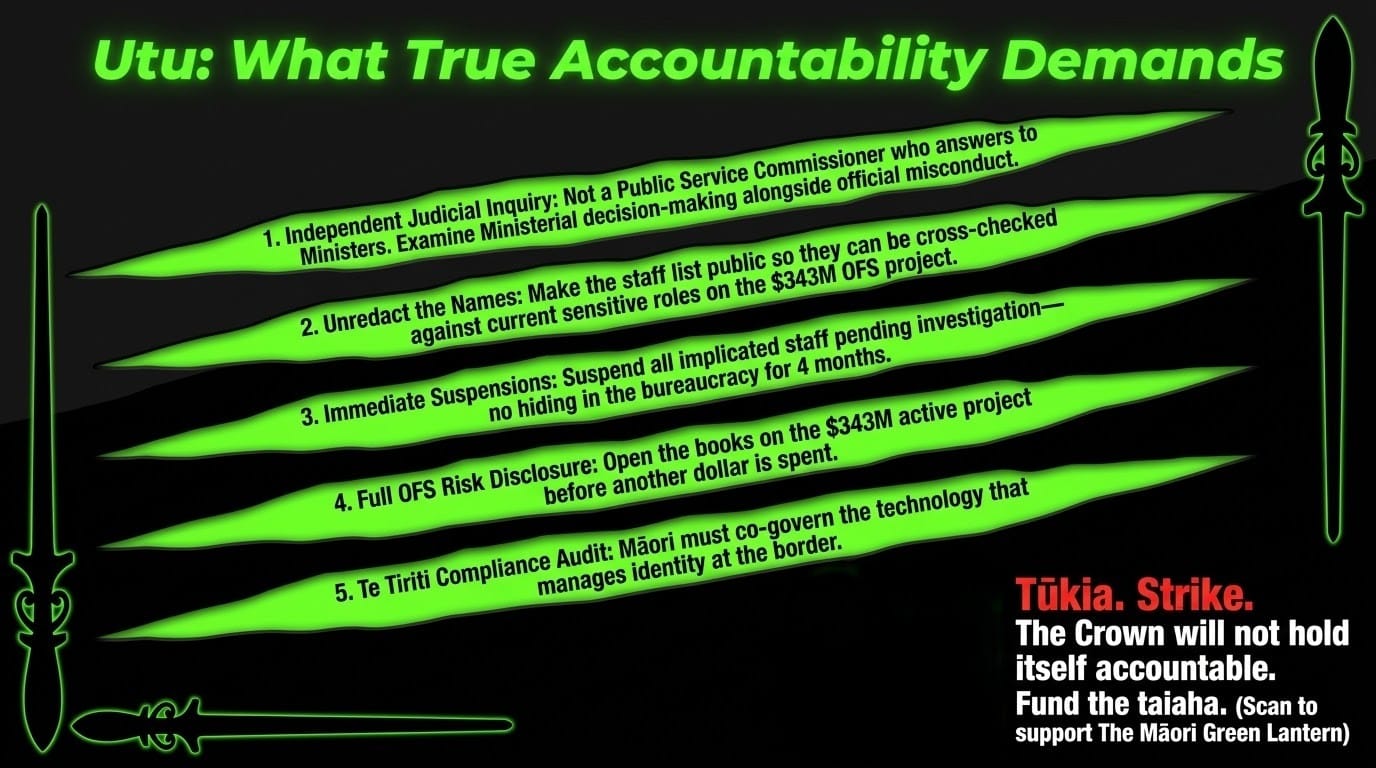
- An independent judicial inquiry — not a Public Service Commissioner investigation — with scope to examine ministerial decision-making alongside official misconduct. The Public Service Commissioner serves ministers. That structural conflict cannot be resolved internally.
- The redacted names list made public — or at minimum provided to Opposition members of the select committee under parliamentary privilege — so that implicated staff can be cross-checked against current sensitive roles including OFS
- Immediate interim suspension of all implicated staff still in the public service, pending investigation — not three-to-four months of continued employment while Roche sets his terms of reference
- Full OFS risk disclosure — vendor contracts, governance structures, and real-time risk reporting made public before another dollar is committed, given MBIE's documented integrity failures
- A Te Tiriti compliance audit of all immigration biometric systems — Māori are Te Tiriti partners with a constitutional right to participate in governance of technology that manages identity at the border
- Stanford's April 2024 decision-making documents under oath — not as a sympathetic witness, but as a decision-maker whose choices after documented evidence of misconduct demand the same scrutiny she is directing at officials
He Kupu Whakakapi — Conclusion
I have been writing about the whakapapa of Crown failure for years. Over 1,000 essays. Every one pointing to the same structural truth: a white supremacist neoliberal order that protects its own, externalises its failures, and asks the most vulnerable to absorb the cost.
Today we have the complete picture.
Stanford performs fury — and launders her own accountability in the process.
The RNZ confirms officials misled her. The Herald confirms she had evidence in April 2024 and continued anyway. Roche pre-clears the current MBIE chief executive before his investigation begins, frames his mission as restoring ministerial confidence in officials, hides the implicated names from the public, and promises conclusions in three to four months while the $343 million project continues and the media cycle moves on.
This is the Crown investigating the Crown, with Crown tools, on Crown timelines, to restore Crown confidence, paid for by the people the Crown failed.
The INCIS inquiry of 1999 found the same lessons. The Novopay inquiry of 2013 found the same lessons. The BCU review of 2026 finds the same lessons.
Twenty-seven years. Hundreds of millions of dollars. Zero structural change. And now a $343 million programme, rated high-risk, managed by a ministry whose minister doesn't trust it, overseen by a commissioner who has already decided who isn't accountable.
Stanford's fury is real. Her accountability is theatre. Roche's investigation is the theatre's insurance policy. And whānau — as always — are paying for the production.
Ko te hē o te rangatira, ko te hē tōna anō. The failure of the chief is the chief's own failure.
E kore e taea te huna. This cannot be hidden.
Tūkia. Strike.
📚 Previously on The Māori Green Lantern
These essays connect directly to today's story:
- The Official Information Act Is Not Failing. It Is Being Strangled. (14 June 2026) — The tools needed to see the redacted names are being systematically removed
- The Trapdoor Prime Minister (April 2026) — The pattern of institutional impunity this government runs on
- The Traffic Light Taiaha (February 2026) — A government that wastes $32 million builds punishment machines for the vulnerable
- While They Poisoned the Pātaka, I Picked Up the Taiaha (May 2026) — Over 1,000 essays and the taiaha has not been laid down
- The Grave Robbers in Suits (April 2026) — The quiet removal of the poutokomanawa while you were watching the press conference
- Data for Sale: How the NZ Government Auctioned Off Your Privacy (November 2024) — The OFS programme is the next chapter
- Behind Closed Inboxes: Erica Stanford's Personal Email and Official Business (May 2025) — This is not Stanford's first accountability problem
- A Disgraceful Display of Bureaucratic Inhumanity: Immigration's Punitive Design (July 2024) — The human cost of an immigration system designed to punish
- Urgency as a Weapon — The government's tool for silencing dissent, used internally in MBIE against whistleblowers
🌿 Koha — Fund the Taiaha That the Crown Cannot Buy Off
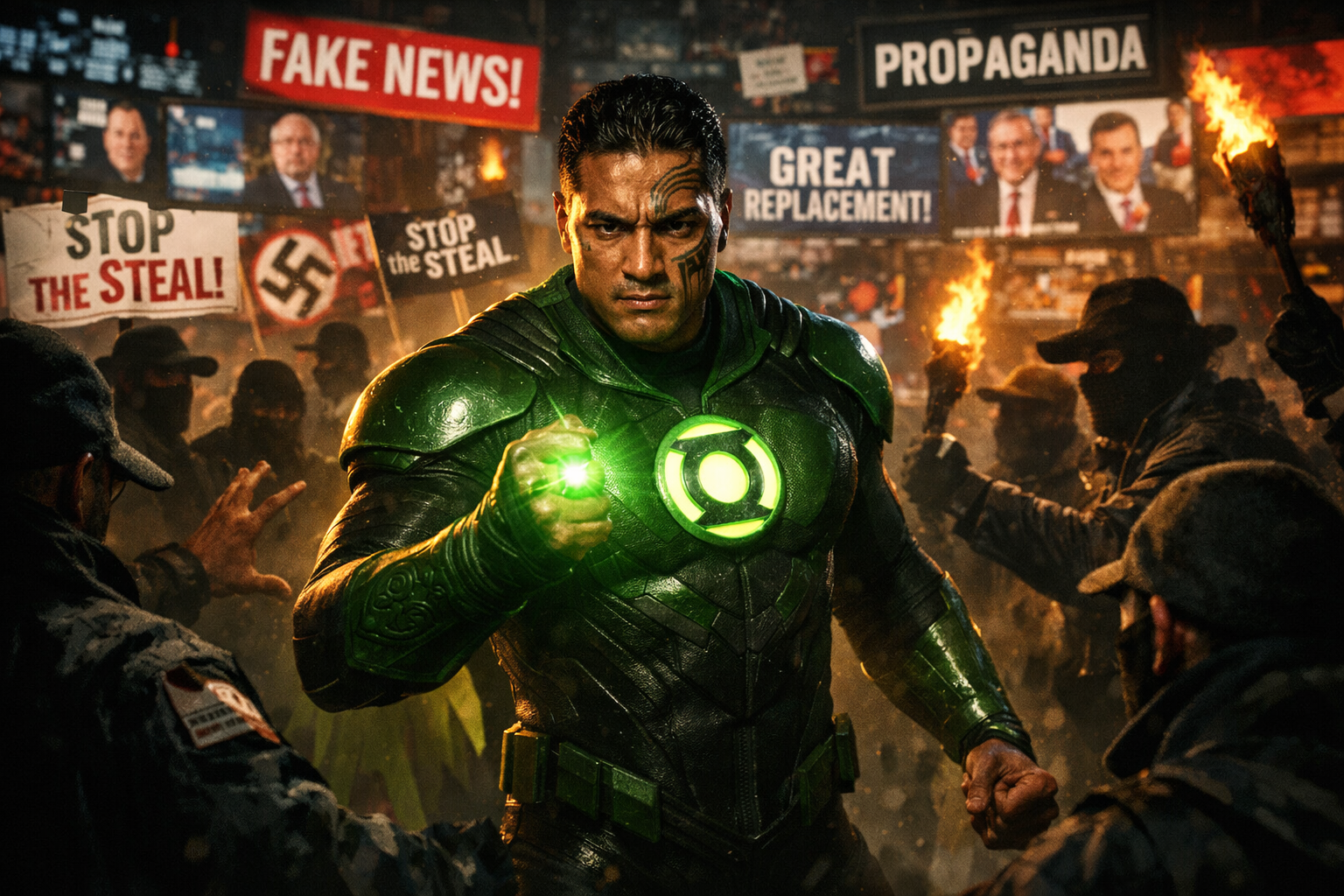
$32 million of your whānau's money has just vanished. The Crown has appointed itself to investigate itself. The names of those responsible are on a redacted list the public cannot see. The $343 million replacement programme continues. And the three-to-four month investigation timeline ensures the media cycle will have moved on before any findings land.
I will not move on.
Every koha to The Māori Green Lantern is a direct signal that whānau are ready to fund the accountability that the Crown, its commissioners, and its neoliberal machinery will never provide for themselves. Every essay I write — on BCU, on MBIE's redacted names, on Roche's structural capture, on the OFS programme now running on broken rails — that is rangatiratanga in practice. The power to fund our own truth-tellers. The power to keep the names in the public record even when the Crown wants them redacted.
Stanford's fury is funded by the Crown. Roche's investigation is funded by the Crown. This taiaha is funded by whānau.
If this essay has given you the words, the evidence, and the analysis to hold power to account — please consider a koha. Not for me. For the mahi. For the next essay. For the whānau who need this voice to stay alive when the media cycle moves on and the redacted names stay redacted.
If you are unable to koha — no worries at all. Subscribe, follow, share with your whānau and friends. Kōrero about it. That is koha in itself, and it keeps the light burning.
Four pathways:
💚 Koha directly: Support The Māori Green Lantern on Koha
📧 Subscribe for essays: Subscribe — themaorigreenlantern.maori.nz
🏦 Direct bank transfer: HTDM — 03-1546-0415173-000
📲 Facebook: Follow and subscribe on Facebook
Kia kaha, whānau. Stay vigilant. Stay connected. The taiaha does not rest while $343 million of your money is being handed to a ministry whose minister says she doesn't trust it — and whose investigator has already decided who isn't accountable.
LEGAL DISCLAIMER — NZ Defamation Act 1992
This essay constitutes political commentary and analysis in the public interest. All factual claims are sourced and hyperlinked. The characterisation of Brian Roche as "structurally captured" is an opinion clearly flagged as such, grounded in his own publicly reported statements, and relates exclusively to his conduct in his public capacity as Public Service Commissioner. No allegation of criminal conduct is made against any individual without verified evidentiary basis. No malice is intended or implied. Right of reply available within 48 hours of publication. Retraction protocol active on complaint. Public interest: Lange v Atkinson 3 NZLR 385.