"NICOLA'S GLASS CANNON" - 15 JUNE 2026
She Aimed an $18.2 Billion Weapon at Labour — and Forgot She Built It From Her Own Shattered Record

Kia ora Aotearoa,
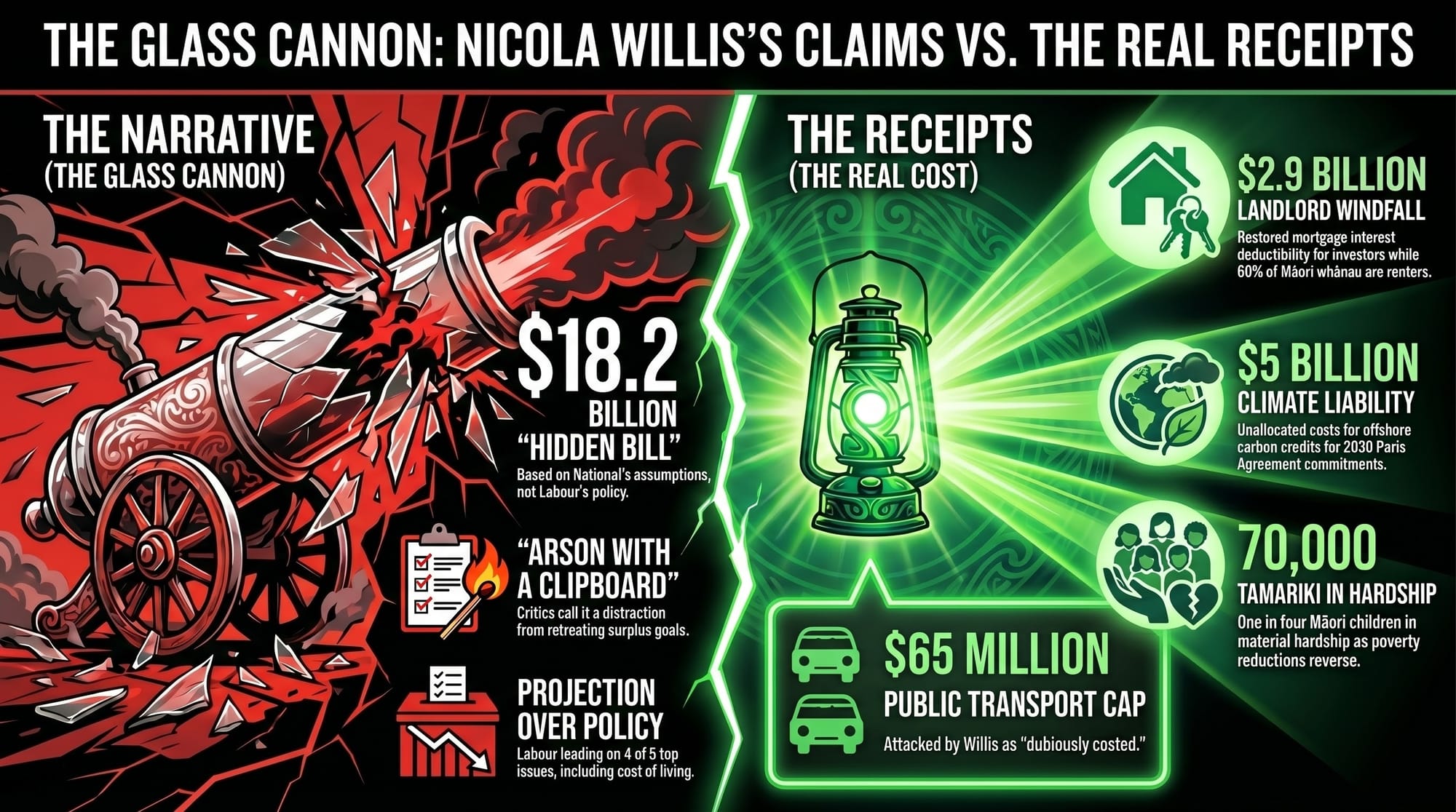
Nicola Willis gave $2.9 billion to landlords, buried a $5 billion climate bomb, left more than 170,000 tamariki in material hardship — then called a Sunday press conference to demand Labour explain its spending. This is not accountability. This is arson with a clipboard.
Ko te taiaha kei roto i ngā tatauranga. The taiaha is inside the numbers.
She built the cannon from glass.
I watched her do it. Three budgets. Three years. Three years of calling pain "discipline," calling a $2.9 billion landlord handout "fiscal neutrality," calling the dismantling of the Māori Health Authority "efficiency." Three years of standing in this burning whare and telling whānau the smoke was good for them.
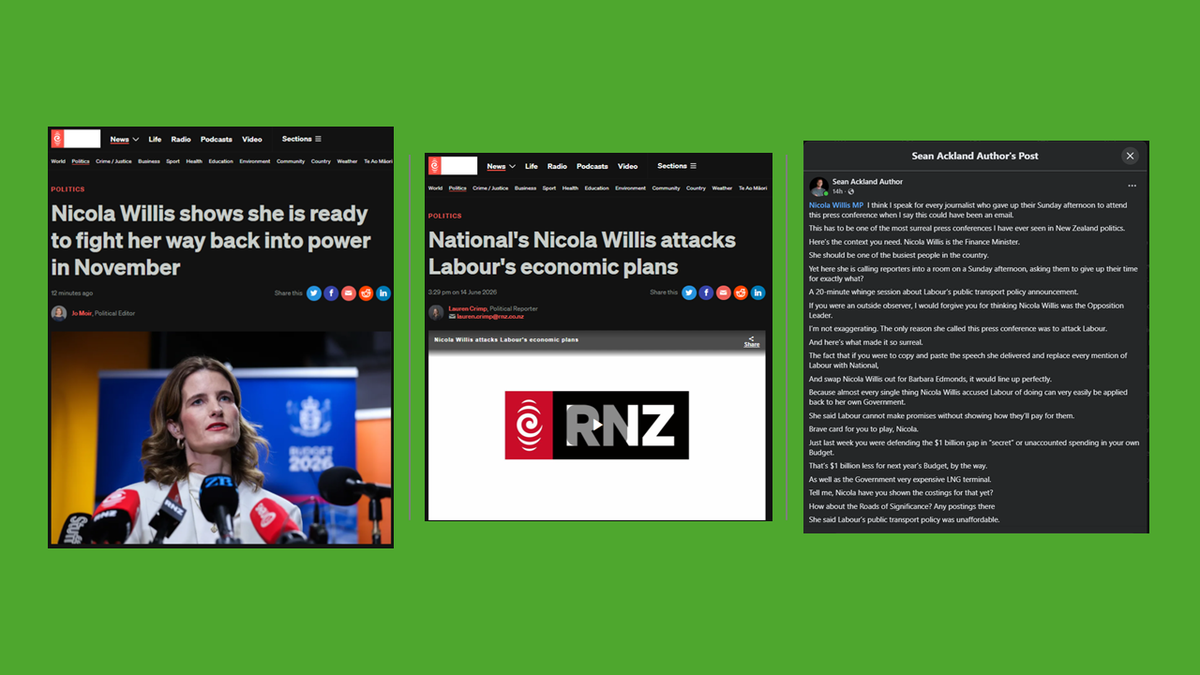
And then, on a Sunday afternoon in Wellington — on the eve of Parliamentary scrutiny week, when her government would face its hardest questions — Nicola Willis wheeled that glass cannon into a press conference room, pointed it at Labour, and pulled the trigger.
The cannon exploded.
I am Ivor Jones. The Māori Green Lantern. Te Arawa, Ngāti Pikiao, Welsh whakapapa. I have spent three years tracing the receipts this government leaves behind. I have named the names. I have followed the money.
And I am here to tell you: the most fiscally dishonest act of this government is not the $2.9 billion handed to landlords. It is not the $5 billion climate liability buried in a Treasury footnote four days before her press conference.
It is not even the surplus she promised for 2027, then 2028, then 2028–29, and which Treasury now says will not arrive until 2029–30.
The most dishonest thing she has done is stand in front of New Zealand journalists and call Labour the fiscally reckless ones.
That takes a level of audacity that can only be sustained by a government that has decided the electorate has forgotten the receipts.
We have not forgotten. We are the receipts.
🎙️ The Deep Dive Podcast
Listen to a lively conversation between two hosts unpacking every source in this essay — the landlord receipts, the carbon bomb, the glass cannon press conference, and what it means for November.
(I apologise in advance for the AI's very harsh pronunciation of te reo. Please don't shoot me. 😅)
Available at themaorigreenlantern.maori.nz — two hosts, every source, nothing softened.
📺 YouTube Video
Like video? Here is a short video supporting this essay — the receipts, the polling, the five hidden connections, and why November matters for your whānau.
(Again — don't shoot the messenger because of the AI's pronunciation. We're doing our best. 😅)
Subscribe at The Māori Green Lantern on YouTube for video essays, deep dives, and real-time accountability journalism.
Te Hītori o te Māra Kōrero — The History of This Trick
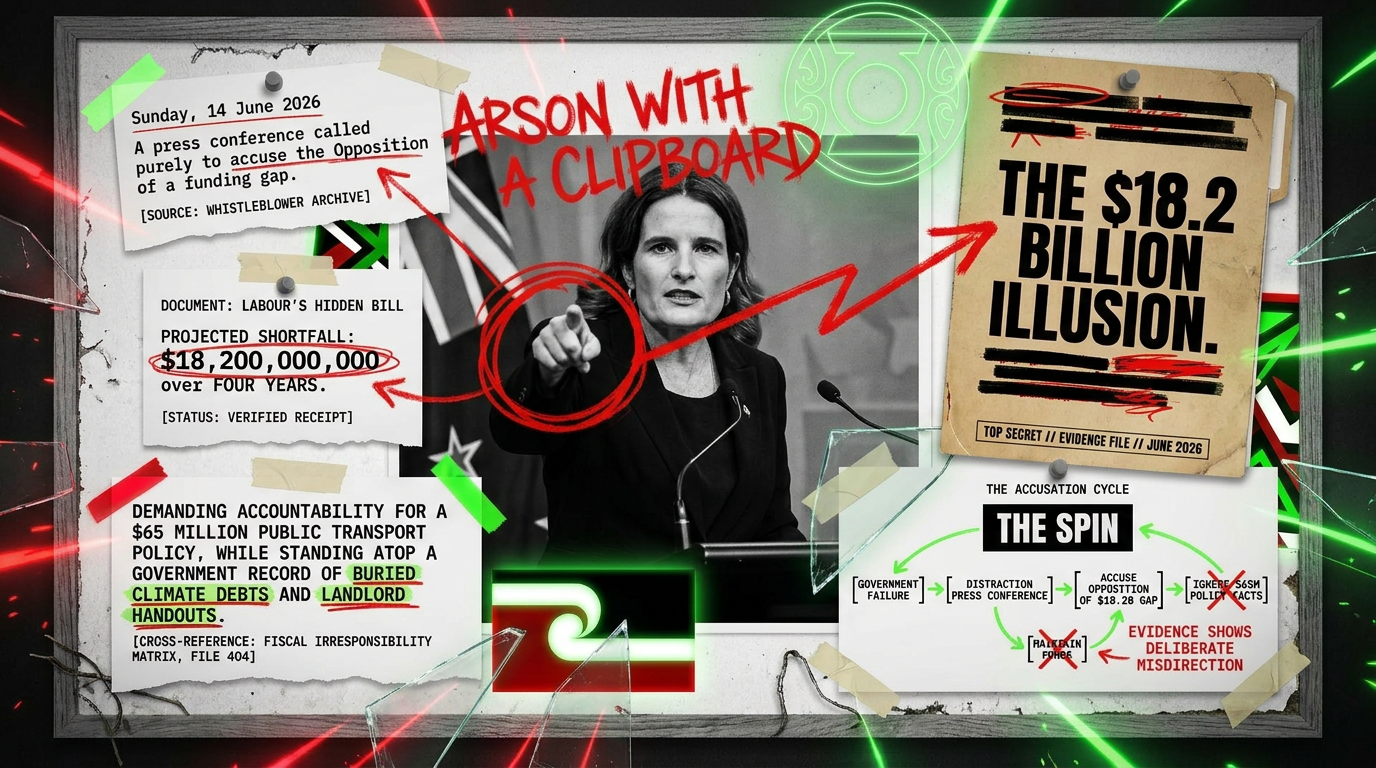
I need you to understand the architecture of what Willis did on Sunday, because it is older than she is.
In 2017, her predecessor Steven Joyce declared Labour had an "$11.7 billion fiscal hole" in the final days before the election.
RNZ's political editor Jo Moir reported Willis was clearly aware of that precedent and deliberately stopped short of using the phrase "fiscal hole," framing her document instead as "Labour's Hidden Bill" and offering Labour a "chance to answer." This is not restraint. This is legal hedging. If it later unravels, she can claim she only asked questions. If it sticks, she upgrades it to a hole at the election.
RNZ reported that the $18.2 billion figure was assembled from Labour policy announcements combined with National's assumptions about reversals and reinstatements — meaning the number reflects choices Willis made, not conclusions Labour reached.
"and by the way, that'd still be more than $17 billion underwater."
The number was never just arithmetic. It was a political weapon built from chosen assumptions and timed for maximum election-year effect. Jo Moir named the core political risk directly: voters may question why Willis is so bothered by Labour when she could be talking about her own record.
That question answers itself.
Ngā Karaipiture — The Receipts She Hoped You'd Forgotten
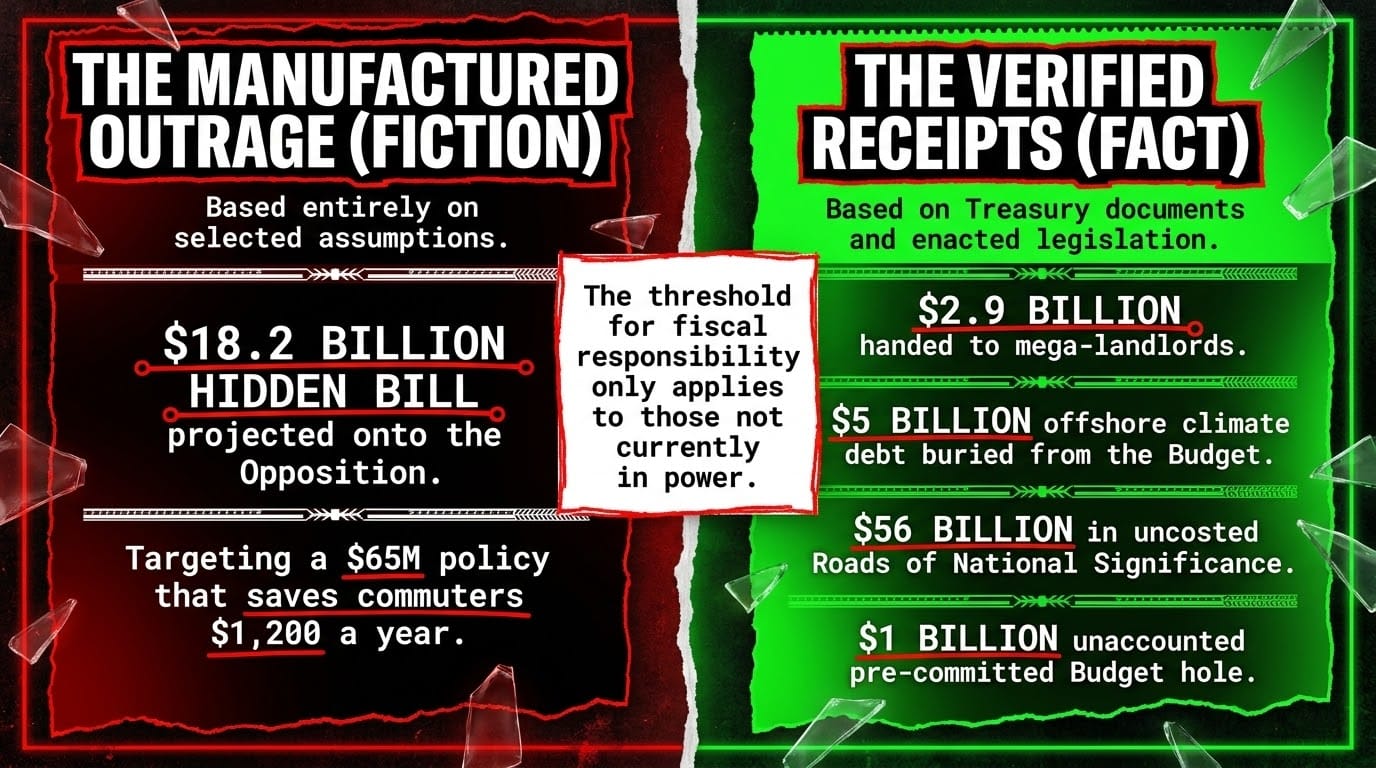
Before Nicola Willis can demand Labour's receipts, she must sit down with her own.
Receipt 1 — $2.9 Billion to Landlords, While Māori Whānau Rent
1News reported that the government's restoration of full interest deductibility for landlords was confirmed by official costings at $2.915 billion over four years — more than $800 million above what National had originally budgeted for. A subsequent Newshub investigation confirmed the gap, showing the policy cost hundreds of millions more than National had campaigned on. Inland Revenue confirmed that from 1 April 2025, interest on residential rental property became 100% deductible. The NZCTU calculated that mega-landlords with more than 200 properties would each receive over $1.3 million over five years.
Te Pāti Māori named this policy at the time as a handout to wealthy investors and pledged to reverse it. They were right. 60% of Māori whānau are renters. This was not tax policy. It was a wealth transfer — from brown tenants to predominantly white landlords — laundered through the language of "fiscal neutrality."
Willis called Labour's $20-per-week public transport cap "dubiously costed". She handed $2.9 billion to landlords and called it policy.
Receipt 2 — $5 Billion in Climate Debt, Buried Four Days Before Her Press Conference
On 10 June 2026 — four days before Willis called that Sunday press conference — Newswire reported Treasury's advice that New Zealand may need to spend between $4.4 billion and $5 billion buying offshore carbon credits to meet its 2030 Paris Agreement target. B2B News confirmed the underlying emissions shortfall at 84 million tonnes — roughly a full year of national emissions — and reported that Budget 2026 had allocated nothing to this liability. Bloomberg confirmed the $2.9 billion USD / $5 billion NZD range in its own reporting on the Treasury advice. The Greens' Chlöe Swarbrick, via Scoop, said the government was "operating outside of reality".
Prime Minister Luxon, reported by ODT, said the government "won't send billions offshore" — which is simply another way of saying: he intends to miss the target and leave the bill for future generations.
Willis said nothing about this $5 billion liability at her Sunday press conference. Not one word. She was too busy attacking Labour's $65 million bus policy.
Receipt 3 — $56 Billion in Roads, No Costings, No Revenue Plan
Ministry of Transport documents confirm the Roads of National Significance programme carries a price tag exceeding $56 billion, with NZTA advising that $49 billion in additional revenue would be required. ODT's Budget 2026 coverage reported the Budget funded just one Road of National Significance. Labour's Barbara Edmonds asked Willis directly how the government would pay for the Roads of National Significance. Willis did not answer.
She was too busy asking Labour to explain how it would pay for the buses.
Receipt 4 — The Surplus That Keeps Retreating
Bloomberg reported Willis herself saying she would not "describe myself as optimistic" about hitting the 2027 surplus target. Newstalk ZB confirmed in December 2025 that Treasury forecasts showed there was still no surplus in sight and debt was still rising. The Spinoff's Budget 2026 analysis confirmed Willis now projects surplus using a redefined fiscal measure that excludes ACC impacts — a measure Treasury itself does not use for its own surplus forecast, projecting 2029–30 instead. 1News reported the government had already pre-committed more than $1 billion against the coming Budget, structurally reducing next year's fiscal allowance.
The goalpost has moved three times. The pain is still here. The gain has not arrived.
Receipt 5 — The $1 Billion Budget Hole She Defended on Thursday, Ignored on Sunday
The Spinoff's Budget 2026 analysis reported that Budget 2026 contained nearly $1.964 billion in savings from cuts, while the overall net operating package was only $2.1 billion — and that pre-committed spending left almost nothing in the discretionary envelope for next year. Politik confirmed as far back as August 2024 that the available allowance for new spending had been consumed, leaving virtually nothing for the following year. Willis defended this at the Budget lockup on Thursday. She did not mention it on Sunday.
Mō te Hinengaro o te Ao Mārama — Three Examples for the Western Mind
You say: "This is complicated fiscal policy." Tēnā. Let me make it simple.
Example 1 — The House, the Rent, and the Receipt
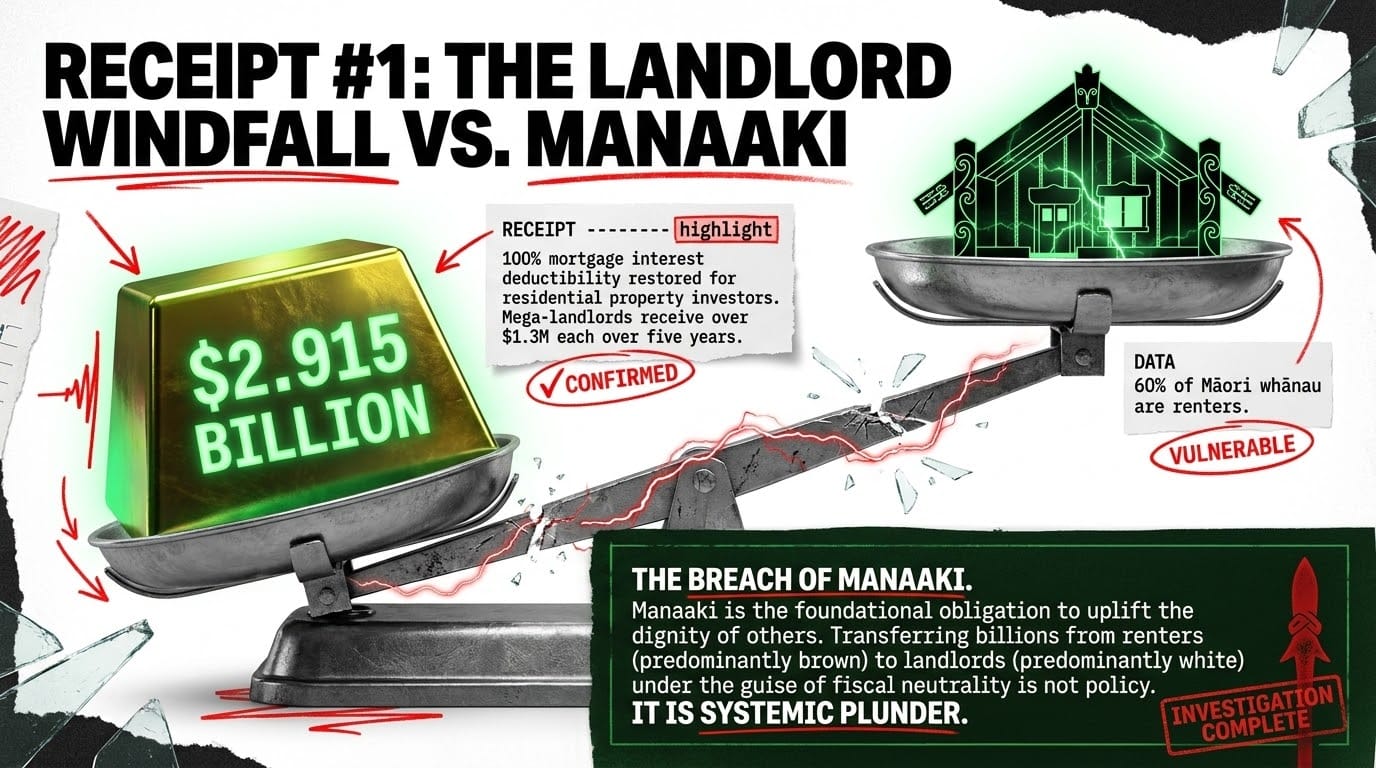
The government handed $2.9 billion to residential landlords through the restoration of mortgage interest deductibility. Your rent did not come down. The CPAG confirmed that landlord-friendly policies in Budget 2024 were forecast to push an additional 20,000 children into poverty within three years. Meanwhile, RNZ reported Willis calling Labour's $20-per-week public transport cap — which she accepted Labour costed at $65 million a year — "dubiously costed".
For the western mind: your landlord received a tax concession worth billions. You were told to endure pain. The person who made that choice then stood at a press conference and demanded Labour justify the cost of cheaper buses.
Tikanga impact: this violates manaaki — the obligation to uplift the dignity of others. Resources were directed upward to property capital while the Crown told those who rent, who are disproportionately Māori, to absorb more cost. As E-Tangata reported, the government was simultaneously "getting tough on state house tenants and homeless people" while a Housing Minister claimed $1,000 a week in a parliamentary housing allowance.
Solution: reverse interest deductibility, reinstate the Māori Health Authority, fund the public transport cap, introduce a capital gains tax that one in ten New Zealanders would pay, as Labour's Barbara Edmonds confirmed.
Example 2 — The Fire, the Budget, and the Bill Left for Your Children
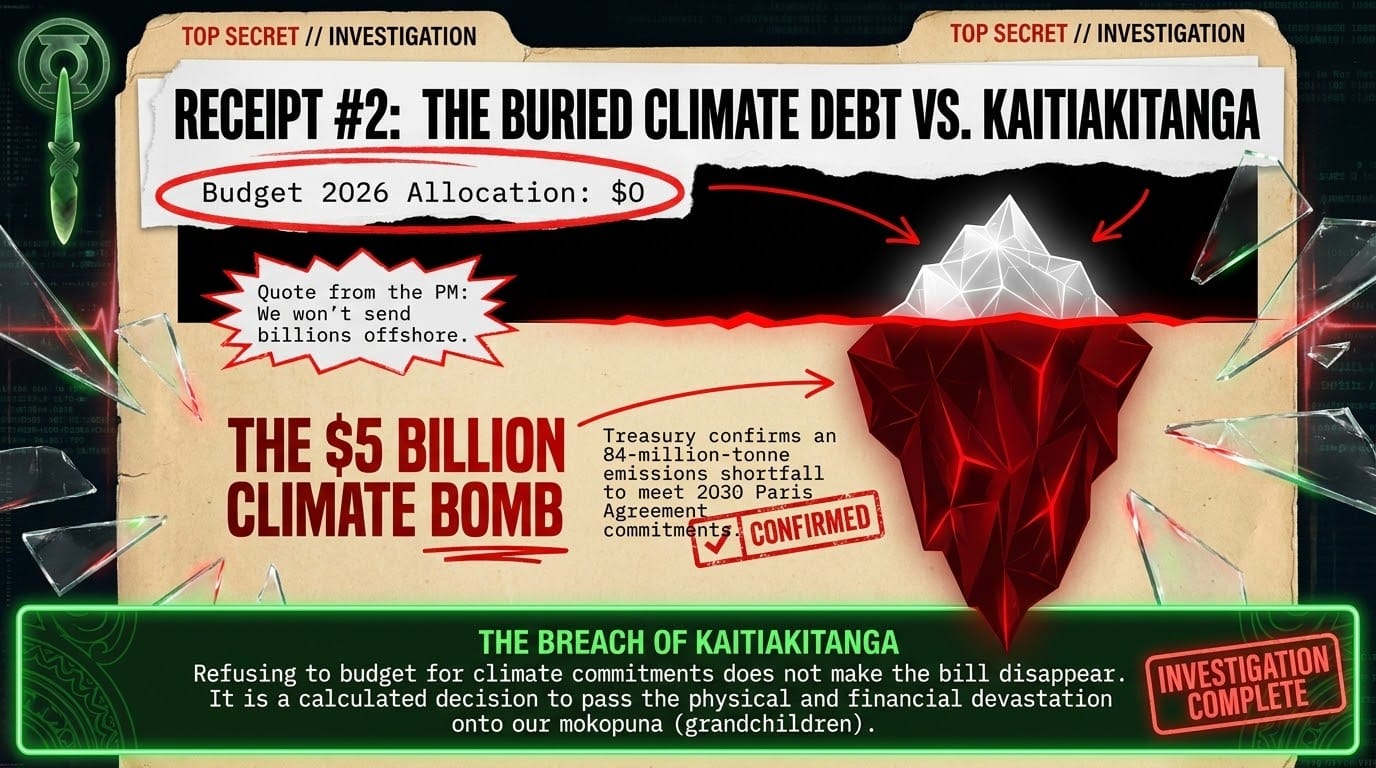
Treasury's own advice, reported by Newswire, showed New Zealand faces up to $5 billion in offshore carbon credit costs. B2B News reported that Budget 2026 funded neither the credits nor a domestic emissions reduction alternative. The Prime Minister told ODT he would not "send billions offshore" — which means the target will be missed and future generations will pay.
For the western mind: the fire chief told you the fire will cost $5 billion to stop before it reaches your street. The government did not budget for it. Then it called a press conference demanding Labour explain the cost of a garden hose.
Tikanga impact: this is a breach of kaitiakitanga — the guardianship of the environment for future generations. When the state refuses to carry a known climate duty, it does not merely fail an international treaty. It commits intergenerational harm against every mokopuna who will inherit the floods and the bill. Māori and Pasifika communities, living disproportionately on coastlines and in flood plains, pay the highest physical price. As Scoop reported, the Greens said the government was failing to "operate in reality".
Solution: budget for the carbon liability, commit to the Paris target, and stop pretending an unbudgeted cost disappears because ministers do not say it at a press conference.
Example 3 — The Goalpost, the Clock, and the Surplus That Never Comes
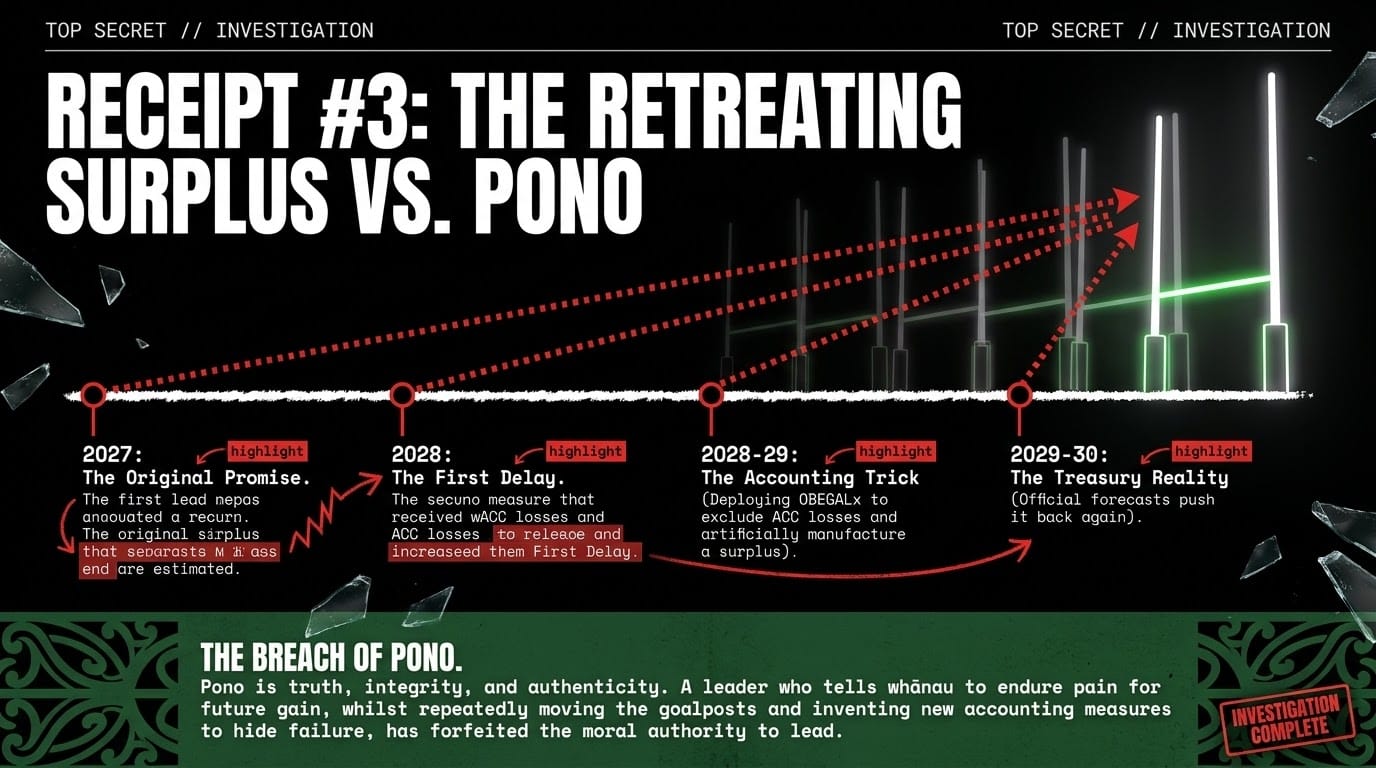
Bloomberg reported Willis saying she would not describe herself as "optimistic" about hitting the surplus target by 2027. Newstalk ZB confirmed in December 2025 that Treasury saw no surplus in sight. The Spinoff reported that Willis now projects surplus under a redefined measure that excludes ACC, while Treasury uses a different measure and forecasts 2029–30.
For the western mind: your financial adviser tells you to cut spending and endure two years of austerity, promises you will be debt-free by 2027, quietly moves the target to 2028, then 2029, then invents a new way to measure debt that makes the failure disappear — and charges the difference to your children's account.
Tikanga impact: this is a breach of pono — truth, integrity, authenticity. A rangatira who moves the goalposts, redefines the measure to obscure the failure, and tells their people to sacrifice while enriching their own class has broken pono. They have forfeited the moral authority to lead. As Nicola Willis's own Rock-Solid Fantasy essay on The Māori Green Lantern traced, the surplus that keeps retreating is not a technical problem — it is a character problem.
Solution: fixed, transparent fiscal targets — not invented accounting measures — with no more enriching landlords while telling working whānau that sacrifice is a virtue.
Ngā Tūāhuatanga — Five Hidden Connections
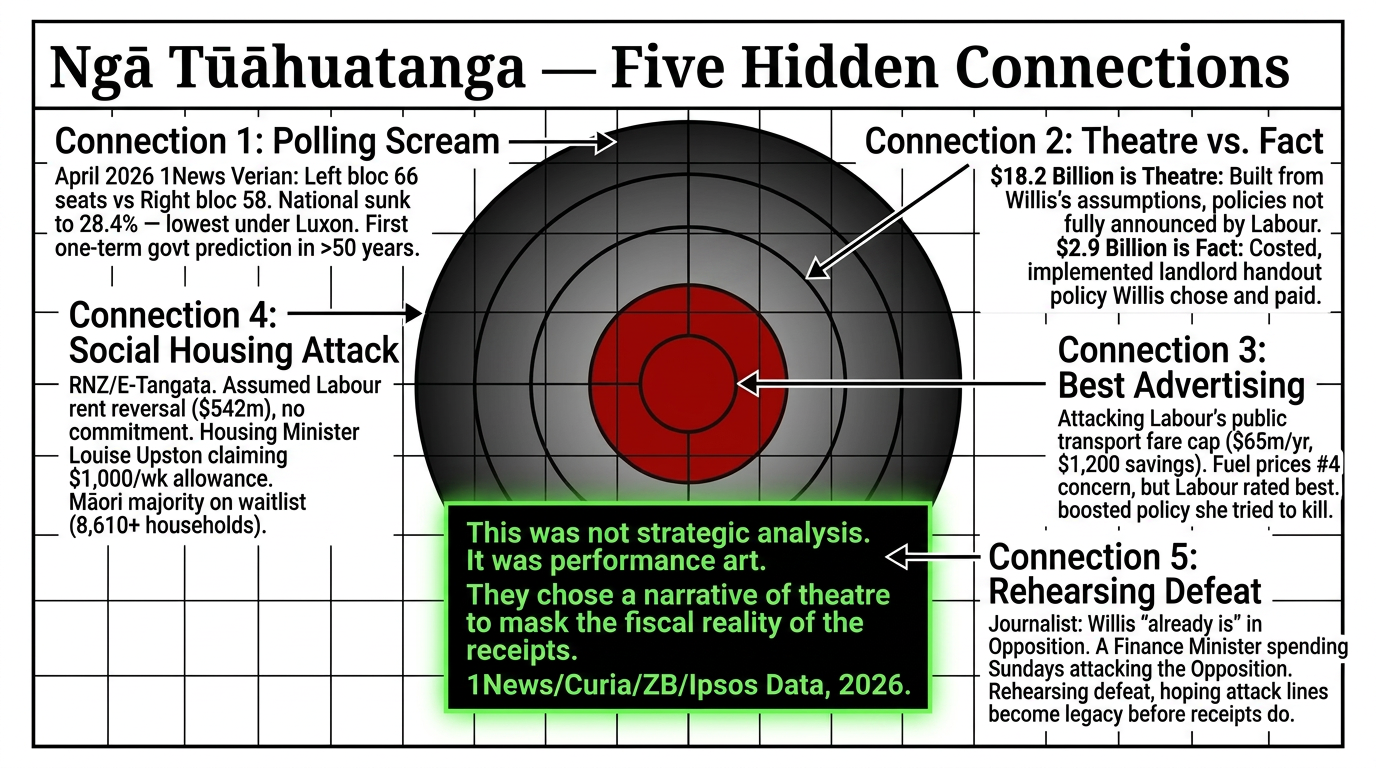
Connection 1 — The Polling Is Screaming at Her and She Knows It
The April 2026 1News Verian poll showed the left bloc at 66 seats versus the right bloc's 58, meaning Labour and its partners would knock the coalition out of power if an election were held then. 1News confirmed Labour sat on 37% — a seven-point lead over National — and that this would mark the first one-term government in New Zealand in more than 50 years. The post-Budget Taxpayers' Union-Curia poll published in May 2026 via Newstalk ZB showed the coalition had narrowed to 62 seats versus 58 for the opposition — a margin of four seats, barely hanging on. Earlier in March, Newstalk ZB reported National had sunk to 28.4% — its lowest result under Luxon since the Judith Collins era.
National only leads Labour on the economy — a lead it lost to Labour in November 2024, only recovering to a tie in March 2026, as the Politics in NZ Substack tracked. When you are losing the economy to Labour, you do not project confidence. You project noise.
Connection 2 — The $18.2 Billion Is Theatre; the $2.9 Billion Is Not
RNZ's Jo Moir noted that Willis set a threshold for Labour she has never met herself: National would release its own fiscal plan "over the next few months" with no date confirmed — despite being the incumbent government with three years of budgets and the full machinery of Treasury and the IRD at her disposal. Moir also noted the high threshold is arguable given Labour operates from Opposition benches with "far less resource and access to officials". The $18.2 billion was built from assumptions Willis chose, from policies Labour has not yet fully announced. 1News confirmed the $2.9 billion landlord handout was built from policy Willis chose and implemented, is fully costed, and has already been paid.
Connection 3 — Attacking the Bus Policy Was the Best Advertising Labour Could Buy
RNZ reported Willis described Labour's public transport fare cap — costed at $65 million a year, saving people an average of $1,200 annually — as "dubiously costed". The February 2026 Ipsos Issues Monitor, as reported by NZ Herald NOW, showed fuel prices had soared to the fourth-biggest concern for New Zealanders in May 2026 — yet Labour, not National, was rated best able to tackle it. Every headline generated by Willis's Sunday press conference led with Labour's transport announcement. She boosted the policy she was trying to kill. She handed them the news cycle.
Connection 4 — The Social Housing Attack Reveals Who This Government Serves
RNZ reported Willis assumed Labour would reverse social housing rent changes at a cost of $542 million, even though Labour made no such commitment. E-Tangata confirmed that while the government was toughening conditions for state house tenants, Housing Minister Louise Upston was claiming $1,000 a week in a parliamentary housing allowance. The MSD Housing Register confirms Māori make up the majority of those on the social housing waitlist, with over 8,610 Māori households waiting as of 2025. I covered this in full in The Lotto Lie: the government is not managing housing. It is managing optics while Māori whānau sleep in cars.
Connection 5 — She Is Already in Opposition Mode Because She Sees the Outcome
The journalist at Sunday's press conference stated on Facebook that Willis "already is" in Opposition — that "she sees the writing on the wall and has made a conscious decision to behave like she's preparing for it". That reading is confirmed by the pattern: the April 2026 1News Verian poll showed National's worst result under Luxon with the left bloc on 66 seats, the post-Budget Taxpayers' Union-Curia poll showed the coalition barely holding a four-seat margin, and 1News confirmed Luxon conceded his party "needed to do better" after the record low polling. A Finance Minister who spends her Sunday attacking the Opposition is not governing. She is rehearsing defeat — and hoping the attack lines become her legacy before the receipts do.
Te Kino Ki a Māori — What This Government Has Actually Cost Whānau
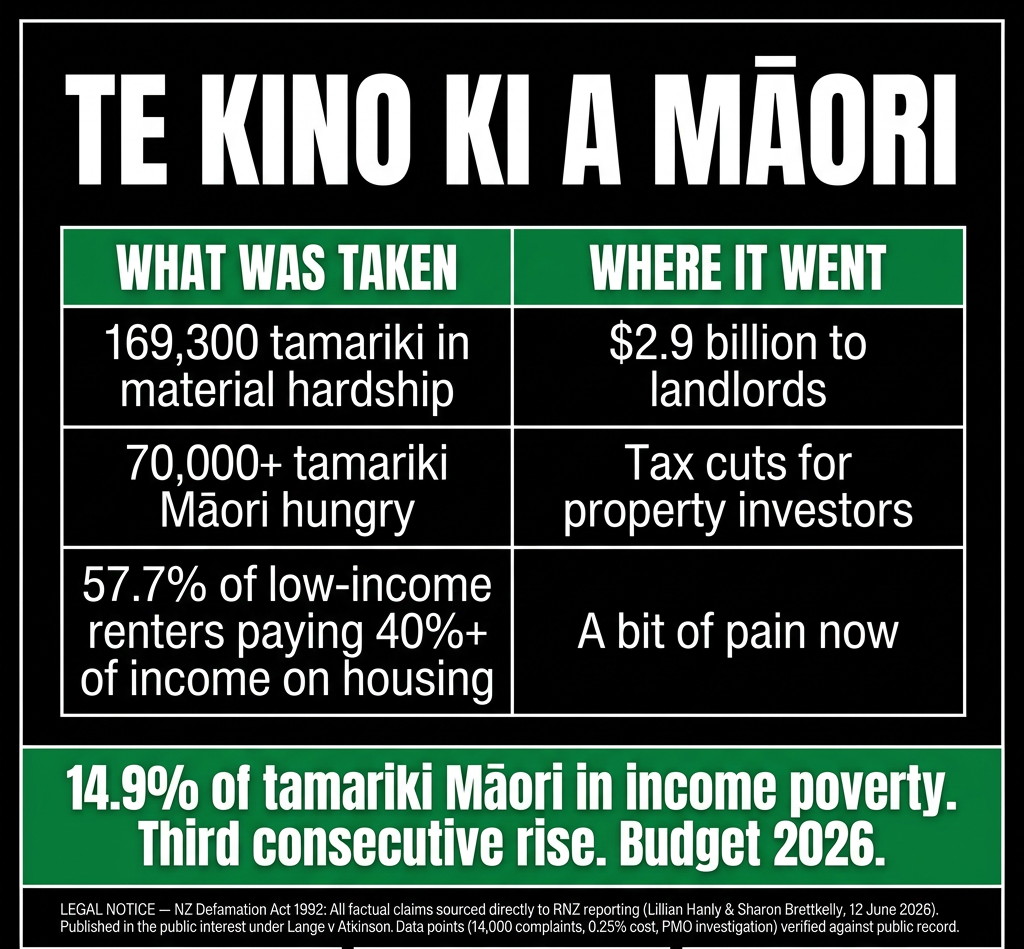
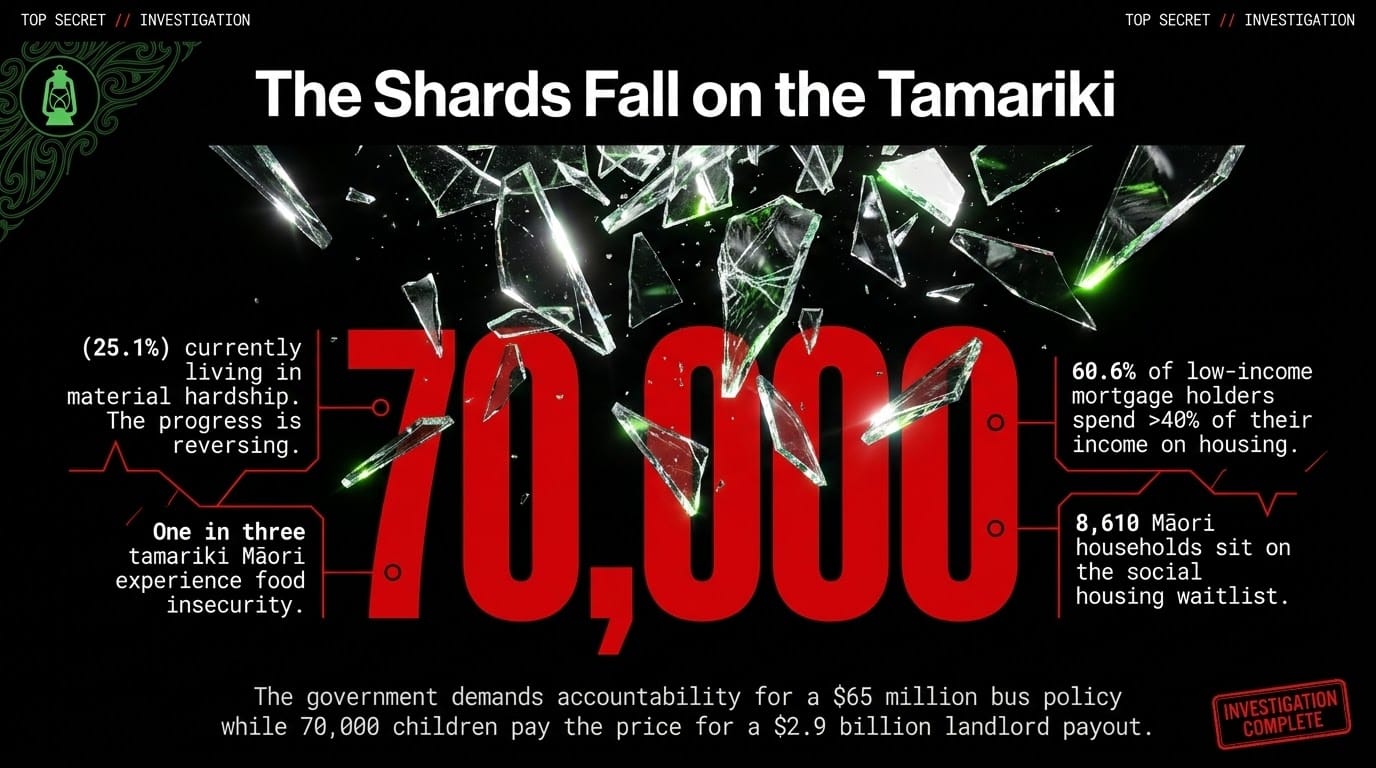
CPAG confirmed in February 2026 that child material hardship reached a 10-year high: 14.3% of children — approximately 169,300 tamariki — are living in material hardship, the highest number on record since 2015 and the third consecutive annual rise. Stats NZ's official child poverty data for the year ended June 2025 confirmed 12.6% of all children were in income poverty, with tamariki Māori at 14.9% on the BHC50 measure. Te Ao Māori News reported in February 2026 that more than 70,000 tamariki Māori were in material hardship and one in three tamariki Māori experienced food insecurity. The CPAG's Budget 2024 analysis confirmed the government's landlord-friendly policy package was forecast to increase child poverty and lock an additional 20,000 children into hardship within three years. Stats NZ household income data confirmed that 57.7% of low-income renters spend at least 40% of their income on housing — yet Willis handed $2.9 billion to the landlords collecting that rent.
Māori have been enduring that pain since 1840. The long run has been promised at every election since then. And in every budget since then, the gain has landed somewhere else.
Ngā Tuhinga o Mua — Previous MGL Work on This Record
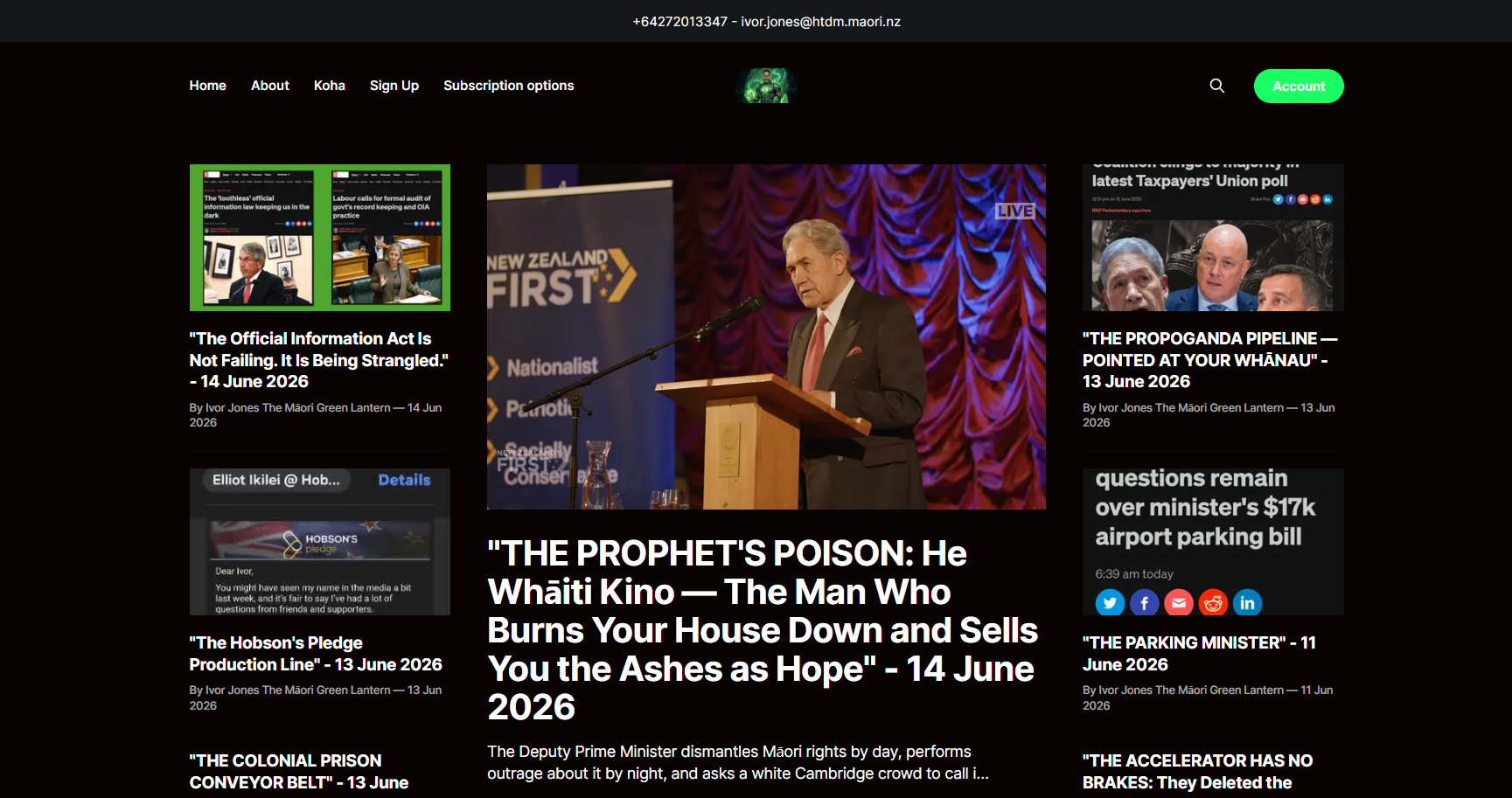
The receipts I am presenting today are not new. I have been tracking this government's fiscal record since the day it took office. The archive is the accountability:
- The Burning Healing House — Budget 2026: How Simeon Brown burned Māori healthcare and called the ashes a billion-dollar investment.
- The Lotto Lie: How Willis called survival a jackpot while gutting social housing for Māori whānau.
- The Whare Is on Fire: Budget Day analysis — Willis collecting $1,000 a week while telling whānau to endure more pain.
- The Pātaka Beside the Strait: Winston Peters and the fiscal arson this coalition calls governance.
- Selling the Stars, Starving the Seeds: How Luxon plugged Aotearoa into Musk's war machine while 170,000 tamariki went hungry.
- Nicola Willis's Rock-Solid Fantasy: The structural deficit, the invented accounting, and the surplus that keeps retreating.
- The Empty Waka in the Storm: How Willis flew to Washington while whānau drowned at home.
- The Great Sellout: Willis's War on Fiscal Responsibility: The ideological rigidity beneath the "responsible finance" brand.
The Sunday press conference is not an isolated event. It is another flare in the same neoliberal fire.
Te Whakakapi — Ko Wai te Kaiwhiwhi? Who Benefits?
Cui bono. Who benefits from Sunday's press conference?
Not the 169,300 tamariki in material hardship. Not the 8,610 Māori households on the social housing waitlist. Not the workers who cannot afford the bus. Not the communities on the coastline who will inherit the unbudgeted $5 billion in climate damage.
The beneficiary is National's election strategy. The mechanism is projection — accuse the Opposition of what you yourself have done, loudly and early enough that the accusation becomes the story before the receipts arrive.
Willis aimed her glass cannon at Labour. She fired. And the shards are falling everywhere except where she intended — because the polling is already screaming at her, because whānau know about the landlord handout, because the surplus has been promised too many times, and because we read the receipts.
Ko te tūāhu tēnei ki a Nicola Willis: the glass you are standing in is visible to everyone except you. And when it shatters in November, the shards will not fall on the 170,000 tamariki who have already been cut by it.
They have been cutting their feet on your fiscal philosophy since the day you took office.
Kia kaha, whānau. Read the receipts. Share the receipts. In November — vote like your tamariki are watching.
Because they are.
💚 Koha — Fund the Accountability They Will Not Provide
Every time Willis stands at a press conference and hands journalists a constructed $18.2 billion number built on assumptions — while burying a verified $5 billion climate bomb and a $2.9 billion landlord gift in the footnotes
— she is counting on you not to read the receipts.
This essay is the receipts.
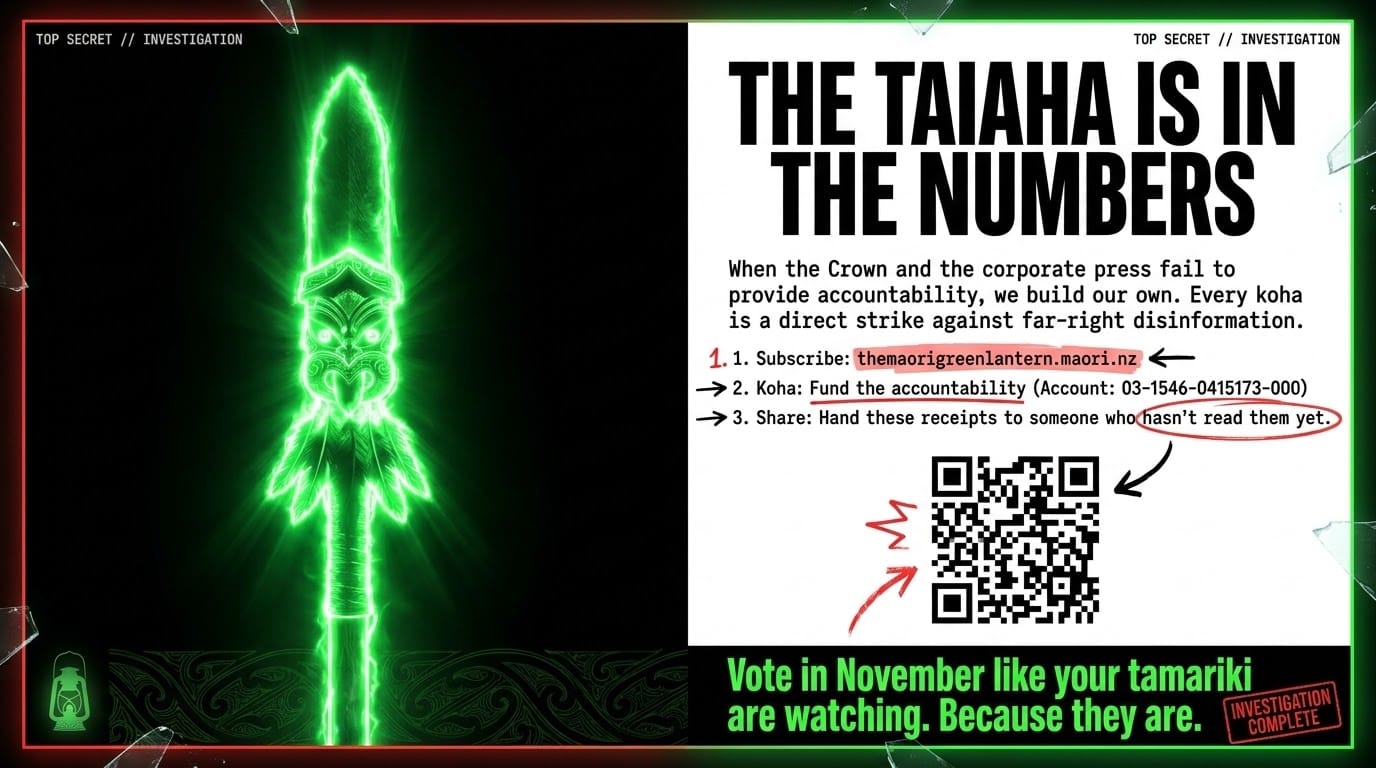
Every koha to The Māori Green Lantern signals that whānau are ready to fund the accountability that Crown and corporate structures will not provide. It signals that rangatiratanga includes the power to fund our own truth tellers. While 169,300 tamariki are in material hardship and Willis hands $2.9 billion to landlords, this taiaha stays sharp because whānau make it so.
If you cannot koha — no worries at all. Subscribing, following, sharing, and kōrero-ing this essay with your whānau and friends is koha. Every share is a receipt handed to someone who hasn't read it yet.
Four pathways to support this mahi:
1. Koha directly — Support The Māori Green Lantern on the Koha platform
2. Subscribe — Receive essays directly to your inbox: themaorigreenlantern.maori.nz/#/portal/support
3. Bank transfer — HTDM | Account: 03-1546-0415173-000
4. Facebook — Follow and subscribe on Facebook
Kia kaha, whānau. Stay vigilant. Stay connected. The taiaha is yours.

Hei whakamārama — Legal Disclaimer: This essay is based on verified publicly available sources as of 15 June 2026. All factual claims are cited with live hyperlinks. Opinions are clearly identified as such and grounded in cited factual bases in the same paragraph. Named individuals are cited in their public capacity only, under qualified privilege (Lange v Atkinson)