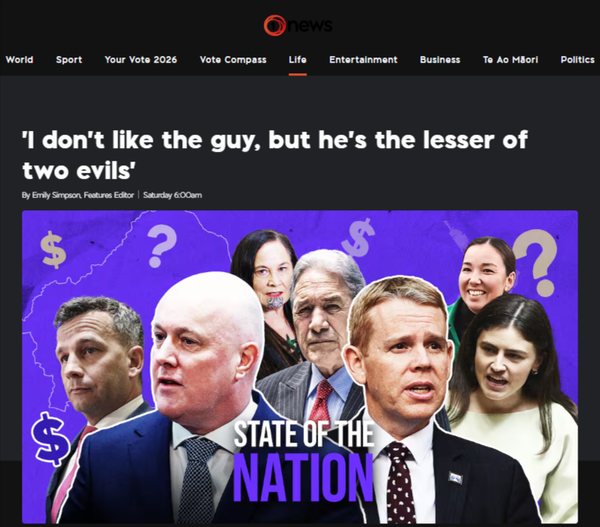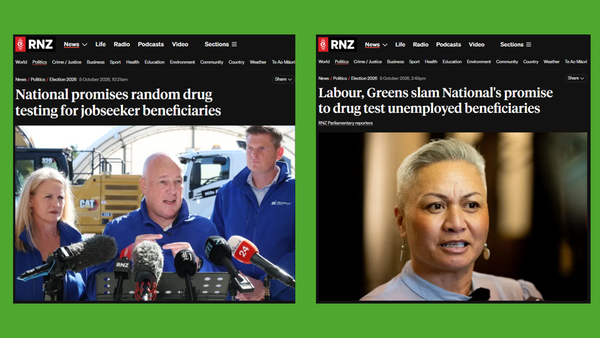
"THE PM FEASTING ON ENTITLEMENTS: $1.6 MILLION FOR THE PERMANENTLY FED" - 16 June 2026
How a White Supremacist Neoliberal Government Subsidises Its Own Alumni, Chauffers Its Former Prime Ministers, and Asks Itself for Advice — While Stripping Māori Whānau of Everything

Ko Ivor Jones tēnei.
He uri nō Ngāti Pikiao, Te Arawa. Ko au te Māori Green Lantern. Tēnei au, e herea ana ki te pono, ki te tika, ki te aroha ki ōku whānau.
I write because no one else is naming this with the precision it demands — and because the taiaha does not put itself down.
The Taiaha Is Drawn
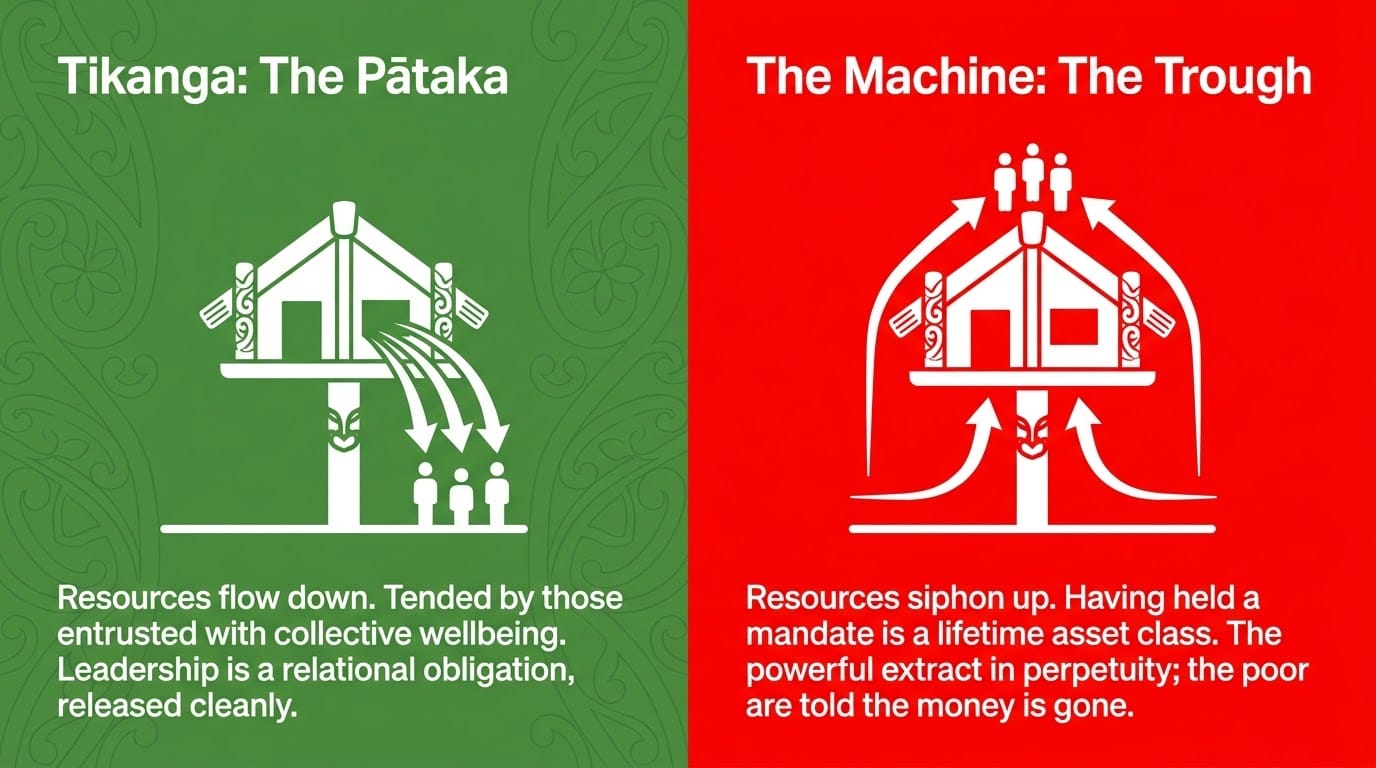
I want you to picture a pātaka — a carved storehouse, elevated on a single post above the ground. In te ao Māori, the pātaka holds the community's reserves. It is tended by those entrusted with collective wellbeing. It is not — under any expression of tikanga in this land — a personal pantry for the people who built it.
Now picture a white supremacist neoliberal government that has spent thirty years dismantling the pātaka for ordinary New Zealanders, stripping Māori housing programmes, gutting Māori health infrastructure, cutting school lunches from tamariki, raising the housing cost burden on the poorest families in the country — while simultaneously writing a Budget line of $1.6 million to subsidise the travel of politicians who left Parliament before your phone had internet access.
Picture the Crown limousines — $300,000 per year — idling outside the homes of former prime ministers and their spouses, funded by the same public that is being told there is no money.
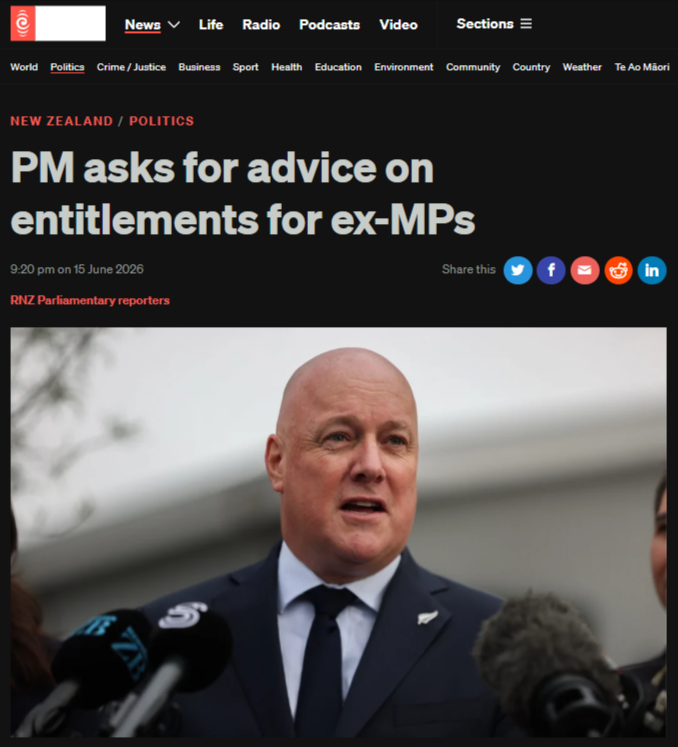
And then picture Christopher Luxon standing at a microphone on 15 June 2026, being asked what he intends to do about it.
He says he has asked his office to seek "further advice."
Not to end it. Not to reform it. Not to repay it.
To understand it.
That is not governance. That is the permanently fed asking itself for the recipe.
I am Ivor Jones — The Māori Green Lantern — and I have written over 1,000 essays documenting the whakapapa of harm this government has inflicted on our people. I have traced every dollar. I have named every decision-maker. I have connected every thread.
Today I connect this one.
The taiaha is in my hand. Let us begin.
🎧 The Deep Dive Podcast
Listen to a lively conversation between two hosts, unpacking and connecting every thread of this essay — from the Crown limousines idling outside former prime ministers' homes to the $40 million ripped from Māori housing while the entitlement machine processed $1.6 million for retired politicians. We follow the Budget line, the whakapapa, and the bipartisan silence.
I apologise in advance for the AI's very harsh pronunciation of te reo Māori. Please don't shoot me — the taiaha is reserved for power, not for algorithms still learning te reo. 😅
📺 YouTube Video
Like video? Here is a short video supporting this essay — tracing the entitlement architecture from the ex-MP travel scheme to the Crown limousines, the accommodation rorts, the Pharmac appointment, and the lunchboxes. All in one Budget. All in one Parliament. All deliberate.
Again, please don't shoot the messenger for the AI's pronunciation. The kaupapa is the point. Kia kaha. 🙏
The Budget Line Is The Confession
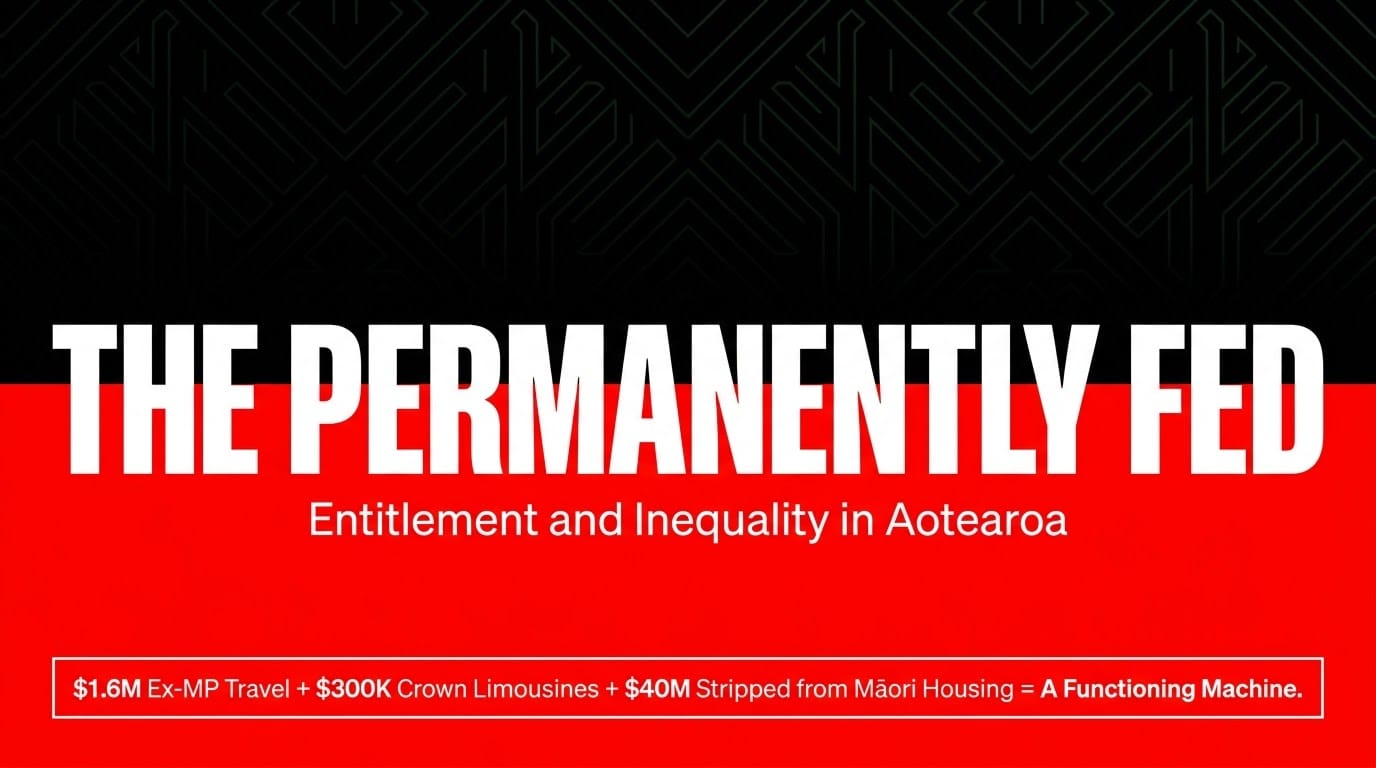
Let the numbers sit on the page without ornament, because they are not historical artefacts. They are current appropriations — money this Parliament allocated this year, in this Budget, under this government:
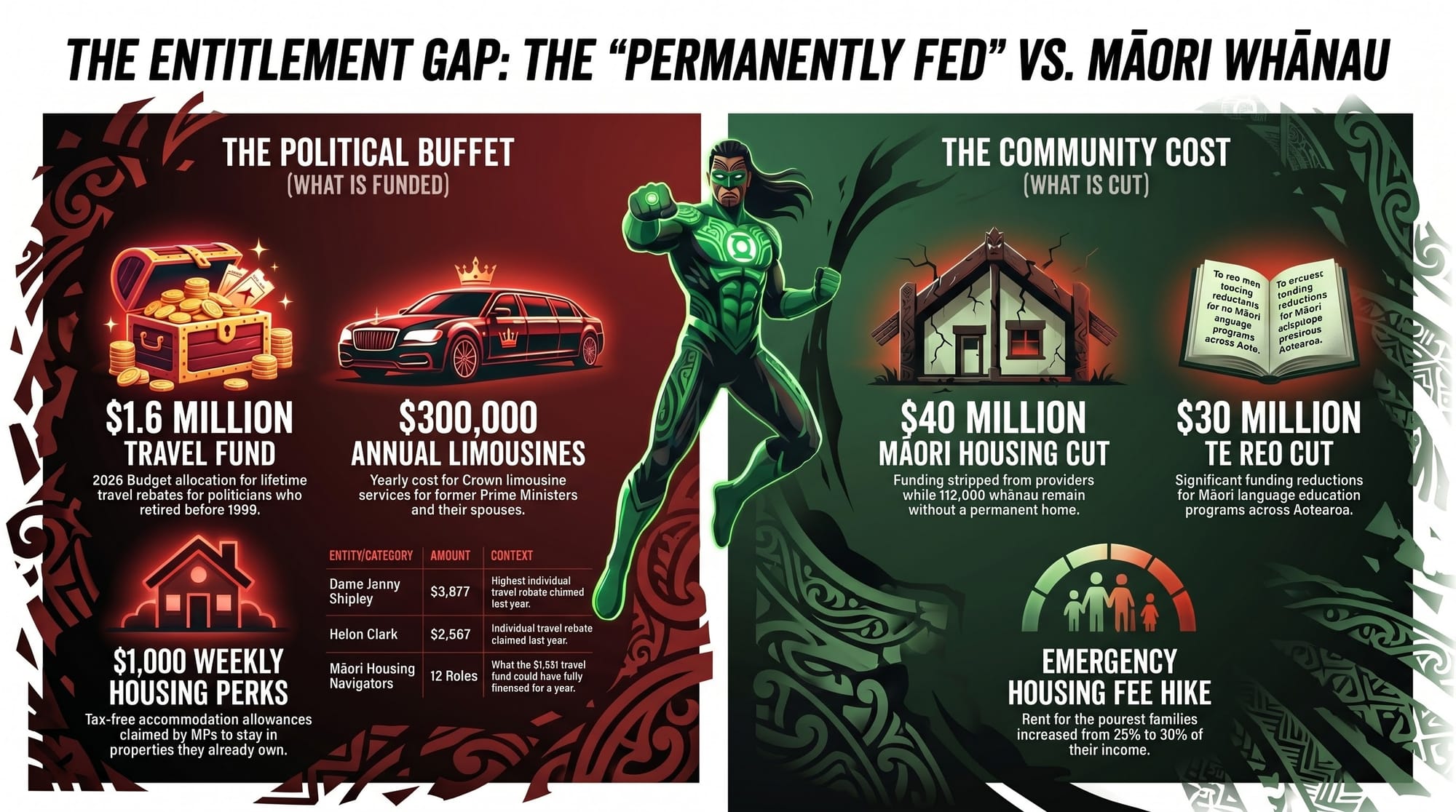
- $1.6 million budgeted in 2026 to subsidise travel for retired politicians who left Parliament before 1999
- $1.5 million spent on the same scheme in 2025
- $300,000 per year in Crown limousine services for some former prime ministers and their spouses
- $3,877 — the highest individual travel rebate claimed last year, by Dame Jenny Shipley
- $2,567 — Helen Clark's claim
Now hold those numbers against the same Budget period:
- $40 million stripped from Māori housing providers — as I documented in The Whare Is On Fire and the Government Is Handing Out Fines
- 112,000 whānau without a home tonight — as I documented in Gerry Brownlee — The Tollgate King
- Emergency housing Income-Related Rent raised from 25% to 30% — the poor pay more, confirmed by HUD, Budget 2026
- $30 million cut from te reo Māori education funding — as I documented in The Lunchbox Coloniser
These are not in different conversations. They are in the same Budget. The same Parliament. The same system.
The ex-MP travel scheme and the Crown limousines are not a relic of a kinder era accidentally left on the books. They are a live, annually renewed, Budget-appropriated statement of who this government believes deserves public subsidy — and it is not the 112,000 whānau sleeping in emergency housing tonight. It is Dame Jenny Shipley. It is Helen Clark. It is the permanently fed.
Three Examples for the Western Mind — Quantifying the Harm, Naming the Tikanga
Example One: The $1.6 Million vs. the 112,000 — What the Money Could Have Done
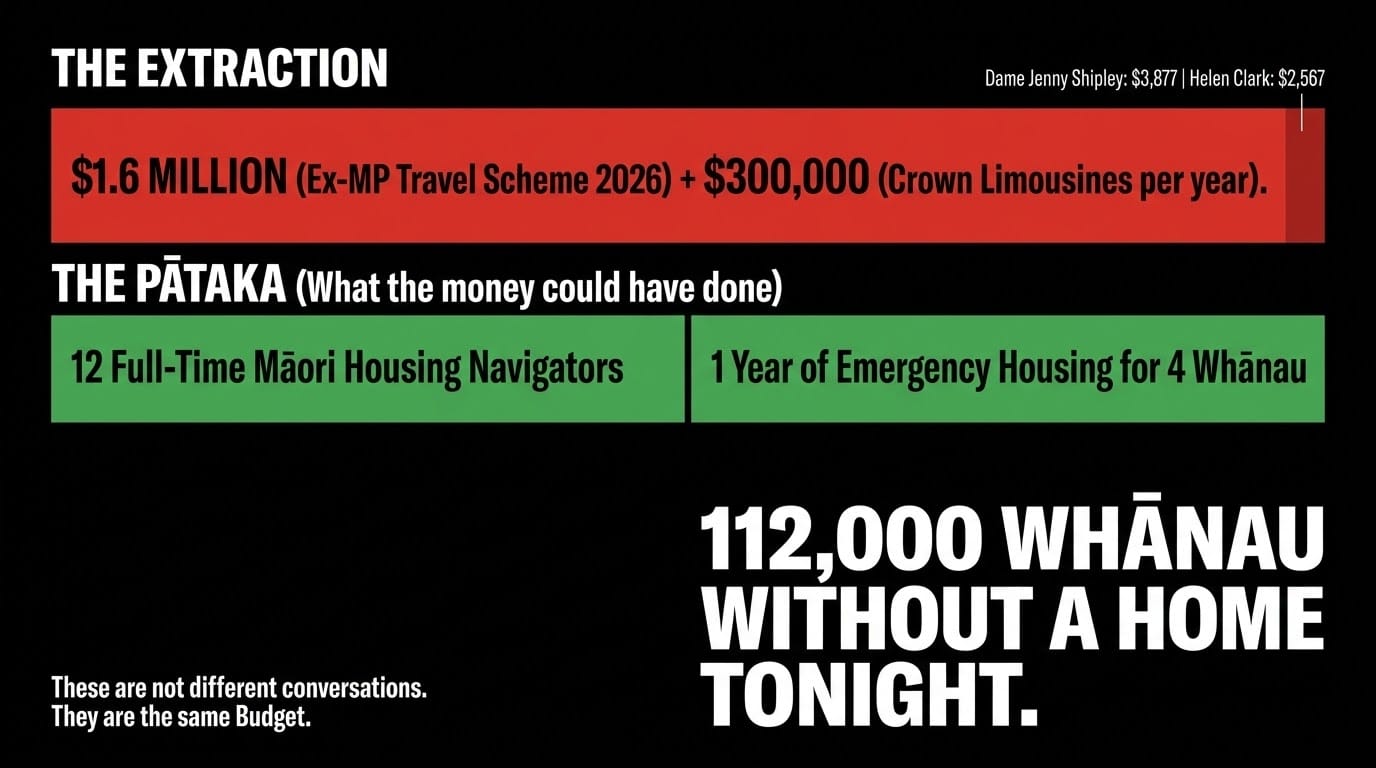
The claim: The 2026 Budget allocates $1.6 million for the ex-MP travel scheme. In the same Budget period, as I documented in The Tollgate King, 112,000 whānau have nowhere to sleep in Aotearoa and the government has raised the cost of emergency housing for the poorest families. These are not separate policy areas. They are the same fiscal decision: Parliament chose what to fund and what to cut.
Quantified harm: $1.6 million would fund approximately twelve full-time Māori housing navigators for a year — specialist workers who keep whānau off emergency housing waitlists by connecting them to providers, legal support, and transitional accommodation. It would fund four whānau in emergency housing for a full year each. It would cover six months of the $40 million that was stripped from Māori housing providers in Budget 2025. Instead, it is processing lifetime travel rebates for former politicians, the most lavish of which went to a former prime minister — Dame Jenny Shipley — who has a pension, international speaking fees, and a public profile that generates income independently.
Solution: Zero the line item. Close the scheme permanently. Redirect the $1.6 million appropriation to Māori housing navigation services via the restored Māori housing provider fund stripped in Budget 2025. No working group. No further advice. A Budget amendment. A single line. Done.
The tikanga impact for the Western mind: In tikanga Māori, the rangatira who has served does not return to the pātaka while the people are still hungry from the first governance. Leadership is not a property right. It is a relational obligation — held for the duration of the mandate and then released cleanly, without conditions, without a lifetime travel allowance, without a Crown car. The ex-MP travel scheme is the precise inversion of this tikanga. It says: having held the mandate is a lifetime asset. Redeemable at airports. On your schedule. At the public's expense. Forever.
This is not a quirk of administration. It is the moral architecture of a white supremacist neoliberal state: the powerful extract in perpetuity; the poor are told the money is gone.
Example Two: The Tollgate Keeper's Chair — How the Man Who Runs the Machine Also Claims From It
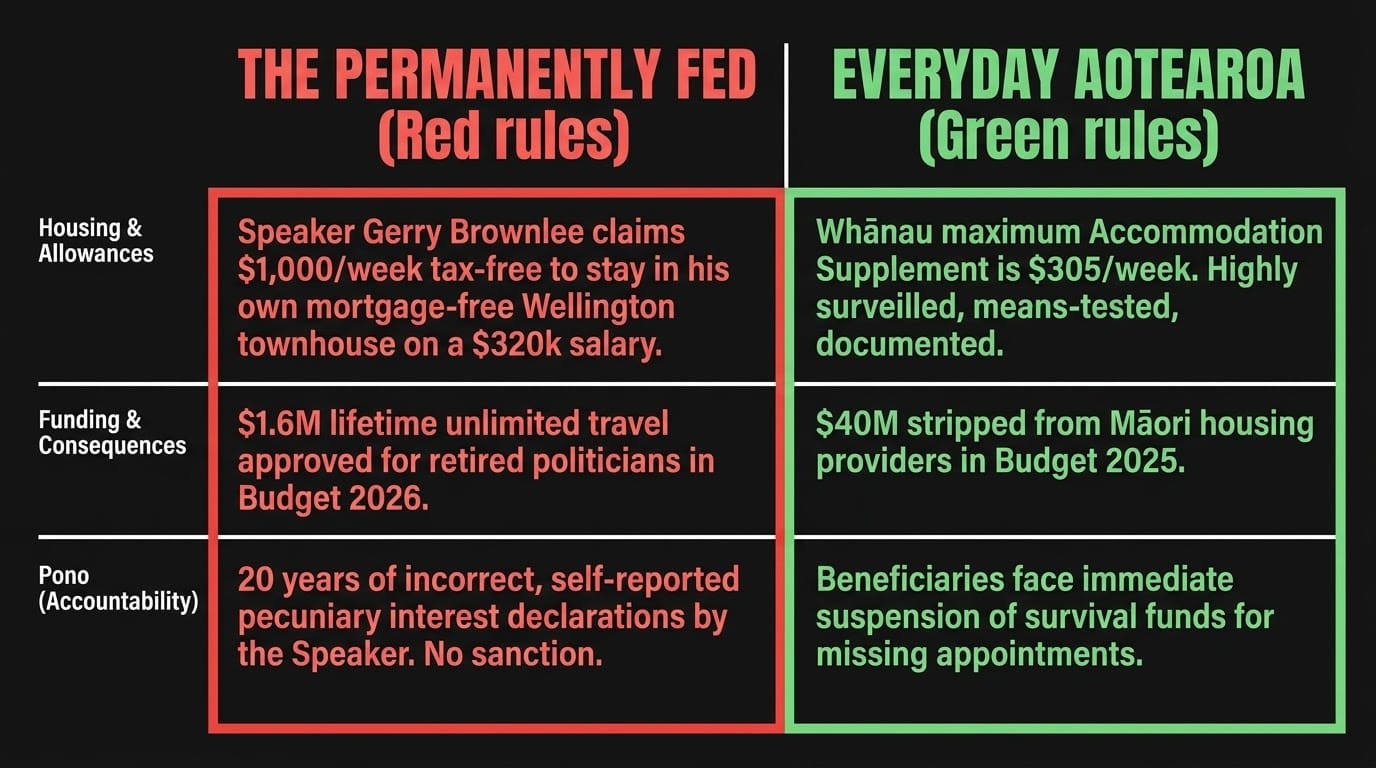
The claim: This is not only a story about former MPs. It is a story about the institution that protects this architecture while its current occupants extract from the same system under different rules. As I documented in Gerry Brownlee — The Tollgate King, the Speaker of the House — earning $320,600 per year, owning six properties, having declined a free apartment inside Parliament because it was "not exactly the sort of accommodation you want to be living in all the time" — has claimed $237,000 in taxpayer-funded accommodation allowances to stay in a Wellington townhouse he owns mortgage-free.
The accommodation allowance Brownlee claims: $1,000 per week, tax-free. The maximum Accommodation Supplement a whānau with dependants in Area 1 can receive: $305 per week. On a means-tested benefit. With documentation requirements. Under surveillance.
That is the same system. Two completely different rules. Both perfectly legal. Both designed by the people who benefit from them.
And when The Post began investigating this conduct, Brownlee — as Speaker, using the constitutional authority of his office — threatened to ban Stuff journalists from Parliament. The man holding the gavel used the gavel to protect the till. Within days, The Post revealed Brownlee was the biggest story he was trying to kill.
Quantified harm: During the twenty years Brownlee filed incomplete and incorrect pecuniary interest declarations — confirmed by The Spinoff (27 May 2026) — he participated in housing policy, resource management, and Canterbury earthquake recovery while his actual property interests remained undisclosed. His conflict of interest was legally invisible because disclosure was inaccurate. No sanction. No consequence. The correction came after a journalist found it.
Solution: Pecuniary interest declarations must be independently audited — not self-reported. The accommodation allowance must be means-tested against actual salary and actual housing costs. A $320,600-a-year Speaker does not need a $52,000 housing subsidy. An independent parliamentary integrity commissioner with binding enforcement powers — not advisory guidance — is the minimum acceptable structural response.
The tikanga impact for the Western mind: Pono — truth, integrity, transparency — is not a soft virtue in tikanga. It is the foundation of every relationship, every agreement, every exercise of legitimate authority. A rangatira who cannot speak pono about their own holdings has forfeited the right to preside over anyone else's. Brownlee's twenty-year disclosure failure is the same whakapapa of deceit documented by the Waitangi Tribunal across 185 years of Crown land transactions — smaller in scale, identical in character. And he presides over the chamber where the ex-MP travel scheme is funded, defended, and annually renewed.
The Tollgate King holds the gavel over the room where the entitlement rules are written. He is not a neutral administrator of a complex system. He is a beneficiary presiding over a racket. Read: Gerry Brownlee — The Tollgate King
Example Three: The Lunchbox and the Limousine — How the Extraction Runs Both Ends of a Political Life
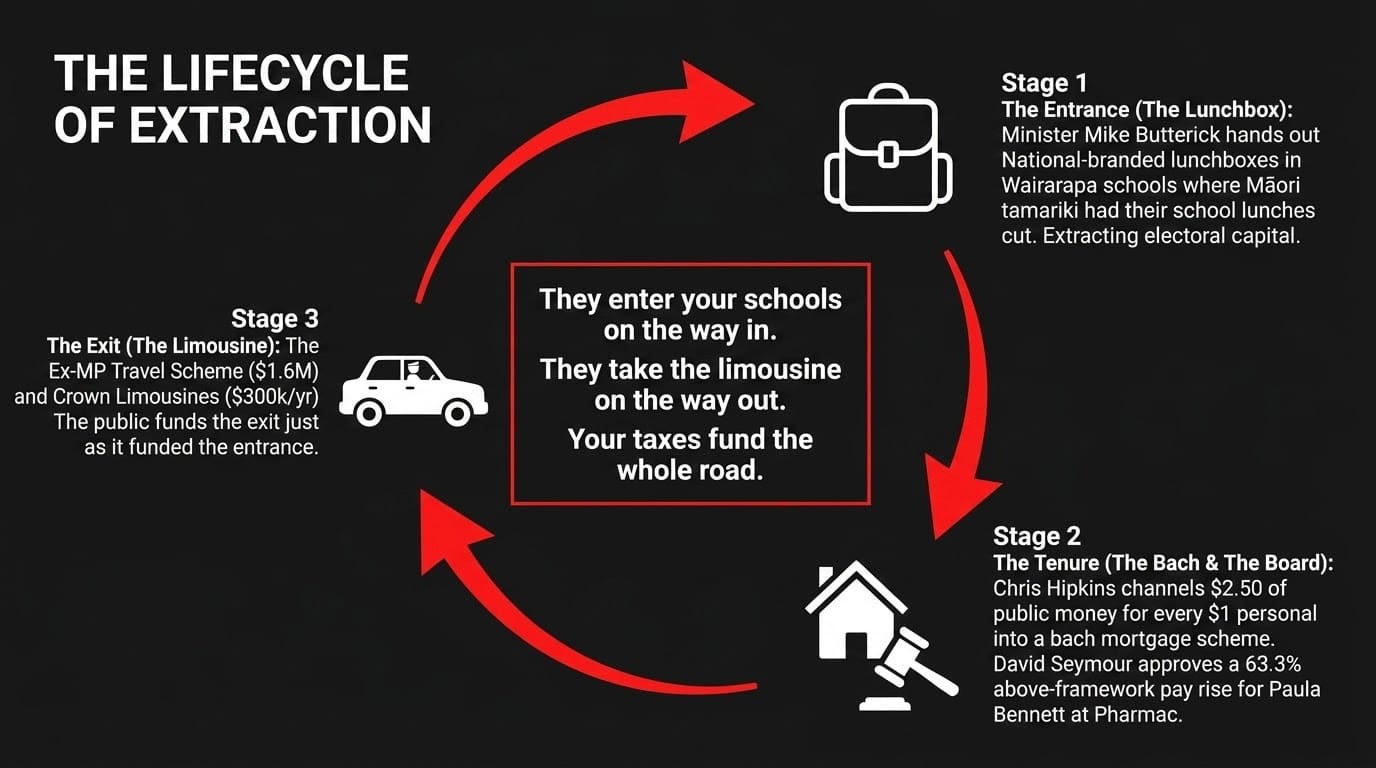
The claim: There is a symmetry so precise it reads as policy. As I documented in The Lunchbox Coloniser, Cabinet Minister Mike Butterick walked into schools across Wairarapa — schools serving Māori tamariki whose whānau this government has stripped of health infrastructure, te reo funding, and housing support — and handed out National Party branded lunchboxes, rulers, pens, and stress balls. Every item branded. Every school a captive audience. The children's own hands carrying the logo of the party that dismantled their futures.
The party enters your children's schools with branded lunchboxes on the way in. It exits with lifetime travel rebates and Crown limousines on the way out. Your taxes fund both ends of the journey. The children receive plastic. The former prime ministers receive chauffeured vehicles. Both are described as normal, appropriate, and within the rules.
Quantified harm: Butterick won Wairarapa by 2,816 votes — a 6.3% majority in an electorate of 44,873, confirmed by the Electoral Commission 2023. Brand visibility across every school in the electorate, delivered through children, at undisclosed cost, under parliamentary cover, ahead of the 2026 election cycle, is not incidental community engagement. It is electoral infrastructure. Meanwhile, the same party's policies have subjected Wairarapa Māori tamariki to: dismantled health authority, $30 million cut from te reo, stripped section 7AA protections, cut school lunches — all documented, all sourced, all on the record.
Solution: A full independent audit of the costs of the Butterick school merchandise and its funding source. A formal Ministry of Education finding on whether the conduct violated political neutrality guidance for Crown educational institutions. A Speaker's ruling — published and binding — on whether parliamentary communications approvals extend to party-branded merchandise in Crown schools. If yes, change the rule. If no, recover the funding and issue consequences. Not a press statement. Consequences.
The tikanga impact for the Western mind: Kaitiakitanga — guardianship, stewardship — demands that those entrusted with power protect the spaces in their care, particularly those spaces where tamariki learn and grow. To enter a kura or a school serving Māori tamariki bearing the branding of the organisation that has systematically degraded their people's mana is not kaitiakitanga. It is the opposite — mana-destruction wearing a gift. The tamariki of Wairarapa knew it. The lunchbox ended up in the bin. The children rendered the verdict the Ministry of Education has not yet had the courage to issue.
This is the extraction at both ends. Follow the lunchbox to the limousine. They travel the same road. Read: The Lunchbox Coloniser
The Permanent Feeding — Whakapapa of the Machine
The four essays I have written in the days preceding this one are not separate investigations. They are chapters of a single document. Let me connect the threads precisely, because the architecture is only visible when you see all of it at once.
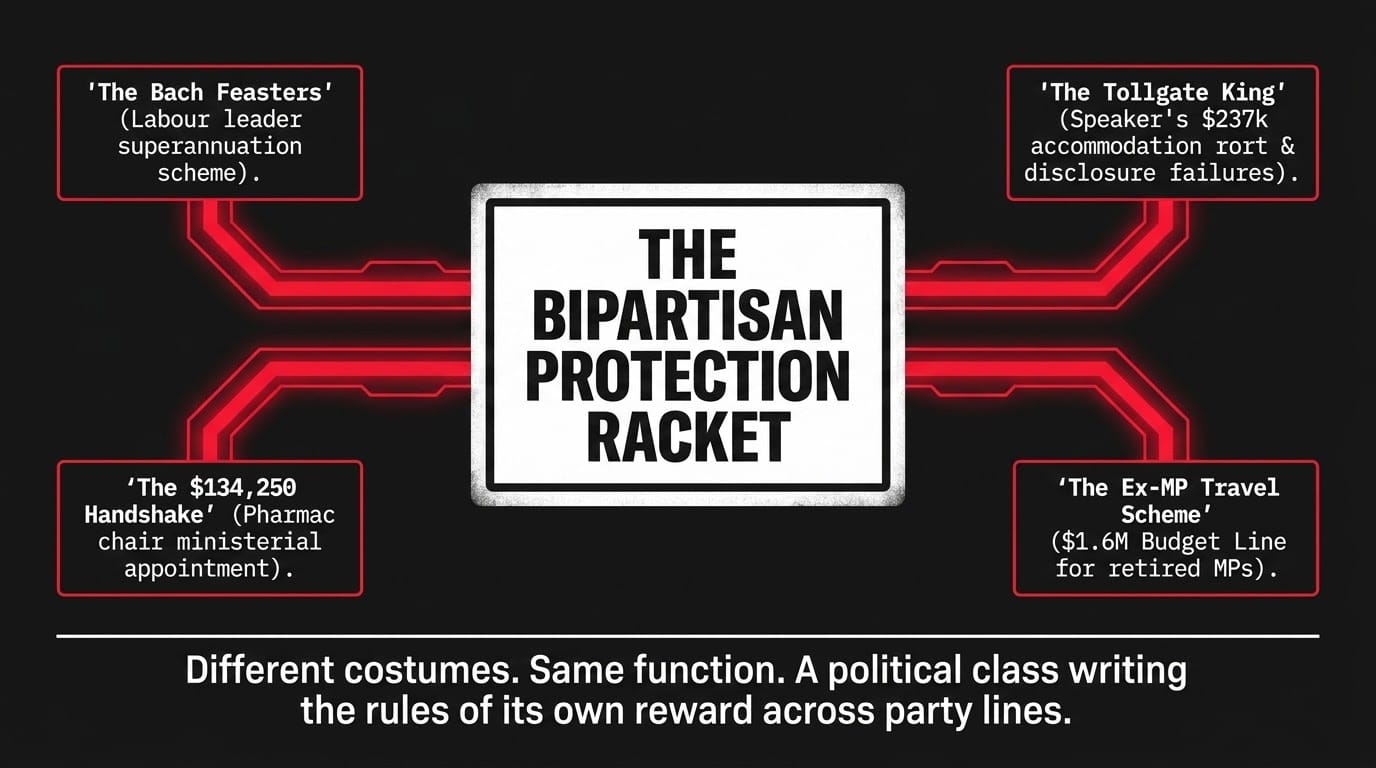
The Bach Feasters (9 June 2026): Labour leader Chris Hipkins directs his taxpayer-boosted superannuation — at $2.50 of public money for every personal dollar, up to $32,600 per year from the taxpayer — into a private retirement scheme named after the street where his family's coastal holiday home sits. He confirmed the scheme services the mortgage on that property. When asked whether this sat comfortably alongside his public arguments against housing speculation, Hipkins said: "I think that is a different conversation." It is not. It is the same conversation about who the rules of public wealth accumulation were written to serve. The ex-MP travel scheme is the Bach Feasters at a different lifecycle stage. The super scheme fattens the asset while you sit in Parliament. The travel rebate rewards you after you leave. The limousine idles outside while both are described as "very complex" by the current Prime Minister.
Gerry Brownlee — The Tollgate King (7 June 2026): The Speaker of the House claims $237,000 in accommodation allowances to stay in a mortgage-free property while earning $320,600. He files incorrect pecuniary interest declarations for twenty years. He threatens journalists investigating his colleagues. He suspends Parliament when Māori dare to sing a haka. He calls the haka "contemptuous" while processing $52,000 per year from the public purse into his private property portfolio. The Tollgate King holds the gavel over the chamber where every one of these entitlements is annually appropriated, defended, and renewed.
The Lunchbox Coloniser (6 June 2026): A Cabinet Minister enters Crown schools bearing party-branded merchandise to children whose whānau have been stripped of every material support this government could reach. The school felt "uncomfortable." The lunchbox ended up in the bin. The Ministry of Education issued no finding. The party branding has still not been audited.
The $134,250 Handshake (6 June 2026): David Seymour approves a 63.3% pay rise above framework rates for Paula Bennett — former National deputy PM, the party's largest-donation fundraiser — to chair Pharmac, despite no pharmaceutical background and no health sector board experience. The Ministry of Health's own briefing noted the fees sat "well above the revised Framework fee ranges." The service was not pharmaceutical expertise. It was political loyalty. The reward was above-framework remuneration. The mechanism was ministerial appointment. The architecture is identical to the ex-MP travel scheme — service to the party is a lifetime asset class. Different form. Same function. Same beneficiaries.
These are not four separate scandals. They are the same scandal in different costumes.
The travel rebate is the Bennett appointment is the Brownlee accommodation claim is the Hipkins bach mortgage is the Butterick lunchbox.
All of them are expressions of a political class that has spent thirty years writing the rules of its own reward, extracting under those rules across party lines, and responding to every exposure with the same three moves: complexity, working group, continuation.
That is not governance. That is a regime.
What "Complex" Actually Means in the Language of Power
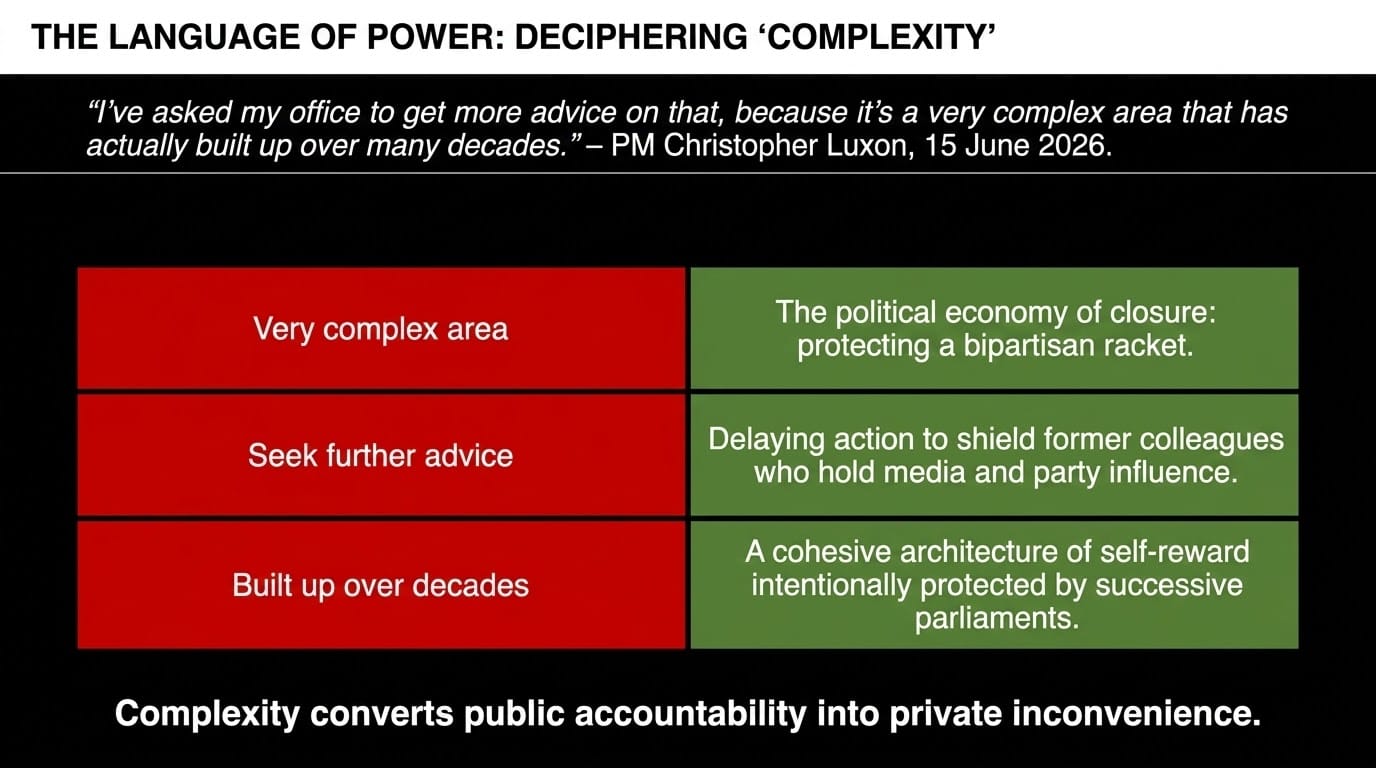
Luxon used the word "complex" twice in his post-Cabinet statement. Let us translate it precisely.
The ex-MP travel scheme is not complex in the sense of being technically difficult to resolve. It is a line item in the Budget. Line items can be zeroed. The scheme was closed to new entrants by Parliament in 1999. Parliament can close it entirely. There is no constitutional barrier. There is no Treaty obligation being served. There is no public interest argument that requires its continuation.
What is complex is the political economy of closure: the fact that former MPs still have party networks, media relationships, and social capital; the fact that current MPs know they exist in proximity to predecessors who still draw the benefits; the fact that reform in one area invites scrutiny across all areas; and the fact that scrutiny across all areas is precisely what the architecture was designed to prevent.
That is not complexity. That is a protection racket in parliamentary robes.
When Hipkins says, "Ultimately, it's my money" — channelling publicly subsidised super into his family's coastal bach — he is doing exactly what Luxon does when he calls the entitlement structure "very complex." Both sentences convert the same material: public accountability into private inconvenience. The complexity exists to protect the feeding from being seen clearly enough to be stopped.
And the bipartisan nature of the protection is the most revealing fact of all. Labour and National differ in rhetoric, in emphasis, and in the communities they flatter while passing through office. But when the self-preservation of the political class is at stake, both parties have shown a remarkable talent for finding reasons to leave the architecture exactly as it is. The highest travel rebate claimants include a former National PM and a former Labour PM. The Bach Feasters scheme belongs to a Labour leader. The accommodation rorts span both caucuses.
This is not an argument for apathy. It is an argument for structural demands that no party can satisfy by changing its communications strategy while leaving the Budget line intact.
Tikanga, Trough, and the Obligation That Was Never Discharged
In tikanga Māori, the rangatira who has led does not return to the pātaka while the people are still hungry from the first governance. Leadership carries relational obligation — to the hapū, to the whenua, to the mokopuna who will inherit what this generation's decisions leave behind. It is not a property right. It is a covenant. And when the covenant is broken, the title of rangatira does not travel.
The ex-MP travel scheme says something very different. It says: having held the mandate is itself a form of property. Not just a legacy. Not just a memory. An asset — redeemable at any airport, for life, at the public's expense, while:
- 112,000 whānau have nowhere to sleep
- Emergency housing costs are being raised for the poorest families
- $40 million has been stripped from Māori housing providers
- Tamariki are going to school in lunchboxes branded by the party that cut their school lunches
- Pharmac's Māori advisory functions have been stripped
- Te reo Māori funding has been gutted by $30 million
These are not in different conversations.
They are in the same Budget.
The same Parliament.
The same system.
And the same Prime Minister who approves the $1.6 million for former politicians' travel is the same Prime Minister who approved the Budget that stripped Māori housing, raised emergency housing costs, and cut te reo funding.
That is not coincidence. That is a value statement written in appropriations.
Five Demands, Not Suggestions — No Working Groups, No Further Advice
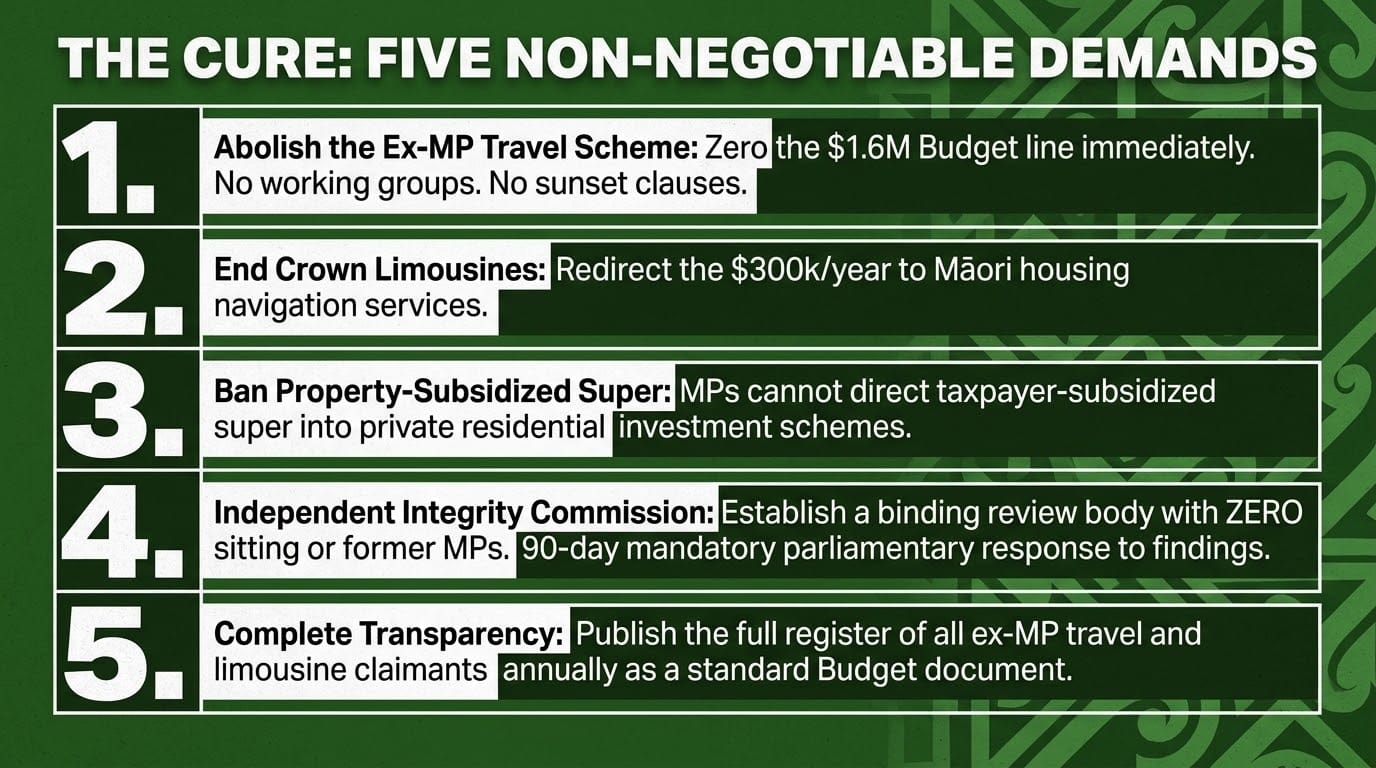
One: Abolish the ex-MP travel subsidy scheme in its entirety. Zero the $1.6 million Budget line. No sunset clause. No transition period. No working group. A Budget amendment. This Parliament. This year.
Two: End Crown limousine services for all former prime ministers and their spouses. This is not a security function — security is separate. It is a comfort arrangement costing $300,000 per year. Redirect those funds to Māori housing navigation services.
Three: Ban MPs from directing taxpayer-subsidised superannuation contributions into private schemes that own or service residential investment properties. The $2.50 per personal dollar public contribution was designed for retirement security — not for Raumati bach mortgage management. The rule change must apply prospectively, with full public disclosure of all existing arrangements.
Four: Establish a fully independent parliamentary entitlements review body with no sitting or former MPs on the panel, full public reporting, and binding — not advisory — authority to reform arrangements that Parliament must respond to on the floor of the House within ninety days of any finding.
Five: Publish the full register of all ex-MP travel and limousine claimants, amounts claimed, and funding sources as a standard Budget transparency document, every year, permanently. The public funds it. The public names it. The public owns the information.
Previously Covered by The Māori Green Lantern
This essay is part of a sustained investigation. The whakapapa is deep. Read the full record:
- The Bach Feasters (9 June 2026) — How Chris Hipkins channels your tax money into his coastal holiday home
- Gerry Brownlee — The Tollgate King (7 June 2026) — The Speaker's $237,000 rort, the press threats, the haka, the 20-year disclosure failure
- The Lunchbox Coloniser (6 June 2026) — How Mike Butterick used your tamariki as electoral infrastructure
- The $134,250 Handshake (6 June 2026) — How David Seymour rewarded Paula Bennett with a 63.3% above-framework pay rise
- The Landlord Parliament — How coalition MPs voted themselves rich while whānau slept in cars
- The Whare Is On Fire and the Government Is Handing Out Fines — Budget 2025, $40 million, 112,000 whānau
- The Traffic Light Taiaha — The punishment machine built for the people this government threw out of work
🌿 Koha — Because The Limousine Is Funded. So Should Be Your Truth Teller.
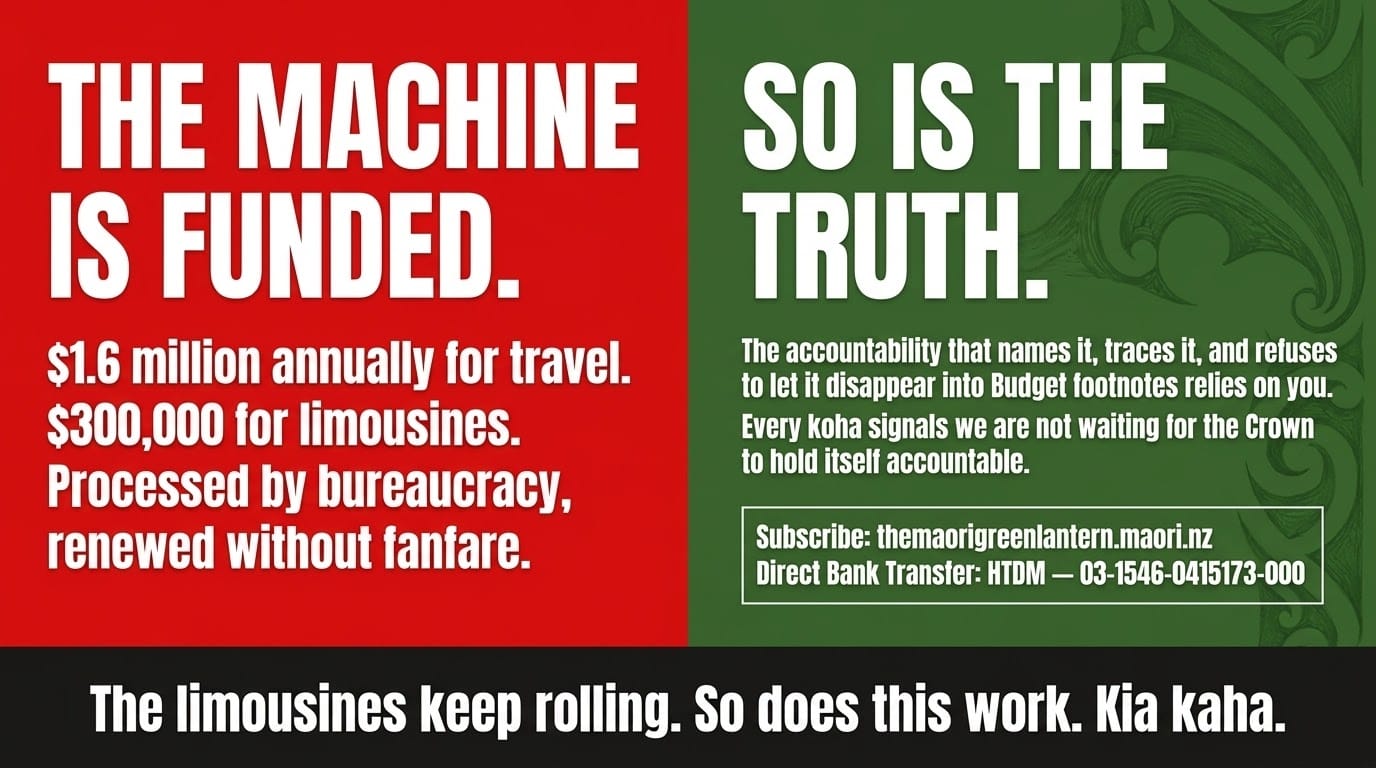
The Crown limousines are funded — $300,000 per year, appropriated in the Budget, processed by the bureaucracy, delivered to former prime ministers' doors. The ex-MP travel scheme is funded — $1.6 million this year, renewed without fanfare, drawn down without press coverage, absorbed into the permanent architecture of political self-reward.
This essay — this investigation, this taiaha — is funded only by whānau who understand that rangatiratanga includes the power to pay for our own truth tellers.
Every koha signals something they cannot legislate away: that we are not waiting for the Crown to hold itself accountable.
The $1.6 million in travel rebates for former politicians is funded annually. The accountability that names it, traces it, and refuses to let it disappear into the Budget footnotes needs to be funded too.
That is your koha. That is what it does.
If you are able, whānau, please consider supporting this mahi through one of four pathways:
🤝 Koha directly — voluntary contribution:
app.koha.kiwi/events/the-maori-green-lantern-fighting-misinformation-and-disinformation-ivor-jones
📩 Subscribe and receive essays directly to your inbox:
themaorigreenlantern.maori.nz/#/portal/support
🏦 Direct bank transfer:
HTDM — 03-1546-0415173-000
📘 Follow and share on Facebook:
facebook.com/Themaorigreenlantern/subscribe
If you cannot koha right now — no worries, not even a little. Subscribe. Follow. Kōrero with your whānau and friends. Share this essay. That is koha in itself. Every pair of eyes on this mahi is a challenge to the silence they depend on. Every share is a taiaha placed in someone else's hands.
Kia kaha, whānau. Stay vigilant. Stay connected.
The limousines keep rolling. So does this work.

✍️ Ivor Jones | The Māori Green Lantern | 16 June 2026 | Ōpōtiki, Bay of Plenty, Aotearoa: Te Arawa, Ngāti Pikiao | Welsh whakapapa
⚖️ Legal disclaimer: Published in the public interest (NZ Defamation Act 1992, s19). All named individuals are discussed in their public capacity as current or former public officeholders. All financial figures are sourced from verified published reporting cited throughout. Opinions are clearly identified as opinions and grounded in disclosed facts. Qualified privilege applies (Lange v Atkinson 3 NZLR 385). Right of reply extended to all named parties. Any factual corrections actioned within 48 hours of notification.