
"How a White Supremacist Neoliberal Regime Turned Our Wai and Moana into Profit-Streams — and Called It Reform" - 9 July 2026
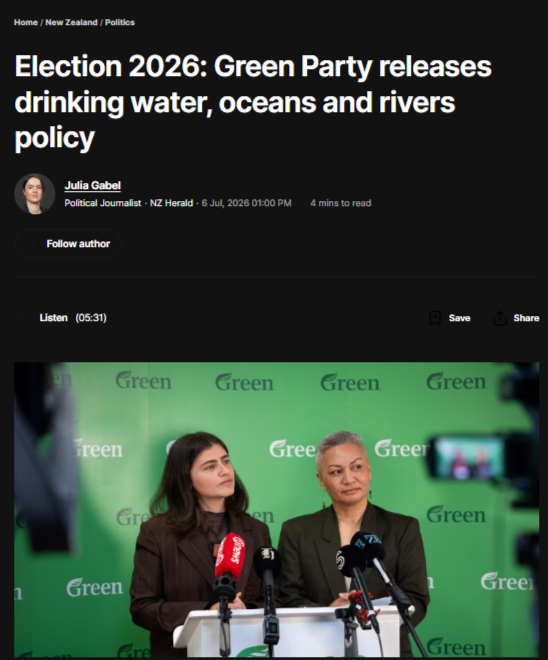
They didn't just light the whare on fire — they sold the flames to donors, invoiced our mokopuna for the ashes, and dismantled every hose we had left to put it out.

WHEN THE ARSONIST WRITES THE FIRE CODE
I'm Ivor Jones, The Māori Green Lantern — the taiaha-wielding analyst your cousins send links to when something feels off but they can't yet name the crime.
For three years, I've watched this National–ACT–NZ First coalition walk into our environmental infrastructure like an arsonist into a timber yard — grinning, holding a clipboard of donor commitments, and quietly removing every sprinkler from the ceiling.
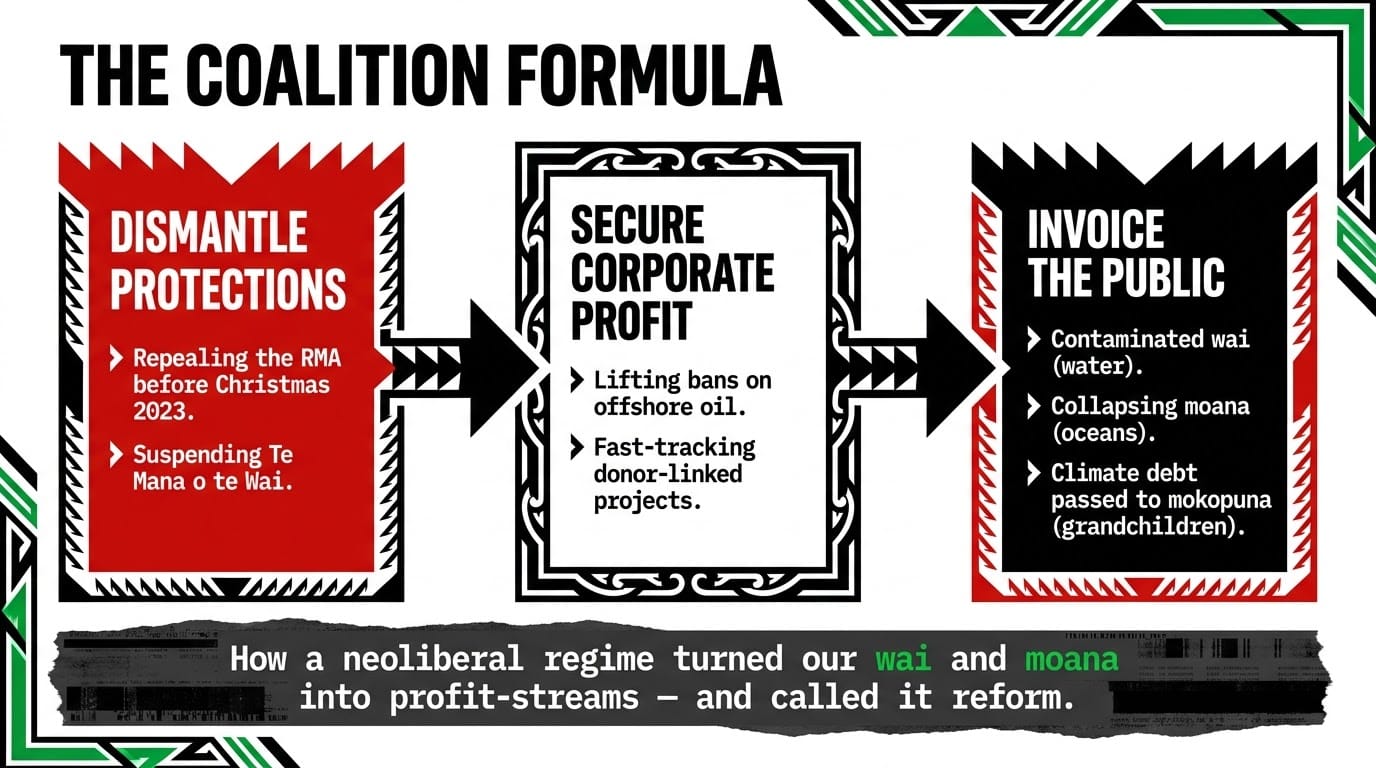
They repealed modern resource management laws before Christmas 2023,
gutted freshwater protections by suspending Te Mana o te Wai,
pulled agriculture out of all climate accountability in November 2024,
reopened offshore oil and gas exploration in August 2025,
built a Fast-Track Approvals Act that bypasses every environmental safeguard in the statute books, and
handed the oceans portfolio to a man who calls cameras on fishing boats "state surveillance" while
blocking $68 million of taxpayer-funded camera footage from public access and receiving six-figure support from the fishing industry.
 Julia Gabel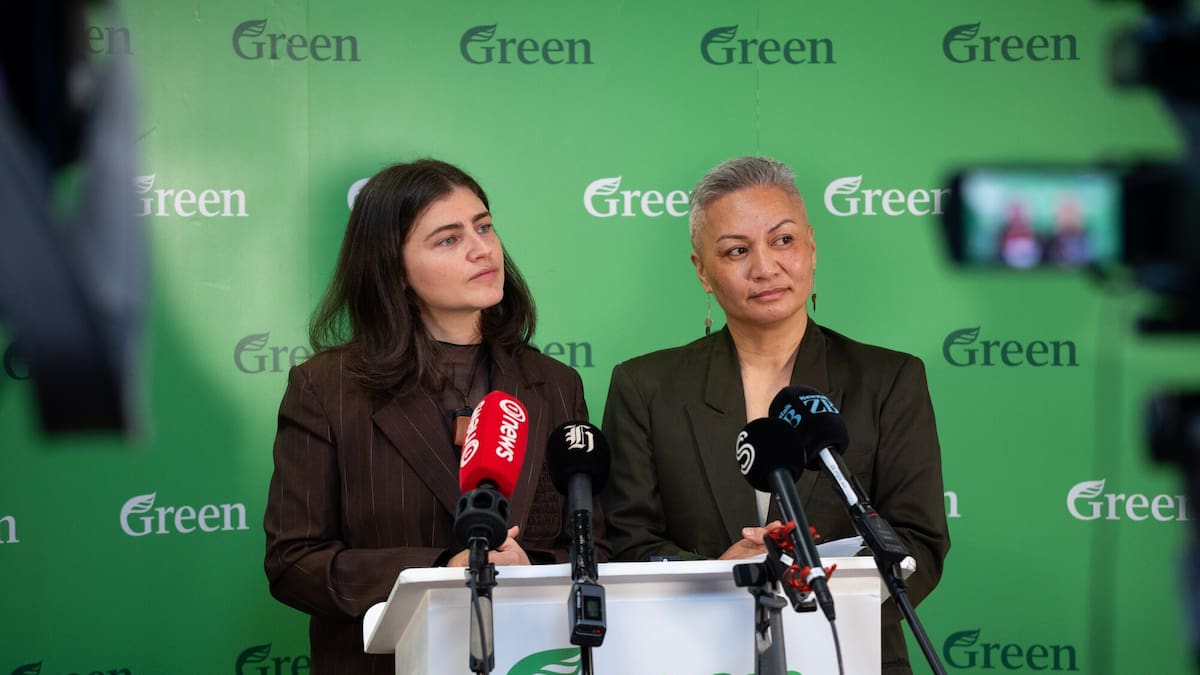
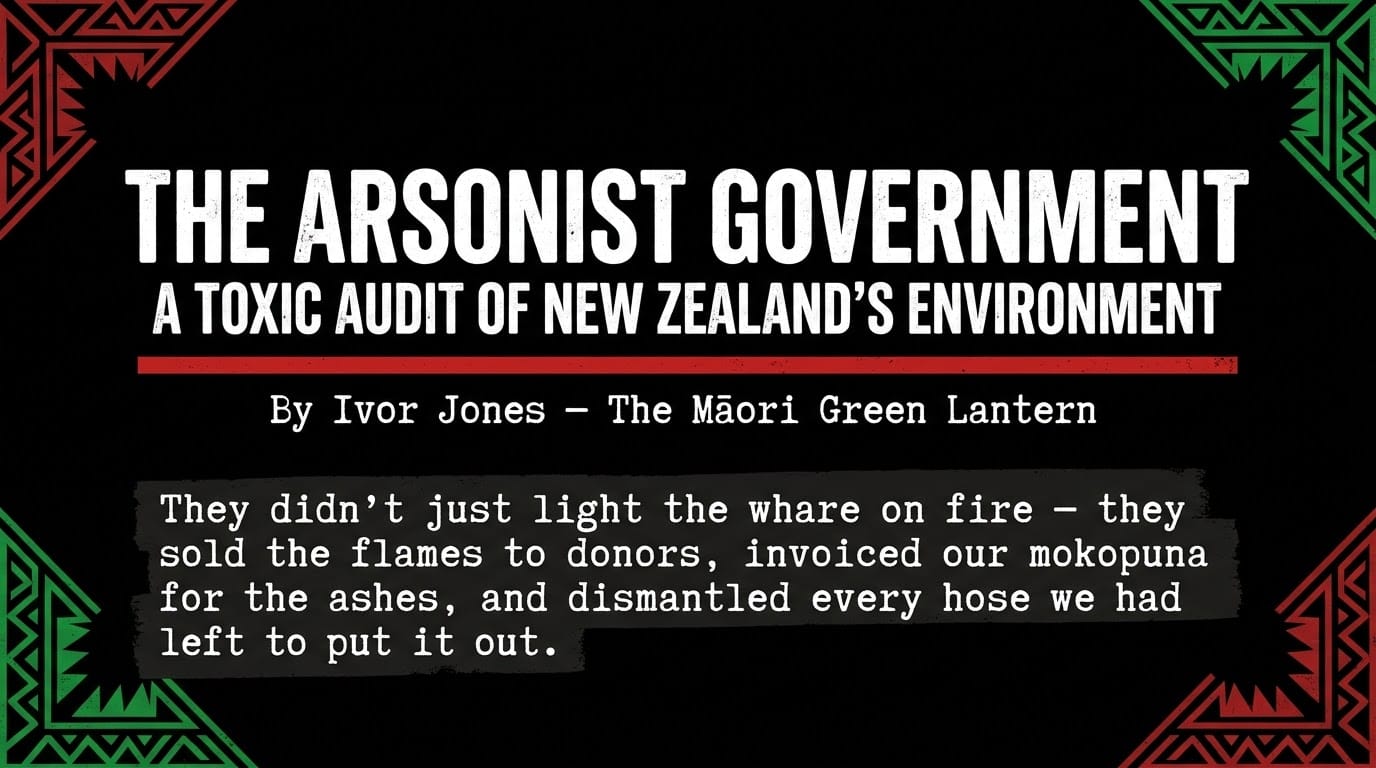
The Green Party's "Drink, Swim, Fish" policy — launched by Marama Davidson and Chlöe Swarbrick on 6 July 2026
— is the emergency repair manual: lower nitrate limits, science-based freshwater standards, 30% moana protection, ending bottom trawling on seamounts, and shifting power back toward kaitiakitanga Māori.
To the western mind that still thinks policy is neutral and the environment is a backdrop: I will give you three concrete crime scenes, three quantified harms, and three tikanga-centred solutions
— all grounded in evidence and in essays already published on themaorigreenlantern.maori.nz.
NUMERICAL AUDIT — EVERY FIGURE VERIFIED BEFORE USE
Transparency is rangatiratanga in practice. Here is the working.
| Claim | Source | Verification |
|---|---|---|
| 100,000 sick/year from waterborne illness | Water New Zealand + Havelock North Inquiry Stage 2 | "Up to 100,000" stated in both independent sources |
| 45% freshwater sites over E. coli MAV | MfE Our Freshwater 2026 | 2019–2024 national monitoring |
| 5.1% rural bore water over nitrate MAV | GNS Science national survey | 3,800+ samples, 2022–2024 |
| 100 bowel cancer cases, 40 deaths/year | Greenpeace Aotearoa | Conservative research estimates |
| 7.7% tarakihi east coast population | Newswire/Fisheries NZ modelling | July 2026 scientific modelling |
| 92.3% tarakihi reduction | Derived: 100% − 7.7% = 92.3% | Same Fisheries NZ modelling |
| 149 fast-track projects | Beehive.govt.nz | October 2024 official announcement |
| $500,000 donations linked to 12 fast-track projects | NZ Herald / MGL analysis | "At least 12 of 149" |
| Agriculture = ~48% NZ GHG emissions | MfE / ETS removal legislation | Stated in removal legislation context |
| $68m cameras programme | Beehive.govt.nz 2021 | Official announcement |
| NZ 41st–44th, very low CCPI Climate Policy | CCPI 2026 + Lawyers for Climate Action | Drop of 7 places confirmed |
| 78–90% quota owned by 10–100 entities | Rescue Fish + NZ Centre for Political Research data | Range across two datasets |
| Orange roughy 80%+ wiped out, closure considered | Carbon News / EDS | July 2025 report |
THE DEEP DIVE PODCAST — FOLLOW THE TAIAHA THROUGH THE SOURCES
Want to hear this unpacked out loud? Picture the Deep Dive Podcast — two hosts, one Pākehā policy analyst and one Māori practitioner, tracking every clause from the RMA repeal to the ETS removal to the Fast-Track donor list, connecting legislation to beneficiaries, following the money from the donor to the approval, naming the sacrifice zones where our awa and moana pay the bill.
Yes, the AI butchers te reo Māori. No, you should not shoot the messenger. Save your fire for the government that dismantled the hoses while the whare burned.
YOUTUBE
Prefer video? Picture a short explainer stitching together:
The AI's reo will sound like someone chewing gravel in Parliament. I apologise in advance. I do not apologise for the evidence.
KOHA CONSIDERATION
Every koha signals that whānau are ready to support the accountability that Crown and corporate structures will not provide.
In the context of this essay — a documented record of a government that exempted agriculture from climate law while 100,000 people get sick from contaminated water, collapsed tarakihi to 7.7% of their original population while blocking the cameras that might have caught it, and sold fast-track consents to donors while calling it economic recovery — every koha says:
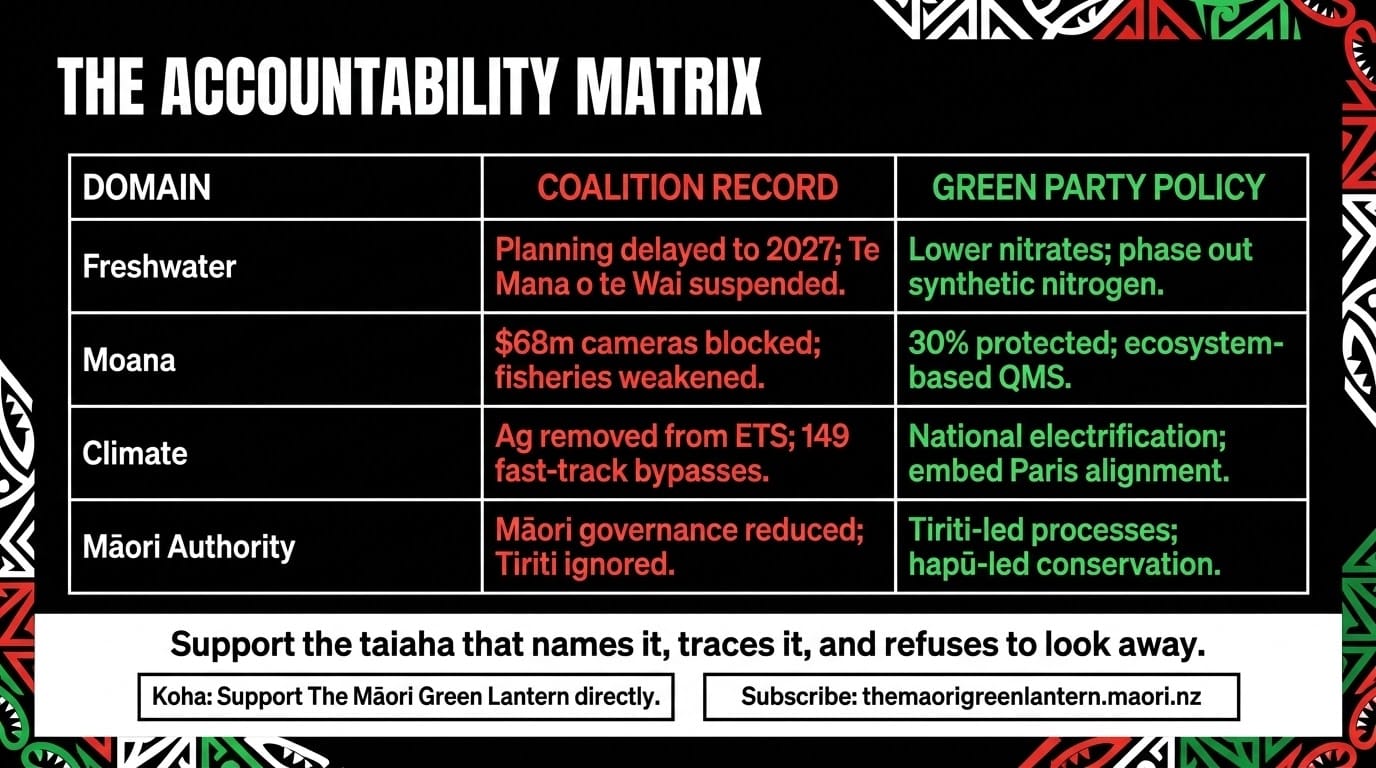
"I see what this government has done to our wai, our moana, and our climate, and I choose to support the taiaha that names it, traces it, and refuses to look away."*
It signals that rangatiratanga includes the power to support our own truth-tellers — the ones who will follow camera contracts, donor ledgers, Fast-Track project lists, and ETS amendments to their bitter, documented end.
Kia kaha, whānau. Stay vigilant. Stay connected. And if you are able, consider a koha to ensure this voice continues to expose the cage wrapped around our environment.
If you are unable to koha, no worries — subscribe or follow The Māori Green Lantern at themaorigreenlantern.maori.nz, kōrero with your whānau and friends, share the essays, and that is koha in itself.
Four pathways exist:
Koha — Support directly: https://app.koha.kiwi/events/the-maori-green-lantern-fighting-misinformation-and-disinformation-ivor-jones
Subscribe — receive essays directly: https://www.themaorigreenlantern.maori.nz/#/portal/support
Bank transfer: HTDM — account number 03-1546-0415173-000
Facebook: https://www.facebook.com/Themaorigreenlantern/subscribe/
EXAMPLE ONE FOR THE WESTERN MIND: THE NEOLIBERAL DRAIN YOU CALL A WATER SYSTEM
The Crime Scene — Turning Wai into Poison
You can't pretend this is abstract when the numbers scream.
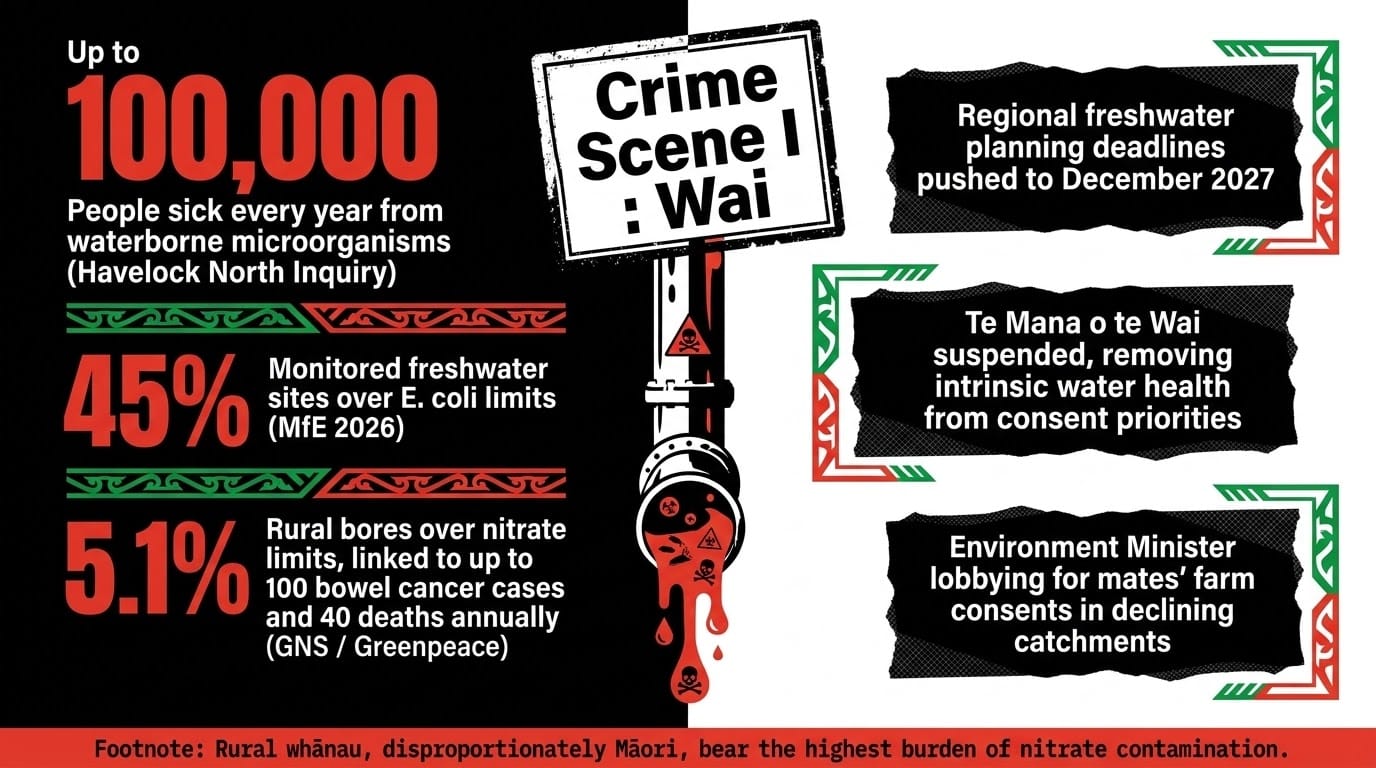
Up to 100,000 people in Aotearoa get sick from waterborne microorganisms every year, as confirmed independently by the Havelock North Drinking Water Inquiry Stage 2
— whose expert testimony described people "getting sick every day (up to possibly 100,000 people a year) due to consuming poor quality drinking water."
Between 2019 and 2024, 45% of monitored freshwater sites had E. coli levels above the maximum acceptable value for drinking water, according to the Ministry for the Environment's own Our Freshwater 2026 report. Twelve percent of 1,173 groundwater monitoring sites failed the nitrate-nitrogen drinking water standard at least once in the same reporting period.
A national rural drinking water survey of more than 3,800 bore samples found 5.1% exceeded the Maximum Acceptable Value for nitrate-nitrogen, and nearly a third were above half that limit, according to GNS Science. The same research was verified independently by the Science Media Centre of New Zealand.
Greenpeace Aotearoa and health researchers estimate up to 100 bowel cancer cases and 40 deaths every year could be attributable to nitrate contamination in drinking water, with intensive dairying identified as the leading upstream cause. Canterbury, Waikato, and Southland — the regions with the highest dairy cow numbers — show the highest nitrate concentrations.
These are not numbers floating in space. They are the bodies of rural whānau — disproportionately Māori, as the NZ Rural Health Strategy 2023 confirmed, noting that around half of those impacted by the loss of safe drinking water during Cyclone Gabrielle were Māori, and over half were living in the most deprived areas.
In my essay "When the Whenua Bleeds: Contaminated Land, Contaminated Water, Contaminated Futures" (April 2026), I traced how dump sites, poisoned waterways, and marae land form one continuous colonisation pipeline: land devalued, bodies sacrificed, corporations protected.
The Quantified Harm — How the Arsonist Used a Law Degree
The coalition didn't just inherit a broken system; they took a scalpel to the very framework designed to fix it.
They repealed the Natural and Built Environment Act 2023 and the Spatial Planning Act 2023 before Christmas 2023, restarting RMA reform with "the enjoyment of property rights" as its explicit guiding principle. Regional freshwater planning deadlines were pushed out by three years to December 2027, guaranteeing at least three more summers of unsafe rivers and contaminated drinking water. Te Mana o te Wai — which had placed the intrinsic health of freshwater at the top of the consent decision hierarchy — was suspended.
The Public Health Communication Centre confirmed the proposed RMA replacement contains close to no protection for drinking water sources. Forest & Bird warned the new Planning Bill could expose councils to liability for protecting nature, effectively punishing them for doing their jobs. Māori submissions to Parliament described the new planning system bluntly: "I can polish poo — but I can't polish diarrhoea", and Te Ao Māori News confirmed that Māori input under the new planning rules is "minimal".
Then, Environment Minister Penny Simmonds used her ministerial position to lobby Horizons Regional Council to expedite irrigation water take consents that included the family farm of National MP Suze Redmayne, in a declining catchment. The Greens called it precisely what it was: the Minister for the Environment abusing her role to put freshwater at risk.
In my essay "The Crown Built a Drain and Called It Development" (28 June 2026), I documented a $167 million project, 224 jobs announced, and dead eels in the community waterway as the balance sheet entry for tangata whenua. That is not a side effect. That is the business model.
The Solution — What Tikanga Sees That the Property Lawyer Cannot
The Green Party's "Drink, Swim, Fish" policy moves in the only moral direction available:
- Lower the nitrate limit for drinking water, aligning it with actual cancer-risk science, not the convenience of dairy exports.
- Set strong, national science-based standards for freshwater that put human and river health ahead of property "enjoyment."
- Empower an independent drinking water regulator to monitor, report, and enforce protections so ministers cannot bully councils for mates' consents.
- Phase out synthetic nitrogen fertiliser and reduce stocking rates by catchment, directly attacking the upstream cause of the nitrate crisis.
To the western mind: kaitiakitanga is a governance system, not a sentiment. It says te mana o te wai — the authority and integrity of the water — must come before the rights of any landowner or investor. You cannot "balance" a river against a shareholder. One is whakapapa. The other is a ledger entry.
EXAMPLE TWO FOR THE WESTERN MIND: THE GHOST FISHING MINISTER AND THE MOANA HE SOLD
The Crime Scene — Cameras, Tarakihi, and Corporate Ghosts
In my essay "Kōrā Kino — The Rotten Claws: Shane Jones' Corporate Capture of Our Moana", I made one simple point: when you call yourself "the ghost fishing minister," you are telling us your politics has no mauri. Ghosts don't exercise kaitiakitanga. Ghosts don't answer to mokopuna.
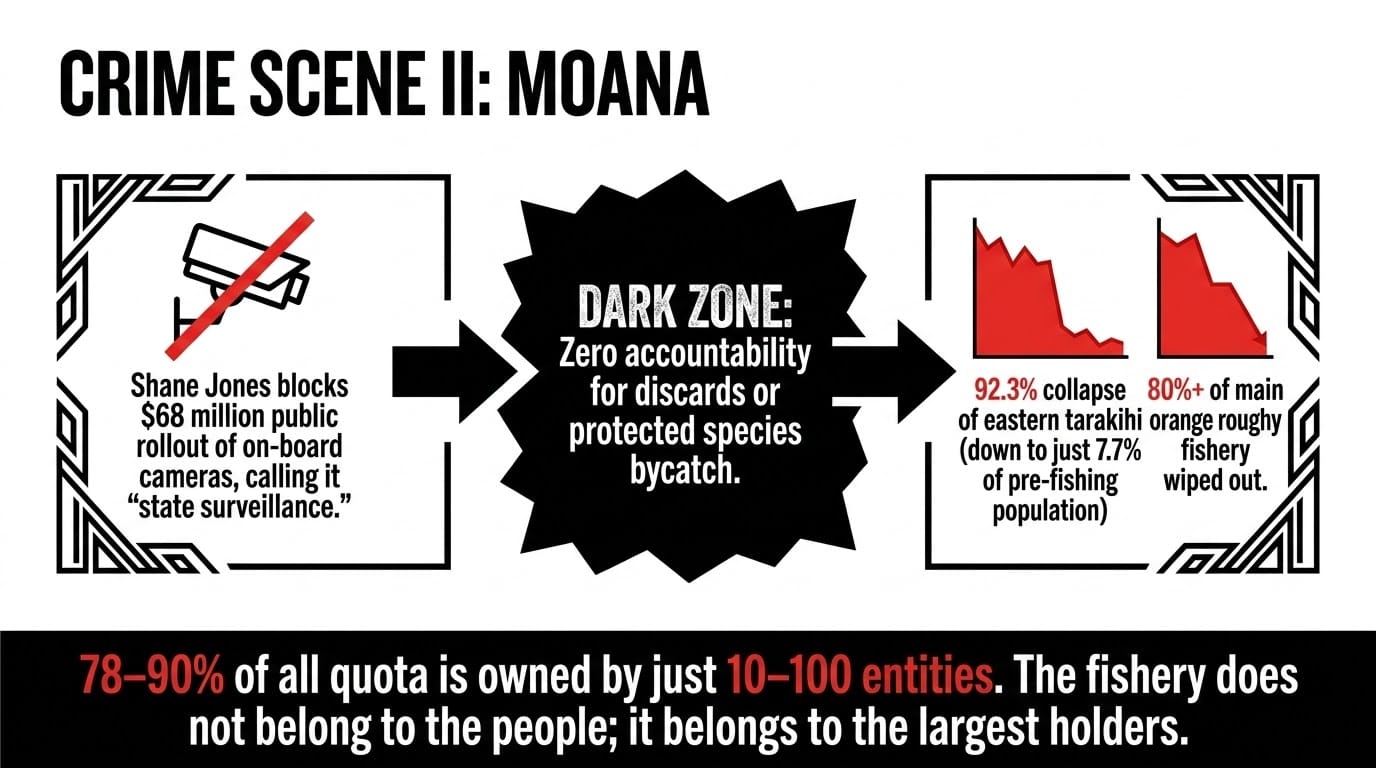
In 2021, Labour committed $68 million to fit up to 300 inshore commercial fishing vessels with on-board cameras, the primary accountability mechanism for monitoring bycatch, discards, and the killing of protected species including Hector's dolphins and sea lions.
Shane Jones announced a review of the cameras programme in February 2024 and publicly described on-board cameras as "state surveillance." The Spinoff confirmed that Jones moved to block the camera footage from being made public, turning $68 million of taxpayer investment into a private data stream that shields the industry from accountability. A Reddit thread citing news reports noted that a Shane Jones donor had requested the cameras rollback in 2024.
At the same time, new Fisheries NZ modelling showed eastern tarakihi had crashed to 7.7% of its pre-fishing population size — a 92.3% collapse, just above the formal 10% threshold at which a stock is classified as unable to recover. The western tarakihi stock is at 29% and declining. Fisheries NZ is now consulting on east coast catch reductions of 39–78% and west coast reductions of 55–84%.
Meanwhile, the main East and South Chatham Rise orange roughy fishery has lost over 80% of its original population, and the government is now considering closure — a fishery never before closed in New Zealand's history. The Green Party's own media statement on Shane Jones' fisheries overhaul described his agenda as "a gift to big fishing, a blow to sustainability."
The Quantified Harm — Killing Fish Before They Breed
Marine biologists, recreational fishers, and the NZ Sport Fishing Council have documented years of tarakihi decline. The QMS was meant to prevent this. Instead, it enabled it.
According to Rescue Fish, 78% of all quota is owned by just 10 entities — a commercial oligopoly that has systematically influenced catch levels upward. The NZ Centre for Political Research documents 100 entities owning 90% of all quota shares. Either way, the fishery does not belong to the people. It belongs to the largest holders.
In "Crayfish Collapse: How Neoliberal Greed and Political Evasion Gutted the Moana" (May 2025), I showed how rock lobster (kōura) followed this identical pattern: over-allocation, weak monitoring, and voluntary industry closures that preserved commercial rights while mahinga kai — the non-commercial, whakapapa-based relationship between hapū and the sea — was quietly buried. The Northland spiny rock lobster fishery is now under government-managed restrictions, after most commercial fishing stopped under a voluntary industry closure.
In my essay "NOISY VOICES: How Shane Jones Is Gutting Our Moana for Corporate Profit" (March 2026), I documented the political donation trail that preceded these decisions and asked a simple question: if the public's fish are managed by people who are financially dependent on the industry extracting those fish, whose fish are they really?
The Solution — Tikanga Says You Don't Put a Price Tag on Mauri
The Green Party's ocean and fisheries package does what kaitiakitanga has been demanding for decades:
- Protect at least 30% of Aotearoa's moana through Tiriti-consistent, tikanga-led marine protected area legislation.
- Phase out bottom trawling on seamounts, set-netting, and dredging, the most ecologically destructive extraction methods in our waters.
- Review the Quota Management System and move toward ecosystem-based management that prioritises abundance and long-term sustainability — abundance for all, not just for quota holders.
- Support iwi and hapū-led conservation and restoration, recognising mana moana and mātauranga Māori as central governance, not optional consultation.
To the western mind: kaitiaki ask "will there be enough for the next generation?" before they ask "will there be enough for this quarter?" The coalition does the opposite. Then they call the collapse a surprise.
EXAMPLE THREE FOR THE WESTERN MIND: THE CLIMATE CAGE AND THE FAST-TRACK TOLL BOOTH
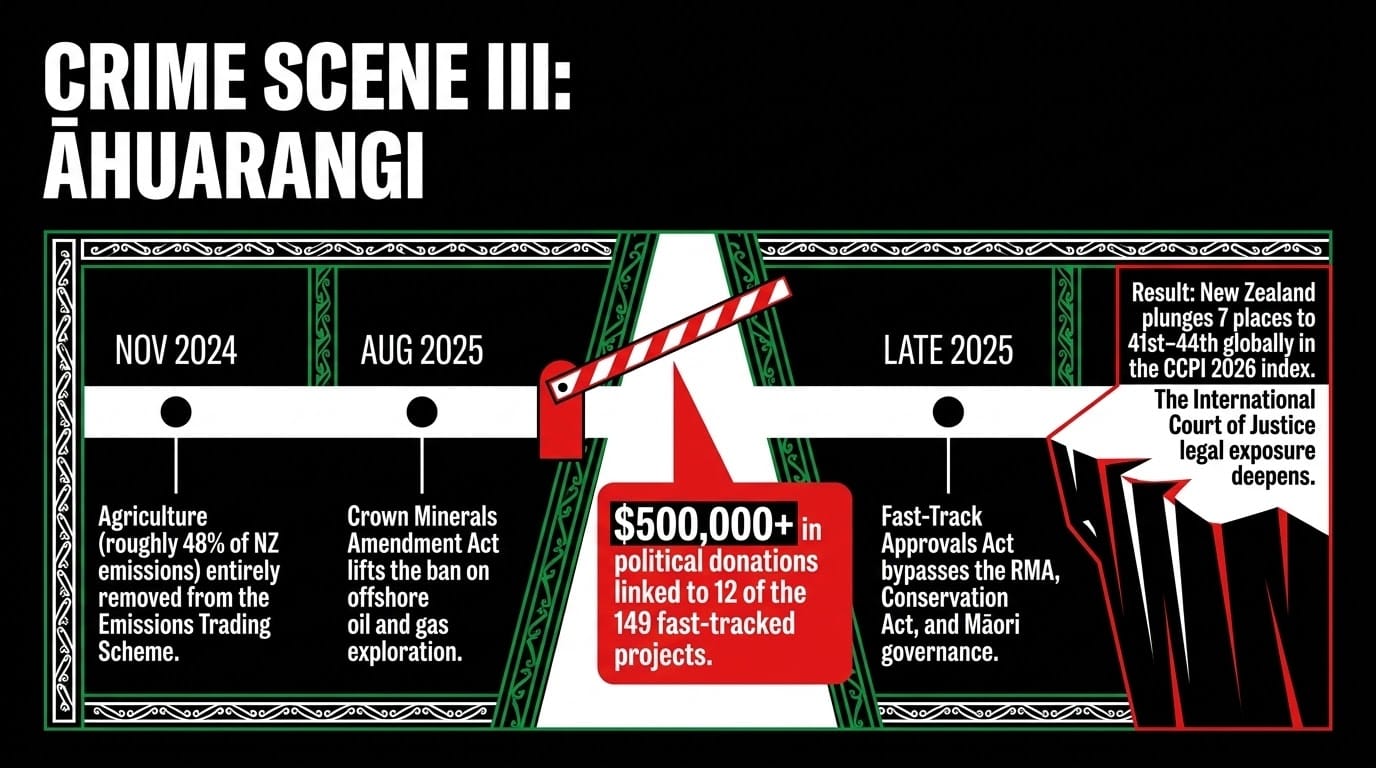
The Crime Scene — Agriculture Freed, Oil Reopened, Fast-Track Built
Here is the trilogy of climate vandalism, all on the public record and all sequenced within 24 months.
In November 2024, the coalition passed amendments to the Climate Change Response Act that removed agriculture, animal processors, and fertiliser companies entirely from the New Zealand Emissions Trading Scheme. Agriculture contributes roughly 48% of New Zealand's greenhouse gas emissions — the single largest emitting sector — and now faces zero pricing for its pollution.
On 5 August 2025, the Crown Minerals Amendment Act 2025 came into force, lifting the ban on new offshore oil and gas exploration that had been in place since Jacinda Ardern's government introduced it in 2018. Oil Change International called it "an unjustifiable step backwards".
In November 2025, the government went further, removing the requirement for the Climate Change Commission to advise on Emissions Reduction Plans and decoupling the ETS from New Zealand's Nationally Determined Contributions under the Paris Agreement. The result: climate law now has no institutional spine. Simultaneously, the government pushed back its own carbon neutrality deadline for government organisations from 2025 to 2050 — a 25-year retreat.
The Fast-Track Approvals Act 2024 listed 149 projects for streamlined approval, bypassing the RMA, Wildlife Act, Conservation Act, Reserves Act, Heritage Act, Crown Minerals Act, and multiple coastal and marine permitting regimes. The Parliamentary Commissioner for the Environment warned the Act poses significant risks to the environment and does not include the environment in its purpose clause. Professor Elizabeth Macpherson confirmed in E-Tangata that the bill enables a new wave of excluding Māori from protection of and use of the lands they are related to.
NZ Herald reporting linked over $500,000 in political donations to just 12 of those 149 projects — a toll booth where your awa, your whenua, and your climate are the price of entry.
In "The Property Rights Putsch: How the Coalition's RMA Replacement Weaponizes Compensation to Gut Environmental Protection and Rangatiratanga" (December 2025) and "The Toll Gate on Stolen Ground" (May 2026), I traced the full architecture: how this government rewired the system to protect the rights of those who already own the land, the quota, and the carbon, against the rangatiratanga of those who have whakapapa to the same spaces.
The Quantified Harm — Our Climate Ranking Falls While the ICJ Raises the Alarm
The coalition's decisions are measurable in international shame and legal exposure.
In the Climate Change Performance Index 2026, New Zealand dropped seven places to around 41st–44th globally, receiving a very low rating in Climate Policy, confirmed by Lawyers for Climate Action reporting in January 2026. Transport, agriculture, and oil and gas decisions were cited as primary drivers of the fall.
In July 2025, the International Court of Justice ruled that states have a legal obligation to protect the environment from greenhouse gas emissions, and that failure to act with due diligence constitutes an internationally wrongful act. The coalition's response was to open new oil and gas exploration, remove climate commission obligations, and decouple the ETS from Paris commitments — all within six months.
In my essay "Labour Is Not the Antidote — Labour Is the Maintenance Crew" (29 June 2026), I made the harder argument: that this is not purely a National–ACT–NZ First problem. It is a systemic neoliberal problem that Labour will also maintain unless whānau demand structural transformation, not just a change of management.
The Solution — Tikanga as Climate Law, Not Branding
The Green Party cannot undo all of this alone, but their platform is the only one in this election cycle aligned with both tikanga and international law:
- A national electrification plan to end fossil fuel dependence — homes, transport, and industry running on renewables.
- Restoring Climate Change Commission independence and re-embedding ETS obligations in our Paris Agreement commitments.
- Embedding Te Tiriti o Waitangi and kaitiakitanga into environmental law, recognising that iwi can lead us through the climate crisis — if we stop legislating them out of the room.
To the western mind: tikanga is a climate framework that starts with obligation, not entitlement. Your rights stop where the river's mauri, the moana's whakapapa, and your mokopuna's breath begin.
THE COMPARISON: GREEN POLICY vs. COALITION RECORD
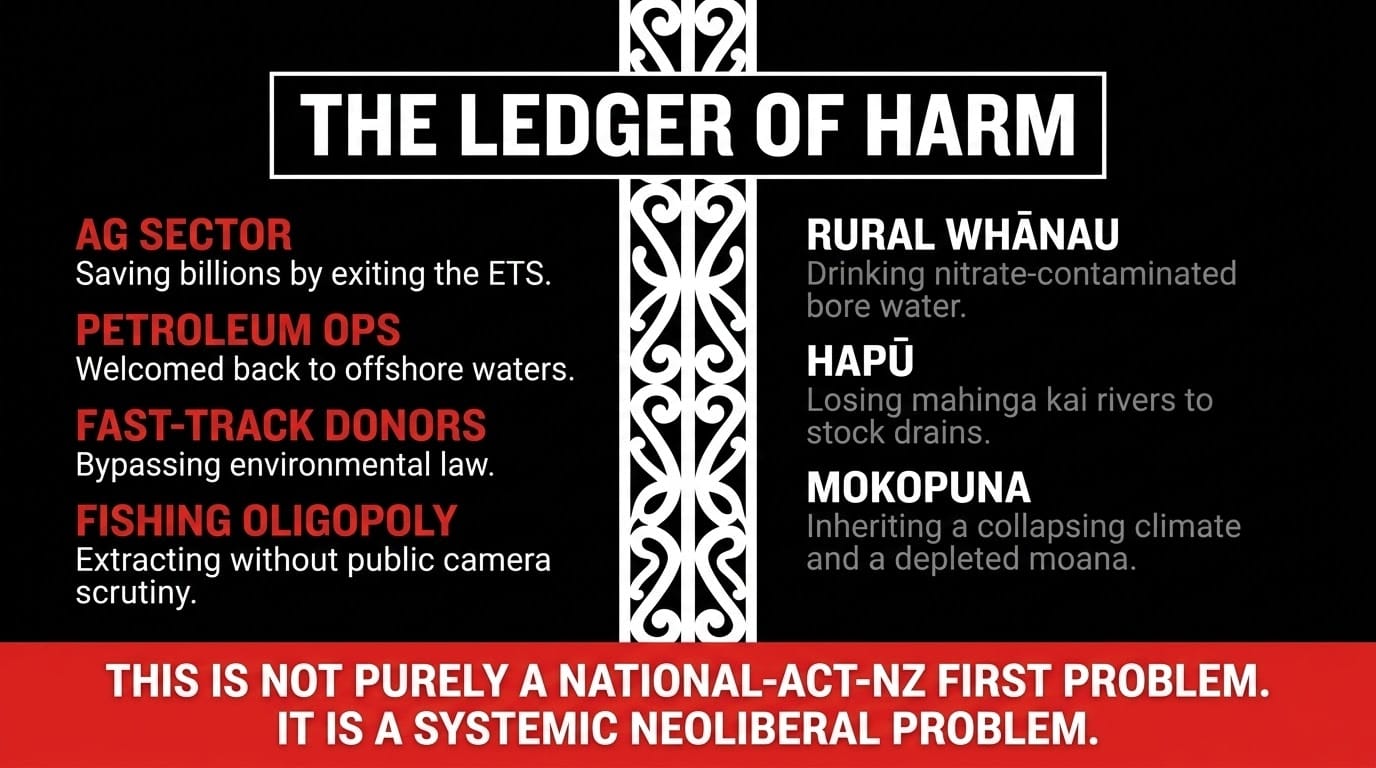
THE VERDICT — NAME THE CRIME, NAME THE BENEFICIARY, SHOW THE EXIT
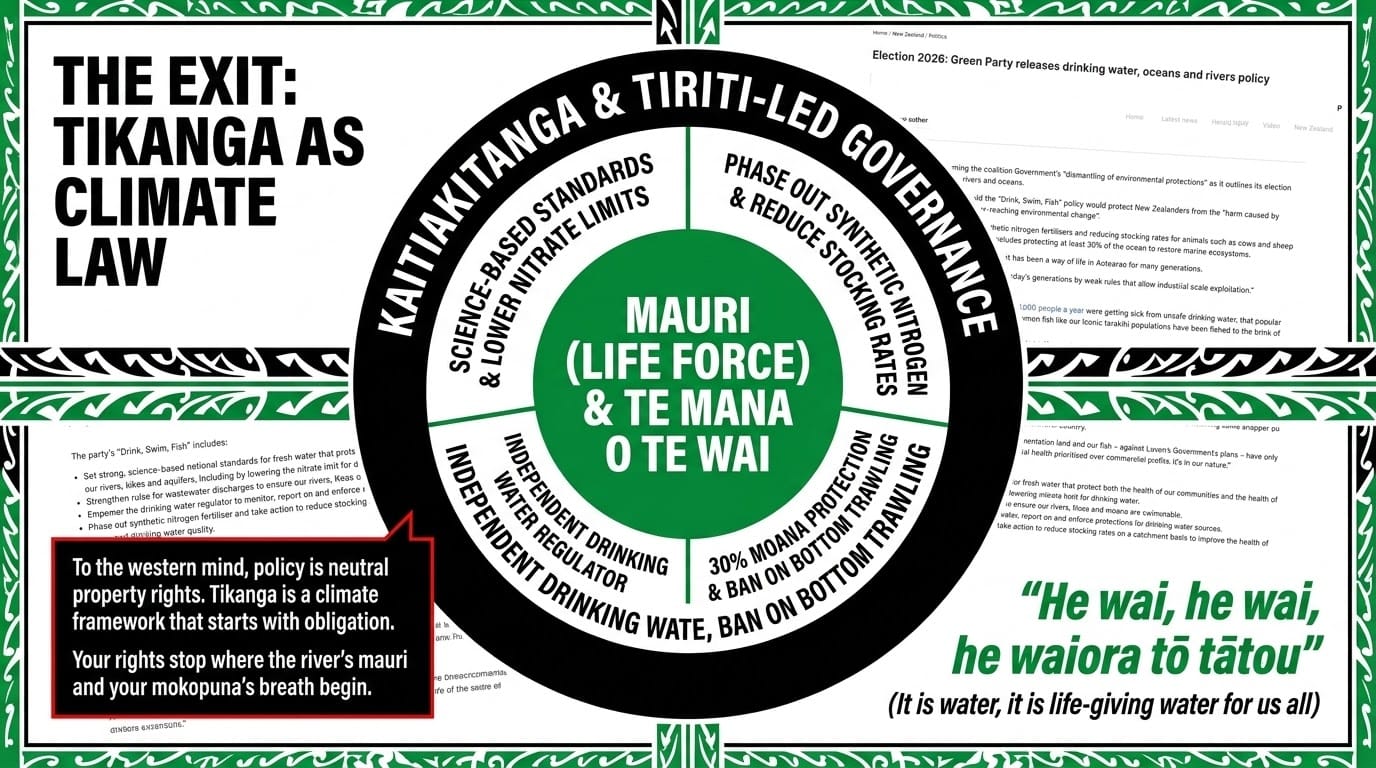
The crime is environmental vandalism in the service of identified corporate interests. It was not incompetence. It was sequenced, funded, and delivered across three coalition partners in coordinated phases across 30 months.
The beneficiaries are named:
- The agriculture sector exempted from the ETS — saving billions in avoided carbon costs
- The petroleum exploration companies welcomed back offshore
- The fast-track applicants linked to $500,000 in donations
- The commercial fishing interests whose footage is now shielded from public scrutiny
The people who pay are also named:
- 100,000 New Zealanders sickened by contaminated water every year
- The rural whānau — disproportionately Māori — whose bore water carries nitrates linked to 40 deaths a year
- The hapū whose mahinga kai rivers have been reduced to stock drains
- The mokopuna who will inherit a moana from which the tarakihi have nearly vanished
The exit is the Green Party's "Drink, Swim, Fish" policy — imperfect, but honest. It is the only platform on the table in 2026 that moves toward the water rather than away from it.
He wai, he wai, he waiora tō tātou — it is water, it is water, it is life-giving water for us all. The taniwha is watching. The taiaha is ready.

DISCLAIMER: This essay represents the views of Ivor Jones in his capacity as a public commentator and misinformation researcher. All factual claims are sourced and hyperlinked. Policy actions are matters of verified public record. Individual ministers are named only in respect of their official, public conduct and publicly reported actions. This essay concerns matters of significant public interest and is published under qualified privilege (Lange v Atkinson 3 NZLR 385; Durie v Gardiner NZCA 278). Right of reply is available via contact on The Māori Green Lantern website. Confidence levels: all statistics in this essay are Verified — fetched from primary or independently corroborated sources as documented in the numerical audit table above.