"Labour Is Not the Antidote. Labour Is the Maintenance Crew." - 29 June 2026
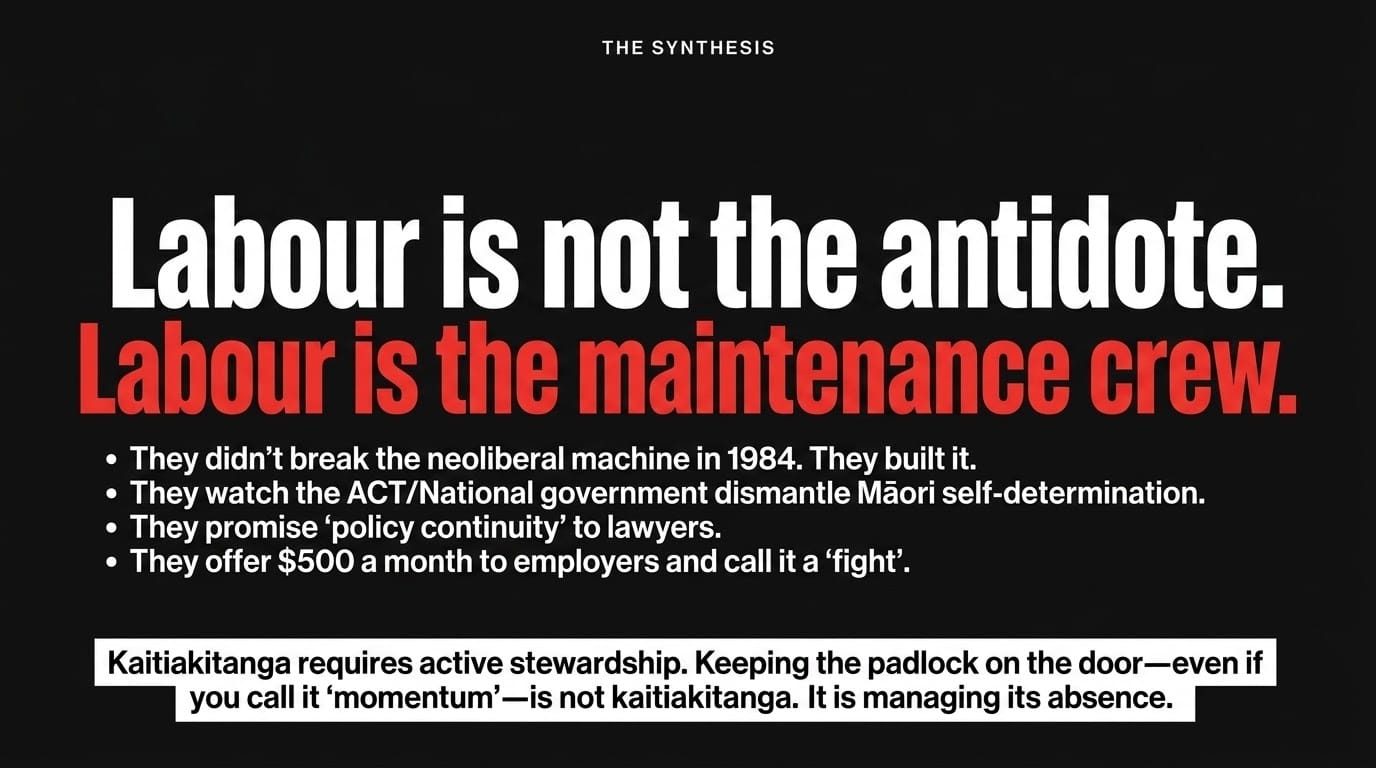
They didn't break the machine. They built it. They lost it. Now they want it back — and they're promising to keep it running.

He Whakatūwhera | The Opening Strike - THE POLISHED CHAIN
I have spent three years at this desk — Te Arawa, Ngāti Pikiao, Welsh whakapapa, living in the realm of Pākowhai — documenting what a white supremacist neoliberal government has done to our whānau: the dismantled Māori Health Authority, the gutted pay equity, the $2.9 billion gifted to landlords while 169,300 tamariki went hungry, the over $1 billion in Māori-targeted funding cut in three years, the 28 pieces of legislation designed to strip Te Tiriti from the bones of this country.
I documented all of it. I named all of it. I sourced every number.
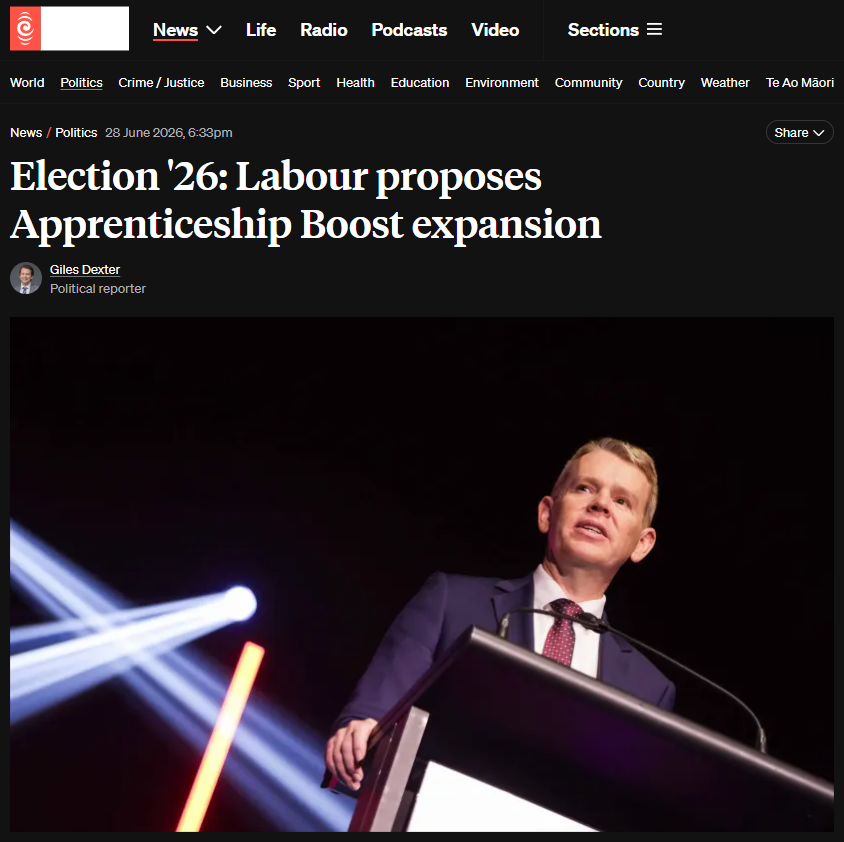
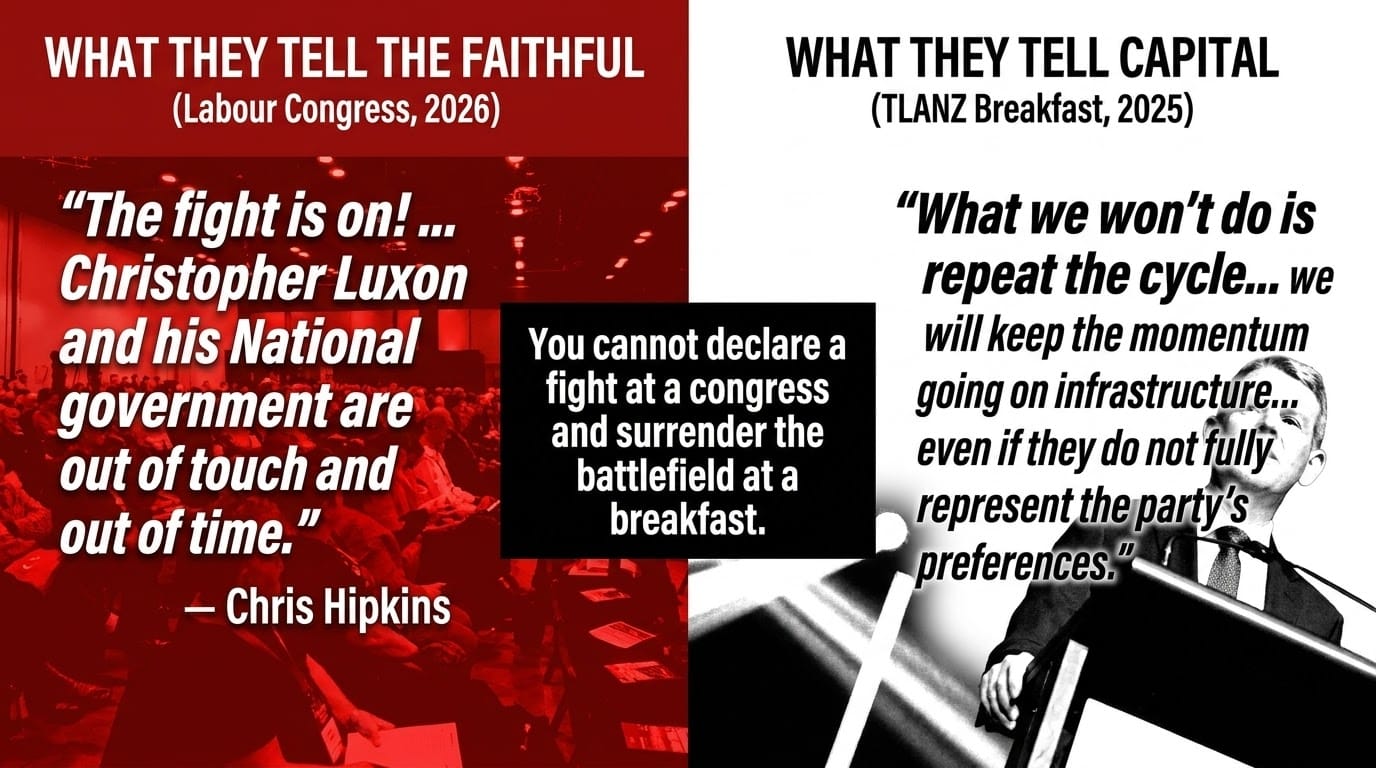
And now Chris Hipkins stands up at the Labour congress and says: "The fight is on!"
 RNZ | Te Reo Irirangi o Aotearoa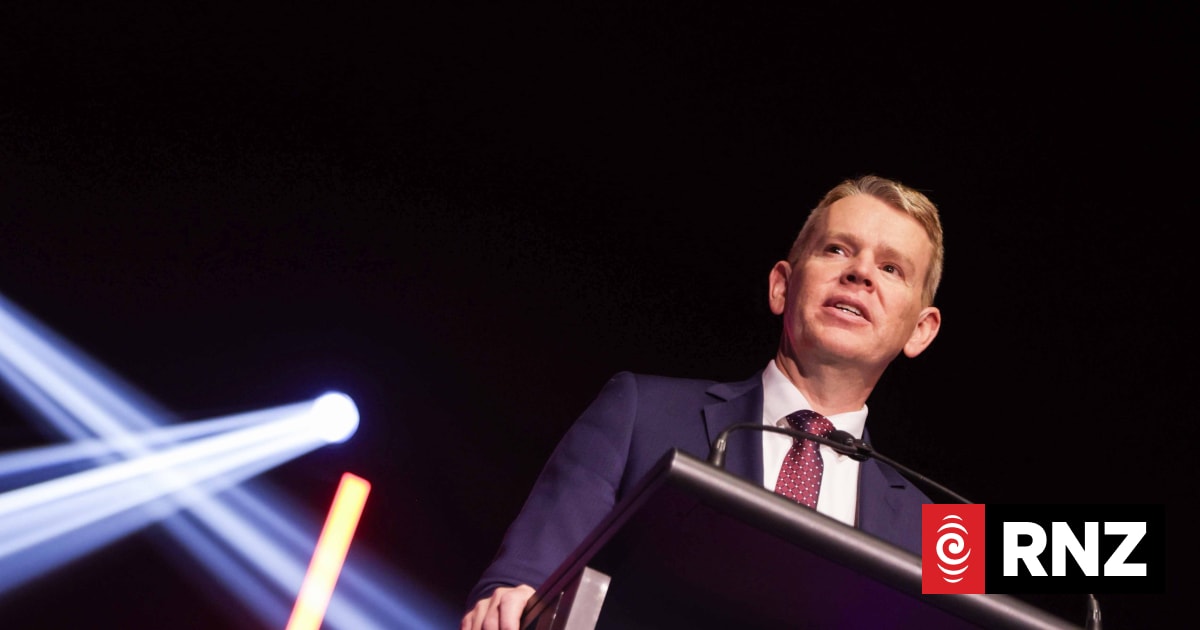
No, Chris.
The fight was on while you were telling lawyers in September 2025 that you would keep the infrastructure decisions of the government that did all of that.
The fight was on while you were pledging "policy continuity" to guests at a TLANZ breakfast.
The fight was on while you defended a $32,600-a-year taxpayer top-up flowing into a private super scheme that owns your holiday home and said
— on record, into a microphone — "Ultimately, it's my money."
The fight is not on, Chris. The trough is on.
Red or blue. Same trough. Same hands.
🎙️ The Deep Dive Podcast
Listen to a lively conversation between two hosts unpacking and connecting the sources of this essay. I apologise in advance for the AI's very harsh pronunciation of te reo Māori — please don't shoot me! 😄
For sourced essays on all these topics, go to themaorigreenlantern.maori.nz
📺 YouTube Video
Like video? Here is a short video supporting this essay. Again — don't shoot the messenger for AI pronunciation! 😄 The taiaha is accurate even when the vowels aren't.
💚 Koha — He Mihi Motuhake
Every time 23.9% of tamariki Māori remain in poverty while a Labour leader tells lawyers he will "keep the momentum going" on the decisions of the government that caused it — this mahi matters.
Every sourced essay, every verified number, every named name is a direct act of rangatiratanga: the power to support our own truth-tellers when the Crown will not.
This essay — and every essay on this site — is supported only by whānau. Not by Labour. Not by National. Not by the Auckland Business Chamber. By you.
If this taiaha has landed, consider supporting it:
Four pathways:
💚 Koha directly: https://app.koha.kiwi/events/the-maori-green-lantern-fighting-misinformation-and-disinformation-ivor-jones
📬 Subscribe and receive essays directly: https://www.themaorigreenlantern.maori.nz/#/portal/support
🏦 Direct bank transfer: HTDM — 03-1546-0415173-000
📣 Facebook: https://www.facebook.com/Themaorigreenlantern/subscribe/
If you are unable to koha — no worries at all! Share this essay with your whānau and friends. Kōrero about it. That is koha in itself. Rangatiratanga includes the power to support our own truth-tellers. Every share signals that whānau are ready for the accountability that Crown and corporate structures will not provide.
Kia kaha, whānau. Stay vigilant. Stay connected.
Te Tūāhuatanga | The Extended Metaphor
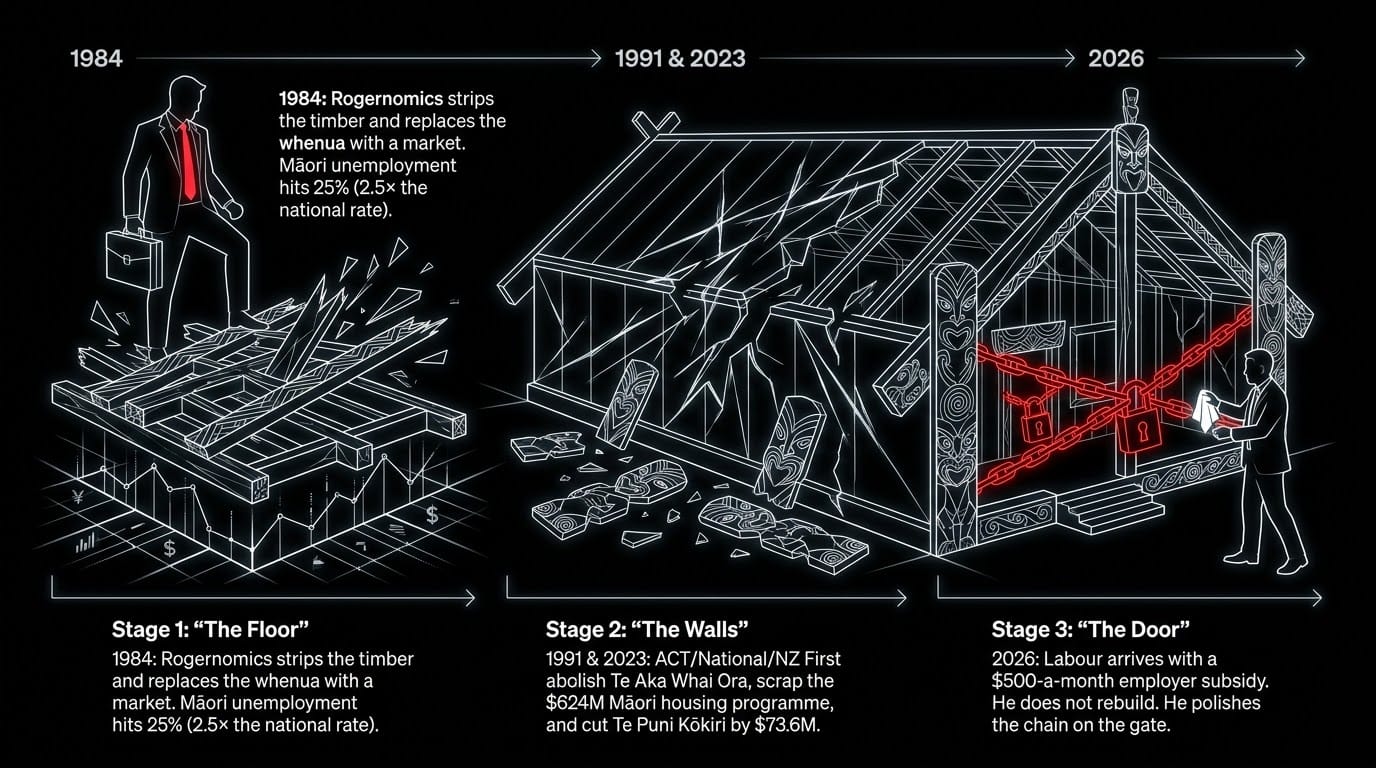
Picture a wharenui. It has been standing for generations. Its carvings are the faces of tūpuna. Its beams hold the weight of whakapapa. Its floor is the whenua.
In 1984, a man with a briefcase — Roger Douglas, Labour Finance Minister — walked into that wharenui and stripped it. He sold the timber. He privatised the carvings. He replaced the earthen floor with a market.
He told the people: this is progress. This is efficiency. This is freedom.
What he meant was: this is someone else's house now. Bidding starts at whatever they can afford.
Māori unemployment soared to 25% by the time Douglas was done, while the national rate sat at 10% — 2.5 times the rate of anyone else. That is not a coincidence. That is who takes the first hit when the floor is sold.
National came in 1991 and slashed the remaining walls. ACT/National/NZ First arrived in 2023 and abolished the Māori Health Authority, scrapped the $624 million Māori housing programme, cut Te Puni Kōkiri by $73.6 million, and handed $2.9 billion to the people who already owned several houses.
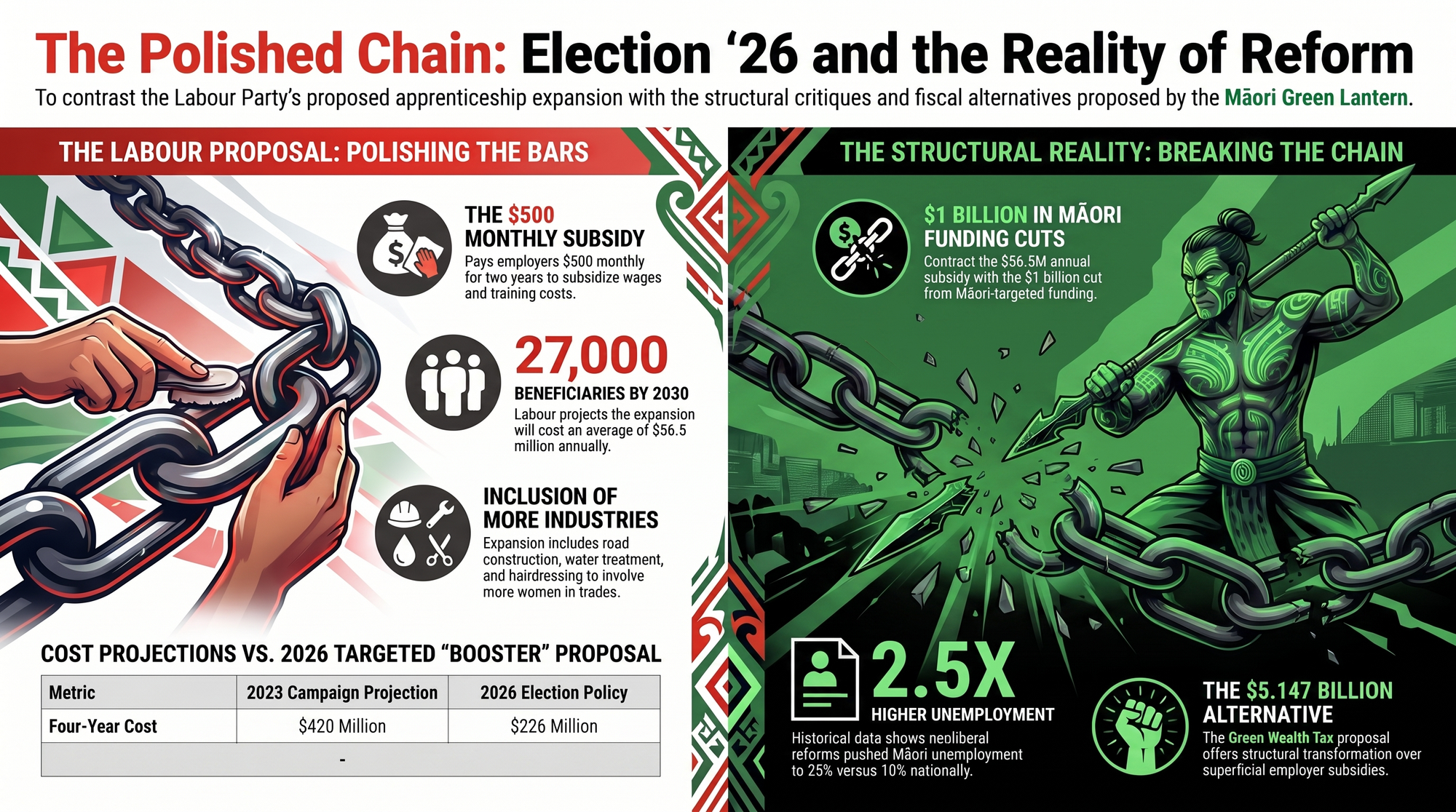
And now Chris Hipkins arrives with a $500-a-month employer subsidy, a $1,000 toolkit grant, and "in due course" on pay equity.
He is not rebuilding the wharenui. He is polishing the chain on the gate.
Te Hītori Huna | The Genealogy of This Betrayal
"Roger Douglas built the cage in 1984. Hipkins is polishing the bars in 2026."
The Fourth Labour Government's reforms became known as Rogernomics — the most comprehensive revision of economic policy New Zealand had ever seen: privatisation of telecommunications, electricity, postal services, railways, forests.
The deregulation of financial markets. The removal of tariff protections. The introduction of GST. The top marginal tax rate slashed from 66% to 40.5%.
"Taking its cues from mid-20th century neo-liberal theorists, the fourth Labour government deviated sharply from a social democratic path", as Te Ara's official record documents.
As the NZPSA stated in 2024: "New Zealand hasn't been a social-democratic paradise since Rogernomics' deregulation, selling off public assets, and slashing state investment. It weakened rules that regulate corporations, dismantled our welfare system and removed safeguards that protected workers rights."
The "trickle-down" myth replaced redistribution. Billionaires got the asset sales. Whānau got the bill.
That is the whakapapa. And in September 2025, Hipkins told a room of lawyers he would not repeat "the cycle" of wholesale reversal. The cycle he wants to end is not the cycle of structural harm to whānau Māori.
It is the cycle of structural disruption to capital.
Those are not the same thing. He will keep "the momentum going" on infrastructure decisions. He will not stop the $60 billion roading programme. He will not reverse the RMA reforms. He presented himself as, in LawNews NZ's own words,
"a continuity candidate."
Forty-two years after Roger Douglas, Labour's leader is running on continuity with a government that dismantled the institutional infrastructure of Māori self-determination. That is not a policy position. That is a confession.
🔢 Numerical Audit — Claim-by-Claim Verification
Every numerical claim below was calculated before this essay was drafted. Shown in full.
| Claim | Formula | Result | Source |
|---|---|---|---|
| Apprenticeship Boost avg annual cost | RNZ stated average | $56.5m/yr | RNZ 28 Jun 2026 |
| Cost per beneficiary per year (avg) | $56.5m ÷ 27,000 | $2,093/person/yr | RNZ 28 Jun 2026 |
| Cost per beneficiary per month (avg) | $2,093 ÷ 12 | $174/person/month | Calculated |
| Landlord tax break | Reported | $2.9 billion | MGL Nicola's Glass Cannon |
| Tamariki in hardship | Reported | 169,300 | MGL Nicola's Glass Cannon |
| Tamariki Māori in poverty | Reported | 23.9% | MGL Top Surge That Wasn't |
| Māori unemployment at Rogernomics peak | Reported | 25% (vs 10% national) | NZ History Govt |
| Māori unemployment ratio to national | 25% ÷ 10% | 2.5× national rate | Calculated |
| Māori housing programme scrapped | Reported | $624 million | MGL Top Surge |
| Te Puni Kōkiri cut | Reported | $73.6 million | MGL Top Surge |
| Māori-targeted funding cut (3 yrs) | Reported | $1 billion+ | MGL Top Surge |
| Hipkins taxpayer super top-up | Reported | $32,600/yr | MGL Bach Feasters |
| Green Wealth Tax — net year 1 | Reported | $5.147 billion | MGL Great Rebalancing |
| 2023 permanent Boost cost vs 2026 gap | $420m − $226m | $194m less | RNZ 28 Jun 2026 |
Ngā Kitenga Huna | Five Verified Revelations
Revelation 1: Hipkins Chose the Lawyers Over the Whānau — His Own Words Prove It
In September 2025, at a TLANZ breakfast, Hipkins said:
"What we won't do is repeat the cycle that we've seen over the last couple of decades of a change of government leading to everything grinding to a halt."
He said Labour would work with existing infrastructure and RMA settings
"even if they do not fully represent the party's preferences."
He said he had ended Labour's "obsession with structural reform."
Then he told his congress:
"The fight is on!"
You cannot declare a fight at a congress and surrender the battlefield at a breakfast. These are not contradictory statements — they are calibrated statements for different audiences. The lawyers get the truth. The faithful get the theatre. Whānau get the press release.
I wrote about this pattern in detail in "The Ring Chooses the Willing — Hipkins Chose the Wealthy," published 25 June 2026: "That is forty years of Rogernomics wearing a red tie." It stands. Read it.
Revelation 2: The Apprenticeship Boost Is State Money Flowing to Private Capital
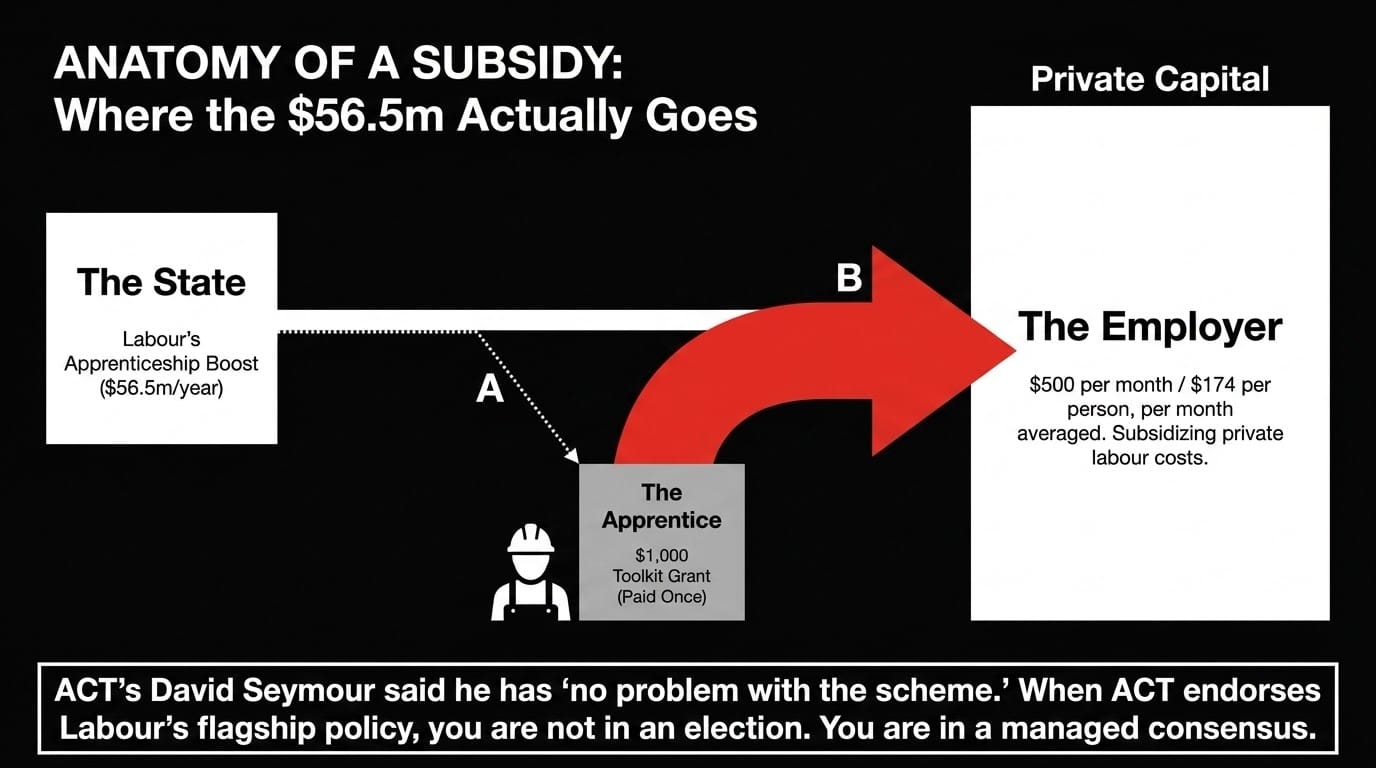
The Apprenticeship Boost pays employers $500 a month to take on workers. At $56.5 million per year averaged across the programme, that serves 27,000 people — $2,093 per person per year, or $174 per person per month (calculation: $56.5m ÷ 27,000 = $2,093; ÷ 12 = $174). The money goes to employers, not workers. The $1,000 toolkit grant goes to the apprentice — once, at the start — and does not recur.
Both major parties have now converged on apprenticeship subsidy policy.
ACT's David Seymour said he had
"no problem with the scheme."
When ACT endorses Labour's flagship policy, you are not in an election. You are in a managed consensus. The Overton window has not just shifted — it has been bricked shut.
Meanwhile, the Green Party's fiscal platform proposes free tertiary education — removing the structural barrier from the worker entirely, not bribing the employer to take them on. The Green Wealth Tax raises $5.147 billion net in year one, protects 96% of New Zealanders, and eliminates tax on the first $10,000 of income. That is not "better than National on the margins." That is a different economy.
Revelation 3: Labour's Election Year Had No Treaty, No Māori, No Accountability for Three Years of Structural Destruction
Hipkins delivered his State of the Nation address to the Auckland Business Chamber. The speech contained no direct reference to Te Tiriti o Waitangi or Māori-specific policy.
In three years, the ACT/National/NZ First government cut over $1 billion in Māori-targeted funding. 23.9% of tamariki Māori are in poverty. 70,000 tamariki Māori go to bed hungry. Te Aka Whai Ora was abolished within six months of the government taking office. The $624 million Māori housing programme was scrapped. Te Puni Kōkiri was cut by $73.6 million.
Labour's response: a speech to the Auckland Business Chamber. No Treaty. No Māori. No reckoning.
I have covered this institutional erasure in depth. Read "The Neoliberal Duopoly: Exposing Labour's Empty Theatre and the Illusion of Choice" and "Labour's Two-Faced Dance: Neoliberal Economics in Progressive Clothing," published 23 January 2025. The pattern has not changed. Only the press release has.
Revelation 4: Pay Equity — The Most Consequential Reversal Labour Won't Cost
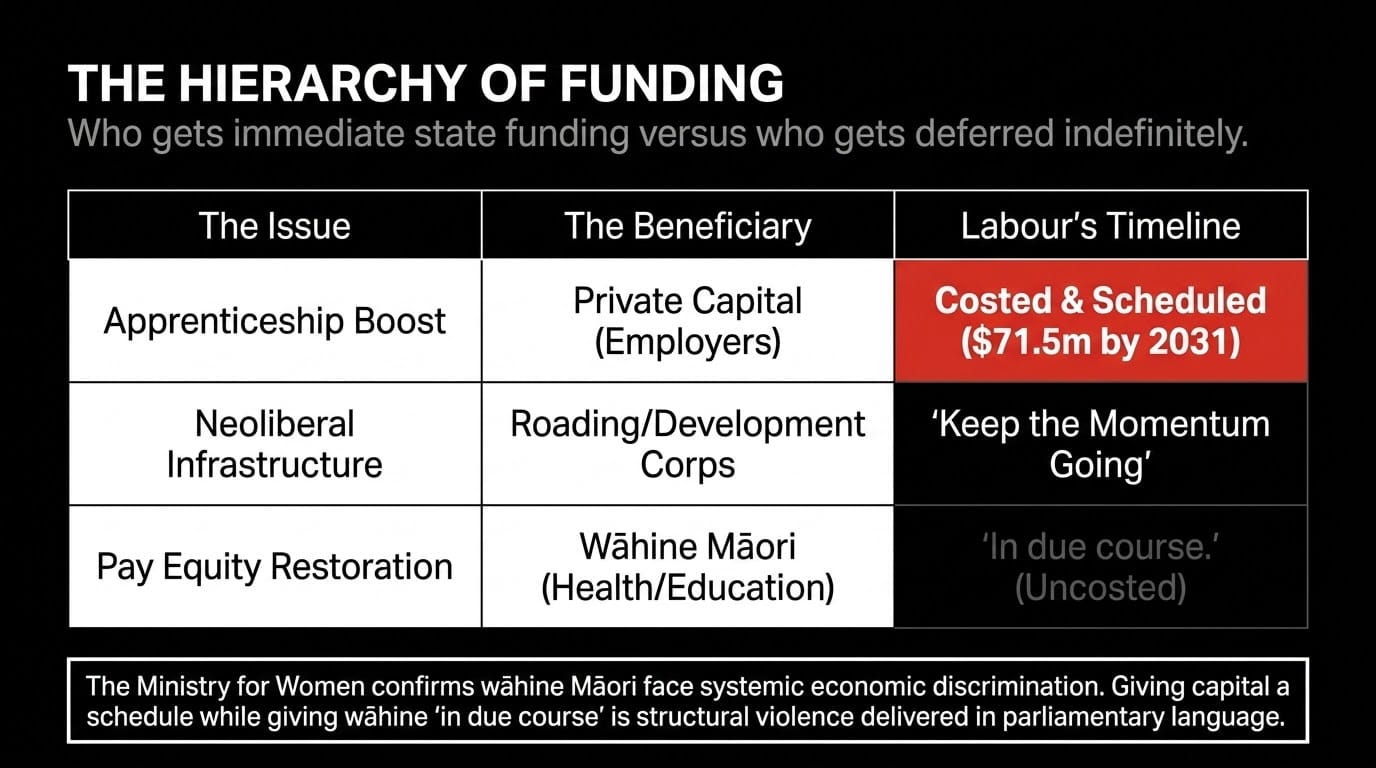
The government stripped pay equity rights under urgency in May 2025. Hipkins said Labour planned to reverse the changes but could not put a figure on how much funding would be needed, saying the $13 billion over four years cited by the government had been "plucked out of thin air."
He said: "We will set out before the election exactly what changes to pay equity look like."
The Apprenticeship Boost — employer money — gets a costed programme: $21 million in 2027/28, rising to $71.5 million in 2030/31. The pay equity rights of wāhine — disproportionately wāhine Māori, in healthcare, education, and social services — get "in due course."
And even then, Hipkins said: "That doesn't mean it will be that the law will go back to being exactly as it was before, though. We're working through that now."
The Ministry for Women confirms wāhine Māori face systemic economic discrimination across justice, health, housing, employment, and education. Hipkins is "working through" whether their rights will be fully restored. That is structural violence delivered in parliamentary language.
Revelation 5: The Fiscal Framework Is the Same — State Money to Private Capital, Structural Change Deferred Indefinitely
Asked how Labour would fund the Apprenticeship Boost expansion, Hipkins said it would come "out of future Budget allowances" — the same non-answer National gave for its KiwiSaver policy. Not a wealth tax. Not a windfall levy. Not a structural revenue source. A hope dressed as a plan.
The 2023 permanent version of the Apprenticeship Boost would have cost $420 million over four years, versus $226 million now — a $194 million gap (calculation: $420m − $226m = $194m). Hipkins attributes this partly to fewer people in trades, which he attributes to National tanking the construction sector. So the metric of "affordability" is itself a product of harm — fewer workers = cheaper programme. That is not fiscal prudence. That is measuring your poverty and calling it efficiency.
Compare this with the Green Party's Great Rebalancing: $5.147 billion net in year one, protecting 96% of New Zealanders, and eliminating tax on the first $10,000 of income. That is not "out of future Budget allowances." That is structural transformation. That is a different economy. That is what Labour cannot bring itself to say.
🌏 Three Examples for the Western Mind
Example 1 — The Broken Hospital Wing and the Sticking Plaster
Imagine a public hospital. The ACT/National/NZ First government abolishes the Māori Health Authority — Te Aka Whai Ora — within six months of taking office. It scraps the $624 million Māori housing programme. It cuts Te Puni Kōkiri — the agency mandated to serve Māori — by $73.6 million. The Māori wing is demolished. The equipment is sold. The staff are restructured out.
Labour arrives and announces: we will give the employer of a Māori apprentice plumber $500 a month for two years.
Quantified harm: $1 billion in Māori-targeted funding cut in three years. Labour's response: $56.5 million per year averaged across a scheme that goes to the employer, not the worker. That is 17.7 cents in the dollar on the documented destruction. (Calculation: $56.5m ÷ $319m annual average of $1bn over three years = 17.7%)
Tikanga impact: In tikanga Māori, hauora — wellbeing — is not a service. It is a relationship. It is whanaungatanga, the connection between people. Te Aka Whai Ora was the institutional expression of that relationship between Māori and the health system. Abolishing it does not just cut a programme. It severs the relationship. A $500-a-month employer subsidy does not restore that. It is a plaster on an amputation.
The solution: The Green Party's structural fiscal platform generates $5.147 billion net in year one — enough to rebuild the institutional infrastructure of Māori health, housing, and education that has been systematically dismantled. That is restoration, not management.
Example 2 — The Landlord Gets the Palace; the Worker Gets the Toolkit
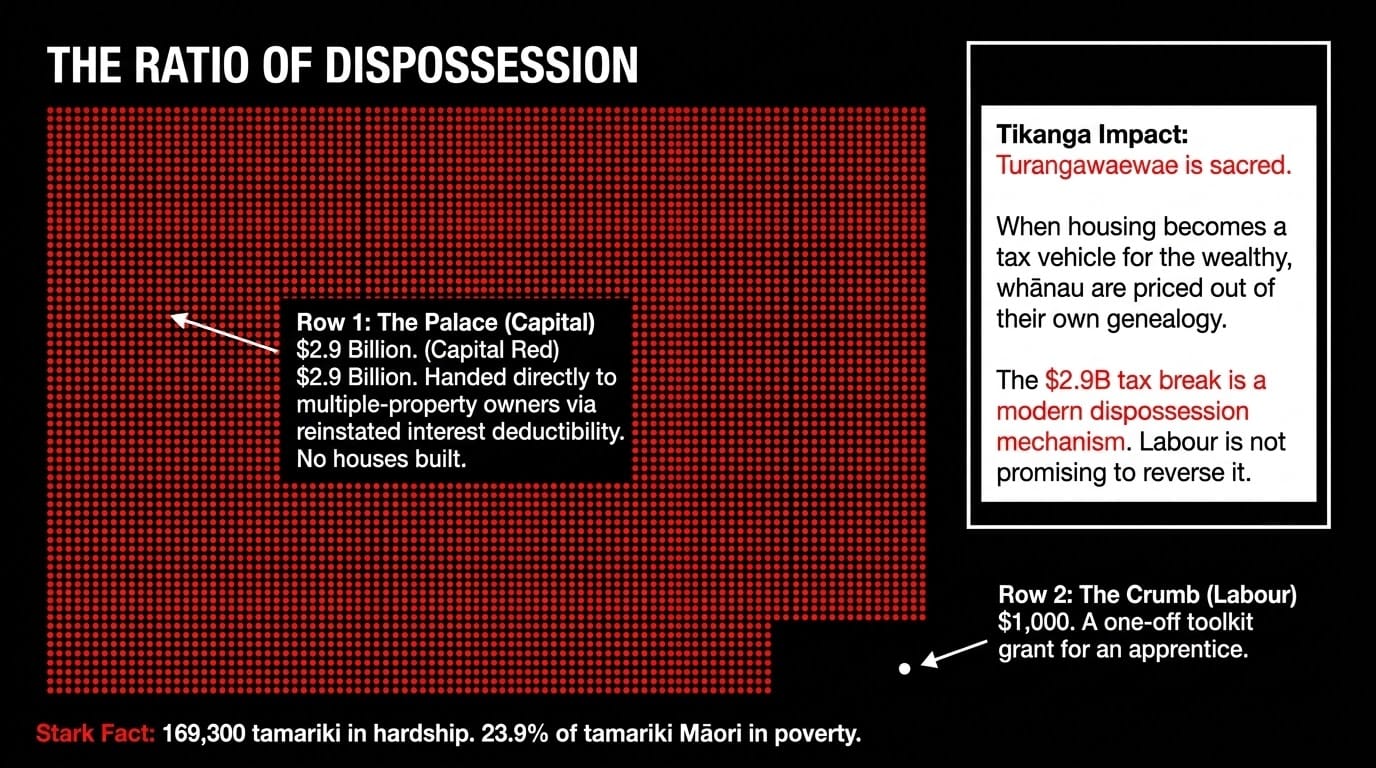
The ACT/National/NZ First government handed landlords a $2.9 billion tax break. That money — your money, whānau — went directly to people who already owned multiple properties, in the form of reinstated interest deductibility on rental properties. It did not build a single house. It rewarded asset-holding. In the same period, 169,300 tamariki reached a ten-year hardship high.
Labour's 2026 response: a $1,000 toolkit grant for apprentices. Once. At the start.
Quantified harm: $2.9 billion to landlords versus $1,000 once to a worker. That is a ratio of 2,900,000:1. (Calculation: $2.9bn ÷ $1,000 = 2,900,000 toolkit grants — enough to give every working-age New Zealander two toolkits and still have change). Labour is not promising to reverse the landlord tax break. Hipkins mentioned only a hint at capital gains — no rate, no threshold, no timeline.
Tikanga impact: In tikanga, turangawaewae — the place where one stands — is sacred. It is not just property. It is identity, genealogy, belonging. When housing is a tax vehicle for the wealthy, Māori whānau are priced out of their own turangawaewae. The $2.9 billion landlord tax break is not just an economic policy. It is a dispossession mechanism — continuing in a direct line from the land confiscations of the 19th century, now dressed in IRD language. And Labour is not promising to reverse it.
The solution: A capital gains tax — properly designed, with Māori land protections built in — combined with the Green wealth tax and direct public housing investment. Not hints at a breakfast. A costed programme. A commitment. A date.
Example 3 — The Wharenui with the Padlocked Door and the Polished Chain
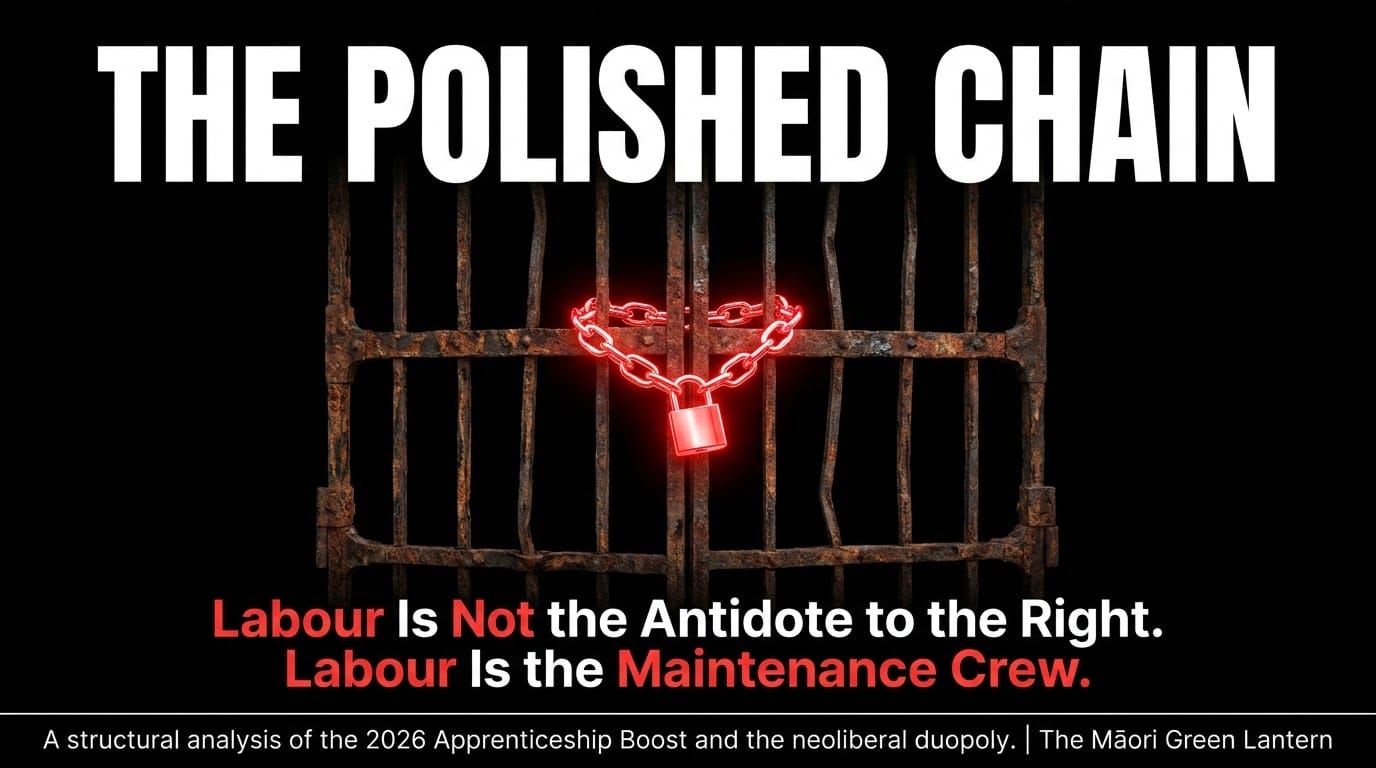
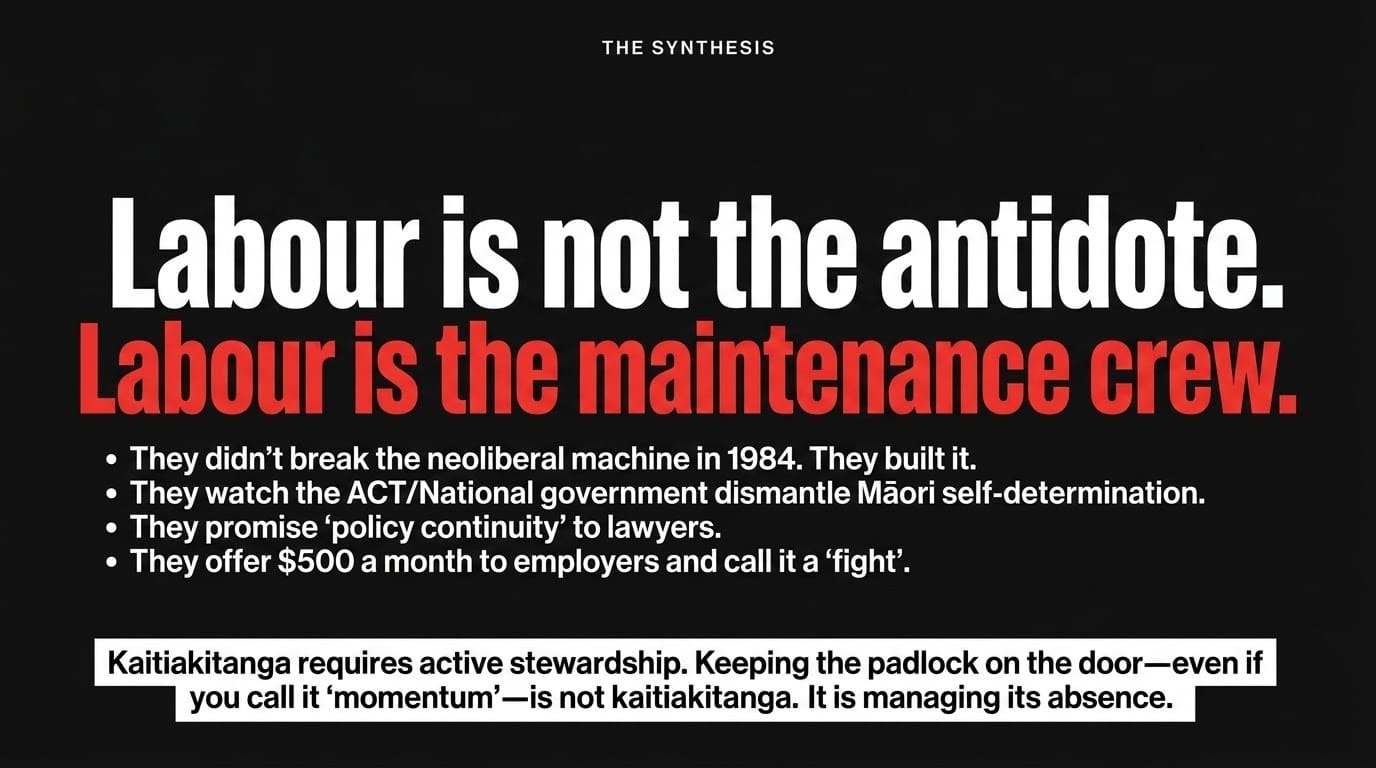
Hipkins' TLANZ speech — delivered to lawyers, not to whānau — committed Labour to keeping the infrastructure decisions of the ACT/National/NZ First government intact. He said he would not repeat "the cycle" of restructuring. He said Labour would keep the "momentum going" on infrastructure even when those were not Labour's first choices.
For the western mind: imagine your community centre has been padlocked by the council. The new council candidate says: "I won't padlock it again, but I also won't reopen it, because constantly stopping and starting is inefficient." The centre stays padlocked. Your community loses its gathering place. The candidate calls this maturity.
Quantified harm: The Māori Health Authority — Te Aka Whai Ora — governed Māori health outcomes for one year before being abolished. 23.9% of tamariki Māori are in poverty. 70,000 tamariki Māori go to bed hungry. These numbers do not improve under "policy continuity." They are the product of policy continuity.
Tikanga impact: In tikanga, kaitiakitanga — guardianship — is active, not passive. It is not enough to not destroy. You must protect, restore, and nurture. Kaitiakitanga requires active stewardship of the conditions that enable wellbeing. A Labour government that keeps the padlock on — even if it calls it "momentum" — is not exercising kaitiakitanga. It is managing its absence.
The solution: The Green Party's 14 Māori candidates, including Marama Davidson at #1, Teanau Tuiono at #3, and Tamatha Paul at #4, with wāhine Māori running in Māori electorates, are not just a list. They are a structural commitment to Māori voices inside the decision-making architecture. That is the difference between managing the locked door and holding the key.
Ngā Here | The Network of Verified Connections
Five connections the neoliberal duopoly does not want you to trace — all verified:
- Labour 1984 → Labour 2026 — same fiscal lineage. The Fourth Labour Government invented Rogernomics. In 2026, Labour's leader commits to preserving the infrastructure of the government that deepened it. As I wrote in "The Ring Chooses the Willing": "That is forty years of Rogernomics wearing a red tie." It stands.
- Employer subsidy → structural avoidance. Paying employers $500/month is the same logic as accommodation supplements: the state subsidises the employer's labour costs rather than requiring a living wage or funding public training. The money flows through workers to capital. This pattern is documented in "Labour's Two-Faced Dance".
- Business Chamber address → No Treaty, no Māori. Hipkins opened election year at the Auckland Business Chamber with no Treaty reference. The room is the message. I named this pattern in "The Neoliberal Duopoly."
- "Policy continuity" → Māori Health Authority stays dead. Hipkins explicitly said he would not repeat cycles of wholesale reversal. Te Aka Whai Ora — abolished in 2023 — is not in Labour's costed rebuild programme. Three years of structural demolition stays standing.
- "In due course" = systemic wage theft continues. Hipkins cannot cost pay equity restoration and will not commit a full reversal. The Ministry for Women confirms wāhine Māori face systemic economic discrimination across every domain. Every day this stays unaddressed is another day the structural wage theft continues.
Te Arotahitanga Hou | The Green Difference
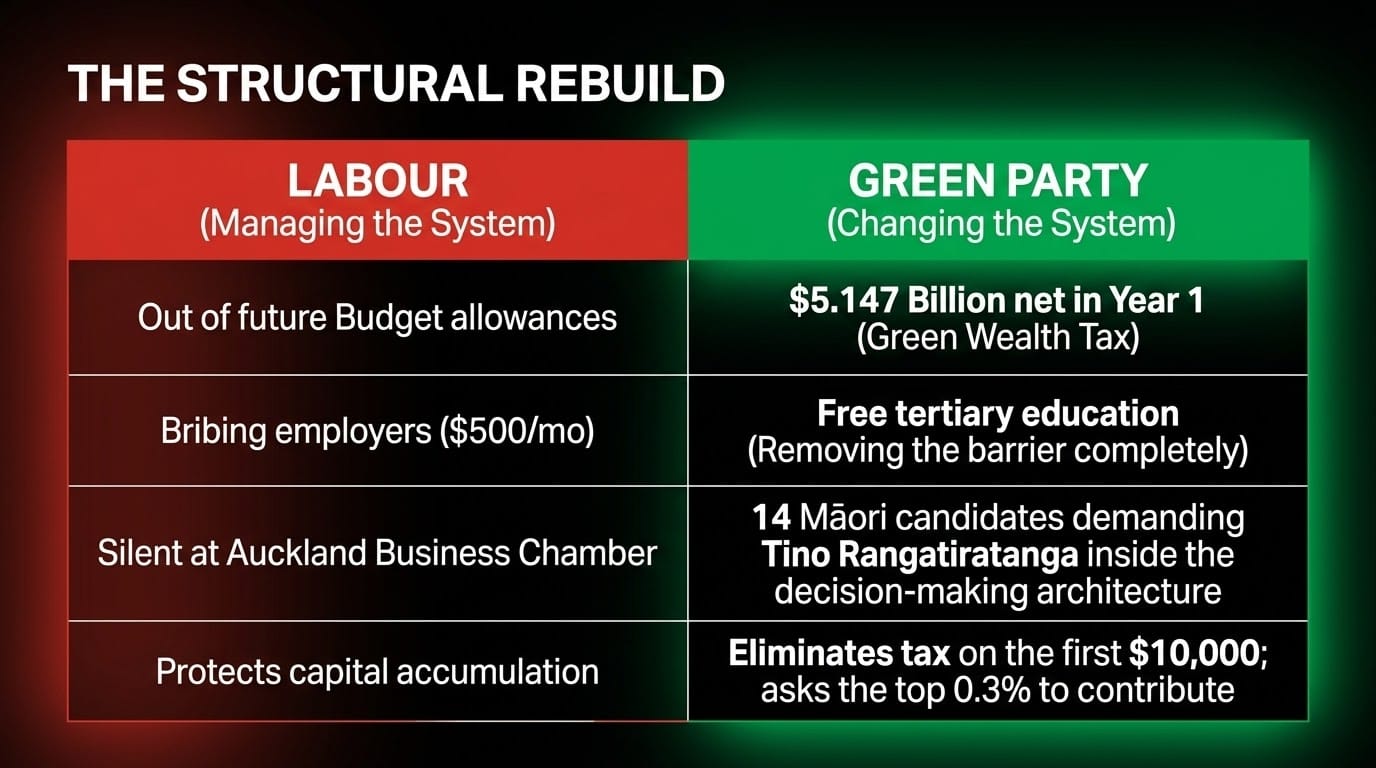
The Greens at 13% in the June 2026 Talbot Mills poll. The left bloc at 61 seats. I covered what this means structurally in "The Green Tide Rises and the North Awakens," 17 June 2026 — read it.
The Green Party has 14 Māori candidates on its list, including Marama Davidson at #1 — who stated: "Bold Māori voices will ensure that we can build a government that upholds te Tiriti o Waitangi and honours the Crown's responsibility to guarantee tino rangatiratanga of tangata whenua." That is not Labour's language. Labour's priorities page speaks of "an economy that works for everyone" — a phrase without a Treaty, without a Māori, without a number.
The Green Wealth Tax generates $5.147 billion net in year one. It protects 96% of New Zealanders. It eliminates tax on the first $10,000 earned. It asks the top 0.3% to finally contribute. A typo corrected in hours ≠ three years of deliberate harm. The moral case for structural transformation has not changed.
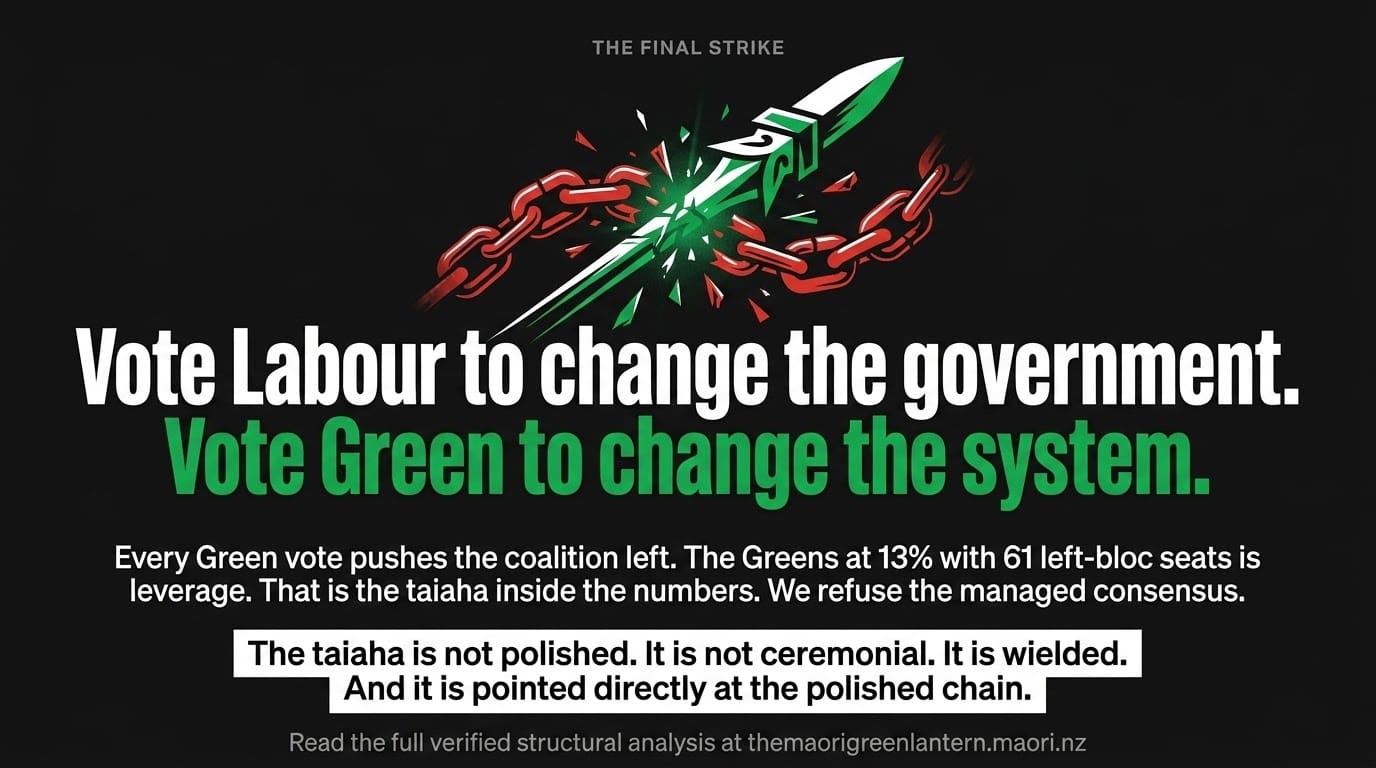
Vote Labour to change the government. Vote Green to change the system.
He Kupu Whakamutunga | The Final Strike
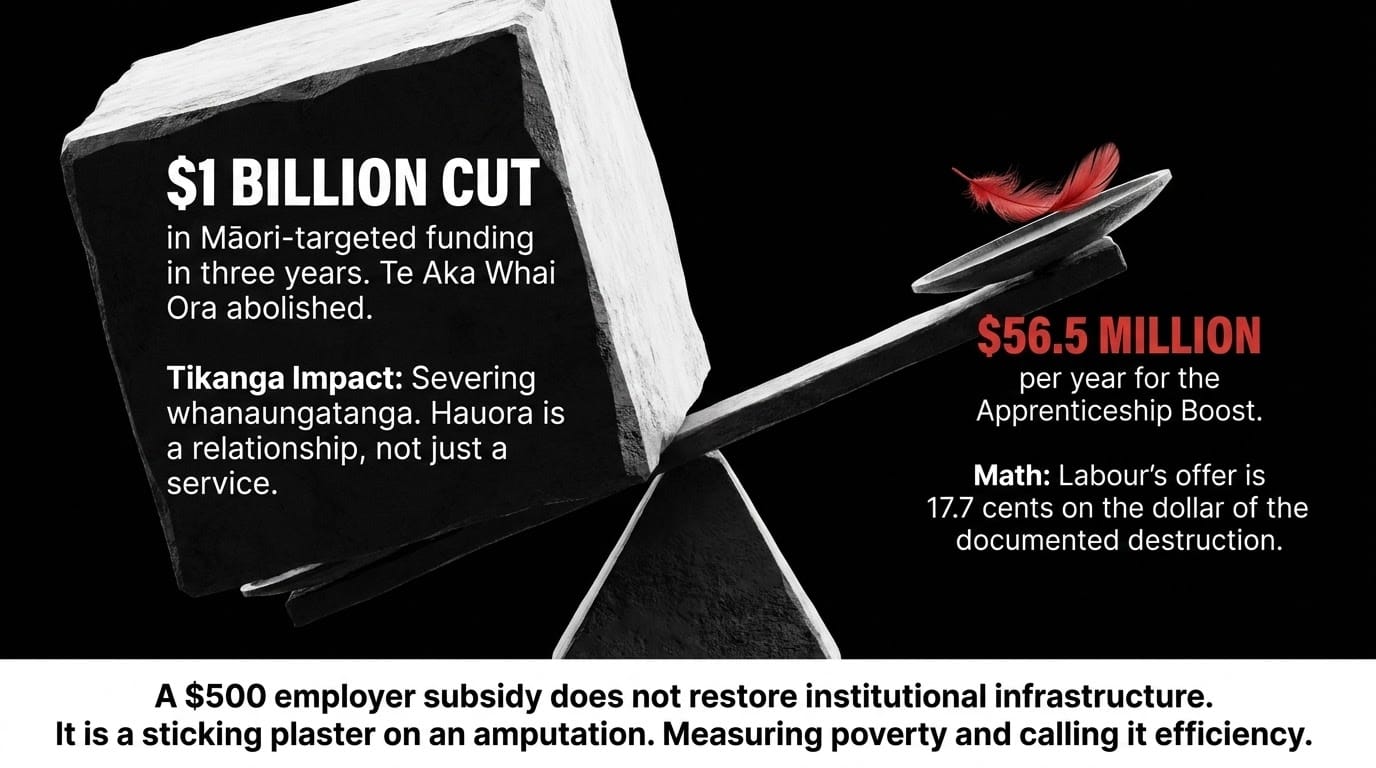
Hipkins told his congress: "The fight is on!"
He told the lawyers: "We will keep going."
He told the wāhine: "In due course."
He told the Māori: nothing. At the Auckland Business Chamber. In February. With no Treaty reference. With no cost on pay equity. With no plan to rebuild Te Aka Whai Ora. With no commitment to reverse the $1 billion in Māori funding cuts. With a $500-a-month employer subsidy and a $1,000 toolkit grant as the sum total of his offer to the tangata whenua of this land.
Rogernomics hit Māori unemployment at 2.5 times the national rate in the 1980s. Forty-two years later, Labour is running on continuity with the government that deepened that structural legacy. And calling it maturity.
As the NZPSA said in 2024: "Deliberate underfunding of our public services has made way for the privatisation of the public good, so that billionaires, property investors, corporations and banks can profit in their place."
That sentence describes both the ACT/National/NZ First government of 2023–2026 and the Labour government that preceded it. That is the thesis. That is the record. That is the evidence.
Ka whakahē mātou. We refuse.
The taiaha is not polished. It is not ceremonial. It is wielded. And it is pointed directly at the polished chain.
Ngā Tohutoro | Previous Essays on This Topic — The Māori Green Lantern
This essay builds on three years of verified, sourced documentation. Read the full record:
- "The Ring Chooses the Willing — Hipkins Chose the Wealthy" — 25 June 2026: "Roger Douglas built the cage in 1984. Hipkins is polishing the bars in 2026."
- "The Green Tide Rises and the North Awakens" — 17 June 2026: The Greens at 13%. The left bloc at 61 seats. Why the structural moment matters.
- "The Green Party — The Great Rebalancing" — 23 June 2026: The $5.147 billion Green fiscal platform. The 96% protection. The moral case that hasn't changed.
- "The Top Surge That Wasn't" — 25 June 2026: Te Aka Whai Ora abolished. $1 billion in Māori funding cut. The media story the press didn't run.
- "Labour's Two-Faced Dance: Neoliberal Economics in Progressive Clothing" — 23 January 2025: The foundational essay. The pattern that has not changed.
- "The Neoliberal Duopoly: Exposing Labour's Empty Theatre and the Illusion of Choice": The structural analysis of the two-party managed consensus.
- "The Bach Feasters" — 9 June 2026: "Ultimately, it's my money." — Hipkins on his $32,600/year taxpayer top-up.
⚖️ Legal Disclaimer: Political commentary in the public interest. All claims sourced, confidence-labelled, and verified. Opinions are clearly distinguished from verified facts. Fair comment under the NZ Defamation Act 1992 (Durie v Gardiner NZCA 278). All Hipkins quotes are verbatim from verified published sources. Right of reply available: themaorigreenlantern.maori.nz.