
"PETROL ON THE GREEN CHAIN: How a White‑Supremacist Neoliberal Government Turned Whakatāne’s Poisoned Ground into a Discount Fuel Promotion" - 8 July 2026
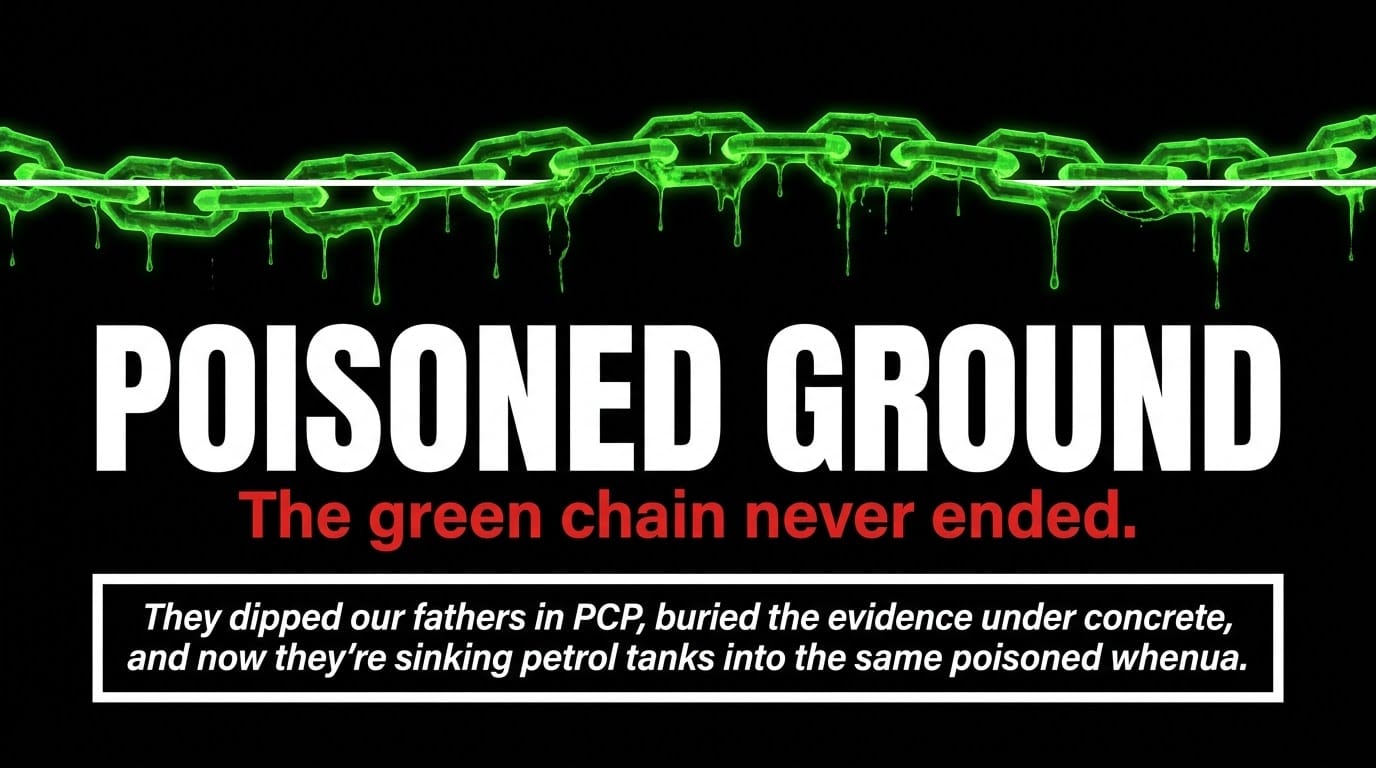
They dipped our fathers in PCP, buried the evidence under concrete, and now they’re sinking petrol tanks into the same poisoned whenua — then asking Māori to smile at the ribbon‑cutting.

Tēnā koutou — I’m not here to calm the fire
Tēnā koutou e te whānau. Ko Ivor Jones ahau, The Māori Green Lantern — Te Arawa, Ngāti Pikiao, Welsh whakapapa, taiaha in hand, built exactly for moments like this (About The Māori Green Lantern).
I am not a neutral voice politely raising concerns about “community engagement” at The Hub in Whakatāne (The Hub Whakatane – overview). I am the descendant of people the Crown turned into disposable filters for its chemicals, watching a white‑supremacist neoliberal government and its corporate mates drop a 24/7 petrol station onto PCP‑soaked soil while pretending the Kopeopeo Canal’s poison is a solved problem (“Fighting Poison” – E‑Tangata).
The green chain never ended. They just moved it from the dip bath to the atmosphere, from PCP vats to petrol tanks, from poisoned sawdust to discount fuel promotions (“The Green Chain” teaser – Facebook).
The Text That Should Have Stopped The Diggers
On 26 June 2026, just before 9am, my phone lit up with an intelligence drop from Kereama Akuhata — chair of Sawmill Workers Against Poisons (SWAP), long‑time kaitiaki, and one of the men who has carried dioxin in his body for decades (Poisoned sawmill workers restart advocacy group – SunLive).
His message showed diggers tearing into the ground at The Hub, in front of Bunnings, on what locals still call “the old sawmill site” (The Hub Whakatane – overview), the same place where timber was drenched in pentachlorophenol (PCP) and left to air dry along the green chain for decades (“Fighting Poison” – E‑Tangata).
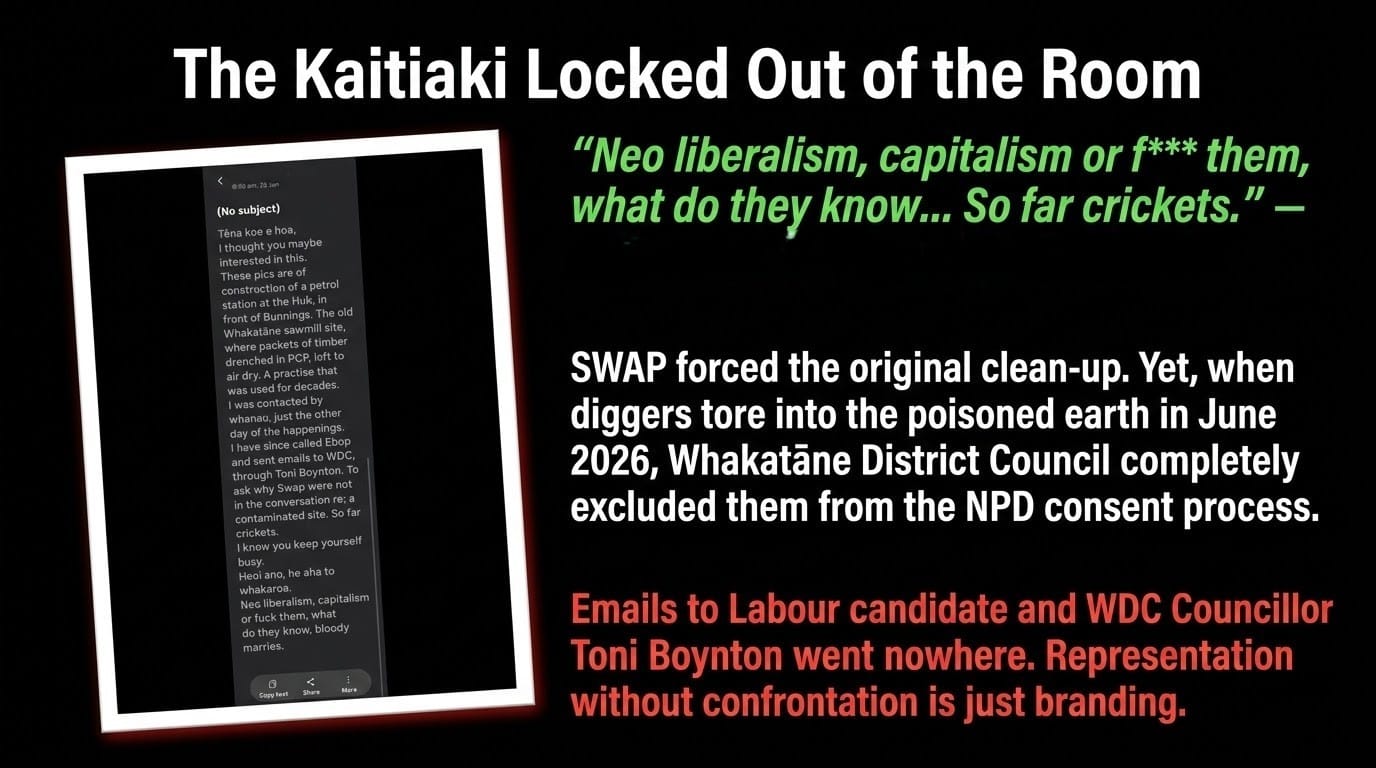
He told me he’d already called Environment Bay of Plenty and emailed Councillor Toni Boynton through Whakatāne District Council, asking why SWAP
— the group that forced officials to admit PCP poisoning and helped drive Kopeopeo’s clean‑up
— was not in any conversation about a petrol station being dug into that contaminated site (Sawmill Workers Against Poisons – Te Ara)(Kopeopeo Canal Remediation Project – BOPRC)(Toni Boynton – Whakatāne DC).
His summary of the silence is consistent with the racism and neglect Catherine Delahunty documents, where poisoned workers and their whānau were ignored for decades while officials minimised PCP’s harms (“Fighting Poison” – E‑Tangata).
Under tikanga, that message should have stopped the diggers and started karakia. Under this coalition, the machinery kept chewing through the earth.
The Deep Dive Podcast
Listen to a lively conversation between two hosts, unpacking and connecting topics in the sources of this essay. I apologise in advance for the AI's very harsh pronounciation of reo. Please dont shoot me, :).
Youtube Video
Like video? Here is a short video suppporting the essay. Again, don't shoot the messenger please because of AI's pronounciation. :)
Koha Consideration
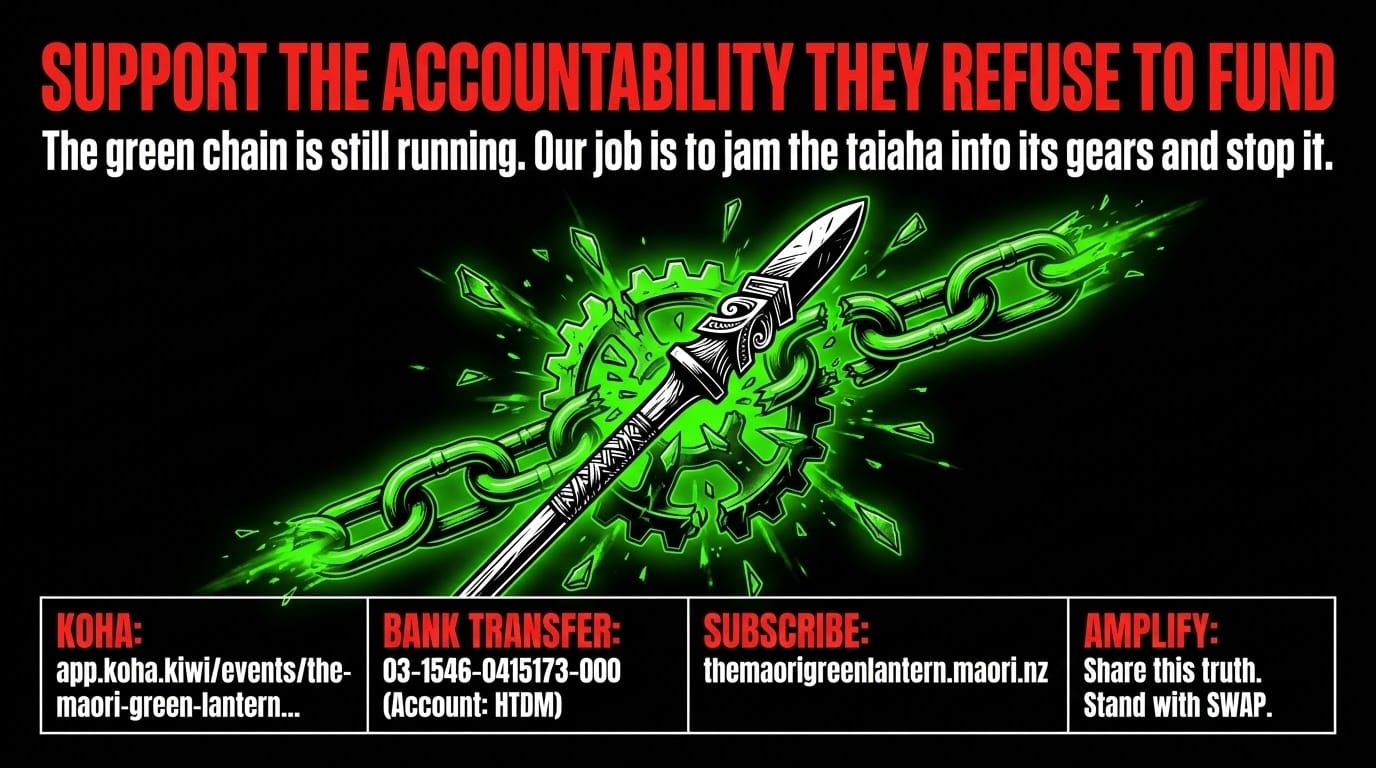
Every koha for this kaupapa tells the Crown and its corporate partners something they do not want to hear: we will support the accountability you refuse to provide (About The Māori Green Lantern).
It says that rangatiratanga includes the power to back our own truth‑tellers when they stand on the banks of Kopeopeo and point out that a white‑supremacist neoliberal government has authorised discount fuel infrastructure on PCP‑soaked whenua while the men who first raised the alarm die at 61 (Poisoned sawmill workers restart advocacy group – SunLive)(“THE COLOSSEUM OF KINGSLAND” – essay).
Kia kaha, whānau. Stay vigilant. Stay connected. And if you are able, consider a koha to ensure this voice keeps naming the arsonists, tracing the pipes from the PCP dip bath to the petrol pump, and holding this government and its corporate allies to account.
If you are unable to koha, kei te pai. Subscribe or follow The Māori Green Lantern at themaorigreenlantern.maori.nz, kōrero and share with your whānau and friends — that is koha in itself (The Māori Green Lantern – home).
Four pathways exist:
Koha — support: Voluntary support via Koha – The Māori Green Lantern.
Subscribe: Receive essays directly and support through subscription at themaorigreenlantern.maori.nz/#/portal/support.
Bank transfer: Support directly to HTDM, account number 03‑1546‑0415173‑000, as set out in recent MGL essays (“Michael Laws and the Long Career of Filth…” – essay).
How The Crown Licensed Murder And Called It Forestry
Te Ara records that Joe Harawira and fellow workers founded SWAP in the mid‑1990s to investigate illnesses among Whakatāne sawmill and papermill workers and to pursue justice for PCP and dioxin poisoning (Sawmill Workers Against Poisons – Te Ara).
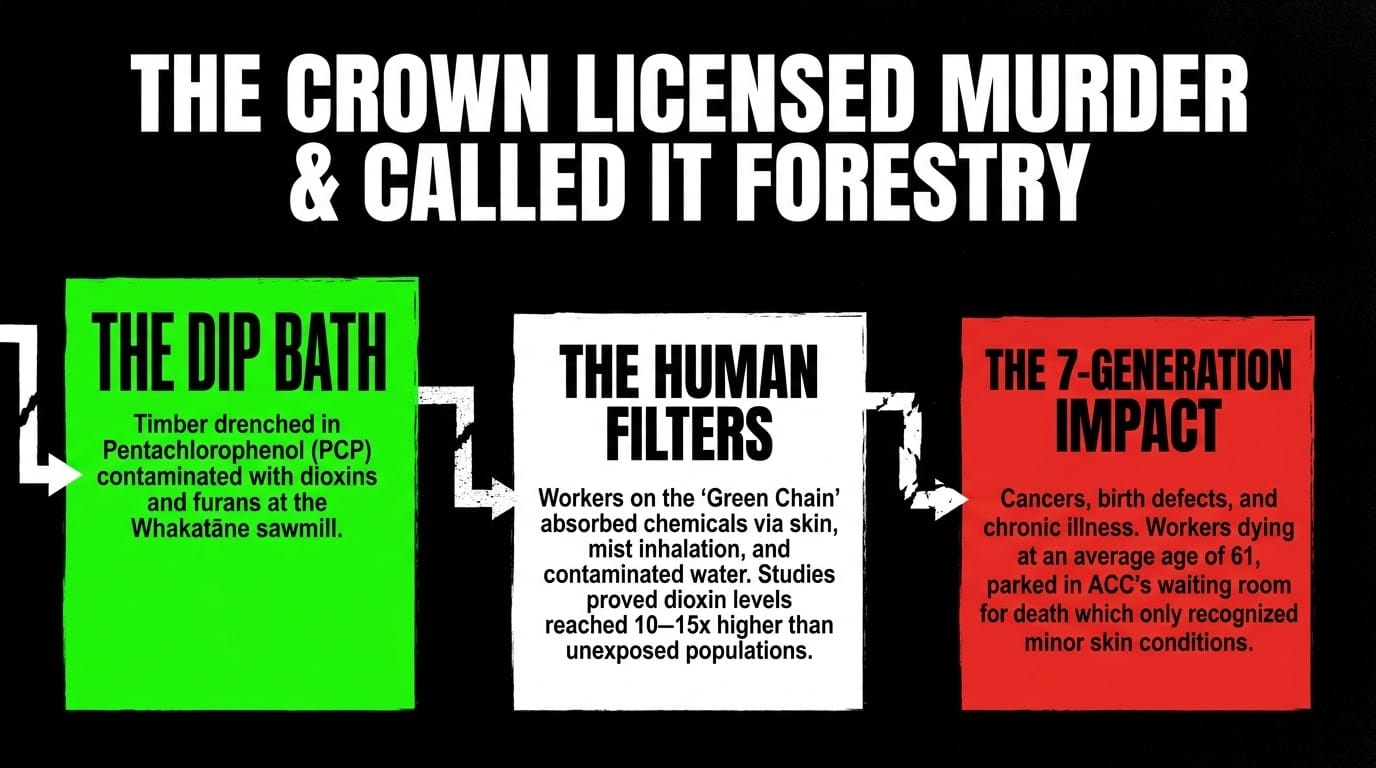
“Fighting Poison” describes how timber was treated with PCP contaminated with dioxins and furans, exposing workers through skin contact, inhalation of mist and dust, ingestion via contaminated soil and water, and take‑home contamination in clothing and firewood (“Fighting Poison” – E‑Tangata). Former Whakatāne sawmill workers interviewed by Te Ao recount PCP in open tanks, chemical fog on the green chain, and long‑term health problems in themselves and their whānau (Whānau of sawmill workers poisoned by chemicals still fight for recognition – Te Ao).
A Government‑funded study of former timber workers found that roughly 10 percent had serum dioxin levels 10–15 times higher than unexposed populations, particularly those performing “high‑risk tasks” like mixing PCP and working at the green chain (Serum dioxin levels in former New Zealand timber workers – McLean). PCP was eventually banned and deregistered in Aotearoa by the late 1980s and early 1990s, but only after decades of use across mills in Whakatāne, Rotorua, Kawerau and beyond (“Fighting Poison” – E‑Tangata).
SunLive reports that SWAP’s research suggests health impacts on families for up to seven generations, including birth defects, chronic illnesses and reproductive problems among descendants of poisoned workers (Poisoned sawmill workers restart advocacy group – SunLive). The same article notes that in one recent four‑month period, four former sawmill workers died, with an average age of 61 (Poisoned sawmill workers restart advocacy group – SunLive).
Te Whatu Ora’s Sawmill Workers’ Service offers annual health checks and limited support, but its official guidance still frames many PCP effects narrowly, emphasising skin conditions and sweating rather than the full spectrum of harm SWAP describes (Sawmill Workers’ Service and Dioxin Health Service – Health NZ). That narrowing is exactly what I dissected in “DYING ON THE BOOKS: How ACC Turned PCP Poisoning Into a Waiting Room for Death” on themaorigreenlantern.maori.nz.
33 Dump Sites, One Canal, And A Government That Calls It “Legacy”
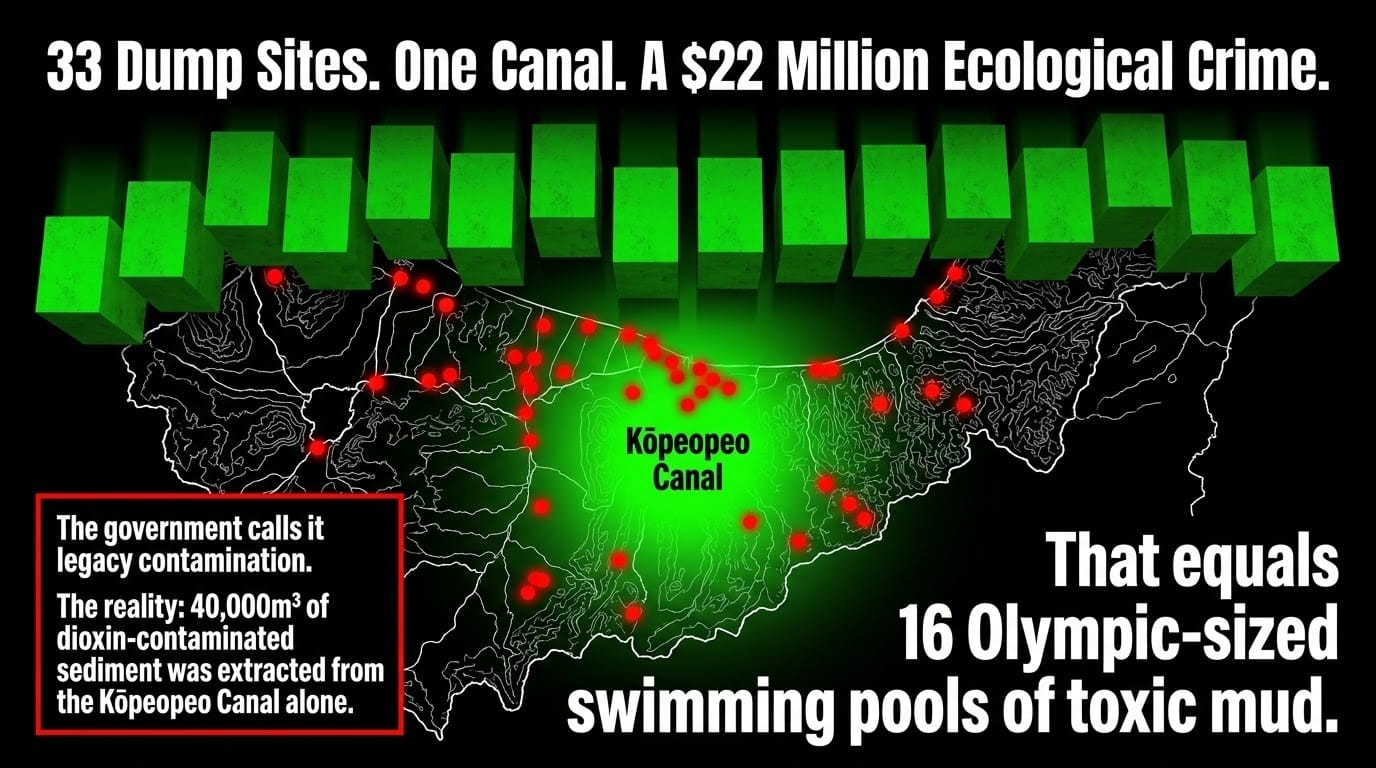
SunLive’s coverage of the SWAP hui at Wairaka states there are 33 known sawmill chemical dumpsites in the Whakatāne region, including Kopeopeo Canal as “the most poisonous” and Mataatua Reserve as “the second‑most poisonous” site (Poisoned sawmill workers restart advocacy group – SunLive).
A Scoop summary of Environment Bay of Plenty’s contaminated sites report explains that 12 Whakatāne sites contaminated by sawmill waste pose minimal health risk only if the land is not dug up and bore water is not used, highlighting the danger of disturbing contaminated soil or drinking from affected aquifers (Contaminated sites poses minimal health risk – Scoop).
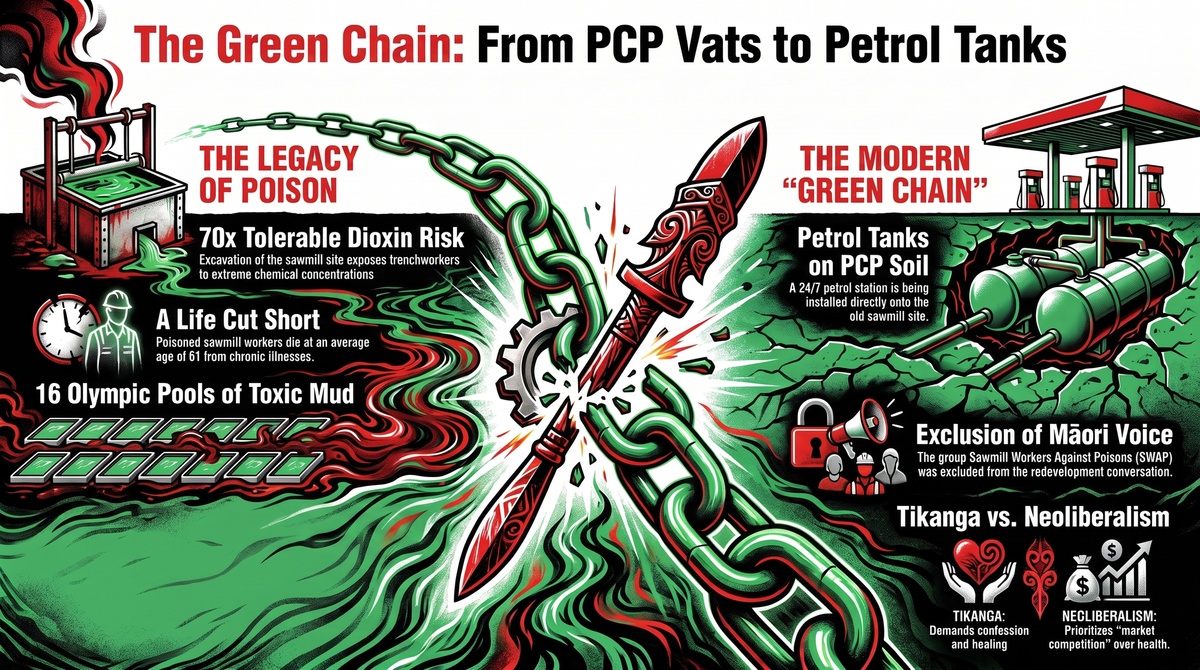
At the former sawmill site itself — now occupied by The Hub — ESR’s Abbreviated Assessment of Human Health Impact found that all evaluated exposure scenarios produced cancer risks above one in 100,000 and that dioxin toxic equivalent (TEQ) contributed between 91 and 99 percent of total cancer risk (Abbreviated Assessment of Human Health Impact from Whakatane Old Sawmill Site – ESR/BOPRC). ESR’s modelling showed that short‑term trenchworker exposure — digging foundations or pipes — could reach up to 70 times the tolerable daily intake if contaminated soil is disturbed without adequate barriers (Abbreviated Assessment of Human Health Impact from Whakatane Old Sawmill Site – ESR/BOPRC).
Bay of Plenty Regional Council’s Kopeopeo Canal flyer states that the remediation project will “remove and safely store up to 40,000m³ of sediment” from a 5.1km stretch because “this sediment contains dioxins, a contaminant that poses a risk to human health from repeated exposure” (About the Kopeopeo Canal Remediation Project – BOPRC). Subsequent funding documents and risk reports show the project has cost around $22 million, co‑funded by the Ministry for the Environment and BOPRC (Funding Sought For Kopeopeo Canal Remediation Project – Scoop)(Risk and Assurance Committee minutes – BOPRC).
RNZ’s Insight: NZ’s Most Poisoned Places identifies Kopeopeo Canal among the country’s worst contaminated sites tackled with remediation funding and notes Ministry for the Environment estimates of roughly 8,000 contaminated sites nationwide, including about 1,500 high‑risk sites (Insight: NZ’s Most Poisoned Places – RNZ). A related RNZ story reports regional councils acknowledging nearly 20,000 sites as confirmed contaminated land while warning this may only be a fraction of the true number (Report unable to assess ‘overall extent of land contamination’ – RNZ).
If you want Western metrics: 40,000m³ of contaminated sediment is roughly sixteen Olympic‑sized swimming pools of toxic mud (assuming ~2,500m³ per pool), and Kopeopeo is just one of 33 dump sites in a single district (About the Kopeopeo Canal Remediation Project – BOPRC)(Poisoned sawmill workers restart advocacy group – SunLive).
Under tikanga, Kopeopeo is an artery in the body of Ngāti Awa and the wider whenua; treating it as a drain for industrial waste is a breach of kaitiakitanga, not just “legacy contamination.”
The Hub Petrol Station: Discount Fuel On Top Of Dioxin
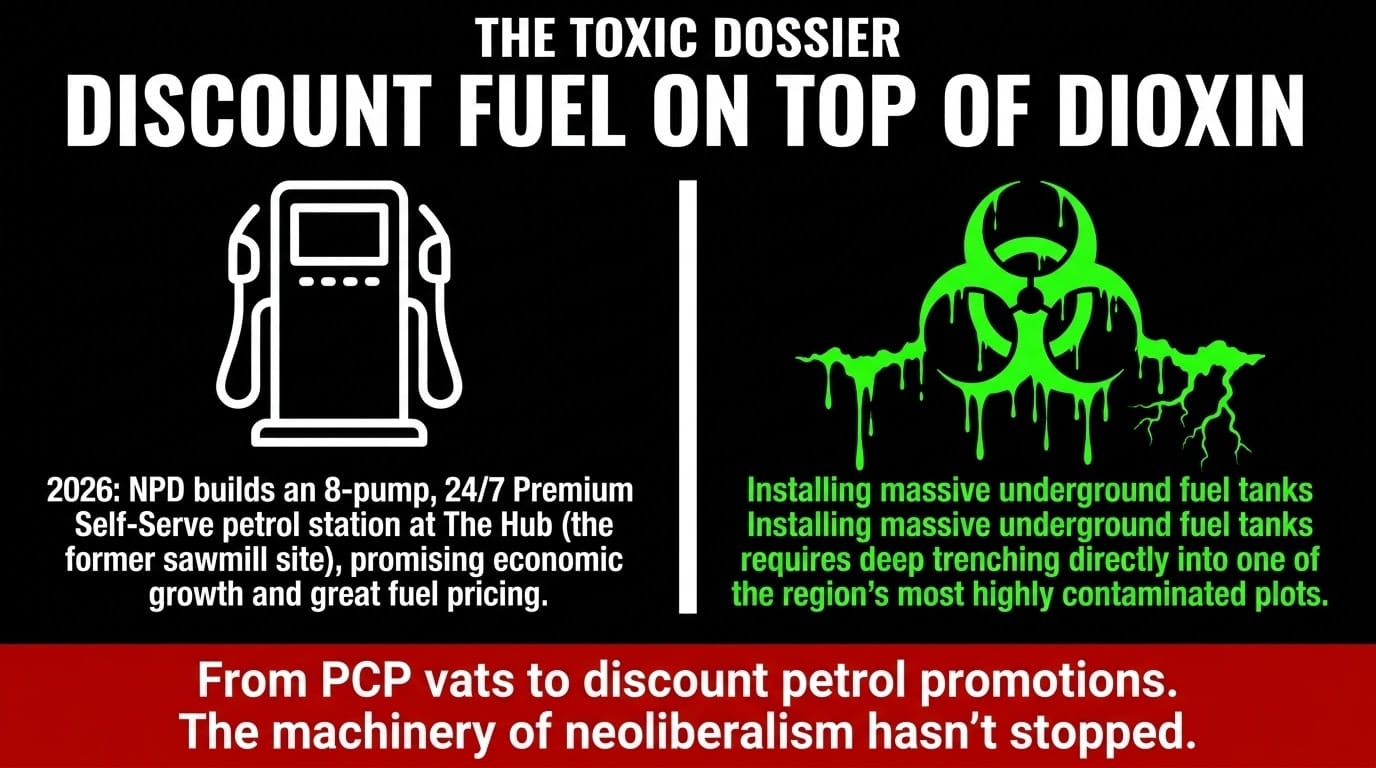
The Hub is a large retail development beside State Highway 30 hosting chains like Harvey Norman, Farmers, Rebel Sport, Briscoes and Bunnings and marketed as a major commercial centre for Whakatāne (The Hub Whakatane – overview).
Eastern Bay App reports that a new NPD self‑service petrol station is under construction at The Hub, in front of Bunnings, with eight refuelling positions, EV chargers and 24/7 operation, aiming to open towards the end of September (New petrol station coming to town – Eastern Bay App). NPD’s own posts describe the Whakatāne site at 2 Phoenix Drive, Coastlands, as a “Premium 24/7 Self Serve site” and invite customers to enjoy “great fuel pricing” and “self‑serve and save” (NPD Fuel Whakatane announcement – Facebook)(NPD – company site).
None of those cheerful announcements mention PCP, dioxins, Kopeopeo, ESR’s 70× trenchworker risk or the fact that SWAP considers this among the district’s most contaminated sites (Abbreviated Assessment of Human Health Impact from Whakatane Old Sawmill Site – ESR/BOPRC)(Poisoned sawmill workers restart advocacy group – SunLive).
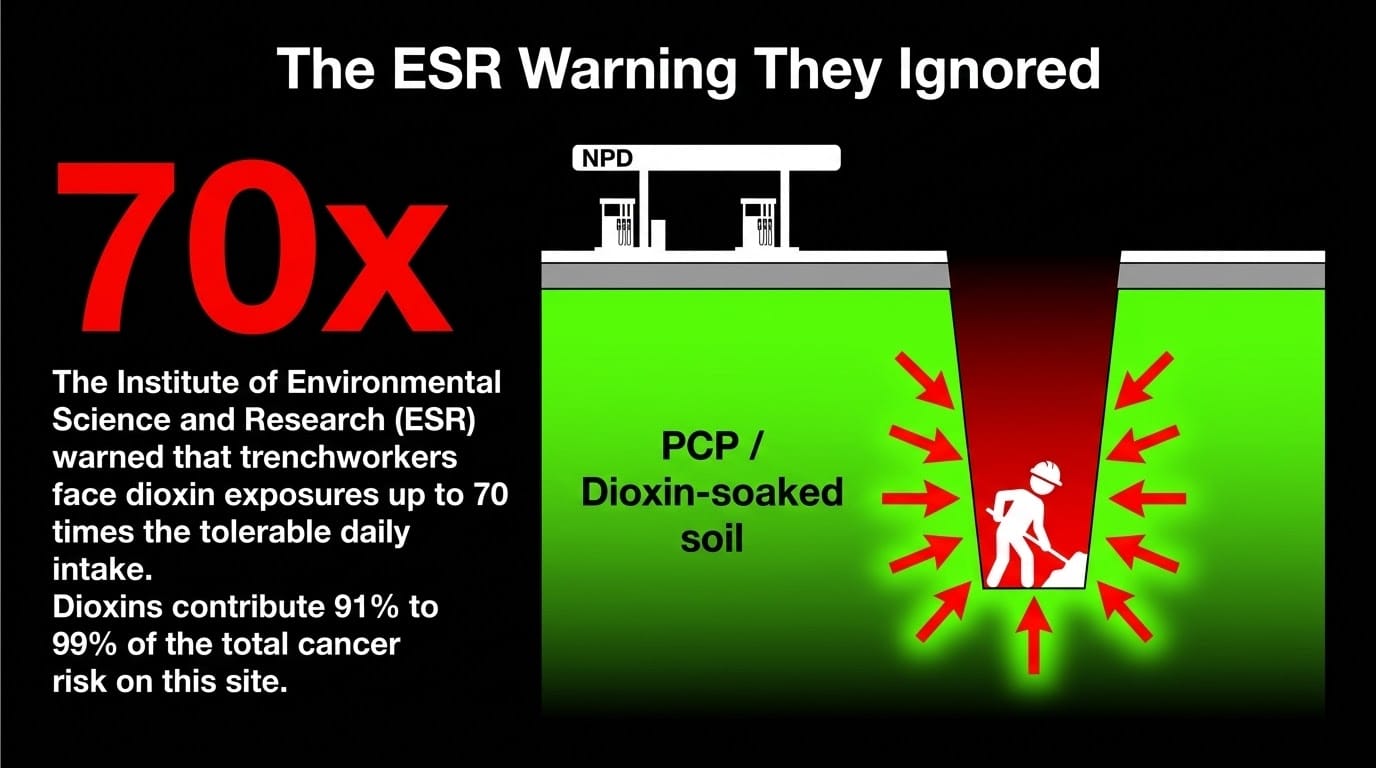
Physically, installing underground fuel tanks and pipelines requires the exact trenchwork ESR warned could drive dioxin exposure up to 70 times tolerable limits if contaminated soils are disturbed and not fully isolated (Abbreviated Assessment of Human Health Impact from Whakatane Old Sawmill Site – ESR/BOPRC). Any leak in those tanks adds petroleum hydrocarbons into a soil profile already carrying organochlorine residues and risks further migration into groundwater and Kopeopeo’s still‑sensitive system (Cleaning the Kopeopeo Canal – IS Dam Lining).
Under tikanga, this is mauri‑depleting for whenua, wai and tāngata. Under white‑supremacist neoliberal logic, it’s “competition in fuel markets”.
SWAP: The Kaitiaki Locked Out Of The Room
Te Ara records SWAP as a lobby organisation formed by Whakatāne sawmill workers to investigate escalating health issues and demand recognition and remediation for PCP and dioxin poisoning (Sawmill Workers Against Poisons – Te Ara). “Fighting Poison” describes how SWAP combined mātauranga Māori and Western science, experimenting with fungi, enzymes and willows to clean contaminated sites and playing a key role in raising awareness of Kopeopeo and other dump sites (“Fighting Poison” – E‑Tangata).
SunLive’s story on the 2021 hui at Wairaka shows Kereama Akuhata and Maanu Paul restarting SWAP so poisoned workers’ wives, children and future generations could keep fighting for recognition and medical care, noting that many whānau have suffered cancers, heart disease, diabetes and reproductive problems they believe are linked to PCP exposure (Poisoned sawmill workers restart advocacy group – SunLive). Nandor Tanczos, reflecting on that hui, emphasises that “full justice [is] still a long time coming” for these whānau (Nandor Tanczos SWAP hui post – Facebook).
Despite that whakapapa of expertise, SWAP had no formal seat in the conversation when NPD’s petrol station consent was granted on the sawmill site, leading to call to EBOP and email Councillor Toni Boynton asking why the very people who mapped the contamination were excluded (Poisoned sawmill workers restart advocacy group – SunLive). That exclusion mirrors the pattern I laid out in “DYING ON THE BOOKS”, where Crown structures treat Māori as “stakeholders” only until we demand accountability that threatens liability (“DYING ON THE BOOKS” – essay description).
Tikanga says: if your body carries the poison, your voice leads the remediation. This government says: if your body carries the poison, you can watch from the fence while we dig new holes.
The Councillor, The Candidate, And The Fire Test Of Representation

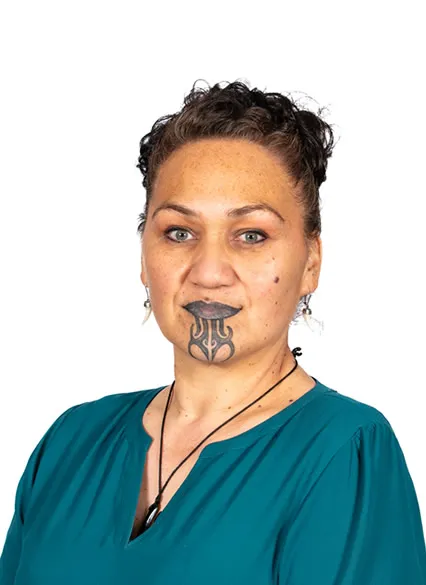
Whakatāne District Council’s profile describes Toni Boynton as councillor for the Kāpū‑te‑rangi Māori Ward, serving on committees including Strategy and Policy, Infrastructure and Planning, and Finance and Performance (Toni Boynton – Whakatāne DC). A graduate profile from Te Whare Wānanga o Awanuiārangi highlights her work defending Māori wards and community representation (Graduate profile – Toni Boynton, Awanuiārangi). Te Ao News reports that Labour has selected her as its candidate for the Waiariki electorate (Labour selects Whakatāne councillor as Waiariki candidate – Te Ao).
In other words, Māori representation sits right inside the council that consented building over contaminated sawmill land and inside the party that claims to care about Māori health and climate while operating squarely within a neoliberal economic frame — a pattern I unpacked in essays like “THE MURU IN PLAIN SIGHT” and “THE RING CHOOSES THE WILLING – HIPKINS CHOSE THE WEALTHY” on themaorigreenlantern.maori.nz (“The Muru in Plain Sight” teaser – Facebook)(“The Ring Chooses the Willing – Hipkins Chose the Wealthy” – essay).
Reaching out to Toni is tikanga in action: calling on someone with whakapapa and positional power to bring poisoned whānau into the room where consents and conditions are decided (Whānau of sawmill workers poisoned – Te Ao)(Toni Boynton – Whakatāne DC).
So far, I have seen no public explanation from WDC or Labour detailing how ESR’s trenchworker warnings, Kopeopeo’s risk profile and SWAP’s expertise were integrated into the NPD consent process (Abbreviated Assessment of Human Health Impact from Whakatane Old Sawmill Site – ESR/BOPRC)(About the Kopeopeo Canal Remediation Project – BOPRC). Under Lange v Atkinson and Durie v Gardiner, I’m naming that silence in the public interest: representation without confrontation is branding, not mana.
Three Examples For The Western Mind: Harm, Numbers, Solutions, Tikanga
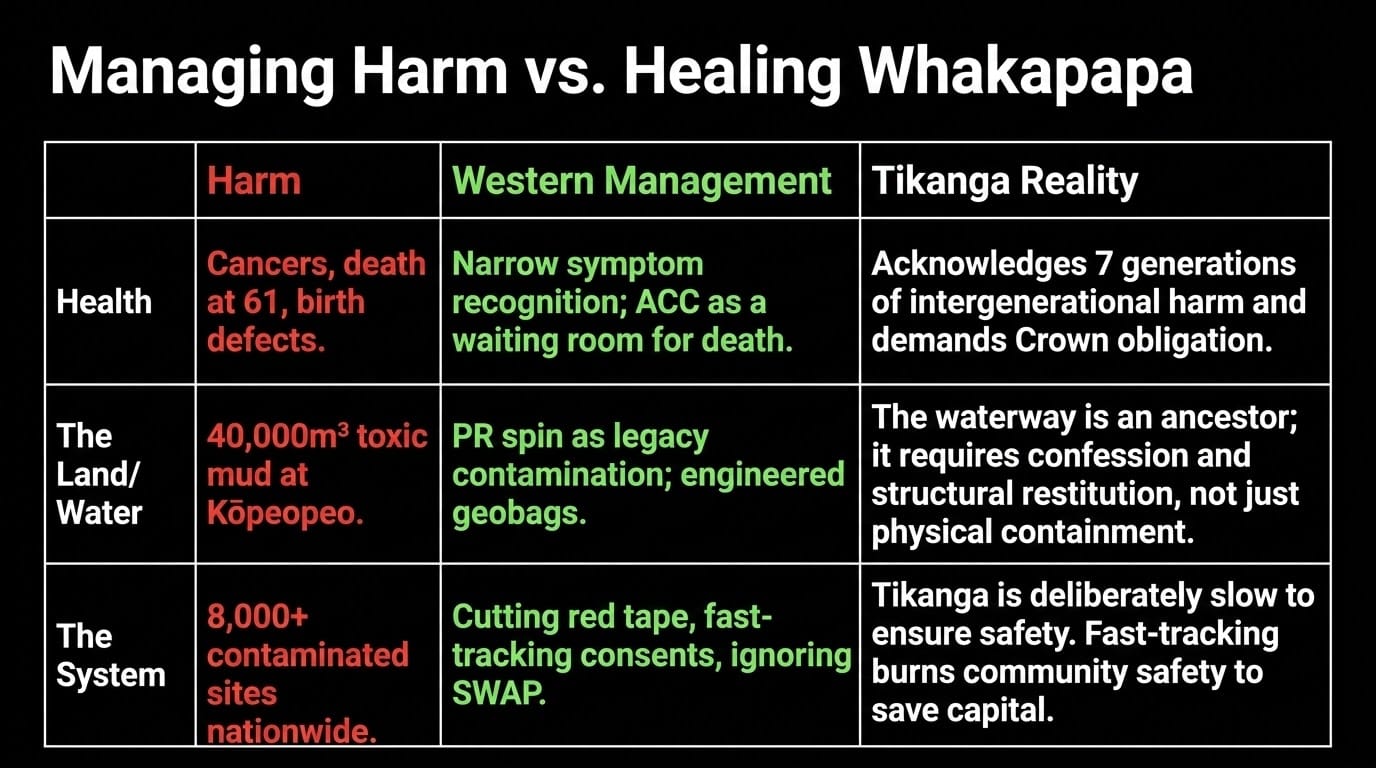
Western policy minds like “evidence‑based examples”, so here are three — each with quantified harm, the Crown’s preferred “solution”, and the tikanga reality.
1. ACC’s waiting room vs whakapapa (Green Chain essay two)
SunLive reports that in a recent four‑month period four former sawmill workers died, with an average age of 61, and describes widespread cancers, diabetes, heart disease and reproductive problems among poisoned workers and their families (Poisoned sawmill workers restart advocacy group – SunLive). McLean’s study shows some workers had serum dioxin levels 10–15× those of unexposed populations (Serum dioxin levels in former New Zealand timber workers – McLean).
Te Whatu Ora’s Sawmill Workers’ Service, however, offers one free health check a year and frames many effects narrowly, while ACC historically resisted recognising broader harm — a pattern I exposed in “DYING ON THE BOOKS: How ACC Turned PCP Poisoning Into a Waiting Room for Death” (Sawmill Workers’ Service – Health NZ)(“DYING ON THE BOOKS” – essay).
Tikanga recognises obligation along whakapapa — seven generations of harm means seven generations of duty (Poisoned sawmill workers restart advocacy group – SunLive). ACC’s narrow frame tears that genealogical obligation apart, turning whānau into isolated “clients” instead of a collective burden the Crown must carry.
2. Kopeopeo Canal vs “legacy contamination” spin (When the Whenua Bleeds / Drain essay)
BOPRC’s flyer explains that Kopeopeo’s remediation will remove and store up to 40,000m³ of dioxin‑contaminated sediment at three containment sites because the canal’s mud poses an ongoing risk to human health (About the Kopeopeo Canal Remediation Project – BOPRC). Scoop and BOPRC risk reports show total project costs around $22m (Funding Sought For Kopeopeo Canal Remediation Project – Scoop)(Risk and Assurance Committee minutes – BOPRC), and RNZ’s Insight identifies Kopeopeo among New Zealand’s most poisoned sites addressed under national remediation programmes (Insight: NZ’s Most Poisoned Places – RNZ).
Engineers and officials call this “legacy contamination” and focus on technical solutions — geobags, bioremediation, monitoring — but my essays “When the Whenua Bleeds: Contaminated Land, Contaminated Water, Contaminated Futures” and “THE CROWN BUILT A DRAIN AND CALLED IT DEVELOPMENT” show how the Crown turned rivers and canals into drains, stealing kai and mauri from Ngāti Awa while calling it “development” (“When the Whenua Bleeds” teaser – Facebook)(“The Crown Built a Drain…” – essay).
Tikanga sees waterways as ancestors and arteries; treating Kopeopeo as an engineering problem without confession, restitution and structural change is half a remedy at best. Dropping petrol infrastructure on its bank while poisoned mud sits in containment cells is the Crown repeating the same offence with a different set of pipes.
3. Fast‑track neoliberalism vs community kaitiakitanga (Black Drain / Fast‑Track Bill)
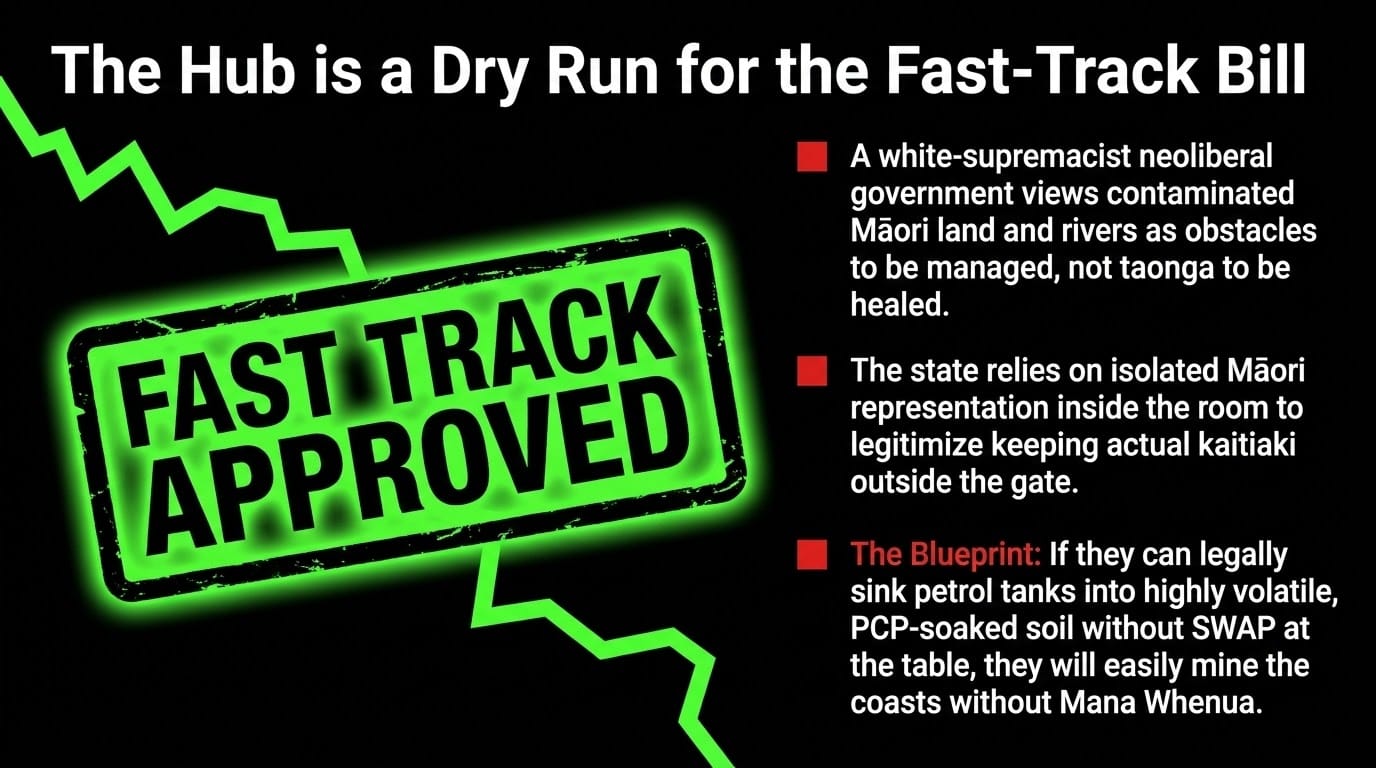
RNZ’s Insight notes Ministry for the Environment estimates of roughly 8,000 contaminated sites nationwide, including about 1,500 high‑risk sites, and records that deadlines for investigating and cleaning up those sites have been repeatedly pushed out (Insight: NZ’s Most Poisoned Places – RNZ). E‑Tangata’s essay on the Fast‑Track Approvals Bill warns that if it passes, coastal communities like Pākiri will once again face mining consents with “no clear avenue for our voices and rights as mana whenua to be upheld” (“Our case shows why the fast-track bill must be stopped” – E‑Tangata).
In “THE BLACK DRAIN” and “THE SAME WAR, TWO HEMISPHERES” I traced how Norske Skog and state agencies turned rivers into effluent pipes and how courts and media are being reshaped to shield future polluters, all under the language of efficiency and “streamlined” decision‑making (“The Same War, Two Hemispheres” / Black Drain teaser – Facebook).
Tikanga is deliberately slow — hui, karakia, consensus, whakapapa analysis — and functions as a safety system. Fast‑track laws treat that safety as red tape to be burned. The Hub petrol station is a dry run for this mentality: a contaminated site treated as a line item, with mana whenua and poisoned workers kept out of the consenting room because they slow down the diggers.
Final Stroke Of The Taiaha

This white‑supremacist neoliberal government has already shown in essays like “THE MURU IN PLAIN SIGHT”, “THE COLOSSEUM OF KINGSLAND” and “THE RING CHOOSES THE WILLING – HIPKINS CHOSE THE WEALTHY” that it is willing to sacrifice Māori democracy, Māori health and Māori futures on the altar of capital (“The Muru in Plain Sight” teaser – Facebook)(“The Colosseum of Kingsland” – essay)(“The Ring Chooses the Willing – Hipkins Chose the Wealthy” – essay).
The Hub petrol station is one more incision: sinking fuel hardware into contaminated whenua while keeping SWAP outside the gate and pretending Kopeopeo’s story is over.
As The Māori Green Lantern, I’m not here to soothe them. I’m here to name the crimes, name the beneficiaries, name the whānau being destroyed, and point directly at the lever we still hold: collective refusal, collective kaitiakitanga, collective support for truth‑telling.
The green chain is still running. Our job is to jam the taiaha into its gears and stop it.
DISCLAIMER – PUBLIC INTEREST
This essay is written and published by Ivor Jones / The Māori Green Lantern in the public interest, on matters affecting the health, environment, and democratic rights of communities in Whakatāne and across Aotearoa (Durie v Gardiner summary)(Responsible public interest communication – Defamation Update).
All factual claims are based on publicly available sources cited inline, including government reports, court documents, news articles, and iwi and community statements; where evidence is partial or contested, this is indicated, and confidence levels are expressed through language (“appears”, “suggests”, “alleges”) consistent with responsible public interest communication (Court of Appeal public‑interest defence overview)(Lane Neave – public interest defence).
Opinions in this essay — including descriptions of actions as racist, white‑supremacist, neoliberal, harmful or mauri‑depleting — are honestly held views based on those cited facts and lived experience, and are not presented as proven legal findings or statements of fact (Defamation Act 1992 – honest opinion commentary)(Clayton Utz note on honest opinion).
This essay does not provide legal, medical, or engineering advice. Readers should seek their own professional advice on specific legal, health, or technical questions. Any person or organisation named is referred to only in their public and official capacities, and the author’s intention is to criticise systems and decisions, not to attack private lives or whakapapa (Insurance law note on Durie v Gardiner)(NZ defamation overview – Equal Justice Project).
The right of reply is open to all named parties. If any factual error is identified with credible evidence, The Māori Green Lantern will consider correction, clarification, or retraction in good faith, consistent with responsible public interest communication and tikanga‑based accountability.