"Opportunities Spreadsheet With A Tiriti-Shaped Hole In It" - 5 September 2026"
Opportunity's Whole Platform Is A Tax Calculator Wearing A Kaupapa Māori Lanyard. I Ran The Numbers On Their Own Policy. Even Their Own Maths Doesn't Quite Add Up — And Neither Does Their Commitment To You.


He Kupu Whakataki — I Went Looking For The Heart Of This Party And Found A Calculator

Every party has a centre of gravity — the one thing that, if you took it away, the whole project would collapse.
For National it's tax cuts and "growth." For Te Pāti Māori it's Te Tiriti, full stop, and I've tested that claim hard in a companion essay.
For Opportunity, I went looking for that centre of gravity in their own words, not mine.
I found it in a single exchange with the NZ Herald's Ryan Bridge, who asked Wong point blank:
"If you don't get a land tax, what's the point of you?"
Her answer: "We've got strong policies around innovation, competition, our energy market, and they don't require the land tax" (Interest.co.nz, Brian Fallow, 28 August 2026).
Notice what wasn't in that list. Not Te Tiriti. Not the Marine and Coastal Area repeal. Not Māori economic devolution.
When a journalist asked this party to name its irreducible core — the thing that makes it worth existing
— the answer was tax, competition, and energy policy.
That is not an accident of one interview. That is the whole architecture of this party, and I'm going to show you exactly how it's built.
Te Horopaki — A Party Built By An Economist, Led By A Consultant, Selling Policy Like A Business Case

Opportunity was founded in 2016 by Gareth Morgan, an economist, on the explicit premise of "evidence-based policy" — treating every social problem as a technical optimisation exercise (Interest.co.nz; Wikipedia, Opportunity Party).
Its current leader, Qiulae Wong, came to politics not from community organising or Māori development, but from a KPMG role as Associate Director of Sustainable Value, advising major corporations on climate transition, after leading the B Corp movement in New Zealand and working in London's ethical fashion and impact-consulting sector (NZ Herald, 28 August 2026; Reuters, 20 August 2026).
I want to be fair here: a business background is not a moral failing, and I'm not going to pretend otherwise. But it explains everything about how this party talks about Māori.
It doesn't talk about Māori in the language of tikanga, whakapapa, or mana. It talks about Māori the way a consultancy talks about an underperforming business unit: "unlock capital," "improve access to finance," "commercialisation," "genuine independence to act... with clear expectations around results, financial management and transparency" (Opportunity Party, Honouring Te Tiriti policy, Pillar 3).
The Deep Dive Podcast
Listen to a lively conversation between two hosts, unpacking and connecting topics in the sources of this essay. I apologise in advance for the AI's very harsh pronounciation of reo. Please dont shoot me, :).
Youtube Video
Like video? Here is a short video suppporting the essay. Again, don't shoot the messenger please because of AI's pronounciation. :)
Koha Consideration
Every koha signals that whānau are ready to support the accountability that a well-designed policy PDF will never provide on its own — someone actually running the numbers on the promise, not just admiring the branding.
It signals that rangatiratanga includes the power to support our own truth tellers — the ones willing to check a party's own arithmetic and tell you honestly when it's $200 short.
Kia kaha, whānau. Stay vigilant. Stay connected. And if you are able, consider a koha to ensure this voice continues.
If you are unable to koha, no worries! Subscribe or follow The Māori Green Lantern at themaorigreenlantern.maori.nz, kōrero and share with your whānau and friends — that is koha in itself.
Four pathways exist:
For those who wish to support this mahi directly with a koha (voluntary contribution): Koha — Support
For those who wish to receive essays directly and support through subscription: Subscribe to The Māori Green Lantern
For those who prefer direct bank transfer: Ivor Jones, account number 03-1395-0099387-000
For those on Facebook: The Māori Green Lantern
Te Whakarāpopoto — When Every Problem Looks Like A Spreadsheet Problem

Here is the mātauranga trick I want the Western mind reading this to actually sit with, because it's more subtle than a lie — it's a worldview.
Opportunity's flagship mechanism for handling contested political questions is the "citizens' assembly" — random members of the public, deliberating with expert input, arriving at "evidence-based" consensus.
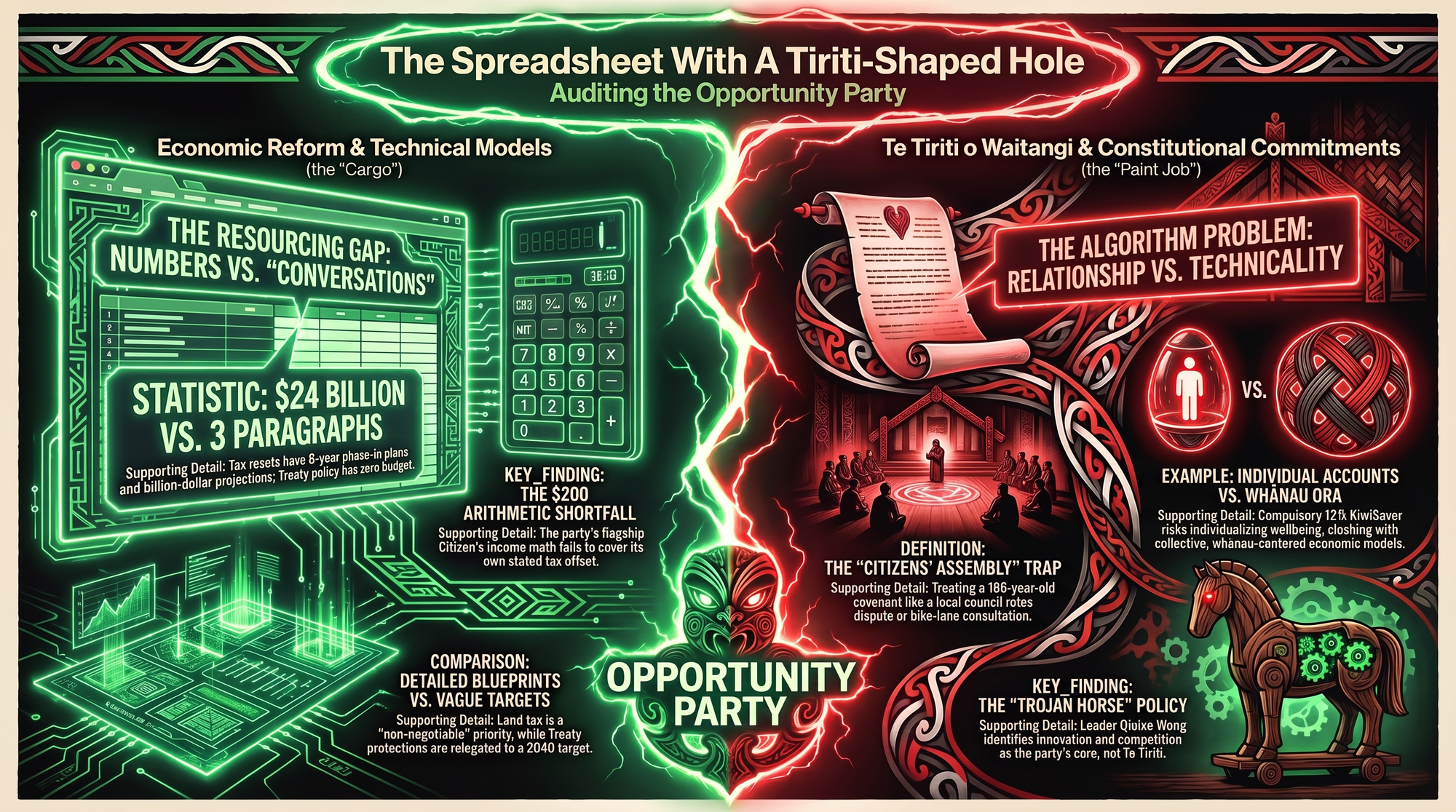
They propose it for local government rates reform. They propose it for constitutional questions about parliamentary term length. And in their Te Tiriti policy, Pillar 2 proposes the exact same mechanism — "deliberative democratic processes, including the principles developed through Opportunity's Citizens' Voice policy" — for resolving the 186-year-old constitutional relationship between Māori and the Crown (Opportunity Party policy).
To a technocrat, that's consistency — one good tool, applied everywhere.
To tangata whenua, it's something else entirely: Te Tiriti o Waitangi is not a rates dispute or a term-length question. It is a covenant between two specific parties — the Crown and iwi/hapū — not a topic for a randomly-selected focus group to workshop alongside cycle lanes and library funding.
Running Te Tiriti through the same deliberative machine you'd use to fix a council budget doesn't honour partnership — it flattens it into just another input for the algorithm.
Ngā Kitenga — What The Numbers Actually Show

One: Even Their Own Maths On The Citizen's Income Doesn't Quite Balance
Opportunity says its $370-a-week Citizen's Income ($19,240 a year) is "equivalent to introducing a large zero bracket" and specifically that it "would cover the tax on the first $66,000 of earned income" (Interest.co.nz). I ran their own bracket numbers: 28% tax on the first $50,000 is $14,000; 34% tax on the next $16,000 (to reach $66,000) is $5,440. Total tax on $66,000 under their own proposed scale: $19,440. Their own Citizen's Income is $19,240 — a $200 shortfall against their own claim.
Both inputs sourced from the same document. It's a small gap in absolute terms, but it's the party built entirely on the promise of rigorous, "evidence-based" economics getting its own headline number slightly wrong — a level of scrutiny they've never once applied to their vague, unresourced "national conversation" on Te Tiriti, which has no dollar figure attached to it at all.
Two: The Land Tax Gets Six Years Of Phase-In And A Costed Transition Plan. The Tiriti Policy Gets A Conversation.
Wong describes the land tax as "a long-term goal," acknowledges it needs six years to phase in, and explicitly frames it as something requiring "buy-in from other political parties and the public" before it happens (Interest.co.nz).
That's honest, and I respect the honesty.
But compare the resourcing: the tax reset comes with a detailed transition plan, projected revenue ($24 billion), specific bracket numbers, and a KiwiSaver contribution schedule rising to 12% of wages (same source).
The Te Tiriti policy gets three paragraphs, a "national conversation," and zero dollars attached to anything except vague references to "longer-term funding for organisations... where this leads to better results" (Opportunity Party policy).
Three: The KiwiSaver Push Quietly Individualises What Whānau Ora Was Built To Do Collectively
Opportunity's KiwiSaver 2.0 would eventually require 12% of every worker's wage (split employer/employee) into a personal, individual retirement account (Interest.co.nz).
That's a bigger compulsory bite out of every Māori worker's pay packet, redirected into individual managed-fund accounts — the direct opposite of the whānau ora principle of collective, whānau-centred resourcing that I've documented this government dismantling in The Pharmacy Con.
Ngā Tauira mō Te Hinengaro o te Tauiwi — Three Examples For The Western Mind

Example 1 — The Missing $200.
Core claim: the party's flagship income policy doesn't quite cover its own stated tax offset.
Quantified harm: a $200 annual shortfall per person against their own promise — small money, but a big tell about which numbers get checked twice and which don't.
Solution: apply the same rigour to the Te Tiriti "national conversation" that's applied to the tax bracket modelling — put a dollar figure and a timeline on it.
Tikanga impact: precision and accountability aren't Pākehā values imposed on Māori kaupapa — manaakitanga demands you get the details right for the people depending on you, and right now the detail only gets checked where the money is.
Example 2 — One Tool For Every Job.
Core claim: the same "citizens' assembly" mechanism is proposed for council rates and for the Crown-Māori constitutional relationship.
Quantified harm: zero dedicated, Treaty-specific institutional mechanism — no Commission, no entrenchment threshold, no enforcement power, unlike the $220 million mechanism Te Pāti Māori has proposed.
Solution: build a Treaty-specific process, negotiated with iwi and hapū directly, not run through the same deliberative machine as a bike-lane consultation.
Tikanga impact: partnership under Te Tiriti is between two specific parties, not a stakeholder-engagement exercise open to anyone selected by ballot.
Example 3 — The Individual Account Versus The Whānau.
Core claim: KiwiSaver 2.0 pushes 12% of every wage into an individual fund.
Quantified harm: this deepens exactly the kind of individualised, privatised approach to wellbeing I traced dismantling collective Māori health and social infrastructure in The Traffic Light Taiaha.
Solution: pair any compulsory savings increase with genuine collective and iwi-administered investment options, not just individual managed funds.
Tikanga impact: whānau ora holds that wellbeing is collective and intergenerational — an individual KiwiSaver balance doesn't feed a marae, fund a kōhanga reo, or pay for a tangihanga.
Ngā Pānga — Why "Trojan Horse" Is The Right Word, Not An Exaggeration

A Trojan horse doesn't have to be malicious to be a Trojan horse — it just has to carry something different inside than what's painted on the outside. Opportunity is polling around 8%, potentially kingmaker territory (Reuters).
If it gets into government, the party's own leader has told you what's non-negotiable: innovation, competition, energy policy — not Te Tiriti.
The Honouring Te Tiriti policy is real, and better than nothing, and better than what I found in June. But it is not the cargo. It's the paint job that makes the horse look friendly enough to wheel through the gate.
The cargo is a tax reset, a UBI, and a KiwiSaver overhaul — genuinely significant economic reforms that may or may not help ordinary Māori whānau, and which will absolutely be the thing this party fights hardest for at 3am in a coalition room, while the "national conversation" waits for a select committee that may never convene.
Action for whānau: before 25 October, ask any Opportunity candidate this exact question
— "if you had to choose between getting your land tax reforms into a coalition agreement, or getting binding Treaty clause protections into it, which one goes first?"
Wong has already answered a version of that question once. Make her answer it again, on the record, about Te Tiriti specifically.
Kupu Whakamutunga — A Kaupapa Māori Lanyard Doesn't Make A Spreadsheet A Relationship

I don't think Qiulae Wong hates Māori. I think she's a capable, well-intentioned business consultant running a party built entirely in the image of business consulting
— where every problem, including a 186-year-old covenant between two peoples, gets processed through the same deliberative, data-driven, cost-benefit machine.
That machine is good at land tax. It is not built to hold whakapapa, mana, or a relationship that predates the company she used to advise for.
Whānau don't need another spreadsheet with a Tiriti-shaped hole cut into it for good optics.
They need a party that treats Te Tiriti as the covenant it is — not a line item waiting for the citizens' assembly to get around to it.

Ivor Jones The Māori Green Lantern Fighting Misinformation And Disinformation From The Far Right
Disclaimer: This essay is opinion and analysis grounded in cited, verified sources current as of 5 September 2026. Facts are attributed to their original reporting; opinions are explicitly flagged as mine and not presented as established fact. No malice is intended toward any named individual; this is a policy-structure and resourcing analysis conducted in the public interest ahead of a general election.