"The $4 Billion Mirage: Do Not Let This Government Sell You Tomorrow While Whānau Struggle Today" - 30 September 2026
Nicola Willis Is Campaigning On Money That Has Not Arrived, A Surplus That Has Not Happened, And Relief That Whānau Cannot Feel


Read This Before They Sell You The Lie

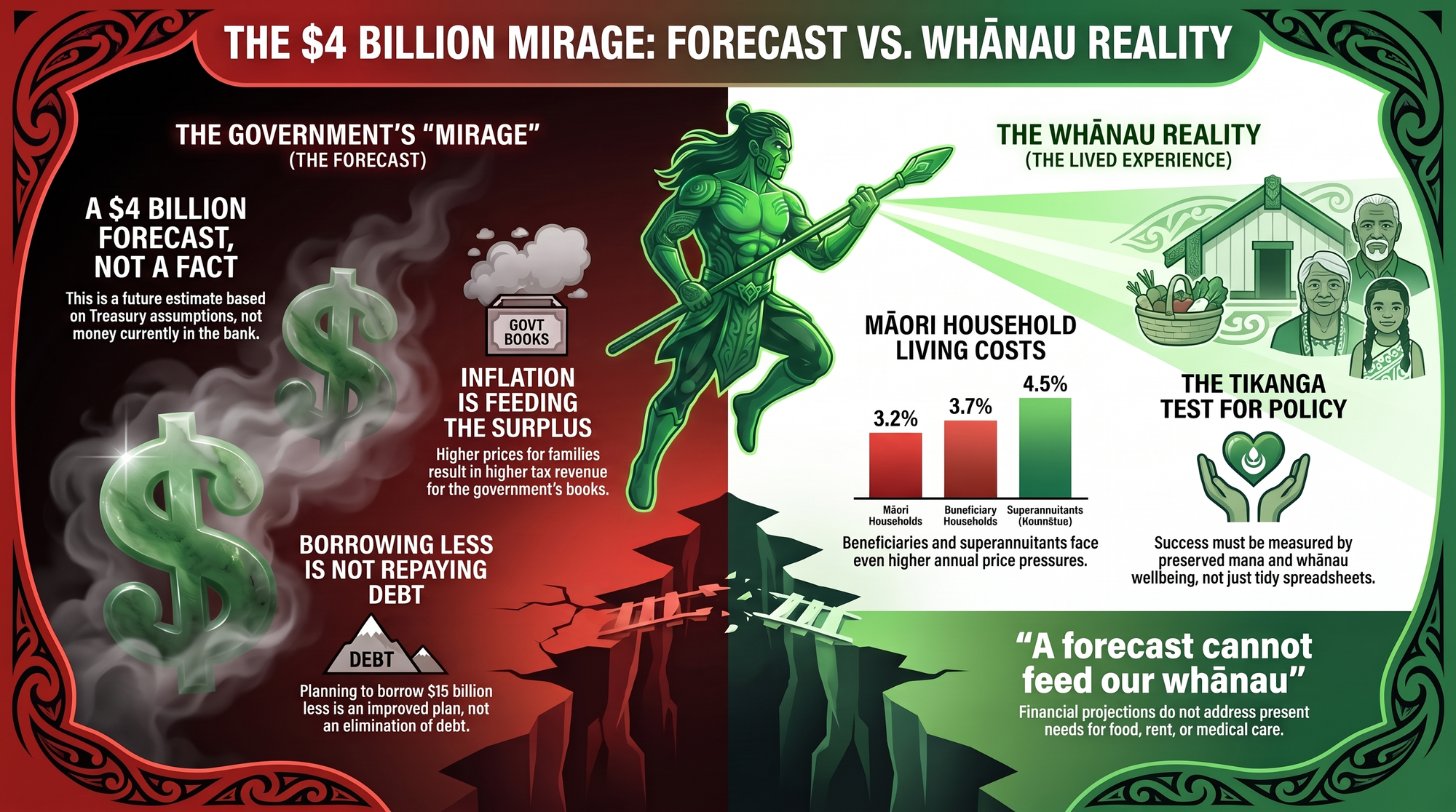
Whānau, pay attention. Over the next few weeks, this coalition will wave an approximately $4 billion forecast surplus around like a winning lottery ticket.
It is not money sitting in the bank today.
It is not food in your cupboard.
It is not cheaper rent, an affordable doctor, secure work or relief at the petrol pump.
It is a forecast—an estimate of what may happen in the future if Treasury’s assumptions hold. The RNZ article explains that the forecast has improved because of stronger business activity and “higher and more persistent inflation”, which is expected to produce more tax revenue. Read what the RNZ article actually says.
That matters because inflation is not an abstract number to whānau. Inflation is the rising supermarket bill. It is the power account. It is the petrol needed to get to mahi, kura and medical appointments.
The government wants political credit now for a surplus that may arrive later—while some of the financial pressure hurting people today helps make its future revenue forecast look better.
That is the deception I am exposing.
I am not alleging that Treasury falsified its figures. I am exposing the political trick of turning a limited forecast into a sweeping claim of government competence.
The numbers may be legitimate.
The story being sold around them is the illusion.
What The Article Means
 RNZ | Te Reo Irirangi o Aotearoa
Here is what the RNZ article was about:
- The government’s future financial forecast looks better than it did previously.
- The forecast surplus may reach approximately $4 billion.
- The government now intends to borrow $15 billion less over four years than it previously planned.
- Stronger business activity contributes to the improvement.
- More persistent inflation also increases expected tax revenue.
- The forecast remains exposed to international instability and economic uncertainty.

Those points are reported in RNZ’s analysis of the pre-election fiscal update.
Now look carefully at what the article does not prove.
It does not prove that whānau have more disposable income.
It does not prove that every government cut was justified.
It does not prove that essential services are better.
It does not prove that the coalition has repaired the cost-of-living crisis.
It does not prove that the forecast surplus has already happened.
That is the gap National hopes voters will not examine.
The Lie Is In The Leap

The supported claim is:
The Crown’s future financial position is forecast to improve.
The political leap is:
Therefore, this government has fixed the economy and deserves another term.
No. Absolutely not.
A better forecast for the Crown does not automatically produce a better life for the people.
The government’s accounts are not your accounts.
Treasury’s expected revenue is not your grocery money.
A smaller future borrowing programme is not your mortgage payment.
A projected surplus is not your ability to see a doctor.
Nicola Willis can polish the forecast until it shines like greenstone under television lights. It still cannot feed one child tonight.
Presenting this forecast as proof of overall success corrupts public accountability. It replaces demonstrated delivery with a promise and asks voters to applaud before the result exists.
Inflation Is Feeding The Headline

RNZ reports that “higher and more persistent inflation” contributes to Treasury expecting more tax revenue. Read RNZ’s explanation of the improved forecast.
That does not mean inflation explains the entire improvement. RNZ also identifies stronger business activity, and Pono requires that favourable evidence to remain in the account. Read both factors in the RNZ analysis.
But the contradiction remains brutal.
Stats NZ reports annual living-cost increases of 3.2% for all households and Māori households, 3.7% for beneficiaries, 4.5% for superannuitants, 4.3% for the lowest-expenditure households and 1.9% for the highest-expenditure households in the year to June 2026. Read the official household figures.
These figures measure price changes, not every household’s complete financial position. But they destroy the fantasy that a brighter government forecast automatically means equal relief across society.
The government cannot celebrate the fiscal benefits associated with inflation while treating the household consequences of rising prices as somebody else’s problem.
Your pain cannot become their campaign trophy.
Less Borrowing Is Not Debt Repaid

RNZ reports that the government intends to borrow $15 billion less over the next four years than previously planned. Read the borrowing claim in context.
That is an improvement against an earlier plan. It is not $15 billion of existing debt repaid.
Imagine planning to borrow $20,000, then reducing the proposed loan to $15,000. Your plan has improved—but you are still planning to borrow.
That example simplifies the language; government finances are not identical to household finances.
The point remains:
Borrowing less than previously expected is not the same as eliminating debt.
Do not let campaign language erase that distinction.
The Deep Dive Podcast
Listen to a lively conversation between two hosts, unpacking and connecting topics in the sources of this essay. I apologise in advance for the AI's very harsh pronounciation of reo. Please dont shoot me, :).
Youtube Video
Like video? Here is a short video suppporting the essay. Again, don't shoot the messenger please because of AI's pronounciation. 😄
Koha: Support Independent Accountability

Who supports The Māori Green Lantern to produce this mahi?
You do, through koha. There is no line of corporate entities waiting to support me to soften the questions.
This essay challenges the dangerous gap between a projected Crown surplus and the lives of whānau carrying pressure now. Your support keeps that scrutiny independent.
Every koha says that rangatiratanga includes the power to support our own truth tellers.
If you cannot koha, no worries. Subscribe, follow, kōrero and share this with your whānau and friends. That is koha too.
- Koha: Support The Māori Green Lantern.
- Subscribe: Receive Essays And Support This Mahi.
- Bank Transfer: Ivor Jones, 03-1395-0099387-000.
- Facebook: Subscribe Or Follow.
Kia kaha, whānau. Stay vigilant. Stay connected. And if you are able, consider a koha to ensure this voice continues.
Tika: Name The Number Honestly

Tika demands accuracy.
Call the $4 billion figure what it is: a forecast.
State when it may occur. State what assumptions support it. State what risks could derail it. Do not turn “we expect this result” into “we have delivered this result”. Do not turn “Treasury expects more tax revenue” into “every household is thriving”. Do not turn “we plan to borrow less” into “we have repaid the debt”.

If a claim loses its power when explained honestly, it never deserved that power.
Pono: Tell The Whole Truth

Pono demands more than a technically accurate number. It demands an honest account of what the number means—and what it does not mean.
The improved forecast is real evidence in the government’s favour. So are stronger business conditions and reduced intended borrowing.
But the uncertainty is also real. The continuing cost-of-living pressure is real. The fact that the surplus remains a forecast is real. RNZ reports both the improved outlook and the risks surrounding it.
Pono does not allow a government to carry the flattering facts onto the election stage while leaving the inconvenient facts locked behind the curtain.
That is not leadership.
That is marketing dressed as accountability.
Tikanga: What Happened To The Person?

Tikanga asks what the system did to the person standing in front of it.
Did it preserve their mana? Did it recognise their whakapapa? Did it respect their wairua? Did it involve their whānau, where that involvement was wanted? Did it help return them towards wellbeing?
For readers trained in Western policy language, the test is simple:
Did the policy improve the person’s life—or merely improve the institution’s numbers?
Mana means dignity.
Whakapapa means recognising that people belong to families, communities, whenua and generations.
Wairua means acknowledging that fear, humiliation, isolation and hopelessness are real consequences.
Whānau means people are not isolated economic units.
Mauri asks whether the encounter strengthens someone’s capacity to live—or drains it.
A government can satisfy an accounting target while failing every one of those tests.
Three Examples For The Western Mind

The Beneficiary Facing Higher Prices
Stats NZ reports annual living-cost inflation of 3.7% for beneficiary households in the year to June 2026. That measures price pressure, not every beneficiary’s net financial loss. Read the beneficiary household measurement.
A future surplus does not answer the present question: can that whānau afford what it needs this week?
The solution: every major fiscal announcement should include a household-impact assessment showing changes in essential costs, income support and access to services.
The tikanga impact: treating people in need as a budget problem attacks mana. Ignoring their family responsibilities erases whakapapa. Forcing them repeatedly to prove distress depletes wairua and mauri.
A mauri-building government helps people regain security. A mauri-depleting government gives them a lecture about restraint while celebrating its future forecast.
The Kaumātua Waiting For Relief
Stats NZ reports annual living-cost inflation of 4.5% for superannuitants. This is a group-level price measurement, not an identical loss for every kaumātua. Read the superannuitant household measurement.
A forecast surplus cannot buy groceries today. It cannot drive anyone to a medical appointment. It cannot remove anxiety from an unpaid bill.
The solution: fiscal announcements affecting older people should disclose essential-cost changes, income adjustments and access to health and social services.
The tikanga impact: kaumātua are not liabilities waiting to be managed. Preserving mana means enabling them to live with dignity. Recognising whakapapa means understanding their place within whānau and the knowledge they carry across generations.
A government that forgets that relationship may balance an account while bankrupting its moral authority.
The Household With The Least Room
Stats NZ reports annual living-cost inflation of 4.3% for the lowest-expenditure household group, compared with 1.9% for the highest-expenditure group. These are spending groups, not direct measures of income or wealth. Read the rates and Stats NZ’s household-group definitions.
The national average does not describe everyone equally.
The solution: require distributional reporting showing which groups bear the costs and which receive the benefits of every major fiscal policy.
The tikanga impact: fairness requires the Crown to see different circumstances instead of hiding them inside an average. Whānau must be able to participate in decisions affecting their wellbeing.
A policy can look tidy from Wellington and still tear through a kitchen-table budget.
A Forecast Cannot Excuse Every Cut

RNZ links Willis’s approach to tight operating allowances, significant cuts, protest and harm, while explaining how the improved forecast may strengthen her election argument. Read RNZ’s assessment of the political strategy.
My answer is simple:
Show us what every cut achieved.
Show us the service that improved. Show us the capability retained. Show us who carried the cost. Show us the whānau whose wellbeing increased. A favourable forecast cannot retrospectively make every decision wise.
Using one projected surplus to excuse an entire programme of cuts is not financial discipline. It is political whitewash poured over consequences the government would prefer voters to forget.
Willis Must Answer For Delivery

I do not need to attack Nicola Willis’s education. I challenge her performance.
Can she present a forecast? Clearly. Can she construct an election message around it? Obviously. But the real question is whether her strategy delivers durable improvement without forcing unacceptable costs onto whānau and public services.
That judgment requires outcomes, not branding.
It requires Tika, not exaggeration. It requires Pono, not selective celebration. It requires Tikanga, not numbers stripped of human consequences.
A minister does not earn competence merely by announcing that conditions may eventually improve.
Why This Could Destroy Their Campaign

This government’s danger is not merely that the forecast could change.
Its real danger is that voters recognise the trick.
If ministers insist the economy is improving while whānau cannot recognise that improvement in their own lives, every celebration deepens the distance between the government and the governed.
Every polished announcement creates a harsher question:
If your management is such a triumph, why are people still being told to wait?
I cannot guarantee this coalition’s downfall. No honest writer can guarantee an election result. But I can identify the political fuse. The government is asking voters to value a future projection above their present experience.
That is not merely risky. It is arrogant.
The forecast does not need to collapse for the campaign story to collapse. Voters need only decide that Nicola Willis is trying to sell them tomorrow because the government cannot adequately defend today.
A Repository For Our Mokopuna

I would love you to visit The Māori Green Lantern because this mahi contains information you can use every day—to question political claims, expose misleading comparisons and demand evidence before surrendering your trust.
My earlier Ten-Point Con Job article includes a deep-dive audio section and supporting video material for people who prefer those formats. Explore the earlier multimedia article.
This kaupapa is larger than one election.
It is a repository for our mokopuna—a record they can examine when they ask who spoke, who stayed silent and who warned that the numbers were being separated from the people.
At least they will be able to say:
The Māori Green Lantern, among others, saw the sales pitch and refused to mistake it for the truth.
My Electoral Challenge

Do not vote this coalition back into power merely because it found a future number to celebrate.
Judge it by what it delivered.
Judge it by who paid.
Judge it by whether public services strengthened.
Judge it by whether whānau gained security, dignity and hope.
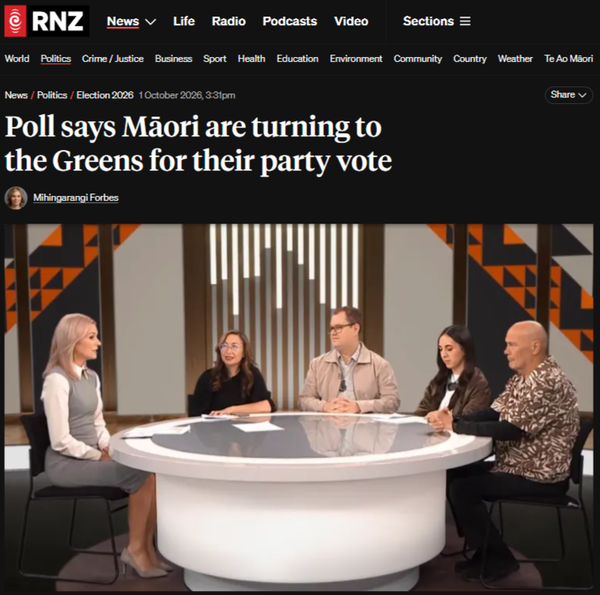
My political recommendation is to consider giving the Green Party your party vote because its published policy direction emphasises dignified incomes, housing, health care, climate responsibility and honouring Te Tiriti. These are policy commitments, not guaranteed outcomes, and voters should examine them directly. Read the Green Party’s published policies.
The Greens must face the same tests.
Tika: are their claims accurate?
Pono: do their actions match their words?
Tikanga: do their policies preserve mana, recognise whakapapa, respect wairua, involve whānau and return people towards wellbeing?
No party deserves blind loyalty.
But this coalition certainly does not deserve another term merely for showing us a forecast and demanding applause.
A brighter spreadsheet cannot feed our whānau.
A future surplus cannot erase present harm.
And a government that confuses its forecast with our wellbeing deserves to be removed—not rewarded.

Disclaimer: This essay distinguishes verified reporting from political opinion. It does not allege that Treasury falsified its figures, establish criminal corruption, or claim a certain election result. The criticism concerns the political meaning attached to the forecast. No direct ministerial right of reply has been obtained. Evidence-supported corrections should be assessed and published.