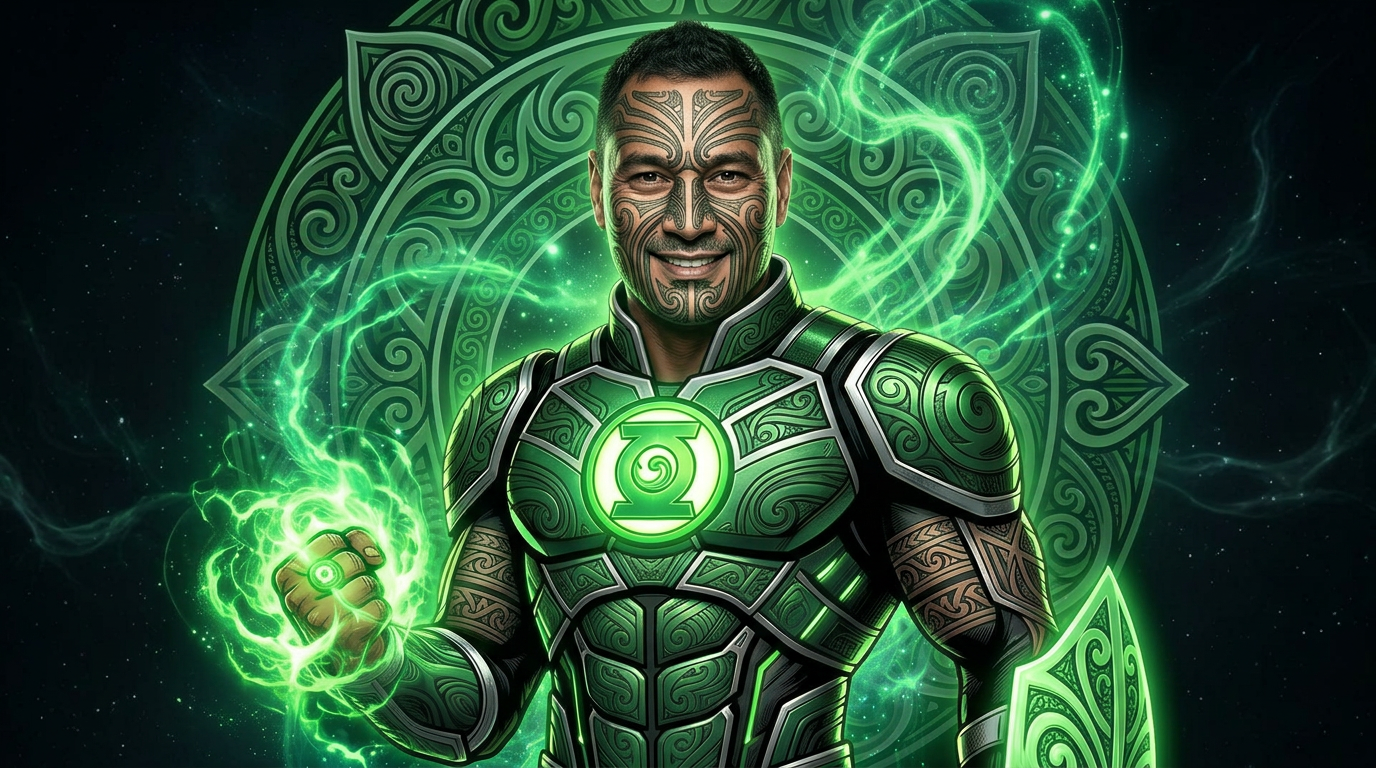
"Five Kingmakers, No Conscience: The Coalition Took The Credit, And Whānau Pay The Bill" - 2 October 2026
They Governed Over The Hunger, Dodged Every Hard Question, And Now Beg For Your Vote While Whānau Queue For Kai.

Kia Ora, Whānau,
The Show Without A Point
Picture a marae kitchen at a tangi. Five people stand at the stove arguing about who stirs the pot, and outside the line for kai goes round the block.
Not one of them lifts the lid.
 RNZ | Te Reo Irirangi o Aotearoa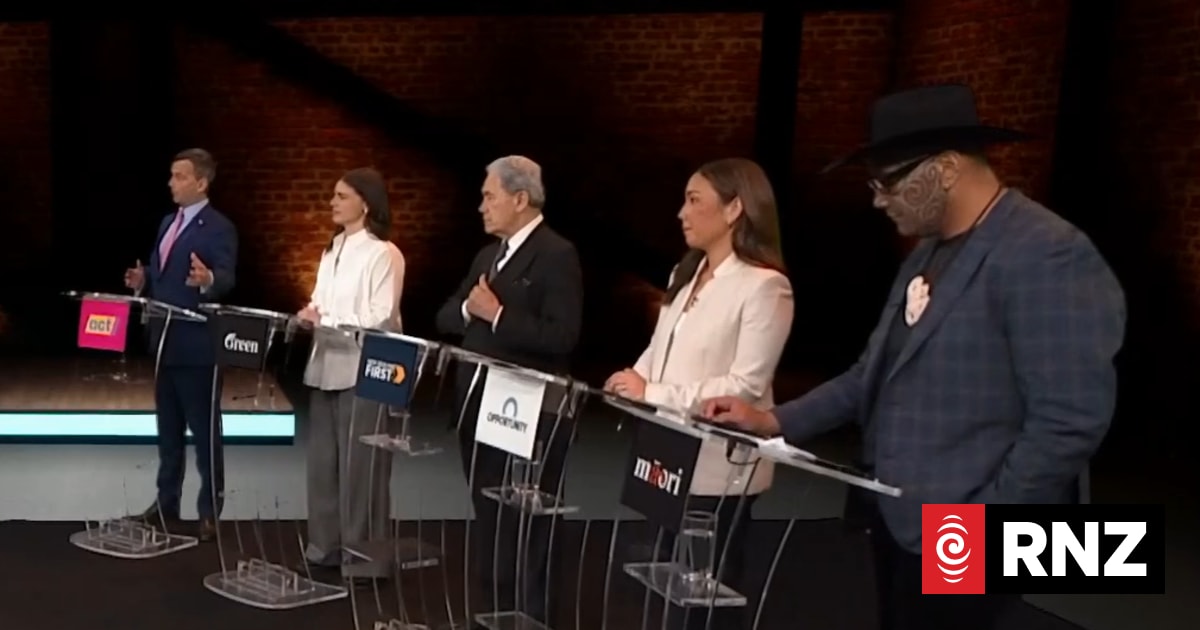
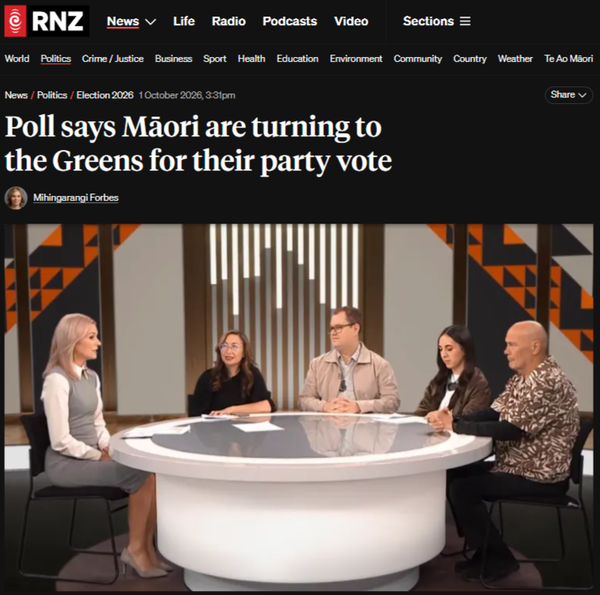
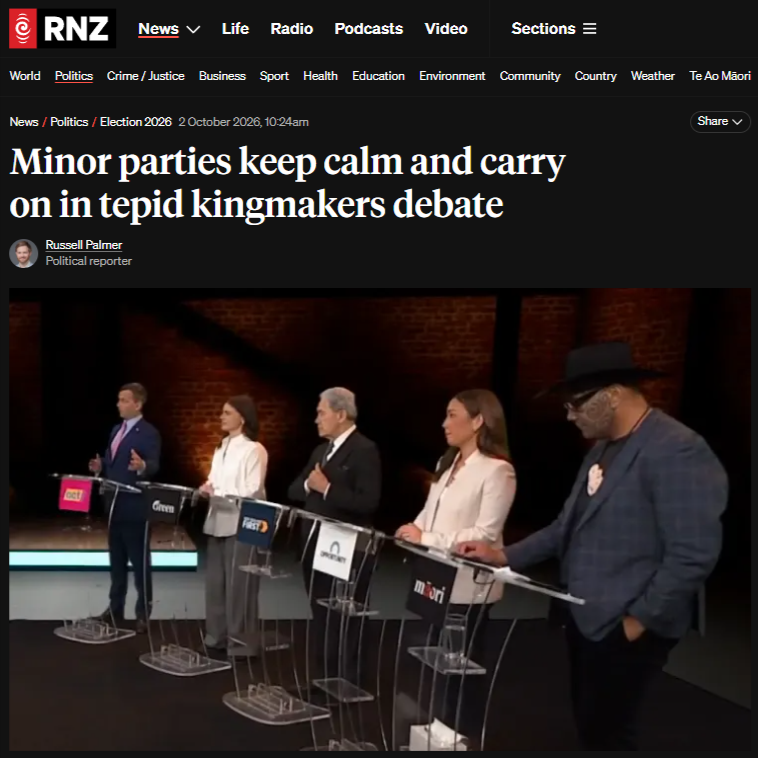
That was the Press Kingmakers' Debate.
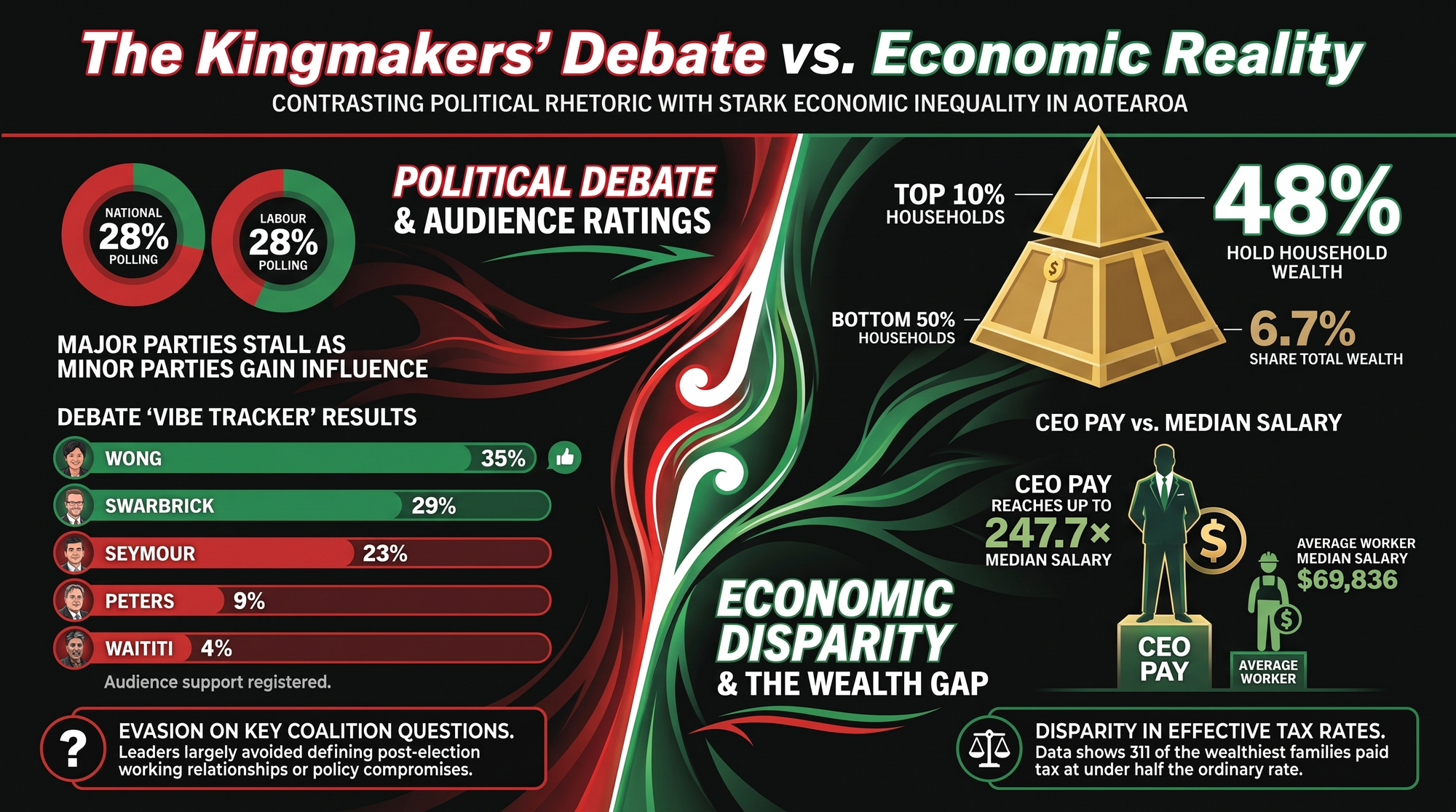
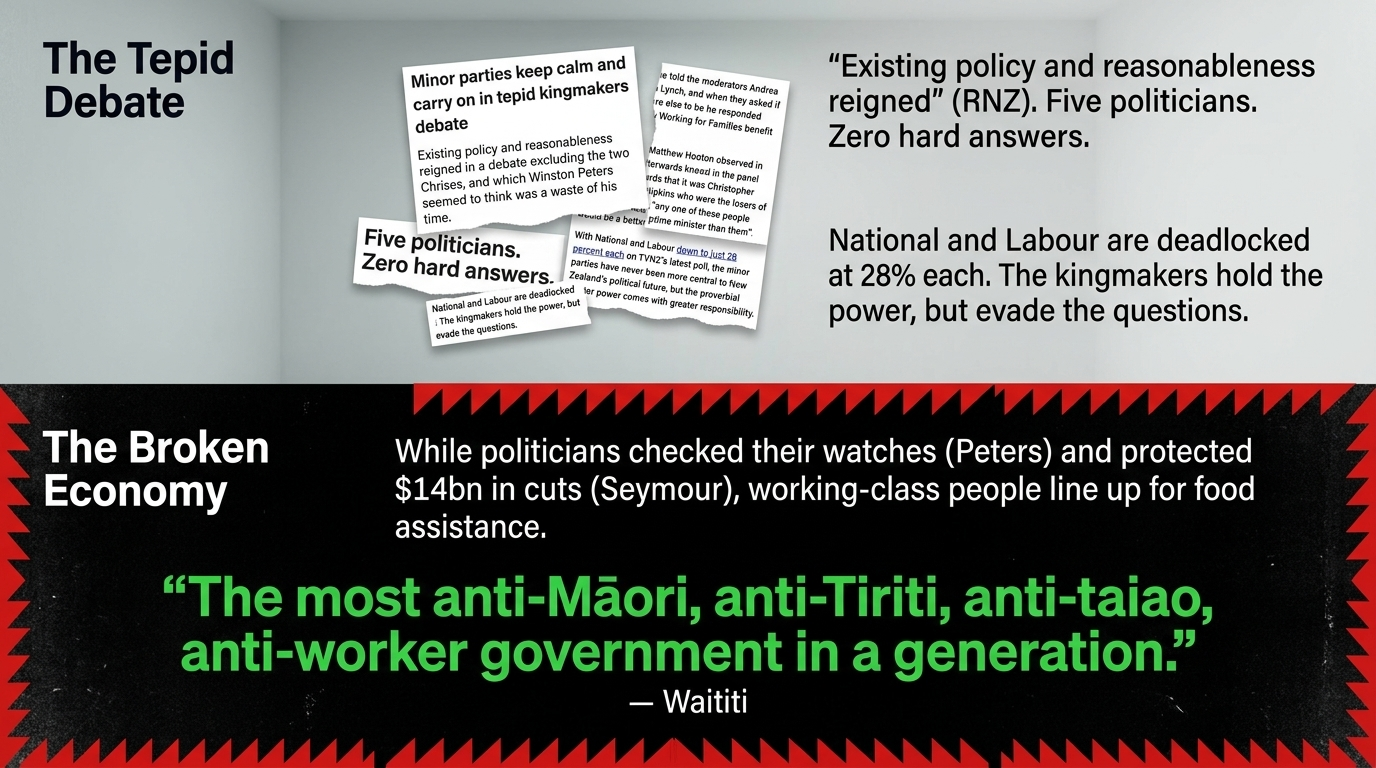
RNZ's Russell Palmer reported that "existing policy and reasonableness reigned", and that questions about who could work with whom were "largely evaded". National and Labour each sit on 28 percent in TVNZ's latest poll.
These five could decide who governs, and they gave us politeness and dodges.
Hooton, on the panel afterwards, said any one of these people would be a better prime minister than Luxon or Hipkins.
Whānau should hold on to that.
Please click through and read this.
It holds information you can use in your kōrero at work, at the marae and around the dinner table. There is an audio podcast that lays out this kaupapa in detail, a short video that explains it, and for long-form readers, a cited essay is waiting.
This is a repository for our mokopuna. When they look back, they can say that at least they knew the Māori Green Lantern, among a few, was warning us.
The essay covers six things.
It starts with what the Kingmakers' Debate showed. It then covers who held power and what they now say, five verified revelations about Peters, Seymour, Waititi and Wong, and who owns the wealth in this country. After that come three examples for the Western mind, with the harm counted and solutions named, and finally my case for why this Coalition must go and why I say vote Green.
I'm Ivor Jones, Te Arawa, Ngāti Pikiao, with Welsh whakapapa. I hold the taiaha for whānau Māori.
Tika, Pono And Tikanga: The Test I Use
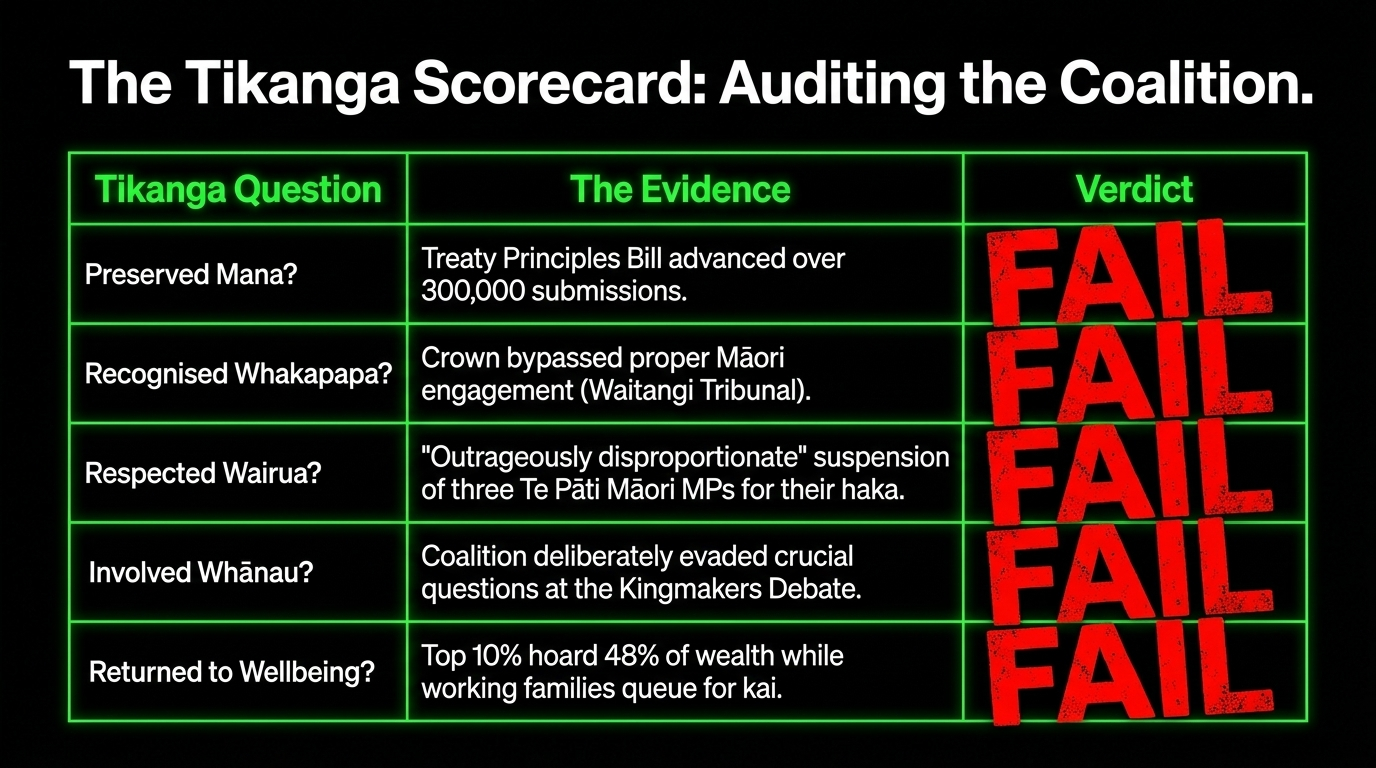
Tika asks whether the action was right. Pono asks whether the word was true. Tikanga asks whether the system built mauri, and I break that into five questions.
Did it preserve mana? Did it recognise whakapapa? Did it respect wairua? Did it involve whānau? Did it return people to wellbeing?
| Tikanga Question | What The Evidence Shows | My Verdict (Opinion) |
|---|---|---|
| Preserved mana? | The Treaty Principles Bill lost 112–11 after a record 300,000 submissions (NZ Herald) | Failed |
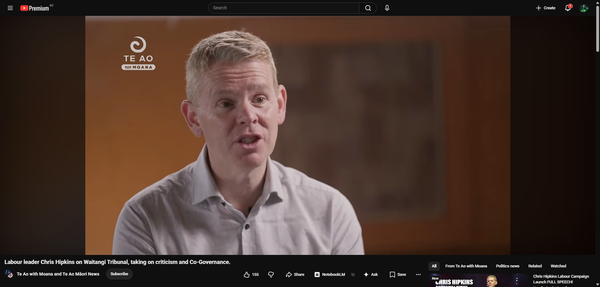
| Recognised whakapapa? | The Tribunal, as I recorded it, found the Crown advanced the bill without proper Māori engagement | Failed |
| Respected wairua? | Brownlee's suspensions of three Te Pāti Māori MPs for their haka, which Audrey Young called "outrageously disproportionate" (The Spinoff) | Failed |
| Involved whānau? | Coalition questions "largely evaded" at the debate | Failed |
| Returned people to wellbeing? | Top 10% hold 48% of wealth; bottom 50% hold 6.7% | Failed |
My verdicts are opinion. The evidence beside each is the factual basis.
Who Held The Power
Peters and Seymour sat in this government.
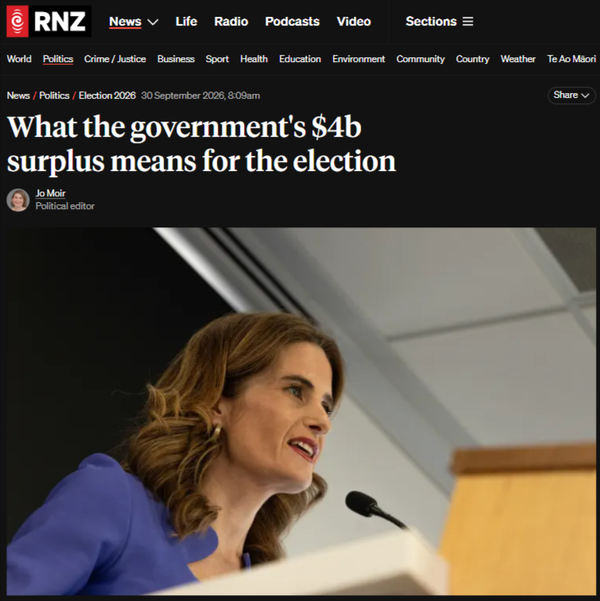
On the last sitting day, Seymour thanked his coalition partners for working together "more successfully than our worst enemies' worst nightmares", claimed $14bn in savings and welcomed Luxon to "the Church of No New Taxes".
Peters said he had submitted 56 members' bills and told the House, "I'm coming back real big time." Waititi called it "the most anti-Māori, anti-Tiriti, anti-taiao, anti-worker government in a generation". RNZ adds that Seymour got his Regulatory Standards Act over the line this term.
The whakapapa of Waititi's party matters too.
Te Ara records that the Māori Party formed in 2004 when Tariana Turia quit the Labour-led government over the Foreshore and Seabed Act. After 2008 it signed a confidence-and-supply agreement with National.
Six Revelations
1. One Coalition, Two Economies.
NZ First is promising to buy back BNZ, break up the gentailers and the supermarkets, set up a $100 billion future fund and give every newborn citizen a grant. Seymour, in the same coalition, says parties intervening in supermarkets are descending into "hysteria" and "a kind of madness", and says he wants more chances to stop his partners "doing all sorts of crazy things".
Either NZ First's flagship promises are the crazy things he failed to stop, or he can't control his own coalition. RNZ also reports that NZ First is plotting an "unprecedented second consecutive term" in government.
2. Peters Offers $6,240 A Year And Calls It Leadership.
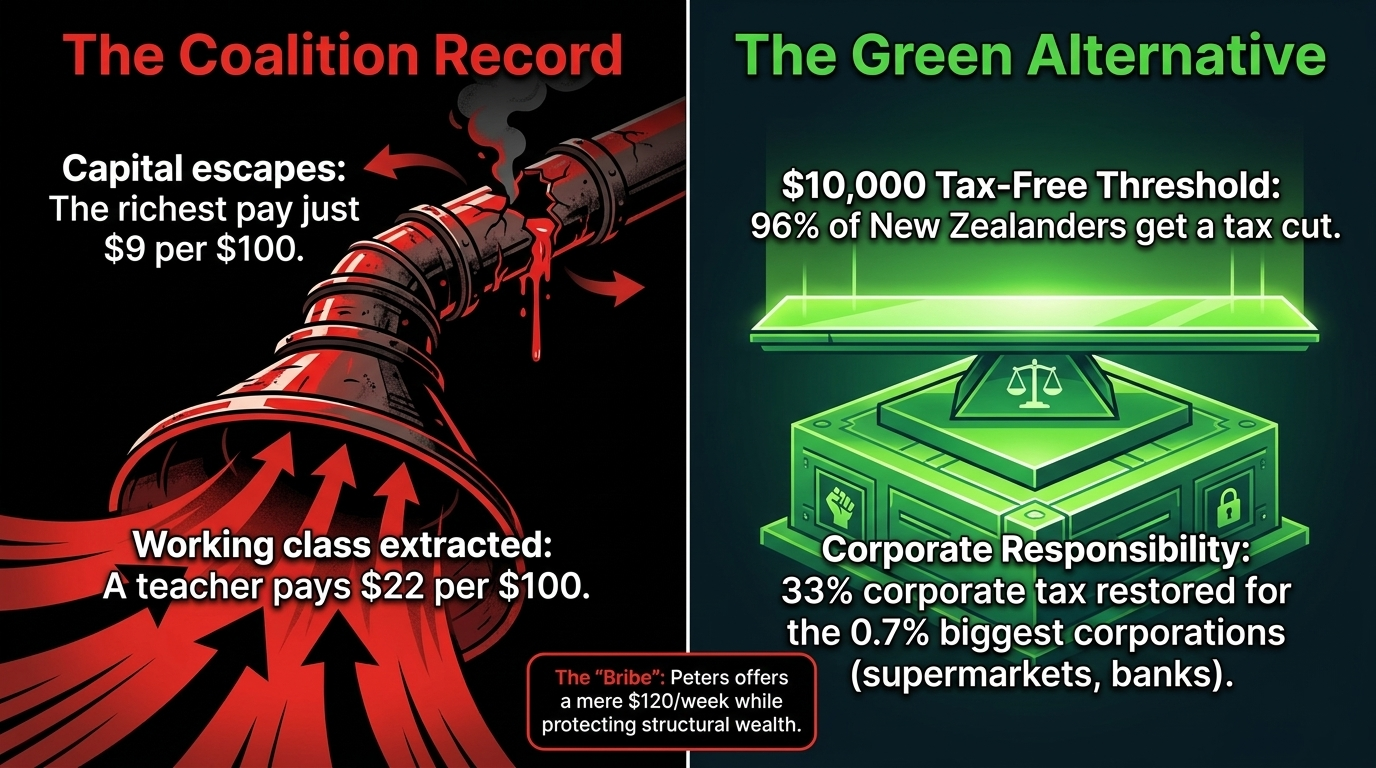
He said he would have no kneejerk reactions, then made the only substantive policy commitment of the night: $120 a week more in Working for Families payments. That is $6,240 a year, 8.9 percent of the median salary.
He called Luxon and Hipkins "not in the same league" while sitting in Luxon's government.
3. Peters Treats The Public As A Nuisance.
According to RNZ, he checked his watch on stage, told the moderators "You said 8.30", and said yes when asked if he had somewhere else to be.
His main target afterwards was the media, and he lambasted the lack of reporters at his own meetings. When the NZ Herald asked him about the Aitken affair, he declined to comment, citing comity.
4. The Disavowed Words.
The Herald reported that in November 2024 Judge Ema Aitken disrupted a NZ First fundraiser where Peters, then Deputy PM, was speaking about tikanga Māori being taught at law schools. The Herald reports Attorney-General Judith Collins' 12 December letter attributed a statement to him, and he "disavowed" it, saying he could not remember saying it.
The panel called it "untested hearsay". Its statement "had no bearing" on the panel's conclusions, and the panel found Aitken did not recognise Peters. It was not satisfied that NZ First had acted with any "political motivation or mischief". Aitken's conduct was a "serious breach of comity". ( full article.)
This doesn't prove Peters lied.
It shows a Deputy PM's recollection falling apart when tested.
5. Seymour Trusts Peters, Who Doesn't Trust Him Back.
Seymour's Treaty Principles Bill lost at second reading with National and NZ First voting against, and he promised to reignite the debate in 2026. The vote was 112–11, which is 91.06 percent of votes cast (Spinoff).
At the debate he said he trusted Peters, reversing his position of three years earlier, and Peters did not return it. He was the only one willing to say he believed Simeon Brown that there was no freeze on hiring nurses. He also shared his salary of $515,060, which is 7.4 times the median.
6. Te Pāti Māori: A Party That Broke Its Own Tikanga.
The High Court ruled that Mariameno Kapa-Kingi was unlawfully expelled. The Te Ao News full report says the National Council breached the party's Kawa, excluded her from key meetings and did not give her a proper chance to respond.
The court said the process failed the tikanga in the party's own constitution. It found "no evidential basis" for the misuse-of-funds allegation, which leadership had relied on. It also dismissed her challenge to John Tamihere's presidency. The party said it respects the ruling.
The Spinoff reports that co-leaders Waititi and Ngarewa-Packer stayed loyal to Tamihere throughout. It reports that Kapa-Kingi called the leadership's silence "deafening" and that Waititi sent her a brief text. Two electorate committees have resigned. RNZ adds that the fallout led to two MPs going it alone. Waititi scored the lowest on the vibe tracker, with 4 percent.
In my opinion, a party that punishes an MP outside its own tikanga has lost the right to lecture anyone else.
On tax, I owe Waititi's party a fair hearing. Its tax plan makes the first $30,000 tax-free. It also includes a wealth tax of 1.5 percent on net wealth above $2m, rising to 2 percent above $5m and 2.5 percent at $10m or more. It returns company tax to 33 percent. The Spinoff reports Labour has ruled out major tax changes beyond its capital gains tax. Te Pāti Māori's problem is conduct and electoral weight, not neoliberal policy.
Qiulae Wong. She won the vibe tracker with 35 percent. She told reporters she was surprised by the civility, and credited "the influence that Opportunity is having on politics already".
That was a debate RNZ called "tepid".
The Wealth They Protect
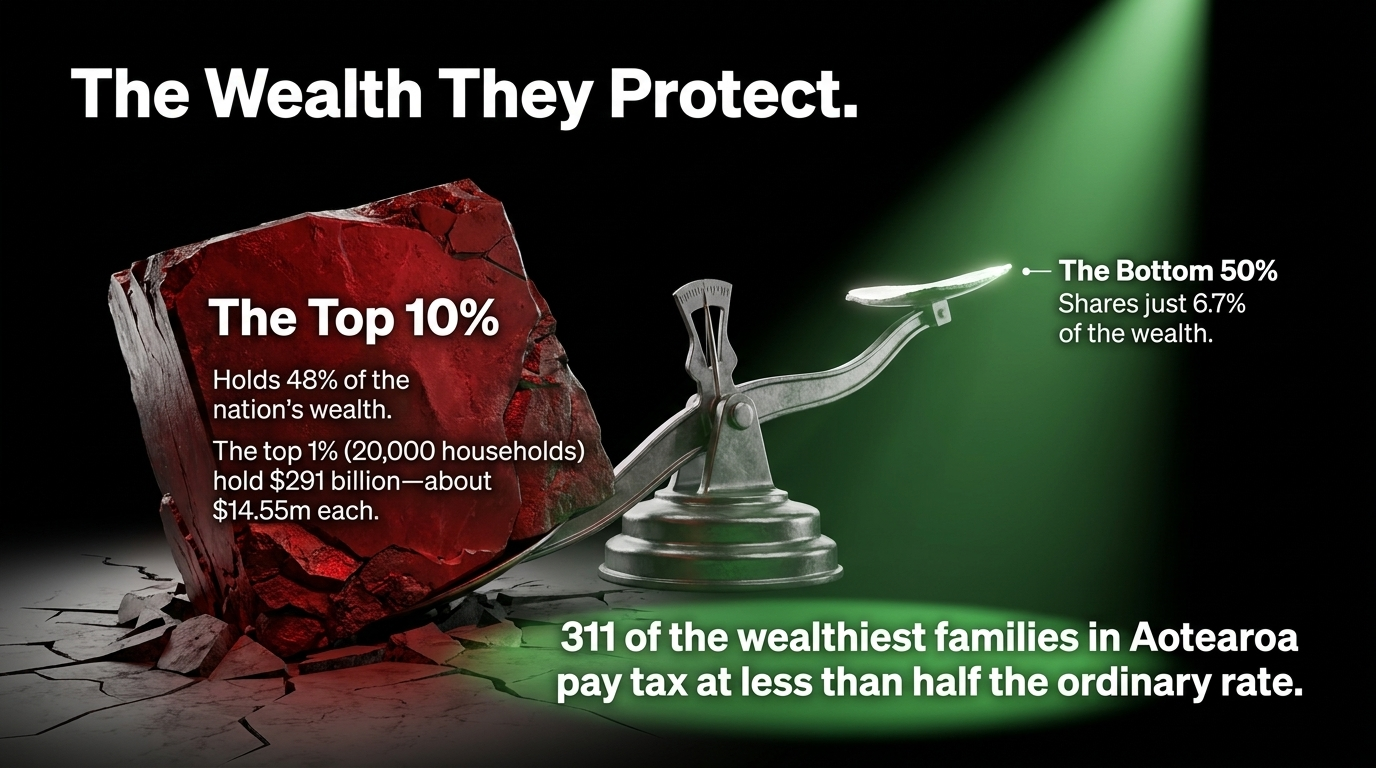
The NZ Herald reports that the top 10 percent of households hold 48 percent of the nation's wealth while the bottom 50 percent share 6.7 percent. A typical top-10% household holds about 35.8 times a typical bottom-50% household. The top 1 percent hold $291bn across 20,000 households, about $14.55m each. A 2023 IRD study found 311 of the wealthiest families paid tax at less than half the ordinary rate. The article also says Pākehā hold substantially more wealth than Māori, Pacific and Asian groups.
CEO pay shows the same gap. Gentrack's chief executive took home $17.3m, which is 247.7 times the median salary of $69,836. A2 Milk's took $7.7m (110.3×), Ebos's $6.95m (99.5×) and Fonterra's $6.1m (87.3×). The Herald also quotes economist Shamubeel Eaqub asking why capital gains go untaxed.
In my assessment, a government that leaves this untouched is neoliberal in practice. The data is the basis and the label is opinion.
The Deep Dive Podcast
Listen to a lively conversation between two hosts, unpacking and connecting topics in the sources of this essay. I apologise in advance for the AI's very harsh pronounciation of reo. Please dont shoot me, :).
Youtube Video
Like video? Here is a short video suppporting the essay. Again, don't shoot the messenger please because of AI's pronounciation. :)
Koha: Support This Mahi
You might ask who is paying the Māori Green Lantern to expose a government that serves the wealthiest 10 percent. The answer is you do. No corporate supports this mahi, and nobody is lavishly backing Ivor to name every dodge in this coalition. Every koha tells us whānau are ready to support the accountability that Crown and corporate power won't provide. It says rangatiratanga includes the power to support our own truth tellers.
Kia kaha, whānau. Stay vigilant. Stay connected. If you're able, consider a koha to ensure this voice continues.
If you can't koha, no worries. Subscribe or follow at themaorigreenlantern.maori.nz, kōrero, and share with your whānau and friends. That is koha in itself.
Four pathways exist:
- Koha: Support the mahi directly
- Subscribe: Get the essays and support through subscription
- Bank transfer: Ivor Jones, account number 03-1395-0099387-000
- Facebook: Subscribe on Facebook
Three Examples For The Western Mind
Example 1: The Coalition That Promised Two Things.
Imagine a firm with two owners. One promises to break up the supermarkets and the other calls that madness, and neither says which promise gets dropped.
Harm: a median-wage worker on $69,836 earns about 1/248th of what Gentrack's CEO takes home.
Solution: publish coalition votes and costings before the election.
Tikanga impact: trust is whakapapa between government and governed, and when promises can't be relied on, mana is lost. I traced the wider pattern of coalition pressure in my Treaty Tribunal essay.
Example 2: The Bill Nobody Wanted.
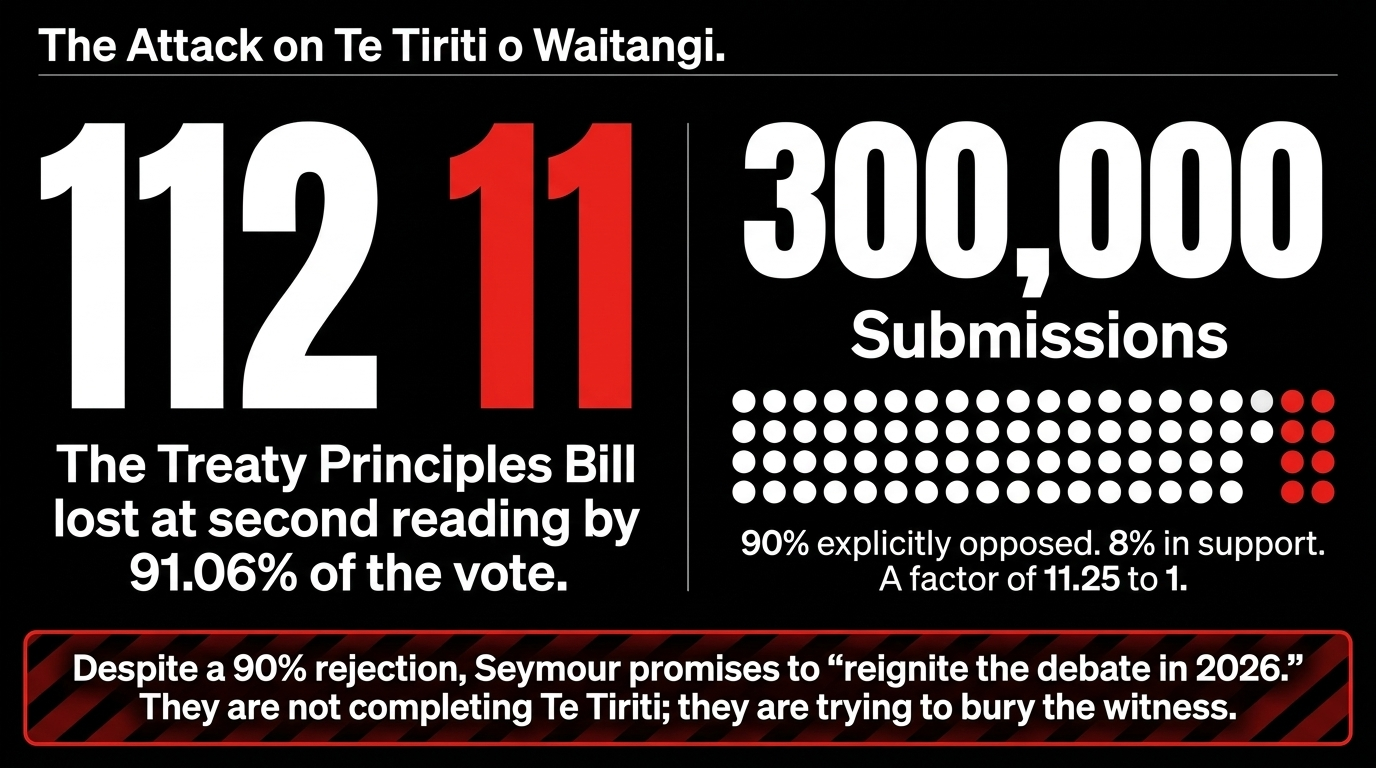
A bill is rejected 112–11, or 91.06 percent of votes cast. It drew a record 300,000 submissions, and my essay records them as 90 percent opposed and 8 percent in support (11.25×).
Harm: Seymour promised to bring it back, and ACT now wants to restrict tikanga in judicial decisions.
Solution: any reconsideration of Te Tiriti should come through a partnership process with Māori, not a temporary majority.
Tikanga impact: rewriting the agreement without the other party ignores whakapapa and rangatiratanga. The full essay sets out the Tribunal's findings.
Example 3: The Club That Broke Its Own Rules.
An MP is expelled at meetings she wasn't invited to, on an allegation the High Court found had no evidential basis.
Harm: she was cut off from voters in Te Tai Tokerau until the Court reinstated her, and the party lost two electorate committees.
Solution: follow your own Kawa, with facilitated hui before discipline.
Tikanga impact: manaakitanga, whanaungatanga and kotahitanga were breached, in the words of the judgment.
For the wider context, my essay How Labour And The Greens Turned Te Tiriti Into A Backdrop examines how the opposition parties treated Te Pāti Māori at Waitangi. Its tikanga analysis applies to Example 3.
The Cost For Whānau

My opinion, with the facts above as its basis, is that this government is neoliberal in its economics and white supremacist in the effect of its Treaty agenda.
I use these labels about outcomes and governing architecture, and I make no claim about any person's private beliefs. That is the framing I set out in my essay on the Tribunal.
Behind each number is a person. A tamaiti waits for a lunch, a kuia waits for a nurse, and a worker on $69,836 watches a CEO earn 247.7 times as much.
Waititi told reporters the people he meets are "working-class people, who are now lining up for food assistance". ( RNZ.)
Why You Should Not Vote This Coalition Back In
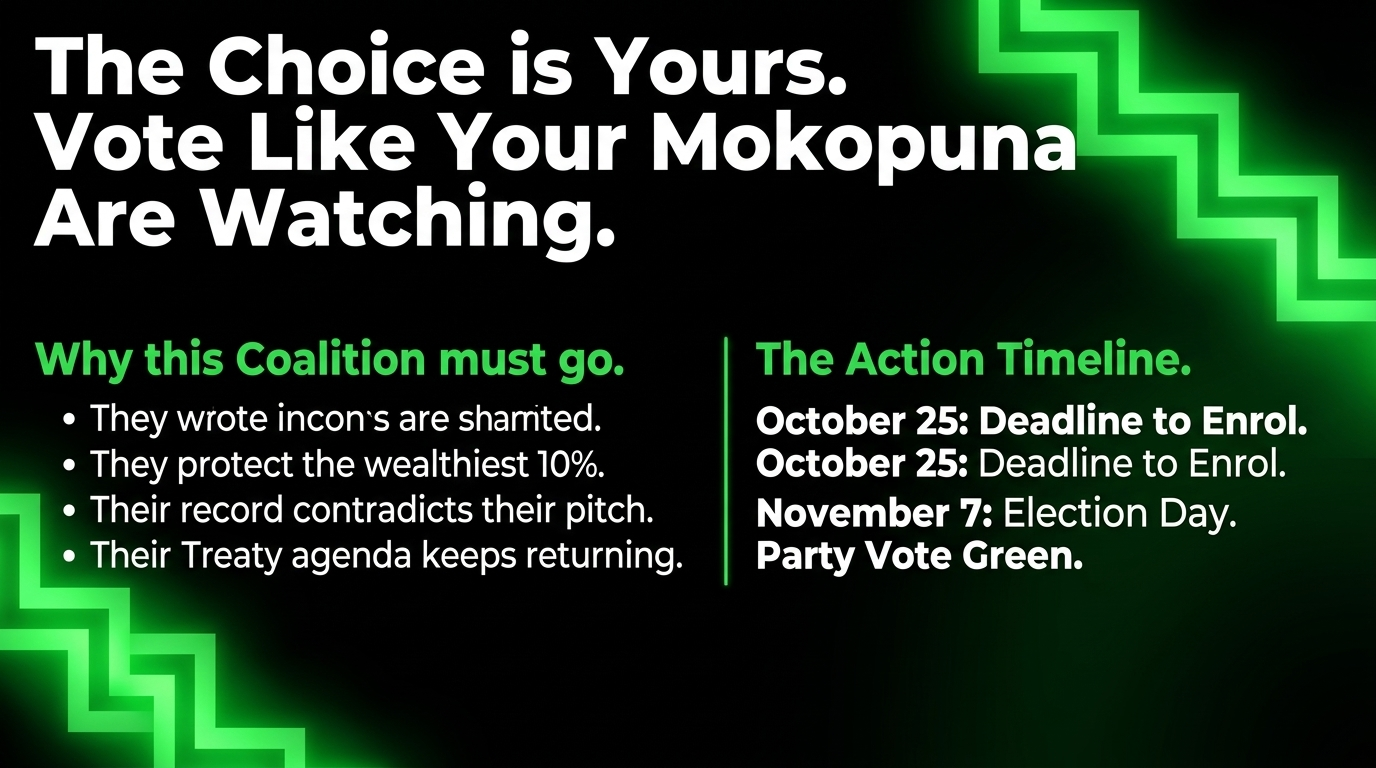
Reason 1: Their record contradicts their pitch. Seymour claims success while promising to stop his partners' "crazy things". Peters offers $6,240 a year.
Reason 2: Their Treaty agenda lost 112–11 and keeps returning.
Reason 3: They protect the wealthy. The top 10 percent hold 48 percent of the wealth, and 311 families paid under half the usual rate of tax.
Reason 4: They dodge the public. The panel afterwards heard evasion on who would work with whom.
The election is on 7 November, and you need to enrol by 25 October.
Why I Say Vote Green
I say give your party vote to the Greens. This is my opinion, and these are my reasons.
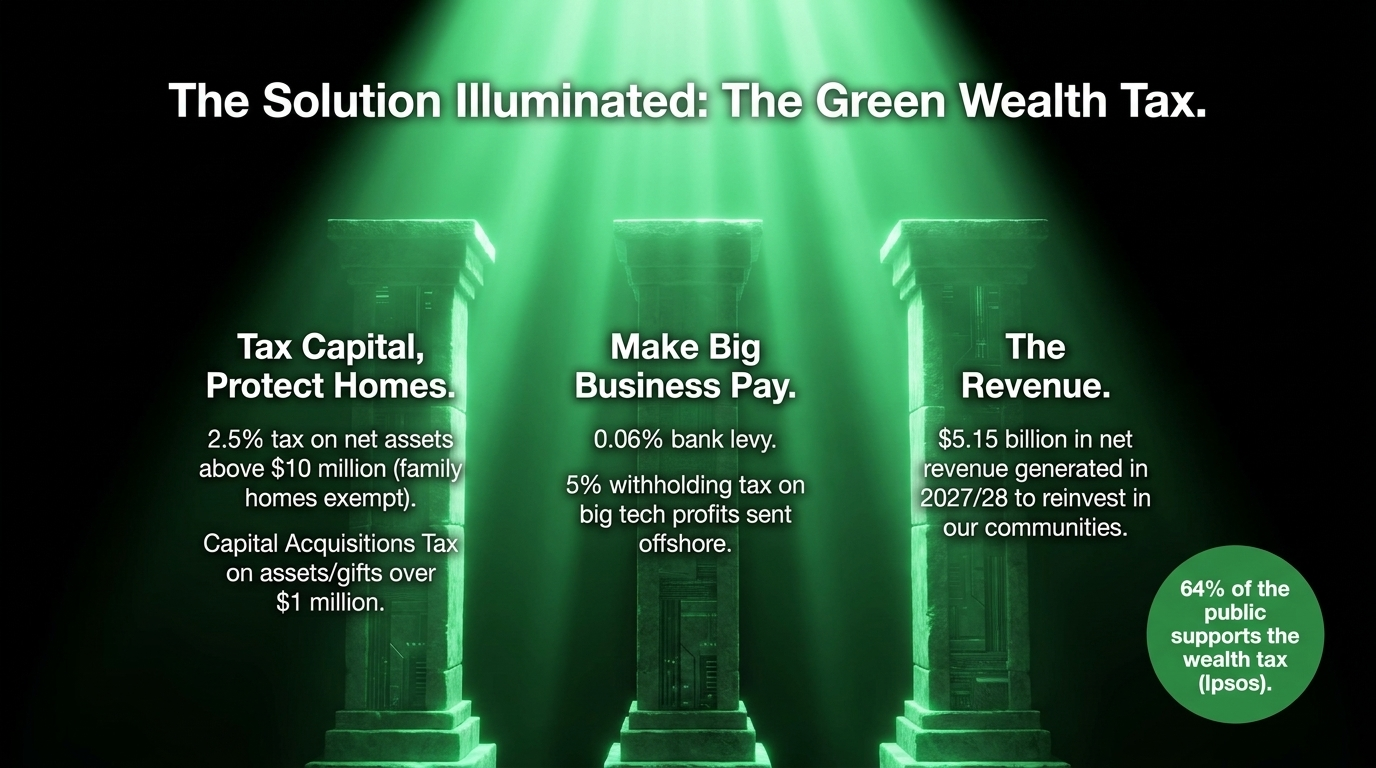
- They tax wealth. The Green policy proposes a 2.5 percent tax on net assets above $10 million, with family homes exempt. It adds a Capital Acquisitions Tax on assets and gifts over $1 million, with family farms and homes exempt.
- They make big business pay. It returns corporate tax to 33 percent for the 0.7 percent biggest corporations, including supermarkets, energy companies and banks. It adds a 0.06 percent bank levy and enforces a 5 percent withholding tax on big tech profits sent offshore.
- They cut tax for most people. A $10,000 tax-free threshold gives 96 percent of New Zealanders a tax cut. The party projects $5.15 billion in net revenue in 2027/28, rising to $5.73 billion by 2030/31. These are the party's own figures.
- The public backs the wealth tax. A party-reported Ipsos survey found 64 percent support and 26 percent oppose. I did not find the survey itself.
- They opposed the bill. My essay records that every opposition party rejected the Treaty Principles Bill.
Hold them to account. RNZ reports the Greens started the term in "tumult": an arrest, a death, a change of co-leader, a cancer diagnosis and the first waka-jump of an MP out of Parliament.
My own essay on Waitangi criticised how Labour and the Greens staged unity without Te Pāti Māori. No party is above scrutiny, and I haven't audited the Green manifesto in full. Te Pāti Māori is asking supporters for their candidate vote only, so a Green party vote doesn't conflict with that.
Chlöe Swarbrick scored 29 percent on the vibe tracker, second to Wong, and took the most jabs at opponents.
Respect for her is my opinion.
This November, vote like your mokopuna are watching.
Public Interest: Durie v Gardiner. This essay concerns politicians acting in their public capacity during an election campaign. Lange v Atkinson qualified privilege applies.
Disclaimer: This essay is opinion and commentary based on published sources. Facts are attributed to the reporting cited, and opinions are flagged. "White supremacist" and "neoliberal" are my opinions about outcomes and governing architecture, with factual bases in the same sections. A retraction will follow where an error is shown.