"The Crown Is Leasing Out an Ancestral Landscape — And Calling It Conservation" - 19 May 2026
They took Rangitahi. They farmed it into the ground. They fenced off the best bits and called themselves conservationists. And now, in May 2026, they're running a business tender for it.

Kia ora Aotearoa,
This essay examines the Rangitahi/Molesworth lease process because it directly affects Māori whānau, the mana whenua rights of Ngāti Kurī and Ngāi Tahu, and the public accountability of the Department of Conservation as a Crown agency discharging Treaty obligations.
I want you to picture something.
You have a relative — an elderly kuia — who has lived on a piece of land for centuries. Her people named every stream, every ridgeline, every seasonal camping ground. They knew which valley to follow in summer to reach the pounamu on the West Coast. They taught the strangers who arrived how to move through the high country. They fed those strangers when they were lost.
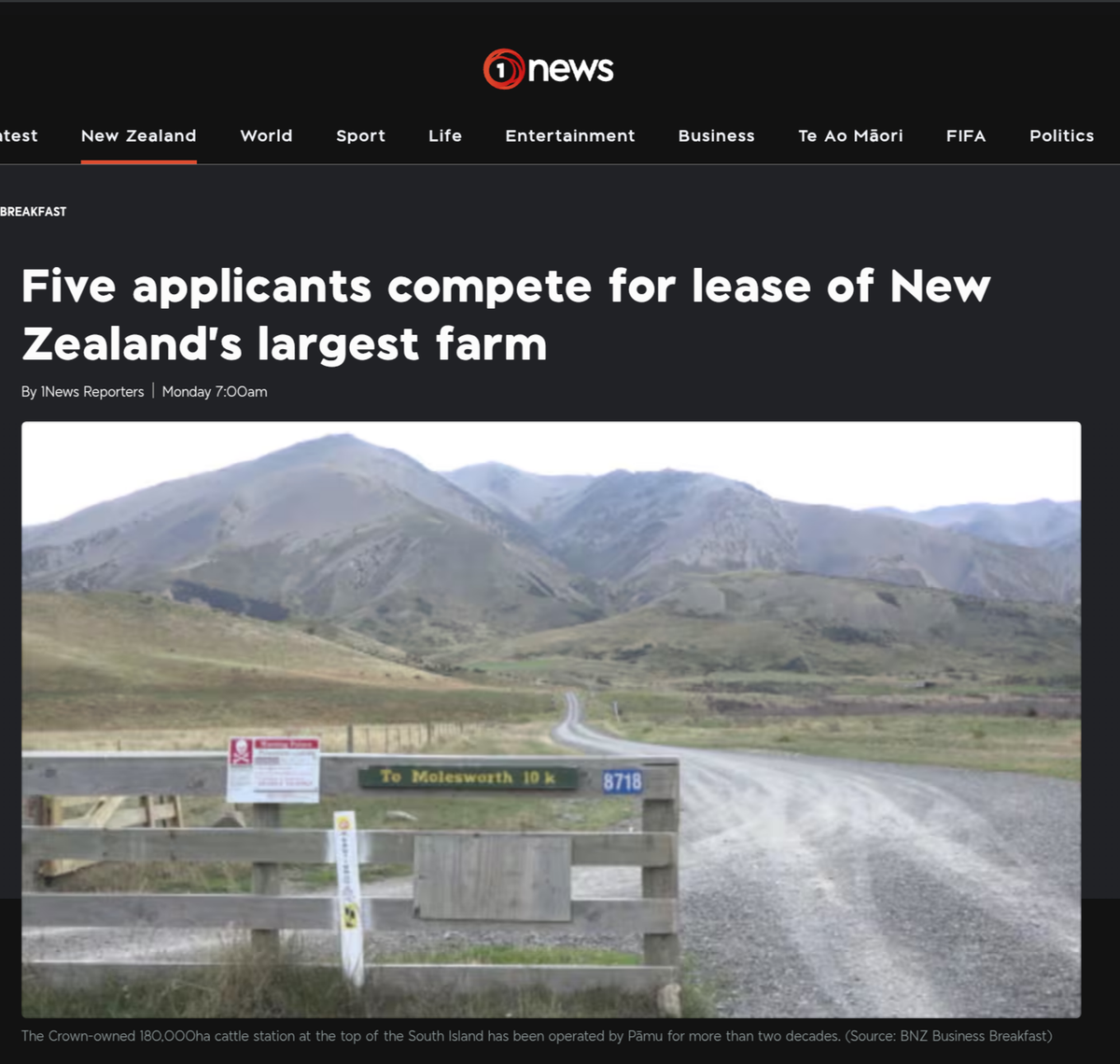
 1News Reporters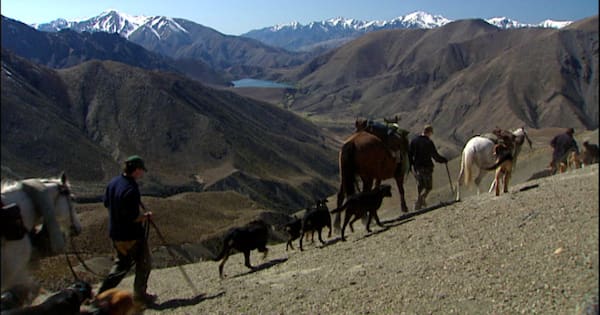
Then one day the strangers' government took the land. Said the family had no proper title. Ran sheep on it until the hillsides were stripped bare. Watched the topsoil blow away and the rabbits finish the job. Watched the pākehā runholders walk off in debt, leaving behind the wreckage. The Crown moved in, acquired the debt-land for a song, farmed it for decades. Put a fence around the most beautiful parts, called it conservation, and leased the rest to a state corporation.
For twenty-three years that state corporation ran the land commercially — cattle, revenue, returns.
The Deep Dive Podcast
Listen to a lively conversation between two hosts, unpacking and connecting topics in the sources of this essay. I apologise in advance for the AI's very harsh pronounciation of reo. Please dont shoot me, :).
And now, in 2026, the lease has expired. So they've put it out to tender.
They've run a "competitive process." Five applicants. Names not publicly disclosed. The Department of Conservation will pick its preferred operator and send out a press release. Your kuia — your whole whānau — can make a submission. Like everyone else. Like it's a resource consent.
That is what is happening to Rangitahi right now. And I am naming it for what it is: a continuation of the longest-running asset strip in New Zealand history, dressed up in the language of conservation and public access.
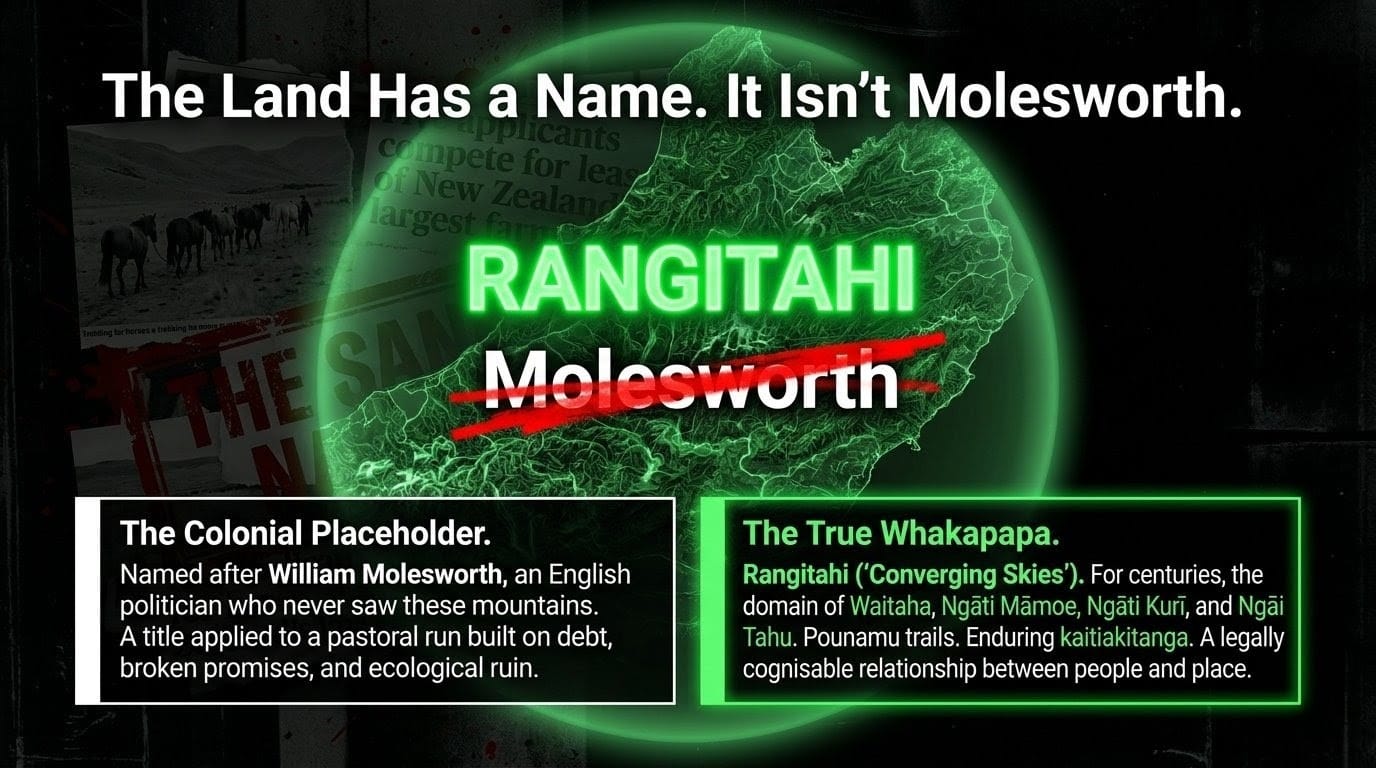
The Land Has a Name — and It Isn't Molesworth

The name "Molesworth" honours William Molesworth, an English politician who never set foot on the South Island of New Zealand, never saw the mountains, never followed the valley routes, never breathed the high country air. His name was applied to a pastoral run assembled from coloniser debt, broken promises and ecological ruin. It is a colonial placeholder. The land's actual name — Rangitahi — means "converging skies." It tells you something about the people who named it: they looked up, they paid attention, they belonged there.
Before the colonists, before the sheep runs, before the rabbits — for centuries — this was Waitaha, Ngāti Māmoe, Ngāti Kurī and Ngāi Tahu country. Kāi Tahu traversed these high country valleys on pounamu trails to the West Coast, as DOC's own historical record confirms. These routes were not just pathways. They were whakapapa — encoded in oral tradition, in placenames, in the seasonal rhythms of people who understood this landscape in a way that no pastoral runholder, no state corporation and no DOC scoring rubric ever has.
The land's mauri — its spiritual life force, its capacity to sustain life — is inseparable from those people. It always has been. That is not metaphor. That is the operating principle of mātauranga Māori, and it has a deeper ecological track record than anything the Crown has managed on this land.
Ben Bateman of Te Rūnanga o Ngāi Tahu said it plainly in September 2025: Rangitahi "is of immense cultural, spiritual, and historical significance for Ngāti Kurī and Ngāi Tahu, an ancestral connection to their whakapapa and traditions through the occupations of Waitaha, Ngāti Māmoe, Ngāti Kurī, and Ngāi Tahu," and that Ngāti Kurī maintain an enduring kaitiaki relationship with this specific whenua, with "the protection and restoration of Rangitahi as an ancestral landscape paramount to their identity and wellbeing," as Farmers Weekly reported.
That is not heritage tourism copy. That is a living, breathing, legally cognisable relationship between people and place. And the Crown is running a business tender over the top of it.
How the Crown Built Its "Conservation" Trophy on Stolen Country
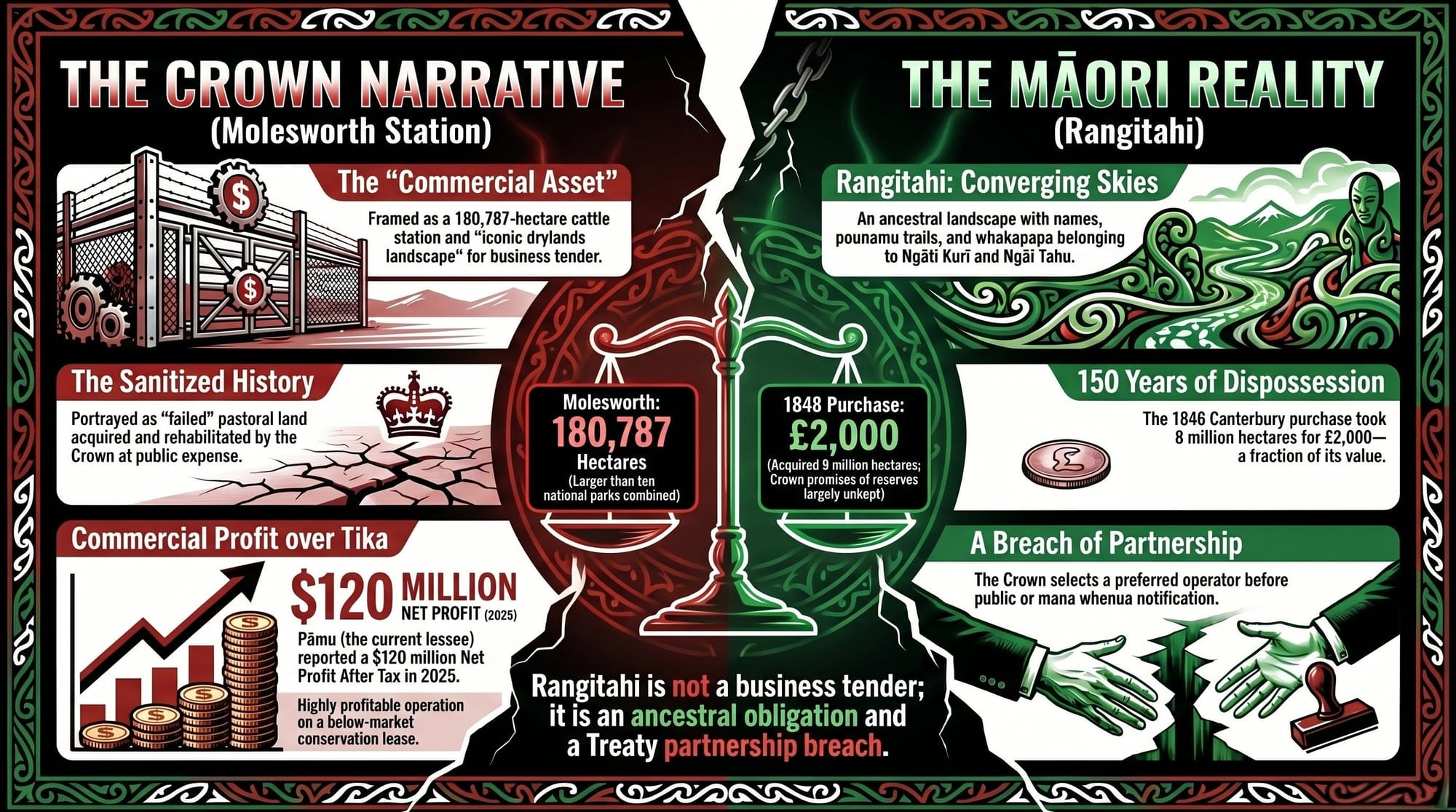
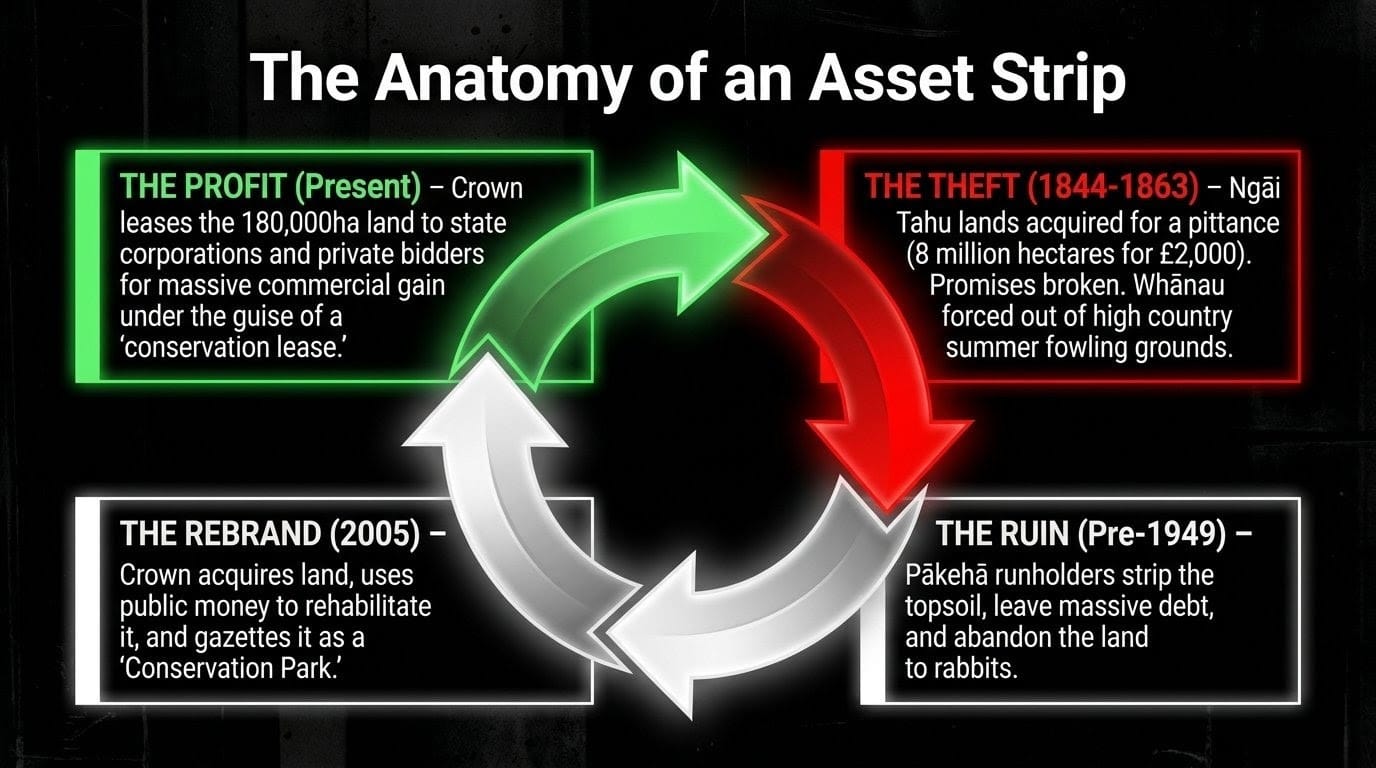
Here is the sanitised version you will read on the DOC website and the Marlborough tourism brochure: Three failed pastoral leases — St Helens, Tarndale, and Molesworth — collapsed under runholder debt, overgrazing and rabbit infestation between 1938 and 1949. The Crown acquired the land, rehabilitated it at public expense, and farmed it as a cattle station before eventually gazetted it as a recreation reserve under DOC, as Marlborough NZ records. In 2005, Helen Clark's government brought Molesworth fully under DOC's oversight to prevent foreign ownership — a legitimate risk at the time — and leased farming operations to Landcorp, later rebranded as Pāmu, as 1News reported. That lease has now expired.
Here is the part the brochure leaves out.
From 1844 to 1863, the Crown purchased Ngāi Tahu's lands across the South Island in a series of nine transactions. The Canterbury purchase of 1848 saw 20 million acres — eight million hectares — sold for £2,000, as Te Ara confirms. The Crown promised reserves, schools and hospitals. It delivered almost none of it. In 1879, the prophet Te Maihāroa led a party to Ōmārama in the upper Waitaki to assert Ngāi Tahu's right to their summer fowling grounds in the South Island interior — and was forced out by sheep-run holders and Crown pressure. The interior of the South Island — the high country that includes Rangitahi — was always contested by Kāi Tahu as land that had never been properly sold.
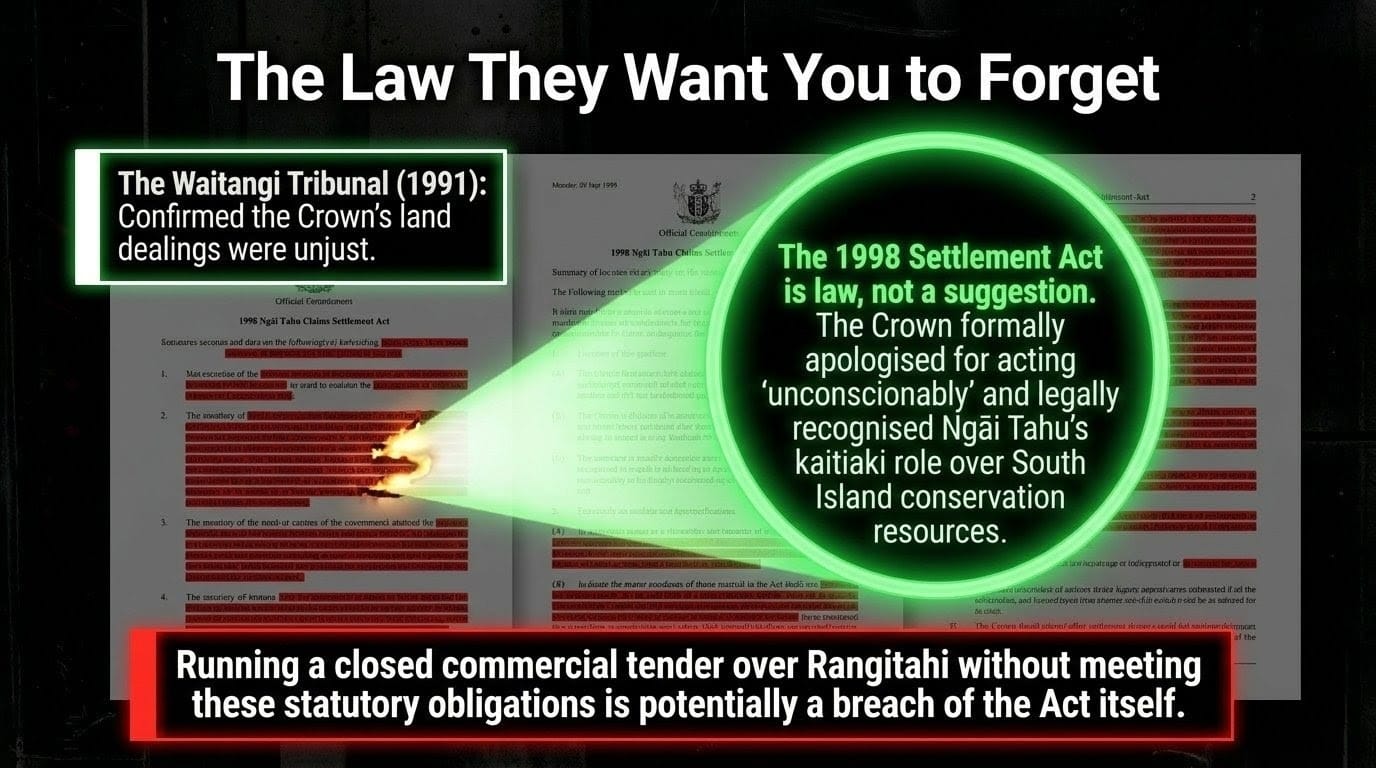
The Waitangi Tribunal's landmark 1991 Ngāi Tahu Report confirmed what Ngāi Tahu had been saying for 150 years: the Crown's land dealings were a fundamental breach of Treaty principles, as the Tribunal's own documents record. The 1998 Ngāi Tahu Claims Settlement Act included a formal Crown apology acknowledging it "acted unconscionably and in repeated breach of the principles of the Treaty of Waitangi," committing $170 million in economic redress and formally recognising Ngāi Tahu's kaitiaki role over South Island conservation resources, as Wikipedia records the Act's provisions. That settlement made Ngāi Tahu's connection to the conservation estate of Te Waipounamu not just a moral claim but a legal one.
Rangitahi sits inside Ngāi Tahu's rohe. The land the Crown stripped, rehabilitated with public money, and is now leasing out to a commercial operator — it sits inside a rohe whose people received a formal Crown apology for exactly this kind of dispossession. The obligation the Crown apologised for breaching in 1998 is being quietly managed around in a commercial procurement document in 2026.
If that does not make you angry, read it again slowly.
The Tender — Five Applicants, Zero Accountability
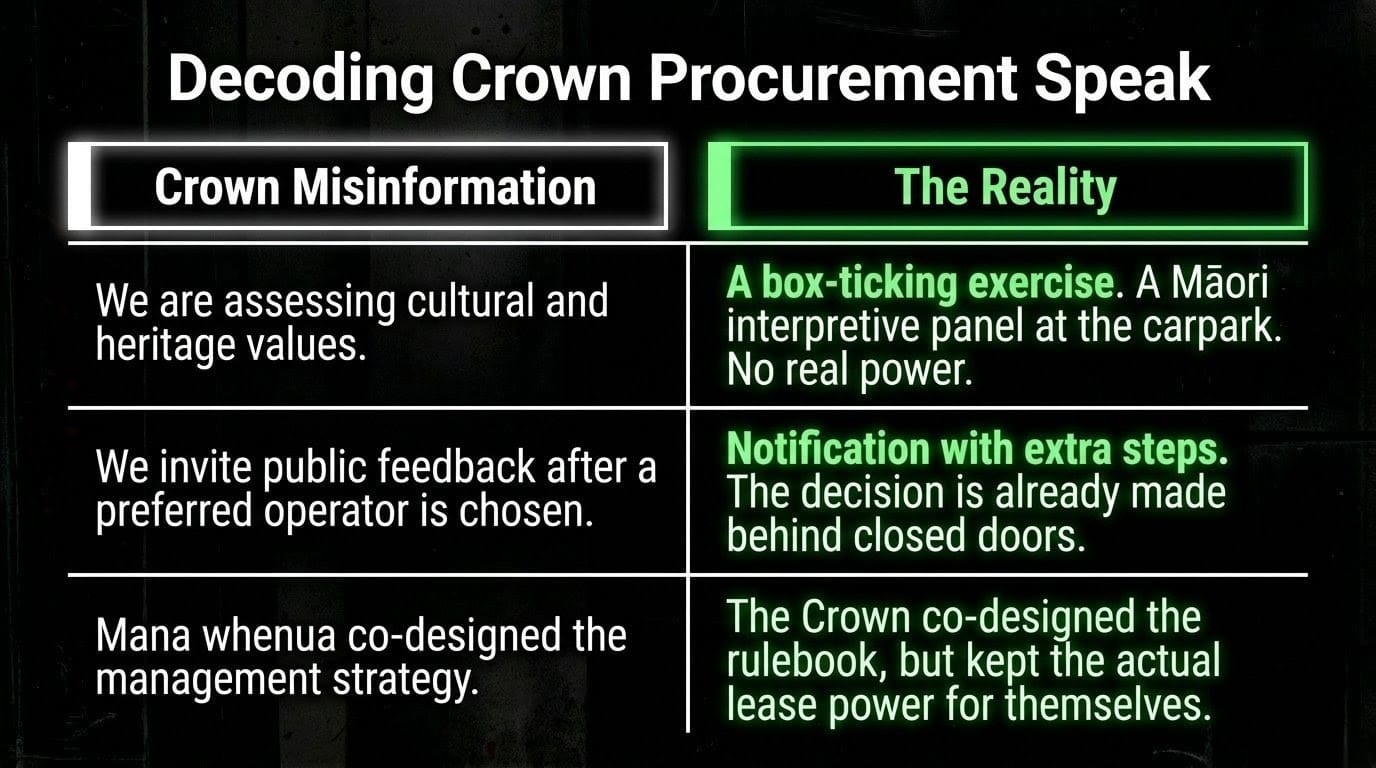
DOC received five proposals by March 20, 2026. Their identities remain undisclosed. DOC's own website states it "aims to confirm a preferred operator by the end of May," after which the successful applicant will be invited to apply for a concession, which will then be "publicly notified," as DOC's competitive allocation page states.
That sequence is worth reading very carefully. DOC selects the winner first. Then the public gets to comment on a decision already made. That is not partnership. That is notification with extra steps.
Ngāi Tahu signalled publicly in September 2025 that it was eyeing a bid, as Farmers Weekly reported. Whether they submitted a proposal — and whether they are among the five shortlisted applicants — DOC will not confirm. The people with the deepest legal and cultural claim to Rangitahi are supposed to find out who controls their ancestral landscape when everyone else does. In an announcement. Like a press release about a new supermarket.
Stacey Wrenn, DOC's South Marlborough Operations Manager, told 1News that applicants are being assessed on "operator experience, skills, resources and the ability to uphold biodiversity, cultural and heritage values." Cultural and heritage values. In a scoring rubric. In a business tender. For 180,787 hectares of Ngāi Tahu and Ngāti Kurī ancestral landscape.
I have seen this language before. "Cultural values" in Crown procurement means: does the applicant acknowledge there was once a Māori presence here and will they install an interpretive panel at the carpark? It does not mean co-governance. It does not mean kaitiaki authority. It does not mean Ngāti Kurī hold decision-making power over how their tīpuna's landscape is used, managed, grazed, or opened to horse trekkers from Auckland.
To be fair: in 2022, DOC confirmed it was working with Te Rūnanga o Kaikōura to co-lead the review of the Conservation Management Strategy for Rangitahi, as Inside Government NZ reported. That is a genuine and positive development. But a co-led strategy review is not the same as controlling the lease. The strategy is the rule book. The lease is the power. The Crown co-designed the rule book with mana whenua, and then ran a closed commercial process to decide who would hold the power. Those are different things. The Crown kept the important one.
The Commercial Reality — Who Profits, Who Bears the Cost
Let me be plain about the economics, because this is where the power actually lives.
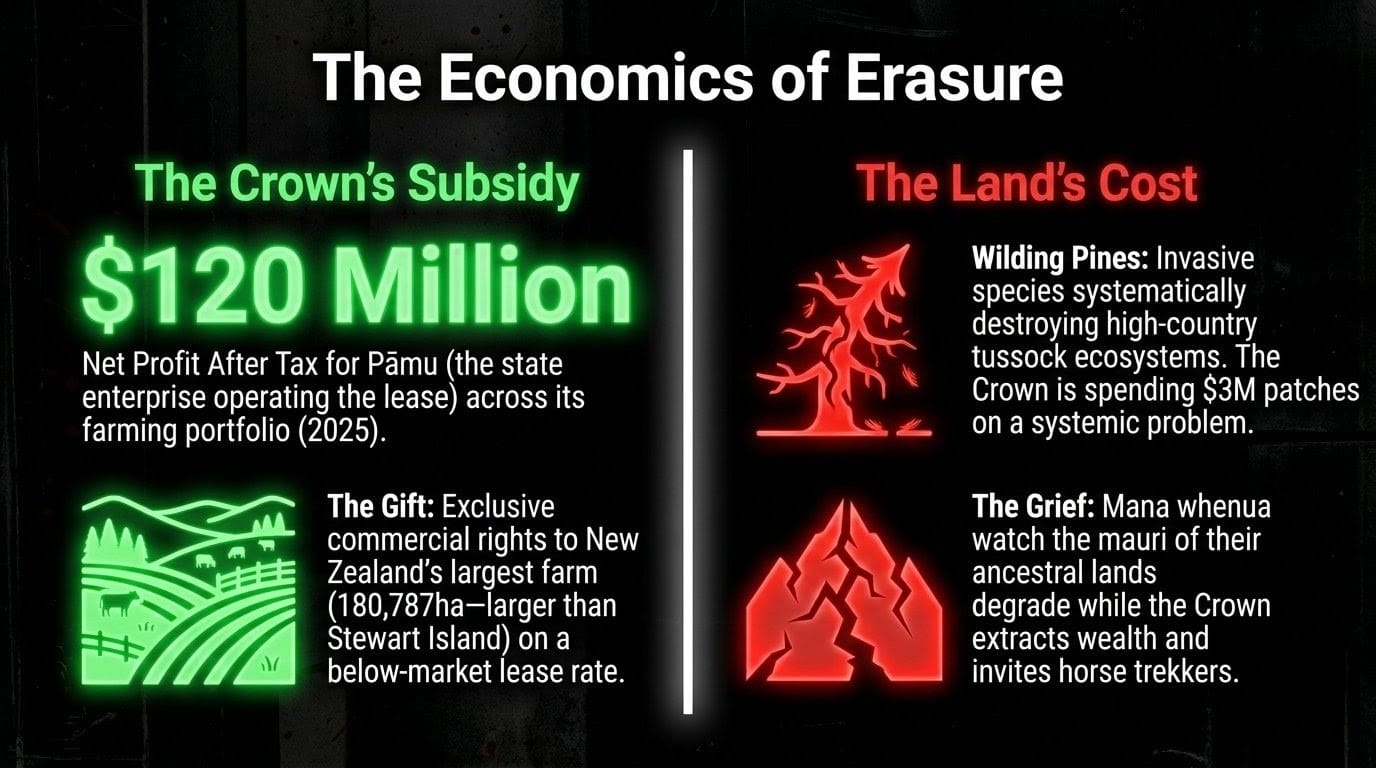
Pāmu — the Crown-owned state enterprise, formerly Landcorp — operated Rangitahi commercially for over two decades. In the year to June 2025, Pāmu reported a Net Operating Profit of $49 million across its farming portfolio, up 145% on the prior year, and a Net Profit After Tax of $120 million, as Pāmu's own financial results confirm. Pāmu is forecasting a Net Operating Profit of between $69 million and $79 million for FY26. These are not small numbers. This is a highly profitable Crown entity farming on a below-commercial-rate lease on Ngāi Tahu and Ngāti Kurī ancestral land.
Rangitahi is New Zealand's largest farm — 180,787 hectares, larger than Stewart Island, larger than ten national parks. The lease sits below commercial market rates because the land is conservation estate. That subsidy — that structural commercial advantage — is a Crown gift to whoever holds the lease. For twenty-three years, that gift went to a state corporation. Now it will go to one of five unnamed applicants.
Mana whenua do not receive the lease subsidy. They receive a submission window.
And then there is the ecological cost. Wilding pines — introduced conifers that spread invasively across high country — are a documented and growing threat to Rangitahi's landscape. The government announced an additional $3 million for wilding pine control at Molesworth in 2025, as Wilding Pines NZ confirmed. MPI confirmed that wilding pine control work had been ongoing at the station, as their own communications show. Wilding pines reduce biodiversity, destroy high country tussock ecosystems, consume water at rates native vegetation does not, and represent the gradual erasure of the exact landscape Ngāti Kurī and Ngāi Tahu have a kaitiaki obligation to protect. Every year the pines spread is a year the mauri of Rangitahi diminishes — and the Crown is spending $3 million patches on a systemic problem while running a commercial lease process.
The Crown extracts commercial value. The land pays the price. Mana whenua bear the grief.
The 1News Tourism Frame — And Why It Should Concern You
The 1News piece that triggered this essay is framed, broadly, as an exciting story about New Zealand's largest farm getting a fresh start. DOC is "open to ways to increase the value for New Zealand." Future operators might run horse trekking alongside cattle farming. Tourists might get to drive through for longer parts of the year. It reads like a property listing for a spectacular lifestyle block.
I am not against public access to Rangitahi. I am not against horse trekking. What I am against is a media frame that presents the question of who controls this 180,000-hectare ancestral Māori landscape as already settled — as if the only remaining question is what tourism experience to offer visitors, and whether the roads should be open an extra month.
The framing assumes the Crown's authority to dispose of this land commercially is uncontested. It is not. That assumption is doing ideological work. It is normalising a process that should, in 2026, be generating urgent public scrutiny rather than feature stories about heritage farming.
The 1991 Ngāi Tahu Report — 35 years old — confirmed the Crown's land dealings with Ngāi Tahu were unjust. The 1998 apology is 28 years old. The $170 million settlement was, by any reasonable measure, a fraction of the value of what was taken. As Te Ara records, the Canterbury purchase of 1848 acquired eight million hectares for £2,000. The land that became Rangitahi — the high country interior that Kāi Tahu asserted had never been properly included in those deals — sits in a rohe that was purchased for the price of a good horse in Victorian England.
And we are still here, in 2026, asking whether Ngāi Tahu and Ngāti Kurī have genuine authority over Rangitahi — or just a seat at the table while DOC holds the chair.
The Fallacy of the "Conservation Lease" — Named
The Crown's management of Rangitahi relies on a specific intellectual sleight of hand that needs to be named.
The argument goes: the land is a conservation park, managed by DOC under the Conservation Act, in the public interest. The farming operation is a lease inside that framework. The lease is commercial. Therefore the selection process can be run commercially, subject to conservation criteria. Therefore mana whenua participate as stakeholders in the criteria — not as decision-makers in the selection.
This argument treats the conservation framework as if it is value-neutral — as if calling land a "conservation park" resolves all prior claims on it. It does not. The conservation designation was applied by the Crown, under Crown legislation, administered by a Crown department, on land that sits in a rohe whose people received a Treaty settlement for Crown breaches of obligation on exactly this land and this rohe. The conservation framework does not override Treaty obligations. It operates alongside them — or it should.
The Ngāi Tahu Claims Settlement Act 1998 gives the iwi specific rights in relation to DOC-managed conservation land in their rohe: rights of first refusal on certain Crown properties, recognition of their role as kaitiaki, and an ongoing relationship with DOC's conservation management, as Eco Jurisprudence Monitor records of the Settlement Act's cultural redress provisions. Those are not aspirational commitments. They are statutory obligations. Running a closed commercial tender for a 23-year lease on Rangitahi without confirming how those statutory obligations have been met is not just poor process — it is potentially a breach of the Settlement Act itself.
I am not a lawyer. I am saying: someone with standing should be asking that question loudly, in writing, before the end of May.
What Tika Demands
Tika — that which is correct, just, right — is not a soft concept in te ao Māori. It is a structural principle. A society that does not act with tika does not hold together. It fractures. The fractures of 150 years of land theft and broken Crown promises are visible in every disparity statistic between Māori and non-Māori in this country — in health, housing, income, incarceration, life expectancy. Every broken Crown commitment is a mauri-depleting act. Every time the Crown chooses process convenience over Treaty obligation, that fracture deepens.
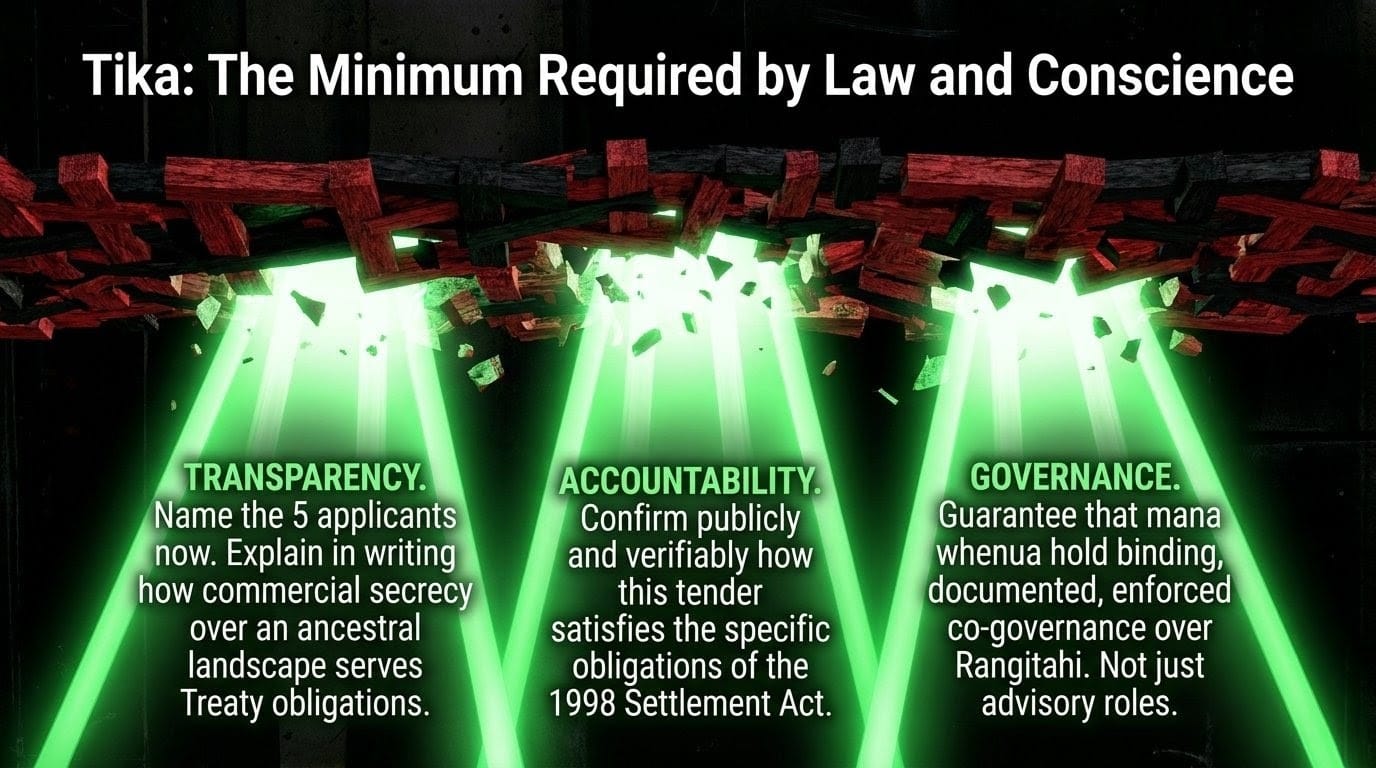
What tika demands from DOC in this process is not complicated. It is not radical. It is the minimum required by law and conscience.
First: Name the five applicants publicly now, before a preferred operator is selected. If commercial confidentiality is the reason for secrecy, the Crown must explain how commercial confidentiality over an ancestral Māori landscape serves the public interest and satisfies Treaty obligations. That explanation should be in writing, and it should be published.
Second: Confirm in writing — publicly, verifiably — how this process satisfies the Crown's Treaty obligations to Ngāi Tahu and Ngāti Kurī under the 1998 Settlement Act. Not in a press release bullet point. In a formal document that names the specific obligations, describes how each one has been met, and identifies who was consulted and when.
Third: If neither Ngāi Tahu nor Ngāti Kurī hold the lease outright, guarantee that mana whenua hold formal co-governance authority over how Rangitahi is managed — not advisory roles, not "cultural values" criteria in a scoring template, not a seat at a consultative table. Governance. Binding. Documented. Enforced.
These are not demands that come from nowhere. They come from the same source DOC claims to honour: the Treaty of Waitangi and the legislation enacted in its name.
The Announcement Is Coming — Watch It Carefully
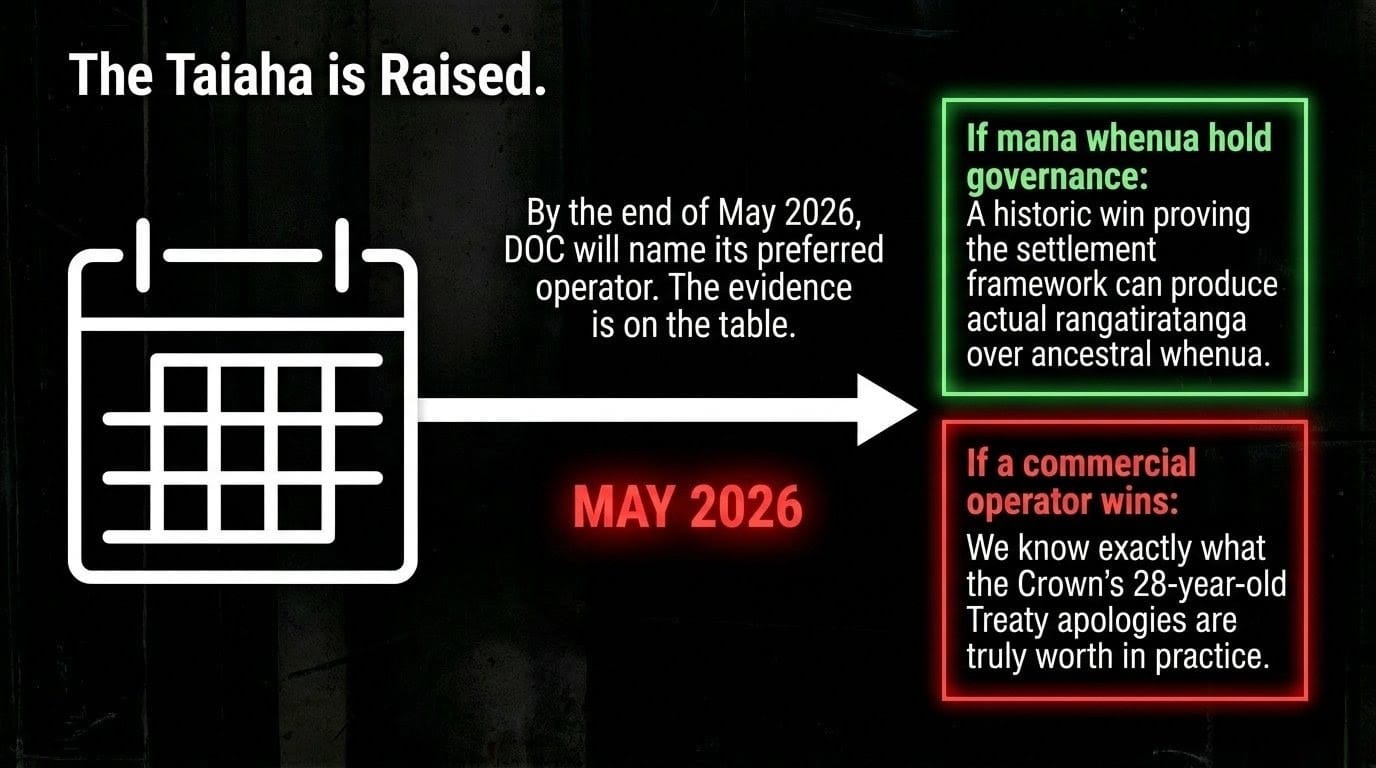
DOC says it expects to name a preferred operator by the end of May 2026. That announcement, when it comes, will be the clearest signal yet of whether the Crown's Treaty obligations are a living, enforceable commitment — or a paragraph in a 28-year-old apology letter that gets cited at Waitangi Day speeches and ignored for the other 364 days.
If mana whenua hold the lease, or hold binding co-governance over it, that announcement will be historic. It will be proof that the settlement framework can actually produce rangatiratanga over ancestral whenua — not just economic redress.
If a commercial farming operator with no demonstrated mana whenua connection wins the tender, and the announcement talks about "cultural values criteria" and "ongoing consultation," then we will know exactly what the Crown's Treaty obligations are worth in practice.
Ngāi Tahu's claim history — 150 years of petitions, royal commissions, Tribunal hearings, parliamentary debates and finally a settlement — is one of the most documented stories of Crown injustice in New Zealand history, as Te Rūnanga o Ngāi Tahu's own account records. Rangitahi is not an abstraction in that history. It is a specific place, with a specific whakapapa connection, with specific people whose tīpuna traversed it, named it, and were pushed off the high country interior by Crown pressure — as the 1879 forced removal of Te Maihāroa and his people from Ōmārama demonstrates, as Te Ara records.
Those people's descendants are watching this process. I am watching this process. And I will report what the announcement says and what it means.
Rangitahi has been waiting for justice since before William Molesworth's name was ever attached to it. The taiaha is raised. The evidence is on the table. The Crown has until the end of May to show us which direction it is facing.
Koha Consideration

This essay serves Ngāti Kurī, Ngāi Tahu, and every whānau watching the Crown run another commercial process over ancestral whenua. The taiaha of this work is truth. Every koha keeps this voice alive and independent.
Every koha funds rangatiratanga's own truth tellers. If you cannot koha — subscribe, follow, kōrero, share. That is koha.
Ko Ivor Jones tōku ingoa — ko au Te Māori Green Lantern.

Views expressed constitute honest opinion on matters of public interest under the Defamation Act 1992 (NZ) and Durie v Gardiner NZCA 278. All factual claims sourced and cited. Named individuals and organisations referenced solely in their public capacity. Errors and corrections: contact via themaorigreenlantern.maori.nz.