
"THE GHOST PASSENGER: How Simeon Brown's Corpse of a Health System Left a Hantavirus Time Bomb Walking Free Among Our Whānau" - 11 May 2026
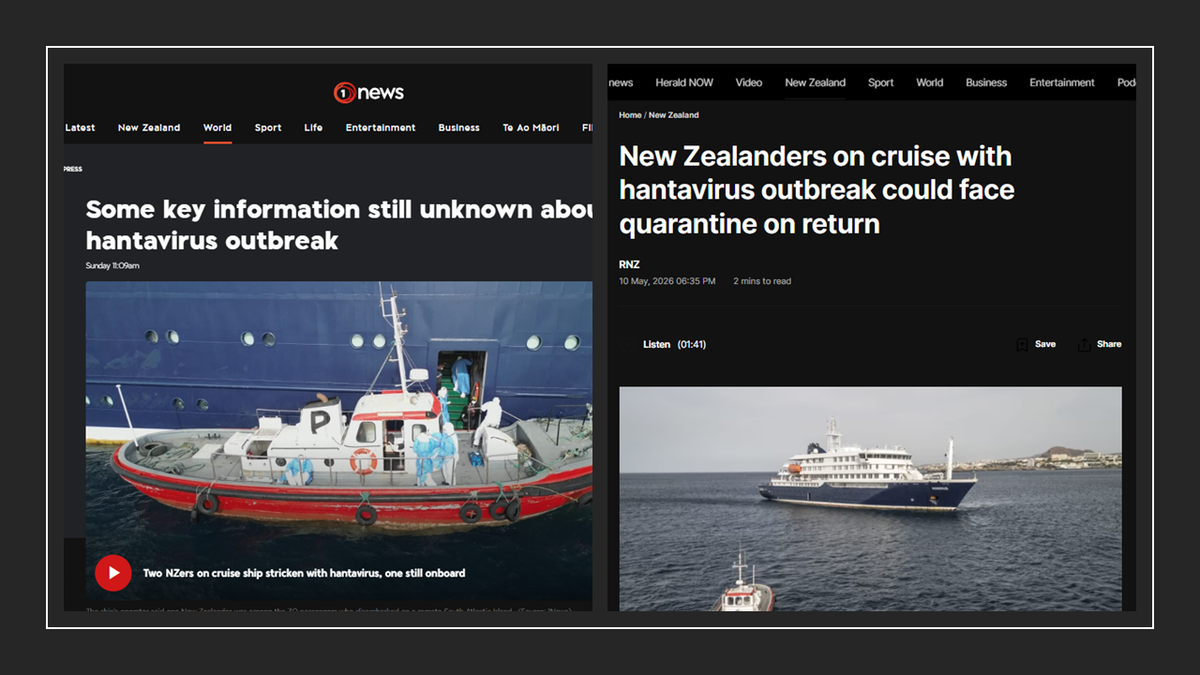
They found hazmat suits for the passengers on the ship. They found military planes for the Americans. They found a quarantine protocol — eventually — for the Kiwi still aboard. They have said nothing about the one who has been home for sixteen days.

Mōrena Aotearoa,
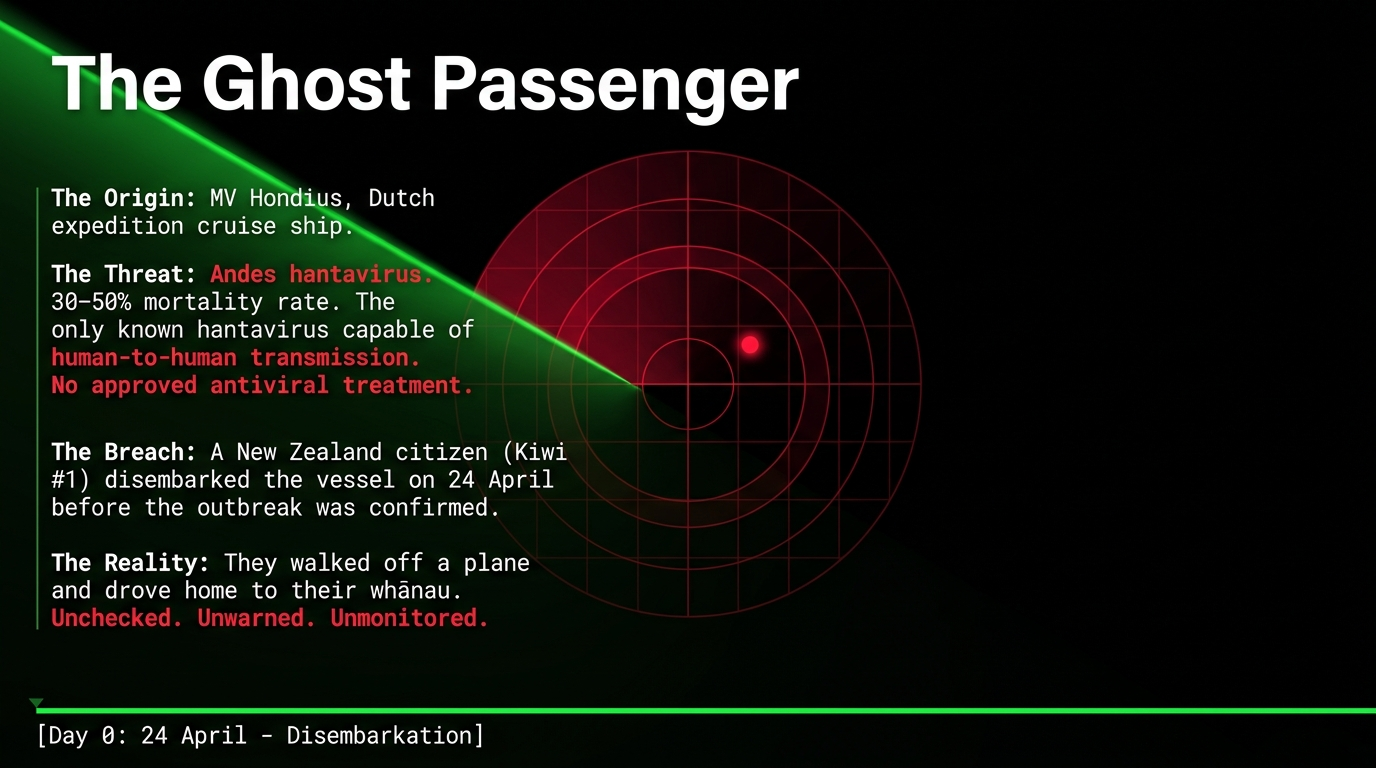
This essay examines the New Zealand government's deliberate and catastrophic failure to proactively monitor a returning passenger exposed to the Andes hantavirus outbreak aboard MV Hondius — because this failure directly endangers the health and lives of Māori whānau and all New Zealanders, and implicates the public accountability of Health Minister Simeon Brown, Prime Minister Christopher Luxon, and ACT leader David Seymour under the New Zealand Public Health and Disability Act 2000, the International Health Regulations 2005, and every promise this government made to the people of Aotearoa.
The Burning Wharenui
Picture a wharenui — the sacred meeting house of a hapū. It holds everything: the genealogy, the stories, the healing knowledge, the collective protection of generations. Now picture it burning. Not because lightning struck. Not because of accident. Because someone soaked it in petrol, lit a match, and then handed out leaflets explaining that the fire department was "unsustainable" and that the smoke was "low risk."
That is New Zealand's public health system in May 2026.
The MV Hondius, a Dutch expedition cruise ship, left Argentina in late April 2026 carrying a passenger already infected with the Andes strain of hantavirus, as confirmed by the WHO Disease Outbreak Notice. The virus — the only known hantavirus on earth capable of human-to-human transmission — killed one passenger on the ship before a second victim disembarked at the remote South Atlantic island of St. Helena on 24 April, collapsed on a connecting flight, and died. By 2 May, the WHO confirmed the outbreak and named twelve nations whose citizens had been potentially exposed, as 1News reported.
One New Zealand citizen was already home.
The Deep Dive Podcast
Listen to a lively conversation between two hosts, unpacking and connecting topics in the sources of this essay.
They walked off a plane. They drove to their whānau. They may have attended a birthday dinner, a Sunday hāngi, a tangi. They had no idea. Because nobody told them. Because the system that was supposed to tell them had been systematically destroyed by the very government now hedging its statements in conditional language and hoping nobody checks the calendar.
The Ship Docked. They Found Hazmat Suits. They Still Haven't Found the Ghost.
On 10 May 2026, the MV Hondius arrived at Tenerife in Spain's Canary Islands with 140 passengers and crew still aboard. The WHO Director-General Tedros Adhanom Ghebreyesus personally supervised the evacuation. Passengers disembarked under health supervision with strict orders that no passenger make contact with the local population before their repatriation flight, as 1News confirmed from the scene.
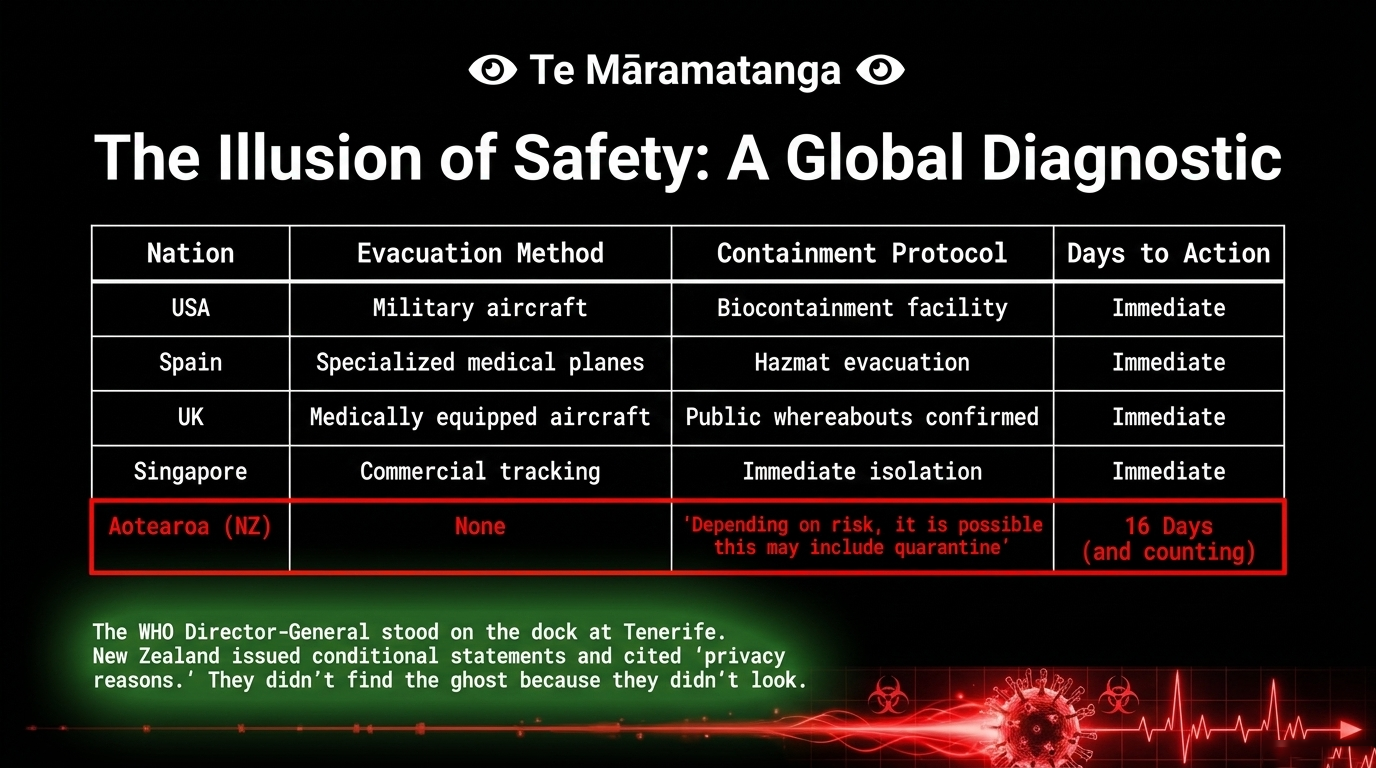
Health workers in full protective gear evacuated three passengers including the ship's doctor. American passengers were flown to the University of Nebraska Medical Centre — the US's dedicated biocontainment facility — under military escort. Spain's regional emergency services requested specialised medical planes for symptomatic passengers. The British government confirmed its citizens' whereabouts and dispatched medically equipped aircraft.
New Zealand's response? A statement from Ministry of Health deputy director of public health Dr Richard Jaine saying repatriation plans would include a "thorough public health assessment" and that —
"depending on the risk it is possible this may also include a period of quarantine for any exposed individual on their return."
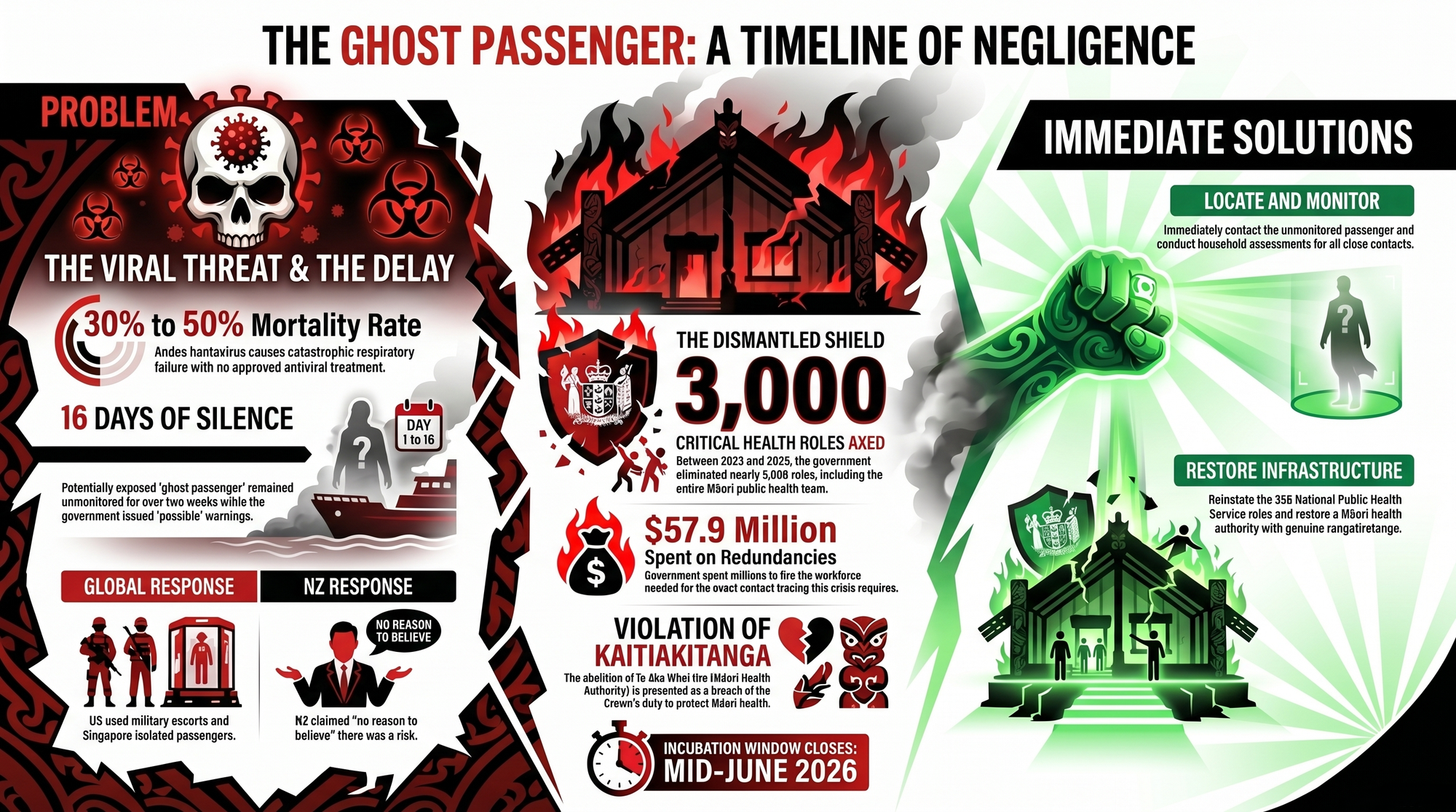
Could. Possible. May include. Depending. Issued on 10 May 2026 — sixteen days after the first Kiwi walked through New Zealand's border unchecked, unwarned, and unmonitored.
Dr Jaine also stated:
"We currently have no reason to believe that any New Zealanders have contracted hantavirus."
Of course they have no reason to believe it. They didn't look.
The Timeline of Negligence
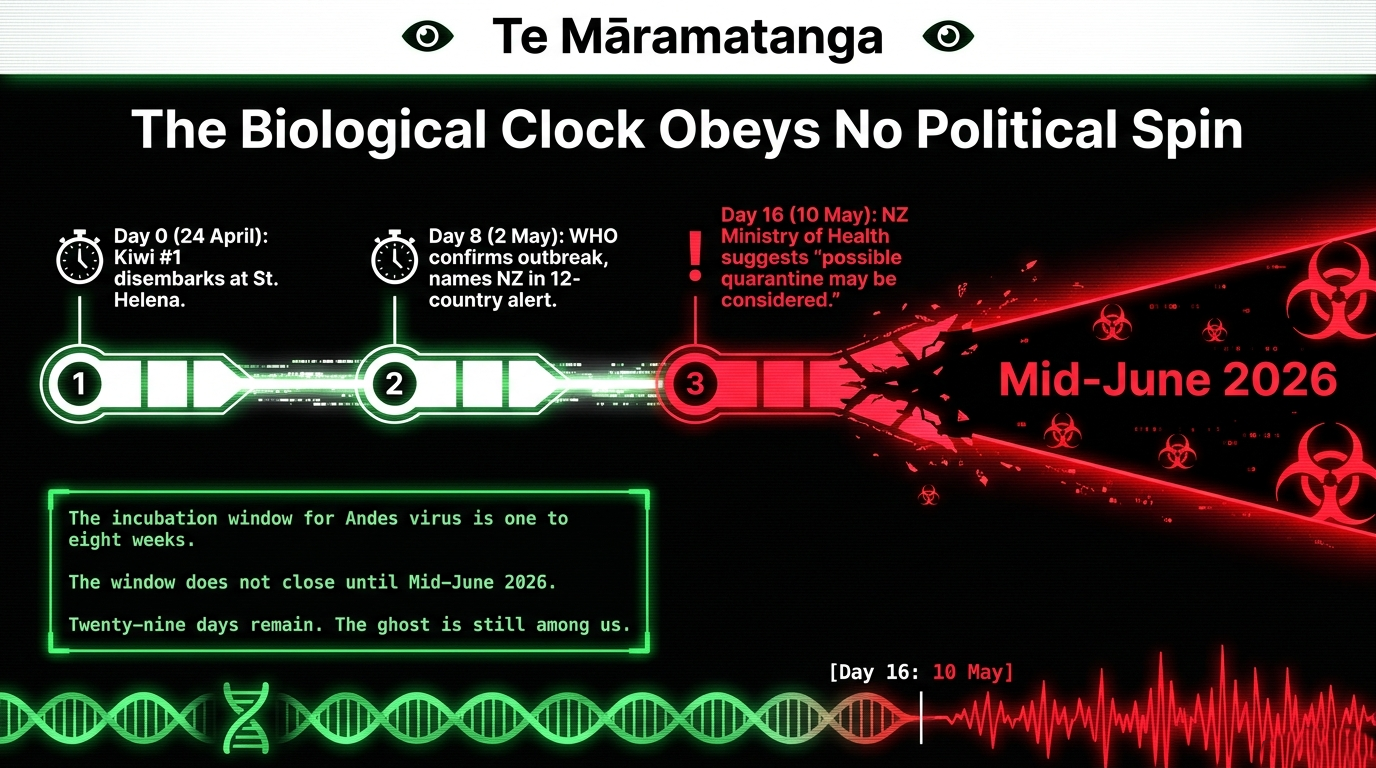
This is not hindsight. This is a sequence of choices — documented, timestamped, and attributable.
| Date | Event | NZ Government Response |
|---|---|---|
| 24 April | Kiwi #1 disembarks at St. Helena before outbreak confirmed | None |
| 2 May | WHO confirms hantavirus; names NZ in 12-country alert | "Not aware of any exposed people" |
| 3 May | WHO Director-General personally names New Zealand | MFAT: "privacy reasons, no comment" |
| 7–8 May | Singapore isolates passengers; Switzerland confirms hospitalisation | No confirmed contact of Kiwi #1 |
| 9 May | MV Hondius arrives Tenerife; hazmat suits, military escort | "Possible quarantine may be considered" |
| 10 May | Kiwi #1 has been home 16 days. Window closes mid-June. | "No reason to believe any NZ case" |
The delay was not logistical. As 1News confirmed, South African and Dutch authorities scrambled to trace everyone who had contact with the infected woman on her Johannesburg connection. A flight attendant who briefly boarded her onward plane reported symptoms and had to be tested. The virus does not wait for bureaucratic timelines. And the ghost passenger — now sixteen days home — is embedded in a web of whānau contact that no one in authority has yet publicly mapped.
What the Virus Actually Does — And Why Sixteen Days Matters
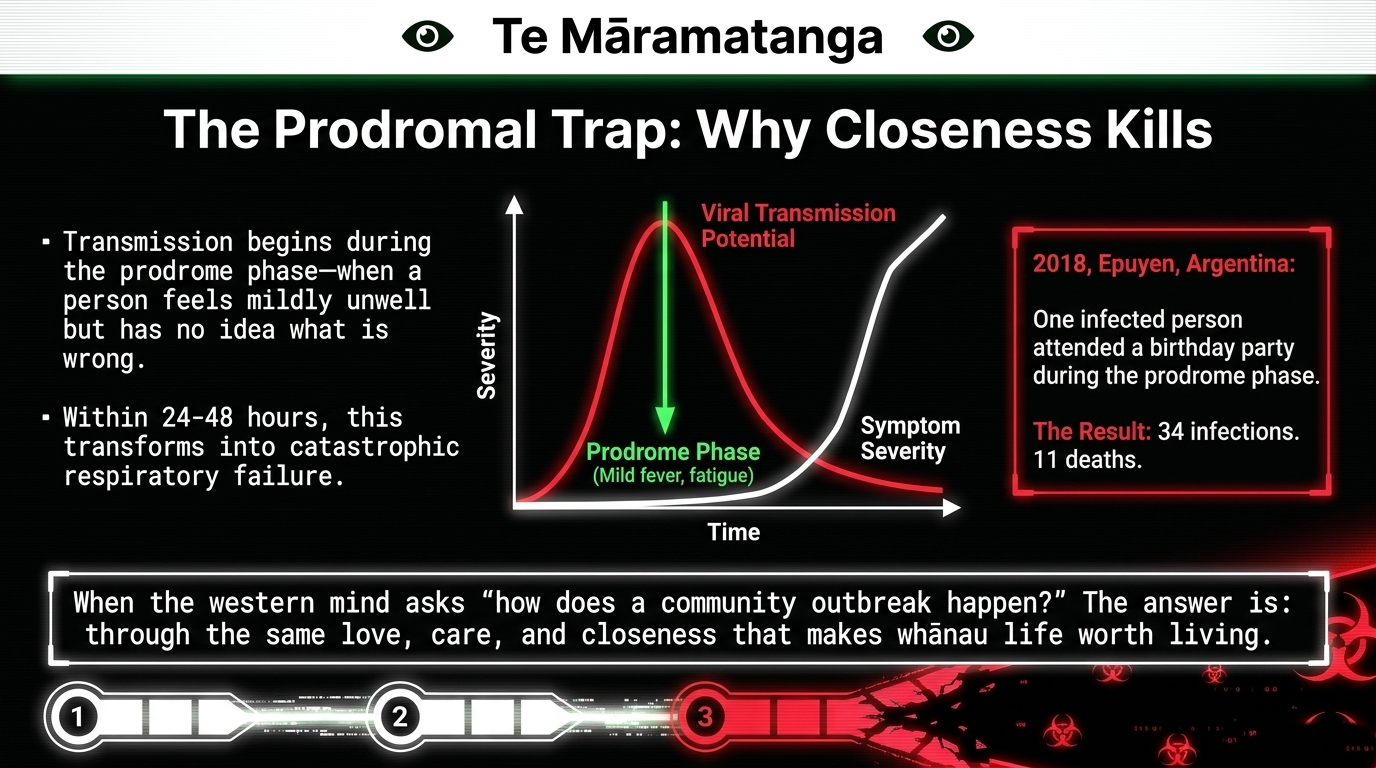
This is not a disease to manage with reassuring press releases. Andes virus causes Hantavirus Pulmonary Syndrome: a flu-like prodrome — fever, muscle aches, fatigue — that transforms within 24 to 48 hours into catastrophic respiratory failure as the lungs fill with fluid, as detailed by the CDC's Andes Virus fact sheet. There is no approved antiviral treatment. Mortality runs at 30–50%, as confirmed by the WHO's hantavirus fact sheet. Argentina recorded 28 deaths in a single year from this virus, as Newstalk ZB reported.
What makes Andes virus uniquely lethal in a community setting is that transmission can begin during the prodromal phase — when a person feels mildly unwell but has no idea what is wrong, as outlined in UK Government clinical guidance on Andes hantavirus. The ECDC's technical assessment of this exact outbreak confirms that close household contacts carry the highest exposure risk, and that higher viral loads correlate with accelerated transmission.
A 2019 peer-reviewed study in Emerging Infectious Diseases confirmed Andes virus human-to-human transmission via molecular sequencing — not assumption, not inference. Established science. Being ignored by a government that no longer has the workforce to act on it.
The incubation window runs one to eight weeks. Kiwi #1 disembarked 24 April. The window does not close until mid-June 2026. We are 16 days in. Twenty-nine days remain. The ghost is still among us.
Three Examples for Those Who Still Think This Is Theoretical
Example One: Epuyen — The Birthday Party That Became a Funeral
In 2018, in the small Argentine village of Epuyen, a single person infected with Andes virus attended a birthday party. They felt mildly unwell. They did not know what was wrong. The virus spread through social contact. The result: 34 infections and 11 deaths in one community, as confirmed by National Geographic's reporting on the outbreak.
In tikanga Māori, this is not an abstraction — it is a warning written in whakapapa. Tikanga demands we protect our kaumātua, our tamariki, our most vulnerable first. The tangihanga, the hāngi, the whānau hui — these are not optional extras. They are the lived expression of whakapapa connectivity. They are how we heal, how we grieve, how we survive. Epuyen was destroyed not by the virus alone but by the failure of institutions to warn in time. When the western mind asks "how does a community outbreak happen?" — the answer is: it happens through the same love, care, and closeness that makes community life worth living. And that is exactly what this government chose not to protect.
The harm quantified: 11 deaths in one village from one undetected introduction. Translated to a marae serving 500 whānau, that proportion represents potentially dozens of deaths before a single contact tracer is assigned. There is no Māori Health Authority to run that response. Simeon Brown abolished it.
The solution: Proactive contact of all returned passengers within 48 hours of a WHO alert. A 45-day monitoring protocol with direct clinical escalation. Singapore did it immediately. New Zealand could not find the will.
Example Two: The $57.9 Million Redundancy Con
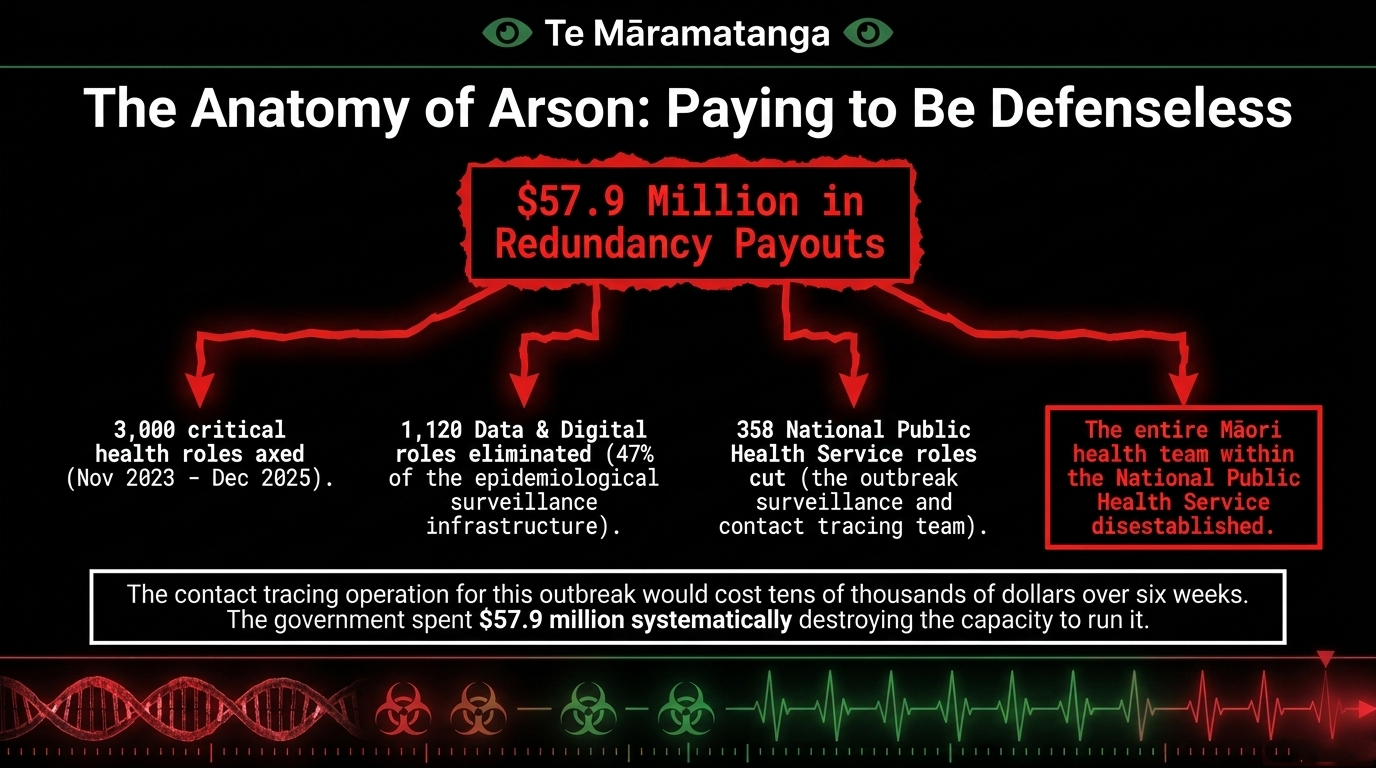
In 2024 and 2025, Health New Zealand – Te Whatu Ora paid out $57.9 million in redundancy payments to eliminate the public health workers who would now be running this contact tracing operation — confirmed by People Matters reporting on the redundancy costs and ODT coverage of the payouts.
Nearly 3,000 critical health roles were axed between November 2023 and December 2025, as the PSA confirmed in January 2026. Among them: 358 roles from the National Public Health Service — the outbreak surveillance and contact tracing team. 1,120 roles from Data and Digital — the epidemiological surveillance infrastructure — representing 47% of that entire workforce, as documented by the NZ Herald. The entire Māori health team within the National Public Health Service was disestablished, as The Māori Green Lantern exposed in Exposing Simeon Brown's Dangerous Health Agenda.
In tikanga, this violates kaitiakitanga — the sacred obligation of guardianship over collective wellbeing. The western mind understands this concept through a parallel: imagine a city that, to save money, dissolved its fire service, paid out the firefighters, deleted the emergency call database, and then declared the fire risk "low." That is what happened to New Zealand's public health outbreak response capacity. Except the city then charged $57.9 million for the privilege of being left defenceless. The Crown's obligation under Te Tiriti Article Three is to extend to Māori the same rights and protections as all citizens. Cutting the Māori public health workforce while a 40%-lethal virus enters unmonitored is not governance. It is a Treaty breach in real time.
The harm quantified: $57.9 million spent destroying capacity. The entire contact tracing operation needed for this outbreak would cost — at maximum — tens of thousands of dollars over six weeks. The government spent fifty-seven point nine million dollars making that impossible, then told you the risk was low.
The solution: Immediate reinstatement of the 358 National Public Health Service roles. Restore the Māori health workforce within that service. Halt all further cuts pending an independent pandemic preparedness review.
Example Three: The Waiting Room Is Already a Grave
The most recent Māori Green Lantern essay — The Waiting Room Is a Grave — published 7 May 2026, documented how this government defunded primary care, handed hospital contracts to private corporations, and dismantled the Māori Health Authority — leaving Māori whānau dying in waiting rooms before they reach treatment. That essay was published three days after the WHO named New Zealand in its hantavirus outbreak alert. The timing is not ironic. It is a pattern.
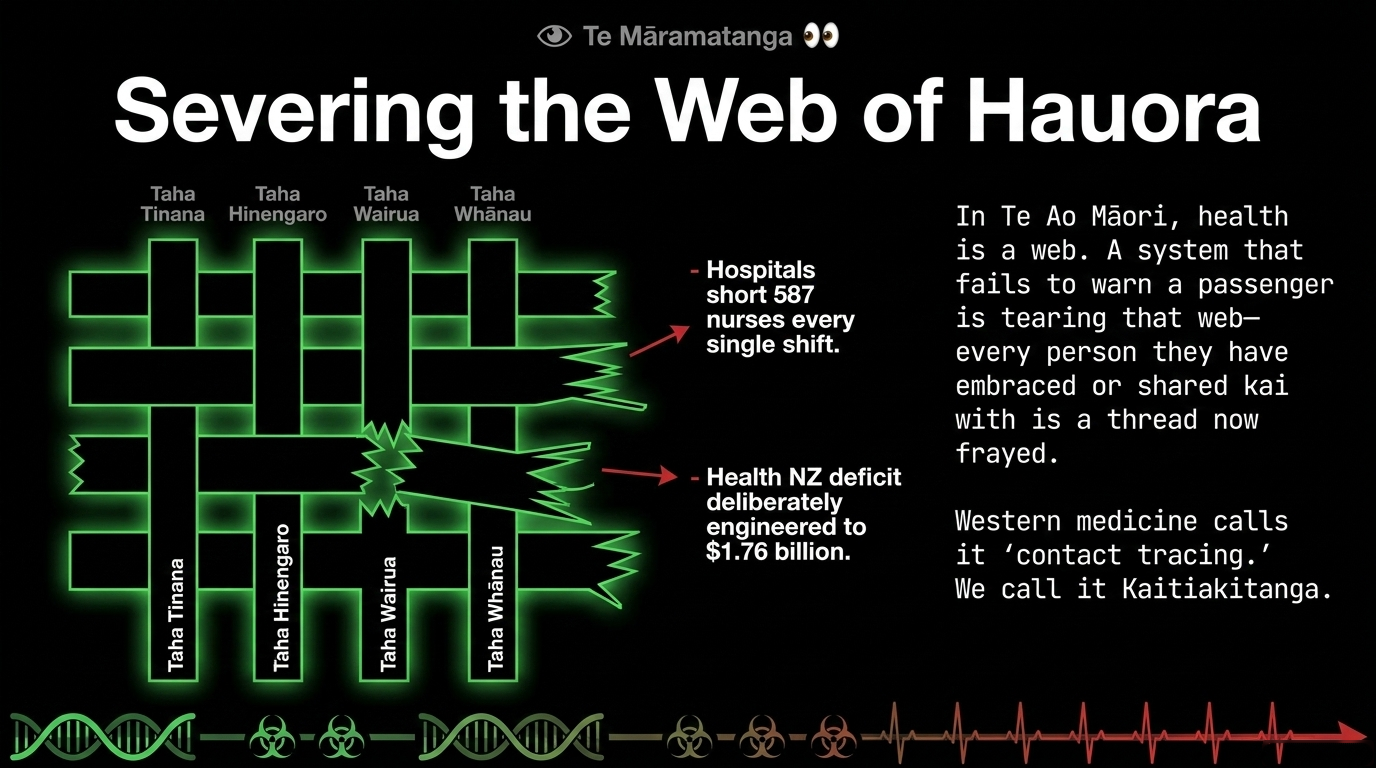
In tikanga, hauora — health — encompasses taha tinana (physical), taha hinengaro (mental), taha wairua (spiritual), and taha whānau (family health). These four dimensions are not separate. They are a web. A system that fails to warn a returned passenger about exposure to a lethal virus is not failing one person. It is tearing the web — every person they have embraced, shared kai with, or sat beside since landing home is a thread now frayed. The western mind calls that "contact tracing." Te ao Māori calls it the basic obligation of kaitiakitanga. Both frameworks demand the same response: find the person. Warn them. Protect the web.
The harm quantified: Hospitals short 587 nurses every single shift. Health NZ's deficit at $1.76 billion. If an Andes cluster emerged in South Auckland tomorrow, the ICU capacity to absorb even a dozen critical cases would be catastrophically strained in a system already operating beyond breaking point, as documented in The Corporate Vultures Circle as Our Health System Burns.
The solution: Rebuild the public health system now. Not in two years. Not after a review. Start with one phone call. Find the ghost passenger. Make the call that should have been made on 3 May 2026.
The COVID Con They Are Running on You
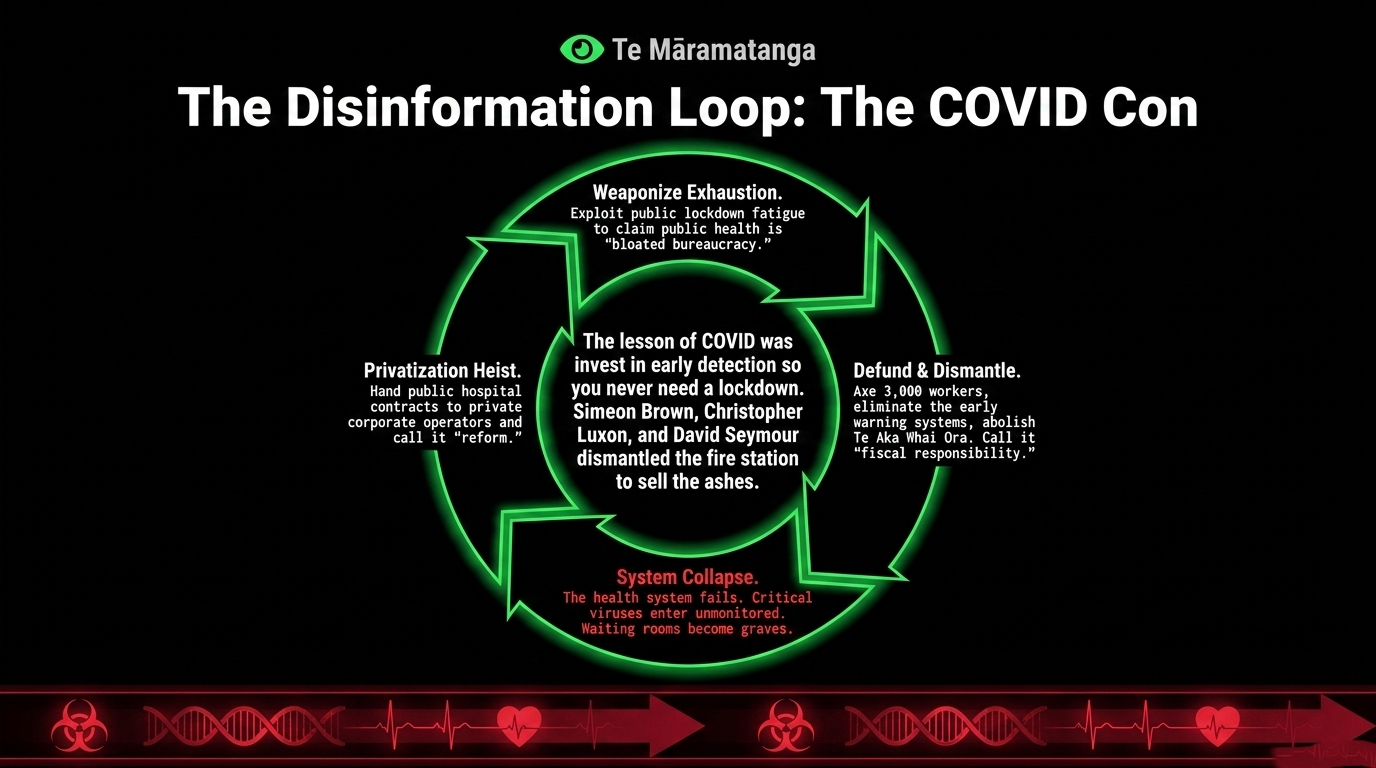
New Zealanders remember. They remember Level 4. The 1pm briefings. The tangihanga on Zoom. The businesses destroyed. The tamariki whose schooling was fractured. They gave everything the government asked of them — in good faith, in solidarity, in aroha for each other and for their kaumātua.
And then this government told them it was overreach. That public health was bureaucracy. That the agencies built to protect them were bloated and wasteful. The public — exhausted by lockdown fatigue documented in New Zealand's own behavioural surveillance data — gave the 2023 election to the people who promised to end it all.
Here is the con: the lesson of COVID was never "stop doing public health."
The lesson was invest in early detection and rapid targeted response so you never need a lockdown at all.
Instead, Simeon Brown, Christopher Luxon, and David Seymour weaponised public exhaustion as a mandate to burn the infrastructure that would prevent the next pandemic from requiring one. They fired the contact tracers. They defunded Māori health navigators. They abolished the Māori Health Authority. They eliminated the early warning system. And they did all of it while the public watched in fatigue-soaked relief, believing the threat was over.
It was not over. It never is. As the Royal Commission COVID-19 inquiry confirmed, community-based structures and tikanga frameworks are essential to effective outbreak response in Aotearoa. That evidence exists. It was available to every minister in this government. It was ignored. By design.
The alternative to early detection is not "nothing happens." The alternative is a larger outbreak requiring exactly the kind of societal intervention they told you they were preventing. They dismantled the fire station and called it fiscal responsibility. Now the smoke is rising from someone's home in Aotearoa, and the fire station is a carpark.
The Manufactured Crisis — and Who Profits
This government's playbook has been documented and exposed with precision by The Māori Green Lantern. In How They Gut Public Healthcare to Justify Privatisation and The Privatisation of Public Health Through the Back Door, the mechanism was laid bare: manufacture a fiscal crisis in the public system, cut its workforce, watch it fail, hand the contracts to private operators, call it reform. In Brown's Billion-Dollar Lie, published September 2025, Health Minister Brown personally attacked Treasury officials who told the truth about what his cuts were doing to health workforce capacity.
Budget 2025 — which landed as hantavirus was spreading through a cruise ship and a Kiwi was flying home unwarned — contained not one single initiative for Māori health equity and actively reduced Māori's share of Health NZ spending from 3% to 2%, as the Health Reform Collective confirmed. Concerns about Simeon Brown's fitness to serve as Health Minister were raised the moment his appointment was announced, as Waatea News reported in January 2025. Those concerns were not alarmism. They were prophecy.
Ko Wai Ka Mamae? | Who Bears the Cost
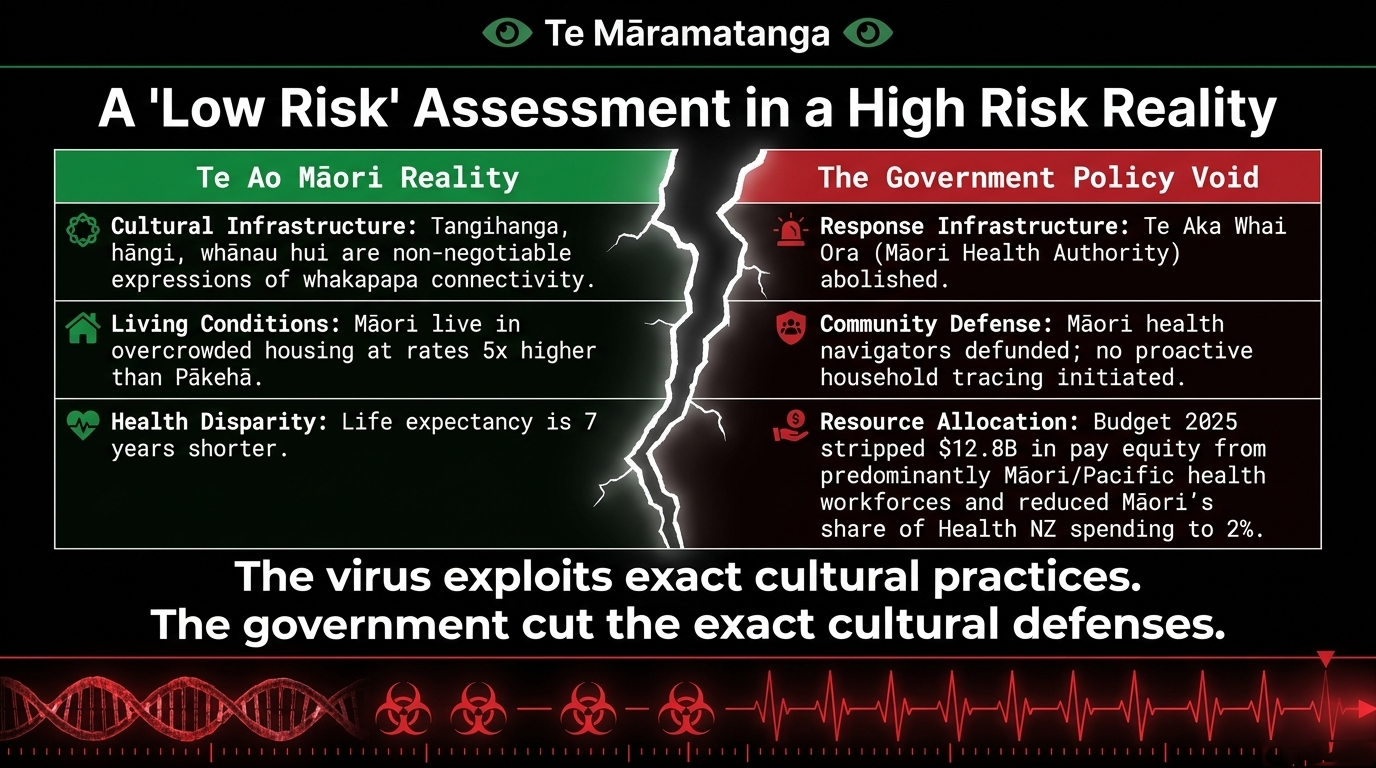
"Low risk"
is always stated from the position of the comfortable — those who can afford a GP visit, who have sick leave, who live in uncrowded houses, who have health literacy and digital access.
Māori experience a life expectancy seven years shorter than non-Māori New Zealanders. Māori live in housing overcrowded at rates five times higher than Pākehā — the precise transmission vector for Andes virus: shared sleeping spaces, shared food preparation, prolonged close contact.
Budget 2025 stripped $12.8 billion in pay equity settlements from predominantly Māori and Pacific health workforces — the community health navigators, the kaupapa Māori health workers, the front-line relationships that make communities resilient — as documented in The Great Heist: How Budget 2025 Robs Wāhine. These were the people who would have received the WHO alert and run the community response. They were made redundant. With public money.
Epuyen spread at a birthday party. In te ao Māori, the tangihanga, the hāngi, the whānau hui are not risk factors to be managed. They are the expressions of Māoritanga that make life worth living — and for a virus that spreads through closeness, they are the settings where a single undetected ghost passenger becomes a cluster before a single contact tracer is assigned. The Health Reform Collective's Budget 2025 analysis confirmed that this government gutted the front-line capacity that would protect those communities first.
If the ghost passenger is Māori — their whānau face this risk inside a system designed, by deliberate policy, to fail them first and fastest.
Me Aha Tātou Ināianei? | What Must Happen — Now
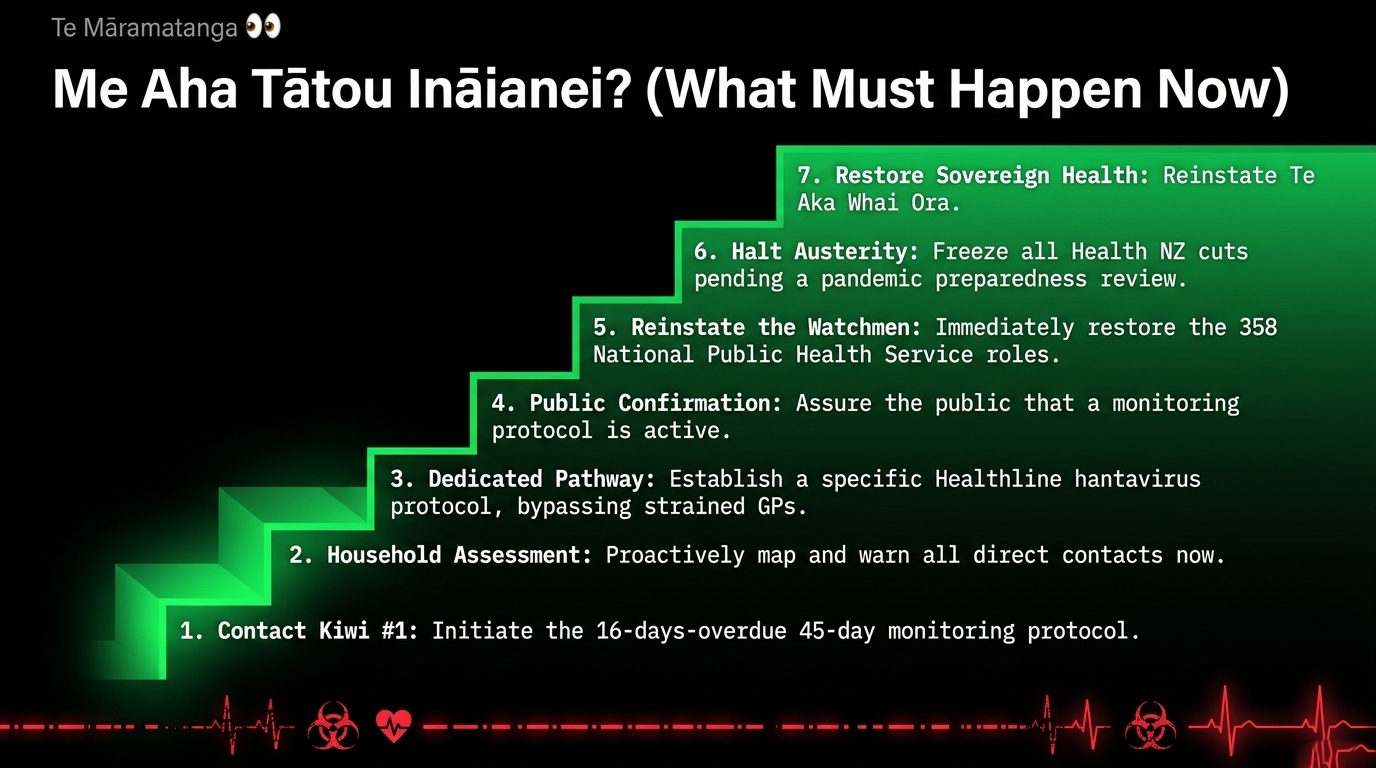
Not a wish list. The minimum standard of governance under the Health Act 1956 and the International Health Regulations 2005, as recorded in Health NZ's own border health framework:
- Immediately contact Kiwi #1 — the passenger home since 24 April — with full information on the 45-day monitoring window, symptom recognition, and isolation protocols per WHO guidance. This call is sixteen days overdue.
- Conduct a household contact assessment — everyone in the same dwelling must be informed and provided monitoring guidance now, not when symptoms appear.
- Establish a dedicated Healthline pathway for hantavirus cruise exposure concerns — not "call your GP" in a country with 485 GPs urgently needed and 587 nursing vacancies per shift.
- Publicly confirm — without breaching individual privacy — that Kiwi #1 has been contacted and a monitoring protocol is active. The public has a right to that assurance.
- Immediately reinstate the 358 National Public Health Service roles cut in November 2024, as documented by the NZ Herald.
- Halt all further cuts to Health NZ and commission an urgent independent pandemic preparedness review.
- Restore Te Aka Whai Ora — or an equivalent Māori health authority with genuine tino rangatiratanga — because without it, Māori communities are last to be warned and first to be harmed, as Tureiti Moxon argued on E-Tāngata.
Kōrero Whakakapi | The Verdict
The Americans found hazmat suits. The British found medically equipped aircraft. The Spanish regional president supervised the evacuation personally. The WHO Director-General stood on the dock at Tenerife.
New Zealand's Health Ministry issued a statement containing the word possible.
Sixteen days ago, a New Zealand citizen walked through this country's border carrying potential exposure to a virus that kills between three and five in every ten people it infects. Nobody told them. Nobody checked on them. Nobody mapped their household contacts. Nobody followed WHO guidance — guidance that New Zealand is legally obligated to implement under international law.
Nearly 3,000 health workers cut. $57.9 million spent destroying the capacity now urgently needed. The entire Māori health team within the National Public Health Service: gone. The Data and Digital surveillance infrastructure: 47% eliminated. Budget 2025: not one dollar for Māori health equity. And when the twelve-nation outbreak alert landed on 2 May 2026 — the response was silence, followed by privacy law, followed by
"possible quarantine may be considered"
— sixteen days too late.
New Zealanders did not give their consent to this. They endured COVID in good faith. They were repaid with the systematic destruction of the infrastructure that would prevent the next lockdown from ever being necessary.
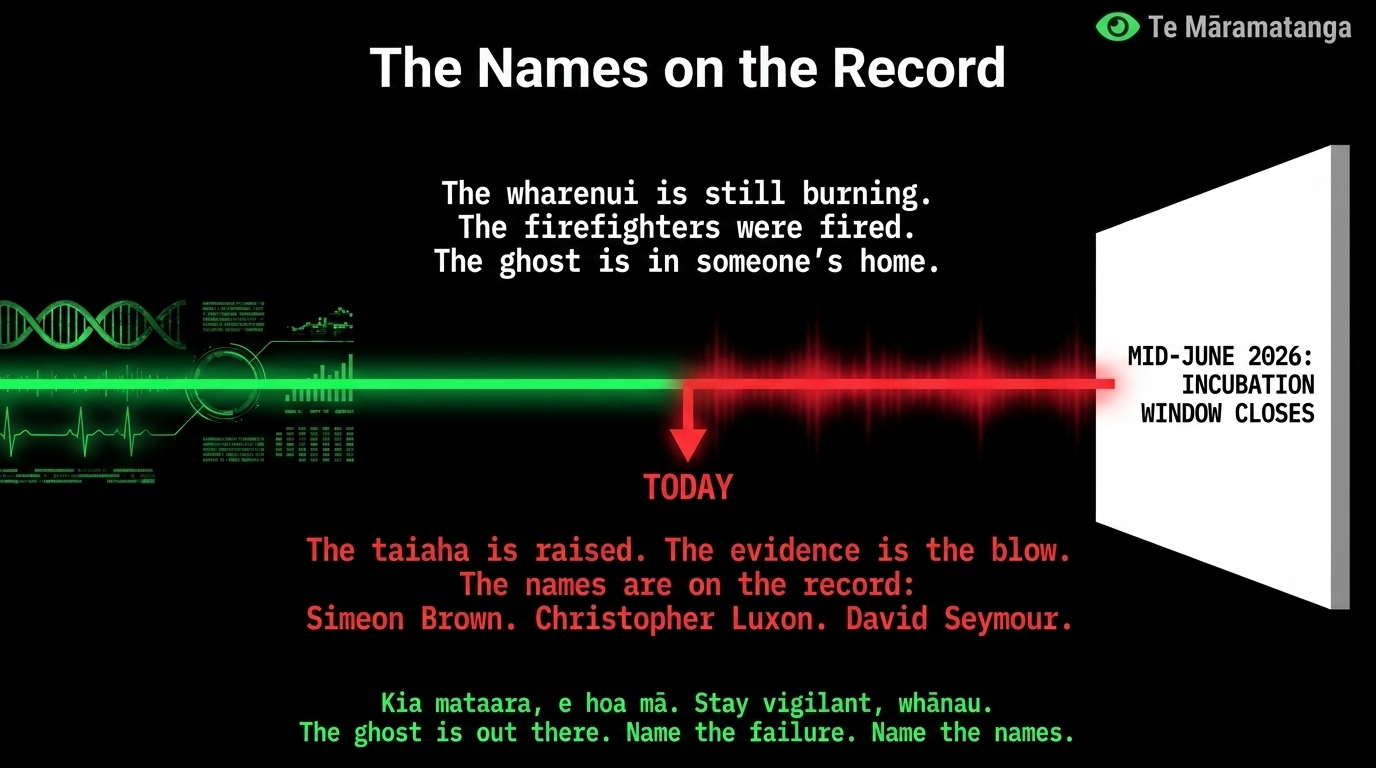
The wharenui is still burning. The firefighters were fired. The ghost is in someone's home. And the people who soaked the building in petrol are issuing conditional statements and hoping nobody counts the days.
The taiaha is raised. The evidence is the blow. The names are on the record: Simeon Brown. Christopher Luxon. David Seymour.
The incubation window closes mid-June 2026.
Kia mataara, e hoa mā. Stay vigilant, whānau.
Tautoko Tēnei Mahi | Support This Work
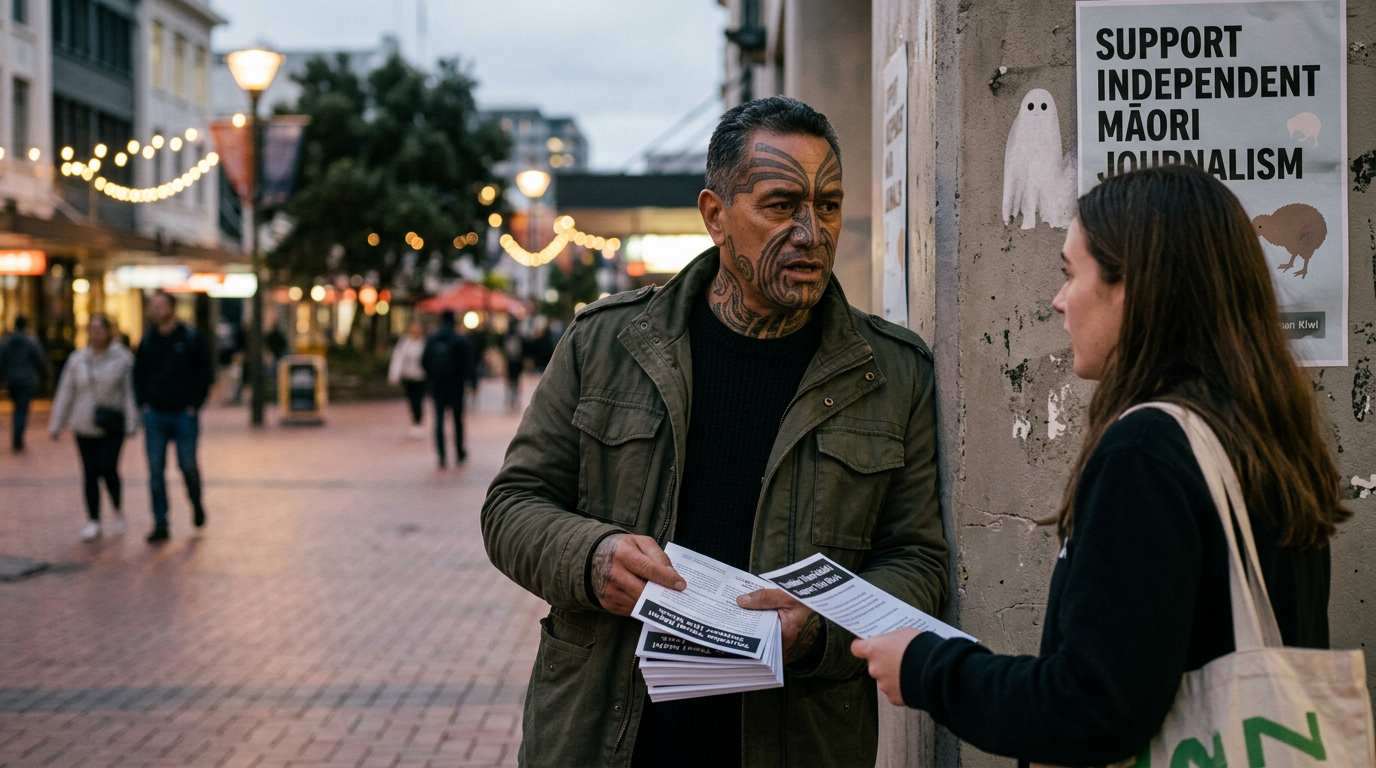
A ghost walks free. Three thousand health workers were fired. A virus with up to a 50% kill rate entered Aotearoa unmonitored while this government issued conditional statements and Privacy Act deflections. This essay spent hours in verified research to put those facts in front of you — because Simeon Brown won't, and whānau deserve truth that power cannot buy and ideology cannot bury.
Every koha signals that rangatiratanga includes the power to fund our own truth tellers — that we will not wait for the Crown to protect us, because the Crown fired the people who would have. If you cannot koha — no worries. Subscribe. Follow. Kōrero. Share this with your hāpori, your network, your MP. Name the ghost. Name the failure. Name the names. That is koha. That is how this voice stays impossible to silence.
- 💰 Koha direct: Support The Māori Green Lantern on Koha
- 📩 Subscribe for essays direct to your inbox: themaorigreenlantern.maori.nz
- 🏦 Bank transfer: HTDM, 03-1546-0415173-000
- 📘 Facebook: Follow and subscribe
Kia kaha, whānau. The ghost is out there. Let's make sure the system finds them — and that those who dismantled that system are never allowed to do it again.
Views expressed constitute honest opinion on matters of public interest under the Defamation Act 1992 (NZ) and Durie v Gardiner NZCA 278. All factual claims are sourced and cited. Named individuals are referenced solely in their public capacity. Corrections and responses may be directed to themaorigreenlantern.maori.nz.